EP0121241B1 - Process for the production of high molecular weight organoaluminum polymers - Google Patents
Process for the production of high molecular weight organoaluminum polymers Download PDFInfo
- Publication number
- EP0121241B1 EP0121241B1 EP19840103455 EP84103455A EP0121241B1 EP 0121241 B1 EP0121241 B1 EP 0121241B1 EP 19840103455 EP19840103455 EP 19840103455 EP 84103455 A EP84103455 A EP 84103455A EP 0121241 B1 EP0121241 B1 EP 0121241B1
- Authority
- EP
- European Patent Office
- Prior art keywords
- acid
- group
- organoaluminum
- added
- organic
- Prior art date
- Legal status (The legal status is an assumption and is not a legal conclusion. Google has not performed a legal analysis and makes no representation as to the accuracy of the status listed.)
- Expired
Links
Classifications
-
- C—CHEMISTRY; METALLURGY
- C07—ORGANIC CHEMISTRY
- C07F—ACYCLIC, CARBOCYCLIC OR HETEROCYCLIC COMPOUNDS CONTAINING ELEMENTS OTHER THAN CARBON, HYDROGEN, HALOGEN, OXYGEN, NITROGEN, SULFUR, SELENIUM OR TELLURIUM
- C07F5/00—Compounds containing elements of Groups 3 or 13 of the Periodic Table
- C07F5/06—Aluminium compounds
- C07F5/069—Aluminium compounds without C-aluminium linkages
-
- C—CHEMISTRY; METALLURGY
- C08—ORGANIC MACROMOLECULAR COMPOUNDS; THEIR PREPARATION OR CHEMICAL WORKING-UP; COMPOSITIONS BASED THEREON
- C08G—MACROMOLECULAR COMPOUNDS OBTAINED OTHERWISE THAN BY REACTIONS ONLY INVOLVING UNSATURATED CARBON-TO-CARBON BONDS
- C08G79/00—Macromolecular compounds obtained by reactions forming a linkage containing atoms other than silicon, sulfur, nitrogen, oxygen, and carbon with or without the latter elements in the main chain of the macromolecule
- C08G79/10—Macromolecular compounds obtained by reactions forming a linkage containing atoms other than silicon, sulfur, nitrogen, oxygen, and carbon with or without the latter elements in the main chain of the macromolecule a linkage containing aluminium
Definitions
- the present invention relates to a process for producing a high molecular weight organoaluminum polymer by reacting at least one organoaluminum compound with water in the presence of organic acids at temperatures of not more than 200°C, to obtain high-grade polymers which can be used as valuable starting materials for the production of alumina fibers having a high strength and a super heat resistance.
- alumina fibers which are suitable for use in fabrication of composite materials in combination with metals, ceramics and so forth.
- a method of calcining fiber precursors made of organoaluminum polymers has received increasing attention for the production of superior alumina fibers.
- a method has not been developed yet which enables to produce with ease and further with high efficiency high molecular weight organoaluminum polymers which are suitable for use in production of such fiber precursors. That is, although it is known that organoaluminum polymers can be prepared by reacting organoaluminum compounds with water, high molecular weight organoaluminum polymers suitable for use in preparing, e.g., fibers are difficult to produce by conventional procedures.
- DE-C-966 973 discloses the reaction of aluminum alkoxides with an excess of organic acids thereby producing organoaluminum compounds having alkoxy and acyloxy groups. These compounds are further reacted in the presence of an excess of the organic acids with water.
- an aluminum alcoholate as organoaluminum compound is first reacted with an organic acid such as capric acid, then the resulting substance is treated with water.
- a polymer having a high-molecular weight cannot be obtained according to this known process. In fact, the reduced viscosity of the polymer obtained according to the process disclosed in the above document is smaller than that obtained according to the present invention.
- Both, the US-A-2 9794797 and the GB-A-825 878 teach the preparation of polymeric organoaluminum compounds by the reaction of aluminum alkoxides with water in the presence of organic acids.
- an aluminum alkoxide is used as starting material having no acyloxy group.
- the polymer obtained in this known process is a cyclic aluminum oxide polymer which cannot be used for the preparation of alumina fibers.
- an aluminum alkoxide is used as starting material and the products obtained therein are useful in producing improved technical progress such as lubricating greases, thickened or modified mineral oils, but not for the production of alumina fibers.
- An object of the present invention is to provide a process for efficiently producing high molecular weight organoaluminum polymers suitable for use in preparing, e.g., fibers.
- the present invention relates to a process for producing a high molecular weight organoaluminum polymer by reacting at least one organoaluminum compound with water in the presence of organic acids at temperatures of not more than 200°C, which is characterized in that an organoaluminum compound represented by the general formula (wherein X and Y may be the same or different and are each a hydrogen atom, an alkyl group, an alkoxy group, or an acyloxy group, and R 1 is an organic radical) is reacted with water and
- the total amount of the organic acid and the acyloxy group contained in the organoaluminum compound is from 1.2 to 11 moles per mole of the organoaluminum compound.
- high- polymerizates can be achieved and the resulting products are high-grade polymers. If organoaluminum compounds and water are reacted without adding the organic acid after the reaction of organoaluminum compound and water, no such qualities can be achieved. However, if the organic acid is added according to the invention after the reaction of the organoaluminum compound and water or at a stage where the reaction proceeds to some extent, the polymerization degree becomes far higher and it is possible to obtain an organoaluminum polymer of higher molecular weight. This can be seen from Examples 6 and 13, below, where the reduced viscosity of the polymer obtained is 5.05. Further, reference is made to the polymer of Example 10 below having a reduced viscosity of 0.76.
- Example 10 has also been carried out according to the invention.
- Example 11 is comparable with Example 10 in view of the used starting materials and the way of proceeding.
- organic acid is added to the polymer solution produced in Example 10. It can be seen that high polymerization is achieved obtaining a polymer with a reduced viscosity of 0.98. This clearly shows the advantage of the present invention, which has not been obvious from the prior art.
- organoaluminum compounds as used herein, as described above, have the following general formula (wherein X and Y may be the same or different and are each a hydrogen atom, an alkyl group, an alkoxy group, or an acyloxy group, and R 1 is an organic radical).
- the alkyl group represented by X and Y includes a methyl group, an ethyl group, a n-propyl group, an isopropyl group, a n-butyl group and its isomers (e.g., an isobutyl group, a sec- butyl group, and a tert-butyl group) a n-pentyl group and its isomers, and a n-hexyl group and its isomers.
- a methyl group an ethyl group, a n-propyl group, an isopropyl group, a n-butyl group and its isomers (e.g., an isobutyl group, a sec- butyl group, and a tert-butyl group) a n-pentyl group and its isomers, and a n-hexyl group and its isomers.
- the alkoxy group includes a methoxy group, an ethoxy group, a n-propoxy group, an iso-propoxy group, a n-butoxy group and its isomers, a n-pentoxy group and its isomers, and a n-hexanoxy group and its isomers.
- X and Y represent acyloxy groups.
- the organoaluminum compounds of the present invention are represented by the general formula (II):
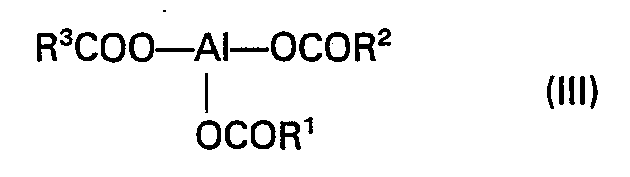
- the organoaluminum compounds are represented by the general formula (III):
- R 2 and R 3 each represent the same organic radical as for R 1 R 1 , R 2 and R 3 may be the same or different.
- the organic radical includes a saturated or unsaturated aliphatic substituent, an alicyclic substituent, and an aromatic substituent.
- the saturated aliphatic substituent includes a methyl group, an ethyl group, a n-propyl group, an isopropyl group, a n-butyl group and its isomers, a n-pentyl group and its isomers, and a n-nonyl group and its isomers.
- the alicyclic substituent includes a cyclohexyl group.
- the unsaturated aliphatic substituent includes an alkenyl group (e.g., a vinyl group, an allyl group, and a crotyl group), a two- or threefold unsaturated hydrocarbon group (e.g., a butadienyl group and an octatrienyl group), and an alkinyl group (e.g., an ethinyl group and a propinyl group).
- an alkenyl group e.g., a vinyl group, an allyl group, and a crotyl group
- a two- or threefold unsaturated hydrocarbon group e.g., a butadienyl group and an octatrienyl group
- an alkinyl group e.g., an ethinyl group and a propinyl group
- the aromatic substituent includes various aryl groups such as a phenyl group, a tolyl group, an anisyl group, and a naphthyl group.
- the saturated aliphatic substituent, unsaturated aliphatic substituent, alicyclic substituent, and aromatic substituent may contain at least one radical, such as a chlorine atom, an amino group, a hydroxyl group, a carboxyl group, an alkoxy group, and an aryl group.
- organic acids are added in the reaction of the organoaluminum compounds represented by the formula (I) and water.
- Most of the known organic acids can be used in the present invention. Suitable examples are saturated or unsaturated aliphatic monocarboxylic acids (excluding formic acid), alicyclic carboxylic acids, aromatic monocarboxylic acids, dicarboxylic acids, hydroxycarboxylic acids, and their derivatives containing a substituent or substituents in the main chain thereof.
- saturated aliphatic monocarboxylic acids are acetic acid, propionic acid, butyric acid, isobutyric acid, pivalic acid, octanoic acid, lauric acid, and stearic acid.
- Typical examples of the unsaturated aliphatic monocarboxylic acids are acrylic acid, methacrylic acid, crotonic acid, and oleic acid.
- a typical example of the alicyclic carboxylic acids is cyclohexanecarboxylic acid.
- aromatic monocarboxylic acids are succinic acid, glutaric acid, phthalic acid, and cyclohexanedicarboxylic acids.
- hydroxycarboxylic acids are glycolic acid, lactic acid, and mandelic acid.
- Typical examples of the substituents of the above-described carboxylic acid derivatives are a chlorine atom, an amino group, a hydroxyl group, a carboxyl group, an alkoxy group, a phenyl group, and an aryl group.
- the type of the organic acid to be added in the reaction of the organoaluminum compound and water is preferably determined as follows:
- organoaluminum compound i.e., R 1 , R 1 and R 2 or R 1 , R 2 and R 3
- those radicals producing the corresponding acids R'COOH, R Z COOH, or R 3 COOH
- organic acids identical to those corresponding to the organic radicals of the organoaluminum compound used herein or organic acids higher in acidity than those be used.
- the organic radicals of the organoaluminum compound to be used in the reaction are a propionyl group and an undecyl group
- the corresponding organic acids are propionic acid and lauric acid
- propionic acid of higher acidity or organic acids having an acidity higher than that of propionic acid be used as the organic acids.
- these organic acids include hexanoic acid, butyric acid, valeric acid, acetic acid, methacrylic acid, and acrylic acid.
- typical organic acids of the saturated or unsaturated aliphatic monocarboxylic acids are listed above, the present invention is not limited thereto.
- organic acids may be used singly or in combination with each other.
- the organoaluminum compound, water, and organic acid may be used as such or without use of any solvents. In general, however, it is preferred for them to be diluted with suitable organic solvents for convenience of handling and also for effective condensation polymerization. In particular, when solid acids are used as the organic acids, they are preferably used after dilution with organic solvents.
- Any organic solvents can be used as long as they are capable of dissolving the organoaluminum compounds, water, and organic acids and, furthermore do not react therewith.
- Typical examples are hydrocarbon solvents such as benzene, toluene, xylene, tetralin, decalin, pentane, hexane, and heptane, ether solvents such as dioxane, diethyl ether, 1,2-dimethoxyethane, tetrahydrofuran, and anisol, tert-amine solvents such as pyridine, picoline, and triethylamine, and polar solvents such as dimethylsulfoxide and dimethylformamide.
- hydrocarbon solvents such as benzene, toluene, xylene, tetralin, decalin, pentane, hexane, and heptane
- ether solvents such as dioxane, diethyl ether
- water may be added at once but it is preferred to gradually add dropwise. It is also convenient for handling that water is used in the form of solutions with suitable organic solvents. In the case of the organic acids, they may be added at once but it is preferred for them to gradually add dropwise as in the case of water.
- organoaluminum compound, water, and organic acid are added is critical in the process of the present invention.
- organic acid it may be added in the course of the condensation polymerization between the organoaluminum compound and water, or after the condensation polymerization, or water may be added after the organic acid is added to the organoaluminum compound.
- organic acid can be added to the polymer formed by the condensation polymerization.
- the organic acid is added in an amount such that the total amount of the organic acid and the acyloxy group contained in the organoaluminum compound is from 1.2 to 11 moles, preferably from 1.4 to 3.5 moles per mole of the organoaluminum compound.
- the organic acid is added within the range as defined above, there can be formed organoaluminum polymers which have an increased molecular weight and thus are suitable for use in production of fibers.
- the amount of the organic acid added is too small, an increase in the molecular weight of the organoaluminum polymer due to the addition of the organic acid cannot almost be expected.
- the organic acid is added excessively, the molecular weight of the organoaluminum polymer is scarcely increased.
- the amount of the organic acid being added is determined based on the total amount of the organic acid and the acyloxy group contained in the organoaluminum compound.
- the organic acid itself is added in an amount of from 0.2 to 10 moles, preferably from 0.5 to 2.5 moles per mole of the organoaluminum compound.
- the amount of the organic acid being added is determined as described above, and the organic acid itself is sufficient to be added in an amount ranging between 0.2 and 9 moles, preferably between 0.5 and 2.5 moles per mole of the organoaluminum compound.
- the amount of the organic acid being added is also determined as described above, and the organic acid itself is sufficient to be added in an amount of from 0.2 to 8 moles, preferably from 0.5 to 2.5 moles per mole of the organoaluminum compound.
- the amount of water to be used in the condensation polymerization of the organoaluminum compound is not critical and can be determined appropriately. Usually it is effective for the production of high molecular weight organoaluminum polymers that water be used in an amount from 1.0 to 3.5 moles per mole of the organoaluminum compound. Especially preferred is the range of from 1.0 to 2.0 moles per mole of the organoaluminum compound. If the amount of water added is too small, there cannot be formed high molecular weight organoaluminum polymers.
- the reaction temperature in the process of the present invention is not critical as long as it is not more than 200°C.
- the reaction temperature is chosen depending on the type of the organoaluminum compound, organic acid, or organic solvent.
- the organoaluminum polymers produced by the process of the present invention have a reduced viscosity of from 0.4 to 5.5 (solvent: a mixed solvent of equal weights of tetrachloroethane and phenol; temperature: 30°C; concentration: 0.5 grams per deciliter); that is, they are high molecular weight polymers suitable for spinning and so forth.
- solvent a mixed solvent of equal weights of tetrachloroethane and phenol; temperature: 30°C; concentration: 0.5 grams per deciliter
- Example 2 The procedure of Example 2 was repeated wherein 6.03 grams (58 millimoles) of 3-methoxypropionic acid was used as the organic acid in place of lauric acid. On allowing the reaction mixture at 0°C for one day and night, a uniform, viscous solution was obtained as in Example 2. The solution was poured into a large amount of hexane to yield 13.5 grams of a white organoaluminum polymer in a powder form.
- the reduced viscosity of the polymer in a mixed solvent of equal weights of phenol and tetrahydrofuran concentration: 0.5 gram per deciliter; temperature: 30°C) was 1.6.
- Example 2 In the same atmosphere and apparatus as used in Example 1, 0.45 gram (25 millimoles) of water and 9.0 grams (125 millimoles) of propionic acid were added simultaneously to 5.8 grams (25 millimoles) of isopropoxy sec-butoxyaluminum propionate and 50 milliliters of a benzene solution and reacted at room temperature.
- the reaction mixture was allowed to stand overnight and then poured into hexane and reprecipitated to yield 3.81 grams of a polymer.
- the reduced viscosity of the polymer in a mixed solvent of equal weights of phenol and tetrahydrofuran was 0.77.
- Example 2 In the same atmosphere and apparatus as used in Example 1, 0.68 gram (38 millimoles) of water and 3.05 grams (25 millimoles) of benzoic acid were added to 20 milliliters of a decalin solution containing a mixture of diisopropoxyaluminum benzoate and isopropoxy secbutoxyaluminum benzoate which had been prepared by reacting 5.45 grams (25 millimoles) of diisopropoxyaluminum sec-butoxide and 3.05 grams (25 millimoles) of benzoic acid, and reacted at 50°C. The reaction mixture was allowed to stand overnight at 50°C. Thereafter, the same procedure as in Example 4 was repeated to yield 5.3 grams of an organoaluminum polymer. The reduced viscosity of the polymer in dimethylformamide (concentration: 0.5 gram per deciliter; temperature: 30°C) was 3.1.
- the reduced viscosity of the polymer in a mixed solvent of equal weights of phenol and tetrachloroethane was 5.05.
- Example 2 In the same atmosphere and apparatus as used in Example 1, 10 milliliters of a tetrahydrofuran solution containing 0.45 gram (25 millimoles) of distilled water was gradually added dropwise at -78°C to a solution of 8.5 grams (25 millimoles) of diisobutylaluminum laurate in 20 milliliters of tetrahydrofuran, said diisobutylaluminum laurate being prepared from triisobutyl aluminum and lauric acid. After the addition was completed, the mixture was raised in temperature to room temperature and stirred at room temperature for additional 1 hour.
- the reduced viscosity of the polymer in a mixed solvent of equal weights of phenol and tetrachloroethane was 0.97.
- Example 2 In the same atmosphere and apparatus as used in Example 1, 0.45 gram (25 millimoles) of water was added to 50 milliliters of a benzene solution containing 5.8 grams (25 millimoles) of isopropoxy sec-butoxyaluminum propionate and reacted at room temperature for 1 hour. Subsequently, 9.0 grams (125 millimoles) of propionic acid was added and stirred at room temperature for 5 hours. Then the resulting mixture was poured into hexane and reprecipitated to yield 3.8 grams of a white polymer in a powder form.
- the reduced viscosity of the polymer in a mixed solvent of equal weights of phenol and tetrachloroethane was 0.83.
- Example 2 In the same atmosphere and apparatus as used in Example 1, a mixed solvent of 58 millimoles of water and 20 milliliters of dioxane was added dropwise at 0°C to 11.7 grams (58 millimoles) of diethylaluminum 3-ethoxypropionate prepared from triethylaluminum and 3-ethoxypropionic acid, and reacted with each other.
- reaction mixture was allowed to stand at room temperature for one day and night, and then poured into a large amount of hexane and reprecipitated to yield 9.2 grams of a product.
- This product was oligomer of poly(acyloxyalox- ane) represented by
- One gram (6.2x10- 3 unit mole) of the oligomer was added into 10 milliliters of tetrahydrofuran, and was reacted with a prescribed amount of 3- ethoxypropionic acid at room temperature for 10 hours to obtain polymer product.
- the polymer products was poured into a large amount of hexane and isolated by reprecipitation. The reduced viscosity of the polymer products were determined. The results obtained are shown in Table 1.
- a mixture of 50 millimoles of ethylaluminum di-3-ethoxypropionate, which had been prepared from a molecular equivalent of triethylaluminum and two molecular equivalents of 3-ethoxypropionic acid, and 50 milliliters of toluene was placed in a three-necked flask equipped with a dropping funnel, a reflux condenser, and a three- way cock, and 10 milliliters of 1,4-dioxane solution containing 0.9 gram (50 millimoles) of distilled water and 1.18 grams (10 millimoles) of 3- ethoxypropionic acid were added dropwise and reacted at room temperature in a nitrogen atmosphere while stirring with a magnetic stirrer.
- the reduced viscosity of the polymer in a mixed solvent of equal weights of phenol and tetrachloroethane was 0.76.
- Example 10 To the viscous solution obtained in Example 10 ' was added 2.95 grams (25 millimoles) of 3- ethoxypropionic acid, and the resulting mixture was allowed to stand overnight at room temperature. The mixture became more viscous than before the addition of the acid. Thereafter, reprecipitation was carried out in the same manner as in Example 10 to yield 13.1 grams of an organoaluminum polymer.
- the reduced viscosity of the polymer in the same solvent and under the same conditions as in Example 10 was 0.98.
- the reduced viscosity of the polymer in the same solvent and under the same conditions as in Example 10 was 1.8.
- the reduced viscosity of the polymer in benzene (concentration: 0.5 gram per deciliter; temperature: 30°C) was 5.05.
Landscapes
- Chemical & Material Sciences (AREA)
- Organic Chemistry (AREA)
- Health & Medical Sciences (AREA)
- Chemical Kinetics & Catalysis (AREA)
- Medicinal Chemistry (AREA)
- Polymers & Plastics (AREA)
- Polymers With Sulfur, Phosphorus Or Metals In The Main Chain (AREA)
Description
- The present invention relates to a process for producing a high molecular weight organoaluminum polymer by reacting at least one organoaluminum compound with water in the presence of organic acids at temperatures of not more than 200°C, to obtain high-grade polymers which can be used as valuable starting materials for the production of alumina fibers having a high strength and a super heat resistance.
- Materials of high strength and super heat resistance have recently been desired in various industrial fields. Among such materials are alumina fibers which are suitable for use in fabrication of composite materials in combination with metals, ceramics and so forth.
- A method of calcining fiber precursors made of organoaluminum polymers has received increasing attention for the production of superior alumina fibers. However, a method has not been developed yet which enables to produce with ease and further with high efficiency high molecular weight organoaluminum polymers which are suitable for use in production of such fiber precursors. That is, although it is known that organoaluminum polymers can be prepared by reacting organoaluminum compounds with water, high molecular weight organoaluminum polymers suitable for use in preparing, e.g., fibers are difficult to produce by conventional procedures.
- DE-C-966 973 discloses the reaction of aluminum alkoxides with an excess of organic acids thereby producing organoaluminum compounds having alkoxy and acyloxy groups. These compounds are further reacted in the presence of an excess of the organic acids with water. However, in this known process an aluminum alcoholate as organoaluminum compound is first reacted with an organic acid such as capric acid, then the resulting substance is treated with water. A polymer having a high-molecular weight cannot be obtained according to this known process. In fact, the reduced viscosity of the polymer obtained according to the process disclosed in the above document is smaller than that obtained according to the present invention. Both, the US-A-2 9794797 and the GB-A-825 878 teach the preparation of polymeric organoaluminum compounds by the reaction of aluminum alkoxides with water in the presence of organic acids. In the former process an aluminum alkoxide is used as starting material having no acyloxy group. Furthermore, the polymer obtained in this known process is a cyclic aluminum oxide polymer which cannot be used for the preparation of alumina fibers. In the latter process, too, an aluminum alkoxide is used as starting material and the products obtained therein are useful in producing improved technical progress such as lubricating greases, thickened or modified mineral oils, but not for the production of alumina fibers.
- An object of the present invention is to provide a process for efficiently producing high molecular weight organoaluminum polymers suitable for use in preparing, e.g., fibers.
- The present invention relates to a process for producing a high molecular weight organoaluminum polymer by reacting at least one organoaluminum compound with water in the presence of organic acids at temperatures of not more than 200°C, which is characterized in that an organoaluminum compound represented by the general formula

- a) an organic acid (excluded formic acid) is added during this reaction, or
- b) an organic acid (excluded formic acid) is added after this reaction to the reaction system or to the polymer formed, or
- c) a part of an organic acid (excluded formic acid) is added during this reaction and the remainder is added after completion of this reaction,
- in an amount such that the total amount of the organic acid and the acyloxy group contained in the organoaluminum compound is from 1.2 to 11 moles per mole of the organoaluminum compound.
- According to the process of the invention high- polymerizates can be achieved and the resulting products are high-grade polymers. If organoaluminum compounds and water are reacted without adding the organic acid after the reaction of organoaluminum compound and water, no such qualities can be achieved. However, if the organic acid is added according to the invention after the reaction of the organoaluminum compound and water or at a stage where the reaction proceeds to some extent, the polymerization degree becomes far higher and it is possible to obtain an organoaluminum polymer of higher molecular weight. This can be seen from Examples 6 and 13, below, where the reduced viscosity of the polymer obtained is 5.05. Further, reference is made to the polymer of Example 10 below having a reduced viscosity of 0.76. Example 10 has also been carried out according to the invention. Example 11 is comparable with Example 10 in view of the used starting materials and the way of proceeding. In accordance with the present invention organic acid is added to the polymer solution produced in Example 10. It can be seen that high polymerization is achieved obtaining a polymer with a reduced viscosity of 0.98. This clearly shows the advantage of the present invention, which has not been obvious from the prior art.
- The organoaluminum compounds as used herein, as described above, have the following general formula

- The alkyl group represented by X and Y includes a methyl group, an ethyl group, a n-propyl group, an isopropyl group, a n-butyl group and its isomers (e.g., an isobutyl group, a sec- butyl group, and a tert-butyl group) a n-pentyl group and its isomers, and a n-hexyl group and its isomers.
- The alkoxy group includes a methoxy group, an ethoxy group, a n-propoxy group, an iso-propoxy group, a n-butoxy group and its isomers, a n-pentoxy group and its isomers, and a n-hexanoxy group and its isomers.
- In addition, X and Y represent acyloxy groups. When Y is an acyloxy group, the organoaluminum compounds of the present invention are represented by the general formula (II):


- In the general formulae (11) and (III), R2 and R3 each represent the same organic radical as for R1 R1, R2 and R3 may be the same or different. The organic radical includes a saturated or unsaturated aliphatic substituent, an alicyclic substituent, and an aromatic substituent.
- Specifically the saturated aliphatic substituent includes a methyl group, an ethyl group, a n-propyl group, an isopropyl group, a n-butyl group and its isomers, a n-pentyl group and its isomers, and a n-nonyl group and its isomers.
- The alicyclic substituent includes a cyclohexyl group.
- The unsaturated aliphatic substituent includes an alkenyl group (e.g., a vinyl group, an allyl group, and a crotyl group), a two- or threefold unsaturated hydrocarbon group (e.g., a butadienyl group and an octatrienyl group), and an alkinyl group (e.g., an ethinyl group and a propinyl group).
- The aromatic substituent includes various aryl groups such as a phenyl group, a tolyl group, an anisyl group, and a naphthyl group.
- The saturated aliphatic substituent, unsaturated aliphatic substituent, alicyclic substituent, and aromatic substituent may contain at least one radical, such as a chlorine atom, an amino group, a hydroxyl group, a carboxyl group, an alkoxy group, and an aryl group.
- In the process of the present invention, a mixture of two or more organoaluminum compounds in which R1, R2 and R3 are different can be used.
- In accordance with the process of the present invention, organic acids are added in the reaction of the organoaluminum compounds represented by the formula (I) and water. Most of the known organic acids can be used in the present invention. Suitable examples are saturated or unsaturated aliphatic monocarboxylic acids (excluding formic acid), alicyclic carboxylic acids, aromatic monocarboxylic acids, dicarboxylic acids, hydroxycarboxylic acids, and their derivatives containing a substituent or substituents in the main chain thereof.
- Typical examples of the saturated aliphatic monocarboxylic acids are acetic acid, propionic acid, butyric acid, isobutyric acid, pivalic acid, octanoic acid, lauric acid, and stearic acid.
- Typical examples of the unsaturated aliphatic monocarboxylic acids are acrylic acid, methacrylic acid, crotonic acid, and oleic acid.
- A typical example of the alicyclic carboxylic acids is cyclohexanecarboxylic acid.
- Typical examples of the aromatic monocarboxylic acids are succinic acid, glutaric acid, phthalic acid, and cyclohexanedicarboxylic acids.
- Typical examples of the hydroxycarboxylic acids are glycolic acid, lactic acid, and mandelic acid.
- Typical examples of the substituents of the above-described carboxylic acid derivatives are a chlorine atom, an amino group, a hydroxyl group, a carboxyl group, an alkoxy group, a phenyl group, and an aryl group.
- The type of the organic acid to be added in the reaction of the organoaluminum compound and water is preferably determined as follows:
- It is considered that amongst the organic radicals contained in the organoaluminum compound (i.e., R1, R1 and R2 or R1, R2 and R3) those radicals producing the corresponding acids (R'COOH, RZCOOH, or R3COOH) having the highest acidity remain in the final high molecular weight organoaluminum polymers. It is therefore preferred that organic acids identical to those corresponding to the organic radicals of the organoaluminum compound used herein or organic acids higher in acidity than those be used.
- For example, when the organic radicals of the organoaluminum compound to be used in the reaction are a propionyl group and an undecyl group, since the corresponding organic acids are propionic acid and lauric acid, it is preferred that propionic acid of higher acidity or organic acids having an acidity higher than that of propionic acid be used as the organic acids. Typical examples of these organic acids include hexanoic acid, butyric acid, valeric acid, acetic acid, methacrylic acid, and acrylic acid. Although typical organic acids of the saturated or unsaturated aliphatic monocarboxylic acids are listed above, the present invention is not limited thereto.
- In the present invention, the above-described organic acids may be used singly or in combination with each other.
- In the practice of the present invention, the organoaluminum compound, water, and organic acid may be used as such or without use of any solvents. In general, however, it is preferred for them to be diluted with suitable organic solvents for convenience of handling and also for effective condensation polymerization. In particular, when solid acids are used as the organic acids, they are preferably used after dilution with organic solvents.
- Any organic solvents can be used as long as they are capable of dissolving the organoaluminum compounds, water, and organic acids and, furthermore do not react therewith. Typical examples are hydrocarbon solvents such as benzene, toluene, xylene, tetralin, decalin, pentane, hexane, and heptane, ether solvents such as dioxane, diethyl ether, 1,2-dimethoxyethane, tetrahydrofuran, and anisol, tert-amine solvents such as pyridine, picoline, and triethylamine, and polar solvents such as dimethylsulfoxide and dimethylformamide.
- In the condensation polymerization reaction of the organoaluminum compound and water, water may be added at once but it is preferred to gradually add dropwise. It is also convenient for handling that water is used in the form of solutions with suitable organic solvents. In the case of the organic acids, they may be added at once but it is preferred for them to gradually add dropwise as in the case of water.
- The order in which the organoaluminum compound, water, and organic acid are added is critical in the process of the present invention.
- With regard to the order of addition of the organic acid, it may be added in the course of the condensation polymerization between the organoaluminum compound and water, or after the condensation polymerization, or water may be added after the organic acid is added to the organoaluminum compound.
- Furthermore, the organic acid can be added to the polymer formed by the condensation polymerization.
- With regard to the amount of the organic acid to be added in the process of the present invention, the organic acid is added in an amount such that the total amount of the organic acid and the acyloxy group contained in the organoaluminum compound is from 1.2 to 11 moles, preferably from 1.4 to 3.5 moles per mole of the organoaluminum compound. if the organic acid is added within the range as defined above, there can be formed organoaluminum polymers which have an increased molecular weight and thus are suitable for use in production of fibers. If the amount of the organic acid added is too small, an increase in the molecular weight of the organoaluminum polymer due to the addition of the organic acid cannot almost be expected. On the other hand, even if the organic acid is added excessively, the molecular weight of the organoaluminum polymer is scarcely increased.
- The amount of the organic acid being added is determined based on the total amount of the organic acid and the acyloxy group contained in the organoaluminum compound. Thus, when an organoaluminum compound having one acyloxy group is used, the organic acid itself is added in an amount of from 0.2 to 10 moles, preferably from 0.5 to 2.5 moles per mole of the organoaluminum compound. In a case where the organoaluminum compound contains two acyloxy groups as in the above-described general formula (II), the amount of the organic acid being added is determined as described above, and the organic acid itself is sufficient to be added in an amount ranging between 0.2 and 9 moles, preferably between 0.5 and 2.5 moles per mole of the organoaluminum compound. In a case where the organoaluminum compound contains three acyloxy groups as in the formula (III), the amount of the organic acid being added is also determined as described above, and the organic acid itself is sufficient to be added in an amount of from 0.2 to 8 moles, preferably from 0.5 to 2.5 moles per mole of the organoaluminum compound.
- The amount of water to be used in the condensation polymerization of the organoaluminum compound is not critical and can be determined appropriately. Usually it is effective for the production of high molecular weight organoaluminum polymers that water be used in an amount from 1.0 to 3.5 moles per mole of the organoaluminum compound. Especially preferred is the range of from 1.0 to 2.0 moles per mole of the organoaluminum compound. If the amount of water added is too small, there cannot be formed high molecular weight organoaluminum polymers. On the other hand, if the amount of water added is too large, the condensation polymerization reaction is accelerated, resulting in the formation of organoaluminum polymers which are excessively polymerized and cross-linked and thus are insoluble in water. However, when at least one of X and Y in the formula (I) represents an alkoxy group, water can be added in an amount of less than 1.0 mole per mole of the organoaluminum compound, since water is formed in the condensation polymerization reaction.
- The reaction temperature in the process of the present invention is not critical as long as it is not more than 200°C. Preferably the reaction temperature is chosen depending on the type of the organoaluminum compound, organic acid, or organic solvent. In commercial practice of the present invention, it is economical for the condensation polymerization reaction to be performed at a temperature ranging between about 0 and 60°C.
- The organoaluminum polymers produced by the process of the present invention have a reduced viscosity of from 0.4 to 5.5 (solvent: a mixed solvent of equal weights of tetrachloroethane and phenol; temperature: 30°C; concentration: 0.5 grams per deciliter); that is, they are high molecular weight polymers suitable for spinning and so forth.
- On the other hand, in accordance with conventional methods even if the amount of water added is from 1.0 to 1.2 moles per mole of trialkyl aluminum such as triethyl aluminum, there can be formed only low molecular weight organoaluminum polymers having a reduced viscosity of 0.2 or less.
- The present invention is described in greater detail with reference to the following Examples.
- A mixture of 15 grams (58 millimoles) of diisobutylaluminum 3-ethoxypropionate prepared from triisobutylaluminum and ethoxypropionic acid, and 30 milliliters of tetrahydrofuran was placed in a three-necked flask equipped with a dropping funnel, a reflux condenser, and a three- way cock, and 10 milliliters of a tetrahydrofuran solution containing 1.04 grams (58 millimoles) of distilled water and 3.44 grams (29 millimoles) of ethoxypropionic acid were gradually added dropwise thereto and reacted at room temperature in a nitrogen atmosphere while stirring with a magnetic stirrer. On allowing the reaction mixture to stand overnight at room temperature, there was formed a uniform, clear and viscous solution. This solution showed a good spinnability at room temperature, said spinnability being a measure of fibre-forming properties.
- The solution was then poured into 500 milliliters of hexane and reprecipitated to yield 11.6 grams of a white organoaluminum polymer in a powder form. The reduced viscosity of the polymer as determined in a mixed solvent of equal weights of phenol and tetrahydrofuran (concentration: 0.5 gram per deciliter; temperature: 30°C) was 1.01.
- In the same atmosphere and apparatus as used in Example 1, 1.26 grams (70 millimoles) of water and 2.4 grams (12 millimoles) of lauric acid were added to a mixture of 16.5 grams (58 millimoles) of diethylaluminum laurate, which had been prepared by reacting triethylaluminum and lauric acid, and 30 milliliters of tetrahydrofuran, and reacted at 60°C. In several hours, the reaction mixture became a uniform, viscous solution. The tetrahydrofuran was distilled off under reduced pressure, and the residue was washed with hexane and dried, yielding 14 grams of a white organoaluminum polymer in a resin form. The reduced viscosity of the polymer in tetrahydrofuran (concentration: 0.5 gram per deciliter; temperature: 30°C) was 2.41.
- The procedure of Example 2 was repeated wherein 6.03 grams (58 millimoles) of 3-methoxypropionic acid was used as the organic acid in place of lauric acid. On allowing the reaction mixture at 0°C for one day and night, a uniform, viscous solution was obtained as in Example 2. The solution was poured into a large amount of hexane to yield 13.5 grams of a white organoaluminum polymer in a powder form.
- The reduced viscosity of the polymer in a mixed solvent of equal weights of phenol and tetrahydrofuran concentration: 0.5 gram per deciliter; temperature: 30°C) was 1.6.
- In the same atmosphere and apparatus as used in Example 1, 0.45 gram (25 millimoles) of water and 9.0 grams (125 millimoles) of propionic acid were added simultaneously to 5.8 grams (25 millimoles) of isopropoxy sec-butoxyaluminum propionate and 50 milliliters of a benzene solution and reacted at room temperature.
- The reaction mixture was allowed to stand overnight and then poured into hexane and reprecipitated to yield 3.81 grams of a polymer. The reduced viscosity of the polymer in a mixed solvent of equal weights of phenol and tetrahydrofuran (concentration: 0.5 gram per deciliter; temperature: 30°C) was 0.77.
- In the same atmosphere and apparatus as used in Example 1, 0.68 gram (38 millimoles) of water and 3.05 grams (25 millimoles) of benzoic acid were added to 20 milliliters of a decalin solution containing a mixture of diisopropoxyaluminum benzoate and isopropoxy secbutoxyaluminum benzoate which had been prepared by reacting 5.45 grams (25 millimoles) of diisopropoxyaluminum sec-butoxide and 3.05 grams (25 millimoles) of benzoic acid, and reacted at 50°C. The reaction mixture was allowed to stand overnight at 50°C. Thereafter, the same procedure as in Example 4 was repeated to yield 5.3 grams of an organoaluminum polymer. The reduced viscosity of the polymer in dimethylformamide (concentration: 0.5 gram per deciliter; temperature: 30°C) was 3.1.
- In the same atmosphere and apparatus as used in Example 1, 10 milliliters of a tetrahydrofuran solution containing 1.04 grams (58 millimoles) of distilled water was gradually added dropwise at room temperature to 30 milliliters of a tetrahydrofuran solution containing 9.16 grams (58 millimoles) of diethylaluminum propionate prepared from triethyl aluminum and propionic acid. After the addition was completed, the mixture was stirred for several hours at the same temperature as above. Subsequently, 4.3 grams (58 millimoles) of propionic acid was added to the reaction mixture and was allowed to stand overnight at room temperature. The mixture became a viscous solution, and it was then reprecipitated in a large amount of hexane to yield 8.9 grams of a white organoaluminum polymer in a powder form.
- The reduced viscosity of the polymer in a mixed solvent of equal weights of phenol and tetrachloroethane (concentration: 0.4 gram per deciliter; temperature: 30°C) was 5.05.
- In the same atmosphere and apparatus as used in Example 1, 10 milliliters of a tetrahydrofuran solution containing 0.45 gram (25 millimoles) of distilled water was gradually added dropwise at -78°C to a solution of 8.5 grams (25 millimoles) of diisobutylaluminum laurate in 20 milliliters of tetrahydrofuran, said diisobutylaluminum laurate being prepared from triisobutyl aluminum and lauric acid. After the addition was completed, the mixture was raised in temperature to room temperature and stirred at room temperature for additional 1 hour. Subsequently, 2.6 grams (25 millimoles) of 3-methoxypropionic acid was added, and the resulting mixture was allowed to stand at room temperature for 12 hours. The mixture became a viscous solution. This solution was reprecipitated in a large amount of hexane to yield 4.2 grams of a white organoaluminum polymer in a powder form.
- The reduced viscosity of the polymer in a mixed solvent of equal weights of phenol and tetrachloroethane (concentration: 0.4 gram per deciliter; temperature: 30°C) was 0.97.
- In the same atmosphere and apparatus as used in Example 1, 0.45 gram (25 millimoles) of water was added to 50 milliliters of a benzene solution containing 5.8 grams (25 millimoles) of isopropoxy sec-butoxyaluminum propionate and reacted at room temperature for 1 hour. Subsequently, 9.0 grams (125 millimoles) of propionic acid was added and stirred at room temperature for 5 hours. Then the resulting mixture was poured into hexane and reprecipitated to yield 3.8 grams of a white polymer in a powder form.
- The reduced viscosity of the polymer in a mixed solvent of equal weights of phenol and tetrachloroethane (concentration: 0.5 gram per deciliter; temperature: 30°C) was 0.83.
- In the same atmosphere and apparatus as used in Example 1, a mixed solvent of 58 millimoles of water and 20 milliliters of dioxane was added dropwise at 0°C to 11.7 grams (58 millimoles) of diethylaluminum 3-ethoxypropionate prepared from triethylaluminum and 3-ethoxypropionic acid, and reacted with each other.
- Then, the reaction mixture was allowed to stand at room temperature for one day and night, and then poured into a large amount of hexane and reprecipitated to yield 9.2 grams of a product. This product was oligomer of poly(acyloxyalox- ane) represented by
-

- One gram (6.2x10⁻³ unit mole) of the oligomer was added into 10 milliliters of tetrahydrofuran, and was reacted with a prescribed amount of 3- ethoxypropionic acid at room temperature for 10 hours to obtain polymer product.
- The polymer products was poured into a large amount of hexane and isolated by reprecipitation. The reduced viscosity of the polymer products were determined. The results obtained are shown in Table 1.

- *1 Molar ratio of 3-ethoxypropionic acid (EPA) to aluminum unit in the oligomer.
- *2 Reduced viscosity determined in a mixed solvent of equal weight of phenol and tetrahydrofuran (concentration: 0.4 gram per deciliter; temperature: 30°C).
- A mixture of 50 millimoles of ethylaluminum di-3-ethoxypropionate, which had been prepared from a molecular equivalent of triethylaluminum and two molecular equivalents of 3-ethoxypropionic acid, and 50 milliliters of toluene was placed in a three-necked flask equipped with a dropping funnel, a reflux condenser, and a three- way cock, and 10 milliliters of 1,4-dioxane solution containing 0.9 gram (50 millimoles) of distilled water and 1.18 grams (10 millimoles) of 3- ethoxypropionic acid were added dropwise and reacted at room temperature in a nitrogen atmosphere while stirring with a magnetic stirrer. In several hours, there was formed a uniform, clear and viscous solution. This solution showed a good spinnability, which was a measure of fiber- forming properties. The solution was poured into 500 milliliters of hexane and reprecipitated to yield 12.7 grams of a white organoaluminum polymer in a powder form.
- The reduced viscosity of the polymer in a mixed solvent of equal weights of phenol and tetrachloroethane (concentration: 0.5 gram per deciliter; temperature: 30°C) was 0.76.
- To the viscous solution obtained in Example 10 ' was added 2.95 grams (25 millimoles) of 3- ethoxypropionic acid, and the resulting mixture was allowed to stand overnight at room temperature. The mixture became more viscous than before the addition of the acid. Thereafter, reprecipitation was carried out in the same manner as in Example 10 to yield 13.1 grams of an organoaluminum polymer.
- The reduced viscosity of the polymer in the same solvent and under the same conditions as in Example 10 was 0.98.
- A mixture of 11.5 grams (50 milliliters) of isobutylaluminum dipropionate, which had been prepared by reacting a molecular equivalent of triisobutyl aluminum and two molecular equivalents of propionic acid, and 50 milliliters of tetrahydrofuran was placed in the same apparatus as used in Example 10, and 0.9 gram (50 millimoles) of water and 20 milliliters of a tetrahydrofuran solution containing 3.7 grams (50 millimoles) of propionic acid were added dropwise and reacted at 50°C while stirring. On maintaining the reaction mixture at 50°C for several hours, it became a viscous solution. The solution was poured into a large amount of hexane and reprecipitated to yield 11.4 grams of a white organoaluminum polymer in a powder form.
- The reduced viscosity of the polymer in the same solvent and under the same conditions as in Example 10 was 1.8.
- A mixture of 24.2 grams (50 millimoles) of isopropoxyaluminum dilaurate, which had been prepared by reacting a molecular equivalent of aluminum isopropoxide and two molecular equivalents of lauric acid, and 100 milliliters of benzene was placed in the same apparatus as used in Example 10, and 1.1 grams (60 millimoles) of water was added dropwise and reacted at 80°C in a nitrogen atmosphere. Then, 5 grams (25 millimoles) of lauric acid was added, and the resulting mixture was stirred at 80°C for several hours and was further allowed to stand at room temperature for one day and night. The mixture became a uniform, viscous solution. The benzene was distilled off under reduced pressure, and the residue was washed with hexane and dried, yielding 21 grams of a white organoaluminum polymer in a resin form.
- The reduced viscosity of the polymer in benzene (concentration: 0.5 gram per deciliter; temperature: 30°C) was 5.05.
- A mixture of 13.7 grams (50 millimoles) of isobutyl aluminum monopropionate mono-3- ethoxypropionate, which had been prepared by reacting a molecular equivalent of triisobutyl aluminum and a molecular equivalent of 3-ethoxypropionic acid, and 30 milliliters of tetrahydrofuran was placed in the same apparatus as used in Example 10, and 1.8 grams (100 millimoles) of water and 50 milliliters of a tetrahydrofuran solution containing 7.4 grams (100 millimoles) of propionic acid were added dropwise while stirring at room temperature. Then the mixture was stirred at room temperature for 10 hours to yield a viscous solution. This viscous solution was poured into a large amount of hexane and reprecipitated to obtain 10.5 grams of an organoaluminum polymer.
- The reduced viscosity of the polymer in the same solvent and under the same conditions as in Example 10 was 1.3.
Claims (4)


Applications Claiming Priority (6)
| Application Number | Priority Date | Filing Date | Title |
|---|---|---|---|
| JP5626683A JPS59179526A (en) | 1983-03-30 | 1983-03-30 | Preparation of organo-aluminum polymer having high molecular weight |
| JP56266/83 | 1983-03-30 | ||
| JP79837/83 | 1983-05-07 | ||
| JP7983783A JPS59204620A (en) | 1983-05-07 | 1983-05-07 | Production of high-molecular weight organoaluminum polymer |
| JP20681583A JPH0246051B2 (en) | 1983-11-02 | 1983-11-02 | KOBUNSHIRYONOJUKIARUMINIUMUJUGOTAINOSEIZOHO |
| JP206815/83 | 1983-11-02 |
Publications (2)
| Publication Number | Publication Date |
|---|---|
| EP0121241A1 EP0121241A1 (en) | 1984-10-10 |
| EP0121241B1 true EP0121241B1 (en) | 1988-03-09 |
Family
ID=27295861
Family Applications (1)
| Application Number | Title | Priority Date | Filing Date |
|---|---|---|---|
| EP19840103455 Expired EP0121241B1 (en) | 1983-03-30 | 1984-03-29 | Process for the production of high molecular weight organoaluminum polymers |
Country Status (2)
| Country | Link |
|---|---|
| EP (1) | EP0121241B1 (en) |
| DE (1) | DE3469745D1 (en) |
Families Citing this family (2)
| Publication number | Priority date | Publication date | Assignee | Title |
|---|---|---|---|---|
| JPS6356455A (en) * | 1986-08-27 | 1988-03-11 | Tokyo Electric Co Ltd | printing device |
| JP2521081B2 (en) * | 1987-03-05 | 1996-07-31 | 住友化学工業株式会社 | Alumina fiber manufacturing method |
Family Cites Families (5)
| Publication number | Priority date | Publication date | Assignee | Title |
|---|---|---|---|---|
| DE966973C (en) * | 1943-07-10 | 1957-09-19 | Rheinpreussen Ag | Process for the production of high molecular weight, spinnable plastics |
| DE1040529B (en) * | 1954-09-10 | 1958-10-09 | Dr Jacobus Rinse | Process for the preparation of polymeric oxoaluminum monoacylates |
| US2979497A (en) * | 1957-02-12 | 1961-04-11 | J W Ayers & Co | Cyclic aluminum oxide acylates, alkoxides, and phenoxides |
| GB825878A (en) * | 1957-07-25 | 1959-12-23 | Hardman & Holden Ltd | Improvements relating to polymeric reaction products of aluminium alkoxides |
| US2910494A (en) * | 1958-01-24 | 1959-10-27 | J W Ayers & Co | Polyaluminum oxide carboxylates |
-
1984
- 1984-03-29 DE DE8484103455T patent/DE3469745D1/en not_active Expired
- 1984-03-29 EP EP19840103455 patent/EP0121241B1/en not_active Expired
Also Published As
| Publication number | Publication date |
|---|---|
| DE3469745D1 (en) | 1988-04-14 |
| EP0121241A1 (en) | 1984-10-10 |
Similar Documents
| Publication | Publication Date | Title |
|---|---|---|
| US2744074A (en) | Polymeric organic aluminum oxides and method for preparing same | |
| JPS6123203B2 (en) | ||
| RU2668553C2 (en) | Method of producing aluminoxanes | |
| US4514555A (en) | Process for the production of high molecular weight organoaluminum _polymers | |
| CN115975084B (en) | Catalyst component for olefin polymerization, catalyst and application | |
| US3021313A (en) | Polymerization of cyclic esters | |
| AU724206B2 (en) | New compounds having an element of group 13 linked to a mono- or di-anionic tridentate ligand, their preparation process and their use as polymerization catalysts | |
| US4533712A (en) | Process for the production of high molecular weight organoaluminum polymers | |
| US2435147A (en) | Organo-silicon polymers and methods of preparing them | |
| US20020055612A1 (en) | Preparing isotactic stereoblock poly (lactic acid) | |
| US3190858A (en) | Polymerization of cyclic esters | |
| CZ460090A3 (en) | Catalytic system for polymerization of olefins | |
| US4324690A (en) | Alpha-olefin polymerization catalyst | |
| KR101942963B1 (en) | Low temperature cure using benzopinacol polymerization initiator | |
| US3392182A (en) | Novel organosilicon compounds and process for their preparation | |
| US2628246A (en) | Method for the preparation of unsaturated silanes | |
| EP0121241A1 (en) | Process for the production of high molecular weight organoaluminum polymers | |
| US5756629A (en) | Method for synthesis of linear inorganic-organic hybrid polymers | |
| CN116041581A (en) | Olefin polymerization catalyst component, preparation method and application thereof | |
| CA1207938A (en) | Process for the production of high molecular weight organoaluminum polymers | |
| JPH0219847B2 (en) | ||
| CN101456924B (en) | Catalyst component for olefin polymerization and catalyst thereof | |
| CN118184981A (en) | An organic metal catalyst and its preparation method and application | |
| US3159496A (en) | Process for the preparation of aqueous solutions of organosilicon compounds | |
| US3243447A (en) | Preparation of spacial tetrameric acyloxy group iv metal oxides |
Legal Events
| Date | Code | Title | Description |
|---|---|---|---|
| PUAI | Public reference made under article 153(3) epc to a published international application that has entered the european phase |
Free format text: ORIGINAL CODE: 0009012 |
|
| AK | Designated contracting states |
Designated state(s): BE CH DE FR GB IT LI NL SE |
|
| 17P | Request for examination filed |
Effective date: 19850403 |
|
| 17Q | First examination report despatched |
Effective date: 19860124 |
|
| GRAA | (expected) grant |
Free format text: ORIGINAL CODE: 0009210 |
|
| AK | Designated contracting states |
Kind code of ref document: B1 Designated state(s): BE CH DE FR GB IT LI NL SE |
|
| PG25 | Lapsed in a contracting state [announced via postgrant information from national office to epo] |
Ref country code: NL Effective date: 19880309 Ref country code: IT Free format text: LAPSE BECAUSE OF FAILURE TO SUBMIT A TRANSLATION OF THE DESCRIPTION OR TO PAY THE FEE WITHIN THE PRESCRIBED TIME-LIMIT;WARNING: LAPSES OF ITALIAN PATENTS WITH EFFECTIVE DATE BEFORE 2007 MAY HAVE OCCURRED AT ANY TIME BEFORE 2007. THE CORRECT EFFECTIVE DATE MAY BE DIFFERENT FROM THE ONE RECORDED. Effective date: 19880309 |
|
| PG25 | Lapsed in a contracting state [announced via postgrant information from national office to epo] |
Ref country code: SE Effective date: 19880331 |
|
| REF | Corresponds to: |
Ref document number: 3469745 Country of ref document: DE Date of ref document: 19880414 |
|
| ET | Fr: translation filed | ||
| NLV1 | Nl: lapsed or annulled due to failure to fulfill the requirements of art. 29p and 29m of the patents act | ||
| PLBE | No opposition filed within time limit |
Free format text: ORIGINAL CODE: 0009261 |
|
| STAA | Information on the status of an ep patent application or granted ep patent |
Free format text: STATUS: NO OPPOSITION FILED WITHIN TIME LIMIT |
|
| 26N | No opposition filed | ||
| PGFP | Annual fee paid to national office [announced via postgrant information from national office to epo] |
Ref country code: BE Payment date: 19900216 Year of fee payment: 7 |
|
| PGFP | Annual fee paid to national office [announced via postgrant information from national office to epo] |
Ref country code: FR Payment date: 19900219 Year of fee payment: 7 |
|
| PGFP | Annual fee paid to national office [announced via postgrant information from national office to epo] |
Ref country code: CH Payment date: 19900222 Year of fee payment: 7 |
|
| PGFP | Annual fee paid to national office [announced via postgrant information from national office to epo] |
Ref country code: GB Payment date: 19900331 Year of fee payment: 7 |
|
| PGFP | Annual fee paid to national office [announced via postgrant information from national office to epo] |
Ref country code: DE Payment date: 19900509 Year of fee payment: 7 |
|
| PG25 | Lapsed in a contracting state [announced via postgrant information from national office to epo] |
Ref country code: GB Effective date: 19910329 |
|
| PG25 | Lapsed in a contracting state [announced via postgrant information from national office to epo] |
Ref country code: LI Effective date: 19910331 Ref country code: CH Effective date: 19910331 Ref country code: BE Effective date: 19910331 |
|
| BERE | Be: lapsed |
Owner name: IDEMITSU KOSAN CY LTD Effective date: 19910331 |
|
| GBPC | Gb: european patent ceased through non-payment of renewal fee | ||
| PG25 | Lapsed in a contracting state [announced via postgrant information from national office to epo] |
Ref country code: FR Effective date: 19911129 |
|
| REG | Reference to a national code |
Ref country code: CH Ref legal event code: PL |
|
| PG25 | Lapsed in a contracting state [announced via postgrant information from national office to epo] |
Ref country code: DE Effective date: 19920101 |
|
| REG | Reference to a national code |
Ref country code: FR Ref legal event code: ST |