EP0120728B1 - Thiazine and thiazepine containing compounds - Google Patents
Thiazine and thiazepine containing compounds Download PDFInfo
- Publication number
- EP0120728B1 EP0120728B1 EP84400293A EP84400293A EP0120728B1 EP 0120728 B1 EP0120728 B1 EP 0120728B1 EP 84400293 A EP84400293 A EP 84400293A EP 84400293 A EP84400293 A EP 84400293A EP 0120728 B1 EP0120728 B1 EP 0120728B1
- Authority
- EP
- European Patent Office
- Prior art keywords
- hydrogen
- alkyl
- compound
- phenyl
- amino
- Prior art date
- Legal status (The legal status is an assumption and is not a legal conclusion. Google has not performed a legal analysis and makes no representation as to the accuracy of the status listed.)
- Expired
Links
- 150000001875 compounds Chemical class 0.000 title claims abstract description 82
- AGIJRRREJXSQJR-UHFFFAOYSA-N 2h-thiazine Chemical compound N1SC=CC=C1 AGIJRRREJXSQJR-UHFFFAOYSA-N 0.000 title abstract description 16
- NYERMPLPURRVGM-UHFFFAOYSA-N thiazepine Chemical compound S1C=CC=CC=N1 NYERMPLPURRVGM-UHFFFAOYSA-N 0.000 title abstract description 11
- 239000002220 antihypertensive agent Substances 0.000 claims abstract description 4
- -1 hydroxyamino, benzylamino, phenethylamino Chemical group 0.000 claims description 122
- 239000000203 mixture Substances 0.000 claims description 93
- 239000001257 hydrogen Substances 0.000 claims description 63
- 229910052739 hydrogen Inorganic materials 0.000 claims description 63
- 125000000217 alkyl group Chemical group 0.000 claims description 46
- 125000004435 hydrogen atom Chemical group [H]* 0.000 claims description 45
- 125000006701 (C1-C7) alkyl group Chemical group 0.000 claims description 28
- 125000004356 hydroxy functional group Chemical group O* 0.000 claims description 25
- SMBQBQBNOXIFSF-UHFFFAOYSA-N dilithium Chemical class [Li][Li] SMBQBQBNOXIFSF-UHFFFAOYSA-N 0.000 claims description 23
- 125000002924 primary amino group Chemical group [H]N([H])* 0.000 claims description 23
- 125000001997 phenyl group Chemical group [H]C1=C([H])C([H])=C(*)C([H])=C1[H] 0.000 claims description 19
- 150000003839 salts Chemical class 0.000 claims description 18
- 125000003545 alkoxy group Chemical group 0.000 claims description 16
- 229910052783 alkali metal Inorganic materials 0.000 claims description 14
- 125000001797 benzyl group Chemical group [H]C1=C([H])C([H])=C(C([H])=C1[H])C([H])([H])* 0.000 claims description 14
- 125000000753 cycloalkyl group Chemical group 0.000 claims description 12
- 125000000113 cyclohexyl group Chemical group [H]C1([H])C([H])([H])C([H])([H])C([H])(*)C([H])([H])C1([H])[H] 0.000 claims description 11
- ZZVUWRFHKOJYTH-UHFFFAOYSA-N diphenhydramine Chemical group C=1C=CC=CC=1C(OCCN(C)C)C1=CC=CC=C1 ZZVUWRFHKOJYTH-UHFFFAOYSA-N 0.000 claims description 9
- 125000005843 halogen group Chemical group 0.000 claims description 9
- 125000005328 phosphinyl group Chemical group [PH2](=O)* 0.000 claims description 9
- 125000001309 chloro group Chemical group Cl* 0.000 claims description 7
- 125000001153 fluoro group Chemical group F* 0.000 claims description 7
- 125000002496 methyl group Chemical group [H]C([H])([H])* 0.000 claims description 7
- 206010020772 Hypertension Diseases 0.000 claims description 5
- 125000001246 bromo group Chemical group Br* 0.000 claims description 5
- 125000001301 ethoxy group Chemical group [H]C([H])([H])C([H])([H])O* 0.000 claims description 5
- 125000000094 2-phenylethyl group Chemical group [H]C1=C([H])C([H])=C(C([H])=C1[H])C([H])([H])C([H])([H])* 0.000 claims description 4
- FFDDCKNECLUARD-UHFFFAOYSA-N 2-[6-[[hydroxy(4-phenylbutyl)phosphoryl]amino]-5-oxo-1,4-thiazepan-4-yl]acetic acid Chemical compound O=C1N(CC(=O)O)CCSCC1NP(O)(=O)CCCCC1=CC=CC=C1 FFDDCKNECLUARD-UHFFFAOYSA-N 0.000 claims description 3
- OBHYVAOZBVJAMJ-WIXQSORDSA-N 2-[[(2r)-3-(carboxymethyl)-4-oxo-2-phenyl-1,3-thiazinan-5-yl]amino]-4-phenylbutanoic acid Chemical compound S([C@@H](N(C1=O)CC(=O)O)C=2C=CC=CC=2)CC1NC(C(O)=O)CCC1=CC=CC=C1 OBHYVAOZBVJAMJ-WIXQSORDSA-N 0.000 claims description 3
- 125000004414 alkyl thio group Chemical group 0.000 claims description 3
- 125000002023 trifluoromethyl group Chemical group FC(F)(F)* 0.000 claims description 3
- BTQYWPVVCQCWGM-AVKWCDSFSA-N 2-[(2r)-5-[[hydroxy(4-phenylbutyl)phosphoryl]amino]-4-oxo-2-phenyl-1,3-thiazinan-3-yl]acetic acid Chemical compound S([C@@H](N(C1=O)CC(=O)O)C=2C=CC=CC=2)CC1NP(O)(=O)CCCCC1=CC=CC=C1 BTQYWPVVCQCWGM-AVKWCDSFSA-N 0.000 claims description 2
- 125000003282 alkyl amino group Chemical group 0.000 claims description 2
- 125000000956 methoxy group Chemical group [H]C([H])([H])O* 0.000 claims description 2
- 239000003937 drug carrier Substances 0.000 claims 1
- 238000004519 manufacturing process Methods 0.000 claims 1
- UUUHXMGGBIUAPW-UHFFFAOYSA-N 1-[1-[2-[[5-amino-2-[[1-[5-(diaminomethylideneamino)-2-[[1-[3-(1h-indol-3-yl)-2-[(5-oxopyrrolidine-2-carbonyl)amino]propanoyl]pyrrolidine-2-carbonyl]amino]pentanoyl]pyrrolidine-2-carbonyl]amino]-5-oxopentanoyl]amino]-3-methylpentanoyl]pyrrolidine-2-carbon Chemical compound C1CCC(C(=O)N2C(CCC2)C(O)=O)N1C(=O)C(C(C)CC)NC(=O)C(CCC(N)=O)NC(=O)C1CCCN1C(=O)C(CCCN=C(N)N)NC(=O)C1CCCN1C(=O)C(CC=1C2=CC=CC=C2NC=1)NC(=O)C1CCC(=O)N1 UUUHXMGGBIUAPW-UHFFFAOYSA-N 0.000 abstract description 4
- 102000004270 Peptidyl-Dipeptidase A Human genes 0.000 abstract description 4
- 108090000882 Peptidyl-Dipeptidase A Proteins 0.000 abstract description 4
- 230000000694 effects Effects 0.000 abstract description 3
- 230000005764 inhibitory process Effects 0.000 abstract 1
- XEKOWRVHYACXOJ-UHFFFAOYSA-N Ethyl acetate Chemical compound CCOC(C)=O XEKOWRVHYACXOJ-UHFFFAOYSA-N 0.000 description 222
- YMWUJEATGCHHMB-UHFFFAOYSA-N Dichloromethane Chemical compound ClCCl YMWUJEATGCHHMB-UHFFFAOYSA-N 0.000 description 165
- XLYOFNOQVPJJNP-UHFFFAOYSA-N water Substances O XLYOFNOQVPJJNP-UHFFFAOYSA-N 0.000 description 101
- WEVYAHXRMPXWCK-UHFFFAOYSA-N Acetonitrile Chemical compound CC#N WEVYAHXRMPXWCK-UHFFFAOYSA-N 0.000 description 99
- RTZKZFJDLAIYFH-UHFFFAOYSA-N Diethyl ether Chemical compound CCOCC RTZKZFJDLAIYFH-UHFFFAOYSA-N 0.000 description 97
- 229910001868 water Inorganic materials 0.000 description 94
- VLKZOEOYAKHREP-UHFFFAOYSA-N n-Hexane Chemical compound CCCCCC VLKZOEOYAKHREP-UHFFFAOYSA-N 0.000 description 81
- QTBSBXVTEAMEQO-UHFFFAOYSA-N acetic acid Substances CC(O)=O QTBSBXVTEAMEQO-UHFFFAOYSA-N 0.000 description 74
- OKKJLVBELUTLKV-UHFFFAOYSA-N Methanol Chemical compound OC OKKJLVBELUTLKV-UHFFFAOYSA-N 0.000 description 69
- 239000000047 product Substances 0.000 description 62
- VYPSYNLAJGMNEJ-UHFFFAOYSA-N Silicium dioxide Chemical compound O=[Si]=O VYPSYNLAJGMNEJ-UHFFFAOYSA-N 0.000 description 45
- HEDRZPFGACZZDS-UHFFFAOYSA-N Chloroform Chemical compound ClC(Cl)Cl HEDRZPFGACZZDS-UHFFFAOYSA-N 0.000 description 44
- 239000000243 solution Substances 0.000 description 44
- 239000011541 reaction mixture Substances 0.000 description 43
- XKRFYHLGVUSROY-UHFFFAOYSA-N Argon Chemical compound [Ar] XKRFYHLGVUSROY-UHFFFAOYSA-N 0.000 description 42
- IJGRMHOSHXDMSA-UHFFFAOYSA-N Atomic nitrogen Chemical compound N#N IJGRMHOSHXDMSA-UHFFFAOYSA-N 0.000 description 40
- YXFVVABEGXRONW-UHFFFAOYSA-N Toluene Chemical compound CC1=CC=CC=C1 YXFVVABEGXRONW-UHFFFAOYSA-N 0.000 description 39
- ZMANZCXQSJIPKH-UHFFFAOYSA-N Triethylamine Chemical compound CCN(CC)CC ZMANZCXQSJIPKH-UHFFFAOYSA-N 0.000 description 39
- KFZMGEQAYNKOFK-UHFFFAOYSA-N Isopropanol Chemical compound CC(C)O KFZMGEQAYNKOFK-UHFFFAOYSA-N 0.000 description 34
- HEMHJVSKTPXQMS-UHFFFAOYSA-M Sodium hydroxide Chemical compound [OH-].[Na+] HEMHJVSKTPXQMS-UHFFFAOYSA-M 0.000 description 33
- 238000006243 chemical reaction Methods 0.000 description 33
- 229910052943 magnesium sulfate Inorganic materials 0.000 description 33
- 239000007787 solid Substances 0.000 description 33
- 238000000034 method Methods 0.000 description 32
- 239000012267 brine Substances 0.000 description 30
- HPALAKNZSZLMCH-UHFFFAOYSA-M sodium;chloride;hydrate Chemical compound O.[Na+].[Cl-] HPALAKNZSZLMCH-UHFFFAOYSA-M 0.000 description 30
- VEXZGXHMUGYJMC-UHFFFAOYSA-N Hydrochloric acid Chemical compound Cl VEXZGXHMUGYJMC-UHFFFAOYSA-N 0.000 description 28
- CSCPPACGZOOCGX-UHFFFAOYSA-N Acetone Chemical compound CC(C)=O CSCPPACGZOOCGX-UHFFFAOYSA-N 0.000 description 27
- UIIMBOGNXHQVGW-DEQYMQKBSA-M Sodium bicarbonate-14C Chemical compound [Na+].O[14C]([O-])=O UIIMBOGNXHQVGW-DEQYMQKBSA-M 0.000 description 25
- JUJWROOIHBZHMG-UHFFFAOYSA-N Pyridine Chemical compound C1=CC=NC=C1 JUJWROOIHBZHMG-UHFFFAOYSA-N 0.000 description 24
- WYURNTSHIVDZCO-UHFFFAOYSA-N Tetrahydrofuran Chemical compound C1CCOC1 WYURNTSHIVDZCO-UHFFFAOYSA-N 0.000 description 24
- JTNCEQNHURODLX-UHFFFAOYSA-N 2-phenylethanimidamide Chemical compound NC(=N)CC1=CC=CC=C1 JTNCEQNHURODLX-UHFFFAOYSA-N 0.000 description 22
- 229910052757 nitrogen Inorganic materials 0.000 description 22
- 229910000343 potassium bisulfate Inorganic materials 0.000 description 22
- WMFOQBRAJBCJND-UHFFFAOYSA-M Lithium hydroxide Chemical compound [Li+].[OH-] WMFOQBRAJBCJND-UHFFFAOYSA-M 0.000 description 21
- 229910052786 argon Inorganic materials 0.000 description 21
- UIIMBOGNXHQVGW-UHFFFAOYSA-M Sodium bicarbonate Chemical compound [Na+].OC([O-])=O UIIMBOGNXHQVGW-UHFFFAOYSA-M 0.000 description 19
- DTQVDTLACAAQTR-UHFFFAOYSA-N Trifluoroacetic acid Chemical compound OC(=O)C(F)(F)F DTQVDTLACAAQTR-UHFFFAOYSA-N 0.000 description 19
- 125000004494 ethyl ester group Chemical group 0.000 description 19
- ZMXDDKWLCZADIW-UHFFFAOYSA-N N,N-Dimethylformamide Chemical compound CN(C)C=O ZMXDDKWLCZADIW-UHFFFAOYSA-N 0.000 description 18
- 239000000741 silica gel Substances 0.000 description 17
- 229910002027 silica gel Inorganic materials 0.000 description 17
- LFQSCWFLJHTTHZ-UHFFFAOYSA-N Ethanol Chemical compound CCO LFQSCWFLJHTTHZ-UHFFFAOYSA-N 0.000 description 16
- HVDLVPGZYFEGFF-KQVJYAISSA-N 2-[(5r)-5-[(1-ethoxy-1-oxo-4-phenylbutan-2-yl)amino]-4-oxo-2-phenyl-1,3-thiazinan-3-yl]acetic acid Chemical compound N([C@@H]1C(N(CC(O)=O)C(SC1)C=1C=CC=CC=1)=O)C(C(=O)OCC)CCC1=CC=CC=C1 HVDLVPGZYFEGFF-KQVJYAISSA-N 0.000 description 15
- UHOVQNZJYSORNB-UHFFFAOYSA-N Benzene Chemical compound C1=CC=CC=C1 UHOVQNZJYSORNB-UHFFFAOYSA-N 0.000 description 15
- GKIRPKYJQBWNGO-OCEACIFDSA-N clomifene Chemical compound C1=CC(OCCN(CC)CC)=CC=C1C(\C=1C=CC=CC=1)=C(\Cl)C1=CC=CC=C1 GKIRPKYJQBWNGO-OCEACIFDSA-N 0.000 description 15
- 239000012043 crude product Substances 0.000 description 15
- 125000004185 ester group Chemical group 0.000 description 15
- 150000002431 hydrogen Chemical class 0.000 description 15
- 0 *C(CP(O)(O)=O)N Chemical compound *C(CP(O)(O)=O)N 0.000 description 14
- IYYIVELXUANFED-UHFFFAOYSA-N bromo(trimethyl)silane Chemical compound C[Si](C)(C)Br IYYIVELXUANFED-UHFFFAOYSA-N 0.000 description 13
- OISVCGZHLKNMSJ-UHFFFAOYSA-N 2,6-dimethylpyridine Chemical compound CC1=CC=CC(C)=N1 OISVCGZHLKNMSJ-UHFFFAOYSA-N 0.000 description 12
- OBHYVAOZBVJAMJ-WBTXTPOCSA-N 2-[[(5r)-3-(carboxymethyl)-4-oxo-2-phenyl-1,3-thiazinan-5-yl]amino]-4-phenylbutanoic acid Chemical compound N([C@H]1CSC(N(C1=O)CC(=O)O)C=1C=CC=CC=1)C(C(O)=O)CCC1=CC=CC=C1 OBHYVAOZBVJAMJ-WBTXTPOCSA-N 0.000 description 12
- 239000004201 L-cysteine Substances 0.000 description 12
- 238000001816 cooling Methods 0.000 description 12
- UMJSCPRVCHMLSP-UHFFFAOYSA-N pyridine Natural products COC1=CC=CN=C1 UMJSCPRVCHMLSP-UHFFFAOYSA-N 0.000 description 12
- 239000000377 silicon dioxide Substances 0.000 description 12
- YLQBMQCUIZJEEH-UHFFFAOYSA-N tetrahydrofuran Natural products C=1C=COC=1 YLQBMQCUIZJEEH-UHFFFAOYSA-N 0.000 description 12
- JRGZTWMPFYNILH-YQYDADCPSA-N 2-[(2r)-5-(1,3-dioxoisoindol-2-yl)-4-oxo-2-phenyl-1,3-thiazinan-3-yl]acetic acid Chemical compound C1([C@@H]2N(C(C(N3C(C4=CC=CC=C4C3=O)=O)CS2)=O)CC(=O)O)=CC=CC=C1 JRGZTWMPFYNILH-YQYDADCPSA-N 0.000 description 11
- PJQBBBCSNMJFSN-FFFFSGIJSA-N 2-[(2r)-5-amino-4-oxo-2-phenyl-1,3-thiazinan-3-yl]acetic acid Chemical compound OC(=O)CN1C(=O)C(N)CS[C@@H]1C1=CC=CC=C1 PJQBBBCSNMJFSN-FFFFSGIJSA-N 0.000 description 11
- 150000002148 esters Chemical class 0.000 description 11
- 125000006239 protecting group Chemical group 0.000 description 11
- HDZGCSFEDULWCS-UHFFFAOYSA-N monomethylhydrazine Chemical compound CNN HDZGCSFEDULWCS-UHFFFAOYSA-N 0.000 description 10
- JRGZTWMPFYNILH-OOJLDXBWSA-N 2-[(5r)-5-(1,3-dioxoisoindol-2-yl)-4-oxo-2-phenyl-1,3-thiazinan-3-yl]acetic acid Chemical compound O=C([C@@H](N1C(C2=CC=CC=C2C1=O)=O)CS1)N(CC(=O)O)C1C1=CC=CC=C1 JRGZTWMPFYNILH-OOJLDXBWSA-N 0.000 description 9
- 239000012300 argon atmosphere Substances 0.000 description 9
- 125000002915 carbonyl group Chemical group [*:2]C([*:1])=O 0.000 description 9
- 229910017974 NH40H Inorganic materials 0.000 description 8
- RDOXTESZEPMUJZ-UHFFFAOYSA-N anisole Chemical compound COC1=CC=CC=C1 RDOXTESZEPMUJZ-UHFFFAOYSA-N 0.000 description 8
- 150000005690 diesters Chemical class 0.000 description 8
- 239000000284 extract Substances 0.000 description 8
- 239000005457 ice water Substances 0.000 description 8
- 229910000030 sodium bicarbonate Inorganic materials 0.000 description 8
- 235000017557 sodium bicarbonate Nutrition 0.000 description 8
- JMXKSZRRTHPKDL-UHFFFAOYSA-N titanium ethoxide Chemical compound [Ti+4].CC[O-].CC[O-].CC[O-].CC[O-] JMXKSZRRTHPKDL-UHFFFAOYSA-N 0.000 description 8
- RYHBNJHYFVUHQT-UHFFFAOYSA-N 1,4-Dioxane Chemical compound C1COCCO1 RYHBNJHYFVUHQT-UHFFFAOYSA-N 0.000 description 7
- HVDLVPGZYFEGFF-YABDQXBESA-N 2-[(2r)-5-[(1-ethoxy-1-oxo-4-phenylbutan-2-yl)amino]-4-oxo-2-phenyl-1,3-thiazinan-3-yl]acetic acid Chemical compound OC(=O)CN([C@H](SC1)C=2C=CC=CC=2)C(=O)C1NC(C(=O)OCC)CCC1=CC=CC=C1 HVDLVPGZYFEGFF-YABDQXBESA-N 0.000 description 7
- CTQNGGLPUBDAKN-UHFFFAOYSA-N O-Xylene Chemical compound CC1=CC=CC=C1C CTQNGGLPUBDAKN-UHFFFAOYSA-N 0.000 description 7
- 238000001704 evaporation Methods 0.000 description 7
- 230000008020 evaporation Effects 0.000 description 7
- 239000000706 filtrate Substances 0.000 description 7
- 229920006395 saturated elastomer Polymers 0.000 description 7
- 239000008096 xylene Substances 0.000 description 7
- FKJMRSNUIRKFPA-UHFFFAOYSA-N 2-(3-amino-4-oxo-2,3-dihydro-1,5-benzothiazepin-5-yl)acetic acid Chemical compound OC(=O)CN1C(=O)C(N)CSC2=CC=CC=C21 FKJMRSNUIRKFPA-UHFFFAOYSA-N 0.000 description 6
- QXNVGIXVLWOKEQ-UHFFFAOYSA-N Disodium Chemical class [Na][Na] QXNVGIXVLWOKEQ-UHFFFAOYSA-N 0.000 description 6
- CSNNHWWHGAXBCP-UHFFFAOYSA-L Magnesium sulfate Chemical compound [Mg+2].[O-][S+2]([O-])([O-])[O-] CSNNHWWHGAXBCP-UHFFFAOYSA-L 0.000 description 6
- FAPWRFPIFSIZLT-UHFFFAOYSA-M Sodium chloride Chemical class [Na+].[Cl-] FAPWRFPIFSIZLT-UHFFFAOYSA-M 0.000 description 6
- 239000006260 foam Substances 0.000 description 6
- 125000005633 phthalidyl group Chemical group 0.000 description 6
- 238000010992 reflux Methods 0.000 description 6
- 239000011734 sodium Substances 0.000 description 6
- 239000000725 suspension Substances 0.000 description 6
- 238000010626 work up procedure Methods 0.000 description 6
- SBICWBFXAWREOU-UHFFFAOYSA-N (4-oxo-3,5-dihydro-2h-1,5-benzothiazepin-3-yl)carbamic acid Chemical compound N1C(=O)C(NC(=O)O)CSC2=CC=CC=C21 SBICWBFXAWREOU-UHFFFAOYSA-N 0.000 description 5
- PJQBBBCSNMJFSN-QHGLUPRGSA-N 2-[(5r)-5-amino-4-oxo-2-phenyl-1,3-thiazinan-3-yl]acetic acid Chemical compound OC(=O)CN1C(=O)[C@@H](N)CSC1C1=CC=CC=C1 PJQBBBCSNMJFSN-QHGLUPRGSA-N 0.000 description 5
- BNDWQYMZOLVICH-UHFFFAOYSA-N 2-[3-[(2-methylpropan-2-yl)oxycarbonylamino]-4-oxo-2,3-dihydro-1,5-benzothiazepin-5-yl]acetic acid Chemical compound OC(=O)CN1C(=O)C(NC(=O)OC(C)(C)C)CSC2=CC=CC=C21 BNDWQYMZOLVICH-UHFFFAOYSA-N 0.000 description 5
- ZNGINKJHQQQORD-UHFFFAOYSA-N 2-trimethylsilylethanol Chemical compound C[Si](C)(C)CCO ZNGINKJHQQQORD-UHFFFAOYSA-N 0.000 description 5
- RNQZRHCEINNLFG-UHFFFAOYSA-N 4-[chloro(ethoxy)phosphoryl]butylbenzene Chemical compound CCOP(Cl)(=O)CCCCC1=CC=CC=C1 RNQZRHCEINNLFG-UHFFFAOYSA-N 0.000 description 5
- UFHFLCQGNIYNRP-UHFFFAOYSA-N Hydrogen Chemical compound [H][H] UFHFLCQGNIYNRP-UHFFFAOYSA-N 0.000 description 5
- 239000002253 acid Substances 0.000 description 5
- 230000015572 biosynthetic process Effects 0.000 description 5
- 238000001914 filtration Methods 0.000 description 5
- 239000012044 organic layer Substances 0.000 description 5
- 239000003208 petroleum Substances 0.000 description 5
- UHZYTMXLRWXGPK-UHFFFAOYSA-N phosphorus pentachloride Chemical compound ClP(Cl)(Cl)(Cl)Cl UHZYTMXLRWXGPK-UHFFFAOYSA-N 0.000 description 5
- BEOOHQFXGBMRKU-UHFFFAOYSA-N sodium cyanoborohydride Chemical compound [Na+].[B-]C#N BEOOHQFXGBMRKU-UHFFFAOYSA-N 0.000 description 5
- 239000002904 solvent Substances 0.000 description 5
- JOXIMZWYDAKGHI-UHFFFAOYSA-N toluene-4-sulfonic acid Chemical compound CC1=CC=C(S(O)(=O)=O)C=C1 JOXIMZWYDAKGHI-UHFFFAOYSA-N 0.000 description 5
- XWKFPIODWVPXLX-UHFFFAOYSA-N 2-methyl-5-methylpyridine Natural products CC1=CC=C(C)N=C1 XWKFPIODWVPXLX-UHFFFAOYSA-N 0.000 description 4
- 101800000734 Angiotensin-1 Proteins 0.000 description 4
- 102400000344 Angiotensin-1 Human genes 0.000 description 4
- 108010064733 Angiotensins Proteins 0.000 description 4
- 102000015427 Angiotensins Human genes 0.000 description 4
- OAKJQQAXSVQMHS-UHFFFAOYSA-N Hydrazine Chemical compound NN OAKJQQAXSVQMHS-UHFFFAOYSA-N 0.000 description 4
- WHXSMMKQMYFTQS-UHFFFAOYSA-N Lithium Chemical compound [Li] WHXSMMKQMYFTQS-UHFFFAOYSA-N 0.000 description 4
- KDLHZDBZIXYQEI-UHFFFAOYSA-N Palladium Chemical compound [Pd] KDLHZDBZIXYQEI-UHFFFAOYSA-N 0.000 description 4
- ISWSIDIOOBJBQZ-UHFFFAOYSA-N Phenol Chemical compound OC1=CC=CC=C1 ISWSIDIOOBJBQZ-UHFFFAOYSA-N 0.000 description 4
- HCHKCACWOHOZIP-UHFFFAOYSA-N Zinc Chemical compound [Zn] HCHKCACWOHOZIP-UHFFFAOYSA-N 0.000 description 4
- ORWYRWWVDCYOMK-HBZPZAIKSA-N angiotensin I Chemical compound C([C@@H](C(=O)N[C@@H]([C@@H](C)CC)C(=O)N[C@@H](CC=1NC=NC=1)C(=O)N1[C@@H](CCC1)C(=O)N[C@@H](CC=1C=CC=CC=1)C(=O)N[C@@H](CC=1NC=NC=1)C(=O)N[C@@H](CC(C)C)C(O)=O)NC(=O)[C@@H](NC(=O)[C@H](CCCN=C(N)N)NC(=O)[C@@H](N)CC(O)=O)C(C)C)C1=CC=C(O)C=C1 ORWYRWWVDCYOMK-HBZPZAIKSA-N 0.000 description 4
- 239000008346 aqueous phase Substances 0.000 description 4
- 239000007864 aqueous solution Substances 0.000 description 4
- HUMNYLRZRPPJDN-UHFFFAOYSA-N benzaldehyde Chemical compound O=CC1=CC=CC=C1 HUMNYLRZRPPJDN-UHFFFAOYSA-N 0.000 description 4
- 238000004587 chromatography analysis Methods 0.000 description 4
- 238000004821 distillation Methods 0.000 description 4
- 239000002934 diuretic Substances 0.000 description 4
- STPXIOGYOLJXMZ-UHFFFAOYSA-N ethyl 2-oxo-4-phenylbutanoate Chemical compound CCOC(=O)C(=O)CCC1=CC=CC=C1 STPXIOGYOLJXMZ-UHFFFAOYSA-N 0.000 description 4
- 238000005984 hydrogenation reaction Methods 0.000 description 4
- UZKWTJUDCOPSNM-UHFFFAOYSA-N methoxybenzene Substances CCCCOC=C UZKWTJUDCOPSNM-UHFFFAOYSA-N 0.000 description 4
- MGBHVVGQPZDMHA-UHFFFAOYSA-N methyl 2-[(2-methylpropan-2-yl)oxycarbonylamino]prop-2-enoate Chemical compound COC(=O)C(=C)NC(=O)OC(C)(C)C MGBHVVGQPZDMHA-UHFFFAOYSA-N 0.000 description 4
- 150000004682 monohydrates Chemical class 0.000 description 4
- 125000002572 propoxy group Chemical group [*]OC([H])([H])C(C([H])([H])[H])([H])[H] 0.000 description 4
- 238000003756 stirring Methods 0.000 description 4
- 239000000126 substance Substances 0.000 description 4
- 238000003786 synthesis reaction Methods 0.000 description 4
- FPGGTKZVZWFYPV-UHFFFAOYSA-M tetrabutylammonium fluoride Chemical compound [F-].CCCC[N+](CCCC)(CCCC)CCCC FPGGTKZVZWFYPV-UHFFFAOYSA-M 0.000 description 4
- 150000004912 thiazepines Chemical class 0.000 description 4
- TXTWXQXDMWILOF-UHFFFAOYSA-N (2-ethoxy-2-oxoethyl)azanium;chloride Chemical compound [Cl-].CCOC(=O)C[NH3+] TXTWXQXDMWILOF-UHFFFAOYSA-N 0.000 description 3
- FHOAKXBXYSJBGX-YFKPBYRVSA-N (2s)-3-hydroxy-2-[(2-methylpropan-2-yl)oxycarbonylamino]propanoic acid Chemical compound CC(C)(C)OC(=O)N[C@@H](CO)C(O)=O FHOAKXBXYSJBGX-YFKPBYRVSA-N 0.000 description 3
- MIOPJNTWMNEORI-GMSGAONNSA-N (S)-camphorsulfonic acid Chemical compound C1C[C@@]2(CS(O)(=O)=O)C(=O)C[C@@H]1C2(C)C MIOPJNTWMNEORI-GMSGAONNSA-N 0.000 description 3
- UZZVNBDLMDAASU-UHFFFAOYSA-N 2-(5-amino-4-oxo-1,3-thiazepan-3-yl)acetic acid Chemical compound NC1CCSCN(CC(O)=O)C1=O UZZVNBDLMDAASU-UHFFFAOYSA-N 0.000 description 3
- QAEIOKINWSATAQ-UHFFFAOYSA-N 2-(6-amino-5-oxo-1,4-thiazepan-4-yl)acetic acid Chemical compound NC1CSCCN(CC(O)=O)C1=O QAEIOKINWSATAQ-UHFFFAOYSA-N 0.000 description 3
- OAZFTIPKNPTDIO-UHFFFAOYSA-N 2-(6-bromohexyl)isoindole-1,3-dione Chemical compound C1=CC=C2C(=O)N(CCCCCCBr)C(=O)C2=C1 OAZFTIPKNPTDIO-UHFFFAOYSA-N 0.000 description 3
- CDLKNEPNIRRATK-UHFFFAOYSA-N 2-(6-diethoxyphosphorylhexyl)isoindole-1,3-dione Chemical compound C1=CC=C2C(=O)N(CCCCCCP(=O)(OCC)OCC)C(=O)C2=C1 CDLKNEPNIRRATK-UHFFFAOYSA-N 0.000 description 3
- AEGZSLIDGVRSIR-DNQXCXABSA-N 2-[(2R)-2-amino-4-[[(3R)-3-amino-3-carboxy-4-(2-carboxyphenyl)-4-oxobutyl]disulfanyl]-2-carboxybutanoyl]benzoic acid Chemical compound C(C=1C(C(=O)O)=CC=CC=1)(=O)[C@](CCSSCC[C@@](C(=O)O)(N)C(C=1C(C(=O)O)=CC=CC=1)=O)(C(=O)O)N AEGZSLIDGVRSIR-DNQXCXABSA-N 0.000 description 3
- NGNBDVOYPDDBFK-UHFFFAOYSA-N 2-[2,4-di(pentan-2-yl)phenoxy]acetyl chloride Chemical compound CCCC(C)C1=CC=C(OCC(Cl)=O)C(C(C)CCC)=C1 NGNBDVOYPDDBFK-UHFFFAOYSA-N 0.000 description 3
- WCMCSPOBKGSQPO-UHFFFAOYSA-N 2-[6-[(2-methylpropan-2-yl)oxycarbonylamino]-5-oxo-1,4-thiazepan-4-yl]acetic acid Chemical compound CC(C)(C)OC(=O)NC1CSCCN(CC(O)=O)C1=O WCMCSPOBKGSQPO-UHFFFAOYSA-N 0.000 description 3
- IDTWDNDXJUZRDB-UHFFFAOYSA-N 2-[6-[chloro(ethoxy)phosphoryl]hexyl]isoindole-1,3-dione Chemical compound C1=CC=C2C(=O)N(CCCCCCP(Cl)(=O)OCC)C(=O)C2=C1 IDTWDNDXJUZRDB-UHFFFAOYSA-N 0.000 description 3
- MHCVQMCLXBDZTG-JTQLQIEISA-N 2-[[(2S)-1-(carboxymethylamino)-1-oxo-4-sulfanylbutan-2-yl]carbamoyl]benzoic acid Chemical compound C(C=1C(C(=O)O)=CC=CC=1)(=O)N[C@@H](CCS)C(=O)NCC(=O)O MHCVQMCLXBDZTG-JTQLQIEISA-N 0.000 description 3
- NFXDYQSFTSHBKU-UHFFFAOYSA-N 2-[[5-(carboxymethyl)-4-oxo-2,3,5a,6-tetrahydro-1,5-benzothiazepin-3-yl]amino]-4-phenylbutanoic acid Chemical compound O=C1N(CC(=O)O)C2CC=CC=C2SCC1NC(C(O)=O)CCC1=CC=CC=C1 NFXDYQSFTSHBKU-UHFFFAOYSA-N 0.000 description 3
- VRVRGVPWCUEOGV-UHFFFAOYSA-N 2-aminothiophenol Chemical compound NC1=CC=CC=C1S VRVRGVPWCUEOGV-UHFFFAOYSA-N 0.000 description 3
- QCQCHGYLTSGIGX-GHXANHINSA-N 4-[[(3ar,5ar,5br,7ar,9s,11ar,11br,13as)-5a,5b,8,8,11a-pentamethyl-3a-[(5-methylpyridine-3-carbonyl)amino]-2-oxo-1-propan-2-yl-4,5,6,7,7a,9,10,11,11b,12,13,13a-dodecahydro-3h-cyclopenta[a]chrysen-9-yl]oxy]-2,2-dimethyl-4-oxobutanoic acid Chemical group N([C@@]12CC[C@@]3(C)[C@]4(C)CC[C@H]5C(C)(C)[C@@H](OC(=O)CC(C)(C)C(O)=O)CC[C@]5(C)[C@H]4CC[C@@H]3C1=C(C(C2)=O)C(C)C)C(=O)C1=CN=CC(C)=C1 QCQCHGYLTSGIGX-GHXANHINSA-N 0.000 description 3
- WFDIJRYMOXRFFG-UHFFFAOYSA-N Acetic anhydride Chemical compound CC(=O)OC(C)=O WFDIJRYMOXRFFG-UHFFFAOYSA-N 0.000 description 3
- QOSSAOTZNIDXMA-UHFFFAOYSA-N Dicylcohexylcarbodiimide Chemical compound C1CCCCC1N=C=NC1CCCCC1 QOSSAOTZNIDXMA-UHFFFAOYSA-N 0.000 description 3
- DGAQECJNVWCQMB-PUAWFVPOSA-M Ilexoside XXIX Chemical compound C[C@@H]1CC[C@@]2(CC[C@@]3(C(=CC[C@H]4[C@]3(CC[C@@H]5[C@@]4(CC[C@@H](C5(C)C)OS(=O)(=O)[O-])C)C)[C@@H]2[C@]1(C)O)C)C(=O)O[C@H]6[C@@H]([C@H]([C@@H]([C@H](O6)CO)O)O)O.[Na+] DGAQECJNVWCQMB-PUAWFVPOSA-M 0.000 description 3
- 229930194542 Keto Natural products 0.000 description 3
- MUBZPKHOEPUJKR-UHFFFAOYSA-N Oxalic acid Chemical compound OC(=O)C(O)=O MUBZPKHOEPUJKR-UHFFFAOYSA-N 0.000 description 3
- LGRFSURHDFAFJT-UHFFFAOYSA-N Phthalic anhydride Natural products C1=CC=C2C(=O)OC(=O)C2=C1 LGRFSURHDFAFJT-UHFFFAOYSA-N 0.000 description 3
- KEAYESYHFKHZAL-UHFFFAOYSA-N Sodium Chemical compound [Na] KEAYESYHFKHZAL-UHFFFAOYSA-N 0.000 description 3
- PBCJIPOGFJYBJE-UHFFFAOYSA-N acetonitrile;hydrate Chemical compound O.CC#N PBCJIPOGFJYBJE-UHFFFAOYSA-N 0.000 description 3
- 229940024606 amino acid Drugs 0.000 description 3
- 235000001014 amino acid Nutrition 0.000 description 3
- 239000002585 base Substances 0.000 description 3
- JAMFGQBENKSWOF-UHFFFAOYSA-N bromo(methoxy)methane Chemical compound COCBr JAMFGQBENKSWOF-UHFFFAOYSA-N 0.000 description 3
- JHIWVOJDXOSYLW-UHFFFAOYSA-N butyl 2,2-difluorocyclopropane-1-carboxylate Chemical compound CCCCOC(=O)C1CC1(F)F JHIWVOJDXOSYLW-UHFFFAOYSA-N 0.000 description 3
- 239000003054 catalyst Substances 0.000 description 3
- 239000000460 chlorine Substances 0.000 description 3
- LXCYSACZTOKNNS-UHFFFAOYSA-N diethoxy(oxo)phosphanium Chemical compound CCO[P+](=O)OCC LXCYSACZTOKNNS-UHFFFAOYSA-N 0.000 description 3
- 230000001882 diuretic effect Effects 0.000 description 3
- 125000003754 ethoxycarbonyl group Chemical group C(=O)(OCC)* 0.000 description 3
- PQJJJMRNHATNKG-UHFFFAOYSA-N ethyl bromoacetate Chemical compound CCOC(=O)CBr PQJJJMRNHATNKG-UHFFFAOYSA-N 0.000 description 3
- 125000001495 ethyl group Chemical group [H]C([H])([H])C([H])([H])* 0.000 description 3
- 238000003818 flash chromatography Methods 0.000 description 3
- IXCSERBJSXMMFS-UHFFFAOYSA-N hydrogen chloride Substances Cl.Cl IXCSERBJSXMMFS-UHFFFAOYSA-N 0.000 description 3
- 229910000041 hydrogen chloride Inorganic materials 0.000 description 3
- 239000000463 material Substances 0.000 description 3
- 150000004702 methyl esters Chemical class 0.000 description 3
- 239000002808 molecular sieve Substances 0.000 description 3
- 230000007935 neutral effect Effects 0.000 description 3
- KJIFKLIQANRMOU-UHFFFAOYSA-N oxidanium;4-methylbenzenesulfonate Chemical compound O.CC1=CC=C(S(O)(=O)=O)C=C1 KJIFKLIQANRMOU-UHFFFAOYSA-N 0.000 description 3
- 238000011176 pooling Methods 0.000 description 3
- LPNYRYFBWFDTMA-UHFFFAOYSA-N potassium tert-butoxide Chemical compound [K+].CC(C)(C)[O-] LPNYRYFBWFDTMA-UHFFFAOYSA-N 0.000 description 3
- 238000000746 purification Methods 0.000 description 3
- 229910052708 sodium Inorganic materials 0.000 description 3
- URGAHOPLAPQHLN-UHFFFAOYSA-N sodium aluminosilicate Chemical compound [Na+].[Al+3].[O-][Si]([O-])=O.[O-][Si]([O-])=O URGAHOPLAPQHLN-UHFFFAOYSA-N 0.000 description 3
- 241000894007 species Species 0.000 description 3
- 239000007858 starting material Substances 0.000 description 3
- WZRSMKIBVJZKKT-UHFFFAOYSA-N tert-butyl n-(5-oxo-1,4-thiazepan-6-yl)carbamate Chemical compound CC(C)(C)OC(=O)NC1CSCCNC1=O WZRSMKIBVJZKKT-UHFFFAOYSA-N 0.000 description 3
- NWZSZGALRFJKBT-KNIFDHDWSA-N (2s)-2,6-diaminohexanoic acid;(2s)-2-hydroxybutanedioic acid Chemical compound OC(=O)[C@@H](O)CC(O)=O.NCCCC[C@H](N)C(O)=O NWZSZGALRFJKBT-KNIFDHDWSA-N 0.000 description 2
- BDNKZNFMNDZQMI-UHFFFAOYSA-N 1,3-diisopropylcarbodiimide Chemical compound CC(C)N=C=NC(C)C BDNKZNFMNDZQMI-UHFFFAOYSA-N 0.000 description 2
- OSUKSSHOHKZSJC-UHFFFAOYSA-N 12591-02-5 Chemical compound ClP(=O)=O OSUKSSHOHKZSJC-UHFFFAOYSA-N 0.000 description 2
- NMNUPJLIIBFRNN-IGSWUVHTSA-N 2-[(2r)-5-[[(2-benzamido-3-phenylpropyl)-hydroxyphosphoryl]amino]-4-oxo-2-phenyl-1,3-thiazinan-3-yl]acetic acid Chemical compound S([C@@H](N(C1=O)CC(=O)O)C=2C=CC=CC=2)CC1NP(O)(=O)CC(NC(=O)C=1C=CC=CC=1)CC1=CC=CC=C1 NMNUPJLIIBFRNN-IGSWUVHTSA-N 0.000 description 2
- TTWPWZQRQYCWAJ-RWZXMGCMSA-N 2-[(2r)-5-[[6-(1,3-dioxoisoindol-2-yl)hexyl-ethoxyphosphoryl]amino]-4-oxo-2-phenyl-1,3-thiazinan-3-yl]acetic acid Chemical compound C1([C@H]2SCC(C(N2CC(O)=O)=O)NP(=O)(CCCCCCN2C(C3=CC=CC=C3C2=O)=O)OCC)=CC=CC=C1 TTWPWZQRQYCWAJ-RWZXMGCMSA-N 0.000 description 2
- HRXBBOYFEYZMDZ-QGDQTTSCSA-N 2-[(2r)-5-[[6-aminohexyl(ethoxy)phosphoryl]amino]-4-oxo-2-phenyl-1,3-thiazinan-3-yl]acetic acid Chemical compound OC(=O)CN1C(=O)C(NP(=O)(CCCCCCN)OCC)CS[C@@H]1C1=CC=CC=C1 HRXBBOYFEYZMDZ-QGDQTTSCSA-N 0.000 description 2
- KTNIWAXPJIDNLE-KPMSDPLLSA-N 2-[(2r)-5-[[6-aminohexyl(hydroxy)phosphoryl]amino]-4-oxo-2-phenyl-1,3-thiazinan-3-yl]acetic acid Chemical compound OC(=O)CN1C(=O)C(NP(O)(=O)CCCCCCN)CS[C@@H]1C1=CC=CC=C1 KTNIWAXPJIDNLE-KPMSDPLLSA-N 0.000 description 2
- LUKDKYVCHMXTGG-TXGLFUJASA-N 2-[(2r)-5-[[[2-(1,3-dioxoisoindol-2-yl)-3-phenylpropyl]-ethoxyphosphoryl]amino]-4-oxo-2-phenyl-1,3-thiazinan-3-yl]acetic acid Chemical compound OC(=O)CN([C@H](SC1)C=2C=CC=CC=2)C(=O)C1NP(=O)(OCC)CC(N1C(C2=CC=CC=C2C1=O)=O)CC1=CC=CC=C1 LUKDKYVCHMXTGG-TXGLFUJASA-N 0.000 description 2
- OTUPFJWISJDQOP-XYGDHQPSSA-N 2-[(2r)-5-[[ethoxy(4-phenylbutyl)phosphoryl]amino]-4-oxo-2-phenyl-1,3-thiazinan-3-yl]acetic acid Chemical compound OC(=O)CN([C@H](SC1)C=2C=CC=CC=2)C(=O)C1NP(=O)(OCC)CCCCC1=CC=CC=C1 OTUPFJWISJDQOP-XYGDHQPSSA-N 0.000 description 2
- ZYHQGITXIJDDKC-UHFFFAOYSA-N 2-[2-(2-aminophenyl)ethyl]aniline Chemical group NC1=CC=CC=C1CCC1=CC=CC=C1N ZYHQGITXIJDDKC-UHFFFAOYSA-N 0.000 description 2
- PSYKYPSYBOWHLQ-UHFFFAOYSA-N 2-[3-[[ethoxy(4-phenylbutyl)phosphoryl]amino]-4-oxo-2,3,5a,6-tetrahydro-1,5-benzothiazepin-5-yl]acetic acid Chemical compound C(C)OP(=O)(CCCCC1=CC=CC=C1)NC1CSC=2C(N(C1=O)CC(=O)O)CC=CC2 PSYKYPSYBOWHLQ-UHFFFAOYSA-N 0.000 description 2
- DYUGJIWEQDEGFI-UHFFFAOYSA-N 2-[6-[[ethoxy(4-phenylbutyl)phosphoryl]amino]-5-oxo-1,4-thiazepan-4-yl]acetic acid Chemical compound C1SCCN(CC(O)=O)C(=O)C1NP(=O)(OCC)CCCCC1=CC=CC=C1 DYUGJIWEQDEGFI-UHFFFAOYSA-N 0.000 description 2
- YBXQFABXBCYPDV-UHFFFAOYSA-N 4-diethoxyphosphorylbutylbenzene Chemical compound CCOP(=O)(OCC)CCCCC1=CC=CC=C1 YBXQFABXBCYPDV-UHFFFAOYSA-N 0.000 description 2
- YYROPELSRYBVMQ-UHFFFAOYSA-N 4-toluenesulfonyl chloride Chemical compound CC1=CC=C(S(Cl)(=O)=O)C=C1 YYROPELSRYBVMQ-UHFFFAOYSA-N 0.000 description 2
- 101000852665 Alopecosa marikovskyi Omega-lycotoxin-Gsp2671a Proteins 0.000 description 2
- 102000004881 Angiotensinogen Human genes 0.000 description 2
- 108090001067 Angiotensinogen Proteins 0.000 description 2
- JZUFKLXOESDKRF-UHFFFAOYSA-N Chlorothiazide Chemical compound C1=C(Cl)C(S(=O)(=O)N)=CC2=C1NCNS2(=O)=O JZUFKLXOESDKRF-UHFFFAOYSA-N 0.000 description 2
- 229910021591 Copper(I) chloride Inorganic materials 0.000 description 2
- ZAFNJMIOTHYJRJ-UHFFFAOYSA-N Diisopropyl ether Chemical compound CC(C)OC(C)C ZAFNJMIOTHYJRJ-UHFFFAOYSA-N 0.000 description 2
- DHMQDGOQFOQNFH-UHFFFAOYSA-N Glycine Chemical compound NCC(O)=O DHMQDGOQFOQNFH-UHFFFAOYSA-N 0.000 description 2
- CPELXLSAUQHCOX-UHFFFAOYSA-N Hydrogen bromide Chemical compound Br CPELXLSAUQHCOX-UHFFFAOYSA-N 0.000 description 2
- CZGUSIXMZVURDU-JZXHSEFVSA-N Ile(5)-angiotensin II Chemical compound C([C@@H](C(=O)N[C@@H]([C@@H](C)CC)C(=O)N[C@@H](CC=1NC=NC=1)C(=O)N1[C@@H](CCC1)C(=O)N[C@@H](CC=1C=CC=CC=1)C([O-])=O)NC(=O)[C@@H](NC(=O)[C@H](CCCNC(N)=[NH2+])NC(=O)[C@@H]([NH3+])CC([O-])=O)C(C)C)C1=CC=C(O)C=C1 CZGUSIXMZVURDU-JZXHSEFVSA-N 0.000 description 2
- 239000004158 L-cystine Substances 0.000 description 2
- YDUXLKFMNMOWPV-UHFFFAOYSA-N O=C1C2=CC=CC=C2C(=O)N1C(CP(=O)O)CC1=CC=CC=C1 Chemical compound O=C1C2=CC=CC=C2C(=O)N1C(CP(=O)O)CC1=CC=CC=C1 YDUXLKFMNMOWPV-UHFFFAOYSA-N 0.000 description 2
- STZJPHZSZGMDTD-UHFFFAOYSA-N OP(=O)(CCCCC1=CC=CC=C1)NC1CSC=2C(N(C1=O)CC(=O)O)CC=CC=2 Chemical compound OP(=O)(CCCCC1=CC=CC=C1)NC1CSC=2C(N(C1=O)CC(=O)O)CC=CC=2 STZJPHZSZGMDTD-UHFFFAOYSA-N 0.000 description 2
- JVOLWIUWDUSNFB-UHFFFAOYSA-N OP(=O)CC(N)CC1=CC=CC=C1 Chemical compound OP(=O)CC(N)CC1=CC=CC=C1 JVOLWIUWDUSNFB-UHFFFAOYSA-N 0.000 description 2
- GTSOBGIMTNKIPJ-UHFFFAOYSA-N OP(Cl)=O Chemical class OP(Cl)=O GTSOBGIMTNKIPJ-UHFFFAOYSA-N 0.000 description 2
- 108090000783 Renin Proteins 0.000 description 2
- CDBYLPFSWZWCQE-UHFFFAOYSA-L Sodium Carbonate Chemical compound [Na+].[Na+].[O-]C([O-])=O CDBYLPFSWZWCQE-UHFFFAOYSA-L 0.000 description 2
- NBJREVLYZJQFQK-UHFFFAOYSA-N [2-[(4-methylphenyl)sulfonylamino]-3-phenylpropyl]phosphonic acid Chemical compound C1=CC(C)=CC=C1S(=O)(=O)NC(CP(O)(O)=O)CC1=CC=CC=C1 NBJREVLYZJQFQK-UHFFFAOYSA-N 0.000 description 2
- 239000002168 alkylating agent Substances 0.000 description 2
- 229940100198 alkylating agent Drugs 0.000 description 2
- 150000001412 amines Chemical class 0.000 description 2
- 150000001413 amino acids Chemical class 0.000 description 2
- 125000001584 benzyloxycarbonyl group Chemical group C(=O)(OCC1=CC=CC=C1)* 0.000 description 2
- 230000036772 blood pressure Effects 0.000 description 2
- KDPAWGWELVVRCH-UHFFFAOYSA-M bromoacetate Chemical compound [O-]C(=O)CBr KDPAWGWELVVRCH-UHFFFAOYSA-M 0.000 description 2
- 125000000484 butyl group Chemical group [H]C([*])([H])C([H])([H])C([H])([H])C([H])([H])[H] 0.000 description 2
- FJDQFPXHSGXQBY-UHFFFAOYSA-L caesium carbonate Chemical compound [Cs+].[Cs+].[O-]C([O-])=O FJDQFPXHSGXQBY-UHFFFAOYSA-L 0.000 description 2
- 229910000024 caesium carbonate Inorganic materials 0.000 description 2
- BNWXCDJUOGEEBY-UHFFFAOYSA-N carbon dioxide;chloroform Chemical compound O=C=O.ClC(Cl)Cl BNWXCDJUOGEEBY-UHFFFAOYSA-N 0.000 description 2
- PFKFTWBEEFSNDU-UHFFFAOYSA-N carbonyldiimidazole Chemical compound C1=CN=CN1C(=O)N1C=CN=C1 PFKFTWBEEFSNDU-UHFFFAOYSA-N 0.000 description 2
- 150000001732 carboxylic acid derivatives Chemical class 0.000 description 2
- 239000003795 chemical substances by application Substances 0.000 description 2
- MWDHKZUTLIGFSN-UHFFFAOYSA-N chlorooxy(4-phenylbutyl)phosphinic acid Chemical compound ClOP(O)(=O)CCCCC1=CC=CC=C1 MWDHKZUTLIGFSN-UHFFFAOYSA-N 0.000 description 2
- OXBLHERUFWYNTN-UHFFFAOYSA-M copper(I) chloride Chemical compound [Cu]Cl OXBLHERUFWYNTN-UHFFFAOYSA-M 0.000 description 2
- 239000007822 coupling agent Substances 0.000 description 2
- 238000005859 coupling reaction Methods 0.000 description 2
- 229940045803 cuprous chloride Drugs 0.000 description 2
- 229960003067 cystine Drugs 0.000 description 2
- BGRWYRAHAFMIBJ-UHFFFAOYSA-N diisopropylcarbodiimide Natural products CC(C)NC(=O)NC(C)C BGRWYRAHAFMIBJ-UHFFFAOYSA-N 0.000 description 2
- MKRTXPORKIRPDG-UHFFFAOYSA-N diphenylphosphoryl azide Chemical compound C=1C=CC=CC=1P(=O)(N=[N+]=[N-])C1=CC=CC=C1 MKRTXPORKIRPDG-UHFFFAOYSA-N 0.000 description 2
- 230000008034 disappearance Effects 0.000 description 2
- VRHAQNTWKSVEEC-UHFFFAOYSA-N ethyl 1,3-dioxoisoindole-2-carboxylate Chemical compound C1=CC=C2C(=O)N(C(=O)OCC)C(=O)C2=C1 VRHAQNTWKSVEEC-UHFFFAOYSA-N 0.000 description 2
- KDCIHNCMPUBDKT-UHFFFAOYSA-N hexane;propan-2-one Chemical compound CC(C)=O.CCCCCC KDCIHNCMPUBDKT-UHFFFAOYSA-N 0.000 description 2
- ZTVZLYBCZNMWCF-UHFFFAOYSA-N homocystine Chemical compound [O-]C(=O)C([NH3+])CCSSCCC([NH3+])C([O-])=O ZTVZLYBCZNMWCF-UHFFFAOYSA-N 0.000 description 2
- IKDUDTNKRLTJSI-UHFFFAOYSA-N hydrazine monohydrate Substances O.NN IKDUDTNKRLTJSI-UHFFFAOYSA-N 0.000 description 2
- 150000002500 ions Chemical class 0.000 description 2
- 239000007788 liquid Substances 0.000 description 2
- DYMKGQRODFWYQX-UHFFFAOYSA-N methyl 2-aminoprop-2-enoate Chemical compound COC(=O)C(N)=C DYMKGQRODFWYQX-UHFFFAOYSA-N 0.000 description 2
- 150000007530 organic bases Chemical class 0.000 description 2
- 150000003891 oxalate salts Chemical class 0.000 description 2
- QNGNSVIICDLXHT-UHFFFAOYSA-N para-ethylbenzaldehyde Natural products CCC1=CC=C(C=O)C=C1 QNGNSVIICDLXHT-UHFFFAOYSA-N 0.000 description 2
- 239000012071 phase Substances 0.000 description 2
- UYWQUFXKFGHYNT-UHFFFAOYSA-N phenylmethyl ester of formic acid Natural products O=COCC1=CC=CC=C1 UYWQUFXKFGHYNT-UHFFFAOYSA-N 0.000 description 2
- ACVYVLVWPXVTIT-UHFFFAOYSA-N phosphinic acid Chemical compound O[PH2]=O ACVYVLVWPXVTIT-UHFFFAOYSA-N 0.000 description 2
- PTMHPRAIXMAOOB-UHFFFAOYSA-N phosphoramidic acid Chemical compound NP(O)(O)=O PTMHPRAIXMAOOB-UHFFFAOYSA-N 0.000 description 2
- XHXFXVLFKHQFAL-UHFFFAOYSA-N phosphoryl trichloride Chemical compound ClP(Cl)(Cl)=O XHXFXVLFKHQFAL-UHFFFAOYSA-N 0.000 description 2
- 125000005544 phthalimido group Chemical group 0.000 description 2
- 229920003053 polystyrene-divinylbenzene Polymers 0.000 description 2
- 238000005086 pumping Methods 0.000 description 2
- XZPVPNZTYPUODG-UHFFFAOYSA-M sodium;chloride;dihydrate Chemical compound O.O.[Na+].[Cl-] XZPVPNZTYPUODG-UHFFFAOYSA-M 0.000 description 2
- 150000004897 thiazines Chemical class 0.000 description 2
- FYSNRJHAOHDILO-UHFFFAOYSA-N thionyl chloride Chemical compound ClS(Cl)=O FYSNRJHAOHDILO-UHFFFAOYSA-N 0.000 description 2
- 125000002088 tosyl group Chemical group [H]C1=C([H])C(=C([H])C([H])=C1C([H])([H])[H])S(*)(=O)=O 0.000 description 2
- 238000001665 trituration Methods 0.000 description 2
- 239000003643 water by type Substances 0.000 description 2
- IMIXSAYOLYBZBI-UHFFFAOYSA-N (1-chloro-2-methylpropyl) propanoate Chemical compound CCC(=O)OC(Cl)C(C)C IMIXSAYOLYBZBI-UHFFFAOYSA-N 0.000 description 1
- CRXXBOZEENXCFJ-UHFFFAOYSA-N (2-amino-3-phenylpropyl)phosphonic acid Chemical compound OP(=O)(O)CC(N)CC1=CC=CC=C1 CRXXBOZEENXCFJ-UHFFFAOYSA-N 0.000 description 1
- 125000004747 1,1-dimethylethoxycarbonyl group Chemical group CC(C)(OC(=O)*)C 0.000 description 1
- NWUYHJFMYQTDRP-UHFFFAOYSA-N 1,2-bis(ethenyl)benzene;1-ethenyl-2-ethylbenzene;styrene Chemical compound C=CC1=CC=CC=C1.CCC1=CC=CC=C1C=C.C=CC1=CC=CC=C1C=C NWUYHJFMYQTDRP-UHFFFAOYSA-N 0.000 description 1
- KJFRSZASZNLCDF-UHFFFAOYSA-N 1,5-benzothiazepine Chemical compound S1C=CC=NC2=CC=CC=C12 KJFRSZASZNLCDF-UHFFFAOYSA-N 0.000 description 1
- ZLTWIJREHQCJJL-UHFFFAOYSA-N 1-trimethylsilylethanol Chemical compound CC(O)[Si](C)(C)C ZLTWIJREHQCJJL-UHFFFAOYSA-N 0.000 description 1
- 125000000453 2,2,2-trichloroethyl group Chemical group [H]C([H])(*)C(Cl)(Cl)Cl 0.000 description 1
- VRIXMTQSVBCZNF-UHFFFAOYSA-N 2-(2,2-dimethylpropanoylamino)prop-2-enoic acid Chemical compound CC(C)(C)C(=O)NC(=C)C(O)=O VRIXMTQSVBCZNF-UHFFFAOYSA-N 0.000 description 1
- LBLYYCQCTBFVLH-UHFFFAOYSA-N 2-Methylbenzenesulfonic acid Chemical compound CC1=CC=CC=C1S(O)(=O)=O LBLYYCQCTBFVLH-UHFFFAOYSA-N 0.000 description 1
- DZRJODGBFIJYKL-LWBMUJRWSA-N 2-[(2r)-5-[[(2-benzamido-3-phenylpropyl)-ethoxyphosphoryl]amino]-4-oxo-2-phenyl-1,3-thiazinan-3-yl]acetic acid Chemical compound OC(=O)CN([C@H](SC1)C=2C=CC=CC=2)C(=O)C1NP(=O)(OCC)CC(NC(=O)C=1C=CC=CC=1)CC1=CC=CC=C1 DZRJODGBFIJYKL-LWBMUJRWSA-N 0.000 description 1
- RLEZDEUOQLKTKL-LRTDYKAYSA-N 2-[(2r)-5-[[6-aminohexyl(hydroxy)phosphoryl]amino]-4-oxo-2-phenyl-1,3-thiazepan-3-yl]acetic acid Chemical compound OC(=O)CN1C(=O)C(NP(O)(=O)CCCCCCN)CCS[C@@H]1C1=CC=CC=C1 RLEZDEUOQLKTKL-LRTDYKAYSA-N 0.000 description 1
- RHEONKNWWJIBCX-UHFFFAOYSA-N 2-[5-(1,3-dioxoisoindol-2-yl)-4-oxo-1,3-thiazepan-3-yl]acetic acid Chemical compound O=C1N(CC(=O)O)CSCCC1N1C(=O)C2=CC=CC=C2C1=O RHEONKNWWJIBCX-UHFFFAOYSA-N 0.000 description 1
- GTECNEQSCUOURX-UHFFFAOYSA-N 2-[5-[[ethoxy(4-phenylbutyl)phosphoryl]amino]-4-oxo-1,3-thiazepan-3-yl]acetic acid Chemical compound C1CSCN(CC(O)=O)C(=O)C1NP(=O)(OCC)CCCCC1=CC=CC=C1 GTECNEQSCUOURX-UHFFFAOYSA-N 0.000 description 1
- XYAZOUHIEDZIGH-UHFFFAOYSA-N 2-[5-[[hydroxy(4-phenylbutyl)phosphoryl]amino]-4-oxo-1,3-thiazepan-3-yl]acetic acid Chemical compound O=C1N(CC(=O)O)CSCCC1NP(O)(=O)CCCCC1=CC=CC=C1 XYAZOUHIEDZIGH-UHFFFAOYSA-N 0.000 description 1
- STVVMTBJNDTZBF-UHFFFAOYSA-N 2-amino-3-phenylpropan-1-ol Chemical compound OCC(N)CC1=CC=CC=C1 STVVMTBJNDTZBF-UHFFFAOYSA-N 0.000 description 1
- UFULAYFCSOUIOV-XSCORUHJSA-N 2-aminoethanethiol Chemical class NCC[35SH] UFULAYFCSOUIOV-XSCORUHJSA-N 0.000 description 1
- OGMADIBCHLQMIP-UHFFFAOYSA-N 2-aminoethanethiol;hydron;chloride Chemical compound Cl.NCCS OGMADIBCHLQMIP-UHFFFAOYSA-N 0.000 description 1
- 125000000022 2-aminoethyl group Chemical group [H]C([*])([H])C([H])([H])N([H])[H] 0.000 description 1
- JIVPVXMEBJLZRO-CQSZACIVSA-N 2-chloro-5-[(1r)-1-hydroxy-3-oxo-2h-isoindol-1-yl]benzenesulfonamide Chemical compound C1=C(Cl)C(S(=O)(=O)N)=CC([C@@]2(O)C3=CC=CC=C3C(=O)N2)=C1 JIVPVXMEBJLZRO-CQSZACIVSA-N 0.000 description 1
- XKMHPJGRFHULPO-UHFFFAOYSA-N 2-n-methylbenzene-1,2-dicarbohydrazide Chemical compound CN(N)C(=O)C1=CC=CC=C1C(=O)NN XKMHPJGRFHULPO-UHFFFAOYSA-N 0.000 description 1
- BMYNFMYTOJXKLE-UHFFFAOYSA-N 3-azaniumyl-2-hydroxypropanoate Chemical compound NCC(O)C(O)=O BMYNFMYTOJXKLE-UHFFFAOYSA-N 0.000 description 1
- QOXOZONBQWIKDA-UHFFFAOYSA-N 3-hydroxypropyl Chemical group [CH2]CCO QOXOZONBQWIKDA-UHFFFAOYSA-N 0.000 description 1
- FLLZCZIHURYEQP-UHFFFAOYSA-N 4-chlorobutylbenzene Chemical compound ClCCCCC1=CC=CC=C1 FLLZCZIHURYEQP-UHFFFAOYSA-N 0.000 description 1
- RMICNNFIYZIHLE-UHFFFAOYSA-N 4-trimethylsilyl-2-(2-trimethylsilylethyl)butanamide Chemical compound C[Si](C)(C)CCC(C(=O)N)CC[Si](C)(C)C RMICNNFIYZIHLE-UHFFFAOYSA-N 0.000 description 1
- SUTWPJHCRAITLU-UHFFFAOYSA-N 6-aminohexan-1-ol Chemical compound NCCCCCCO SUTWPJHCRAITLU-UHFFFAOYSA-N 0.000 description 1
- HBAQYPYDRFILMT-UHFFFAOYSA-N 8-[3-(1-cyclopropylpyrazol-4-yl)-1H-pyrazolo[4,3-d]pyrimidin-5-yl]-3-methyl-3,8-diazabicyclo[3.2.1]octan-2-one Chemical class C1(CC1)N1N=CC(=C1)C1=NNC2=C1N=C(N=C2)N1C2C(N(CC1CC2)C)=O HBAQYPYDRFILMT-UHFFFAOYSA-N 0.000 description 1
- VHUUQVKOLVNVRT-UHFFFAOYSA-N Ammonium hydroxide Chemical class [NH4+].[OH-] VHUUQVKOLVNVRT-UHFFFAOYSA-N 0.000 description 1
- 102000005862 Angiotensin II Human genes 0.000 description 1
- 101800000733 Angiotensin-2 Proteins 0.000 description 1
- 239000004475 Arginine Substances 0.000 description 1
- WKBOTKDWSSQWDR-UHFFFAOYSA-N Bromine atom Chemical compound [Br] WKBOTKDWSSQWDR-UHFFFAOYSA-N 0.000 description 1
- YPLYGKLWIYOWKT-UHFFFAOYSA-N C(C)OC(=O)C(CCC1=CC=CC=C1)NC1CSC=2C(N(C1=O)CC(=O)O)CC=CC=2 Chemical compound C(C)OC(=O)C(CCC1=CC=CC=C1)NC1CSC=2C(N(C1=O)CC(=O)O)CC=CC=2 YPLYGKLWIYOWKT-UHFFFAOYSA-N 0.000 description 1
- YWNMNINEKGDMSW-UHFFFAOYSA-M CC(CSCC[N-]1)C1=O Chemical compound CC(CSCC[N-]1)C1=O YWNMNINEKGDMSW-UHFFFAOYSA-M 0.000 description 1
- SQVZWOGDKSYYIC-UHFFFAOYSA-M CC(CSc1ccccc1[N-]1)C1=O Chemical compound CC(CSc1ccccc1[N-]1)C1=O SQVZWOGDKSYYIC-UHFFFAOYSA-M 0.000 description 1
- ZEZDRJOBPOCEIM-UHFFFAOYSA-N C[N]C(CN(C(c1c2cccc1)=O)C2=O)=O Chemical compound C[N]C(CN(C(c1c2cccc1)=O)C2=O)=O ZEZDRJOBPOCEIM-UHFFFAOYSA-N 0.000 description 1
- OYPRJOBELJOOCE-UHFFFAOYSA-N Calcium Chemical compound [Ca] OYPRJOBELJOOCE-UHFFFAOYSA-N 0.000 description 1
- 239000004215 Carbon black (E152) Substances 0.000 description 1
- VEXZGXHMUGYJMC-UHFFFAOYSA-M Chloride anion Chemical compound [Cl-] VEXZGXHMUGYJMC-UHFFFAOYSA-M 0.000 description 1
- ZAMOUSCENKQFHK-UHFFFAOYSA-N Chlorine atom Chemical compound [Cl] ZAMOUSCENKQFHK-UHFFFAOYSA-N 0.000 description 1
- XBPCUCUWBYBCDP-UHFFFAOYSA-N Dicyclohexylamine Chemical class C1CCCCC1NC1CCCCC1 XBPCUCUWBYBCDP-UHFFFAOYSA-N 0.000 description 1
- 239000004471 Glycine Substances 0.000 description 1
- AVXURJPOCDRRFD-UHFFFAOYSA-N Hydroxylamine Chemical compound ON AVXURJPOCDRRFD-UHFFFAOYSA-N 0.000 description 1
- RRHGJUQNOFWUDK-UHFFFAOYSA-N Isoprene Chemical compound CC(=C)C=C RRHGJUQNOFWUDK-UHFFFAOYSA-N 0.000 description 1
- KDXKERNSBIXSRK-UHFFFAOYSA-N Lysine Natural products NCCCCC(N)C(O)=O KDXKERNSBIXSRK-UHFFFAOYSA-N 0.000 description 1
- 239000004472 Lysine Substances 0.000 description 1
- 241000124008 Mammalia Species 0.000 description 1
- LSDPWZHWYPCBBB-UHFFFAOYSA-N Methanethiol Chemical compound SC LSDPWZHWYPCBBB-UHFFFAOYSA-N 0.000 description 1
- CESYKOGBSMNBPD-UHFFFAOYSA-N Methyclothiazide Chemical compound ClC1=C(S(N)(=O)=O)C=C2S(=O)(=O)N(C)C(CCl)NC2=C1 CESYKOGBSMNBPD-UHFFFAOYSA-N 0.000 description 1
- PHSPJQZRQAJPPF-UHFFFAOYSA-N N-alpha-Methylhistamine Chemical compound CNCCC1=CN=CN1 PHSPJQZRQAJPPF-UHFFFAOYSA-N 0.000 description 1
- MBBZMMPHUWSWHV-BDVNFPICSA-N N-methylglucamine Chemical compound CNC[C@H](O)[C@@H](O)[C@H](O)[C@H](O)CO MBBZMMPHUWSWHV-BDVNFPICSA-N 0.000 description 1
- 108010049175 N-substituted Glycines Proteins 0.000 description 1
- 239000007832 Na2SO4 Substances 0.000 description 1
- VXSDQQLXALMLQC-UHFFFAOYSA-N O=S1C(N=CC=C1)C1=CC=CC=C1 Chemical compound O=S1C(N=CC=C1)C1=CC=CC=C1 VXSDQQLXALMLQC-UHFFFAOYSA-N 0.000 description 1
- ABLZXFCXXLZCGV-UHFFFAOYSA-N Phosphorous acid Chemical compound OP(O)=O ABLZXFCXXLZCGV-UHFFFAOYSA-N 0.000 description 1
- OAICVXFJPJFONN-UHFFFAOYSA-N Phosphorus Chemical compound [P] OAICVXFJPJFONN-UHFFFAOYSA-N 0.000 description 1
- CYLWJCABXYDINA-UHFFFAOYSA-N Polythiazide Polymers ClC1=C(S(N)(=O)=O)C=C2S(=O)(=O)N(C)C(CSCC(F)(F)F)NC2=C1 CYLWJCABXYDINA-UHFFFAOYSA-N 0.000 description 1
- ZLMJMSJWJFRBEC-UHFFFAOYSA-N Potassium Chemical compound [K] ZLMJMSJWJFRBEC-UHFFFAOYSA-N 0.000 description 1
- 102100028255 Renin Human genes 0.000 description 1
- NYOINCJIMLXQSP-UHFFFAOYSA-N S1C=CC(=O)N(CC(=O)O)C1C1=CC=CC=C1 Chemical compound S1C=CC(=O)N(CC(=O)O)C1C1=CC=CC=C1 NYOINCJIMLXQSP-UHFFFAOYSA-N 0.000 description 1
- 102000005686 Serum Globulins Human genes 0.000 description 1
- 108010045362 Serum Globulins Proteins 0.000 description 1
- PMZURENOXWZQFD-UHFFFAOYSA-L Sodium Sulfate Chemical compound [Na+].[Na+].[O-]S([O-])(=O)=O PMZURENOXWZQFD-UHFFFAOYSA-L 0.000 description 1
- NINIDFKCEFEMDL-UHFFFAOYSA-N Sulfur Chemical compound [S] NINIDFKCEFEMDL-UHFFFAOYSA-N 0.000 description 1
- FNYLWPVRPXGIIP-UHFFFAOYSA-N Triamterene Chemical compound NC1=NC2=NC(N)=NC(N)=C2N=C1C1=CC=CC=C1 FNYLWPVRPXGIIP-UHFFFAOYSA-N 0.000 description 1
- QLJMTBHMRNPEIX-UHFFFAOYSA-N [2-(1,3-dioxoisoindol-2-yl)-3-phenylpropyl]phosphonic acid Chemical compound O=C1C2=CC=CC=C2C(=O)N1C(CP(O)(=O)O)CC1=CC=CC=C1 QLJMTBHMRNPEIX-UHFFFAOYSA-N 0.000 description 1
- RWUOQFVKCYVXKI-XZHMJXCFSA-N [2-methyl-1-[[[(2R)-4-oxo-2-phenyl-1,3-thiazinan-5-yl]amino]-(4-phenylbutyl)phosphoryl]oxypropyl] propanoate Chemical compound CC(C(OP(=O)(CCCCC1=CC=CC=C1)NC1C(N[C@H](SC1)C1=CC=CC=C1)=O)OC(CC)=O)C RWUOQFVKCYVXKI-XZHMJXCFSA-N 0.000 description 1
- 239000013543 active substance Substances 0.000 description 1
- 239000003513 alkali Substances 0.000 description 1
- 150000001447 alkali salts Chemical class 0.000 description 1
- 229910052784 alkaline earth metal Inorganic materials 0.000 description 1
- 150000001347 alkyl bromides Chemical class 0.000 description 1
- PNEYBMLMFCGWSK-UHFFFAOYSA-N aluminium oxide Inorganic materials [O-2].[O-2].[O-2].[Al+3].[Al+3] PNEYBMLMFCGWSK-UHFFFAOYSA-N 0.000 description 1
- XSDQTOBWRPYKKA-UHFFFAOYSA-N amiloride Chemical compound NC(=N)NC(=O)C1=NC(Cl)=C(N)N=C1N XSDQTOBWRPYKKA-UHFFFAOYSA-N 0.000 description 1
- 229960002576 amiloride Drugs 0.000 description 1
- 125000004202 aminomethyl group Chemical group [H]N([H])C([H])([H])* 0.000 description 1
- 150000003863 ammonium salts Chemical class 0.000 description 1
- 229950006323 angiotensin ii Drugs 0.000 description 1
- 229940030600 antihypertensive agent Drugs 0.000 description 1
- ODKSFYDXXFIFQN-UHFFFAOYSA-N arginine Natural products OC(=O)C(N)CCCNC(N)=N ODKSFYDXXFIFQN-UHFFFAOYSA-N 0.000 description 1
- QVGXLLKOCUKJST-UHFFFAOYSA-N atomic oxygen Chemical compound [O] QVGXLLKOCUKJST-UHFFFAOYSA-N 0.000 description 1
- 229960003515 bendroflumethiazide Drugs 0.000 description 1
- HDWIHXWEUNVBIY-UHFFFAOYSA-N bendroflumethiazidum Chemical compound C1=C(C(F)(F)F)C(S(=O)(=O)N)=CC(S(N2)(=O)=O)=C1NC2CC1=CC=CC=C1 HDWIHXWEUNVBIY-UHFFFAOYSA-N 0.000 description 1
- JUHORIMYRDESRB-UHFFFAOYSA-N benzathine Chemical compound C=1C=CC=CC=1CNCCNCC1=CC=CC=C1 JUHORIMYRDESRB-UHFFFAOYSA-N 0.000 description 1
- PASDCCFISLVPSO-UHFFFAOYSA-N benzoyl chloride Chemical compound ClC(=O)C1=CC=CC=C1 PASDCCFISLVPSO-UHFFFAOYSA-N 0.000 description 1
- 229960001541 benzthiazide Drugs 0.000 description 1
- NDTSRXAMMQDVSW-UHFFFAOYSA-N benzthiazide Chemical compound C1=C(Cl)C(S(=O)(=O)N)=CC(S(N2)(=O)=O)=C1N=C2CSCC1=CC=CC=C1 NDTSRXAMMQDVSW-UHFFFAOYSA-N 0.000 description 1
- AGEZXYOZHKGVCM-UHFFFAOYSA-N benzyl bromide Chemical compound BrCC1=CC=CC=C1 AGEZXYOZHKGVCM-UHFFFAOYSA-N 0.000 description 1
- 239000011230 binding agent Substances 0.000 description 1
- 230000037396 body weight Effects 0.000 description 1
- GDTBXPJZTBHREO-UHFFFAOYSA-N bromine Substances BrBr GDTBXPJZTBHREO-UHFFFAOYSA-N 0.000 description 1
- 229910052794 bromium Inorganic materials 0.000 description 1
- 125000005997 bromomethyl group Chemical group 0.000 description 1
- MAEIEVLCKWDQJH-UHFFFAOYSA-N bumetanide Chemical compound CCCCNC1=CC(C(O)=O)=CC(S(N)(=O)=O)=C1OC1=CC=CC=C1 MAEIEVLCKWDQJH-UHFFFAOYSA-N 0.000 description 1
- 229960004064 bumetanide Drugs 0.000 description 1
- 239000006227 byproduct Substances 0.000 description 1
- 239000011575 calcium Substances 0.000 description 1
- 229910052791 calcium Inorganic materials 0.000 description 1
- 239000002775 capsule Substances 0.000 description 1
- 229910052799 carbon Inorganic materials 0.000 description 1
- 150000001721 carbon Chemical group 0.000 description 1
- 125000004432 carbon atom Chemical group C* 0.000 description 1
- HUNKABVKDXZOTL-UHFFFAOYSA-N carbonochloridoyl benzoate Chemical compound ClC(=O)OC(=O)C1=CC=CC=C1 HUNKABVKDXZOTL-UHFFFAOYSA-N 0.000 description 1
- 239000003729 cation exchange resin Substances 0.000 description 1
- 229910052801 chlorine Inorganic materials 0.000 description 1
- 229960002155 chlorothiazide Drugs 0.000 description 1
- 229960001523 chlortalidone Drugs 0.000 description 1
- 238000004440 column chromatography Methods 0.000 description 1
- 239000013066 combination product Substances 0.000 description 1
- 229940127555 combination product Drugs 0.000 description 1
- 238000007796 conventional method Methods 0.000 description 1
- 239000003218 coronary vasodilator agent Substances 0.000 description 1
- 230000008878 coupling Effects 0.000 description 1
- 238000010168 coupling process Methods 0.000 description 1
- 239000013078 crystal Substances 0.000 description 1
- 125000001511 cyclopentyl group Chemical group [H]C1([H])C([H])([H])C([H])([H])C([H])(*)C1([H])[H] 0.000 description 1
- 125000002704 decyl group Chemical group [H]C([H])([H])C([H])([H])C([H])([H])C([H])([H])C([H])([H])C([H])([H])C([H])([H])C([H])([H])C([H])([H])C([H])([H])* 0.000 description 1
- 230000001419 dependent effect Effects 0.000 description 1
- WBKFWQBXFREOFH-UHFFFAOYSA-N dichloromethane;ethyl acetate Chemical compound ClCCl.CCOC(C)=O WBKFWQBXFREOFH-UHFFFAOYSA-N 0.000 description 1
- KCIDZIIHRGYJAE-YGFYJFDDSA-L dipotassium;[(2r,3r,4s,5r,6r)-3,4,5-trihydroxy-6-(hydroxymethyl)oxan-2-yl] phosphate Chemical class [K+].[K+].OC[C@H]1O[C@H](OP([O-])([O-])=O)[C@H](O)[C@@H](O)[C@H]1O KCIDZIIHRGYJAE-YGFYJFDDSA-L 0.000 description 1
- 231100000676 disease causative agent Toxicity 0.000 description 1
- 229940030606 diuretics Drugs 0.000 description 1
- 239000002552 dosage form Substances 0.000 description 1
- 238000010828 elution Methods 0.000 description 1
- 239000012156 elution solvent Substances 0.000 description 1
- AVOLMBLBETYQHX-UHFFFAOYSA-N etacrynic acid Chemical compound CCC(=C)C(=O)C1=CC=C(OCC(O)=O)C(Cl)=C1Cl AVOLMBLBETYQHX-UHFFFAOYSA-N 0.000 description 1
- 229960003199 etacrynic acid Drugs 0.000 description 1
- ZJYKSSGYDPNKQS-UHFFFAOYSA-N ethyl 2-hydroxy-4-phenylbutanoate Chemical compound CCOC(=O)C(O)CCC1=CC=CC=C1 ZJYKSSGYDPNKQS-UHFFFAOYSA-N 0.000 description 1
- OAYLNYINCPYISS-UHFFFAOYSA-N ethyl acetate;hexane Chemical compound CCCCCC.CCOC(C)=O OAYLNYINCPYISS-UHFFFAOYSA-N 0.000 description 1
- MHYCRLGKOZWVEF-UHFFFAOYSA-N ethyl acetate;hydrate Chemical compound O.CCOC(C)=O MHYCRLGKOZWVEF-UHFFFAOYSA-N 0.000 description 1
- 239000000796 flavoring agent Substances 0.000 description 1
- 235000019634 flavors Nutrition 0.000 description 1
- RGUQWGXAYZNLMI-UHFFFAOYSA-N flumethiazide Chemical compound C1=C(C(F)(F)F)C(S(=O)(=O)N)=CC2=C1NC=NS2(=O)=O RGUQWGXAYZNLMI-UHFFFAOYSA-N 0.000 description 1
- 229960003028 flumethiazide Drugs 0.000 description 1
- 238000001640 fractional crystallisation Methods 0.000 description 1
- ZZUFCTLCJUWOSV-UHFFFAOYSA-N furosemide Chemical compound C1=C(Cl)C(S(=O)(=O)N)=CC(C(O)=O)=C1NCC1=CC=CO1 ZZUFCTLCJUWOSV-UHFFFAOYSA-N 0.000 description 1
- 229960003883 furosemide Drugs 0.000 description 1
- 239000007789 gas Substances 0.000 description 1
- 239000000499 gel Substances 0.000 description 1
- 229910052736 halogen Inorganic materials 0.000 description 1
- 150000002367 halogens Chemical class 0.000 description 1
- 125000003187 heptyl group Chemical group [H]C([*])([H])C([H])([H])C([H])([H])C([H])([H])C([H])([H])C([H])([H])C([H])([H])[H] 0.000 description 1
- 239000008241 heterogeneous mixture Substances 0.000 description 1
- 239000012456 homogeneous solution Substances 0.000 description 1
- XGIHQYAWBCFNPY-AZOCGYLKSA-N hydrabamine Chemical class C([C@@H]12)CC3=CC(C(C)C)=CC=C3[C@@]2(C)CCC[C@@]1(C)CNCCNC[C@@]1(C)[C@@H]2CCC3=CC(C(C)C)=CC=C3[C@@]2(C)CCC1 XGIHQYAWBCFNPY-AZOCGYLKSA-N 0.000 description 1
- 229930195733 hydrocarbon Natural products 0.000 description 1
- 229960002003 hydrochlorothiazide Drugs 0.000 description 1
- 229960003313 hydroflumethiazide Drugs 0.000 description 1
- DMDGGSIALPNSEE-UHFFFAOYSA-N hydroflumethiazide Chemical compound C1=C(C(F)(F)F)C(S(=O)(=O)N)=CC2=C1NCNS2(=O)=O DMDGGSIALPNSEE-UHFFFAOYSA-N 0.000 description 1
- 229910000042 hydrogen bromide Inorganic materials 0.000 description 1
- XLYOFNOQVPJJNP-UHFFFAOYSA-M hydroxide Chemical compound [OH-] XLYOFNOQVPJJNP-UHFFFAOYSA-M 0.000 description 1
- 125000002887 hydroxy group Chemical group [H]O* 0.000 description 1
- 230000002401 inhibitory effect Effects 0.000 description 1
- 150000007529 inorganic bases Chemical class 0.000 description 1
- 239000002198 insoluble material Substances 0.000 description 1
- 238000007918 intramuscular administration Methods 0.000 description 1
- 238000007912 intraperitoneal administration Methods 0.000 description 1
- 238000001990 intravenous administration Methods 0.000 description 1
- INQOMBQAUSQDDS-UHFFFAOYSA-N iodomethane Chemical compound IC INQOMBQAUSQDDS-UHFFFAOYSA-N 0.000 description 1
- 125000000959 isobutyl group Chemical group [H]C([H])([H])C([H])(C([H])([H])[H])C([H])([H])* 0.000 description 1
- 125000001972 isopentyl group Chemical group [H]C([H])([H])C([H])(C([H])([H])[H])C([H])([H])C([H])([H])* 0.000 description 1
- 125000001449 isopropyl group Chemical group [H]C([H])([H])C([H])(*)C([H])([H])[H] 0.000 description 1
- 125000000468 ketone group Chemical group 0.000 description 1
- 150000002576 ketones Chemical class 0.000 description 1
- 239000010410 layer Substances 0.000 description 1
- 229910052744 lithium Inorganic materials 0.000 description 1
- 159000000003 magnesium salts Chemical class 0.000 description 1
- 238000002844 melting Methods 0.000 description 1
- 230000008018 melting Effects 0.000 description 1
- 229960003739 methyclothiazide Drugs 0.000 description 1
- 239000012452 mother liquor Substances 0.000 description 1
- FEMOMIGRRWSMCU-UHFFFAOYSA-N ninhydrin Chemical compound C1=CC=C2C(=O)C(O)(O)C(=O)C2=C1 FEMOMIGRRWSMCU-UHFFFAOYSA-N 0.000 description 1
- 125000000449 nitro group Chemical group [O-][N+](*)=O 0.000 description 1
- 231100000252 nontoxic Toxicity 0.000 description 1
- 230000003000 nontoxic effect Effects 0.000 description 1
- 125000002347 octyl group Chemical group [H]C([*])([H])C([H])([H])C([H])([H])C([H])([H])C([H])([H])C([H])([H])C([H])([H])C([H])([H])[H] 0.000 description 1
- 239000004533 oil dispersion Substances 0.000 description 1
- 239000003960 organic solvent Substances 0.000 description 1
- 150000002903 organophosphorus compounds Chemical class 0.000 description 1
- 235000006408 oxalic acid Nutrition 0.000 description 1
- 239000001301 oxygen Substances 0.000 description 1
- 229910052760 oxygen Inorganic materials 0.000 description 1
- 238000007911 parenteral administration Methods 0.000 description 1
- 235000019371 penicillin G benzathine Nutrition 0.000 description 1
- 125000006340 pentafluoro ethyl group Chemical group FC(F)(F)C(F)(F)* 0.000 description 1
- 125000001147 pentyl group Chemical group C(CCCC)* 0.000 description 1
- 239000000546 pharmaceutical excipient Substances 0.000 description 1
- 150000003008 phosphonic acid esters Chemical class 0.000 description 1
- 229910052698 phosphorus Inorganic materials 0.000 description 1
- 239000011574 phosphorus Substances 0.000 description 1
- 210000002381 plasma Anatomy 0.000 description 1
- 239000002952 polymeric resin Substances 0.000 description 1
- 229960005483 polythiazide Drugs 0.000 description 1
- 229920000046 polythiazide Polymers 0.000 description 1
- 159000000001 potassium salts Chemical class 0.000 description 1
- 238000002360 preparation method Methods 0.000 description 1
- 239000003755 preservative agent Substances 0.000 description 1
- 230000002335 preservative effect Effects 0.000 description 1
- 125000001436 propyl group Chemical group [H]C([*])([H])C([H])([H])C([H])([H])[H] 0.000 description 1
- OENLEHTYJXMVBG-UHFFFAOYSA-N pyridine;hydrate Chemical compound [OH-].C1=CC=[NH+]C=C1 OENLEHTYJXMVBG-UHFFFAOYSA-N 0.000 description 1
- 238000010791 quenching Methods 0.000 description 1
- 229910000029 sodium carbonate Inorganic materials 0.000 description 1
- 239000011780 sodium chloride Substances 0.000 description 1
- 239000012312 sodium hydride Substances 0.000 description 1
- 229910000104 sodium hydride Inorganic materials 0.000 description 1
- 229910052938 sodium sulfate Inorganic materials 0.000 description 1
- AKHNMLFCWUSKQB-UHFFFAOYSA-L sodium thiosulfate Chemical compound [Na+].[Na+].[O-]S([O-])(=O)=S AKHNMLFCWUSKQB-UHFFFAOYSA-L 0.000 description 1
- 235000019345 sodium thiosulphate Nutrition 0.000 description 1
- 239000012265 solid product Substances 0.000 description 1
- LXMSZDCAJNLERA-ZHYRCANASA-N spironolactone Chemical compound C([C@@H]1[C@]2(C)CC[C@@H]3[C@@]4(C)CCC(=O)C=C4C[C@H]([C@@H]13)SC(=O)C)C[C@@]21CCC(=O)O1 LXMSZDCAJNLERA-ZHYRCANASA-N 0.000 description 1
- 229960002256 spironolactone Drugs 0.000 description 1
- 239000003381 stabilizer Substances 0.000 description 1
- 239000008174 sterile solution Substances 0.000 description 1
- 238000007920 subcutaneous administration Methods 0.000 description 1
- 150000003462 sulfoxides Chemical class 0.000 description 1
- 229910052717 sulfur Inorganic materials 0.000 description 1
- 239000011593 sulfur Substances 0.000 description 1
- 229920003002 synthetic resin Polymers 0.000 description 1
- LFKDJXLFVYVEFG-UHFFFAOYSA-N tert-butyl carbamate Chemical compound CC(C)(C)OC(N)=O LFKDJXLFVYVEFG-UHFFFAOYSA-N 0.000 description 1
- 125000000999 tert-butyl group Chemical group [H]C([H])([H])C(*)(C([H])([H])[H])C([H])([H])[H] 0.000 description 1
- VEPTXBCIDSFGBF-UHFFFAOYSA-M tetrabutylammonium fluoride trihydrate Substances O.O.O.[F-].CCCC[N+](CCCC)(CCCC)CCCC VEPTXBCIDSFGBF-UHFFFAOYSA-M 0.000 description 1
- DPKBAXPHAYBPRL-UHFFFAOYSA-M tetrabutylazanium;iodide Chemical compound [I-].CCCC[N+](CCCC)(CCCC)CCCC DPKBAXPHAYBPRL-UHFFFAOYSA-M 0.000 description 1
- 239000003451 thiazide diuretic agent Substances 0.000 description 1
- DWRGLIHFAJTMGM-UHFFFAOYSA-N thiohydroxylamine;hydrochloride Chemical compound Cl.SN DWRGLIHFAJTMGM-UHFFFAOYSA-N 0.000 description 1
- AGHANLSBXUWXTB-UHFFFAOYSA-N tienilic acid Chemical compound ClC1=C(Cl)C(OCC(=O)O)=CC=C1C(=O)C1=CC=CS1 AGHANLSBXUWXTB-UHFFFAOYSA-N 0.000 description 1
- 229960000356 tienilic acid Drugs 0.000 description 1
- 229960001288 triamterene Drugs 0.000 description 1
- 229960004813 trichlormethiazide Drugs 0.000 description 1
- LMJSLTNSBFUCMU-UHFFFAOYSA-N trichlormethiazide Chemical compound C1=C(Cl)C(S(=O)(=O)N)=CC2=C1NC(C(Cl)Cl)NS2(=O)=O LMJSLTNSBFUCMU-UHFFFAOYSA-N 0.000 description 1
- GKASDNZWUGIAMG-UHFFFAOYSA-N triethyl orthoformate Chemical compound CCOC(OCC)OCC GKASDNZWUGIAMG-UHFFFAOYSA-N 0.000 description 1
- BDZBKCUKTQZUTL-UHFFFAOYSA-N triethyl phosphite Chemical compound CCOP(OCC)OCC BDZBKCUKTQZUTL-UHFFFAOYSA-N 0.000 description 1
- QAEDZJGFFMLHHQ-UHFFFAOYSA-N trifluoroacetic anhydride Chemical compound FC(F)(F)C(=O)OC(=O)C(F)(F)F QAEDZJGFFMLHHQ-UHFFFAOYSA-N 0.000 description 1
- 125000002221 trityl group Chemical group [H]C1=C([H])C([H])=C([H])C([H])=C1C([*])(C1=C(C(=C(C(=C1[H])[H])[H])[H])[H])C1=C([H])C([H])=C([H])C([H])=C1[H] 0.000 description 1
- 239000003039 volatile agent Substances 0.000 description 1
Classifications
-
- C—CHEMISTRY; METALLURGY
- C07—ORGANIC CHEMISTRY
- C07D—HETEROCYCLIC COMPOUNDS
- C07D209/00—Heterocyclic compounds containing five-membered rings, condensed with other rings, with one nitrogen atom as the only ring hetero atom
- C07D209/02—Heterocyclic compounds containing five-membered rings, condensed with other rings, with one nitrogen atom as the only ring hetero atom condensed with one carbocyclic ring
- C07D209/44—Iso-indoles; Hydrogenated iso-indoles
- C07D209/48—Iso-indoles; Hydrogenated iso-indoles with oxygen atoms in positions 1 and 3, e.g. phthalimide
-
- C—CHEMISTRY; METALLURGY
- C07—ORGANIC CHEMISTRY
- C07D—HETEROCYCLIC COMPOUNDS
- C07D279/00—Heterocyclic compounds containing six-membered rings having one nitrogen atom and one sulfur atom as the only ring hetero atoms
- C07D279/04—1,3-Thiazines; Hydrogenated 1,3-thiazines
- C07D279/06—1,3-Thiazines; Hydrogenated 1,3-thiazines not condensed with other rings
-
- C—CHEMISTRY; METALLURGY
- C07—ORGANIC CHEMISTRY
- C07D—HETEROCYCLIC COMPOUNDS
- C07D281/00—Heterocyclic compounds containing rings of more than six members having one nitrogen atom and one sulfur atom as the only ring hetero atoms
- C07D281/02—Seven-membered rings
- C07D281/04—Seven-membered rings having the hetero atoms in positions 1 and 4
- C07D281/06—Seven-membered rings having the hetero atoms in positions 1 and 4 not condensed with other rings
-
- C—CHEMISTRY; METALLURGY
- C07—ORGANIC CHEMISTRY
- C07D—HETEROCYCLIC COMPOUNDS
- C07D281/00—Heterocyclic compounds containing rings of more than six members having one nitrogen atom and one sulfur atom as the only ring hetero atoms
- C07D281/02—Seven-membered rings
- C07D281/04—Seven-membered rings having the hetero atoms in positions 1 and 4
- C07D281/08—Seven-membered rings having the hetero atoms in positions 1 and 4 condensed with carbocyclic rings or ring systems
- C07D281/10—Seven-membered rings having the hetero atoms in positions 1 and 4 condensed with carbocyclic rings or ring systems condensed with one six-membered ring
-
- C—CHEMISTRY; METALLURGY
- C07—ORGANIC CHEMISTRY
- C07D—HETEROCYCLIC COMPOUNDS
- C07D417/00—Heterocyclic compounds containing two or more hetero rings, at least one ring having nitrogen and sulfur atoms as the only ring hetero atoms, not provided for by group C07D415/00
- C07D417/02—Heterocyclic compounds containing two or more hetero rings, at least one ring having nitrogen and sulfur atoms as the only ring hetero atoms, not provided for by group C07D415/00 containing two hetero rings
- C07D417/04—Heterocyclic compounds containing two or more hetero rings, at least one ring having nitrogen and sulfur atoms as the only ring hetero atoms, not provided for by group C07D415/00 containing two hetero rings directly linked by a ring-member-to-ring-member bond
-
- C—CHEMISTRY; METALLURGY
- C07—ORGANIC CHEMISTRY
- C07F—ACYCLIC, CARBOCYCLIC OR HETEROCYCLIC COMPOUNDS CONTAINING ELEMENTS OTHER THAN CARBON, HYDROGEN, HALOGEN, OXYGEN, NITROGEN, SULFUR, SELENIUM OR TELLURIUM
- C07F9/00—Compounds containing elements of Groups 5 or 15 of the Periodic Table
- C07F9/02—Phosphorus compounds
- C07F9/547—Heterocyclic compounds, e.g. containing phosphorus as a ring hetero atom
- C07F9/553—Heterocyclic compounds, e.g. containing phosphorus as a ring hetero atom having one nitrogen atom as the only ring hetero atom
- C07F9/5537—Heterocyclic compounds, e.g. containing phosphorus as a ring hetero atom having one nitrogen atom as the only ring hetero atom the heteroring containing the structure -C(=O)-N-C(=O)- (both carbon atoms belong to the heteroring)
-
- C—CHEMISTRY; METALLURGY
- C07—ORGANIC CHEMISTRY
- C07F—ACYCLIC, CARBOCYCLIC OR HETEROCYCLIC COMPOUNDS CONTAINING ELEMENTS OTHER THAN CARBON, HYDROGEN, HALOGEN, OXYGEN, NITROGEN, SULFUR, SELENIUM OR TELLURIUM
- C07F9/00—Compounds containing elements of Groups 5 or 15 of the Periodic Table
- C07F9/02—Phosphorus compounds
- C07F9/547—Heterocyclic compounds, e.g. containing phosphorus as a ring hetero atom
- C07F9/6536—Heterocyclic compounds, e.g. containing phosphorus as a ring hetero atom having nitrogen and sulfur atoms with or without oxygen atoms, as the only ring hetero atoms
-
- C—CHEMISTRY; METALLURGY
- C07—ORGANIC CHEMISTRY
- C07F—ACYCLIC, CARBOCYCLIC OR HETEROCYCLIC COMPOUNDS CONTAINING ELEMENTS OTHER THAN CARBON, HYDROGEN, HALOGEN, OXYGEN, NITROGEN, SULFUR, SELENIUM OR TELLURIUM
- C07F9/00—Compounds containing elements of Groups 5 or 15 of the Periodic Table
- C07F9/02—Phosphorus compounds
- C07F9/547—Heterocyclic compounds, e.g. containing phosphorus as a ring hetero atom
- C07F9/6536—Heterocyclic compounds, e.g. containing phosphorus as a ring hetero atom having nitrogen and sulfur atoms with or without oxygen atoms, as the only ring hetero atoms
- C07F9/6544—Six-membered rings
-
- C—CHEMISTRY; METALLURGY
- C07—ORGANIC CHEMISTRY
- C07K—PEPTIDES
- C07K5/00—Peptides containing up to four amino acids in a fully defined sequence; Derivatives thereof
- C07K5/04—Peptides containing up to four amino acids in a fully defined sequence; Derivatives thereof containing only normal peptide links
- C07K5/06—Dipeptides
- C07K5/06139—Dipeptides with the first amino acid being heterocyclic
-
- C—CHEMISTRY; METALLURGY
- C07—ORGANIC CHEMISTRY
- C07K—PEPTIDES
- C07K5/00—Peptides containing up to four amino acids in a fully defined sequence; Derivatives thereof
- C07K5/04—Peptides containing up to four amino acids in a fully defined sequence; Derivatives thereof containing only normal peptide links
- C07K5/06—Dipeptides
- C07K5/06191—Dipeptides containing heteroatoms different from O, S, or N
-
- A—HUMAN NECESSITIES
- A61—MEDICAL OR VETERINARY SCIENCE; HYGIENE
- A61K—PREPARATIONS FOR MEDICAL, DENTAL OR TOILETRY PURPOSES
- A61K38/00—Medicinal preparations containing peptides
Definitions
- This invention is directed to the thiazine and thiazepine compounds of formula I and salts thereof (I) R is
- p is an integer from 1 to 3 provided that p is more than one only if R 14 is hydrogen, methyl, methoxy, chloro, or fluoro.
- US-A-3,646,008 discloses 2-(4-methoxyphenyl)-3-lower alkoxycarbonyloxy-5-( ⁇ -dimethylaminoethyl)-2,3-dihydro-1,5-benzothiazepin-4(5H)-one and pharmaceutically acceptable acid addition salts thereof, which are useful as coronary vasodilators.
- This invention is in its broadest aspects relates to the thiazine and thiazepine compounds of formula I above, to compositions containing such compounds and to the method of using such compounds as antihypertensive agents.
- alkyl used indefining R 7 refers to straight or branched chain hydrocarbon radicals having up to ten carbons, for example, methyl, ethyl, propyl, isopropyl, butyl, isobutyl, t-butyl, pentyl, isopentyl, heptyl, octyl, decyl, etc.
- the preferred C 1 ⁇ C 7 alkyl groups are up to four carbons with methyl and ethyl most preferred.
- C 1 -C 7 alkoxy and C 1 ⁇ C 7 alkylthio refer to such C 1 ⁇ C 7 alkyl groups attached to an oxygen or sulfur.
- cycloalkyl refers to saturated rings of 3 to 7 carbon atoms, with cyclopentyl and cyclohexyl being most preferred.
- halogen refers to chloro, bromo, and fluoro.
- halo substituted C 1 ⁇ C 7 alkyl refers to such C 1 ⁇ C 7 alkyl groups described above in which one or more hydrogens have been replaced by chloro, bromo, or fluoro groups such as trifluoromethyl, which is preferred, pentafluoroethyl, 2,2,2-trichloroethyl, choromethyl, bromomethyl, etc.
- amino substituted C 1 ⁇ C 7 alkyl and hydroxy substituted C 1 ⁇ C 7 alkyl refers to such C 1 ⁇ C 7 alkyl groups described above in which one or more hydrogens have been replaced by-NH 2 or OH, i.e., aminomethyl, 2-aminoethyl, 3-hydroxypropyl, etc.
- the thiazine or thiazepine ester of formula III is in its hydrochloride salt form and R 2 is C 1 -C 7 alkyl, benzyl or benzhydryl.
- R 8 and R 2 are C 1 -C 7 alkyl, benzyl, or benzhydryl
- the products of formula I wherein either or both of R 8 and R 2 are C 1 -C 7 alkyl, benzyl, or benzhydryl can be hydrogenated, for example, by treating with hydrogen in the presence of a palladium on carbon catalyst or chemically treated such as with sodium hydroxide in aqueous dioxane or with trimethylsilylbromide in dichloromethane to yield the products of formula I wherein R 8 and R 2 are hydrogen.
- ester products of formula I wherein R 2 is may be obtained by employing the thiazine or thiazepine of formula III in the above reaction with the ester group already in place.
- ester products of formula I wherein R 2 is can also be obtained by treating the product of formula I wherein R 2 is hydrogen with a molar equivalent of the compound of the formula (IV) wherein L is a leaving group such as chlorine, bromine, tolysulfonyloxy, etc.
- L is a leaving group such as chlorine, bromine, tolysulfonyloxy, etc.
- the diester products wherein R 8 and R 2 are the same and are can be obtained by treating the product of formula I wherein R 8 and R 2 are both hydrogen or an alkali metal salt with two or more equivalents of the compound of formula IV.
- ester products of formula I wherein R 8 is can be obtained by treating the product of formula I wherein R 8 is hydrogen or an alkali metal salt and R 2 is benzyl or benzhydryl with the compound of formula IV in the presence of base. Removal of the R 2 ester group such as by hydrogenation yields the products of formula I wherein R 8 is and R 2 is hydrogen.
- the compounds of formula I wherein R is and R 7 is ⁇ (CH 2 ) t ⁇ NH 2 are prepared by reacting a phthalidyl protected compound of the formula wherein R 8 is C 1 ⁇ C 7 alkyl, benzyl or benzhydryl with the thiazine ester of formula III, preferably wherein R 2 is benzyl, in the presence of triethylamine to yield the protected compound of the formula
- the phosphonochloridates of formula V can be prepared by treating a phthalidyl protected alkylbromide of the formula with a trialkylphosphite of the formula (VIII) to yield the diester of the formula Treatment of this diester with trimethylsilylbromide yields the phosphonic acid of the formula
- the acid of formula X can be treated with phosphorous pentachloride and an alcohol of the formula in the presence of triethylamine to give the compound of formula V.
- the aminophosphonic acid of formula XIV is then reacted with benzoyloxycarbonyl chloride or D hthalic anhvdride to saud (XV) wherein Prot is benzyloxycarbonyl or phthalidyl.
- the acid of formula XV is then converted to the phosphonochloridate of the formula (XVI) wherein R 8 is lower alkyl, benzyl or benzhydryl by treating XV with triethylorthoformate, benzyl bromide, etc., followed by treatment with thionyl chloride or phosphorous pentachloride.
- the acid chloride of formula XVI is then coupled with the thiazine or thiazepine ester of formula III to yield the intermediate of the formula (XVII)
- Removal of the protecting group such as by hydrogenation where Prot is benzoyloxycarbonyl or by treatment with hydrazine where Prot is phthalidyl followed by reaction with the acid chloride of the formula (XVIII) yields the desired products of formula I.
- the thiazine or thiazepine ester of formula III wherein R 3 is other than hydrogen can be prepared as follows.
- a phthaloyl amino acid of the formula (XIX) is reacted with an N-substituted glycine ester of the formula (XX) in the presence of a coupling agent such as dicylcohexylcarbodiimide to yield the N-protected thiazine or thiazepine of the formula
- Treatment of the compound of formula XXI with methylhydrazine removes the phthalimido protecting group and yields the desired thiazine or thiazepine ester of formula III.
- N-protected thiazxine or thiazepine of formula XXI can also be prepared by cyclizing a sulfoxide of the formula [prepared as set forth by Wolfe et al., Can. J. Chem., Vol. 57, p. 2412-2425 (1979)] by treatment with a mixture of trifluoroacetic acid anhydride and acetic anhydride followed by 2,6-lutidine.
- the thiazine or thiazepine ester of formula III wherein R 5 is hydrogen can be prepared as follows.
- a dithiobis amino acid of the formula (XXIII) is reacted with N-carboethoxyphthalimide to give the compound of the formula which is treated with a glycine ester hydrochloride in the presence of base and coupling agent such as carbonyldiimidazole to yield the compound of the formula
- the dithiobis compound of formula XXV is treated with zinc dust to yield which is then treated with bromomethyl methyl ether in the presence of pyridine to give
- the compound of formula XXVII is cyclized by treatment with camphorsulfonic acid to give the N-protected thiazine or thiazepine of the formula
- Treatment of the compound of formula XXVIII methylhydrazine removes the phthalimido protecting group and yields the desired thiazine or thiazepine ester of formula III.
- the thiazepine ester of formula III wherein X is can be prepared as follows.
- An N-protected serine for example, a t-butyloxycarbonyl N-protected serine, is treated with methanol and cesium carbonate to yield the corresponding N-protected serine methyl ester.
- This methyl ester is then treated with diisopropylcarbodiimide and cuprous chloride to yield the N-protected.
- the thiazepine ester of formula III wherein X is can be prepared as follows.
- the N-protected dehydroalanine methyl ester of formula XXIX is reacted with 2-aminothiophenol and 2,6-lutidine to give the compound of formula
- the methyl ester of formula XXXV is converted to the carboxylic acid and then cyclized by refluxing in xylene to give the compound of formula
- the thiazepine of formula XXXVI is treated with the bromoacetate of formula XXXIII and the N-protecting group is removed as described above to give the desired thiazepine ester.
- the compounds of formula I wherein R is can be prepared as follows. A keto compound of the formula (XXXVII) is reacted with the thiazine or thiazepine of formula III in the presence of sodium cyanoborohydride to yield the ester of formula I.
- the R 2 and R 3 ester groups can then be removed to yield the corresponding diacid compound.
- the compounds of formula I wherein R 3 is C 1 ⁇ C 7 alkoxy and R 2 is hydrogen can be prepared by converting the thiazine or thiazepine ester of formula II wherein R 2 is ethyl to the corresponding trimethylsilylethyl ester prior to reaction with the ketone of formula II.
- the resulting product can then be treated to remove the R 2 trimethylsilylethyl ester group such as by use of tetrabutylammonium fluoride while leaving the R 3 ester group in place.
- R 4 is of if R 1 is amino or hydroxy substituted C 1 ⁇ C 7 alkyl
- R 1 is amino or hydroxy substituted C 1 ⁇ C 7 alkyl
- Suitable protecting groups include benzyloxycarbonyl, t-butoxycarbonyl, benzyl, benzhydryl, trityl, etc., and nitro in the case of guanidinyl.
- the protecting group is removed by hydrogenation, treatment with acid, or other known methods following completion of the reaction.
- Such salts include ammonium salts, alkali metal salts like lithium, sodium and potassium salts (which are preferred), alkaline earth metal salts like calcium and magnesium salts, salts with organic bases, e.g., dicyclohexylamine salt, benzathine, N-methyl-D-glucamine, hydrabamine salts, salts with amino acids like arginine, lysine and the like.
- the nontoxic, physiologically acceptable salts are preferred, although other salts are also useful, e.g., in isolating or purifying the product.
- the salts are formed using conventional techniques.
- the symbols * is used to represent various asymmetric centers which may be present in the compounds of formula I.
- the compounds of this invention can accordingly exist in diastereoisomeric forms or in mixtures thereof.
- the above described processes can utilize racemates, enantiomers or diastereomers as starting materials. When diastereomeric products are prepared, then can be separated by conventional chromatographic or fractional crystallization methods.
- the compounds of formula I are hypotensive agents. They inhibit the conversion of the decapeptide angiotensin I to angiotensin II and, therefore, are useful in reducing or relieving angiotensin related hypertension.
- Angiotensin I is converted by angiotensin converting enzyme (ACE) to angiotensin (Il).
- ACE angiotensin converting enzyme
- Il angiotensin
- the compounds of this invention intervene in the angiotensinogen - (renin) ⁇ angiotensin I ⁇ angiotensin II sequence by inhibiting angiotensin converting enzyme and reducing or eliminating the formation of the pressor substance angiotensin 11.
- a composition containing one (or a combination) of the compounds of this invention angiotensin dependent hypertension in a species of mammal (e.g., humans) suffering therefrom is alleviated.
- a single dose, or preferably two or more divided daily doses, provided on a basis of about 0.1 to 100 mg. per kilogram of body weight per day is appropriate to reduce blood pressure.
- the substance is preferably administered orally, but parenteral routes such as the subcutaneous, intramuscular, intravenous or intraperitoneal routes can also be employed.
- the compounds of this invention can also be formulated in combination with a diuretic for the treatment of hypertension.
- a combination product comprising a compound of this invention and a diuretic can be administered in an effective amount which comprises a total daily dosage of about 30 to 600 mg., preferably about 30 to 330 mg. of a compound of this invention, and about 15 to 300 mg., preferably about 15 to 200 mg., of the diuretic, to a mammalian species in need thereof.
- Exemplary of the diuretics contemplated for use in combination with a compound of this invention are the thiazide diuretics, e.g., chlorothiazide, hydrochlorothiazide, flumethiazide, hydroflumethiazide, bendroflumethiazide, methyclothiazide, trichloromethiazide, polythiazide or benzthiazide as well as ethacrynic acid, ticrynafen, chlorthalidone, furosemide, musolimine, bumetanide, triamterene, amiloride and spironolactone and salts of such compounds.
- thiazide diuretics e.g., chlorothiazide, hydrochlorothiazide, flumethiazide, hydroflumethiazide, bendroflumethiazide, methyclothiazide, trichloromethiazide, polythiazide
- the compounds of formula I can be formulated for use in the reduction of blood pressure in compositions such as tablets, capsules or elixirs for oral administration, or in sterile solutions or suspensions for parenteral administration.
- compositions such as tablets, capsules or elixirs for oral administration, or in sterile solutions or suspensions for parenteral administration.
- About 10 to 500 mg. of a compound of formula I is compounded with physiologically acceptable vehicle, carrier, excipient, binder, preservative, stabilizer, flavor, etc., in a unit dosage form as called for by accepted pharmaceutical practice.
- the amount of active substance in these compositions or preparations is such that a suitable dosage in the range indicated is obtained.
- the aqueous phase is made basic with saturated sodium bicarbonate, extracted with methylene chloride (twice), dried (MgS0 4 ), and evaporated to give 720 mg., of (R)-dihydro-5-amino-4-oxo-2-phenyl-2H-1,3-thiazine-3(4H)-acetic acid, ethyl ester as an oil.
- the methylene chloride and excess bromotrimethylsilane are removed in vacuo and the residue is take up in acetonitrile (6 ml.) and 1 N lithium hydroxide (6.0 ml., approximately 3.0 eq.).
- the solution is dried (MgS0 4 ) and evaporated to a residue which is chromatographed on silica gel eluting with ethyl acetate/hexane (5:4).
- the major fraction (4.7 g.) is bis(phthaloyl)homocystinylglycine, ethyl ester.
- a mixture of bis(phthaloyl)homocystinylglycine, ethyl ester (2.9 g., 0.041 mole) and acetic acid (8.2 ml.) in ethanol (40 ml.) is treated with zinc dust (1.62 g.) and stirred at room temperature for 1 hour.
- the mixture is filtered, the filtrate evaporated, and the residue taken up in ethyl acetate and washed with water and brine.
- the solution is evaporated to yield 2.9 g. of N-phthaloyl-homocysteinylglycine, ethyl ester as a yellow semi-solid.
- N-Phthaloyl-S-(methoxymethyl)homocysteinylglycine, ethyl ester (0.76 g., 2.0 mmole) and camphorsulfonic acid (0.01 g.) in benzene (15 mi.) are refluxed for 1 hour. Additional camphorsulfonic acid (0.05 g.) is added and reflux is continued for 2 more hours after which anhydrous p-toluenesulfonic acid (0.1 g.) is added and the mixture is refluxed for 20 hours. The mixture is then diluted with ethyl acetate and washed with saturated sodium bicarbonate, 5% potassium bisulfate, and brine, dried (MgS0 4 ) and evaporated.
- Example 1 (f) A mixture of crude chloro(4-phenylbutyl)phosphinic acid, ethyl ester, dry methylene chloride and 5-amino-tetrahydro-4-oxo-1,3-thiazepine-3(2H)-acetic acid, ethyl ester are reacted as set forth in Example 1 (f). Work up of the reaction mixture according to Example 1 (f) yields 5[[ethoxy(4-phenylbutyl)phospinyl]-amino]tetrahydro-4-oxo-1,3-thiazepine-3(2H)-acetic acid, ethyl ester.
- the diethyl ester product from part (g) is treated with bromotrimethylsilane according to the procedure of Example 1(g) and the residue is treated with 1N lithium hydroxide and worked up as set forth in Example 1(g) to give 5-[[hydroxy(4-phenylbutyl)phosphinyl]amino]tetrahydro-4-oxo-1,3-thiazepine-3(2H)-acetic acid, dilithium salt.
- the gelatinous residue (19.0 g.) is filtered through a pad of silica (100 g.) eluting with ethyl acetate/hexane (1:16) to give 8.2 g. of 2-[[(1,1-dimethylethoxy)-carbonyl]amino]-2-propenoic acid, methyl ester as a light green liquid.
- the reaction mixture is taken up in ethyl acetate, filtered, and washed successively with water (twice), saturated sodium bicarbonate, brine, and evaporated.
- the gelatinous residue (9.4 g.) is taken up in ether and added dropwise to a solution of oxalic acid (3.6 g.)/ethyl ether (250 ml.) to obtain the oxalate salt as a white solid after filtration.
- the oxalate salt is taken up in water and basified with saturated sodium bicarbonate.
- the resulting oil is extracted into methylene chloride (approximately 20 times) to give 7.5 g.
- the resulting foam is taken into dry dimethylformamide (100 ml.), treated with diphenylphosphoryl azide (6.5 ml., 1.1 eq.), and stirred under argon at 25° for 3.5 days.
- the reaction mixture is diluted with ethyl acetate and washed successively with water, saturated sodium bicarbonate, 5% potassium bisulfate, brine, dried (MgS0 4 ), and evaporated.
- the residue (3.0 g.) is taken up in hot ethyl acetate and upon cooling 1.1 g. of the product crystallizes as a colorless solid.
- the mother liquor (1.9 g.) is chromatographed on silica (70 g.) eluting with 5% acetone/methylene chloride to give an additional 0.4 g. of product as a slightly colored solid.
- a small portion of the product is recrystallized from toluene to give (hexa-hydro-5-oxo-1,4-thiazepin-6-yl)carbamic acid, (1,1-dimethylethyl)ester as fine colorless needles; m.p. 199.5 ⁇ 201°.
- reaction mixture is then diluted with ethyl acetate and washed successively with saturated sodium bicarbonate, 5% potassium bisulfate, brine, dried (MgSO 4 ) and evaporated.
- the residue is chromatographed on silica (85 g.) eluting with 5% acetone/methylene chloride to give 1.65 g. of 6-[[(1,1-dimethylethoxy)carbonyl]amino]-tetrahydro-5-oxo-1,4-thiazepine-4(5H)-acetic acid, ethyl ester as an oil following evaporation.
- a mixture of the diester product from part (g) (1.45 g., 3.17 mmole), methylene chloride (5 ml.), and bromotrimethylsilane (1.3 ml., 3.0 eq.) is stirred under argon at 25°. After 16 hours additional bromotrimethylsilane (1.0 eq.) is added. After an additional 3 hours the methylene chloride and excess bromotrimethylsilane are removed in vacuo and the residue is treated with dry acetonitrile (10 mi.) and 1 N sodium hydroxide (10 ml., approximately 3 eq.). After 3 hours the acetonitrile is evaporated and the resulting aqueous phase is applied to an HP-20 (200 ml.
- Example 17 Following the procedure of Example 17 but employing substituted 2-aminoethanethiol shown below in Col. I in part (c) one obtains the thiazepine shown below in Col. II. This thiazepine is then reacted with the phosphinic acid ester shown in Col. III to give the ester product shown in Col. IV.
- the R 2 and R 8 ester groups can be removed to give the corresponding diacid which can then be converted to a salt or in the case of Examples 27 and 28 only the R 8 ester group would be removed.
- the R 1 protecting group shown in Examples 24 and 25 would be removed as the last step of the synthesis.
- reaction mixture is then diluted with ethyl acetate and washed successively with saturated sodium bicarbonate, 5% potassium bisulfate, and brine, dried (MgS0 4 ) and evaporated.
- the residue (1.3 g.) is chromatographed on silica (60 g.) eluting with hexane/ethyl acetate (4:1) to give 1.0 g. of ( ⁇ )-3-[[(1,1-dimethylethoxy)carbonyl]amino]-3,4-dihydro-4-oxo-1,5-benzothiazepine-5(2H)-acetic acid, ethyl ester as a foam.
- a mixture of the diester product from part (f) (0.8 g., 1.59 mmole), dry methylene chloride (5 ml.), and bromotrimethylsilane (0.63 ml., 3.0 eq.) is stirred at room temperature in an argon atmosphere for 16 hours.
- the methylene chloride and bromotrimethylsilane are removed in vacuo and the residue is taken up in acetonitrile (approximately 5 ml.) and 1N lithium hydroxide (5.6 ml., 3.5 eq.) and stirred for 2 hours.
- Example 29 by following the procedure of Example 29 but employing the various chloro (substituted) phosphinic acid esters shown in Col. II of Examples 3 to 16 and 18 to 28, other compounds within the scope of this invention are obtained.
- a mixture of crystalline 6-aminohexanol (11.7 g., 0.1 mole) and phthalic anhydride (14.8 g., 0.1 mole) is heated at 170° for 1.5 hours in an argon atmosphere. The evolved water is then removed with heat and argon flow. The reaction mixture is cooled to 100° and phosphorus tribromide (7.2 ml., 0.086 mmole) is added in portions via gas tight syringe to the reaction mixture. A vigorous reaction occurs with each addition. After addition is complete, the reaction mixture is heated at 100° for an additional 30 minutes. The cooled reaction mixture is diluted with ethanol (20 ml.) then poured over ice-water and refrigerated overnight.
- a solution of diethylphosphite (7.3 g., 52.9 mmole) in dry tetrahydrofuran (100 ml.) is treated with sodium hydride 50% oil dispersion (2.20 g., 45.8 mmole) in small portions under argon.
- the mixture is then refluxed for 30 minutes, cooled to room temperature, and treated with 4-methylbenzenesulfonic acid, 2-[[(4-methylphenyl)sulfonyl]amino]-3-phenylpropyl ester (6.9 g., 15 mmole). After 15 minutes, a white solid separates; additional tetrahydrofuran (75 ml.) is added and stirring continued overnight.
- a suspension of (2-phthalimido-3-phenylpropyl)phosphinic acid in dry benzene is treated with phosphorus pentachloride and stirred at room temperature under argon for an hour. The mixture is then refluxed for 15 minutes, cooled and evaporated to dryness at room temperature (0.5 mm. of Hg).
- the diethyl ester product from part (f) is treated with bromotrimethylsilane in methylene chloride and the residue is taken up in acetonitrile and treated with 1N lithium hydroxide according to the procedure of Example 1 (g). Work up of the product according to the procedure of Example 1 (g) gives (R)-dihydro-5-[[[2-(benzoylamino)-3-phenylpropyl]hydroxyphosphinyl]amino]-4-oxo-2-phenyl-2H-1,3-thiazine-3(4H)-acetic acid, dilithium salt.
- Example 35 Following the procedure of Example 35 but employing the protected amine shown in Col. I and the phosphinic diester shown in Col. II, one obtains, after removal of the tosyl protecting group and reaction with phthalic anhydride, the phosphinic acid shown in Col. III.
- the acid of Col. III is then converted to the phosphinic acid ester chloride shown in Col. IV which is then coupled with the thiazine ester shown in Col. V to yield the intermediate shown in Col. VI.
- Removal of the phthalidyl group and reaction with the acid chloride shown in Col. VII yields the ester product shown in Col. VIII.
- the R 2 and R 8 ester groups can be removed to give the corresponding diacid which can then be converted to a salt or in the case of Example 45 only the R 8 ester group would be removed.
- the R 1 protecting group shown in Example 40 would be removed as the last step of the synthesis.
- Example 46 Following the procedure of Example 46 but employing the keto compound shown in Col. and the thiazine ester shown in Col. II, one obtains the product shown in Col. III.
- the R 3 and R 4 protecting groups shown in Examples 59, 61, and 63 to 65 are removed as the last step of the synthesis.
- the R 2 and R 3 ester groups can be removed to give the corresponding diacid which can then be converted to a salt.
- the thiazine ethyl ester is converted to its trimethylsilylethyl ester prior to reaction with the keto compound.
- a mixture of the diester product from part (c) and bis(trimethylsilylethyl)acetamide in methylene chloride is stirred at ambient temperature for several hours. After concentration in vacuo at 30°, methylene chloride is added followed by bromotrimethylsilane. The mixture is stirred at room temperature for several hours and concentrated in vacuo overnight. The residue is dissolved in methylene chloride and treated with triethylamine and water and again concentrated in vacuo. The residue is taken up in chloroform and treated with triethylamine 1-chloroisobutyl propanoate, sodium chloride, and tetrabutylammonium iodide. The mixture is stirred at reflux temperature overnight.
- the diester product from part (d) in dry dimethylformamide is treated with a solution of n-tetrabutylammonium fluoride in dimethylformamide.
- the reaction mixture is diluted with ethyl acetate, washed with water, and concentrated in vacuo.
- the residue is dissolved in water and applied to an AG50 X 8(Li+) column eluting with water. Fractions containing the desired product are combined and lyophilized.
- the lyophilate is chromatographed on an HP-20 column eluting with a linear gradient of acetonitrile/water (0 ⁇ 90%).
- alkylating agents of Examples 71 to 77 can be employed with the ester products of Examples 2 to 45 to yield other compounds within the scope of this invention.
- toluenesulfonic acid monohydrate (386 mg., 2.03 mmole) followed by 4.5 g. of freshly pulverized 3A° molecular sieves.
- This mixture is stirred for 1 hour while keeping the pH between 6 and 8 by adding solid sodium bicarbonate.
- a solution of sodium cyanoborohydride (509 mg., 8.1 mmole) in isopropanol (8.1 ml.) is added over a period of 5 hours while keeping the pH between 6 and 8 by adding p-toluenesulfonic acid, monohydrate.
- the reaction is stirred at room temperature overnight, diluted with 150 ml. of ether, and filtered. The filtrate is rinsed with 30 ml.
- the fraction from the above flash column contains 525 mg. of the fast moving diastereomer.
- This material is further purified by hydrogenation in 40 ml. of ethyl acetate at 50 psi in the presence of 125 mg. of 10% palladium/carbon catalyst. After 20 hours, the solution is filtered, concentrated in vacuo and the residue (450 mg.) is flash chromatographed on 22 g. of LPS-1 silica gel eluting with petroleum ether:ether (3:1). Pooling of the product containing fractions yields 325 mg.
- a mixture of trifluoroacetic acid (8 ml.) and anisole (0.4 ml.) is cooled in an ice-water bath under nitrogen and treated with (5R) - 5 - [[1 - (ethoxycarbonyl) - 3 - phenylpropyl]amino]dihydro - 4 - oxo - 2 - phenyl - 2H - 1,3 - thiazine - 3(4H) - acetic acid, 2 - (trimethylsilyl)ethyl ester (B-slow isomer) (400 mg., 0.72 mmole) dissolved in dry methylene chloride (4 ml.).
- reaction mixture is diluted with ether (200 ml.), and stirred with 1N hydrochloric acid (25 ml.) for 10 minutes.
- the organic layer is separated, rinsed with saturated aqueous sodium bicarbonate, water, and brine, dried (MgS0 4 ), and concentrated in vacuo.
- Most of the excess 2-trimethylsilylethanol is removed by distillation using a 40° oil bath and an ice-cooled receiving flask. After continued pumping overnight in vacuo, the residue (4.3 g.) is flash chromatographed on 215 g. of LPS ⁇ 1 silica gel eluted with hexane:ethyl acetate (5:1) to yield 2.7 g.
- reaction mixture is then diluted with 70 ml. of ether, stirred for 10 minutes, and filtered.
- the mixture is stirred for one hour while the pH is kept between 6 and 8 by adding solid sodium bicarbonate.
- a solution of sodium cyanoborohydride (682 mg., 10.86 mmole) in isopropanol (10.9 ml.) is added to the reaction over a 5 hour period while keeping the pH between 6 and 8 by adding p-toluenesulfonic acid, monohydrate.
- the reaction is stirred at room temperature overnight, then diluted with ether (200 ml.), and filtered. The filtrate is rinsed with 40 ml. portions of 10% potassium bisulfate, water, saturated sodium bicarbonate, water, and brine, dried (MgS0 4 ), and concentrated in vacuo to yield 8.6 g.
- a solution of trifluoroacetic acid (8 ml.) and anisole (0.4 ml.) is cooled in an ice-water bath under nitrogen and treated with (5R) - 5 - [[1 - (ethoxycarbonyl) - 3 - phenylpropyl]amino]dihydro - 4 - oxo - 2 - phenyl - 2H - 1,3 - thiazine - 3(4H) - acetic acid, 2-(trimethylsilyl)ethyl ester (A-slow isomer) (400 mg., 0.72 mmole) dissolved in dry methylene chloride (4 ml.).
- a solution of trifluoroacetic acid (4 ml.) and anisole (0.3 ml. is cooled in an ice-water bath under nitrogen and treated with a solution of (5R) - 5 - [[1 - (ethoxycarbonyl) - 3 - phenylpropyl]amino]-dihydro - 4 - oxo - 2 - phenyl - 2H - 1,3 - thiazine - 3(4H) - acetic acid, 2-(trimethylsilyl)ethyl ester (A-fast isomer), from Example 3(c), (233 mg., 0.4 mmole) in dry methylene chloride (2 ml.).
- reaction mixture is diluted with ethyl acetate and washed with saturated sodium bicarbonate, water, brine, dried (MgS0 4 ), and evaporated.
- the residue (4.1 g.) is chromatographed on silica (125 g.) eluting with hexane/ethyl acetate (5:1) to give 2.5 g. of S - (2 - aminophenyl) - N - [(1,1 - dimethylethoxy)carbonyl] - L - cysteine, methyl ester as an oil after evaporation.
- the diethyl ester product from part (f) is treated with sodium hydroxide according to the procedure of Example 1 (h) to yield ( ⁇ ) - dihydro - 3 - [(1 - carboxy - 3 - phenylpropyl)amino] - 4 - oxo - 1,5 - benzothiazepine - 5(2H) - acetic acid.
- keto compounds shown in Col. I of Examples 5 to 31 can be employed in the above procedure to yield other compounds within the scope of the invention.
- the diacid product from Example 1 (1 mmole) is dissolved in water (50 mi.). Aqueous sodium bicarbonate (0.1 N, 20 ml.) is added and the aqueous solution is lyophilized. The residue is dissolved and purified chromatographically to give (5R) -5 -[(1 -carboxy -3 -phenylpropyl)aminoldihydro -4 oxo - 2 - phenyl - 2H - 1,3 - thiazine - 3 - (4H) - acetic acid (B-slow isomer), disodium salt.
Landscapes
- Chemical & Material Sciences (AREA)
- Organic Chemistry (AREA)
- Biochemistry (AREA)
- Health & Medical Sciences (AREA)
- General Health & Medical Sciences (AREA)
- Molecular Biology (AREA)
- Life Sciences & Earth Sciences (AREA)
- Biophysics (AREA)
- Genetics & Genomics (AREA)
- Medicinal Chemistry (AREA)
- Proteomics, Peptides & Aminoacids (AREA)
- Pharmaceuticals Containing Other Organic And Inorganic Compounds (AREA)
- Nitrogen- Or Sulfur-Containing Heterocyclic Ring Compounds With Rings Of Six Or More Members (AREA)
- Nitrogen And Oxygen Or Sulfur-Condensed Heterocyclic Ring Systems (AREA)
- Plural Heterocyclic Compounds (AREA)
Abstract
Description
- This invention is directed to the thiazine and thiazepine compounds of formula I and salts thereof (I)


- R1is hydrogen, C1―CT alkyl, amino substituted C1―C7 alkyl, hydroxy substituted C1―C7 alkyl, or halo substituted C1―C7 alkyl.
- X is

- n is one or two
- R5 and R6 are independently selected from hydrogen, C1―C7 alkyl,


- R is hydroxy, lower alkoxy, di(lower alkyl)-amino-lower alkoxy, lower alkyl-carbonyl-amino-lower alkoxy, lower alkyl-carbonyloxy-lower alkoxy,

- R4 is hydrogen, lower alkyl,


- m is zero or an integer from 1 to 4.
- q is an integer from 1 to 4.
- R14 is hydrogen, alkyl of 1 to 4 carbons, alkoxy of 1 to 4 carbons, alkylthio of 1 to 4 carbons, halo, trifluoromethyl, or hydroxy.
- p is an integer from 1 to 3 provided that p is more than one only if R14 is hydrogen, methyl, methoxy, chloro, or fluoro.
- R,5 is C1―C7 alkyl, ―C3―C7 cycloalkyl, or
-


- R9 and R12 are independently selected from C1―C7 alkyl, halo substituted C1―C7 alkyl,


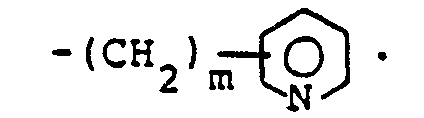
- R8 and R2 are independently selected from hydrogen, C1―C7 alkyl, benzyl, benzhydryl, salt forming ion, or

- R10 is hydrogen, C1―C7 alkyl, C3―C7 cycloalkyl, or phenyl.
- R11 is hydrogen, Cl-C7 alkyl, C1-C7 alkoxy, C3―C7 cycloalkyl, phenyl, benzyl, or phenethyl.
- US-A-3,646,008 discloses 2-(4-methoxyphenyl)-3-lower alkoxycarbonyloxy-5-(β-dimethylaminoethyl)-2,3-dihydro-1,5-benzothiazepin-4(5H)-one and pharmaceutically acceptable acid addition salts thereof, which are useful as coronary vasodilators.
- This invention is in its broadest aspects relates to the thiazine and thiazepine compounds of formula I above, to compositions containing such compounds and to the method of using such compounds as antihypertensive agents.
- The term alkyl used indefining R7 refers to straight or branched chain hydrocarbon radicals having up to ten carbons, for example, methyl, ethyl, propyl, isopropyl, butyl, isobutyl, t-butyl, pentyl, isopentyl, heptyl, octyl, decyl, etc. The preferred C1―C7 alkyl groups are up to four carbons with methyl and ethyl most preferred. Similarly, the terms C1-C7 alkoxy and C1―C7 alkylthio refer to such C1―C7 alkyl groups attached to an oxygen or sulfur.
- The term cycloalkyl refers to saturated rings of 3 to 7 carbon atoms, with cyclopentyl and cyclohexyl being most preferred.
- The term halogen refers to chloro, bromo, and fluoro.
- The term halo substituted C1―C7 alkyl refers to such C1―C7 alkyl groups described above in which one or more hydrogens have been replaced by chloro, bromo, or fluoro groups such as trifluoromethyl, which is preferred, pentafluoroethyl, 2,2,2-trichloroethyl, choromethyl, bromomethyl, etc. Similarly, the terms amino substituted C1―C7 alkyl and hydroxy substituted C1―C7 alkyl refers to such C1―C7 alkyl groups described above in which one or more hydrogens have been replaced by-NH2 or OH, i.e., aminomethyl, 2-aminoethyl, 3-hydroxypropyl, etc.
- The symbols


- Preferably, the thiazine or thiazepine ester of formula III is in its hydrochloride salt form and R2 is C1-C7 alkyl, benzyl or benzhydryl.
- The products of formula I wherein either or both of R8 and R2 are C1-C7 alkyl, benzyl, or benzhydryl can be hydrogenated, for example, by treating with hydrogen in the presence of a palladium on carbon catalyst or chemically treated such as with sodium hydroxide in aqueous dioxane or with trimethylsilylbromide in dichloromethane to yield the products of formula I wherein R8 and R2 are hydrogen.
- The ester products of formula I wherein R2 is

- The ester products of formula I wherein R2 is
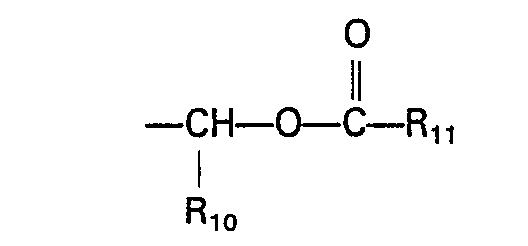


- The ester products of formula I wherein R8 is


- The phosphonochloridates of formula II are described in the literature and in particular by Kosolapoff et al. in Organic Phosphorous Compounds, Vol. 7, Chapter 18 (Wiley, 1972).
- The compounds of formula I wherein R is


- Treatment with hydrazine removes the phthalidyl protecting group after which the R8 and R2 ester group can be removed as described previously to yield the corresponding diacid compounds of formula I.
- The phosphonochloridates of formula V can be prepared by treating a phthalidyl protected alkylbromide of the formula


-


- The compounds of formula I wherein R is


- Treatment with hydrogen bromide (48%) in the presence of phenol with heat yields the aminophosphonic acid of the formula (XIV)

- The aminophosphonic acid of formula XIV is then reacted with benzoyloxycarbonyl chloride or Dhthalic anhvdride to vield (XV)


- The acid chloride of formula XVI is then coupled with the thiazine or thiazepine ester of formula III to yield the intermediate of the formula (XVII)


- The thiazine or thiazepine ester of formula III wherein R3 is other than hydrogen can be prepared as follows. A phthaloyl amino acid of the formula (XIX)


- The N-protected thiazxine or thiazepine of formula XXI can also be prepared by cyclizing a sulfoxide of the formula

- The thiazine or thiazepine ester of formula III wherein R5 is hydrogen can be prepared as follows. A dithiobis amino acid of the formula (XXIII)


- The dithiobis compound of formula XXV is treated with zinc dust to yield


- The compound of formula XXVII is cyclized by treatment with camphorsulfonic acid to give the N-protected thiazine or thiazepine of the formula

- The thiazepine ester of formula III wherein X is


- The thiazepine ester of formula III wherein X is


- If desired, the R2 and R3 ester groups can then be removed to yield the corresponding diacid compound.
- The compounds of formula I wherein R3 is C1―C7 alkoxy and R2 is hydrogen can be prepared by converting the thiazine or thiazepine ester of formula II wherein R2 is ethyl to the corresponding trimethylsilylethyl ester prior to reaction with the ketone of formula II. The resulting product can then be treated to remove the R2 trimethylsilylethyl ester group such as by use of tetrabutylammonium fluoride while leaving the R3 ester group in place.
- In the above reactions, if R4 is


- Preferred compounds of this invention are those of formula I wherein:
- R3 is hydroxy, alkoxy of 1 to 4 carbons, or ―O―alkali metal-salt.
- R4 is

- m is zero, one, two or three,
- R7 is alkyl of 1 to 10 carbons,

- Rg and R12 are selected from alkyl of 1 to 4 carbons and

- s is zero or an integer from 1 to 7.
- t is an integer from 1 to 8.
- R14 is hydrogen, methyl, methoxy, methylthio, chloro, bromo, fluoro, or hydroxy.
- R1 is hydrogen, alkyl of 1 to 4 carbons, or―(CH2)4―NH2.
- Rs and R6 are independently selected from hydrogen, alkyl of 1 to 4 carbons, and

- R8 and R2 are independently selected from hydrogen, alkyl of 1 to 4 carbons, alkali metal salt, or

- R10 is hydrogen, straight or branched chain alkyl of 1 to 4 carbons, or cyclohexyl.
- R11 is straight or branched chain alkyl of 1 to 4 carbons, cyclohexyl or phenyl.
- Most preferred compounds of this invention are those of formula I wherein:
- X is

- R3 is hydroxy, ethoxy, or -0-alkali metal salt.
- R4 is

- R7 is alkyl of 1 to 10 carbons or


- R1 is hydrogen.
- R5 is hydrogen or phenyl.
- R8 and R2 are independently selected from hydrogen, alkali metal salt, and


- R10 is hydrogen, straight or branched chain alkyl of 1 to 4 carbons, or cyclohexyl.
- Rll is straight or branch chain alkyl of 1 to 4 carbons.
- The compounds of this invention wherein at least one of R8 or R2 is hydrogen or R3 is hydroxy, form basic salts with various inorganic and organic bases which are also within the scope of the invention. Such salts include ammonium salts, alkali metal salts like lithium, sodium and potassium salts (which are preferred), alkaline earth metal salts like calcium and magnesium salts, salts with organic bases, e.g., dicyclohexylamine salt, benzathine, N-methyl-D-glucamine, hydrabamine salts, salts with amino acids like arginine, lysine and the like. The nontoxic, physiologically acceptable salts are preferred, although other salts are also useful, e.g., in isolating or purifying the product. The salts are formed using conventional techniques.
- The symbol * is used to represent various asymmetric centers which may be present in the compounds of formula I. Thus, the compounds of this invention can accordingly exist in diastereoisomeric forms or in mixtures thereof. The above described processes can utilize racemates, enantiomers or diastereomers as starting materials. When diastereomeric products are prepared, then can be separated by conventional chromatographic or fractional crystallization methods.
- The compounds of formula I, and the physiologically acceptable salts thereof, are hypotensive agents. They inhibit the conversion of the decapeptide angiotensin I to angiotensin II and, therefore, are useful in reducing or relieving angiotensin related hypertension. The action of the enzyme renin on angiotensinogen, a pseudoglobulin in blood plasma, produces angiotensin I. Angiotensin I is converted by angiotensin converting enzyme (ACE) to angiotensin (Il). The latter is an active pressor substance which has been implicated as the causative agent in several forms of hypertension in various mammalian species, e.g., humans. The compounds of this invention intervene in the angiotensinogen - (renin)→ angiotensin I → angiotensin II sequence by inhibiting angiotensin converting enzyme and reducing or eliminating the formation of the pressor substance angiotensin 11. Thus by the administration of a composition containing one (or a combination) of the compounds of this invention, angiotensin dependent hypertension in a species of mammal (e.g., humans) suffering therefrom is alleviated. A single dose, or preferably two or more divided daily doses, provided on a basis of about 0.1 to 100 mg. per kilogram of body weight per day is appropriate to reduce blood pressure. The substance is preferably administered orally, but parenteral routes such as the subcutaneous, intramuscular, intravenous or intraperitoneal routes can also be employed.
- The compounds of this invention can also be formulated in combination with a diuretic for the treatment of hypertension. A combination product comprising a compound of this invention and a diuretic can be administered in an effective amount which comprises a total daily dosage of about 30 to 600 mg., preferably about 30 to 330 mg. of a compound of this invention, and about 15 to 300 mg., preferably about 15 to 200 mg., of the diuretic, to a mammalian species in need thereof. Exemplary of the diuretics contemplated for use in combination with a compound of this invention are the thiazide diuretics, e.g., chlorothiazide, hydrochlorothiazide, flumethiazide, hydroflumethiazide, bendroflumethiazide, methyclothiazide, trichloromethiazide, polythiazide or benzthiazide as well as ethacrynic acid, ticrynafen, chlorthalidone, furosemide, musolimine, bumetanide, triamterene, amiloride and spironolactone and salts of such compounds.
- The compounds of formula I can be formulated for use in the reduction of blood pressure in compositions such as tablets, capsules or elixirs for oral administration, or in sterile solutions or suspensions for parenteral administration. About 10 to 500 mg. of a compound of formula I is compounded with physiologically acceptable vehicle, carrier, excipient, binder, preservative, stabilizer, flavor, etc., in a unit dosage form as called for by accepted pharmaceutical practice. The amount of active substance in these compositions or preparations is such that a suitable dosage in the range indicated is obtained.
- The following examples are illustrative of the invention. Temperatures are given in degrees centigrade. AG-50W-X8 refers to a crosslinked polystyrene-divinylbenzene sulfonic acid cation exchange resin. HP-20 refers to a porous cross-linked polystyrene-divinylbenzene polymer resin.
- A solution of N,N'-diphthaloyl-L-cystine (19.5 g., 38.9 mmole) in a mixture of trifluoroacetic acid (60 ml.) and dry tetrahydrofuran (200 ml.) is cooled in an ice-bath under nitrogen and treated with zinc dust (15.3 g., 233.4 mmole) in three equal portions over a period of 15 minutes. The reaction is stirred cold for 2 hours, then filtered (celite) and concentrated in vacuo. The residue is partitioned between 600 ml. of ethyl acetate:ether (5:1) and a water-brine mixture. The organic layer is washed with water, brine and dried (MgS04). Removal of the solvents in vacuo yields 21.9 g. of crude product which is flash chromatographed on silica gel (400 g.) eluting with toluene:acetic acid (6:1). Fractions containing the desired product are combined to to give 12.1 g. of N-phthaloyl-L-cysteine as an oil. [a]o = -54.2° (c = 1, methanol). TLC (toluene/acetic acid; 6:1) spot at R, =0.30.
- A mixture of glycine, ethyl ester, hydrochloride (10 g., 71.6 mmole), triethylamine (14.5 g., 143.2 mmole), and anhydrous MgS04 (6.0 g., 50.1 mmole) in dry methylene chloride (150 ml.) is treated with a solution of benzaldehyde (7.6 g., 71.6 mmole) in methylene chloride (10 ml.) added over a period of 15 minutes. After 5 hours, the reaction mixture is filtered, concentrated in vacuo, and then partitioned between 400 ml. of ether and 50 ml. of water. The organic layer is washed with water and brine, dried (MgS04), and concentrated in vacuo to give 12.1 g. of N-benyzlidineglycine, ethyl ester.
- To a solution of N-phthaloyl-L-cysteine (15.8 g., 62.8 mmole) and N-benzylidineglycine, ethyl ester (12.3 g., 64.3 mmole) in dry chloroform (160 ml.) cooled in an ice-bath under nitrogen is added dicyclohexylcarbodiimide (13.0 g., 62.8 mmole) in one portion. After 2 hours, the cold reaction mixture is filtered, concentrated in vacuo and redissolved in a mixture of ether (500 ml.) and chloroform (200 ml.). The organic extract is washed with saturated aqueous sodium bicarbonate, water, 5% potassium bisulfate and brine, dried (MgS04) and concentrated in vacuo to give 23.8 g. of crude product. Flash chromatography on silica (600 g.) eluting with hexane:ethyl acetate (3:1) yields 15.6 g. of (R)-dihydro-5-phthalimido-4-oxo-2-phenyl-2H-1,3-thiazine-3(4H) acetic acid, ethyl ester as a diastereomeric mixture.
- A mixture of (R)-dihydro-5-phthalimido-4-oxo-2-phenyl-2H-1,3-thiazine-3(4H)-acetic acid, ethyl ester (1.5 g., 3.5 mmole), methylhydrazine (0.3 ml.,1.6 eq.), and chloroform (10 ml.) is stirred at 25° in an argon atmosphere for 48 hours. The heterogeneous mixture is diluted with ethyl acetate, filtered, washed with water, brine, and evaporated. The residue is taken up into 5% potassium bisulfate and washed with ethyl acetate. The aqueous phase is made basic with saturated sodium bicarbonate, extracted with methylene chloride (twice), dried (MgS04), and evaporated to give 720 mg., of (R)-dihydro-5-amino-4-oxo-2-phenyl-2H-1,3-thiazine-3(4H)-acetic acid, ethyl ester as an oil. TLC (7:2:1, isopropanol/conc. NH40H/water) major spot at Rf = 0.77.
- A mixture of 4-phenylbutyl chloride (8.0 g., 47.5 mmole) and triethylphosphite (15.0 mi., 72 mmole) is heated at reflux (bath temperature 185°) under argon for 41.5 hours. Distillation of the mixture gives 10.8 g. of diethyl (4-phenylbutyl)phosphonate as a colorless liquid; b.p. 152-154° (1.0 mm of Hg.).
- A mixture of diethyl (4-phenylbutyl) phosphonate (0.73 g., 2.6 mmole), benzene (10 ml.) and phosphorus pentachloride (1.0 eq.) is refluxed under argon for 30 minutes. The benzene and phosphorus oxychloride are removed in vacuo to give chloro(4-phenylbutyl) phosphinic acid, ethyl ester.
- A mixture of the crude chloro (4-phenyl-butyl)phosphonic acid, ethyl ester (2.6 mmole), dry methylene chloride (9.0 mi.) and (R)-dihydro-5-amino-4-oxo-2-phenyl-2H-1,3-thiazine-3(4H)-acetic acid, ethyl ester (0.72 g., 2.4 mmole) at 0° (ice bath) in an argon atmosphere is treated dropwise with triethylamine (0.44 ml., 1.3 eq.) in methylene chloride (2 ml.) over 5 minutes. After 30 minutes, the ice bath is removed and the reaction mixture is stirred at room temperature for 16 hours. The mixture is diluted with ethyl acetate and washed successively with saturated sodium bicarbonate, 5% potassium bisulfate, brine, dried (MgS04), and evaporated. The residue (1.5 g.) is chromatographed on silica (80 g.) eluting with hexane/acetone (2:1) to give 1.0 g. of (R)-dihydro-5-[[ethoxy(4-phenylbutyl)phosphinyl]-amino]-4-oxo-2-phenyl-2H-1,3-thiazine-3(4H)-acetic acid, ethyl ester as an oil after evaporation. TLC (hexane/acetone, 2:1) single spot at R, = 0.5.
- A mixture of the diethyl ester product from part (f) (1.0 g., 1.93 mmole), methylene chloride (4 ml.) and bromotrimethylsilane (0.5 ml., 2.0 eq.) is stirred at room temperature under argon for 16 hours. The methylene chloride and excess bromotrimethylsilane are removed in vacuo and the residue is take up in acetonitrile (6 ml.) and 1 N lithium hydroxide (6.0 ml., approximately 3.0 eq.). After 2 hours the acetonitrile is evaporated, the aqueous solution is filtered, and chromatographed on an HP-20 (200 ml.) column eluting with a linear gradient of water-acetonitrile (0 → 90% acetonitrile). The desired fractions are combined, evaporated to a small volume, filtered (millipore), and lyophilized to give 385 mg. of (R)-dihydro-5-[[(hydroxy(4-phenylbutyl)phosphinyl]-amino]-4-oxo-2-phenyl-2H-1,3-thiazine-3(4H)-acetic acid, dilithium salt as a fluffy white solid. TLC (7:2:1 isopropanol/concentrated NH4OH/water) isomers R, = 0.66,0.62. [a]o = -5.5 (c = 1.0, H2O); m.p. 215° (decomp.).
-

- A mixture of homocystine (5.36, 0.02 mole), sodium carbonate (4.24 g., 0.04 mole) and N-carboethoxyphthalimide (9.7 g., 0.44 mole) in water (50 ml.) is stirred for 4 hours, during which time it becomes homogeneous. The reaction mixture is washed with ethyl acetate, acidified with concentrated hydrochloric acid, and extracted with methylene chloride. The extracts are dried and evaporated to a residue which is chromatographed on silica gel eluting with methylene chloride/methanol/acetic acid (40:1:1). The major fraction is crystallized from acetic acid, washed with water and dried to give 7.7 g. of bis(phthaloyl)homocystine as a white solid.
- A solution of bis(phthaloyl)homocystine (7.0 g., 0.013 mole) and carbonyldiimidazole (4.3 g., 0.026 mole) in tetrahydrofuran (40 ml.) is stirred for 1 hour at 0°, the treated with triethylamine (7.4 ml., 0.052 mole) and glycine, ethyl ester, hydrochloride (4.0 g., 0.026 mole). The mixture is stirred for 4 hours at room temperature, diluted with ethyl acetate, and washed with saturated sodium bicarbonate, 5% potassium bisulfate, and brine. The solution is dried (MgS04) and evaporated to a residue which is chromatographed on silica gel eluting with ethyl acetate/hexane (5:4). The major fraction (4.7 g.) is bis(phthaloyl)homocystinylglycine, ethyl ester.
- A mixture of bis(phthaloyl)homocystinylglycine, ethyl ester (2.9 g., 0.041 mole) and acetic acid (8.2 ml.) in ethanol (40 ml.) is treated with zinc dust (1.62 g.) and stirred at room temperature for 1 hour. The mixture is filtered, the filtrate evaporated, and the residue taken up in ethyl acetate and washed with water and brine. The solution is evaporated to yield 2.9 g. of N-phthaloyl-homocysteinylglycine, ethyl ester as a yellow semi-solid.
- A solution of N-phthaloylhomocysteinylglycine, ethyl ester (0.97 g., 2.8 mmole) and pyridine (0.67 ml., 8.4 mmole) in methylene chloride (4 ml.) is added dropwise to bromomethyl methyl ether (0.56 ml., 7.0 mmole) in methylene chloride (1.5 ml.) at 0° under argon. The mixture is stirred for 2 hours at room temperature, then additional pyridine (0.67 ml., 8.4 mmole) and bromomethyl methyl ether (0.56 ml., 7.0 mmole) are added and the mixture is stirrerd 1.5 hours longer. The mixture is washed with water, 5% potassium bisulfate, dired (MgS04) and evaporated to yield a residue which is chromatographed on silica gel eluting with ethyl acetate/hexane (1:1) to give 0.78 g. of N-phthaloyl-S-(methoxymethyl)-homocysteinylglycine, ethyl ester as an oil.
- N-Phthaloyl-S-(methoxymethyl)homocysteinylglycine, ethyl ester (0.76 g., 2.0 mmole) and camphorsulfonic acid (0.01 g.) in benzene (15 mi.) are refluxed for 1 hour. Additional camphorsulfonic acid (0.05 g.) is added and reflux is continued for 2 more hours after which anhydrous p-toluenesulfonic acid (0.1 g.) is added and the mixture is refluxed for 20 hours. The mixture is then diluted with ethyl acetate and washed with saturated sodium bicarbonate, 5% potassium bisulfate, and brine, dried (MgS04) and evaporated. The residue is chromatographed on silica gel eluting with ethyl acetate to yield a main fraction which is then crystallized from toluene to give 0.51 g. of 5-phthalimido-tetrahydro-4-oxo-1,3-thiazepine-3(2H)acetic acid, ethyl ester as a crystalline solid; m.p. 191.5-193.5°.
- A mixture of 5-phthaiimido-tetrahydro-4-oxo-1,3-thiazepine-3(2H)-acetic acid, ethyl ester (0.48 g., 1.3 mmole) and methylhydrazine (0.12 ml) in acetonitrile is stirred at room temperature for 3 days. the reaction mixture is diluted with ethyl acetate, filtered and evaporated to a residue which is taken up in 5% potassium bisulfate and washed with ethyl acetate. The aqueous phase is saturated with sodium bicarbonate and extracted with methylene chloride. The extracts are dried and evaporated to yield 0.2 g. of 5-amino- tetrahydro-4-oxo-1,3-thiazepine-3(2H)-acetic acid, ethyl ester as an oil. TLC (siiica gel, 10% methanol in methylene chloride) R, = 0.19.
- A mixture of crude chloro(4-phenylbutyl)phosphinic acid, ethyl ester, dry methylene chloride and 5-amino-tetrahydro-4-oxo-1,3-thiazepine-3(2H)-acetic acid, ethyl ester are reacted as set forth in Example 1 (f). Work up of the reaction mixture according to Example 1 (f) yields 5[[ethoxy(4-phenylbutyl)phospinyl]-amino]tetrahydro-4-oxo-1,3-thiazepine-3(2H)-acetic acid, ethyl ester. h)5-[[Hydroxy(4-phenylbutyl)phosphinyl]amino]tetrahydro-4-oxo-1,3-thiazepine-3(2H)-acetic acid, dilithium salt
- The diethyl ester product from part (g) is treated with bromotrimethylsilane according to the procedure of Example 1(g) and the residue is treated with 1N lithium hydroxide and worked up as set forth in Example 1(g) to give 5-[[hydroxy(4-phenylbutyl)phosphinyl]amino]tetrahydro-4-oxo-1,3-thiazepine-3(2H)-acetic acid, dilithium salt.
- Following the procedures of Examples 1 and 2, the thiazine or thiazepine shown below in Col. I is reacted with the phosphonic acid ester shown in Col. II to give the ester product shown in Col. III. The R2 and R8 ester groups can be removed to give the corresponding diacid which can then be converted to salt or in the case of Examples 15 and 16 only the R8 ester group would be removed. The R1 protecting group shown in Examples 6 and 10 would be removed as the last step of synthesis.


- To a solution of N-[(1,1-dimethylethoxy)carbonyl]-L-serine (20.5 g., 0.1 mole), methanol (50 ml.), and water (10 ml.) is added cesium carbonate (16.3 g., 0.5 eq.). After 5 minutes the solution becomes homogeneous, the methanol is stripped, and the residual water is removed azeotropically with acetonitrile (three times). The resulting foam is taken up in dry dimethylformamide (250 ml.) and treated with methyl iodide (6.2 ml., 10 eq.) at 25° under argon (slight exotherm). After 25 hours the reaction mixture is taken up in ethyl acetate and washed successively with saturated sodium bicarbonate, 5% potassium bisulfate, brine, dried (MgS04), and evaporated to give 17.5 g. of N-[(1,1-dimethylethoxy)carbonyl]-L-serine, methyl ester as a light green oil. TLC (ethyl acetate) single spot at Rf = 0.71.
- A mixture of N-[(1, 1-dimethylethoxycarbonyl]-L-serine, methyl ester (18.4 g., 83.9 mmole), diisopropylcarbodiimide (14.4 ml., 1.1 eq.) and acetonitrile (30 ml.) is treated with cuprous chloride (2.6 g., 0.3 eq.) at 25° in an argon atmosphere. After stirring the green mixture for 16 hours, ethyl acetate is added and the resulting mixture is filtered (celite bed) and evaporated. The gelatinous residue (19.0 g.) is filtered through a pad of silica (100 g.) eluting with ethyl acetate/hexane (1:16) to give 8.2 g. of 2-[[(1,1-dimethylethoxy)-carbonyl]amino]-2-propenoic acid, methyl ester as a light green liquid. TLC (ethyl acetate/hexane; 1:16) major spot at Rf = 0.29.
- A mixture of 2-aminoethanethiol, hydrochloride (5.5 g., 1.2 eq.), triethylamine (16.6 ml., 2.4 eq.), and methylene chloride (20 ml.) at 0° (ice bath) under argon is treated dropwise with 2-([(1,1-dimethylethoxy)-carbonyl]amino]-2-propenoic acid, methyl ester (8.2 g., 40.8 mmole) in methylene chloride (30 ml.) over a 15 minute period. The ice bath is then removed and the resulting solution is stirred for 20 hours. The reaction mixture is taken up in ethyl acetate, filtered, and washed successively with water (twice), saturated sodium bicarbonate, brine, and evaporated. The gelatinous residue (9.4 g.) is taken up in ether and added dropwise to a solution of oxalic acid (3.6 g.)/ethyl ether (250 ml.) to obtain the oxalate salt as a white solid after filtration. The oxalate salt is taken up in water and basified with saturated sodium bicarbonate. The resulting oil is extracted into methylene chloride (approximately 20 times) to give 7.5 g. of S-(2-aminoethyl)-N-[(1,1-dimethylethoxy)carbonyl]-L-cysteine, methyl ester as an oil after evaporation. TLC (methylene chloride/methanol/acetic acid; 8:1:1 ) major spot at R, = 0.52.
- A mixture of S-(2-aminoethyl)-N-[(1,1-dimethylethoxy)carbonyl]-L-cysteine, methyl ester (7.5 g., 26.9 mmole), 1N sodium hydroxide (31.0 ml., 1.15 eq.), and dioxane (30 ml.) is stirred at room temperature for 2 hours. The reaction is then treated with 1N hydrochloric acid (4.1 ml.) to quench excess hydroxide. The dioxane and water are evaporated and the residual water is removed azeotropically with acetonitrile (twice). The resulting foam is taken into dry dimethylformamide (100 ml.), treated with diphenylphosphoryl azide (6.5 ml., 1.1 eq.), and stirred under argon at 25° for 3.5 days. The reaction mixture is diluted with ethyl acetate and washed successively with water, saturated sodium bicarbonate, 5% potassium bisulfate, brine, dried (MgS04), and evaporated. The residue (3.0 g.) is taken up in hot ethyl acetate and upon cooling 1.1 g. of the product crystallizes as a colorless solid. The mother liquor (1.9 g.) is chromatographed on silica (70 g.) eluting with 5% acetone/methylene chloride to give an additional 0.4 g. of product as a slightly colored solid. A small portion of the product is recrystallized from toluene to give (hexa-hydro-5-oxo-1,4-thiazepin-6-yl)carbamic acid, (1,1-dimethylethyl)ester as fine colorless needles; m.p. 199.5―201°. TLC (10% acetone/methylene chloride) single spot at R, = 0.49.

- A suspension of (hexahydro-5-oxo-1,4-thiazepin-6-yl)carbamic acid, (1,1-dimethylethyl)ester (1.35 g., 5.48 mmole) in dry tetrahydrofuran (10 mi.) under argon at 0° (ice bath) is treated with potassium tert-butoxide (0.68 g., 1.1 eq.) to effect an orange homogeneous solution. After 5 minutes, ethyl bromoacetate (1.1 ml., 1.8 eq.) is added, the ice bath removed, and the reaction mixture is stirred for 2 hours. The reaction mixture is then diluted with ethyl acetate and washed successively with saturated sodium bicarbonate, 5% potassium bisulfate, brine, dried (MgSO4) and evaporated. The residue is chromatographed on silica (85 g.) eluting with 5% acetone/methylene chloride to give 1.65 g. of 6-[[(1,1-dimethylethoxy)carbonyl]amino]-tetrahydro-5-oxo-1,4-thiazepine-4(5H)-acetic acid, ethyl ester as an oil following evaporation. TLC (10% acetone/methylene chloride) single spot at Rf = 0.71.
- A mixture of 6-[[(1,1-dimethylethoxy)carbonyl]amino]-tetrahydro-5-oxo-1,4-thiazepine-4(5H)-acetic acid, ethyl ester (1.65 g., 4.96 mmole) and ethyl acetate (10 ml.) at 0° (ice bath) is treated with cold saturated hydrochloric acid/ethyl acetate (20 ml.:). After stirring for 2 hours at 0°, nitrogen is passed through the solution to remove excess hydrochloric acid. The ethyl acetate is evaporated and the residue is triturated with ether (three times) to give 1.35 g. of 6-amino-tetrahydro-5-oxo-1,4-thiazepine-4(5H)-acetic acid, ethyl ester, hydrochloride as a yellow solid. TLC (methylene chloride/methanol/acetic acid; 8:1:1 ) single spot at Rf = 0.5 (visualized with ninhydrin and heat).

- A mixture of crude chloro (4-phenylbutyl)phosphinic acid, ethyl ester (4.09 mmole), dry tetrahydrofuran (5 ml.), and 6-amino-tetrahydro-5-oxo-1,4-thiazepine-4(5H)-acetic acid, ethyl ester, hydrochloride (1.10 g., 4.09 mmole) at 0° (ice bath) in an argon atmosphere is treated dropwise with triethylamine (1.25 mi., 2.2 eq.) in tetrahydrofuran (5 ml.) over a 2 minute period. After 20 minutes the ice bath is removed, and the reaction mixture is stirred for an additional 2 hours. The reaction mixture is diluted with ethyl acetate and washed successively with saturated sodium bicarbonate, 5% potassium bisulfate, brine, dried (MgS04), and evaporated. The residue (2.0 g.) is chromatographed on silica (75 g.) eluting with 3:1 toluene/acetone to give 1.45 g. of tetrahydro-6-[[ethoxy(4-phenylbutyl)phosphinyl]amino]-5-oxo-1,4-thiazepine-4(5H)-acetic acid, ethyl ester as an oil. TLC (toluene/acetic acid; 3:1) single spot at Rf = 0.16.
- A mixture of the diester product from part (g) (1.45 g., 3.17 mmole), methylene chloride (5 ml.), and bromotrimethylsilane (1.3 ml., 3.0 eq.) is stirred under argon at 25°. After 16 hours additional bromotrimethylsilane (1.0 eq.) is added. After an additional 3 hours the methylene chloride and excess bromotrimethylsilane are removed in vacuo and the residue is treated with dry acetonitrile (10 mi.) and 1 N sodium hydroxide (10 ml., approximately 3 eq.). After 3 hours the acetonitrile is evaporated and the resulting aqueous phase is applied to an HP-20 (200 ml. bed) column eluting with a linear gradient water→ acetonitrile (0/90%). The desired fractions are combined, evaporated to a small volume, and applied to an AG50W x 8 (Li+) (40 ml.) column eluting with water. The desired fractions are combined, filtered (millipore), and lyophilized to give 0.85 g. of tetrahydro-6-[[hydroxy(4-phenylbutyl)-phosphinyl]amino]-5-oxo-1,4-thiazepine-4(5H)-acetic acid, dilithium salt as a white solid; m.p. darkens at 233°. TLC (isopropanol/conc. NH40H/water; 7:2:1) single spot at Rf = 0.71.

- Following the procedure of Example 17 but employing substituted 2-aminoethanethiol shown below in Col. I in part (c) one obtains the thiazepine shown below in Col. II. This thiazepine is then reacted with the phosphinic acid ester shown in Col. III to give the ester product shown in Col. IV. The R2 and R8 ester groups can be removed to give the corresponding diacid which can then be converted to a salt or in the case of Examples 27 and 28 only the R8 ester group would be removed. The R1 protecting group shown in Examples 24 and 25 would be removed as the last step of the synthesis.
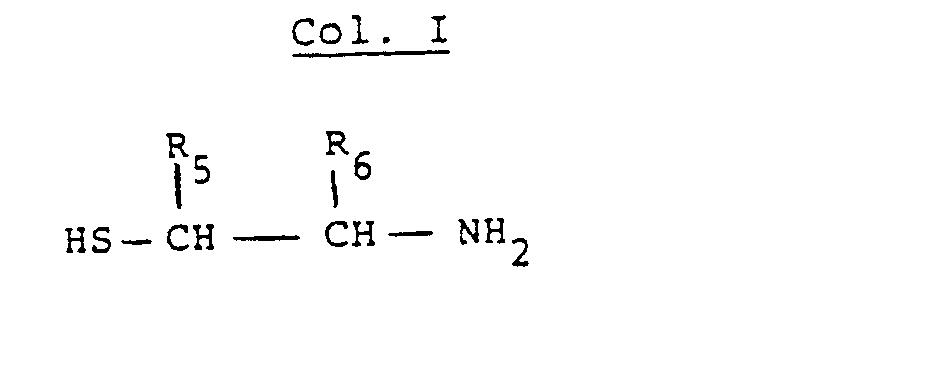


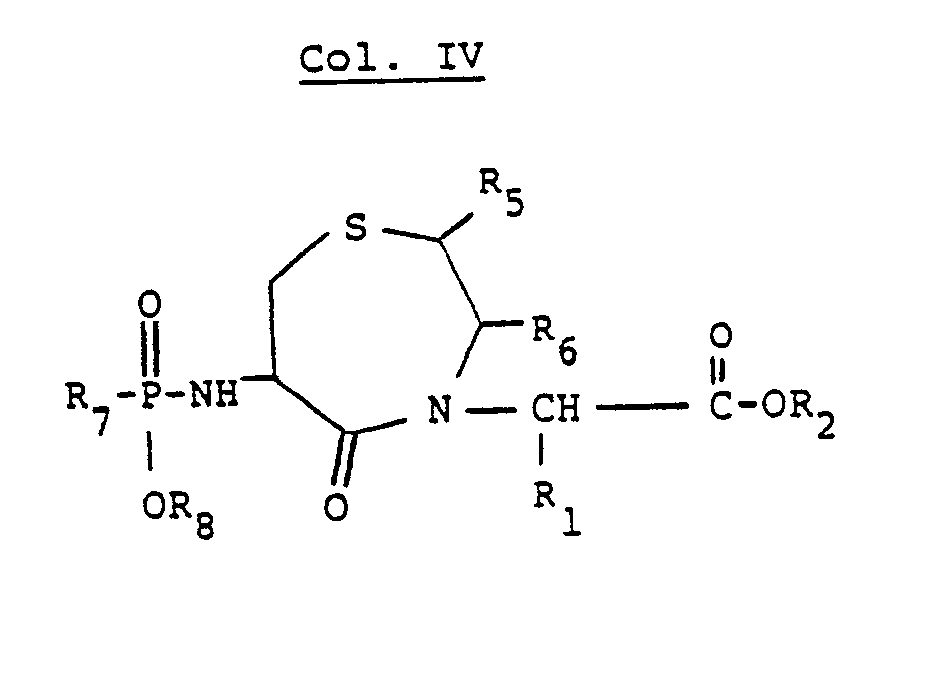


- To a mixture of 2-amino-thiophenol (1.9 g., 15.4 mmole), methylene chloride (15 ml.), and 2,6-lutidine (1.8 ml., 1.0 eq.) at -20° (chloroform dry ice) is added 2-[[(1,1-dimethylethoxy)carbonyl]amino]-2-propenoic acid, methyl ester (3.0 g., 1.0 eq.) dropwise over 5 minutes. After one hour the cooling bath is removed and the reaction mixture is stirred for an additional 16 hours. The reaction mixture is diluted with ethyl acetate and washed with saturated sodium bicarbonate, water, brine, dried (MgS04), and evaporated. The residue (4.1 g.) is chromatographed on silica (125 g.) eluting with hexane/ethyl acetate (5:1) to give 2.5 g. of S-(2-aminophenyl)-N-[(1,1-dimethylethoxy)carbonyl]-L-cysteine, methyl ester as an oil after evaporation.
- A mixture of S-(2-aminophenyl)-N-[(1,1-dimethylethoxy)carbonyl]-L-cysteine, methyl ester (1.0 g., 3.1 mmole), 1N sodium hydroxide (3.1 ml., 1.0 eq.), and dioxane (6 ml.) is stirred at room temperature in an argon atmosphere for one hour. The reaction mixture is washed with ethyl acetate, neutralized with 1N hydrochloric acid (3.1 ml.) and extracted with methylene chloride (twice). The combined extracts are dried (MgS04) and evaporated to give 1.0 g. of S-(2-aminophenyl)-N-[(1,1-dimethylethoxy)carbonyl]-L-cysteine as a foam. TLC (methylene chloride/acetic acid/methanol; 100:5:5) major spot at Rf = 0.5. The product crystallizes from xylene to give S-(2-aminophenyl)-N-[(1,1-dimethylethoxy)carbonyl]-L-cysteine as a fluffy crystalline solid; m.p. 109-111°.
- Anal. calc'd. for C14H20N2O4S: C, 53.83; H, 6.45; N, 8.97; S, 10.26
- Found: C, 53.51; H, 6.28; N, 8.99; S, 10.26.
- A suspension of S-(2-aminophenyl)-N-[(1,1-dimethylethoxy)carbonyl]-L-cysteine (0.65 g., 2.1 mmole) in xylene (15 mi.) is refluxed in a flask equipped with a Dean-Stark trap for 7 hours. Upon cooling of the reaction mixture the product crystallizes. The solid is collected by filtration, washed with xylene, and dried (high vacuum) to give 0.4 g. of (±)-(2,3,4,5-tetrahydro-4-oxo-1,5-benzothiazepin-3-yi)carbamic acid, 1,1-dimethylethyl ester as anoff-white crystalline solid; m.p. 197―200° (decomp.).
- Anal. calc'd for C14H18N2O3S: C, 57.12; H, 6.16; N, 9.52; S, 10.89
- Found: C, 56.88; H, 6.17; N, 9.40; S, 10.87.
- A mixture of (±)-(2,3,4,5-tetrahydro-4-oxo-1,5-benzothiazepin-3-yl)carbamic acid, 1,1-dimethylethyl ester (0.8 g., 2.7 mmole), tetrahydrofuran (10 ml.) and potassium tert-butoxide (0.4 g., 1.3 eq.) is stirred at 0° (ice bath) under argon for 10 minutes and then treated with ethyl bromoacetate (0.5 g., 1.7 eq.). After 3 minutes the ice bath is removed and the mixture is stirred for one hour. The reaction mixture is then diluted with ethyl acetate and washed successively with saturated sodium bicarbonate, 5% potassium bisulfate, and brine, dried (MgS04) and evaporated. The residue (1.3 g.) is chromatographed on silica (60 g.) eluting with hexane/ethyl acetate (4:1) to give 1.0 g. of (±)-3-[[(1,1-dimethylethoxy)carbonyl]amino]-3,4-dihydro-4-oxo-1,5-benzothiazepine-5(2H)-acetic acid, ethyl ester as a foam. TLC (hexane/ethyl acetate; 4: 1) single spot at Rf = 0.21.
- A mixture of (±)-3-[[(1,1-dimethylethoxy)carbonyl]amino]-3,4-dihydro-4-oxo-1,5-benzothiazepine-5(2H)-acetic acid, ethyl ester (1.0 g., 2.6 mmole), methylene chloride (5 ml.), and trifluoroacetic acid (3 ml.) is stirred under argon at 25° for 30 minutes. The methylene chloride and trifluoroacetic acid are removed in vacuo and the residue is taken up in ethyl acetate and the hydrochloride salt is precipitated with saturated hydrochloric acid/ethyl ether. The white solid is collected by filtration and washed with 2:1 ethyl acetate/ ethyl ether to yield 0.7 g. of (±)-3-amino-3,4-dihydro-4-oxo-1,5-benzothiazepine-5(2H)-acetic acid, ethyl ester as a white solid; m.p. 231―233° (decomp.). TLC (methylene chloride/acetic acid/methanol; 100:5:5) single spot at Rf = 0.08.
- Anal. calc'd. for C13H16N2O3S·HCl: C, 49.29; H,5.41; N, 8.84; S,10.12; CI,11.37
- Found: C, 48.87; H,5.31; N,8.80; S,10.05; CI,11.37.
- A mixture of crude chloro(4-phenylbutyl)phosphinic acid, ethyl ester (2.44 mmole), dry tetrahydrofuran (10 ml.), and (±)-3-amino-3,4-dihydro-4-oxo-1,5-benzothiazepine-5(2H)-acetic acid, ethyl ester (0.65 g., 2.05 mmole) at 0° (ice bath) in an argon atmosphere is treated dropwise with triethylamine (0.86 ml., 3.0 eq.) in tetrahydrofuran (5 ml.) over 1 minute. After standing at 0° for 20 minutes the ice bath is removed and the reaction mixture is stirred for 16 hours. The reaction mixture is diluted with ethyl acetate and washed successively with saturated sodium bicarbonate, 5% potassium bisulfate and brine, dried (MgS04), and evaporated. The residue (1.2 g.) is chromatographed on silica (60 g.) eluting with acetone/hexane (1:1) to give 0.8 g. of (±)-dihydro-3-[[ethoxy(4-phenylbutyl)phosphinyl]amino]-4-oxo-1,5-benzothiazepine-5(2H)-acetic acid, ethyl ester as an oil after evaporation. TLC (acetone/hexane; 2:1) two spots at Rf = 0.59, 0.65 (isomers at phosphorus).
- A mixture of the diester product from part (f) (0.8 g., 1.59 mmole), dry methylene chloride (5 ml.), and bromotrimethylsilane (0.63 ml., 3.0 eq.) is stirred at room temperature in an argon atmosphere for 16 hours. The methylene chloride and bromotrimethylsilane are removed in vacuo and the residue is taken up in acetonitrile (approximately 5 ml.) and 1N lithium hydroxide (5.6 ml., 3.5 eq.) and stirred for 2 hours. The acetonitrile is stripped, the aqueous solution is filtered, and applied to an HP-20 (200 ml.) column eluting with a linear gradient water-acetonitrile (0→ 90% acetonitrile). The desired fractions are combined, filtered (millipore), and lyophilized to give 0.5 g. of (±)-dihydro-3-[[hydroxy(4-phenylbutyl)phosphinyl]amino]-4-oxo-1,5-benzothiazepine-5(2H)-acetic acid, dilithium salt as a fluffy white solid; m.p. 245° (decomp.). TLC (isopropanol/conc. NH40H/water; 7:2:1) single spot at Rf = 0.48.
- Anal. calc'd. for C21H23N2OsSPLi2·1.8 H2O: C, 51.19; H, 5.44; N, 5.68; S, 6.51; P, 6.3
- Found: C, 51.24; H, 5.12; N, 5.53; S, 6.57; P, 6.2.
- Similarly, by following the procedure of Example 29 but employing the various chloro (substituted) phosphinic acid esters shown in Col. II of Examples 3 to 16 and 18 to 28, other compounds within the scope of this invention are obtained.
- A mixture of crystalline 6-aminohexanol (11.7 g., 0.1 mole) and phthalic anhydride (14.8 g., 0.1 mole) is heated at 170° for 1.5 hours in an argon atmosphere. The evolved water is then removed with heat and argon flow. The reaction mixture is cooled to 100° and phosphorus tribromide (7.2 ml., 0.086 mmole) is added in portions via gas tight syringe to the reaction mixture. A vigorous reaction occurs with each addition. After addition is complete, the reaction mixture is heated at 100° for an additional 30 minutes. The cooled reaction mixture is diluted with ethanol (20 ml.) then poured over ice-water and refrigerated overnight. A yellow solid is filtered and washed several times with cold water until the filtrate is nearly neutral. The crude solid is recrystallized from ethanol to give 21.0 g. of N-(6-bromohexyl)phthalimide as a pale yellow solid; m.p. 54^55°. TLC (hexane-ethyl acetate; 1:1) shows a major spot at Rf = 0.8.
- A mixture of N-(6-bromohexyl)phthalimide (5.5 g., 17.7 mmole) and triethytphosphite (10.0 ml., 58.4 mmole) is refluxed (bath temperature 160-165°) under argon for 16 hours. The volatiles are removed by distillation at 100° (bath temperature), 0.5 mm. of Hg to leave a pale yellow viscous oil. The crude product is purified by flash chromatography on silica gel (100 g.) eluting with acetone-hexane (1:2) to give 6.00 g. of (6-phthalimidohexyl)phosphonic acid, diethyl ester as a colorless viscous oil. TLC (acetone- hexane; 1:1) shows a single spot at R, = 0.40.
- A mixture of (6-phthalimidohexyl)phosphonic acid, diethyl ester, benzene, and phosphorus pentachloride is refluxed according to the procedure of Example 1(e) to give chloro(6-phthalimidohexyl)-phosphinic acid, ethyl ester.
- Chloro(6-phthalimidohexyl)phosphinic acid, ethyl ester and (R)-dihydro-5-amino-4-oxo-2-phenyl-2H-1,3-thiazine-3(4H)-acetic acid, ethyl ester are reacted according to the procedure of Example 1 (f) to give (R)-dihydro-5-[[ethoxy(6-phthalimidohexyl)phosphinyl]amino]-4-oxo-2-phenyl-2H-1,3-thiazine-3(4H)-acetic acid, ethyl ester.
- A solution of (R)-dihydro-5-[[ethoxy(6-phthalimidohexyl)phosphinyl]amino]-4-oxo-2-phenyl-2H-1,3-thiazine-3(4H)-acetic acid, ethyl ester in dioxane is treated with hydrazine hydrate and stirred at room temperature under argon. After the reaction is completed, the mixture is diluted with toluene and the solvents decanted. The residue is triturated with methylene chloride and filtered. The combined filtrate is evaporated to dryness to give (R)-dihydro-5-[[(6-aminohexyl)ethoxyphosphinyl]amino]-4-oxo-2-phenyl-2H-1,3-thiazine-3(4H)-acetic acid, ethyl ester.
- The diethyl ester product from part (e) is treated with bromotrimethylsilane in methylene chloride and the residue is taken up in acetonitrile and treated with 1 N lithium hydroxide according to the procedure of Example 1(g) Work-up of the product according to the procedure of Example 1(g) gives (R)-dihydro-5-[[(6-aminohexyl)hydroxyphosphinyl]amino]-4-oxo-2-phenyl-2H-1,3-thiazine-3(4H)-acetic acid, dilithium salt.
- Following the procedure of Example 30 but employing the aminoalcohol listed in Col. I one obtains the product listed in Col. II.

- Similarly, by employing the thiazine or thiazepine esters of Examples 2 to 29 within the procedure of Examples 30 to 34, other compounds within the scope of the invention are obtained.
- A solution of d,l-phenylalaninol, hydrochloride (9.4 g., 50.1 mmole) in dry pyridine (35 ml.) at 0° (ice bath) is treated with p-toluenesulfonyl chloride (19.4 g., 102 mmole) in small portions over a 15 minute period. The mixture is allowed to come to room temperature and stirred overnight. The mixture is evaporated to dryness and the residue partitioned between ethyl acetate and 5% potassium bisulfate. The ethyl acetate layer is washed successively with 5% potassium bisulfate, saturated sodium bicarbonate and saturated sodium chloride, dried (Na2S04), and evaporated. The dark residue is filtered through a pad of silica gel eluting with methylene chloride then methylene chloride-ethyl acetate (1:1). Evaporation of the solvents and trituration of the residue with ether gives 13.93 g. of 4-methylbenzenesulfonic acid, 2-[[(4-methylphenyl)sulfonyl]amino]-3-phenylpropyl ester as white crystals; m.p. 95―96°; TLC (ethyl acetate/ hexane; 1:2) spot at R, = 0.39. A sample recrystallized from diisopropyl ether has m.p. 96-98°.
- A solution of diethylphosphite (7.3 g., 52.9 mmole) in dry tetrahydrofuran (100 ml.) is treated with sodium hydride 50% oil dispersion (2.20 g., 45.8 mmole) in small portions under argon. The mixture is then refluxed for 30 minutes, cooled to room temperature, and treated with 4-methylbenzenesulfonic acid, 2-[[(4-methylphenyl)sulfonyl]amino]-3-phenylpropyl ester (6.9 g., 15 mmole). After 15 minutes, a white solid separates; additional tetrahydrofuran (75 ml.) is added and stirring continued overnight. After stirring at room temperature overnight, the mixture is refluxed for one hour, cooled and partitioned between ethyl acetate (75 ml.) and 5% potassium bisulfate (50 ml.). The ethyl acetate phase is washed successively with 5% potassium bisulfate, saturated sodium bicarbonate and saturated sodium chloride, dried (Na2SO4), and evaporated. The residue is triturated with hexane to give 5.9 g. of [2-[[(4-methylphenyl)sulfonyl]amino]-3-phenylpropyl]phosphonic acid, diethyl ester as an off-white solid; m.p. 86-89°; TLC (ethyl acetate) spot at Rf = 0.48. A sample recrystallized from diisopropyl ether has m.p. 94-95°.
- A mixture of [2-[[(4-methylphenyl)sulfonyl]amino]-3-phenylpropyl]phosphonic acid, diethyl ester (5.9 g., 13.9 mmole), phenol (8.0 g., 85.1 mmole), and 48% aqueous hydrobromic acid (50 ml.) is refluxed for 5.5 hours. The cooled mixture is diluted with water (50 ml.) and washed with ethyl acetate (2 x 50 ml.). The aqueous phase is evaporated to dryness, taken up in water (30 ml.) and evaporated again. This is repeated twice more. Finally, the residue is taken up in water and applied to an AG 50 W X2 (H' form) column (60 ml. bed volume) and eluted first with water then with 5% pyridine-water. The fractions containing the desired product are combined and evaporated to dryness. The solid residue is triturated with acetonitrile to give 2.55 g. of (2-amino-3-phenylpropyl)phosphonic acid as an off-white crystalline solid; m.p. 347° (dec.); TLC (isopropanol/conc. NH40H/water; 7:2:1) spot at R, = 0.27.
- A mixture of (2-amino-3-phenylpropyl)phosphinic acid (2.0 g., 9.3 mmole) and phthalic anhydride (1.55 g., 10.5 mmole) is fused in a flask under argon at 195―200° (bath temperature) for 1.5 hours. The glassy dark residue is refluxed with ethyl acetate (25 ml.) until the glassy residue dissolves and a fluffy crystalline solid separates. The cooled mixture is diluted with diethyl ether (25 mI.) and filtered. The solid is washed thoroughly with diethyl ether and dried to give 2.87 g. of (2-phthalimido-3-phenylpropyl)-phosphinic acid as an off-white crystalline solid; m.p. 127-130°. A sample crystallized from ethyl acetate m.p. 129-131°; TLC (isopropanol/conc. NH40H/water; 7:2:1) spot at Rf = 0.33.
- A suspension of (2-phthalimido-3-phenylpropyl)phosphinic acid in dry benzene is treated with phosphorus pentachloride and stirred at room temperature under argon for an hour. The mixture is then refluxed for 15 minutes, cooled and evaporated to dryness at room temperature (0.5 mm. of Hg). The residue is taken up in dry methylene chloride and reacted successively with a mixture of ethanol (1 eq.) and triethylamine (1 eq.) in methylene chloride and (R)-dihydro-5-amino-4-oxo-2-phenyl-2H-1,3-thiazine-3(4H)-acetic acid, ethyl ester in the presence of triethylamine according to the procedure of Example 1 (f). Work up of the reaction mixture according to the procedure of Example 1(f) yields (R)-dihydro-5-[[[2-phthalimido-3-phenylpropyl]ethoxyphosphinyl]amino]-4-oxo-2-phenyl-2H-1,3-thiazine-3(4H)-acetic acid, ethyl ester.
- A solution of (R)-dihydro-5-[[[2-phthalimidol-3-phenylpropyl]ethoxyphosphinyl]amino]-4-oxo-2-phenyl-2H-1,3-thiazine-3(4H)-acetic acid, ethyl ester in dioxane is treated with hydrazine hydrate and stirred for 24 hours at room temperature. The mixture is then partitioned between ethyl acetate-water and the ethyl acetate phase was washed with water and saturated sodium chloride, dried (Na2S04), and evaporated. The residue is taken up in dry toluene and refluxed for one hour. The mixture is filtered, treated with triethylamine and benzoyl chloride and stirred at room temperature for 30 minutes. The mixture is diluted with ethyl acetate, washed successively with 5% potassium bisulfate, saturated sodium bicarbonate, and saturated sodium chloride, dried (Na2S04), and evaporated. The residue is chromatographed on silica gel to give (R)-dihydro-5-[[[2-(benzoylamino)-3-phenylpropyl]ethoxy- phosphinyl]amino]-4-oxo-2-phenyl-2H-1,3-thiazine-3(4H)-acetic acid, ethyl ester.
- The diethyl ester product from part (f) is treated with bromotrimethylsilane in methylene chloride and the residue is taken up in acetonitrile and treated with 1N lithium hydroxide according to the procedure of Example 1 (g). Work up of the product according to the procedure of Example 1 (g) gives (R)-dihydro-5-[[[2-(benzoylamino)-3-phenylpropyl]hydroxyphosphinyl]amino]-4-oxo-2-phenyl-2H-1,3-thiazine-3(4H)-acetic acid, dilithium salt.
- Following the procedure of Example 35 but employing the protected amine shown in Col. I and the phosphinic diester shown in Col. II, one obtains, after removal of the tosyl protecting group and reaction with phthalic anhydride, the phosphinic acid shown in Col. III. The acid of Col. III is then converted to the phosphinic acid ester chloride shown in Col. IV which is then coupled with the thiazine ester shown in Col. V to yield the intermediate shown in Col. VI. Removal of the phthalidyl group and reaction with the acid chloride shown in Col. VII yields the ester product shown in Col. VIII. The R2 and R8 ester groups can be removed to give the corresponding diacid which can then be converted to a salt or in the case of Example 45 only the R8 ester group would be removed. The R1 protecting group shown in Example 40 would be removed as the last step of the synthesis.


- Similarly, by employing the thiazine esters of Examples 17 to 29 within the procedure of Examples 35 to 45, other compounds within the scope of the invention are obtained.
- The diastereomeric mixture of (R)-dihydro-5-phthalimido-4-oxo-2-phenyl-2H-1,3-thiazine-3(4H)-acetic acid, ethyl ester (15.6 g.) from Example 1 (c) is refluxed in ether (500 mi.) for 4 hours, then cooled in an ice-bath and filtered to give 5.9 g. of isomer A at least 90% free of isomer B; m.p. 166―168°. [α]D = -72.9° (c = 1, chloroform). TLC (hexane/ethyl acetate; 1:1) shows spot at Rf = 0.40.
- Anal. calc'd. for C22H20O5N2S: C, 62.25; H, 4.75; N, 6.60; S, 7.55
- Found: C, 62.21; H, 4.82; N, 6.63; S, 7.52.
- A second, lower melting sample of isomer A (0.9 g., m.p. 162164°) is obtained by refluxing the remaining mixture in 125 ml. of ether and collecting the solid product. The remaining mixture (8 g.) is refluxed in 50 ml. of ether affording 250 mg. of insoluble material and 7.1 g. of soluble product enriched in isomer B. 5.8 g. of this material is purified chromatographically on two Waters Prep LC columns run with hexane:ethyl acetate (3:1). Bythis route, 4.8 g. of isomer B is obtained; m.p. 66―68°; [a]o = -101.2° (c = 1, chloroform). TLC same as for isomer A.
- Anal. calc'd. for C22H20O5N2S·0.2 H20: C, 61.83; H, 4.79; N, 6.55; S, 7.50
- Found: C, 61.83; H, 5.07; N, 6.25; S, 7.42.
- (R)-Dihydro-5-phthalimido-4-oxo-2-phenyl-2H-1,3-thiazine-3(4H)-acetic acid, ethyl ester (isomer A) (1.0 g., 2.36 mmole) is heated in 2-trimethylsilylethanol (5.58 g., 47.2 mmole) in the presence of titanium (IV) ethoxide (135 mg., 0.59 mmole). Upon completion of the reaction, the reaction mixture is diluted with ether, washed with 1N hydrochloric acid, water, saturated aqueous sodium bicarbonate, and brine, dried (MgS04), and concentrated in vacuo. The residue is purified chromatographically on silica gel eluting with hexane/ethyl acetate (3:1) to give (R)-dihydro-5-phthalimido-4-oxo-2-phenyl-2H-1,3-thiazine-3(4H)-acetic acid, 2-(trimethylsilyl)ethyl ester.
- A solution of the trimethylsilyl ester product from part (b) (1.17 g., 2.36 mmole) in 4 ml. of dry chloroform is treated with N-methylhydrazine (217 mg., 4.72 mmole). The stoppered reaction is stirred at room temperature overnight, then diluted with ether and filtered to remove N-methyl-phthalhydrazide. Removal of organic solvents in vacuo yields (R)-dihydro-5-amino-4-oxo-2-phenyl-2H-1,3-thiazine-3(4H)-acetic acid, 2-(trimethylsilyl)ethyl ester.
- A solution of (R)-dihydro-5-amino-4-oxo-2-phenyl-2H-1,3-thiazine-3(4H)-acetic acid, 2-(trimethylsilyl)-ethyl ester (9 mmole) in dry isopropanol (12 ml.) under nitrogen is treated with sodium bicarbonate (2.25 mmole) followed by ethyl 2-oxo-4-phenylbutyrate (9.3 g., 45 mmole) dissolved in isopropanol (8 ml.). To the resulting suspension is added powdered 3A° molecular sieves (8 g.). The reaction mixture is stirred for one hour while the pH is maintained at around 7.0. Next a solution of sodium cyanoborohydride (1.13 g., 18 mmole) in isopropanol (14 ml.) is added incrementally over a 5 hour period while continuing to . maintain neutral pH. The reaction mixture is then stirred overnight at room temperature, then filtered (celite), concentrated in vacuo, and partitioned between ether and water. Normal work up of the organic extract followed by column chromatography on silica gel yields (R)-dihydro-5-[[1-(ethoxycarbonyl)-3-phenylpropyl]amino]-4-oxo-2-phenyl-2H-1,3-thiazine-3(4H)-acetic acid, 2-(trimethylsilyl)ethyl ester as a mixture of diastereomers.
- A solution of (R)-dihydro-5-[[1-(ethoxycarbonyl)-3-phenylpropyl]amino]-4-oxo-2-phenyl-2H-1,3-thiazine-3(4H)-acetic acid, 2-(trimethylsilyl)ethyl ester (1.47 mmole) in dry dimethylformamide (4.5 ml.) is cooled in an ice-bath and reacted with a solution of n-tetrabutylammonium fluoride trihydrate (0.928 g., 2.94 mmole) in dimethylformamide (1.5 ml.). Upon disappearance of starting material, the reaction mixture is diluted with ethyl acetate (200 ml.) and washed with water (30 ml., twice). Normal work-up of the organic extract followed by chromatography affords (R)-dihydro-5-[[1-(ethoxycarbonyl)-3-phenylpropyl]amino]-4-oxo-2-phenyl-2H-1,3-thiazine-3(4H)-acetic acid as a mixture of diastereomers.
- Similarly, the diastereomic mixture of (R)-dihydro-5-phthalimido-4-oxo-2-phenyl-2H-1,3-thiazine-3(4H)-acetic acid, ethyl ester or its isomer B could be employed in place of isomer A in the above procedure to yield other compounds within the scope of the invention.
- A solution of (R)-dihydro-5-[[1-(ethoxycarbonyl)-3-phenylpropyl]amino]-4-oxo-2-phenyl-2H-1,3-thiazine-3(4H)-acetic acid (1 mmole), prepared as set forth in Example 46, in methanol (4 ml.) is treated with 1N aqueous lithium hydroxide (2 ml.). Upon completion of the reaction, the aqueous solution is filtered and chromatographed on an HP-20 (200 ml.) column eluting with a linear gradient of water-acetonitrile (10 → 90% acetonitrile). The desired fractions are combined, evaporated to a small volume, filtered (millipore) and lyophilized to give (R)-dihydro-5-[[1-carboxy-3-phenylpropyl]amino]-4-oxo-2-phenyl-2H-1,3-thiazine-3(4H)-acetic acid, dilithium salt.
- Following the procedure of Example 46 but employing the keto compound shown in Col. and the thiazine ester shown in Col. II, one obtains the product shown in Col. III. The R3 and R4 protecting groups shown in Examples 59, 61, and 63 to 65 are removed as the last step of the synthesis. The R2 and R3 ester groups can be removed to give the corresponding diacid which can then be converted to a salt. When it is desired to remove only the R2 ester group and leave the R3 ester group in place, then the thiazine ethyl ester is converted to its trimethylsilylethyl ester prior to reaction with the keto compound.


- Similarly, by employing the thiazine esters of Examples 17 to 29 within the procedure of Examples 46 to 70, other compounds within the scope of the invention are obtained.
- (R)-Dihydro-5-phthalimido-4-oxo-2-phenyl-2H-1,3-thiazine-3(4H)-acetic acid, ethyl ester is heated in trimethylsilylethanol in the presence of titanium (IV) ethoxide. Upon completion of the reaction, the reaction mixture is diluted with ether, washed with 1 N hydrochloric acid, water, saturated aqueous sodium bicarbonate, and brine, dried (MgS04), and concentrated in vacuo. The residue is purified chromatographically on silica gel to yield (R)-dihydro-5-phthalimido-4-oxo-2-phenyl-2H-1,3-thiazine-3(4H)-acetic acid, trimethylsilylethyl ester.
- A solution of the trimethylsilylethyl ester product from part (a) in dry chloroform is treated with N-methylhydrazine to the procedure of Example 1(d) to give (R)-dihydro-5-amino-4-oxo-2-phenyl-2H-1,3-thiazine-3(4H)-acetic acid, trimethylsilylethyl ester.
- Chloro(4-phenylbutyl)phosphinic acid, ethyl ester is reacted with (R)-dihydro-5-amino-4-oxo-2-phenyl-2H-1,3-thiazine-3(4H)-acetic acid, trimethylsilylethyl ester according to the procedure of Example 1(f) to yield (R) - dihydro - 5 - [[ethoxy(4 - phenylbutyl)phospinyl]amino] - 4 - oxo - 2 - phenyl - 2H - 1,3 - thiazine - 3(4H) - acetic acid, trimethylsilylethyl ester
- A mixture of the diester product from part (c) and bis(trimethylsilylethyl)acetamide in methylene chloride is stirred at ambient temperature for several hours. After concentration in vacuo at 30°, methylene chloride is added followed by bromotrimethylsilane. The mixture is stirred at room temperature for several hours and concentrated in vacuo overnight. The residue is dissolved in methylene chloride and treated with triethylamine and water and again concentrated in vacuo. The residue is taken up in chloroform and treated with triethylamine 1-chloroisobutyl propanoate, sodium chloride, and tetrabutylammonium iodide. The mixture is stirred at reflux temperature overnight. The reaction mixture is then concentrated in vacuo and ether is added to the residue. The water soluble solids separating from solution are filtered off and the ethereal filtrate is washed with water, 2% sodium thiosulfate, and brine, dried (MgS04), and concentrated in vacuo to give (R)-dihydro - 5 - [[[2 - methyl - 1 - (1 - oxopropoxy)propoxy](4-phenylbutyl)phospinyll- amino] - 4 - oxo - 2 - phenyl - 2H - 1,3- - thiazine - 3(4H) acetic acid, trimethylsilylethyl ester.
- The diester product from part (d) in dry dimethylformamide is treated with a solution of n-tetrabutylammonium fluoride in dimethylformamide. Upon disappearance of the starting material, the reaction mixture is diluted with ethyl acetate, washed with water, and concentrated in vacuo. The residue is dissolved in water and applied to an AG50 X 8(Li+) column eluting with water. Fractions containing the desired product are combined and lyophilized. The lyophilate is chromatographed on an HP-20 column eluting with a linear gradient of acetonitrile/water (0→ 90%). Fractions containing the desired product are combined, concentrated in vacuo and the residue is dissolved in water, filtered, and lyophilized to give (R) - dihydro - 5 - [[[2 - methyl -1 - (1 - oxopropoxy)propoxy](4 - phenylbutyl)phosphinyl]amino] - 4 - oxo - 2 - phenyl - 2H - 1,3 - thiazine - 3(4H) - actic acid, monolithium salt.
- Following the procedure of Example 71 but substituting for the 1-chloroisobutyl propanoate the alkylating agents listed below in Col. I, the products listed in Col. II are obtained.

- Similarly, the alkylating agents of Examples 71 to 77 can be employed with the ester products of Examples 2 to 45 to yield other compounds within the scope of this invention.
- Following the procedure of Example 1 but substituting sodium hydroxide for the lithium hydroxide in part (g), one obtains (R) - dihydro - 5 - [[hydroxy(4 - phenylbutyl)phosphinyl]amino] - 4 - oxo - 2 - phenyl - 2H - 1,3 - thiazine - 3(4H) - acetic acid, disodium salt.
- This procedure can be employed generally to give the corresponding mono or disodium salt. In a similar manner, the corresponding mono or dipotassium salt can be obtained.
- A solution of N,N'-diphthaloyl-L-cystine (19.5 g., 38.9 mmole) in a mixture of trifluoroacetic acid (60 ml.) and dry tetrahydrofuran (200 ml.) is cooled in an ice-bath under nitrogen and treated with zinc dust (15.3 g., 233.4 mmole) in three equal portions over a period of 15 minutes. The reaction is stirred cold for 2 hours, then filtered (celite) and concentrated in vacuo. The residue is partitioned between 600 ml. of ethyl acetate:ether (5:1) and a water-brine mixture. The organic layer is washed with water, brine and dried (MgS04). Removal of the solvents in vacuo yields 21.9 g. of crude product which is flash chromatographed on silica gel (400 g.) eluting with toluene:acetic acid (6:1). Fractions containing the desired product are combined to give 12.1 g of N-phthaloyl-L-cysteine as an oil. [a]D = -54.2° (c = 1, methanol). TLC (toluene/ acetic acid; 6.1) spot at R, = 0.30.
- A mixture of glycine, ethyl ester, hydrochloride (10 g., 71.6 mmole), triethylamine (14.5 g., 143.2 mmole) and anhydrous MgSO4 (6.0 g., 50.1 mmole) in dry methylene chloride (150 ml.) is treated with a solution of benzaldehyde (7.6 g., 71.6 mmole) in methylene chloride (10 ml.) added over a period of 15 minutes. After 5 hours, the reaction mixture is filtered, concentrated in vacuo, and then partitioned between 400 ml. of ether and 50 ml. of water. The organic layer is washed with water and brine, dried (MgS04) and concentrated in vacuo to give 12.1 g. of N-benzylidineglycine, ethyl ester.
- To a solution of N-phthaloyl-L-cysteine (15.8 g., 62.8 mmole) and N-benzylidineglycine, ethyl ester (12.3 g., 64.3 mmole) in dry chloroform (160 ml.) cooled in an ice bath under nitrogen is added dicyclohexylcarbodiimide (13.0 g., 62.8 mmole) in one portion. After 2 hours, the cold reaction mixture is filtered, concentrated in vacuo and redissolved in a mixture of ether (500 ml.) and chloroform (200 ml.). The organic extract is washed with saturated aqueous sodium bicarbonate, water, 5% potassium bisulfate and brine, dried (MgS04), and concentrated in vacuo to give 23.8 g of crude product. Flash chromatography on silica (600 g.) eluting with hexane:ethyl acetate (3:1) yields 15.6 g. of (5R)-dihydro-5-phthalimido-4-oxo-2-phenyl-2H-1,3-thiazine-3(4H)-acetic acid, ethyl ester as a diastereomeric mixture.
- This mixture is refluxed in 500 ml. of ether for 4 hours, then cooled in an ice-bath and filtered to yield 5.9 g. of 5(R)-dihydro-5-phthalimido-4-oxo-phenyl-2H-1,3-thiazine-3-(4H)-acetic acid, ethyl ester (isomer A); m.p. 166―168°; [α]D = -72.9° (c = 1, chloroform). TLC (hexane/ethyl acetate; 1:1) spot at Rf = 0.40
- Anal. calc'd. for C22H20N2O5S: C, 62.55; H, 4.75; N, 6.60; S, 7.55
- Found: C, 62.21; H, 4.82; N, 6.63; S, 7.52.
- Trituration of the remainder of the diasteromeric product mixture with 125 ml. of refluxing ether affords a second batch of isomer A (0.9 g., m.p. 162-164°). The residue is triturated with ether to give 0.75 g. of insoluble substance (presumably largely isomer A) and 7.1 g. of material enriched in isomer B. The enriched isomer B (6.0 g.) is chromatographed on two connected Waters Prep LC columns eluted with hexane:ethyl acetate (3:1). Pooling of the product containing fractions yields 4.8 g. of purified 5(R) - dihydro - 5 - phthalimido - 4 - oxo - 2 - phenyl - 2H - 1,3 - thiazine - 3(4H) - acetic acid, ethyl ester (isomer B); m.p. 66-68°; [a]D = -101.2° (c = 1, chloroform). TLC same as isomer A.
- Anal. calc'd. for C22H2oN205S: C, 61.83; H, 4.79; N, 6.55; S, 7.50
- Found: C, 61.83; H, 5.07; N, 6.25; S, 7.42.
- A mixture of (5R)-dihydro-5-phthalimido-4-oxo-2-phenyl-2H-1,3-thiazine-3(4H)-acetic acid, ethyl ester (isomer B) (2.5 g., 5.9 mmole), 2-trimethylsilylethanol (14.0 g., 118 mmole) and titanium (IV) ethoxide (338 mg., 1.48 mmole) is heated at 100° under nitrogen for 5 hours and then cooled to room temperature. The reaction mixture is then diluted with 200 ml. of ether and stirred with 25 ml. of 1 N hydrochloric acid for 10 minutes. Next, the organic solution is separated, rinsed with water, saturated sodium bicarbonate, water, and brine, dried (MgS04), and concentrated in vacuo. Most of the excess 2-trimethylsilylethanol is removed by distillation using a 40° oil bath and an ice-cooled receiving flask. After further pumping in vacuo the residue (3.2 g.) is flash chromatographed on 160 g. of LSP-1 silica gel eluted with hexane:ethyl acetate (5:1) to give 2.2 g. of (5R)-dihydro-5-phthalimido-4-oxo-2-phenyl-2H-1,3-thiazine-3(4H)-acetic acid, 2-trimethylsilyl)ethyl ester (isomer B); m.p. 65―66°; [a]D = - 75.0° (c = 1, chloroform). TLC (hexane:ethyl acetate; 2:1) spot at Rf = 0.46.
- Anal. calc'd. for C25H28N2O5SSi: C, 60.46; H, 5.68; N, 5.64; S, 6.46
- Found: C, 60.44; H, 5.69; N, 5.50; S, 6.43
- A solution of (5R) - dihydro - 5 - phthalimido - 4 - oxo - 2 - phenyl - 2H - 1,3 - thiazine - 3(4H) - acetic acid, 2-(trimethylsilyl)ethyl ester (isomer B) (2.01 g., 4.05 mmole) in dry chloroform (9 ml.) under nitrogen at room temperature is treated with methylhydrazine (317 mg., 6.88 mmole). After 12 hours, an additional 0.1 ml. of methylhydrazine is added and the reaction is stoppered and stirred overnight. The reaction mixture is then diluted with an additional 100 ml. of ether and the solution is rinsed with 25 ml. portions of saturated sodium bicarbonate, water, and brine, dried (MgS04), and concentrated in vacuo to give 1.55 g. of crude (5R) - dihydro - 5 - amino - 4 - oxo - 2 - phenyl - 2H - 1,3 - thiazine - 3(4H) - acetic acid, 2-(trimethylsilyl)ethyl ester (isomer B); [α]D = -47.3° (c = 1, chloroform).
- To a solution of (5R)-dihydro-5-amino-4-oxo-2-phenyl-2H-1,3-thiazine-3(4H)-acetic acid, 2-(trimethylsilyl)ethyl ester (isomer B) (1.55 g., 4.05 mmole) in 11 ml. of isopropanol is added ethyl-2-oxo-4-phenylbutyrate (4.18 g., 20.2 mmole). The above mixture, at room temperature under nitrogen, is treated with p-
- toluenesulfonic acid, monohydrate (386 mg., 2.03 mmole) followed by 4.5 g. of freshly pulverized 3A° molecular sieves. This mixture is stirred for 1 hour while keeping the pH between 6 and 8 by adding solid sodium bicarbonate. Next, a solution of sodium cyanoborohydride (509 mg., 8.1 mmole) in isopropanol (8.1 ml.) is added over a period of 5 hours while keeping the pH between 6 and 8 by adding p-toluenesulfonic acid, monohydrate. Upon completion of the addition, the reaction is stirred at room temperature overnight, diluted with 150 ml. of ether, and filtered. The filtrate is rinsed with 30 ml. portions of water, 10% potassium bisulfate, water, saturated sodium bicarbonate, water, and brine, then dried (MgSO4), and concentrated in vacuo to give 5.4 g. of crude product. Removal of most of the by-product, ethyl-2-hydroxy-4-phenylbutyrate, is accomplished by chromatography. The resulting crude mixture of diastereomers (1.6 g) is flash chromatographed on 100 g. of LSP―1 silica gel eluted with petroleum ether:ether (7:2). This yields 821 mg. of (5R) - 5 - [[1 - (ethoxycarbonyl) - 3 - phenylpropyl]amino]dihydro - 4 - oxo - 2 - phenyl - 2H -1,3 - thiazine - 3(4H) - acetic acid, 2-(trimethylsilyl)ethyl ester (B-slow isomer), [α]D = -29.8° (c = 1, chloroform).
- Anal. Caic'd. for C29H40N2O5SSi: C, 62.55; H, 7.24; N, 5.03; S, 5.76 Found: C, 62.25; H, 7.30; N, 4.91; S, 5.56.
- The fraction from the above flash column contains 525 mg. of the fast moving diastereomer. This material is further purified by hydrogenation in 40 ml. of ethyl acetate at 50 psi in the presence of 125 mg. of 10% palladium/carbon catalyst. After 20 hours, the solution is filtered, concentrated in vacuo and the residue (450 mg.) is flash chromatographed on 22 g. of LPS-1 silica gel eluting with petroleum ether:ether (3:1). Pooling of the product containing fractions yields 325 mg. of (5R) - 5 - [[1 - (ethoxycarbonyl) - 3 - phenylpropyl]amino]dihydro - 4 - oxo - 2 - phenyl - 2H - 1,3 - thiazine - 3(4H) - acetic acid, 2 - (trimethylsilyl)ethyl ester (B-fast isomer, [α]D = -22.4° (c = 1, chloroform).
- Anal. calc'd. for C29H40N2O5SSi: C, 62.55; H, 7.24; N, 5.03; S, 5.76
- Found: C, 62.73; H, 7.43; N, 4.82; S, 5.47.
- A mixture of trifluoroacetic acid (8 ml.) and anisole (0.4 ml.) is cooled in an ice-water bath under nitrogen and treated with (5R) - 5 - [[1 - (ethoxycarbonyl) - 3 - phenylpropyl]amino]dihydro - 4 - oxo - 2 - phenyl - 2H - 1,3 - thiazine - 3(4H) - acetic acid, 2 - (trimethylsilyl)ethyl ester (B-slow isomer) (400 mg., 0.72 mmole) dissolved in dry methylene chloride (4 ml.). The cooling bath is removed and the reaction is stirred at ambient temperature for 3 hours, then concentrated in vacuo and azetroped with toluene. The crude product (440 mg.) is chromatographed on 150 ml. of HP―20 eluted with a gradient from 400 ml. of water:acetonitrile (5:4) to 400 ml. of 100% acetonitrile. The product containing fractions are pooled, evaporated, then precipitated from ethanol (10 ml.) by the addition of water (300 ml.). By this method 171 mg. of (5R) - 5 - [[1 - (ethoxycarbonyl) - 3 - phenylpropyl]amino]dihydro - 4 - oxo - 2 - phenyl - 2H - 1,3 - thiazine - 3(4H) - acetic acid (B-slow isomer) are obtained; m.p. 130―135°: [α]D = -36.1° (c = 1, methanol). TLC (ethyl acetate:pyridine:acetic acid:water, 100:20:6:11) spot at Rf = 0.79.
- Anal. calc'd for C24H28N2O5S: C, 63.13; H, 6.18; N, 6.14; S, 7.02
- Found: C, 63.20; H, 6.26; N,6.12; S, 6.97.
- A solution of the product from part (g) (50 mg., 0.11 mmole) in methanol (0.2 ml.) is cooled in an ice-water bath under argon and treated with 1N aqueous sodium hydroxide (0.241 ml.). The cooling bath is removed and the reaction is stirred at room temperature for 5 hours. The reaction is then quenched directly onto a 2 ml. AG 50W―X2(H+) column and eluted with water. The elution solvent is then changed to 3% aqueous pyridine to elute about 40 mg. of crude product. Final purification is carried out on a 15 x 180 mm. HP―20 column eluted with a gradient from 200 ml. of acetonitrile:water (1:1) to 200 ml. of 100% acetonitrile. Pooling of the product containing fractions yields 34 mg. of (5R) - 5 - [(1 - carboxy - 3 - phenylpropyl)amino]dihydro - 4 - oxo - 2 - phenyl - 2H 1,3 - thiazine - 3(4H) - acetic acid (B-slow isomer) as a monohydrate; m.p. 132―138°; [α]D = 40.8° (c = 0.5, 5% aqueous sodium bicarbonate). TLC (isopropanol: NH40H:water; 7:2:1) spot at Rf = 06.3.
- Anal. calc'd. for C22H24N2O5S·1.0 H20: C, 59.17; H, 5.87; N, 6.28; S, 7.18
- Found: C, 59.36; H, 5.53; N, 6.35; S,7.18.
- A mixture of trifluroacetic acid (6 ml.) and anisole (0.3 ml) is cooled in an ice-bath under nitrogen and treated with (5R) - 5 - [[1 - (ethoxycarbonyl) - 3 - phenylpropyl]amino]dihydro - 4 - oxo - 2 - phenyl - 2H - 1,3 - thiazine - 3(4H) - acetic acid, 2 - (trimethylsilyl)ethyl ester (B-fast isomer) (315 mg., 0.57 mmole) dissolved in dry methylene chloride (4 ml.). The cooling bath is removed and the reaction is stirred at room
- temperature under nitrogen for 3 hours, then concentrated in vacuo and azeotroped with toulene to yield 363 mg. of crude produce. Chromatography on 150 ml. of HP-20 eluted with a gradient from 400 ml. of water:acetonitrile (5:4) to 400 ml. of 100% acetonitrile yields 200 mg. of (5R) - 5 - [[(1 - (ethoxycarbonyl) - 3 - phenylpropyl]amino]dihydro - 4 - oxo - 2 - phenyl - 2H - 1,3 - thiazine - 3(4H) - acetic acid (B-fast isomer); m.p. 160―165°; [a]D = -24.4° (c = 0.5, methanol). TLC (ethyl acetate:pyridine:acetic acid: water; 100:20:6:11) spot at Rf = 0.70 (minor spot at Rf = 0.80).
- Anal. calc'd. for C24H28N2O5S: C, 63.13; H, 6.18; N, 6.14; S, 7.02
- Found: C, 63.39; H, 6.37; N, 5.94; S, 6.92.
- A solution of the product form part (a) (50 mg., 0.11 mmol) in methanol (0.2 ml.) is cooled in an ice-water bath under argon and treated with 1N aqueous sodium hydroxide (0.241 ml.). The cooling bath is removed and the reaction is stirred at room temperature for 7 hours, then quenched directly onto a 2 ml. AG50W―X2(H+) column. The exchange colume is initially eluted with several ml. of water then with 3% aqueous pyridine to give 42 mg. of crude product after removal of solvents. The crude product is purified by gradient elution on a 15 x 180 mm. HP-20 column from 210 ml. of water:acetonitrile (2:1) to 210 ml. of 100% acetonitrile taking about 3 ml./2 min. fractions. The product containing fractions are pooled with methanol rinses and evaporated to give 31.3 mg. of (5R) - 5 - [(1 - carboxy - 3 - phenylpropyl)amino]-dihydro - 4 - oxo - 2 - phenyl - 2H - 1,3 - thiazine - 3(4H) - acetic acid (B-fast isomer) as a monohydrate; m.p. 131-134°; [a]D = -40.45° (c = 0.5, 5% aqueous sodium bicarbonate). TLC (isopropanol:NH3:water; 7:2:1) spot at Rf = 0.51.
- Anal. calc'd. for C22H24N2O5S·1.0 H20: C,59.17; H, 5.87; N, 6.28; S, 7.18
- Found: C, 59.24; H,5.58; N,6.32; S, 7.00.
- A mixture of (5R) - dihydro - 5 - phthalimido - 4 - oxo - 2 - phenyl - 2H - 1,3 - thiazine - 3(4H) - acetic acid, ethyl ester (isomer A), from Example 1 (c), (2.8 g. 6.6 mmole), 2-trimethylsilylethanol (15.37 g., 130 mmole), and titanium (IV) ethoxide (376 mg., 1.65 mmole) is heated at 100° under nitrogen for 5.5 hours, then cooled to room temperature overnight. The reaction mixture is diluted with ether (200 ml.), and stirred with 1N hydrochloric acid (25 ml.) for 10 minutes. The organic layer is separated, rinsed with saturated aqueous sodium bicarbonate, water, and brine, dried (MgS04), and concentrated in vacuo. Most of the excess 2-trimethylsilylethanol is removed by distillation using a 40° oil bath and an ice-cooled receiving flask. After continued pumping overnight in vacuo, the residue (4.3 g.) is flash chromatographed on 215 g. of LPS―1 silica gel eluted with hexane:ethyl acetate (5:1) to yield 2.7 g. of (5R) - dihydro - 5 - phthalimido - 4 - oxo - 2 - phenyl - 2H - 1,3 - thiazine - 3(4H) - acetic acid, 2-(trimethylsilyl)ethyl ester (isomer A); m.p. 58―60°; [α]D = -53.6° (c = 1, chloroform). TLC (hexane:ethyl acetate; 2:1) spot at Rf = 0.32.
- Anal. calc'd. for C25H28N2O5SSi: C, 60.46; H, 5.68; N, 5.64; S, 6.46
- Found: C, 60.20; H, 5.71; N, 5.56; S, 6.42.
- A solution of (5R) - dihydro - 5 - phthalimido - 4 - oxo - 2 - phenyl - 2H - 1,3 - thiazine - 3(4H) - acetic acid, 2-(trimethylsilyl)ethyl ester (isomer A) (2.7 g., 5.43 mmole) in dry chloroform (12ml.) under nitrogen at room temperature is treated with 425 mg. of methylhydrazine (9.24 mmole) and the reaction is stoppered. After 48 hours, an additional 0.15 ml, of methylhydrazine is added, and the reaction is stoppered and stirred overnight. The reaction mixture is then diluted with 70 ml. of ether, stirred for 10 minutes, and filtered. The filtrate is diluted with ether (150 ml.), washed with 35 mi. portions of aqueous sodium bicarbonate, water, and brine, dried (MgS04), and concentrated in vacuo to give 2.1 g. of (5R) - dihydro - 5 - amino - 4 - oxo - 2 - phenyl - 2H - 1,3 - thiazine - 3(4H) - acetic acid, 2-(trimethylsily)ethyl ester (isomer A); [α]D = +35.2° (c = 1, chloroform).
- To a solution of (5R)-dihydro-5-amino-4-oxo-2-phenyl-2H-1,3-thiazine-3(4H)-acetic acid, 2-(trimethylsilyl)ethyl ester (isomer A) (2.1 g., 5.43 mmole) in isopropanol (15 ml.) under nitrogen at room temperature is added ethyl-2-oxo-4-phenylbutyrate (5.6 g., 27.15 mmole) followed by p-toluenesulfonic acid, monohydrate (518 mg., 2.72 mmole) and finally freshly pulverized 3A° molecular sieves (6.0 g.). The mixture is stirred for one hour while the pH is kept between 6 and 8 by adding solid sodium bicarbonate. A solution of sodium cyanoborohydride (682 mg., 10.86 mmole) in isopropanol (10.9 ml.) is added to the reaction over a 5 hour period while keeping the pH between 6 and 8 by adding p-toluenesulfonic acid, monohydrate. After the addition is completed, the reaction is stirred at room temperature overnight, then diluted with ether (200 ml.), and filtered. The filtrate is rinsed with 40 ml. portions of 10% potassium bisulfate, water, saturated sodium bicarbonate, water, and brine, dried (MgS04), and concentrated in vacuo to yield 8.6 g. of crude product. Further purification is accomplished chromatographically using 350 g. of Activity II neutral alumina eluted with ether:acetonitrile (20:1). The resulting crude product obtained (800 mg.) is hydrogenated by dissolving in ethyl acetate (70 ml.), adding 200 mg. of 10% palladium/carbon catalyst and shaking on a Parr apparatus at an initial hydrogen pressure of 50 psi overnight. The resulting crude mixture of diastereomers (760 mg.) is flash chromatographed on 50 g. of LPS-1 silica gel eluting with petroleum ether:ether (3:1).
- The column yields 240 mg. of (5R) - 5 - [[1 - (ethoxycarbonyl) - 3 - phenylpropyl]amino]dihydro - 4 - oxo - 2 - phenyl - 2H 1,3 - thiazine - 3(4H) - acetic acid, 2-(trimethylsilyl)ethyl ester (A-fast isomer); [a]D = +26.1° (c = 1, chloroform). TLC (petroleum ether:ether; 3:1) spot at Rf = 0.10.
- Anal. calc'd. for C29H40N2O5SSi: C, 62.55; H, 7.24; N, 5.03; S, 5.76
- Found: C, 62.31; H, 7.50; N, 4.94; S, 5.74.
- The column also yields 400 mg. of (5R) - 5 - [[1 - (ethoxycarbonyl) - 3 - phenylpropyl]amino]-dihydro - 4 - oxo - 2 - phenyl - 2H - 1,3 - thiazine - 3(4H) - acetic acid, 2-(trimethylsilyl)ethyl ester (A-slow isomer); [a]D = +14.5° (c = 1, chloroform). TLC (petroleum ether:ether; 3:1) spot at Rf = 0.06.
- Anal. calc'd. for C29H40N2O5SSi: C, 62.55; H, 7.24; N, 5.03; S, 5.76
- Found: C, 62.46; H, 7.32; N, 4.94; S, 5.64.
- A solution of trifluoroacetic acid (8 ml.) and anisole (0.4 ml.) is cooled in an ice-water bath under nitrogen and treated with (5R) - 5 - [[1 - (ethoxycarbonyl) - 3 - phenylpropyl]amino]dihydro - 4 - oxo - 2 - phenyl - 2H - 1,3 - thiazine - 3(4H) - acetic acid, 2-(trimethylsilyl)ethyl ester (A-slow isomer) (400 mg., 0.72 mmole) dissolved in dry methylene chloride (4 ml.). The cooling bath is removed, and the reaction is stirred at room temperature for 3 hours, concentrated in vacuo and azeotroped with toluene. The crude product (398 mg.) is chromatographed on 150 ml. of HP-20 eluted with a gradient from 400 ml. of water:acetonitrile (5:4) to 400 ml. of 100% acetonitrile. The produce containing fractions are pooled and concentrated in vacuo to give 275 mg. of (5R) - 5 - [[1 - exthoxycarbonyl) - 3 - phenylpropyl]amino]-dihydro - 4 - oxo - 2 - phenyl - 2H - 1,3 - thiazine - 3(4H) - acetic acid (A-slow isomer); m.p. 47―52°; [α]D = +21.4° (c = 0.5, methanol). TLC (ethyl acetate:pyridine:acetic acid:water; 100:20:6:11) spot at R, = 0.83.
- Anal. calc'd. for C24H28N2O5S·0.8 H20: C, 61.20; H, 6.34; N, 5.95; S,'6.81
- Found: C,61.20; H,6.07; N,5.94; S,6.68.
- A solution of the product from part (d) (50 mg., 0.11 mmole) in methanol (0.2 ml.) is cooled in an ice-water bath under nitrogen and treated with 1N sodium hydroxide (0.24 ml.). The ice bath is removed, and the reaction is stirred at ambient temperature for 5 hours. The reaction is then quenched directly onto a 2 ml. AG50W―X2(H+) column and washed with water. The desired product is eluted with 3% aqueous pyridine to give 46 mg. of crude product. Final purification is carried out on a 50 ml. HP-20 column eluted with a gradient from 200 ml. of water:acetonitrile (2:1) to 200 ml. of 100% acetonitrile. The product containing fractions are concentrated in vacuo, triturated with cold water, and filtered to give 24 mg. of (5R) - 5 - [(1 - carboxy - 3 - phenylpropyl)amino]dihydro - 4 - oxo - 2 - phenyl - 2H - 1,3 - thiazine - 3(4H) - acetic acid (A-slow isomer) as a monohydrate; m.p. 190-192°; [a]D = +55.4° (c = 0.5, 5% aqueous sodium bicarbaonte). TLC (isopropanol:NH40H:water; 7:2:1) spot at Rf = 0.56.
- Anal. calc'd. for C22H24N2O5S·1.0 H20: C, 59.07; H, 5.86; N, 6.26; S, 7.16
- Found: C, 59.07; H, 5.58; N, 6.10; S, 7.05.
- A solution of trifluoroacetic acid (4 ml.) and anisole (0.3 ml. is cooled in an ice-water bath under nitrogen and treated with a solution of (5R) - 5 - [[1 - (ethoxycarbonyl) - 3 - phenylpropyl]amino]-dihydro - 4 - oxo - 2 - phenyl - 2H - 1,3 - thiazine - 3(4H) - acetic acid, 2-(trimethylsilyl)ethyl ester (A-fast isomer), from Example 3(c), (233 mg., 0.4 mmole) in dry methylene chloride (2 ml.). The cooling bath is removed and the reaction mixture is stirred at ambient temperature under nitrogen for 3 hours, concentrated in vacuo, and azeotroped with toluene to give 240 mg. of crude product. Chromatography on 150 ml. of HP-20 eluting with a gradient from 400 ml. water:acetonitrile (5:4) to 400 mi. of 100% acetonitrile yields 169 mg. of (5R) - 5 - [[1 - (ethoxycarbonyl) - 3 - phenylpropyl]amino]dihydro - 4 -
- oxo - 2 - phenyl - 2H1,3 - thiazine - 3(4H) - acetic acid (A-fast isomer); m.p. 45-52°; [a]D = +25.2° (c = 0.5, methanol). TLC (ethyl acetate:pyridine:acetic acid:water; 100:20:6:11) spot at Rf = 0.56.
- Anal. Calc'd for C24H28N2O5S·0.3 H2O: C, 62.39; H, 6.24; N, 6.06; S, 6.94
- Found: C, 62.61; H, 6.07; N,5.61; S, 6.91.
- A solution of the product from part (a) (49 mg., 0.11 mole) in methanol (0.2 ml.) is cooled in an ice-water bath under nitrogen and treated with 1 N sodium hydroxide (0.24 ml., 0.241 mmole). The cooling bath is removed, the reaction is stirred for 6 hours at room temperature, and then quenched directly onto 2 ml. AG50W―X2(H+) column. The column is initially washed with a few volumes of water, then the product is eluted with 3% aqueous pyridine to give 35 mg. of (5R) - 5 - [(1 - carboxy - 3 - phenylpropyl)amino]-dihydro - 4 - oxo - 2 - phenyl - 2H - 1,3 - thiazine - 3(4H) - acetic acid (A-fast isomer) as a 1.2 hydrate; m.p. 146-150°; [α]D = +52.8° (c = 0.5, 5% aqueous sodium bicarbonate). TCL (isopropanol:NH40H:water, 7:2:1) spot at Rf = 0.52.
- Anal. calc'd. for C22H24N2O5S·1.2 H20: C, 58.70; H, 5.91; N, 6.22; S, 7.12
- Found: C, 58.70; H, 5.70; N, 6.22; S, 7.16:
- To a mixture of 2-amino-thiophenol (1.9 g., 15.4 mmole), methylene chloride (15 ml.), and 2,6-lutidine (1.8 ml., 1.0 eq.) at -20° (chloroform dry ice) is added 2 - [[(1,1 - dimethylethoxy)carbonyl]amino] - 2 - propenoic acid, methyl ester (3.0 g., 1.0 eq.) dropwise over 5 minutes. After one hour the cooling bath is removed and the reaction mixture is stirred for an additional 16 hours. The reaction mixture is diluted with ethyl acetate and washed with saturated sodium bicarbonate, water, brine, dried (MgS04), and evaporated. The residue (4.1 g.) is chromatographed on silica (125 g.) eluting with hexane/ethyl acetate (5:1) to give 2.5 g. of S - (2 - aminophenyl) - N - [(1,1 - dimethylethoxy)carbonyl] - L - cysteine, methyl ester as an oil after evaporation.
- A mixture of S-(2-aminophenyl)-N-[(1,1-dimethylethoxy)carbonyl]-L-cysteine, methyl ester (1.0 g., 3.1 mmole), 1N sodium hydroxide (3.1 ml., 1.0 eq.), and dioxane (6 ml.) is stirred at room temperature in an argon atmosphere for one hour. The reacton mixture is washed with ethyl acetate, neutralized with 1N hydrochloric acid (3.1 ml.) and extracted with methylene chloride (twice). The combined extracts are dried (MgS04) and evaporated to give 1.0 g of S-(2 - aminophenyl) - N - [(1,1 - dimethylethoxy)carbonyl] - L - cysteine as a foam. TLC (methylene chloride/acetic acid/methanol; 100:5:5) major spot at Rf = 0.5. The product crystallizes from xylene to give S - (2 - aminophenyl) - N - [(1,1 - dimethylethoxy)carbonyl] - L - cysteine as a fluffy crystalline solid; m.p. 109-111°.
- Anal. caic'd. for C14H20N2O4S: C, 53.83; H, 6.45; N, 8.97; S, 10.26
- Found: C, 53.51; H, 6.28; N, 8:99; S, 10.26.
- A suspension of S-(2-aminophenyl)-N-[(1,1-dimethylethoxy)carbonyl]-L-cysteine (0.65 g., 2.1 mmole) in xylene (15 ml.) is refluxed in a flask equipped with a Dean-Stark trap for 7 hours. Upon cooling of the reaction mixture the product cyrstallizes. The solid is collected by filtration, washed with xylene, and dried (high vacuum) to give 0.4 g. of (±) - (2,3,4,5 - tetrahydro - 4 - oxo-1,5 - benzothiazepin - 3 - yl)carbamic acid, 1,1-dimethylethyl ester as an off-white crystalline solid, m.p. 197-200° (decomp.).
- Anal. calc'd. for C14H18N2O3S: C, 57.12; H, 6.16; N, 9.52; S, 10.89
- Found: C, 56.88; H, 6.17; N, 9.40; S, 10.87.
- A mixture of (±)-(2,3,4,5-tetrahydro-4-oxo-1,5-benzothiazepin-3-yl)carbamic acid, 1,1-dimethylethyl ester (0.8 g., 2.7 mmole), tetrahydrofuran (10 ml.) and potassium tert-butoxide (0.4 g., 1.3 eq.) is stirred at 0° (ice bath) under argon for 10 minutes and then treated with ethyl bromoacetate (0.5 g., 1.7 eq.). After 3 minutes the ice bath is removed and the mixture is stirred for one hour. The reaction mixture is then diluted with ethyl acetate and washed successively with saturated sodium bicarbonate, 5% potassium bisulfate, and brine, dried (MgS04) and evaporated. The residue (1.3 g.) is chromatographed on silica (60 g.) eluting with hexane/ethyl acetate (4:1) to give 1.0 g. of (±) - 3 - [[(1,1 - dimethylethoxy)carbonyl]amino] - 3,4 - dihydro - 4 - oxo - 1,5 - benzothiazepine - 5(2H) - acetic acid, ethyl ester as a foam. TLC (hexane/ethyl acetate; 4: 1) single spot at Rf = 0.21.
- A mixture of (±)-3-[[(1,1 - dimethylethoxy)carbonyl]amino] - 3,4 - dihydro - 4 - oxo±1,5 - benzothiazepine - 5(2H) - acetic acid, ethyl ester (1.0 g., 2.6 mmole), methylene chloride (5 ml.), and trifluoroacetic acid (3 ml.) is stirred under argon at 25°C for 30 minutes. The methylene chloride and trifluoroacetic acid are removed in vacuo and the residue is taken up in ethyl acetate and the hydrochloride salt is precipitated with saturated hydrochloric acid/ethyl ether. The white solid is collected by filtration and washed with 2:1 ethyl acetate/ethyl ether to yield 0.7 g. of (±) - 3 - amino - 3,4 - dihydro - 4 - oxo - 1,5 - benzothiazepine - 5(2H) - acetic acid, ethyl ester as a white solid; m.p. 231―233° (decomp.). TLC (methylene chloride/acetic acid/methanol; 100:5:5) single spot at Rf = 0.08.
- Anal. calc'd. for C13H16N2O3S―HCl: C, 49.29; H, 5.41; N, 8.84; S, 10.12; Cl, 11.37
- Found: C, 48.87; H,5.31; N,8.80; S, 10.05; Cl,11.37.
- (±) - 3 - Amino - 3,4 - dihydro - 4 - oxo - 1,5 - benzothiazepine - 5(2H) - acetic acid, ethyl ester is reacted with ethyl - 2 - oxo - 4 - phenylbutyrate in the presence of sodium cyanoborohydride according to the procedure of Example 1(f) to yield (±) - dihydro - 3 - [[1 - [ethoxycarbonyl) - 3 - phenylpropyl]-amino] - 4 - oxo - 1,5 - benzothiazepine - 5(2H) - acetic acid, ethyl ester.
- The diethyl ester product from part (f) is treated with sodium hydroxide according to the procedure of Example 1 (h) to yield (±) - dihydro - 3 - [(1 - carboxy - 3 - phenylpropyl)amino] - 4 - oxo - 1,5 - benzothiazepine - 5(2H) - acetic acid.
- In a similar manner, the keto compounds shown in Col. I of Examples 5 to 31 can be employed in the above procedure to yield other compounds within the scope of the invention.
- The diacid product from Example 1 (1 mmole) is dissolved in water (50 mi.). Aqueous sodium bicarbonate (0.1 N, 20 ml.) is added and the aqueous solution is lyophilized. The residue is dissolved and purified chromatographically to give (5R) -5 -[(1 -carboxy -3 -phenylpropyl)aminoldihydro -4 oxo - 2 - phenyl - 2H - 1,3 - thiazine - 3 - (4H) - acetic acid (B-slow isomer), disodium salt.
- In a similar manner disodium or monosodium salts of the products of Examples 2 to 32 can be prepared.
Claims (54)





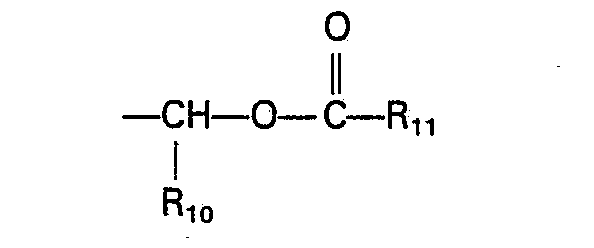


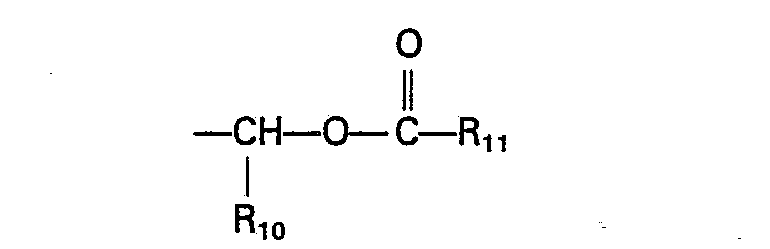


Priority Applications (1)
| Application Number | Priority Date | Filing Date | Title |
|---|---|---|---|
| AT84400293T ATE34388T1 (en) | 1983-02-28 | 1984-02-14 | THIAZINE AND THIAZEPIN CONTAINING COMPOUNDS. |
Applications Claiming Priority (2)
| Application Number | Priority Date | Filing Date | Title |
|---|---|---|---|
| US06/470,882 US4460579A (en) | 1983-02-28 | 1983-02-28 | Thiazine and thiazepine containing compounds |
| US470882 | 1983-02-28 |
Publications (2)
| Publication Number | Publication Date |
|---|---|
| EP0120728A1 EP0120728A1 (en) | 1984-10-03 |
| EP0120728B1 true EP0120728B1 (en) | 1988-05-18 |
Family
ID=23869447
Family Applications (1)
| Application Number | Title | Priority Date | Filing Date |
|---|---|---|---|
| EP84400293A Expired EP0120728B1 (en) | 1983-02-28 | 1984-02-14 | Thiazine and thiazepine containing compounds |
Country Status (6)
| Country | Link |
|---|---|
| US (1) | US4460579A (en) |
| EP (1) | EP0120728B1 (en) |
| JP (1) | JPS59167577A (en) |
| AT (1) | ATE34388T1 (en) |
| CA (1) | CA1219862A (en) |
| DE (1) | DE3471305D1 (en) |
Families Citing this family (31)
| Publication number | Priority date | Publication date | Assignee | Title |
|---|---|---|---|---|
| WO1984004306A1 (en) * | 1983-04-22 | 1984-11-08 | Takeda Chemical Industries Ltd | Fused 7-membered ring compounds and process for their preparation |
| WO1985004402A1 (en) * | 1984-03-24 | 1985-10-10 | Takeda Chemical Industries, Ltd. | Fused 7-membered ring compounds and process for their preparation |
| US4564612A (en) * | 1983-04-22 | 1986-01-14 | Takeda Chemical Industries, Ltd. | Condensed, seven-membered ring compounds and their use |
| JPS608284A (en) * | 1983-06-29 | 1985-01-17 | Mitsui Toatsu Chem Inc | Benzothiazepine derivative and its preparation |
| JPS608283A (en) * | 1983-06-29 | 1985-01-17 | Mitsui Toatsu Chem Inc | Benzothiazepine derivative and its preparation |
| US4638000A (en) * | 1983-08-12 | 1987-01-20 | Takeda Chemical Industries, Ltd. | Condensed seven-membered ring compounds, their production and use |
| JPS60174775A (en) * | 1984-02-21 | 1985-09-09 | Mitsui Toatsu Chem Inc | Benzothiazepine derivative |
| US4512988A (en) * | 1984-03-01 | 1985-04-23 | E. R. Squibb & Sons, Inc. | Acylamino oxo or hydroxy substituted alkylamino thiazines and thiazepines |
| US4699905A (en) * | 1984-04-10 | 1987-10-13 | Sankyo Company, Limited | Perhydrothiazepine derivatives, their preparation and their therapeutic use |
| JPS6165894A (en) * | 1984-09-08 | 1986-04-04 | Shionogi & Co Ltd | Thiazine phosphonic acid derivative, its preparation and insecticide |
| JPS61148171A (en) * | 1984-12-21 | 1986-07-05 | Mitsui Toatsu Chem Inc | Benzothiazepine derivative |
| JPH07113020B2 (en) * | 1985-09-12 | 1995-12-06 | 三共株式会社 | Process for producing perhydro-1,4-thiazepine derivative |
| DK173287A (en) * | 1986-04-04 | 1987-10-05 | Sankyo Co | PERHYDROTHIAZEPINE AND PERHYDROAZEPINE DERIVATIVES AND PROCEDURES FOR PREPARING THEREOF |
| JPH07116224B2 (en) * | 1987-12-29 | 1995-12-13 | 吉富製薬株式会社 | Benzolactam compound |
| US5552397A (en) * | 1992-05-18 | 1996-09-03 | E. R. Squibb & Sons, Inc. | Substituted azepinone dual inhibitors of angiotensin converting enzyme and neutral exdopeptidase |
| RU2124503C1 (en) | 1992-05-18 | 1999-01-10 | И.Р.Сквибб энд Санз, Инк. | Heterocyclic nitrogen-containing derivatives of carboxylic acid, method of their synthesis, pharmaceutical composition |
| US5504080A (en) * | 1992-10-28 | 1996-04-02 | Bristol-Myers Squibb Co. | Benzo-fused lactams |
| US5654294A (en) * | 1993-05-13 | 1997-08-05 | Bristol-Myers Squibb | Spiro lactam dual action inhibitors |
| US5508272A (en) * | 1993-06-15 | 1996-04-16 | Bristol-Myers Squibb Company | Compounds containing a fused bicycle ring and processes therefor |
| US5362727A (en) * | 1993-07-26 | 1994-11-08 | Bristol-Myers Squibb | Substituted azepino[2,1-a]isoquinoline compounds |
| US5525723A (en) * | 1993-11-18 | 1996-06-11 | Bristol-Myers Squibb Co. | Compounds containing a fused multiple ring lactam |
| JP2664865B2 (en) * | 1994-01-13 | 1997-10-22 | 三共株式会社 | Method for producing perhydro-1,4-thiazepine derivative |
| US5616775A (en) * | 1994-05-05 | 1997-04-01 | Bristol-Myers Squibb Co. | Process for preparing homocystein analogs useful as intermediates for compounds containing a fused bicyclic ring |
| US5587375A (en) * | 1995-02-17 | 1996-12-24 | Bristol-Myers Squibb Company | Azepinone compounds useful in the inhibition of ACE and NEP |
| US5877313A (en) * | 1995-05-17 | 1999-03-02 | Bristol-Myers Squibb | Benzo-fused azepinone and piperidinone compounds useful in the inhibition of ACE and NEP |
| US5650408A (en) * | 1995-06-07 | 1997-07-22 | Karanewsky; Donald S. | Thiazolo benzazepine containing dual action inhibitors |
| US5635504A (en) * | 1995-06-07 | 1997-06-03 | Bristol-Myers Squibb Co. | Diazepine containing dual action inhibitors |
| US6635632B1 (en) | 1996-12-23 | 2003-10-21 | Athena Neurosciences, Inc. | Cycloalkyl, lactam, lactone and related compounds, pharmaceutical compositions comprising same, and methods for inhibiting β-amyloid peptide release and/or its synthesis by use of such compounds |
| US6683075B1 (en) | 1996-12-23 | 2004-01-27 | Athena Neurosciences, Inc. | Cycloalkyl, lactam, lactone and related compounds, pharmaceutical compositions comprising same, and methods for inhibiting β-amyloid peptide release and/or its synthesis by use |
| US6958330B1 (en) | 1998-06-22 | 2005-10-25 | Elan Pharmaceuticals, Inc. | Polycyclic α-amino-ε-caprolactams and related compounds |
| FR2781483A1 (en) * | 1998-07-21 | 2000-01-28 | Hoechst Marion Roussel Inc | Thioazepinone derivatives having Src domain SH2 inhibiting and osteoclast-mediated calcium resorption from bone inhibiting activity, for treatment of osteoporosis |
Family Cites Families (9)
| Publication number | Priority date | Publication date | Assignee | Title |
|---|---|---|---|---|
| BR6915295D0 (en) * | 1969-01-25 | 1973-04-12 | Tanabe Seiyaku Co | CHRONOLOGICAL INDICATOR OF EVENT IN TELEVISED TRANSMISSION |
| US3691163A (en) * | 1970-08-03 | 1972-09-12 | Exxon Research Engineering Co | Certain phosphorus-containing thiomorpholinones |
| GR74635B (en) * | 1980-08-18 | 1984-06-29 | Merck & Co Inc | |
| IL63540A0 (en) * | 1980-08-18 | 1981-11-30 | Merck & Co Inc | Substituted enantholactam derivatives as antihypertensives |
| GR74625B (en) * | 1980-08-18 | 1984-06-29 | Merck & Co Inc | |
| US4379146A (en) * | 1981-02-17 | 1983-04-05 | Merck & Co., Inc. | Substituted phosphonamides as antihypertensives |
| JPS58116477A (en) * | 1981-06-05 | 1983-07-11 | メルク・エンド・カムパニ−・インコ−ポレ−テツド | Antihypertensive perhydro-1,4-thiazepin-5-one and perhydro-1,4-thiazocin-5-one derivative |
| EP0068173B1 (en) * | 1981-06-05 | 1984-09-26 | Merck & Co. Inc. | Perhydro-1,4-thiazepin-5-one and perhydro-1,4-thiazocin-5-one derivatives, process for preparing and pharmceutical composition containing the same |
| US4474955A (en) * | 1981-06-17 | 1984-10-02 | Vincenzo Iannella | Process for preparing 4-hydroxy-2-methyl-2H-1,2-benzothiazine-3-[N-(2-pyridinyl)carboxamide]-1,1-dioxide, and its phosphoric ester |
-
1983
- 1983-02-28 US US06/470,882 patent/US4460579A/en not_active Expired - Fee Related
-
1984
- 1984-02-10 CA CA000447163A patent/CA1219862A/en not_active Expired
- 1984-02-14 AT AT84400293T patent/ATE34388T1/en active
- 1984-02-14 EP EP84400293A patent/EP0120728B1/en not_active Expired
- 1984-02-14 DE DE8484400293T patent/DE3471305D1/en not_active Expired
- 1984-02-28 JP JP59038452A patent/JPS59167577A/en active Pending
Also Published As
| Publication number | Publication date |
|---|---|
| DE3471305D1 (en) | 1988-06-23 |
| EP0120728A1 (en) | 1984-10-03 |
| JPS59167577A (en) | 1984-09-21 |
| US4460579A (en) | 1984-07-17 |
| ATE34388T1 (en) | 1988-06-15 |
| CA1219862A (en) | 1987-03-31 |
Similar Documents
| Publication | Publication Date | Title |
|---|---|---|
| CA1219862A (en) | Thiazine and thiazepine containing compounds | |
| EP0097534B1 (en) | Phosphonyl hydroxyacyl amino acid derivatives as antihypertensives | |
| EP0083172B1 (en) | Phosphorus containing compounds | |
| EP0097050B1 (en) | Esters of phosphinylalkanoyl substituted prolines | |
| EP0053902B1 (en) | Phosphinylalkanoyl substituted prolines | |
| EP0063896B1 (en) | Amino and substituted amino phosphinyl-alkanoyl compositions | |
| EP0009183B1 (en) | Phosphoryl aminoacid derivatives and composition for treating hypertension containing the same | |
| US5650408A (en) | Thiazolo benzazepine containing dual action inhibitors | |
| EP0099785B1 (en) | Amino and substituted amino phosphinylalkanoyl compounds | |
| EP0094687B1 (en) | Phosphinylalkanoyl substituted imino acids | |
| GB2210043A (en) | Phosphinylcycloalkylcarbonyl and phosphinylcycloalkenylcarbonyl dipeptides | |
| CA2226414A1 (en) | Phosphorous-containing cysteine and serine protease inhibitors | |
| JPS6226288A (en) | Phosphorus-containing enzyme inhibitor | |
| US4711884A (en) | Thiazine and thiazepine containing compounds | |
| EP0154904B1 (en) | Acylamino oxo or hydroxy substituted alkylamino thiazines and thiazepines | |
| EP0071544A1 (en) | Phosphonamidate compounds | |
| US4533661A (en) | Certain 3-phosphinyl-amino-2-oxo-1H-azepine-1-acetic acid derivatives having anti-hypertensive activity | |
| FI85862C (en) | FOERFARANDE FOER FRAMSTAELLNING AV NYA TERAPEUTISKT ANVAENDBARA FOSFONYLHYDROXIACYLPROLINER. | |
| US4567167A (en) | Certain 3-phosphinyl-2-oxo-piperidine-1-acetic acid derivatives having anti-hypertensive activity | |
| EP0249445A2 (en) | Substituted aminoalkanoylaminoalkyl phosphonate angiotensin converting enzyme inhibitors | |
| US4598071A (en) | Certain 3-phosphinyl-amino-2-oxo-1H-azocine or azonine-1-acetic acid derivatives having anti-hypertensive properties | |
| HU201302B (en) | Process for production of peridiazodiazepines and medical compositions contqining them | |
| AU632596B2 (en) | Phosphonate substituted amino or imino acids useful as antihypertensives | |
| US4900860A (en) | Process for preparing phosphonyloxyacyl amino acids | |
| US4885380A (en) | Process for preparing phosphonyloxyacyl amino acids and derivatives thereof |
Legal Events
| Date | Code | Title | Description |
|---|---|---|---|
| PUAI | Public reference made under article 153(3) epc to a published international application that has entered the european phase |
Free format text: ORIGINAL CODE: 0009012 |
|
| AK | Designated contracting states |
Designated state(s): AT BE CH DE FR GB IT LI LU NL SE |
|
| 17P | Request for examination filed |
Effective date: 19850304 |
|
| 17Q | First examination report despatched |
Effective date: 19861105 |
|
| GRAA | (expected) grant |
Free format text: ORIGINAL CODE: 0009210 |
|
| AK | Designated contracting states |
Kind code of ref document: B1 Designated state(s): AT BE CH DE FR GB IT LI LU NL SE |
|
| REF | Corresponds to: |
Ref document number: 34388 Country of ref document: AT Date of ref document: 19880615 Kind code of ref document: T |
|
| ITF | It: translation for a ep patent filed | ||
| REF | Corresponds to: |
Ref document number: 3471305 Country of ref document: DE Date of ref document: 19880623 |
|
| ET | Fr: translation filed | ||
| PG25 | Lapsed in a contracting state [announced via postgrant information from national office to epo] |
Ref country code: GB Effective date: 19890214 |
|
| PG25 | Lapsed in a contracting state [announced via postgrant information from national office to epo] |
Ref country code: LU Free format text: LAPSE BECAUSE OF NON-PAYMENT OF DUE FEES Effective date: 19890228 |
|
| PLBE | No opposition filed within time limit |
Free format text: ORIGINAL CODE: 0009261 |
|
| STAA | Information on the status of an ep patent application or granted ep patent |
Free format text: STATUS: NO OPPOSITION FILED WITHIN TIME LIMIT |
|
| 26N | No opposition filed | ||
| GBPC | Gb: european patent ceased through non-payment of renewal fee | ||
| PGFP | Annual fee paid to national office [announced via postgrant information from national office to epo] |
Ref country code: CH Payment date: 19920228 Year of fee payment: 9 |
|
| ITTA | It: last paid annual fee | ||
| PGFP | Annual fee paid to national office [announced via postgrant information from national office to epo] |
Ref country code: NL Payment date: 19920229 Year of fee payment: 9 |
|
| PGFP | Annual fee paid to national office [announced via postgrant information from national office to epo] |
Ref country code: BE Payment date: 19920407 Year of fee payment: 9 |
|
| PGFP | Annual fee paid to national office [announced via postgrant information from national office to epo] |
Ref country code: DE Payment date: 19920429 Year of fee payment: 9 |
|
| PGFP | Annual fee paid to national office [announced via postgrant information from national office to epo] |
Ref country code: SE Payment date: 19921111 Year of fee payment: 10 |
|
| PGFP | Annual fee paid to national office [announced via postgrant information from national office to epo] |
Ref country code: AT Payment date: 19921214 Year of fee payment: 10 |
|
| PGFP | Annual fee paid to national office [announced via postgrant information from national office to epo] |
Ref country code: FR Payment date: 19921229 Year of fee payment: 10 |
|
| PG25 | Lapsed in a contracting state [announced via postgrant information from national office to epo] |
Ref country code: SE Effective date: 19930215 |
|
| PG25 | Lapsed in a contracting state [announced via postgrant information from national office to epo] |
Ref country code: LI Effective date: 19930228 Ref country code: CH Effective date: 19930228 Ref country code: BE Effective date: 19930228 |
|
| BERE | Be: lapsed |
Owner name: E.R. SQUIBB & SONS INC. Effective date: 19930228 |
|
| PG25 | Lapsed in a contracting state [announced via postgrant information from national office to epo] |
Ref country code: NL Effective date: 19930901 |
|
| NLV4 | Nl: lapsed or anulled due to non-payment of the annual fee | ||
| REG | Reference to a national code |
Ref country code: CH Ref legal event code: PL |
|
| PG25 | Lapsed in a contracting state [announced via postgrant information from national office to epo] |
Ref country code: DE Effective date: 19931103 |
|
| PG25 | Lapsed in a contracting state [announced via postgrant information from national office to epo] |
Ref country code: AT Effective date: 19940214 |
|
| PG25 | Lapsed in a contracting state [announced via postgrant information from national office to epo] |
Ref country code: FR Effective date: 19941031 |
|
| REG | Reference to a national code |
Ref country code: FR Ref legal event code: ST |
|
| EUG | Se: european patent has lapsed |
Ref document number: 84400293.1 Effective date: 19930912 |
|
| PG25 | Lapsed in a contracting state [announced via postgrant information from national office to epo] |
Ref country code: FR Effective date: 19930228 |