EP0120693A1 - Maltogenic amylase enzyme product, preparation and use thereof - Google Patents
Maltogenic amylase enzyme product, preparation and use thereof Download PDFInfo
- Publication number
- EP0120693A1 EP0120693A1 EP84301994A EP84301994A EP0120693A1 EP 0120693 A1 EP0120693 A1 EP 0120693A1 EP 84301994 A EP84301994 A EP 84301994A EP 84301994 A EP84301994 A EP 84301994A EP 0120693 A1 EP0120693 A1 EP 0120693A1
- Authority
- EP
- European Patent Office
- Prior art keywords
- plasmid
- amylase
- enzyme
- maltogenic amylase
- process according
- Prior art date
- Legal status (The legal status is an assumption and is not a legal conclusion. Google has not performed a legal analysis and makes no representation as to the accuracy of the status listed.)
- Granted
Links
- 108010061330 glucan 1,4-alpha-maltohydrolase Proteins 0.000 title claims description 51
- 238000002360 preparation method Methods 0.000 title claims description 12
- 102000004190 Enzymes Human genes 0.000 claims abstract description 38
- 108090000790 Enzymes Proteins 0.000 claims abstract description 38
- 244000005700 microbiome Species 0.000 claims abstract description 25
- 241000193830 Bacillus <bacterium> Species 0.000 claims abstract description 23
- 108090000623 proteins and genes Proteins 0.000 claims abstract description 16
- 239000013612 plasmid Substances 0.000 claims description 65
- 230000000694 effects Effects 0.000 claims description 32
- 238000000034 method Methods 0.000 claims description 31
- 108010065511 Amylases Proteins 0.000 claims description 29
- 239000004382 Amylase Substances 0.000 claims description 28
- OWEGMIWEEQEYGQ-UHFFFAOYSA-N 100676-05-9 Natural products OC1C(O)C(O)C(CO)OC1OCC1C(O)C(O)C(O)C(OC2C(OC(O)C(O)C2O)CO)O1 OWEGMIWEEQEYGQ-UHFFFAOYSA-N 0.000 claims description 26
- GUBGYTABKSRVRQ-PICCSMPSSA-N Maltose Natural products O[C@@H]1[C@@H](O)[C@H](O)[C@@H](CO)O[C@@H]1O[C@@H]1[C@@H](CO)OC(O)[C@H](O)[C@H]1O GUBGYTABKSRVRQ-PICCSMPSSA-N 0.000 claims description 26
- 235000014469 Bacillus subtilis Nutrition 0.000 claims description 25
- 102000013142 Amylases Human genes 0.000 claims description 24
- 235000019418 amylase Nutrition 0.000 claims description 23
- 241000588724 Escherichia coli Species 0.000 claims description 18
- 229920002472 Starch Polymers 0.000 claims description 18
- 239000008107 starch Substances 0.000 claims description 18
- 235000019698 starch Nutrition 0.000 claims description 18
- 108091008146 restriction endonucleases Proteins 0.000 claims description 16
- IJGRMHOSHXDMSA-UHFFFAOYSA-N Atomic nitrogen Chemical compound N#N IJGRMHOSHXDMSA-UHFFFAOYSA-N 0.000 claims description 14
- 244000063299 Bacillus subtilis Species 0.000 claims description 13
- 108091028043 Nucleic acid sequence Proteins 0.000 claims description 9
- 239000002609 medium Substances 0.000 claims description 9
- 235000020357 syrup Nutrition 0.000 claims description 9
- 239000006188 syrup Substances 0.000 claims description 9
- 238000005520 cutting process Methods 0.000 claims description 8
- 239000013611 chromosomal DNA Substances 0.000 claims description 7
- 239000012634 fragment Substances 0.000 claims description 7
- 229910052757 nitrogen Inorganic materials 0.000 claims description 7
- 235000015097 nutrients Nutrition 0.000 claims description 7
- 229910052799 carbon Inorganic materials 0.000 claims description 6
- 238000004519 manufacturing process Methods 0.000 claims description 6
- OKTJSMMVPCPJKN-UHFFFAOYSA-N Carbon Chemical compound [C] OKTJSMMVPCPJKN-UHFFFAOYSA-N 0.000 claims description 5
- 150000003839 salts Chemical class 0.000 claims description 5
- 239000007787 solid Substances 0.000 claims description 5
- 230000001131 transforming effect Effects 0.000 claims description 5
- 230000000593 degrading effect Effects 0.000 claims description 4
- 239000012736 aqueous medium Substances 0.000 claims description 3
- 230000001747 exhibiting effect Effects 0.000 claims description 2
- 239000002773 nucleotide Substances 0.000 claims description 2
- 125000003729 nucleotide group Chemical group 0.000 claims description 2
- 230000010076 replication Effects 0.000 claims 1
- 241000193385 Geobacillus stearothermophilus Species 0.000 abstract description 3
- 229940088598 enzyme Drugs 0.000 description 34
- 239000000872 buffer Substances 0.000 description 22
- WQZGKKKJIJFFOK-GASJEMHNSA-N Glucose Natural products OC[C@H]1OC(O)[C@H](O)[C@@H](O)[C@@H]1O WQZGKKKJIJFFOK-GASJEMHNSA-N 0.000 description 19
- 239000008103 glucose Substances 0.000 description 19
- 239000000758 substrate Substances 0.000 description 19
- 108020004414 DNA Proteins 0.000 description 18
- LFQSCWFLJHTTHZ-UHFFFAOYSA-N Ethanol Chemical compound CCO LFQSCWFLJHTTHZ-UHFFFAOYSA-N 0.000 description 18
- FAPWRFPIFSIZLT-UHFFFAOYSA-M Sodium chloride Chemical compound [Na+].[Cl-] FAPWRFPIFSIZLT-UHFFFAOYSA-M 0.000 description 18
- XLYOFNOQVPJJNP-UHFFFAOYSA-N water Chemical compound O XLYOFNOQVPJJNP-UHFFFAOYSA-N 0.000 description 17
- 239000000203 mixture Substances 0.000 description 16
- 239000000047 product Substances 0.000 description 16
- 229960005091 chloramphenicol Drugs 0.000 description 14
- WIIZWVCIJKGZOK-RKDXNWHRSA-N chloramphenicol Chemical compound ClC(Cl)C(=O)N[C@H](CO)[C@H](O)C1=CC=C([N+]([O-])=O)C=C1 WIIZWVCIJKGZOK-RKDXNWHRSA-N 0.000 description 14
- 108010019077 beta-Amylase Proteins 0.000 description 13
- DBTMGCOVALSLOR-UHFFFAOYSA-N 32-alpha-galactosyl-3-alpha-galactosyl-galactose Natural products OC1C(O)C(O)C(CO)OC1OC1C(O)C(OC2C(C(CO)OC(O)C2O)O)OC(CO)C1O DBTMGCOVALSLOR-UHFFFAOYSA-N 0.000 description 12
- RXVWSYJTUUKTEA-UHFFFAOYSA-N D-maltotriose Natural products OC1C(O)C(OC(C(O)CO)C(O)C(O)C=O)OC(CO)C1OC1C(O)C(O)C(O)C(CO)O1 RXVWSYJTUUKTEA-UHFFFAOYSA-N 0.000 description 12
- HEMHJVSKTPXQMS-UHFFFAOYSA-M Sodium hydroxide Chemical compound [OH-].[Na+] HEMHJVSKTPXQMS-UHFFFAOYSA-M 0.000 description 12
- FYGDTMLNYKFZSV-UHFFFAOYSA-N mannotriose Natural products OC1C(O)C(O)C(CO)OC1OC1C(CO)OC(OC2C(OC(O)C(O)C2O)CO)C(O)C1O FYGDTMLNYKFZSV-UHFFFAOYSA-N 0.000 description 12
- FYGDTMLNYKFZSV-BYLHFPJWSA-N β-1,4-galactotrioside Chemical compound O[C@@H]1[C@@H](O)[C@H](O)[C@@H](CO)O[C@H]1O[C@@H]1[C@H](CO)O[C@@H](O[C@@H]2[C@@H](O[C@@H](O)[C@H](O)[C@H]2O)CO)[C@H](O)[C@H]1O FYGDTMLNYKFZSV-BYLHFPJWSA-N 0.000 description 12
- 229920001817 Agar Polymers 0.000 description 11
- 239000008272 agar Substances 0.000 description 11
- 239000003153 chemical reaction reagent Substances 0.000 description 11
- TWRXJAOTZQYOKJ-UHFFFAOYSA-L Magnesium chloride Chemical compound [Mg+2].[Cl-].[Cl-] TWRXJAOTZQYOKJ-UHFFFAOYSA-L 0.000 description 10
- ISWSIDIOOBJBQZ-UHFFFAOYSA-N Phenol Chemical compound OC1=CC=CC=C1 ISWSIDIOOBJBQZ-UHFFFAOYSA-N 0.000 description 10
- 239000007983 Tris buffer Substances 0.000 description 10
- 238000000855 fermentation Methods 0.000 description 10
- 230000004151 fermentation Effects 0.000 description 10
- LENZDBCJOHFCAS-UHFFFAOYSA-N tris Chemical compound OCC(N)(CO)CO LENZDBCJOHFCAS-UHFFFAOYSA-N 0.000 description 10
- 229910001868 water Inorganic materials 0.000 description 10
- 239000011780 sodium chloride Substances 0.000 description 9
- 239000008351 acetate buffer Substances 0.000 description 8
- KCXVZYZYPLLWCC-UHFFFAOYSA-N EDTA Chemical compound OC(=O)CN(CC(O)=O)CCN(CC(O)=O)CC(O)=O KCXVZYZYPLLWCC-UHFFFAOYSA-N 0.000 description 7
- 229920000945 Amylopectin Polymers 0.000 description 6
- PEDCQBHIVMGVHV-UHFFFAOYSA-N Glycerine Chemical compound OCC(O)CO PEDCQBHIVMGVHV-UHFFFAOYSA-N 0.000 description 6
- 238000011534 incubation Methods 0.000 description 6
- 230000035484 reaction time Effects 0.000 description 6
- 238000012360 testing method Methods 0.000 description 6
- 238000005119 centrifugation Methods 0.000 description 5
- ZMMJGEGLRURXTF-UHFFFAOYSA-N ethidium bromide Chemical compound [Br-].C12=CC(N)=CC=C2C2=CC=C(N)C=C2[N+](CC)=C1C1=CC=CC=C1 ZMMJGEGLRURXTF-UHFFFAOYSA-N 0.000 description 5
- 229910001629 magnesium chloride Inorganic materials 0.000 description 5
- 239000006152 selective media Substances 0.000 description 5
- ZCYVEMRRCGMTRW-UHFFFAOYSA-N 7553-56-2 Chemical compound [I] ZCYVEMRRCGMTRW-UHFFFAOYSA-N 0.000 description 4
- HEDRZPFGACZZDS-UHFFFAOYSA-N Chloroform Chemical compound ClC(Cl)Cl HEDRZPFGACZZDS-UHFFFAOYSA-N 0.000 description 4
- 229920000858 Cyclodextrin Polymers 0.000 description 4
- 239000001828 Gelatine Substances 0.000 description 4
- KFZMGEQAYNKOFK-UHFFFAOYSA-N Isopropanol Chemical compound CC(C)O KFZMGEQAYNKOFK-UHFFFAOYSA-N 0.000 description 4
- 229940025131 amylases Drugs 0.000 description 4
- WQZGKKKJIJFFOK-VFUOTHLCSA-N beta-D-glucose Chemical compound OC[C@H]1O[C@@H](O)[C@H](O)[C@@H](O)[C@@H]1O WQZGKKKJIJFFOK-VFUOTHLCSA-N 0.000 description 4
- GUBGYTABKSRVRQ-QUYVBRFLSA-N beta-maltose Chemical compound OC[C@H]1O[C@H](O[C@H]2[C@H](O)[C@@H](O)[C@H](O)O[C@@H]2CO)[C@H](O)[C@@H](O)[C@@H]1O GUBGYTABKSRVRQ-QUYVBRFLSA-N 0.000 description 4
- AIYUHDOJVYHVIT-UHFFFAOYSA-M caesium chloride Chemical compound [Cl-].[Cs+] AIYUHDOJVYHVIT-UHFFFAOYSA-M 0.000 description 4
- 229920000159 gelatin Polymers 0.000 description 4
- 235000019322 gelatine Nutrition 0.000 description 4
- 239000001963 growth medium Substances 0.000 description 4
- 230000007062 hydrolysis Effects 0.000 description 4
- 238000006460 hydrolysis reaction Methods 0.000 description 4
- 229910052740 iodine Inorganic materials 0.000 description 4
- 239000011630 iodine Substances 0.000 description 4
- 230000000813 microbial effect Effects 0.000 description 4
- 239000000243 solution Substances 0.000 description 4
- 239000006228 supernatant Substances 0.000 description 4
- 229930101283 tetracycline Natural products 0.000 description 4
- 230000009466 transformation Effects 0.000 description 4
- LWIHDJKSTIGBAC-UHFFFAOYSA-K tripotassium phosphate Chemical compound [K+].[K+].[K+].[O-]P([O-])([O-])=O LWIHDJKSTIGBAC-UHFFFAOYSA-K 0.000 description 4
- NWXMGUDVXFXRIG-WESIUVDSSA-N (4s,4as,5as,6s,12ar)-4-(dimethylamino)-1,6,10,11,12a-pentahydroxy-6-methyl-3,12-dioxo-4,4a,5,5a-tetrahydrotetracene-2-carboxamide Chemical compound C1=CC=C2[C@](O)(C)[C@H]3C[C@H]4[C@H](N(C)C)C(=O)C(C(N)=O)=C(O)[C@@]4(O)C(=O)C3=C(O)C2=C1O NWXMGUDVXFXRIG-WESIUVDSSA-N 0.000 description 3
- QTBSBXVTEAMEQO-UHFFFAOYSA-N Acetic acid Chemical compound CC(O)=O QTBSBXVTEAMEQO-UHFFFAOYSA-N 0.000 description 3
- 241000193752 Bacillus circulans Species 0.000 description 3
- 241000196324 Embryophyta Species 0.000 description 3
- 241001646716 Escherichia coli K-12 Species 0.000 description 3
- 229920002527 Glycogen Polymers 0.000 description 3
- 229930006000 Sucrose Natural products 0.000 description 3
- CZMRCDWAGMRECN-UGDNZRGBSA-N Sucrose Chemical compound O[C@H]1[C@H](O)[C@@H](CO)O[C@@]1(CO)O[C@@H]1[C@H](O)[C@@H](O)[C@H](O)[C@@H](CO)O1 CZMRCDWAGMRECN-UGDNZRGBSA-N 0.000 description 3
- KRKNYBCHXYNGOX-UHFFFAOYSA-N citric acid Chemical compound OC(=O)CC(O)(C(O)=O)CC(O)=O KRKNYBCHXYNGOX-UHFFFAOYSA-N 0.000 description 3
- 229940097362 cyclodextrins Drugs 0.000 description 3
- 239000008367 deionised water Substances 0.000 description 3
- 229910021641 deionized water Inorganic materials 0.000 description 3
- 229940096919 glycogen Drugs 0.000 description 3
- 239000002054 inoculum Substances 0.000 description 3
- 239000007788 liquid Substances 0.000 description 3
- 102000004169 proteins and genes Human genes 0.000 description 3
- 238000011084 recovery Methods 0.000 description 3
- 239000005720 sucrose Substances 0.000 description 3
- 125000003396 thiol group Chemical group [H]S* 0.000 description 3
- 229920000856 Amylose Polymers 0.000 description 2
- 241000894006 Bacteria Species 0.000 description 2
- UXVMQQNJUSDDNG-UHFFFAOYSA-L Calcium chloride Chemical compound [Cl-].[Cl-].[Ca+2] UXVMQQNJUSDDNG-UHFFFAOYSA-L 0.000 description 2
- 102000012410 DNA Ligases Human genes 0.000 description 2
- 108010061982 DNA Ligases Proteins 0.000 description 2
- 229920001353 Dextrin Polymers 0.000 description 2
- 239000004375 Dextrin Substances 0.000 description 2
- DHMQDGOQFOQNFH-UHFFFAOYSA-N Glycine Chemical compound NCC(O)=O DHMQDGOQFOQNFH-UHFFFAOYSA-N 0.000 description 2
- 244000068988 Glycine max Species 0.000 description 2
- 235000010469 Glycine max Nutrition 0.000 description 2
- 239000006142 Luria-Bertani Agar Substances 0.000 description 2
- 108010014251 Muramidase Proteins 0.000 description 2
- 102000016943 Muramidase Human genes 0.000 description 2
- 108010062010 N-Acetylmuramoyl-L-alanine Amidase Proteins 0.000 description 2
- 108020002230 Pancreatic Ribonuclease Proteins 0.000 description 2
- 102000005891 Pancreatic ribonuclease Human genes 0.000 description 2
- 229920002684 Sepharose Polymers 0.000 description 2
- 241000191967 Staphylococcus aureus Species 0.000 description 2
- QAOWNCQODCNURD-UHFFFAOYSA-N Sulfuric acid Chemical compound OS(O)(=O)=O QAOWNCQODCNURD-UHFFFAOYSA-N 0.000 description 2
- 230000001580 bacterial effect Effects 0.000 description 2
- 230000015572 biosynthetic process Effects 0.000 description 2
- 239000007853 buffer solution Substances 0.000 description 2
- 239000001110 calcium chloride Substances 0.000 description 2
- 229910001628 calcium chloride Inorganic materials 0.000 description 2
- 229940041514 candida albicans extract Drugs 0.000 description 2
- 239000007979 citrate buffer Substances 0.000 description 2
- 238000003776 cleavage reaction Methods 0.000 description 2
- 238000010367 cloning Methods 0.000 description 2
- 235000009508 confectionery Nutrition 0.000 description 2
- 235000019425 dextrin Nutrition 0.000 description 2
- 238000010790 dilution Methods 0.000 description 2
- 239000012895 dilution Substances 0.000 description 2
- DNJIEGIFACGWOD-UHFFFAOYSA-N ethyl mercaptane Natural products CCS DNJIEGIFACGWOD-UHFFFAOYSA-N 0.000 description 2
- 238000001914 filtration Methods 0.000 description 2
- 238000001502 gel electrophoresis Methods 0.000 description 2
- 125000001475 halogen functional group Chemical group 0.000 description 2
- 230000001900 immune effect Effects 0.000 description 2
- 238000000760 immunoelectrophoresis Methods 0.000 description 2
- 229930027917 kanamycin Natural products 0.000 description 2
- 229960000318 kanamycin Drugs 0.000 description 2
- SBUJHOSQTJFQJX-NOAMYHISSA-N kanamycin Chemical compound O[C@@H]1[C@@H](O)[C@H](O)[C@@H](CN)O[C@@H]1O[C@H]1[C@H](O)[C@@H](O[C@@H]2[C@@H]([C@@H](N)[C@H](O)[C@@H](CO)O2)O)[C@H](N)C[C@@H]1N SBUJHOSQTJFQJX-NOAMYHISSA-N 0.000 description 2
- 229930182823 kanamycin A Natural products 0.000 description 2
- 239000004325 lysozyme Substances 0.000 description 2
- 229960000274 lysozyme Drugs 0.000 description 2
- 235000010335 lysozyme Nutrition 0.000 description 2
- 239000000463 material Substances 0.000 description 2
- 238000002156 mixing Methods 0.000 description 2
- 229930027945 nicotinamide-adenine dinucleotide Natural products 0.000 description 2
- BOPGDPNILDQYTO-NNYOXOHSSA-N nicotinamide-adenine dinucleotide Chemical compound C1=CCC(C(=O)N)=CN1[C@H]1[C@H](O)[C@H](O)[C@@H](COP(O)(=O)OP(O)(=O)OC[C@@H]2[C@H]([C@@H](O)[C@@H](O2)N2C3=NC=NC(N)=C3N=C2)O)O1 BOPGDPNILDQYTO-NNYOXOHSSA-N 0.000 description 2
- 229920002401 polyacrylamide Polymers 0.000 description 2
- 229910000160 potassium phosphate Inorganic materials 0.000 description 2
- 235000011009 potassium phosphates Nutrition 0.000 description 2
- 239000000843 powder Substances 0.000 description 2
- 230000000644 propagated effect Effects 0.000 description 2
- 239000012266 salt solution Substances 0.000 description 2
- 230000007017 scission Effects 0.000 description 2
- 238000010183 spectrum analysis Methods 0.000 description 2
- 239000012086 standard solution Substances 0.000 description 2
- 239000000126 substance Substances 0.000 description 2
- 239000001117 sulphuric acid Substances 0.000 description 2
- 235000011149 sulphuric acid Nutrition 0.000 description 2
- 239000012137 tryptone Substances 0.000 description 2
- 239000012138 yeast extract Substances 0.000 description 2
- DGVVWUTYPXICAM-UHFFFAOYSA-N β‐Mercaptoethanol Chemical compound OCCS DGVVWUTYPXICAM-UHFFFAOYSA-N 0.000 description 2
- QTBSBXVTEAMEQO-UHFFFAOYSA-M Acetate Chemical compound CC([O-])=O QTBSBXVTEAMEQO-UHFFFAOYSA-M 0.000 description 1
- 102000002260 Alkaline Phosphatase Human genes 0.000 description 1
- 108020004774 Alkaline Phosphatase Proteins 0.000 description 1
- 208000035404 Autolysis Diseases 0.000 description 1
- 241000194107 Bacillus megaterium Species 0.000 description 1
- 241000194106 Bacillus mycoides Species 0.000 description 1
- 241000276408 Bacillus subtilis subsp. subtilis str. 168 Species 0.000 description 1
- 108010073178 Glucan 1,4-alpha-Glucosidase Proteins 0.000 description 1
- 108010050375 Glucose 1-Dehydrogenase Proteins 0.000 description 1
- 239000004471 Glycine Substances 0.000 description 1
- 240000005979 Hordeum vulgare Species 0.000 description 1
- 235000007340 Hordeum vulgare Nutrition 0.000 description 1
- 244000017020 Ipomoea batatas Species 0.000 description 1
- 235000002678 Ipomoea batatas Nutrition 0.000 description 1
- 102000004195 Isomerases Human genes 0.000 description 1
- 108090000769 Isomerases Proteins 0.000 description 1
- 241000533950 Leucojum Species 0.000 description 1
- 102000003960 Ligases Human genes 0.000 description 1
- 108090000364 Ligases Proteins 0.000 description 1
- 229920002774 Maltodextrin Polymers 0.000 description 1
- 239000005913 Maltodextrin Substances 0.000 description 1
- 241000283973 Oryctolagus cuniculus Species 0.000 description 1
- 229910019142 PO4 Inorganic materials 0.000 description 1
- 241000194105 Paenibacillus polymyxa Species 0.000 description 1
- 102000004160 Phosphoric Monoester Hydrolases Human genes 0.000 description 1
- 108090000608 Phosphoric Monoester Hydrolases Proteins 0.000 description 1
- 229910000831 Steel Inorganic materials 0.000 description 1
- 239000004098 Tetracycline Substances 0.000 description 1
- 239000011543 agarose gel Substances 0.000 description 1
- HFHDHCJBZVLPGP-RWMJIURBSA-N alpha-cyclodextrin Chemical compound OC[C@H]([C@H]([C@@H]([C@H]1O)O)O[C@H]2O[C@@H]([C@@H](O[C@H]3O[C@H](CO)[C@H]([C@@H]([C@H]3O)O)O[C@H]3O[C@H](CO)[C@H]([C@@H]([C@H]3O)O)O[C@H]3O[C@H](CO)[C@H]([C@@H]([C@H]3O)O)O3)[C@H](O)[C@H]2O)CO)O[C@@H]1O[C@H]1[C@H](O)[C@@H](O)[C@@H]3O[C@@H]1CO HFHDHCJBZVLPGP-RWMJIURBSA-N 0.000 description 1
- 239000003242 anti bacterial agent Substances 0.000 description 1
- 229940088710 antibiotic agent Drugs 0.000 description 1
- 239000007864 aqueous solution Substances 0.000 description 1
- 238000003556 assay Methods 0.000 description 1
- 108010064866 biozym Proteins 0.000 description 1
- 244000309466 calf Species 0.000 description 1
- 150000001768 cations Chemical class 0.000 description 1
- 239000002738 chelating agent Substances 0.000 description 1
- 238000006243 chemical reaction Methods 0.000 description 1
- 239000007795 chemical reaction product Substances 0.000 description 1
- 239000003795 chemical substances by application Substances 0.000 description 1
- 238000010960 commercial process Methods 0.000 description 1
- 235000008504 concentrate Nutrition 0.000 description 1
- 239000012141 concentrate Substances 0.000 description 1
- 230000009849 deactivation Effects 0.000 description 1
- 238000006911 enzymatic reaction Methods 0.000 description 1
- 229960005542 ethidium bromide Drugs 0.000 description 1
- DEFVIWRASFVYLL-UHFFFAOYSA-N ethylene glycol bis(2-aminoethyl)tetraacetic acid Chemical compound OC(=O)CN(CC(O)=O)CCOCCOCCN(CC(O)=O)CC(O)=O DEFVIWRASFVYLL-UHFFFAOYSA-N 0.000 description 1
- 238000002474 experimental method Methods 0.000 description 1
- 239000000706 filtrate Substances 0.000 description 1
- 238000005194 fractionation Methods 0.000 description 1
- 238000004108 freeze drying Methods 0.000 description 1
- 230000002068 genetic effect Effects 0.000 description 1
- 150000004676 glycans Chemical class 0.000 description 1
- 238000003306 harvesting Methods 0.000 description 1
- 229910001385 heavy metal Inorganic materials 0.000 description 1
- 230000003053 immunization Effects 0.000 description 1
- 239000012133 immunoprecipitate Substances 0.000 description 1
- 208000015181 infectious disease Diseases 0.000 description 1
- 238000011081 inoculation Methods 0.000 description 1
- 238000003780 insertion Methods 0.000 description 1
- 230000037431 insertion Effects 0.000 description 1
- 210000000936 intestine Anatomy 0.000 description 1
- 150000002500 ions Chemical class 0.000 description 1
- 238000001155 isoelectric focusing Methods 0.000 description 1
- 238000002955 isolation Methods 0.000 description 1
- 229940035034 maltodextrin Drugs 0.000 description 1
- 238000012986 modification Methods 0.000 description 1
- 230000004048 modification Effects 0.000 description 1
- 239000008188 pellet Substances 0.000 description 1
- NBIIXXVUZAFLBC-UHFFFAOYSA-K phosphate Chemical compound [O-]P([O-])([O-])=O NBIIXXVUZAFLBC-UHFFFAOYSA-K 0.000 description 1
- 239000010452 phosphate Substances 0.000 description 1
- 239000008363 phosphate buffer Substances 0.000 description 1
- 229920001282 polysaccharide Polymers 0.000 description 1
- 239000005017 polysaccharide Substances 0.000 description 1
- 230000001737 promoting effect Effects 0.000 description 1
- 238000000746 purification Methods 0.000 description 1
- 239000011541 reaction mixture Substances 0.000 description 1
- 238000010188 recombinant method Methods 0.000 description 1
- 230000003362 replicative effect Effects 0.000 description 1
- 238000011160 research Methods 0.000 description 1
- 230000000717 retained effect Effects 0.000 description 1
- 210000002966 serum Anatomy 0.000 description 1
- 239000002689 soil Substances 0.000 description 1
- 230000028070 sporulation Effects 0.000 description 1
- 238000001694 spray drying Methods 0.000 description 1
- 239000010959 steel Substances 0.000 description 1
- 238000003756 stirring Methods 0.000 description 1
- 239000000725 suspension Substances 0.000 description 1
- 235000019605 sweet taste sensations Nutrition 0.000 description 1
- 229960002180 tetracycline Drugs 0.000 description 1
- 235000019364 tetracycline Nutrition 0.000 description 1
- 150000003522 tetracyclines Chemical class 0.000 description 1
- 238000004809 thin layer chromatography Methods 0.000 description 1
- 238000000108 ultra-filtration Methods 0.000 description 1
- 235000015099 wheat brans Nutrition 0.000 description 1
- 239000002023 wood Substances 0.000 description 1
Images


Classifications
-
- C—CHEMISTRY; METALLURGY
- C12—BIOCHEMISTRY; BEER; SPIRITS; WINE; VINEGAR; MICROBIOLOGY; ENZYMOLOGY; MUTATION OR GENETIC ENGINEERING
- C12N—MICROORGANISMS OR ENZYMES; COMPOSITIONS THEREOF; PROPAGATING, PRESERVING, OR MAINTAINING MICROORGANISMS; MUTATION OR GENETIC ENGINEERING; CULTURE MEDIA
- C12N9/00—Enzymes; Proenzymes; Compositions thereof; Processes for preparing, activating, inhibiting, separating or purifying enzymes
- C12N9/14—Hydrolases (3)
- C12N9/24—Hydrolases (3) acting on glycosyl compounds (3.2)
- C12N9/2402—Hydrolases (3) acting on glycosyl compounds (3.2) hydrolysing O- and S- glycosyl compounds (3.2.1)
- C12N9/2405—Glucanases
- C12N9/2408—Glucanases acting on alpha -1,4-glucosidic bonds
- C12N9/2411—Amylases
-
- C—CHEMISTRY; METALLURGY
- C12—BIOCHEMISTRY; BEER; SPIRITS; WINE; VINEGAR; MICROBIOLOGY; ENZYMOLOGY; MUTATION OR GENETIC ENGINEERING
- C12N—MICROORGANISMS OR ENZYMES; COMPOSITIONS THEREOF; PROPAGATING, PRESERVING, OR MAINTAINING MICROORGANISMS; MUTATION OR GENETIC ENGINEERING; CULTURE MEDIA
- C12N9/00—Enzymes; Proenzymes; Compositions thereof; Processes for preparing, activating, inhibiting, separating or purifying enzymes
- C12N9/14—Hydrolases (3)
- C12N9/24—Hydrolases (3) acting on glycosyl compounds (3.2)
- C12N9/2402—Hydrolases (3) acting on glycosyl compounds (3.2) hydrolysing O- and S- glycosyl compounds (3.2.1)
- C12N9/2405—Glucanases
- C12N9/2408—Glucanases acting on alpha -1,4-glucosidic bonds
-
- Y—GENERAL TAGGING OF NEW TECHNOLOGICAL DEVELOPMENTS; GENERAL TAGGING OF CROSS-SECTIONAL TECHNOLOGIES SPANNING OVER SEVERAL SECTIONS OF THE IPC; TECHNICAL SUBJECTS COVERED BY FORMER USPC CROSS-REFERENCE ART COLLECTIONS [XRACs] AND DIGESTS
- Y10—TECHNICAL SUBJECTS COVERED BY FORMER USPC
- Y10S—TECHNICAL SUBJECTS COVERED BY FORMER USPC CROSS-REFERENCE ART COLLECTIONS [XRACs] AND DIGESTS
- Y10S435/00—Chemistry: molecular biology and microbiology
- Y10S435/8215—Microorganisms
- Y10S435/822—Microorganisms using bacteria or actinomycetales
- Y10S435/832—Bacillus
Definitions
- ⁇ -amylases are maltogenic exo-amylases which hydrolyse a-1,4-glycosidic bonds from the non-reducing ends of amylose, amylopectin, or glycogen to produce the ⁇ -form of maltose.
- the s-form of maltose will isomerase spontaneously in aqueous solutions to a mixture of the a-and ⁇ -form.
- s-amylases may be used to produce maltose containing syrups of use in the confectionery -, baking -, and brewing industries.
- s-amylases have been isolated from various plants and microorganisms (W.M. Fogarty and C.T. Kelly, Progress in Industrial Microbiology, vol. 15, p. 112 - 115, 1973).
- the ⁇ -amylases known from plants (barley, sweet potato, and soy beans) and from the Bacillus species B. mycoides, B. megaterium, and B. polymyxa are all enzymes whose activity is inhibited by sulphydryl reagents, such as PCMB (parachloromecuribenzoate) thus indicating that the active site involves an SH-group.
- Bacillus circulans ⁇ -amylase is less than well suited for commercial use at about 65 - 70°C because of too rapid deactivation.
- the present invention is based upon the discovery that a novel extracellular maltogenic enzyme (C599 amylase) having such properties is produced from a newly isolated microorganism belonging to the Bacillus stearothermophilus complex.
- the present invention provides a maltogenic amylase enzyme product which comprises a novel thermostable maltogenic amylase having the following characteristics:
- the maltogenic amylase product may be in solid or liquid form. Solid forms will generally have an activity of 500 - 25000 U (as hereinafter defined) per gram.
- the present invention provides a process for the preparation of the above maltogenic, thermostable amylase enzyme product which process comprises the cultivation of the above mentioned Bacillus strain C599 or variants or mutants thereof productive of this enzyme in a suitable nutrient medium containing carbon and nitrogen sources and inorganic salts, optionally followed by recovery of the maltogenic amylase enzyme product.
- the gene coding for the novel thermostable maltogenic amylase has been transferred into another microorganism which produces, under appropriate conditions of cultivation, substantially greater amounts of the maltogenic amylase than are produced by the donor microorganism (C599).
- the present invention accordingly provides a method of preparing a maltogenic amylase enzyme product by transforming a suitable host microorganism with a recombinant plasmid containing a gene coding for the maltogenic, thermostable amylase and culti- . vating the transformed microorganism in a suitable nutrient medium containing carbon and nitrogen sources and inorganic salts optionally followed by recovery of said maltogenic amylase enzyme product.
- the present invention provides a method of producing a recombinant plasmid containing the gene coding for the thermostable maltogenic amylase which method comprises cutting with an appropriate restriction enzyme chromosomal DNA from a donor microorganism productive of amylase to obtain a linear DNA-sequence containing the amylase-coding gene, cutting a suitable vector to obtain a second linear DNA-sequence and ligating the two linear DNA-sequences to obtain a recombinant plasmid containing the amylase gene.
- the vector preferably an E.coli plasmid, is cut with an appropriate restriction enzyme that will give linear DNA with ends that can be joined to ends of the fragments of donor DNA.
- Ligation of the two linear sources of DNA-sequences is accomplished by means of a ligase using techniques well known in the art.
- the host microorganism is selected from the Bacillus group, preferably B.subtilis.
- Transformation of the host microorganism is also accomplished by well known methods including transforming of the recombinant plasmid into E.coli cells, identifying starch degrading transformants and subcloning the recombinant plasmid from such Amy + transformants into the chosen host microorganism.
- the host microorganism (which preferably does not display amylase activity) can upon acquisition of the said recombinant plasmid produce the novel maltogenic amylase when cultured on an appropriate culture medium.
- the amylase is secreted into the growth medium, thus providing a simple enzyme recovery step.
- the present invention also provides a new recombinant plasmid, pDN452, containing a gene coding for the said amylase which plasmid is prepared by cleaving chromosomal DNA from Bacillus C599 with the restriction enzyme Mbol, isolating DNA-fragments in the range of 4 - 12 kb (kilobase pairs), ligating with E.coli plasmid pACYC184, which has been cut with restriction enzyme BamHl, transforming into E.coli cells, identifying the starch degrading transformants which harbour plasmids containing the amylase gene, cutting said plasmids with a restriction enzyme Sau3Al, ligating the DNA-fragment expressing amylase activity with plasmid pBD64 which has been cut with the restriction enzyme BamHl and transforming the new recombinant plasmid into B.subtilis.
- pDN452 containing a gene coding for the said amylase which plasm
- Fig. 3 depicts the restriction endo-nuclease cleavage map for this novel plasmid pDN452.
- the novel plasmid is a 7.6 kb hybrid plasmid which comprises the nucleotide sequence of pBD64 and inserted at the BamHl site of this plasmid the DNA sequence from Bacillus C599 coding for the said amylase.
- the present invention provides a process for the production of high purity maltose syrups wherein starch is treated with the novel maltogenic amylase enzyme product in an aqueous medium.
- the industrial process of producing maltose syrups comprises-liquefying starch, then saccharification with a maltose producing enzyme, and optionally with an enzyme cleaving the 1.6- branching points in amylopectin, for instance an a-1.6- amyloglucosidase.
- novel enzyme of this invention in many respects reacts like the known s-amylases it differs therefrom in several essentials as will appear in the following detailed description and, consequently, the novel enzyme is characterized as a maltogenic amylase, rather than a 6-amylase.
- the novel enzyme migrates at SDS-polyacrylamid gelelectrophoresis as a single band indicating a molecular weight of about 70,000 Dalton.
- the isoelectric point determined by thin layer gelelectrofocusing is 8.5.
- C599 amylase hydrolyzes amylopectin, glycogen, and amylose, maltose constituting a substantial part of the reaction products.
- Glucose is generated in small amounts corresponding to 1 - 10% of the maltose formed.
- branched polysaccharides such as amylopectin and glycogen C599 amylase forms limit dextrins, which can be hydrolyzed by glycoamylase.
- Sulphydryl reagents such as para-chlor-meruri- benzoate and chelating agents, such as EDTA do not have any influence on the enzyme activity.
- C599 maltogenic amylase differs from the known ⁇ -amylases in the following respects:
- the maltogenic amylase according to the invention is an exoenzyme which attacks the a-l,4-glycosidic bonds the main hydrolysis product being a-maltose.
- maltogenic amylase of the present invention to cleave maltotriose present in the known maltose syrups quantitatively into maltose and glucose thereby increasing the maltose yield is noteworthy as lately there has been an increasing interest in high maltose syrups containing more than 80% maltose.
- the microorganism capable of producing the maltogenic amylase according to the present invention was selected by means of its ability to grow on an agar substrate prepared as follows:
- Tryptone (10 g), amylopectin (CPC snowflake 10 g), Bacto agar (40 g), and deionized water (1000 ml) are mixed aseptically at 55°C with an equivalent amount of a salt solution of the following composition: the pH of the salt solution being adjusted to 3.0 with 10 N sulphuric acid.
- the isolated microorganism C599 was deposited with the National Collection of Industrial Bacteria, Torry Research Station, Aberdeen, Scotland, on 15th March 1983 and accorded the reference number NCIB 11837.
- the recently discovered microorganism according to the present invention is an aerobic rod shaped and spore forming bacterium. Consequently, it belongs to the genus
- the morphology and the temperature for growth which lies between 50 and 70°C indicates that the new microorganism belongs to the Bacillus stearothermophilus complex.
- the spores are oval, about 1 x 1.6 ⁇ and are terminally to subterminally placed.
- the sporangia are strongly swollen and look like rackets or drumsticks.
- One maltogenic amylase unit (U) is defined as the amount of enzyme which under standard conditions (temperature 60°C, pH 5.5, and reaction time 30 minutes) produces reducing sugar corresponding to 1 ⁇ mol maltose per minute.
- a 0.5% soluble starch (supplied by Merck) in 0.1 M acetate buffer or 0.05 M phosphate buffer (pH 5) is incubated with 1 ml of the enzyme dissolved in deionized water containing 0.1 - 0.2 U per ml. The reaction is stopped after 30 minutes by addition of 4 ml 0.5 N NaOH.
- the content of reducing sugar is then determined by means of the Somogyi method (Somogyi: J.Biol.Chem., 193, p. 265 (1951)).
- An alternative way of determining the enzyme activity is based upon the capability of the maltogenic amylase to quantitatively cleave maltotriose into equimolar amounts of maltose and glucose.
- One maltogenic amylase NOVO unit is defined as the amount of enzyme which under standard conditions cleaves 1 ⁇ mol maltotriose per minute. The enzyme reaction is stopped by shifting pH to about 11. The glucose formed is by means of glucose dehydrogenase (Merck, GlucDH) converted into gluconolacton under formation of NADH. The amount of NADH formed is measured by colorimetric determination at 340 nm.
- citric acid C 6 H 8 0 7 , H 2 0
- pH is adjusted to 5.0 with 4.0/1.0 N NaOH.
- Demineralized water is added up to 250 ml and pH is controlled.
- the buffer solution may be stored for one week in the refrigerator (pH must be checked before use) but is preferably prepared each test day.
- citrate buffer (reagent 1) up to 25 (50) ml. To be prepared each test day.
- Enzyme mixture Merck No. 14055 flask "1" and “2" is filled up with buffer solution, Merck No. 14051. After 15 min. standing the flask contents are transferred to a 500 ml measuring flask containing about 200 ml buffer (Merck No. 14051) and additional buffer is added up to 500 ml. Stable 14 days in refrigerator.
- 1.6 g glucose is dissolved in 1000 ml demineralized water and aliquots of 1.0, 2.0, 4.0, 6.0 and 10.0 ml are diluted with demineralized water up to 100 ml.
- the obtained five standard solutions have a glucose concentration of 88.8, 177.6, 355.2, 532.9 and 888.1 ⁇ mol /liter respectively.
- the glucose standard curve is made by mixing 2.0 ml of the above glucose standard solutions with 3.0 ml GlucDH reagent and incubating for 30 min. at ambient temperature whereafter OD 340 is measured. As blank a sample with demineralized water instead of glucose is used.
- test samples are diluted with demineralized water so that the end dilution is within the interval covered by the standard curve.
- stop reagent and maltotriose substrate was used as blank a sample containing enzyme.
- the maltotriose substrate was not added until immediately after the stop reagent.
- a Bacillus strain capable of producing the maltogenic amylase of the present invention is usually propagated on a solid substrate prior to its cultivation under aerobic conditions in a suitable fermentation medium.
- Both media contain assimilable sources of carbon and nitrogen besides inorganic salts optionally together with growth promoting nutrients, such as yeast extract.
- the fermentation is typically conducted at 50 - 55°C and at a pH of 6.5 and preferably kept approximately constant by automatic means.
- the enzyme is excreted into the medium.
- the ensuing fermentation broth may be freed of bacterial cells, debris therefrom together with other solids, for example by filtration.
- the supernatant containing the enzyme may be further clarified, for example by filtration or centrifugation, and then concentrated as required, for example by ultrafiltration or in an evaporator under reduced pressure to give a concentrate which, if desired, may be taken to dryness, for example by lyophilization or spray-drying.
- the resulting crude enzyme product exhibits an activity in the range of about 500 - 25,000 E per gram.
- the maltogenic amylase of the present invention can be purified from a batch fermentation culture broth as follows:
- the powder is dissolved in 15 mM acetate buffer, pH 5.0 and dialysed against 15 mM acetate buffer pH 5.0 until the conductivity is about 1 mS.
- the dialyzate is then applied to a cation exchanger CM-sepharose Cl-6B which has been equilibrated with the same buffer.
- the amylase passes through the column whereas 60% of the remaining proteins is withheld by the ion-exchanger.
- the pH of the effluent from this column is adjusted to 4.0 with acetic acid and the eluate is subsequently applied to a CM-sepharose Cl-6B column equilibrated with 15 mM acetate buffer pH 4.0. Under these circumstances the amylase is adsorbed by the ion-exchanger.
- the enzyme is then eluated with acetate buffer of pH 4.0 with increasing ionic strength.
- the enzyme activity in the eluate follows the protein content in a symmetrical peak.
- the peak material shows a single sharp protein band by SDS-polyacrylamid gel electrophoresis.
- the MW is about 70,000 Dalton.
- pI is 8.5 as determined by iso-electric focusing.
- the specific activity is 325MANU/mg protein of the crystallized, redissolved and freeze dried product.
- Monospecific antiserum was generated by immunizing rabbits with purified maltogenic amylase according to the method described by N.H. Axelsen et al., A Manual of Quantitative Immunoelectrophoresis (Oslo 1973) chapter 23.
- C599 maltogenic amylase has an activity optimum at pH 5.5 of about 60°C and that its pH optimum is in the range of 4.5 - 6.0. More than 50% of the maximum activity is still found at 80°C.
- Ions of heavy metals as Hg ++ and Ca ++ inhibit the activity of C599 amylase, whereas neither PCMB, EDTA or Schardinger-cyclodextrins have any effect on the activity.
- maltogenic amylase gene can be cloned and expressed in B. subtilis in the following way:
- Plasmid pACYC184 confers resistance to both tetracyclin and chloramphenicol and contains a single restriction site for the restriction enzyme BamHl. Insertion of DNA in the BamHl site destroys the capacity to confer resistance to tetracyclin but not to chloramphenicol.
- the ligation mixture is transformed into competent E. coli cells.
- the transformed cells are plated on an appropriate.selective medium containing soluble starch and chloramphenicol.
- Chloramphenicol resistant transformants harbouring a cloned fragment in the BamHl site are identified as being tetracyclin sensitive.
- transformants exhibiting amylase activity are identified by the pale halo appearing around the colonies upon exposure of the starch containing agar to iodine vapour.
- One such transformant harbours a first recombinant plasmid containing a gene coding for the novel maltogenic amylase.
- B. subtilis plasmid pBD64 (a derivative of Staphylococcus aureus plasmid pUB110 (Gryczan et al., J. Bacteriol. 141: 246 - 53, 1980) is used.
- pBD64 is capable of replicating in B. subtilis and confers resistance to kanamycin and chloramphenicol.
- pBD64 is cleaved with BamHl and ligated with the above prepared first recombinant plasmid partially cleaved with Sau3Al (Biolabs Cat. No. 169).
- This subcloning is preferably carried out by means of the so-called rescue technique (Gryczan et al., Mol.Gen.Genet. 177: 459 - 67, 1980) using an amylase-negative B. subtilis strain harbouring plasmid pUB110, a plasmid from Staphylococcus aureus which can be transformed into B. subtilis.
- Transformed cells of the pUB110 harbouring B. subtilis strain are then plated on an appropriate selective medium containing soluble starch and chloramphenicol.
- An Amy + transformant harbouring a second recombinant plasmid is identified as above and plasmid from this transformant is isolated and transformed into an amylase-negative Bacillus subtilis which does not harbour pUB110.
- These transformed cells are then plated on an appropriate selective medium and Amy + transformants harbouring the above second recombinant plasmid are identified.
- the C599 culture was grown at 60° C for 1 - 2 days on the following agar: Inoculum
- a freeze-dried culture from the above growth medium was propagated in 500 ml baffled shake flasks in 100 ml of the following substrate:
- Incubation was performed for 1 - 2 days at 50 - 55°C.
- the shake flasks were inoculated with 1 - 5 ml of the above inoculum. Incubation was performed at 50°C for 2 - 3 days.
- the resulting fermentation broth contained about 10 - 20 U per ml.
- Upscaling from shake flasks to 550 liter steel fermentator can be conducted in a stepwise fashion by increasing the volume of the culture medium by a factor from 3 to 5 in each step.
- the fermentation was carried out in an Eschweiler fermentor, type S 10 with 1 liter working volume.
- the fermentation was started up with 100 ml of the above inoculum and the substrate dosage was started after 24 hours at 55° C.
- the pH was adjusted to 6.5 with 3% sulphuric acid and the temperature was kept at 55°C.
- the activity yield was 50 - 75 U per ml on TMP and 40 - 50 U per ml on SMP.
- Bacillus subtilis strains were derivatives of B. subtilis 168 (Spizizen, Proc Natl. Acad. Sci. 44:1072 - 78, 1958).
- DN304 aroI906 sacA321 amy is a Met + transformant of QB1133 (Steinmetz et al., Mol. Gen. Genet 148: 281 - 85, 1976) and has been deposited with the NCIB on7.3.84and accorded the reference number 11957.
- DN314 is DN304 pUB110 and DN311 is DN304 pBD64. Plasmids pUB110 and pBD64 (Gryczan et al., J. Bacteriol. 134: 318 - 329 1978, and Gryczan et al., J. Bacteriol. 141: 246 - 53, 1980) were isolated from B.
- pUB110 and pBD64 both confer resistance to kanamycin and pBD64 also to chloramphenicol.
- B, subtilis strains 168, QB1133, BD366 and BD624 can be obtained from the Bacillus Genetic Stock Center, Columbus, Ohio, USA (strain file number BGSC lAl, 1A289, lE6 and lE22, respectively).
- the culture was chilled, left 15 min. on ice spun for 15 min. at 3000 rpm (in a Sorvall GS3 rotor), resuspended in 200 ml cold 0.1 M CaCl 2 , left on ice for 20 min. spun for 10 min. at 3000 rpm, resuspended in 5 ml cold 0.1 M CaCl 2 and left on ice for 20 hours.
- Competent Bacillus subtilis cells were prepared according to Yasbin et al. (J. Bacteriol. 121: 296 - 304, 1975). Cells were then harvested by centrifugation (7000 rpm, 3 min.), resuspended in one tenth volume of supernatant including 20% glycerol, frozen in liquid nitrogen and stored at -70°C. For transformation, frozen cells were thawed at 42°C and mixed with one volume buffer (Spizizen's minimal medium (Spizizen, Proc. Natl. Acad. Sci. USA 44:1072 - 78, 1958) with 0.4% glucose, 0.04 M MgCl 2 and 0.002 M EGTA). DNA was added and the mixture incubated with shaking at 37°C for 20 min. Cells were then plated on appropriate selective media.
- 0.5 ml fractions were tapped after puncturing the bottom of the tube and precipitated with cold ethanol.
- the DNA was dissolved in 50 ⁇ l TE and the size of the DNA in each fraction estimated on a 0.7% agarose gel stained with 0.5 ⁇ g/ml EtBr. Fractions containing DNA from about 4 - 12 kb were pooled, phenol extracted, ethanol precipitated and dissolved in TE.
- the cells were plated on freshly poured agar plates consisting of two layers: At the bottom, 10 ml LB agar with 0.5% soluble starch and 60 pg/ml chloramphenicol. At the top 25 ml of the same agar but without chloramphenicol. After incubation overnight at 37°C, about 1200 chloramphenicol resistant transformants appeared. Approx. 600 of these were tetracycline sensitive indicating that the plasmid of these transformants harboured a cloned fragment in the BamHl site.
- DN400 Among those 600 colonies (representing a gene bank of C599) one strain, named DN400, exhibited amylase activity as indicated by the pale halo appearing around this colony upon expossure of the starch containing agar to vapour of iodine. Strain DN400 was shown to harbour a plasmid, named pDN400, of approx. 14000 basepairs including the amylase coding gene.
- Among ca. 6000 transformants one Amy (starch- degrading as tested with iodine) was identified.
- Plasmid from this strain was isolated (as described in section F) and transformed into a Bacillus subtilis strain, named DN304, (as described in section C).
- DN304 Bacillus subtilis strain
- One Amy + transformant strain, named DN463, harbouring plasmid pDN452 was isolated.
- cultivating of DN463 provided improved yields of the novel thermostable amylase product according to the present invention.
- thermostable, maltogenic amylase from Bacillus subtilis strain DN463
- a culture of the above cloned microorganism DN463 was inoculated in 500 ml shake flasks on 100 ml of the following substrate: 5pg/ml chloramphenicol was added to the above substrate before the inoculation.
- the culture broth was centrifugated for 20 min at 6000 g.
- the centrifugate containing about 200 U/ml was used directly in the following example.
- Substrates for saccharificaton were prepared by redissolving a 7DE spray-dried maltodextrin in deionized water and making up to approximately 30% D.S.
- the saccharification experiments were carried out in standard 500 ml laboratory batch reactors. Aliquots of this substrates were heated to 60°C and the pH adjusted to 5.5 and 50 amylase units/g D.S. were then added. After 72 hours at 60°C the content of glucose, maltose and maltotriose in the syrup was as follows:
Landscapes
- Health & Medical Sciences (AREA)
- Life Sciences & Earth Sciences (AREA)
- Chemical & Material Sciences (AREA)
- Zoology (AREA)
- Genetics & Genomics (AREA)
- Engineering & Computer Science (AREA)
- Bioinformatics & Cheminformatics (AREA)
- Organic Chemistry (AREA)
- Wood Science & Technology (AREA)
- General Engineering & Computer Science (AREA)
- Biomedical Technology (AREA)
- Biotechnology (AREA)
- Medicinal Chemistry (AREA)
- Biochemistry (AREA)
- Molecular Biology (AREA)
- General Health & Medical Sciences (AREA)
- Microbiology (AREA)
- Enzymes And Modification Thereof (AREA)
- Micro-Organisms Or Cultivation Processes Thereof (AREA)
- Preparation Of Compounds By Using Micro-Organisms (AREA)
- Measuring Or Testing Involving Enzymes Or Micro-Organisms (AREA)
- Cereal-Derived Products (AREA)
- Coloring Foods And Improving Nutritive Qualities (AREA)
- Medicinal Preparation (AREA)
- Medicines That Contain Protein Lipid Enzymes And Other Medicines (AREA)
Abstract
Description
- β-amylases are maltogenic exo-amylases which hydrolyse a-1,4-glycosidic bonds from the non-reducing ends of amylose, amylopectin, or glycogen to produce the β-form of maltose. The s-form of maltose will isomerase spontaneously in aqueous solutions to a mixture of the a-and β-form.
- s-amylases may be used to produce maltose containing syrups of use in the confectionery -, baking -, and brewing industries.
- s-amylases have been isolated from various plants and microorganisms (W.M. Fogarty and C.T. Kelly, Progress in Industrial Microbiology, vol. 15, p. 112 - 115, 1973). The β-amylases known from plants (barley, sweet potato, and soy beans) and from the Bacillus species B. mycoides, B. megaterium, and B. polymyxa are all enzymes whose activity is inhibited by sulphydryl reagents, such as PCMB (parachloromecuribenzoate) thus indicating that the active site involves an SH-group.
- Hitherto only one β-amylase has been described which is not inhibited by PCMB, namely a β-amylase produced by Bacillus circulans (US-patent 4,001,136). The B. circulans s-amylase is more thermostable than the above mentioned β-amylases. However, it is rapidly inactivated at and above 65°C.
- In a process for the production of maltose wherein starch in an aqueous medium is hydrolyzed by a β-amylase it is, however, advantageous to use a process temperature of about 65 - 70°C to inhibit retrogradation and to avoid microbial infections.
- Therefore, the above mentioned Bacillus circulans β-amylase is less than well suited for commercial use at about 65 - 70°C because of too rapid deactivation.
- In US-patent No. 3.804.715 is discrosed a heat resistant a-amylase which is extracted from wheat bran as described in British patent No. 1.130.398. The s-amylase is, however, less attractive in a commercial process as compared with an enzyme derived from a bacterial source because the latter can be produced on a large scale at relatively low costs compared to that of a a-amylase of plant origin.
- Therefore, there exists a need for an effective microbial maltogenic amylase preparation which is sufficiently thermostable to be employed at 65 - 70°C for extended periods of time to allow hydrolysis of the starch in an economical way.
- It is an object of the present invention to furnish a novel microbial maltogenic amylase which apart from not being inactivated by sulphydryl reagents as PCMB has a higher temperature stability than the microbial β-amylases already known.
- The present invention is based upon the discovery that a novel extracellular maltogenic enzyme (C599 amylase) having such properties is produced from a newly isolated microorganism belonging to the Bacillus stearothermophilus complex.
- For better understanding of the invention herein and the description which follows, attention is directed to the attached drawing wherein:
- Figure 1 is a plot of relative activity of the maltogenic enzyme against temperature;
- Figure 2 is a plot of relative activity against pH; and
- Figure 3 depicts the restriction endo-nuclease cleavage map for the novel plasmid pDN452 of this invention.
- According to its first aspect, the present invention provides a maltogenic amylase enzyme product which comprises a novel thermostable maltogenic amylase having the following characteristics:
- a) it is obtainable by cultivation in a suitable nutrient medium of a Bacillus strain C599 with the deposit number NCIB 11837.
- b) it exhibits the enzyme chemical and immunological properties of the maltogenic amylase derived from the Bacillus strain C599,
- c) its activity optimum measured at 30 min reaction time in acetate buffer (0.1 M) at pH 5.5 is about 60°C,
- d) its pH optimum is at 30 min reaction time in the range of 4.5 - 6 as determined in a MC Ilvaine buffer at about 60° C and
- e) it has a residual activity after 60 minutes at 70°C in acetate buffer (0.1 M) at pH 5.5 of at least 75%.
- The maltogenic amylase product may be in solid or liquid form. Solid forms will generally have an activity of 500 - 25000 U (as hereinafter defined) per gram.
- According to its second aspect, the present invention provides a process for the preparation of the above maltogenic, thermostable amylase enzyme product which process comprises the cultivation of the above mentioned Bacillus strain C599 or variants or mutants thereof productive of this enzyme in a suitable nutrient medium containing carbon and nitrogen sources and inorganic salts, optionally followed by recovery of the maltogenic amylase enzyme product.
- Furthermore, by means of DNA recombinant technique the gene coding for the novel thermostable maltogenic amylase has been transferred into another microorganism which produces, under appropriate conditions of cultivation, substantially greater amounts of the maltogenic amylase than are produced by the donor microorganism (C599).
- According to its third aspect, the present invention accordingly provides a method of preparing a maltogenic amylase enzyme product by transforming a suitable host microorganism with a recombinant plasmid containing a gene coding for the maltogenic, thermostable amylase and culti- . vating the transformed microorganism in a suitable nutrient medium containing carbon and nitrogen sources and inorganic salts optionally followed by recovery of said maltogenic amylase enzyme product.
- According to a further aspect, the present invention provides a method of producing a recombinant plasmid containing the gene coding for the thermostable maltogenic amylase which method comprises cutting with an appropriate restriction enzyme chromosomal DNA from a donor microorganism productive of amylase to obtain a linear DNA-sequence containing the amylase-coding gene, cutting a suitable vector to obtain a second linear DNA-sequence and ligating the two linear DNA-sequences to obtain a recombinant plasmid containing the amylase gene.
- The vector, preferably an E.coli plasmid, is cut with an appropriate restriction enzyme that will give linear DNA with ends that can be joined to ends of the fragments of donor DNA.
- Ligation of the two linear sources of DNA-sequences is accomplished by means of a ligase using techniques well known in the art.
- According to a preferred embodiment of the present invention the host microorganism is selected from the Bacillus group, preferably B.subtilis.
- Transformation of the host microorganism is also accomplished by well known methods including transforming of the recombinant plasmid into E.coli cells, identifying starch degrading transformants and subcloning the recombinant plasmid from such Amy+ transformants into the chosen host microorganism.
- The host microorganism (which preferably does not display amylase activity) can upon acquisition of the said recombinant plasmid produce the novel maltogenic amylase when cultured on an appropriate culture medium. The amylase is secreted into the growth medium, thus providing a simple enzyme recovery step.
- The present invention also provides a new recombinant plasmid, pDN452, containing a gene coding for the said amylase which plasmid is prepared by cleaving chromosomal DNA from Bacillus C599 with the restriction enzyme Mbol, isolating DNA-fragments in the range of 4 - 12 kb (kilobase pairs), ligating with E.coli plasmid pACYC184, which has been cut with restriction enzyme BamHl, transforming into E.coli cells, identifying the starch degrading transformants which harbour plasmids containing the amylase gene, cutting said plasmids with a restriction enzyme Sau3Al, ligating the DNA-fragment expressing amylase activity with plasmid pBD64 which has been cut with the restriction enzyme BamHl and transforming the new recombinant plasmid into B.subtilis.
- Fig. 3 depicts the restriction endo-nuclease cleavage map for this novel plasmid pDN452. The novel plasmid is a 7.6 kb hybrid plasmid which comprises the nucleotide sequence of pBD64 and inserted at the BamHl site of this plasmid the DNA sequence from Bacillus C599 coding for the said amylase.
- According to a further aspect the present invention provides a process for the production of high purity maltose syrups wherein starch is treated with the novel maltogenic amylase enzyme product in an aqueous medium.
- Tests have shown that the novel maltogenic amylase enzyme product is suitable for the production of maltose and high maltose syrups: Such products are of considerable interest by the production of certain confectioneries because of the low hygroscoposity, low viscosity, good heat stability and mild, not too sweet taste of maltose.
- The industrial process of producing maltose syrups comprises-liquefying starch, then saccharification with a maltose producing enzyme, and optionally with an enzyme cleaving the 1.6- branching points in amylopectin, for instance an a-1.6- amyloglucosidase.
- Although the novel enzyme of this invention in many respects reacts like the known s-amylases it differs therefrom in several essentials as will appear in the following detailed description and, consequently, the novel enzyme is characterized as a maltogenic amylase, rather than a 6-amylase.
- The novel enzyme migrates at SDS-polyacrylamid gelelectrophoresis as a single band indicating a molecular weight of about 70,000 Dalton. The isoelectric point determined by thin layer gelelectrofocusing is 8.5.
- C599 amylase hydrolyzes amylopectin, glycogen, and amylose, maltose constituting a substantial part of the reaction products. Glucose is generated in small amounts corresponding to 1 - 10% of the maltose formed.
- From branched polysaccharides, such as amylopectin and glycogen C599 amylase forms limit dextrins, which can be hydrolyzed by glycoamylase.
- Sulphydryl reagents, such as para-chlor-meruri- benzoate and chelating agents, such as EDTA do not have any influence on the enzyme activity.
- C599 maltogenic amylase differs from the known β-amylases in the following respects:
- 1. It hydrolyzes Schardinger-cyclodextrins quantitatively. Schardinger-s-cyclodextrin is hydrolyzed into maltose + glucose in a molar ratio of 3:1, whereas a-cyclodextrin is hydrolyzed into maltose + glucose in a molar ratio of 10:1. 'HNMR spectral analysis of a-cyclo dextrins incubated with the maltogenic amylase'shows the initial formation of a-maltose as the first main product.
- 2. Maltotriose is quantitatively cleaved into equimolecular amounts of maltose and glucose. 'HNMR spectral analysis of maltotriose incubated with the maltogenic amylase shows that the hydrolysis product is a-maltose + glucose.
- 3. It is stable in buffer at 70°C, and
- 4. -the limit dextrins of C599 maltogenic amylase do not form coloured complexes with I2-KI-reagens.
- Accordingly the maltogenic amylase according to the invention is an exoenzyme which attacks the a-l,4-glycosidic bonds the main hydrolysis product being a-maltose.
- The ability of the maltogenic amylase of the present invention to cleave maltotriose present in the known maltose syrups quantitatively into maltose and glucose thereby increasing the maltose yield is noteworthy as lately there has been an increasing interest in high maltose syrups containing more than 80% maltose.
- The microorganism capable of producing the maltogenic amylase according to the present invention was selected by means of its ability to grow on an agar substrate prepared as follows:
- Tryptone (10 g), amylopectin (CPC snowflake 10 g), Bacto agar (40 g), and deionized water (1000 ml) are mixed aseptically at 55°C with an equivalent amount of a salt solution of the following composition:
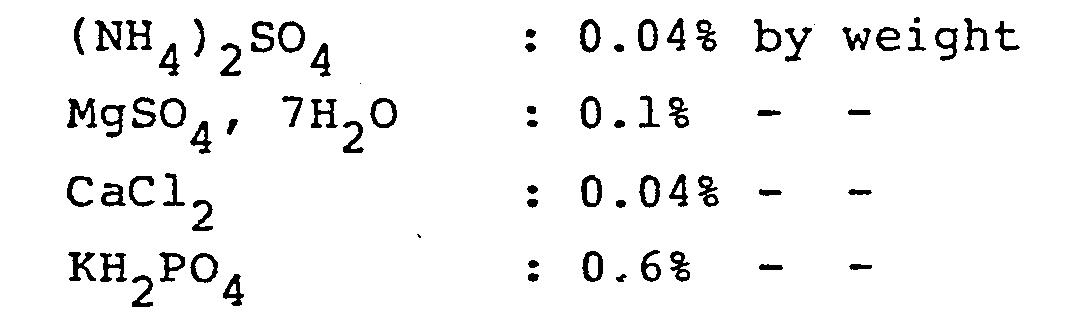
- Soil samples collected at Krisuvik, an area with hot springs on Iceland, were spread on the above agar substrate and incubated at 65°C.
- After 48 hours the agar surface was coloured with iodine vapour and a colony, C599, surrounded by a zone of uncoloured amylopectin was isolated.
- The isolated colony of C599 with underlying agar was incubated over night with starch of pH 4.5 at 60°C and 70°C. A thin layer chromatography examination revealed maltose as the main product of hydrolysis.
- _The isolated microorganism C599 was deposited with the National Collection of Industrial Bacteria, Torry Research Station, Aberdeen, Scotland, on 15th March 1983 and accorded the reference number NCIB 11837.
- The recently discovered microorganism according to the present invention is an aerobic rod shaped and spore forming bacterium. Consequently, it belongs to the genus
- On agar substrates where the sporulation is poor the culture autolyses rapidly and dies. Therefore, it has been impossible to carry out the taxonomic programme normally used for classification of Bacillus species.
- However, the morphology and the temperature for growth which lies between 50 and 70°C indicates that the new microorganism belongs to the Bacillus stearothermophilus complex.
- The spores are oval, about 1 x 1.6 µ and are terminally to subterminally placed.
- The sporangia are strongly swollen and look like rackets or drumsticks.
- One maltogenic amylase unit (U) is defined as the amount of enzyme which under standard conditions (
temperature 60°C, pH 5.5, andreaction time 30 minutes) produces reducing sugar corresponding to 1 µmol maltose per minute. - A 0.5% soluble starch (supplied by Merck) in 0.1 M acetate buffer or 0.05 M phosphate buffer (pH 5) is incubated with 1 ml of the enzyme dissolved in deionized water containing 0.1 - 0.2 U per ml. The reaction is stopped after 30 minutes by addition of 4 ml 0.5 N NaOH.
- The content of reducing sugar is then determined by means of the Somogyi method (Somogyi: J.Biol.Chem., 193, p. 265 (1951)).
- An alternative way of determining the enzyme activity is based upon the capability of the maltogenic amylase to quantitatively cleave maltotriose into equimolar amounts of maltose and glucose.
- One maltogenic amylase NOVO unit (MANU) is defined as the amount of enzyme which under standard conditions cleaves 1 µmol maltotriose per minute. The enzyme reaction is stopped by shifting pH to about 11. The glucose formed is by means of glucose dehydrogenase (Merck, GlucDH) converted into gluconolacton under formation of NADH. The amount of NADH formed is measured by colorimetric determination at 340 nm.
- Standard conditions: Temperature 37°C ± 0.05°C pH 5.0
Incubation time 30 min. - 5.255 g citric acid (C6H807 , H20) is dissolved in about 200 ml demineralized water and pH is adjusted to 5.0 with 4.0/1.0 N NaOH. Demineralized water is added up to 250 ml and pH is controlled. The buffer solution may be stored for one week in the refrigerator (pH must be checked before use) but is preferably prepared each test day.
- To 500 (1000) mg maltotriose (Sigma M 8378) is added citrate buffer (reagent 1) up to 25 (50) ml. To be prepared each test day.
- Enzyme mixture, Merck No. 14055 flask "1" and "2", is filled up with buffer solution, Merck No. 14051. After 15 min. standing the flask contents are transferred to a 500 ml measuring flask containing about 200 ml buffer (Merck No. 14051) and additional buffer is added up to 500 ml. Stable 14 days in refrigerator.
- 1.6 g glucose is dissolved in 1000 ml demineralized water and aliquots of 1.0, 2.0, 4.0, 6.0 and 10.0 ml are diluted with demineralized water up to 100 ml. The obtained five standard solutions have a glucose concentration of 88.8, 177.6, 355.2, 532.9 and 888.1 µmol /liter respectively.
- The glucose standard curve is made by mixing 2.0 ml of the above glucose standard solutions with 3.0 ml GlucDH reagent and incubating for 30 min. at ambient temperature whereafter OD340 is measured. As blank a sample with demineralized water instead of glucose is used.
- The test samples are diluted with demineralized water so that the end dilution is within the interval covered by the standard curve.
- To 500 µl enzyme (preheated to 37°C) was added 500 µl maltotriose substrate (preheated to 37°C) and the mixture was after careful mixing placed on a water bath (37°C). After 30 min reaction time the test tube was removed from the water bath and 1000 µl stop reagent was added. 3.0 ml GlucDH reagent was then added and OD340 was measured after 30 min standing at ambient temperature.
- As blank a sample containing enzyme, stop reagent and maltotriose substrate was used. The maltotriose substrate was not added until immediately after the stop reagent.
- A Bacillus strain capable of producing the maltogenic amylase of the present invention is usually propagated on a solid substrate prior to its cultivation under aerobic conditions in a suitable fermentation medium. Both media contain assimilable sources of carbon and nitrogen besides inorganic salts optionally together with growth promoting nutrients, such as yeast extract. The fermentation is typically conducted at 50 - 55°C and at a pH of 6.5 and preferably kept approximately constant by automatic means. The enzyme is excreted into the medium.
- The ensuing fermentation broth may be freed of bacterial cells, debris therefrom together with other solids, for example by filtration. The supernatant containing the enzyme may be further clarified, for example by filtration or centrifugation, and then concentrated as required, for example by ultrafiltration or in an evaporator under reduced pressure to give a concentrate which, if desired, may be taken to dryness, for example by lyophilization or spray-drying. Typically, the resulting crude enzyme product exhibits an activity in the range of about 500 - 25,000 E per gram.
- The maltogenic amylase of the present invention can be purified from a batch fermentation culture broth as follows:
- 250 litres of culture broth with an enzyme activity of 4 E per ml is filtered and the filtrate is ultrafiltered, germ filtered, and freeze-dried. 193 g of freeze-dried powder are obtained having an activity of 2400 E per g corresponding to 47% of the original activity.
- The powder is dissolved in 15 mM acetate buffer, pH 5.0 and dialysed against 15 mM acetate buffer pH 5.0 until the conductivity is about 1 mS. The dialyzate is then applied to a cation exchanger CM-sepharose Cl-6B which has been equilibrated with the same buffer. The amylase passes through the column whereas 60% of the remaining proteins is withheld by the ion-exchanger.
- The pH of the effluent from this column is adjusted to 4.0 with acetic acid and the eluate is subsequently applied to a CM-sepharose Cl-6B column equilibrated with 15 mM acetate buffer pH 4.0. Under these circumstances the amylase is adsorbed by the ion-exchanger. The enzyme is then eluated with acetate buffer of pH 4.0 with increasing ionic strength. The enzyme activity in the eluate follows the protein content in a symmetrical peak. The peak material shows a single sharp protein band by SDS-polyacrylamid gel electrophoresis. The MW is about 70,000 Dalton. pI is 8.5 as determined by iso-electric focusing. The specific activity is 325MANU/mg protein of the crystallized, redissolved and freeze dried product.
- Monospecific antiserum was generated by immunizing rabbits with purified maltogenic amylase according to the method described by N.H. Axelsen et al., A Manual of Quantitative Immunoelectrophoresis (Oslo 1973) chapter 23.
- Crossed immunoelectrophoresis according to the same authors of crude C599 amylase against this serum gave a single peak of immunoprecipitate confirming the monospeci- ficity of the antiserum.
- The dependence of the activity of the maltogenic amylase of this invention on pH and temperature was determined by the method described above using a reaction mixture in which pH and temperature were adjusted to predetermined values.
- Reference is again made to the attached drawings in which
- Fig. 1 graphically illustrates the relative activity plotted against temperature (
substrate 4% soluble starch, pH 5.5 (0.1 M acetate), 30 minutes reaction time) and - Fig. 2 graphically illustrates the relative activity plotted against pH (temp. 60°C,
substrate 2% soluble starch, 30 minutes reaction time, MC Ilvaine buffer). - It appears from the drawings that C599 maltogenic amylase has an activity optimum at pH 5.5 of about 60°C and that its pH optimum is in the range of 4.5 - 6.0. More than 50% of the maximum activity is still found at 80°C.
- In order to determine the- thermostability of the maltogenic enzyme the enzyme preparation, 1500 E/g, was mixed with 0.1 M acetate buffer (150 mg/ml) of pH 5.5 at a temperature of 50°C, 60°C, and 70°C, respectively. The residual amylase activity was determined by the method described above. The results are presented in the following table:

- After 60 minutes at 70°C 75% of the enzyme activity is retained. None of the known β-amylases exhibits such a good thermostability.
- -The influence of a variety of agents on the activity of the maltogenic amylase of the present invention is shown in the following Table II.

- Ions of heavy metals as Hg++ and Ca++ inhibit the activity of C599 amylase, whereas neither PCMB, EDTA or Schardinger-cyclodextrins have any effect on the activity.
- Cloning of the Maltogenic Amylase Gene from Bacillus C599.
- As described in further detail below, the maltogenic amylase gene can be cloned and expressed in B. subtilis in the following way:
- Chromosomal DNA from C599 is partially degraded with restriction enzyme Mbol (Biolabs cat. No. 147). Fragments in the range of 4 - 12 kb are isolated and ligated (with DNA ligase (Biolabs Cat. No. 202)) with E. coli plasmid pACYC184 (Chang et al., J. Bacteriol. 134: 1141 - 56, 1978), which has been cut with restriction enzyme BamHl (Biolabs Cat. No. 136).
- Plasmid pACYC184 confers resistance to both tetracyclin and chloramphenicol and contains a single restriction site for the restriction enzyme BamHl. Insertion of DNA in the BamHl site destroys the capacity to confer resistance to tetracyclin but not to chloramphenicol.
- The ligation mixture is transformed into competent E. coli cells. The transformed cells are plated on an appropriate.selective medium containing soluble starch and chloramphenicol. Chloramphenicol resistant transformants harbouring a cloned fragment in the BamHl site are identified as being tetracyclin sensitive. Among those, transformants exhibiting amylase activity are identified by the pale halo appearing around the colonies upon exposure of the starch containing agar to iodine vapour. One such transformant harbours a first recombinant plasmid containing a gene coding for the novel maltogenic amylase.
- For subcloning into B. subtilis plasmid pBD64 (a derivative of Staphylococcus aureus plasmid pUB110 (Gryczan et al., J. Bacteriol. 141: 246 - 53, 1980)) is used. pBD64 is capable of replicating in B. subtilis and confers resistance to kanamycin and chloramphenicol.
- pBD64 is cleaved with BamHl and ligated with the above prepared first recombinant plasmid partially cleaved with Sau3Al (Biolabs Cat. No. 169). This subcloning is preferably carried out by means of the so-called rescue technique (Gryczan et al., Mol.Gen.Genet. 177: 459 - 67, 1980) using an amylase-negative B. subtilis strain harbouring plasmid pUB110, a plasmid from Staphylococcus aureus which can be transformed into B. subtilis.
- Transformed cells of the pUB110 harbouring B. subtilis strain are then plated on an appropriate selective medium containing soluble starch and chloramphenicol. An Amy+ transformant harbouring a second recombinant plasmid is identified as above and plasmid from this transformant is isolated and transformed into an amylase-negative Bacillus subtilis which does not harbour pUB110. These transformed cells are then plated on an appropriate selective medium and Amy+ transformants harbouring the above second recombinant plasmid are identified.
- The following examples are presented as illustrative embodiments of this invention and are not intended as specific limitations thereof.
- The C599 culture was grown at 60° C for 1 - 2 days on the following agar:

- A freeze-dried culture from the above growth medium was propagated in 500 ml baffled shake flasks in 100 ml of the following substrate:

- Incubation was performed for 1 - 2 days at 50 - 55°C.
- 500 ml shake flasks were charged with 100 ml of a substrate having the following composition:

- The shake flasks were inoculated with 1 - 5 ml of the above inoculum. Incubation was performed at 50°C for 2 - 3 days.
- The resulting fermentation broth contained about 10 - 20 U per ml.
- Upscaling from shake flasks to 550 liter steel fermentator can be conducted in a stepwise fashion by increasing the volume of the culture medium by a factor from 3 to 5 in each step.
- In 550 liter scale the yield was about 5 U per ml.
- Continuous fermentation was carried out with TMP and SMP substrates having the following composition:


- The fermentation was carried out in an Eschweiler fermentor,
type S 10 with 1 liter working volume. - The fermentation was started up with 100 ml of the above inoculum and the substrate dosage was started after 24 hours at 55° C.
- The pH was adjusted to 6.5 with 3% sulphuric acid and the temperature was kept at 55°C.
- Aerating: 1 liter/liter substrate/minute Stirring: 1000 rpm Dilution rate: D = 0.05 hr
- Under the above mentioned conditions the activity yield was 50 - 75 U per ml on TMP and 40 - 50 U per ml on SMP.
- All Bacillus subtilis strains were derivatives of B. subtilis 168 (Spizizen, Proc Natl. Acad. Sci. 44:1072 - 78, 1958).
- DN304: aroI906 sacA321 amy is a Met+ transformant of QB1133 (Steinmetz et al., Mol. Gen. Genet 148: 281 - 85, 1976) and has been deposited with the NCIB on7.3.84and accorded the reference number 11957. DN314 is DN304 pUB110 and DN311 is DN304 pBD64. Plasmids pUB110 and pBD64 (Gryczan et al., J. Bacteriol. 134: 318 - 329 1978, and Gryczan et al., J. Bacteriol. 141: 246 - 53, 1980) were isolated from B. subtilis strains BD366 and BD624, respectively. pUB110 and pBD64 both confer resistance to kanamycin and pBD64 also to chloramphenicol. B, subtilis strains 168, QB1133, BD366 and BD624 can be obtained from the Bacillus Genetic Stock Center, Columbus, Ohio, USA (strain file number BGSC lAl, 1A289, lE6 and lE22, respectively).
- All Escherichia coli strains were derivatives of E. coli K-12. E. coli No. 802 met r m+ gal lac (Wood, J.Mol.Biol, 16: 118 - 33 1966) and E. coli MC1000:Δ (ara-leu) 7697 ara D 139 Δ lac x 74 gal K gal U str A (Casadaban et al., J.Mol.Biol. 138:179-207, 1980) harbouring plasmid pACYC184 (Chang et al., J.Bacteriol. 134:1141 - 56 1978) have both been deposited (NCIB No.11958and NCIB No.11956 ) on 7th March 1984.
- An overnight culture of E. coli K-12 strain No. 802 in LB (10 g Bacto tryptone, 5 g Bacto yeast extract and 10 g NaCl per liter water, pH 7.0) was diluted 100 fold in 500 ml LB and grown at 37°C to OD450 = 0.4. The culture was chilled, left 15 min. on ice spun for 15 min. at 3000 rpm (in a Sorvall GS3 rotor), resuspended in 200 ml cold 0.1 M CaCl2, left on ice for 20 min. spun for 10 min. at 3000 rpm, resuspended in 5 ml cold 0.1 M CaCl2 and left on ice for 20 hours. Cold glycerol was then added to 10% and aliquotes were frozen in liquid nitrogen and stored at -70°C. Frozen cells were thawn on ice, DNA was added, the mixture incubated 45 min. on ice, 2 min. at 37°C and then plated on an appropriate selective medium.
- Competent Bacillus subtilis cells were prepared according to Yasbin et al. (J. Bacteriol. 121: 296 - 304, 1975). Cells were then harvested by centrifugation (7000 rpm, 3 min.), resuspended in one tenth volume of supernatant including 20% glycerol, frozen in liquid nitrogen and stored at -70°C. For transformation, frozen cells were thawed at 42°C and mixed with one volume buffer (Spizizen's minimal medium (Spizizen, Proc. Natl. Acad. Sci. USA 44:1072 - 78, 1958) with 0.4% glucose, 0.04 M MgCl2 and 0.002 M EGTA). DNA was added and the mixture incubated with shaking at 37°C for 20 min. Cells were then plated on appropriate selective media.
- E. coli K-12 strain MC1000 harbouring plasmid pACYC184 was grown over night in 250 ml LB, 0.4% glucose, 20 pg/ml chloramphenicol. Cells were harvested by centrifugation and resuspended in 4 ml Buffer 1 (0.025 M Tris ˙HCl, pH = 8.0, 0.01 M EDTA, 0.05 M glucose, 2 mg/ml lysozyme). The suspension was incubated at 0°C for 15 min. and then mixed with ,8 ml Buffer 2 (0.2 M NaOH, 1% SDS). Then 6 ml Buffer 3 (3M NaAcetate, pH = 4.8) was added, the mixture kept at 0°C for 60 min. followed by centrifugation for 20 min. at 19000 rpm (ca. 45000 g in Sorvall SS34 rotor). The supernatant was precipitated with 0.6 vol cold isopropanol and resuspended in 1.2 ml 5TE (0.05 M Tris'HC1, pH = 8.0, 0.005 M EDTA), plus 20 µl boiled RNase A (Boehringer) (2 mg/ml). 30 min. later the solution was layered on top of 4.0 ml Buffer 4 (80 g CsCl plus 56 ml 5TE) and 0.1 ml EtBr (ethidium bromide) in a VTi65 tube. The mixture was centrifuged at 45000 rpm for 20 h. The plasmid was then removed from the tube, dialyzed and extracted as described in section G.
- Plasmid was prepared as described for E. coli strains (see section D) but with the following modifications. Growth was in LB including 0.01 M potassium phosphate, pH = 7.0 and 6 pg/ml chloramphenicol. After harvest, cells were incubated at 37°C with lysozyme.
Buffei 2 was replaced by a mixture of onevolume Buffer 2 and three volumes Buffer 5 (0.2 M glycine, 0.2 M NaCl and 1% SDS). The following steps were the same as in D. - Plasmid from 5 ml B. subtilis in LB (including 0.01 M phosphate pH = 7.0 and appropriate antibiotics) was prepared as in section E except: 1: volumes of buffers were reduced four fold. 2: 0.5 ml phenol and 0.5 ml chloroform are added after Buffer 3. 3: After centrifugation at 19000 rpm, the supernatant was precipitated with ethanol, resuspended in 400 µl Buffer 6 (0.05 M Tris˙HCl pH = 8.0, 0.1 M NaAcetate), the plasmid was again precipitated, resuspended in 400
µl Buffer 6, precipitated, washed and resuspended in 100 µl TE with 1 pg/ml boiled RNase A (Boehringer). - A pellet of frozen cells from about 50 ml culture was resuspended in 1.1 ml Buffer (0.05 M Tris˙HCl, pH = 7.4, 0.1 M NaCl, 25% sucrose). 100 µl lyzosyme (25 mg/ml) and 150 µl EDTA (0.5 M, pH = 8.0) were added. The mixture was incubated at 37°C for 30 min. 2 ml 0.2% SDS was added followed by incubation for 30 min. at 37°C. 1 g CsCl and 0.05 ml EtBr (10 mg/ml) were added per 0.95 ml mixture and the mixture was centrifuged at 45000 rpm, 15°C, for 20 hours in a VTi65 rotor (Beckman).
- The DNA was located under a long wave UV lamp and removed by puncturing the tube with a syringe. EtBr was extracted with isopropanol and the solution dialyzed for 2 hours against TEE (0.01 M Tris˙HCl, pH = 8.0, 0.01 M EDTA). The solution was then adjusted to 8 ml with TEE and extracted twice with phenol and once with chloroform. The DNA was precipitated with 0.1 M NaCl and cold ethanol and dissolved in 1 ml TE (0.01 M Tris˙HCl, pH = 8.0, 0.001 M EDTA). The solution of chromosomal DNA (chr DNA) was kept at 4°C.
- 60 µg chr DNA from C599 (see section G) was cut in 900 µl buffer (0.01 M Tris˙HCl, pH = 7.4, 0.075 M NaCl, 0.01 M MgCl2, 0.006 M mercaptoethanol, 100 pg/ml gelatine) with 10 units Mbol (Biolabs Cat. No. 147) at 37° C. After 10 min. and 40 min., 450 µl samples were extracted with phenol,. precipitated with 0.1 M NaCl and cold ethanol. Each sample was dissolved in 100 µl TEE. 100 µl DNA was loaded per 12 ml sucrose gradient (Maniatis T. et al., Cell 15: 687 - 701,
- 1978) and centrifuged at 27000 rpm for 22 hours at 20°C in a SW41 rotor (Beckman).
- 0.5 ml fractions were tapped after puncturing the bottom of the tube and precipitated with cold ethanol. The DNA was dissolved in 50 µl TE and the size of the DNA in each fraction estimated on a 0.7% agarose gel stained with 0.5 µg/ml EtBr. Fractions containing DNA from about 4 - 12 kb were pooled, phenol extracted, ethanol precipitated and dissolved in TE.
- 4 µg pACYC184 (see section D) was cut with 8 U BamHl (Biolabs Cat. No. 136) for 1 hour, 37°C in 50 µl buffer (0.006 M Tris˙HCl, pH = 8.0, 0.15 M NaCl, 0.006 M MgCl2, 0.006 M mercaptoethanol, 100µg/ml gelatine). The linear DNA was treated with calf intestine alkaline phosphatase (Sigma P 4502), (Goodman et al., Methods in Enzymology, 68: 75 - 90, 1979) . 0.4 µg BamHl and phosphatase treated pACYC184 was then ligated with ca. 1 µg C599 chr DNA from sucrose gradients with about 100 U DNA ligase (Biolabs Cat. No. 202) for 4 hours, 16°C in 100 µl buffer (0.066 M Tris˙HCl, pH = 7.5, 0.01 M MgCl2, 25 µg/ml gelatine, 0.001 M ATP, 0.01 M DTT). The ligated DNA was transformed into competent E. coli strain No. 802 as described in section B.
- The cells were plated on freshly poured agar plates consisting of two layers: At the bottom, 10 ml LB agar with 0.5% soluble starch and 60 pg/ml chloramphenicol. At the top 25 ml of the same agar but without chloramphenicol. After incubation overnight at 37°C, about 1200 chloramphenicol resistant transformants appeared. Approx. 600 of these were tetracycline sensitive indicating that the plasmid of these transformants harboured a cloned fragment in the BamHl site. Among those 600 colonies (representing a gene bank of C599) one strain, named DN400, exhibited amylase activity as indicated by the pale halo appearing around this colony upon expossure of the starch containing agar to vapour of iodine. Strain DN400 was shown to harbour a plasmid, named pDN400, of approx. 14000 basepairs including the amylase coding gene.
- About 1 µg of pDN400 (constructed as described in section I and prepared from E. coli. strain DN400 as described for pACYCl84 in section D) was cut at 37°C in 100 µl buffer (0.006 M Tris˙HCl, pH= 7.5, 0.05 M NaCl, 0.005 M magnesium chloride, 100 µg/ml gelatine) with 0.06 U Sau3Al (Biolabs cat. No. 169). 25 µl aliquotes were-transferred to phenol after 10, 20, 30 and 40 min and were phenolextracted and precipipated with 0.1 M NaCl and cold ethanol. Half of the DNA was ligated (see section H) with 0.4 µg plasmid pBD64 (see section E), which had been cut with BamHl (as described for pACYC184 in section I).
- A Bacillus subtilis strain named DN314 was then transformed (see section C) with the ligation mixture and plated on LB agar plates containing 0.01 M potassium phosphate pH= 7.0, 0.5% soluble starch and 6pg/ml chloramphenicol. Among ca. 6000 transformants one Amy (starch- degrading as tested with iodine) was identified.
- Plasmid from this strain was isolated (as described in section F) and transformed into a Bacillus subtilis strain, named DN304, (as described in section C). One Amy+ transformant strain, named DN463, harbouring plasmid pDN452 was isolated. As described in the following Example 3 cultivating of DN463 provided improved yields of the novel thermostable amylase product according to the present invention.
- A culture of the above cloned microorganism DN463 was inoculated in 500 ml shake flasks on 100 ml of the following substrate:

- Incubation was performed at 30°C for 3-4 days.
- The culture broth was centrifugated for 20 min at 6000 g. The centrifugate containing about 200 U/ml was used directly in the following example.
- Substrates for saccharificaton.were prepared by redissolving a 7DE spray-dried maltodextrin in deionized water and making up to approximately 30% D.S. The saccharification experiments were carried out in standard 500 ml laboratory batch reactors. Aliquots of this substrates were heated to 60°C and the pH adjusted to 5.5 and 50 amylase units/g D.S. were then added. After 72 hours at 60°C the content of glucose, maltose and maltotriose in the syrup was as follows:

- Saccharification with 25 β-amylase unit/g D.S. Biozym MII (soy bean β-amylase, 20.000 β-amylase/g) under the same conditions gives a syrup containing 0.3% glucose, 61% maltose and 7% maltotriose.
- The features disclosed in the foregoing description, in the following claims and/or in the accompanying drawings may, both separately and in any combination thereof, be material for realising the invention in diverse forms thereof.
Claims (21)
Priority Applications (1)
| Application Number | Priority Date | Filing Date | Title |
|---|---|---|---|
| AT84301994T ATE43634T1 (en) | 1983-03-25 | 1984-03-23 | MALTOSE-GENOUSING AMYLASE ENZYME PRODUCT, ITS PRODUCTION AND USE. |
Applications Claiming Priority (2)
| Application Number | Priority Date | Filing Date | Title |
|---|---|---|---|
| DK1359/83 | 1983-03-25 | ||
| DK1359/83A DK135983D0 (en) | 1983-03-25 | 1983-03-25 | THE AMYLASEENZYM SYMBOL PRODUCT AND PROCEDURE FOR ITS MANUFACTURING AND USING |
Publications (2)
| Publication Number | Publication Date |
|---|---|
| EP0120693A1 true EP0120693A1 (en) | 1984-10-03 |
| EP0120693B1 EP0120693B1 (en) | 1989-05-31 |
Family
ID=8103997
Family Applications (1)
| Application Number | Title | Priority Date | Filing Date |
|---|---|---|---|
| EP84301994A Expired EP0120693B1 (en) | 1983-03-25 | 1984-03-23 | Maltogenic amylase enzyme product, preparation and use thereof |
Country Status (7)
| Country | Link |
|---|---|
| US (2) | US4604355A (en) |
| EP (1) | EP0120693B1 (en) |
| JP (1) | JPS602185A (en) |
| AT (1) | ATE43634T1 (en) |
| CA (1) | CA1214407A (en) |
| DE (1) | DE3478469D1 (en) |
| DK (1) | DK135983D0 (en) |
Cited By (32)
| Publication number | Priority date | Publication date | Assignee | Title |
|---|---|---|---|---|
| EP0246678A1 (en) * | 1983-06-24 | 1987-11-25 | Genencor International, Inc. | Bacillus incapable of excreting subtilisin or neutral protease |
| EP0337090A1 (en) * | 1988-02-26 | 1989-10-18 | Shigezo Udaka | Beta-amylase gene |
| WO1995010627A1 (en) * | 1993-10-14 | 1995-04-20 | Novo Nordisk A/S | Method for production of maltose and a limit dextrin, the limit dextrin, and use of the limit dextrin |
| WO1999015636A1 (en) * | 1997-09-24 | 1999-04-01 | Novo Nordisk A/S | Expression of starch-binding domain (sbd) |
| WO1999043794A1 (en) | 1998-02-27 | 1999-09-02 | Novo Nordisk A/S | Maltogenic alpha-amylase variants |
| FR2778412A1 (en) * | 1998-05-05 | 1999-11-12 | Univ Reims Champagne Ardennes | Production of recombinant thermophilic alpha-amylase active at low pH |
| WO2000029591A1 (en) * | 1998-11-12 | 2000-05-25 | Novozymes A/S | Transgenic plant expressing maltogenic alpha-amylase |
| WO2001016349A1 (en) * | 1999-09-01 | 2001-03-08 | Novozymes A/S | Method for production of maltose and/or enzymatically modified starch |
| WO2001016348A1 (en) * | 1999-09-01 | 2001-03-08 | Novozymes A/S | Maltogenic amylase-modified starch derivatives |
| WO2002002726A1 (en) * | 2000-06-30 | 2002-01-10 | The Procter & Gamble Company | Detergent compositions comprising a maltogenic alpha-amylase enzyme |
| US6482622B1 (en) | 1998-02-27 | 2002-11-19 | Novozymes A/S | Amylolytic enzyme variants |
| WO2003024242A1 (en) | 2001-09-18 | 2003-03-27 | Novozymes A/S | Enzymatic treatment of starchy food products for shortening the tempering step |
| WO2005001064A2 (en) | 2003-06-25 | 2005-01-06 | Novozymes A/S | Polypeptides having alpha-amylase activity and polypeptides encoding same |
| US6876932B1 (en) | 1998-02-27 | 2005-04-05 | Novozymes A/S | Maltogenic alpha-amylase variants |
| US6940002B1 (en) | 1998-11-12 | 2005-09-06 | Novozymes A/S | Transgenic plant expressing maltogenic alpha-amylase |
| EP1073339B2 (en) † | 1998-04-20 | 2008-04-16 | Novozymes A/S | Preparation of dough and baked products |
| EP1953223A1 (en) | 2003-06-13 | 2008-08-06 | Danisco A/S | Variant pseudomonas polypeptides having a non-maltogenic exoamylase activity and their use in preparing food products |
| US7776576B2 (en) | 2003-07-07 | 2010-08-17 | Danisco A/S | Thermostable amylase polypeptides, nucleic acids encoding those polypeptides and uses thereof |
| WO2011039324A1 (en) | 2009-09-30 | 2011-04-07 | Novozymes A/S | Steamed bread preparation methods and steamed bread improving compositions |
| US8030050B2 (en) | 2005-07-07 | 2011-10-04 | Danisco A/S | Modified amylases from Pseudomonas species |
| WO2011154529A1 (en) | 2010-06-11 | 2011-12-15 | Novozymes A/S | Enzymatic flour correction |
| US8137944B2 (en) | 2004-07-07 | 2012-03-20 | Danisco A/S | Modified amylases from pseudomonas species, methods of making and uses thereof |
| US8143048B2 (en) | 2003-07-07 | 2012-03-27 | Danisco A/S | Exo-specific amylase polypeptides, nucleic acids encoding those polypeptides and uses thereof |
| US8178336B2 (en) | 2006-06-19 | 2012-05-15 | Danisco A/S | Polypeptide |
| WO2012110778A2 (en) | 2011-02-18 | 2012-08-23 | Dupont Nutrition Biosciences Aps | Feed additive composition |
| WO2012130969A1 (en) | 2011-03-29 | 2012-10-04 | Novozymes A/S | Process for production of a baked product |
| WO2014001351A1 (en) | 2012-06-27 | 2014-01-03 | Novozymes A/S | Rice cooking method |
| EP2747574B1 (en) | 2011-08-25 | 2016-06-22 | Bakery Supplies Europe Holding B.V. | Use of an anti-staling enzyme mixture in the preparation of baked bread |
| EP3133154A2 (en) | 2009-05-19 | 2017-02-22 | DuPont Nutrition Biosciences ApS | Amylase polypeptides |
| WO2019042971A1 (en) | 2017-08-29 | 2019-03-07 | Novozymes A/S | Baker's yeast expressing anti-staling/freshness amylases |
| US10463701B2 (en) | 2013-12-31 | 2019-11-05 | DuPont Nutrition BioScience ApS | Blends of Bacillus strains and enzymes |
| WO2024243330A1 (en) | 2023-05-22 | 2024-11-28 | Caravan Ingredients Inc. | Baked goods enhancer and methods of making and using the same |
Families Citing this family (88)
| Publication number | Priority date | Publication date | Assignee | Title |
|---|---|---|---|---|
| US5624829A (en) * | 1984-07-03 | 1997-04-29 | Gist-Brocades, B.V. | Transformed industrial bacillus strains and methods for making and using them |
| GB8414271D0 (en) * | 1984-06-05 | 1984-07-11 | Cpc International Inc | Recombinant dna |
| DK160563C (en) * | 1986-02-19 | 1991-09-02 | Novo Industri As | BETA AMYLASE, PROCEDURE FOR ITS PREPARATION AND PREPARATION CONTAINING BETA AMYLASE |
| JPS6474997A (en) * | 1987-09-17 | 1989-03-20 | Nat Food Res | Complex branched cyclodextrin and production thereof |
| US5501968A (en) * | 1987-10-15 | 1996-03-26 | Novo Nordisk A/S | Thermostable cyclodextrin glycosyl transferase and processes using it |
| DK474589D0 (en) * | 1989-09-27 | 1989-09-27 | Novo Nordisk As | PROCEDURE FOR THE PREPARATION OF BAKERY PRODUCTS |
| USRE38507E1 (en) | 1989-09-27 | 2004-04-27 | Novozymes A/S | Antistaling process and agent |
| US5583039A (en) * | 1990-06-07 | 1996-12-10 | Sunkyong Industries Ltd. | Escherichia coli containing a gene encoding a maltogenic amylase BLMA of Bacillus licheniformis and gene product produced by same |
| WO1997012972A2 (en) | 1995-09-29 | 1997-04-10 | Universita'degli Studi Di Siena | Regulated genes and uses thereof |
| US6300115B1 (en) * | 1998-05-18 | 2001-10-09 | Enzyme Bio-Systems Ltd. | Pullulanase expression constructs containing α-amylase promoter and leader sequences |
| US20040063184A1 (en) | 2002-09-26 | 2004-04-01 | Novozymes North America, Inc. | Fermentation processes and compositions |
| US20040253696A1 (en) | 2003-06-10 | 2004-12-16 | Novozymes North America, Inc. | Fermentation processes and compositions |
| ATE457034T1 (en) | 2003-10-28 | 2010-02-15 | Novozymes North America Inc | HYBRID ENZYMES |
| EP1797179A1 (en) | 2004-08-02 | 2007-06-20 | Novozymes A/S | Maltogenic alpha-amylase variants |
| ES2543131T3 (en) | 2004-12-22 | 2015-08-14 | Novozymes North America, Inc. | Enzymes for starch treatment |
| EP1999265B1 (en) | 2006-03-22 | 2019-03-20 | Novozymes North America, Inc. | Fermentation processes |
| EP2140016B1 (en) | 2007-04-24 | 2012-08-08 | Novozymes North America, Inc. | Detoxifying pre-treated lignocellulose-containing materials |
| DK2191061T3 (en) | 2007-09-03 | 2013-08-19 | Novozymes As | DISSOLUTION AND RECYCLING OF WASH SOLUTION USED IN PRE-TREATMENT OF LIGNOCELLULOSE-CONTAINING MATERIALS |
| JP5528333B2 (en) | 2008-05-08 | 2014-06-25 | 天野エンザイム株式会社 | β-amylase, gene encoding the same, and method for producing the same |
| US20090297659A1 (en) * | 2008-06-03 | 2009-12-03 | Boutte Troy T | Enzymatic dough conditioner and flavor improver for bakery products |
| US20110097779A1 (en) | 2008-06-23 | 2011-04-28 | Chee-Leong Soong | Processes for Producing Fermentation Products |
| US7666457B1 (en) | 2008-08-19 | 2010-02-23 | Delavau Llc | Dry mixes comprising glycerine |
| CN102171350B (en) | 2008-09-30 | 2013-09-11 | 诺维信北美公司 | Improvement of enzymatic hydrolysis of pre-treated lignocellulose-containing material with distillers dried grains |
| ES2667812T3 (en) | 2008-11-20 | 2018-05-14 | Novozymes Inc. | Polypeptides having amylolytic enhancing activity and polynucleotides encoding them |
| WO2010078391A2 (en) | 2008-12-30 | 2010-07-08 | Novozymes North America, Inc. | Improvement of enzymatic hydrolysis of pretreated lignocellulose-containing material with dissolved air flotation sludge |
| WO2010078392A2 (en) | 2008-12-31 | 2010-07-08 | Novozymes North America, Inc. | Processes of producing fermentation products |
| BR112012001069A2 (en) | 2009-07-17 | 2016-03-29 | Novozymes As | methods for analyzing cellulose degradation in cellulosic material hydrolysis, biomass hydrolysis, and lignocellulose hydrolysis, a method for determining whether an enzyme of interest affects cellulose hydrolysis, a high throughput method for analyzing cellulose enzymes and / or polypeptides. interest, method for analyzing enzyme performance, system for assessing enzyme performance, method for normalizing methods for determining the amount of target cellulose in a biological sample, method for normalizing fluorescent intensity data, and method for determining whether an enzyme of interest and a polypeptide of interest affect cellulose hydrolysis |
| WO2011007404A1 (en) | 2009-07-17 | 2011-01-20 | 天野エンザイム株式会社 | METHOD FOR IMPROVEMENT OF FOODS UTILIZING β-AMYLASE |
| EP2507370B1 (en) | 2009-11-30 | 2015-02-11 | Novozymes A/S | Polypeptides having glucoamylase activity and polynucleotides encoding same |
| ES2534098T3 (en) | 2009-11-30 | 2015-04-17 | Novozymes A/S | Polypeptides having glucoamylase activity and polynucleotides encoding them |
| CN104169417B (en) | 2009-12-01 | 2020-05-08 | 诺维信公司 | Polypeptide with glucoamylase activity and its encoding polynucleotide |
| EP2516640A2 (en) | 2009-12-22 | 2012-10-31 | Novozymes A/S | Pullulanase variants and uses thereof |
| WO2011100161A1 (en) | 2010-02-09 | 2011-08-18 | Novozymes North America, Inc. | Addition of alpha - glucosidase and cobalt for producing fermentation products from starch |
| EP2553110B1 (en) | 2010-03-30 | 2017-05-17 | Novozymes North America, Inc. | Processes of producing a fermentation product |
| WO2011127802A1 (en) | 2010-04-14 | 2011-10-20 | Novozymes A/S | Polypeptides having glucoamylase activity and polynucleotides encoding same |
| DK2595488T3 (en) | 2010-07-21 | 2020-02-24 | Novozymes As | PROCEDURE FOR THE PREPARATION OF A BAKED PRODUCT WITH ANTILLING AMYLASE AND PEPTIDASE |
| WO2012018775A1 (en) | 2010-08-02 | 2012-02-09 | Novozymes North America, Inc. | Process of producing a fermentation product |
| ES2649555T3 (en) | 2010-11-08 | 2018-01-12 | Novozymes A/S | Polypeptides with glucoamylase activity and polynucleotides that encode them |
| WO2012064351A1 (en) | 2010-11-08 | 2012-05-18 | Novozymes A/S | Polypeptides having glucoamylase activity and polynucleotides encoding same |
| WO2012068047A2 (en) | 2010-11-19 | 2012-05-24 | Novozymes North America, Inc. | Processes of producing a fermentation product |
| US9816112B2 (en) | 2010-12-22 | 2017-11-14 | Novozymes A/S | Processes for producing fermentation products |
| EP2673368B1 (en) | 2011-02-07 | 2014-12-24 | Novozymes North America, Inc. | Process for liquefying starch in the presence of pyridoxamine |
| CA2840962C (en) | 2011-07-06 | 2021-04-13 | Novozymes A/S | Alpha amylase variants and polynucleotides encoding same |
| DK2734633T3 (en) | 2011-07-22 | 2019-06-11 | Novozymes North America Inc | PROCEDURES FOR PREPARING CELLULOSE MATERIALS AND IMPROVING HYDROLYSIS THEREOF |
| US20140199752A1 (en) | 2011-08-12 | 2014-07-17 | Novozymes A/S | Reduction of culture viscosity by manganese addition |
| EP2748188A4 (en) | 2011-08-26 | 2015-03-18 | Novozymes As | POLYPEPTIDES HAVING GLUCOAMYLASE ACTIVITY AND POLYNUCLEOTIDES ENCODING THESE POLYPEPTIDES |
| WO2013036526A1 (en) | 2011-09-06 | 2013-03-14 | Novozymes A/S | Glucoamylase variants and polynucleotides encoding same |
| DK2766476T3 (en) | 2011-10-11 | 2017-08-28 | Novozymes As | GLUCOAMYLASE VARIETIES AND POLYNUCLEOTIDES CODING THEM |
| IN2014CN03467A (en) | 2011-10-11 | 2015-10-16 | Novozymes North America Inc | |
| CN104245942A (en) | 2011-12-02 | 2014-12-24 | 诺维信公司 | Method for producing fermentation product |
| US20150017670A1 (en) | 2011-12-21 | 2015-01-15 | Novozymes, Inc. | Methods For Determining The Degradation Of A Biomass Material |
| MX2014007603A (en) | 2011-12-26 | 2014-09-12 | Dupont Nutrition Biosci Aps | Use of amylase enzyme. |
| ES2546630T3 (en) | 2012-01-30 | 2015-09-25 | Dsm Ip Assets B.V. | Alpha-amylase |
| ES2935920T3 (en) | 2012-03-30 | 2023-03-13 | Novozymes North America Inc | Production processes of fermentation products |
| CA2869047C (en) | 2012-03-30 | 2022-11-01 | Novozymes North America, Inc. | Processes of producing fermentation products |
| EP2870256A1 (en) | 2012-07-06 | 2015-05-13 | Novozymes A/S | Inactivation of a production strain using a fatty acid |
| BR112015003257A2 (en) | 2012-08-17 | 2017-11-14 | Novozymes As | asparaginase variant, methods for producing a food product from a food material, for producing an asparaginase variant and for obtaining an asparaginase variant, isolated polynucleotide, nucleic acid construct, expression vector, and host cell |
| US20150291656A1 (en) | 2012-11-01 | 2015-10-15 | Novozymes A/S | Method for removal of dna |
| US9301533B2 (en) | 2013-03-01 | 2016-04-05 | Dsm Ip Assets B.V. | Alpha-amylase variants |
| EA201591609A1 (en) | 2013-03-01 | 2016-03-31 | ДСМ АйПи АССЕТС Б.В. | ALPHA-AMILASE OPTIONS |
| WO2014177541A2 (en) | 2013-04-30 | 2014-11-06 | Novozymes A/S | Glucoamylase variants and polynucleotides encoding same |
| CN121380029A (en) | 2013-04-30 | 2026-01-23 | 诺维信公司 | Glucosylamylase variants and the polynucleotides encoding them |
| CN105339494B (en) | 2013-07-17 | 2020-04-17 | 诺维信公司 | Pullulanase chimeras and polynucleotides encoding same |
| EP3063282B1 (en) | 2013-09-11 | 2020-03-25 | Novozymes A/S | Processes for producing fermentation products |
| CN103695387B (en) * | 2013-12-18 | 2015-05-06 | 广西大学 | Saccharomonospora viridis maltose alpha-amylase mutant and application thereof |
| US10030237B2 (en) | 2014-01-22 | 2018-07-24 | Novozymes A/S | Pullulanase variants and polynucleotides encoding same |
| EP2901869A1 (en) | 2014-01-31 | 2015-08-05 | Crisp Sensation Holding SA | Microwaveable batter |
| EP3129478B1 (en) | 2014-04-10 | 2019-03-27 | Novozymes A/S | Alpha-amylase variants and polynucleotides encoding same |
| JP6548679B2 (en) | 2014-07-08 | 2019-07-24 | キャラヴァン イングリーディエンツ インク. | Bakery method for producing sugar and improving texture and product formed therefrom |
| CN106795505A (en) | 2014-10-23 | 2017-05-31 | 诺维信公司 | Glucoamylase variant and their polynucleotides of coding |
| CA3007103A1 (en) | 2015-12-22 | 2017-06-29 | Novozymes A/S | Process of extracting oil from thin stillage |
| EP3682014A1 (en) | 2017-09-15 | 2020-07-22 | Novozymes A/S | Enzyme blends and processes for improving the nutritional quality of animal feed |
| EP3701037A1 (en) | 2017-10-23 | 2020-09-02 | Novozymes A/S | Processes for reducing lactic acid in a biofuel fermentation system |
| JP7407522B2 (en) * | 2018-05-09 | 2024-01-04 | ミヨシ油脂株式会社 | Oil and fat composition for kneading confectionery and confectionery using the same |
| CN112166197A (en) | 2018-05-31 | 2021-01-01 | 诺维信公司 | Method for enhancing yeast growth and productivity |
| CN112368393A (en) | 2018-07-11 | 2021-02-12 | 诺维信公司 | Process for producing a fermentation product |
| CN109486791B (en) * | 2018-11-22 | 2020-11-03 | 湖南汇升生物科技有限公司 | Preparation and application of maltogenic amylase mutant |
| BR112021014873A2 (en) | 2019-01-31 | 2021-10-05 | Novozymes A/S | POLYPEPTIDE, COMBINATION OF ENZYMES, POLYNUCLEOTIDE, NUCLEIC ACID CONSTRUCTION OR RECOMBINANT EXPRESSION VECTOR, RECOMBINANT HOST CELL, METHOD OF PRODUCTION OF A POLYPEPTIDE, AND, PROCESS OF PRODUCTION OF A FERMENTATION PRODUCT |
| BR112022002203A2 (en) | 2019-08-05 | 2022-09-06 | Novozymes As | ENZYME MIXTURES AND PROCESSES FOR PRODUCTION OF A FOOD INGREDIENT WITH HIGH PROTEIN CONTENT FROM A COMPLETE VINAGE BY-PRODUCT |
| BR112022011634A2 (en) | 2019-12-16 | 2022-08-30 | Novozymes As | PROCESSES FOR PRODUCTION OF A FERMENTATION PRODUCT, FOR DECREASE THE QUANTITY OF RESIDUAL STARCH PRESENT IN A LIQUEPHATE AND FOR INCREASE THE QUANTITY OF SHORT-CHAIN OLIGOSACCHARIDES PRESENT IN A LIQUEFATE |
| EP4638724A1 (en) | 2022-12-19 | 2025-10-29 | Novozymes A/S | Carbohydrate esterase family 1 (ce1) polypeptides having ferulic acid esterase and/or acetyl xylan esterase activity and polynucleotides encoding same |
| EP4638725A1 (en) | 2022-12-19 | 2025-10-29 | Novozymes A/S | Carbohydrate esterase family 3 (ce3) polypeptides having acetyl xylan esterase activity and polynucleotides encoding same |
| CN120380158A (en) | 2022-12-19 | 2025-07-25 | 诺维信公司 | Method for reducing the viscosity of a slurry at the back end of a fermentation product production process |
| JP2025541374A (en) | 2022-12-19 | 2025-12-18 | ノボザイムス アクティーゼルスカブ | Compositions Comprising Arabinofuranosidase and Xylanase and Their Use for Increasing Solubilization of Hemicellulosic Fibers - Patent application |
| EP4638768A2 (en) | 2022-12-19 | 2025-10-29 | Novozymes A/S | Processes for producing fermentation products using fiber-degrading enzymes with engineered yeast |
| AU2024303961A1 (en) | 2023-06-13 | 2025-12-11 | Novozymes A/S | Processes for producing fermentation products using engineered yeast expressing a beta-xylosidase |
| WO2025128568A1 (en) | 2023-12-11 | 2025-06-19 | Novozymes A/S | Composition and use thereof for increasing hemicellulosic fiber solubilization |
| WO2026008449A2 (en) | 2024-07-04 | 2026-01-08 | Novozymes A/S | A process for producing a fermentation product and a concentrated protein co-product |
Citations (4)
| Publication number | Priority date | Publication date | Assignee | Title |
|---|---|---|---|---|
| US3804715A (en) * | 1969-04-09 | 1974-04-16 | Hayashibara Co | Process for preparing sugar containing maltose of high purity |
| GB1408158A (en) * | 1971-12-17 | 1975-10-01 | Ajinomoto Kk | Microbial beta-amylase and preparation thereof |
| GB1476727A (en) * | 1973-07-23 | 1977-06-16 | Glaxo Lab Ltd | Beta-amylase and its microbiological production |
| EP0034470A2 (en) * | 1980-02-15 | 1981-08-26 | Cpc International Inc. | Genetically engineered microorganisms for massive production of amylolytic enzymes and process for preparing same |
Family Cites Families (4)
| Publication number | Priority date | Publication date | Assignee | Title |
|---|---|---|---|---|
| US4001136A (en) * | 1974-12-30 | 1977-01-04 | The United States Of America As Represented By The Secretary Of The Air Force | Fluorine generating formulation for use in chemical lasers |
| JPS54147996A (en) * | 1978-05-11 | 1979-11-19 | Agency Of Ind Science & Technol | Bacterial preparation of beta-amylase |
| JPS56144087A (en) * | 1980-11-17 | 1981-11-10 | Agency Of Ind Science & Technol | Adsorption of beta-amylase and alpha-1,6-glucosidase |
| US4493893A (en) * | 1981-01-15 | 1985-01-15 | Cpc International Inc. | Process for cloning the gene coding for a thermostable alpha-amylase into Escherichia coli and Bacillus subtilis |
-
1983
- 1983-03-25 DK DK1359/83A patent/DK135983D0/en not_active Application Discontinuation
-
1984
- 1984-03-20 US US06/591,460 patent/US4604355A/en not_active Expired - Lifetime
- 1984-03-20 US US06/591,461 patent/US4598048A/en not_active Expired - Lifetime
- 1984-03-23 AT AT84301994T patent/ATE43634T1/en not_active IP Right Cessation
- 1984-03-23 DE DE8484301994T patent/DE3478469D1/en not_active Expired
- 1984-03-23 EP EP84301994A patent/EP0120693B1/en not_active Expired
- 1984-03-26 CA CA000450515A patent/CA1214407A/en not_active Expired
- 1984-03-26 JP JP59056379A patent/JPS602185A/en active Granted
Patent Citations (4)
| Publication number | Priority date | Publication date | Assignee | Title |
|---|---|---|---|---|
| US3804715A (en) * | 1969-04-09 | 1974-04-16 | Hayashibara Co | Process for preparing sugar containing maltose of high purity |
| GB1408158A (en) * | 1971-12-17 | 1975-10-01 | Ajinomoto Kk | Microbial beta-amylase and preparation thereof |
| GB1476727A (en) * | 1973-07-23 | 1977-06-16 | Glaxo Lab Ltd | Beta-amylase and its microbiological production |
| EP0034470A2 (en) * | 1980-02-15 | 1981-08-26 | Cpc International Inc. | Genetically engineered microorganisms for massive production of amylolytic enzymes and process for preparing same |
Cited By (57)
| Publication number | Priority date | Publication date | Assignee | Title |
|---|---|---|---|---|
| EP0246678A1 (en) * | 1983-06-24 | 1987-11-25 | Genencor International, Inc. | Bacillus incapable of excreting subtilisin or neutral protease |
| EP0337090A1 (en) * | 1988-02-26 | 1989-10-18 | Shigezo Udaka | Beta-amylase gene |
| US5082781A (en) * | 1988-02-26 | 1992-01-21 | Shigezo Udaka | β-amylase gene |
| USRE39005E1 (en) | 1993-10-14 | 2006-03-07 | Novozymes A/S | Method for production of maltose and a limit dextrin, the limit dextrin, and use of the limit dextrin |
| WO1995010627A1 (en) * | 1993-10-14 | 1995-04-20 | Novo Nordisk A/S | Method for production of maltose and a limit dextrin, the limit dextrin, and use of the limit dextrin |
| US6361809B1 (en) | 1993-10-14 | 2002-03-26 | Novozymes A/S | Method for production of maltose and a limit dextrin, the limit dextrin, and use of the limit dextrin |
| WO1999015636A1 (en) * | 1997-09-24 | 1999-04-01 | Novo Nordisk A/S | Expression of starch-binding domain (sbd) |
| US8232086B2 (en) | 1998-02-27 | 2012-07-31 | Novozymes A/S | Method for preparing maltogenic alpha-amylase variants |
| US6162628A (en) * | 1998-02-27 | 2000-12-19 | Novo Nordisk A/S | Maltogenic alpha-amylase variants |
| EP2316929A2 (en) | 1998-02-27 | 2011-05-04 | Novozymes A/S | Maltogenic alpha-amylase variants |
| EP2305799A2 (en) | 1998-02-27 | 2011-04-06 | Novozymes A/S | Maltogenic alpha-amylase variants |
| US8546099B2 (en) | 1998-02-27 | 2013-10-01 | Novozymes A/S | Processes for preparing a dough or a baked product using maltogenic alpha-amylase variants |
| US6482622B1 (en) | 1998-02-27 | 2002-11-19 | Novozymes A/S | Amylolytic enzyme variants |
| WO1999043794A1 (en) | 1998-02-27 | 1999-09-02 | Novo Nordisk A/S | Maltogenic alpha-amylase variants |
| US8828460B2 (en) | 1998-02-27 | 2014-09-09 | Novozymes A/S | Method for preparing maltogenic alpha-amylase variants |
| US6876932B1 (en) | 1998-02-27 | 2005-04-05 | Novozymes A/S | Maltogenic alpha-amylase variants |
| US7908094B2 (en) | 1998-02-27 | 2011-03-15 | Novozymes A/S | Method for preparing maltogenic alpha-amylase variants |
| EP1073339B2 (en) † | 1998-04-20 | 2008-04-16 | Novozymes A/S | Preparation of dough and baked products |
| FR2778412A1 (en) * | 1998-05-05 | 1999-11-12 | Univ Reims Champagne Ardennes | Production of recombinant thermophilic alpha-amylase active at low pH |
| US7348470B2 (en) | 1998-11-12 | 2008-03-25 | Jack Bech Nielsen | Transgenic plant expressing maltogenic alpha-amylase |
| US6940002B1 (en) | 1998-11-12 | 2005-09-06 | Novozymes A/S | Transgenic plant expressing maltogenic alpha-amylase |
| WO2000029591A1 (en) * | 1998-11-12 | 2000-05-25 | Novozymes A/S | Transgenic plant expressing maltogenic alpha-amylase |
| WO2001016348A1 (en) * | 1999-09-01 | 2001-03-08 | Novozymes A/S | Maltogenic amylase-modified starch derivatives |
| WO2001016349A1 (en) * | 1999-09-01 | 2001-03-08 | Novozymes A/S | Method for production of maltose and/or enzymatically modified starch |
| WO2002002726A1 (en) * | 2000-06-30 | 2002-01-10 | The Procter & Gamble Company | Detergent compositions comprising a maltogenic alpha-amylase enzyme |
| WO2003024242A1 (en) | 2001-09-18 | 2003-03-27 | Novozymes A/S | Enzymatic treatment of starchy food products for shortening the tempering step |
| US7858352B2 (en) | 2003-06-13 | 2010-12-28 | Danisco A/S | Polypeptide |
| EP1953223A1 (en) | 2003-06-13 | 2008-08-06 | Danisco A/S | Variant pseudomonas polypeptides having a non-maltogenic exoamylase activity and their use in preparing food products |
| WO2005001064A2 (en) | 2003-06-25 | 2005-01-06 | Novozymes A/S | Polypeptides having alpha-amylase activity and polypeptides encoding same |
| US8129511B2 (en) | 2003-07-07 | 2012-03-06 | Danisco A/S | Modified amylases, nucleic acids encoding those amylases and uses thereof |
| US7833770B2 (en) | 2003-07-07 | 2010-11-16 | Danisco A/S | Thermostable amylase polypeptides, nucleic acids encoding those polypeptides and uses thereof |
| EP2292745A1 (en) | 2003-07-07 | 2011-03-09 | Genencor International, Inc. | Thermostable amylase polypeptides, nucleic acids encoding those polypeptides and uses thereof |
| US8143048B2 (en) | 2003-07-07 | 2012-03-27 | Danisco A/S | Exo-specific amylase polypeptides, nucleic acids encoding those polypeptides and uses thereof |
| US7776576B2 (en) | 2003-07-07 | 2010-08-17 | Danisco A/S | Thermostable amylase polypeptides, nucleic acids encoding those polypeptides and uses thereof |
| US8809032B2 (en) | 2003-07-07 | 2014-08-19 | Dupont Nutrition Biosciences Aps | Exo-specific amylase polypeptides, nucleic acids encoding those polypeptides and uses thereof |
| US8663966B2 (en) | 2003-07-07 | 2014-03-04 | Dupont Nutrition Biosciences Aps | Polypeptide |
| US8137944B2 (en) | 2004-07-07 | 2012-03-20 | Danisco A/S | Modified amylases from pseudomonas species, methods of making and uses thereof |
| US8030050B2 (en) | 2005-07-07 | 2011-10-04 | Danisco A/S | Modified amylases from Pseudomonas species |
| US8178336B2 (en) | 2006-06-19 | 2012-05-15 | Danisco A/S | Polypeptide |
| EP3412771A1 (en) | 2009-05-19 | 2018-12-12 | DuPont Nutrition Biosciences ApS | Amylase polypeptides |
| EP3591046A1 (en) | 2009-05-19 | 2020-01-08 | DuPont Nutrition Biosciences ApS | Amylase polypeptide |
| EP3783103A1 (en) | 2009-05-19 | 2021-02-24 | DuPont Nutrition Biosciences ApS | Amylase polypeptides |
| EP3133154A2 (en) | 2009-05-19 | 2017-02-22 | DuPont Nutrition Biosciences ApS | Amylase polypeptides |
| EP3346004A1 (en) | 2009-05-19 | 2018-07-11 | DuPont Nutrition Biosciences ApS | Amylase polypeptides |
| EP3473711A1 (en) | 2009-05-19 | 2019-04-24 | DuPont Nutrition Biosciences ApS | Amylase polypeptides |
| EP3620518A1 (en) | 2009-05-19 | 2020-03-11 | DuPont Nutrition Biosciences ApS | Amylase polypeptide |
| WO2011039324A1 (en) | 2009-09-30 | 2011-04-07 | Novozymes A/S | Steamed bread preparation methods and steamed bread improving compositions |
| WO2011154529A1 (en) | 2010-06-11 | 2011-12-15 | Novozymes A/S | Enzymatic flour correction |
| WO2012110778A2 (en) | 2011-02-18 | 2012-08-23 | Dupont Nutrition Biosciences Aps | Feed additive composition |
| US10695384B2 (en) | 2011-02-18 | 2020-06-30 | Dupont Nutrition Biosciences Aps | Feed additive composition |
| WO2012130969A1 (en) | 2011-03-29 | 2012-10-04 | Novozymes A/S | Process for production of a baked product |
| EP2747574B1 (en) | 2011-08-25 | 2016-06-22 | Bakery Supplies Europe Holding B.V. | Use of an anti-staling enzyme mixture in the preparation of baked bread |
| WO2014001351A1 (en) | 2012-06-27 | 2014-01-03 | Novozymes A/S | Rice cooking method |
| US10463701B2 (en) | 2013-12-31 | 2019-11-05 | DuPont Nutrition BioScience ApS | Blends of Bacillus strains and enzymes |
| WO2019042971A1 (en) | 2017-08-29 | 2019-03-07 | Novozymes A/S | Baker's yeast expressing anti-staling/freshness amylases |
| US11834484B2 (en) | 2017-08-29 | 2023-12-05 | Novozymes A/S | Bakers's yeast expressing anti-staling/freshness amylases |
| WO2024243330A1 (en) | 2023-05-22 | 2024-11-28 | Caravan Ingredients Inc. | Baked goods enhancer and methods of making and using the same |
Also Published As
| Publication number | Publication date |
|---|---|
| DK135983D0 (en) | 1983-03-25 |
| EP0120693B1 (en) | 1989-05-31 |
| US4604355A (en) | 1986-08-05 |
| JPH0472505B2 (en) | 1992-11-18 |
| ATE43634T1 (en) | 1989-06-15 |
| CA1214407A (en) | 1986-11-25 |
| US4598048A (en) | 1986-07-01 |
| DE3478469D1 (en) | 1989-07-06 |
| JPS602185A (en) | 1985-01-08 |
Similar Documents
| Publication | Publication Date | Title |
|---|---|---|
| EP0120693B1 (en) | Maltogenic amylase enzyme product, preparation and use thereof | |
| US4469791A (en) | Genetically engineered microorganisms for massive production of amylolytic enzymes and process for preparing same | |
| US4493893A (en) | Process for cloning the gene coding for a thermostable alpha-amylase into Escherichia coli and Bacillus subtilis | |
| EP1022334A2 (en) | Novel amylases | |
| WO1992002614A1 (en) | Novel thermostable pullulanases | |
| JPH06217770A (en) | Pullulanase, microorganism producing the same, preparation method and use of the pullulanase | |
| JPH07106147B2 (en) | Maltopentaose-Producing Amylase A-180, Process for Producing the Same, DNA-Structure and Alkali Isolate | |
| EP0024182A2 (en) | Thermo-stable micro-organism and proteolytic enzyme prepared therefrom, and processes for the preparation of the micro-organism and the proteolytic enzyme | |
| EP0057976B1 (en) | a process for cloning the gene coding for a thermostable alpha-amylase into escherichia coli and bacillus subtilis | |
| EP0131253B1 (en) | Novel thermostable, aciduric alpha-amylase and method for its production | |
| EP0140610A2 (en) | A process for producing thermostable alpha-amylases by culturing micro-organisms at elevated temperatures | |
| CA1304030C (en) | .beta.-AMYLASE ENZYME PRODUCT, PREPARATION AND USE THEREOF | |
| EP0195802B1 (en) | Thermostable g(b)-amylase - | |
| EP0184019B1 (en) | Thermostable alpha-amylase-producing, thermophilic anaerobic bacteria, thermostable alpha-amylase and process for producing the same | |
| Uchino | A thermophilic and unusually acidophilic amylase produced by a thermophilic acidophilic Bacillus sp. | |
| US4612287A (en) | Plasmids containing a gene coding for a thermostable pullulanase and pullulanase-producing strains of Escherichia coli and Bacillus subtilis containing the plasmids | |
| US3697378A (en) | Dextrinization of starch with alph-amylase from bacillus coaculans | |
| CA1081633A (en) | Heat and acid-stable alpha-amylase enzymes and processes for producing the same | |
| CA1285896C (en) | .alpha.-1, 6-GLUCOSIDASE AND PROCESS FOR PRODUCING THE SAME | |
| EP0402092A2 (en) | Alpha-amylase-pullulanase enzyme | |
| JPH03108482A (en) | New alkali pullulanase y with alpha-amylase activity, microorganism capable of producing same and production of new alkali pullulanase y | |
| Yamamoto et al. | Purification and properties of an oligo-1, 6-D-glucosidase from an alkalophilic Bacillus species | |
| JPH0565157B2 (en) | ||
| Bezbaruah et al. | Amylase production by three Bacillus strains active at alkaline pH | |
| DK153799B (en) | Maltogenic amylase, process for its preparation, and a plasmid used for obtaining it |
Legal Events
| Date | Code | Title | Description |
|---|---|---|---|
| PUAI | Public reference made under article 153(3) epc to a published international application that has entered the european phase |
Free format text: ORIGINAL CODE: 0009012 |
|
| AK | Designated contracting states |
Designated state(s): AT BE CH DE FR GB IT LI LU NL SE |
|
| 17P | Request for examination filed |
Effective date: 19841220 |
|
| 17Q | First examination report despatched |
Effective date: 19860507 |
|
| GRAA | (expected) grant |
Free format text: ORIGINAL CODE: 0009210 |
|
| AK | Designated contracting states |
Kind code of ref document: B1 Designated state(s): AT BE CH DE FR GB IT LI LU NL SE |
|
| REF | Corresponds to: |
Ref document number: 43634 Country of ref document: AT Date of ref document: 19890615 Kind code of ref document: T |
|
| REF | Corresponds to: |
Ref document number: 3478469 Country of ref document: DE Date of ref document: 19890706 |
|
| ITF | It: translation for a ep patent filed | ||
| ET | Fr: translation filed | ||
| RAP2 | Party data changed (patent owner data changed or rights of a patent transferred) |
Owner name: NOVO-NORDISK A/S |
|
| BECN | Be: change of holder's name |
Effective date: 19890531 |
|
| NLT2 | Nl: modifications (of names), taken from the european patent patent bulletin |
Owner name: NOVO-NORDISK A/S TE BAGSVAERD, DENEMARKEN. |
|
| ITTA | It: last paid annual fee | ||
| PLBE | No opposition filed within time limit |
Free format text: ORIGINAL CODE: 0009261 |
|
| STAA | Information on the status of an ep patent application or granted ep patent |
Free format text: STATUS: NO OPPOSITION FILED WITHIN TIME LIMIT |
|
| 26N | No opposition filed | ||
| ITPR | It: changes in ownership of a european patent |
Owner name: CAMBIO RAGIONE SOCIALE;NOVO NORDISK A/S |
|
| EPTA | Lu: last paid annual fee | ||
| EAL | Se: european patent in force in sweden |
Ref document number: 84301994.4 |
|
| REG | Reference to a national code |
Ref country code: GB Ref legal event code: 732E |
|
| REG | Reference to a national code |
Ref country code: GB Ref legal event code: IF02 |
|
| PGFP | Annual fee paid to national office [announced via postgrant information from national office to epo] |
Ref country code: SE Payment date: 20030306 Year of fee payment: 20 |
|
| PGFP | Annual fee paid to national office [announced via postgrant information from national office to epo] |
Ref country code: FR Payment date: 20030310 Year of fee payment: 20 |
|
| PGFP | Annual fee paid to national office [announced via postgrant information from national office to epo] |
Ref country code: AT Payment date: 20030312 Year of fee payment: 20 |
|
| PGFP | Annual fee paid to national office [announced via postgrant information from national office to epo] |
Ref country code: GB Payment date: 20030319 Year of fee payment: 20 |
|
| PGFP | Annual fee paid to national office [announced via postgrant information from national office to epo] |
Ref country code: NL Payment date: 20030327 Year of fee payment: 20 |
|
| PGFP | Annual fee paid to national office [announced via postgrant information from national office to epo] |
Ref country code: LU Payment date: 20030328 Year of fee payment: 20 |
|
| PGFP | Annual fee paid to national office [announced via postgrant information from national office to epo] |
Ref country code: CH Payment date: 20030331 Year of fee payment: 20 |
|
| PGFP | Annual fee paid to national office [announced via postgrant information from national office to epo] |
Ref country code: DE Payment date: 20030403 Year of fee payment: 20 |
|
| PGFP | Annual fee paid to national office [announced via postgrant information from national office to epo] |
Ref country code: BE Payment date: 20030514 Year of fee payment: 20 |
|
| PG25 | Lapsed in a contracting state [announced via postgrant information from national office to epo] |
Ref country code: LI Free format text: LAPSE BECAUSE OF EXPIRATION OF PROTECTION Effective date: 20040322 Ref country code: GB Free format text: LAPSE BECAUSE OF EXPIRATION OF PROTECTION Effective date: 20040322 Ref country code: CH Free format text: LAPSE BECAUSE OF EXPIRATION OF PROTECTION Effective date: 20040322 |
|
| PG25 | Lapsed in a contracting state [announced via postgrant information from national office to epo] |
Ref country code: NL Free format text: LAPSE BECAUSE OF EXPIRATION OF PROTECTION Effective date: 20040323 Ref country code: LU Free format text: LAPSE BECAUSE OF NON-PAYMENT OF DUE FEES Effective date: 20040323 Ref country code: AT Free format text: LAPSE BECAUSE OF EXPIRATION OF PROTECTION Effective date: 20040323 |
|
| BE20 | Be: patent expired |
Owner name: *NOVO-NORDISK A/S Effective date: 20040323 |
|
| REG | Reference to a national code |
Ref country code: GB Ref legal event code: PE20 |
|
| REG | Reference to a national code |
Ref country code: CH Ref legal event code: PL |
|
| EUG | Se: european patent has lapsed | ||
| NLV7 | Nl: ceased due to reaching the maximum lifetime of a patent |
Effective date: 20040323 |