EP0120480B1 - 4h-3,1-benzoxazine derivatives, process for producing the same and agricultural or horticultural fungicide containing the same - Google Patents
4h-3,1-benzoxazine derivatives, process for producing the same and agricultural or horticultural fungicide containing the same Download PDFInfo
- Publication number
- EP0120480B1 EP0120480B1 EP84103191A EP84103191A EP0120480B1 EP 0120480 B1 EP0120480 B1 EP 0120480B1 EP 84103191 A EP84103191 A EP 84103191A EP 84103191 A EP84103191 A EP 84103191A EP 0120480 B1 EP0120480 B1 EP 0120480B1
- Authority
- EP
- European Patent Office
- Prior art keywords
- group
- independently represent
- compound
- same
- weight
- Prior art date
- Legal status (The legal status is an assumption and is not a legal conclusion. Google has not performed a legal analysis and makes no representation as to the accuracy of the status listed.)
- Expired
Links
Classifications
-
- C—CHEMISTRY; METALLURGY
- C07—ORGANIC CHEMISTRY
- C07D—HETEROCYCLIC COMPOUNDS
- C07D413/00—Heterocyclic compounds containing two or more hetero rings, at least one ring having nitrogen and oxygen atoms as the only ring hetero atoms
- C07D413/02—Heterocyclic compounds containing two or more hetero rings, at least one ring having nitrogen and oxygen atoms as the only ring hetero atoms containing two hetero rings
- C07D413/04—Heterocyclic compounds containing two or more hetero rings, at least one ring having nitrogen and oxygen atoms as the only ring hetero atoms containing two hetero rings directly linked by a ring-member-to-ring-member bond
-
- A—HUMAN NECESSITIES
- A01—AGRICULTURE; FORESTRY; ANIMAL HUSBANDRY; HUNTING; TRAPPING; FISHING
- A01N—PRESERVATION OF BODIES OF HUMANS OR ANIMALS OR PLANTS OR PARTS THEREOF; BIOCIDES, e.g. AS DISINFECTANTS, AS PESTICIDES OR AS HERBICIDES; PEST REPELLANTS OR ATTRACTANTS; PLANT GROWTH REGULATORS
- A01N43/00—Biocides, pest repellants or attractants, or plant growth regulators containing heterocyclic compounds
- A01N43/72—Biocides, pest repellants or attractants, or plant growth regulators containing heterocyclic compounds having rings with nitrogen atoms and oxygen or sulfur atoms as ring hetero atoms
- A01N43/86—Biocides, pest repellants or attractants, or plant growth regulators containing heterocyclic compounds having rings with nitrogen atoms and oxygen or sulfur atoms as ring hetero atoms six-membered rings with one nitrogen atom and either one oxygen atom or one sulfur atom in positions 1,3
Definitions
- the present invention relates to novel 4H-3,1-benzoxazine derivatives, a process for producing the same and an agricultural or horticultural fungicide containing the same.
- the present invention is the result of our extensive studies to develop a compound that has a novel basic structure and exhibits high efficacy even if it is used in a small amount as an effective ingredient.
- One object of the present invention is to provide a novel 4H-3,1-Benzoxazine derivative which is highly effective against pathogenic fungi while having little toxic effect on cultivated plants, and a process for producing said compound.
- Another object of the present invention is to provide a method for controlling pathogenic fungi on plants or in soil by use of said compound.
- the novel 4H-3,1-Benzoxazine derivative of the invention is represented by formula (I): wherein X and Y each independently represent a halogen atom i.e. F, CI, Br, I, or a alkyl group which may be straight or branched and having 1 to 4, preferably 1 to 2 carbon atoms; m and n each independently represent an integer of 0 to 2, and when m or n is 2, the plurality of each of X or Y may have the same or different meanings; R is a hydrogen atom, an alkyloxy group, and alkynyloxy group, an alkylthio group or an alkenylthio group.
- formula (I) wherein X and Y each independently represent a halogen atom i.e. F, CI, Br, I, or a alkyl group which may be straight or branched and having 1 to 4, preferably 1 to 2 carbon atoms; m and n each independently represent an integer of 0 to 2,
- R has a meaning other than hydrogen
- the alkyl, alkenyl or alkynyl moiety of said R may be straight or branched and it has 1 to 5 carbon atoms.
- Preferred alkyloxy groups for R have 1 to 5 carbon atoms and more preferably they have 1 to 4 carbon atoms.
- Preferred alkynyloxy groups for R have 3 to 4 carbon atoms and more preferably they have 2 to 3 carbon atoms.
- Preferred alkylthio group for R have 1 to 4 carbon atoms and more preferably they have 1 to 3 carbon atoms.
- Preferred alkenylthio groups for R have 3 to 4 carbon atoms and more preferably they have 2 to 3 carbon atoms.
- the compound of formula (I) is novel and exhibits high efficacy against diseases affecting cultivated plants. However, this compound is by no means toxic to humans, animals or fish, and causes no adverse effects on cultivated plants.
- the compound of formula (I) used in an agricultural fungicide has both preventive and curative effects against a wide spectrum of pathogenic fungi such as phycomycetes, Ascomycetes, Basidiomycetes and Deuteromycetes.
- the compound is particularly useful against powderly mildew, rust diseases, downy mildew and seedling damping-off which affect cultivated plants.
- the compounds of formula (I) of the present invention may be produced by any of the following two methods.
- reaction with alcohols or thiols can be carried out smoothly by using a suitable acid acceptor such as triethylamine, pyridine, sodium hydroxide, potassium hydroxide or sodium alkoxide.
- a suitable acid acceptor such as triethylamine, pyridine, sodium hydroxide, potassium hydroxide or sodium alkoxide.
- the reaction in the first method is performed at a temperature of 0 to 90°C for a period of 1 to 6 hours.
- the reaction in the second method may be satisfactorily performed at room temperature without any special heating or cooling operation. However, in general, the reaction is carried out in a temperature range of -5 to 30°C, preferably 0 to 20°C, for a period of 3 to 5 hours.
- the ethyl acetate was distilled off under vacuum. Upon recrystallizing the residue from a mixed solvent of ethyl acetate and n-hexane, the titled compound was obtained in an amount of 10.1 g (yield: 80%). m.p. 114 ⁇ 115°C.
- the compounds of the present invention thus prepared have systemic effect on plants, so they can be applied in various manners to treat the stem and foliage of plants over the ground, seeds, the surface of water, and the soil.
- the compounds of the present invention have no adverse effects on the cultivated plants to be treated, so they can be used either before or after sowing or at any stage of the plant growth whether it is a juvenile seedling, in the midst of growth or in the fruiting stage.
- the compounds of the present invention may be used alone without mixing with other ingredients. But in order to provide greater convenience, they may be mixed with various solid or liquid agricultural carriers so as to formulate wettable powders, emulsifiable concentrates, oils, dusts, granules or suspension concentrates. These formulations may be further supplemented with adjuvants such as dispersants, diluents, emulsifiers, spreaders, wetting agents, adsorbents, thickeners, anti-foaming agents and antifreezing agents.
- the solids and liquid carriers may be used either alone or in combination.
- Illustrative carriers include talc, clay, bentonite, kaolin, diatomaceous earth, calcium carbonate, woodmeal, starch, gum arabic, water, alcohol, kerosene, naphtha, xylene, cyclohexanone, methyl naphthalene, benzene, acetone, dimethylformamide, glycol ether and N-methylpyrrolidone.
- Suitable adjuvants include polyoxyethylene alkylphenyl ether, polyoxyethylene sorbitan monooleate, ethylene oxide-propylene oxide copolymer, lignin sulfonate, sorbitan esters, soaps, sulfated oils, alkyl sulfate esters, petroleum sulfonates, dioctyl sulfo-succinates, alkylbenzensulfonates, aliphatic amine salts, quaternary ammonium salts, alkyl pyridinium salts, alkylaminoethyl glycine, alkyldimethyl betaine, polyglycol sulfate esters, alkylamine sulfonic acid, isopropyl phosphate, carboxymethyl cellulose, polyvinyl alcohol, hydroxypropyl cellulose, ethylene glycol and xanthan gum.
- the compounds of the present invention may also be mixed with propellants such as fluorotrichloromethane and dichlorodifluoromethane for use as aerosols.
- propellants such as fluorotrichloromethane and dichlorodifluoromethane
- the compounds may be mixed with suitable foaming agents of combustion aids to prepare fumigants or formulations for smoking.
- the compounds of the present invention When preparing fungicides from the compounds of the present invention, they are generally used in an amount, on a weight basis, of 0.05 to 95%, preferably 0.1 to 80%, more preferably 1 to 70%, with the carriers and adjuvants being used in amounts of 70 to 99% and 0 to 20%, respectively.
- the compounds may be used in combination with fertilizers or other fungicides or agrochemicals such as herbicides, plant growth regulators, insecticides and acaricides.
- concentrations of the compounds of the present invention and the relevant amounts to be applied will vary with many factors such as the season, weather, method of application, type of formulation, the location of use, the disease to be combatted and the crop plant to be treated. Generally, the concentrations of the compounds are in the range of 0.5 to 1,000 ppm, preferably 3 to 500 ppm.
- concentrations of the compounds applied generally range from 0.5 to 500 g, preferably from 1 to 250 g, for 10 acres.
- a biscuit pot with a diameter of 15 cm was filled with horticultural granular soil, and ten seeds of Takasago strain cucumber were sown. After cultivation under greenhouse conditions for 10 days, the juvenile seedlings with cotyledon were tested.
- seedlings were sprayed with a dose of 15 ml per pot of a wettable powder of Formulation 2, described below which had been diluted with water at a predetermined concentration. After air drying, the seedlings were inoculated with a suspension of conidiospores of Sphaerotheca fuliginea by spraying it on the foliage of the seedlings. Then, the cultivation was effected at a temperature of from 23 to 26°C for 10 days, and the seedlings were checked for the occurrence and severity of infection in terms of percent infection calculated as follows.
- test seedlings were rated on the following infection index of from 0 to 5.
- Percent infection was calculated from the Infection indexes thus obtained according to the following equation: Percent infection
- Percent protection was obtained by comparing the percent infections (P.I.) of untreated seedlings and treated seedlings, according to the following equation:
- a biscuit pot with a diameter of 15 cm was filled with horticultural granular soil, and ten seeds of Takasago strain cucumber were sown. After cultivation under greenhouse conditions for 10 dyes, the juvenile seedlings with completely developed cotyledon were tested.
- the seedlings were inoculated with a suspension of conidiospores of Sphaerotheca fuliginea by spraying, and after leaving at a temperature of from 23 to 26°C for one day, were sprayed with a dose of 15 ml per pot of an emulsion prepared from Formulation 3, described below, by dilution with water at a predetermined concentration. After air drying, the seedlings were cultivated at 23-26°C under greenhouse conditions for 10 days, and checked for the occurrence and severity of infection.
- a biscuit pot with a diameter of 12 cm was filled with horticultural granular soil known by the name of "Arakida” and 15 grains of wheat (Norin No. 61 strain) were seeded. After cultivation under greenhouse conditions for 12 days, the juvenile seedlings at the one-leaf stage were subjected to the following test.
- seedlings were sprayed with a dose of 15 ml per pot of emulsifiable concentrate of Formulation 4, described below which had been diluted with water at a predetermined concentration. After air drying, the seedlings were inoculated with a suspension of conidiospores of Erysiphe graminis, and after cultivation at a temperature of from 20 to 24°C under greenhouse conditions for 10 days, were checked for the occurrence and severity of infection.
- a biscuit pot with a diameter of 12 cm was filled with horticultural granular soil known by the name of "Arakida", and 15 grains of wheat (Norin No. 61 strain) were seeded. Then cultivation was effected under greenhouse conditions for 12 days and the juvenile seedlings at the one-leaf stage were used for the following tests.
- seedlings were inoculated by spraying with a suspension of conidiospores of Erysiphe graminis, and after allowing to stand for one day at 20-23°C under greenhouse conditions, were sprayed with a dose of 15 ml of wettable powder of Formulation 2, described below, which had been diluted with water at a predetermined concentration. After air drying, the seedlings were cultivated at 20-24°C under greenhouse conditions for 10 days and checked for the occurrence and severity of infection.
- a biscuit pot with a diameter of 12 cm was filled with commercial horticulture soil (Kureha Kagaku, Tokyo, Japan), seeds of cucumber (Ochiai-aonagafushinari strain) were sown and cultivated under greenhouse conditions for 10 days.
- the juvenile seedlings with cotyledon were sprayed with an emulsifiable concentrate of the compound which had been diluted with water at a predetermined concentration so that the surface of the leaves were fully wetted with the sprayed emulsion of Formulation 3.
- the seedlings were cultivated under greenhouse conditions for two days, and inoculated with a suspension of conidiospores of Pseudoperonospora cubensis by spraying it as an aqueous suspension.
- the treated seedlings were allowed to stand at 2122°C in a humid atmosphere for 3 days, cultivated at 21-22°C under the light of fluorescent lamps, and checked for the occurrence and severity of infection in terms of percent infection, calculated as follows.
- test seedlings were rated on the infection index of form 0 to 5.
- a Neubauer pot was filled with field soil, and pathogenic soil in which Pythium aphanidernatum had been cultivated was blended with the field soil in a layer of a depth of 2 cm in the pot to inoculate the soil with the pathogenic fungus.
- the pot was allowed to stand at 28°C under super humid conditions for 24 hours in greenhouse, and subjected to soil injection treatment at a predetermined dose level with wettable powder of Formulation 2 described below which had been diluted with water.
- Ten seeds of cucumber (Ociai-aonagafushinari strain) were sown and lightly covered with the same field soil. After two week cultivation under greenhouse conditions, the seedlings were checked for the occurrence of infection, and the good seedling rate was calculated by the following equation:
- Formulation 2 Wettable Powder
- this emulsifiable concentrate is diluted with water to a desired level and sprayed.
- Formulation 5 Granules
Landscapes
- Life Sciences & Earth Sciences (AREA)
- Organic Chemistry (AREA)
- Chemical & Material Sciences (AREA)
- Health & Medical Sciences (AREA)
- Plant Pathology (AREA)
- Engineering & Computer Science (AREA)
- Dentistry (AREA)
- General Health & Medical Sciences (AREA)
- Wood Science & Technology (AREA)
- Zoology (AREA)
- Environmental Sciences (AREA)
- Pest Control & Pesticides (AREA)
- Agronomy & Crop Science (AREA)
- Agricultural Chemicals And Associated Chemicals (AREA)
- Heterocyclic Carbon Compounds Containing A Hetero Ring Having Nitrogen And Oxygen As The Only Ring Hetero Atoms (AREA)
- Plural Heterocyclic Compounds (AREA)
Description
- The present invention relates to novel 4H-3,1-benzoxazine derivatives, a process for producing the same and an agricultural or horticultural fungicide containing the same.
- Many synthetic organic compounds and antibiotics have been found to have the ability to kill fungi and several of them have been commercialized for use as agricultural and horticultural fungicides. However, these compounds are not completely safe since they often inhibit the growth of plants or are accompanied by herbicidal effects.
- The present invention is the result of our extensive studies to develop a compound that has a novel basic structure and exhibits high efficacy even if it is used in a small amount as an effective ingredient.
- One object of the present invention is to provide a novel 4H-3,1-Benzoxazine derivative which is highly effective against pathogenic fungi while having little toxic effect on cultivated plants, and a process for producing said compound.
- Another object of the present invention is to provide a method for controlling pathogenic fungi on plants or in soil by use of said compound.
- Further objects will become clear from the following decriptions.
- The novel 4H-3,1-Benzoxazine derivative of the invention is represented by formula (I):

- When R has a meaning other than hydrogen, the alkyl, alkenyl or alkynyl moiety of said R may be straight or branched and it has 1 to 5 carbon atoms.
- Preferred alkyloxy groups for R have 1 to 5 carbon atoms and more preferably they have 1 to 4 carbon atoms.
- Preferred alkynyloxy groups for R have 3 to 4 carbon atoms and more preferably they have 2 to 3 carbon atoms.
- Preferred alkylthio group for R have 1 to 4 carbon atoms and more preferably they have 1 to 3 carbon atoms.
- Preferred alkenylthio groups for R have 3 to 4 carbon atoms and more preferably they have 2 to 3 carbon atoms.
- The compound of formula (I) is novel and exhibits high efficacy against diseases affecting cultivated plants. However, this compound is by no means toxic to humans, animals or fish, and causes no adverse effects on cultivated plants.
- The compound of formula (I) used in an agricultural fungicide has both preventive and curative effects against a wide spectrum of pathogenic fungi such as phycomycetes, Ascomycetes, Basidiomycetes and Deuteromycetes. The compound is particularly efficaceous against powderly mildew, rust diseases, downy mildew and seedling damping-off which affect cultivated plants.
- The compounds of formula (I) of the present invention may be produced by any of the following two methods.
- (1) The first method starts with a known benzophenone derivative of formula (II) (see, for example, Japanese Patent Laid Open Public No. 139306/80):

- The reaction with alcohols or thiols can be carried out smoothly by using a suitable acid acceptor such as triethylamine, pyridine, sodium hydroxide, potassium hydroxide or sodium alkoxide.
- The reaction in the first method is performed at a temperature of 0 to 90°C for a period of 1 to 6 hours.
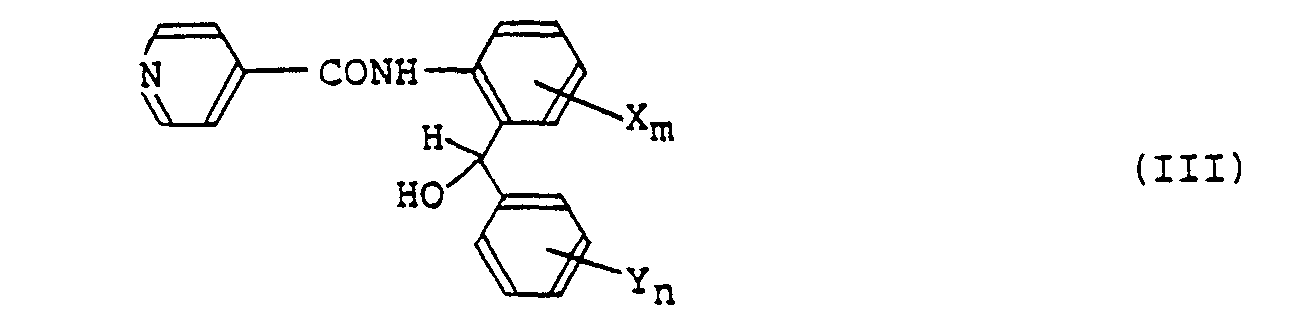
- (2) The second method starts with a benzhydrol derivative (III) that can be synthesized from the benzophenone derivative of formula (II) by a known method (see, for example, Japanese Patent Laid Open Public No. 59867/82):

- The reaction in the second method may be satisfactorily performed at room temperature without any special heating or cooling operation. However, in general, the reaction is carried out in a temperature range of -5 to 30°C, preferably 0 to 20°C, for a period of 3 to 5 hours.
- The production of compounds of formula (I) is illustrated by the following examples of synthesis.
- 2-(4-Chlorobenzoyl)-isonicotinanilide (11.2 g) was added to thionyl chloride (100 ml) and the mixture was heated for 4 hours under reflux. Under reduced pressure, the thionyl chloride was distilled off completely. To the resulting reaction product, isopropyl alcohol (100 ml) was added, and triethylamine (15 ml) was slowly added dropwise with stirring under cooling with ice. After the completion of the addition, the mixture was stirred for another 2 hours at room temperature. Water was added to the reaction product and mixture was extracted with ethyl acetate. The resulting ethyl acetate layer was dried over magnesium sulfate. After filtering off the magnesium sulfate, the ethyl acetate was distilled off under vacuum. Upon recrystallizing the residue from a mixed solvent of ethyl acetate and n-hexane, the titled compound was obtained in an amount of 10.1 g (yield: 80%). m.p. 114―115°C.
- Analysis:

- The procedure of Synthesis 1 was repeated except that isopropyl alcohol was replaced by ethyl mercaptan (10 ml) in tetrahydrofuran (100 mI). The titled compound was obtained in an amount of 10.8 g (yield: 85%). m.p. 138-139°C.
- Analysis:

- 2-(4-Chloro-a-hydroxybenzyl)-isonicotinanilide (11.3 g) was added to pyridine (200 ml) under cooling with ice, and thionyl chloride (4 g) was then added slowly. The mixture was stirred for 1 hour. Following a continued stirring at room temperature, the reaction mixture was poured into water. The resulting crystal was separated by filtration and dissolved in ethyl acetate. After washing with water, the ethyl acetate solution was dried over anhydrous sodium sulfate. The anhydrous sodium sulfate was filtered off and the ethyl acetate was distilled off under vacuum. Upon recrystallizing the residue with a mixed solvent of ethyl acetate and n-hexane, the crystal of the compound was obtained in an amount of 9.8 g (yield: 92%). m.p. 116-1170C.
- Analysis:

- 2-(4-Chloro-α-hydroxybenzyl)-4-fluoro-isonicotinanilide (11.9 g) was treated as in Synthesis 3. The titled compound was obtained in an amount of 10.2 g (yield: 90%). m.p. 144―145°C.
- Analysis:

- 2-(4-bromo-a-hydroxybenzyl)-5-chloro-6-methyl-isonicotinanilide (14.4 g) was treated as in an amount of 11.7 g (yield: 85%). m.p. 169―170°C.
- Analysis:

- To chloroform (300 ml), 4-chloro-2-(4-chloro-a-hydroxybenzyl)-isonicotinanilide (12.4 g) and triethylamine (5.0 ml) were added. With stirring and under cooling with ice, phosphorus tribromide (9.1 g) was added slowly, and the stirring was continued for 1 hour. Following another 3-hour stirring at room temperature, the reaction mixture was poured into water. The chloroform layer was thoroughly washed with water and subsequently dried. The chloroform was completely distilled off under vacuum. Upon recrystallization from a mixed solvent of ethyl acetate and n-hexane, the titled compound was obtained in an amount of 10.1 g (yield: 85%). m.p. 140―141°C.
- Analysis:

- 4-Bromo-2-(a-hydroxybenzyl)-isonicotinanilide (12.8 g) was treated as in Synthesis 6 except that triethylamine was replaced by diethylaniline (6.0 mI). The titled compound was obtained in an amount of 10.3 g (yield: 85%). m.p. 161-162°C.

- Several other compounds of formula (I) were prepared in a like manner, ana they are listea in table 1I as non-limiting examples together with the compounds prepared by Syntheses Nos. 1 to 7.
- The respective numbers used in Table 1 to indicate the positions of substituents X and Y have the following definitions:


- The compounds of the present invention thus prepared have systemic effect on plants, so they can be applied in various manners to treat the stem and foliage of plants over the ground, seeds, the surface of water, and the soil.
- The compounds of the present invention have no adverse effects on the cultivated plants to be treated, so they can be used either before or after sowing or at any stage of the plant growth whether it is a juvenile seedling, in the midst of growth or in the fruiting stage.
- The compounds of the present invention may be used alone without mixing with other ingredients. But in order to provide greater convenience, they may be mixed with various solid or liquid agricultural carriers so as to formulate wettable powders, emulsifiable concentrates, oils, dusts, granules or suspension concentrates. These formulations may be further supplemented with adjuvants such as dispersants, diluents, emulsifiers, spreaders, wetting agents, adsorbents, thickeners, anti-foaming agents and antifreezing agents. The solids and liquid carriers may be used either alone or in combination. Illustrative carriers include talc, clay, bentonite, kaolin, diatomaceous earth, calcium carbonate, woodmeal, starch, gum arabic, water, alcohol, kerosene, naphtha, xylene, cyclohexanone, methyl naphthalene, benzene, acetone, dimethylformamide, glycol ether and N-methylpyrrolidone.
- Suitable adjuvants include polyoxyethylene alkylphenyl ether, polyoxyethylene sorbitan monooleate, ethylene oxide-propylene oxide copolymer, lignin sulfonate, sorbitan esters, soaps, sulfated oils, alkyl sulfate esters, petroleum sulfonates, dioctyl sulfo-succinates, alkylbenzensulfonates, aliphatic amine salts, quaternary ammonium salts, alkyl pyridinium salts, alkylaminoethyl glycine, alkyldimethyl betaine, polyglycol sulfate esters, alkylamine sulfonic acid, isopropyl phosphate, carboxymethyl cellulose, polyvinyl alcohol, hydroxypropyl cellulose, ethylene glycol and xanthan gum.
- The compounds of the present invention may also be mixed with propellants such as fluorotrichloromethane and dichlorodifluoromethane for use as aerosols. Alternatively, the compounds may be mixed with suitable foaming agents of combustion aids to prepare fumigants or formulations for smoking.
- When preparing fungicides from the compounds of the present invention, they are generally used in an amount, on a weight basis, of 0.05 to 95%, preferably 0.1 to 80%, more preferably 1 to 70%, with the carriers and adjuvants being used in amounts of 70 to 99% and 0 to 20%, respectively. In order to achieve a wide spectrum of effects, the compounds may be used in combination with fertilizers or other fungicides or agrochemicals such as herbicides, plant growth regulators, insecticides and acaricides.
- The concentrations of the compounds of the present invention and the relevant amounts to be applied will vary with many factors such as the season, weather, method of application, type of formulation, the location of use, the disease to be combatted and the crop plant to be treated. Generally, the concentrations of the compounds are in the range of 0.5 to 1,000 ppm, preferably 3 to 500 ppm. The amounts of the compounds applied generally range from 0.5 to 500 g, preferably from 1 to 250 g, for 10 acres.
- The efficacy of the compounds of the present invention as agricultural and horticultural fungicides will become apparent by reading the following results of experiments.
- A biscuit pot with a diameter of 15 cm was filled with horticultural granular soil, and ten seeds of Takasago strain cucumber were sown. After cultivation under greenhouse conditions for 10 days, the juvenile seedlings with cotyledon were tested.
- These seedlings were sprayed with a dose of 15 ml per pot of a wettable powder of Formulation 2, described below which had been diluted with water at a predetermined concentration. After air drying, the seedlings were inoculated with a suspension of conidiospores of Sphaerotheca fuliginea by spraying it on the foliage of the seedlings. Then, the cultivation was effected at a temperature of from 23 to 26°C for 10 days, and the seedlings were checked for the occurrence and severity of infection in terms of percent infection calculated as follows.
- First, on the basis of the percentage of infected area, the test seedlings were rated on the following infection index of from 0 to 5.

- Percent infection was calculated from the Infection indexes thus obtained according to the following equation: Percent infection

- Percent protection was obtained by comparing the percent infections (P.I.) of untreated seedlings and treated seedlings, according to the following equation:
-

- The results are shown in Table 2.

- A biscuit pot with a diameter of 15 cm was filled with horticultural granular soil, and ten seeds of Takasago strain cucumber were sown. After cultivation under greenhouse conditions for 10 dyes, the juvenile seedlings with completely developed cotyledon were tested.
- The seedlings were inoculated with a suspension of conidiospores of Sphaerotheca fuliginea by spraying, and after leaving at a temperature of from 23 to 26°C for one day, were sprayed with a dose of 15 ml per pot of an emulsion prepared from Formulation 3, described below, by dilution with water at a predetermined concentration. After air drying, the seedlings were cultivated at 23-26°C under greenhouse conditions for 10 days, and checked for the occurrence and severity of infection.
- Infection index, percent infection and percent protection on this experiment were determined as in Experiment 1.
- The results are shown in Table 3 below.


- A biscuit pot with a diameter of 12 cm was filled with horticultural granular soil known by the name of "Arakida" and 15 grains of wheat (Norin No. 61 strain) were seeded. After cultivation under greenhouse conditions for 12 days, the juvenile seedlings at the one-leaf stage were subjected to the following test.
- These seedlings were sprayed with a dose of 15 ml per pot of emulsifiable concentrate of Formulation 4, described below which had been diluted with water at a predetermined concentration. After air drying, the seedlings were inoculated with a suspension of conidiospores of Erysiphe graminis, and after cultivation at a temperature of from 20 to 24°C under greenhouse conditions for 10 days, were checked for the occurrence and severity of infection.
- Infection index, percent infection and percent protection were determined as in Experiment 1.
- The results are shown in Table 4 below.

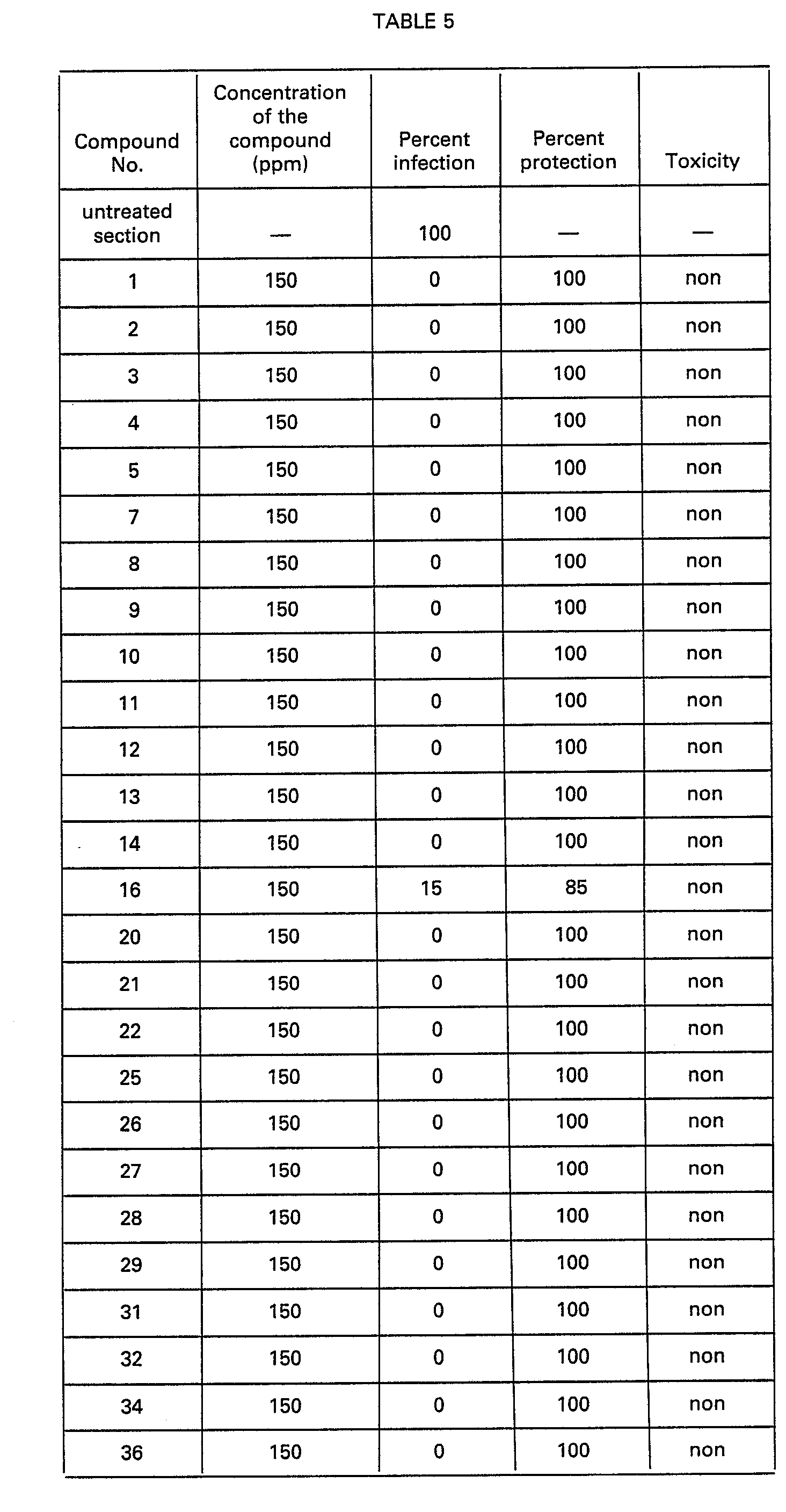
- A biscuit pot with a diameter of 12 cm was filled with horticultural granular soil known by the name of "Arakida", and 15 grains of wheat (Norin No. 61 strain) were seeded. Then cultivation was effected under greenhouse conditions for 12 days and the juvenile seedlings at the one-leaf stage were used for the following tests.
- These seedlings were inoculated by spraying with a suspension of conidiospores of Erysiphe graminis, and after allowing to stand for one day at 20-23°C under greenhouse conditions, were sprayed with a dose of 15 ml of wettable powder of Formulation 2, described below, which had been diluted with water at a predetermined concentration. After air drying, the seedlings were cultivated at 20-24°C under greenhouse conditions for 10 days and checked for the occurrence and severity of infection.
- Infection index, percent infection and percent protection were determined as in Experiment 1.
- The results are shown in Table 5 below.
- Test similar to those in Experiment 1 were conducted except for using a smaller dose of the active compound as shown.
- The results are given in Table 6.

- Tests similar to those in Experiment 2 were conducted except for using a smaller dose of the active compound as indicated below.
- The results are shown in Table 7.

- A biscuit pot with a diameter of 12 cm was filled with commercial horticulture soil (Kureha Kagaku, Tokyo, Japan), seeds of cucumber (Ochiai-aonagafushinari strain) were sown and cultivated under greenhouse conditions for 10 days. The juvenile seedlings with cotyledon were sprayed with an emulsifiable concentrate of the compound which had been diluted with water at a predetermined concentration so that the surface of the leaves were fully wetted with the sprayed emulsion of Formulation 3. Then, the seedlings were cultivated under greenhouse conditions for two days, and inoculated with a suspension of conidiospores of Pseudoperonospora cubensis by spraying it as an aqueous suspension. The treated seedlings were allowed to stand at 2122°C in a humid atmosphere for 3 days, cultivated at 21-22°C under the light of fluorescent lamps, and checked for the occurrence and severity of infection in terms of percent infection, calculated as follows.
- First, on the basis of the percentage of infected area, the test seedlings were rated on the infection index of form 0 to 5.

- Second, on the basis of the infection indexes, percent infection was culculated by the following equation: Percent infection

- Then, percent protection was calculated on the basis of the equation below.
-

- The results are shown in Table 8.

- A Neubauer pot was filled with field soil, and pathogenic soil in which Pythium aphanidernatum had been cultivated was blended with the field soil in a layer of a depth of 2 cm in the pot to inoculate the soil with the pathogenic fungus. The pot was allowed to stand at 28°C under super humid conditions for 24 hours in greenhouse, and subjected to soil injection treatment at a predetermined dose level with wettable powder of Formulation 2 described below which had been diluted with water. Ten seeds of cucumber (Ociai-aonagafushinari strain) were sown and lightly covered with the same field soil. After two week cultivation under greenhouse conditions, the seedlings were checked for the occurrence of infection, and the good seedling rate was calculated by the following equation:
-

- The results are shown in Table 9 below.

- This invention is further illustrated by the following Formulation Examples. It should be understood that the active compounds, carriers, adjuvants and the mixing proportions of the formulation of this invention are not limited to the following Formulations. Incidentally, all parts in the Formulation Examples are by weight.
-

- The components above were thoroughly mixed and finely divided to give dust.
-

- All the components above were thoroughly mixed and finely divided to give wettable powder.
-

- All the components were mixed uniformly to give an emulsifiable concentrate. For use, this emulsifiable concentrate is diluted with water to a desired level and sprayed.
-

- All the components were mixed uniformly to give an emusifiable concentrate.
-

- All the components were mixed uniformly. Water was added to the mixture and kneaded, granulated, and dried to give granules.
-

- All the components were mixed and wet-pulverized to give a suspension concentrate.
Claims (31)




Priority Applications (1)
| Application Number | Priority Date | Filing Date | Title |
|---|---|---|---|
| AT84103191T ATE28198T1 (en) | 1983-03-24 | 1984-03-22 | 4H-3,1 BENZOXAZINE DERIVATIVES, PROCESS FOR THEIR MANUFACTURE AND ANTI-FUNGI AGRICULTURAL OR HORTICULTURAL PRODUCT CONTAINING THEM. |
Applications Claiming Priority (4)
| Application Number | Priority Date | Filing Date | Title |
|---|---|---|---|
| JP47967/83 | 1983-03-24 | ||
| JP4796783A JPS59175489A (en) | 1983-03-24 | 1983-03-24 | 4h-3,1-benzoxazine derivative, its preparation and agricultural and horticultural fungicide containing it |
| JP9331/84 | 1984-01-20 | ||
| JP933184A JPS60152484A (en) | 1984-01-20 | 1984-01-20 | 4h-3,1-benzoxazine derivative, preparation thereof and agricultural and horticultural germicide containing same |
Publications (2)
| Publication Number | Publication Date |
|---|---|
| EP0120480A1 EP0120480A1 (en) | 1984-10-03 |
| EP0120480B1 true EP0120480B1 (en) | 1987-07-08 |
Family
ID=26344032
Family Applications (1)
| Application Number | Title | Priority Date | Filing Date |
|---|---|---|---|
| EP84103191A Expired EP0120480B1 (en) | 1983-03-24 | 1984-03-22 | 4h-3,1-benzoxazine derivatives, process for producing the same and agricultural or horticultural fungicide containing the same |
Country Status (7)
| Country | Link |
|---|---|
| US (1) | US4596801A (en) |
| EP (1) | EP0120480B1 (en) |
| AU (1) | AU562226B2 (en) |
| BR (1) | BR8401360A (en) |
| CA (1) | CA1228590A (en) |
| DE (1) | DE3464608D1 (en) |
| ES (2) | ES8604947A1 (en) |
Families Citing this family (5)
| Publication number | Priority date | Publication date | Assignee | Title |
|---|---|---|---|---|
| GB8622900D0 (en) * | 1986-09-23 | 1986-10-29 | Shell Int Research | Fungicidal compositions |
| RU2323936C1 (en) * | 2006-09-11 | 2008-05-10 | Государственное образовательное учреждение высшего профессионального образования "Кубанский государственный технологический университет" (ГОУВПО "КубГТУ") | Substituted 2-pyridyl-1,2-dihydro-4=-3,1-benzoxazines showing growth-regulating activity |
| CN104910094B (en) * | 2015-06-08 | 2016-08-31 | 湖南科技大学 | 1-amide groups-2-aryl-2,4-dihydro-3,1-benzimidazole dihydrochloride compounds with bactericidal activity and application thereof |
| CN105541745B (en) * | 2015-12-17 | 2018-05-04 | 湖南科技大学 | 1- (fragrant amino ethyl) -2- aryl -3,1- benzoxazine compounds and its preparation and use with bactericidal activity |
| CN117586198B (en) * | 2023-11-24 | 2024-10-25 | 南开大学 | Bromobenzoxazines method for synthesizing compound |
Family Cites Families (9)
| Publication number | Priority date | Publication date | Assignee | Title |
|---|---|---|---|---|
| US29556A (en) * | 1860-08-14 | Machine for bending tires | ||
| DE1287581B (en) * | 1963-04-27 | 1969-01-23 | Krewel Werke Gmbh | Process for the preparation of 2- (pyridyl) -2, 3-dihydro-1, 3-benzoxazin-4-one derivatives |
| DE1670772C3 (en) * | 1966-11-24 | 1978-04-20 | Hoechst Ag, 6000 Frankfurt | 4H-3,1-Benzoxazine derivatives, their salts and pharmaceutical preparations |
| US3634455A (en) * | 1969-05-28 | 1972-01-11 | Upjohn Co | 2 3-disubstituted 3h-indol-3-ols and a process of production therefor |
| US3928361A (en) * | 1973-05-21 | 1975-12-23 | Merck & Co Inc | 1-(Sulfamoylphenylalkyl)-3,5-dipyridyl-1,2,4 triazoles |
| US3917615A (en) | 1974-04-01 | 1975-11-04 | Searle & Co | 1,1-Diaryl-1-oxadiazol-alkylamines |
| US4214889A (en) * | 1977-10-07 | 1980-07-29 | Sandoz, Inc. | Benzoxazine herbicides |
| US4447427A (en) * | 1979-01-04 | 1984-05-08 | The United States Of America As Represented By The Secretary Of The Army | Method for treating bacterial infections with 2-acetyl- and 2-propionylpyridine thiosemicarbazones |
| DE2914915A1 (en) * | 1979-04-12 | 1980-10-30 | Basf Ag | 4H-3,1-BENZOXAZINE DERIVATIVES |
-
1984
- 1984-03-13 US US06/589,018 patent/US4596801A/en not_active Expired - Lifetime
- 1984-03-14 CA CA000449586A patent/CA1228590A/en not_active Expired
- 1984-03-16 AU AU25806/84A patent/AU562226B2/en not_active Ceased
- 1984-03-22 EP EP84103191A patent/EP0120480B1/en not_active Expired
- 1984-03-22 DE DE8484103191T patent/DE3464608D1/en not_active Expired
- 1984-03-23 BR BR8401360A patent/BR8401360A/en not_active IP Right Cessation
- 1984-03-23 ES ES530959A patent/ES8604947A1/en not_active Expired
-
1985
- 1985-06-14 ES ES544241A patent/ES8604194A1/en not_active Expired
Also Published As
| Publication number | Publication date |
|---|---|
| ES544241A0 (en) | 1986-01-16 |
| BR8401360A (en) | 1984-10-30 |
| ES8604947A1 (en) | 1986-03-01 |
| ES530959A0 (en) | 1986-03-01 |
| AU2580684A (en) | 1984-09-27 |
| CA1228590A (en) | 1987-10-27 |
| EP0120480A1 (en) | 1984-10-03 |
| US4596801A (en) | 1986-06-24 |
| DE3464608D1 (en) | 1987-08-13 |
| ES8604194A1 (en) | 1986-01-16 |
| AU562226B2 (en) | 1987-06-04 |
Similar Documents
| Publication | Publication Date | Title |
|---|---|---|
| US4134751A (en) | Herbicidal compound, herbicidal composition containing the same and method of use thereof | |
| JPH05178844A (en) | Herbicide compound | |
| GB2043062A (en) | N-(heterocyclyl)-acetanilide derivatives and herbicidal and plant growth regulating compositions containing them | |
| US4596801A (en) | 4H-3,1-benzoxazine derivatives, process for producing the same and agricultural or horticultural fungicide containing the same | |
| US4304791A (en) | Benzenamines, formulations, and fungicidal method | |
| US4334909A (en) | N-(Alkoxymethyl)-2'-nitro-6'-substituted-2-haloacetanilides and their use as herbicides and plant growth regulants | |
| US4590198A (en) | Fungicidal isonicotinanllide retals, their compositions and method of using them | |
| JPH0655705B2 (en) | Acylaminovaleronitrile derivatives, a method for producing the same, herbicides and agricultural / horticultural fungicides containing them | |
| CS210604B2 (en) | Herbicide and preparation method of active substance | |
| JPH0583555B2 (en) | ||
| JPS6011031B2 (en) | Method for producing imidazole derivatives | |
| JPH02178266A (en) | Nicotinic acid anilide compound and herbicide containing the compound | |
| JPH0368865B2 (en) | ||
| CS199724B2 (en) | Growth plants regulator and process for preparing effective compounds | |
| JPS60136565A (en) | Acetal compound, its production and agricultural and horticultural germicide containing the same | |
| CA1089873A (en) | Phenoxy-phenoxy valeric acids and derivatives thereof | |
| JPS5940830B2 (en) | Aniline derivatives, their production methods, microbicides containing the compounds, and pest control methods using the same | |
| JPH0251553B2 (en) | ||
| JPS5976045A (en) | Alpha,alpha-dimethylphenylacetic acid anilide derivative, its preparation and herbicide containing the same | |
| JPH0314827B2 (en) | ||
| JPS62106093A (en) | N-(alpha-cyanofurfuryl)nicotinic acid amide derivative, production thereof, herbicide and agricultural and horticultural fungicide containing same | |
| JPH0123472B2 (en) | ||
| JPS60126267A (en) | Schiff base derivative, its preparation and fungicide for agricultural and horticultural purposes containing the same | |
| JPS6148508B2 (en) | ||
| JPH0466869B2 (en) |
Legal Events
| Date | Code | Title | Description |
|---|---|---|---|
| PUAI | Public reference made under article 153(3) epc to a published international application that has entered the european phase |
Free format text: ORIGINAL CODE: 0009012 |
|
| AK | Designated contracting states |
Designated state(s): AT CH DE FR GB IT LI NL SE |
|
| 17P | Request for examination filed |
Effective date: 19850321 |
|
| 17Q | First examination report despatched |
Effective date: 19860505 |
|
| ITF | It: translation for a ep patent filed | ||
| GRAA | (expected) grant |
Free format text: ORIGINAL CODE: 0009210 |
|
| AK | Designated contracting states |
Kind code of ref document: B1 Designated state(s): AT CH DE FR GB IT LI NL SE |
|
| REF | Corresponds to: |
Ref document number: 28198 Country of ref document: AT Date of ref document: 19870715 Kind code of ref document: T |
|
| REF | Corresponds to: |
Ref document number: 3464608 Country of ref document: DE Date of ref document: 19870813 |
|
| ET | Fr: translation filed | ||
| PLBE | No opposition filed within time limit |
Free format text: ORIGINAL CODE: 0009261 |
|
| STAA | Information on the status of an ep patent application or granted ep patent |
Free format text: STATUS: NO OPPOSITION FILED WITHIN TIME LIMIT |
|
| 26N | No opposition filed | ||
| ITTA | It: last paid annual fee | ||
| EAL | Se: european patent in force in sweden |
Ref document number: 84103191.7 |
|
| PGFP | Annual fee paid to national office [announced via postgrant information from national office to epo] |
Ref country code: GB Payment date: 20000125 Year of fee payment: 17 |
|
| PGFP | Annual fee paid to national office [announced via postgrant information from national office to epo] |
Ref country code: SE Payment date: 20000127 Year of fee payment: 17 |
|
| PGFP | Annual fee paid to national office [announced via postgrant information from national office to epo] |
Ref country code: AT Payment date: 20000216 Year of fee payment: 17 |
|
| PGFP | Annual fee paid to national office [announced via postgrant information from national office to epo] |
Ref country code: CH Payment date: 20000229 Year of fee payment: 17 |
|
| PGFP | Annual fee paid to national office [announced via postgrant information from national office to epo] |
Ref country code: FR Payment date: 20000315 Year of fee payment: 17 |
|
| PGFP | Annual fee paid to national office [announced via postgrant information from national office to epo] |
Ref country code: NL Payment date: 20000329 Year of fee payment: 17 |
|
| PGFP | Annual fee paid to national office [announced via postgrant information from national office to epo] |
Ref country code: DE Payment date: 20000530 Year of fee payment: 17 |
|
| PG25 | Lapsed in a contracting state [announced via postgrant information from national office to epo] |
Ref country code: GB Free format text: LAPSE BECAUSE OF NON-PAYMENT OF DUE FEES Effective date: 20010322 Ref country code: AT Free format text: LAPSE BECAUSE OF NON-PAYMENT OF DUE FEES Effective date: 20010322 |
|
| PG25 | Lapsed in a contracting state [announced via postgrant information from national office to epo] |
Ref country code: SE Free format text: LAPSE BECAUSE OF NON-PAYMENT OF DUE FEES Effective date: 20010323 |
|
| PG25 | Lapsed in a contracting state [announced via postgrant information from national office to epo] |
Ref country code: LI Free format text: LAPSE BECAUSE OF NON-PAYMENT OF DUE FEES Effective date: 20010331 Ref country code: CH Free format text: LAPSE BECAUSE OF NON-PAYMENT OF DUE FEES Effective date: 20010331 |
|
| PG25 | Lapsed in a contracting state [announced via postgrant information from national office to epo] |
Ref country code: NL Free format text: LAPSE BECAUSE OF NON-PAYMENT OF DUE FEES Effective date: 20011001 |
|
| EUG | Se: european patent has lapsed |
Ref document number: 84103191.7 |
|
| GBPC | Gb: european patent ceased through non-payment of renewal fee |
Effective date: 20010322 |
|
| REG | Reference to a national code |
Ref country code: CH Ref legal event code: PL |
|
| PG25 | Lapsed in a contracting state [announced via postgrant information from national office to epo] |
Ref country code: FR Free format text: LAPSE BECAUSE OF NON-PAYMENT OF DUE FEES Effective date: 20011130 |
|
| NLV4 | Nl: lapsed or anulled due to non-payment of the annual fee |
Effective date: 20011001 |
|
| REG | Reference to a national code |
Ref country code: FR Ref legal event code: ST |
|
| PG25 | Lapsed in a contracting state [announced via postgrant information from national office to epo] |
Ref country code: DE Free format text: LAPSE BECAUSE OF NON-PAYMENT OF DUE FEES Effective date: 20020101 |