EP0120115B1 - Compositions based on a polysiloxane and an organo titanate and the use thereof in the preparation of water curable, silane modified alkylene-alkyl acrylate copolymers - Google Patents
Compositions based on a polysiloxane and an organo titanate and the use thereof in the preparation of water curable, silane modified alkylene-alkyl acrylate copolymers Download PDFInfo
- Publication number
- EP0120115B1 EP0120115B1 EP83107296A EP83107296A EP0120115B1 EP 0120115 B1 EP0120115 B1 EP 0120115B1 EP 83107296 A EP83107296 A EP 83107296A EP 83107296 A EP83107296 A EP 83107296A EP 0120115 B1 EP0120115 B1 EP 0120115B1
- Authority
- EP
- European Patent Office
- Prior art keywords
- composition
- polysiloxane
- titanate
- alkyl acrylate
- silane modified
- Prior art date
- Legal status (The legal status is an assumption and is not a legal conclusion. Google has not performed a legal analysis and makes no representation as to the accuracy of the status listed.)
- Expired
Links
- -1 polysiloxane Polymers 0.000 title claims abstract description 92
- 239000000203 mixture Substances 0.000 title claims abstract description 57
- 229920001296 polysiloxane Polymers 0.000 title claims abstract description 31
- XLYOFNOQVPJJNP-UHFFFAOYSA-N water Substances O XLYOFNOQVPJJNP-UHFFFAOYSA-N 0.000 title claims abstract description 23
- 229920000800 acrylic rubber Polymers 0.000 title claims abstract description 20
- 229910000077 silane Inorganic materials 0.000 title abstract description 21
- BLRPTPMANUNPDV-UHFFFAOYSA-N Silane Chemical compound [SiH4] BLRPTPMANUNPDV-UHFFFAOYSA-N 0.000 title abstract description 19
- 125000004432 carbon atom Chemical group C* 0.000 claims description 24
- 238000006243 chemical reaction Methods 0.000 claims description 15
- 239000004215 Carbon black (E152) Substances 0.000 claims description 14
- 229930195733 hydrocarbon Natural products 0.000 claims description 14
- 150000001875 compounds Chemical class 0.000 claims description 13
- 239000000945 filler Substances 0.000 claims description 9
- 230000002401 inhibitory effect Effects 0.000 claims description 8
- LQZZUXJYWNFBMV-UHFFFAOYSA-N dodecan-1-ol Chemical compound CCCCCCCCCCCCO LQZZUXJYWNFBMV-UHFFFAOYSA-N 0.000 claims description 6
- 239000001257 hydrogen Substances 0.000 claims description 6
- 229910052739 hydrogen Inorganic materials 0.000 claims description 6
- 229920000642 polymer Polymers 0.000 claims description 6
- 229920006244 ethylene-ethyl acrylate Polymers 0.000 claims description 5
- 125000004435 hydrogen atom Chemical group [H]* 0.000 claims description 3
- VTHJTEIRLNZDEV-UHFFFAOYSA-L magnesium dihydroxide Chemical compound [OH-].[OH-].[Mg+2] VTHJTEIRLNZDEV-UHFFFAOYSA-L 0.000 claims description 3
- 239000000347 magnesium hydroxide Substances 0.000 claims description 3
- 229910001862 magnesium hydroxide Inorganic materials 0.000 claims description 3
- 239000003707 silyl modified polymer Substances 0.000 claims description 3
- VXUYXOFXAQZZMF-UHFFFAOYSA-N titanium(IV) isopropoxide Chemical group CC(C)O[Ti](OC(C)C)(OC(C)C)OC(C)C VXUYXOFXAQZZMF-UHFFFAOYSA-N 0.000 claims description 3
- QLZJUIZVJLSNDD-UHFFFAOYSA-N 2-(2-methylidenebutanoyloxy)ethyl 2-methylidenebutanoate Chemical group CCC(=C)C(=O)OCCOC(=O)C(=C)CC QLZJUIZVJLSNDD-UHFFFAOYSA-N 0.000 claims description 2
- CGSLYBDCEGBZCG-UHFFFAOYSA-N Octicizer Chemical compound C=1C=CC=CC=1OP(=O)(OCC(CC)CCCC)OC1=CC=CC=C1 CGSLYBDCEGBZCG-UHFFFAOYSA-N 0.000 claims description 2
- YHWCPXVTRSHPNY-UHFFFAOYSA-N butan-1-olate;titanium(4+) Chemical compound [Ti+4].CCCC[O-].CCCC[O-].CCCC[O-].CCCC[O-] YHWCPXVTRSHPNY-UHFFFAOYSA-N 0.000 claims description 2
- 239000005042 ethylene-ethyl acrylate Substances 0.000 claims description 2
- MXRIRQGCELJRSN-UHFFFAOYSA-N O.O.O.[Al] Chemical group O.O.O.[Al] MXRIRQGCELJRSN-UHFFFAOYSA-N 0.000 claims 1
- 125000004429 atom Chemical group 0.000 claims 1
- 125000000956 methoxy group Chemical group [H]C([H])([H])O* 0.000 claims 1
- 239000000654 additive Substances 0.000 abstract description 5
- RNFJDJUURJAICM-UHFFFAOYSA-N 2,2,4,4,6,6-hexaphenoxy-1,3,5-triaza-2$l^{5},4$l^{5},6$l^{5}-triphosphacyclohexa-1,3,5-triene Chemical compound N=1P(OC=2C=CC=CC=2)(OC=2C=CC=CC=2)=NP(OC=2C=CC=CC=2)(OC=2C=CC=CC=2)=NP=1(OC=1C=CC=CC=1)OC1=CC=CC=C1 RNFJDJUURJAICM-UHFFFAOYSA-N 0.000 abstract description 4
- 238000004519 manufacturing process Methods 0.000 abstract description 3
- 239000003063 flame retardant Substances 0.000 abstract description 2
- 229920001577 copolymer Polymers 0.000 description 17
- 238000012360 testing method Methods 0.000 description 10
- XKRFYHLGVUSROY-UHFFFAOYSA-N Argon Chemical compound [Ar] XKRFYHLGVUSROY-UHFFFAOYSA-N 0.000 description 8
- WNLRTRBMVRJNCN-UHFFFAOYSA-N adipic acid Chemical compound OC(=O)CCCCC(O)=O WNLRTRBMVRJNCN-UHFFFAOYSA-N 0.000 description 6
- 238000004132 cross linking Methods 0.000 description 6
- 239000004014 plasticizer Substances 0.000 description 6
- RREGISFBPQOLTM-UHFFFAOYSA-N alumane;trihydrate Chemical compound O.O.O.[AlH3] RREGISFBPQOLTM-UHFFFAOYSA-N 0.000 description 5
- 125000005250 alkyl acrylate group Chemical group 0.000 description 4
- 229910052786 argon Inorganic materials 0.000 description 4
- 238000001125 extrusion Methods 0.000 description 4
- 125000002496 methyl group Chemical group [H]C([H])([H])* 0.000 description 4
- 125000000962 organic group Chemical group 0.000 description 4
- 238000012545 processing Methods 0.000 description 4
- 150000003254 radicals Chemical class 0.000 description 4
- 239000001361 adipic acid Substances 0.000 description 3
- 235000011037 adipic acid Nutrition 0.000 description 3
- 230000002411 adverse Effects 0.000 description 3
- 150000001298 alcohols Chemical class 0.000 description 3
- 150000001336 alkenes Chemical class 0.000 description 3
- 150000005840 aryl radicals Chemical class 0.000 description 3
- 239000003054 catalyst Substances 0.000 description 3
- 238000009833 condensation Methods 0.000 description 3
- 230000005494 condensation Effects 0.000 description 3
- 230000000694 effects Effects 0.000 description 3
- 150000002148 esters Chemical class 0.000 description 3
- 125000001495 ethyl group Chemical group [H]C([H])([H])C([H])([H])* 0.000 description 3
- 238000009472 formulation Methods 0.000 description 3
- 239000007789 gas Substances 0.000 description 3
- 125000001449 isopropyl group Chemical group [H]C([H])([H])C([H])(*)C([H])([H])[H] 0.000 description 3
- 238000000034 method Methods 0.000 description 3
- 125000004123 n-propyl group Chemical group [H]C([H])([H])C([H])([H])C([H])([H])* 0.000 description 3
- 125000001997 phenyl group Chemical group [H]C1=C([H])C([H])=C(*)C([H])=C1[H] 0.000 description 3
- SCPYDCQAZCOKTP-UHFFFAOYSA-N silanol Chemical compound [SiH3]O SCPYDCQAZCOKTP-UHFFFAOYSA-N 0.000 description 3
- ARCGXLSVLAOJQL-UHFFFAOYSA-N trimellitic acid Chemical class OC(=O)C1=CC=C(C(O)=O)C(C(O)=O)=C1 ARCGXLSVLAOJQL-UHFFFAOYSA-N 0.000 description 3
- VXNZUUAINFGPBY-UHFFFAOYSA-N 1-Butene Chemical compound CCC=C VXNZUUAINFGPBY-UHFFFAOYSA-N 0.000 description 2
- KBPLFHHGFOOTCA-UHFFFAOYSA-N 1-Octanol Chemical compound CCCCCCCCO KBPLFHHGFOOTCA-UHFFFAOYSA-N 0.000 description 2
- MHNNAWXXUZQSNM-UHFFFAOYSA-N 2-methylbut-1-ene Chemical compound CCC(C)=C MHNNAWXXUZQSNM-UHFFFAOYSA-N 0.000 description 2
- SOGAXMICEFXMKE-UHFFFAOYSA-N Butylmethacrylate Chemical compound CCCCOC(=O)C(C)=C SOGAXMICEFXMKE-UHFFFAOYSA-N 0.000 description 2
- JIGUQPWFLRLWPJ-UHFFFAOYSA-N Ethyl acrylate Chemical compound CCOC(=O)C=C JIGUQPWFLRLWPJ-UHFFFAOYSA-N 0.000 description 2
- QUSNBJAOOMFDIB-UHFFFAOYSA-N Ethylamine Chemical compound CCN QUSNBJAOOMFDIB-UHFFFAOYSA-N 0.000 description 2
- LYCAIKOWRPUZTN-UHFFFAOYSA-N Ethylene glycol Chemical compound OCCO LYCAIKOWRPUZTN-UHFFFAOYSA-N 0.000 description 2
- BAPJBEWLBFYGME-UHFFFAOYSA-N Methyl acrylate Chemical compound COC(=O)C=C BAPJBEWLBFYGME-UHFFFAOYSA-N 0.000 description 2
- NQRYJNQNLNOLGT-UHFFFAOYSA-N Piperidine Chemical compound C1CCNCC1 NQRYJNQNLNOLGT-UHFFFAOYSA-N 0.000 description 2
- PPBRXRYQALVLMV-UHFFFAOYSA-N Styrene Chemical compound C=CC1=CC=CC=C1 PPBRXRYQALVLMV-UHFFFAOYSA-N 0.000 description 2
- RTAQQCXQSZGOHL-UHFFFAOYSA-N Titanium Chemical compound [Ti] RTAQQCXQSZGOHL-UHFFFAOYSA-N 0.000 description 2
- 239000002253 acid Substances 0.000 description 2
- 150000007513 acids Chemical class 0.000 description 2
- 238000007792 addition Methods 0.000 description 2
- 125000000217 alkyl group Chemical group 0.000 description 2
- 125000001797 benzyl group Chemical group [H]C1=C([H])C([H])=C(C([H])=C1[H])C([H])([H])* 0.000 description 2
- 125000000113 cyclohexyl group Chemical group [H]C1([H])C([H])([H])C([H])([H])C([H])(*)C([H])([H])C1([H])[H] 0.000 description 2
- 125000001511 cyclopentyl group Chemical group [H]C1([H])C([H])([H])C([H])([H])C([H])(*)C1([H])[H] 0.000 description 2
- MWKFXSUHUHTGQN-UHFFFAOYSA-N decan-1-ol Chemical compound CCCCCCCCCCO MWKFXSUHUHTGQN-UHFFFAOYSA-N 0.000 description 2
- DOIRQSBPFJWKBE-UHFFFAOYSA-N dibutyl phthalate Chemical compound CCCCOC(=O)C1=CC=CC=C1C(=O)OCCCC DOIRQSBPFJWKBE-UHFFFAOYSA-N 0.000 description 2
- JQVDAXLFBXTEQA-UHFFFAOYSA-N dibutylamine Chemical compound CCCCNCCCC JQVDAXLFBXTEQA-UHFFFAOYSA-N 0.000 description 2
- 150000002431 hydrogen Chemical class 0.000 description 2
- 239000000463 material Substances 0.000 description 2
- 239000000155 melt Substances 0.000 description 2
- 238000002156 mixing Methods 0.000 description 2
- 125000004108 n-butyl group Chemical group [H]C([H])([H])C([H])([H])C([H])([H])C([H])([H])* 0.000 description 2
- GLDOVTGHNKAZLK-UHFFFAOYSA-N octadecan-1-ol Chemical compound CCCCCCCCCCCCCCCCCCO GLDOVTGHNKAZLK-UHFFFAOYSA-N 0.000 description 2
- PNJWIWWMYCMZRO-UHFFFAOYSA-N pent‐4‐en‐2‐one Natural products CC(=O)CC=C PNJWIWWMYCMZRO-UHFFFAOYSA-N 0.000 description 2
- HLZKNKRTKFSKGZ-UHFFFAOYSA-N tetradecan-1-ol Chemical compound CCCCCCCCCCCCCCO HLZKNKRTKFSKGZ-UHFFFAOYSA-N 0.000 description 2
- 239000010936 titanium Substances 0.000 description 2
- 229910052719 titanium Inorganic materials 0.000 description 2
- 125000003944 tolyl group Chemical group 0.000 description 2
- 125000000391 vinyl group Chemical group [H]C([*])=C([H])[H] 0.000 description 2
- 229920002554 vinyl polymer Polymers 0.000 description 2
- RYSXWUYLAWPLES-MTOQALJVSA-N (Z)-4-hydroxypent-3-en-2-one titanium Chemical compound [Ti].C\C(O)=C\C(C)=O.C\C(O)=C\C(C)=O.C\C(O)=C\C(C)=O.C\C(O)=C\C(C)=O RYSXWUYLAWPLES-MTOQALJVSA-N 0.000 description 1
- BMVXCPBXGZKUPN-UHFFFAOYSA-N 1-hexanamine Chemical compound CCCCCCN BMVXCPBXGZKUPN-UHFFFAOYSA-N 0.000 description 1
- LIKMAJRDDDTEIG-UHFFFAOYSA-N 1-hexene Chemical compound CCCCC=C LIKMAJRDDDTEIG-UHFFFAOYSA-N 0.000 description 1
- NJMAFLHPUNGKOD-UHFFFAOYSA-N 1-o-butyl 2-o-decyl benzene-1,2-dicarboxylate Chemical compound CCCCCCCCCCOC(=O)C1=CC=CC=C1C(=O)OCCCC NJMAFLHPUNGKOD-UHFFFAOYSA-N 0.000 description 1
- KFHLAQZSZAJKKJ-UHFFFAOYSA-N 2,3,4-trimethyl-1,2-dihydroquinoline Chemical compound C1=CC=C2C(C)=C(C)C(C)NC2=C1 KFHLAQZSZAJKKJ-UHFFFAOYSA-N 0.000 description 1
- GOXQRTZXKQZDDN-UHFFFAOYSA-N 2-Ethylhexyl acrylate Chemical compound CCCCC(CC)COC(=O)C=C GOXQRTZXKQZDDN-UHFFFAOYSA-N 0.000 description 1
- IHEDBVUTTQXGSJ-UHFFFAOYSA-M 2-[bis(2-oxidoethyl)amino]ethanolate;titanium(4+);hydroxide Chemical compound [OH-].[Ti+4].[O-]CCN(CC[O-])CC[O-] IHEDBVUTTQXGSJ-UHFFFAOYSA-M 0.000 description 1
- LIAWCKFOFPPVGF-UHFFFAOYSA-N 2-ethyladamantane Chemical compound C1C(C2)CC3CC1C(CC)C2C3 LIAWCKFOFPPVGF-UHFFFAOYSA-N 0.000 description 1
- AIFLGMNWQFPTAJ-UHFFFAOYSA-J 2-hydroxypropanoate;titanium(4+) Chemical compound [Ti+4].CC(O)C([O-])=O.CC(O)C([O-])=O.CC(O)C([O-])=O.CC(O)C([O-])=O AIFLGMNWQFPTAJ-UHFFFAOYSA-J 0.000 description 1
- YHQXBTXEYZIYOV-UHFFFAOYSA-N 3-methylbut-1-ene Chemical compound CC(C)C=C YHQXBTXEYZIYOV-UHFFFAOYSA-N 0.000 description 1
- DMIMWGHYIPFAIF-UHFFFAOYSA-N 5-nitro-2-piperidin-1-ylaniline Chemical compound NC1=CC([N+]([O-])=O)=CC=C1N1CCCCC1 DMIMWGHYIPFAIF-UHFFFAOYSA-N 0.000 description 1
- VTYYLEPIZMXCLO-UHFFFAOYSA-L Calcium carbonate Chemical compound [Ca+2].[O-]C([O-])=O VTYYLEPIZMXCLO-UHFFFAOYSA-L 0.000 description 1
- ZAMOUSCENKQFHK-UHFFFAOYSA-N Chlorine atom Chemical compound [Cl] ZAMOUSCENKQFHK-UHFFFAOYSA-N 0.000 description 1
- MQIUGAXCHLFZKX-UHFFFAOYSA-N Di-n-octyl phthalate Natural products CCCCCCCCOC(=O)C1=CC=CC=C1C(=O)OCCCCCCCC MQIUGAXCHLFZKX-UHFFFAOYSA-N 0.000 description 1
- VOWAEIGWURALJQ-UHFFFAOYSA-N Dicyclohexyl phthalate Chemical compound C=1C=CC=C(C(=O)OC2CCCCC2)C=1C(=O)OC1CCCCC1 VOWAEIGWURALJQ-UHFFFAOYSA-N 0.000 description 1
- 229920002943 EPDM rubber Polymers 0.000 description 1
- 229920000181 Ethylene propylene rubber Polymers 0.000 description 1
- UFHFLCQGNIYNRP-UHFFFAOYSA-N Hydrogen Chemical compound [H][H] UFHFLCQGNIYNRP-UHFFFAOYSA-N 0.000 description 1
- VQTUBCCKSQIDNK-UHFFFAOYSA-N Isobutene Chemical group CC(C)=C VQTUBCCKSQIDNK-UHFFFAOYSA-N 0.000 description 1
- VVQNEPGJFQJSBK-UHFFFAOYSA-N Methyl methacrylate Chemical compound COC(=O)C(C)=C VVQNEPGJFQJSBK-UHFFFAOYSA-N 0.000 description 1
- MURWRBWZIMXKGC-UHFFFAOYSA-N Phthalsaeure-butylester-octylester Natural products CCCCCCCCOC(=O)C1=CC=CC=C1C(=O)OCCCC MURWRBWZIMXKGC-UHFFFAOYSA-N 0.000 description 1
- 239000004698 Polyethylene Substances 0.000 description 1
- 239000006087 Silane Coupling Agent Substances 0.000 description 1
- 239000004809 Teflon Substances 0.000 description 1
- 229920006362 Teflon® Polymers 0.000 description 1
- PHYFQTYBJUILEZ-UHFFFAOYSA-N Trioleoylglycerol Natural products CCCCCCCCC=CCCCCCCCC(=O)OCC(OC(=O)CCCCCCCC=CCCCCCCCC)COC(=O)CCCCCCCC=CCCCCCCCC PHYFQTYBJUILEZ-UHFFFAOYSA-N 0.000 description 1
- BZHJMEDXRYGGRV-UHFFFAOYSA-N Vinyl chloride Chemical compound ClC=C BZHJMEDXRYGGRV-UHFFFAOYSA-N 0.000 description 1
- UKLDJPRMSDWDSL-UHFFFAOYSA-L [dibutyl(dodecanoyloxy)stannyl] dodecanoate Chemical compound CCCCCCCCCCCC(=O)O[Sn](CCCC)(CCCC)OC(=O)CCCCCCCCCCC UKLDJPRMSDWDSL-UHFFFAOYSA-L 0.000 description 1
- 150000001252 acrylic acid derivatives Chemical class 0.000 description 1
- 125000002947 alkylene group Chemical group 0.000 description 1
- 239000003963 antioxidant agent Substances 0.000 description 1
- 230000003078 antioxidant effect Effects 0.000 description 1
- 235000006708 antioxidants Nutrition 0.000 description 1
- RQPZNWPYLFFXCP-UHFFFAOYSA-L barium dihydroxide Chemical compound [OH-].[OH-].[Ba+2] RQPZNWPYLFFXCP-UHFFFAOYSA-L 0.000 description 1
- 229910001863 barium hydroxide Inorganic materials 0.000 description 1
- 230000015572 biosynthetic process Effects 0.000 description 1
- BJQHLKABXJIVAM-UHFFFAOYSA-N bis(2-ethylhexyl) phthalate Chemical compound CCCCC(CC)COC(=O)C1=CC=CC=C1C(=O)OCC(CC)CCCC BJQHLKABXJIVAM-UHFFFAOYSA-N 0.000 description 1
- ZFMQKOWCDKKBIF-UHFFFAOYSA-N bis(3,5-difluorophenyl)phosphane Chemical compound FC1=CC(F)=CC(PC=2C=C(F)C=C(F)C=2)=C1 ZFMQKOWCDKKBIF-UHFFFAOYSA-N 0.000 description 1
- YKGYQYOQRGPFTO-UHFFFAOYSA-N bis(8-methylnonyl) hexanedioate Chemical compound CC(C)CCCCCCCOC(=O)CCCCC(=O)OCCCCCCCC(C)C YKGYQYOQRGPFTO-UHFFFAOYSA-N 0.000 description 1
- 238000009835 boiling Methods 0.000 description 1
- FBYUNLMTXMFAQK-UHFFFAOYSA-N butyl dodecanoate Chemical compound CCCCCCCCCCCC(=O)OCCCC.CCCCCCCCCCCC(=O)OCCCC FBYUNLMTXMFAQK-UHFFFAOYSA-N 0.000 description 1
- 125000000484 butyl group Chemical group [H]C([*])([H])C([H])([H])C([H])([H])C([H])([H])[H] 0.000 description 1
- AXCZMVOFGPJBDE-UHFFFAOYSA-L calcium dihydroxide Chemical compound [OH-].[OH-].[Ca+2] AXCZMVOFGPJBDE-UHFFFAOYSA-L 0.000 description 1
- 239000000920 calcium hydroxide Substances 0.000 description 1
- 229910001861 calcium hydroxide Inorganic materials 0.000 description 1
- 239000006229 carbon black Substances 0.000 description 1
- 150000007942 carboxylates Chemical class 0.000 description 1
- 238000006555 catalytic reaction Methods 0.000 description 1
- 239000000460 chlorine Substances 0.000 description 1
- 229910052801 chlorine Inorganic materials 0.000 description 1
- 125000000068 chlorophenyl group Chemical group 0.000 description 1
- 239000004927 clay Substances 0.000 description 1
- 238000004140 cleaning Methods 0.000 description 1
- 238000000576 coating method Methods 0.000 description 1
- 230000003750 conditioning effect Effects 0.000 description 1
- 125000004122 cyclic group Chemical group 0.000 description 1
- 125000002933 cyclohexyloxy group Chemical group C1(CCCCC1)O* 0.000 description 1
- 239000012975 dibutyltin dilaurate Substances 0.000 description 1
- KQFWGKYBDALZRK-UHFFFAOYSA-N dicyclooctyl benzene-1,2-dicarboxylate Chemical compound C=1C=CC=C(C(=O)OC2CCCCCCC2)C=1C(=O)OC1CCCCCCC1 KQFWGKYBDALZRK-UHFFFAOYSA-N 0.000 description 1
- 235000014113 dietary fatty acids Nutrition 0.000 description 1
- KWABLUYIOFEZOY-UHFFFAOYSA-N dioctyl butanedioate Chemical compound CCCCCCCCOC(=O)CCC(=O)OCCCCCCCC KWABLUYIOFEZOY-UHFFFAOYSA-N 0.000 description 1
- 238000007599 discharging Methods 0.000 description 1
- 125000003438 dodecyl group Chemical group [H]C([H])([H])C([H])([H])C([H])([H])C([H])([H])C([H])([H])C([H])([H])C([H])([H])C([H])([H])C([H])([H])C([H])([H])C([H])([H])C([H])([H])* 0.000 description 1
- QYDYPVFESGNLHU-UHFFFAOYSA-N elaidic acid methyl ester Natural products CCCCCCCCC=CCCCCCCCC(=O)OC QYDYPVFESGNLHU-UHFFFAOYSA-N 0.000 description 1
- 239000000194 fatty acid Substances 0.000 description 1
- 229930195729 fatty acid Natural products 0.000 description 1
- 150000004665 fatty acids Chemical class 0.000 description 1
- 229910052736 halogen Inorganic materials 0.000 description 1
- 150000002367 halogens Chemical class 0.000 description 1
- 238000010438 heat treatment Methods 0.000 description 1
- 229920001903 high density polyethylene Polymers 0.000 description 1
- 239000004700 high-density polyethylene Substances 0.000 description 1
- XLYOFNOQVPJJNP-UHFFFAOYSA-M hydroxide Chemical compound [OH-] XLYOFNOQVPJJNP-UHFFFAOYSA-M 0.000 description 1
- WGCNASOHLSPBMP-UHFFFAOYSA-N hydroxyacetaldehyde Natural products OCC=O WGCNASOHLSPBMP-UHFFFAOYSA-N 0.000 description 1
- 238000007654 immersion Methods 0.000 description 1
- 239000011261 inert gas Substances 0.000 description 1
- 239000003112 inhibitor Substances 0.000 description 1
- 229910052500 inorganic mineral Inorganic materials 0.000 description 1
- 229920001684 low density polyethylene Polymers 0.000 description 1
- 239000004702 low-density polyethylene Substances 0.000 description 1
- ZLNQQNXFFQJAID-UHFFFAOYSA-L magnesium carbonate Chemical compound [Mg+2].[O-]C([O-])=O ZLNQQNXFFQJAID-UHFFFAOYSA-L 0.000 description 1
- 239000001095 magnesium carbonate Substances 0.000 description 1
- 229910000021 magnesium carbonate Inorganic materials 0.000 description 1
- 238000005259 measurement Methods 0.000 description 1
- 229910052751 metal Inorganic materials 0.000 description 1
- 239000002184 metal Substances 0.000 description 1
- QYDYPVFESGNLHU-KHPPLWFESA-N methyl oleate Chemical compound CCCCCCCC\C=C/CCCCCCCC(=O)OC QYDYPVFESGNLHU-KHPPLWFESA-N 0.000 description 1
- 229940073769 methyl oleate Drugs 0.000 description 1
- 239000011707 mineral Substances 0.000 description 1
- 239000000178 monomer Substances 0.000 description 1
- 229940043348 myristyl alcohol Drugs 0.000 description 1
- 125000001421 myristyl group Chemical group [H]C([*])([H])C([H])([H])C([H])([H])C([H])([H])C([H])([H])C([H])([H])C([H])([H])C([H])([H])C([H])([H])C([H])([H])C([H])([H])C([H])([H])C([H])([H])C([H])([H])[H] 0.000 description 1
- WIBFFTLQMKKBLZ-SEYXRHQNSA-N n-butyl oleate Chemical compound CCCCCCCC\C=C/CCCCCCCC(=O)OCCCC WIBFFTLQMKKBLZ-SEYXRHQNSA-N 0.000 description 1
- GOQYKNQRPGWPLP-UHFFFAOYSA-N n-heptadecyl alcohol Natural products CCCCCCCCCCCCCCCCCO GOQYKNQRPGWPLP-UHFFFAOYSA-N 0.000 description 1
- 125000001280 n-hexyl group Chemical group C(CCCCC)* 0.000 description 1
- 125000002347 octyl group Chemical group [H]C([*])([H])C([H])([H])C([H])([H])C([H])([H])C([H])([H])C([H])([H])C([H])([H])C([H])([H])[H] 0.000 description 1
- MSRJTTSHWYDFIU-UHFFFAOYSA-N octyltriethoxysilane Chemical compound CCCCCCCC[Si](OCC)(OCC)OCC MSRJTTSHWYDFIU-UHFFFAOYSA-N 0.000 description 1
- 150000002888 oleic acid derivatives Chemical class 0.000 description 1
- 150000007530 organic bases Chemical class 0.000 description 1
- YWAKXRMUMFPDSH-UHFFFAOYSA-N pentene Chemical compound CCCC=C YWAKXRMUMFPDSH-UHFFFAOYSA-N 0.000 description 1
- 150000002978 peroxides Chemical class 0.000 description 1
- 150000003014 phosphoric acid esters Chemical class 0.000 description 1
- XNGIFLGASWRNHJ-UHFFFAOYSA-L phthalate(2-) Chemical compound [O-]C(=O)C1=CC=CC=C1C([O-])=O XNGIFLGASWRNHJ-UHFFFAOYSA-L 0.000 description 1
- 229920000573 polyethylene Polymers 0.000 description 1
- 230000000379 polymerizing effect Effects 0.000 description 1
- 229940088417 precipitated calcium carbonate Drugs 0.000 description 1
- 230000002028 premature Effects 0.000 description 1
- RLJWTAURUFQFJP-UHFFFAOYSA-N propan-2-ol;titanium Chemical compound [Ti].CC(C)O.CC(C)O.CC(C)O.CC(C)O RLJWTAURUFQFJP-UHFFFAOYSA-N 0.000 description 1
- 239000000376 reactant Substances 0.000 description 1
- 238000011084 recovery Methods 0.000 description 1
- 238000011160 research Methods 0.000 description 1
- 229920005989 resin Polymers 0.000 description 1
- 239000011347 resin Substances 0.000 description 1
- 239000011369 resultant mixture Substances 0.000 description 1
- 150000004756 silanes Chemical class 0.000 description 1
- 125000004079 stearyl group Chemical group [H]C([*])([H])C([H])([H])C([H])([H])C([H])([H])C([H])([H])C([H])([H])C([H])([H])C([H])([H])C([H])([H])C([H])([H])C([H])([H])C([H])([H])C([H])([H])C([H])([H])C([H])([H])C([H])([H])C([H])([H])C([H])([H])[H] 0.000 description 1
- 238000003860 storage Methods 0.000 description 1
- 239000000454 talc Substances 0.000 description 1
- 229910052623 talc Inorganic materials 0.000 description 1
- 229920001897 terpolymer Polymers 0.000 description 1
- ISXSCDLOGDJUNJ-UHFFFAOYSA-N tert-butyl prop-2-enoate Chemical compound CC(C)(C)OC(=O)C=C ISXSCDLOGDJUNJ-UHFFFAOYSA-N 0.000 description 1
- PHYFQTYBJUILEZ-IUPFWZBJSA-N triolein Chemical compound CCCCCCCC\C=C/CCCCCCCC(=O)OCC(OC(=O)CCCCCCC\C=C/CCCCCCCC)COC(=O)CCCCCCC\C=C/CCCCCCCC PHYFQTYBJUILEZ-IUPFWZBJSA-N 0.000 description 1
- 229940117972 triolein Drugs 0.000 description 1
- XZZNDPSIHUTMOC-UHFFFAOYSA-N triphenyl phosphate Chemical compound C=1C=CC=CC=1OP(OC=1C=CC=CC=1)(=O)OC1=CC=CC=C1 XZZNDPSIHUTMOC-UHFFFAOYSA-N 0.000 description 1
- BIKXLKXABVUSMH-UHFFFAOYSA-N trizinc;diborate Chemical compound [Zn+2].[Zn+2].[Zn+2].[O-]B([O-])[O-].[O-]B([O-])[O-] BIKXLKXABVUSMH-UHFFFAOYSA-N 0.000 description 1
- UGZADUVQMDAIAO-UHFFFAOYSA-L zinc hydroxide Chemical compound [OH-].[OH-].[Zn+2] UGZADUVQMDAIAO-UHFFFAOYSA-L 0.000 description 1
- 229940007718 zinc hydroxide Drugs 0.000 description 1
- 229910021511 zinc hydroxide Inorganic materials 0.000 description 1
Classifications
-
- H—ELECTRICITY
- H01—ELECTRIC ELEMENTS
- H01B—CABLES; CONDUCTORS; INSULATORS; SELECTION OF MATERIALS FOR THEIR CONDUCTIVE, INSULATING OR DIELECTRIC PROPERTIES
- H01B3/00—Insulators or insulating bodies characterised by the insulating materials; Selection of materials for their insulating or dielectric properties
- H01B3/18—Insulators or insulating bodies characterised by the insulating materials; Selection of materials for their insulating or dielectric properties mainly consisting of organic substances
- H01B3/30—Insulators or insulating bodies characterised by the insulating materials; Selection of materials for their insulating or dielectric properties mainly consisting of organic substances plastics; resins; waxes
- H01B3/46—Insulators or insulating bodies characterised by the insulating materials; Selection of materials for their insulating or dielectric properties mainly consisting of organic substances plastics; resins; waxes silicones
-
- C—CHEMISTRY; METALLURGY
- C08—ORGANIC MACROMOLECULAR COMPOUNDS; THEIR PREPARATION OR CHEMICAL WORKING-UP; COMPOSITIONS BASED THEREON
- C08K—Use of inorganic or non-macromolecular organic substances as compounding ingredients
- C08K5/00—Use of organic ingredients
- C08K5/0091—Complexes with metal-heteroatom-bonds
-
- C—CHEMISTRY; METALLURGY
- C08—ORGANIC MACROMOLECULAR COMPOUNDS; THEIR PREPARATION OR CHEMICAL WORKING-UP; COMPOSITIONS BASED THEREON
- C08K—Use of inorganic or non-macromolecular organic substances as compounding ingredients
- C08K5/00—Use of organic ingredients
- C08K5/04—Oxygen-containing compounds
- C08K5/05—Alcohols; Metal alcoholates
- C08K5/057—Metal alcoholates
-
- C—CHEMISTRY; METALLURGY
- C08—ORGANIC MACROMOLECULAR COMPOUNDS; THEIR PREPARATION OR CHEMICAL WORKING-UP; COMPOSITIONS BASED THEREON
- C08L—COMPOSITIONS OF MACROMOLECULAR COMPOUNDS
- C08L43/00—Compositions of homopolymers or copolymers of compounds having one or more unsaturated aliphatic radicals, each having only one carbon-to-carbon double bond, and containing boron, silicon, phosphorus, selenium, tellurium or a metal; Compositions of derivatives of such polymers
- C08L43/04—Homopolymers or copolymers of monomers containing silicon
-
- C—CHEMISTRY; METALLURGY
- C08—ORGANIC MACROMOLECULAR COMPOUNDS; THEIR PREPARATION OR CHEMICAL WORKING-UP; COMPOSITIONS BASED THEREON
- C08L—COMPOSITIONS OF MACROMOLECULAR COMPOUNDS
- C08L83/00—Compositions of macromolecular compounds obtained by reactions forming in the main chain of the macromolecule a linkage containing silicon with or without sulfur, nitrogen, oxygen or carbon only; Compositions of derivatives of such polymers
- C08L83/16—Compositions of macromolecular compounds obtained by reactions forming in the main chain of the macromolecule a linkage containing silicon with or without sulfur, nitrogen, oxygen or carbon only; Compositions of derivatives of such polymers in which all the silicon atoms are connected by linkages other than oxygen atoms
-
- Y—GENERAL TAGGING OF NEW TECHNOLOGICAL DEVELOPMENTS; GENERAL TAGGING OF CROSS-SECTIONAL TECHNOLOGIES SPANNING OVER SEVERAL SECTIONS OF THE IPC; TECHNICAL SUBJECTS COVERED BY FORMER USPC CROSS-REFERENCE ART COLLECTIONS [XRACs] AND DIGESTS
- Y10—TECHNICAL SUBJECTS COVERED BY FORMER USPC
- Y10T—TECHNICAL SUBJECTS COVERED BY FORMER US CLASSIFICATION
- Y10T428/00—Stock material or miscellaneous articles
- Y10T428/29—Coated or structually defined flake, particle, cell, strand, strand portion, rod, filament, macroscopic fiber or mass thereof
- Y10T428/2913—Rod, strand, filament or fiber
- Y10T428/2933—Coated or with bond, impregnation or core
- Y10T428/294—Coated or with bond, impregnation or core including metal or compound thereof [excluding glass, ceramic and asbestos]
- Y10T428/296—Rubber, cellulosic or silicic material in coating
-
- Y—GENERAL TAGGING OF NEW TECHNOLOGICAL DEVELOPMENTS; GENERAL TAGGING OF CROSS-SECTIONAL TECHNOLOGIES SPANNING OVER SEVERAL SECTIONS OF THE IPC; TECHNICAL SUBJECTS COVERED BY FORMER USPC CROSS-REFERENCE ART COLLECTIONS [XRACs] AND DIGESTS
- Y10—TECHNICAL SUBJECTS COVERED BY FORMER USPC
- Y10T—TECHNICAL SUBJECTS COVERED BY FORMER US CLASSIFICATION
- Y10T428/00—Stock material or miscellaneous articles
- Y10T428/31504—Composite [nonstructural laminate]
- Y10T428/31652—Of asbestos
- Y10T428/31663—As siloxane, silicone or silane
Definitions
- Silane modified, alkylene-alkyl acrylate copolymers as described in U.S. Patent 4,328,323 (corresponding to EP-A-49155) are particularly desirable for use in commercial applications as these copolymers and compositions based thereon can be cured by a simple water treatment, as opposed to the more conventional peroxide curing.
- silane modified alkylene-alkyl acrylate copolymers and compositions based thereon are especially useful in extrusion applications, being capable of extrusion under a wide latitude of processing conditions.
- the production of water curable, silane modified alkylene-alkyl acrylate copolymers is conveniently- carried out by reacting a mixture containing a polysiloxane, an alkylenealkyl acrylate copolymer and organo titanate with the result that the polysiloxane reacts with the alkylene-alkyl acrylate copolymer, the reaction being catalyzed by the organo titanate.
- compositions which are capable of reaction to produce a water curable, silane modified polymer and comprising a polymer, a polysiloxane, an organo titanate and a scorch inhibiting compound, wherein the organo titanate is present in an amount sufficient to inhibit the adverse effect of moisture, present in the compositon or generated therein during processing.
- the weight ratio of organo titanate, to polysiloxane is at least 0.5:1, preferably 1.5 to 10:1 and more preferably 1.5 to 5:1.
- compositions as described in the preceding paragraph are not only resistant to the adverse effects of moisture, but in addition, provide a number of other advantages.
- organo titanate At the level of organo titanate defined, it is possible to reduce the amount of polysiloxane used in formulating compositions containing polysiloxanes and alkylene-alkyl acrylate copolymers, reacted to produce water curable, silane modified alkylene-alkyl acrylate copolymers. As a result, a cost advantage is realised since polysiloxanes are more expensive than organo titanates. In addition, a process advantage is realized as reducing the amount of polysiloxane reduces the surging in the extruder wherein the polysiloxane and alkylene-alkyl acrylate copolymer are processed, reacted and extruded onto wires and cables. This results in wires and cables having coatings of more uniform thickness.
- compositions can be formulated, containing hydrous and/or water-releasing fillers, which are resistant to scorch during the processing thereof, scorch being a function of time and temperature.
- a particular advantage of the present invention is that flame retardant compositions can be formulated, devoid of halogenated flame retardant additives.
- compositions comprising a water curable, silane modified alkylene-alkyl acrylate copolymer, an organo titanate in an amount sufficient to neutralize the adverse effects of moisture under the processing conditions to which the composition is being subjected, aluminum trihydrate or magnesim hydroxide and a scorch inhibiting compound.
- Polysiloxanes which are suitable for purposes of the present invention, contain repeating units of the formula: wherein R is a hydrocarbon radical or oxy substituted hydrocarbon radical, each V, which can be the same or different, is hydrogen, a hydrocarbon radical or a hydrolyzable group; Z is a hydrolyzable group; n is an integer having a value of one to 18 inclusive and x is an integer having a value of at least 2, generally 2 to 1000 inclusive, preferably 5 to 25 inclusive.
- suitable hydrocarbon radicals for R are alkylene radicals having one to 18 carbon atoms inclusive, preferably one to 6 carbon atoms inclusive, such as methylene, ethylene, propylene, butylene, hexylene and the like; alkoxy radicals having one to 18 carbon atoms inclusive, preferably one to 6 carbon atoms inclusive such as methyloxymethyl, methyloxypropyl, ethyloxyethyl, ethyloxypropyl, propyloxypropyl, propyloxybutyl, propyloxyhexyl and the like.
- each V can be hydrogen, a hydrocarbon radical or a hydrolyzable group.
- suitable radicals are alkyl radicals having one to 18 carbon atoms inclusive, preferably one to 6 carbon atoms inclusive such as methyl, ethyl, n-propyl, isopropyl, n-butyl, n-hexyl and the like; alkoxy radicals having one to 18 carbon atoms inclusive, preferably one to 6 carbon atoms inclusive, such as methoxy, ethoxy, propoxy, hexoxy, dodecyloxy, methoxyethoxy and the like; aryl radicals having 6 to 8 carbon atoms inclusive such as phenyl, methyl phenyl, ethyl phenyl and the like; cycloaliphatic radicals having 5 to 8 carbon atoms inclusive such as cyclopentyl, cyclohexyl, cyclohexyloxy and the like.
- Z is a hydrolyzdable group among which can be noted alkoxy radicals as previously described for R; oxy aryl radicals such as oxyphenyl and the like; oxyaliphatic radicals such as oxyhexyl and the like; halogens such as chlorine and the like.
- R 1 is a hydrocarbon radical, as for example an alkyl radical having one to 18 carbon atoms inclusive, preferably one to four carbon atoms inclusive such as methyl, ethyl, n-propyl, isopropyl, n-butyl and the like; alkylene radicals having two to 18 carbon atoms inclusive, preferably two to 4 carbon atoms inclusive such as ethylene, propylene and the like; aryl radicals having six to ten carbon atoms inclusive such as phenyl, benzyl and the like. Other variables are as previously defined.
- silanes falling within the scope of Formula II are the following:
- Preferred polysiloxanes have a viscosity of 0.5 to 150 mPas preferably one to 20 mPas as determined by a Gardner-Holt bubble viscometer at a temperature of 25°C.
- organo titanates which are suitable for purposes of this invention, are those falling within the scope of Formula III. wherein each R 2 , which can be the same or different, is hydrogen or a hydrocarbon radical having one to 18 carbon atoms inclusive, preferably one to 14 carbon atoms inclusive. By definition of a titanate, one R 2 must be a hydrocarbon radical.
- hydrocarbon radicals are alkyl radicals such as methyl, ethyl, n-propyl, isopropyl, butyl, octyl, lauryl, myristyl, stearyl and the like, cycloaliphatic radicals such as cyclopentyl, cyclohexyl and the like, aryl radicals such as phenyl, methylphenyl, chlorophenyl and the like; alkaryl radicals such as benzyl and the like.
- alkyl radicals such as methyl, ethyl, n-propyl, isopropyl, butyl, octyl, lauryl, myristyl, stearyl and the like
- cycloaliphatic radicals such as cyclopentyl, cyclohexyl and the like
- aryl radicals such as phenyl, methylphenyl, chlorophenyl and the like
- Particularly desirable titanates falling within the scope of Formula III are those wherein each R is alkyl having one to 18 carbon atoms inclusive, preferably one to 14 carbon atoms inclusive, exemplified by tetrabutyl titanate, tetraisopropyl titanate and the like.
- Organo titanates falling within the-scope of Formula III are known compounds and can be conveniently prepared as described in in U.S. Patent 2,984,641.
- organo titanates are the organo titanium chelates such as tetraoctylene glycol titanium, triethanol amine titanate, titanium acetyl acetonate, titanium lactate and the like.
- alkylene-alkyl acrylate copolymers with which the polysiloxanes are reacted to form the silane modified copolymers are known copolymers produced by reacting an alkene with an alkyl acrylate.
- Suitable alkenes are ethylene, propylene, butene-1, isobutylene, pentene-1, 2-methylbutene-1, 3-methylbutene-1, hexene, heptene-1, octene-1, vinyl chloride, styrene and the like and mixtures thereof.
- the alkylene moiety of the alkylene-alkyl acrylate copolymer generally contains from 2 to 18 carbon atoms inclusive, preferably 2 to 3 carbon atoms inclusive.
- Suitable alkyl acrylate monomers which are copolymerized with the alkenes fall within the scope of the following formula: wherein R 4 is hydrogen or methyl and R 5 is alkyl having one to 8 carbon atoms inclusive.
- Illustrative compounds encompassed by this formula are: methyl acrylate, ethyl acrylate, t-butyl acrylate, methyl methacrylate, -n-butyl acrylate, n-butyl methacrylate, 2-ethylhexyl acrylate and the like.
- Alkylene-alkyl acrylate copolymers generally have a density (ASTM D 1505) with conditioning as in ASTM D 147-72) of 0.92 to 0.94 and a melt index (ASTMD-1238 of 3.03 bar (44 psi) tested pressure) of 0.5 to 500 decigrams per minute.
- the preferred copolymer generally a copolymer of ethylene-ethyl acrylate, has one to 50 percent by weight combined alkyl acrylate, preferably having 2 to 40 percent by weight combined alkyl acrylate.
- silane modified copolymer of an alkylene-alkyl acrylate is carried out by reaction of a mixture containing a copolymer of an alkylene-alkyl acrylate, a polysiloxane and an organo titanate wherein the amount of organo titanate is as previously defined and the amount of polysiloxane is generally about 0.05 to about 10, preferably about 0.3 to about 5 percent by weight, based on the weight of the copolymer.
- the temperature at which this reaction is carried out is kept below about 180°C in order to minimize scorch. Higher temperatures can be employed in situations wherein a scorch inhibitor is added to the compositions.
- the reaction can be carried out at atmospheric, subatmospheric or superatmospheric pressure, although atmospheric pressure is preferred.
- Recovery of the silane modified copolymer is effected by allowing the contents of the reaction flask to cool and discharging to a suitable receiver for storage preferably under an inert gas blanket.
- Formulation of the compositions of this invention and the reaction thereof to water curable, silane modified alkylene-alkyl acrylate copolymers can be carried out in any suitable apparatus, preferably an apparatus in which the composition is subjected to mechanical working such as a Brabender mixer, a Banbury mixer or an extruder.
- compositions it is preferred to admix the polysiloxane and organo titanate and to then add the mixture to the alkylene-alkyl acrylate copolymer.
- the components of the compositions can be admixed individually.
- the curing or crosslinking of the silane modified alkylene-alkyl acrylate copolymer and compositions based thereon is effected by exposing the copolymer to moisture.
- the moisture present in the atmosphere is usually sufficient to permit curing to occur over a period of 48 hours.
- the rate of curing in a matter of 30 minutes, can be accelerated by exposure to an artificially humidified atmosphere or immersion in water, and heating to elevated temperatures or by exposure to steam.
- curing is effected at temperatures on the order of 23°C to 100°C, preferably 70°C to 100°C.
- crosslinking may be carried out in the presence of a silanol condensation catalyst, although the crosslinking reaction can be carried out at significant rates in the absence of added silanol condensation catalyst.
- Such materials include metal carboxylates such as dibutyl dilaurate; organic bases such as ethylamine, hexylamine, dibutylamine and piperidine and the like and acids such as mineral acids and fatty acids and the like.
- silane modified copolymers can be added various additives in amounts well known in the art. The addition can be accomplished prior to the formation of the silane modified polymers, as illustrated by the examples which follow or the additives can be added to the preformed, silane modified copolymers.
- Exemplary of such additives are those disclosed in U.S. Patent No. 4,328,323 and U.S. Patent No. 4,353,997.
- compositions of this invention can contain hydrous and/or water-releasing fillers as previously discussed.
- fillers which are generally used in amounts of 1 to 250 percent by weight based on the total weight of the copolymer can be exemplified by the following: hydrous fillers such as hydrous clay, carbon black, zinc borate, talc, precipitated calcium carbonate, basic magnesium carbonate and the like; water-releasing fillers such as aluminum trihydrate, magnesium hydroxide, calcium hydroxide, barium hydroxide, zinc hydroxide and the like.
- compositions comprise a water curable, silane modified alkylene-aryl acrylate copolymer, an organo titanate, aluminum trihydrate or magnesium hydroxide and a scorch inhibiting compound.
- scorch inhibiting compounds can be noted alcohols, particularly alcohols having a boiling point higher than 100°C such as octanol, decanol, dodecanol, myristyl alcohol, stearyl alcohol and the like. Also suitable are esters of such alcohols such as dioctyl phthalate, dioctyl adipate, dioctyl succinate and the like.
- Plasticizers for vinyl resins are also suitable as scorch inhibiting compounds. These plasticizers include cyclic plasticizers such as phthalate plasticizers among which can be noted butyl decyl phthalate, butyl octyl phthalate, dibutyl phthalate, dicyclohexyl phthalate, dicyclooctyl phthalate and the like.
- cyclic plasticizers such as phthalate plasticizers among which can be noted butyl decyl phthalate, butyl octyl phthalate, dibutyl phthalate, dicyclohexyl phthalate, dicyclooctyl phthalate and the like.
- Phosphate esters such as cresyl diphenyl phosphate, 2-ethylhexyl diphenyl phosphate, triphenyl phosphate and the like; trimellitic acid esters such as the n-octyl and n-decyl ester of trimellitic acid and the like; acylic plasticizers such as the di(2-(2-butoxyethoxy)ethyl) ester of adipic acid, the di(2-ethylhexyl) ester of adipic acid, the diisodecyl ester of adipic acid and the like; oleic acid esters such as butyl oleate, glyceryl trioleate, methyloleate and the like as further disclosed in a publication entitled Vinyl Plasticizers, Report No. 62, April 1970, Stanford Research Institute, Menlo Park, California.
- Suitable scorch inhibiting compounds that is compounds which reduce scorch and do not undergo a crosslinking reaction with the components of the composition to which they are added are used in amounts sufficient to reduce scorch, generally in amounts of 0.5 to 20 percent by weight, preferably 2 to 10 percent by weight based on the weight of the total composition.
- a 300 g Brabender mixer was preheated to a temperature of 200°C, under an argon gas flow and charged with an ethylene-ethyl acrylate copolymer containing 22 percent by weight combined ethyl acrylate and having a melt index of 6.5, aluminum trihydrate and 1,2-dihydro-2,3,4-trimethyl quinoline, an anti-oxidant, while under an argon gas flow.
- the charge was mixed for five minutes while the temperature was allowed to drop from 200°C to 185°C.
- n-octyltriethoxy silane a silane coupling agent
- the recovered composition containing a water curable silane modified ethylene-ethyl acrylate copolymer was flattened in a press between teflon sheets and stored in a double lined polyethylene bag, under argon gas, which was placed in a dry box.
- test plaques having dimensions of 7.62d x 7.62 x 0.38 cm (3 x 3 x 0.150 inch) in a press under the following conditions:
- Monsanto Rheometer tests reported in Nm (inch-Ibs) were conducted on uncured test plaques as well as on cured test plaques, cured by being placed in a water bath, maintained at a temperature of 80°C for three hours.
- a higher Monsanto Rheometer value indicates a greater degree of cure.
- a higher Percent Grafting Efficiency indicates more complete reaction or grafting of polysiloxane onto the alkylene-alkyl acrylate copolymer.
- the polysiloxane of the Examples contains the unit:
- mixtures of reactants can be used in preparing the polysiloxanes, titanates and silane modified copolymers.
- formulation of water curable compositions containing an organo titanate, aluminum trihydrate and an anti-scorch compound can be based on such polymers as water curable, silane modified, low density polyethylene, high density polyethylene, ethylene-propylene rubbers, ethylene-propylene-diene rubbers, ethylene-propylene-hexene terpolymers, polyalkyl acrylates and the like.
Landscapes
- Chemical & Material Sciences (AREA)
- Health & Medical Sciences (AREA)
- Chemical Kinetics & Catalysis (AREA)
- Medicinal Chemistry (AREA)
- Polymers & Plastics (AREA)
- Organic Chemistry (AREA)
- Physics & Mathematics (AREA)
- Spectroscopy & Molecular Physics (AREA)
- Compositions Of Macromolecular Compounds (AREA)
- Silicon Polymers (AREA)
- Addition Polymer Or Copolymer, Post-Treatments, Or Chemical Modifications (AREA)
- Organic Insulating Materials (AREA)
Abstract
Description
- Silane modified, alkylene-alkyl acrylate copolymers, as described in U.S. Patent 4,328,323 (corresponding to EP-A-49155) are particularly desirable for use in commercial applications as these copolymers and compositions based thereon can be cured by a simple water treatment, as opposed to the more conventional peroxide curing. As a result, silane modified alkylene-alkyl acrylate copolymers and compositions based thereon are especially useful in extrusion applications, being capable of extrusion under a wide latitude of processing conditions.
- The production of water curable, silane modified alkylene-alkyl acrylate copolymers is conveniently- carried out by reacting a mixture containing a polysiloxane, an alkylenealkyl acrylate copolymer and organo titanate with the result that the polysiloxane reacts with the alkylene-alkyl acrylate copolymer, the reaction being catalyzed by the organo titanate.
- In carrying out the reaction, care must be taken to protect the polysiloxane from moisture. Polysiloxanes hydrolyze rapidly on contact with moisture and crosslink to gelled products, which for all practical purposes, are useless. Furthermore, the problem associated with moisture is accentuated when the formulations of the compositions include hydrous or water-releasing fillers which, through reaction or catalysis cause the compositions to prematurely crosslink. Premature crosslinking, commonly referred to as scorch, usually occurs in the extruder where the compositions are processed, undergo a reaction and are extruded about wires and cables. In extreme cases, scorching necessitates stopping of the extrusion operation and cleaning of the extruder.
- In one aspect of the present invention compositions are provided which are capable of reaction to produce a water curable, silane modified polymer and comprising a polymer, a polysiloxane, an organo titanate and a scorch inhibiting compound, wherein the organo titanate is present in an amount sufficient to inhibit the adverse effect of moisture, present in the compositon or generated therein during processing. Generally, the weight ratio of organo titanate, to polysiloxane is at least 0.5:1, preferably 1.5 to 10:1 and more preferably 1.5 to 5:1.
- Compositions as described in the preceding paragraph are not only resistant to the adverse effects of moisture, but in addition, provide a number of other advantages.
- At the level of organo titanate defined, it is possible to reduce the amount of polysiloxane used in formulating compositions containing polysiloxanes and alkylene-alkyl acrylate copolymers, reacted to produce water curable, silane modified alkylene-alkyl acrylate copolymers. As a result, a cost advantage is realised since polysiloxanes are more expensive than organo titanates. In addition, a process advantage is realized as reducing the amount of polysiloxane reduces the surging in the extruder wherein the polysiloxane and alkylene-alkyl acrylate copolymer are processed, reacted and extruded onto wires and cables. This results in wires and cables having coatings of more uniform thickness.
- Another advantage which inures from the present invention is that compositions can be formulated, containing hydrous and/or water-releasing fillers, which are resistant to scorch during the processing thereof, scorch being a function of time and temperature.
- A particular advantage of the present invention is that flame retardant compositions can be formulated, devoid of halogenated flame retardant additives.
- As to this feature and in another aspect of the present invention, compositions are provided comprising a water curable, silane modified alkylene-alkyl acrylate copolymer, an organo titanate in an amount sufficient to neutralize the adverse effects of moisture under the processing conditions to which the composition is being subjected, aluminum trihydrate or magnesim hydroxide and a scorch inhibiting compound.
- Polysiloxanes, which are suitable for purposes of the present invention, contain repeating units of the formula:

- Illustrative of suitable hydrocarbon radicals for R are alkylene radicals having one to 18 carbon atoms inclusive, preferably one to 6 carbon atoms inclusive, such as methylene, ethylene, propylene, butylene, hexylene and the like; alkoxy radicals having one to 18 carbon atoms inclusive, preferably one to 6 carbon atoms inclusive such as methyloxymethyl, methyloxypropyl, ethyloxyethyl, ethyloxypropyl, propyloxypropyl, propyloxybutyl, propyloxyhexyl and the like.
- As stated, each V can be hydrogen, a hydrocarbon radical or a hydrolyzable group. Illustrative of suitable radicals are alkyl radicals having one to 18 carbon atoms inclusive, preferably one to 6 carbon atoms inclusive such as methyl, ethyl, n-propyl, isopropyl, n-butyl, n-hexyl and the like; alkoxy radicals having one to 18 carbon atoms inclusive, preferably one to 6 carbon atoms inclusive, such as methoxy, ethoxy, propoxy, hexoxy, dodecyloxy, methoxyethoxy and the like; aryl radicals having 6 to 8 carbon atoms inclusive such as phenyl, methyl phenyl, ethyl phenyl and the like; cycloaliphatic radicals having 5 to 8 carbon atoms inclusive such as cyclopentyl, cyclohexyl, cyclohexyloxy and the like.
- Z, as previously stated, is a hydrolyzdable group among which can be noted alkoxy radicals as previously described for R; oxy aryl radicals such as oxyphenyl and the like; oxyaliphatic radicals such as oxyhexyl and the like; halogens such as chlorine and the like.
- Polysiloxanes containing repeating units falling within the scope of Formula I can be prepared as described in U.S. Patent No. 4,328,323 by condensing and polymerizing a silane falling within the scope of formula II.

- Exemplary of suitable silanes falling within the scope of Formula II are the following:


- Preferred polysiloxanes have a viscosity of 0.5 to 150 mPas preferably one to 20 mPas as determined by a Gardner-Holt bubble viscometer at a temperature of 25°C.
- Among organo titanates, which are suitable for purposes of this invention, are those falling within the scope of Formula III.

- Exemplary of suitable hydrocarbon radicals are alkyl radicals such as methyl, ethyl, n-propyl, isopropyl, butyl, octyl, lauryl, myristyl, stearyl and the like, cycloaliphatic radicals such as cyclopentyl, cyclohexyl and the like, aryl radicals such as phenyl, methylphenyl, chlorophenyl and the like; alkaryl radicals such as benzyl and the like.
- Particularly desirable titanates falling within the scope of Formula III are those wherein each R is alkyl having one to 18 carbon atoms inclusive, preferably one to 14 carbon atoms inclusive, exemplified by tetrabutyl titanate, tetraisopropyl titanate and the like.
- Organo titanates falling within the-scope of Formula III are known compounds and can be conveniently prepared as described in in U.S. Patent 2,984,641.
- Other suitable organo titanates are the organo titanium chelates such as tetraoctylene glycol titanium, triethanol amine titanate, titanium acetyl acetonate, titanium lactate and the like.
- The alkylene-alkyl acrylate copolymers with which the polysiloxanes are reacted to form the silane modified copolymers are known copolymers produced by reacting an alkene with an alkyl acrylate.
- Suitable alkenes are ethylene, propylene, butene-1, isobutylene, pentene-1, 2-methylbutene-1, 3-methylbutene-1, hexene, heptene-1, octene-1, vinyl chloride, styrene and the like and mixtures thereof.
- The alkylene moiety of the alkylene-alkyl acrylate copolymer generally contains from 2 to 18 carbon atoms inclusive, preferably 2 to 3 carbon atoms inclusive.
- Suitable alkyl acrylate monomers which are copolymerized with the alkenes fall within the scope of the following formula:

- Alkylene-alkyl acrylate copolymers generally have a density (ASTM D 1505) with conditioning as in ASTM D 147-72) of 0.92 to 0.94 and a melt index (ASTMD-1238 of 3.03 bar (44 psi) tested pressure) of 0.5 to 500 decigrams per minute.
- For purposes of the present invention, the preferred copolymer, generally a copolymer of ethylene-ethyl acrylate, has one to 50 percent by weight combined alkyl acrylate, preferably having 2 to 40 percent by weight combined alkyl acrylate.
- The production of a silane modified copolymer of an alkylene-alkyl acrylate is carried out by reaction of a mixture containing a copolymer of an alkylene-alkyl acrylate, a polysiloxane and an organo titanate wherein the amount of organo titanate is as previously defined and the amount of polysiloxane is generally about 0.05 to about 10, preferably about 0.3 to about 5 percent by weight, based on the weight of the copolymer.
- The temperature at which this reaction is carried out is kept below about 180°C in order to minimize scorch. Higher temperatures can be employed in situations wherein a scorch inhibitor is added to the compositions.
- The reaction can be carried out at atmospheric, subatmospheric or superatmospheric pressure, although atmospheric pressure is preferred.
- Completion of the reaction is evidenced by measurement of no further viscosity change.
- Recovery of the silane modified copolymer is effected by allowing the contents of the reaction flask to cool and discharging to a suitable receiver for storage preferably under an inert gas blanket.
- Formulation of the compositions of this invention and the reaction thereof to water curable, silane modified alkylene-alkyl acrylate copolymers can be carried out in any suitable apparatus, preferably an apparatus in which the composition is subjected to mechanical working such as a Brabender mixer, a Banbury mixer or an extruder.
- In formulating the compositions, it is preferred to admix the polysiloxane and organo titanate and to then add the mixture to the alkylene-alkyl acrylate copolymer. Alternatively, the components of the compositions can be admixed individually.
- In extrusion applications, it has been found preferable to soak the copolymers with the organo titanate, to feed the polysiloxanes to the soaked compositions and thereafter to extrude the compositions onto a wire or cable.
- The curing or crosslinking of the silane modified alkylene-alkyl acrylate copolymer and compositions based thereon is effected by exposing the copolymer to moisture. The moisture present in the atmosphere is usually sufficient to permit curing to occur over a period of 48 hours.
- The rate of curing, in a matter of 30 minutes, can be accelerated by exposure to an artificially humidified atmosphere or immersion in water, and heating to elevated temperatures or by exposure to steam.
- Generally, curing is effected at temperatures on the order of 23°C to 100°C, preferably 70°C to 100°C.
- Additionally, the crosslinking may be carried out in the presence of a silanol condensation catalyst, although the crosslinking reaction can be carried out at significant rates in the absence of added silanol condensation catalyst.
- A wide variety of materials which function as silanol condensation catalysts and which are known in the art can be employed in the crosslinking process. Such materials include metal carboxylates such as dibutyl dilaurate; organic bases such as ethylamine, hexylamine, dibutylamine and piperidine and the like and acids such as mineral acids and fatty acids and the like.
- To the silane modified copolymers can be added various additives in amounts well known in the art. The addition can be accomplished prior to the formation of the silane modified polymers, as illustrated by the examples which follow or the additives can be added to the preformed, silane modified copolymers.
- Exemplary of such additives are those disclosed in U.S. Patent No. 4,328,323 and U.S. Patent No. 4,353,997.
- As previously stated, the compositions of this invention can contain hydrous and/or water-releasing fillers as previously discussed.
- These fillers, which are generally used in amounts of 1 to 250 percent by weight based on the total weight of the copolymer can be exemplified by the following: hydrous fillers such as hydrous clay, carbon black, zinc borate, talc, precipitated calcium carbonate, basic magnesium carbonate and the like; water-releasing fillers such as aluminum trihydrate, magnesium hydroxide, calcium hydroxide, barium hydroxide, zinc hydroxide and the like.
- As previously stated, particularly desirable compositions comprise a water curable, silane modified alkylene-aryl acrylate copolymer, an organo titanate, aluminum trihydrate or magnesium hydroxide and a scorch inhibiting compound.
- Among suitable scorch inhibiting compounds can be noted alcohols, particularly alcohols having a boiling point higher than 100°C such as octanol, decanol, dodecanol, myristyl alcohol, stearyl alcohol and the like. Also suitable are esters of such alcohols such as dioctyl phthalate, dioctyl adipate, dioctyl succinate and the like.
- Plasticizers for vinyl resins are also suitable as scorch inhibiting compounds. These plasticizers include cyclic plasticizers such as phthalate plasticizers among which can be noted butyl decyl phthalate, butyl octyl phthalate, dibutyl phthalate, dicyclohexyl phthalate, dicyclooctyl phthalate and the like. Phosphate esters such as cresyl diphenyl phosphate, 2-ethylhexyl diphenyl phosphate, triphenyl phosphate and the like; trimellitic acid esters such as the n-octyl and n-decyl ester of trimellitic acid and the like; acylic plasticizers such as the di(2-(2-butoxyethoxy)ethyl) ester of adipic acid, the di(2-ethylhexyl) ester of adipic acid, the diisodecyl ester of adipic acid and the like; oleic acid esters such as butyl oleate, glyceryl trioleate, methyloleate and the like as further disclosed in a publication entitled Vinyl Plasticizers, Report No. 62, April 1970, Stanford Research Institute, Menlo Park, California.
- Suitable scorch inhibiting compounds, that is compounds which reduce scorch and do not undergo a crosslinking reaction with the components of the composition to which they are added are used in amounts sufficient to reduce scorch, generally in amounts of 0.5 to 20 percent by weight, preferably 2 to 10 percent by weight based on the weight of the total composition.
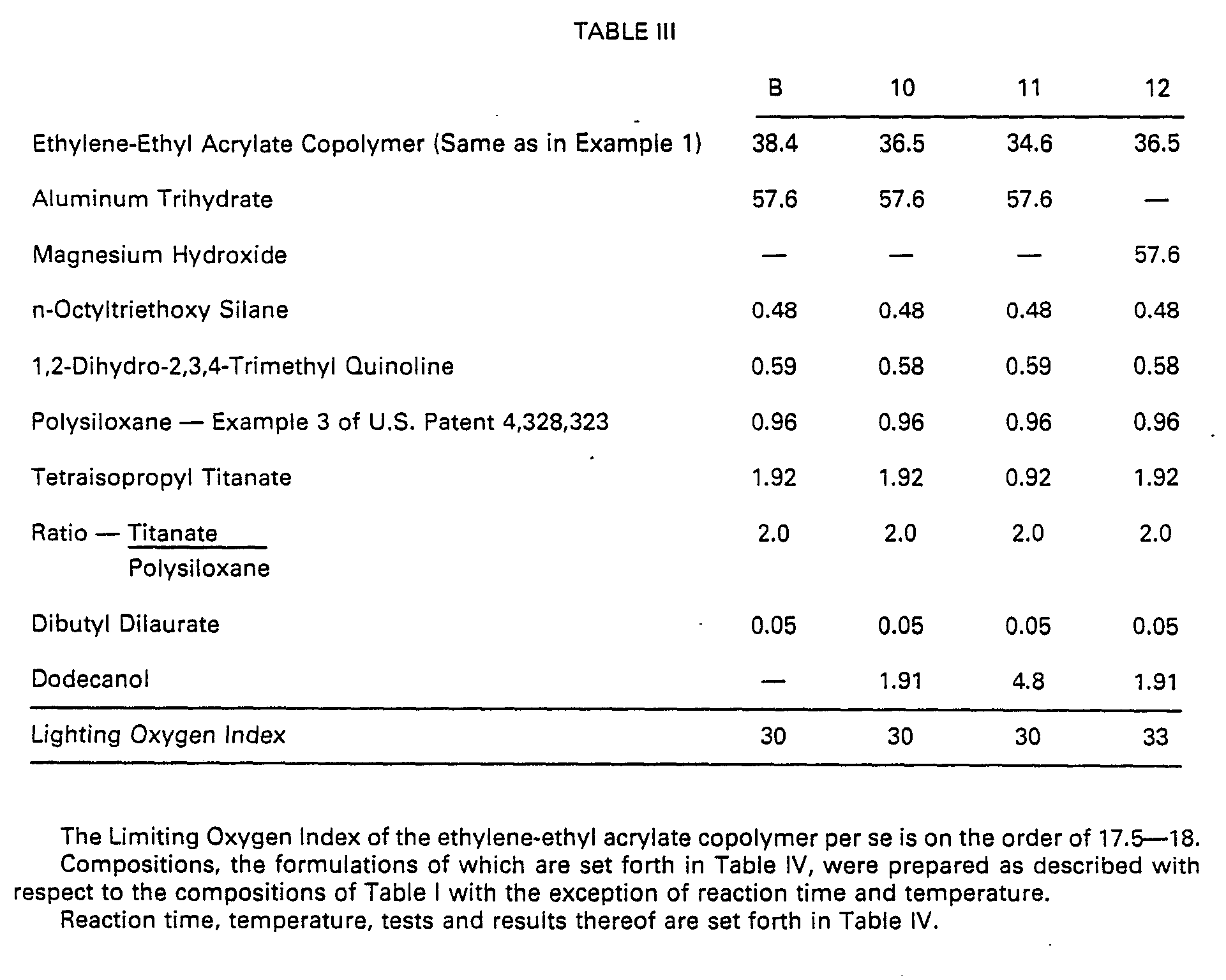
- In the following examples, which are exemplary of the present invention, procedures conducted with respect to Examples 1-4 and Control A of Table I were as follows:
- A 300 g Brabender mixer was preheated to a temperature of 200°C, under an argon gas flow and charged with an ethylene-ethyl acrylate copolymer containing 22 percent by weight combined ethyl acrylate and having a melt index of 6.5, aluminum trihydrate and 1,2-dihydro-2,3,4-trimethyl quinoline, an anti-oxidant, while under an argon gas flow. The charge was mixed for five minutes while the temperature was allowed to drop from 200°C to 185°C. At the end of the five minute period; n-octyltriethoxy silane, a silane coupling agent, was added to the contents of the Brabender and the resultant mixture maintained at a temperature of 185°C while being mixed. At this point, the following additions were made in the order indicated, while the argon flow was continued:
- mixing continued for an additional minute (Examples 1 through 4)
- individually syringed into the Brabender (Control A and Examples 1 through 4)
- Mixing was continued for another 4.5 minutes while the contents of the flask was maintained at a temperature of 185°C, allowing the polysiloxane to react with the ethylene-ethyl acrylate copolymer. Dibutyltin dilaurate was then added by means of a syringe and the contents of the Brabender mixed for another 0.5 minutes.
- The contents of the Brabender was then rapidly discharged, the recovered composition, containing a water curable silane modified ethylene-ethyl acrylate copolymer was flattened in a press between teflon sheets and stored in a double lined polyethylene bag, under argon gas, which was placed in a dry box.
- Samples of the compositions were used to prepare test plaques having dimensions of 7.62d x 7.62 x 0.38 cm (3 x 3 x 0.150 inch) in a press under the following conditions:
- Pressure = 345 bar (5000 psi)
- Temperature = - 150°C
- Time Cycle = 15 minutes
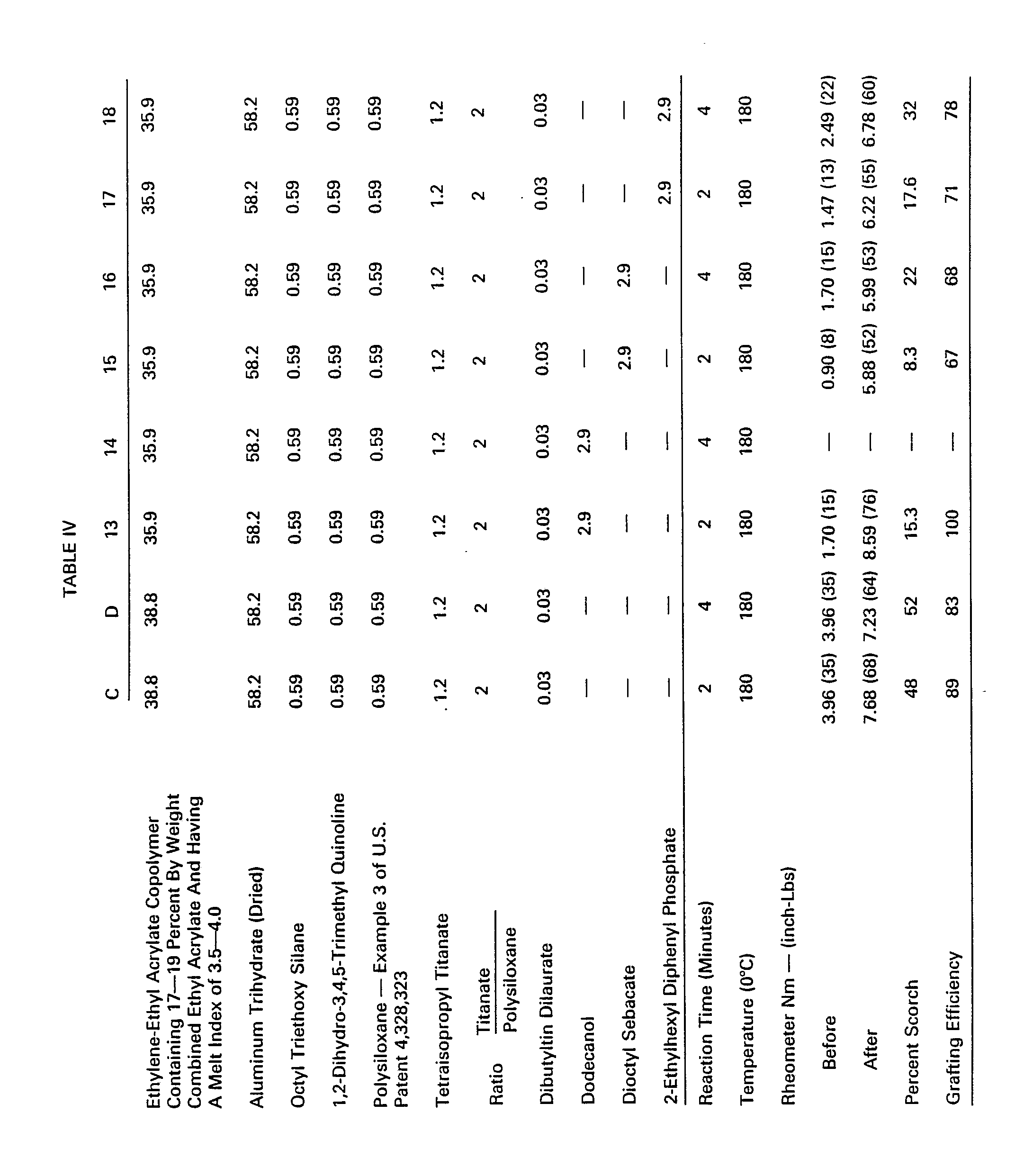
- Test plaques were subjected to the Monsanto Rheometer test, described in detail in U.S. Patent No. 4,018,852.
- Monsanto Rheometer tests, reported in Nm (inch-Ibs) were conducted on uncured test plaques as well as on cured test plaques, cured by being placed in a water bath, maintained at a temperature of 80°C for three hours.
- Monsanto Rheometer test results were then used to determine Percent Scorch, Percent Grafting Efficiency and the System Efficiency according to the following:

- Before - Monsanto Rheometer test results with respect to uncured plaques
- After - Monsanto Rheometer test results with respect to cured plaques
- Initial - Monsanto Rheometer test results with respect to plaques produced from compositions which did not contain organo titanate or polysiloxane

- Example 1, having the highest Rheometer reading (after), was considered as 100 percent efficient.
- Initial = 0.452 Nm (4 inch-Ibs)

- According to the results:
- A higher Monsanto Rheometer value indicates a greater degree of cure.
- A higher Percent Scorch value indicates greater scorch.
- A higher Percent Grafting Efficiency indicates more complete reaction or grafting of polysiloxane onto the alkylene-alkyl acrylate copolymer.
- Amounts noted in the Examples of this specification are in parts by weight.
- The polysiloxane of the Examples contains the unit:


- It is to be understood that in formulating the composition of this invention, mixtures of compounds can be used.
- Also, mixtures of reactants can be used in preparing the polysiloxanes, titanates and silane modified copolymers.
- Although the present invention has been described in reference to water curable, silane modified alkylene-alkyl acrylate copolymers, it is to be understood that formulation of water curable compositions containing an organo titanate, aluminum trihydrate and an anti-scorch compound can be based on such polymers as water curable, silane modified, low density polyethylene, high density polyethylene, ethylene-propylene rubbers, ethylene-propylene-diene rubbers, ethylene-propylene-hexene terpolymers, polyalkyl acrylates and the like.
Claims (15)


Priority Applications (1)
| Application Number | Priority Date | Filing Date | Title |
|---|---|---|---|
| AT83107296T ATE32089T1 (en) | 1983-02-23 | 1983-07-25 | COMPOSITIONS CONTAINING POLYSILOXANE AND ORGANIC TITANATE AND THEIR APPLICATION IN THE PRODUCTION OF WATER-CURING SILANE-MODIFIED ALKYLENE-ACRYLATE COPOLYMERS. |
Applications Claiming Priority (2)
| Application Number | Priority Date | Filing Date | Title |
|---|---|---|---|
| US06/467,318 US4446279A (en) | 1982-02-22 | 1983-02-23 | Compositions based on a polysiloxane and an organo titanate and the use thereof in the preparation of water curable, silane modified alkylene-alkyl acrylate copolymers |
| US467318 | 1983-02-23 |
Publications (2)
| Publication Number | Publication Date |
|---|---|
| EP0120115A1 EP0120115A1 (en) | 1984-10-03 |
| EP0120115B1 true EP0120115B1 (en) | 1988-01-20 |
Family
ID=23855217
Family Applications (1)
| Application Number | Title | Priority Date | Filing Date |
|---|---|---|---|
| EP83107296A Expired EP0120115B1 (en) | 1983-02-23 | 1983-07-25 | Compositions based on a polysiloxane and an organo titanate and the use thereof in the preparation of water curable, silane modified alkylene-alkyl acrylate copolymers |
Country Status (7)
| Country | Link |
|---|---|
| US (1) | US4446279A (en) |
| EP (1) | EP0120115B1 (en) |
| JP (1) | JPS59159850A (en) |
| AT (1) | ATE32089T1 (en) |
| CA (1) | CA1197645A (en) |
| DE (1) | DE3375403D1 (en) |
| ZA (1) | ZA835593B (en) |
Families Citing this family (37)
| Publication number | Priority date | Publication date | Assignee | Title |
|---|---|---|---|---|
| US4575535A (en) * | 1981-08-20 | 1986-03-11 | Union Carbide Corporation | Water-curable, silane modified alkylene-alkyl acrylate copolymers and a process for the production thereof |
| US4489029A (en) * | 1983-06-01 | 1984-12-18 | Union Carbide Corporation | Compositions based on alkylene-alkyl acrylate copolymers and silanol condensation catalysts; and the use thereof in the production of covered wires and cables |
| US4598116A (en) * | 1984-11-09 | 1986-07-01 | Union Carbide Corporation | Scorch resistant compositions based on water-curable thermoplastic polymers having hydrolyzable, pendant silane moieties, and organo titanates |
| NL8800832A (en) * | 1988-03-31 | 1989-10-16 | Lovink Terborg Bv | METHOD FOR PROTECTING PROTECTION AGAINST MOISTURE-ENCLOSED ELEMENTS AND FILLING MASS USED IN THAT METHOD |
| GB8816657D0 (en) * | 1988-07-13 | 1988-08-17 | Bp Chem Int Ltd | Crosslinkable silyl polymer composition |
| US5057361A (en) * | 1989-11-17 | 1991-10-15 | Kimberly-Clark Corporation | Wettable polymeric fabrics |
| KR100242146B1 (en) | 1991-05-31 | 2000-03-02 | 데이 수잔 자넷 | Cross linkable polymeric composition |
| US5211746A (en) * | 1992-06-22 | 1993-05-18 | Union Carbide Chemicals & Plastics Technology Corporation | Flame retardant compositions |
| FR2736060B1 (en) * | 1995-06-30 | 1998-10-23 | Gen Electric | COMPOSITIONS BASED ON ELASTOMERIC SILICONE, HEAT CURING, AND ARTICLES OBTAINED FROM THESE COMPOSITIONS |
| US6188026B1 (en) * | 1998-04-09 | 2001-02-13 | Pirelli Cable Corporation | Pre-lubricated cable and method of manufacture |
| US6967261B1 (en) | 2001-12-28 | 2005-11-22 | Kimberly-Clark Worldwide | Bandage, methods of producing and using same |
| US6822135B2 (en) * | 2002-07-26 | 2004-11-23 | Kimberly-Clark Worldwide, Inc. | Fluid storage material including particles secured with a crosslinkable binder composition and method of making same |
| US6964803B2 (en) | 2002-07-26 | 2005-11-15 | Kimberly-Clark Worldwide, Inc. | Absorbent structures with selectively placed flexible absorbent binder |
| MXPA05000433A (en) | 2002-07-26 | 2005-07-22 | Kimberly Clark Co | Absorbent binder composition, method of making it, and articles incorporating it. |
| US6887961B2 (en) * | 2002-07-26 | 2005-05-03 | Kimberly-Clark Worldwide, Inc. | Absorbent binder composition and method of making it |
| US6808801B2 (en) | 2002-07-26 | 2004-10-26 | Kimberly-Clark Worldwide, Inc. | Absorbent article with self-forming absorbent binder layer |
| US7115321B2 (en) * | 2002-07-26 | 2006-10-03 | Kimberly-Clark Worldwide, Inc. | Absorbent binder coating |
| US7205259B2 (en) * | 2002-07-26 | 2007-04-17 | Kimberly-Clark Worldwide, Inc. | Absorbent binder desiccant composition and articles incorporating it |
| US6737491B2 (en) * | 2002-07-26 | 2004-05-18 | Kimberly-Clark Worldwide, Inc. | Absorbent binder composition and method of making same |
| US7294591B2 (en) * | 2002-12-13 | 2007-11-13 | Kimberly-Clark Worldwide, Inc. | Absorbent composite including a folded substrate and an absorbent adhesive composition |
| US7378566B2 (en) * | 2002-12-13 | 2008-05-27 | Kimberly-Clark Worldwide, Inc. | Absorbent core including folded substrate |
| US20050186427A1 (en) * | 2004-02-19 | 2005-08-25 | The Procter & Gamble Company | Lubricious coated applicator |
| JP2008239634A (en) * | 2005-07-12 | 2008-10-09 | Toagosei Co Ltd | Organic silicon resin having alcoholic hydroxy group, and method for producing the same |
| DE102005039625A1 (en) * | 2005-08-22 | 2007-03-01 | Basf Ag | Open cell foam with fire retardant and oleophobic / hydrophobic properties and process for its preparation |
| US20070083175A1 (en) * | 2005-10-11 | 2007-04-12 | Kimberly-Clark Worldwide, Inc. | Transparent/translucent absorbent composites and articles |
| US7619131B2 (en) * | 2005-12-02 | 2009-11-17 | Kimberly-Clark Worldwide, Inc. | Articles comprising transparent/translucent polymer composition |
| US7312286B2 (en) * | 2005-12-02 | 2007-12-25 | Stockhausen, Inc. | Flexible superabsorbent binder polymer composition |
| US20070129697A1 (en) * | 2005-12-02 | 2007-06-07 | Soerens Dave A | Articles comprising flexible superabsorbent binder polymer composition |
| US7335713B2 (en) | 2005-12-02 | 2008-02-26 | Stockhausen, Inc. | Method for preparing a flexible superabsorbent binder polymer composition |
| EP2199351A1 (en) * | 2008-12-19 | 2010-06-23 | Sika Technology AG | Fluid film based on silane-terminated polymers |
| DE102010003108A1 (en) | 2010-03-22 | 2011-09-22 | Wacker Chemie Ag | Silaoxacyclen |
| DE102010003110A1 (en) | 2010-03-22 | 2011-09-22 | Wacker Chemie Ag | Preparation of Silaoxacycles |
| EP2872563A4 (en) | 2012-07-16 | 2016-05-25 | Polyone Corp | Polyethylene compounds having non-migratory slip properties |
| US9796839B2 (en) | 2012-07-16 | 2017-10-24 | Polyone Corporation | Polypropylene compounds having non-migratory slip properties |
| US10295935B2 (en) * | 2014-10-31 | 2019-05-21 | Hp Indigo B.V. | Electrostatic printing apparatus and intermediate transfer members |
| KR102591753B1 (en) * | 2017-09-26 | 2023-10-23 | 다우 글로벌 테크놀로지스 엘엘씨 | Composition comprising a tin-based catalyst and titanium dioxide for moisture curing of silane-functionalized ethylenic polymers |
| CA3230145A1 (en) * | 2023-02-24 | 2025-04-29 | Bmic Llc | Water-curable silicone compositions and related methods |
Family Cites Families (17)
| Publication number | Priority date | Publication date | Assignee | Title |
|---|---|---|---|---|
| US2716656A (en) * | 1953-01-21 | 1955-08-30 | Monsanto Chemicals | Organo titanium-silicon copolymer preparation |
| US2984641A (en) * | 1956-06-20 | 1961-05-16 | Du Pont | Polyethylene compositions containing titanium organic compounds and structures produced therefrom |
| GB872411A (en) * | 1958-08-05 | 1961-07-12 | Rhone Poulenc Sa | Organopolysiloxane beaten enamels for high temperatures |
| US3057822A (en) * | 1959-06-30 | 1962-10-09 | Hughes Aircraft Co | Organo silicon-titanium copolymers and method of preparation thereof |
| US3677998A (en) * | 1970-04-09 | 1972-07-18 | Dow Corning | Primer for adhesion of silicone rubber to metal |
| US3687882A (en) * | 1971-04-29 | 1972-08-29 | Nexcel Corp | Silane-titanate dispersions for coating aluminum |
| BE787592A (en) * | 1971-08-17 | 1973-02-16 | Dow Corning | SILICONE RUBBER WITH IMPROVED WORKABILITY AND PROCESS OF PREPARATION |
| JPS5347816A (en) * | 1976-10-13 | 1978-04-28 | Mitsubishi Electric Corp | Vibrating plate for speaker |
| US4328323A (en) * | 1979-08-29 | 1982-05-04 | Union Carbide Corporation | Production of silane modified copolymers of alkylene-alkyl acrylates |
| NZ190052A (en) * | 1978-03-31 | 1980-11-14 | Union Carbide Corp | Water-curable silane-modified alkylene alkylacrylate copolymers |
| US4353997A (en) * | 1978-03-31 | 1982-10-12 | Union Carbide Corporation | Compositions based on water-curable, silane modified copolymers of alkylene-alkyl acrylates |
| US4291136A (en) * | 1978-03-31 | 1981-09-22 | Union Carbide Corporation | Water-curable silane modified alkylene alkylacrylate copolymer and a process for its production |
| US4299713A (en) * | 1979-07-19 | 1981-11-10 | National Distillers And Chemical Corp. | Electrical tree and water tree resistant polymer compositions |
| US4369289A (en) * | 1980-09-30 | 1983-01-18 | Union Carbide Corporation | Masterbatch composition comprising a matrix having a polysiloxane dispersed therein and a method for the preparation thereof |
| US4321263A (en) * | 1980-09-30 | 1982-03-23 | Rowell Laboratories, Inc. | Psyllium compositions |
| GB2101138A (en) * | 1981-05-28 | 1983-01-12 | Bicc Plc | Polymer compositions |
| JPS581924A (en) * | 1982-06-17 | 1983-01-07 | 日立電線株式会社 | Method of producing crosslinked polyolefin wire |
-
1983
- 1983-02-23 US US06/467,318 patent/US4446279A/en not_active Expired - Lifetime
- 1983-07-25 EP EP83107296A patent/EP0120115B1/en not_active Expired
- 1983-07-25 AT AT83107296T patent/ATE32089T1/en not_active IP Right Cessation
- 1983-07-25 DE DE8383107296T patent/DE3375403D1/en not_active Expired
- 1983-07-28 CA CA000433484A patent/CA1197645A/en not_active Expired
- 1983-07-29 ZA ZA835593A patent/ZA835593B/en unknown
- 1983-08-02 JP JP58140647A patent/JPS59159850A/en active Granted
Also Published As
| Publication number | Publication date |
|---|---|
| EP0120115A1 (en) | 1984-10-03 |
| ZA835593B (en) | 1984-04-25 |
| US4446279A (en) | 1984-05-01 |
| ATE32089T1 (en) | 1988-02-15 |
| JPS59159850A (en) | 1984-09-10 |
| JPS643909B2 (en) | 1989-01-24 |
| DE3375403D1 (en) | 1988-02-25 |
| CA1197645A (en) | 1985-12-03 |
Similar Documents
| Publication | Publication Date | Title |
|---|---|---|
| US4446279A (en) | Compositions based on a polysiloxane and an organo titanate and the use thereof in the preparation of water curable, silane modified alkylene-alkyl acrylate copolymers | |
| US4369289A (en) | Masterbatch composition comprising a matrix having a polysiloxane dispersed therein and a method for the preparation thereof | |
| EP0049155B1 (en) | Production of silane modified copolymers of alkylene-alkyl acrylates, polysiloxanes having combined therein organo titanates used in their production, process for producing such polysiloxanes, and electrical conductors insulated by cured silane modified copolymers | |
| US4328323A (en) | Production of silane modified copolymers of alkylene-alkyl acrylates | |
| US4353997A (en) | Compositions based on water-curable, silane modified copolymers of alkylene-alkyl acrylates | |
| EP0106062B1 (en) | Polysiloxanes and the use thereof in the production of silane modified alkylene-alkyl acrylate copolymers | |
| EP0135923B1 (en) | Production of water-curable, silane modified thermoplastic polymers | |
| US4489029A (en) | Compositions based on alkylene-alkyl acrylate copolymers and silanol condensation catalysts; and the use thereof in the production of covered wires and cables | |
| US4343917A (en) | Water curable, amino silane modified alkylene-alkyl acrylate copolymers | |
| US4291136A (en) | Water-curable silane modified alkylene alkylacrylate copolymer and a process for its production | |
| US4440907A (en) | Process of producing a water-curable, silane modified alkylene-alkyl acrylate copolymer by reacting an alkylene-alkyl acrylate copolymer with a polysiloxane predispersed in a thermoplastic resin matrix | |
| US4434272A (en) | Water-curable, silane modified alkyl acrylate copolymers and a process for the preparation thereof | |
| US4575535A (en) | Water-curable, silane modified alkylene-alkyl acrylate copolymers and a process for the production thereof | |
| EP0093806A1 (en) | Compositions based on water-curable, silane modified copolymers of alkylene-alkyl acrylates | |
| US4404349A (en) | Polysiloxanes having combined therein organo titanates | |
| US4617338A (en) | Compositions based on alkylene-alkyl acrylate copolymers and silanol condensation catalysts | |
| EP0150774B1 (en) | Water curable, azide sulfonyl silane modified, alkylene acrylate copolymers | |
| JPS6218577B2 (en) | ||
| CA1177195A (en) | Compositions based on water-curable silane modified copolymers of alkylene-alkyl acrylates | |
| CA1239721A (en) | Polysiloxanes and the use thereof in the production of silane modified alkylene-alkyl acrylate copolymers | |
| CA1186437A (en) | Production of silane modified copolymers of alkylene- alkyl acrylates, polysiloxanes having combined therein organo titanates and the use thereof in the production of silane modified copolymers of alkylene- alkyl acrylates | |
| EP0032587A2 (en) | Heat curable polymers and a process for making these polymers | |
| NO821247L (en) | PREPARATION BASED ON WATERABLE SILANE MODIFIED COPOLYMERS OF ALKYLEN-ALKYLACRYLATES |
Legal Events
| Date | Code | Title | Description |
|---|---|---|---|
| PUAI | Public reference made under article 153(3) epc to a published international application that has entered the european phase |
Free format text: ORIGINAL CODE: 0009012 |
|
| AK | Designated contracting states |
Designated state(s): AT BE CH DE FR GB IT LI LU NL SE |
|
| 17P | Request for examination filed |
Effective date: 19841210 |
|
| 17Q | First examination report despatched |
Effective date: 19860206 |
|
| GRAA | (expected) grant |
Free format text: ORIGINAL CODE: 0009210 |
|
| AK | Designated contracting states |
Kind code of ref document: B1 Designated state(s): AT BE CH DE FR GB IT LI LU NL SE |
|
| REF | Corresponds to: |
Ref document number: 32089 Country of ref document: AT Date of ref document: 19880215 Kind code of ref document: T |
|
| ITF | It: translation for a ep patent filed | ||
| REF | Corresponds to: |
Ref document number: 3375403 Country of ref document: DE Date of ref document: 19880225 |
|
| ET | Fr: translation filed | ||
| PG25 | Lapsed in a contracting state [announced via postgrant information from national office to epo] |
Ref country code: LU Free format text: LAPSE BECAUSE OF NON-PAYMENT OF DUE FEES Effective date: 19880731 |
|
| PLBE | No opposition filed within time limit |
Free format text: ORIGINAL CODE: 0009261 |
|
| STAA | Information on the status of an ep patent application or granted ep patent |
Free format text: STATUS: NO OPPOSITION FILED WITHIN TIME LIMIT |
|
| 26N | No opposition filed | ||
| PG25 | Lapsed in a contracting state [announced via postgrant information from national office to epo] |
Ref country code: GB Effective date: 19890725 Ref country code: AT Effective date: 19890725 |
|
| PG25 | Lapsed in a contracting state [announced via postgrant information from national office to epo] |
Ref country code: SE Effective date: 19890726 |
|
| PG25 | Lapsed in a contracting state [announced via postgrant information from national office to epo] |
Ref country code: LI Effective date: 19890731 Ref country code: CH Effective date: 19890731 Ref country code: BE Effective date: 19890731 |
|
| BERE | Be: lapsed |
Owner name: UNION CARBIDE CORP. Effective date: 19890731 |
|
| PG25 | Lapsed in a contracting state [announced via postgrant information from national office to epo] |
Ref country code: NL Effective date: 19900201 |
|
| GBPC | Gb: european patent ceased through non-payment of renewal fee | ||
| NLV4 | Nl: lapsed or anulled due to non-payment of the annual fee | ||
| PG25 | Lapsed in a contracting state [announced via postgrant information from national office to epo] |
Ref country code: FR Free format text: LAPSE BECAUSE OF NON-PAYMENT OF DUE FEES Effective date: 19900330 |
|
| REG | Reference to a national code |
Ref country code: CH Ref legal event code: PL |
|
| PG25 | Lapsed in a contracting state [announced via postgrant information from national office to epo] |
Ref country code: DE Effective date: 19900403 |
|
| REG | Reference to a national code |
Ref country code: FR Ref legal event code: ST |
|
| EUG | Se: european patent has lapsed |
Ref document number: 83107296.2 Effective date: 19900418 |