EP0118990A2 - Wine stabilization using immobilized phenolic compounds or tannic acid - Google Patents
Wine stabilization using immobilized phenolic compounds or tannic acid Download PDFInfo
- Publication number
- EP0118990A2 EP0118990A2 EP84300652A EP84300652A EP0118990A2 EP 0118990 A2 EP0118990 A2 EP 0118990A2 EP 84300652 A EP84300652 A EP 84300652A EP 84300652 A EP84300652 A EP 84300652A EP 0118990 A2 EP0118990 A2 EP 0118990A2
- Authority
- EP
- European Patent Office
- Prior art keywords
- immobilized
- wine
- tannic acid
- phenolic compound
- phenol
- Prior art date
- Legal status (The legal status is an assumption and is not a legal conclusion. Google has not performed a legal analysis and makes no representation as to the accuracy of the status listed.)
- Withdrawn
Links
Classifications
-
- C—CHEMISTRY; METALLURGY
- C12—BIOCHEMISTRY; BEER; SPIRITS; WINE; VINEGAR; MICROBIOLOGY; ENZYMOLOGY; MUTATION OR GENETIC ENGINEERING
- C12H—PASTEURISATION, STERILISATION, PRESERVATION, PURIFICATION, CLARIFICATION OR AGEING OF ALCOHOLIC BEVERAGES; METHODS FOR ALTERING THE ALCOHOL CONTENT OF FERMENTED SOLUTIONS OR ALCOHOLIC BEVERAGES
- C12H1/00—Pasteurisation, sterilisation, preservation, purification, clarification, or ageing of alcoholic beverages
- C12H1/02—Pasteurisation, sterilisation, preservation, purification, clarification, or ageing of alcoholic beverages combined with removal of precipitate or added materials, e.g. adsorption material
Definitions
- the present invention relates to a method and apparatus for stabilizing wine. More particularly, it discloses a novel means for removing compounds which can cause haze formation in wine exposed to higher than ambient storage temperatures. Immobilized phenolic compounds or tannic acid are used.
- Immobilized gallotannins have been reported in the prior art.
- the authors described how immobilized chinese gallotannin reduced the turbidity which results from pasteurizing beer (sake).
- Sake produced from fermented rice was pasteurized at 65°C for 15 minutes, whereupon it became turbid. It was then passed through a column packed with immobilized gallotannin. Sake treated in this way was said to not change in turbidity during storage.
- the disclosed adsorbent was said to hold promise for improving sake, beer, wine and juice by removing undesirable protein constituents.
- tannic acid can be immobilized to many known carriers by various methods known to those of skill in the art. An exhaustive recitation of these methods and carriers is not necessary.
- the immobilized heterocyclic phenolic compounds of the present invention can be in two forms, either attached to an insoluble carrier or polymerized into an insoluble state.
- phenolic refers to the broad category of chemicals having at least one hydroxy group attached to at least one aromatic hydrocarbon ring, such as phenol-formaldehyde resins. In other words, phenolic refers to compounds having an aryl alcohol component.
- suitable phenolic compounds meant to be illustrative and not comprehensive, follows: phenol, tyrosine, phloroglucinol, phenylalanine napthols, phenol-formaldehyde resin, and lignin.
- the present invention solves a problem not easily addressed in the prior art, namely, the destabilization of wine under long term, slightly elevated temperatures. This is to be distinguished from other forms of turbidity problems or hazing. Cloudiness due either to chilling, chill haze, or to short periods of excessive heat, such as pasteurization haze, is not the same as that which occurs as a result of the destabilization of wine over the long term.
- a haze formation test was used to determine whether wine has been stabilized. A 5.0 ml sample of wine was warmed to 45°C for 120 minutes. The sample was then checked for haze formation spectrophotometrically at 550 nm.
- a white wine supplied by a California vintner not previously stabilized by bentonite treatment was passed through a 30g column at.a flow rate of 133 ml/hr. Samples were collected over time and subjected to stabilization testing.
- tannic acid was attached to a SiO 2 carrier (40/80 mesh, 380A average pore diameter) by periodate oxidation.
- the present invention solves a problem not easily addressed in the prior art, namely, the destabilization of wine under long term, slightly elevated temperatures. This is to be distinguished from other forms of turbidity problems or hazing. Cloudiness due either to chilling, chill haze, or to short periods of excessive heat, such as pasteurization haze, is not the same as that which occurs as a result of the destabilization of wine over the long term.
- a haze formation test was used to determine whether wine has been stabilized. A 5.0 ml sample of wine was warmed to 45°C for 120 minutes. The sample was then checked for haze formation spectrophotometrically at 550 nm.
- a white wine supplied by a California vintner not previously stabilized by bentonite treatment was passed through a 30g column at a flow rate of 133 ml/hr. Samples were collected over time and subjected to stabilization testing.
- tannic acid was attached to a SiO 2 carrier (40/80 mesh, 380A average pore diameter) by periodate oxidation.
- a 30g column of SiO 2 coupled to gamma-aminopropyltriethyoxysilane was prepared and operated in a manner identical to the column in Example 1. Unstabilized white wine was heated at 45°C for 120 minutes, then flowed through the control column. The result was:
- the SiO 2 alkylamine acted in a fashion identical to centrifugation and celite filtration. Unlike tannic acid treatment the haze causing components were not removed completely.
- a phenol-formaldehyde amine functional resin column was run. However, the resin was reacted with periodate oxidized tannic acid as previously described. A 2x30 cm column was used and the wine flow rate through the column was 60 ml/hr.
- the product was washed with water for 3 days on a fluidized bed using tap water. This was followed by washing in 0.01N HC1 until the solution was clear.
- the product was tested for wine stabilization in a 1.5x30 cm column at flow rate of 60 ml/hr.
- a column of the above compound was poured and unstable wine was passed through it at 110 ml/hr.
- Assay was by the 2 minute boil test, wherein a 5.0 ml sample of wine is boiled for 2 minutes, plunged into ice and allowed to stand for 10 minutes. The sample was checked for haze. Results were determined spectrophotometrically at 550 nm and were as folows:
- the coupled silica was poured into a column and unstable white wine was passed through the column at 140 ml/hr.
- the wine sample was taken after 200 ml had passed through the column and was subjected to two tests. The first, a boil test resulted in a clear product:
- the second test was a haze formation test.
- a 500 ml sample was warmed to 45°C for 120 minutes. The sample was then checked for haze formation spectrophotometrically at 550 nm. The result was 0.02.
- Immobilized resorcinol acted as a stabilizing agent.
- the Si0 2 alkylamine column while removing the initially visible precipitate,' did not prevent haze formation upon boiling for 2 min. or heating to 45°C for 120 minutes.
- the SiO 2 alkylamine acted in a fashion identical to centrifugation and celite filtration.
- Immobilized lignin was prepared as follows:
- Immobilized lignin stabilized wine Immobilized lignin stabilized wine.
- the resin was washed with 0.001M HC1 overnight and soaked in white wine for 30 minutes. A 1.5 cm x 40 cm colnmn was poured. The unstable wine was passed through the column and the effluent tested for stability by the 45°C overnight assay. Flow rate was set at about 60 ml/hr.
Landscapes
- Chemical & Material Sciences (AREA)
- Organic Chemistry (AREA)
- Engineering & Computer Science (AREA)
- Bioinformatics & Cheminformatics (AREA)
- Life Sciences & Earth Sciences (AREA)
- Biochemistry (AREA)
- Health & Medical Sciences (AREA)
- General Engineering & Computer Science (AREA)
- General Health & Medical Sciences (AREA)
- Genetics & Genomics (AREA)
- Food Science & Technology (AREA)
- Wood Science & Technology (AREA)
- Zoology (AREA)
- Distillation Of Fermentation Liquor, Processing Of Alcohols, Vinegar And Beer (AREA)
Abstract
A process for stabilizing wine is characterized by:
- a) immobilizing tannic acid or a phenolic compound;
- b) contacting a wine having components which causes haze formation upon heating with the immobolized tannic acid or the immobilized phenolic compound for a period sufficient to remove the desired amount of haze components; and
- c) separating the treated wine from the immobilized tannic acid or the immobilized phenolic compound.
Description
- The present invention relates to a method and apparatus for stabilizing wine. More particularly, it discloses a novel means for removing compounds which can cause haze formation in wine exposed to higher than ambient storage temperatures. Immobilized phenolic compounds or tannic acid are used.
- During the handling and bulk shipping of wine, it can be exposed to higher than ambient storage temperatures, such as during truck shipment during the hot summer months. While the wine may stay clear during wine cellar storage, the warmer temperatures can cause hazing problems. In the past this problem was addressed by bentonite treatments known to the art.
- Immobilized gallotannins have been reported in the prior art. In an article presented at the Sixth Enzyme Engineering Conference in Japan, 1981, titled "Applications of Immobilized Tannin for Protein and Metal Adsorption", the authors described how immobilized chinese gallotannin reduced the turbidity which results from pasteurizing beer (sake).
- Sake produced from fermented rice was pasteurized at 65°C for 15 minutes, whereupon it became turbid. It was then passed through a column packed with immobilized gallotannin. Sake treated in this way was said to not change in turbidity during storage. The disclosed adsorbent was said to hold promise for improving sake, beer, wine and juice by removing undesirable protein constituents.
- It was unexpectedly found that wine can be stabilized by using immobilized tannic acid or . immobilized phenolic compounds. Wine having components which cause haze formation when heated at above ambient storage temperatures are contacted with immobilized tannic acid or an immobilized phenolic compound for a time sufficient to remove the desired amount of haze components. After this treatment, wine separated from the immobilized tannic acid or phenolic compound is stable, even when subjected to heat for a long time.
- It should be noted that tannic acid can be immobilized to many known carriers by various methods known to those of skill in the art. An exhaustive recitation of these methods and carriers is not necessary.
- The immobilized heterocyclic phenolic compounds of the present invention can be in two forms, either attached to an insoluble carrier or polymerized into an insoluble state. The term "phenolic" refers to the broad category of chemicals having at least one hydroxy group attached to at least one aromatic hydrocarbon ring, such as phenol-formaldehyde resins. In other words, phenolic refers to compounds having an aryl alcohol component. A list of suitable phenolic compounds, meant to be illustrative and not comprehensive, follows: phenol, tyrosine, phloroglucinol, phenylalanine napthols, phenol-formaldehyde resin, and lignin.
- The present invention solves a problem not easily addressed in the prior art, namely, the destabilization of wine under long term, slightly elevated temperatures. This is to be distinguished from other forms of turbidity problems or hazing.. Cloudiness due either to chilling, chill haze, or to short periods of excessive heat, such as pasteurization haze, is not the same as that which occurs as a result of the destabilization of wine over the long term.
- The following examples further illustrate preferred modes of stabilizing wines by the present invention.
- A haze formation test was used to determine whether wine has been stabilized. A 5.0 ml sample of wine was warmed to 45°C for 120 minutes. The sample was then checked for haze formation spectrophotometrically at 550 nm.
- A white wine supplied by a California vintner not previously stabilized by bentonite treatment was passed through a 30g column at.a flow rate of 133 ml/hr. Samples were collected over time and subjected to stabilization testing.
- The wine was flowed over a column of immobilized tannic acid. By methods known to one of skill in the art, tannic acid was attached to a SiO2 carrier (40/80 mesh, 380A average pore diameter) by periodate oxidation.
-
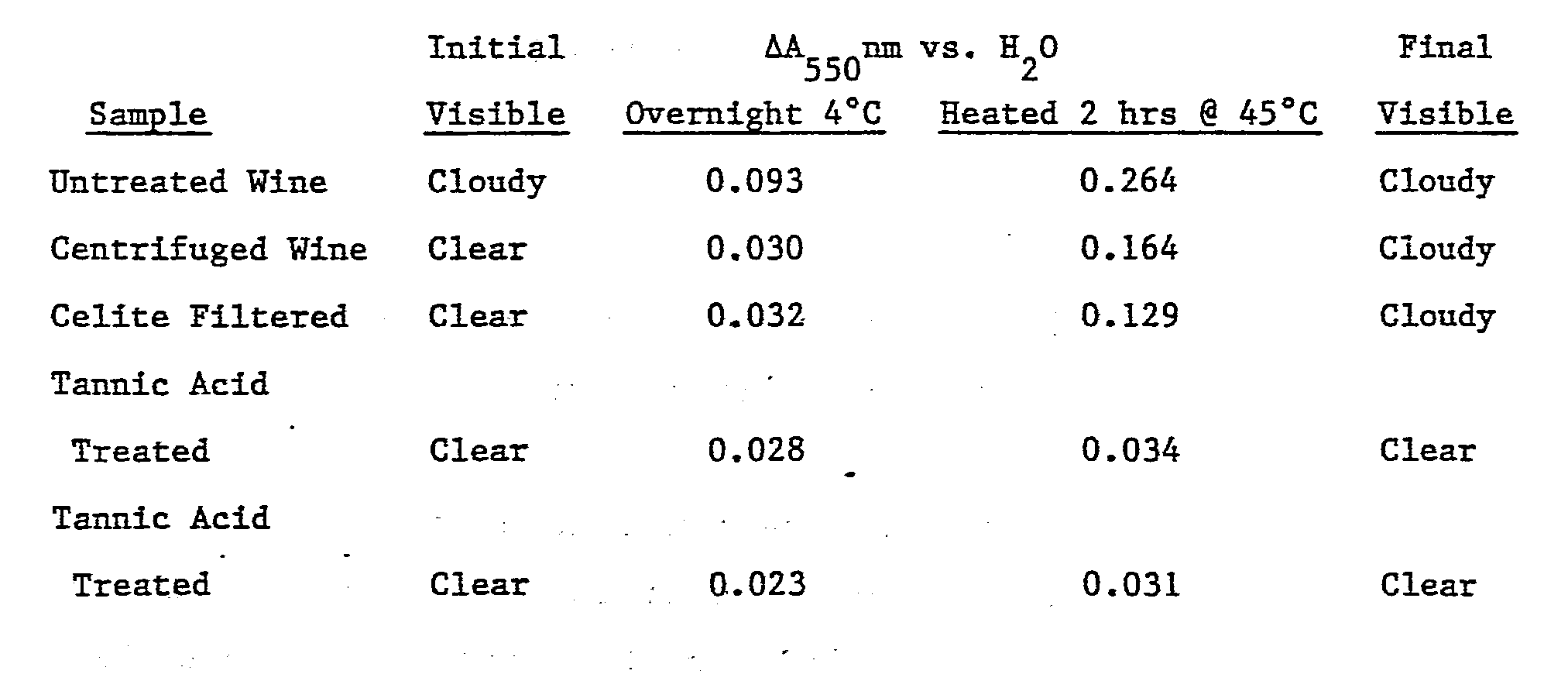
- After passing 2000 ml through the column a sample was again evaluated as follows:
- Tannic Acidgroup attached to at least one aromatic hydrocarbon ring, such as phenol-formaldehyde resins. In other words, phenolic refers to compounds having an aryl alcohol component. A list of suitable phenolic compounds, meant to be illustrative and not comprehensive, follows: phenol, tyrosine, phloroglucinol, phenylalanine napthols, phenol-formaldehyde resin, and lignin.

- The present invention solves a problem not easily addressed in the prior art, namely, the destabilization of wine under long term, slightly elevated temperatures. This is to be distinguished from other forms of turbidity problems or hazing. Cloudiness due either to chilling, chill haze, or to short periods of excessive heat, such as pasteurization haze, is not the same as that which occurs as a result of the destabilization of wine over the long term.
- The following examples further illustrate preferred modes of stabilizing wines by the present invention.
- A haze formation test was used to determine whether wine has been stabilized. A 5.0 ml sample of wine was warmed to 45°C for 120 minutes. The sample was then checked for haze formation spectrophotometrically at 550 nm.
- A white wine supplied by a California vintner not previously stabilized by bentonite treatment was passed through a 30g column at a flow rate of 133 ml/hr. Samples were collected over time and subjected to stabilization testing.
- The wine was flowed over a column of immobilized tannic acid. By methods known to one of skill in the art, tannic acid was attached to a SiO2 carrier (40/80 mesh, 380A average pore diameter) by periodate oxidation.
-

- After passing 2000 ml through the column a sample was again evaluated as follows:
- Tannic Acid

- A 30g column of SiO2 coupled to gamma-aminopropyltriethyoxysilane was prepared and operated in a manner identical to the column in Example 1. Unstabilized white wine was heated at 45°C for 120 minutes, then flowed through the control column. The result was:

- The SiO2 alkylamine acted in a fashion identical to centrifugation and celite filtration. Unlike tannic acid treatment the haze causing components were not removed completely.
- A phenol-formaldehyde amine functional resin column was run. However, the resin was reacted with periodate oxidized tannic acid as previously described. A 2x30 cm column was used and the wine flow rate through the column was 60 ml/hr.
- The results were:
-

- These results were similar to that of Example 1.
- To 100g SiO2 carrier was added 34g tannic acid plus 250 ml water. The pH was adjusted to 10.8 with NaOH solution. To this was added 29.2 ml of formaldehyde solution (37% solution). This was heated at 70°C for 2 hours, brought to pH 6.7 with H2SO4, washed once with H20 (one volume), placed in a 70°C oven and dried overnight.
- The product was washed with water for 3 days on a fluidized bed using tap water. This was followed by washing in 0.01N HC1 until the solution was clear.
- The product was tested for wine stabilization in a 1.5x30 cm column at flow rate of 60 ml/hr.

- Results show stabilization of the wine occurs.
- The following procedure was used to prepare an immobilized phenol:
- Fifty grams SiO2 porous ceramic (350A° average pore diameter) was converted to arylamine by methods described in-the literature. This was diazotized with NaNO3/HCl in the cold to phenol. The phenol used was 5.35 ml dissolved in 100 ml 0.05M NaHCO3, pH 8.0. Coupling was for 2 hrs at 0°C. The product was washed in pH 9.0, NaHCO3 solution followed by 0.1M acetate at pH 3.0.
- A column of the above compound was poured and unstable wine was passed through it at 110 ml/hr.
- Assay was by the 2 minute boil test, wherein a 5.0 ml sample of wine is boiled for 2 minutes, plunged into ice and allowed to stand for 10 minutes. The sample was checked for haze. Results were determined spectrophotometrically at 550 nm and were as folows:

- These results indicated that phenol does stabilize wine.
- The following procedure was used to prepare an immobilized resorcinol:
- Fifty grams of porous silica, 350A average pore diameter previously converted to arylamine was diazotized and coupled to resorcinol using 1% resorcinol in a total volume of 100 ml 0.1M NaHCO3 buffer. The product was washed with water followed by 0.001M HC1.
- The coupled silica was poured into a column and unstable white wine was passed through the column at 140 ml/hr.
- The wine sample was taken after 200 ml had passed through the column and was subjected to two tests. The first, a boil test resulted in a clear product:

- The second test was a haze formation test. A 500 ml sample was warmed to 45°C for 120 minutes. The sample was then checked for haze formation spectrophotometrically at 550 nm. The result was 0.02.
- Immobilized resorcinol acted as a stabilizing agent.
- As a control, a 30g column of SiO2 was coupled to gamma-aminopropyltriethyoxysilane.. A packed column was prepared and operated in a manner identical to that of Examples 1 and 2.
- The Si02 alkylamine column while removing the initially visible precipitate,' did not prevent haze formation upon boiling for 2 min. or heating to 45°C for 120 minutes. The SiO2 alkylamine acted in a fashion identical to centrifugation and celite filtration.
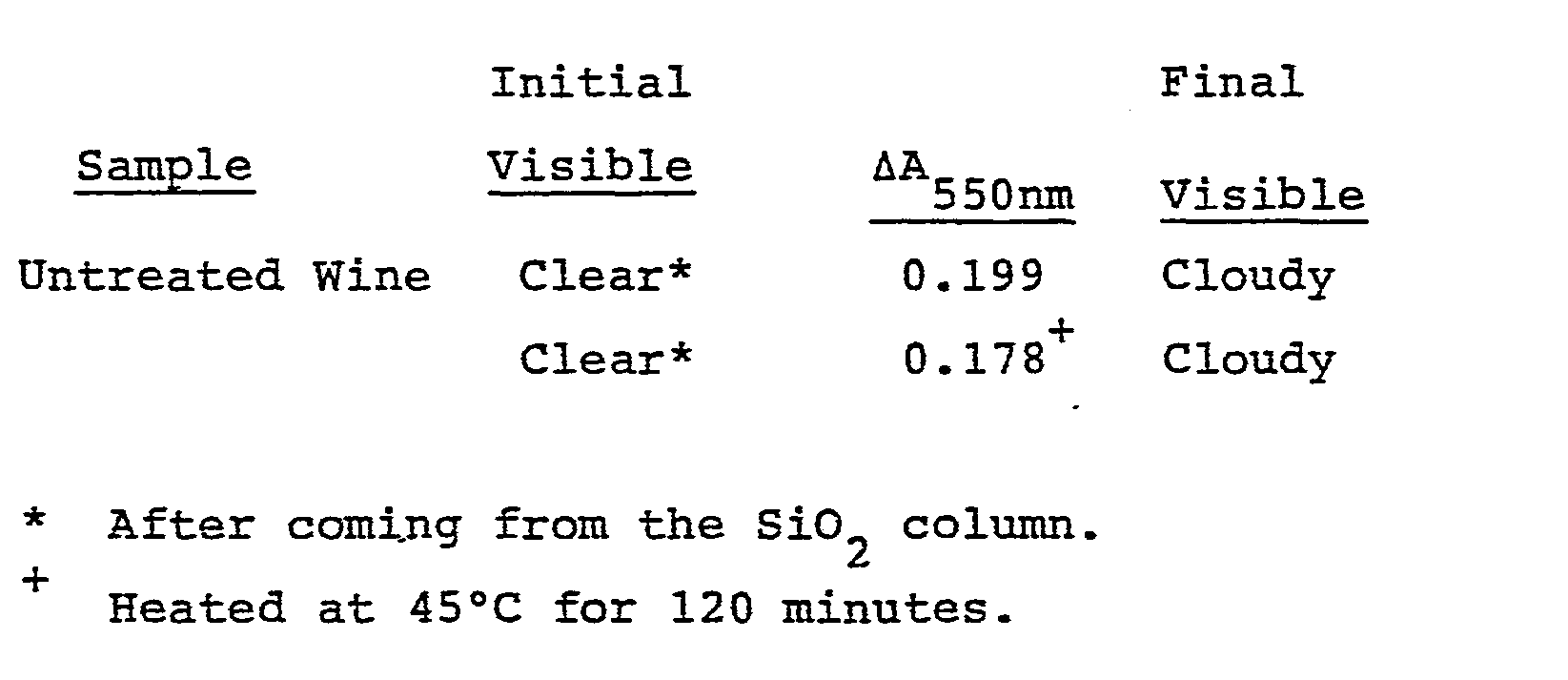
- To show that polymerized, insoluble phenolic groups also stabilize wine, a column of Dualite A-4 (phenol-formaldehyde resin containing amine function groups previously shown to have no effect) was used. A 2 x 30 cm column of resin as poured and unstable wine was passed through it at 50 ml/hr. Stability was determined by means of the 2 minute boil and the 45°C assays previously described. An untreated control wine was also assayed. :

- These results indicated that the resin did indeed stabilize the white wine.
- Immobilized lignin was prepared as follows:
- Thirty grams of Reed Lignin (sulfonated soluble lignin) was dissolved in 200 ml H20 at pH 9.0. To this was added 2 grams sodium periodate dissolved in 30 ml H20. The reaction was continued at pH 9.0 for 1 hr. The result was then added to 50 grams of alkylamine-SiO2 carrier previously soaked in 0.1M phosphate,.pH 10.0. The phosphate was decanted off before addition of the lignin and allowed to react overnight at pH 9.0.
- The next morning the product was washed with water and 0.001M HC1 and placed in a 2 x 30 cm column. Unstable white wine was passed through at 50 ml/hr. After 4 hours, the effluent was tested for activity.
- The effluent was tested with the following results:
- 2 min boil (880 ml)

- Immobilized lignin stabilized wine.
- Finally, a porous phenol-formaldehyde resin having only hydroxyl groups was tested. The average pore diameter was 300A.
- The resin was washed with 0.001M HC1 overnight and soaked in white wine for 30 minutes. A 1.5 cm x 40 cm colnmn was poured. The unstable wine was passed through the column and the effluent tested for stability by the 45°C overnight assay. Flow rate was set at about 60 ml/hr.
- The results were:

- These results indicated that the phenol-formaldehyde resin stabilized the wine.
Claims (8)
1. A process for stabilizing wine comprising the steps of:
(a) immobilizing tannic acid or a phenolic compound;
(b) contacting a wine having components which cause haze formation upon heating with the immobilized tannic acid or the immobilized phenolic compound for a period sufficient to remove the desired amount of haze components; and
(c) separating the treated wine from the immobilized tannic acid or the immobilized phenolic compound.
2. A process as claimed in claim 1 characterised in that the phenolic compound is selected from lignin, phenol, resorcinol, phloroglucinol, tyrosine, phenylalanine, and phenol-formaldehyde resin.
3. A process as claimed in claim 1 or claim 2 characterised in that the tannic acid or the phenolic compound is immobilized by attachment to an insoluble carrier.
4. A process as claimed in claim 3 characterised in that the attachment is by means of periodate oxidation to a silicon dioxide carrier.
5. A process as claimed in claim 1 or claim 2 characterised in that the phenolic compound is immobilized by polymerization into an insoluble phenolic polymer.
Example 10 Phenol-Formaldehyde Resins Without Amine Groups Finally, a porous phenol-formaldehyde resin having only hydroxyl groups was tested. The average pore diameter was 300A. The resin was washed with 0.001M HC1 overnight and soaked in white wine for 30 minutes. A 1.5 cm x 40 cm column was poured. The unstable wine was passed through the column and the effluent tested for stability by the 45°C .overnight assay. Flow rate was set at about 60 ml/hr. The results were: 
These results indicated that the phenol-formaldehyde resin stabilized the wine.
1. A process for stabilizing wine comprising the steps of: (a) immobilizing tannic acid or a phenolic compound; (b) contacting a wine having components which cause haze formation upon heating with the immobilized tannic acid or the immobilized phenolic compound for a period sufficient to remove the desired amount of haze components; and (c) separating the treated wine from the immobilized tannic acid or the immobilized phenolic compound. 2. A process as claimed in claim 1 characterised in that the phenolic compound is selected from lignin, phenol, resorcinol, phloroglucinol, tyrosine, phenylalanine, and phenol-formaldehyde resin. 3. A process as claimed in claim 1 or claim 2 characterised in that the tannic acid or the phenolic compound is immobilized by attachment to an insoluble carrier. 4. A process as claimed in claim 3 characterised in that the attachment is by means of periodate oxidation to a silicon dioxide carrier. 5. A process as claimed in claim 1 or claim 2 characterised in that the phenolic compound is immobilized by polymerization into an insoluble phenolic polymer.
Example 10 Phenol-Formaldehyde Resins Without Amine Groups Finally, a porous phenol-formaldehyde resin having only hydroxyl groups was tested. The average pore diameter was 300A. The resin was washed with 0.001M HC1 overnight and soaked in white wine for 30 minutes. A 1.5 cm x 40 cm column was poured. The unstable wine was passed through the column and the effluent tested for stability by the 45°C .overnight assay. Flow rate was set at about 60 ml/hr. The results were:
1. A process for stabilizing wine comprising the steps of: (a) immobilizing tannic acid or a phenolic compound; (b) contacting a wine having components which cause haze formation upon heating with the immobilized tannic acid or the immobilized phenolic compound for a period sufficient to remove the desired amount of haze components; and (c) separating the treated wine from the immobilized tannic acid or the immobilized phenolic compound. 2. A process as claimed in claim 1 characterised in that the phenolic compound is selected from lignin, phenol, resorcinol, phloroglucinol, tyrosine, phenylalanine, and phenol-formaldehyde resin. 3. A process as claimed in claim 1 or claim 2 characterised in that the tannic acid or the phenolic compound is immobilized by attachment to an insoluble carrier. 4. A process as claimed in claim 3 characterised in that the attachment is by means of periodate oxidation to a silicon dioxide carrier. 5. A process as claimed in claim 1 or claim 2 characterised in that the phenolic compound is immobilized by polymerization into an insoluble phenolic polymer.
6. The process recited in claim 3 wherein the attachment is by means of formaldehyde-tannic acid copolymerization onto the carrier.
7. The process recited in claim 1 wherein the wine is white wine..
8. An apparatus for carrying out the method of any one of claims 1-7, characterized by:
a reactor containing immobilized tannic acid or an immobilized phenolic compound,
a means for contacting wine having components which cause haze formation upon heating with the immobilized phenolic compound contained by the reactor; and .
a means for separating the treated wine from the reactor.
Applications Claiming Priority (4)
| Application Number | Priority Date | Filing Date | Title |
|---|---|---|---|
| US46631083A | 1983-02-14 | 1983-02-14 | |
| US466310 | 1983-02-14 | ||
| US06/466,309 US4500554A (en) | 1983-02-14 | 1983-02-14 | Wine stabilization using immobilized tannic acid |
| US466309 | 1983-02-14 |
Publications (2)
| Publication Number | Publication Date |
|---|---|
| EP0118990A2 true EP0118990A2 (en) | 1984-09-19 |
| EP0118990A3 EP0118990A3 (en) | 1986-10-22 |
Family
ID=27041613
Family Applications (1)
| Application Number | Title | Priority Date | Filing Date |
|---|---|---|---|
| EP84300652A Withdrawn EP0118990A3 (en) | 1983-02-14 | 1984-02-02 | Wine stabilization using immobilized phenolic compounds or tannic acid |
Country Status (2)
| Country | Link |
|---|---|
| EP (1) | EP0118990A3 (en) |
| AU (1) | AU2427384A (en) |
Cited By (5)
| Publication number | Priority date | Publication date | Assignee | Title |
|---|---|---|---|---|
| GB2294944A (en) * | 1994-11-09 | 1996-05-15 | Bass Plc | Stabilising beer by removal of haze precursors |
| WO1998000455A1 (en) * | 1996-06-28 | 1998-01-08 | W.R. Grace & Co.-Conn. | Cross-linked tannin/inorganic oxide composites |
| WO2000066705A3 (en) * | 1999-05-03 | 2001-05-17 | Pq Holding Inc | Process and composition for reducing chill haze in beverages |
| FR2917749A1 (en) * | 2007-06-19 | 2008-12-26 | Laffort Soc Par Actions Simpli | USE OF OENOLOGY TANNINS |
| US11865510B2 (en) | 2018-04-19 | 2024-01-09 | Alma Mater Studiorum-Universita'di Bologna | Device and method for stabilizing wine and other vegetable beverages |
Family Cites Families (5)
| Publication number | Priority date | Publication date | Assignee | Title |
|---|---|---|---|---|
| US1724021A (en) * | 1927-08-01 | 1929-08-13 | Us Process Corp | Cereal beverage and liquid |
| US2471502A (en) * | 1944-08-12 | 1949-05-31 | Wallerstein Co Inc | Method of improving fermented beverages and product obtained thereby |
| FR1151638A (en) * | 1956-06-15 | 1958-02-03 | Process for stabilizing wines against tartar deposits and disturbances of metallic origin | |
| US4073954A (en) * | 1976-02-03 | 1978-02-14 | Mobius Christian Hermann | Method of removing tannins and reducing clouding in drinks |
| US4202910A (en) * | 1977-02-07 | 1980-05-13 | Johns-Manville Corporation | Filtration of vegetable based matter |
-
1984
- 1984-02-02 EP EP84300652A patent/EP0118990A3/en not_active Withdrawn
- 1984-02-08 AU AU24273/84A patent/AU2427384A/en not_active Abandoned
Cited By (10)
| Publication number | Priority date | Publication date | Assignee | Title |
|---|---|---|---|---|
| GB2294944A (en) * | 1994-11-09 | 1996-05-15 | Bass Plc | Stabilising beer by removal of haze precursors |
| GB2294944B (en) * | 1994-11-09 | 1997-11-19 | Bass Plc | Stabilisation of beverages |
| WO1997043400A1 (en) * | 1994-11-09 | 1997-11-20 | Bass Public Limited Company | Improvements in and relating to production of beverages |
| WO1998000455A1 (en) * | 1996-06-28 | 1998-01-08 | W.R. Grace & Co.-Conn. | Cross-linked tannin/inorganic oxide composites |
| US5789467A (en) * | 1996-06-28 | 1998-08-04 | W. R. Grace & Co.-Conn. | Crosslinked tannin/inorganic oxide composites |
| US5912037A (en) * | 1996-06-28 | 1999-06-15 | W. R. Grace & Co. -Conn. | Method of removing proteins from beverages using crosslinked tannin/inorganic oxide composites |
| WO2000066705A3 (en) * | 1999-05-03 | 2001-05-17 | Pq Holding Inc | Process and composition for reducing chill haze in beverages |
| FR2917749A1 (en) * | 2007-06-19 | 2008-12-26 | Laffort Soc Par Actions Simpli | USE OF OENOLOGY TANNINS |
| WO2009004242A3 (en) * | 2007-06-19 | 2009-03-12 | Laffort | Use of tannins in oenology |
| US11865510B2 (en) | 2018-04-19 | 2024-01-09 | Alma Mater Studiorum-Universita'di Bologna | Device and method for stabilizing wine and other vegetable beverages |
Also Published As
| Publication number | Publication date |
|---|---|
| EP0118990A3 (en) | 1986-10-22 |
| AU2427384A (en) | 1984-08-23 |
Similar Documents
| Publication | Publication Date | Title |
|---|---|---|
| US3940498A (en) | Chill-proofing with synthetic magnesium silicates | |
| KR910008623B1 (en) | Treating beer to prevent chill haze and metal contamination | |
| US4134857A (en) | Use of tannic or gallic acid to produce low beverage soluble iron content filter aid | |
| KR940005581B1 (en) | Immobilization Method of Enzyme and Immobilized Enzyme | |
| US4500554A (en) | Wine stabilization using immobilized tannic acid | |
| US4965084A (en) | Method of reducing the iron content in beverages utilizing a particulate filteraid with a polydentate ligand | |
| US4636394A (en) | Method and compositions for chillproofing beverages | |
| US5006356A (en) | Treatment of fruit-based or vegetable-based beverages with precipitated magnesium silicate | |
| US6555151B2 (en) | Process for making and using a low beverage soluble iron content adsorbent and composition made thereby | |
| US5616691A (en) | Process for producing albumin preparation | |
| US4202910A (en) | Filtration of vegetable based matter | |
| US3597351A (en) | Purification of aqueous media by removal of phenolic and metal contaminants therefrom | |
| US5294341A (en) | Method for separation of β-amylase | |
| JPH04264060A (en) | Acetaminophen purification method | |
| US5789467A (en) | Crosslinked tannin/inorganic oxide composites | |
| KR940000527B1 (en) | Manufacturing method of tea drink | |
| CA1202584A (en) | Proteases fixed on a carrier and their use in biotechnology | |
| CN106819755B (en) | A kind of reagent and method for removing astringency and turbidity of fruit juice | |
| CN116618027B (en) | A method to increase the adsorption capacity of resin microspheres | |
| EP1013179A1 (en) | Fruit juice clarification | |
| JPH04108341A (en) | Method for improving blood plasma | |
| Dharmadhikari | Methods for tartrate stabilization of wine | |
| JPH01284310A (en) | Adsorption of protein from fluid using composite gel | |
| JPH0822220B2 (en) | Method for reducing unpleasant odor of alcoholic beverages using acetic acid bacteria | |
| CN1223676A (en) | Cross-linked tannin/inorganic oxide composites |
Legal Events
| Date | Code | Title | Description |
|---|---|---|---|
| PUAI | Public reference made under article 153(3) epc to a published international application that has entered the european phase |
Free format text: ORIGINAL CODE: 0009012 |
|
| AK | Designated contracting states |
Designated state(s): AT CH DE FR IT LI |
|
| PUAL | Search report despatched |
Free format text: ORIGINAL CODE: 0009013 |
|
| AK | Designated contracting states |
Kind code of ref document: A3 Designated state(s): AT CH DE FR IT LI |
|
| 17P | Request for examination filed |
Effective date: 19870224 |
|
| STAA | Information on the status of an ep patent application or granted ep patent |
Free format text: STATUS: THE APPLICATION HAS BEEN WITHDRAWN |
|
| 18W | Application withdrawn |
Withdrawal date: 19870327 |
|
| RIN1 | Information on inventor provided before grant (corrected) |
Inventor name: WEETALL, HOWARD HAYYIM |