EP0117742B1 - Production of aqueous coal slurries having high coal contents - Google Patents
Production of aqueous coal slurries having high coal contents Download PDFInfo
- Publication number
- EP0117742B1 EP0117742B1 EP84301213A EP84301213A EP0117742B1 EP 0117742 B1 EP0117742 B1 EP 0117742B1 EP 84301213 A EP84301213 A EP 84301213A EP 84301213 A EP84301213 A EP 84301213A EP 0117742 B1 EP0117742 B1 EP 0117742B1
- Authority
- EP
- European Patent Office
- Prior art keywords
- coal
- derivative
- compound
- weight
- adduct
- Prior art date
- Legal status (The legal status is an assumption and is not a legal conclusion. Google has not performed a legal analysis and makes no representation as to the accuracy of the status listed.)
- Expired
Links
Classifications
-
- C—CHEMISTRY; METALLURGY
- C10—PETROLEUM, GAS OR COKE INDUSTRIES; TECHNICAL GASES CONTAINING CARBON MONOXIDE; FUELS; LUBRICANTS; PEAT
- C10L—FUELS NOT OTHERWISE PROVIDED FOR; NATURAL GAS; SYNTHETIC NATURAL GAS OBTAINED BY PROCESSES NOT COVERED BY SUBCLASSES C10G OR C10K; LIQUIFIED PETROLEUM GAS; USE OF ADDITIVES TO FUELS OR FIRES; FIRE-LIGHTERS
- C10L1/00—Liquid carbonaceous fuels
- C10L1/32—Liquid carbonaceous fuels consisting of coal-oil suspensions or aqueous emulsions or oil emulsions
- C10L1/326—Coal-water suspensions
-
- Y—GENERAL TAGGING OF NEW TECHNOLOGICAL DEVELOPMENTS; GENERAL TAGGING OF CROSS-SECTIONAL TECHNOLOGIES SPANNING OVER SEVERAL SECTIONS OF THE IPC; TECHNICAL SUBJECTS COVERED BY FORMER USPC CROSS-REFERENCE ART COLLECTIONS [XRACs] AND DIGESTS
- Y10—TECHNICAL SUBJECTS COVERED BY FORMER USPC
- Y10S—TECHNICAL SUBJECTS COVERED BY FORMER USPC CROSS-REFERENCE ART COLLECTIONS [XRACs] AND DIGESTS
- Y10S516/00—Colloid systems and wetting agents; subcombinations thereof; processes of
- Y10S516/01—Wetting, emulsifying, dispersing, or stabilizing agents
-
- Y—GENERAL TAGGING OF NEW TECHNOLOGICAL DEVELOPMENTS; GENERAL TAGGING OF CROSS-SECTIONAL TECHNOLOGIES SPANNING OVER SEVERAL SECTIONS OF THE IPC; TECHNICAL SUBJECTS COVERED BY FORMER USPC CROSS-REFERENCE ART COLLECTIONS [XRACs] AND DIGESTS
- Y10—TECHNICAL SUBJECTS COVERED BY FORMER USPC
- Y10S—TECHNICAL SUBJECTS COVERED BY FORMER USPC CROSS-REFERENCE ART COLLECTIONS [XRACs] AND DIGESTS
- Y10S516/00—Colloid systems and wetting agents; subcombinations thereof; processes of
- Y10S516/01—Wetting, emulsifying, dispersing, or stabilizing agents
- Y10S516/07—Organic amine, amide, or n-base containing
Definitions
- This invention relates to a method for forming aqueous coal slurries having high coal contents by directly pulverizing coarse coal particles in the presence of water.
- coal as an energy source has now become important for substituting for petroleum and a number of techniques for utilizing coal are being studied.
- One such technique is directed to aqueous slurries of pulverized coal which may be transported and burnt as such.
- coal may be disintegrated either by dry process or by wet process.
- the dry process has difficulties such as risks of explosion, environmental problems caused by coal dust, low operational efficiency etc., particularly when coal is to be pulverized as fine as possible.
- the wet process is more advantageous than the dry process in that not only it does not have the above difficulties but also it may dispense with a separate step of dispersing pulverized coal in water to form aqueous coal slurries.
- a a fuel aqueous coal slurries must have high coal concentrations and the coal particles therein must be very fine.
- coarse coal particles are successively divided into finer particles by the wet process, fresh surfaces having high surface energy levels are constantly exposed without being wetted well with water and thus the resulting particles tend to agglomerate by the action of interparticle cohesive forces.
- Japanese Unexamined Patent Publication No. 136,665/1981 discloses an additive to be used in conjunction with the wet pulverization of coal to avoid the above-mentioned difficulties.
- this agent has been proven in practice to be effective only at coal concentrations less than 60% by weight. At coal concentrations higher than 60% the resulting slurry loses its fluidity before coal particles reach 70% passing through a 200 mesh screen.
- EP-A-77909 describes the use of polyoxyethylene adducts as viscosity lowering agents in the wet pulverization of coal.
- a method for forming aqueous coal slurries which comprises pulverizing coarse coal particles in the presence of an amount of water sufficient to form a slurry having a coal concentration from 60 to 80% by weight until the coal particles are pulverized such that at least 70% pass through a standard (JIS) 200 mesh screen, wherein the wet pulverization of coal is carried out in a continuous mode by continuously feeding the coarse coal particles and water to a mill in one or more stages and also continuously feeding to the mill a polyether-type adduct having a molecular weight from 16,000 to 300,000; said adduct being a polyoxyalkylene adduct of either a polyhydroxyl compound having at least three active hydrogen atoms, a condensate of a phenolic compound with an aliphatic aldehyde or a polyalkyleneimine or a derivative thereof containing 7 to 200 nitrogen atoms, or alternatively a derivative of such an adduct in
- Such derivatives of these adducts may for example be formed by reacting their terminal hydroxyl groups with various reactants such as inorganic or organic esterifying agents, halogenating agents or monoisocyanates.
- the JIS standard 200 mesh screen has a 74x74 m- 6 square mesh.
- the above polyether compounds may be prepared by well-known methods, i.e. by reacting an appropriate starting active hydrogen compound with an alkylene oxide in the presence of an acid or alkaline catalyst.
- starting polyhydroxyl compounds having three or more active hydrogen atoms include glycerine, butanetriol, hexanetriol, trimethylolpropane, triethanolamine, diglycerine, pentaerythritol, sorbitan, sorbitol, xylitol, glucose, sucrose, partially saponified poly(vinyl acetate), cellulose, starch and the like. Partially esterified polyols having three or more remaining hydroxyl groups may also be used.
- Phenol-aldehyde condensate typed starting compounds are well-known.
- phenolic compounds include phenol, cresol, xylenol, butylphenol, nonylphenol, aminophenol, hydroxybenzoic acid, catechol, resorcinol, pyrogallol, naphthol, methylnaphthol, butylnaphthol, octylnaphthol, naphthoresorcinol, a-naphthohydroquinone, bisphenol A, bisphenol S and the like.
- aliphatic aldehydes include formaldehyde, acetaldehyde, glyoxal and the like. Formaldehyde is preferable.
- the degree of condensation generally ranges from 1.5 to 50, preferably between 2.0 to 30.
- starting polyalkyleneimines examples include polyethyleneimine, polypropyleneimine, addition products of ethyleneimine or propylene imine with alcohols, phenols, amines or carboxylic acids, ammonolysis or aminolysis products of dihaloalkanes and the like. Also included in this class are derivatives of the above polyalkyleneimines derived by reacting these polyalkyleneimines with aldehydes, ketones, alkyl halides, isocyanates, thioisocyanates, active double bond-containing compounds, epoxy compounds, epiphalohydrins, cyanamides, guanidines, urea, carboxylic acids, carboxylic acid anhydrides, acyl halides and the like.
- the polyalkylene imines and their derivatives must have from 7 to 200, preferably from 9 to 100 nitrogen atoms per molecule.
- Examples of derivatives of polyoxyalkylene adducts formed by reacting their terminal hydroxyl groups with various reactants include esters with inorganic or organic acids, halides such as chloride or bromide (with hydrohalides or phosphorus halides), aldehydes or carboxylic acids (with oxidizing agents), urethanes (with monoisocyanates) and the like.
- alkylene oxides include ethylene oxide, propylene oxide, butylene oxide and the like. More than one alkylene oxide may be addition-reacted with the starting active hydrogen compound to form a block or random copolymer.
- the polyether compound contains greater than 60% more preferably greater than 80% by weight of oxyethylene units, based on the total oxyalkylene content.
- the polyether compounds used in the present invention are capable of being adsorbed by freshly formed coal surfaces and preventing the agglomeration of freshly formed coal particles. They are stable under strong impact and energy exerted on the coal particles during the pulverization process.
- the polyether compound used herein is strongly adsorbed by freshly formed coal particles and then hydrated with surrounding water molecules to prevent coal particles from agglomerating. This greatly facilitates to pulverize coal into fine particles even at high coal contents and maintains the resulting aqueous coal slurry to be flowable.
- the types of coal which can be used herein include anthracite, bituminous and sub-bituminous. Anthracite and bituminous are preferable. It is preferred that raw coal blocks are crushed to coarse particles, e.g. about 2 mm size by the dry process before pulverizing in a wet mill.
- any conventional wet mill such as ball mills or rod mills may be employed for pulverizing coarse coal particles to form aqueous coal slurries in accordance with the method of this invention.
- the mill is charged with coarse coal particles, water and the polyether compound simultaneously.
- the proportions of coal and water are such that the coal content in the final slurry ranges from 60 to 80% by weight.
- the proportion of the polyether compound is generally at least 0.03% by weight of the final slurry.
- the upper limit is a matter of economy and preferably less than 2.0% by weight of the final slurry.
- the mill should also be filled with grinding media such as balls or rods to occupy 15 to 55%, preferably 20 to 40% of its interior volume with the grinding media.
- grinding media such as balls or rods to occupy 15 to 55%, preferably 20 to 40% of its interior volume with the grinding media.
- the wet pulverization should be continued until the coal is pulverized to at least 70% passing through a standard 200 mesh screen.
- the degree of pulverization does not exceed 90% passing through the 200 mesh screen.
- aqueous coal slurries having the desired characteristics cannot be obtained by directly pulverizing coal by the wet process if the polyether compound used herein is not present.
- Example 3 illustrates the continuous pulverisation of coal, and Examples 1 and 2 are included for reference purposes.
- aqueuous coal slurries as shown in Table II were prepared from bituminous (china) or anthracite (Vietnam) of about 2 mm diameter size by one of the following Methods A, B and C.
- Coal, water and polyether compound were introduced into a ball mill together and the coal was pulverized in one stage for 70 minutes.
- Method B was followed except that the ball mill was replaced by a rod mill.
- the resultant slurry was withdrawn from the mill, and tested on its fluidity, viscosity, fineness and stability.
- the viscosity was measured with a B-type viscometer at 25°C.
- the fineness was measured in terms of percents of coal particles passing through a standard 200 mesh screen.
- the stability was measured by the following rod penetrating test. Namely, the slurry was poured into a measuring cylinder of 5.5 cm inner diameterx20 cm height up to 18 cm level and allowed to stand for 30 days. Then a lid having a center opening was placed on the top of the cylinder and a 5 mm diameter stainless steel rod weighing 50 g and having a flat end surface was inserted into the cylinder through the center opening. The length of time required for penetrating the slurry from the top level to the bottom with the flat surface of the rod by its own weight was determined. This length of time is inversely proportional to the stability due to the settlement of coal particles.
- Table II shows that aqueous coal slurries pulverized to 72.0-86.0% passing through a 200 mesh screen were prepared at coal concentrations of 66-78% by weight according to the method of the present invention, whereas control runs failed to reach the same pulverization degree even at coal concentrations of 60-66% by weight.
- Example 1 All runs of Example 1 were continued until slurries were gelled and no further pulverization became possible.
- the gelling time (the length of pulverization time until gelation) was measured in each run. The results are shown in Table III.
- Table III shows that polyether compounds used in the present invention were capable of prolonging the gelling time for at least 80 minutes, whereas slurries in control runs gelled very quickly.
- the table also shows that polyether compounds having an oxyethylene content greater than 80% by weight based on the total oxyalkylene content were more effective for extending gelling time than those having an oxyethylene content less than 80%.
- Example 1 Some of runs of Example 1 were repeated in the continuous mode. A 50 liter capacity wet ball mill filled 30% of its interior volume with grinding media was continuously charged with coal, water and polyether compounds in amounts corresponding to respective runs and slurries were discharged after a residence time for 70 minutes.
Landscapes
- Chemical & Material Sciences (AREA)
- Oil, Petroleum & Natural Gas (AREA)
- Engineering & Computer Science (AREA)
- Chemical Kinetics & Catalysis (AREA)
- General Chemical & Material Sciences (AREA)
- Organic Chemistry (AREA)
- Compositions Of Macromolecular Compounds (AREA)
- Processes Of Treating Macromolecular Substances (AREA)
- Disintegrating Or Milling (AREA)
- Liquid Carbonaceous Fuels (AREA)
Description
- This invention relates to a method for forming aqueous coal slurries having high coal contents by directly pulverizing coarse coal particles in the presence of water.
- The use of coal as an energy source has now become important for substituting for petroleum and a number of techniques for utilizing coal are being studied. One such technique is directed to aqueous slurries of pulverized coal which may be transported and burnt as such.
- Generally, coal may be disintegrated either by dry process or by wet process. However, the dry process has difficulties such as risks of explosion, environmental problems caused by coal dust, low operational efficiency etc., particularly when coal is to be pulverized as fine as possible.
- The wet process is more advantageous than the dry process in that not only it does not have the above difficulties but also it may dispense with a separate step of dispersing pulverized coal in water to form aqueous coal slurries.
- For use a a fuel aqueous coal slurries must have high coal concentrations and the coal particles therein must be very fine. When coarse coal particles are successively divided into finer particles by the wet process, fresh surfaces having high surface energy levels are constantly exposed without being wetted well with water and thus the resulting particles tend to agglomerate by the action of interparticle cohesive forces. This greatly decreases the pulverization efficiency and requires more power consumption to continue further pulverization. These phenomena become more remarkable with increasing coal concentrations and decreasing particle size in the aqueous coal slurry. When agglomeration takes place the slurry loses its fluidity so that its further pulverization and discharge impossible.
- Japanese Unexamined Patent Publication No. 136,665/1981 discloses an additive to be used in conjunction with the wet pulverization of coal to avoid the above-mentioned difficulties. However, this agent has been proven in practice to be effective only at coal concentrations less than 60% by weight. At coal concentrations higher than 60% the resulting slurry loses its fluidity before coal particles reach 70% passing through a 200 mesh screen.
- EP-A-77909 describes the use of polyoxyethylene adducts as viscosity lowering agents in the wet pulverization of coal.
- It is an object of the present invention to provide a continuous process for forming aqueous slurries of finely divided coal particles.
- According to the present invention, there is provided a method for forming aqueous coal slurries which comprises pulverizing coarse coal particles in the presence of an amount of water sufficient to form a slurry having a coal concentration from 60 to 80% by weight until the coal particles are pulverized such that at least 70% pass through a standard (JIS) 200 mesh screen, wherein the wet pulverization of coal is carried out in a continuous mode by continuously feeding the coarse coal particles and water to a mill in one or more stages and also continuously feeding to the mill a polyether-type adduct having a molecular weight from 16,000 to 300,000; said adduct being a polyoxyalkylene adduct of either a polyhydroxyl compound having at least three active hydrogen atoms, a condensate of a phenolic compound with an aliphatic aldehyde or a polyalkyleneimine or a derivative thereof containing 7 to 200 nitrogen atoms, or alternatively a derivative of such an adduct in which the terminal hydroxyl groups are modified. Such derivatives of these adducts may for example be formed by reacting their terminal hydroxyl groups with various reactants such as inorganic or organic esterifying agents, halogenating agents or monoisocyanates. The JIS standard 200 mesh screen has a 74x74 m-6 square mesh.
- The above polyether compounds may be prepared by well-known methods, i.e. by reacting an appropriate starting active hydrogen compound with an alkylene oxide in the presence of an acid or alkaline catalyst.
- Examples of starting polyhydroxyl compounds having three or more active hydrogen atoms include glycerine, butanetriol, hexanetriol, trimethylolpropane, triethanolamine, diglycerine, pentaerythritol, sorbitan, sorbitol, xylitol, glucose, sucrose, partially saponified poly(vinyl acetate), cellulose, starch and the like. Partially esterified polyols having three or more remaining hydroxyl groups may also be used.
- Phenol-aldehyde condensate typed starting compounds are well-known. Examples of phenolic compounds include phenol, cresol, xylenol, butylphenol, nonylphenol, aminophenol, hydroxybenzoic acid, catechol, resorcinol, pyrogallol, naphthol, methylnaphthol, butylnaphthol, octylnaphthol, naphthoresorcinol, a-naphthohydroquinone, bisphenol A, bisphenol S and the like. Examples of aliphatic aldehydes include formaldehyde, acetaldehyde, glyoxal and the like. Formaldehyde is preferable. The degree of condensation generally ranges from 1.5 to 50, preferably between 2.0 to 30.
- Examples of starting polyalkyleneimines includes polyethyleneimine, polypropyleneimine, addition products of ethyleneimine or propylene imine with alcohols, phenols, amines or carboxylic acids, ammonolysis or aminolysis products of dihaloalkanes and the like. Also included in this class are derivatives of the above polyalkyleneimines derived by reacting these polyalkyleneimines with aldehydes, ketones, alkyl halides, isocyanates, thioisocyanates, active double bond-containing compounds, epoxy compounds, epiphalohydrins, cyanamides, guanidines, urea, carboxylic acids, carboxylic acid anhydrides, acyl halides and the like. The polyalkylene imines and their derivatives must have from 7 to 200, preferably from 9 to 100 nitrogen atoms per molecule.
- Examples of derivatives of polyoxyalkylene adducts formed by reacting their terminal hydroxyl groups with various reactants include esters with inorganic or organic acids, halides such as chloride or bromide (with hydrohalides or phosphorus halides), aldehydes or carboxylic acids (with oxidizing agents), urethanes (with monoisocyanates) and the like.
- Examples of alkylene oxides include ethylene oxide, propylene oxide, butylene oxide and the like. More than one alkylene oxide may be addition-reacted with the starting active hydrogen compound to form a block or random copolymer. Preferably the polyether compound contains greater than 60% more preferably greater than 80% by weight of oxyethylene units, based on the total oxyalkylene content.
- The polyether compounds used in the present invention are capable of being adsorbed by freshly formed coal surfaces and preventing the agglomeration of freshly formed coal particles. They are stable under strong impact and energy exerted on the coal particles during the pulverization process.
- Although the present invention is not bound in any particular theory, it is postulated that the polyether compound used herein is strongly adsorbed by freshly formed coal particles and then hydrated with surrounding water molecules to prevent coal particles from agglomerating. This greatly facilitates to pulverize coal into fine particles even at high coal contents and maintains the resulting aqueous coal slurry to be flowable.
- The types of coal which can be used herein include anthracite, bituminous and sub-bituminous. Anthracite and bituminous are preferable. It is preferred that raw coal blocks are crushed to coarse particles, e.g. about 2 mm size by the dry process before pulverizing in a wet mill.
- Any conventional wet mill such as ball mills or rod mills may be employed for pulverizing coarse coal particles to form aqueous coal slurries in accordance with the method of this invention. The mill is charged with coarse coal particles, water and the polyether compound simultaneously. The proportions of coal and water are such that the coal content in the final slurry ranges from 60 to 80% by weight. The proportion of the polyether compound is generally at least 0.03% by weight of the final slurry. The upper limit is a matter of economy and preferably less than 2.0% by weight of the final slurry.
- The mill should also be filled with grinding media such as balls or rods to occupy 15 to 55%, preferably 20 to 40% of its interior volume with the grinding media.
- The wet pulverization should be continued until the coal is pulverized to at least 70% passing through a standard 200 mesh screen. Preferably the degree of pulverization does not exceed 90% passing through the 200 mesh screen.
- In contradistinction, aqueous coal slurries having the desired characteristics cannot be obtained by directly pulverizing coal by the wet process if the polyether compound used herein is not present.
- The following examples will further illustrate the invention. All parts and percents are by weight unless otherwise indicated. Example 3 illustrates the continuous pulverisation of coal, and Examples 1 and 2 are included for reference purposes.
- Using various polyether coompounds listed in Table I, aqueuous coal slurries as shown in Table II were prepared from bituminous (china) or anthracite (Vietnam) of about 2 mm diameter size by one of the following Methods A, B and C.
- Coal, water and polyether compound were introduced into a ball mill together and the coal was pulverized in one stage for 70 minutes.
- In the first stage a portion of coal was pulverized in a ball mill charged with whole amounts of water and polyether compound for 40 minutes. Then the remaining coal was introduced and pulverized in the second stage for 30 minutes.
- Method B was followed except that the ball mill was replaced by a rod mill.
- After forming, the resultant slurry was withdrawn from the mill, and tested on its fluidity, viscosity, fineness and stability. The viscosity was measured with a B-type viscometer at 25°C. The fineness was measured in terms of percents of coal particles passing through a standard 200 mesh screen. The stability was measured by the following rod penetrating test. Namely, the slurry was poured into a measuring cylinder of 5.5 cm inner diameterx20 cm height up to 18 cm level and allowed to stand for 30 days. Then a lid having a center opening was placed on the top of the cylinder and a 5 mm diameter stainless steel rod weighing 50 g and having a flat end surface was inserted into the cylinder through the center opening. The length of time required for penetrating the slurry from the top level to the bottom with the flat surface of the rod by its own weight was determined. This length of time is inversely proportional to the stability due to the settlement of coal particles.


- Table II shows that aqueous coal slurries pulverized to 72.0-86.0% passing through a 200 mesh screen were prepared at coal concentrations of 66-78% by weight according to the method of the present invention, whereas control runs failed to reach the same pulverization degree even at coal concentrations of 60-66% by weight.
- Also slurries prepared by the method of the present invention were flowable and stable on storage, while slurries of control runs lost fluidity in the course of the pulverization process and thus no further pulverization could be continued.
- All runs of Example 1 were continued until slurries were gelled and no further pulverization became possible. The gelling time (the length of pulverization time until gelation) was measured in each run. The results are shown in Table III.


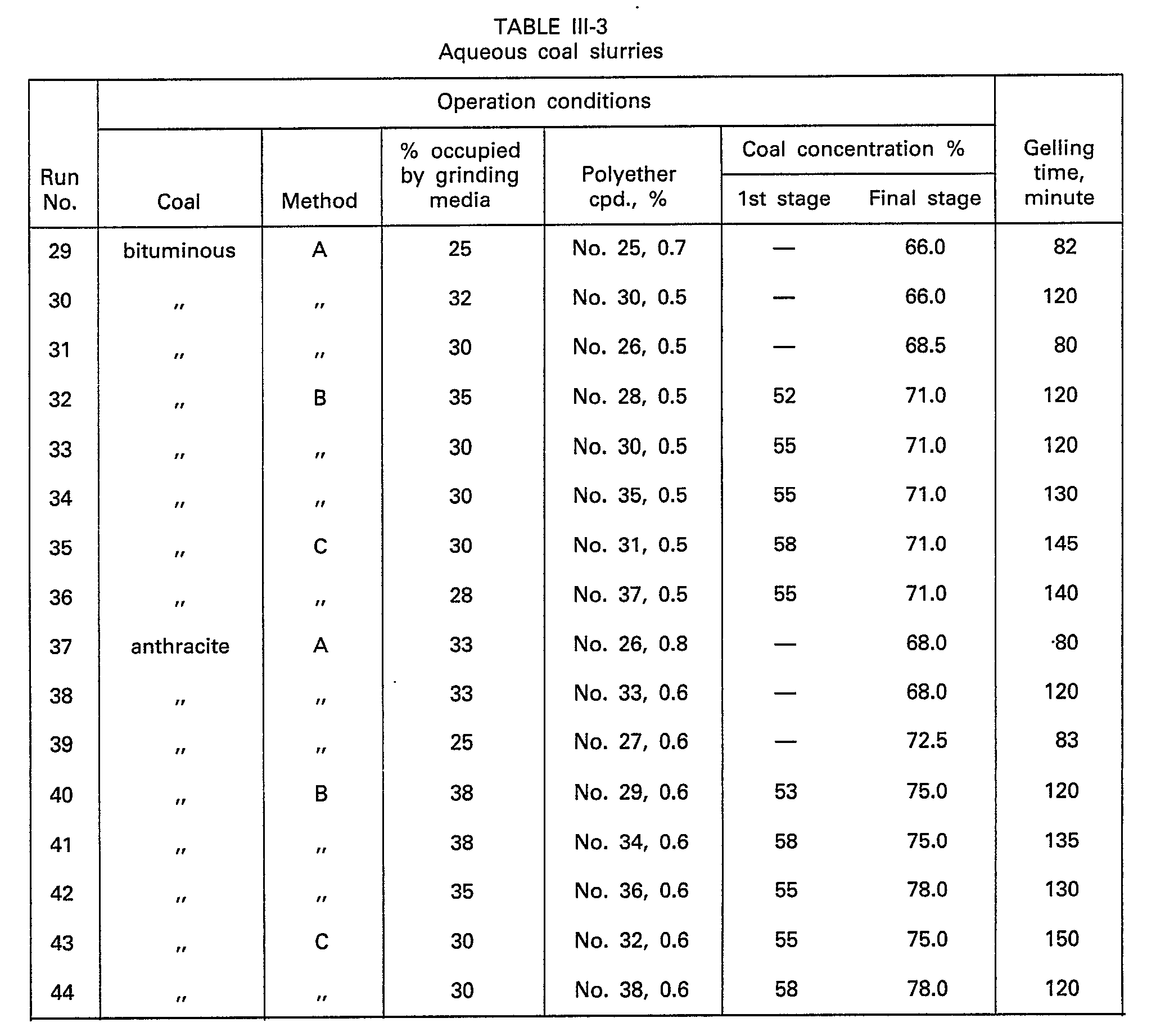

- Table III shows that polyether compounds used in the present invention were capable of prolonging the gelling time for at least 80 minutes, whereas slurries in control runs gelled very quickly.
- The table also shows that polyether compounds having an oxyethylene content greater than 80% by weight based on the total oxyalkylene content were more effective for extending gelling time than those having an oxyethylene content less than 80%.
- Some of runs of Example 1 were repeated in the continuous mode. A 50 liter capacity wet ball mill filled 30% of its interior volume with grinding media was continuously charged with coal, water and polyether compounds in amounts corresponding to respective runs and slurries were discharged after a residence time for 70 minutes.
- All runs according to the present invention gave flowable slurries pulverized to 70-85% passing through a 200 mesh screen, whereas control runs failed to give flowable slurries but resulted in gelation of the slurries in the mill.
- The above tests were repeated except that the feeding rates of materials were decreased to 70% and the residence time was extended to 100 minutes. Polyether compounds having an oxyethylene content greater than 80% by weight based on the total oxyalkylene content exhibited satisfactory results.
Claims (11)
Applications Claiming Priority (6)
| Application Number | Priority Date | Filing Date | Title |
|---|---|---|---|
| JP3153583A JPS59157186A (en) | 1983-02-25 | 1983-02-25 | Wet process for preparation of coal-water slurry having high concentration |
| JP31535/83 | 1983-02-25 | ||
| JP3427983A JPS59159893A (en) | 1983-03-01 | 1983-03-01 | Preparation of concentrated coal/water slurry by wet process |
| JP34279/83 | 1983-03-01 | ||
| JP35114/83 | 1983-03-02 | ||
| JP3511483A JPS59159894A (en) | 1983-03-02 | 1983-03-02 | Preparation of concentrated coal/water slurry by wet process |
Publications (3)
| Publication Number | Publication Date |
|---|---|
| EP0117742A2 EP0117742A2 (en) | 1984-09-05 |
| EP0117742A3 EP0117742A3 (en) | 1984-11-14 |
| EP0117742B1 true EP0117742B1 (en) | 1987-05-20 |
Family
ID=27287355
Family Applications (1)
| Application Number | Title | Priority Date | Filing Date |
|---|---|---|---|
| EP84301213A Expired EP0117742B1 (en) | 1983-02-25 | 1984-02-24 | Production of aqueous coal slurries having high coal contents |
Country Status (5)
| Country | Link |
|---|---|
| US (1) | US4592759A (en) |
| EP (1) | EP0117742B1 (en) |
| CA (1) | CA1221235A (en) |
| DE (1) | DE3463783D1 (en) |
| ES (1) | ES530025A0 (en) |
Families Citing this family (7)
| Publication number | Priority date | Publication date | Assignee | Title |
|---|---|---|---|---|
| IT1197637B (en) * | 1983-04-29 | 1988-12-06 | Centro Speriment Metallurg | PROCEDURE FOR THE PREPARATION OF STABLE COAL-WATER MIXTURES |
| EP0130849B1 (en) * | 1983-07-05 | 1987-04-29 | Babcock-Hitachi Kabushiki Kaisha | Process for producing a high concentration coal-water slurry |
| IT1184665B (en) * | 1985-10-24 | 1987-10-28 | Centro Speriment Metallurg | CHARCOAL-TAR MIX WITH HIGH SOLID CONTENT |
| US5783109A (en) * | 1994-04-29 | 1998-07-21 | Nalco/Exxon Energy Chemicals, L.P. | Dispersion of gums and iron sulfide in hydrocarbon streams with alkyl phenol-polyethylenepolyamine formaldehyde resins |
| US5494607A (en) * | 1994-04-29 | 1996-02-27 | Nalco Chemical Company | Alkyl substituted phenol-polyethylenepolyamine-formaldehyde resins as asphaltene dispersants |
| CN103965981B (en) | 2013-01-31 | 2016-05-25 | 通用电气公司 | The apparatus and method of preparation water-coal-slurry |
| KR101684746B1 (en) * | 2014-12-24 | 2016-12-08 | 에스케이이노베이션 주식회사 | Petroleum slurry composition comprising polyurethane based gelling agent |
Family Cites Families (8)
| Publication number | Priority date | Publication date | Assignee | Title |
|---|---|---|---|---|
| US4251229A (en) * | 1977-10-03 | 1981-02-17 | Dai-Ichi Kogyo Seiyaku Co., Ltd. | Stabilized fuel slurry |
| US4282006A (en) * | 1978-11-02 | 1981-08-04 | Alfred University Research Foundation Inc. | Coal-water slurry and method for its preparation |
| JPS56136665A (en) * | 1980-03-27 | 1981-10-26 | Kao Corp | Coal wet crushing aid |
| JPS5753594A (en) * | 1980-09-16 | 1982-03-30 | Kao Corp | Stabilizer for mixed fuel |
| US4358293A (en) * | 1981-01-29 | 1982-11-09 | Gulf & Western Manufacturing Co. | Coal-aqueous mixtures |
| JPS57155294A (en) * | 1981-03-20 | 1982-09-25 | Dai Ichi Kogyo Seiyaku Co Ltd | Additive for flocculating pulverized coal in coal-water slurry |
| JPS6014074B2 (en) * | 1981-04-03 | 1985-04-11 | 第一工業製薬株式会社 | Additive for pulverized coal-oil mixture |
| DE3270436D1 (en) * | 1981-09-14 | 1986-05-15 | Dai Ichi Kogyo Seiyaku Co Ltd | High consistency-aqueous slurry of powdered coal |
-
1984
- 1984-02-17 US US06/581,455 patent/US4592759A/en not_active Expired - Fee Related
- 1984-02-22 CA CA000447990A patent/CA1221235A/en not_active Expired
- 1984-02-24 ES ES530025A patent/ES530025A0/en active Granted
- 1984-02-24 DE DE8484301213T patent/DE3463783D1/en not_active Expired
- 1984-02-24 EP EP84301213A patent/EP0117742B1/en not_active Expired
Also Published As
| Publication number | Publication date |
|---|---|
| EP0117742A3 (en) | 1984-11-14 |
| ES8504906A1 (en) | 1985-05-01 |
| DE3463783D1 (en) | 1987-06-25 |
| EP0117742A2 (en) | 1984-09-05 |
| ES530025A0 (en) | 1985-05-01 |
| CA1221235A (en) | 1987-05-05 |
| US4592759A (en) | 1986-06-03 |
Similar Documents
| Publication | Publication Date | Title |
|---|---|---|
| US4251229A (en) | Stabilized fuel slurry | |
| US4592759A (en) | Production of aqueous coal slurries having high coal contents | |
| EP0062220B1 (en) | Stabilized coal-oil mixture | |
| JPS628480B2 (en) | ||
| JPS59500971A (en) | Pumpable aqueous slurry of solid fuel and method for producing the same | |
| CN1034227C (en) | Preparation method of high concentration coal-water slurry | |
| EP0077909B1 (en) | High consistency-aqueous slurry of powdered coal | |
| AU612127B2 (en) | Solid fuel-water slurry composition and process for the preparation of the same | |
| JPS6063291A (en) | Wet process for forming high-concentration coal-water slurry | |
| JPS5918791A (en) | Manufacture of slurry of granulate of pulverized coal | |
| JPS62232493A (en) | High-concentration coal/water slurry composition | |
| JPS59159893A (en) | Preparation of concentrated coal/water slurry by wet process | |
| CA1115055A (en) | Wet pelletizing of brown coal and drying | |
| JPS6084392A (en) | Preparation of concentrated coal/water slurry by wet process | |
| JPS60184593A (en) | Preparation of concentrated coal/water slurry by wet process | |
| JPS59166591A (en) | Solid fuel-aqueous slurry composition | |
| JPS59187090A (en) | Preparation of slurry of solid fuel and water | |
| JPS60166391A (en) | Production of pitch-water slurry | |
| JPS6195094A (en) | Method for producing coal water slurry | |
| JPS5823436B2 (en) | Additive for pulverized coal-oil mixture | |
| JPS62589A (en) | Dispersant for water slurry of high-concentration finely divided carbonaceous powder | |
| JPS63194748A (en) | Highly concentrated coal/water slurry manufacturing equipment and its manufacturing method | |
| JPS63137992A (en) | Hard cake formation depressant | |
| JPS60223895A (en) | Fuel mixture composition | |
| JPH0475277B2 (en) |
Legal Events
| Date | Code | Title | Description |
|---|---|---|---|
| PUAI | Public reference made under article 153(3) epc to a published international application that has entered the european phase |
Free format text: ORIGINAL CODE: 0009012 |
|
| AK | Designated contracting states |
Designated state(s): DE FR GB IT SE |
|
| PUAL | Search report despatched |
Free format text: ORIGINAL CODE: 0009013 |
|
| AK | Designated contracting states |
Designated state(s): DE FR GB IT SE |
|
| 17P | Request for examination filed |
Effective date: 19841213 |
|
| GRAA | (expected) grant |
Free format text: ORIGINAL CODE: 0009210 |
|
| AK | Designated contracting states |
Kind code of ref document: B1 Designated state(s): DE FR GB IT SE |
|
| ITF | It: translation for a ep patent filed | ||
| REF | Corresponds to: |
Ref document number: 3463783 Country of ref document: DE Date of ref document: 19870625 |
|
| ET | Fr: translation filed | ||
| PLBE | No opposition filed within time limit |
Free format text: ORIGINAL CODE: 0009261 |
|
| 26N | No opposition filed | ||
| ITTA | It: last paid annual fee | ||
| EAL | Se: european patent in force in sweden |
Ref document number: 84301213.9 |
|
| PGFP | Annual fee paid to national office [announced via postgrant information from national office to epo] |
Ref country code: FR Payment date: 19970211 Year of fee payment: 14 |
|
| PGFP | Annual fee paid to national office [announced via postgrant information from national office to epo] |
Ref country code: SE Payment date: 19970217 Year of fee payment: 14 Ref country code: GB Payment date: 19970217 Year of fee payment: 14 |
|
| PGFP | Annual fee paid to national office [announced via postgrant information from national office to epo] |
Ref country code: DE Payment date: 19970228 Year of fee payment: 14 |
|
| PG25 | Lapsed in a contracting state [announced via postgrant information from national office to epo] |
Ref country code: GB Free format text: LAPSE BECAUSE OF NON-PAYMENT OF DUE FEES Effective date: 19980224 |
|
| PG25 | Lapsed in a contracting state [announced via postgrant information from national office to epo] |
Ref country code: SE Free format text: LAPSE BECAUSE OF NON-PAYMENT OF DUE FEES Effective date: 19980225 |
|
| PG25 | Lapsed in a contracting state [announced via postgrant information from national office to epo] |
Ref country code: FR Free format text: THE PATENT HAS BEEN ANNULLED BY A DECISION OF A NATIONAL AUTHORITY Effective date: 19980228 |
|
| GBPC | Gb: european patent ceased through non-payment of renewal fee |
Effective date: 19980224 |
|
| EUG | Se: european patent has lapsed |
Ref document number: 84301213.9 |
|
| PG25 | Lapsed in a contracting state [announced via postgrant information from national office to epo] |
Ref country code: DE Free format text: LAPSE BECAUSE OF NON-PAYMENT OF DUE FEES Effective date: 19981103 |
|
| REG | Reference to a national code |
Ref country code: FR Ref legal event code: ST |