EP0112257B1 - Jauge piézorésistive et son procédé de fabrication - Google Patents
Jauge piézorésistive et son procédé de fabrication Download PDFInfo
- Publication number
- EP0112257B1 EP0112257B1 EP83402464A EP83402464A EP0112257B1 EP 0112257 B1 EP0112257 B1 EP 0112257B1 EP 83402464 A EP83402464 A EP 83402464A EP 83402464 A EP83402464 A EP 83402464A EP 0112257 B1 EP0112257 B1 EP 0112257B1
- Authority
- EP
- European Patent Office
- Prior art keywords
- piezoresistive
- support
- electrically conductive
- tetracyanoquinodimethane
- organic compound
- Prior art date
- Legal status (The legal status is an assumption and is not a legal conclusion. Google has not performed a legal analysis and makes no representation as to the accuracy of the status listed.)
- Expired
Links
- 238000000034 method Methods 0.000 title claims description 9
- 238000004519 manufacturing process Methods 0.000 title description 6
- 150000002894 organic compounds Chemical class 0.000 claims description 18
- 238000000151 deposition Methods 0.000 claims description 14
- 239000004020 conductor Substances 0.000 claims description 9
- 150000003839 salts Chemical class 0.000 claims description 9
- PCCVSPMFGIFTHU-UHFFFAOYSA-N tetracyanoquinodimethane Chemical class N#CC(C#N)=C1C=CC(=C(C#N)C#N)C=C1 PCCVSPMFGIFTHU-UHFFFAOYSA-N 0.000 claims description 9
- 238000001704 evaporation Methods 0.000 claims description 8
- 230000008020 evaporation Effects 0.000 claims description 8
- 239000011521 glass Substances 0.000 claims description 7
- 150000003242 quaternary ammonium salts Chemical class 0.000 claims description 7
- PCHJSUWPFVWCPO-UHFFFAOYSA-N gold Chemical compound [Au] PCHJSUWPFVWCPO-UHFFFAOYSA-N 0.000 claims description 6
- 239000000843 powder Substances 0.000 claims description 6
- CPELXLSAUQHCOX-UHFFFAOYSA-M Bromide Chemical compound [Br-] CPELXLSAUQHCOX-UHFFFAOYSA-M 0.000 claims description 5
- 239000003822 epoxy resin Substances 0.000 claims description 5
- 229920000647 polyepoxide Polymers 0.000 claims description 5
- BQCADISMDOOEFD-UHFFFAOYSA-N Silver Chemical compound [Ag] BQCADISMDOOEFD-UHFFFAOYSA-N 0.000 claims description 4
- 239000010931 gold Substances 0.000 claims description 4
- BASFCYQUMIYNBI-UHFFFAOYSA-N platinum Chemical compound [Pt] BASFCYQUMIYNBI-UHFFFAOYSA-N 0.000 claims description 4
- 229920000642 polymer Polymers 0.000 claims description 4
- 229910052709 silver Inorganic materials 0.000 claims description 4
- 239000004332 silver Substances 0.000 claims description 4
- RYGMFSIKBFXOCR-UHFFFAOYSA-N Copper Chemical compound [Cu] RYGMFSIKBFXOCR-UHFFFAOYSA-N 0.000 claims description 3
- 229910052802 copper Inorganic materials 0.000 claims description 3
- 239000010949 copper Substances 0.000 claims description 3
- 229910052737 gold Inorganic materials 0.000 claims description 3
- 239000000203 mixture Substances 0.000 claims description 3
- 239000010453 quartz Substances 0.000 claims description 3
- VYPSYNLAJGMNEJ-UHFFFAOYSA-N silicon dioxide Inorganic materials O=[Si]=O VYPSYNLAJGMNEJ-UHFFFAOYSA-N 0.000 claims description 3
- 230000009056 active transport Effects 0.000 claims description 2
- 229910045601 alloy Inorganic materials 0.000 claims description 2
- 239000000956 alloy Substances 0.000 claims description 2
- 229910052697 platinum Inorganic materials 0.000 claims description 2
- 238000002360 preparation method Methods 0.000 claims description 2
- BZWKPZBXAMTXNQ-UHFFFAOYSA-N sulfurocyanidic acid Chemical compound OS(=O)(=O)C#N BZWKPZBXAMTXNQ-UHFFFAOYSA-N 0.000 claims description 2
- 229910052751 metal Inorganic materials 0.000 claims 1
- 239000002184 metal Substances 0.000 claims 1
- 150000001875 compounds Chemical class 0.000 description 10
- 230000008021 deposition Effects 0.000 description 10
- 239000010445 mica Substances 0.000 description 7
- 229910052618 mica group Inorganic materials 0.000 description 7
- 229920003319 Araldite® Polymers 0.000 description 5
- 230000035945 sensitivity Effects 0.000 description 4
- 238000007738 vacuum evaporation Methods 0.000 description 4
- 230000006835 compression Effects 0.000 description 3
- 238000007906 compression Methods 0.000 description 3
- 230000006837 decompression Effects 0.000 description 3
- -1 des ions Chemical class 0.000 description 3
- 230000003068 static effect Effects 0.000 description 3
- ZMZDMBWJUHKJPS-UHFFFAOYSA-N thiocyanic acid Chemical compound SC#N ZMZDMBWJUHKJPS-UHFFFAOYSA-N 0.000 description 3
- SQHWUYVHKRVCMD-UHFFFAOYSA-N 2-n,2-n-dimethyl-10-phenylphenazin-10-ium-2,8-diamine;chloride Chemical compound [Cl-].C12=CC(N(C)C)=CC=C2N=C2C=CC(N)=CC2=[N+]1C1=CC=CC=C1 SQHWUYVHKRVCMD-UHFFFAOYSA-N 0.000 description 2
- 229910001316 Ag alloy Inorganic materials 0.000 description 2
- NLZUEZXRPGMBCV-UHFFFAOYSA-N Butylhydroxytoluene Chemical compound CC1=CC(C(C)(C)C)=C(O)C(C(C)(C)C)=C1 NLZUEZXRPGMBCV-UHFFFAOYSA-N 0.000 description 2
- OKTJSMMVPCPJKN-UHFFFAOYSA-N Carbon Chemical compound [C] OKTJSMMVPCPJKN-UHFFFAOYSA-N 0.000 description 2
- DZBUGLKDJFMEHC-UHFFFAOYSA-O acridine;hydron Chemical compound C1=CC=CC2=CC3=CC=CC=C3[NH+]=C21 DZBUGLKDJFMEHC-UHFFFAOYSA-O 0.000 description 2
- 229910052799 carbon Inorganic materials 0.000 description 2
- 238000006243 chemical reaction Methods 0.000 description 2
- 230000007797 corrosion Effects 0.000 description 2
- 238000005260 corrosion Methods 0.000 description 2
- 239000013078 crystal Substances 0.000 description 2
- 230000005292 diamagnetic effect Effects 0.000 description 2
- 230000000694 effects Effects 0.000 description 2
- 150000004820 halides Chemical class 0.000 description 2
- SMWDFEZZVXVKRB-UHFFFAOYSA-O hydron;quinoline Chemical compound [NH+]1=CC=CC2=CC=CC=C21 SMWDFEZZVXVKRB-UHFFFAOYSA-O 0.000 description 2
- 150000002500 ions Chemical class 0.000 description 2
- IOLCXVTUBQKXJR-UHFFFAOYSA-M potassium bromide Chemical compound [K+].[Br-] IOLCXVTUBQKXJR-UHFFFAOYSA-M 0.000 description 2
- 125000002577 pseudohalo group Chemical group 0.000 description 2
- 150000005838 radical anions Chemical class 0.000 description 2
- 150000005839 radical cations Chemical class 0.000 description 2
- XZPNVGKRRGOOMS-UHFFFAOYSA-N 10-methyl-5h-phenazine Chemical compound C1=CC=C2N(C)C3=CC=CC=C3NC2=C1 XZPNVGKRRGOOMS-UHFFFAOYSA-N 0.000 description 1
- KBZALDXXIMXRBJ-UHFFFAOYSA-N 5-methylphenazin-5-ium Chemical compound C1=CC=C2[N+](C)=C(C=CC=C3)C3=NC2=C1 KBZALDXXIMXRBJ-UHFFFAOYSA-N 0.000 description 1
- 229910001020 Au alloy Inorganic materials 0.000 description 1
- ZMZDMBWJUHKJPS-UHFFFAOYSA-M Thiocyanate anion Chemical compound [S-]C#N ZMZDMBWJUHKJPS-UHFFFAOYSA-M 0.000 description 1
- 241001061127 Thione Species 0.000 description 1
- 238000010668 complexation reaction Methods 0.000 description 1
- 230000006866 deterioration Effects 0.000 description 1
- 230000005611 electricity Effects 0.000 description 1
- 230000005283 ground state Effects 0.000 description 1
- 230000002706 hydrostatic effect Effects 0.000 description 1
- 239000011810 insulating material Substances 0.000 description 1
- 150000008040 ionic compounds Chemical class 0.000 description 1
- 239000000463 material Substances 0.000 description 1
- 239000011159 matrix material Substances 0.000 description 1
- 238000005259 measurement Methods 0.000 description 1
- 230000007935 neutral effect Effects 0.000 description 1
- 229910000510 noble metal Inorganic materials 0.000 description 1
- 238000007254 oxidation reaction Methods 0.000 description 1
- 229920003223 poly(pyromellitimide-1,4-diphenyl ether) Polymers 0.000 description 1
- 150000005837 radical ions Chemical class 0.000 description 1
- 150000003254 radicals Chemical class 0.000 description 1
- 238000006479 redox reaction Methods 0.000 description 1
- 238000007789 sealing Methods 0.000 description 1
- 238000000859 sublimation Methods 0.000 description 1
- 230000008022 sublimation Effects 0.000 description 1
- 239000000758 substrate Substances 0.000 description 1
- 238000005979 thermal decomposition reaction Methods 0.000 description 1
- 239000012808 vapor phase Substances 0.000 description 1
- 238000003466 welding Methods 0.000 description 1
Images

Classifications
-
- H—ELECTRICITY
- H01—ELECTRIC ELEMENTS
- H01C—RESISTORS
- H01C10/00—Adjustable resistors
- H01C10/10—Adjustable resistors adjustable by mechanical pressure or force
-
- G—PHYSICS
- G01—MEASURING; TESTING
- G01L—MEASURING FORCE, STRESS, TORQUE, WORK, MECHANICAL POWER, MECHANICAL EFFICIENCY, OR FLUID PRESSURE
- G01L1/00—Measuring force or stress, in general
- G01L1/18—Measuring force or stress, in general using properties of piezo-resistive materials, i.e. materials of which the ohmic resistance varies according to changes in magnitude or direction of force applied to the material
Definitions
- the present invention relates to a piezoresistive gauge and its manufacturing process.
- piezoresistive gauges the sensitive element of which consists of a conductive organic compound, these gauges being usable for measuring pressures of the order of 500 bars to 10 kbars.
- Piezoresistive gauges comprising a piezoresistive carbon element held between two copper conductors.
- Such gauges have the drawback of not having sufficient sensitivity for measuring pressures ranging from 500 bars to a few kbar and of being moreover influenced by the temperature.
- the present invention specifically relates to a piezoresistive gauge which overcomes the aforementioned drawbacks.
- the piezoresistive gauge according to the invention comprises a piezoresistive element and it is characterized in that said piezoresistive element consists of an organic electrically conductive compound chosen from the group comprising tetramethyltetrathiofulvalene salts, quaternary ammonium salts tetracyanoquinodimethane and diethyldimethyltetrathiofulvalene-tetracyanoquinodimethane (DEDMTTF-TCNO).
- organic electrically conductive compound chosen from the group comprising tetramethyltetrathiofulvalene salts, quaternary ammonium salts tetracyanoquinodimethane and diethyldimethyltetrathiofulvalene-tetracyanoquinodimethane (DEDMTTF-TCNO).
- the piezoresistive element consists of a thin layer of said organic electrically conductive compound, deposited on an insulating support, for example made of quartz or glass.
- the piezoresistive element can be formed by a single crystal of the electrically conductive organic compound.
- piezoresistive element constituted by a mixture of compacted fine powder of the electrically conductive organic compound, placed on an insulating support.
- the electrically conductive organic compounds used in the invention are described in: Annales de Physique, 1976, tome 1, n ° 4-5, p. 145-256 and in Journal de Chimie Physique, 1982, 79, n ° 4.
- the complex is a molecular complex with a neutral ground state.
- the electrically conductive organic compound is a tetramethyltetrathiofulvalene salt such as bromide or tetramethyltetrathiofulvalene sulfocyanide, a quaternary ammonium salt of tetracyanoquinodimethane such as tetracyanoquinodimethane-N-methylphenazinium or NMP-TCNQ) diethyldimethyltetrathiofulvalene-tetracyanoquinodimethane.
- a tetramethyltetrathiofulvalene salt such as bromide or tetramethyltetrathiofulvalene sulfocyanide
- a quaternary ammonium salt of tetracyanoquinodimethane such as tetracyanoquinodimethane-N-methylphenazinium or NMP-TCNQ diethyldimethyltetrathiofulvalene-tetracyanoquinod
- the piezoresistive element is a charge transfer complex: diethyldimethyltetrathiofulvalene-tetracyanoquinodimethane (DEDMTTF-TCNCI) or a radical ion salt, ie radical anion of TCNQ (quaternary ammonium salts such as salts quinolinium, acridinium, phenazinium and bipyridillium), ie a radical cation of TMTTF (halide or pseudohalide salts BF-4 , ClO - 4 , SCN -, NO- 3 , ).
- DEDMTTF-TCNCI diethyldimethyltetrathiofulvalene-tetracyanoquinodimethane
- TCNQ quaternary ammonium salts such as salts quinolinium, acridinium, phenazinium and bipyridillium
- ie a radical cation of TMTTF halide or pseudohalide salt
- the piezoresistive element can be constituted by a charge transfer complex such as diethyldimethyl-tetrathiofulvalene-tetracyanoquinodimethane (DEDMTTF-TCNO) or by a radical ion salt or radical anion of TCNQ (quaternary ammonium salts such as quinolinium, acridinium, phenazinium and bipyridillium salts), either a radical cation of TTF or TSF (R l R 2 R 3 R 4 ), halide or pseudohalide salts BF- 4 , CIO- 4 , SCN-, NO- 3 , ).
- a charge transfer complex such as diethyldimethyl-tetrathiofulvalene-tetracyanoquinodimethane (DEDMTTF-TCNO) or by a radical ion salt or radical anion of TCNQ (quaternary ammonium salts such as quinolinium, acridinium, phen
- the organic compound constituting the piezoresistive element is the diéthyldiméthyl tetrathiofulvalene-tetracyanoquinodimethane (TTF-TCNQ DEDM) tétraméthyltétrathiofulvalène bromide ((TMTTF) 2 Br), the thiocyanate tétraméthyltétrathiofulvalène ((TMTTF) Z SCN), or tetracyanoquinodimethane N-methyl phenazinium (NMP-TCNQ).
- the piezoresistive element of the gauge is preferably protected by an insulating plate, for example made of mica, connected to the support by a seal, which can be formed of epoxy resin such as an araldite, or of another polymer.
- a seal which can be formed of epoxy resin such as an araldite, or of another polymer.
- the thin layer of organic compound is deposited by evaporation under vacuum.
- This deposition mode can only be used in the case of compounds for which it is possible to find deposition conditions corresponding to sublimation without thermal decomposition of the compound.
- this deposition is carried out so as to obtain layers from 5000 to 8000 A thick, which corresponds to a resistance of a few kiloohms.
- the insulating support is generally an amorphous support constituted by a glass or quartz disc.
- crystalline supports for example potassium bromide or mica and thus choose a crystalline structure of the support close to that of the organic compound to obtain an epitaxial deposit.
- one begins by depositing on certain parts of the insulating support an electrically conductive material, consisting of a noble metal such as copper, silver, platinum, gold and their alloys, for example a silver alloy, in order to form on the support two pairs of electrical contacts constituting the output and input terminals of the gauge, which will be used, on the one hand, for the supply of electric current to the gauge and , on the other hand, for the connection of a measuring device such as a voltmeter.
- This deposition can be carried out by active transport in the vapor phase or by vacuum evaporation using a mask of suitable shape to obtain the desired geometry.
- the same deposition enclosure can be used to consecutively deposit by evaporation under vacuum the thin layer of electrically conductive organic compound.
- the evaporation temperature is chosen according to the material, the pressure, the temperature of the support, the distance between the support and the evaporation crucible and the nature of the support so as to control the deposition rate and the quality of the thin layers obtained.
- a sublimator comprising a glass bell placed above a vacuum assembly including the primary and secondary pumps achieve a vacuum of 10 -6 torr.
- the piezoresistive gauge can also be produced from a finely ground powder of the electrically conductive organic compound.
- a flexible insulating support made, for example, of a polymer sold under the brand Kapton, and the finely ground powder is mixed with a powder of insulating material which will constitute an insulating matrix, in appropriate proportions.
- the powder After placing the mixture on the carrier, the powder is compacted and a layer is thus obtained of about 1/10 of mm in thickness and 10 mm in length, then o 'n form the electrical connections.
- a gauge of this type has the particular advantage of having a lower intrinsic resistance than that of gauges, the piezoresistive element of which is a thin layer. It can be used in particular as a strain gauge.
- the gauge comprises an insulating support 1 made of glass locally covered with two pairs of electrical contacts constituted by strips 3 of electrically conductive material and a thin layer 5 of an organic conductive compound of electricity constituting the piezoresistive element of the gauge.
- This thin layer 5 only partially covers the strips of conductive material 3 so as to be able to connect the gauge to an external circuit.
- Layer 5 is protected against impact and corrosion by a sheet of mica 6, the seal being produced by a seal 8 of epoxy resin such as araldite.
- This gauge can be performed as follows. Four strips 3 of electrically conductive material, for example gold or silver alloy, are deposited by vacuum evaporation on a glass insulating support 1, using a mask. The support 1 is then covered with the strips 3 of the thin layer 5 of electrically conductive organic compound, also by vacuum evaporation, using a mask in order to leave the ends of the strips 3 previously deposited free. After this operation, electrical connections are formed on the ends of the strips 3 by micro-welding of silver wires 7 and 9 and the thin layer 5 is covered with a sheet of mica 6 and then the seal 8 is made. using epoxy resin which is allowed to harden.
- electrically conductive material for example gold or silver alloy
- a piezoresistive gauge is thus obtained, the first pair of contacts 3 spaced apart from each other by the distance d f can be connected by the wires 7 to a stabilized current supply with an intensity of the order of 50 uA , and the second pair of contacts 3 spaced from each other by the distance d 2 , can be connected by the wires 9 to an electronic voltmeter to record the variations in voltage across the terminals of the gauge.
- a piezoresistive element consisting of tetramethyltetrathiofulvalene bromide (TMTTF) 2 Br is used.
- the tetramethyltetrathiofulvalene molecule is first synthesized from the corresponding thiones by a conventional process such as that cited in the article published in the Journal of Physical Chemistry (1982).
- the electrical connections 7 and 9 are then formed by microsoldering of silver wires, the thin layer is covered with a sheet of mica 0.03 mm thick and sealing is carried out by fitting a seal. araldite.
- the piezoresistive gauge is subjected to hydrostatic pressure by placing it in an enclosure filled with oil, the pressure of which is varied by means of a hydraulic press.
- the resistance variations of the gauge are measured as a function of the pressure applied.
- the same measurement is carried out in the same enclosure on a commercial carbon gauge.
- curve 1 represents the variations in resistance (in%) of the gauge as a function of the pressure applied (in kbar) during compression and the curve Il in dashes represents the variations as a function of pressure during decompression.
- R o represents the initial resistance of the gauge before the test.
- the gauge presents a slight hysteresis phenomenon which however is not troublesome since such gauges are generally not reused.
- curve III represents the results obtained with the trade gauge.
- NMP-TCNQ N-methylphenazinium-tetracyanoquinodimethane
- a thin layer 0.5-0.7 ⁇ m thick is thus obtained. Then, as in Example 1, the electrical connections are formed, then a sheet of mica is covered and the araldite joint is formed. The properties of the gauge thus obtained are then checked by subjecting it to the same static pressure test.
- a gauge identical to that of Example 1 is produced, but using, for the manufacture of the piezoresistive element, diethyldimethyltetrathiofulvalene-tetracyanoquinodimethane (DEDMTTF-TCNO).
- the DEDMTTF-TCNQ molecule is first synthesized from tetracyanoquinodimethane and diethyldimethyltetrathiofulvalene using the conventional complexation reaction.
- a thin layer 0.5-0.7 ⁇ m thick is thus obtained.
- the electrical connections are formed, then the thin layer is covered with a sheet of mica and the araldite joint is formed.
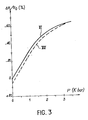
- the properties of the gauge thus obtained are then verified by subjecting it to the same static pressure tests. The results obtained are given in FIG. 3, in which the curve VI represents the variations in resistance. (%) as a function of the pressure applied during compression and curve VII (in dashes) represents variations during decompression.
Landscapes
- Physics & Mathematics (AREA)
- General Physics & Mathematics (AREA)
- Engineering & Computer Science (AREA)
- Microelectronics & Electronic Packaging (AREA)
- Measuring Fluid Pressure (AREA)
Applications Claiming Priority (2)
| Application Number | Priority Date | Filing Date | Title |
|---|---|---|---|
| FR8221445 | 1982-12-21 | ||
| FR8221445A FR2538110A1 (fr) | 1982-12-21 | 1982-12-21 | Jauge piezoresistive et son procede de fabrication |
Publications (2)
| Publication Number | Publication Date |
|---|---|
| EP0112257A1 EP0112257A1 (fr) | 1984-06-27 |
| EP0112257B1 true EP0112257B1 (fr) | 1987-04-08 |
Family
ID=9280346
Family Applications (1)
| Application Number | Title | Priority Date | Filing Date |
|---|---|---|---|
| EP83402464A Expired EP0112257B1 (fr) | 1982-12-21 | 1983-12-19 | Jauge piézorésistive et son procédé de fabrication |
Country Status (4)
| Country | Link |
|---|---|
| US (1) | US4535317A (OSRAM) |
| EP (1) | EP0112257B1 (OSRAM) |
| DE (1) | DE3370862D1 (OSRAM) |
| FR (1) | FR2538110A1 (OSRAM) |
Families Citing this family (4)
| Publication number | Priority date | Publication date | Assignee | Title |
|---|---|---|---|---|
| FR2613169B1 (fr) * | 1987-03-24 | 1989-06-09 | Commissariat Energie Atomique | Procede microlithographique de realisation de circuits utilisant des films organiques, conducteurs, sensibles aux rayonnements electromagnetiques et aux particules chargees et les circuits et composants obtenus par ce procede |
| GB2222258A (en) * | 1988-07-29 | 1990-02-28 | David Coates | Tactile pressure sensor |
| US5099738A (en) * | 1989-01-03 | 1992-03-31 | Hotz Instruments Technology, Inc. | MIDI musical translator |
| ES2299392B1 (es) * | 2006-11-14 | 2009-04-16 | Consejo Superior Investigaciones Cientificas | Dispositivo sensor organico y sus aplicaciones. |
Family Cites Families (3)
| Publication number | Priority date | Publication date | Assignee | Title |
|---|---|---|---|---|
| US4026905A (en) * | 1972-12-26 | 1977-05-31 | Monsanto Company | Electrically conducting organic salts |
| JPS56106302A (en) * | 1980-01-24 | 1981-08-24 | Matsushita Electric Industrial Co Ltd | Electrode for conductive high molecular material |
| GB2098739B (en) * | 1981-05-16 | 1985-01-16 | Colvern Ltd | Electrical strain gauges |
-
1982
- 1982-12-21 FR FR8221445A patent/FR2538110A1/fr active Granted
-
1983
- 1983-12-19 DE DE8383402464T patent/DE3370862D1/de not_active Expired
- 1983-12-19 US US06/562,523 patent/US4535317A/en not_active Expired - Fee Related
- 1983-12-19 EP EP83402464A patent/EP0112257B1/fr not_active Expired
Also Published As
| Publication number | Publication date |
|---|---|
| DE3370862D1 (en) | 1987-05-14 |
| US4535317A (en) | 1985-08-13 |
| EP0112257A1 (fr) | 1984-06-27 |
| FR2538110B1 (OSRAM) | 1985-05-24 |
| FR2538110A1 (fr) | 1984-06-22 |
Similar Documents
| Publication | Publication Date | Title |
|---|---|---|
| Street et al. | Preparation and characterization of neutral and oxidized polypyrrole films | |
| EP0165111B1 (fr) | Films conducteurs de l'électricité comprenant au moins une couche monomoléculaire d'un complexe organique à transfert de charge et leur procédé de fabrication | |
| Kim | Ladder polymers as new polymeric conductors | |
| Kumar et al. | Au–ZnO bullet-like heterodimer nanoparticles: synthesis and use for enhanced nonenzymatic electrochemical determination of glucose | |
| FR3071656A1 (fr) | Electrolyte solide pour element electrochimique lithium-ion | |
| FR2527843A1 (fr) | Electrode comprenant un film de polymere electrochrome pouvant servir dans un dispositif d'affichage ou de stockage d'energie | |
| EP0221793A1 (fr) | Polymères conducteurs électroniques azotés, leurs procédés de préparation, cellule d'affichage électrochrome et générateur électrochimique utilisant ces polymères | |
| EP0251934B1 (fr) | Procédé et dispositif de détection d'espèces moléculaires ou ioniques | |
| EP0112257B1 (fr) | Jauge piézorésistive et son procédé de fabrication | |
| EP1921084B1 (fr) | Sels de diazonium polymérisables, procédé de fabrication et utilisations de ceux-ci | |
| EP0618276A1 (fr) | Procédé de dépôt par électropolymérisation d'un film d'un matériau composite sur une surface conductrice d'électricité | |
| Calvert et al. | Spectral, electrochemical, and conductivity studies of poly (pyridyl) ruthenium complexes containing polymerizable acetylenic and olefinic ligands | |
| Chutia et al. | Liquefied petroleum gas sensing activity of betel nut fiber‐polyaniline conducting composites synthesized by time‐controlled in situ polymerization | |
| CA2133912A1 (fr) | Materiau cathodique pour generateur electrochimique | |
| EP0229563B1 (fr) | Procédé de fabrication d'un film de polyparaphénylène et applications du film de polyparaphénylène obtenu | |
| WO1998048467A1 (fr) | Materiau d'electrode positive a base d'oxysulfure de titane pour generateur electrochimique et son procede de preparation | |
| Chakraborty et al. | Exploring novel methods: Acid treatment, metal nanoparticle doping, and graphene insertion for enhanced electrical conductivity of nm thin PEDOT: PSS films | |
| EP0100251A1 (fr) | Procédé de réduction de composé en couche sur un substrat, et son application à la fabrication de structure semiconductrice à effet de champ | |
| WO2002015256A1 (fr) | Capteur micro-usine avec protection isolante des connexions | |
| FR2989906A1 (fr) | Procede de depot de nanoparticules sur un substrat d'oxyde metallique nanostructure | |
| FR2475278A1 (fr) | Dispositif conducteur utilisant des compositions polymeres conductrices | |
| Yanagi et al. | Electrochromic oxidation and reduction of cobalt and zinc naphthalocyanine thin films | |
| EP0731975B1 (fr) | Composant de type empile et procede de fabrication de composant de type empile | |
| EP0591035A1 (fr) | Procédé de fabrication de condensateurs électrolytiques à couche en polymer conducteur et à faible courant de fuite | |
| Wagner et al. | Characterization of Water‐Dispersible n‐Type Poly (benzimidazobenzophenanthroline) Derivatives |
Legal Events
| Date | Code | Title | Description |
|---|---|---|---|
| PUAI | Public reference made under article 153(3) epc to a published international application that has entered the european phase |
Free format text: ORIGINAL CODE: 0009012 |
|
| AK | Designated contracting states |
Designated state(s): CH DE GB LI |
|
| 17P | Request for examination filed |
Effective date: 19841112 |
|
| 17Q | First examination report despatched |
Effective date: 19860422 |
|
| GRAA | (expected) grant |
Free format text: ORIGINAL CODE: 0009210 |
|
| AK | Designated contracting states |
Kind code of ref document: B1 Designated state(s): CH DE GB LI |
|
| REF | Corresponds to: |
Ref document number: 3370862 Country of ref document: DE Date of ref document: 19870514 |
|
| RAP2 | Party data changed (patent owner data changed or rights of a patent transferred) |
Owner name: COMMISSARIAT A L'ENERGIE ATOMIQUE |
|
| PLBE | No opposition filed within time limit |
Free format text: ORIGINAL CODE: 0009261 |
|
| STAA | Information on the status of an ep patent application or granted ep patent |
Free format text: STATUS: NO OPPOSITION FILED WITHIN TIME LIMIT |
|
| 26N | No opposition filed | ||
| PGFP | Annual fee paid to national office [announced via postgrant information from national office to epo] |
Ref country code: CH Payment date: 19890111 Year of fee payment: 6 |
|
| PG25 | Lapsed in a contracting state [announced via postgrant information from national office to epo] |
Ref country code: GB Effective date: 19891219 |
|
| PG25 | Lapsed in a contracting state [announced via postgrant information from national office to epo] |
Ref country code: LI Effective date: 19891231 Ref country code: CH Effective date: 19891231 |
|
| GBPC | Gb: european patent ceased through non-payment of renewal fee | ||
| REG | Reference to a national code |
Ref country code: CH Ref legal event code: PL |
|
| PG25 | Lapsed in a contracting state [announced via postgrant information from national office to epo] |
Ref country code: DE Effective date: 19900901 |