EP0110498A1 - Artificial lung surfactant and remedy for respiratory distress syndrome containing it as active principle - Google Patents
Artificial lung surfactant and remedy for respiratory distress syndrome containing it as active principle Download PDFInfo
- Publication number
- EP0110498A1 EP0110498A1 EP83304596A EP83304596A EP0110498A1 EP 0110498 A1 EP0110498 A1 EP 0110498A1 EP 83304596 A EP83304596 A EP 83304596A EP 83304596 A EP83304596 A EP 83304596A EP 0110498 A1 EP0110498 A1 EP 0110498A1
- Authority
- EP
- European Patent Office
- Prior art keywords
- lung surfactant
- whole composition
- artificial lung
- remedy
- distress syndrome
- Prior art date
- Legal status (The legal status is an assumption and is not a legal conclusion. Google has not performed a legal analysis and makes no representation as to the accuracy of the status listed.)
- Granted
Links
- 239000000596 artificial lung surfactant Substances 0.000 title claims abstract description 30
- 206010001052 Acute respiratory distress syndrome Diseases 0.000 title claims abstract description 9
- 208000013616 Respiratory Distress Syndrome Diseases 0.000 title claims abstract description 9
- 239000000203 mixture Substances 0.000 claims abstract description 22
- 150000002632 lipids Chemical class 0.000 claims abstract description 17
- 150000003904 phospholipids Chemical class 0.000 claims abstract description 16
- ZGSPNIOCEDOHGS-UHFFFAOYSA-L disodium [3-[2,3-di(octadeca-9,12-dienoyloxy)propoxy-oxidophosphoryl]oxy-2-hydroxypropyl] 2,3-di(octadeca-9,12-dienoyloxy)propyl phosphate Chemical compound [Na+].[Na+].CCCCCC=CCC=CCCCCCCCC(=O)OCC(OC(=O)CCCCCCCC=CCC=CCCCCC)COP([O-])(=O)OCC(O)COP([O-])(=O)OCC(OC(=O)CCCCCCCC=CCC=CCCCCC)COC(=O)CCCCCCCC=CCC=CCCCCC ZGSPNIOCEDOHGS-UHFFFAOYSA-L 0.000 claims abstract description 14
- ATBOMIWRCZXYSZ-XZBBILGWSA-N [1-[2,3-dihydroxypropoxy(hydroxy)phosphoryl]oxy-3-hexadecanoyloxypropan-2-yl] (9e,12e)-octadeca-9,12-dienoate Chemical compound CCCCCCCCCCCCCCCC(=O)OCC(COP(O)(=O)OCC(O)CO)OC(=O)CCCCCCC\C=C\C\C=C\CCCCC ATBOMIWRCZXYSZ-XZBBILGWSA-N 0.000 claims abstract description 13
- AWUCVROLDVIAJX-UHFFFAOYSA-N alpha-glycerophosphate Natural products OCC(O)COP(O)(O)=O AWUCVROLDVIAJX-UHFFFAOYSA-N 0.000 claims abstract description 13
- WTJKGGKOPKCXLL-RRHRGVEJSA-N phosphatidylcholine Chemical compound CCCCCCCCCCCCCCCC(=O)OC[C@H](COP([O-])(=O)OCC[N+](C)(C)C)OC(=O)CCCCCCCC=CCCCCCCCC WTJKGGKOPKCXLL-RRHRGVEJSA-N 0.000 claims abstract description 13
- 230000007935 neutral effect Effects 0.000 claims abstract description 12
- 150000004665 fatty acids Chemical class 0.000 claims abstract description 8
- 235000014113 dietary fatty acids Nutrition 0.000 claims abstract description 7
- 229930195729 fatty acid Natural products 0.000 claims abstract description 7
- 239000000194 fatty acid Substances 0.000 claims abstract description 7
- 239000000126 substance Substances 0.000 claims description 45
- FAPWRFPIFSIZLT-UHFFFAOYSA-M Sodium chloride Chemical compound [Na+].[Cl-] FAPWRFPIFSIZLT-UHFFFAOYSA-M 0.000 claims description 15
- 125000005480 straight-chain fatty acid group Chemical group 0.000 claims description 13
- 125000004432 carbon atom Chemical group C* 0.000 claims description 10
- XLYOFNOQVPJJNP-UHFFFAOYSA-N water Substances O XLYOFNOQVPJJNP-UHFFFAOYSA-N 0.000 claims description 8
- 150000001413 amino acids Chemical class 0.000 claims description 6
- 238000002156 mixing Methods 0.000 claims description 4
- 239000002075 main ingredient Substances 0.000 claims description 3
- UFTFJSFQGQCHQW-UHFFFAOYSA-N triformin Chemical compound O=COCC(OC=O)COC=O UFTFJSFQGQCHQW-UHFFFAOYSA-N 0.000 claims description 3
- 239000008151 electrolyte solution Substances 0.000 claims description 2
- 235000013681 dietary sucrose Nutrition 0.000 claims 1
- 239000004094 surface-active agent Substances 0.000 abstract description 7
- 230000000694 effects Effects 0.000 description 34
- HEDRZPFGACZZDS-UHFFFAOYSA-N Chloroform Chemical compound ClC(Cl)Cl HEDRZPFGACZZDS-UHFFFAOYSA-N 0.000 description 25
- 239000003580 lung surfactant Substances 0.000 description 23
- 229940066294 lung surfactant Drugs 0.000 description 23
- 239000006185 dispersion Substances 0.000 description 20
- 239000007788 liquid Substances 0.000 description 19
- 239000000843 powder Substances 0.000 description 19
- PVNIQBQSYATKKL-UHFFFAOYSA-N tripalmitin Chemical compound CCCCCCCCCCCCCCCC(=O)OCC(OC(=O)CCCCCCCCCCCCCCC)COC(=O)CCCCCCCCCCCCCCC PVNIQBQSYATKKL-UHFFFAOYSA-N 0.000 description 18
- 210000004072 lung Anatomy 0.000 description 17
- 238000000034 method Methods 0.000 description 17
- 241000283973 Oryctolagus cuniculus Species 0.000 description 12
- KILNVBDSWZSGLL-KXQOOQHDSA-N 1,2-dihexadecanoyl-sn-glycero-3-phosphocholine Chemical compound CCCCCCCCCCCCCCCC(=O)OC[C@H](COP([O-])(=O)OCC[N+](C)(C)C)OC(=O)CCCCCCCCCCCCCCC KILNVBDSWZSGLL-KXQOOQHDSA-N 0.000 description 11
- 235000018102 proteins Nutrition 0.000 description 11
- 102000004169 proteins and genes Human genes 0.000 description 11
- 108090000623 proteins and genes Proteins 0.000 description 11
- 239000007787 solid Substances 0.000 description 11
- 239000000243 solution Substances 0.000 description 10
- OKKJLVBELUTLKV-UHFFFAOYSA-N Methanol Chemical compound OC OKKJLVBELUTLKV-UHFFFAOYSA-N 0.000 description 9
- 229960001947 tripalmitin Drugs 0.000 description 9
- 238000001665 trituration Methods 0.000 description 8
- 238000001727 in vivo Methods 0.000 description 7
- ZCYVEMRRCGMTRW-UHFFFAOYSA-N 7553-56-2 Chemical compound [I] ZCYVEMRRCGMTRW-UHFFFAOYSA-N 0.000 description 6
- 229910052740 iodine Inorganic materials 0.000 description 6
- 239000011630 iodine Substances 0.000 description 6
- 241000283690 Bos taurus Species 0.000 description 5
- 235000001014 amino acid Nutrition 0.000 description 5
- QVGXLLKOCUKJST-UHFFFAOYSA-N atomic oxygen Chemical compound [O] QVGXLLKOCUKJST-UHFFFAOYSA-N 0.000 description 5
- 239000008280 blood Substances 0.000 description 5
- 210000004369 blood Anatomy 0.000 description 5
- 150000001875 compounds Chemical class 0.000 description 5
- 238000005259 measurement Methods 0.000 description 5
- 229910052760 oxygen Inorganic materials 0.000 description 5
- 239000001301 oxygen Substances 0.000 description 5
- IPCSVZSSVZVIGE-UHFFFAOYSA-N palmitic acid group Chemical group C(CCCCCCCCCCCCCCC)(=O)O IPCSVZSSVZVIGE-UHFFFAOYSA-N 0.000 description 5
- 239000002245 particle Substances 0.000 description 5
- FBPFZTCFMRRESA-KVTDHHQDSA-N D-Mannitol Chemical compound OC[C@@H](O)[C@@H](O)[C@H](O)[C@H](O)CO FBPFZTCFMRRESA-KVTDHHQDSA-N 0.000 description 4
- 229930195725 Mannitol Natural products 0.000 description 4
- 241001465754 Metazoa Species 0.000 description 4
- 239000004615 ingredient Substances 0.000 description 4
- 239000000594 mannitol Substances 0.000 description 4
- 235000010355 mannitol Nutrition 0.000 description 4
- 201000002652 newborn respiratory distress syndrome Diseases 0.000 description 4
- 238000002360 preparation method Methods 0.000 description 4
- 238000011084 recovery Methods 0.000 description 4
- 230000004202 respiratory function Effects 0.000 description 4
- DCXXMTOCNZCJGO-UHFFFAOYSA-N tristearoylglycerol Chemical compound CCCCCCCCCCCCCCCCCC(=O)OCC(OC(=O)CCCCCCCCCCCCCCCCC)COC(=O)CCCCCCCCCCCCCCCCC DCXXMTOCNZCJGO-UHFFFAOYSA-N 0.000 description 4
- 241000282898 Sus scrofa Species 0.000 description 3
- 239000013543 active substance Substances 0.000 description 3
- 239000007864 aqueous solution Substances 0.000 description 3
- 150000001720 carbohydrates Chemical class 0.000 description 3
- -1 diglyceride Chemical compound 0.000 description 3
- 239000007970 homogeneous dispersion Substances 0.000 description 3
- 239000012046 mixed solvent Substances 0.000 description 3
- 238000011160 research Methods 0.000 description 3
- 230000001225 therapeutic effect Effects 0.000 description 3
- HBOQXIRUPVQLKX-BBWANDEASA-N 1,2,3-trilinoleoylglycerol Chemical compound CCCCC\C=C/C\C=C/CCCCCCCC(=O)OCC(OC(=O)CCCCCCC\C=C/C\C=C/CCCCC)COC(=O)CCCCCCC\C=C/C\C=C/CCCCC HBOQXIRUPVQLKX-BBWANDEASA-N 0.000 description 2
- MQGBAQLIFKSMEM-MAZCIEHSSA-N 1,2-dilinoleoylglycerol Chemical compound CCCCC\C=C/C\C=C/CCCCCCCC(=O)OCC(CO)OC(=O)CCCCCCC\C=C/C\C=C/CCCCC MQGBAQLIFKSMEM-MAZCIEHSSA-N 0.000 description 2
- KILNVBDSWZSGLL-UHFFFAOYSA-O 2-[2,3-di(hexadecanoyloxy)propoxy-hydroxyphosphoryl]oxyethyl-trimethylazanium Chemical group CCCCCCCCCCCCCCCC(=O)OCC(COP(O)(=O)OCC[N+](C)(C)C)OC(=O)CCCCCCCCCCCCCCC KILNVBDSWZSGLL-UHFFFAOYSA-O 0.000 description 2
- DHMQDGOQFOQNFH-UHFFFAOYSA-N Glycine Chemical compound NCC(O)=O DHMQDGOQFOQNFH-UHFFFAOYSA-N 0.000 description 2
- ZQPPMHVWECSIRJ-UHFFFAOYSA-N Oleic acid Natural products CCCCCCCCC=CCCCCCCCC(O)=O ZQPPMHVWECSIRJ-UHFFFAOYSA-N 0.000 description 2
- 235000021314 Palmitic acid Nutrition 0.000 description 2
- 238000004458 analytical method Methods 0.000 description 2
- 238000010586 diagram Methods 0.000 description 2
- ZQPPMHVWECSIRJ-MDZDMXLPSA-N elaidic acid Chemical compound CCCCCCCC\C=C\CCCCCCCC(O)=O ZQPPMHVWECSIRJ-MDZDMXLPSA-N 0.000 description 2
- 238000001962 electrophoresis Methods 0.000 description 2
- 239000012456 homogeneous solution Substances 0.000 description 2
- VKOBVWXKNCXXDE-UHFFFAOYSA-N icosanoic acid Chemical compound CCCCCCCCCCCCCCCCCCCC(O)=O VKOBVWXKNCXXDE-UHFFFAOYSA-N 0.000 description 2
- 230000002262 irrigation Effects 0.000 description 2
- 238000003973 irrigation Methods 0.000 description 2
- QXJSBBXBKPUZAA-UHFFFAOYSA-N isooleic acid Natural products CCCCCCCC=CCCCCCCCCC(O)=O QXJSBBXBKPUZAA-UHFFFAOYSA-N 0.000 description 2
- HBOQXIRUPVQLKX-UHFFFAOYSA-N linoleic acid triglyceride Natural products CCCCCC=CCC=CCCCCCCCC(=O)OCC(OC(=O)CCCCCCCC=CCC=CCCCCC)COC(=O)CCCCCCCC=CCC=CCCCCC HBOQXIRUPVQLKX-UHFFFAOYSA-N 0.000 description 2
- QSHDDOUJBYECFT-UHFFFAOYSA-N mercury Chemical compound [Hg] QSHDDOUJBYECFT-UHFFFAOYSA-N 0.000 description 2
- 229910052753 mercury Inorganic materials 0.000 description 2
- WQEPLUUGTLDZJY-UHFFFAOYSA-N n-Pentadecanoic acid Natural products CCCCCCCCCCCCCCC(O)=O WQEPLUUGTLDZJY-UHFFFAOYSA-N 0.000 description 2
- QIQXTHQIDYTFRH-UHFFFAOYSA-N octadecanoic acid Chemical group CCCCCCCCCCCCCCCCCC(O)=O QIQXTHQIDYTFRH-UHFFFAOYSA-N 0.000 description 2
- 239000003960 organic solvent Substances 0.000 description 2
- 239000000546 pharmaceutical excipient Substances 0.000 description 2
- 230000000241 respiratory effect Effects 0.000 description 2
- 150000004671 saturated fatty acids Chemical group 0.000 description 2
- 159000000000 sodium salts Chemical class 0.000 description 2
- 239000002904 solvent Substances 0.000 description 2
- 239000006228 supernatant Substances 0.000 description 2
- 238000002560 therapeutic procedure Methods 0.000 description 2
- 210000003437 trachea Anatomy 0.000 description 2
- 229940081852 trilinolein Drugs 0.000 description 2
- DUXYWXYOBMKGIN-UHFFFAOYSA-N trimyristin Chemical compound CCCCCCCCCCCCCC(=O)OCC(OC(=O)CCCCCCCCCCCCC)COC(=O)CCCCCCCCCCCCC DUXYWXYOBMKGIN-UHFFFAOYSA-N 0.000 description 2
- 125000005314 unsaturated fatty acid group Chemical group 0.000 description 2
- JQWAHKMIYCERGA-UHFFFAOYSA-N (2-nonanoyloxy-3-octadeca-9,12-dienoyloxypropoxy)-[2-(trimethylazaniumyl)ethyl]phosphinate Chemical compound CCCCCCCCC(=O)OC(COP([O-])(=O)CC[N+](C)(C)C)COC(=O)CCCCCCCC=CCC=CCCCCC JQWAHKMIYCERGA-UHFFFAOYSA-N 0.000 description 1
- OYHQOLUKZRVURQ-NTGFUMLPSA-N (9Z,12Z)-9,10,12,13-tetratritiooctadeca-9,12-dienoic acid Chemical compound C(CCCCCCC\C(=C(/C\C(=C(/CCCCC)\[3H])\[3H])\[3H])\[3H])(=O)O OYHQOLUKZRVURQ-NTGFUMLPSA-N 0.000 description 1
- WRIDQFICGBMAFQ-UHFFFAOYSA-N (E)-8-Octadecenoic acid Natural products CCCCCCCCCC=CCCCCCCC(O)=O WRIDQFICGBMAFQ-UHFFFAOYSA-N 0.000 description 1
- CITHEXJVPOWHKC-UUWRZZSWSA-N 1,2-di-O-myristoyl-sn-glycero-3-phosphocholine Chemical compound CCCCCCCCCCCCCC(=O)OC[C@H](COP([O-])(=O)OCC[N+](C)(C)C)OC(=O)CCCCCCCCCCCCC CITHEXJVPOWHKC-UUWRZZSWSA-N 0.000 description 1
- AFSHUZFNMVJNKX-LLWMBOQKSA-N 1,2-dioleoyl-sn-glycerol Chemical compound CCCCCCCC\C=C/CCCCCCCC(=O)OC[C@H](CO)OC(=O)CCCCCCC\C=C/CCCCCCCC AFSHUZFNMVJNKX-LLWMBOQKSA-N 0.000 description 1
- BIABMEZBCHDPBV-MPQUPPDSSA-N 1,2-palmitoyl-sn-glycero-3-phospho-(1'-sn-glycerol) Chemical compound CCCCCCCCCCCCCCCC(=O)OC[C@H](COP(O)(=O)OC[C@@H](O)CO)OC(=O)CCCCCCCCCCCCCCC BIABMEZBCHDPBV-MPQUPPDSSA-N 0.000 description 1
- KCVWRCXEUJUXIG-UHFFFAOYSA-N 1,3-bis(icosanoyloxy)propan-2-yl icosanoate Chemical compound CCCCCCCCCCCCCCCCCCCC(=O)OCC(OC(=O)CCCCCCCCCCCCCCCCCCC)COC(=O)CCCCCCCCCCCCCCCCCCC KCVWRCXEUJUXIG-UHFFFAOYSA-N 0.000 description 1
- LDVVTQMJQSCDMK-UHFFFAOYSA-N 1,3-dihydroxypropan-2-yl formate Chemical compound OCC(CO)OC=O LDVVTQMJQSCDMK-UHFFFAOYSA-N 0.000 description 1
- HVVJCLFLKMGEIY-UHFFFAOYSA-N 2,3-dioctadecoxypropyl 2-(trimethylazaniumyl)ethyl phosphate Chemical compound CCCCCCCCCCCCCCCCCCOCC(COP([O-])(=O)OCC[N+](C)(C)C)OCCCCCCCCCCCCCCCCCC HVVJCLFLKMGEIY-UHFFFAOYSA-N 0.000 description 1
- JADYBWICRJWGBW-UHFFFAOYSA-N 2-hydroxy-3-(tetradecanoyloxy)propyl tetradecanoate Chemical compound CCCCCCCCCCCCCC(=O)OCC(O)COC(=O)CCCCCCCCCCCCC JADYBWICRJWGBW-UHFFFAOYSA-N 0.000 description 1
- LQJBNNIYVWPHFW-UHFFFAOYSA-N 20:1omega9c fatty acid Natural products CCCCCCCCCCC=CCCCCCCCC(O)=O LQJBNNIYVWPHFW-UHFFFAOYSA-N 0.000 description 1
- QSBYPNXLFMSGKH-UHFFFAOYSA-N 9-Heptadecensaeure Natural products CCCCCCCC=CCCCCCCCC(O)=O QSBYPNXLFMSGKH-UHFFFAOYSA-N 0.000 description 1
- 241001521809 Acoma Species 0.000 description 1
- 206010002198 Anaphylactic reaction Diseases 0.000 description 1
- FBPFZTCFMRRESA-FSIIMWSLSA-N D-Glucitol Natural products OC[C@H](O)[C@H](O)[C@@H](O)[C@H](O)CO FBPFZTCFMRRESA-FSIIMWSLSA-N 0.000 description 1
- FBPFZTCFMRRESA-JGWLITMVSA-N D-glucitol Chemical compound OC[C@H](O)[C@@H](O)[C@H](O)[C@H](O)CO FBPFZTCFMRRESA-JGWLITMVSA-N 0.000 description 1
- MYMOFIZGZYHOMD-UHFFFAOYSA-N Dioxygen Chemical compound O=O MYMOFIZGZYHOMD-UHFFFAOYSA-N 0.000 description 1
- 241000283073 Equus caballus Species 0.000 description 1
- WQZGKKKJIJFFOK-GASJEMHNSA-N Glucose Natural products OC[C@H]1OC(O)[C@H](O)[C@@H](O)[C@@H]1O WQZGKKKJIJFFOK-GASJEMHNSA-N 0.000 description 1
- 239000004471 Glycine Substances 0.000 description 1
- 108060003951 Immunoglobulin Proteins 0.000 description 1
- QNAYBMKLOCPYGJ-REOHCLBHSA-N L-alanine Chemical compound C[C@H](N)C(O)=O QNAYBMKLOCPYGJ-REOHCLBHSA-N 0.000 description 1
- LEVWYRKDKASIDU-IMJSIDKUSA-N L-cystine Chemical compound [O-]C(=O)[C@@H]([NH3+])CSSC[C@H]([NH3+])C([O-])=O LEVWYRKDKASIDU-IMJSIDKUSA-N 0.000 description 1
- QIVBCDIJIAJPQS-VIFPVBQESA-N L-tryptophane Chemical compound C1=CC=C2C(C[C@H](N)C(O)=O)=CNC2=C1 QIVBCDIJIAJPQS-VIFPVBQESA-N 0.000 description 1
- 239000005642 Oleic acid Substances 0.000 description 1
- 206010036590 Premature baby Diseases 0.000 description 1
- 102000007562 Serum Albumin Human genes 0.000 description 1
- 108010071390 Serum Albumin Proteins 0.000 description 1
- 235000021355 Stearic acid Nutrition 0.000 description 1
- 239000004809 Teflon Substances 0.000 description 1
- 229920006362 Teflon® Polymers 0.000 description 1
- BAECOWNUKCLBPZ-HIUWNOOHSA-N Triolein Natural products O([C@H](OCC(=O)CCCCCCC/C=C\CCCCCCCC)COC(=O)CCCCCCC/C=C\CCCCCCCC)C(=O)CCCCCCC/C=C\CCCCCCCC BAECOWNUKCLBPZ-HIUWNOOHSA-N 0.000 description 1
- PHYFQTYBJUILEZ-UHFFFAOYSA-N Trioleoylglycerol Natural products CCCCCCCCC=CCCCCCCCC(=O)OCC(OC(=O)CCCCCCCC=CCCCCCCCC)COC(=O)CCCCCCCC=CCCCCCCCC PHYFQTYBJUILEZ-UHFFFAOYSA-N 0.000 description 1
- QIVBCDIJIAJPQS-UHFFFAOYSA-N Tryptophan Natural products C1=CC=C2C(CC(N)C(O)=O)=CNC2=C1 QIVBCDIJIAJPQS-UHFFFAOYSA-N 0.000 description 1
- 239000006035 Tryptophane Substances 0.000 description 1
- 239000002253 acid Substances 0.000 description 1
- 235000004279 alanine Nutrition 0.000 description 1
- 229960003767 alanine Drugs 0.000 description 1
- DTOSIQBPPRVQHS-PDBXOOCHSA-N alpha-linolenic acid Chemical compound CC\C=C/C\C=C/C\C=C/CCCCCCCC(O)=O DTOSIQBPPRVQHS-PDBXOOCHSA-N 0.000 description 1
- 235000020661 alpha-linolenic acid Nutrition 0.000 description 1
- 210000002821 alveolar epithelial cell Anatomy 0.000 description 1
- 230000003444 anaesthetic effect Effects 0.000 description 1
- 230000036783 anaphylactic response Effects 0.000 description 1
- 208000003455 anaphylaxis Diseases 0.000 description 1
- 230000002593 anti-atelectatic effect Effects 0.000 description 1
- WQZGKKKJIJFFOK-VFUOTHLCSA-N beta-D-glucose Chemical compound OC[C@H]1O[C@@H](O)[C@H](O)[C@@H](O)[C@@H]1O WQZGKKKJIJFFOK-VFUOTHLCSA-N 0.000 description 1
- 150000001841 cholesterols Chemical class 0.000 description 1
- 239000000470 constituent Substances 0.000 description 1
- 230000001351 cycling effect Effects 0.000 description 1
- 229960003067 cystine Drugs 0.000 description 1
- 230000003247 decreasing effect Effects 0.000 description 1
- 230000007547 defect Effects 0.000 description 1
- 229960003724 dimyristoylphosphatidylcholine Drugs 0.000 description 1
- BIABMEZBCHDPBV-UHFFFAOYSA-N dipalmitoyl phosphatidylglycerol Chemical compound CCCCCCCCCCCCCCCC(=O)OCC(COP(O)(=O)OCC(O)CO)OC(=O)CCCCCCCCCCCCCCC BIABMEZBCHDPBV-UHFFFAOYSA-N 0.000 description 1
- 239000012153 distilled water Substances 0.000 description 1
- 230000008030 elimination Effects 0.000 description 1
- 238000003379 elimination reaction Methods 0.000 description 1
- 235000020776 essential amino acid Nutrition 0.000 description 1
- 239000003797 essential amino acid Substances 0.000 description 1
- 238000000605 extraction Methods 0.000 description 1
- 239000007789 gas Substances 0.000 description 1
- 239000008103 glucose Substances 0.000 description 1
- UHUSDOQQWJGJQS-UHFFFAOYSA-N glycerol 1,2-dioctadecanoate Chemical compound CCCCCCCCCCCCCCCCCC(=O)OCC(CO)OC(=O)CCCCCCCCCCCCCCCCC UHUSDOQQWJGJQS-UHFFFAOYSA-N 0.000 description 1
- 229960002449 glycine Drugs 0.000 description 1
- 230000005484 gravity Effects 0.000 description 1
- 239000008240 homogeneous mixture Substances 0.000 description 1
- 230000002209 hydrophobic effect Effects 0.000 description 1
- 102000018358 immunoglobulin Human genes 0.000 description 1
- 230000003434 inspiratory effect Effects 0.000 description 1
- 210000003734 kidney Anatomy 0.000 description 1
- OYHQOLUKZRVURQ-HZJYTTRNSA-N linoleic acid group Chemical group C(CCCCCCC\C=C/C\C=C/CCCCC)(=O)O OYHQOLUKZRVURQ-HZJYTTRNSA-N 0.000 description 1
- KQQKGWQCNNTQJW-UHFFFAOYSA-N linolenic acid Natural products CC=CCCC=CCC=CCCCCCCCC(O)=O KQQKGWQCNNTQJW-UHFFFAOYSA-N 0.000 description 1
- 229960004488 linolenic acid Drugs 0.000 description 1
- 238000000464 low-speed centrifugation Methods 0.000 description 1
- 238000012423 maintenance Methods 0.000 description 1
- 210000004165 myocardium Anatomy 0.000 description 1
- 238000002663 nebulization Methods 0.000 description 1
- OQCDKBAXFALNLD-UHFFFAOYSA-N octadecanoic acid Natural products CCCCCCCC(C)CCCCCCCCC(O)=O OQCDKBAXFALNLD-UHFFFAOYSA-N 0.000 description 1
- ZQPPMHVWECSIRJ-KTKRTIGZSA-N oleic acid group Chemical group C(CCCCCCC\C=C/CCCCCCCC)(=O)O ZQPPMHVWECSIRJ-KTKRTIGZSA-N 0.000 description 1
- 230000035790 physiological processes and functions Effects 0.000 description 1
- 229920002401 polyacrylamide Polymers 0.000 description 1
- 238000010298 pulverizing process Methods 0.000 description 1
- 210000002345 respiratory system Anatomy 0.000 description 1
- 150000003839 salts Chemical class 0.000 description 1
- 235000003441 saturated fatty acids Nutrition 0.000 description 1
- 239000000600 sorbitol Substances 0.000 description 1
- 239000008117 stearic acid Substances 0.000 description 1
- 238000003756 stirring Methods 0.000 description 1
- 238000006467 substitution reaction Methods 0.000 description 1
- 238000012360 testing method Methods 0.000 description 1
- TUNFSRHWOTWDNC-UHFFFAOYSA-N tetradecanoic acid Chemical group CCCCCCCCCCCCCC(O)=O TUNFSRHWOTWDNC-UHFFFAOYSA-N 0.000 description 1
- TUNFSRHWOTWDNC-HKGQFRNVSA-N tetradecanoic acid Chemical compound CCCCCCCCCCCCC[14C](O)=O TUNFSRHWOTWDNC-HKGQFRNVSA-N 0.000 description 1
- 229940081851 triarachidin Drugs 0.000 description 1
- 229940113164 trimyristin Drugs 0.000 description 1
- PHYFQTYBJUILEZ-IUPFWZBJSA-N triolein Chemical compound CCCCCCCC\C=C/CCCCCCCC(=O)OCC(OC(=O)CCCCCCC\C=C/CCCCCCCC)COC(=O)CCCCCCC\C=C/CCCCCCCC PHYFQTYBJUILEZ-IUPFWZBJSA-N 0.000 description 1
- 229940117972 triolein Drugs 0.000 description 1
- 229960004799 tryptophan Drugs 0.000 description 1
- 235000021122 unsaturated fatty acids Nutrition 0.000 description 1
- 150000004670 unsaturated fatty acids Chemical class 0.000 description 1
- 210000001835 viscera Anatomy 0.000 description 1
- 238000005406 washing Methods 0.000 description 1
Images


Classifications
-
- A—HUMAN NECESSITIES
- A61—MEDICAL OR VETERINARY SCIENCE; HYGIENE
- A61K—PREPARATIONS FOR MEDICAL, DENTAL OR TOILETRY PURPOSES
- A61K31/00—Medicinal preparations containing organic active ingredients
- A61K31/66—Phosphorus compounds
- A61K31/683—Diesters of a phosphorus acid with two hydroxy compounds, e.g. phosphatidylinositols
- A61K31/685—Diesters of a phosphorus acid with two hydroxy compounds, e.g. phosphatidylinositols one of the hydroxy compounds having nitrogen atoms, e.g. phosphatidylserine, lecithin
Definitions
- the present invention relates to an artificial lung surfactant having a surface activity similar to a natural lung surfactant and a remedy for the respiratory distress syndrome containing said artificial lung surfactant as an active principle.
- a physiological active substance which is called a lung surfactant, mainly comprising phospholipid.
- This substance covers the inner walls of alveoli of the lung to protect the alveolar epitheliums and also performs an important physiological function for animals to maintain their respiratory functioning.
- the lung surfactant is regarded as a substance having a specific surface- active function to change the surface tension of the inner walls of alveoli of the lung corresponding to the exhalation and inhalation of breath and also contributing to the maintenance of interalveolium functional stability to exercise an antiatelectatic action.
- this is a liposoluble protein, which is mainly of molecular weight 34,000, containing a hydrophobic amino acid in large quantities. From the facts mentioned in the above, it is considered that in case where a lung surfactant is prepared from lipids extracted from the native lung surfactant according to the Folch procedure, not only desired phospholipid, neutral lipids, etc. but also protein proper to the lung are extracted and the getting in of such protein is regarded as inevitable. The existence of such protein in the lung surfactant is not desirable from the medicamental viewpoint, since it gives strong probability of causing the manifestation of anti- genecity and side effects including anaphylaxis.
- an artificial lung surfactant which does not contain any foreign protein, has easily obtainable compounds for its ingredients, and possesses such physicochemical property as specific surface activity peculiar to the lung surfactant including, for instance, instantaneous dispersibility into the interface between gas and liquid, formability of a stable interfacial layer, and capability of lowering the surface tension to 10 dyne/cm or less
- the inventors of the present invention have found that a certain specific compound has a peculiar surface activity and shows an excellent physiological efficacy in the tests made in vivo on the rabbits who have undergone pulmonic irrigations and have produced this invention.
- an artificial lung surfactant which comprises (a) phosphatidyl choline and also cardiolipin and/or phosphatidyl glycerol in addition as phospholipids, wherein the contant of said phospholipids is 80 to 95 wt % of the whole composition, (b) neutral lipids, wherein the content is 5 to 20 wt % of the whole composition, and (c) fatty acids, wherein the content is 0 to 10 wt % of the whole composition, and a remedy for the respiratory distress syndrome containing said artificial lung surfactant as an active principle.
- Phosphatidyl choline which is referred to in this invention is a compound expressed by the following formula (I) wherein R 1 and R 2 indicate saturated straight chain fatty acid residues.
- Phosphatidyl choline used in the present invention may be either a native L-substance or artificial DL-substance.
- fatty acid residues those having 14 to 25 carbon atoms are desirable.
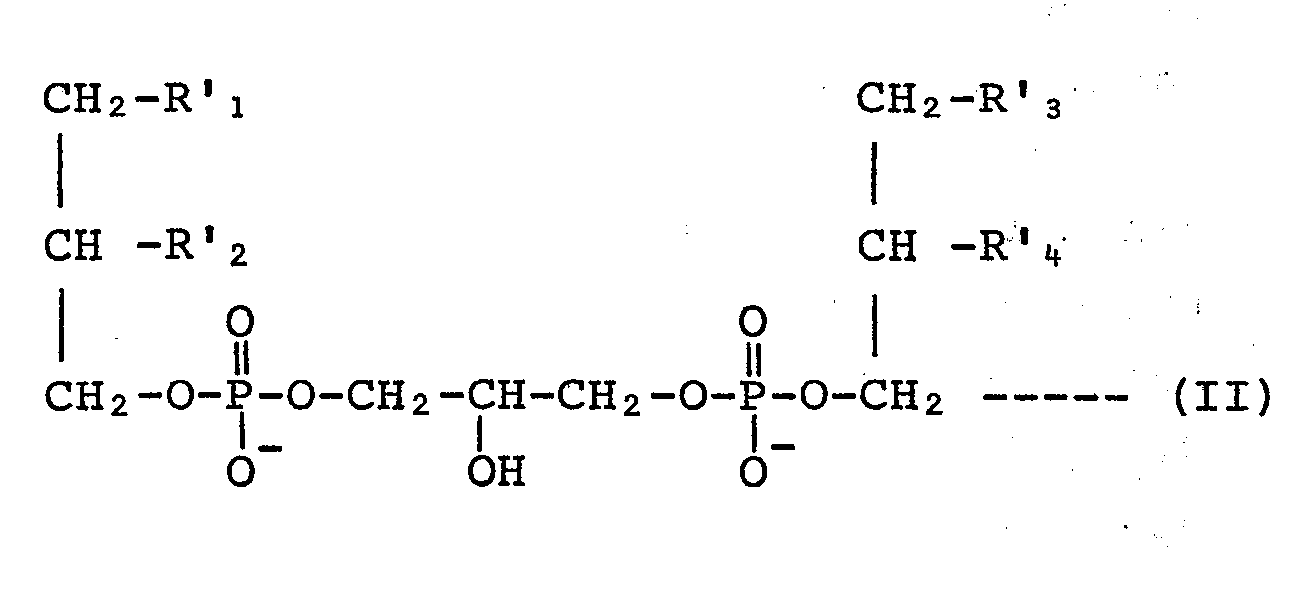
- Cardiolopin used in the present invention is a compound expressed by the following formula (II) wherein R' i , R' 2 , R' 3 , and R' 4 indicate straight chain fatty acid residues.
- Both native cardiopin and artificial one are usable in the present invention.
- the native cardiolipin are mainly obtained by extraction from the internal organs such as myocardia, lungs, kidneys, etc. of animals such as bovine, horse, swine, etc.
- the artificial cardiolipin is obtained synthetically, for instance, according to the method proposed by Van Deenen et al. (Advances in Lipid Research, p. 167, Academic Press (1964)).
- said R' 1 , R' 2 , R' 3 , and R' 4 in the formula (II) are straight chain fatty acid residues and it is desirable that part of them are unsaturated ones.
- Phosphatidyl glycerol used in the present invention is a compound expressed by the following formula (III) wherein R" 1 and R" 2 indicate straight chain fatty acid residues.
- Phosphatidyl glycerol used in this invention may be either a native L-substance or artificial DL-substance.
- R" 1 and R" 2 in the formula (II) should desirably be straight chain fatty acid residues having 14 to 25 carbon atoms.
- saturated fatty acid residues there are myristic acid residues, palmitic acid residues, stearic acid residues, etc., of which dipalmitoyl phosphatidyl glycerol is especially desirable.
- unsaturated fatty acid residues oleic acid residues and linoleic acid residues may be mentioned.
- neutral lipids used in the present invention there are triglyceride, diglyceride, monoglyceride, cholesterol derivatives, etc., of which triglyceride or diglyceride, whose main ingredients are saturated straight chain fatty acid residues having 14 to 25 carbon atoms, are desirable.
- neutral lipids there are trimyristin, tripalmitin, tristearin, triarachidin, dimyristin, dipalmitin, distearin, diarachidin, trilinolein, triolein, dilinolein, and diolein.
- Fatty acids used in this invention are preferably those straight chain fatty acids and, for instance, myristic acid, palmit acid, stearic acid, arachidic acid, etc. may be mentioned as saturated fatty acids, and oleic acid, elaidic acid, linoleic acid, linolenic acid, etc. may be mentioned as unsaturated fatty acids.
- the phospholipids to be contained in the artificial lung surfactant of the present invention there are a combination of phosphatidyl choline and cardiolipin, a combination of phosphatidyl choline and phosphatidyl glycerol, and a combination of phosphatidyl choline, cardiolipin, and phosphatidyl glycerol.
- These phospholipids should represent 80 to 95 wt % of the whole composition, desirably 85 to 90 wt %, the neutral lipids should represent 5 to 20 wt % of the whole composition, desirably 5 to 10 wt %, and the fatty acids should represent 0 to 10 wt % of the whole composition, desirably 0 to 5 wt %. If the abovementioned instructions as to the content of main ingredients are not observed, the object of the present invention can not be achieved.
- the artificial lung surfactant contain phosphatidyl choline, which possesses two saturated straight chain fatty acid residues having 14 to 25 carbon atoms, representing 55 to 80 wt % of the whole composition, phosphatidyl glycerol, which possesses two straight chain fatty acid residues having 14 to 25 carbon atoms, representing 10 to 35 wt % of the whole composition, and neutral lipids representing 5 to 20 2t % of the whole composition.
- phospholipids, carbonhydrates, etc. may be contained as ingredients in addition to the abovementioned ones to such an extent as not degrade the surface activity of the artificial lung surfactant.
- the artificial lung surfactant of this invention can be obtained by homogeneously mixing said phosphatidyl choline and cardiolipin and/or phosphatidyl glycerol. No limit is set to the method and means of mixing; however, to cite one example, a homogeneous mixture can be prepared easily by dissolving the ingredients in such a common solvent as chloroform, etc. and then removing the solvent from the solution.
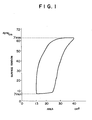
- the artificial lung surfactant thus obtained is usually in a state of wax and when its surface activity is measured by use of a Wilhelmy balance as mentioned later, its minimum surface tension value is 10 dyne/cm or less and its maximum surface tension value is 36 to 70 dyne/cm. Its stability index is 1.2 or more. These values generate a specific hysteresis loop as shown in Fig. 1 similar to that of a natural lung surfactant to indicate that the obtained artificial lung surfactant has a high surface activity.
- the artificial lung surfactant of this invention is usually obtained in the state of wax, it is advisable to administer it by dispersing it in water or such an electrolytic solution as saline solution or by forming it into a trituration by use of other medically permissible powders as excipients.
- the preparation of a dispersion liquid can be achieved by dispersing the waxy surfactant directly in a liquid; however, for reasons of sanitation and preparing procedure, a method is taken wherein a trituration is prepared beforehand by lyophilizing a dispersion liquid of appropriate concentration obtained from said waxy surfactant by addition of excipients, as case may require, and said trituration is dispersed in water at the time of its administration.
- those powders which are water-soluble and innocuous are desirable and it is proper to use it at a ratio of 2 to 50 parts by weight against 1 part by weight of the artificial lung surfactant, especially 5 to 20 parts by weight is recommendable.
- amino acids and saccharides may be mentioned because they do not degrade the surface activity.
- amino acids there are essential amino acids such as glycine, alanine, tryptophane, cystine, etc. and as the saccharides, there are glucose, mannitol, sorbitol, etc.
- the methods of preparing a trituration can be prepared simply by thoroughly mixing the artificial lung surfactant with medically permissible powders.
- the obtained dispersion liquid is put into a rotary evaporator, etc. and evaporated to dryness under reduced pressure with rotation and stirring.
- the obtained powder is further pulverized into fine powder of uniform particle size to give a desired trituration.
- the surfactant is dispersed in water or aqueous solution of salt, etc. uniformly.
- a prescribed amount of said saccharide or amino acid is dissolved in the obtained dispersion liquid to prepare a homogeneous dispersion solution.
- the dispersion solution is then lyophilized and the obtained powder is further pulverized into fine powder having a uniform particle size to give a desired trituration.
- the artificial lung surfactant is made to attach to the surfaces of the powdery substance uniformly and can be used as a preparation having the form of powder. Since the artificial lung surfactant thus prepared in the form of powder makes no change in its surface activity and has the same degree of surface activity as the natural lung surfactant as mentioned herein before, the triburation of the artificial lung surfactant of this invention can reasonably be expected to have enough efficacy as a remedy for respiratory distress syndrome such as IRDS, etc. when administered by inhalation or nebulization.
- the measurement of surface tension and the calculation of stability index of the artificial lung surfactant were conducted according to the following procedures.
- the minimum surface tension (y min) value, maximum surface tension (y max), and area surrounded by the hysteresis loop were obtained from the hysteresis loop converged invariantly at the 5th or 6th cycling from the start.
- the stability index (S.I.) was obtained from the following equation:
- a adult rabbit had its trachea cut open under an anesthetic and was given lung lavage five times at intervals of 10 minutes with 75 mQ of saline solution through a tube inserted from the cut opening into the trachea.
- the lung lavage were conducted by slowly injecting a saline solution and then sucking up to remove it.
- the rabbit was given 10 mQ of a dispersion liquid containing 1% artificial lung surfactant obtained in the example of the present invention.
- the treated rabbit was kept under the respiratory control vy use of a respirator based on the inspiratory intratracheal pressure of 20 cm of mercury and PEEP (positive end expiratory pressure) of 3 cm of mercury under pure oxygen.
- the same amount of saline solution was administered according to the same method.
- a lung surfactant was separated following the procedure mentioned below which was based on the method proposed by M. E. Abrams (J. Appl. Physiol. 21, 718-720). 2 kg of bovine lung was cut into ting pieces, homogenized in 5 t of saline solution in a homogenizer, and filtered through a gauze to obtain an extract. The extract was subjected to low speed centrifugation at a rate of 1,000 rpm for 30 minutes to obtain a supernatant. The obtained supernatant was centrifuged at a high rate of 7,000 rpm for 60 minutes to give a centrifugate. The centrifugate was dispersed in a saturated saline solution (specific gravity 1.21) which had been prepared and cooled beforehand. The dispersion liquid was centrifuged at a rate of 7.000 rpm for 30 minutes and the upper white layer was collected, which was then dialyzed against cooled distilled water and lyophilized to obtain a natural lung surfactant.
- the obtained natural lung surfactant was dissolved in a mixed solvent of chloroform and methanol (volume ratio 2:1) and the solution was then allowed to stand in contact with a 0.5 saline solution to obtain lipids. It was found that the lipids contained about 2% protein. Its surface activity is as shown in Table 1.
- the lipids were solubilized with SDS and subjected to the electrophoresis analysis of polyacrylamide gel desk type according to the ordinary method.
- the single band was observed at the mobility of 0.72, from which the molecular weight was assumed to be about 35,000 as compared with the mobility of L-chain and H-chain of the immunoglobulin used as a control in the same electrophoresis analysis.
- the hysteresis loop was large (i.e. the area was large) and the minimum surface tension (y min) was 10 dyne/cm or less.
- a homogeneous 1% dispersion liquid of the obtained solid substance was prepared to evaluate its effect in vivo when administered to the rabbits subjected to lung lavage. As seen from Fig. 2, the partial pressure of oxygen (Pa 0 2 ) in the blood of the rabbits subjected to lung lavage presented the same rise as the natural lung surfactant to show the recovery of respiratory function.
- 550 mg of DL-a-DPPC, 200 mg of ovolecithin (natural phosphatidyl choline), 100 mg of cardiolipin, 75 mg of tripalmitin, and 75 mg of palmitic acid were weighed, dissolved in 30 mQ of chloroform, and evaporated to dryness according to Example 5 to obtain a white waxy solid substance.
- This substance had an iodine value of 23.0.
- 100 mg of this substance was dispersed homogeneously in 50 mt of saline solution and its surface activity was measured with the use of an improved Wilhelmy balance. The result is shown in Table 2, indicating an excellent surface activity.
- DL-a-DPPC 200 mg of phosphatidyl glycerol, which contains unsaturated fatty acid residues having 14 to 25 carbon atoms, arising from egg yolk lecithin, 100 mg of tripalmitin, and 50 mg of trilinolein were weighed respectively, dissolved in 30 ml of chloroform, and evaporated to dryness according to Example 5 to obtain a yellowish white waxy solid substance.
- the iodine value of this substance was 24.1.
- a 0.2% dispersion liquid of this substance was prepared to measure its surface activity by using a Wilhelmy balance according to Example 5. The result is shown in Table 2, indicating that it has an excellent surface activity.
Landscapes
- Health & Medical Sciences (AREA)
- Chemical & Material Sciences (AREA)
- Medicinal Chemistry (AREA)
- Pharmacology & Pharmacy (AREA)
- Epidemiology (AREA)
- Life Sciences & Earth Sciences (AREA)
- Animal Behavior & Ethology (AREA)
- General Health & Medical Sciences (AREA)
- Public Health (AREA)
- Veterinary Medicine (AREA)
- Medicinal Preparation (AREA)
- Pharmaceuticals Containing Other Organic And Inorganic Compounds (AREA)
Abstract
Description
- The present invention relates to an artificial lung surfactant having a surface activity similar to a natural lung surfactant and a remedy for the respiratory distress syndrome containing said artificial lung surfactant as an active principle.
- There exists in alveoli of the animal lungs a physiological active substance, which is called a lung surfactant, mainly comprising phospholipid. This substance covers the inner walls of alveoli of the lung to protect the alveolar epitheliums and also performs an important physiological function for animals to maintain their respiratory functioning. More particularly, the lung surfactant is regarded as a substance having a specific surface- active function to change the surface tension of the inner walls of alveoli of the lung corresponding to the exhalation and inhalation of breath and also contributing to the maintenance of interalveolium functional stability to exercise an antiatelectatic action. After years of researches conducted by the medical circles with the use of various animals with regard to the lung surfactant, detailed particulars of its activities are now being made clear step by step. It has been made apparent that this active substance contains phospholipids, neutral lipids, protein, etc. as ingredients and that its main constituent is dipalmitoyl lecithin which is known as one of the phospholipids.
- T. Fujiwara et al. recently reported that they obtained an artificially prepared lung surfactant having a higher surface activity by adding dipalmitoyl lecithin, etc. to a surfactant recovered from the bovine lung and that they achieved a good result for the therapy of infantile respiratory distress syndrome (IRDS) by the instillation of the said lung surfactant dispersion to the respiratory tracts of the premature babies (Pediatric Clinics, Vol. 32, No.7, p. 1343, 1979).
- Also Kobayashi et al. obtained a lung surfactant prepared from an active substance isolated from the swine lung washings, in which Ca++ were made to coexist to enhance the activity, and successfully achieved a good result for the substitution therapy of-IRDS (Journal of Japanese Medical Society for Biological Interface Vol. 12, No.1, 1981).
- In these methods, it is intended to extract phospholipid only from the natural lung surfactant following the Folch procedure, wherein organic solvent soluble substances are extracted by use of a mixed solvent consisting of chlorform and methanol, eliminating the foreign protein arising from bovine and swine; however, the elimination is incomplete and the intermixture of foreign protein up to about 1 to 3% in the obtained phospholipid is observed. Also, the existence of protein, which is proper to the lung but different from ordinary serum albumin, in the naturally obtained lung surfactant is recognized by King et al. (King S.Am. J. Phyoiol. 224 788 ~ 795, 1973. Fed. Proc. 33 2238 m 2241, 1974). It is known that this is a liposoluble protein, which is mainly of molecular weight 34,000, containing a hydrophobic amino acid in large quantities. From the facts mentioned in the above, it is considered that in case where a lung surfactant is prepared from lipids extracted from the native lung surfactant according to the Folch procedure, not only desired phospholipid, neutral lipids, etc. but also protein proper to the lung are extracted and the getting in of such protein is regarded as inevitable. The existence of such protein in the lung surfactant is not desirable from the medicamental viewpoint, since it gives strong probability of causing the manifestation of anti- genecity and side effects including anaphylaxis.
- With the purpose of repairing the abovementioned defects, C. J. Morley et al. attempted the preparation of an artificial lung surfactant containing no foreign protein and succeeded clinically in its application to the IRDS (The Lancet, Jamary 10, 1981). However, this artificial surfactant is prepared in the form of powder containing dipalmitoyl phosphatidyl choline and phosphatidyl glycerol at the weight ratio of 7:3 and its administration is limited to powder administration which presents some technical difficulty found with the administration of powder to the alveoli.
- As the result of the strenuous research work to develop an artificial lung surfactant which does not contain any foreign protein, has easily obtainable compounds for its ingredients, and possesses such physicochemical property as specific surface activity peculiar to the lung surfactant including, for instance, instantaneous dispersibility into the interface between gas and liquid, formability of a stable interfacial layer, and capability of lowering the surface tension to 10 dyne/cm or less, the inventors of the present invention have found that a certain specific compound has a peculiar surface activity and shows an excellent physiological efficacy in the tests made in vivo on the rabbits who have undergone pulmonic irrigations and have produced this invention.
- Accordingly the present invention is directed to an artificial lung surfactant which comprises (a) phosphatidyl choline and also cardiolipin and/or phosphatidyl glycerol in addition as phospholipids, wherein the contant of said phospholipids is 80 to 95 wt % of the whole composition, (b) neutral lipids, wherein the content is 5 to 20 wt % of the whole composition, and (c) fatty acids, wherein the content is 0 to 10 wt % of the whole composition, and a remedy for the respiratory distress syndrome containing said artificial lung surfactant as an active principle.
-
- Fig. 1 shows a diagram of surface area versus surface tension of the artificial lung surfactant.
- Fig. 2 and Fig. 3 show changes in partial pressure of oxygen in the blood with the passage of time resulting from the administration of the lung surfactant dispersion to the lung lavaged rabbits.
- Phosphatidyl choline which is referred to in this invention is a compound expressed by the following formula (I)

- Phosphatidyl choline used in the present invention may be either a native L-substance or artificial DL-substance. As fatty acid residues, those having 14 to 25 carbon atoms are desirable. As examples of them, there are dimyristoyl phosphatidyl choline, dipalmitoyl phosphatidyl choline, distearyl phosphatidyl choline, etc., of which dipalmitoyl phosphatidyl choline is especially desirable.
- Cardiolopin used in the present invention is a compound expressed by the following formula (II)
- Phosphatidyl glycerol used in the present invention is a compound expressed by the following formula (III)

- Phosphatidyl glycerol used in this invention may be either a native L-substance or artificial DL-substance. R"1 and R"2 in the formula (II) should desirably be straight chain fatty acid residues having 14 to 25 carbon atoms. As examples of their saturated fatty acid residues, there are myristic acid residues, palmitic acid residues, stearic acid residues, etc., of which dipalmitoyl phosphatidyl glycerol is especially desirable. As examples of unsaturated fatty acid residues, oleic acid residues and linoleic acid residues may be mentioned.
- As neutral lipids used in the present invention, there are triglyceride, diglyceride, monoglyceride, cholesterol derivatives, etc., of which triglyceride or diglyceride, whose main ingredients are saturated straight chain fatty acid residues having 14 to 25 carbon atoms, are desirable. As examples of neutral lipids, there are trimyristin, tripalmitin, tristearin, triarachidin, dimyristin, dipalmitin, distearin, diarachidin, trilinolein, triolein, dilinolein, and diolein.
- Fatty acids used in this invention are preferably those straight chain fatty acids and, for instance, myristic acid, palmit acid, stearic acid, arachidic acid, etc. may be mentioned as saturated fatty acids, and oleic acid, elaidic acid, linoleic acid, linolenic acid, etc. may be mentioned as unsaturated fatty acids.
- As the phospholipids to be contained in the artificial lung surfactant of the present invention, there are a combination of phosphatidyl choline and cardiolipin, a combination of phosphatidyl choline and phosphatidyl glycerol, and a combination of phosphatidyl choline, cardiolipin, and phosphatidyl glycerol. These phospholipids should represent 80 to 95 wt % of the whole composition, desirably 85 to 90 wt %, the neutral lipids should represent 5 to 20 wt % of the whole composition, desirably 5 to 10 wt %, and the fatty acids should represent 0 to 10 wt % of the whole composition, desirably 0 to 5 wt %. If the abovementioned instructions as to the content of main ingredients are not observed, the object of the present invention can not be achieved.
- In the present invention, it is especially desirable to have the artificial lung surfactant contain phosphatidyl choline, which possesses two saturated straight chain fatty acid residues having 14 to 25 carbon atoms, representing 55 to 80 wt % of the whole composition, phosphatidyl glycerol, which possesses two straight chain fatty acid residues having 14 to 25 carbon atoms, representing 10 to 35 wt % of the whole composition, and neutral lipids representing 5 to 20 2t % of the whole composition.
- In the present invention, other phospholipids, carbonhydrates, etc. may be contained as ingredients in addition to the abovementioned ones to such an extent as not degrade the surface activity of the artificial lung surfactant.
- The artificial lung surfactant of this invention can be obtained by homogeneously mixing said phosphatidyl choline and cardiolipin and/or phosphatidyl glycerol. No limit is set to the method and means of mixing; however, to cite one example, a homogeneous mixture can be prepared easily by dissolving the ingredients in such a common solvent as chloroform, etc. and then removing the solvent from the solution. The artificial lung surfactant thus obtained is usually in a state of wax and when its surface activity is measured by use of a Wilhelmy balance as mentioned later, its minimum surface tension value is 10 dyne/cm or less and its maximum surface tension value is 36 to 70 dyne/cm. Its stability index is 1.2 or more. These values generate a specific hysteresis loop as shown in Fig. 1 similar to that of a natural lung surfactant to indicate that the obtained artificial lung surfactant has a high surface activity.
- Since the artificial lung surfactant of this invention is usually obtained in the state of wax, it is advisable to administer it by dispersing it in water or such an electrolytic solution as saline solution or by forming it into a trituration by use of other medically permissible powders as excipients. The preparation of a dispersion liquid can be achieved by dispersing the waxy surfactant directly in a liquid; however, for reasons of sanitation and preparing procedure, a method is taken wherein a trituration is prepared beforehand by lyophilizing a dispersion liquid of appropriate concentration obtained from said waxy surfactant by addition of excipients, as case may require, and said trituration is dispersed in water at the time of its administration.
- As medically permissible powders, those powders which are water-soluble and innocuous are desirable and it is proper to use it at a ratio of 2 to 50 parts by weight against 1 part by weight of the artificial lung surfactant, especially 5 to 20 parts by weight is recommendable. As desirable powders, amino acids and saccharides may be mentioned because they do not degrade the surface activity. As the amino acids, there are essential amino acids such as glycine, alanine, tryptophane, cystine, etc. and as the saccharides, there are glucose, mannitol, sorbitol, etc.
- As the methods of preparing a trituration, it can be prepared simply by thoroughly mixing the artificial lung surfactant with medically permissible powders. However, it is preferable to prepare a trituration by dissolving the surfactant in an organic solvent, to which a proper quantity of fine powder of amino acid was added to obtain a homogeneous dispersion liquid. The obtained dispersion liquid is put into a rotary evaporator, etc. and evaporated to dryness under reduced pressure with rotation and stirring. The obtained powder is further pulverized into fine powder of uniform particle size to give a desired trituration. In another method of preparing a trituration, the surfactant is dispersed in water or aqueous solution of salt, etc. uniformly. A prescribed amount of said saccharide or amino acid is dissolved in the obtained dispersion liquid to prepare a homogeneous dispersion solution. The dispersion solution is then lyophilized and the obtained powder is further pulverized into fine powder having a uniform particle size to give a desired trituration. The artificial lung surfactant is made to attach to the surfaces of the powdery substance uniformly and can be used as a preparation having the form of powder. Since the artificial lung surfactant thus prepared in the form of powder makes no change in its surface activity and has the same degree of surface activity as the natural lung surfactant as mentioned herein before, the triburation of the artificial lung surfactant of this invention can reasonably be expected to have enough efficacy as a remedy for respiratory distress syndrome such as IRDS, etc. when administered by inhalation or nebulization.
- In the present invention, the measurement of surface tension and the calculation of stability index of the artificial lung surfactant were conducted according to the following procedures.
- In measuring the surface tension, an improved type of Wilhelmy balance of Acoma make was used. 50 mt of saline solution was put in the teflon trough of the balance and the surface tension of water was adjusted to 72 dyne/cm. In case where the specimen was a dispersion liquid, the measurement was made after 50 mt of saline solution used in the adjustment was replaced with 50 mℓ of specimen dispersion liquid. In case where the specimen was a dry substance or powder, a very small amount of the specimen powder was placed gently on 50 mℓ of saline solution. The surface film area was compressed cyclically in the range of a maximum of 40 cm2 to a minimum of 13 cm2 at the rate of 0.3 cycle/min. to record a surface area-surface tension diagram as shown in Fig. 1 by use of an X-Y recorder. The minimum surface tension (y min) value, maximum surface tension (y max), and area surrounded by the hysteresis loop were obtained from the hysteresis loop converged invariantly at the 5th or 6th cycling from the start. The stability index (S.I.) was obtained from the following equation:

- The measurement of surface activity in vivo was made according to the method proposed by Kataoka et al. (Journal of Japanese Medical Society for Biological Interface 13 (2) 61 (1982)) by means lung-lavage as follows.
- A adult rabbit had its trachea cut open under an anesthetic and was given lung lavage five times at intervals of 10 minutes with 75 mQ of saline solution through a tube inserted from the cut opening into the trachea. The lung lavage were conducted by slowly injecting a saline solution and then sucking up to remove it. When 5 minutes passed after the lavage were over, the rabbit was given 10 mQ of a dispersion liquid containing 1% artificial lung surfactant obtained in the example of the present invention. The treated rabbit was kept under the respiratory control vy use of a respirator based on the inspiratory intratracheal pressure of 20 cm of mercury and PEEP (positive end expiratory pressure) of 3 cm of mercury under pure oxygen. For comparison's sake, the same amount of saline solution was administered according to the same method.
- The following Comparison and Examples, in which per cents are by weight, illustrate the invention in detail.
- A lung surfactant was separated following the procedure mentioned below which was based on the method proposed by M. E. Abrams (J. Appl. Physiol. 21, 718-720). 2 kg of bovine lung was cut into ting pieces, homogenized in 5 t of saline solution in a homogenizer, and filtered through a gauze to obtain an extract. The extract was subjected to low speed centrifugation at a rate of 1,000 rpm for 30 minutes to obtain a supernatant. The obtained supernatant was centrifuged at a high rate of 7,000 rpm for 60 minutes to give a centrifugate. The centrifugate was dispersed in a saturated saline solution (specific gravity 1.21) which had been prepared and cooled beforehand. The dispersion liquid was centrifuged at a rate of 7.000 rpm for 30 minutes and the upper white layer was collected, which was then dialyzed against cooled distilled water and lyophilized to obtain a natural lung surfactant.
- In accordance with the procedure proposed by Folch, the obtained natural lung surfactant was dissolved in a mixed solvent of chloroform and methanol (volume ratio 2:1) and the solution was then allowed to stand in contact with a 0.5 saline solution to obtain lipids. It was found that the lipids contained about 2% protein. Its surface activity is as shown in Table 1.
- The lipids were solubilized with SDS and subjected to the electrophoresis analysis of polyacrylamide gel desk type according to the ordinary method. The single band was observed at the mobility of 0.72, from which the molecular weight was assumed to be about 35,000 as compared with the mobility of L-chain and H-chain of the immunoglobulin used as a control in the same electrophoresis analysis.
- 650 mg of L-a-dipalmitoyl phosphatidyl choline (DPPC), 250 mg of L-a-dipalmitoyl phosphatidyl glycerol (DPPG), and 100 mg of tripalmitin were mixed and dissolved in 50 mt of chloroform to obtain a homogeneous solution. The solution was placed in a rotary evaporator and evaporated at room temperature under reduced pressure to dryness and dried further at a high degree of vacuum to obtain a white waxy solid substance. 50 mg of thus obtained solid substance was dispersed homogeneously in 50 mk of saline solution and its surface activity was determined with the use of an improved type of Wilhelmy balance. The result is shown in Table 1. The hysteresis loop was large (i.e. the area was large) and the minimum surface tension (y min) was 10 dyne/cm or less. A homogeneous 1% dispersion liquid of the obtained solid substance was prepared to evaluate its effect in vivo when administered to the rabbits subjected to lung lavage. As seen from Fig. 2, the partial pressure of oxygen (Pa 02) in the blood of the rabbits subjected to lung lavage presented the same rise as the natural lung surfactant to show the recovery of respiratory function.
- 600 mg of L-a-DPPC, 300 mg of L-a-DPPG, and 100 mg of tripalmitin were mixed and dissolved in 35 mt of chloroform. The solution was evaporated to dryness according to Example 1 to obtain a white waxy solid substance.
- Its surface activity was determined according to Example 1 and the obtained result is shown in Table 1. Thereafter, a homogeneous 1% dispersion liquid of this substance was prepared to evaluate its effect in vivo when administered to the rabbits subjected to pulmonic irrigations. As shown in Fig. 2, the partial pressure of oxygen (Pa O2) in the blood presented the same rise as the natural lung surfactant as in Example 1 to show the recovery of respiratory function.
- 750 mg of DL-a-DPPC, 150 mg of L-a-DPPG, and 100 mg of tripalmitin were mixed and dissolved in 35 mQ of chloroform. A white solid substance was obtained from the solution according to the same procedure as Example 1.
- Then 100 mg of this substance was dispersed homogeneously in 50 mt of saline solution and the surface activity was measured with the use of a Wilhelmy balance. The result showed that it had an excellent surface activity as shown in Table 1.
- 650 mg of L-a-DPPC, 250 mg of L-a-DPPG, and 100 mg of tristearin were weighed respectively, dissolved in 50 mℓ of chloroform, and evaporated to dryness to obtain a while waxy substance. The result of the measurement of its surface activity is shown in Table 1 and it showed a hysteresis loop having a large area and the minimum surface tension (y min) of 10 dyne/cm or less. 500 mg of this substance was dispersed homogeneously in 50 mk of an aqueous solution of 15% mannitol. This dispersion liquid was then lyophilized to obtain a white dry substance. The obtained substance was pulverized in a small-sized ball mill for 20 hours to obtain a fine white powder of uniform particle size. This fine powder had a surface activity as shown in Table 1 and its dispersibility was also very good.
-

- 650 mg of L-a-DPPC, 250 mg of sodium salt of cardiolipin having an iodine value of 77.7 extracted from bovine hearts, and 100 mg of tripalmitin were weighed respectively, mixed, and dissolved in 30 mQ of chloroform to prepare a homogeneous solution. The solution was then put in a rotary evaporator and evaporated to dryness at room temperature under reduced pressure, and further dried under high vacuum to obtain a white waxy solid substance. The iodine value of this substance was 19.3. Thereafter, 100 mg of this substance was dispersed homogeneously in 50 mℓ of saline solution and its surface activity was measured with the use of an improved Wilhelmy balance. When the specimen dispersion liquid was poured in, the surface tension decreased instantly to show an excellent interfacial adsorbability and presented a hysteresis loop having a large area. The result is shown in Table 2 indicating that it has a surface activity similar to the natural lung surfactant. Also, a homogeneous 1% dispersion liquid of this substance was prepared to examine its therapeutic effect in vivo by administering it to rabbits subjected to lung lavage along with Reference 1. As shown in Fig. 3, the partial pressure of oxygen (Pa 02) in the blood of the rabbits presented the same rise as the natural one to show the recovery of respiratory function.
- 600 mg of L-a-DPPC, 250 mg of cardiolipin, 100 mg of tripalmitin, and also 50 mg of palmitic acid were mixed, dissolved in 30 mt of chloroform, and evaporated to dryness according to Example 5 to obtain a white waxy solid substance. This substance had an iodine value of 19.3 and-its surface activity was measured according to Example 5. The result is shown in Table 2.
- Thereafter, a homogeneous 1% dispersion liquid of this substance was prepared to evaluate its therapeutic effect in vivo by administering it to the rabbits subjected to lung lavage.
- Then a homogeneous 1% dispersion liquid of this substance was prepared to examine its therapeutic effect in vivo by giving it to rabbits subjected to lung lavage. As seen from Fig. 3, the partial pressure of oxygen (Pa 02) in the blood presented almost the same rise as the natural one to show the recovery of respiratory function.
- 550 mg of DL-a-DPPC, 200 mg of ovolecithin (natural phosphatidyl choline), 100 mg of cardiolipin, 75 mg of tripalmitin, and 75 mg of palmitic acid were weighed, dissolved in 30 mQ of chloroform, and evaporated to dryness according to Example 5 to obtain a white waxy solid substance. This substance had an iodine value of 23.0. Then, 100 mg of this substance was dispersed homogeneously in 50 mt of saline solution and its surface activity was measured with the use of an improved Wilhelmy balance. The result is shown in Table 2, indicating an excellent surface activity.
- 650 mg of DL-a-DPPC, 200 mg of phosphatidyl glycerol, which contains unsaturated fatty acid residues having 14 to 25 carbon atoms, arising from egg yolk lecithin, 100 mg of tripalmitin, and 50 mg of trilinolein were weighed respectively, dissolved in 30 mℓ of chloroform, and evaporated to dryness according to Example 5 to obtain a yellowish white waxy solid substance. The iodine value of this substance was 24.1.
- A 0.2% dispersion liquid of this substance was prepared to measure its surface activity by using a Wilhelmy balance according to Example 5. The result is shown in Table 2, indicating that it has an excellent surface activity.
- 600 mg of L-a-DPPC, 300 mg of cardiolipin, and 100 mg of tripalmitin were weighed, dissolved in 30 mQ of mixed solvent of chloroform and methanol (
volume ratio 2/1), and evaporated to dryness to obtain a white waxy substance. It had an iodine value of 28.0 and the result of the measurement of its surface activity is shown in Table 2. It had an excellent adsorbability and described a hysteresis loop having a large area. Also, 500 mg of this substance was dispersed homogeneously in 50 mℓ of water, in which 10 g of mannitol was dissolved to prepare a homogeneous dispersion solution. The dispersion solution was lyophilized to obtain a white dry substance. This substance was subjected to pulverization in a small-sized ball mill for 15 hours to give a white pulverulenta of uniform particle size. It had a surface activity as shown in Table 2 and its dispersibility was also very good.
- 650 mg of L-a-DPPC, 300 mg of sodium salt of cardiolipin, and 50 mg of dilinolein were dissolved in 30 mt of chloroform and evaporated to dryness according to Example 5 to obtain a white waxy solid substance. The surface activity of this substance was measured and is shown in Table 2. Furthermore, this waxy solid substance was dispersed homogeneously in 50 mℓ of an aqueous solution of about 20 wt % mannitol and lyophilized. Thus obtained white lyophile substance was pulverized in a small-sized ball mill at low room temperature for 30 hours to give a white pulverulenta of uniform particle size. The surface activity of this pulverulenta was measured and the result is shown in Table 2. The dispersibility of this substance on the water surface was very good.
Claims (8)
Applications Claiming Priority (4)
| Application Number | Priority Date | Filing Date | Title |
|---|---|---|---|
| JP203684/82 | 1982-11-22 | ||
| JP20368482A JPS5995219A (en) | 1982-11-22 | 1982-11-22 | Synthetic active substance for lung surface and remedy for respiratory distress syndrome containing said substance as active component |
| JP31752/83 | 1983-03-01 | ||
| JP3175283A JPS59181216A (en) | 1983-03-01 | 1983-03-01 | Synthetic pulmonary surface active substance and remedy for respiratory distress syndrome containing the same as active constituent |
Publications (3)
| Publication Number | Publication Date |
|---|---|
| EP0110498A1 true EP0110498A1 (en) | 1984-06-13 |
| EP0110498B1 EP0110498B1 (en) | 1987-02-04 |
| EP0110498B2 EP0110498B2 (en) | 1991-09-18 |
Family
ID=26370263
Family Applications (1)
| Application Number | Title | Priority Date | Filing Date |
|---|---|---|---|
| EP83304596A Expired EP0110498B2 (en) | 1982-11-22 | 1983-08-09 | Artificial lung surfactant and remedy for respiratory distress syndrome containing it as active principle |
Country Status (5)
| Country | Link |
|---|---|
| US (1) | US4973582A (en) |
| EP (1) | EP0110498B2 (en) |
| CA (1) | CA1205387A (en) |
| CH (1) | CH657049A5 (en) |
| DE (1) | DE3369644D1 (en) |
Cited By (13)
| Publication number | Priority date | Publication date | Assignee | Title |
|---|---|---|---|---|
| FR2586587A1 (en) * | 1985-08-30 | 1987-03-06 | Adir | NEW ARTIFICIAL SURFACTANTS, THEIR PREPARATION AND THE PHARMACEUTICAL COMPOSITIONS CONTAINING THEM. |
| EP0287198A3 (en) * | 1987-02-17 | 1988-11-17 | Board Of Regents The University Of Texas System | Methods and compositions employing unique mixtures of polar and neutral lipids for protecting the gastronointestinal tract |
| US4861756A (en) * | 1988-03-08 | 1989-08-29 | Merrell Dow Pharmaceuticals Inc. | Synthetic pulmonary surfactant |
| EP0406732A3 (en) * | 1989-07-04 | 1991-02-27 | Dr. Karl Thomae Gmbh | Highly concentrated and low-viscosity surfactant suspension |
| US5032585A (en) * | 1987-02-17 | 1991-07-16 | Board Of Regents, The University Of Texas System | Methods and compositions employing unique mixtures of polar and neutral lipids for surfactant replacement therapy |
| US5043329A (en) * | 1987-02-17 | 1991-08-27 | Board Of Regents, University Of Texas System | Methods and compositions employing unique mixtures of polar and neutral lipids for protecting the gastrointestinal tract |
| US5134129A (en) * | 1989-03-15 | 1992-07-28 | Board Of Regents, The University Of Texas System | Methods employing unique mixtures of polar and neutral lipids for surfactant replacement therapy |
| EP0528034A4 (en) * | 1990-05-18 | 1993-03-24 | Tokyo Tanabe Company Limited | Remedy for asthma |
| US5260284A (en) * | 1987-02-17 | 1993-11-09 | Board Of Regents, The University Of Texas System | Methods employing unique mixtures of polar and neutral lipids and sterol for lung surfactant replacement therapy |
| DE10018022A1 (en) * | 2000-04-12 | 2001-10-31 | Byk Gulden Lomberg Chem Fab | Use of a lung surfactant composition to produce medicaments for the prophylaxis or early therapy of acute lung disorders in mammals |
| US7053176B1 (en) | 1999-09-16 | 2006-05-30 | Altana Pharma Ag | Combination of C1-INH and lung surfactant for the treatment of respiratory disorders |
| US7951781B2 (en) | 2006-11-02 | 2011-05-31 | University Of Iowa Research Foundation | Methods and compositions related to PLUNC surfactant polypeptides |
| US9289388B2 (en) | 2008-12-10 | 2016-03-22 | Paka Pulmonary Pharmaceuticals, Inc. | Methods and compositions for delivery of medicaments to the lungs |
Families Citing this family (14)
| Publication number | Priority date | Publication date | Assignee | Title |
|---|---|---|---|---|
| US5110806A (en) * | 1985-06-26 | 1992-05-05 | The Regents Of The University Of California | Lung surfactant compositions |
| US6013619A (en) * | 1988-01-06 | 2000-01-11 | The Scripps Research Institute | Pulmonary surfactants and therapeutic uses, including pulmonary lavage |
| US5207220A (en) * | 1989-12-12 | 1993-05-04 | Burroughs Wellcome Co. | Method for administering pharmaceuticals, including liquid surfactant, to the lungs |
| US5614216A (en) * | 1990-10-17 | 1997-03-25 | The Liposome Company, Inc. | Synthetic lung surfactant |
| US6250300B1 (en) | 1992-12-11 | 2001-06-26 | Ab Astra | System for dispensing pharmaceutically active compounds |
| SE9203743D0 (en) * | 1992-12-11 | 1992-12-11 | Astra Ab | EFFICIENT USE |
| US7654998B1 (en) | 1999-08-23 | 2010-02-02 | Aeris Therapeutics, Inc. | Tissue volume reduction |
| US6610043B1 (en) | 1999-08-23 | 2003-08-26 | Bistech, Inc. | Tissue volume reduction |
| NL1015288C2 (en) * | 2000-05-24 | 2001-12-14 | Peter Ferdinand Elbers | Preparation for stabilizing the protective layer on the epithelium of the cornea or alveoli. |
| GB0026239D0 (en) * | 2000-10-26 | 2000-12-13 | Britannia Pharmaceuticals Ltd | Surface active lipids in treatment of wet lung |
| DE50214446D1 (en) | 2001-10-11 | 2010-07-01 | Nycomed Gmbh | NEW USE OF LUNGSSURFACTANT |
| CA2518794A1 (en) * | 2002-03-11 | 2003-09-25 | Aeris Therapeutics, Inc. | Compositions and methods for treating emphysema |
| JP5108515B2 (en) | 2004-08-06 | 2012-12-26 | ニコメッド ゲゼルシャフト ミット ベシュレンクテル ハフツング | Composition comprising pulmonary surfactant and TNF-derived peptide |
| EP2711004A1 (en) * | 2009-10-05 | 2014-03-26 | Nutri-Fit GmbH & Co. KG | Methods for increasing physical capacity of mammalian livestock |
Citations (2)
| Publication number | Priority date | Publication date | Assignee | Title |
|---|---|---|---|---|
| FR2343481A1 (en) * | 1976-03-11 | 1977-10-07 | Gerlich Norbert | Preventing damage to and repairing biomembranes - by adding lipid mixtures contg. phosphatidyl-choline,-serine-and-ethanolamine, and unsaturated fatty acids |
| DE2900300A1 (en) * | 1979-01-05 | 1980-07-17 | Lebrecht Von Dr Klitzing | Medicaments contg. di:palmitoyl phosphocholine - for prophylaxis of respiratory emergency syndrome |
-
1983
- 1983-08-09 EP EP83304596A patent/EP0110498B2/en not_active Expired
- 1983-08-09 DE DE8383304596T patent/DE3369644D1/en not_active Expired
- 1983-11-17 CA CA000441422A patent/CA1205387A/en not_active Expired
- 1983-11-22 CH CH6272/83A patent/CH657049A5/en not_active IP Right Cessation
-
1987
- 1987-05-29 US US07/056,298 patent/US4973582A/en not_active Expired - Fee Related
Patent Citations (2)
| Publication number | Priority date | Publication date | Assignee | Title |
|---|---|---|---|---|
| FR2343481A1 (en) * | 1976-03-11 | 1977-10-07 | Gerlich Norbert | Preventing damage to and repairing biomembranes - by adding lipid mixtures contg. phosphatidyl-choline,-serine-and-ethanolamine, and unsaturated fatty acids |
| DE2900300A1 (en) * | 1979-01-05 | 1980-07-17 | Lebrecht Von Dr Klitzing | Medicaments contg. di:palmitoyl phosphocholine - for prophylaxis of respiratory emergency syndrome |
Non-Patent Citations (4)
| Title |
|---|
| CHEMICAL ABSTRACTS, volume 92, no. 3, January 21, 1980, page 62, abstract 15574p (COLUMBUS, OHIO, US) M. IKEGAMI et al. "Restoration of lung pressure-volume characteristics with various phospholipids", & Pediatr. Res. 1979, 13(6), 777-80 * |
| CHEMICAL ABSTRACTS, volume 95, no. 12, September 21, 1983, page 348, abstract 103230r (COLUMBUS, OHIO, US) C. MEBAN "Effect of lipids and other substances on the adsorption of dipalmitoyl phosphatidylcholine", & Pediatr. Res. 1981, 15(7), 1029-31 * |
| CHEMICAL ABSTRACTS, volume 99, no. 11, September 12, 1983, page 46, abstract 82279d (COLUMBUS, OHIO, US) M. KOKUBO et al. "Trial preparations of artificial surfactant. Effect on lung lavaged rabbits", & Nippon Kaimen Igakkai Zasshi 1983, 14(1), 59-66 * |
| CHEMICAL ABSTRACTS, volume 99, no. 20, November 14, 1983, page 343, abstract 163999r (COLUMBUS, OHIO, US) & JP - A - 58 045 299 (TOKYO TANABE CO. LTD.) 16-03-1983 * |
Cited By (16)
| Publication number | Priority date | Publication date | Assignee | Title |
|---|---|---|---|---|
| EP0214055A1 (en) * | 1985-08-30 | 1987-03-11 | Adir Et Compagnie | Synthetic surface-active agents, their preparation and pharmaceutical compositions containing them |
| US4765987A (en) * | 1985-08-30 | 1988-08-23 | Adir & Cie | Artificial surfactants, pharmaceutical compositions containing them and use thereof |
| FR2586587A1 (en) * | 1985-08-30 | 1987-03-06 | Adir | NEW ARTIFICIAL SURFACTANTS, THEIR PREPARATION AND THE PHARMACEUTICAL COMPOSITIONS CONTAINING THEM. |
| US5043329A (en) * | 1987-02-17 | 1991-08-27 | Board Of Regents, University Of Texas System | Methods and compositions employing unique mixtures of polar and neutral lipids for protecting the gastrointestinal tract |
| EP0287198A3 (en) * | 1987-02-17 | 1988-11-17 | Board Of Regents The University Of Texas System | Methods and compositions employing unique mixtures of polar and neutral lipids for protecting the gastronointestinal tract |
| US4918063A (en) * | 1987-02-17 | 1990-04-17 | Board Of Regents, The University Of Texas System | Methods and compositions employing unique mixtures of polar and neutral lipids for protecting the gastrointestinal tract |
| US5260284A (en) * | 1987-02-17 | 1993-11-09 | Board Of Regents, The University Of Texas System | Methods employing unique mixtures of polar and neutral lipids and sterol for lung surfactant replacement therapy |
| US5032585A (en) * | 1987-02-17 | 1991-07-16 | Board Of Regents, The University Of Texas System | Methods and compositions employing unique mixtures of polar and neutral lipids for surfactant replacement therapy |
| US4861756A (en) * | 1988-03-08 | 1989-08-29 | Merrell Dow Pharmaceuticals Inc. | Synthetic pulmonary surfactant |
| US5134129A (en) * | 1989-03-15 | 1992-07-28 | Board Of Regents, The University Of Texas System | Methods employing unique mixtures of polar and neutral lipids for surfactant replacement therapy |
| EP0406732A3 (en) * | 1989-07-04 | 1991-02-27 | Dr. Karl Thomae Gmbh | Highly concentrated and low-viscosity surfactant suspension |
| EP0528034A4 (en) * | 1990-05-18 | 1993-03-24 | Tokyo Tanabe Company Limited | Remedy for asthma |
| US7053176B1 (en) | 1999-09-16 | 2006-05-30 | Altana Pharma Ag | Combination of C1-INH and lung surfactant for the treatment of respiratory disorders |
| DE10018022A1 (en) * | 2000-04-12 | 2001-10-31 | Byk Gulden Lomberg Chem Fab | Use of a lung surfactant composition to produce medicaments for the prophylaxis or early therapy of acute lung disorders in mammals |
| US7951781B2 (en) | 2006-11-02 | 2011-05-31 | University Of Iowa Research Foundation | Methods and compositions related to PLUNC surfactant polypeptides |
| US9289388B2 (en) | 2008-12-10 | 2016-03-22 | Paka Pulmonary Pharmaceuticals, Inc. | Methods and compositions for delivery of medicaments to the lungs |
Also Published As
| Publication number | Publication date |
|---|---|
| CA1205387A (en) | 1986-06-03 |
| CH657049A5 (en) | 1986-08-15 |
| DE3369644D1 (en) | 1987-03-12 |
| EP0110498B2 (en) | 1991-09-18 |
| US4973582A (en) | 1990-11-27 |
| EP0110498B1 (en) | 1987-02-04 |
Similar Documents
| Publication | Publication Date | Title |
|---|---|---|
| US4973582A (en) | Artificial lung surfactant and remedy for respiratory distress syndrome containing it as active principle | |
| EP0055041B1 (en) | Composition for curing respiratory diseases | |
| US4603124A (en) | Surfactant and pharmaceutical compositions containing same | |
| KR100197915B1 (en) | Medicine | |
| US4614796A (en) | Liposome and method of manufacture therefor | |
| CA1142089A (en) | Fat emulsion for intravenous injection | |
| DE69802268T2 (en) | MEDICAL PREPARATION CONTAINING A LIPOPHILIC EDELGAS | |
| FI92905B (en) | Process for the preparation of a surfactant for lungs | |
| CZ93593A3 (en) | Process for preparing a formulation of a surface-active substances for administration in a patient lungs | |
| EP0588869A1 (en) | X-ray contrast agent | |
| EA021163B1 (en) | Improved reconstituted surfactant composition containing analogs of surfactant protein b (sp-b) and surfactant protein c (sp-c) | |
| WO1999044594A1 (en) | Fat emulsions for inhalational administration | |
| EP0092121B1 (en) | Methods and compositions for treating gastro-intestinal ulcer diesease | |
| JPS62181225A (en) | Anesthetic medicine composition | |
| KR20030053507A (en) | Lung surfactant compositions with dynamic swelling behaviour | |
| JPH04149126A (en) | Pharmaceutical composition for transmucosal administration | |
| WO2006102060A1 (en) | Calcium salt of myo-inositol 1,6:2,3:4,5 tripyrophosphate as an allosteric effector of hemoglobin | |
| CN112022860A (en) | Anti-inflammatory composition, preparation method and application | |
| HRP20041058A2 (en) | Improved synthetic lipid mixtures for the preparation of a reconstituted surfactant | |
| JPH0129171B2 (en) | ||
| US20100029593A1 (en) | Calcium/sodium salt of inositol tripyrophosphate as an allosteric effector of hemoglobin | |
| US20120003161A1 (en) | Use of inositol-tripyrophosphate in treating tumors and diseases | |
| JPH07285827A (en) | External preparation for skin | |
| JPS59181216A (en) | Synthetic pulmonary surface active substance and remedy for respiratory distress syndrome containing the same as active constituent | |
| JP2911550B2 (en) | Liposome preparation |
Legal Events
| Date | Code | Title | Description |
|---|---|---|---|
| PUAI | Public reference made under article 153(3) epc to a published international application that has entered the european phase |
Free format text: ORIGINAL CODE: 0009012 |
|
| AK | Designated contracting states |
Designated state(s): DE FR GB IT SE |
|
| 17P | Request for examination filed |
Effective date: 19841119 |
|
| GRAA | (expected) grant |
Free format text: ORIGINAL CODE: 0009210 |
|
| AK | Designated contracting states |
Kind code of ref document: B1 Designated state(s): DE FR GB IT SE |
|
| REF | Corresponds to: |
Ref document number: 3369644 Country of ref document: DE Date of ref document: 19870312 |
|
| ET | Fr: translation filed | ||
| ITF | It: translation for a ep patent filed | ||
| PLBI | Opposition filed |
Free format text: ORIGINAL CODE: 0009260 |
|
| 26 | Opposition filed |
Opponent name: A. NATTERMANN & CIE. GMBH Effective date: 19871020 |
|
| PUAH | Patent maintained in amended form |
Free format text: ORIGINAL CODE: 0009272 |
|
| STAA | Information on the status of an ep patent application or granted ep patent |
Free format text: STATUS: PATENT MAINTAINED AS AMENDED |
|
| ITTA | It: last paid annual fee | ||
| 27A | Patent maintained in amended form |
Effective date: 19910918 |
|
| AK | Designated contracting states |
Kind code of ref document: B2 Designated state(s): DE FR GB IT SE |
|
| ET3 | Fr: translation filed ** decision concerning opposition | ||
| ITF | It: translation for a ep patent filed | ||
| PGFP | Annual fee paid to national office [announced via postgrant information from national office to epo] |
Ref country code: SE Payment date: 19930614 Year of fee payment: 11 |
|
| PG25 | Lapsed in a contracting state [announced via postgrant information from national office to epo] |
Ref country code: SE Effective date: 19940810 |
|
| EAL | Se: european patent in force in sweden |
Ref document number: 83304596.6 |
|
| EUG | Se: european patent has lapsed |
Ref document number: 83304596.6 |
|
| PGFP | Annual fee paid to national office [announced via postgrant information from national office to epo] |
Ref country code: FR Payment date: 19960625 Year of fee payment: 14 |
|
| PGFP | Annual fee paid to national office [announced via postgrant information from national office to epo] |
Ref country code: GB Payment date: 19960627 Year of fee payment: 14 |
|
| PGFP | Annual fee paid to national office [announced via postgrant information from national office to epo] |
Ref country code: DE Payment date: 19960930 Year of fee payment: 14 |
|
| PG25 | Lapsed in a contracting state [announced via postgrant information from national office to epo] |
Ref country code: GB Free format text: LAPSE BECAUSE OF NON-PAYMENT OF DUE FEES Effective date: 19970809 |
|
| GBPC | Gb: european patent ceased through non-payment of renewal fee |
Effective date: 19970809 |
|
| PG25 | Lapsed in a contracting state [announced via postgrant information from national office to epo] |
Ref country code: FR Free format text: LAPSE BECAUSE OF NON-PAYMENT OF DUE FEES Effective date: 19980430 |
|
| PG25 | Lapsed in a contracting state [announced via postgrant information from national office to epo] |
Ref country code: DE Free format text: LAPSE BECAUSE OF NON-PAYMENT OF DUE FEES Effective date: 19980501 |
|
| REG | Reference to a national code |
Ref country code: FR Ref legal event code: ST |
|
| APAH | Appeal reference modified |
Free format text: ORIGINAL CODE: EPIDOSCREFNO |