EP0109561B1 - Celiprolol for the treatment of glaucoma - Google Patents
Celiprolol for the treatment of glaucoma Download PDFInfo
- Publication number
- EP0109561B1 EP0109561B1 EP83110477A EP83110477A EP0109561B1 EP 0109561 B1 EP0109561 B1 EP 0109561B1 EP 83110477 A EP83110477 A EP 83110477A EP 83110477 A EP83110477 A EP 83110477A EP 0109561 B1 EP0109561 B1 EP 0109561B1
- Authority
- EP
- European Patent Office
- Prior art keywords
- preparation
- celiprolol
- sodium
- salt
- pharmaceutically acceptable
- Prior art date
- Legal status (The legal status is an assumption and is not a legal conclusion. Google has not performed a legal analysis and makes no representation as to the accuracy of the status listed.)
- Expired
Links
Classifications
-
- A—HUMAN NECESSITIES
- A61—MEDICAL OR VETERINARY SCIENCE; HYGIENE
- A61K—PREPARATIONS FOR MEDICAL, DENTAL OR TOILETRY PURPOSES
- A61K31/00—Medicinal preparations containing organic active ingredients
- A61K31/16—Amides, e.g. hydroxamic acids
- A61K31/17—Amides, e.g. hydroxamic acids having the group >N—C(O)—N< or >N—C(S)—N<, e.g. urea, thiourea, carmustine
-
- A—HUMAN NECESSITIES
- A61—MEDICAL OR VETERINARY SCIENCE; HYGIENE
- A61P—SPECIFIC THERAPEUTIC ACTIVITY OF CHEMICAL COMPOUNDS OR MEDICINAL PREPARATIONS
- A61P27/00—Drugs for disorders of the senses
- A61P27/02—Ophthalmic agents
Definitions
- This invention relates to an ophthalmic preparation for the treatment of glaucoma and a process of preparing said preparation.
- Said preparation has been found useful in lowering intraocular pressure.
- Elevated intraocular pressure is a major risk factor in the onset and development of glaucomatous visual field loss.
- beta adrenergic blocking agents commonly known as beta blockers
- the beta blockers have several effects. For example, they can reduce the heart rate of an angina patient, which in turn reduces the workload of the heart and thus its need for blood and oxygen. They also tend to decrease the heart's force of concentration, which likewise diminishes the heart's workload. In addition, these drugs reduce the systolic blood pressure which is beneficial to patients with hypertension.
- beta blockers were experimented with for treating other ailments, such as migraine, alcohol and drug withdrawal problems, and glaucoma.
- beta blockers While the use of beta blockers provides valuable benefits to humankind, it also has some undesirable side effects and reactions. Some beta blockers tend to build up in the central nervous system causing fatigue, lethargy, and confusion. Others may cause bronchial spasm and cannot be used in people with bronchial asthma. Still others, while having minimal side effects, fail to produce acceptable results because of their limited potency.
- Timolol a non-selective beta-adrenoceptor antagonist
- TIMOPTIC° the only beta blocker sold in the U.S. for this purpose.
- adverse reactions reported on the use of timolol is the aggravation or precipitation of certain cardiovascular and pulmonary disorders including bronchospastic disease, sinus bradycardia, cardiogenic shock and cardiac failure.
- Atenolol, sotalol, pindolol, oxprenolol, practolol, propranolol, butidrine and metoprolol were reported to have activity in the treatment of glaucoma.
- some of these compounds have been reported to cause pronounced side-effects, for example, metoprolol provokes allergic reactions, oxprenolol may cause corneal epitheliopathy and practolol induces oculomucoculaneous syndrome by immunopathological reactions.
- Celiprolol hydrochloride has been shown a selective beta-1-adrenoceptor antagonist having intrisnic sympathomimetic, but no local anesthetic activity.
- DE-A-24 58 624 discloses 4-ureido-2-acyl phenoxypropylamin derivatives as cardio-selective beta blocking agents.
- the pharmaceutical composition disclosed having excipients or diluents may be administered orally, rectally or parenterally.
- the composition may be in the form of tablets, dragees or capsules, or it may be in the form of injectable solutions.
- Celiprolol hydrochloride as well as selected pharmaceutically acceptable salts thereof such as maleate, and succinate when topically applied to the eyes in a pharmaceutically suitable vehicle, such as an ophthalmic solution, is effective in lowering intraocular pressure.
- a pharmaceutically suitable vehicle such as an ophthalmic solution
- Such ophthalmic preparation contain from 0.01 % w/v to 5.0% w/v, preferably from 0.03% w/v to 2.0% w/v of the active ingredient along with inactive ingredients used in the art, such as sodium borate-boric acid, sodium hydroxide to adjust pH, benzalkonium chloride as preservative and water as the vehicle of preference.
- celiprolol hydrochloride when used according to the present invention, produces bronchodilation following each application and as such possesses significant therapeutic advantage to patients suffering from both glaucoma and respiratory disease.
- celiprolol salt is coliprolol hydrochloride (3-[3-acetyl-4-[3(tertbutylamino)-2-hydroxy- propoxy]-phenyl]-1, 1-diethylurea hydrochloride) which has the following structure as the free base:
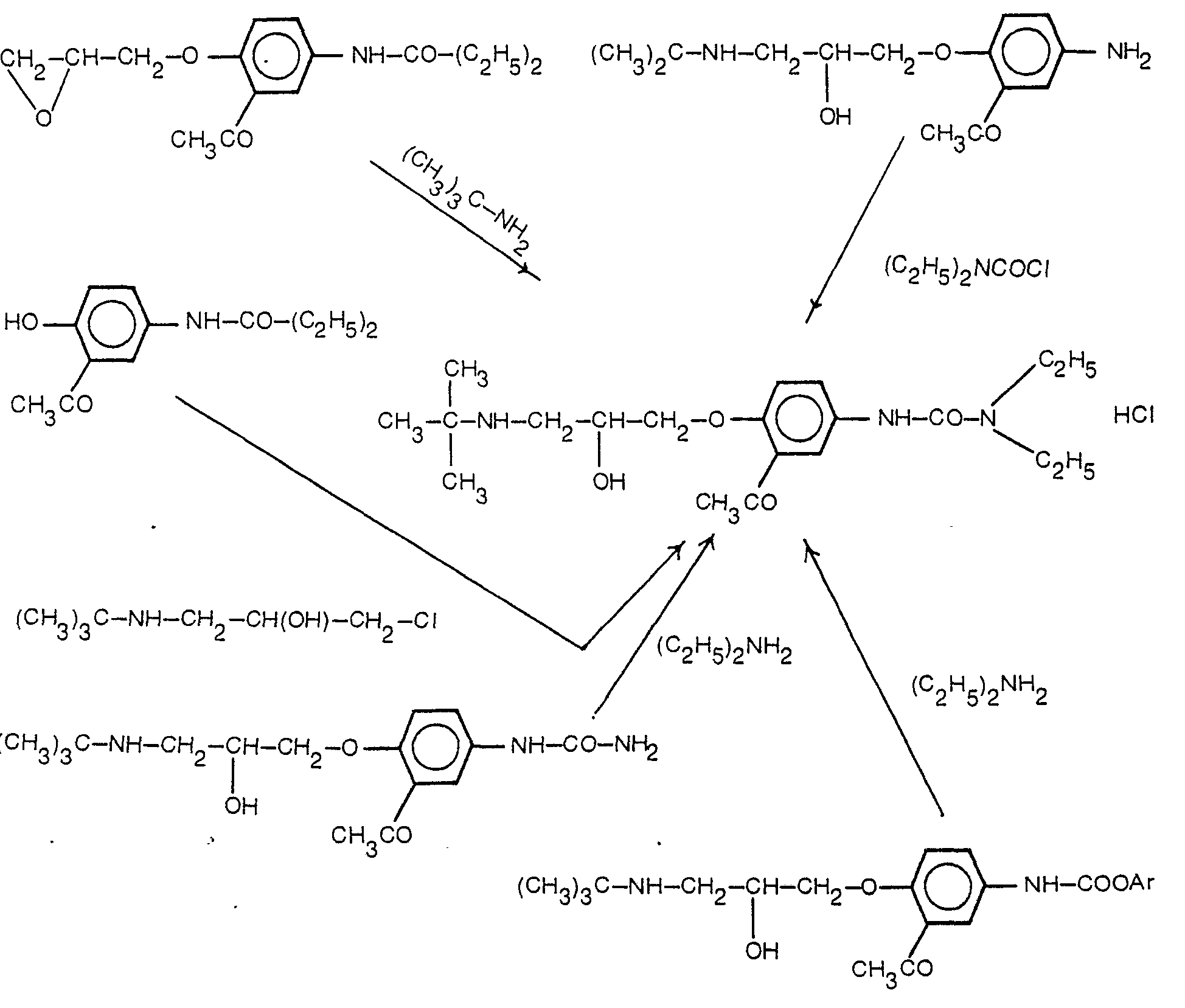
- Celiprolol can be prepared according to several pathways described. in Austrian Patents 334 465, 335 464 and 335 467. The pathways for the preparation of celiprolol according to these patents are as illustrated:
- the inactive carriers for the active compounds used in the formulations of the present invention include water and ointment bases, such as mineral oil in the range of 2 to 10% w/v and white petrolatum in the range of 90 to 98% w/v.
- the active compound is solubilized in the carrier.
- a co-solvent in addition to the carrier, may be used.
- Such co-solvents include glycerin, polyethylene glycol fatty acid esters in the range of 1 to 10% w/v, propylene glycol in the range of 1 to 10% w/v, polyethylene glycol in the range of 1 to 15% w/v, polysorbate 20,60 and 80 in the range of 0.01 to 0.2% w/v and Plur( nic F ⁇ 68® in the range of 0.01 to 2% w/ v and mixtures thereof.
- the isotonicity of the preparation should be in the range of 270 to 330 milliosmoles.
- Sodium chloride in the range of 0.9 ⁇ 0.1 % w/v may be used, if necessary, to adjust the isotonicity.
- the ophthalmic preparations of the present invention will have a pH of about 6 to 9, preferably in the range of 7-8.
- Buffers that may be used to obtain said pH range include alkali metal or alkaline metal earth carbonates, bicarbonates, borates, citrates and tris buffers. More specifically such buffers include 0.01 to 0.2 molar concentrations of boric acid-sodium borate, phosphate buffers, boric acid-sodium bicarbonate, boric acid-sodium citrate, citric acid-sodium phosphate, tris(hydroxymethyl) amino methane-maleic acid and tris(hydroxymethyl) amino methane-HCI.
- viscosity builder agents examples include viscosity builder agents, preservatives and stabilizers. Examples of these, which may be incorporated into the preparations during the process or after the active compound is solubilized, include the following:
- More specific examples include. water QS to 100, and having an isotonicity range of 270 to 330 milliosmoles.
- preparations of the present invention may be made and manufactured as illustrated herein:
- celiprolol decreases intraocular pressure in dogs and that the decrease is dose-dependent.
- Mongrel dogs of either sex weighing between 9 and 16 kg were anesthetized with sodium pentobarbital, 35 mg/kg, i.v. (Ganes Chemical, Pennsville, N.J.). The animals then were intubated with an endotracheal tube (Rusch, size 8-9F, Artistic Surgical, New York, N.Y.) and allowed to breathe spontaneously.
- Pulsatile arterial pressure was monitored using a polyethylene catheter (PE 240, Clay-Adams, Parsippany, N.J.) inserted into the right femoral artery and its tip advanced until a distinct dicrotic notch was observed on the arterial pressure tracing.
- the catheter was connected to a pressure transducer (P23 ID, Statham, Oxnard, CA) and a D.C. driver amplifier (Model 7D; Grass Instruments, Quincy, MA) via a low level D.C. preamplifier (Model 7P1, Grass Instruments).
- Mean arterial pressure was determined electronically by damping the pulsatile arterial pressure signal.
- Heart rate was recorded from the output of a tachometer (Model 7PA, Grass Instruments) triggered by the R wave of a Lead II electrocardiogram (EKG-Tachograph Preamplifier, Model 7P4, Grass Instruments). The outputs of arterial pressure and EKG-Tachometer Preamplifier were recorded continuously on an oscillograph (Model 7D, Grass Instruments). Heart rate was measured manually from the tachometer output or calculated from the EKG preamplifier output. Mean arterial pressure was measured manually from the oscillograph tracings. Intraocular pressure was measured using a pneumatonometer (Model 30R, Digilab, Cambridge, MA).
- Eight mongrel dogs were divided into two groups of four dogs each: the control group and the test group.
- Two pretreatment baseline measurements of intraocular pressure, mean arterial pressure and heart rate were recorded at -15 and 0 minutes. The means values of these two readings were used as the pretreatment (0 times) values.
- the control group was then administered saline topically in a volume of 5pl instilled into the left eye of each dog at hourly intervals.
- the test group was administered celiprolol topically in a volume of 50 ⁇ l instilled into the left eye of each dog, in ascending concentrations (0.03%, 0.06%, 0.125%, 0.5%), at hourly intervals.
- Intraocular pressure, mean arterial pressure and heart rate were recorded at 15 minute intervals for 60 minutes post drug or vehicle (saline) administration for each concentration of celiprolol administered and each administration of saline.
- Celiprolol (RHC 5320-A Lot 2) was dissolved and diluted in normal saline (0.9%, Abbott Laboratories, North Chicago, IL).
- the control group received normal saline.
- the absolute change and the percent change from the pretreatment (0 time) values for intraocular pressure, mean arterial pressure and heart rate were expresed as the mean ⁇ S.D.
- the significance of the difference between the vehicle control group and the celiprolol test group were evaluated using a "t" test for grouped data (as described in SAS T TEST Release 79.5, SAS Institute, Gary, NC 1982). Differences were considered significant if P ⁇ 0.05.
- the maximum percent intraocular pressure change for each concentration of celiprolol administered was expressed as the mean ⁇ 1 S.D.
- Table I shows that celiprolol caused an immediate decrease in intraocular pressure which persisted for the duration of the experiment. The magnitude of the decrease became significantly different (P ⁇ 0.05) from that of the control group at 75 minutes. The data also indicate that celiprolol causes a dose-dependent decrease in intraocular pressure which reaches a maximum at 0.25% concentration.
- Table II shows that the celiprolol group exhibited a small decrease in mean arterial pressure which became significantly different from that of the control at a concentration of 0.06%. Since this decrease in arterial pressure was not dose-dependent, it may be a chance occurrence and not pharmacologically important.
- Table III shows that celiprolol had no effect on heart rate at any of the concentrations tested.
- This example compares the activity of celiprolol and timolol in dogs on intraocular pressure, systemic arterial pressure and heart rate.
- Celiprolol and saline were used as shown in Example I. Timolol (TIMOPTIC ® , 0.5% Merck Sharp and Dohme, West Point, PA) was used.
- Mongrel dogs were screened for intraocular pressure and only dogs that had intraocular pressures between 3066 Pa(23 mm Hg) and 3732 Pa(28 mm Hg) were chosen in this study.
- the control group had a mean intraocular pressure of 3373 ⁇ 80 Pa(25.3 ⁇ 0.6 mm Hg); the celiprolol, or test, group had a mean intraocular pressure of 3412 ⁇ 80 Pa(25.6 ⁇ 0.6 mm Hg); and the timolol group, with which the celiprolol group was compared, had a mean intraocular pressure of 3359 ⁇ 213 Pa(25.2 ⁇ 1.6 mm Hg).
- Table IV shows that at equal doses both celiprolol and timolol were effective in decreasing intraocular pressure in anesthetized dogs.
- Celiprolol caused a significant change from control of the one hour post drug administration which persisted for the duration of the study, while timolol attained a significant difference from the control only after 180 minutes post drug administration, which from thereon also persisted for the duration of the experiment.
- Table V shows that neither celiprolol nor timolol had any significant effect on means arterial pressure.
- Table VI shows that celiprolol seems to have no effect on heart rate whereas timolol at least for the first two hours has a tendency to decrease heart rate.
- celiprolol provides for the treatment of glaucoma without having the deleterious side effects of airway constriction associated with certain ( ⁇ -blockers, such as atenolol, metoprolol, propanolol, and timolol.
- ⁇ -blockers such as atenolol, metoprolol, propanolol, and timolol.
- Example III describes the comparative study conducted on celiprolol with three other beta blocking agents for effects on bronchomotor tone in mechanically ventilated cats infused with serotonin.
- Doses are expressed as the free bases. All drugs were dissolved in 0.9% saline, except timolol, which was used in the form of Timoptic @ ophthalmic solution suitably diluted with saline. In experiments in which celiprolol was given introduodenally, needle-tipped cannulae were surgically inserted into the duodena of cats fasted for 16 hours.
- the duration of the broncodilator effect of celiprolol was about 14 minutes at 1 and 3 mg/kg.
- the effect of 10 mg/kg lasted for more than 40 minutes.
- test compounds of celiprolol and timolol were administered topically as follows. 50 ⁇ l of test solution was instilled into the eyes of anesthetized cats whose airway resistance, RAW, had been increased by infusion of serotonin. Three doses of timolol (5 mg/ml) further increased RAW by 20 to 35%. Similar doses of celiprolol decreased RAW by 21 to 23%.
Landscapes
- Health & Medical Sciences (AREA)
- Veterinary Medicine (AREA)
- Public Health (AREA)
- General Health & Medical Sciences (AREA)
- Pharmacology & Pharmacy (AREA)
- Animal Behavior & Ethology (AREA)
- Chemical & Material Sciences (AREA)
- Medicinal Chemistry (AREA)
- Life Sciences & Earth Sciences (AREA)
- Epidemiology (AREA)
- Engineering & Computer Science (AREA)
- Nuclear Medicine, Radiotherapy & Molecular Imaging (AREA)
- General Chemical & Material Sciences (AREA)
- Chemical Kinetics & Catalysis (AREA)
- Bioinformatics & Cheminformatics (AREA)
- Organic Chemistry (AREA)
- Ophthalmology & Optometry (AREA)
- Acyclic And Carbocyclic Compounds In Medicinal Compositions (AREA)
- Pharmaceuticals Containing Other Organic And Inorganic Compounds (AREA)
- Medicinal Preparation (AREA)
Description
- This invention relates to an ophthalmic preparation for the treatment of glaucoma and a process of preparing said preparation.
- Said preparation has been found useful in lowering intraocular pressure.
- Elevated intraocular pressure is a major risk factor in the onset and development of glaucomatous visual field loss. The higher the level of intraocular pressure, the greater the likelihood of glaucomatous visual field loss and optic nerve damage.
- Attempts have been made to lower intraocular pressure in glaucoma by administering the patients certain beta adrenergic blocking agents, commonly known as beta blockers.
- In the human body, the beta blockers have several effects. For example, they can reduce the heart rate of an angina patient, which in turn reduces the workload of the heart and thus its need for blood and oxygen. They also tend to decrease the heart's force of concentration, which likewise diminishes the heart's workload. In addition, these drugs reduce the systolic blood pressure which is beneficial to patients with hypertension.
- In addition to treating heart ailments, some beta blockers were experimented with for treating other ailments, such as migraine, alcohol and drug withdrawal problems, and glaucoma.
- While the use of beta blockers provides valuable benefits to humankind, it also has some undesirable side effects and reactions. Some beta blockers tend to build up in the central nervous system causing fatigue, lethargy, and confusion. Others may cause bronchial spasm and cannot be used in people with bronchial asthma. Still others, while having minimal side effects, fail to produce acceptable results because of their limited potency.
- Timolol, a non-selective beta-adrenoceptor antagonist, has been shown to lower intraocular pressure in both patients with normal intraocular pressure and in patients with open angle glaucoma. Sold as TIMOPTIC°, it is the only beta blocker sold in the U.S. for this purpose. Among the adverse reactions reported on the use of timolol is the aggravation or precipitation of certain cardiovascular and pulmonary disorders including bronchospastic disease, sinus bradycardia, cardiogenic shock and cardiac failure. Similarly, atenolol, sotalol, pindolol, oxprenolol, practolol, propranolol, butidrine and metoprolol were reported to have activity in the treatment of glaucoma. However, some of these compounds have been reported to cause pronounced side-effects, for example, metoprolol provokes allergic reactions, oxprenolol may cause corneal epitheliopathy and practolol induces oculomucoculaneous syndrome by immunopathological reactions.
- Celiprolol hydrochloride has been shown a selective beta-1-adrenoceptor antagonist having intrisnic sympathomimetic, but no local anesthetic activity. DE-A-24 58 624 discloses 4-ureido-2-acyl phenoxypropylamin derivatives as cardio-selective beta blocking agents. The pharmaceutical composition disclosed having excipients or diluents may be administered orally, rectally or parenterally. The composition may be in the form of tablets, dragees or capsules, or it may be in the form of injectable solutions.
- It is the object of the present invention to provide an improved ophthalmic preparation for the treatment of glaucoma. Said object is achieved by an opthalmic preparation for the treatment of glaucoma comprising an effective amount of celiprolol salt in a pharmaceutically acceptable ophthalmic carrier with the exception of intravenously injectable solutions.
- Celiprolol hydrochloride, as well as selected pharmaceutically acceptable salts thereof such as maleate, and succinate when topically applied to the eyes in a pharmaceutically suitable vehicle, such as an ophthalmic solution, is effective in lowering intraocular pressure. Such ophthalmic preparation contain from 0.01 % w/v to 5.0% w/v, preferably from 0.03% w/v to 2.0% w/v of the active ingredient along with inactive ingredients used in the art, such as sodium borate-boric acid, sodium hydroxide to adjust pH, benzalkonium chloride as preservative and water as the vehicle of preference.
- It has also been surprisingly discovered that celiprolol hydrochloride, when used according to the present invention, produces bronchodilation following each application and as such possesses significant therapeutic advantage to patients suffering from both glaucoma and respiratory disease.
- The preferred celiprolol salt is coliprolol hydrochloride (3-[3-acetyl-4-[3(tertbutylamino)-2-hydroxy- propoxy]-phenyl]-1, 1-diethylurea hydrochloride) which has the following structure as the free base:

- It has a molecular weight of 415.95 having C = 57.75%, H = 8.24%, N = 10.10%, O = 15.39% and CI = 8.52%.
- Celiprolol can be prepared according to several pathways described. in Austrian Patents 334 465, 335 464 and 335 467. The pathways for the preparation of celiprolol according to these patents are as illustrated:
- In accordance with the present invention ophthalmic preparations containing celiprolol hydrochloride incorporated in a suitable carrier is applied to the glaucomatous eyes to relieve intraocular pressure. It is to be understood that both the racemic a levorotatory forms of celiprolol hydrochloride are contemplated for use in the present invention, as well as other pharmaceutically acceptable salts of celiprolol, such as maleate or succinate in the range of 0.01 to 5% w/v.
- The inactive carriers for the active compounds used in the formulations of the present invention include water and ointment bases, such as mineral oil in the range of 2 to 10% w/v and white petrolatum in the range of 90 to 98% w/v. In preparing the formulations of the present invention, the active compound is solubilized in the carrier. For solubilizing the active compound a co-solvent, in addition to the carrier, may be used. Such co-solvents include glycerin, polyethylene glycol fatty acid esters in the range of 1 to 10% w/v, propylene glycol in the range of 1 to 10% w/v, polyethylene glycol in the range of 1 to 15% w/v, polysorbate 20,60 and 80 in the range of 0.01 to 0.2% w/v and Plur( nic F―68® in the range of 0.01 to 2% w/ v and mixtures thereof.
- To prevent irritation to the eye the isotonicity of the preparation should be in the range of 270 to 330 milliosmoles. Sodium chloride in the range of 0.9 ± 0.1 % w/v may be used, if necessary, to adjust the isotonicity.
- The ophthalmic preparations of the present invention will have a pH of about 6 to 9, preferably in the range of 7-8. Buffers that may be used to obtain said pH range include alkali metal or alkaline metal earth carbonates, bicarbonates, borates, citrates and tris buffers. More specifically such buffers include 0.01 to 0.2 molar concentrations of boric acid-sodium borate, phosphate buffers, boric acid-sodium bicarbonate, boric acid-sodium citrate, citric acid-sodium phosphate, tris(hydroxymethyl) amino methane-maleic acid and tris(hydroxymethyl) amino methane-HCI.
- Other ingredients which may be desirable to use in the ophthalmic preparations of the present invention include viscosity builder agents, preservatives and stabilizers. Examples of these, which may be incorporated into the preparations during the process or after the active compound is solubilized, include the following:
- a. preservatives in the range of 0.001 to 1.0% w/v.
- b. stabilizers in the range of 0.01 to 5.0% w/v; and viscosity builders or viscosity agents in the range of 0.01 to 2.0% w/v.
- More specific examples include.


- In general, the preparations of the present invention may be made and manufactured as illustrated herein:
- a., The active drug is dissolved in the aqueous vehicle or thoroughly dispersed in the ointment vehicle by adequate stirring:
- b., After dissolution or dispersion of the active drug additional ingredients, such as preservatives, buffer salts, stabilizers, and/or viscosity agents are added and dissolved by further stirring. Sodium chloride is then added, if required, to adjust isotonicity, and the solution is brought to final volume;
- c., The product is then stereilized by filtration through a 0.22 µm membrane or alternatively autoclaved at 121-123°C, or by a combination of both methods;
- d., The sterile solution is filled into sterile containers and sealed.
- The following examples illustrate the present invention.


- Illustrative of the benefits obtained in accorance with the present invention the studies described in the Examples following, were conducted.
- This example shows that celiprolol decreases intraocular pressure in dogs and that the decrease is dose-dependent.
- Mongrel dogs of either sex weighing between 9 and 16 kg were anesthetized with sodium pentobarbital, 35 mg/kg, i.v. (Ganes Chemical, Pennsville, N.J.). The animals then were intubated with an endotracheal tube (Rusch, size 8-9F, Artistic Surgical, New York, N.Y.) and allowed to breathe spontaneously.
- Pulsatile arterial pressure was monitored using a polyethylene catheter (PE 240, Clay-Adams, Parsippany, N.J.) inserted into the right femoral artery and its tip advanced until a distinct dicrotic notch was observed on the arterial pressure tracing. The catheter was connected to a pressure transducer (P23 ID, Statham, Oxnard, CA) and a D.C. driver amplifier (Model 7D; Grass Instruments, Quincy, MA) via a low level D.C. preamplifier (Model 7P1, Grass Instruments). Mean arterial pressure was determined electronically by damping the pulsatile arterial pressure signal. Heart rate was recorded from the output of a tachometer (Model 7PA, Grass Instruments) triggered by the R wave of a Lead II electrocardiogram (EKG-Tachograph Preamplifier, Model 7P4, Grass Instruments). The outputs of arterial pressure and EKG-Tachometer Preamplifier were recorded continuously on an oscillograph (Model 7D, Grass Instruments). Heart rate was measured manually from the tachometer output or calculated from the EKG preamplifier output. Mean arterial pressure was measured manually from the oscillograph tracings. Intraocular pressure was measured using a pneumatonometer (Model 30R, Digilab, Cambridge, MA).
- Upon completing of all surgical procedure the animals were allowed to stabilize for 15―30 minutes before pretreatment baseline measurements were taken.
- Eight mongrel dogs were divided into two groups of four dogs each: the control group and the test group. Two pretreatment baseline measurements of intraocular pressure, mean arterial pressure and heart rate were recorded at -15 and 0 minutes. The means values of these two readings were used as the pretreatment (0 times) values. The control group was then administered saline topically in a volume of 5pl instilled into the left eye of each dog at hourly intervals. The test group was administered celiprolol topically in a volume of 50µl instilled into the left eye of each dog, in ascending concentrations (0.03%, 0.06%, 0.125%, 0.5%), at hourly intervals. Intraocular pressure, mean arterial pressure and heart rate were recorded at 15 minute intervals for 60 minutes post drug or vehicle (saline) administration for each concentration of celiprolol administered and each administration of saline.
- Celiprolol (RHC 5320-A Lot 2) was dissolved and diluted in normal saline (0.9%, Abbott Laboratories, North Chicago, IL).
- The control group received normal saline.
- The absolute change and the percent change from the pretreatment (0 time) values for intraocular pressure, mean arterial pressure and heart rate were expresed as the mean ± S.D. The significance of the difference between the vehicle control group and the celiprolol test group were evaluated using a "t" test for grouped data (as described in SAS T TEST Release 79.5, SAS Institute, Gary, NC 1982). Differences were considered significant if P < 0.05. In addition, the maximum percent intraocular pressure change for each concentration of celiprolol administered was expressed as the mean ± 1 S.D.
- Test results were shown in Tables I; II & III.


- Table I shows that celiprolol caused an immediate decrease in intraocular pressure which persisted for the duration of the experiment. The magnitude of the decrease became significantly different (P < 0.05) from that of the control group at 75 minutes. The data also indicate that celiprolol causes a dose-dependent decrease in intraocular pressure which reaches a maximum at 0.25% concentration.
- Table II shows that the celiprolol group exhibited a small decrease in mean arterial pressure which became significantly different from that of the control at a concentration of 0.06%. Since this decrease in arterial pressure was not dose-dependent, it may be a chance occurrence and not pharmacologically important.
- Table III shows that celiprolol had no effect on heart rate at any of the concentrations tested.
- This example compares the activity of celiprolol and timolol in dogs on intraocular pressure, systemic arterial pressure and heart rate.
- Celiprolol and saline were used as shown in Example I. Timolol (TIMOPTIC®, 0.5% Merck Sharp and Dohme, West Point, PA) was used.
- Mongrel dogs were screened for intraocular pressure and only dogs that had intraocular pressures between 3066 Pa(23 mm Hg) and 3732 Pa(28 mm Hg) were chosen in this study.
- Twelve mongrel dogs which met the above-described criterion were subdivided into three groups of four dogs each. The control group had a mean intraocular pressure of 3373 ± 80 Pa(25.3 ± 0.6 mm Hg); the celiprolol, or test, group had a mean intraocular pressure of 3412 ± 80 Pa(25.6 ± 0.6 mm Hg); and the timolol group, with which the celiprolol group was compared, had a mean intraocular pressure of 3359 ± 213 Pa(25.2 ± 1.6 mm Hg).
- Two pretreatment baseline measurements of intraocular pressure, mean arterial pressure and heart rate were recorded at -15 and 0 minutes for each groups. The mean values of these two readings were used as pretreatment (0 time) values 0.5% celiprolol in a volume of 50µl was then administered into the left of each dog in the test or celiprolol group; 0.5% timolol in a volume of 50ui was administered into the left eye of each dog in the timolol group; and 50µl of saline was administered into the left eye of each dog in the control group. Intraocular pressure, mean arterial pressure and heart rate measurements were made at various intervals for five hours respectively for post drug or saline administration.
- Test results are shown in Tables IV, V and VI Table IV shows that at equal doses both celiprolol and timolol were effective in decreasing intraocular pressure in anesthetized dogs. Celiprolol, however, caused a significant change from control of the one hour post drug administration which persisted for the duration of the study, while timolol attained a significant difference from the control only after 180 minutes post drug administration, which from thereon also persisted for the duration of the experiment.
- Table V shows that neither celiprolol nor timolol had any significant effect on means arterial pressure.
- Table VI shows that celiprolol seems to have no effect on heart rate whereas timolol at least for the first two hours has a tendency to decrease heart rate.


- In asthmatic patients airway constriction has been reported as the result of the use of certain β-blockers. The present invention, utilizing celiprolol, provides for the treatment of glaucoma without having the deleterious side effects of airway constriction associated with certain (β-blockers, such as atenolol, metoprolol, propanolol, and timolol. Example III describes the comparative study conducted on celiprolol with three other beta blocking agents for effects on bronchomotor tone in mechanically ventilated cats infused with serotonin.
- Male cats (3-5 kg) were anesthetized with pentobarbital sodium, 35 mg/kg i.p. Maintenance anesthetic was administered intravenously as needed. The trachea of each cat was cannulated and a pneumotacho- graph placed on-line for monitoring airflow. A differential pressure transducer placed between the tracheal cannula and a cannula in the pleural cavity was used to monitor transpulmonary pressure. Electronic signals proportional to air flow and transpulmonary pressure were converted by an on-line analog computer to values of pulmonary (airway) resistance, RAW, for each breath. Cannulae were inserted into the right femoral artery and both femoral veins. The arterial cannula was used for monitoring blood pressure and heart rate. In addition, it allowed for withdrawal of arterial blood samples for assessment of P02, PC02 and pH, as a means of confirming the adequacy of ventilation. The animal was paralyzed with gallamine triethiodide (Flaxedil, 20 mg i.v.) and mechanically ventilated.
- In order to test for bronchodilator activity, it was necessary to increase the normally low bronchomotor tone of the cat. This increase was induced by a constant i.v. infusion of serotonin (5-HT), approximately 20 µg/kg/min. During this steady state bronchoconstriction, each animal received three or four increasing bolus doses of a single beta blocker, either atenolol (1-10 mg/kg/i.v.), celiprolol hydrochloride (1-10 mg/ kg i.v. or 1-100 mg/kg i.d.), metoprolol tartrate (1-10 mg/kg i.v.) or timolol maleate (0.03-3 mg/kg i.v.). Doses are expressed as the free bases. All drugs were dissolved in 0.9% saline, except timolol, which was used in the form of Timoptic@ ophthalmic solution suitably diluted with saline. In experiments in which celiprolol was given introduodenally, needle-tipped cannulae were surgically inserted into the duodena of cats fasted for 16 hours.
- Drug-induced changes in bronchomotor tone, averaged over 6-second intervals, were calculated as percent changes in RAW from the steady state values established by serotonin infusion. Mean ± standard deviation were calculated for experiments in which n = 3. Data for one celiprolol dose, 10 mg/kg i.d., were calculated using n = 2. Statistical analysis was carried out with the t-test for paired data.
- The results are shown in Table VII wherein RAW = % change in airway resistance; HR = heart rate - breaths/minute; i.v. = intravenous; i.d. = intraduodenal.

- As shown in the table, intravenous administration of atenolol, metoprolol and timolol caused dose-dependent bronchoconstriction, i.e., increased RAw. Bronchoconstriction has increased to 48% with atenolol, to 105% with metoprolol and to 49% with timolol. In contrast, celiprolol produced bronchodilation, i.e., RAW decreased to -70%.
- The duration of the broncodilator effect of celiprolol was about 14 minutes at 1 and 3 mg/kg. The effect of 10 mg/kg lasted for more than 40 minutes.
- The procedure in this example generally follows the procedure used in Example III, except that the test compounds of celiprolol and timolol were administered topically as follows. 50 µl of test solution was instilled into the eyes of anesthetized cats whose airway resistance, RAW, had been increased by infusion of serotonin. Three doses of timolol (5 mg/ml) further increased RAW by 20 to 35%. Similar doses of celiprolol decreased RAW by 21 to 23%.
- This procedure in this sample generally follows the procedure used in Example III, except that celiprolol was administered to cats intraduodenally. Tested in the range of 10-100 mg/kg, celiprolol reduced RAW by 29 to 41 %.
Claims (13)

Priority Applications (1)
| Application Number | Priority Date | Filing Date | Title |
|---|---|---|---|
| AT83110477T ATE33098T1 (en) | 1982-10-27 | 1983-10-20 | CELIPROLOL FOR THE TREATMENT OF GLAUCOMA. |
Applications Claiming Priority (2)
| Application Number | Priority Date | Filing Date | Title |
|---|---|---|---|
| US06/437,072 US4470965A (en) | 1982-10-27 | 1982-10-27 | Celiprolol for the treatment of glaucoma |
| US437072 | 1995-05-05 |
Publications (2)
| Publication Number | Publication Date |
|---|---|
| EP0109561A1 EP0109561A1 (en) | 1984-05-30 |
| EP0109561B1 true EP0109561B1 (en) | 1988-03-23 |
Family
ID=23734943
Family Applications (1)
| Application Number | Title | Priority Date | Filing Date |
|---|---|---|---|
| EP83110477A Expired EP0109561B1 (en) | 1982-10-27 | 1983-10-20 | Celiprolol for the treatment of glaucoma |
Country Status (16)
| Country | Link |
|---|---|
| US (1) | US4470965A (en) |
| EP (1) | EP0109561B1 (en) |
| JP (1) | JPS5998016A (en) |
| AR (1) | AR230952A1 (en) |
| AT (1) | ATE33098T1 (en) |
| AU (1) | AU562110B2 (en) |
| CA (1) | CA1220719A (en) |
| DE (1) | DE3376051D1 (en) |
| DK (1) | DK491483A (en) |
| FI (1) | FI833928A7 (en) |
| IE (1) | IE56177B1 (en) |
| IL (1) | IL70050A (en) |
| MX (1) | MX7289E (en) |
| NZ (1) | NZ206069A (en) |
| PH (1) | PH19559A (en) |
| ZA (1) | ZA837748B (en) |
Families Citing this family (27)
| Publication number | Priority date | Publication date | Assignee | Title |
|---|---|---|---|---|
| DE3410380A1 (en) * | 1984-03-21 | 1985-10-10 | Lentia GmbH Chem. u. pharm. Erzeugnisse - Industriebedarf, 8000 München | S (-) - CELIPROLOL, THEIR PHARMACEUTICALLY COMPATIBLE SALT, METHOD FOR THE PRODUCTION THEREOF, USE IN THERAPY AND PHARMACEUTICAL PREPARATIONS |
| IL80298A (en) * | 1986-10-14 | 1993-01-31 | Res & Dev Co Ltd | Eye drops |
| DE3636209A1 (en) * | 1986-10-24 | 1988-04-28 | Lentia Gmbh | METHOD FOR PRODUCING A BINDER-FREE TABLET-TABLE CELIPROLOL HYDROCHLORIDE GRANULATE |
| US5055456A (en) * | 1989-01-27 | 1991-10-08 | American Cyanamid Co. | Anti-alopecia composition |
| US5075105A (en) * | 1989-09-27 | 1991-12-24 | Avetisov Eduard S | Composition for treatment of progressive myopia |
| CZ260093A3 (en) * | 1992-03-18 | 1994-07-13 | Coopervision Pharma | VERAPAMIL HCl PREPARATION AND OTHER OPHTHALMIC SOLUTIONS WITH A BUFFER SYSTEM FOR EYE ADMINISTRATION |
| DK0639070T4 (en) * | 1992-05-06 | 2010-12-13 | Alcon Lab Inc | Use of borate-polyol complexes for ophthalmic preparations |
| US5505953A (en) | 1992-05-06 | 1996-04-09 | Alcon Laboratories, Inc. | Use of borate-polyol complexes in ophthalmic compositions |
| US5362758A (en) * | 1992-09-18 | 1994-11-08 | Pfizer Inc. | Ophthalmic piroxicam solution |
| CA2125060C (en) * | 1993-07-02 | 1999-03-30 | Henry P. Dabrowski | Ophthalmic solution for artificial tears |
| US5897858A (en) * | 1994-02-03 | 1999-04-27 | Schering-Plough Healthcare Products, Inc. | Nasal spray compositions exhibiting increased retention in the nasal cavity |
| TW431888B (en) * | 1994-02-03 | 2001-05-01 | Schering Plough Healthcare | Nasal spray compositions |
| JP3297969B2 (en) * | 1994-12-26 | 2002-07-02 | ライオン株式会社 | Eye drops |
| US5895645A (en) * | 1995-01-31 | 1999-04-20 | Bausch & Lomb Incorporated | Opthalmic solution for artificial tears |
| US5800807A (en) * | 1997-01-29 | 1998-09-01 | Bausch & Lomb Incorporated | Ophthalmic compositions including glycerin and propylene glycol |
| US5916179A (en) * | 1997-04-18 | 1999-06-29 | Sharrock; Nigel | System and method for reducing iatrogenic damage to nerves |
| JP2002523475A (en) | 1998-09-02 | 2002-07-30 | アラーガン・セイルズ・インコーポレイテッド | Preserved cyclodextrin-containing composition |
| US20040152664A1 (en) * | 1998-09-02 | 2004-08-05 | Allergan, Inc. | Prednisolone compositions |
| JP4255656B2 (en) * | 2001-09-17 | 2009-04-15 | 株式会社メニコン | Ophthalmic solution and contact lens solution |
| JPWO2003029199A1 (en) * | 2001-09-28 | 2005-01-13 | 武田薬品工業株式会社 | Benzene derivatives, their production and use |
| WO2004062576A2 (en) * | 2003-01-03 | 2004-07-29 | Bernstein Eric F | Methods for treating ocular diseases |
| US6933289B2 (en) | 2003-07-01 | 2005-08-23 | Allergan, Inc. | Inhibition of irritating side effects associated with use of a topical ophthalmic medication |
| US20060073172A1 (en) * | 2004-10-01 | 2006-04-06 | Schneider L W | Stabilized ophthalmic solution for the treatment of glaucoma and lowering intraocular pressure |
| US20060229219A1 (en) * | 2005-04-11 | 2006-10-12 | Advanced Medical Optics, Inc. | Borate-polyol mixtures as a buffering system |
| US20080021068A1 (en) * | 2006-07-24 | 2008-01-24 | Akorn, Inc. | Aqueous gel formulation and method for inducing topical anesthesia |
| BRPI0909797A2 (en) * | 2008-03-07 | 2017-08-22 | Sun Pharma Advanced Res Co Ltd | OPHTHALMIC COMPOSITION |
| TWI544922B (en) | 2011-05-19 | 2016-08-11 | 愛爾康研究有限公司 | High concentration europart ingot ophthalmic composition |
Citations (5)
| Publication number | Priority date | Publication date | Assignee | Title |
|---|---|---|---|---|
| US3930016A (en) * | 1972-07-06 | 1975-12-30 | Haessle Ab | Pharmaceutical preparations containing amines useful for treatment of cardiovascular diseases |
| US4034009A (en) * | 1973-12-20 | 1977-07-05 | Chemie Linz Aktiengesellschaft | 4-Ureido-2-acyl phenoxypropanolamine |
| US4038313A (en) * | 1970-01-08 | 1977-07-26 | Ciba-Geigy Corporation | Cycloalkylureido phenoxy propanolamines |
| US4120978A (en) * | 1970-01-08 | 1978-10-17 | Ciba-Geigy Corporation | Pharmaceutical composition for inhibiting and blocking cardioselective beta-receptors |
| US4178374A (en) * | 1974-08-16 | 1979-12-11 | Merck & Co., Inc. | Novel pharmaceutical compositions of β-blockers with diuretics |
Family Cites Families (1)
| Publication number | Priority date | Publication date | Assignee | Title |
|---|---|---|---|---|
| HU170678B (en) * | 1973-12-20 | 1977-08-28 |
-
1982
- 1982-10-27 US US06/437,072 patent/US4470965A/en not_active Expired - Fee Related
-
1983
- 1983-10-18 ZA ZA837748A patent/ZA837748B/en unknown
- 1983-10-20 AU AU20439/83A patent/AU562110B2/en not_active Ceased
- 1983-10-20 AT AT83110477T patent/ATE33098T1/en active
- 1983-10-20 DE DE8383110477T patent/DE3376051D1/en not_active Expired
- 1983-10-20 EP EP83110477A patent/EP0109561B1/en not_active Expired
- 1983-10-24 CA CA000439538A patent/CA1220719A/en not_active Expired
- 1983-10-25 AR AR294633A patent/AR230952A1/en active
- 1983-10-26 PH PH29761A patent/PH19559A/en unknown
- 1983-10-26 DK DK491483A patent/DK491483A/en not_active Application Discontinuation
- 1983-10-26 JP JP58199339A patent/JPS5998016A/en active Pending
- 1983-10-26 IL IL70050A patent/IL70050A/en unknown
- 1983-10-26 NZ NZ206069A patent/NZ206069A/en unknown
- 1983-10-26 MX MX8310859U patent/MX7289E/en unknown
- 1983-10-27 FI FI833928A patent/FI833928A7/en not_active Application Discontinuation
- 1983-10-27 IE IE2513/83A patent/IE56177B1/en unknown
Patent Citations (5)
| Publication number | Priority date | Publication date | Assignee | Title |
|---|---|---|---|---|
| US4038313A (en) * | 1970-01-08 | 1977-07-26 | Ciba-Geigy Corporation | Cycloalkylureido phenoxy propanolamines |
| US4120978A (en) * | 1970-01-08 | 1978-10-17 | Ciba-Geigy Corporation | Pharmaceutical composition for inhibiting and blocking cardioselective beta-receptors |
| US3930016A (en) * | 1972-07-06 | 1975-12-30 | Haessle Ab | Pharmaceutical preparations containing amines useful for treatment of cardiovascular diseases |
| US4034009A (en) * | 1973-12-20 | 1977-07-05 | Chemie Linz Aktiengesellschaft | 4-Ureido-2-acyl phenoxypropanolamine |
| US4178374A (en) * | 1974-08-16 | 1979-12-11 | Merck & Co., Inc. | Novel pharmaceutical compositions of β-blockers with diuretics |
Non-Patent Citations (6)
| Title |
|---|
| "Glaucoma Update" Krieglstein et al., Springer Verlag, N.Y. USA, 1979, pp. 19-23 * |
| Arch. Ophthalmol. 95: 601-604, (1977), Zimmermann et al * |
| Chem. Abstr. 77: 775w (1972), Pecori-Giraldi et al. * |
| Ophthalmologica, Babel, 184: 198-203 (1982), Stempel * |
| Pettner et al.: "Celiprocol A Cardioselective Beta-Receptor Blocking Agent, (UL/2006/111, Chemie Linz AG Drug Division, 1982) * |
| Werner Blinisch Wochenschrift, 90: 350-354 (1978), Borrelli et al. * |
Also Published As
| Publication number | Publication date |
|---|---|
| DE3376051D1 (en) | 1988-04-28 |
| MX7289E (en) | 1988-04-15 |
| PH19559A (en) | 1986-05-21 |
| IL70050A (en) | 1986-11-30 |
| DK491483A (en) | 1984-04-28 |
| ATE33098T1 (en) | 1988-04-15 |
| DK491483D0 (en) | 1983-10-26 |
| CA1220719A (en) | 1987-04-21 |
| AU562110B2 (en) | 1987-05-28 |
| IE56177B1 (en) | 1991-05-08 |
| US4470965A (en) | 1984-09-11 |
| FI833928A0 (en) | 1983-10-27 |
| AR230952A1 (en) | 1984-08-31 |
| JPS5998016A (en) | 1984-06-06 |
| AU2043983A (en) | 1984-05-03 |
| ZA837748B (en) | 1984-06-27 |
| EP0109561A1 (en) | 1984-05-30 |
| IL70050A0 (en) | 1984-01-31 |
| FI833928L (en) | 1984-04-28 |
| NZ206069A (en) | 1987-07-31 |
| FI833928A7 (en) | 1984-04-28 |
Similar Documents
| Publication | Publication Date | Title |
|---|---|---|
| US4470965A (en) | Celiprolol for the treatment of glaucoma | |
| JP3701870B2 (en) | 9-Deoxy-2 ', 9-α-methano-3-oxa-4,5,6-trinol-3,7- (1', 3'-interpheny for the treatment of peripheral vascular disease | |
| Burns et al. | Zoxazolamine: physiological disposition, uricosuric properties | |
| CA2029657C (en) | Compositions and their use in lowering intraocular pressure | |
| JPS62178514A (en) | Agent for lowering intraocular pressure | |
| PT735877E (en) | COMPOUNDS OF 6- (2-IMIDAZOLINYLAMINO) UQUINAL QUINOXALINS AS AGONISTS OF ADRENERGIC ALPHA-2 RECEPTOR | |
| Fleischer et al. | Failure of deferoxamine, an iron chelator, to improve neurologic outcome following complete cerebral ischemia in dogs. | |
| JPH0228112A (en) | Intraocular pressure regulator for eye drops | |
| EP0166183B1 (en) | Use of hydroxyindole derivatives for the manufacture of a medicament for lowering the blood pressure | |
| US20040192699A1 (en) | Optic nerve protecting agents containing alpha1 receptor blocker as active ingredient | |
| Pascoe et al. | Arterial hypertension associated with topical ocular use of phenylephrine in dogs | |
| US5789439A (en) | Pharmaceutical use of forskolin derivatives | |
| US3959485A (en) | Method of reducing intraocular pressure in warm-blooded animals | |
| EP0337697B1 (en) | Use of a thromboxane a2 receptor antagonist for the manufacture of a medicament for treating pulmonary hypertension caused by protamine induced neutralization of hepamin | |
| EP0163683A1 (en) | Chromone-2-carboxilic acid derivatives as cardiovascular agents | |
| US3983249A (en) | Method for treating angina pectoris with certain N-arylsulfonyl-N'(aza-3-bicycloalkyl) ureas | |
| EP0075029B1 (en) | Agent for treating chronic obliterative lung disease | |
| DE3887426T2 (en) | Eperisone as a hypotonic. | |
| EP0759756A1 (en) | Pharmaceutical composition for treating glaucoma containing terazosin | |
| SE451070B (en) | APPLICATION OF A CARBOSTYRIC DERIVATIVE FOR THE PREPARATION OF A MEDICINE FOR THE TREATMENT OF GLAUCOM | |
| THOMPSON et al. | Quantitative assessment of anesthetic-induced cardiac sensitization to epinephrine | |
| JP3064089B2 (en) | New bronchodilator | |
| US6884819B1 (en) | Neuropathy remedies | |
| JPH0129168B2 (en) | ||
| AU617024B2 (en) | Antiarrhythmic method |
Legal Events
| Date | Code | Title | Description |
|---|---|---|---|
| PUAI | Public reference made under article 153(3) epc to a published international application that has entered the european phase |
Free format text: ORIGINAL CODE: 0009012 |
|
| AK | Designated contracting states |
Designated state(s): AT BE CH DE FR GB IT LI LU NL SE |
|
| 17P | Request for examination filed |
Effective date: 19841129 |
|
| RAP1 | Party data changed (applicant data changed or rights of an application transferred) |
Owner name: RORER PHARMACEUTICAL CORPORATION |
|
| RAP1 | Party data changed (applicant data changed or rights of an application transferred) |
Owner name: RORER INTERNATIONAL (OVERSEAS) INC. |
|
| GRAA | (expected) grant |
Free format text: ORIGINAL CODE: 0009210 |
|
| AK | Designated contracting states |
Kind code of ref document: B1 Designated state(s): AT BE CH DE FR GB IT LI LU NL SE |
|
| REF | Corresponds to: |
Ref document number: 33098 Country of ref document: AT Date of ref document: 19880415 Kind code of ref document: T |
|
| REF | Corresponds to: |
Ref document number: 3376051 Country of ref document: DE Date of ref document: 19880428 |
|
| ET | Fr: translation filed | ||
| ITF | It: translation for a ep patent filed | ||
| R20 | Corrections of a patent specification |
Effective date: 19880502 |
|
| PGFP | Annual fee paid to national office [announced via postgrant information from national office to epo] |
Ref country code: DE Payment date: 19881008 Year of fee payment: 6 |
|
| PG25 | Lapsed in a contracting state [announced via postgrant information from national office to epo] |
Ref country code: LU Free format text: LAPSE BECAUSE OF NON-PAYMENT OF DUE FEES Effective date: 19881031 |
|
| PLBE | No opposition filed within time limit |
Free format text: ORIGINAL CODE: 0009261 |
|
| STAA | Information on the status of an ep patent application or granted ep patent |
Free format text: STATUS: NO OPPOSITION FILED WITHIN TIME LIMIT |
|
| 26N | No opposition filed | ||
| PGFP | Annual fee paid to national office [announced via postgrant information from national office to epo] |
Ref country code: FR Payment date: 19890924 Year of fee payment: 7 |
|
| PG25 | Lapsed in a contracting state [announced via postgrant information from national office to epo] |
Ref country code: GB Effective date: 19891020 Ref country code: AT Effective date: 19891020 |
|
| PG25 | Lapsed in a contracting state [announced via postgrant information from national office to epo] |
Ref country code: SE Effective date: 19891021 |
|
| PG25 | Lapsed in a contracting state [announced via postgrant information from national office to epo] |
Ref country code: LI Effective date: 19891031 Ref country code: CH Effective date: 19891031 Ref country code: BE Effective date: 19891031 |
|
| BERE | Be: lapsed |
Owner name: RORER INTERNATIONAL (OVERSEAS) INC. Effective date: 19891031 |
|
| PG25 | Lapsed in a contracting state [announced via postgrant information from national office to epo] |
Ref country code: NL Effective date: 19900501 |
|
| NLV4 | Nl: lapsed or anulled due to non-payment of the annual fee | ||
| GBPC | Gb: european patent ceased through non-payment of renewal fee | ||
| REG | Reference to a national code |
Ref country code: CH Ref legal event code: PL |
|
| PG25 | Lapsed in a contracting state [announced via postgrant information from national office to epo] |
Ref country code: DE Effective date: 19900703 |
|
| PG25 | Lapsed in a contracting state [announced via postgrant information from national office to epo] |
Ref country code: FR Effective date: 19910628 |
|
| REG | Reference to a national code |
Ref country code: FR Ref legal event code: ST |
|
| EUG | Se: european patent has lapsed |
Ref document number: 83110477.3 Effective date: 19900706 |