EP0108954B1 - Sheet-shaped polymer secondary battery of layer built type - Google Patents
Sheet-shaped polymer secondary battery of layer built type Download PDFInfo
- Publication number
- EP0108954B1 EP0108954B1 EP83110425A EP83110425A EP0108954B1 EP 0108954 B1 EP0108954 B1 EP 0108954B1 EP 83110425 A EP83110425 A EP 83110425A EP 83110425 A EP83110425 A EP 83110425A EP 0108954 B1 EP0108954 B1 EP 0108954B1
- Authority
- EP
- European Patent Office
- Prior art keywords
- sheet
- shaped polymer
- secondary battery
- film
- polymer secondary
- Prior art date
- Legal status (The legal status is an assumption and is not a legal conclusion. Google has not performed a legal analysis and makes no representation as to the accuracy of the status listed.)
- Expired
Links
Images
Classifications
-
- H—ELECTRICITY
- H01—ELECTRIC ELEMENTS
- H01M—PROCESSES OR MEANS, e.g. BATTERIES, FOR THE DIRECT CONVERSION OF CHEMICAL ENERGY INTO ELECTRICAL ENERGY
- H01M10/00—Secondary cells; Manufacture thereof
- H01M10/05—Accumulators with non-aqueous electrolyte
-
- H—ELECTRICITY
- H01—ELECTRIC ELEMENTS
- H01M—PROCESSES OR MEANS, e.g. BATTERIES, FOR THE DIRECT CONVERSION OF CHEMICAL ENERGY INTO ELECTRICAL ENERGY
- H01M10/00—Secondary cells; Manufacture thereof
- H01M10/36—Accumulators not provided for in groups H01M10/05-H01M10/34
-
- H—ELECTRICITY
- H01—ELECTRIC ELEMENTS
- H01M—PROCESSES OR MEANS, e.g. BATTERIES, FOR THE DIRECT CONVERSION OF CHEMICAL ENERGY INTO ELECTRICAL ENERGY
- H01M4/00—Electrodes
- H01M4/02—Electrodes composed of, or comprising, active material
- H01M4/36—Selection of substances as active materials, active masses, active liquids
- H01M4/60—Selection of substances as active materials, active masses, active liquids of organic compounds
-
- H—ELECTRICITY
- H01—ELECTRIC ELEMENTS
- H01M—PROCESSES OR MEANS, e.g. BATTERIES, FOR THE DIRECT CONVERSION OF CHEMICAL ENERGY INTO ELECTRICAL ENERGY
- H01M50/00—Constructional details or processes of manufacture of the non-active parts of electrochemical cells other than fuel cells, e.g. hybrid cells
- H01M50/40—Separators; Membranes; Diaphragms; Spacing elements inside cells
- H01M50/409—Separators, membranes or diaphragms characterised by the material
- H01M50/411—Organic material
- H01M50/414—Synthetic resins, e.g. thermoplastics or thermosetting resins
-
- H—ELECTRICITY
- H01—ELECTRIC ELEMENTS
- H01M—PROCESSES OR MEANS, e.g. BATTERIES, FOR THE DIRECT CONVERSION OF CHEMICAL ENERGY INTO ELECTRICAL ENERGY
- H01M50/00—Constructional details or processes of manufacture of the non-active parts of electrochemical cells other than fuel cells, e.g. hybrid cells
- H01M50/40—Separators; Membranes; Diaphragms; Spacing elements inside cells
- H01M50/409—Separators, membranes or diaphragms characterised by the material
- H01M50/411—Organic material
- H01M50/414—Synthetic resins, e.g. thermoplastics or thermosetting resins
- H01M50/417—Polyolefins
-
- H—ELECTRICITY
- H01—ELECTRIC ELEMENTS
- H01M—PROCESSES OR MEANS, e.g. BATTERIES, FOR THE DIRECT CONVERSION OF CHEMICAL ENERGY INTO ELECTRICAL ENERGY
- H01M50/00—Constructional details or processes of manufacture of the non-active parts of electrochemical cells other than fuel cells, e.g. hybrid cells
- H01M50/40—Separators; Membranes; Diaphragms; Spacing elements inside cells
- H01M50/409—Separators, membranes or diaphragms characterised by the material
- H01M50/431—Inorganic material
- H01M50/434—Ceramics
-
- H—ELECTRICITY
- H01—ELECTRIC ELEMENTS
- H01M—PROCESSES OR MEANS, e.g. BATTERIES, FOR THE DIRECT CONVERSION OF CHEMICAL ENERGY INTO ELECTRICAL ENERGY
- H01M50/00—Constructional details or processes of manufacture of the non-active parts of electrochemical cells other than fuel cells, e.g. hybrid cells
- H01M50/40—Separators; Membranes; Diaphragms; Spacing elements inside cells
- H01M50/409—Separators, membranes or diaphragms characterised by the material
- H01M50/44—Fibrous material
-
- H—ELECTRICITY
- H01—ELECTRIC ELEMENTS
- H01M—PROCESSES OR MEANS, e.g. BATTERIES, FOR THE DIRECT CONVERSION OF CHEMICAL ENERGY INTO ELECTRICAL ENERGY
- H01M50/00—Constructional details or processes of manufacture of the non-active parts of electrochemical cells other than fuel cells, e.g. hybrid cells
- H01M50/40—Separators; Membranes; Diaphragms; Spacing elements inside cells
- H01M50/409—Separators, membranes or diaphragms characterised by the material
- H01M50/443—Particulate material
-
- H—ELECTRICITY
- H01—ELECTRIC ELEMENTS
- H01M—PROCESSES OR MEANS, e.g. BATTERIES, FOR THE DIRECT CONVERSION OF CHEMICAL ENERGY INTO ELECTRICAL ENERGY
- H01M50/00—Constructional details or processes of manufacture of the non-active parts of electrochemical cells other than fuel cells, e.g. hybrid cells
- H01M50/40—Separators; Membranes; Diaphragms; Spacing elements inside cells
- H01M50/409—Separators, membranes or diaphragms characterised by the material
- H01M50/449—Separators, membranes or diaphragms characterised by the material having a layered structure
- H01M50/451—Separators, membranes or diaphragms characterised by the material having a layered structure comprising layers of only organic material and layers containing inorganic material
-
- H—ELECTRICITY
- H01—ELECTRIC ELEMENTS
- H01M—PROCESSES OR MEANS, e.g. BATTERIES, FOR THE DIRECT CONVERSION OF CHEMICAL ENERGY INTO ELECTRICAL ENERGY
- H01M50/00—Constructional details or processes of manufacture of the non-active parts of electrochemical cells other than fuel cells, e.g. hybrid cells
- H01M50/40—Separators; Membranes; Diaphragms; Spacing elements inside cells
- H01M50/409—Separators, membranes or diaphragms characterised by the material
- H01M50/449—Separators, membranes or diaphragms characterised by the material having a layered structure
- H01M50/454—Separators, membranes or diaphragms characterised by the material having a layered structure comprising a non-fibrous layer and a fibrous layer superimposed on one another
-
- H—ELECTRICITY
- H01—ELECTRIC ELEMENTS
- H01M—PROCESSES OR MEANS, e.g. BATTERIES, FOR THE DIRECT CONVERSION OF CHEMICAL ENERGY INTO ELECTRICAL ENERGY
- H01M50/00—Constructional details or processes of manufacture of the non-active parts of electrochemical cells other than fuel cells, e.g. hybrid cells
- H01M50/40—Separators; Membranes; Diaphragms; Spacing elements inside cells
- H01M50/489—Separators, membranes, diaphragms or spacing elements inside the cells, characterised by their physical properties, e.g. swelling degree, hydrophilicity or shut down properties
-
- H—ELECTRICITY
- H01—ELECTRIC ELEMENTS
- H01M—PROCESSES OR MEANS, e.g. BATTERIES, FOR THE DIRECT CONVERSION OF CHEMICAL ENERGY INTO ELECTRICAL ENERGY
- H01M2300/00—Electrolytes
- H01M2300/0017—Non-aqueous electrolytes
-
- Y—GENERAL TAGGING OF NEW TECHNOLOGICAL DEVELOPMENTS; GENERAL TAGGING OF CROSS-SECTIONAL TECHNOLOGIES SPANNING OVER SEVERAL SECTIONS OF THE IPC; TECHNICAL SUBJECTS COVERED BY FORMER USPC CROSS-REFERENCE ART COLLECTIONS [XRACs] AND DIGESTS
- Y02—TECHNOLOGIES OR APPLICATIONS FOR MITIGATION OR ADAPTATION AGAINST CLIMATE CHANGE
- Y02E—REDUCTION OF GREENHOUSE GAS [GHG] EMISSIONS, RELATED TO ENERGY GENERATION, TRANSMISSION OR DISTRIBUTION
- Y02E60/00—Enabling technologies; Technologies with a potential or indirect contribution to GHG emissions mitigation
- Y02E60/10—Energy storage using batteries
-
- Y—GENERAL TAGGING OF NEW TECHNOLOGICAL DEVELOPMENTS; GENERAL TAGGING OF CROSS-SECTIONAL TECHNOLOGIES SPANNING OVER SEVERAL SECTIONS OF THE IPC; TECHNICAL SUBJECTS COVERED BY FORMER USPC CROSS-REFERENCE ART COLLECTIONS [XRACs] AND DIGESTS
- Y02—TECHNOLOGIES OR APPLICATIONS FOR MITIGATION OR ADAPTATION AGAINST CLIMATE CHANGE
- Y02P—CLIMATE CHANGE MITIGATION TECHNOLOGIES IN THE PRODUCTION OR PROCESSING OF GOODS
- Y02P70/00—Climate change mitigation technologies in the production process for final industrial or consumer products
- Y02P70/50—Manufacturing or production processes characterised by the final manufactured product
Definitions
- the present invention relates to a sheet-shaped secondary battery of layer built type using polymers such as a polyacetylene as the electrodes.
- batteries using polymers having conjugated double bonds such as a polyacetylene as the electrodes are drawing attention, since they have high energy densities, thus can be used as one of the starting materials for making batteries of small size and light weight.
- a battery is described, for example in Japanese Patent Application Kokai (Laid-open) No. 56-136469/1981.
- the present inventors have made extensive studies for developing a sheet-shaped battery which is flexible and usable even when flexed and has excellent durability as a secondary battery.
- the polymers having conjugated double bonds such as a polyacetylene have excellent flexing resistance and can preferably be used in sheet-shaped secondary batteries.
- the object of the present invention is to provide a sheet-shaped secondary battery of layer built type usable even in a flexed condition.
- the sheet-shaped polymer secondary battery of layer built type usable in the flexed condition according to the present invention is characterized by being a laminate of a plurality of sheet-shaped unit cells each of which comprises the following elements (a) to (c):
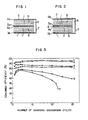
- Figs. 1 and 2 are fragmentary sectional views showing structures of a sheet-shaped polymer secondary battery of layer built type according to two embodiments of the present invention.
- Fig. 3 is a curve showing the relationship between charging-discharging cycle and efficiency.
- Fig. 1 is a fragmentary sectional view showing a structure of a battery which is one of the embodiments of the present invention.
- Numeral 1 designates the positive electrodes
- 2 designates the negative electrodes.
- These electrodes independently are a film-shaped polymer having conjugated double bonds.
- the positive electrodes the said polymer capable of being reversibly doped and undoped with negative ions
- the negative electrodes the said polymer capable of being reversibly doped and undoped with positive ions is used.
- Numerals 3a and 3b independently designate a thin metal layer provided at one side of the surface of the positive electrode.
- Numerals 4a and 4b independently designate a thin metal layer provided at one side of the surface of the negative electrode. These thin metal layers independently are, for example, a vapor-deposited metal film. Numeral 5 designates a separator supporting an electrolyte.
- One of the features of the present invention lies in the above thin metal layers. That is, when unit cells are laminated to form a layer built type battery, fundamentally the battery functions as such by placing either of the thin metal layers 3a and 4a or by placing a thin metal layer (not shown in Fig. 1) between the positive electrode and the negative electrode which are adjacent to each other.
- Numeral 5 designates an insulating porous separator supporting a dopant-containing electrolyte.
- Numeral 6 designates a battery support.
- Numeral 7 designates a battery case.
- Another feature of the present invention is to use a film-shaped polymer having conjugated double bonds such as a polyacetylene for both the positive electrodes and the negative electrodes.
- a film-shaped polymer having conjugated double bonds such as a polyacetylene
- the positive electrodes 1 and the negative electrodes 2 besides the aforementioned polyacetylene, there can be used a polyparaphenylene, a polypyrrole, a poly-2,5-thienylene, etc.
- a vapor-deposited metal film is preferred.
- the dopant and a solvent therefor known substances can be used.
- the dopant there can be used, for example, ions giving a p-type electroconductive conjugated high molecular compound such as CI-, Br-, I - , ClO 4 - , PF s - , AsF 4 - , AsF 6 - , CF 6 S0 3 - , BF 4 - and the like, as well as ions type electroconductive conjugated high molecular compound such as Li + , Na + , K + , R 4 N + , (wherein R is a hydrocarbon group of 1 to 20 carbon atoms) and the like.
- the solvent there can be used, for example, one compound selected from tetrahydrofuran, dioxane, y-butyrolactone, dimethoxyethane, propylene carbonate, acetonitrile, dimethylformamide, dimethyl sulfoxide, sulfolane, ethylene carbonate and the like, or a mixture of two or more thereof.
- the electrolyte can be used in the form of paste or a solid state.
- the separator there are used, for example, a glass fiber, an alumina fiber, a potassium titanate fiber, a porous film of a synthetic resin such as a polyethylene or a polypropylene, a natural fiber, etc.
- the present inventors found out that it is effective for the separator to support an adsorbent powder for adsorbing moisture present or decomposition products which may be formed from the electrochemical reactions in the battery.
- adsorbent powder By allowing the separator to support an adsorbent powder, coulombic efficiency in charging-discharging can be enhanced and battery life can be extended.
- adsorbent powder there can be used at least one of inorganic adsorbent [such as porous alumina, silica, aluminosilicate compounds (molecular sieve) and the like] and organic synthetic resin, [such as a sytrene-divinylbenzene crosslinked gel, an acrylic resin and the like] and actived carbon, etc.
- inorganic adsorbent such as porous alumina, silica, aluminosilicate compounds (molecular sieve) and the like
- organic synthetic resin such as a sytrene-divinylbenzene crosslinked gel, an acrylic resin and the like
- actived carbon etc.
- the present inventors further found out that placing an electrolyte-impermeable metal foil 8 between two adjacent unit cells, namely, two adjacent thin metal layers 3a and 4a as shown in Fig. 2 is effective, and by placing this metal foil 8, permeation of an electrolyte through the two adjacent cells as well as reduction of battery characteristics can be prevented, and these effects are particularly striking when the thin metal layers 3a and 4a are a vapor-deposited metal film.
- unit cells when unit cells are laminated, they can be electrically connected in series, in parallel or in combination thereof.
- a shielding layer made from an inorganic insulating substance or the like may be provided between a battery main body and a battery case.
- the thin metal layers 3b and 4b shown in Figs. 1 and 2 may be thicker to make them more impermeable to oxygen and moisture.
- the battery case may be sealed.
- a solution of 0.5 mol/liter of tetraethylammonium perchlorate [(C 2 H 5 ) 4 NClO 4 ] (which is an electrolyte and at the same time is a dopant) dissolved in acetonitrile (being purified by distillation and dehydrated).
- a polypropylene unwoven cloth supporting alumina (AI 2 0 3 W200 Neutral” manufactured by M. Woelm Eschwege A. G.) and having a total thickness of 650 pm.
- This separator was impregnated with the above mentioned supported electrolyte.
- a sheet-shaped polymer secondary battery of layer built type as shown in Fig. 1 was prepared. In this battery, the thin metal layers 3a and 4a attached to the respective polyacetylene films shown in Fig. 1 had direct contact.
- This battery was charged for 30 minutes at a current density of 5 mAlcm 2 and then discharged at a current density of 5 mA/cm 2 until the battery voltage dropped to 2 V, a coulombic efficiency (percentage of quantity of electricity discharged to quantity of electricity charged) in each charging cycles was measured.
- the relationship between the number of cycles and the coulombic efficiency when a charging-discharging cycle was repeated 30 times is shown as the curve A in Fig. 3.
- the coulombic efficiency at 30th cycle was 92% and the after-charge voltage at that time was 5.5 V.
- a sheet-shaped polymer secondary battery of layer built type was prepared, which has the same structure as in the battery of Example 1, except that for a separator there was used a polypropylene unwoven cloth supporting silica ground to 200 meshes ("Silbead N" manufactured by Mizusawa Kagaku Kogyo Co., Ltd.) and having a total thickness of 600 pm.
- a charging-discharging test was conducted in the same condition as in Example 1. The result is shown in as curve B in Fig.
- the coulombic efficiency at 30th cycle was 83% and the after-charge voltage at that time was 6.1 V.
- a sheet-shaped polymer secondary battery of layer built type was prepared which has the same structure as in the battery of Example 1 except that for a separator there was used a polypropylene unwoven cloth supporting a styrenedivinylbenzene crosslinked gel ("XAD-2", ground to 200 mesh manufactured by Rohm and Haas Co.) and having a total thickness of 750 pm.
- XAD-2 styrenedivinylbenzene crosslinked gel
- a charging-discharging test was conducted in the same condition as in Example 1. The result is shown as curve C in Fig. 3.
- the coulombic efficiency at 30th cycle was 81 % and the after-charge voltage at that time was 6.2 V.
- a sheet-shaped polymer secondary battery of layer built type was prepared. That is, a battery which is a battery of Fig. 1 without having the vapor-deposited metal film 3a was prepared.
- the coulombic efficiency at 30th cycle was-58% and the after-charge voltage at that time was 6.8 V.
- a sheet-shaped polymer secondary battery of layer built type was prepared which is the same as the battery of Comparative Example 1, except that for a separator a laminated polypropylene unwoven cloth having 600 pm thickness was used.
- the same charging-discharging test as in Example 1 was conducted. The result is shown as curve F in Fig. 3.
Landscapes
- Chemical & Material Sciences (AREA)
- Chemical Kinetics & Catalysis (AREA)
- Electrochemistry (AREA)
- General Chemical & Material Sciences (AREA)
- Engineering & Computer Science (AREA)
- Inorganic Chemistry (AREA)
- Manufacturing & Machinery (AREA)
- Ceramic Engineering (AREA)
- Secondary Cells (AREA)
- Battery Electrode And Active Subsutance (AREA)
- Cell Separators (AREA)
Description
- The present invention relates to a sheet-shaped secondary battery of layer built type using polymers such as a polyacetylene as the electrodes.
- Recently, batteries using polymers having conjugated double bonds such as a polyacetylene as the electrodes are drawing attention, since they have high energy densities, thus can be used as one of the starting materials for making batteries of small size and light weight. Such a battery is described, for example in Japanese Patent Application Kokai (Laid-open) No. 56-136469/1981.
- The present inventors have made extensive studies for developing a sheet-shaped battery which is flexible and usable even when flexed and has excellent durability as a secondary battery. As a result of the studies, it was found that the polymers having conjugated double bonds such as a polyacetylene have excellent flexing resistance and can preferably be used in sheet-shaped secondary batteries. It was also found out from the studies by the present inventors that, when a plurality of unit cells, each of which using said polymers, is laminated to form a layer built type battery, even if either one of two electrodes is provided with a thin metal layer, this battery functions fundamentally as such, but does not exhibit a sufficient charging-discharging characteristic and this is due to the fact that current-collecting action is not properly done in the battery.
- The object of the present invention is to provide a sheet-shaped secondary battery of layer built type usable even in a flexed condition.
- The sheet-shaped polymer secondary battery of layer built type usable in the flexed condition according to the present invention is characterized by being a laminate of a plurality of sheet-shaped unit cells each of which comprises the following elements (a) to (c):
- (a) a positive electrode made of a film-shaped polymer having conjugated double bonds and provided with a thin metal layer at one side of the surface of the film and being capable of being reversibly doped and undoped with negative ions.
- (b) a negative electrode made of a film-shaped polymer having conjugated double bonds and provided with a thin metal layer at one side of the surface of the film and being capable of being reversibly doped and undoped with positive ions, and
- (c) an insulating porous separator supporting a dopant-containing electrolyte and existing between the positive electrode and the negative electrode.
- Further developments of the invention are claimed in the sub-claims.
- Figs. 1 and 2 are fragmentary sectional views showing structures of a sheet-shaped polymer secondary battery of layer built type according to two embodiments of the present invention. Fig. 3 is a curve showing the relationship between charging-discharging cycle and efficiency.
- The present invention will be explained by referring to the accompanying drawings. Fig. 1 is a fragmentary sectional view showing a structure of a battery which is one of the embodiments of the present invention. Numeral 1 designates the positive electrodes, and 2 designates the negative electrodes. These electrodes independently are a film-shaped polymer having conjugated double bonds. For the positive electrodes, the said polymer capable of being reversibly doped and undoped with negative ions, is used. For the negative electrodes, the said polymer capable of being reversibly doped and undoped with positive ions is used.
Numerals Numerals thin metal layers thin metal layers Numeral 7 designates a battery case. - Another feature of the present invention is to use a film-shaped polymer having conjugated double bonds such as a polyacetylene for both the positive electrodes and the negative electrodes. The present inventors found out that this is requisite in order to satisfy flexing resistance required for a sheet-shaped secondary battery of layer built type.
- For the positive electrodes 1 and the
negative electrodes 2, besides the aforementioned polyacetylene, there can be used a polyparaphenylene, a polypyrrole, a poly-2,5-thienylene, etc. - For the
thin metal layers - For the dopant and a solvent therefor, known substances can be used. For the dopant there can be used, for example, ions giving a p-type electroconductive conjugated high molecular compound such as CI-, Br-, I-, ClO4 -, PFs -, AsF4 -, AsF6 -, CF6S03 -, BF4 - and the like, as well as ions type electroconductive conjugated high molecular compound such as Li+, Na+, K+, R4N+, (wherein R is a hydrocarbon group of 1 to 20 carbon atoms) and the like. For the solvent, there can be used, for example, one compound selected from tetrahydrofuran, dioxane, y-butyrolactone, dimethoxyethane, propylene carbonate, acetonitrile, dimethylformamide, dimethyl sulfoxide, sulfolane, ethylene carbonate and the like, or a mixture of two or more thereof. In the present invention, the electrolyte can be used in the form of paste or a solid state.
- For the separator, there are used, for example, a glass fiber, an alumina fiber, a potassium titanate fiber, a porous film of a synthetic resin such as a polyethylene or a polypropylene, a natural fiber, etc. The present inventors found out that it is effective for the separator to support an adsorbent powder for adsorbing moisture present or decomposition products which may be formed from the electrochemical reactions in the battery. By allowing the separator to support an adsorbent powder, coulombic efficiency in charging-discharging can be enhanced and battery life can be extended. For the adsorbent powder, there can be used at least one of inorganic adsorbent [such as porous alumina, silica, aluminosilicate compounds (molecular sieve) and the like] and organic synthetic resin, [such as a sytrene-divinylbenzene crosslinked gel, an acrylic resin and the like] and actived carbon, etc.
- The present inventors further found out that placing an electrolyte-
impermeable metal foil 8 between two adjacent unit cells, namely, two adjacentthin metal layers metal foil 8, permeation of an electrolyte through the two adjacent cells as well as reduction of battery characteristics can be prevented, and these effects are particularly striking when thethin metal layers - In the present invention, when unit cells are laminated, they can be electrically connected in series, in parallel or in combination thereof.
- In the present invention, in order to prevent the penetration of oxygen or moisture from outside, a shielding layer made from an inorganic insulating substance or the like may be provided between a battery main body and a battery case. Also, the
thin metal layers - For the positive electrodes and the negative electrodes there were used a polyacetylene sheet having a specific gravity of 0.91, a thickness of 236 pm and an area of 4 cm2 having a vapor-deposited metal film of 300 A (30 nm) thickness formed on one side of the surface of the film by the use of a spattering apparatus. For the supported electrolyte, there was used a solution of 0.5 mol/liter of tetraethylammonium perchlorate [(C2H5)4NClO4] (which is an electrolyte and at the same time is a dopant) dissolved in acetonitrile (being purified by distillation and dehydrated). For the separator, there was used a polypropylene unwoven cloth supporting alumina ("AI203 W200 Neutral" manufactured by M. Woelm Eschwege A. G.) and having a total thickness of 650 pm. This separator was impregnated with the above mentioned supported electrolyte. Using these materials, a sheet-shaped polymer secondary battery of layer built type as shown in Fig. 1 was prepared. In this battery, the
thin metal layers - This battery was charged for 30 minutes at a current density of 5 mAlcm2 and then discharged at a current density of 5 mA/cm2 until the battery voltage dropped to 2 V, a coulombic efficiency (percentage of quantity of electricity discharged to quantity of electricity charged) in each charging cycles was measured. The relationship between the number of cycles and the coulombic efficiency when a charging-discharging cycle was repeated 30 times is shown as the curve A in Fig. 3. The coulombic efficiency at 30th cycle was 92% and the after-charge voltage at that time was 5.5 V.
- A sheet-shaped polymer secondary battery of layer built type was prepared, which has the same structure as in the battery of Example 1, except that for a separator there was used a polypropylene unwoven cloth supporting silica ground to 200 meshes ("Silbead N" manufactured by Mizusawa Kagaku Kogyo Co., Ltd.) and having a total thickness of 600 pm. A charging-discharging test was conducted in the same condition as in Example 1. The result is shown in as curve B in Fig.
- The coulombic efficiency at 30th cycle was 83% and the after-charge voltage at that time was 6.1 V.
- A sheet-shaped polymer secondary battery of layer built type was prepared which has the same structure as in the battery of Example 1 except that for a separator there was used a polypropylene unwoven cloth supporting a styrenedivinylbenzene crosslinked gel ("XAD-2", ground to 200 mesh manufactured by Rohm and Haas Co.) and having a total thickness of 750 pm. A charging-discharging test was conducted in the same condition as in Example 1. The result is shown as curve C in Fig. 3.
- The coulombic efficiency at 30th cycle was 81 % and the after-charge voltage at that time was 6.2 V.
- By using positive electrodes, negative electrodes, a supported electrolyte and a separator which were the same as those used in _ Example 1, a sheet-shaped polymer secondary battery of layer built type having the structure as shown in Fig. 2 was prepared. The same charging-discharging test as in Example 1 was conducted. The result is shown as curve D in Fig. 3. In Fig. 2, as the
metal foil 8, SUS 304 having 50 11m in thickness was used. The coulombic efficiency at 30th cycle was 94% and the after-charge voltage at that time was 5.6 V. - Using one piece of polyacetylene sheet having no vapor-deposited metal film and three pieces of polyacetylene sheets each having a vapor-deposited metal film which are the same as those used in Example 1 and also using a support electrolyte and a separator both of which are the same as those used in Example 1, a sheet-shaped polymer secondary battery of layer built type was prepared. That is, a battery which is a battery of Fig. 1 without having the vapor-deposited
metal film 3a was prepared. - A charging-discharging test was conducted in the same condition as in Example 1. The result is shown as curve E in Fig. 3.
- The coulombic efficiency at 30th cycle was-58% and the after-charge voltage at that time was 6.8 V.
- A sheet-shaped polymer secondary battery of layer built type was prepared which is the same as the battery of Comparative Example 1, except that for a separator a laminated polypropylene unwoven cloth having 600 pm thickness was used. The same charging-discharging test as in Example 1 was conducted. The result is shown as curve F in Fig. 3.
- The current efficiency began to sharply decrease at 20th cycle and the after-charge voltage at that time exceeded 7.4 V.
- As is obvious from the above Examples and Comparative Examples, when a film-shaped polymer having conjugated double bonds such as a polyacetylene is provided with a vapor-deposited metal film at one side of the surface of the film, and this integrated sheet is laminated in a plural number, when two of these metal films are allowed to have a tight contact with each other and current is collected, advantages are obtained that current-collecting efficiency can be enhanced, current efficiency in charging-discharging can be improved and a battery life can also be extended. The present invention is also advantageous in that it can provide flexing resistance which is requisite for sheet-shaped secondary batteries of layer built type.
Claims (6)
Applications Claiming Priority (2)
| Application Number | Priority Date | Filing Date | Title |
|---|---|---|---|
| JP57182776A JPS5973864A (en) | 1982-10-20 | 1982-10-20 | Laminated sheet-shaped polymer secondary battery |
| JP182776/82 | 1982-10-20 |
Publications (2)
| Publication Number | Publication Date |
|---|---|
| EP0108954A1 EP0108954A1 (en) | 1984-05-23 |
| EP0108954B1 true EP0108954B1 (en) | 1987-01-07 |
Family
ID=16124214
Family Applications (1)
| Application Number | Title | Priority Date | Filing Date |
|---|---|---|---|
| EP83110425A Expired EP0108954B1 (en) | 1982-10-20 | 1983-10-19 | Sheet-shaped polymer secondary battery of layer built type |
Country Status (5)
| Country | Link |
|---|---|
| US (1) | US4518665A (en) |
| EP (1) | EP0108954B1 (en) |
| JP (1) | JPS5973864A (en) |
| CA (1) | CA1204472A (en) |
| DE (1) | DE3369031D1 (en) |
Families Citing this family (27)
| Publication number | Priority date | Publication date | Assignee | Title |
|---|---|---|---|---|
| DE3480312D1 (en) * | 1983-08-31 | 1989-11-30 | Hoxan Kk | Plastics electrode secondary battery |
| JPS6065478A (en) * | 1983-09-21 | 1985-04-15 | Hitachi Ltd | Polymer secondary battery |
| DE3724056A1 (en) * | 1987-07-21 | 1989-02-02 | Basf Ag | ARRANGEMENT FOR REVERSIBLE STORAGE OF ELECTRICAL ENERGY |
| JP2547816B2 (en) * | 1988-03-23 | 1996-10-23 | 旭化成工業株式会社 | Solid electrolyte secondary battery |
| JP2984696B2 (en) * | 1988-07-11 | 1999-11-29 | 株式会社リコー | Thin battery |
| US5108855A (en) * | 1990-03-19 | 1992-04-28 | Bridgestone Corporation | Secondary battery |
| US5147737A (en) * | 1991-05-07 | 1992-09-15 | Wilson Greatbatch Ltd. | Electrochemical cell with improved efficiency serpentine electrode |
| US5441830A (en) * | 1992-10-29 | 1995-08-15 | Moulton; Russell D. | Electrically-conducting adhesion-promoters on conductive plastic |
| US5464707A (en) * | 1992-10-29 | 1995-11-07 | Moulton; Russell D. | Electrically-conducting adhesion-promoters |
| WO1995021467A1 (en) * | 1994-02-02 | 1995-08-10 | Valence Technology, Inc. | Equalizing charge rates of individual battery cells |
| US5422200A (en) * | 1994-07-27 | 1995-06-06 | Hope; Stephen F. | Battery packaging construction for alkali metal multicell batteries |
| US6046514A (en) * | 1997-07-25 | 2000-04-04 | 3M Innovative Properties Company | Bypass apparatus and method for series connected energy storage devices |
| US6104967A (en) * | 1997-07-25 | 2000-08-15 | 3M Innovative Properties Company | Fault-tolerant battery system employing intra-battery network architecture |
| US6099986A (en) | 1997-07-25 | 2000-08-08 | 3M Innovative Properties Company | In-situ short circuit protection system and method for high-energy electrochemical cells |
| US6120930A (en) | 1997-07-25 | 2000-09-19 | 3M Innovative Properties Corporation | Rechargeable thin-film electrochemical generator |
| US6146778A (en) | 1997-07-25 | 2000-11-14 | 3M Innovative Properties Company | Solid-state energy storage module employing integrated interconnect board |
| US5952815A (en) * | 1997-07-25 | 1999-09-14 | Minnesota Mining & Manufacturing Co. | Equalizer system and method for series connected energy storing devices |
| US6100702A (en) * | 1997-07-25 | 2000-08-08 | 3M Innovative Properties Company | In-situ fault detection apparatus and method for an encased energy storing device |
| US6087036A (en) * | 1997-07-25 | 2000-07-11 | 3M Innovative Properties Company | Thermal management system and method for a solid-state energy storing device |
| US6117584A (en) * | 1997-07-25 | 2000-09-12 | 3M Innovative Properties Company | Thermal conductor for high-energy electrochemical cells |
| US6171723B1 (en) | 1997-10-10 | 2001-01-09 | 3M Innovative Properties Company | Batteries with porous components |
| US6235425B1 (en) | 1997-12-12 | 2001-05-22 | 3M Innovative Properties Company | Apparatus and method for treating a cathode material provided on a thin-film substrate |
| JP2943792B1 (en) * | 1998-04-03 | 1999-08-30 | 日本電気株式会社 | Proton conductive polymer battery and method for producing the same |
| US6797348B1 (en) | 2000-04-24 | 2004-09-28 | Nexpress Solutions Llc | Fuser member overcoated with fluorocarbon-silicone random copolymer containing aluminum oxide |
| US6555229B1 (en) | 2000-04-24 | 2003-04-29 | Nexpress Solutions Llc | Fluorocarbon-silicone random copolymer for use in toner release layer |
| US20070251083A1 (en) * | 2006-04-28 | 2007-11-01 | Starkey Laboratories, Inc. | Moisture Resistant Barrier for Batteries |
| DE102012212258A1 (en) * | 2012-07-13 | 2014-01-16 | Robert Bosch Gmbh | Condenser and method for condensing moisture in a vehicle battery |
Family Cites Families (6)
| Publication number | Priority date | Publication date | Assignee | Title |
|---|---|---|---|---|
| US3964932A (en) * | 1973-01-26 | 1976-06-22 | Esb Incorporated | Battery having deformations in a metal layer |
| US4078935A (en) * | 1974-04-30 | 1978-03-14 | Fuji Photo Film Co., Ltd. | Support member |
| US4442187A (en) * | 1980-03-11 | 1984-04-10 | University Patents, Inc. | Batteries having conjugated polymer electrodes |
| US4321114A (en) * | 1980-03-11 | 1982-03-23 | University Patents, Inc. | Electrochemical doping of conjugated polymers |
| US4298668A (en) * | 1980-07-03 | 1981-11-03 | Kimberly-Clark Corporation | Alkaline battery, electrolyte absorber therefor |
| DE3276842D1 (en) * | 1981-01-22 | 1987-08-27 | Showa Denko Kk | Battery having acetylene high polymer electrode |
-
1982
- 1982-10-20 JP JP57182776A patent/JPS5973864A/en active Pending
-
1983
- 1983-10-19 DE DE8383110425T patent/DE3369031D1/en not_active Expired
- 1983-10-19 CA CA000439247A patent/CA1204472A/en not_active Expired
- 1983-10-19 EP EP83110425A patent/EP0108954B1/en not_active Expired
- 1983-10-20 US US06/544,118 patent/US4518665A/en not_active Expired - Lifetime
Also Published As
| Publication number | Publication date |
|---|---|
| CA1204472A (en) | 1986-05-13 |
| DE3369031D1 (en) | 1987-02-12 |
| EP0108954A1 (en) | 1984-05-23 |
| US4518665A (en) | 1985-05-21 |
| JPS5973864A (en) | 1984-04-26 |
Similar Documents
| Publication | Publication Date | Title |
|---|---|---|
| US4518665A (en) | Sheet-shaped polymer secondary battery of layer built type | |
| EP0221183B1 (en) | Rechargeable secondary battery | |
| CA2169484C (en) | Rechargeable non-aqueous lithium battery having stacked electrochemical cells | |
| KR100573722B1 (en) | Granular Electrode with Electrolyte for Rechargeable Lithium Battery | |
| KR100619652B1 (en) | Non-Aqueous Electrolyte Cell | |
| US4638407A (en) | Solid state electrochemical device | |
| CN1137522C (en) | Multi-layer type nonaqueous electrolyte secondary cell | |
| US5705259A (en) | Method of using a bipolar electrochemical storage device | |
| JPH09505932A (en) | Multilayered electrolyte and electrochemical cell using the same | |
| WO2000049669B1 (en) | Electrically conductive, freestanding microporous polymer sheet | |
| WO2004107493A1 (en) | Nonaqueous electrolyte solution and lithium ion secondary battery | |
| US4824745A (en) | Electric cell comprising a polymeric material film electrode having a collection integrated therewith | |
| JPS58192266A (en) | Storage element for electric energy | |
| US11251483B2 (en) | Method of preparing an electrochemical cell | |
| US4816359A (en) | Electrochemical secondary element with at least one polymer electrode | |
| WO2000025373A1 (en) | Nonaqueous electrolyte cell | |
| GB2298309A (en) | Fan-folded lithium battery construction comprising lithium ion-containing polymer electrolyte sandwiched between discrete electrode plates | |
| EP0118026A1 (en) | Secondary cell using polymeric material | |
| JP2021072267A (en) | Electrode precursor | |
| US4585717A (en) | Organic battery | |
| JPH0782839B2 (en) | Secondary battery negative electrode | |
| US7042708B1 (en) | High capacitance energy storage device | |
| JPH09205041A (en) | Electric double layer capacitor | |
| JP3028869B2 (en) | Positive electrode of metal-halogen battery | |
| KR102929470B1 (en) | Activatable battery |
Legal Events
| Date | Code | Title | Description |
|---|---|---|---|
| PUAI | Public reference made under article 153(3) epc to a published international application that has entered the european phase |
Free format text: ORIGINAL CODE: 0009012 |
|
| AK | Designated contracting states |
Designated state(s): BE CH DE FR GB LI NL |
|
| 17P | Request for examination filed |
Effective date: 19840525 |
|
| GRAA | (expected) grant |
Free format text: ORIGINAL CODE: 0009210 |
|
| AK | Designated contracting states |
Kind code of ref document: B1 Designated state(s): BE CH DE FR GB LI NL |
|
| REF | Corresponds to: |
Ref document number: 3369031 Country of ref document: DE Date of ref document: 19870212 |
|
| ET | Fr: translation filed | ||
| PLBE | No opposition filed within time limit |
Free format text: ORIGINAL CODE: 0009261 |
|
| STAA | Information on the status of an ep patent application or granted ep patent |
Free format text: STATUS: NO OPPOSITION FILED WITHIN TIME LIMIT |
|
| 26N | No opposition filed | ||
| PGFP | Annual fee paid to national office [announced via postgrant information from national office to epo] |
Ref country code: FR Payment date: 19980814 Year of fee payment: 16 |
|
| PGFP | Annual fee paid to national office [announced via postgrant information from national office to epo] |
Ref country code: BE Payment date: 19980914 Year of fee payment: 16 |
|
| PGFP | Annual fee paid to national office [announced via postgrant information from national office to epo] |
Ref country code: GB Payment date: 19981008 Year of fee payment: 16 |
|
| PGFP | Annual fee paid to national office [announced via postgrant information from national office to epo] |
Ref country code: NL Payment date: 19981031 Year of fee payment: 16 |
|
| PGFP | Annual fee paid to national office [announced via postgrant information from national office to epo] |
Ref country code: DE Payment date: 19981230 Year of fee payment: 16 Ref country code: CH Payment date: 19981230 Year of fee payment: 16 |
|
| PG25 | Lapsed in a contracting state [announced via postgrant information from national office to epo] |
Ref country code: GB Free format text: LAPSE BECAUSE OF NON-PAYMENT OF DUE FEES Effective date: 19991019 |
|
| PG25 | Lapsed in a contracting state [announced via postgrant information from national office to epo] |
Ref country code: LI Free format text: LAPSE BECAUSE OF NON-PAYMENT OF DUE FEES Effective date: 19991031 Ref country code: CH Free format text: LAPSE BECAUSE OF NON-PAYMENT OF DUE FEES Effective date: 19991031 Ref country code: BE Free format text: LAPSE BECAUSE OF NON-PAYMENT OF DUE FEES Effective date: 19991031 |
|
| BERE | Be: lapsed |
Owner name: SHOWA DENKO K.K. Effective date: 19991031 Owner name: HITACHI LTD. Effective date: 19991031 |
|
| PG25 | Lapsed in a contracting state [announced via postgrant information from national office to epo] |
Ref country code: NL Free format text: LAPSE BECAUSE OF NON-PAYMENT OF DUE FEES Effective date: 20000501 |
|
| GBPC | Gb: european patent ceased through non-payment of renewal fee |
Effective date: 19991019 |
|
| REG | Reference to a national code |
Ref country code: CH Ref legal event code: PL |
|
| PG25 | Lapsed in a contracting state [announced via postgrant information from national office to epo] |
Ref country code: FR Free format text: LAPSE BECAUSE OF NON-PAYMENT OF DUE FEES Effective date: 20000630 |
|
| NLV4 | Nl: lapsed or anulled due to non-payment of the annual fee |
Effective date: 20000501 |
|
| PG25 | Lapsed in a contracting state [announced via postgrant information from national office to epo] |
Ref country code: DE Free format text: LAPSE BECAUSE OF NON-PAYMENT OF DUE FEES Effective date: 20000801 |
|
| REG | Reference to a national code |
Ref country code: FR Ref legal event code: ST |