EP0108638A1 - X-ray contrast agents - Google Patents
X-ray contrast agents Download PDFInfo
- Publication number
- EP0108638A1 EP0108638A1 EP83306766A EP83306766A EP0108638A1 EP 0108638 A1 EP0108638 A1 EP 0108638A1 EP 83306766 A EP83306766 A EP 83306766A EP 83306766 A EP83306766 A EP 83306766A EP 0108638 A1 EP0108638 A1 EP 0108638A1
- Authority
- EP
- European Patent Office
- Prior art keywords
- bis
- compound
- compounds
- acetylamino
- group
- Prior art date
- Legal status (The legal status is an assumption and is not a legal conclusion. Google has not performed a legal analysis and makes no representation as to the accuracy of the status listed.)
- Granted
Links
- 0 C*Cc1c(*)c(C)c(C)c(*C)c1C Chemical compound C*Cc1c(*)c(C)c(C)c(*C)c1C 0.000 description 1
Classifications
-
- C—CHEMISTRY; METALLURGY
- C07—ORGANIC CHEMISTRY
- C07C—ACYCLIC OR CARBOCYCLIC COMPOUNDS
- C07C233/00—Carboxylic acid amides
-
- C—CHEMISTRY; METALLURGY
- C07—ORGANIC CHEMISTRY
- C07C—ACYCLIC OR CARBOCYCLIC COMPOUNDS
- C07C233/00—Carboxylic acid amides
- C07C233/01—Carboxylic acid amides having carbon atoms of carboxamide groups bound to hydrogen atoms or to acyclic carbon atoms
- C07C233/12—Carboxylic acid amides having carbon atoms of carboxamide groups bound to hydrogen atoms or to acyclic carbon atoms having the nitrogen atom of at least one of the carboxamide groups bound to a carbon atom of a hydrocarbon radical substituted by halogen atoms or by nitro or nitroso groups
Definitions
- the present invention relates to novel non-ionic X-ray contrast agents, to compositions containing them and to methods for their manufacture.
- non-ionic compounds as X-ray contrast agents, such compounds representing an important advance over previously known ionic X-ray contrast agents in respect of side effects due to high concentrations of ions and/or to high osmolality.
- Such compounds are suitable for one or more possible fields of X-ray visualisation but are not usually suitable for a wide range or spectrum of such uses.
- non-ionic X-ray contrast agents may be of use in two main fields, namely:-
- Intravascular visualisation including urography and angiography, for example cerebral, coronary and peripheral angiography, and
- Myelography i.e. injection into the cerebrospinal fluid.
- Radiologists have used different X-ray contrast agents particularly adapted to different fields of use but there are clearly advantages if it is possible to use a single X-ray contrast agent for a wide range of uses; apart from economies of scale in manufacture, it is also more satisfactory for the radiologist to be able to use experience of a contrast agent gained in one field of use, e.g. urography, in some other field, e.g. angiography or myelography.
- a 'general X-ray contrast agent' an X-ray contrast agent which can be used in all forms of intravascular visualisation and myelography.
- a general X-ray contrast agent should possess a 'package' of favourable parameters, namely low toxicity, low osmolality, low viscosity, low nephrotoxicity, high urinary excretion and, in particular, the ability to produce solutions of high concentration but low osmolality.
- X-ray contrast agents which possess close structural similarities may nevertheless possess very different properties such as for example toxicity. Thus it is a difficult empirical task to identify a compound which possesses a complete package of favourable parameters and which can be used as a general X-ray contrast agent.
- one of the principal advantages of non-ionic X-ray contrast agents is their low osmolality as compared with ionic compounds, due to the reduction in the number of dissolved particles present at a particular iodine concentration. Low osmolality is desirable in order to reduce tissue damage arising from unduly high osmotic pressures generated by the very high concentrations at which X-ray contrast agents are administered.
- the osmolality can be reduced still further if the number of iodine atoms in each non-ionic molecule can be increased and it has been proposed to use relatively large molecules containing two triiodo- phenyl rings joined by a short chain.
- relatively large molecules commonly exhibit nephrotoxicity and are thus thought to be unsuitable for vascular X-ray visualisation.
- European Patent Application 0023992Al of Bracco Industria Chemica S.p.A. describes non-ionic X-ray contrast agents of the general formula where (HO) 2-3 Alkyl represents a 1,3-dihydroxyisopropyl, 2,3-dihydroxypropyl or 1,3-dihydroxy-2-hydroxymethyliso- propyl group, R represents hydrogen or methyl and Alkylene represents a divalent alkylene group with 2 to 10 carbon atoms, which can be substituted by hydroxy functions, or a mono-, di- or poly-oxa- alkylene group with 4 to 12 carbon atoms, which can be substituted by hydroxy functions.
- the Bracco compounds all carry a relatively large number of hydroxyl groups including one in each of the acyl (lactyl) functions. This would be expected to lead to relatively high viscosities and it would normally be thought desirable to avoid additional hydroxyl functions, for example, on the Alkylene group, in the absence of other compensating factors. Furthermore, it is well known that a hydroxyl group on an N-alkyl grouping of a triiodoaniline often undergoes nucleophilic reaction at high temperatures at the adjacent C-I bond with cyclisation. The Bracco patent suggests protection of such OH groups but this would clearly complicate any synthesis and would lead a chemist to choose the simpler solution of avoiding hydroxyl groups in Alkylene.
- the compounds may exist in several isomers due to chiral carbon atoms.
- the compounds exhibit exo/endo isomerism due to restricted rotation of the N-CO bond in the acetamido groups caused by the proximity of the bulky iodine atoms.
- the invention extends to all the isomeric forms of the compounds, including optically active, racemic and meso isomers.
- the compounds of the invention exhibit a package of outstanding properties rendering them capable of use in all forms of X-ray visualisation.
- the compounds possess osmolalities significantly lower, for example more than 50% lower, than comparable compounds having a single triiodinated benzene ring.
- the osmolality of Compound A is 196 mOs/Kg H 2 0 at 300mgI/ml and 223 mOs/Kg H 2 0 at 350 mgI/ml.
- the osmolality of Compound B is 120 mOs/Kg H 2 0 at 195 mgI/ml and 160 mOs/Kg H 2 0 at 295 mgI/ml.
- the osmolality of Compound C is 242 mOs/Kg H 2 0 at 370 mgI/ml.
- the osmolality of Compound D is 189 mOs/Kg H 2 0 at 300 mgI/ml and 224 mOs/Kg H 2 0 at 350 mgI/ml. It will be noted from the above values that the compounds are capable of forming solutions of very high concentration.
- the nephrotoxicity levels of the compounds are acceptably low, compared to many known 'bis' X-ray contrast agents.
- the nephrotoxicity of Compound A in rabbits is 7.5 gI/Kg, that of Compound B is also 7.5 gI/Kg and that of Compound C is 10.5gI/kg.
- the intravenous toxicities of the compounds in mice are also low, that of Compound A being 14.4 gI/Kg, that of Compound B and Compound C being 18.5gI/Kg.
- the viscosities of the compounds at high concentrations are acceptable, given their high molecular weights and content of hydroxyl groups.
- the specific viscosity of Compound A at 300 mgI/ml is 18.9 cP at 20°C and 8.7 cP at 37°C, while at 350 mgI/ml it is 44.5cP at 20°C and 17.7 cP at 37°C.
- the viscosity of Compound B at 300 mgI/ml is 18.4cP at 20°C and 8.7cP at 37°C, while at 370 mgI/ml it is 62 cP at 20°C and 23.6 cP at 37°C.
- the viscosity of Compound C at 300 mgI/ml is 22.7cPat 20°C and 10.3cP at 37°C, while at 350 mgI/ml it is 54.7cP at 20°C and 21.7cP at 37°C.
- the urinary excretion levels of the compounds of the invention in rabbits are higher than those expected for the X-ray contrast agents presently in clinical use. Such agents are generally excreted in the range 50 - 150 mg ' I/ml urine when the compound is given at a dose of 500 mgI/kg body weight. In comparison, compounds of the present invention when given at a dose of only 200 mg I/kg are excreted as listed below. The figures are median values and the figures in brackets are the number of animals investigated.
- the subarachnoid tolerances of the compounds A and C in unanaesthetised rabbits were particularly good being generally at least as good as that of N,N-bis (2,3-dihydroxypropyl)-5-[N-(2,3-dihydroxypropyl)-acetamido]-2,4,6-triiodoisophthalamide.
- N,N-bis (2,3-dihydroxypropyl)-5-[N-(2,3-dihydroxypropyl)-acetamido]-2,4,6-triiodoisophthalamide In anaesthetised rats no motoric or convulsive effects were observed on administration of Compounds A and C to 7 out of 8 rats.
- the present invention also provides radiological compositions comprising as active.ingredient at least one of the compounds of formula I as hereinbefore defined in association with a radiological carrier.
- the radiological compositions of the present invention are conveniently presented in a form suitable for administration by injection, for example, in ampoules or vials.
- the capacity of the ampoule or vial may be, for example, from 5 to 500 ml and the concentration may, for example, be from 20 to 500 mg I/ml.
- the compounds of the present invention may be prepared in any convenient manner, but the following process is of particular interest and constitutes a further feature of the present invention.
- a process for the preparation of the compounds of formula I as hereinbefore defined which comprises reacting the compound of formula: (where R has the above meaning) or a hydroxyl protected derivative thereof with a compound of the formula III X-A-X' (where X and X' are readily eliminatable atoms or groups and A has the above meaning) or a hydroxyl protected derivative thereof or a corresponding epoxide in which one or both of the substituents X and X' and the hydroxyl group on an adjacent carbon atom are replaced by -0- followed, where required, by removal of any unwanted protecting groups.
- the groups X and X' compounds of Formula III may be chosen from halogen atoms, e.g.
- the compound of Formula III may thus be epichlorohydrin or 1,4-dichloro-2,3-dihydroxybutane.
- hydroxyl groups present in the groups R and A may, if desired, be in a hydroxyl protected form; suitable protecting groups include acyl groups such as acetyl or, where adjacent hydroxyl groups are concerned, cyclic ketal or acetal groups.
- the reaction between compounds II and III is preferably effected in the presence of an- acid binding agent, for example an organic or inorganic base preferably in an aqueous or alcoholic medium such as water or an alkanol or glycol; an alkali metal alkoxide such as sodium methoxide or an alkali metal hydroxide such as sodium or potassium hydroxide may be used as base.
- an organic or inorganic base preferably in an aqueous or alcoholic medium such as water or an alkanol or glycol
- an alkali metal alkoxide such as sodium methoxide or an alkali metal hydroxide such as sodium or potassium hydroxide
- Any protecting groups may be removed by standard methods, for example hydrolysis.
- the compound of formula II may be prepared by acetylation of the corresponding compound having a free amino group and in such a reaction, hydroxyl groups in the substituents R may also be acetylated. Such acetyl groups may be removed by basic hydrolysis.
- the product may be purified by preparative chromatography.
- the compounds of formula II may be prepared in any convenient manner, for example, by reaction of 5-acetamido-2,4,6-triiodoisophthaloyl chloride and/or 5-diacetylamino-2,4,6-triiodoisophthaloyl chlorine with l,3-dihydroxy-2-propylamine or 2,3-dihydroxypropylamine followed, where the 5-diacetylamino compound is used, by removal of one N-acetyl group, e.g. by alkaline hydrolysis at slightly elevated temperature.
- the reaction may, for example, be effected in the presence of dimethylformamide or dioxan as solvent, conveniently in the additional presence of an alkali metal or alkaline earth metal carbonate or bicarbonate such as potassium bicarbonate.
- a compound of formula II may also be prepared for example, by acetylation of a compound of the formula: (where R has the above meanings).
- Acetylation may be effected by any convenient method e.g. by the use of acetic anhydride (which can also serve as the solvent) together with catalytic amounts of a mineral acid e.g. sulphuric or perchloric acid, or by the use of an acid halide preferably in a polar solvent such as dimethylformamide or dimethylacetamide.
- O-acetyl groupings may be removed either at this stage or after the reaction with the compound of formula III.
- the basic hydrolysis of the 0-acetyl grouping may for example, be effected using aqueous alkali metal hydroxide, e.g. sodium hydroxide, the reaction preferably being carried out at slightly elevated temperature, e.g. about 50°C.
- the primary amino group is often, in part, bis-acetylated, such that an overacetylated product is obtained. In general a mixture of acetylated products will be obtained.
- the bis-acetylamino group may be hydrolysed to the monoacetylamino group under mild basic conditions e.g. by the use of sodium hydroxide in, for example, methanol prior to N-hydroxyalkylation. It is, however, possible to effect N-hydroxyalkylation using the bis-acetylamino compound with simultaneous solvolysis.
- 1,4-dichloro-2,3-dihydroxybutane was prepared as follows; 1,2,3,4- diepoxybutane (4.89 g, 56.9 mmol) was dissolved in water (70 ml) and concentrated hydrochloric acid (9.5 ml) was slowly added while the reaction-mixture was cooled in ice-water. After stirring for 30 min. the reaction-mixture was concentrated, and redissolved in methanol (25 ml).
- Example 2 l,3- B is(acetylamino)-N,N'-bis[3,5-bis(l,3-dihydroxy-2 -propylaminocarbonyl)-2,4,6-triiodophenyl]-2-hydroxypropane (Compound B)
- the purest fractions were purified once more by preparative LC. This time the column was loaded with 5g substance (10ml solution) and eluted with 14% methanol in water. The product was eluted between 2.4-5.0 1, and the total eluent was about 8 1. The purest fractions were collected and evaporated to dryness at 50-60° in vacuo. Yield: 70g, Melting point: 305-310° decomp. HPLC (the same conditions as described above) show two peaks with retention times 39.97 and 44.04 minutes.
- the ratio of the spots were about 2-3: 30-35: 60-65 in order of increasing R f values.
- the reaction mixture was neutralized and then treated with strongly acid cation exchange resin (Amberlite I R 120) and strongly basic anion exchange resin (Dowex lx4) to remove inorganic salts. After filtration the solution was evaported to dryness at 50° in vacuo. Yield: 240g.
- the product was dissolved in methanol (1500ml) and precipitated by adding isopropyl alcohol (1500ml). Yield: 160g. Further purification was performed by preparative LC in a similar manner as described in example 1. The eluent was 15% methanol in water. Yield: 101g. Melting point: 310 -317° (Found: I 47.5 Calc. for C 36 H 46 I 6 O 16 :I 48.18).
- trometamol (TRIS') and the edetate (CaNa 2 E D T A) are dissolved in water suitable for injection (approximately 500 ml).
- the pH is adjusted to 7.5 by means of hydrochloric acid (5M), and sodium chloride is added to make the solution isotonic.
- Water suitable for injection is added to make the volume of the solution up to 1000 ml.
- the solution is membrane-filtered and dispensed into bottles or injection vials.
- the infusion solutions are prepared in bottles of 250 ml and 500 ml, while solutions for injection are dispensed in 20, 50 and 100 ml injection vials.
- the dispensed products are autoclaved for 20 min at 120°C.
Landscapes
- Organic Chemistry (AREA)
- Chemical & Material Sciences (AREA)
- Medicines Containing Antibodies Or Antigens For Use As Internal Diagnostic Agents (AREA)
- Organic Low-Molecular-Weight Compounds And Preparation Thereof (AREA)
- Apparatus For Radiation Diagnosis (AREA)
- Meat, Egg Or Seafood Products (AREA)
- Medicinal Preparation (AREA)
- Polymers With Sulfur, Phosphorus Or Metals In The Main Chain (AREA)
- Macromolecular Compounds Obtained By Forming Nitrogen-Containing Linkages In General (AREA)
- Polysaccharides And Polysaccharide Derivatives (AREA)
- Polyesters Or Polycarbonates (AREA)
- Non-Silver Salt Photosensitive Materials And Non-Silver Salt Photography (AREA)
- Medicines Containing Material From Animals Or Micro-Organisms (AREA)
- Analysing Materials By The Use Of Radiation (AREA)
Abstract

Description
- The present invention relates to novel non-ionic X-ray contrast agents, to compositions containing them and to methods for their manufacture.
- In our British Patent Specification No. 1,321,591 we describe and claim certain non-ionic compounds as X-ray contrast agents, such compounds representing an important advance over previously known ionic X-ray contrast agents in respect of side effects due to high concentrations of ions and/or to high osmolality. Such compounds are suitable for one or more possible fields of X-ray visualisation but are not usually suitable for a wide range or spectrum of such uses. In general, non-ionic X-ray contrast agents may be of use in two main fields, namely:-
- Intravascular visualisation, including urography and angiography, for example cerebral, coronary and peripheral angiography, and
- Myelography, i.e. injection into the cerebrospinal fluid.
- Radiologists have used different X-ray contrast agents particularly adapted to different fields of use but there are clearly advantages if it is possible to use a single X-ray contrast agent for a wide range of uses; apart from economies of scale in manufacture, it is also more satisfactory for the radiologist to be able to use experience of a contrast agent gained in one field of use, e.g. urography, in some other field, e.g. angiography or myelography. For the purposes of this specification an X-ray contrast agent which can be used in all forms of intravascular visualisation and myelography is termed a 'general X-ray contrast agent'.
- A general X-ray contrast agent should possess a 'package' of favourable parameters, namely low toxicity, low osmolality, low viscosity, low nephrotoxicity, high urinary excretion and, in particular, the ability to produce solutions of high concentration but low osmolality.
- It is known that X-ray contrast agents which possess close structural similarities may nevertheless possess very different properties such as for example toxicity. Thus it is a difficult empirical task to identify a compound which possesses a complete package of favourable parameters and which can be used as a general X-ray contrast agent. As indicated above, one of the principal advantages of non-ionic X-ray contrast agents is their low osmolality as compared with ionic compounds, due to the reduction in the number of dissolved particles present at a particular iodine concentration. Low osmolality is desirable in order to reduce tissue damage arising from unduly high osmotic pressures generated by the very high concentrations at which X-ray contrast agents are administered. The osmolality can be reduced still further if the number of iodine atoms in each non-ionic molecule can be increased and it has been proposed to use relatively large molecules containing two triiodo- phenyl rings joined by a short chain. However, such large molecules commonly exhibit nephrotoxicity and are thus thought to be unsuitable for vascular X-ray visualisation.
- In particular, European Patent Application 0023992Al of Bracco Industria Chemica S.p.A. describes non-ionic X-ray contrast agents of the general formula

- It should be noted that the Bracco compounds all carry a relatively large number of hydroxyl groups including one in each of the acyl (lactyl) functions. This would be expected to lead to relatively high viscosities and it would normally be thought desirable to avoid additional hydroxyl functions, for example, on the Alkylene group, in the absence of other compensating factors. Furthermore, it is well known that a hydroxyl group on an N-alkyl grouping of a triiodoaniline often undergoes nucleophilic reaction at high temperatures at the adjacent C-I bond with cyclisation. The Bracco patent suggests protection of such OH groups but this would clearly complicate any synthesis and would lead a chemist to choose the simpler solution of avoiding hydroxyl groups in Alkylene.
- We have now found that a small group of non-ionic X-ray contrast agents of the same general type as those of European Patent Application 0023992Al but possessing acetyl groups in place of the two lactyl groups and having a hydroxylated alkylene chain joining the two triiodoaniline rings, have outstanding properties, including low nephrotoxicity, which enable them to be used for vascular as well as for subarachnoid'visualisation, that is as general X-ray contrast agents.
- According to the present invention, therefore, we provide compounds of the general formula I
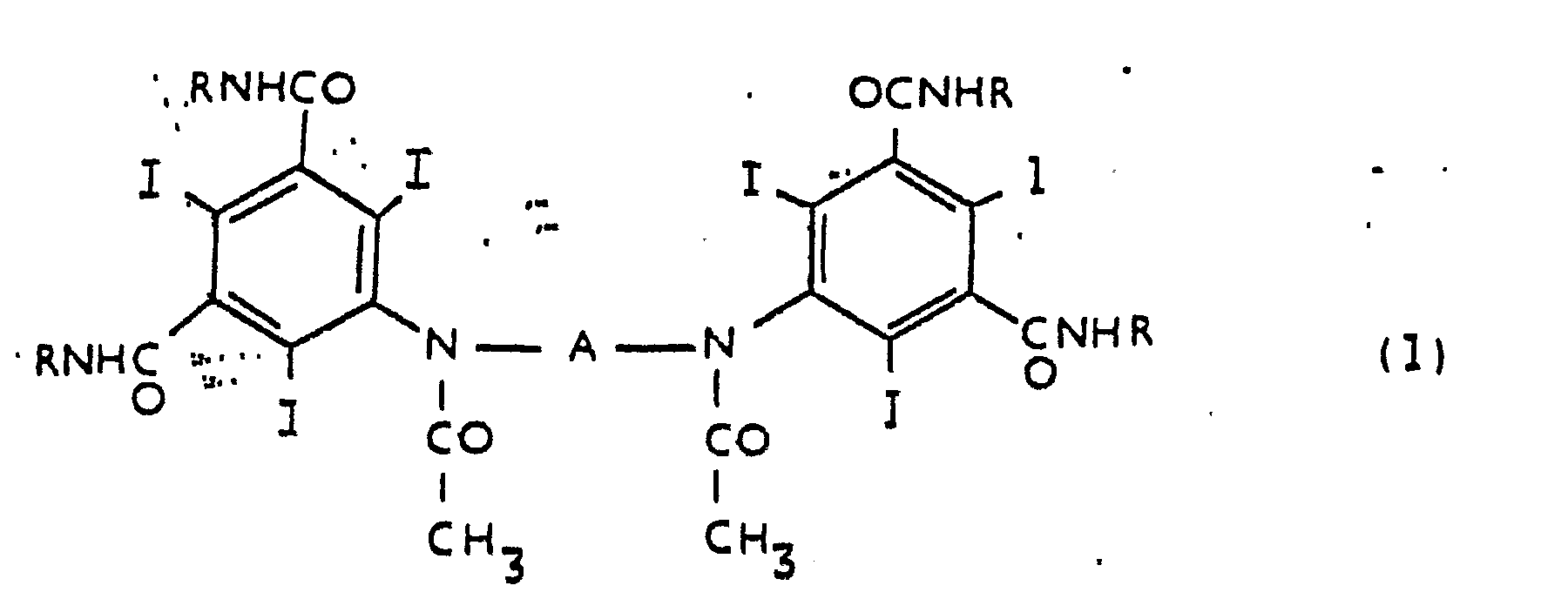
- Formula I includes four compounds, namely Compound A; R=-CH2CH(OH)CH2OH; A=-CH2CH(OH)CH2-Compound B; R=-CH(CH20H)2; A=-CH2CH(OH)CH 2-Compound C; R=-CH2CH(OH)CH20H; A=-CH2CH(OH)CH(OH)CH2-Compound D; R=-CH(CH20H)2; A=-CH2CH(OH)CH(OH)CH2-
- These compounds may exist in several isomers due to chiral carbon atoms. In addition, the compounds exhibit exo/endo isomerism due to restricted rotation of the N-CO bond in the acetamido groups caused by the proximity of the bulky iodine atoms. The invention extends to all the isomeric forms of the compounds, including optically active, racemic and meso isomers.
- As indicated above, the compounds of the invention exhibit a package of outstanding properties rendering them capable of use in all forms of X-ray visualisation. The compounds possess osmolalities significantly lower, for example more than 50% lower, than comparable compounds having a single triiodinated benzene ring. Thus, the osmolality of Compound A is 196 mOs/Kg H20 at 300mgI/ml and 223 mOs/Kg H20 at 350 mgI/ml. The osmolality of Compound B is 120 mOs/Kg H20 at 195 mgI/ml and 160 mOs/Kg H20 at 295 mgI/ml. The osmolality of Compound C is 242 mOs/Kg H20 at 370 mgI/ml. The osmolality of Compound D is 189 mOs/Kg H20 at 300 mgI/ml and 224 mOs/Kg H20 at 350 mgI/ml. It will be noted from the above values that the compounds are capable of forming solutions of very high concentration.
- The nephrotoxicity levels of the compounds are acceptably low, compared to many known 'bis' X-ray contrast agents. The nephrotoxicity of Compound A in rabbits is 7.5 gI/Kg, that of Compound B is also 7.5 gI/Kg and that of Compound C is 10.5gI/kg. The intravenous toxicities of the compounds in mice are also low, that of Compound A being 14.4 gI/Kg, that of Compound B and Compound C being 18.5gI/Kg.
- The viscosities of the compounds at high concentrations are acceptable, given their high molecular weights and content of hydroxyl groups. Thus, the specific viscosity of Compound A at 300 mgI/ml is 18.9 cP at 20°C and 8.7 cP at 37°C, while at 350 mgI/ml it is 44.5cP at 20°C and 17.7 cP at 37°C. The viscosity of Compound B at 300 mgI/ml is 18.4cP at 20°C and 8.7cP at 37°C, while at 370 mgI/ml it is 62 cP at 20°C and 23.6 cP at 37°C. The viscosity of Compound C at 300 mgI/ml is 22.7cPat 20°C and 10.3cP at 37°C, while at 350 mgI/ml it is 54.7cP at 20°C and 21.7cP at 37°C.
- The urinary excretion levels of the compounds of the invention in rabbits are higher than those expected for the X-ray contrast agents presently in clinical use. Such agents are generally excreted in the range 50 - 150 mg 'I/ml urine when the compound is given at a dose of 500 mgI/kg body weight. In comparison, compounds of the present invention when given at a dose of only 200 mg I/kg are excreted as listed below. The figures are median values and the figures in brackets are the number of animals investigated.

- The subarachnoid tolerances of the compounds A and C in unanaesthetised rabbits were particularly good being generally at least as good as that of N,N-bis (2,3-dihydroxypropyl)-5-[N-(2,3-dihydroxypropyl)-acetamido]-2,4,6-triiodoisophthalamide. In anaesthetised rats no motoric or convulsive effects were observed on administration of Compounds A and C to 7 out of 8 rats.
- The present invention also provides radiological compositions comprising as active.ingredient at least one of the compounds of formula I as hereinbefore defined in association with a radiological carrier. The radiological compositions of the present invention are conveniently presented in a form suitable for administration by injection, for example, in ampoules or vials. The capacity of the ampoule or vial may be, for example, from 5 to 500 ml and the concentration may, for example, be from 20 to 500 mg I/ml.
- The compounds of the present invention may be prepared in any convenient manner, but the following process is of particular interest and constitutes a further feature of the present invention.
- Thus there is provided a process for the preparation of the compounds of formula I as hereinbefore defined which comprises reacting the compound of formula:

- As indicated above, the hydroxyl groups present in the groups R and A may, if desired, be in a hydroxyl protected form; suitable protecting groups include acyl groups such as acetyl or, where adjacent hydroxyl groups are concerned, cyclic ketal or acetal groups.
- The reaction between compounds II and III is preferably effected in the presence of an- acid binding agent, for example an organic or inorganic base preferably in an aqueous or alcoholic medium such as water or an alkanol or glycol; an alkali metal alkoxide such as sodium methoxide or an alkali metal hydroxide such as sodium or potassium hydroxide may be used as base.
- Any protecting groups may be removed by standard methods, for example hydrolysis. The compound of formula II may be prepared by acetylation of the corresponding compound having a free amino group and in such a reaction, hydroxyl groups in the substituents R may also be acetylated. Such acetyl groups may be removed by basic hydrolysis.
- If necessary, the product may be purified by preparative chromatography.
- The compounds of formula II may be prepared in any convenient manner, for example, by reaction of 5-acetamido-2,4,6-triiodoisophthaloyl chloride and/or 5-diacetylamino-2,4,6-triiodoisophthaloyl chlorine with l,3-dihydroxy-2-propylamine or 2,3-dihydroxypropylamine followed, where the 5-diacetylamino compound is used, by removal of one N-acetyl group, e.g. by alkaline hydrolysis at slightly elevated temperature. The reaction may, for example, be effected in the presence of dimethylformamide or dioxan as solvent, conveniently in the additional presence of an alkali metal or alkaline earth metal carbonate or bicarbonate such as potassium bicarbonate. A compound of formula II may also be prepared for example, by acetylation of a compound of the formula:

- In addition, depending on the acylating agent used, other products may be formed and require separation. When an acyl anhydride such as acetic anhydride is used with concentrated sulphuric acid as catalyst, the primary amino group is often, in part, bis-acetylated, such that an overacetylated product is obtained. In general a mixture of acetylated products will be obtained. If desired, the bis-acetylamino group may be hydrolysed to the monoacetylamino group under mild basic conditions e.g. by the use of sodium hydroxide in, for example, methanol prior to N-hydroxyalkylation. It is, however, possible to effect N-hydroxyalkylation using the bis-acetylamino compound with simultaneous solvolysis.
- The following examples are given by way of illustration only: all temperatures are in °C:-
- 5-Acetylamino-N,N'-bis(2,3-dihydroxypropyl)-2,4,6-triiodoisophthalamide (75 g, 100.4 mmol) was dissolved in methanol (230 ml) containing sodium hydroxide (6.03 g, 150 mmol) at room temperature. To this solution 1,4-dichloro-2,3-dihydroxy-butane, dissolved in methanol (25 ml), was added and the resulting mixture was stirred at room temperature for 42 hours. The above described 1,4-dichloro-2,3-dihydroxybutane was prepared as follows; 1,2,3,4- diepoxybutane (4.89 g, 56.9 mmol) was dissolved in water (70 ml) and concentrated hydrochloric acid (9.5 ml) was slowly added while the reaction-mixture was cooled in ice-water. After stirring for 30 min. the reaction-mixture was concentrated, and redissolved in methanol (25 ml).
- The reaction was quenched by adding concentrated aqueous hydrochloric acid (pH 2). Filtration and evaporation gave the crude reaction product (85.0 g). This material was purified using preparative LC (Waters LC 500, prepPak C-18). Eluent: 14% methanol in water. 8 runs of 8.5 g. The product was eluted betwen 3.0 1 and 4.5 1, and the total eluent was about 9 1. The purest fractions were collected and evaporated to dryness at 60°C in
- Yield: 24 g, melting point 228-233°C.
- HPLC: RP-18. 5 um, gradient 5-17% acetonitrile. 3 peaks. 18,47 min (4.6%). 19,20 min (61.5%). 20,85 min (33.5%). These three peaks correspond to endo/endo, exo/exo and exo/endo (endo/exo).
- The product gave three spots on TLC (precoated TLC plates. Silica gel 60 F-254 from Merck AG) Eluent: n-BuOH: H20: HOAc. (50: 25: 11), Rf 0.19, 0.18 and 0.15.
- Found C: 27.64, H:2.94, I: 48.3 Calc. for C36H46I6N6016 C: 27.36, H: 2.93, I: 48.2.
- 5-Acetylamino-N,N'-bis(l,3-dihydroxy-2-propyl)-2,4,6-triiodoisophthalamide (400g, 0.535 mol) was slurried in water (1600 ml) at room temperature. Sodium hydroxide (16.1g, 0.040 mol) was added followed by epichlorohydrin (37.2g, 0.40 mol). After about 3 days the starting material was completely dissolved. HPLC (Column: Brownlee Labs, RP 18 Spheri 5 5 um, 4.6 mm i.d. x 25 cm. Linear gradient: 1-20% CH3CN in water, 0.2% per min, flow: 1 ml per min. Detector: UV 254 nm) of the reaction mixture showed about 60% of the "dimer" compound, about 23% of the "monomer" compound and about 2% of the starting material. The rest of the peaks represented unidentified compounds. The solution was neutralized with hydrochloric acid and evaporated to dryness at 60° in vacuo. The product was dissolved in a mixture of 17% methanol in water to a final volume of 600ml and purified by preparative liquid chromatography (Instrument: Prep LC/System 500 (Waters Ass).
- Column: PrepPak-500/C18. Eluent: 17% methanol in water. Flow: about 200ml/min). The purification was performed by injecting a portion (15ml) of the solution mentioned above. The "monomeric" compound was eluted first and was readily separated from the desired product which followed. Other impurities were eluted from the column after the desired product. When a sufficient volume of the eluent had been passed through the column to remove the most strongly retained components, the procedure was repeated with a new portion of the crude product. The purest fractions of the product were eluted between 1.5-4.5 1 and total volume of eluent used for one injection was about 8 1. The corresponding fractions were collected and evaporated to dryness at 50-60° in vacuo.
- The purest fractions were purified once more by preparative LC. This time the column was loaded with 5g substance (10ml solution) and eluted with 14% methanol in water. The product was eluted between 2.4-5.0 1, and the total eluent was about 8 1. The purest fractions were collected and evaporated to dryness at 50-60° in vacuo. Yield: 70g, Melting point: 305-310° decomp. HPLC (the same conditions as described above) show two peaks with retention times 39.97 and 44.04 minutes.
- Probably these two peaks represented the endo/exo and exo/exo isomers. The product gave three spots by TLC (precoated TLC Plates Silica Gel 60 F-254 gtp, Merck A.G. and developed in n-BuOH: HOAC:H20= 50:11:25) with Rf values 0.24, 0.28 and 0.31 in the ratio 2-3:30-35:60-70, respectively. Probably the spots represented the endo/endo and exo/exo isomers in order of increasing Rf values. (Found: C 27.14; H 2.94; I 48.5; N 5.40; 0 15.18. Calc. for C35H44I6N6O15: C 27.12; H 2.87; I 49.12; N 5.42; 0 15.48).
- The starting material 5-acetylamino-N,N'- bis(l,3-dihydroxy-2-propyl)-2,4,6-triiodoisophthalamide was prepared as follows:
- 5-Amino-N,N'-bis(l,3-dihydroxy-2-propyl)-2,4,6-triiodoisophthalamide (300g) was suspended in acetic anhydride (1.51) at 90° (on the oil bath) and then p-toluenesulphonic acid (3g) was added. The mixture was heated for 4t hours and then cooled slowly to room temperature. The product was collected on a filter and washed with small amounts of acetic anhydride. Yield: 353g. The product was suspended in a mixture of methanol (600 ml) and water (300ml) at room temperature and then pH was adjusted to about 11.5 by adding 5N sodium hydroxide (200 ml). This mixture was heated at 50°C and more 5N sodium hydroxide (235ml) was added dropwise in such a manner that pH was kept at about 10.5. After 2-3 hours pH did not decrease, and the hydrolysis was finished. After cooling to room temperature the mixture was acidified with 6N hydrochloric acid to pH 6.2. After stirring for two hours at room temperature, the mixture was cooled to 3° for 2-3 days. The product was collected on a filter, suspended in water (500ml) and filtered again. Yield: 257g. Melting point: above 270°. (Found: C 25.681 H 2.85; I 51.01 N 6.03. Calc. for C16H20I3N3O7: C 25.72; H 2.70; I 50.96; N 5.62) TLC (precoated TLC Plates Silica Gel 60 F-254 from Merck A.G. and developed in CHCl3:MeOH=70:30) showed one spot with Rf value 0.38.
- 5-Acetylamino-N,N'-bis(2,3-dihydroxypropyl)-2,4,6-triiodoisophthalamide (200g, 0.268 mol) was slurried in water (800ml) at room temperature.
- Sodium hydroxide (8.0g, 0.20 mol) was added and epichlorohydrin (18.6g, 0.20 mol) was added. After three days the starting material was dissolved and the solution neutralized with diluted hydrochloric acid. The solution was evaporated to dryness at 50° in vacuo finally purified by preparative LC in a similar manner as described in Example 1. Yield: 37g. Melting point: 240 - 250°. TLC (Precoated TLC Plates Silica Gel 60 F-254 from Merck A.G. and developed in n-BuOH :HOAc: H20=50:11:25) showed two spots with Rf values 0.26 and 0.28 which probably represented the endo/exo and the exo/exo isomers, respectively. The ratio between the two spots was about 1:2 in order of increasing Rf values. HPLC (the same conditions as described in example 1) showed two peaks with retention times 48.39 and 52.30 minutes, respectively. (Found: C 27.40; H 3.03; I 48.4; N 5.37; 0 15.31. Calc. for C35H44I6O15: C 27.12; H 2.86; I 49.12; N 5.42; 0 15.48)
- 5-Acetylamino-N,N'-bis(1,3-dihydroxy-2-propyl)-2,4,6-triiodoisophthalamide (224g, 0.3 mol) was slurried in water (900ml). Sodium hydroxide (6ml 5M) was added and then 1,2,3,4,-diepoxybutane (19.4g, 0.225 mol) was added. After three days TLC (Precoated TLC Plates Silica Gel 60 F-254 from Merck A.G. and developed in n-butanol: acetic acid: water= 50:11:25) of the reaction solution showed three new spots with Rf values 0.25, 0.26 and 0.29 representing the three endo/exo isomers of the desired product. The ratio of the spots were about 2-3: 30-35: 60-65 in order of increasing Rf values. The reaction mixture was neutralized and then treated with strongly acid cation exchange resin (Amberlite IR 120) and strongly basic anion exchange resin (Dowex lx4) to remove inorganic salts. After filtration the solution was evaported to dryness at 50° in vacuo. Yield: 240g. The product was dissolved in methanol (1500ml) and precipitated by adding isopropyl alcohol (1500ml). Yield: 160g. Further purification was performed by preparative LC in a similar manner as described in example 1. The eluent was 15% methanol in water. Yield: 101g. Melting point: 310-317° (Found: I 47.5 Calc. for C36H46I6O16:I 48.18).
- 1,4-Bis(acetylamino)-N,N'-bis[3,5-bis(2,3-dihydroxypropylaminocarbonyl)-2,4,6-triiodophenyl]-2,3-dihydroxybutane (Compound C) of the present invention, trometamol (TRIS') and the edetate (CaNa2 EDTA) are dissolved in water suitable for injection (approximately 500 ml). The pH is adjusted to 7.5 by means of hydrochloric acid (5M), and sodium chloride is added to make the solution isotonic. Water suitable for injection is added to make the volume of the solution up to 1000 ml. The solution is membrane-filtered and dispensed into bottles or injection vials.
- The infusion solutions are prepared in bottles of 250 ml and 500 ml, while solutions for injection are dispensed in 20, 50 and 100 ml injection vials.
- The dispensed products are autoclaved for 20 min at 120°C.

Claims (10)
-

- 2. 1,4-Bis(acetylamino)-N,N'-bis[3,5-bis(2,3-dihydroxypropylaminocarbonyl)-2,4,6-triiodophenyl]-2,3-dihydroxybutane.
- 3. 1,3-Bis(acetylamino)-N,N'-bis[3,5-bis(1,3-dihydroxy-2-propylaminocarbonyl)-2,4,6-triiodophenyl]-2-hydroxypropane.
- 4. 1,3-Bis(acetylamino)-N,N'-bis(3,5-bis(2,3-dihydroxypropylaminocarbonyl)-2,4,6-triiodophenyl]-2-hydroxypropane.
- 5. 1,4-Bis(acetylamino)-N,N'-bis[3,5-bis(1,3-dihydroxy-2-propylaminocarbonyl)-2,4,6-triiodophenyl]-2,3-dihydroxybutane.
- 6. A process for the preparation of compounds of formula I as defined in claim 1 which comprises reacting a compound of the formula:

- 7. A process as claimed in claim 6 wherein the compound of formula III used is epichlorohydrin or l,4-dichloro-2,3-dihydroxybutane.
- 8. Radiological compositions comprising as active ingredient a compound of formula I as defined in claim 1 in association with an inert carrier.
- 9. Compositions as claimed in claim 8 in vials or ampoules.
- 10. Compositions as claimed in claim 9 wherein each vial or ampoule contains the said active ingredient in a concentration of from 20 to 500 mgI/ml.
Priority Applications (2)
| Application Number | Priority Date | Filing Date | Title |
|---|---|---|---|
| AT83306766T ATE20733T1 (en) | 1982-11-08 | 1983-11-07 | X-RAY CONTRAST AGENT. |
| NO1994015C NO1994015I1 (en) | 1982-11-08 | 1994-09-05 | Iodixanol / 1,3-bis (acetylamino-N, N <O> 1 </O> -bis [3,5-bis (2,3-dihydroxypropylaminocarbonyl) -2,4,6-triiodo-phenyl] -2- hydroxypropane |
Applications Claiming Priority (2)
| Application Number | Priority Date | Filing Date | Title |
|---|---|---|---|
| GB8231796 | 1982-11-08 | ||
| GB8231796 | 1982-11-08 |
Publications (2)
| Publication Number | Publication Date |
|---|---|
| EP0108638A1 true EP0108638A1 (en) | 1984-05-16 |
| EP0108638B1 EP0108638B1 (en) | 1986-07-16 |
Family
ID=10534110
Family Applications (1)
| Application Number | Title | Priority Date | Filing Date |
|---|---|---|---|
| EP83306766A Expired EP0108638B1 (en) | 1982-11-08 | 1983-11-07 | X-ray contrast agents |
Country Status (10)
| Country | Link |
|---|---|
| US (1) | US5349085A (en) |
| EP (1) | EP0108638B1 (en) |
| JP (1) | JPS59104352A (en) |
| AT (1) | ATE20733T1 (en) |
| DE (1) | DE3364536D1 (en) |
| DK (1) | DK160868C (en) |
| HK (1) | HK46791A (en) |
| LU (1) | LU88639I2 (en) |
| NL (1) | NL950010I1 (en) |
| NO (2) | NO161368C (en) |
Cited By (40)
| Publication number | Priority date | Publication date | Assignee | Title |
|---|---|---|---|---|
| EP0317492A3 (en) * | 1987-11-16 | 1990-07-11 | Schering Aktiengesellschaft Berlin Und Bergkamen | Substituted dicarboxylic acids-bis(3,5-dicarbamoyl-2,4,6-triiodo-anilides), process for their preparation and x-ray contrast agents containing them |
| US5073362A (en) * | 1987-09-17 | 1991-12-17 | Schering Aktiengesellschaft | Dicarboxylic acid-bis(3,5-dicarbamoyl-2,4,6-triiodoanilides) and x-ray contrast media containing them |
| WO1993012071A1 (en) * | 1991-12-10 | 1993-06-24 | Bracco S.P.A. | 5,5'-/(1,3-propanediyl) bis-/imino(2-oxo-2,1-ethanediyl)acetylimino/bis(2,4,6-triiodo-1,3-benzenedicarboxyamides), and contrast media containing them |
| WO1994022811A1 (en) * | 1993-04-01 | 1994-10-13 | Centro Investigacion Justesa Imagen, S.A. | New non ionic iodine-containing dimers useful as x-ray contrast agents, method for the preparation thereof, and galenical compositions containing them |
| US5447711A (en) * | 1989-09-04 | 1995-09-05 | Nycomed Imaging As | Contrast media |
| US5840967A (en) * | 1996-08-29 | 1998-11-24 | Nycomed Imaging As | Process for the preparation of contrast agents |
| WO1999018054A1 (en) * | 1997-10-02 | 1999-04-15 | Nycomed Imaging As | Process for the crystallisation of sterically hindered compounds |
| US5948940A (en) * | 1996-08-29 | 1999-09-07 | Nycomed Imaging As | Process for iohexol manufacture |
| WO2000047549A1 (en) * | 1999-02-11 | 2000-08-17 | Nycomed Imaging As | Preparation of iodixanol |
| US6660248B2 (en) | 2000-11-10 | 2003-12-09 | William Marsh Rice University | Fullerene (C60)-based X-ray contrast agent for diagnostic imaging |
| KR100574087B1 (en) | 2004-09-09 | 2006-04-27 | 주식회사태준제약 | Method for preparing iodisanol |
| WO2007073202A1 (en) | 2005-12-19 | 2007-06-28 | Ge Healthcare As | Purification process of iodixanol |
| WO2007094683A1 (en) | 2006-02-15 | 2007-08-23 | Ge Healthcare As | Contrast agents |
| WO2009008734A2 (en) | 2007-07-12 | 2009-01-15 | Ge Healthcare As | Contrast agents |
| WO2009047318A1 (en) | 2007-10-12 | 2009-04-16 | Ge Healthcare As | Contrast agents |
| WO2009047316A1 (en) | 2007-10-12 | 2009-04-16 | Ge Healthcare As | Contrast agents |
| WO2009047319A1 (en) | 2007-10-12 | 2009-04-16 | Ge Healthcare As | Contrast agents |
| WO2009047315A1 (en) | 2007-10-12 | 2009-04-16 | Ge Healthcare As | Contrast agents |
| US7662859B2 (en) | 2007-02-16 | 2010-02-16 | Ge Healthcare As | Contrast agents |
| WO2009106552A3 (en) * | 2008-02-27 | 2010-02-18 | Ge Healthcare As | Contrast agents |
| US7696381B1 (en) | 2009-07-21 | 2010-04-13 | Ge Healthcare As | Alternative dimerisation reagents for synthesis of iodixanol |
| WO2010079201A1 (en) | 2009-01-09 | 2010-07-15 | Ge Healthcare As | Contrast media compositions |
| WO2010060941A3 (en) * | 2008-11-27 | 2010-07-29 | Ge Healthcare As | Contrast agents |
| EP2245004A2 (en) * | 2008-02-27 | 2010-11-03 | GE Healthcare AS | Contrast agents |
| EP2277855A1 (en) | 2009-07-21 | 2011-01-26 | GE Healthcare AS | Crystallization of iodixanol using milling |
| EP2277856A1 (en) | 2009-07-21 | 2011-01-26 | GE Healthcare AS | Crystallization of iodixanol using ultrasound |
| EP2277854A1 (en) * | 2009-07-21 | 2011-01-26 | GE Healthcare AS | Synthesis of iodixanol in 1-methoxy-2-propanol and water or methanol |
| EP2277853A1 (en) * | 2009-07-21 | 2011-01-26 | GE Healthcare AS | Synthesis of iodixanol in methanol |
| EP2277852A1 (en) * | 2009-07-21 | 2011-01-26 | GE Healthcare AS | Synthesis of iodixanol in water |
| CN101962335A (en) * | 2009-07-21 | 2011-02-02 | 通用电气医疗集团股份有限公司 | Synthetic Visipaque 320 in propylene glycol |
| CN101962337A (en) * | 2009-07-21 | 2011-02-02 | 通用电气医疗集团股份有限公司 | Continuous acetylize technology in non-ionic x-ray contrast agents synthetic |
| WO2011063551A1 (en) | 2009-11-26 | 2011-06-03 | Hovione China Holding Limited | Preparation and purification of iodixanol |
| WO2012007456A1 (en) | 2010-07-12 | 2012-01-19 | Ge Healthcare As | X-ray imaging at low contrast agent concentrations and/or low dose radiation |
| CN102816125A (en) * | 2011-06-08 | 2012-12-12 | 浙江司太立制药股份有限公司 | Contrast agent |
| WO2013104690A1 (en) | 2012-01-11 | 2013-07-18 | Ge Healthcare As | X-ray imaging contrast media with low iodine concentration and x-ray imaging process |
| WO2014052091A1 (en) | 2012-09-27 | 2014-04-03 | Ge Healthcare As | Preparation of an intermediate compound of ioforminol |
| WO2014074315A1 (en) | 2012-11-12 | 2014-05-15 | Ge Healthcare As | Preparation of intermediates of x-ray contrast agents |
| WO2016193740A1 (en) | 2015-06-02 | 2016-12-08 | Hovione Scientia Limited | Process for the preparation of intermediates useful in the preparation of non-ionic contrast agents |
| WO2020249801A1 (en) | 2019-06-12 | 2020-12-17 | Technical University Of Denmark | Dissacharide formulations for controlled drug release |
| US11058780B2 (en) | 2016-05-20 | 2021-07-13 | Technical University Of Denmark | Palpable marker composition |
Families Citing this family (10)
| Publication number | Priority date | Publication date | Assignee | Title |
|---|---|---|---|---|
| EP2316468A1 (en) | 2002-02-22 | 2011-05-04 | Shire LLC | Delivery system and methods for protecting and administering dextroamphetamine |
| CA2591942A1 (en) | 2005-01-13 | 2006-07-20 | Cinvention Ag | Composite materials containing carbon nanoparticles |
| FR2899581B1 (en) * | 2006-04-07 | 2008-06-27 | Guerbet Sa | METHOD FOR ATOMIZING IOXILAN |
| US7754920B1 (en) * | 2009-07-21 | 2010-07-13 | Ge Healthcare As | Solvent reduction in crystallisation of intermediate for non-ionic X-ray contrast agents |
| US20110021822A1 (en) * | 2009-07-21 | 2011-01-27 | Ge Healthcare As | continuous deacetylation and purification process in synthesis of non-ionic x-ray contrast agents |
| IN2012DN02126A (en) * | 2009-10-29 | 2015-08-21 | Ge Healthcare As | |
| WO2012136813A2 (en) | 2011-04-07 | 2012-10-11 | Universitetet I Oslo | Agents for medical radar diagnosis |
| CN107249570B (en) | 2014-11-21 | 2022-08-09 | 丹麦技术大学 | Gel formulations for topical drug delivery |
| CN111440084B (en) * | 2019-01-16 | 2023-01-06 | 苏州纳微科技股份有限公司 | Purification method of iodixanol |
| CN113121377A (en) * | 2019-12-31 | 2021-07-16 | 江苏汉邦科技有限公司 | Purification method of iodixanol |
Citations (4)
| Publication number | Priority date | Publication date | Assignee | Title |
|---|---|---|---|---|
| US3804892A (en) * | 1967-12-28 | 1974-04-16 | Pharmacia Ab | Novel 3,5-substituted 2,4,6-triiodobenzoic acids and salts thereof |
| FR2354316A1 (en) * | 1976-06-11 | 1978-01-06 | Nyegaard & Co As | NEW NON-IONIC IODINE CONTRAST AGENTS |
| EP0023992A1 (en) * | 1979-08-09 | 1981-02-18 | BRACCO INDUSTRIA CHIMICA Società per Azioni | Derivatives of 2,4,6-triodo-isophthalic acid, process for their preparation and X-ray contrast agents containing them |
| EP0049745A1 (en) * | 1980-10-10 | 1982-04-21 | Schering Aktiengesellschaft | N-hydroxyalkylated (3,5-dicarbamoyl)-2,4,6-triiodo anilides) of dicarboxylic acids, their production and X-ray contrast agents containing them |
Family Cites Families (9)
| Publication number | Priority date | Publication date | Assignee | Title |
|---|---|---|---|---|
| SE344166B (en) * | 1966-12-13 | 1972-04-04 | Pharmacia Ab | |
| SE315974B (en) * | 1967-12-28 | 1969-10-13 | Pharmacia Ab | |
| SE315975B (en) * | 1967-12-28 | 1969-10-13 | Pharmacia Ab | |
| US3763227A (en) * | 1967-12-28 | 1973-10-02 | Pharmacia Ab | Novel 3,5-substituted 2,4,6-triiodobenzoic acids and salts thereof |
| FR2053037B1 (en) * | 1969-06-27 | 1974-08-09 | Nyegaard & Co As | |
| NL7102816A (en) * | 1970-03-12 | 1971-09-14 | ||
| DD104193A5 (en) * | 1972-12-22 | 1974-03-05 | ||
| DE2628517C2 (en) * | 1976-06-23 | 1985-02-21 | Schering AG, 1000 Berlin und 4709 Bergkamen | Dicarboxylic acid bis (3,5-dicarbamoyl-2,4,6-triiodanilide) compounds, process for their preparation and X-ray contrast media |
| FR2511871A1 (en) * | 1981-08-28 | 1983-03-04 | Guerbet Sa | PROCESS FOR INCREASING THE TOLERANCE OF OPACIFYING PRODUCTS AND OPACIFYING PRODUCTS THUS OBTAINED |
-
1983
- 1983-11-07 AT AT83306766T patent/ATE20733T1/en active
- 1983-11-07 EP EP83306766A patent/EP0108638B1/en not_active Expired
- 1983-11-07 DE DE8383306766T patent/DE3364536D1/en not_active Expired
- 1983-11-07 NO NO834056A patent/NO161368C/en not_active IP Right Cessation
- 1983-11-07 DK DK508283A patent/DK160868C/en not_active IP Right Cessation
- 1983-11-07 LU LU88639C patent/LU88639I2/en unknown
- 1983-11-07 JP JP58207650A patent/JPS59104352A/en active Granted
-
1991
- 1991-06-11 HK HK467/91A patent/HK46791A/en not_active IP Right Cessation
-
1992
- 1992-10-13 US US07/960,231 patent/US5349085A/en not_active Expired - Lifetime
-
1994
- 1994-09-05 NO NO1994015C patent/NO1994015I1/en unknown
-
1995
- 1995-06-15 NL NL950010C patent/NL950010I1/en unknown
Patent Citations (4)
| Publication number | Priority date | Publication date | Assignee | Title |
|---|---|---|---|---|
| US3804892A (en) * | 1967-12-28 | 1974-04-16 | Pharmacia Ab | Novel 3,5-substituted 2,4,6-triiodobenzoic acids and salts thereof |
| FR2354316A1 (en) * | 1976-06-11 | 1978-01-06 | Nyegaard & Co As | NEW NON-IONIC IODINE CONTRAST AGENTS |
| EP0023992A1 (en) * | 1979-08-09 | 1981-02-18 | BRACCO INDUSTRIA CHIMICA Società per Azioni | Derivatives of 2,4,6-triodo-isophthalic acid, process for their preparation and X-ray contrast agents containing them |
| EP0049745A1 (en) * | 1980-10-10 | 1982-04-21 | Schering Aktiengesellschaft | N-hydroxyalkylated (3,5-dicarbamoyl)-2,4,6-triiodo anilides) of dicarboxylic acids, their production and X-ray contrast agents containing them |
Cited By (67)
| Publication number | Priority date | Publication date | Assignee | Title |
|---|---|---|---|---|
| US5073362A (en) * | 1987-09-17 | 1991-12-17 | Schering Aktiengesellschaft | Dicarboxylic acid-bis(3,5-dicarbamoyl-2,4,6-triiodoanilides) and x-ray contrast media containing them |
| EP0317492A3 (en) * | 1987-11-16 | 1990-07-11 | Schering Aktiengesellschaft Berlin Und Bergkamen | Substituted dicarboxylic acids-bis(3,5-dicarbamoyl-2,4,6-triiodo-anilides), process for their preparation and x-ray contrast agents containing them |
| US5447711A (en) * | 1989-09-04 | 1995-09-05 | Nycomed Imaging As | Contrast media |
| LT3582B (en) | 1989-09-04 | 1995-12-27 | Nycomed Imaging As | Contrast media, methods for preparing and using the same |
| WO1993012071A1 (en) * | 1991-12-10 | 1993-06-24 | Bracco S.P.A. | 5,5'-/(1,3-propanediyl) bis-/imino(2-oxo-2,1-ethanediyl)acetylimino/bis(2,4,6-triiodo-1,3-benzenedicarboxyamides), and contrast media containing them |
| US5464607A (en) * | 1991-12-10 | 1995-11-07 | Dibra S.P.A. | 5,5'-/(1,3-propanediyl) bis-/imino(2-oxo-2,1-ethanediyl)acetylimino/bis(2,4,6-triiodo-1,3-benzenedicarboxylamides), and contrast media containing them |
| WO1994022811A1 (en) * | 1993-04-01 | 1994-10-13 | Centro Investigacion Justesa Imagen, S.A. | New non ionic iodine-containing dimers useful as x-ray contrast agents, method for the preparation thereof, and galenical compositions containing them |
| WO1994022810A1 (en) * | 1993-04-01 | 1994-10-13 | Centro Investigacion Justesa Imagen, S.A. | New non-ionic iodine-containing dimers useful as x-rays contrast agents, method for the preparation thereof, and galenical compositions containing them |
| US5840967A (en) * | 1996-08-29 | 1998-11-24 | Nycomed Imaging As | Process for the preparation of contrast agents |
| US5948940A (en) * | 1996-08-29 | 1999-09-07 | Nycomed Imaging As | Process for iohexol manufacture |
| US6153796A (en) * | 1996-08-29 | 2000-11-28 | Nycomed Imaging As | Process for iohexol manufacture |
| WO1999018054A1 (en) * | 1997-10-02 | 1999-04-15 | Nycomed Imaging As | Process for the crystallisation of sterically hindered compounds |
| US6646171B2 (en) | 1997-10-02 | 2003-11-11 | Amersham Health As | Process for the crystallization of sterically hindered compounds |
| WO2000047549A1 (en) * | 1999-02-11 | 2000-08-17 | Nycomed Imaging As | Preparation of iodixanol |
| US6974882B2 (en) | 1999-02-11 | 2005-12-13 | Amersham Health As | Preparation of iodixanol |
| US6660248B2 (en) | 2000-11-10 | 2003-12-09 | William Marsh Rice University | Fullerene (C60)-based X-ray contrast agent for diagnostic imaging |
| KR100574087B1 (en) | 2004-09-09 | 2006-04-27 | 주식회사태준제약 | Method for preparing iodisanol |
| WO2007073202A1 (en) | 2005-12-19 | 2007-06-28 | Ge Healthcare As | Purification process of iodixanol |
| WO2007094683A1 (en) | 2006-02-15 | 2007-08-23 | Ge Healthcare As | Contrast agents |
| US7662859B2 (en) | 2007-02-16 | 2010-02-16 | Ge Healthcare As | Contrast agents |
| US9738596B2 (en) | 2007-07-12 | 2017-08-22 | Ge Healthcare As | Contrast agents |
| WO2009008734A2 (en) | 2007-07-12 | 2009-01-15 | Ge Healthcare As | Contrast agents |
| CN103951585A (en) * | 2007-07-12 | 2014-07-30 | 通用电气医疗集团股份有限公司 | Contrast agents |
| US8920780B2 (en) | 2007-07-12 | 2014-12-30 | Ge Healthcare As | Contrast agents |
| CN103980154B (en) * | 2007-07-12 | 2015-02-25 | 通用电气医疗集团股份有限公司 | Contrast agents |
| WO2009008734A3 (en) * | 2007-07-12 | 2009-10-29 | Ge Healthcare As | Contrast agents |
| WO2009047316A1 (en) | 2007-10-12 | 2009-04-16 | Ge Healthcare As | Contrast agents |
| WO2009047315A1 (en) | 2007-10-12 | 2009-04-16 | Ge Healthcare As | Contrast agents |
| WO2009047319A1 (en) | 2007-10-12 | 2009-04-16 | Ge Healthcare As | Contrast agents |
| WO2009047318A1 (en) | 2007-10-12 | 2009-04-16 | Ge Healthcare As | Contrast agents |
| WO2009106552A3 (en) * | 2008-02-27 | 2010-02-18 | Ge Healthcare As | Contrast agents |
| EP2245004A2 (en) * | 2008-02-27 | 2010-11-03 | GE Healthcare AS | Contrast agents |
| US8535642B2 (en) | 2008-02-27 | 2013-09-17 | Ge Healthcare As | Contrast agents |
| WO2010060941A3 (en) * | 2008-11-27 | 2010-07-29 | Ge Healthcare As | Contrast agents |
| WO2010079201A1 (en) | 2009-01-09 | 2010-07-15 | Ge Healthcare As | Contrast media compositions |
| EP2277856A1 (en) | 2009-07-21 | 2011-01-26 | GE Healthcare AS | Crystallization of iodixanol using ultrasound |
| EP2277855A1 (en) | 2009-07-21 | 2011-01-26 | GE Healthcare AS | Crystallization of iodixanol using milling |
| CN101962335A (en) * | 2009-07-21 | 2011-02-02 | 通用电气医疗集团股份有限公司 | Synthetic Visipaque 320 in propylene glycol |
| CN101962336A (en) * | 2009-07-21 | 2011-02-02 | 通用电气医疗集团股份有限公司 | Crystallization of iodixanol using milling |
| EP2279998A1 (en) * | 2009-07-21 | 2011-02-02 | GE Healthcare AS | Synthesis of iodixanol in propyleneglycol |
| CN101962337A (en) * | 2009-07-21 | 2011-02-02 | 通用电气医疗集团股份有限公司 | Continuous acetylize technology in non-ionic x-ray contrast agents synthetic |
| EP2281802A1 (en) * | 2009-07-21 | 2011-02-09 | GE Healthcare AS | Alternative dimerisation reagents for synthesis of iodixanol |
| EP2281814A1 (en) * | 2009-07-21 | 2011-02-09 | GE Healthcare AS | A continuous acetylation process in the synthesis of non-ionic X-ray contrast agents |
| CN102001965A (en) * | 2009-07-21 | 2011-04-06 | 通用电气医疗集团股份有限公司 | Synthesis of iodixanol in water |
| US7696381B1 (en) | 2009-07-21 | 2010-04-13 | Ge Healthcare As | Alternative dimerisation reagents for synthesis of iodixanol |
| CN101962335B (en) * | 2009-07-21 | 2015-11-25 | 通用电气医疗集团股份有限公司 | Visipaque 320 is synthesized in propylene glycol |
| CN102001965B (en) * | 2009-07-21 | 2015-09-02 | 通用电气医疗集团股份有限公司 | Visipaque 320 is synthesized in water |
| CN101962341B (en) * | 2009-07-21 | 2015-05-27 | 通用电气医疗集团股份有限公司 | Synthesis of iodixanol in methanol |
| EP2277852A1 (en) * | 2009-07-21 | 2011-01-26 | GE Healthcare AS | Synthesis of iodixanol in water |
| US8969619B2 (en) | 2009-07-21 | 2015-03-03 | Ge Healthcare As | Synthesis of iodixanol in propyleneglycol |
| CN101962341A (en) * | 2009-07-21 | 2011-02-02 | 通用电气医疗集团股份有限公司 | Synthesis of iodixanol in methanol |
| US8962886B2 (en) | 2009-07-21 | 2015-02-24 | Ge Healthcare As | Synthesis of iodixanol in methanol |
| US8962887B2 (en) | 2009-07-21 | 2015-02-24 | Ge Healthcare As | Synthesis of iodixanol in 1-methoxy-2-propanol and water or methanol |
| EP2277853A1 (en) * | 2009-07-21 | 2011-01-26 | GE Healthcare AS | Synthesis of iodixanol in methanol |
| EP2277854A1 (en) * | 2009-07-21 | 2011-01-26 | GE Healthcare AS | Synthesis of iodixanol in 1-methoxy-2-propanol and water or methanol |
| US8766002B2 (en) | 2009-11-26 | 2014-07-01 | Imax Diagnostic Imaging Holding Limited | Preparation and purification of iodixanol |
| WO2011063551A1 (en) | 2009-11-26 | 2011-06-03 | Hovione China Holding Limited | Preparation and purification of iodixanol |
| WO2012007456A1 (en) | 2010-07-12 | 2012-01-19 | Ge Healthcare As | X-ray imaging at low contrast agent concentrations and/or low dose radiation |
| CN102816125B (en) * | 2011-06-08 | 2014-03-26 | 浙江司太立制药股份有限公司 | Contrast agent |
| CN102816125A (en) * | 2011-06-08 | 2012-12-12 | 浙江司太立制药股份有限公司 | Contrast agent |
| WO2013104690A1 (en) | 2012-01-11 | 2013-07-18 | Ge Healthcare As | X-ray imaging contrast media with low iodine concentration and x-ray imaging process |
| WO2014052091A1 (en) | 2012-09-27 | 2014-04-03 | Ge Healthcare As | Preparation of an intermediate compound of ioforminol |
| US9884808B2 (en) | 2012-09-27 | 2018-02-06 | Ge Healthcare As | Preparation of an intermediate compound of ioforminol |
| WO2014074315A1 (en) | 2012-11-12 | 2014-05-15 | Ge Healthcare As | Preparation of intermediates of x-ray contrast agents |
| WO2016193740A1 (en) | 2015-06-02 | 2016-12-08 | Hovione Scientia Limited | Process for the preparation of intermediates useful in the preparation of non-ionic contrast agents |
| US11058780B2 (en) | 2016-05-20 | 2021-07-13 | Technical University Of Denmark | Palpable marker composition |
| WO2020249801A1 (en) | 2019-06-12 | 2020-12-17 | Technical University Of Denmark | Dissacharide formulations for controlled drug release |
Also Published As
| Publication number | Publication date |
|---|---|
| NO161368B (en) | 1989-05-02 |
| NL950010I2 (en) | 1997-02-03 |
| DE3364536D1 (en) | 1986-08-21 |
| DK508283D0 (en) | 1983-11-07 |
| JPS59104352A (en) | 1984-06-16 |
| US5349085A (en) | 1994-09-20 |
| NL950010I1 (en) | 1997-02-03 |
| DK508283A (en) | 1984-05-09 |
| NO161368C (en) | 1989-08-09 |
| HK46791A (en) | 1991-06-21 |
| LU88639I2 (en) | 1996-02-01 |
| ATE20733T1 (en) | 1986-08-15 |
| NO1994015I1 (en) | 1994-09-05 |
| DK160868C (en) | 1991-10-14 |
| EP0108638B1 (en) | 1986-07-16 |
| JPS6355509B2 (en) | 1988-11-02 |
| DK160868B (en) | 1991-04-29 |
| NO834056L (en) | 1984-05-09 |
Similar Documents
| Publication | Publication Date | Title |
|---|---|---|
| EP0108638B1 (en) | X-ray contrast agents | |
| US4021481A (en) | Amido derivatives of 2,4,6-triiodobenzoic acids containing at least one N-hydroxyalkyl and at least two hydroxyl groups | |
| KR101555457B1 (en) | Contrast agents | |
| IE62460B1 (en) | New dicarboxylic acid-bis-(3,5-dicarbamoyl-2,4,6-triiodoanilides), process for their production as well as x-ray contrast media containing them | |
| EP0557345B1 (en) | 1,3-bis- 3-(mono- or poly-hydroxy)acylamino-5-(mono- or poly-hydroxyalkyl)aminocarbonyl-2,4,6-triiodo-benzoyl-amino]-hydroxy- or hydroxyalkyl-propanes, their methods of preparation and x-ray contrast media containing them | |
| US5698739A (en) | Carboxamide non-ionic contrast media | |
| US6072069A (en) | Biodegradable nonionic contrast media | |
| AU643447B2 (en) | Novel carboxamide non-ionic contrast media | |
| US5851511A (en) | Polyiodo compounds, their preparation and their use in X-ray radiology | |
| AU654952B2 (en) | Novel X-ray contrast agents, compositions and methods | |
| US5204086A (en) | X-ray contrast agent | |
| IE64759B1 (en) | New substituted dicarboxylic acid-bis (3,5-dicarbamoyl-2,4,6-triiodoanilides) process for their production as well as x-ray contrast media containing them | |
| CA1339666C (en) | Non-ionic polyol contrast media from ionic contrast media | |
| EP0647618B1 (en) | New non ionic iodine-containing dimers useful as x-ray contrast agents, method for the preparation thereof, and galenical compositions containing them | |
| US5035877A (en) | Non-ionic contrast media from ionic contrast media | |
| EP0577962A1 (en) | Nonionic radiographic contrast agents | |
| US5356613A (en) | X-ray contrast agents, compositions and methods | |
| JPH05208921A (en) | Iodobenzene derivative and x-ray contrast medium composition containing the same | |
| DE29923502U1 (en) | Biodegradable, non-ionic contrast agents |
Legal Events
| Date | Code | Title | Description |
|---|---|---|---|
| PUAI | Public reference made under article 153(3) epc to a published international application that has entered the european phase |
Free format text: ORIGINAL CODE: 0009012 |
|
| AK | Designated contracting states |
Designated state(s): AT BE CH DE FR GB IT LI LU NL SE |
|
| 17P | Request for examination filed |
Effective date: 19840817 |
|
| GRAA | (expected) grant |
Free format text: ORIGINAL CODE: 0009210 |
|
| AK | Designated contracting states |
Kind code of ref document: B1 Designated state(s): AT BE CH DE FR GB IT LI LU NL SE |
|
| REF | Corresponds to: |
Ref document number: 20733 Country of ref document: AT Date of ref document: 19860815 Kind code of ref document: T |
|
| REF | Corresponds to: |
Ref document number: 3364536 Country of ref document: DE Date of ref document: 19860821 |
|
| ET | Fr: translation filed | ||
| ITF | It: translation for a ep patent filed | ||
| REG | Reference to a national code |
Ref country code: AT Ref legal event code: UEP Ref document number: 20733 Country of ref document: AT Kind code of ref document: T |
|
| PLBE | No opposition filed within time limit |
Free format text: ORIGINAL CODE: 0009261 |
|
| STAA | Information on the status of an ep patent application or granted ep patent |
Free format text: STATUS: NO OPPOSITION FILED WITHIN TIME LIMIT |
|
| 26N | No opposition filed | ||
| REG | Reference to a national code |
Ref country code: CH Ref legal event code: PFA Free format text: NYCOMED A/S |
|
| ITPR | It: changes in ownership of a european patent |
Owner name: CAMBIO RAGIONE SOCIALE;NYCOMED AS |
|
| REG | Reference to a national code |
Ref country code: FR Ref legal event code: CN |
|
| REG | Reference to a national code |
Ref country code: AT Ref legal event code: EEFA Ref document number: 20733 Country of ref document: AT Kind code of ref document: T |
|
| NLT1 | Nl: modifications of names registered in virtue of documents presented to the patent office pursuant to art. 16 a, paragraph 1 |
Owner name: NYCOMED A/S TE OSLO, NOORWEGEN. |
|
| REG | Reference to a national code |
Ref country code: GB Ref legal event code: CTFF Free format text: GBCTFFSPC/GB93/150, 930701 |
|
| ITTA | It: last paid annual fee | ||
| EPTA | Lu: last paid annual fee | ||
| REG | Reference to a national code |
Ref country code: GB Ref legal event code: CTFG Free format text: GBCTFGSPC/GB93/150, 931217, EXPIRES:19930330 |
|
| REG | Reference to a national code |
Ref country code: SE Ref legal event code: SPCF Free format text: 83306766 |
|
| EAL | Se: european patent in force in sweden |
Ref document number: 83306766.3 |
|
| REG | Reference to a national code |
Ref country code: FR Ref legal event code: CP Free format text: PRODUCT NAME: IODIXANOL; NAT. REGISTRATION NO/DATE: NL 20146 19950208; FIRST REGISTRATION: SE - 920156 19930205 Spc suppl protection certif: 95C0015 Filing date: 19950613 |
|
| NLT1 | Nl: modifications of names registered in virtue of documents presented to the patent office pursuant to art. 16 a, paragraph 1 |
Owner name: NYCOMED IMAGING AS |
|
| REG | Reference to a national code |
Ref country code: FR Ref legal event code: CD |
|
| REG | Reference to a national code |
Ref country code: AT Ref legal event code: EEFA Ref document number: 20733 Country of ref document: AT Kind code of ref document: T |
|
| REG | Reference to a national code |
Ref country code: SE Ref legal event code: SPCG Free format text: 9490110, 930205, EXPIRES: 20080204 |
|
| REG | Reference to a national code |
Ref country code: FR Ref legal event code: CR Free format text: FRCR 95C0015, 950613 |
|
| REG | Reference to a national code |
Ref country code: FR Ref legal event code: CP |
|
| REG | Reference to a national code |
Ref country code: LU Ref legal event code: CCP Free format text: LUCCP 88639, EXPIRES:20081107 |
|
| REG | Reference to a national code |
Ref country code: FR Ref legal event code: CY Free format text: FRCY 95C0015, 950613, EXPIRES:20080205 |
|
| REG | Reference to a national code |
Ref country code: CH Ref legal event code: SPCF Free format text: PRODUCT NAME: IODIXANOL; IKS 52228/19940415 Spc suppl protection certif: C00108638/01 Filing date: 19960118 Ref country code: CH Ref legal event code: PFA Free format text: NYCOMED A/S TRANSFER- NYCOMED IMAGING AS |
|
| REG | Reference to a national code |
Ref country code: FR Ref legal event code: CP |
|
| REG | Reference to a national code |
Ref country code: CH Ref legal event code: SPCG Free format text: PRODUCT NAME: IODIXANOL; IKS 52228/19940415 Spc suppl protection certif: C00108638/01 Filing date: 19960118 Extension date: 20081106 |
|
| MEDD | It: supplementary protection certificate for pharmaceutical products: granted |
Free format text: CCP 545, 19961003; NYCOMED IMAGING A.S. |
|
| REG | Reference to a national code |
Ref country code: AT Ref legal event code: EEZF Free format text: PRODUCT NAME: IODIXANOL Spc suppl protection certif: SZ 8/1995 Filing date: 19950619 Extension date: 20080205 Effective date: 19961119 |
|
| REG | Reference to a national code |
Ref country code: NL Ref legal event code: AC1 Free format text: NLAC1 950010, 950615 |
|
| CCPV | Be: grant of a complementary protection certificate |
Free format text: 097C0101, EXPIRES: 20080205 |
|
| REG | Reference to a national code |
Ref country code: GB Ref legal event code: IF02 |
|
| PGFP | Annual fee paid to national office [announced via postgrant information from national office to epo] |
Ref country code: GB Payment date: 20021106 Year of fee payment: 20 Ref country code: SE Payment date: 20021106 Year of fee payment: 20 |
|
| PGFP | Annual fee paid to national office [announced via postgrant information from national office to epo] |
Ref country code: DE Payment date: 20021107 Year of fee payment: 20 |
|
| PGFP | Annual fee paid to national office [announced via postgrant information from national office to epo] |
Ref country code: FR Payment date: 20021108 Year of fee payment: 20 |
|
| PGFP | Annual fee paid to national office [announced via postgrant information from national office to epo] |
Ref country code: AT Payment date: 20021113 Year of fee payment: 20 Ref country code: LU Payment date: 20021113 Year of fee payment: 20 |
|
| PGFP | Annual fee paid to national office [announced via postgrant information from national office to epo] |
Ref country code: CH Payment date: 20021115 Year of fee payment: 20 |
|
| PGFP | Annual fee paid to national office [announced via postgrant information from national office to epo] |
Ref country code: NL Payment date: 20021129 Year of fee payment: 20 |
|
| PGFP | Annual fee paid to national office [announced via postgrant information from national office to epo] |
Ref country code: BE Payment date: 20030117 Year of fee payment: 20 |
|
| REG | Reference to a national code |
Ref country code: CH Ref legal event code: PFA Owner name: AMERSHAM HEALTH AS Free format text: NYCOMED IMAGING AS#NYCOVEIEN 2, POSTBOKS 4220, TORSHOV#N-0401 OSLO 4 (NO) -TRANSFER TO- AMERSHAM HEALTH AS#NYCOVEIEN 2 P.O. BOX 4220 NYDALEN#0401 OSLO (NO) |
|
| NLT1 | Nl: modifications of names registered in virtue of documents presented to the patent office pursuant to art. 16 a, paragraph 1 |
Owner name: AMERSHAM HEALTH AS |
|
| PG25 | Lapsed in a contracting state [announced via postgrant information from national office to epo] |
Ref country code: LI Free format text: LAPSE BECAUSE OF EXPIRATION OF PROTECTION Effective date: 20031106 Ref country code: GB Free format text: LAPSE BECAUSE OF EXPIRATION OF PROTECTION Effective date: 20031106 Ref country code: CH Free format text: LAPSE BECAUSE OF EXPIRATION OF PROTECTION Effective date: 20031106 |
|
| PG25 | Lapsed in a contracting state [announced via postgrant information from national office to epo] |
Ref country code: AT Free format text: LAPSE BECAUSE OF EXPIRATION OF PROTECTION Effective date: 20031107 Ref country code: NL Free format text: LAPSE BECAUSE OF EXPIRATION OF PROTECTION Effective date: 20031107 Ref country code: LU Free format text: LAPSE BECAUSE OF EXPIRATION OF PROTECTION Effective date: 20031107 |
|
| REG | Reference to a national code |
Ref country code: FR Ref legal event code: CD |
|
| REG | Reference to a national code |
Ref country code: GB Ref legal event code: PE20 |
|
| REG | Reference to a national code |
Ref country code: CH Ref legal event code: PL |
|
| BE20 | Be: patent expired |
Owner name: *AMERSHAM HEALTH A.S. Effective date: 20031107 |
|
| NLV7 | Nl: ceased due to reaching the maximum lifetime of a patent |
Effective date: 20031107 |
|
| REG | Reference to a national code |
Ref country code: GB Ref legal event code: CTFE Free format text: SPC/GB93/150: 20031107, EXPIRES: 20080330 Spc suppl protection certif: SPC/GB93/150 Filing date: 20031107 Expiry date: 20080330 |
|
| REG | Reference to a national code |
Ref country code: GB Ref legal event code: CTFE Free format text: SPC/GB93/150, 20031107, EXPIRES: 20080330 Spc suppl protection certif: SPC/GB93/150 Filing date: 20031107 Expiry date: 20080330 |
|
| EUG | Se: european patent has lapsed | ||
| REG | Reference to a national code |
Ref country code: AT Ref legal event code: EELA Ref document number: 20733 Country of ref document: AT Kind code of ref document: T |
|
| REG | Reference to a national code |
Ref country code: NL Ref legal event code: SPCT Spc suppl protection certif: 950010 |
|
| REG | Reference to a national code |
Ref country code: BE Ref legal event code: CCRE Free format text: PRODUCT NAME: IODIXANOL; NAT. REGISTRATION NO/DATE: 914 IS 204 F 12 19970325; FIRST REGISTRATION: SE 11758 19930205 Spc suppl protection certif: 97C0101 Filing date: 19970919 Expiry date: 20031107 Extension date: 20080205 Effective date: 20080205 |
|
| REG | Reference to a national code |
Ref country code: GB Ref legal event code: SPCE Spc suppl protection certif: SPC/GB93/150 Filing date: 19930701 Expiry date: 20031107 Extension date: 20080330 |
|
| REG | Reference to a national code |
Ref country code: CH Ref legal event code: SPCN Free format text: FORMER REPRESENTATIVE: A. BRAUN, BRAUN, HERITIER, ESCHMANN AG PATENTANWAELTE, CH Spc suppl protection certif: C00108638/01 Representative=s name: BOHEST AG, CH |
|
| REG | Reference to a national code |
Ref country code: CH Ref legal event code: SPCL Spc suppl protection certif: C00108638/01 |