EP0106653B1 - Hydroxyarylaldehyde preparation - Google Patents
Hydroxyarylaldehyde preparation Download PDFInfo
- Publication number
- EP0106653B1 EP0106653B1 EP83306149A EP83306149A EP0106653B1 EP 0106653 B1 EP0106653 B1 EP 0106653B1 EP 83306149 A EP83306149 A EP 83306149A EP 83306149 A EP83306149 A EP 83306149A EP 0106653 B1 EP0106653 B1 EP 0106653B1
- Authority
- EP
- European Patent Office
- Prior art keywords
- titanium
- residue
- compound
- catalyst
- alkyl
- Prior art date
- Legal status (The legal status is an assumption and is not a legal conclusion. Google has not performed a legal analysis and makes no representation as to the accuracy of the status listed.)
- Expired - Lifetime
Links
- 238000002360 preparation method Methods 0.000 title claims description 13
- 238000000034 method Methods 0.000 claims description 82
- 239000003054 catalyst Substances 0.000 claims description 75
- WSFSSNUMVMOOMR-UHFFFAOYSA-N Formaldehyde Chemical compound O=C WSFSSNUMVMOOMR-UHFFFAOYSA-N 0.000 claims description 67
- SMQUZDBALVYZAC-UHFFFAOYSA-N salicylaldehyde Chemical class OC1=CC=CC=C1C=O SMQUZDBALVYZAC-UHFFFAOYSA-N 0.000 claims description 56
- RTAQQCXQSZGOHL-UHFFFAOYSA-N Titanium Chemical compound [Ti] RTAQQCXQSZGOHL-UHFFFAOYSA-N 0.000 claims description 50
- 239000010936 titanium Substances 0.000 claims description 50
- 229910052719 titanium Inorganic materials 0.000 claims description 50
- 150000002989 phenols Chemical class 0.000 claims description 39
- JUJWROOIHBZHMG-UHFFFAOYSA-N Pyridine Chemical group C1=CC=NC=C1 JUJWROOIHBZHMG-UHFFFAOYSA-N 0.000 claims description 38
- -1 titanium(IV) compound Chemical class 0.000 claims description 34
- 125000000217 alkyl group Chemical group 0.000 claims description 28
- MCJGNVYPOGVAJF-UHFFFAOYSA-N quinolin-8-ol Chemical compound C1=CN=C2C(O)=CC=CC2=C1 MCJGNVYPOGVAJF-UHFFFAOYSA-N 0.000 claims description 28
- IGFHQQFPSIBGKE-UHFFFAOYSA-N Nonylphenol Natural products CCCCCCCCCC1=CC=C(O)C=C1 IGFHQQFPSIBGKE-UHFFFAOYSA-N 0.000 claims description 25
- 125000003118 aryl group Chemical group 0.000 claims description 25
- 238000006243 chemical reaction Methods 0.000 claims description 25
- 125000003545 alkoxy group Chemical group 0.000 claims description 23
- 150000003609 titanium compounds Chemical class 0.000 claims description 22
- 125000004104 aryloxy group Chemical group 0.000 claims description 20
- UMJSCPRVCHMLSP-UHFFFAOYSA-N pyridine Natural products COC1=CC=CN=C1 UMJSCPRVCHMLSP-UHFFFAOYSA-N 0.000 claims description 19
- 125000002252 acyl group Chemical group 0.000 claims description 18
- 125000002877 alkyl aryl group Chemical group 0.000 claims description 16
- 125000003710 aryl alkyl group Chemical group 0.000 claims description 16
- 150000001875 compounds Chemical class 0.000 claims description 16
- 239000005725 8-Hydroxyquinoline Substances 0.000 claims description 14
- YRKCREAYFQTBPV-UHFFFAOYSA-N acetylacetone Chemical compound CC(=O)CC(C)=O YRKCREAYFQTBPV-UHFFFAOYSA-N 0.000 claims description 14
- 125000005843 halogen group Chemical group 0.000 claims description 14
- 229960003540 oxyquinoline Drugs 0.000 claims description 14
- 125000005248 alkyl aryloxy group Chemical group 0.000 claims description 13
- 125000004432 carbon atom Chemical group C* 0.000 claims description 13
- 229930040373 Paraformaldehyde Natural products 0.000 claims description 12
- 229920002866 paraformaldehyde Polymers 0.000 claims description 12
- ISWSIDIOOBJBQZ-UHFFFAOYSA-N Phenol Chemical compound OC1=CC=CC=C1 ISWSIDIOOBJBQZ-UHFFFAOYSA-N 0.000 claims description 10
- LCKIEQZJEYYRIY-UHFFFAOYSA-N Titanium ion Chemical compound [Ti+4] LCKIEQZJEYYRIY-UHFFFAOYSA-N 0.000 claims description 10
- 125000004423 acyloxy group Chemical group 0.000 claims description 10
- 229940051043 cresylate Drugs 0.000 claims description 10
- 125000000753 cycloalkyl group Chemical group 0.000 claims description 10
- QCWXUUIWCKQGHC-UHFFFAOYSA-N Zirconium Chemical group [Zr] QCWXUUIWCKQGHC-UHFFFAOYSA-N 0.000 claims description 9
- 229910052726 zirconium Inorganic materials 0.000 claims description 9
- 125000001997 phenyl group Chemical group [H]C1=C([H])C([H])=C(*)C([H])=C1[H] 0.000 claims description 8
- NZYWOLRBUMDENO-UHFFFAOYSA-N 2-nonoxybenzaldehyde Chemical compound CCCCCCCCCOC1=CC=CC=C1C=O NZYWOLRBUMDENO-UHFFFAOYSA-N 0.000 claims description 7
- FPCJKVGGYOAWIZ-UHFFFAOYSA-N butan-1-ol;titanium Chemical compound [Ti].CCCCO.CCCCO.CCCCO.CCCCO FPCJKVGGYOAWIZ-UHFFFAOYSA-N 0.000 claims description 6
- CYEJMVLDXAUOPN-UHFFFAOYSA-N 2-dodecylphenol Chemical compound CCCCCCCCCCCCC1=CC=CC=C1O CYEJMVLDXAUOPN-UHFFFAOYSA-N 0.000 claims description 5
- 150000003755 zirconium compounds Chemical class 0.000 claims description 5
- UFHFLCQGNIYNRP-UHFFFAOYSA-N Hydrogen Chemical compound [H][H] UFHFLCQGNIYNRP-UHFFFAOYSA-N 0.000 claims description 4
- 239000007795 chemical reaction product Substances 0.000 claims description 4
- 229910052801 chlorine Inorganic materials 0.000 claims description 4
- 125000000058 cyclopentadienyl group Chemical group C1(=CC=CC1)* 0.000 claims description 4
- 229910052739 hydrogen Inorganic materials 0.000 claims description 4
- 239000001257 hydrogen Substances 0.000 claims description 4
- 125000004430 oxygen atom Chemical group O* 0.000 claims description 4
- 229920000642 polymer Polymers 0.000 claims description 4
- 230000000536 complexating effect Effects 0.000 claims description 3
- 150000004982 aromatic amines Chemical class 0.000 claims description 2
- 239000007983 Tris buffer Substances 0.000 claims 4
- 125000001309 chloro group Chemical group Cl* 0.000 claims 3
- IHEDBVUTTQXGSJ-UHFFFAOYSA-M 2-[bis(2-oxidoethyl)amino]ethanolate;titanium(4+);hydroxide Chemical compound [OH-].[Ti+4].[O-]CCN(CC[O-])CC[O-] IHEDBVUTTQXGSJ-UHFFFAOYSA-M 0.000 claims 2
- SCZVXVGZMZRGRU-UHFFFAOYSA-N n'-ethylethane-1,2-diamine Chemical compound CCNCCN SCZVXVGZMZRGRU-UHFFFAOYSA-N 0.000 claims 2
- SNQQPOLDUKLAAF-UHFFFAOYSA-N nonylphenol Chemical compound CCCCCCCCCC1=CC=CC=C1O SNQQPOLDUKLAAF-UHFFFAOYSA-N 0.000 claims 2
- LMBFAGIMSUYTBN-MPZNNTNKSA-N teixobactin Chemical class C([C@H](C(=O)N[C@@H]([C@@H](C)CC)C(=O)N[C@@H](CO)C(=O)N[C@H](CCC(N)=O)C(=O)N[C@H]([C@@H](C)CC)C(=O)N[C@@H]([C@@H](C)CC)C(=O)N[C@@H](CO)C(=O)N[C@H]1C(N[C@@H](C)C(=O)N[C@@H](C[C@@H]2NC(=N)NC2)C(=O)N[C@H](C(=O)O[C@H]1C)[C@@H](C)CC)=O)NC)C1=CC=CC=C1 LMBFAGIMSUYTBN-MPZNNTNKSA-N 0.000 claims 2
- FPFOSIXCIBGKOH-MTOQALJVSA-J (z)-4-oxopent-2-en-2-olate;zirconium(4+) Chemical compound [Zr+4].C\C([O-])=C\C(C)=O.C\C([O-])=C\C(C)=O.C\C([O-])=C\C(C)=O.C\C([O-])=C\C(C)=O FPFOSIXCIBGKOH-MTOQALJVSA-J 0.000 claims 1
- 150000001412 amines Chemical class 0.000 claims 1
- BSDOQSMQCZQLDV-UHFFFAOYSA-N butan-1-olate;zirconium(4+) Chemical compound [Zr+4].CCCC[O-].CCCC[O-].CCCC[O-].CCCC[O-] BSDOQSMQCZQLDV-UHFFFAOYSA-N 0.000 claims 1
- KSFCHHFBQJDGFF-UHFFFAOYSA-L cyclopenta-1,3-diene;dichlorotitanium Chemical compound Cl[Ti]Cl.C1C=CC=C1.C1C=CC=C1 KSFCHHFBQJDGFF-UHFFFAOYSA-L 0.000 claims 1
- XJDNKRIXUMDJCW-UHFFFAOYSA-J titanium tetrachloride Chemical compound Cl[Ti](Cl)(Cl)Cl XJDNKRIXUMDJCW-UHFFFAOYSA-J 0.000 claims 1
- YXFVVABEGXRONW-UHFFFAOYSA-N Toluene Chemical compound CC1=CC=CC=C1 YXFVVABEGXRONW-UHFFFAOYSA-N 0.000 description 60
- 239000002904 solvent Substances 0.000 description 9
- 239000002002 slurry Substances 0.000 description 8
- 239000000463 material Substances 0.000 description 6
- 239000000203 mixture Substances 0.000 description 6
- 239000000376 reactant Substances 0.000 description 5
- XEEYBQQBJWHFJM-UHFFFAOYSA-N Iron Chemical compound [Fe] XEEYBQQBJWHFJM-UHFFFAOYSA-N 0.000 description 4
- 230000000694 effects Effects 0.000 description 4
- 239000000126 substance Substances 0.000 description 4
- 238000012546 transfer Methods 0.000 description 4
- UHOVQNZJYSORNB-UHFFFAOYSA-N Benzene Chemical compound C1=CC=CC=C1 UHOVQNZJYSORNB-UHFFFAOYSA-N 0.000 description 3
- GWEVSGVZZGPLCZ-UHFFFAOYSA-N Titan oxide Chemical group O=[Ti]=O GWEVSGVZZGPLCZ-UHFFFAOYSA-N 0.000 description 3
- 230000015572 biosynthetic process Effects 0.000 description 3
- 238000004817 gas chromatography Methods 0.000 description 3
- 238000012552 review Methods 0.000 description 3
- 238000007086 side reaction Methods 0.000 description 3
- HEDRZPFGACZZDS-UHFFFAOYSA-N Chloroform Chemical compound ClC(Cl)Cl HEDRZPFGACZZDS-UHFFFAOYSA-N 0.000 description 2
- SMWDFEZZVXVKRB-UHFFFAOYSA-N Quinoline Chemical compound N1=CC=CC2=CC=CC=C21 SMWDFEZZVXVKRB-UHFFFAOYSA-N 0.000 description 2
- QAOWNCQODCNURD-UHFFFAOYSA-N Sulfuric acid Chemical compound OS(O)(=O)=O QAOWNCQODCNURD-UHFFFAOYSA-N 0.000 description 2
- 230000002411 adverse Effects 0.000 description 2
- MVPPADPHJFYWMZ-UHFFFAOYSA-N chlorobenzene Chemical compound ClC1=CC=CC=C1 MVPPADPHJFYWMZ-UHFFFAOYSA-N 0.000 description 2
- 150000001845 chromium compounds Chemical class 0.000 description 2
- RWGFKTVRMDUZSP-UHFFFAOYSA-N cumene Chemical compound CC(C)C1=CC=CC=C1 RWGFKTVRMDUZSP-UHFFFAOYSA-N 0.000 description 2
- 229910052742 iron Inorganic materials 0.000 description 2
- 238000004519 manufacturing process Methods 0.000 description 2
- 229910052751 metal Inorganic materials 0.000 description 2
- 239000002184 metal Substances 0.000 description 2
- 230000003647 oxidation Effects 0.000 description 2
- 238000007254 oxidation reaction Methods 0.000 description 2
- 150000002923 oximes Chemical class 0.000 description 2
- NWVVVBRKAWDGAB-UHFFFAOYSA-N p-methoxyphenol Chemical compound COC1=CC=C(O)C=C1 NWVVVBRKAWDGAB-UHFFFAOYSA-N 0.000 description 2
- 238000010992 reflux Methods 0.000 description 2
- 238000003756 stirring Methods 0.000 description 2
- 235000010215 titanium dioxide Nutrition 0.000 description 2
- 239000002699 waste material Substances 0.000 description 2
- GBNDTYKAOXLLID-UHFFFAOYSA-N zirconium(4+) ion Chemical compound [Zr+4] GBNDTYKAOXLLID-UHFFFAOYSA-N 0.000 description 2
- TXUICONDJPYNPY-UHFFFAOYSA-N (1,10,13-trimethyl-3-oxo-4,5,6,7,8,9,11,12,14,15,16,17-dodecahydrocyclopenta[a]phenanthren-17-yl) heptanoate Chemical compound C1CC2CC(=O)C=C(C)C2(C)C2C1C1CCC(OC(=O)CCCCCC)C1(C)CC2 TXUICONDJPYNPY-UHFFFAOYSA-N 0.000 description 1
- POILWHVDKZOXJZ-ARJAWSKDSA-M (z)-4-oxopent-2-en-2-olate Chemical compound C\C([O-])=C\C(C)=O POILWHVDKZOXJZ-ARJAWSKDSA-M 0.000 description 1
- 0 *c1cc(O)c(*)c(I*)c1* Chemical compound *c1cc(O)c(*)c(I*)c1* 0.000 description 1
- BZJTUOGZUKFLQT-UHFFFAOYSA-N 1,3,5,7-tetramethylcyclooctane Chemical group CC1CC(C)CC(C)CC(C)C1 BZJTUOGZUKFLQT-UHFFFAOYSA-N 0.000 description 1
- JRZJOMJEPLMPRA-UHFFFAOYSA-N 1-nonene Chemical compound CCCCCCCC=C JRZJOMJEPLMPRA-UHFFFAOYSA-N 0.000 description 1
- ISPYQTSUDJAMAB-UHFFFAOYSA-N 2-chlorophenol Chemical compound OC1=CC=CC=C1Cl ISPYQTSUDJAMAB-UHFFFAOYSA-N 0.000 description 1
- MVRPPTGLVPEMPI-UHFFFAOYSA-N 2-cyclohexylphenol Chemical compound OC1=CC=CC=C1C1CCCCC1 MVRPPTGLVPEMPI-UHFFFAOYSA-N 0.000 description 1
- FKZSPBKGUNSVCV-UHFFFAOYSA-N 2-dodecoxybenzaldehyde Chemical compound CCCCCCCCCCCCOC1=CC=CC=C1C=O FKZSPBKGUNSVCV-UHFFFAOYSA-N 0.000 description 1
- QTWJRLJHJPIABL-UHFFFAOYSA-N 2-methylphenol;3-methylphenol;4-methylphenol Chemical compound CC1=CC=C(O)C=C1.CC1=CC=CC(O)=C1.CC1=CC=CC=C1O QTWJRLJHJPIABL-UHFFFAOYSA-N 0.000 description 1
- WJQOZHYUIDYNHM-UHFFFAOYSA-N 2-tert-Butylphenol Chemical compound CC(C)(C)C1=CC=CC=C1O WJQOZHYUIDYNHM-UHFFFAOYSA-N 0.000 description 1
- WXNZTHHGJRFXKQ-UHFFFAOYSA-N 4-chlorophenol Chemical compound OC1=CC=C(Cl)C=C1 WXNZTHHGJRFXKQ-UHFFFAOYSA-N 0.000 description 1
- CXRVNRVRMMXKKA-UHFFFAOYSA-N CC(C)O[Ti+2]OC(C)C Chemical compound CC(C)O[Ti+2]OC(C)C CXRVNRVRMMXKKA-UHFFFAOYSA-N 0.000 description 1
- VYZAMTAEIAYCRO-UHFFFAOYSA-N Chromium Chemical compound [Cr] VYZAMTAEIAYCRO-UHFFFAOYSA-N 0.000 description 1
- 238000005481 NMR spectroscopy Methods 0.000 description 1
- CTQNGGLPUBDAKN-UHFFFAOYSA-N O-Xylene Chemical compound CC1=CC=CC=C1C CTQNGGLPUBDAKN-UHFFFAOYSA-N 0.000 description 1
- 229910019142 PO4 Inorganic materials 0.000 description 1
- 238000007013 Reimer-Tiemann formylation reaction Methods 0.000 description 1
- 229910021626 Tin(II) chloride Inorganic materials 0.000 description 1
- 150000001299 aldehydes Chemical class 0.000 description 1
- 150000001338 aliphatic hydrocarbons Chemical class 0.000 description 1
- 150000004703 alkoxides Chemical class 0.000 description 1
- 150000001398 aluminium Chemical class 0.000 description 1
- 238000013459 approach Methods 0.000 description 1
- 150000004945 aromatic hydrocarbons Chemical class 0.000 description 1
- QVGXLLKOCUKJST-UHFFFAOYSA-N atomic oxygen Chemical compound [O] QVGXLLKOCUKJST-UHFFFAOYSA-N 0.000 description 1
- 150000003935 benzaldehydes Chemical class 0.000 description 1
- YHWCPXVTRSHPNY-UHFFFAOYSA-N butan-1-olate;titanium(4+) Chemical compound [Ti+4].CCCC[O-].CCCC[O-].CCCC[O-].CCCC[O-] YHWCPXVTRSHPNY-UHFFFAOYSA-N 0.000 description 1
- 239000006227 byproduct Substances 0.000 description 1
- 239000002738 chelating agent Substances 0.000 description 1
- 238000009833 condensation Methods 0.000 description 1
- 230000005494 condensation Effects 0.000 description 1
- 229930003836 cresol Natural products 0.000 description 1
- 239000012043 crude product Substances 0.000 description 1
- 238000000354 decomposition reaction Methods 0.000 description 1
- 230000001419 dependent effect Effects 0.000 description 1
- 125000003438 dodecyl group Chemical group [H]C([H])([H])C([H])([H])C([H])([H])C([H])([H])C([H])([H])C([H])([H])C([H])([H])C([H])([H])C([H])([H])C([H])([H])C([H])([H])C([H])([H])* 0.000 description 1
- 150000002170 ethers Chemical class 0.000 description 1
- 239000000796 flavoring agent Substances 0.000 description 1
- 235000019634 flavors Nutrition 0.000 description 1
- 230000022244 formylation Effects 0.000 description 1
- 238000006170 formylation reaction Methods 0.000 description 1
- 239000003205 fragrance Substances 0.000 description 1
- 229910052736 halogen Inorganic materials 0.000 description 1
- 150000002367 halogens Chemical class 0.000 description 1
- 238000010438 heat treatment Methods 0.000 description 1
- 229910001385 heavy metal Inorganic materials 0.000 description 1
- 238000004128 high performance liquid chromatography Methods 0.000 description 1
- 230000007062 hydrolysis Effects 0.000 description 1
- 238000006460 hydrolysis reaction Methods 0.000 description 1
- 125000002887 hydroxy group Chemical group [H]O* 0.000 description 1
- 238000011065 in-situ storage Methods 0.000 description 1
- 239000000543 intermediate Substances 0.000 description 1
- 239000006101 laboratory sample Substances 0.000 description 1
- WSFSSNUMVMOOMR-NJFSPNSNSA-N methanone Chemical compound O=[14CH2] WSFSSNUMVMOOMR-NJFSPNSNSA-N 0.000 description 1
- 238000002156 mixing Methods 0.000 description 1
- 230000004048 modification Effects 0.000 description 1
- 238000012986 modification Methods 0.000 description 1
- YHEKLJFCDOLGDD-UHFFFAOYSA-N n-[(2-nonoxyphenyl)methylidene]hydroxylamine Chemical compound CCCCCCCCCOC1=CC=CC=C1C=NO YHEKLJFCDOLGDD-UHFFFAOYSA-N 0.000 description 1
- 125000001400 nonyl group Chemical group [H]C([*])([H])C([H])([H])C([H])([H])C([H])([H])C([H])([H])C([H])([H])C([H])([H])C([H])([H])C([H])([H])[H] 0.000 description 1
- 239000003921 oil Substances 0.000 description 1
- 125000000962 organic group Chemical group 0.000 description 1
- 239000012074 organic phase Substances 0.000 description 1
- MPQXHAGKBWFSNV-UHFFFAOYSA-N oxidophosphanium Chemical class [PH3]=O MPQXHAGKBWFSNV-UHFFFAOYSA-N 0.000 description 1
- 229910052760 oxygen Inorganic materials 0.000 description 1
- 239000001301 oxygen Substances 0.000 description 1
- SOQBVABWOPYFQZ-UHFFFAOYSA-N oxygen(2-);titanium(4+) Chemical class [O-2].[O-2].[Ti+4] SOQBVABWOPYFQZ-UHFFFAOYSA-N 0.000 description 1
- QBDSZLJBMIMQRS-UHFFFAOYSA-N p-Cumylphenol Chemical compound C=1C=C(O)C=CC=1C(C)(C)C1=CC=CC=C1 QBDSZLJBMIMQRS-UHFFFAOYSA-N 0.000 description 1
- NKTOLZVEWDHZMU-UHFFFAOYSA-N p-cumyl phenol Natural products CC1=CC=C(C)C(O)=C1 NKTOLZVEWDHZMU-UHFFFAOYSA-N 0.000 description 1
- 125000000951 phenoxy group Chemical group [H]C1=C([H])C([H])=C(O*)C([H])=C1[H] 0.000 description 1
- 235000021317 phosphate Nutrition 0.000 description 1
- 150000003013 phosphoric acid derivatives Chemical class 0.000 description 1
- 239000000047 product Substances 0.000 description 1
- YRWWCNGKZLMTPH-UHFFFAOYSA-J prop-2-enoate;titanium(4+) Chemical class [Ti+4].[O-]C(=O)C=C.[O-]C(=O)C=C.[O-]C(=O)C=C.[O-]C(=O)C=C YRWWCNGKZLMTPH-UHFFFAOYSA-J 0.000 description 1
- 238000011084 recovery Methods 0.000 description 1
- 235000011150 stannous chloride Nutrition 0.000 description 1
- 239000001119 stannous chloride Substances 0.000 description 1
- 125000001424 substituent group Chemical group 0.000 description 1
- 238000003786 synthesis reaction Methods 0.000 description 1
- AXZWODMDQAVCJE-UHFFFAOYSA-L tin(II) chloride (anhydrous) Chemical compound [Cl-].[Cl-].[Sn+2] AXZWODMDQAVCJE-UHFFFAOYSA-L 0.000 description 1
- 239000004408 titanium dioxide Substances 0.000 description 1
- OGIDPMRJRNCKJF-UHFFFAOYSA-N titanium oxide Inorganic materials [Ti]=O OGIDPMRJRNCKJF-UHFFFAOYSA-N 0.000 description 1
- STCOOQWBFONSKY-UHFFFAOYSA-N tributyl phosphate Chemical compound CCCCOP(=O)(OCCCC)OCCCC STCOOQWBFONSKY-UHFFFAOYSA-N 0.000 description 1
- 229940093635 tributyl phosphate Drugs 0.000 description 1
- ZMBHCYHQLYEYDV-UHFFFAOYSA-N trioctylphosphine oxide Chemical compound CCCCCCCCP(=O)(CCCCCCCC)CCCCCCCC ZMBHCYHQLYEYDV-UHFFFAOYSA-N 0.000 description 1
- XLYOFNOQVPJJNP-UHFFFAOYSA-N water Substances O XLYOFNOQVPJJNP-UHFFFAOYSA-N 0.000 description 1
- 239000008096 xylene Substances 0.000 description 1
Classifications
-
- C—CHEMISTRY; METALLURGY
- C07—ORGANIC CHEMISTRY
- C07C—ACYCLIC OR CARBOCYCLIC COMPOUNDS
- C07C45/00—Preparation of compounds having >C = O groups bound only to carbon or hydrogen atoms; Preparation of chelates of such compounds
- C07C45/61—Preparation of compounds having >C = O groups bound only to carbon or hydrogen atoms; Preparation of chelates of such compounds by reactions not involving the formation of >C = O groups
- C07C45/67—Preparation of compounds having >C = O groups bound only to carbon or hydrogen atoms; Preparation of chelates of such compounds by reactions not involving the formation of >C = O groups by isomerisation; by change of size of the carbon skeleton
- C07C45/68—Preparation of compounds having >C = O groups bound only to carbon or hydrogen atoms; Preparation of chelates of such compounds by reactions not involving the formation of >C = O groups by isomerisation; by change of size of the carbon skeleton by increase in the number of carbon atoms
Definitions
- This invention relates to a process for the preparation of hydroxyarylaldehydes wherein a corresponding phenolic compound is reacted with formaldehyde in the presence of a titanium or zirconium containing catalyst, particularly a catalyst comprising a titanium or zirconium compound.
- hydroxyarylaldehydes are particularly useful as intermediates in the preparation of the corresponding oximes, which find utility as metal extractants.
- Hydroxyarylaldehydes may be prepared by a number of routes.
- a summary and review of the synthesis of aromatic hydroxyaldehydes may be found in H. Fiege, K. Wedemeyer, K. A. Bauer, A. Krève and R. G. Molleken, Fragrance Flavor Subst. Proc. Int. Haarmann Reimer Symp. 2nd, 1979 (Publ. 1980), pp 63-73, which discusses in particular three processes of preparation.
- EP-A-0 077 279 discloses a process for the production of orthohydroxy benzaldehydes by direct formylation of phenols by paraformaldehyde in the presence of titane-(IV) and aluminium derivatives and optionally a base.
- a process for the preparation of an hydroxyarylaldehyde wherein a phenolic compound is reacted with formaldehyde in the presence of a catalyst, characterised in that the said catalyst comprises a titanium or zirconium compound.
- the present invention involves the reaction of a phenolic compound (such as an alkylphenol) with formaldehyde, or a formaldehyde-liberating compound (such as paraformaldehyde) in the presence of a titanium or zirconium containing catalyst (such as a titanium (IV) or zirconium (IV) ester or complex), optionally in the presence of a catalyst promoter (such as pyridine).
- a phenolic compound such as an alkylphenol
- formaldehyde-liberating compound such as paraformaldehyde
- a titanium or zirconium containing catalyst such as a titanium (IV) or zirconium (IV) ester or complex
- a catalyst promoter such as pyridine
- the present invention involves the preparation of hydroxyarylaldehydes by reaction of a phenolic compound with formaldehyde in the presence of a titanium or zirconium catalyst, particularly a titanium (IV) or zirconium (IV) catalyst.
- the reaction temperature is desirably on the order of about 150°-250°C. Temperatures below 150°C may be employed but this is undesirable as a long period of time would be required to complete the reaction. At temperatures above 250°C side reaction may occur and results may be poor either in yields or quality. In any event a temperature sufficiently high for the reaction of the phenolic compound and the formaldehyde within a practical time period is desired, while avoiding decomposition or adverse side reaction. The most desirable and preferred temperature range is generally found in the range of about 180-220°C.
- the process is generally carried out at greater than atmospheric pressure. About 2 hours are required for complete reaction at 180°C with longer periods at the lower temperatures and shorter periods at higher temperatures. In general from about 0.5-8 hours is a practical time in which to carry out the reaction.
- the reaction is conducted in a solvent system, utilizing conventional solvents for such reaction.
- the preferred solvent systems are the aromatic hydrocarbons such as toluene, benzene, xylene, chlorobenzene and isopropyl benzene; however, the aliphatic hydrocarbons and ethers, among those disclosed in U.S. Patent 4,231,967, are also desirable solvents.
- any solvent system for the reactants which does not strongly coordinate with the catalyst or otherwise substantially interfere with reaction is suitable.
- the preferred formaldehyde compounds to be used are formaldehyde and paraformaldehyde.
- the molar ratio of formaldehyde to phenolic compound is generally in the range of about 2-6:1 and preferably 3-5:1.
- the phenolic compounds particularly useful in the present process are those having an available activated or unsubstituted position adjacent the phenolic, hydroxyl group, such as the ortho position of phenol.
- the present process appears generally to be selective for the ortho-position and to have no reaction at the para-position.
- the preferred compounds are those phenols having at least one unsubstituted ortho position available for reaction.
- Exemplary classes of phenolic compounds which are suitable for this invention are alkyl and aryl (including alkaryl and aralkyl) phenols, cycloalkyl phenols, alkoxy and aryloxy phenols, acyl phenols and halophenols, as well as phenol itself.
- the present invention refers to a process for the preparation of an hydroxyarylaldehyde wherein a phenolic compound is reacted with formaldehyde in the presence of a catalyst, characterized in that said catalyst comprises a titanium compound and said phenolic compound is of formula III wherein the groups R, R 1 , R 2 and R 3 , which may be the same or different, each represent a hydrogen or halogen atom or an alkyl, aryl, alkaryl, aralkyl, cycloalkyl, alkoxy, aryloxy or acyl group, and at least one of these groups R, R', R 2 and R 3 is an alkyl, aryl, alkaryl, aralkyl, cycloalkyl, alkoxy, aryloxy or acyl group, wherein the alkyl or alkoxy
- the present invention further relates to a process for the preparation of a hydroxyarylaldehyde wherein a phenolic compound is reacted with formaldehyde in the presence of a zirconium compound.
- the aromatic hydroxy aldehyde can be substituted with 1 to 4 substituents selected from the group of alkyl, alkyloxy, halogen, aryl, alkaryl, aralkyl, cycloalkyl, aryloxy or acyl.
- the desirable acyl groups or moieties generally contain up to 22 carbon atoms.
- the aryl groups or moieties desirably are phenyl groups.
- the alkyl substituted compounds in which the alkyl group contains from 8-22 carbon atoms e.g. octylphenol, and preferably 9 or 12 carbon atoms, e.g. nonylphenol and dodecylphenol
- Other desirable substituted phenols include cresol, tert-butylphenol (ortho and para), p-cumylphenol, cyclohexylphenol, 4-methoxyphenol, and o- and p-chlorophenol.
- the catalysts useful in the present invention are titanium or zirconium containing compounds and particularly titanium (IV) or zirconium (IV) compounds, or compounds in which the titanium or zirconium becomes oxidized to the (IV) state in the course of the reaction.
- Metallic titanium or zirconium itself is not suitable for use alone in the process.
- the particular catalyst employed is somewhat dependent upon the particular solvent and phenolic compound system employed in that the catalyst must be soluble in the system used to provide desirable results in yields and quality.
- the preferred catalysts contain an organic moiety to provide solubility in the system. The organic moiety may be introduced by preforming the catalyst to contain such moiety or by formation in situ in the course of the reaction.
- titanium(IV) alkoxides as alkyl titanates.
- titanium(IV) butoxide can also be referred to as tetrabutyl titanate or simply butyl titanate.
- the preferred titanium compounds are the tetra-alkyl (alkoxides) and tetra-aryl titanates, titanium acrylates, titanium halides, organic group containing titanium oxides and chelated compounds of titanium (IV).
- alkoxides alkoxides
- tetra-aryl titanates titanium acrylates
- titanium halides organic group containing titanium oxides
- chelated compounds of titanium IV.
- a list of various organic titanium compounds can be found in "The Organic Chemistry of Titanium", Raoul Feld & Peter L. Cowe, Washington, Butterworths, 1965.
- pages 66 and 67 thereof are disclosed several species of chelated compounds of titanium which are useful in the present process.
- the 8-hydroxyquinoline chelated compounds or complexes tend to provide further improvement in yield over the non-chelated.
- this chelated titanium ester will provide improved yield over the titanate ester itself when employed in the same system.
- the chelated or complex compositions found preferable in the present invention are the complexes of 2,4-pentanedionates, an 8-hydroxyquinoline complex and an optionally substituted salicylaldehyde (including the aldehydes formed by this invention) complex of the titanate esters.
- Particularly desirable are the reaction products of 8-hydroxyquinoline with titanium cresylate and titanium(IV) butoxide; the reaction products of salicylaldehyde with titanium cresylate; and titanium(IV) diisopropoxide bis(2,4-pentanedionate) and titanium(IV) oxide bis (2,4-pentanedionate).
- the molar ratio of catalyst to phenol is generally on the order of about 0.017 to 0.0005 and preferably in the range of 0.005 to 0.0005.
- titanium compound catalysts include alkyl, alkaryl, aryl and aralkyl titanates (viz titanium alkoxides, alkaryloxides, aryloxides and aralkoxides); titanium acylates; titanium halides; titanium chelates; and titanate polymers.
- the preferred catalysts may also be represented by the formula I (wherein M represents titanium or zirconium; W, X, Y and Z, which may be the same or different, each represents a halogen atom (preferably Cl, I, or Br) or an alkoxy, aryloxy, alkaryloxy, aralkoxy, acyloxy or cyclopentadienyl group or a residue of a (3-diketone, an hydroxyquinoline or an optionally substituted salicylaldehyde, or two of W, X, Y and Z together represent an oxygen atom the remaining two, which may be the same or different, each representing a halogen atom or an alkoxy, aralkoxy, aryloxy, alkaryloxy or acyloxy group or a residue of a (3-diketone (such as acetylacetone), an hydroxyquinoline (such as 8-hydroxyquinoline) or an optionally substituted salicylaldehyde (such as salicylalde
- nonylsalicylaldehyde Generally the alkyl or acyl moiety of a group W, X, Y or Z will contain up to 22 carbon atoms and the aryl moiety will be phenyl (such as phenoxy).
- Titanate polymers may also be employed as catalysts such as may be represented by the formula II (wherein n is an integer representing the number of repeating units and each X, which may be the same or different, represents an alkyl, aryl, alkaryl or aralkyl group, or a residue of a (3-diketone (such as acetylacetone), hydroxyquinoline (such as 8-hydroxyquinoline), or an optionally substituted salicylaldehyde.
- n is an integer representing the number of repeating units and each X, which may be the same or different, represents an alkyl, aryl, alkaryl or aralkyl group, or a residue of a (3-diketone (such as acetylacetone), hydroxyquinoline (such as 8-hydroxyquinoline), or an optionally substituted salicylaldehyde.
- a catalyst promoter may be added to the reaction system.
- These generally are unhindered aromatic amines, such as pyridine or quinoline, or phosphine oxides or phosphates, such as trioctylphosphine oxide and tributylphosphate.
- nonylsalicylaldehyde (NSA) were made using different catalysts from a commercially available p-nonylphenol (in which the nonyl group is derived from propylene trimer). The procedure employed was as follows.
- Toluene (750 to 850 ml.) was charged to a two liter Parr stirred autoclave, model 4500, and heated to 200°C. A slurry containing 147 g. (0.668 mole) of nonylphenol, 63 g. (2.0 moles @ 95%) of paraformaldehyde, 2.1 g. (0.026 mole) of pyridine, 50 ml. of toluene, and 0.0038 mole of the catalyst shown in Table 2 was then pumped over a period of 5 ⁇ 30 minutes into the reactor. An additional 100 to 200 ml. of toluene was then pumped into the reactor to insure transfer of all the reactants into the reactor.
- the pyridine was charged directly to the reactor with the initial toluene. After two hours at 200°C., the reactor was cooled, and the contents transferred to a 2 liter separatory funnel. The organic phase was washed with 10 gpl sulfuric acid, water washed to neutrality, and then the solvent was removed. The resultant oily material was then assayed by gas chromatography.
- Example 20 In these examples the procedure was carried out in the same fashion as in Example 20 with the following modifications.
- the reactor was charged with 123.2 g. (0.56 mole) of nonylphenol, 67.3 g. (2.24 moles @ 95%) of paraformaldehyde, 1.1 g. (0.014 mole) of pyridine, 0.83 g. (0.0017 m.) of titanium cresylate, and 905 ml. of solvent.
- Table 8 The results are shown in Table 8.
- Toluene (630 ml) was charged to a two liter Parr Stirred Autoclave, model 4500, and heated to 213°C.
- the catalyst was prepared by refluxing 4.54 g. (0.0095 mole) of titanium cresylate, 3.46 g. (0.023 mole) of 8-hydroxyquinoline, and 8 g. of toluene for 30 minutes.
- a portion (2.49 g.) of the resultant catalyst mixture was then added to a slurry containing 0.60 mole of the alkyl phenol, 81.1 g. (2.57 moles [ 95%) of paraformaldehyde, and 50 ml. of toluene.
- the resultant slurry mixture was pumped into the reactor over a period of 5 ⁇ 30 minutes. An additional 200 ml. of toluene was then pumped into the reactor to insure complete transfer of all the reactants. After two hours at 213°C., the reactor was cooled and the contents worked up in the same fashion as described in Example 1.
- the resultant oils were assayed by either gas chromatography or high pressure liquid chromatography. The results of the two different alkylphenols are shown in Table 9.
- the dodecyl phenol was a commercially available phenol in which the dodecyl group is derived from tetrapropylene.
- the nonylphenol is the same as employed in the earlier examples above.
- the examples illustrate the use of other phenols.
- the procedure was carried out in the same manner as in Example 2, except that nonylphenol was replaced by the phenols shown in the Table 10, and the pyridine was added as a portion of the slurry.
- the crude products were assayed by nuclear magnetic resonance.
- Catalyst A was prepared by refluxing 4.54 g. (0.0095 mole) of titanium cresylate, 3.46 g. (0.023 mole) of 8-hydroxyquinoline and 8 g. of toluene for 30 minutes.
- Catalyst B was prepared by stirring 4.54 g. (0.0095 mole) of titanium cresylate, 6.59 g. (0.023 mole @ 92% purity) of nonylsalicylaldoxime, and 8 g. of toluene for one hour.
- a portion of the resultant catalyst mixture (see Table 12) was then added to a slurry containing 144.9 g. (0.65 mole) of nonylphenol, 67.47 g. (2.14 mole @ 95% purity) of paraformaldehyde, 2.1 g. (0.026 mole) of pyridine, and 50 ml. of toluene.
- the resultant slurry mixture was then pumped into the reactor over a 5 minute interval.
- An additional 200 ml. of toluene was then pumped into the reactor to insure complete transfer of all the reactants.
- the reactor was cooled and the contents worked up in the same fashion as described in Example 1.
- the resultant oily materials were assayed by gas chromatography.
- Toluene (850 ml.) was charged to a two liter Parr stirred autoclave, model 4500, and heated to 180°C. A slurry containing 100 g. (0.45 mole) of nonylphenol, 43 g. (1.36 mole @ 95%) of paraformaldehyde, 2.1 g. (0.026 mole) of pyridine, 50 ml. of toluene, and sufficient catalyst to provide 0.0038 mole of titanium was then pumped into the reactor over a five minute period. An additional 200 mls of toluene was then pumped into the reactor to insure transfer of all the reactants into the reactor. After two hours at 180°C., the reactor was cooled. The reactor contents were then worked up and assayed as described for Examples 15 to 19. The results are summarized in Table 13.
- Example 14 The procedure was carried out in the same manner as in Example 15 except that the charge was modified. In one case, nonylsalicylaldehyde (46.4 g., 0.10 mole) was added to the charge. The charge contained 110 g. (0.5 moles) of nonylphenol, 47.47 g. (1.50 mole @ 95%) of paraformaldehyde, 2.1 g. (0.026 mole) of pyridine, 1.8 g. (0.0038 mole) of titanium cresylate, and one liter of toluene. The results are summarized in Table 14.
Landscapes
- Chemical & Material Sciences (AREA)
- Organic Chemistry (AREA)
- Chemical Kinetics & Catalysis (AREA)
- Organic Low-Molecular-Weight Compounds And Preparation Thereof (AREA)
- Low-Molecular Organic Synthesis Reactions Using Catalysts (AREA)
- Catalysts (AREA)
Description
- This invention relates to a process for the preparation of hydroxyarylaldehydes wherein a corresponding phenolic compound is reacted with formaldehyde in the presence of a titanium or zirconium containing catalyst, particularly a catalyst comprising a titanium or zirconium compound.
- Among other uses known to the art, hydroxyarylaldehydes are particularly useful as intermediates in the preparation of the corresponding oximes, which find utility as metal extractants.
- Hydroxyarylaldehydes may be prepared by a number of routes. A summary and review of the synthesis of aromatic hydroxyaldehydes may be found in H. Fiege, K. Wedemeyer, K. A. Bauer, A. Krempel and R. G. Molleken, Fragrance Flavor Subst. Proc. Int. Haarmann Reimer Symp. 2nd, 1979 (Publ. 1980), pp 63-73, which discusses in particular three processes of preparation.
- One of these three processes is the Reimer-Tiemann reaction which involves the reaction of a phenol with chloroform under very basic conditions to give the salicylaldehyde. Yields tend to be low and recovery of the product difficult. A recent patent, U.S. Patent 4,324,922, relates to improvements in the process citing as further background Hans Wynberg, "Chemical Reviews", Vol. 60, 169 (1960) and Ferguson, "Chemical Reviews", Vol. 38, 229 (1946). Other U.S. Patents 3,206,513 and 3,972,945 provide further background in relation thereto.
- A second industrially useful approach involves condensation of the phenol with formaldehyde followed by oxidation with oxygen and a catalyst. While reasonable yields of salicylaldehyde are obtained, the process consists of two steps and involves the use of expensive catalysts. Illustrative of some of the patents relating to this process are U.S. Patents 3,173,956, 3,321,526, 3,673,257, 3,780,110, 4,026,950 and 4,190,605.
- Two other recent variations have been introduced. The first, which can be seen in U.S. Patent 4,151,201, involves heating paraformaldehyde with phenol in the presence of anhydrous stannous chloride and pyridine. The second, which can be seen in U.S. Patent 4,231,967, involves replacing the stannous chloride with an iron or chromium compound, preferably chromiun acetylacetonate. Good yields are obtained via both processes. Both processes require relatively high levels of pyridine, which must be recycled and requires special handling on an industrial scale. The presence of the heavy metals also presents problems in waste disposal. Further iron and chromium compounds tend to promote adverse side reactions.
- Another process, which is described in U.S. Patent 4,085,146 which is directed specifically towards production of alkylsalicylaldehydes, involves formation of a Mannich base, followed by oxidation and hydrolysis to the alkylsalicylaldehyde. While good yields are obtained, the process is economically burdensome due to the number of steps involved.
- EP-A-0 077 279 discloses a process for the production of orthohydroxy benzaldehydes by direct formylation of phenols by paraformaldehyde in the presence of titane-(IV) and aluminium derivatives and optionally a base.
- According to the present invention there is provided a process for the preparation of an hydroxyarylaldehyde wherein a phenolic compound is reacted with formaldehyde in the presence of a catalyst, characterised in that the said catalyst comprises a titanium or zirconium compound.
- The present invention involves the reaction of a phenolic compound (such as an alkylphenol) with formaldehyde, or a formaldehyde-liberating compound (such as paraformaldehyde) in the presence of a titanium or zirconium containing catalyst (such as a titanium (IV) or zirconium (IV) ester or complex), optionally in the presence of a catalyst promoter (such as pyridine). This process has a number of key advantages. Excellent yields are obtained in one process step. When pyridine is employed, the reaction requires less than one tenth the pyridine required with the stannous or chrome catalysts. The titanium(IV) esters useful as catalysts are cheap and readily available. The by-product from the catalyst is titanium dioxide; hence, waste disposal is greatly simplified.
- As indicated above, the present invention involves the preparation of hydroxyarylaldehydes by reaction of a phenolic compound with formaldehyde in the presence of a titanium or zirconium catalyst, particularly a titanium (IV) or zirconium (IV) catalyst.
- In the present invention, the reaction temperature is desirably on the order of about 150°-250°C. Temperatures below 150°C may be employed but this is undesirable as a long period of time would be required to complete the reaction. At temperatures above 250°C side reaction may occur and results may be poor either in yields or quality. In any event a temperature sufficiently high for the reaction of the phenolic compound and the formaldehyde within a practical time period is desired, while avoiding decomposition or adverse side reaction. The most desirable and preferred temperature range is generally found in the range of about 180-220°C.
- The process is generally carried out at greater than atmospheric pressure. About 2 hours are required for complete reaction at 180°C with longer periods at the lower temperatures and shorter periods at higher temperatures. In general from about 0.5-8 hours is a practical time in which to carry out the reaction.
- The reaction is conducted in a solvent system, utilizing conventional solvents for such reaction. The preferred solvent systems are the aromatic hydrocarbons such as toluene, benzene, xylene, chlorobenzene and isopropyl benzene; however, the aliphatic hydrocarbons and ethers, among those disclosed in U.S. Patent 4,231,967, are also desirable solvents. As a practical matter any solvent system for the reactants which does not strongly coordinate with the catalyst or otherwise substantially interfere with reaction is suitable.
- Under the reaction conditions of this process the preferred formaldehyde compounds to be used are formaldehyde and paraformaldehyde. The molar ratio of formaldehyde to phenolic compound is generally in the range of about 2-6:1 and preferably 3-5:1.
- The phenolic compounds particularly useful in the present process are those having an available activated or unsubstituted position adjacent the phenolic, hydroxyl group, such as the ortho position of phenol. The present process appears generally to be selective for the ortho-position and to have no reaction at the para-position. Thus the preferred compounds are those phenols having at least one unsubstituted ortho position available for reaction. Exemplary classes of phenolic compounds which are suitable for this invention are alkyl and aryl (including alkaryl and aralkyl) phenols, cycloalkyl phenols, alkoxy and aryloxy phenols, acyl phenols and halophenols, as well as phenol itself. Thus, many of the phenolic compounds may be such as are found in U.S. Patents 4,324,922, 4,231,967 and 4,151,201. In detail the present invention refers to a process for the preparation of an hydroxyarylaldehyde wherein a phenolic compound is reacted with formaldehyde in the presence of a catalyst, characterized in that said catalyst comprises a titanium compound and said phenolic compound is of formula III

- The present invention further relates to a process for the preparation of a hydroxyarylaldehyde wherein a phenolic compound is reacted with formaldehyde in the presence of a zirconium compound. The aromatic hydroxy aldehyde can be substituted with 1 to 4 substituents selected from the group of alkyl, alkyloxy, halogen, aryl, alkaryl, aralkyl, cycloalkyl, aryloxy or acyl. In these compounds the desirable acyl groups or moieties generally contain up to 22 carbon atoms. Preferably, the aryl groups or moieties desirably are phenyl groups. For those phenolic compounds which are to be converted to the corresponding oximes for use as metal extractants, the alkyl substituted compounds in which the alkyl group contains from 8-22 carbon atoms, e.g. octylphenol, and preferably 9 or 12 carbon atoms, e.g. nonylphenol and dodecylphenol, are the most desirable. Other desirable substituted phenols include cresol, tert-butylphenol (ortho and para), p-cumylphenol, cyclohexylphenol, 4-methoxyphenol, and o- and p-chlorophenol.
- The catalysts useful in the present invention are titanium or zirconium containing compounds and particularly titanium (IV) or zirconium (IV) compounds, or compounds in which the titanium or zirconium becomes oxidized to the (IV) state in the course of the reaction. Metallic titanium or zirconium itself is not suitable for use alone in the process. The particular catalyst employed is somewhat dependent upon the particular solvent and phenolic compound system employed in that the catalyst must be soluble in the system used to provide desirable results in yields and quality. Accordingly for the purpose of this invention, the preferred catalysts contain an organic moiety to provide solubility in the system. The organic moiety may be introduced by preforming the catalyst to contain such moiety or by formation in situ in the course of the reaction. The examples to follow will serve to illustrate the particular systems which are preferred for use with specific catalysts.
- A large number of titanium compounds are known, many of which are commercially available, at least in laboratory sample quantities. In the nomenclature of the titanium compounds strict chemical names are not always employed and common names are frequently used in combination with well established chemical nomenclature systems. Accordingly it has become common to those in the field of titanium chemistry to refer to the titanium(IV) alkoxides as alkyl titanates. Thus, titanium(IV) butoxide can also be referred to as tetrabutyl titanate or simply butyl titanate. The preferred titanium compounds (or their zirconium counterparts) are the tetra-alkyl (alkoxides) and tetra-aryl titanates, titanium acrylates, titanium halides, organic group containing titanium oxides and chelated compounds of titanium (IV). A list of various organic titanium compounds can be found in "The Organic Chemistry of Titanium", Raoul Feld & Peter L. Cowe, Washington, Butterworths, 1965. On pages 66 and 67 thereof are disclosed several species of chelated compounds of titanium which are useful in the present process. The 8-hydroxyquinoline chelated compounds or complexes tend to provide further improvement in yield over the non-chelated. Thus, this chelated titanium ester will provide improved yield over the titanate ester itself when employed in the same system. The chelated or complex compositions found preferable in the present invention are the complexes of 2,4-pentanedionates, an 8-hydroxyquinoline complex and an optionally substituted salicylaldehyde (including the aldehydes formed by this invention) complex of the titanate esters. Particularly desirable are the reaction products of 8-hydroxyquinoline with titanium cresylate and titanium(IV) butoxide; the reaction products of salicylaldehyde with titanium cresylate; and titanium(IV) diisopropoxide bis(2,4-pentanedionate) and titanium(IV) oxide bis (2,4-pentanedionate). These complexes are generally preformed prior to reaction by mixing the desired titanate compound with the complexing compound for about 30 minutes. The molar ratio of catalyst to phenol is generally on the order of about 0.017 to 0.0005 and preferably in the range of 0.005 to 0.0005.
- Thus preferred titanium compound catalysts include alkyl, alkaryl, aryl and aralkyl titanates (viz titanium alkoxides, alkaryloxides, aryloxides and aralkoxides); titanium acylates; titanium halides; titanium chelates; and titanate polymers.
- The preferred catalysts may also be represented by the formula I

- Titanate polymers may also be employed as catalysts such as may be represented by the formula II

- In order to further promote the reaction a catalyst promoter may be added to the reaction system. These generally are unhindered aromatic amines, such as pyridine or quinoline, or phosphine oxides or phosphates, such as trioctylphosphine oxide and tributylphosphate.
- The invention is further illustrated by the following non-limiting Examples in which all parts and percentages are by weight unless otherwise stated.
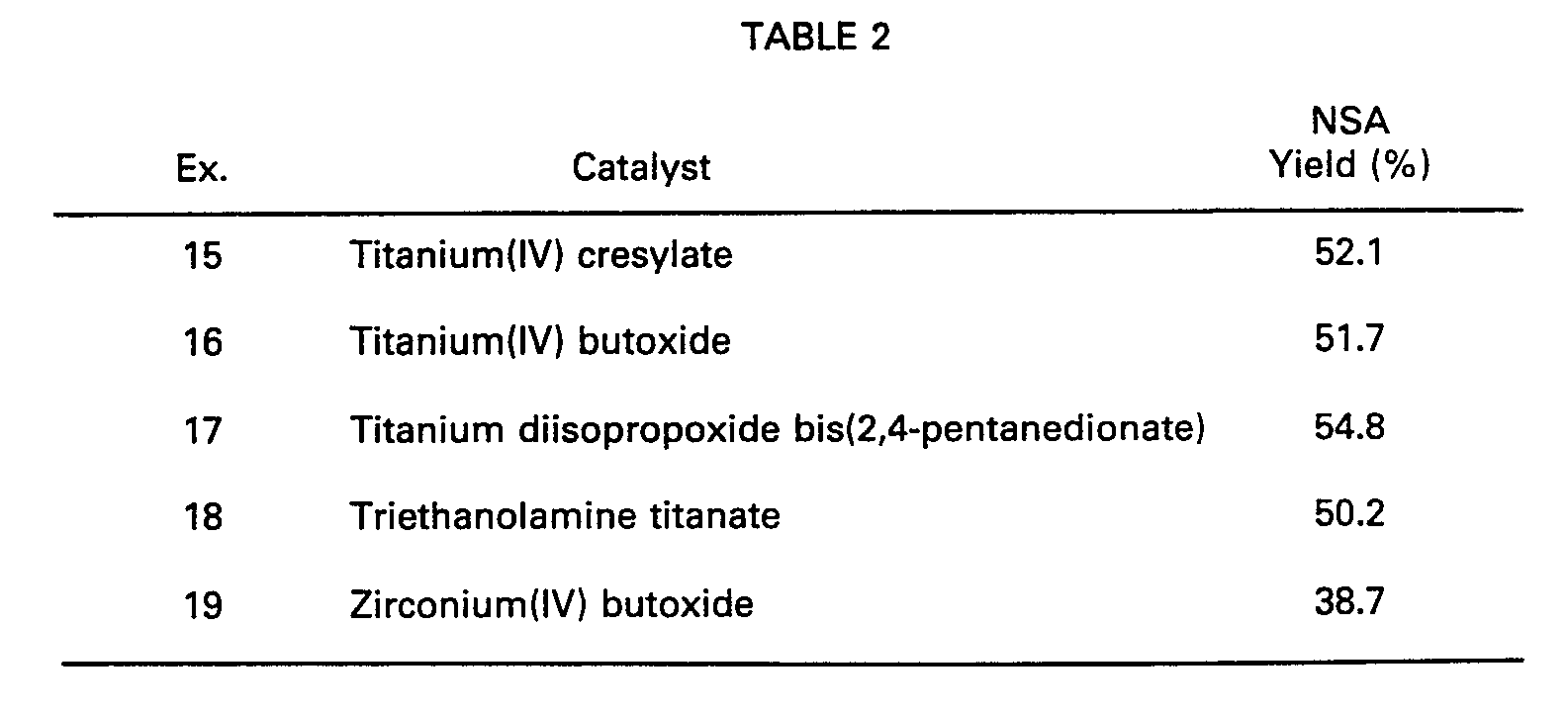
- Several preparations of nonylsalicylaldehyde (NSA) were made using different catalysts from a commercially available p-nonylphenol (in which the nonyl group is derived from propylene trimer). The procedure employed was as follows.
- Toluene (750 to 850 ml.) was charged to a two liter Parr stirred autoclave, model 4500, and heated to 200°C. A slurry containing 147 g. (0.668 mole) of nonylphenol, 63 g. (2.0 moles @ 95%) of paraformaldehyde, 2.1 g. (0.026 mole) of pyridine, 50 ml. of toluene, and 0.0038 mole of the catalyst shown in Table 2 was then pumped over a period of 5―30 minutes into the reactor. An additional 100 to 200 ml. of toluene was then pumped into the reactor to insure transfer of all the reactants into the reactor. In example 2 the pyridine was charged directly to the reactor with the initial toluene. After two hours at 200°C., the reactor was cooled, and the contents transferred to a 2 liter separatory funnel. The organic phase was washed with 10 gpl sulfuric acid, water washed to neutrality, and then the solvent was removed. The resultant oily material was then assayed by gas chromatography.

- Using a slightly different procedure at a temperature of 180°C. additional runs were made employing the same nonylphenol as in the preceding examples. The procedure was as follows.
- To a two liter Parr stirred autoclave, Model 4500, equipped with thermocouple were added 147 g. (0.668 mole) of nonylphenol, 63 g. (2.0 mole @ 95%) of paraformaldehyde, one liter of toluene, 2.1 g. (0.026 mole) of pyridine, and 0.0038 mole of a catalyst shown in Table 2. The reactor was then sealed, heated to 180°C. over a twenty minute period, and then stirred for 2 hours at 180°C. The reactor was then cooled. The reactor contents were then worked up and assayed as described for Examples 1 to 14.
- The results can be seen from Table 2.
- Several runs were made following the same procedure as employed in Example 15, but varying the amount of pyridine. The results are shown in Table 3.

- The foregoing illustrates that while the yields are significant even without the pyridine, further improvement is possible by the use of pyridine as a catalyst promoter, even at relatively low levels of pyridine.
- In these examples the temperature was varied to illustrate the effect thereof. Otherwise the procedure and materials were the same as in Example 15. The results are as shown in Table 4.

- These examples also illustrate the effect of higher temperatures but in this instance the procedure and materials employed were as described in Example 1. The results are shown in Table 5.

- In these examples, the catalyst concentration was varied to illustrate the effect thereof, using the procedure and materials of Example 15. The results are shown in Table 6.

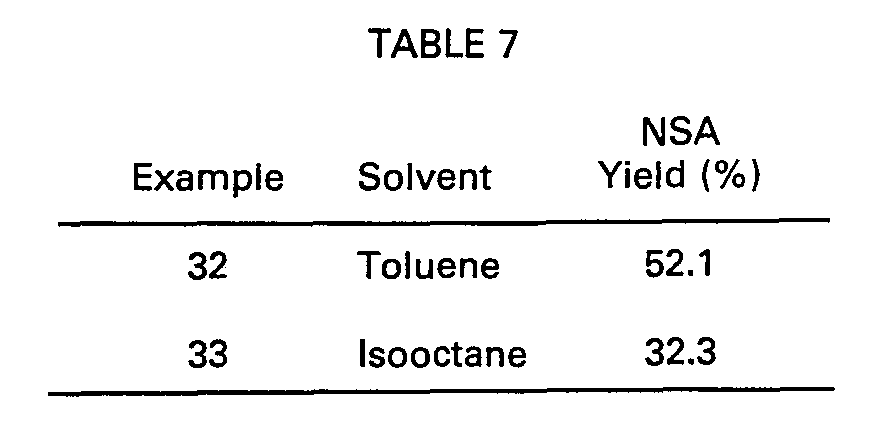
- In these examples the effect of differing solvent is illustrated. The procedure and materials were the same in Example 15. The results are shown in Table 7.
- In these examples the procedure was carried out in the same fashion as in Example 20 with the following modifications. The reactor was charged with 123.2 g. (0.56 mole) of nonylphenol, 67.3 g. (2.24 moles @ 95%) of paraformaldehyde, 1.1 g. (0.014 mole) of pyridine, 0.83 g. (0.0017 m.) of titanium cresylate, and 905 ml. of solvent. The results are shown in Table 8.

- Toluene (630 ml) was charged to a two liter Parr Stirred Autoclave, model 4500, and heated to 213°C. The catalyst was prepared by refluxing 4.54 g. (0.0095 mole) of titanium cresylate, 3.46 g. (0.023 mole) of 8-hydroxyquinoline, and 8 g. of toluene for 30 minutes. A portion (2.49 g.) of the resultant catalyst mixture was then added to a slurry containing 0.60 mole of the alkyl phenol, 81.1 g. (2.57 moles [ 95%) of paraformaldehyde, and 50 ml. of toluene. The resultant slurry mixture was pumped into the reactor over a period of 5―30 minutes. An additional 200 ml. of toluene was then pumped into the reactor to insure complete transfer of all the reactants. After two hours at 213°C., the reactor was cooled and the contents worked up in the same fashion as described in Example 1. The resultant oils were assayed by either gas chromatography or high pressure liquid chromatography. The results of the two different alkylphenols are shown in Table 9. The dodecyl phenol was a commercially available phenol in which the dodecyl group is derived from tetrapropylene. The nonylphenol is the same as employed in the earlier examples above.

- In this example commercially available octylphenol was employed. The procedure was carried out in the same manner as in Example 37 except that nonylphenol was replaced with 137.6 g. (0.668 mole) of octylphenol. The yield of octylsalicylaldehyde was 66%.
- The examples illustrate the use of other phenols. The procedure was carried out in the same manner as in Example 2, except that nonylphenol was replaced by the phenols shown in the Table 10, and the pyridine was added as a portion of the slurry. The crude products were assayed by nuclear magnetic resonance.

- The procedure was carried out in the same fashion as described for example 38 except that the catalyst was prepared by stirring 0.51 g. (0.0018 mole) of titanium(IV) butoxide, 0.54 g. (0.0037 mole) of 8-hydroxyquinoline, and 1.0 g. of toluene together for 30 minutes. The resultant catalyst mixture was then transferred quantitatively into the slurry. The yield of dodecylsalicylaldehyde was 71.5%.
- The procedure was carried out in the same fashion as described for Example 37 except that 8-hydroxyquinoline was replaced on a mole for mole basis by the chelating agents listed in Table 11.

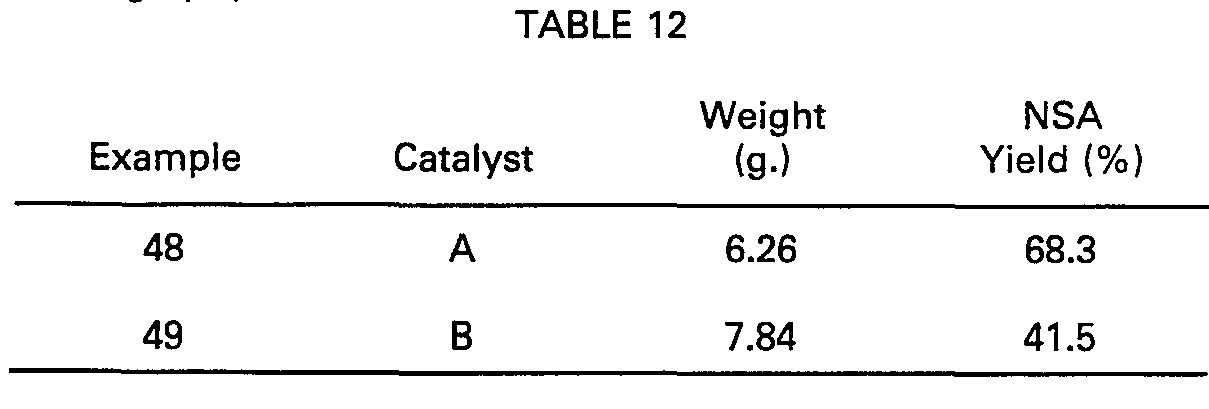
- Toluene (630 mi.) was charged to a two liter Parr stirred autoclave, model 4500, and heated to 225°C. Catalyst A was prepared by refluxing 4.54 g. (0.0095 mole) of titanium cresylate, 3.46 g. (0.023 mole) of 8-hydroxyquinoline and 8 g. of toluene for 30 minutes. Catalyst B was prepared by stirring 4.54 g. (0.0095 mole) of titanium cresylate, 6.59 g. (0.023 mole @ 92% purity) of nonylsalicylaldoxime, and 8 g. of toluene for one hour. A portion of the resultant catalyst mixture (see Table 12) was then added to a slurry containing 144.9 g. (0.65 mole) of nonylphenol, 67.47 g. (2.14 mole @ 95% purity) of paraformaldehyde, 2.1 g. (0.026 mole) of pyridine, and 50 ml. of toluene. The resultant slurry mixture was then pumped into the reactor over a 5 minute interval. An additional 200 ml. of toluene was then pumped into the reactor to insure complete transfer of all the reactants. After two hours at 225°C., the reactor was cooled and the contents worked up in the same fashion as described in Example 1. The resultant oily materials were assayed by gas chromatography.
- Toluene (850 ml.) was charged to a two liter Parr stirred autoclave, model 4500, and heated to 180°C. A slurry containing 100 g. (0.45 mole) of nonylphenol, 43 g. (1.36 mole @ 95%) of paraformaldehyde, 2.1 g. (0.026 mole) of pyridine, 50 ml. of toluene, and sufficient catalyst to provide 0.0038 mole of titanium was then pumped into the reactor over a five minute period. An additional 200 mls of toluene was then pumped into the reactor to insure transfer of all the reactants into the reactor. After two hours at 180°C., the reactor was cooled. The reactor contents were then worked up and assayed as described for Examples 15 to 19. The results are summarized in Table 13.

- The procedure was carried out in the same manner as in Example 15 except that the charge was modified. In one case, nonylsalicylaldehyde (46.4 g., 0.10 mole) was added to the charge. The charge contained 110 g. (0.5 moles) of nonylphenol, 47.47 g. (1.50 mole @ 95%) of paraformaldehyde, 2.1 g. (0.026 mole) of pyridine, 1.8 g. (0.0038 mole) of titanium cresylate, and one liter of toluene. The results are summarized in Table 14.

Claims (43)


Applications Claiming Priority (2)
| Application Number | Priority Date | Filing Date | Title |
|---|---|---|---|
| US433745 | 1982-10-12 | ||
| US06/433,745 US4638096A (en) | 1982-10-12 | 1982-10-12 | Process of preparing hydroxyarylaldehydes and catalyst therefor |
Publications (3)
| Publication Number | Publication Date |
|---|---|
| EP0106653A2 EP0106653A2 (en) | 1984-04-25 |
| EP0106653A3 EP0106653A3 (en) | 1984-08-22 |
| EP0106653B1 true EP0106653B1 (en) | 1991-01-02 |
Family
ID=23721377
Family Applications (1)
| Application Number | Title | Priority Date | Filing Date |
|---|---|---|---|
| EP83306149A Expired - Lifetime EP0106653B1 (en) | 1982-10-12 | 1983-10-11 | Hydroxyarylaldehyde preparation |
Country Status (7)
| Country | Link |
|---|---|
| US (1) | US4638096A (en) |
| EP (1) | EP0106653B1 (en) |
| JP (1) | JPH0639443B2 (en) |
| CA (1) | CA1225097A (en) |
| DE (1) | DE3382074D1 (en) |
| IE (1) | IE57045B1 (en) |
| ZA (1) | ZA835648B (en) |
Families Citing this family (12)
| Publication number | Priority date | Publication date | Assignee | Title |
|---|---|---|---|---|
| IE58737B1 (en) * | 1984-08-13 | 1993-11-03 | Ici Plc | Process for hydroxyarylaldehydes |
| US4599457A (en) * | 1985-03-20 | 1986-07-08 | Henkel Corporation | Process of preparing hydroxyarylaldehydes |
| ATE133155T1 (en) * | 1991-08-23 | 1996-02-15 | Zeneca Ltd | PRODUCTION OF 2-HYDROXYARYL ALDEHYDES |
| EP0584988B1 (en) * | 1992-08-20 | 1996-10-23 | Zeneca Limited | Process for the preparation of salicylaldoxine derivatives |
| GB9217724D0 (en) * | 1992-08-20 | 1992-09-30 | Ici Plc | Chemical process |
| US5334762A (en) * | 1993-02-04 | 1994-08-02 | Zeneca Inc. | Method for accelerating oxime production |
| US5514823A (en) * | 1994-02-07 | 1996-05-07 | Henkel Corporation | Bis-(alkylsalicylidene)ethylene or phenylene diamines and transition metal complexes thereof |
| US5877355A (en) * | 1996-03-19 | 1999-03-02 | Henkel Corporation | 2-hydroxy-5-alkyl-beta-methylstyrene and process of preparing hydroxyarylaldehydes therefrom |
| US5969185A (en) * | 1997-07-14 | 1999-10-19 | Henkel Corporation | Process for making phenolic ketones |
| EP3121161B1 (en) * | 2015-07-23 | 2018-03-07 | S.P.C.M. Sa | A method for the preparation of alkylsalicylaldehyde and alkylsalicylaldoxime, and use thereof |
| CN112898350A (en) * | 2021-01-20 | 2021-06-04 | 上海克琴科技有限公司 | Preparation method of guaiacol-derived bisiminomanganese complex |
| CN117924056B (en) * | 2024-03-25 | 2024-06-11 | 山东新和成药业有限公司 | Synthesis method of conjugated diketone compound |
Family Cites Families (4)
| Publication number | Priority date | Publication date | Assignee | Title |
|---|---|---|---|---|
| GB1563206A (en) * | 1975-12-15 | 1980-03-19 | Ici Ltd | Process for the manufacture of o-hydroxyaryl aldehydes |
| IT1068110B (en) * | 1976-08-13 | 1985-03-21 | Montedison Spa | PROCESS FOR THE PREPARATION OF HYDROXIBENZOIC ALDEHYDES 2 |
| US4324922A (en) * | 1979-06-28 | 1982-04-13 | The Dow Chemical Company | Reimer-Tiemann aldehyde synthesis process |
| FR2514344A1 (en) * | 1981-10-09 | 1983-04-15 | Rhone Poulenc Spec Chim | PROCESS FOR THE PREPARATION OF ORTHOHYDROXYBENZALDEHYDES |
-
1982
- 1982-10-12 US US06/433,745 patent/US4638096A/en not_active Expired - Lifetime
-
1983
- 1983-08-02 ZA ZA835648A patent/ZA835648B/en unknown
- 1983-08-12 CA CA000434470A patent/CA1225097A/en not_active Expired
- 1983-09-14 JP JP58168476A patent/JPH0639443B2/en not_active Expired - Lifetime
- 1983-10-11 EP EP83306149A patent/EP0106653B1/en not_active Expired - Lifetime
- 1983-10-11 IE IE2388/83A patent/IE57045B1/en not_active IP Right Cessation
- 1983-10-11 DE DE8383306149T patent/DE3382074D1/en not_active Expired - Lifetime
Also Published As
| Publication number | Publication date |
|---|---|
| CA1225097A (en) | 1987-08-04 |
| JPS5973537A (en) | 1984-04-25 |
| EP0106653A3 (en) | 1984-08-22 |
| IE57045B1 (en) | 1992-04-08 |
| US4638096A (en) | 1987-01-20 |
| IE832388L (en) | 1984-04-12 |
| ZA835648B (en) | 1984-09-26 |
| DE3382074D1 (en) | 1991-02-07 |
| JPH0639443B2 (en) | 1994-05-25 |
| EP0106653A2 (en) | 1984-04-25 |
Similar Documents
| Publication | Publication Date | Title |
|---|---|---|
| US4638096A (en) | Process of preparing hydroxyarylaldehydes and catalyst therefor | |
| WO1980000841A1 (en) | Process for producing oxymorphone | |
| US4196135A (en) | Palladium complex | |
| GB1563206A (en) | Process for the manufacture of o-hydroxyaryl aldehydes | |
| AU668739B2 (en) | Chemical process | |
| JP3562586B2 (en) | Chemical method | |
| US4453004A (en) | Process for the alkylation of phenolic compounds | |
| US3862994A (en) | Process for condensation of alcohols | |
| US5260487A (en) | Process for the preparation of 2-hydroxyarylaldehydes | |
| IE57046B1 (en) | Process for preparing dialkyl propanediimidate dihydrohalides | |
| US4599457A (en) | Process of preparing hydroxyarylaldehydes | |
| EP0584988B1 (en) | Process for the preparation of salicylaldoxine derivatives | |
| CN111320655B (en) | Phosphine ligand compound and preparation method thereof, catalyst composition and application thereof, and vinyl acetate hydroformylation method | |
| WO2002094755A1 (en) | Catalytic system for aldol reactions | |
| EP0074272B1 (en) | Process for the preparation of hydroxybenzaldehydes | |
| JPS6338338B2 (en) | ||
| US5877355A (en) | 2-hydroxy-5-alkyl-beta-methylstyrene and process of preparing hydroxyarylaldehydes therefrom | |
| Michman et al. | Reactions of methyltris (triarylphosphine) cobalt: III. Aldol condensation catalysed by methyltris (triphenylphosphine) cobalt,(Ph3P) 3CoCH3 | |
| US5969185A (en) | Process for making phenolic ketones | |
| Awasarkar et al. | Organoxytitanium and Organotin Derivatives of Dibasic Tetradentate Chelating Disulphides | |
| JPS6038343A (en) | Production of phenylacetic acid derivative | |
| JP2000264855A (en) | Method for producing halopropyl ethers | |
| EP0506760A1 (en) | Catalytic method to produce hydroxy substituted arylophenones | |
| CN111320656A (en) | Phosphine ligand compound and preparation method thereof, catalyst composition and application thereof, and vinyl acetate hydroformylation method | |
| Ackland et al. | Conversion of (2-methyl-1-azabuta-1, 3-diene) tricarbonyliron (> 0>) complexes into (enamine) tricarbonyliron (> 0>) complexes |
Legal Events
| Date | Code | Title | Description |
|---|---|---|---|
| PUAI | Public reference made under article 153(3) epc to a published international application that has entered the european phase |
Free format text: ORIGINAL CODE: 0009012 |
|
| AK | Designated contracting states |
Designated state(s): BE CH DE FR GB IT LI NL SE |
|
| PUAL | Search report despatched |
Free format text: ORIGINAL CODE: 0009013 |
|
| AK | Designated contracting states |
Designated state(s): BE CH DE FR GB IT LI NL SE |
|
| 17P | Request for examination filed |
Effective date: 19841219 |
|
| GRAA | (expected) grant |
Free format text: ORIGINAL CODE: 0009210 |
|
| AK | Designated contracting states |
Kind code of ref document: B1 Designated state(s): BE CH DE FR GB IT LI NL SE |
|
| ITF | It: translation for a ep patent filed | ||
| REF | Corresponds to: |
Ref document number: 3382074 Country of ref document: DE Date of ref document: 19910207 |
|
| ET | Fr: translation filed | ||
| PLBE | No opposition filed within time limit |
Free format text: ORIGINAL CODE: 0009261 |
|
| STAA | Information on the status of an ep patent application or granted ep patent |
Free format text: STATUS: NO OPPOSITION FILED WITHIN TIME LIMIT |
|
| 26N | No opposition filed | ||
| PGFP | Annual fee paid to national office [announced via postgrant information from national office to epo] |
Ref country code: SE Payment date: 19920924 Year of fee payment: 10 Ref country code: CH Payment date: 19920924 Year of fee payment: 10 |
|
| PG25 | Lapsed in a contracting state [announced via postgrant information from national office to epo] |
Ref country code: SE Effective date: 19931012 |
|
| PG25 | Lapsed in a contracting state [announced via postgrant information from national office to epo] |
Ref country code: LI Effective date: 19931031 Ref country code: CH Effective date: 19931031 |
|
| REG | Reference to a national code |
Ref country code: CH Ref legal event code: PL |
|
| EUG | Se: european patent has lapsed |
Ref document number: 83306149.2 Effective date: 19940510 |
|
| PGFP | Annual fee paid to national office [announced via postgrant information from national office to epo] |
Ref country code: NL Payment date: 19970918 Year of fee payment: 15 |
|
| PGFP | Annual fee paid to national office [announced via postgrant information from national office to epo] |
Ref country code: BE Payment date: 19981005 Year of fee payment: 16 |
|
| PG25 | Lapsed in a contracting state [announced via postgrant information from national office to epo] |
Ref country code: NL Free format text: LAPSE BECAUSE OF NON-PAYMENT OF DUE FEES Effective date: 19990501 |
|
| NLV4 | Nl: lapsed or anulled due to non-payment of the annual fee |
Effective date: 19990501 |
|
| PG25 | Lapsed in a contracting state [announced via postgrant information from national office to epo] |
Ref country code: BE Free format text: LAPSE BECAUSE OF NON-PAYMENT OF DUE FEES Effective date: 19991031 |
|
| BERE | Be: lapsed |
Owner name: HENKEL CORP. (A DELAWARE CORP.) Effective date: 19991031 |
|
| PGFP | Annual fee paid to national office [announced via postgrant information from national office to epo] |
Ref country code: FR Payment date: 20010920 Year of fee payment: 19 Ref country code: DE Payment date: 20010920 Year of fee payment: 19 |
|
| PGFP | Annual fee paid to national office [announced via postgrant information from national office to epo] |
Ref country code: GB Payment date: 20010921 Year of fee payment: 19 |
|
| REG | Reference to a national code |
Ref country code: GB Ref legal event code: IF02 |
|
| PG25 | Lapsed in a contracting state [announced via postgrant information from national office to epo] |
Ref country code: GB Free format text: LAPSE BECAUSE OF NON-PAYMENT OF DUE FEES Effective date: 20021011 |
|
| PG25 | Lapsed in a contracting state [announced via postgrant information from national office to epo] |
Ref country code: DE Free format text: LAPSE BECAUSE OF NON-PAYMENT OF DUE FEES Effective date: 20030501 |
|
| GBPC | Gb: european patent ceased through non-payment of renewal fee |
Effective date: 20021011 |
|
| PG25 | Lapsed in a contracting state [announced via postgrant information from national office to epo] |
Ref country code: FR Free format text: LAPSE BECAUSE OF NON-PAYMENT OF DUE FEES Effective date: 20030630 |
|
| REG | Reference to a national code |
Ref country code: FR Ref legal event code: FC |
|
| REG | Reference to a national code |
Ref country code: FR Ref legal event code: ST |