EP0106363A2 - Water resistant room temperature vulcanizable polyorganosiloxane compositions and method for preparing same - Google Patents
Water resistant room temperature vulcanizable polyorganosiloxane compositions and method for preparing same Download PDFInfo
- Publication number
- EP0106363A2 EP0106363A2 EP83110416A EP83110416A EP0106363A2 EP 0106363 A2 EP0106363 A2 EP 0106363A2 EP 83110416 A EP83110416 A EP 83110416A EP 83110416 A EP83110416 A EP 83110416A EP 0106363 A2 EP0106363 A2 EP 0106363A2
- Authority
- EP
- European Patent Office
- Prior art keywords
- parts
- calcium carbonate
- weight
- group
- compositions
- Prior art date
- Legal status (The legal status is an assumption and is not a legal conclusion. Google has not performed a legal analysis and makes no representation as to the accuracy of the status listed.)
- Withdrawn
Links
Classifications
-
- C—CHEMISTRY; METALLURGY
- C09—DYES; PAINTS; POLISHES; NATURAL RESINS; ADHESIVES; COMPOSITIONS NOT OTHERWISE PROVIDED FOR; APPLICATIONS OF MATERIALS NOT OTHERWISE PROVIDED FOR
- C09K—MATERIALS FOR MISCELLANEOUS APPLICATIONS, NOT PROVIDED FOR ELSEWHERE
- C09K3/00—Materials not provided for elsewhere
- C09K3/10—Materials in mouldable or extrudable form for sealing or packing joints or covers
- C09K3/1006—Materials in mouldable or extrudable form for sealing or packing joints or covers characterised by the chemical nature of one of its constituents
- C09K3/1018—Macromolecular compounds having one or more carbon-to-silicon linkages
-
- C—CHEMISTRY; METALLURGY
- C08—ORGANIC MACROMOLECULAR COMPOUNDS; THEIR PREPARATION OR CHEMICAL WORKING-UP; COMPOSITIONS BASED THEREON
- C08K—Use of inorganic or non-macromolecular organic substances as compounding ingredients
- C08K3/00—Use of inorganic substances as compounding ingredients
- C08K3/18—Oxygen-containing compounds, e.g. metal carbonyls
- C08K3/24—Acids; Salts thereof
- C08K3/26—Carbonates; Bicarbonates
-
- C—CHEMISTRY; METALLURGY
- C08—ORGANIC MACROMOLECULAR COMPOUNDS; THEIR PREPARATION OR CHEMICAL WORKING-UP; COMPOSITIONS BASED THEREON
- C08K—Use of inorganic or non-macromolecular organic substances as compounding ingredients
- C08K5/00—Use of organic ingredients
- C08K5/54—Silicon-containing compounds
-
- C—CHEMISTRY; METALLURGY
- C08—ORGANIC MACROMOLECULAR COMPOUNDS; THEIR PREPARATION OR CHEMICAL WORKING-UP; COMPOSITIONS BASED THEREON
- C08K—Use of inorganic or non-macromolecular organic substances as compounding ingredients
- C08K9/00—Use of pretreated ingredients
- C08K9/04—Ingredients treated with organic substances
-
- C—CHEMISTRY; METALLURGY
- C09—DYES; PAINTS; POLISHES; NATURAL RESINS; ADHESIVES; COMPOSITIONS NOT OTHERWISE PROVIDED FOR; APPLICATIONS OF MATERIALS NOT OTHERWISE PROVIDED FOR
- C09K—MATERIALS FOR MISCELLANEOUS APPLICATIONS, NOT PROVIDED FOR ELSEWHERE
- C09K2200/00—Chemical nature of materials in mouldable or extrudable form for sealing or packing joints or covers
- C09K2200/02—Inorganic compounds
- C09K2200/0239—Oxides, hydroxides, carbonates
Definitions
- This invention relates to room temperature-curable polyorganosiloxane compositions. More particularly, this invention relates to such room temperature-curable polyorganosiloxane compositions that exhibit improved water resistance during the initial stages of curing relative to prior art compositions.
- organosilicon compounds containing two amide groups in combination with organosiliccn compounds containing 3 or more amide or aminoxy groups in room temperature vulcanizable compositions-containing a hydroxyl-terminated polyorganosiloxane has been disclosed in the prior art.
- By varying the ratio of these difunctional and polyfunctional curing agents it is possible to obtain a range of properties in the cured product ranging from low modulus and high elongation to high moldulus and low elongation.
- Low modulus-high elongation materials are widely used as construction sealants due to the superior resistance of these materials to weather and fatigue.
- Room temperature vulcanizable (RTV) compositions typically contain fillers such as silica and calcium carbonate to improve the physical properties or to impart certain characteristics, such as paintability, to the cured products.
- Paintable RTV compositions containing hydroxyl endblocked polydiorganosiloxanes, acyloxysilanes, tin carboxylate catalysts and a finely divided, accicular form of calcium carbonate are disclosed in United States Patent No. 3,957,714, which issued to Clark and Johnson on May 18, 1976, and in United States Patent Nos. 4,247,445 and 4,293,616, which issued to Smith, et al. on January 27 and October 6, 1981, respectively.
- One objective of this invention is to provide moisture curable calcium carbonate filled RTV polyorganosiloxane compositions which are more water resistant during curing than prior art compositions.
- a second objective of this invention is to provide a method for increasing the water resistance of incompletely cured RTV polyorganosiloxane compositions containing calcium carbonate as a filler without adversely affecting other properties of the cured compositions, such as adhesion.
- the objectives of this invention are achieved by treating a calcium carbonate filler for moisture curable RTV polyorganosiloxane compositions with a cationic or nonionic surfactant or with an organosilicon compound to render the particles hydrophobic.
- the treatment can be carried out prior to or during addition of the calcium carbonate to the curable polyorganosiloxane composition.
- This invention provides a room temperature vulcanizable calcium carbonate-filled polyorganosiloxane composition which is stable in the absence of moisture, curable in the presence of moisture, and exhibits water resistance and adhesion during curing, said composition comprising (A) 100 parts by weight of an hydroxyl endblocked organopolysiloxane having a viscosity at 25°C of at least 0.02 Pa's, (B) from 0.5 to 30 parts by weight of an organosilicon compound containing 2 amide groups per molecule, (C) from 0 to 15 parts by weight of an organosilicon compound containing at least 3 amide, aminoxy or amino groups per molecule, and (D) from 1 to 300 parts by weight of calcium carbonate which has been treated with a hydrophobicizing agent selected from the group consisting of cationic surfactants, nonionic surfactants exhibiting a maximum HLB value of 10, and organosilanes containing at least one silicon-bonded hydrocarbyl or substituted hydrocarbyl radical where the
- the aforementioned polyorganosiloxane constitutes the base material of the present compositions.
- This polyorganosiloxane is preferably a a,w-dihydroxy- polydiorganosiloxane of the general formula HO( ⁇ R 2 SiO) ⁇ n H wherein R represents a hydrocarbyl, halohydrocarbyl, or cyanohydrocarbyl radical, and n represents an integer having a minimum value such that the viscosity of the polydiorganosiloxane is at least 0.02 Pa's at 25°C. While linear polyorganosiloxanes are preferred, branched polymers containing 3 or more hydroxyl groups per molecule can also be used.
- the radical represented by R in the foregoing formula can be alkyl, such as methyl, ethyl, propyl and octyl; alkenyl such as vinyl and alkyl; aryl such as phenyl; alkaryl such as tolyl; haloalkyl such as chloromethyl and 3,3,3-trifluoropropyl or cyanoalkyl such as 6-cyanoethyl.
- the two R radicals bonded to each silicon atom can be identical or different.
- the mechanical properties of the cured elastomers obtained from the present curable compositions, and the viscosity of the curable composition it is preferable that at least 70% of the R radicals are methyl. Most preferably all of the R radicals are methyl.
- n which represents the average degree of polymerization of the polyorganosiloxane, is such that the viscosity of the polyorganosiloxane is at least 0.02 Pa's at 25°C.
- the viscosity of the polyorganosiloxane is below this value, the cured elastomer does not exhibit superior physical properties, such as flexibility and high elongation. Because hydroxyl groups are present at both ends of the polymer molecules, polyorganosiloxane (A) should be capable of further polymerization, irrespective of its molecular weight in the curable composition.
- gums having viscosities of 1,000 Pa's or higher at 25°C can be used, so long as further polymerization of the polyorganosiloxane is possible.
- a high viscosity polymer is usually mixed with a lower viscosity polymer or diluted with a solvent before being incorporated into the present composition.
- the viscosity of polyorganosiloxane (A) be within the range of from 0.1 to 200 Pa's at 25°C.
- Organosilicon compound (B), containing 2 amide groups per molecule, is necessary to this invention. It reacts with the hydroxyl groups of polyorganosiloxane (A) to extend the polymer chain and produce a low modulus-high elongation cured composition. Moreover, in those instances when (A) contains 3 or more hydroxyl groups per molecule and organosilicon compound (C) is absent, organosilicon compound (B) can also function as a crosslinking agent. The reason for restricting (B) to amide group-containing organosilicon compounds is the superior single package storage stability and the remarkable adhesiveness for base materials obtained using these compounds.
- organosilicon compound (B) examples include, but are not limited to: bifunctional amidosilanes such as dimethylbis(N-methylacetamido)silane, dimethylbis(N-ethylacetamido)silane, methylvinylbis-(N-ethylacetamido)silane, methylvinylbis(N-butylacetamido)-silane, methylphenylbis(N-methylacetamido)silane, and dimethylbis(N-phenylacetamido)silane; bifunctional amidosiloxanes such as , and and bifunctional amidocyclosiloxanes such as and
- the concentration of (B) is dependent upon the required properties of the cured elastomer. In order-to obtain the low modulus material which is the goal of this invention, from 0.5% to 30 parts by weight of (B) are necessary per 100 parts by weight of polyorganosiloxane (A). Below this range, the cured material will have a high modulus and the single package storage stability will be poor. Above this range, the curing rate becomes too slow, which is economically disadvantageous.
- Organosilicon compound (C) must contain in each molecule at least 3 functional groups selected from among amide, aminoxy, and amino.
- (C) is a crosslinking agent which reacts with the hydroxyl groups of the organopolysiloxane (A) at room temperature in the presence of moisture to achieve crosslinking and curing. For this purpose, at least 3 functional groups chosen from among amide, aminoxy and amino are required in each molecule.
- (C) is not required and (B) alone is adequate for curing.
- (A) is the most commonly used embodiment, namely an a,w-dihydroxypolydiorganosiloxane
- (C) is an indispensable part of the curable composition.
- (C) is an amide group-containing organosilicon compound: amidosilanes such as methyltris(N-methylacetamido)silane and vinyltris-( N -ethylacetamido)silane, tetrakis(N-butylacetamido)silane; amidosiloxanes such as and amidocyclosiloxanes such as and
- (C) is an amino group-containing organosilicon compound: methyltri(phenylamino)silane, ethyltri(phenylamino)silane, methyltri(n-butylamino)silane, phenyltri(dimethylamino)-silane and methyltri(cyclohexylamino)silane.
- (C) can be an organosilicon compound containing in each molecule 2 or 3 types of functional groups chosen from among amide, aminoxy and amino.
- functional groups chosen from among amide, aminoxy and amino.
- compositions can include as (C) one or more of the aforementioned types of amide group-containing organosilicon compounds, aminoxy group-containing organosilicon compounds and amino group-containing organosilicon compounds. In some instances 2 or 3 types of these organosilicon compounds with different functional groups can be combined and used as (C).
- the total concentration of the organosilicon compounds constituting (C) should be from 0 to 15 parts by weight per 100 parts by weight of polyorganosiloxane (A). Exceeding this range will cause several problems, including a slow curing rate and no possibility of obtaining a superior cured elastomeric product, and is therefore disadvantageous both economically and practically.
- the hydrophobicized calcium carbonate (D) is indispensable to achieving the objective of this invention, specifically improving the water resistance of the present compositions during the initial stage of curing.
- Hydrophobicization is achieved by treating the surface of calcium carbonate using at least one treatment agent selected from cationic surfactants, nonionic surfactants and organosilanes containing at least one silicon-bonded substituted or unsubstituted hydrocarbyl radical.
- the substituent is an amino, epoxy, acyloxy, or mercapto group.
- the remaining valences on the silicon atom are preferably satisfied by alkoxy groups. Most preferably the alkoxy group is methoxy or ethoxy.
- the type of calcium carbonate used is not critical. Any of the untreated commercially available types of calcium carbonate can be used.
- the particles are treated in accordance with this invention either prior to or during preparation of the curable compositions.
- the aliphatic acids and resin acids commonly used for surface treatment of calcium carbonate are not suitable.
- the accompanying examples demonstrate that while these treating agents may improve the water resistance of the composition during the initial stage of curing, they adversely affect the adhesiveness of RTV polyorganosiloxane compositions for base materials.
- Cationic surfactants include, among others, aliphatic amine salts, quaternary ammonium salts and alkylpyridinium salts. Among these, quaternary ammonium salts are preferred, with dodecyltrimethylammonium chloride, octadecyltrimethylammonium chloride, and dioctadecadienyl- dimethylammonium chloride being particularly preferred.
- Nonionic surfactants include, among others, polyoxyalkylene glycols, ethers of polyoxyalkylene glycols, esters of polyoxyalkylene glycols, monoamino derivatives of polyoxyalkylene glycols and aliphatic alkanolamides. Among these, polyalkylene glycols and their monoethers or monoesters are preferred, with poly(oxyethyleneoxypropylene) glycols, polyoxypropylene glycol monoethers and poly(oxyethyleneoxypropylene) glycol monoesters being particularly preferred. Suitable nonionic surfactants exhibit a hydrophilic-lyophelic balance (HLB) of at most 10, and preferably at most 5.
- HLB hydrophilic-lyophelic balance
- Organosilanes that are useful hydrophobizing agents include, among others, aminoalkylsilanes such as y-aminopropyltriethoxysilane; ⁇ -( ⁇ -aminoethyl)aminopropyltrimethoxysilane and y-aminopropyltriethoxysilane; epoxyalkylsilanes such as y-glycidyloxypropyltrimethoxy- silane and P-(3,4-epoxycyclohexyl)ethyltrimethoxysilane; acryloxyalkylsilanes such as Y-methacryloxypropylmethyldimethoxysilane and y-acryloxypropyltrimethoxysilane; mercaptoalkylsilanes such as y-mercaptopropylmethoxysilane and y-mercaptopropylmethyldimethoxysilane; and hydrocarbyl- silanes such as
- organosilanes When the aforementioned organosilanes are used, it is preferably to either treat the calcium carbonate prior to adding the calcium carbonate to the curable composition or to add the organosilane while simultaneously mixing the polyorganosiloxane (A) and the untreated calcium carbonate during the production of a curable composition of this invention.
- a general procedure for pretreating calcium carbonate is as follows:
- the concentration of hydrophobicized calcium carbonate is from 1 to 300 parts by weight, preferably from 5 to 150 parts by weight, per 100 parts by weight of polyorganosiloxane (A). Below 1 part by weight, the improvement in water resistance during the initial stage of curing, which is the objective of this invention, is inadequate. Above a concentration of 300 parts by weight of calcium carbonate, the composition's viscosity increases to the extent that a good quality cured elastomer cannot be obtained.
- finely divided inorganic fillers may be added to the present curable compositions.
- suitable inorganic fillers include fumed silica, calcined silica, precipitated silica, fine quartz powder, untreated calcium carbonate, titanium oxide, diatomaceous earth, aluminum hydroxide, and alumina, among others.
- the present compositions may also include organic solvents, mold release agents, flame retardants, plasticizers, and adhesion promoters.
- compositions of this invention can be prepared by homogeneously blending the aforementioned required and optional ingredients in a moisture-free environment.
- the compositions remain stable for relatively long periods in a moisture-free environment. Upon contact with atmospheric moisture, they readily cure to a silicone rubber.
- the resistance to rain and other forms of liquid water during the initial stages of curing is improved, as evidenced by the elimination of cracking, partial flow-out and incomplete curing.
- the present compositions can be applied and exposed to rain during the initial stages of curing, and are ideal construction sealants.
- composition to be evaluated was extruded in beads on a glass plate and immediately showered for 5 minutes with water from an outlet located 15 cm from the composition.
- the rate of water flow was 5 liters per minute.
- "0" indicates no change. in the appearance of the composition and "X” indicates flowing and/or cracking of the composition.
- composition to be evaluated was extruded in beads on a glass plate, an alumite sulfate-treated aluminum plate and a mortar plate. Each sample was then cured at room temperature for 2 weeks. The cured compositions were then peeled off the plates at 90°C by pulling them in a direction perpendicular to the plane of the plate.
- Table 2 “O” indicates cohesive failure of the composition and "X” indicates adhesive failure.
- a 2 mm-thick sheet was produced from each of the compositions. After storing the sheets at room temperature for 2 weeks, the hardness (D), tensile strength (T) and elongation (E) were measured according to JIS K6301.
- compositions were prepared and evaluated as described in the first part of this example, the only difference being that the calcium carbonate was either untreated or treated with an aliphatic carboxylic acid or a resin acid.
- the results of these evaluations are also reported in Table 2.
- the composition containing untreated calcium carbonate When compared with the compositions of the present invention, the composition containing untreated calcium carbonate exhibited an inferior initial water resistance.
- the compositions containing aliphatic acid-treated or resin acid-treated calcium carbonate exhibited an improved initial water resistance relative to Comparison 5, however, the cured composition exhibited adhesive failure in the adhesion test.
- compositions were prepared under the same conditions, except that the calcium carbonate of the invention was replaced by untreated calcium carbonate or aliphatic acid-treated calcium carbonate.
- compositions according to the present invention were obtained.
- a poly(oxyethylenoxypropylene) glycol was used as an in-situ treating agent.
- compositions were prepared under the same conditions, except the calcium carbonate of the invention was replaced by untreated calcium carbonate, aliphatic acid-treated calcium carbonate or a mixture of aliphatic acid-treated calcium carbonate and untreated calcium carbonate.
- composition of the test samples is reported in Table 5.
- the compositions were prepared and evaluated as described in Example 1.
- Table 6 reports the results, which were similar to those reported in Table 2.
- the resultant composition was blended to homogeneity, following which the same initial water resistance test and adhesion test described hereinbefore were performed. Ratings of "O" were obtained in both tests.
Landscapes
- Chemical & Material Sciences (AREA)
- Organic Chemistry (AREA)
- Health & Medical Sciences (AREA)
- Chemical Kinetics & Catalysis (AREA)
- Medicinal Chemistry (AREA)
- Polymers & Plastics (AREA)
- Engineering & Computer Science (AREA)
- Materials Engineering (AREA)
- Compositions Of Macromolecular Compounds (AREA)
- Sealing Material Composition (AREA)
Abstract
Description
- This invention relates to room temperature-curable polyorganosiloxane compositions. More particularly, this invention relates to such room temperature-curable polyorganosiloxane compositions that exhibit improved water resistance during the initial stages of curing relative to prior art compositions.
- The use of organosilicon compounds containing two amide groups in combination with organosiliccn compounds containing 3 or more amide or aminoxy groups in room temperature vulcanizable compositions-containing a hydroxyl-terminated polyorganosiloxane has been disclosed in the prior art. By varying the ratio of these difunctional and polyfunctional curing agents, it is possible to obtain a range of properties in the cured product ranging from low modulus and high elongation to high moldulus and low elongation. Low modulus-high elongation materials are widely used as construction sealants due to the superior resistance of these materials to weather and fatigue.
- Room temperature vulcanizable (RTV) compositions typically contain fillers such as silica and calcium carbonate to improve the physical properties or to impart certain characteristics, such as paintability, to the cured products. Paintable RTV compositions containing hydroxyl endblocked polydiorganosiloxanes, acyloxysilanes, tin carboxylate catalysts and a finely divided, accicular form of calcium carbonate are disclosed in United States Patent No. 3,957,714, which issued to Clark and Johnson on May 18, 1976, and in United States Patent Nos. 4,247,445 and 4,293,616, which issued to Smith, et al. on January 27 and October 6, 1981, respectively.
- None of the aforementioned references concerning the use of calcium carbonate in RTV polyorganosiloxane compositions disclose the susceptability of incompletely cured RTV polyorganosiloxane compositions containing calcium carbonate as a filler to undergo cracking, flow out, inhibition of curing and/or loss of adhesion to an underlying substrate in the presence of water.
- One objective of this invention is to provide moisture curable calcium carbonate filled RTV polyorganosiloxane compositions which are more water resistant during curing than prior art compositions.
- A second objective of this invention is to provide a method for increasing the water resistance of incompletely cured RTV polyorganosiloxane compositions containing calcium carbonate as a filler without adversely affecting other properties of the cured compositions, such as adhesion.
- The objectives of this invention are achieved by treating a calcium carbonate filler for moisture curable RTV polyorganosiloxane compositions with a cationic or nonionic surfactant or with an organosilicon compound to render the particles hydrophobic. The treatment can be carried out prior to or during addition of the calcium carbonate to the curable polyorganosiloxane composition.
- This invention provides a room temperature vulcanizable calcium carbonate-filled polyorganosiloxane composition which is stable in the absence of moisture, curable in the presence of moisture, and exhibits water resistance and adhesion during curing, said composition comprising (A) 100 parts by weight of an hydroxyl endblocked organopolysiloxane having a viscosity at 25°C of at least 0.02 Pa's, (B) from 0.5 to 30 parts by weight of an organosilicon compound containing 2 amide groups per molecule, (C) from 0 to 15 parts by weight of an organosilicon compound containing at least 3 amide, aminoxy or amino groups per molecule, and (D) from 1 to 300 parts by weight of calcium carbonate which has been treated with a hydrophobicizing agent selected from the group consisting of cationic surfactants, nonionic surfactants exhibiting a maximum HLB value of 10, and organosilanes containing at least one silicon-bonded hydrocarbyl or substituted hydrocarbyl radical where the substituent on the substituted hydrocarbyl radical is selected from the group consisting of amino, epoxy, acryloxy, and mercapto groups.
- The aforementioned polyorganosiloxane constitutes the base material of the present compositions. This polyorganosiloxane is preferably a a,w-dihydroxy- polydiorganosiloxane of the general formula HO(̵R2SiO)̵nH wherein R represents a hydrocarbyl, halohydrocarbyl, or cyanohydrocarbyl radical, and n represents an integer having a minimum value such that the viscosity of the polydiorganosiloxane is at least 0.02 Pa's at 25°C. While linear polyorganosiloxanes are preferred, branched polymers containing 3 or more hydroxyl groups per molecule can also be used.
- The radical represented by R in the foregoing formula can be alkyl, such as methyl, ethyl, propyl and octyl; alkenyl such as vinyl and alkyl; aryl such as phenyl; alkaryl such as tolyl; haloalkyl such as chloromethyl and 3,3,3-trifluoropropyl or cyanoalkyl such as 6-cyanoethyl. The two R radicals bonded to each silicon atom can be identical or different. To achieve a favorable balance between ease of synthesis of the polyorganosiloxane, the mechanical properties of the cured elastomers obtained from the present curable compositions, and the viscosity of the curable composition, it is preferable that at least 70% of the R radicals are methyl. Most preferably all of the R radicals are methyl.
- As previously disclosed, the minimum value of n, which represents the average degree of polymerization of the polyorganosiloxane, is such that the viscosity of the polyorganosiloxane is at least 0.02 Pa's at 25°C. When the viscosity of the polyorganosiloxane is below this value, the cured elastomer does not exhibit superior physical properties, such as flexibility and high elongation. Because hydroxyl groups are present at both ends of the polymer molecules, polyorganosiloxane (A) should be capable of further polymerization, irrespective of its molecular weight in the curable composition. Even gums having viscosities of 1,000 Pa's or higher at 25°C can be used, so long as further polymerization of the polyorganosiloxane is possible. A high viscosity polymer is usually mixed with a lower viscosity polymer or diluted with a solvent before being incorporated into the present composition. For practical purposes, including a useful production rate for the present curable compositions, it is preferable that the viscosity of polyorganosiloxane (A) be within the range of from 0.1 to 200 Pa's at 25°C.
- Organosilicon compound (B), containing 2 amide groups per molecule, is necessary to this invention. It reacts with the hydroxyl groups of polyorganosiloxane (A) to extend the polymer chain and produce a low modulus-high elongation cured composition. Moreover, in those instances when (A) contains 3 or more hydroxyl groups per molecule and organosilicon compound (C) is absent, organosilicon compound (B) can also function as a crosslinking agent. The reason for restricting (B) to amide group-containing organosilicon compounds is the superior single package storage stability and the remarkable adhesiveness for base materials obtained using these compounds.
- Compounds that can be used as organosilicon compound (B) include, but are not limited to: bifunctional amidosilanes such as dimethylbis(N-methylacetamido)silane, dimethylbis(N-ethylacetamido)silane, methylvinylbis-(N-ethylacetamido)silane, methylvinylbis(N-butylacetamido)-silane, methylphenylbis(N-methylacetamido)silane, and dimethylbis(N-phenylacetamido)silane; bifunctional amidosiloxanes such as


- The concentration of (B) is dependent upon the required properties of the cured elastomer. In order-to obtain the low modulus material which is the goal of this invention, from 0.5% to 30 parts by weight of (B) are necessary per 100 parts by weight of polyorganosiloxane (A). Below this range, the cured material will have a high modulus and the single package storage stability will be poor. Above this range, the curing rate becomes too slow, which is economically disadvantageous.
- Organosilicon compound (C) must contain in each molecule at least 3 functional groups selected from among amide, aminoxy, and amino. (C) is a crosslinking agent which reacts with the hydroxyl groups of the organopolysiloxane (A) at room temperature in the presence of moisture to achieve crosslinking and curing. For this purpose, at least 3 functional groups chosen from among amide, aminoxy and amino are required in each molecule. When the molecules of (A) are branched and contain at least 3 hydroxyl groups per molecule, (C) is not required and (B) alone is adequate for curing. However, when (A) is the most commonly used embodiment, namely an a,w-dihydroxypolydiorganosiloxane, (C) is an indispensable part of the curable composition.
- The following compounds can be used when (C) is an amide group-containing organosilicon compound: amidosilanes such as methyltris(N-methylacetamido)silane and vinyltris-(N-ethylacetamido)silane, tetrakis(N-butylacetamido)silane; amidosiloxanes such as


- The following compounds can be used when (C) is an aminoxy group-containing organosilicon compound: aminoxysilanes such as methyltris(diethylaminoxy)silane, phenyltris(diethylaminoxy)silane, CH2 = CH - Si(ON(CH2)4]3 and Si(ON(C2H5)2]4; aminoxysilanes such as


- . The following compounds can be used when (C) is an amino group-containing organosilicon compound: methyltri(phenylamino)silane, ethyltri(phenylamino)silane, methyltri(n-butylamino)silane, phenyltri(dimethylamino)-silane and methyltri(cyclohexylamino)silane.
- Alternatively, (C) can be an organosilicon compound containing in each molecule 2 or 3 types of functional groups chosen from among amide, aminoxy and amino. However, considering the difficulty of synthesis and the cost, such compounds are generally not used.
- The present compositions can include as (C) one or more of the aforementioned types of amide group-containing organosilicon compounds, aminoxy group-containing organosilicon compounds and amino group-containing organosilicon compounds. In some instances 2 or 3 types of these organosilicon compounds with different functional groups can be combined and used as (C).
- The total concentration of the organosilicon compounds constituting (C) should be from 0 to 15 parts by weight per 100 parts by weight of polyorganosiloxane (A). Exceeding this range will cause several problems, including a slow curing rate and no possibility of obtaining a superior cured elastomeric product, and is therefore disadvantageous both economically and practically.
- The hydrophobicized calcium carbonate (D) is indispensable to achieving the objective of this invention, specifically improving the water resistance of the present compositions during the initial stage of curing. Hydrophobicization is achieved by treating the surface of calcium carbonate using at least one treatment agent selected from cationic surfactants, nonionic surfactants and organosilanes containing at least one silicon-bonded substituted or unsubstituted hydrocarbyl radical. The substituent is an amino, epoxy, acyloxy, or mercapto group. The remaining valences on the silicon atom are preferably satisfied by alkoxy groups. Most preferably the alkoxy group is methoxy or ethoxy.
- The type of calcium carbonate used is not critical. Any of the untreated commercially available types of calcium carbonate can be used. The particles are treated in accordance with this invention either prior to or during preparation of the curable compositions.
- The aliphatic acids and resin acids commonly used for surface treatment of calcium carbonate are not suitable. The accompanying examples demonstrate that while these treating agents may improve the water resistance of the composition during the initial stage of curing, they adversely affect the adhesiveness of RTV polyorganosiloxane compositions for base materials.
- Cationic surfactants include, among others, aliphatic amine salts, quaternary ammonium salts and alkylpyridinium salts. Among these, quaternary ammonium salts are preferred, with dodecyltrimethylammonium chloride, octadecyltrimethylammonium chloride, and dioctadecadienyl- dimethylammonium chloride being particularly preferred.
- Nonionic surfactants include, among others, polyoxyalkylene glycols, ethers of polyoxyalkylene glycols, esters of polyoxyalkylene glycols, monoamino derivatives of polyoxyalkylene glycols and aliphatic alkanolamides. Among these, polyalkylene glycols and their monoethers or monoesters are preferred, with poly(oxyethyleneoxypropylene) glycols, polyoxypropylene glycol monoethers and poly(oxyethyleneoxypropylene) glycol monoesters being particularly preferred. Suitable nonionic surfactants exhibit a hydrophilic-lyophelic balance (HLB) of at most 10, and preferably at most 5.
- Organosilanes that are useful hydrophobizing agents include, among others, aminoalkylsilanes such as y-aminopropyltriethoxysilane; γ-(β-aminoethyl)aminopropyltrimethoxysilane and y-aminopropyltriethoxysilane; epoxyalkylsilanes such as y-glycidyloxypropyltrimethoxy- silane and P-(3,4-epoxycyclohexyl)ethyltrimethoxysilane; acryloxyalkylsilanes such as Y-methacryloxypropylmethyldimethoxysilane and y-acryloxypropyltrimethoxysilane; mercaptoalkylsilanes such as y-mercaptopropylmethoxysilane and y-mercaptopropylmethyldimethoxysilane; and hydrocarbyl- silanes such as methyltrimethoxysilane, vinyltrimethoxysilane, and phenyltrimethoxysilane.
- When the aforementioned organosilanes are used, it is preferably to either treat the calcium carbonate prior to adding the calcium carbonate to the curable composition or to add the organosilane while simultaneously mixing the polyorganosiloxane (A) and the untreated calcium carbonate during the production of a curable composition of this invention.
- A general procedure for pretreating calcium carbonate is as follows:
- Calcium carbonate is suspended in a solution of treating agent in a suitable solvent such as toluene, xylene, 1,1,1-trichloroethane, or ethanol. The treating agent is present at a concentration of from 0.1 to 5 parts by weight per 100 parts by weight of calcium carbonate. The mixture is then mixed at room temperature or with heating at reflux temperature for a period of from 30 minutes to 5 hours. The solvent is then removed by distillation in vacuo to yield a hydrophobicized calcium carbonate.
- The concentration of hydrophobicized calcium carbonate is from 1 to 300 parts by weight, preferably from 5 to 150 parts by weight, per 100 parts by weight of polyorganosiloxane (A). Below 1 part by weight, the improvement in water resistance during the initial stage of curing, which is the objective of this invention, is inadequate. Above a concentration of 300 parts by weight of calcium carbonate, the composition's viscosity increases to the extent that a good quality cured elastomer cannot be obtained.
- In addition to the aforementioned ingredients (A), (B), (C) and (D), finely divided inorganic fillers may be added to the present curable compositions. Examples of suitable inorganic fillers include fumed silica, calcined silica, precipitated silica, fine quartz powder, untreated calcium carbonate, titanium oxide, diatomaceous earth, aluminum hydroxide, and alumina, among others. The present compositions may also include organic solvents, mold release agents, flame retardants, plasticizers, and adhesion promoters.
- The compositions of this invention can be prepared by homogeneously blending the aforementioned required and optional ingredients in a moisture-free environment. The compositions remain stable for relatively long periods in a moisture-free environment. Upon contact with atmospheric moisture, they readily cure to a silicone rubber. The resistance to rain and other forms of liquid water during the initial stages of curing is improved, as evidenced by the elimination of cracking, partial flow-out and incomplete curing. Thus, the present compositions can be applied and exposed to rain during the initial stages of curing, and are ideal construction sealants.
- The following examples demonstrate preferred embodiments of this invention. "Parts" in both the examples and comparison examples refer to parts by weight, and viscosities are measured at 25°C.
- The experimental results given in the examples and comparison examples were obtained using the following test methods:
- The composition to be evaluated was extruded in beads on a glass plate and immediately showered for 5 minutes with water from an outlet located 15 cm from the composition. The rate of water flow was 5 liters per minute. In the following Table 2, "0" indicates no change. in the appearance of the composition and "X" indicates flowing and/or cracking of the composition.
- The composition to be evaluated was extruded in beads on a glass plate, an alumite sulfate-treated aluminum plate and a mortar plate. Each sample was then cured at room temperature for 2 weeks. The cured compositions were then peeled off the plates at 90°C by pulling them in a direction perpendicular to the plane of the plate. In the following Table 2, "O" indicates cohesive failure of the composition and "X" indicates adhesive failure.
- A 2 mm-thick sheet was produced from each of the compositions. After storing the sheets at room temperature for 2 weeks, the hardness (D), tensile strength (T) and elongation (E) were measured according to JIS K6301.
- 100 parts of an a,w-dihydroxypolydimethylsiloxane with a viscosity of 15 Pa's were compounded with either (a) calcium carbonate which had been previously treated with an organosilicon compound or (b) a mixture of a lipophilic surfactant and untreated calcium carbonate, as shown in Table 1, and then blended to homogeneity. 10 parts dimethylbis(N-ethylacetamido)silane and 5 parts of an aminoxy group-containing organosilicon compound represented by the following structure:

- Using the methods described hereinabove, the initial water resistance, adhesion, and cured rubber properties were measured and are reported in Table 2.
- For purposes of comparison, three compositions were prepared and evaluated as described in the first part of this example, the only difference being that the calcium carbonate was either untreated or treated with an aliphatic carboxylic acid or a resin acid. The results of these evaluations are also reported in Table 2.
- When compared with the compositions of the present invention, the composition containing untreated calcium carbonate exhibited an inferior initial water resistance. The compositions containing aliphatic acid-treated or resin acid-treated calcium carbonate exhibited an improved initial water resistance relative to Comparison 5, however, the cured composition exhibited adhesive failure in the adhesion test.
- 100 parts of an α,ω-dihydroxypolydimethylsiloxane with a viscosity of 10 Pa's were compounded with the calcium carbonates listed in Table 3. The resulting mixture was then blended to homogeneity. To this mixture were added 15 parts dimethylbis(N-methylacetamido)silane and 1 part methyltris(N-methylacetamido)silane. The resulting mixture was blended in a moisture-free environment to homogeneity to give 5 compositions of the invention.
- For comparison, the same compositions were prepared under the same conditions, except that the calcium carbonate of the invention was replaced by untreated calcium carbonate or aliphatic acid-treated calcium carbonate.
- All of the compositions were evaluated as described in the foregoing specification. The ingredients present in each of the compositions and the results of the evaluation are reported in Tables 3 and 4, respectively. The results of the evaluations were similar to those obtained in Example 1.
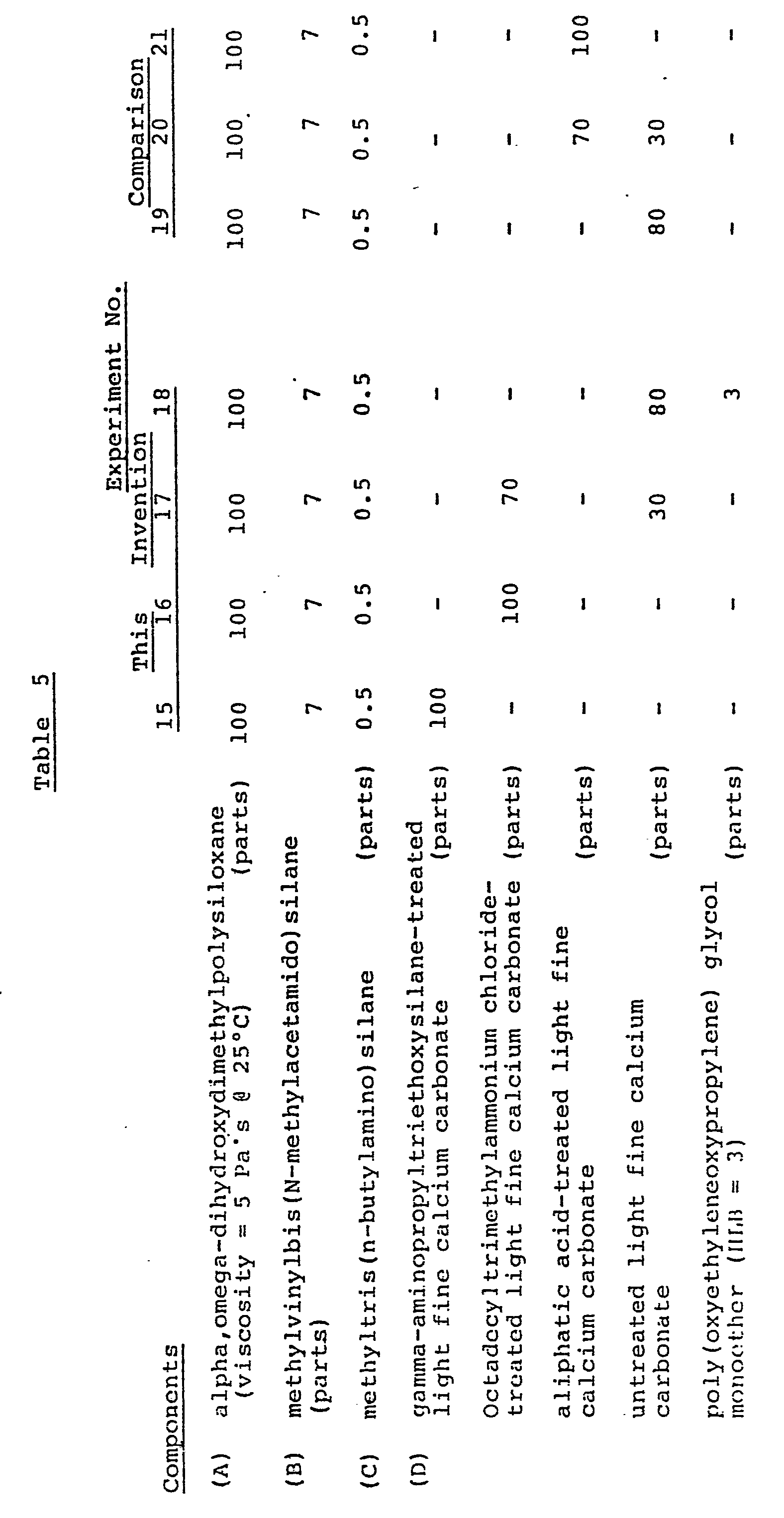
- 100 parts of an a,w-dihydroxypolydimethylsiloxane having a viscosity of 5 Pa's were compounded with the calcium carbonates listed in Table 5 and blended to homogeneity. To the resulting mixture were added 7 parts methylvinylbis(N-methylacetamido)silane and 0.5 parts methyltris(n-butylamino)silane. After blending in a moisture-free environment to homogeneity, 4 compositions according to the present invention were obtained. A poly(oxyethylenoxypropylene) glycol was used as an in-situ treating agent.
- For comparison, the same compositions were prepared under the same conditions, except the calcium carbonate of the invention was replaced by untreated calcium carbonate, aliphatic acid-treated calcium carbonate or a mixture of aliphatic acid-treated calcium carbonate and untreated calcium carbonate.
- The composition of the test samples is reported in Table 5. The compositions were prepared and evaluated as described in Example 1. Table 6 reports the results, which were similar to those reported in Table 2.
- 100 parts of an α,ω-dihydroxypolydimethylsiloxane having a viscosity of 7 Pa's, 20 parts of a polydimethylsiloxane having a viscosity of 2 Pa's and containing 3 Si-OH group per molecule, 30 parts of untreated light fine calcium carbonate and 90 parts of vinyltrimethoxysilane-treated light calcium carbonate were blended to homogeneity. To this mixture were added 20 parts methylvinylbis(N-methylacetamido)silane followed by blending in a moisture-free environment to homogeneity. Using this composition, the same initial water resistance test and adhesion test as described hereinbefore were carried out. Ratings of "O" were obtained in both tests.
- 100 parts of an a,w-dihydroxypolymethylsiloxane having a viscosity of 15 Pa's, 10 parts of hydroxyl endblocked polydimethylsiloxane gum having a viscosity of approximately 10,000 Pa's and 120 parts octadecyltrimethylammonium chloride-treated light calcium carbonate were blended to homogeneity. To this mixture were added 15 parts dimethylbis(N-ethylacetamido)silane and 3 parts of an aminoxy group-containing organosilicon compound with the structure:

- The resultant composition was blended to homogeneity, following which the same initial water resistance test and adhesion test described hereinbefore were performed. Ratings of "O" were obtained in both tests.
-



Claims (7)
wherein said method comprises treating said calcium carbonate with a hydrophobicizing agent selected from the group consisting of cationic surfactants, nonionic surfactants exhibiting a maximum HLB value of 10, and organosilanes containing at least one silicon-bonded hydrocarbyl or substituted hydrocarbyl radical, wherein the substituent on said hydrocarbyl radical is selected from the group consisting of amino, epoxy, acryloxy and mercapto.
Applications Claiming Priority (2)
| Application Number | Priority Date | Filing Date | Title |
|---|---|---|---|
| JP57183069A JPS5971363A (en) | 1982-10-19 | 1982-10-19 | Room temperature curing organopolysiloxane composition |
| JP183069/82 | 1982-10-19 |
Publications (2)
| Publication Number | Publication Date |
|---|---|
| EP0106363A2 true EP0106363A2 (en) | 1984-04-25 |
| EP0106363A3 EP0106363A3 (en) | 1985-04-24 |
Family
ID=16129198
Family Applications (1)
| Application Number | Title | Priority Date | Filing Date |
|---|---|---|---|
| EP83110416A Withdrawn EP0106363A3 (en) | 1982-10-19 | 1983-10-19 | Water resistant room temperature vulcanizable polyorganosiloxane compositions and method for preparing same |
Country Status (4)
| Country | Link |
|---|---|
| US (1) | US4477606A (en) |
| EP (1) | EP0106363A3 (en) |
| JP (1) | JPS5971363A (en) |
| CA (1) | CA1245790A (en) |
Cited By (4)
| Publication number | Priority date | Publication date | Assignee | Title |
|---|---|---|---|---|
| EP0202635A3 (en) * | 1985-05-21 | 1988-06-22 | Shin-Etsu Chemical Co., Ltd. | A method for the preparation of shaped articles of a vinyl chloride-based resin having improved surface properties |
| EP0392262A3 (en) * | 1989-03-29 | 1991-08-28 | Dow Corning Toray Silicone Company Ltd. | Silicone rubber composition |
| EP0857760A1 (en) * | 1997-02-05 | 1998-08-12 | General Electric Company | Room temperature vulcanizable silicone compositions having a reduced stringiness |
| WO2013089044A1 (en) * | 2011-12-16 | 2013-06-20 | Dow Corning Toray Co., Ltd. | Use of acid in the manufacture of organopolysiloxane |
Families Citing this family (5)
| Publication number | Priority date | Publication date | Assignee | Title |
|---|---|---|---|---|
| US5166243A (en) * | 1986-06-30 | 1992-11-24 | Union Carbide Chemicals & Plastics Technology Corporation | Polyorganosiloxane cross-linkers for RTV sealants |
| US4822830A (en) * | 1987-11-09 | 1989-04-18 | Wacker Silicones Corporation | Organopolysiloxane elastomers having improved electrical properties and insulators coated therewith |
| JP2784045B2 (en) * | 1989-06-15 | 1998-08-06 | 東芝シリコーン株式会社 | Room temperature curable silicone rubber composition |
| US5744703A (en) * | 1997-02-26 | 1998-04-28 | General Electric Company | Process to measure the stringiness of room temperature vulcanizable silicone sealant compositions |
| US6743509B2 (en) | 2002-10-01 | 2004-06-01 | Dow Corning Corporation | Method of treating precipitated calcium carbonate fillers |
Family Cites Families (8)
| Publication number | Priority date | Publication date | Assignee | Title |
|---|---|---|---|---|
| BE795952A (en) * | 1972-09-29 | 1973-08-27 | Dow Corning | LOW MODULE SILICONE ELASTOMER COMPOSITIONS CURABLE AT ROOM TEMPERATURE |
| US3766127A (en) * | 1972-09-29 | 1973-10-16 | Dow Corning | Amidosilicon low modulus room temperature vulcanizable silicone elastomer |
| US3766128A (en) * | 1972-09-29 | 1973-10-16 | Dow Corning | Silicone elastomer composition containing amidosilane and aminosilane |
| US4247445A (en) * | 1979-02-28 | 1981-01-27 | General Electric Company | Paintable one-component RTV systems |
| JPS6026510B2 (en) * | 1980-03-04 | 1985-06-24 | ト−レ・シリコ−ン株式会社 | Room temperature curable organopolysiloxane composition and method for producing the same |
| US4374178A (en) * | 1980-12-29 | 1983-02-15 | Union Carbide Corporation | Silanated calcium carbonate fillers |
| JPS57179243A (en) * | 1981-04-27 | 1982-11-04 | Toray Silicone Co Ltd | Cold curing organopolysiloxane composition |
| JPS58215453A (en) * | 1982-06-09 | 1983-12-14 | Toray Silicone Co Ltd | Organopolysiloxane composition which is coatable after room temperature curing |
-
1982
- 1982-10-19 JP JP57183069A patent/JPS5971363A/en active Granted
-
1983
- 1983-10-17 US US06/542,859 patent/US4477606A/en not_active Expired - Fee Related
- 1983-10-18 CA CA000439151A patent/CA1245790A/en not_active Expired
- 1983-10-19 EP EP83110416A patent/EP0106363A3/en not_active Withdrawn
Cited By (7)
| Publication number | Priority date | Publication date | Assignee | Title |
|---|---|---|---|---|
| EP0202635A3 (en) * | 1985-05-21 | 1988-06-22 | Shin-Etsu Chemical Co., Ltd. | A method for the preparation of shaped articles of a vinyl chloride-based resin having improved surface properties |
| EP0392262A3 (en) * | 1989-03-29 | 1991-08-28 | Dow Corning Toray Silicone Company Ltd. | Silicone rubber composition |
| EP0857760A1 (en) * | 1997-02-05 | 1998-08-12 | General Electric Company | Room temperature vulcanizable silicone compositions having a reduced stringiness |
| WO2013089044A1 (en) * | 2011-12-16 | 2013-06-20 | Dow Corning Toray Co., Ltd. | Use of acid in the manufacture of organopolysiloxane |
| CN104011139A (en) * | 2011-12-16 | 2014-08-27 | 道康宁东丽株式会社 | Use of acid in the manufacture of organopolysiloxane |
| US9439842B2 (en) | 2011-12-16 | 2016-09-13 | Dow Corning Toray Co. Ltd. | Use of acid in the manufacture of organopolysiloxane |
| CN104011139B (en) * | 2011-12-16 | 2016-11-09 | 道康宁东丽株式会社 | The purposes of acid in organopolysiloxane preparation process |
Also Published As
| Publication number | Publication date |
|---|---|
| JPS5971363A (en) | 1984-04-23 |
| CA1245790A (en) | 1988-11-29 |
| JPH0318667B2 (en) | 1991-03-13 |
| US4477606A (en) | 1984-10-16 |
| EP0106363A3 (en) | 1985-04-24 |
Similar Documents
| Publication | Publication Date | Title |
|---|---|---|
| JPH02133490A (en) | Manufacture of silicone sealant | |
| US20200385527A1 (en) | Moisture curable silicone polymer and uses thereof | |
| WO1983002948A1 (en) | Scavengers for one-component alkoxy-functional rtv compositions and processes | |
| US6254811B1 (en) | Organopolysilozane compositions crosslinkable with elimination of alcohols to give elastomer | |
| JP2001152020A5 (en) | ||
| KR19990007006A (en) | Alkoxy-crosslinked RTV1 Silicone Rubber Mixtures | |
| EP1197525B1 (en) | Room temperature curable organopolysiloxane compositions | |
| JPWO2017187762A1 (en) | Terminal silanol group-containing polyoxyalkylene compound and method for producing the same, room temperature curable composition, sealing material and article | |
| KR0140083B1 (en) | Silicone sealant | |
| JPWO2016117206A1 (en) | Room temperature curable organopolysiloxane composition | |
| US4477606A (en) | Water resistant room temperature vulcanizable polyorganosiloxane compositions and method for preparing same | |
| EP0799860A2 (en) | Method for enhancing longevity of a surface drying oil on a silicone composition modified by incorporation of zinc oxide | |
| EP0575863A1 (en) | Modulus controllable room-temperature-curable silicone elastomer composition | |
| JP2613446B2 (en) | Method for producing room temperature curable polyorganosiloxane composition | |
| JP2687038B2 (en) | Room temperature curable composition | |
| JPH0834922A (en) | Room temperature curable silicone elastomer composition | |
| JP2007145900A (en) | Room temperature curable polyorganosiloxane composition | |
| WO2023068094A1 (en) | Room temperature-curable organopolysiloxane composition, adhesive, sealing agent, and coating agent | |
| JPH06157910A (en) | Room temperature curable polyorganosiloxane composition | |
| JP3418262B2 (en) | Room temperature curable polyorganosiloxane composition | |
| JP2816930B2 (en) | Room temperature curable organopolysiloxane composition | |
| KR20000006408A (en) | Silica filled rtv compositions having adhesion to glass and ceramic materials | |
| EP0709435B1 (en) | Room-temperature-curable organopolysiloxane compositions | |
| JP7800552B2 (en) | ORGANOPOLYSILOXANE COMPOUND, ROOM-TEMPERATURE-CURABLE ORGANOPOLYSILOXANE COMPOSITION, AND ARTICLE | |
| JP3853073B2 (en) | Room temperature curable polyorganosiloxane composition |
Legal Events
| Date | Code | Title | Description |
|---|---|---|---|
| PUAI | Public reference made under article 153(3) epc to a published international application that has entered the european phase |
Free format text: ORIGINAL CODE: 0009012 |
|
| AK | Designated contracting states |
Designated state(s): DE FR GB |
|
| PUAL | Search report despatched |
Free format text: ORIGINAL CODE: 0009013 |
|
| AK | Designated contracting states |
Designated state(s): DE FR GB |
|
| 17P | Request for examination filed |
Effective date: 19850808 |
|
| 17Q | First examination report despatched |
Effective date: 19860415 |
|
| STAA | Information on the status of an ep patent application or granted ep patent |
Free format text: STATUS: THE APPLICATION HAS BEEN WITHDRAWN |
|
| 18W | Application withdrawn |
Withdrawal date: 19861222 |
|
| RIN1 | Information on inventor provided before grant (corrected) |
Inventor name: SARUYAMA, TOSHIO Inventor name: SUGANUMA, NORIYUKI Inventor name: FUKAYAMA, MIYOJI |