EP0105584B1 - Perfluorocarbon emulsions and their preparation and use in therapy - Google Patents
Perfluorocarbon emulsions and their preparation and use in therapy Download PDFInfo
- Publication number
- EP0105584B1 EP0105584B1 EP83304632A EP83304632A EP0105584B1 EP 0105584 B1 EP0105584 B1 EP 0105584B1 EP 83304632 A EP83304632 A EP 83304632A EP 83304632 A EP83304632 A EP 83304632A EP 0105584 B1 EP0105584 B1 EP 0105584B1
- Authority
- EP
- European Patent Office
- Prior art keywords
- pharmaceutical composition
- oxygen
- composition according
- pfc
- aqueous pharmaceutical
- Prior art date
- Legal status (The legal status is an assumption and is not a legal conclusion. Google has not performed a legal analysis and makes no representation as to the accuracy of the status listed.)
- Expired
Links
Classifications
-
- A—HUMAN NECESSITIES
- A61—MEDICAL OR VETERINARY SCIENCE; HYGIENE
- A61K—PREPARATIONS FOR MEDICAL, DENTAL OR TOILETRY PURPOSES
- A61K9/00—Medicinal preparations characterised by special physical form
- A61K9/10—Dispersions; Emulsions
-
- A—HUMAN NECESSITIES
- A61—MEDICAL OR VETERINARY SCIENCE; HYGIENE
- A61K—PREPARATIONS FOR MEDICAL, DENTAL OR TOILETRY PURPOSES
- A61K9/00—Medicinal preparations characterised by special physical form
- A61K9/10—Dispersions; Emulsions
- A61K9/107—Emulsions ; Emulsion preconcentrates; Micelles
-
- A—HUMAN NECESSITIES
- A61—MEDICAL OR VETERINARY SCIENCE; HYGIENE
- A61K—PREPARATIONS FOR MEDICAL, DENTAL OR TOILETRY PURPOSES
- A61K9/00—Medicinal preparations characterised by special physical form
- A61K9/0012—Galenical forms characterised by the site of application
- A61K9/0019—Injectable compositions; Intramuscular, intravenous, arterial, subcutaneous administration; Compositions to be administered through the skin in an invasive manner
- A61K9/0026—Blood substitute; Oxygen transporting formulations; Plasma extender
-
- A—HUMAN NECESSITIES
- A61—MEDICAL OR VETERINARY SCIENCE; HYGIENE
- A61K—PREPARATIONS FOR MEDICAL, DENTAL OR TOILETRY PURPOSES
- A61K31/00—Medicinal preparations containing organic active ingredients
- A61K31/02—Halogenated hydrocarbons
- A61K31/025—Halogenated hydrocarbons carbocyclic
-
- A—HUMAN NECESSITIES
- A61—MEDICAL OR VETERINARY SCIENCE; HYGIENE
- A61K—PREPARATIONS FOR MEDICAL, DENTAL OR TOILETRY PURPOSES
- A61K31/00—Medicinal preparations containing organic active ingredients
- A61K31/70—Carbohydrates; Sugars; Derivatives thereof
-
- A—HUMAN NECESSITIES
- A61—MEDICAL OR VETERINARY SCIENCE; HYGIENE
- A61K—PREPARATIONS FOR MEDICAL, DENTAL OR TOILETRY PURPOSES
- A61K31/00—Medicinal preparations containing organic active ingredients
- A61K31/70—Carbohydrates; Sugars; Derivatives thereof
- A61K31/7088—Compounds having three or more nucleosides or nucleotides
-
- A—HUMAN NECESSITIES
- A61—MEDICAL OR VETERINARY SCIENCE; HYGIENE
- A61M—DEVICES FOR INTRODUCING MEDIA INTO, OR ONTO, THE BODY; DEVICES FOR TRANSDUCING BODY MEDIA OR FOR TAKING MEDIA FROM THE BODY; DEVICES FOR PRODUCING OR ENDING SLEEP OR STUPOR
- A61M2202/00—Special media to be introduced, removed or treated
- A61M2202/04—Liquids
- A61M2202/0468—Liquids non-physiological
- A61M2202/0476—Oxygenated solutions
Definitions
- This invention relates to perfluorocompound (i.e. perfluorinated cyclichydrocarbon) emulsions containing inter alia a chemotherapeutic agent.
- perfluorocompound i.e. perfluorinated cyclichydrocarbon
- Certain of these compositions are useful in the sensitization of hypoxic tumor cells to therapy, for example by radiation and/or to certain chemotherapeutic agents, whether the therapy is employed alone or in combination with agents which protect normal tissues from injury.
- the invention further relates to methods for producing those compositions.
- the claimed compositions are also useful in the diagnostic field.
- Oxygen deficient (hypoxic) cells can be up to about three times more resistant to radiation than are well-oxygenated cells. These cells are relatively common in tumors but are rare in normal tissues, thereby giving the tumor cells a greater resistance to radiation than one observes in normal tissues. As a consequence, one often cannot deliver enough radiation to eradicate the tumor cells without incurring an unacceptably high risk of severe injury to normal tissue. These same hypoxic cells are often resistant to those forms of chemotherapy which are oxygen dependent. In such chemotherapy, however, oxygen must often be supplied to the hypoxic cells for another reason in addition to maximal cell destruction: hypoxic cells are not actively growing (multiplying) and many of the more effective chemotherapeutic drugs cannot kill the cells unless they are growing. Further, hypoxic cells have low energy reserves and are thus believed less able to actively transport certain chemotherapeutic drugs across their membranes.
- hypoxic cells contribute to the relatively common occurrence of hypoxic cells in tumors: the tumors outgrow their blood supply; blood flow through the vessels in the tumor is sluggish; and the tumor cells near the blood vessels consume large amounts of oxygen, thereby even further reducing the amount available to more distant cells. If means could be developed to re-oxygenate these hypoxic areas one would expect large increases in radiosensitivity because the hypoxic tumor regions are near the minimum of oxygen dependent radiosensitivity. The same does not hold true for normal tissues, since, under natural conditions, they are already near the maximum for oxygen dependent radiosensitivity. The same or similar considerations also apply in sensitizing cells to chemotherapy.
- the Belgrad et al study is not useful as a guide or suggestion of the use of perfluorooctyl bromide or other PFC in hypoxic tumor cell therapy.
- the study has little clinical relevance, and discourages further studies leading to clinical investigations.
- oxygenation of a PFC priorto administration coupled with radiation treatment 24 hours after administration offers almost no opportunity for the leukemic cells to be sensitized to radiation.
- the highest irradiation doses reported by Belgrad et al are known to be lethal to mice, and thus leave open to conjecture whether the perfluorooctyl bromide had any sensitizing effect at all under such conditions.
- Typical of such drugs are metronidazole, misonidazole and the nitroimidazole compounds disclosed in US ⁇ A ⁇ 4,241,060 and 4,282,232.
- metronidazole, misonidazole and the nitroimidazole compounds disclosed in US ⁇ A ⁇ 4,241,060 and 4,282,232 are metronidazole, misonidazole and the nitroimidazole compounds disclosed in US ⁇ A ⁇ 4,241,060 and 4,282,232.
- Such drugs while initially promising, have not produced large therapeutic gains clinically because the drug doses required to produce significant radiosensitization also produce unacceptable neurotoxicity in patients.
- hypoxia is invariably found in carcinoma and sarcoma but even in benign conditions (where the hypoxic cell tumors are not continually increasing in mass), radiotherapy and/or chemotherapy are sometimes prescribed in order to forestall cancerous conditions.
- the present invention is therefore applicable both to malignant and benign hypoxic tumor cells.
- the oxygen transfer compound if used systemically, will diffuse quickly through the vasculature, pick up oxygen in the lungs, remain in the cardiovascular system for about 10 to 12 days, (to permit periodic irradiation at controlled dosages) and then be rapidly eliminated, while producing no tolerable toxicity. Under such conditions sensitization to radiotherapy and/or chemotherapy can be maximized. However, residence times as short as 2 to 8 hours may be sufficient if only short term therapy is necessary. Hence, considerable leeway should be possible in treatment protocols, depending on the types, state of division and site of the tumor cells, and other considerations known to therapists, such as type of irradiation or chemotherapeutic agent, side effects, and mode of administration.
- the present invention provides an aqueous pharmeutical composition
- an aqueous pharmeutical composition comprising an emulsified oxygen-transporting perfluorinated cyclic hydrocarbon, a lipophilic drug, a chemotherapeutic agent, a chemotherapeutic protective agent, or a radioprotective agent or a mixture of two or more thereof and a dispersant.
- the cells or vasculature thereof is contacted with such a composition medium.
- the aqueous dispersion is rendered isotonic (or otherwise physiologically acceptable) to mammalian cells prior to use as a sensitizing agent by the addition of salts, buffering agents or other reagents known to be effective for this purpose.
- compositions containing chemotherapeutic agents may be injected intravenously, carried through the lungs where it picks up oxygen, and then penetrate the region of the hypoxic tumor cells.
- the oxygen transferred from the perfluoro compound to the hypoxic cells sensitizes the cells to action of the chemotherapeutic agent.
- Cell destruction or reduced rate of growth can be monitored by biopsy, radioimaging or other technique.
- Crowth as used herein means cell multiplication; "control of growth” or similar term means cell destruction or decreased growth rate).
- compositions containing radioimaging agents are administered to penetrate into the regions of the hypoxic tumor cells thereby permitting radioimaging.
- RP and/or CTP agents are combined with the oxygen carrying PFC in the dispersion, in order to afford additional therapeutic response.
- This effect is achieved through the ability of the perfluoro compound to sensitize the tumor cells, while the RP and CTP agents, since they are not absorbed by the tumor cells, shield the normal tissues from attack by radiation and the CT agents, respectively.
- the same agent can be both radioprotective and chemotherapeutic protective.
- compositions of the present invention comprise aqueous dispersions of an oxygen carrying cyclic perfluoro compound and a dispersant (surfactant or emulsifier) which is effective for uniformly dispersing the perfluoro compound in the aqueous medium.
- a dispersant surfactant or emulsifier
- the dispersant is required because the perfluoro compounds are relatively hydrophobic and would otherwise tend to agglomerate in the mammalian body fluids through which the compound must pass and which serve to carry the compound to the hypoxic tumor cells or vasculature thereof.
- the aqueous dispersion medium also permits addition of reagents for rendering the dispersion isotonic or otherwise physiologically acceptable to the cells.
- perfluoro compounds and dispersions thereof useful in this invention are those materials identified in the patent and other technical literature as synthetic blood substitutes.
- Representative of the patent literature disclosing such blood substitutes are US-A-3,641,167, 3,823,091, 3,911,138, 3,962,439, 3,993,581, 4,041,086, 4,105,798, and 4,325,972.
- perfluoro compound for use in specific cases in accordance with the invention will depend on a variety of factors, including whether the treatment is in conjunction with radiotherapy, chemotherapy, or both; the character and locus of the hypoxia; the potency of the perfluoro compound as a sensitizer; toxicity of the perfluoro compound to normal cells and to the host mammal; capability of forming sufficiently small particle size dispersions and sufficiently stable dispersions to diffuse rapidly to the region of the hypoxic cells; residence time in the mammal, including accummulation tendencies; and similar considerations familiar to those knowledgeable in the sensitization art.
- Guidance for such selection can be obtained from the blood substitute art, particularly as to oxygen transport capability, dispersion particle size and stability, mammalian residence time, and cytotoxicity. Additionally, on the basis of the in vitro and in vivo studies reported and discussed hereinafter, guidance is provided for selection of perfluoro compound and treatment parameters in specific cases of sensitization.
- substantially fluorinated as used herein means that most of the hydrogen atoms of a compound have been replaced by fluorine atoms, such that further replacement does not substantially increase the oxygen transport capability of the material. It is believed that this level is reached when at least about 80-90% of the hydrogen atoms have been replaced by fluorine atoms. However, it is preferred that at least 95% of the hydrogen atoms have been replaced, more preferably at least 98% and most preferably, 100%.
- perfluoro compounds preferred to use in this invention are the perfluorinated derivatives of chemically inert C 9 -C '8 polycyclic compounds such as bicyclononanes (e.g., bicyclo [3.3.1] nonane, 2,6 - dimethylbicyclo [3.3.1 ] nonane, 3 - methylbicyclo [3.3.1] nonane and trimethylbicyclo [3.3.1] nonane); adamantane and alkyl (C,-C 6 ) adamantanes such as methyl and dimethyladamantane, ethyl and dimethyladamantane, trimethyladamantane, ethylmethyladamantane, ethyldimethyladamantane and triethyladamantane; methyldiadamantane and trimethyldiadamantane; methyl and dimethylbicyclo- .
- bicyclononanes e.g., bicyclo [
- octanes tetrahydrobinor-S, pinane, camphane, decalin and alkyl decalins such as 1 - methyldecalin; and 1,4,6,9 - dimethanodecalin; bicyclo [4.3.2] undecane, bicyclo [5.3.0] decane, tricyclo [5.2.1.0 2,6 ] decane, methyltricyclo [5.2.1.0 2,6 ] decane, and the like; or any mixtures thereof.
- Hetero atom perfluoro compounds includes F - N,N - dimethylcyclohexylmethylamine; perfluoro ethers such as F - 2 - butyltetrahydrofuran, F - 2 - butylfuran, F-hydrofuran, F - N - methyldecahydroquinoline, F - 1 - methyloctahydroquinolizine, F - octahydroquinolidine and F - N - cyclohexylpyrrolidine.
- Aromatic and aliphatic compounds include F - naphthalene, F - 1 - methyl naphthalene and F - n - methylmorpholine.
- fluorine atoms of the foregoing materials may be substituted by other halogen atoms such as bromine. Included among these compounds, are, for example, monobrominated compounds such as 1 - bromopentadecafluoro - 4 - isopropylcyclohexane, and 1 - bromo - pentadecafluoro - 3 - isopropylcyclopentane.
- the compounds When bromo or iodo atoms appear in the perfluoro compounds, the compounds tend to be radiopaque while also retaining a large measure of their oxygen transporting capabilities.
- the radiopacity renders these compounds useful as radioimaging (RI) agents, and therefore these compounds in some cases can be used not only as sensitizing agents but also as RI agents.
- the more preferred perfluoro compounds for use in the invention on the basis of relative inertness (chemical and biological), good dispersability and residence time are the perfluoro C T -C, 8 polycyclic hydrocarbons of US ⁇ A ⁇ 4,105,798, and particularly F - dimethyladamantane, F - trimethylbicyclononane, F - tricyclo [5.2.1.0 2,6 ] decane, F - methyltricyclo [5.2.1 .0 2,6 ] decane, F - bicyclo [5.2.0] decane and F - methylbicyclo [5.2.0] decane, including any isomers thereof, and mixtures of such compounds, for example mixtures of F - dimethyladamantane and F - trimethylbicyclononane, ranging from about 90/10 to 10/90 by weight.
- the preferred dispersants for uniformly dispersing the perfluoro compounds in an aqueous medium are the nonionic surfactants.
- ionic or amphoteric surfactants may be used to disperse the perfluoro compounds. Because systemic treatments require careful attention to physiological acceptability of the compounds, such as isotonic character, ionic surfactants are less desirable, although it is possible to offset or moderate their ionic character by formulating the dispersions with electrolytes or other additives.
- Suitable nonionic surfactants include aliphatic materials such as block copolymers of ethylene oxide and propylene oxide comprising a hydrophobic propylene oxide section combined with one or more hydrophilic ethylene oxide sections, for example the "Pluronic" surfactants available from BASF-Wyandotte, Inc.
- aromatic types may also be used, such as alkylphenoxypolyethoxyethanols having alkyl groups of about 7 to 18 carbon atoms and 1 to 60 or more oxyethylene units, for example: heptylphenoxypolyethoxyethanols, octylphenoxypolyethoxyethanols, methyloctylphenoxypolyethoxy- ethanols, nonylphenoxypolyethoxyethanols and dodecylphenoxypolyethoxy ethanols; polyethoxyethanol derivatives of methylene linked alkylphenols; sulfur-containing analogs of the foregoing; ethylene oxide derivatives of long-chain carboxylic acids, such as lauric, myristic, palmitic and oleic, or mixtures of acids such as are found in tall oil containing 1 to 60 oxyethylene units per molecule; and analogous ethylene oxide condensates of long-chain or branched-chain amines, such as dodecylamine,
- Naturally occurring emulsifiers or derivatives thereof are also useful. These include the alginates, cellulose derivatives such as methyl cellulose and carboxymethyl cellulose, water soluble gums such as gum arabic and gum tragacanth, the phospholipids (such as lecithin and yolk phospholipid), and the stereo.
- Nonionic fluorine containing surfactants are particularly preferred.
- the fluorinated alkyl esters are one class of these surfactants, and are commercially available from 3M Company under the designations FC-93, FC-95, FC-128, FC-143, FC-430 and FC-431.
- the more preferred nonionic, fluorine containing surfactants from the standpoint of their exceptional ability to form dispersions which maintain a range of small particle size over substantial periods of time, of the order of 35 weeks to a year or more, even at room temperature, are the fluorinated amidoamine oxides described in US ⁇ A ⁇ 3,828,085 to Price et al, and 3,547,995 to Bartlett.
- R f is a perfluoroalkyl radical of 4 to 25 carbon atoms or a polyfluoroalkoxyalkyl radical wherein the alkoxy group may contain 3 to 40 carbon atoms of which at least a major portion thereof are perfluorinated and the alkyl group may-contain 2 to 40 carbon atoms, fluorinated or unfluorinated;
- Y is hydrogen or alkyl of 1 to 6 carbon atoms;
- R is an alkylene radical of the formula: wherein z is an integer of 1 to 6;
- Q is an aliphatic amine oxide radical of the formula: wherein R 5 and R 6 are each alkyl radicals of 1 to 6 carbon atoms or hydroxy-terminated alkyl radicals of 2 to 6 carbon atoms.
- the alkoxy, alkyl and alkylene groups may be straight or branched chain.
- Preferred subclasses of the surfactants of the foregoing patents are those of the following Formulas (2) and (3): wherein n is at least 3 (preferably 3-10), x is at least 2 (preferably 2-6), y is at least 1 (preferably 2-6), and R 1 and R 2 independently are alkyl radicals contains 1-6 carbon atoms. wherein n is at least 3 (preferably 3-10), z is at least 1 (preferably 2-6), and R 1 and R 2 independently are alkyl radicals containing 1-6 carbon atoms.
- aqueous dispersions of the invention are prepared by any mixing technique which will provide a uniform blend of the ingredients, and preparation accordingly may be readily accomplished by the skilled formulator.
- the dispersions of the invention When formulating the dispersions of the invention for systemic administration, it is important not only to add electrolytes and other materials to render the dispersions physiologically acceptable (such as isotonic with mammalian cells), but also to adjust the pH, as necessary, to offset the lowering of the pH of the hypoxic cell environment due to generation of lactic acid by the hypoxic tumor cells.
- a suitable pH range is 7.2-7.4.
- buffers such as sodium bicarbonate, and mixtures such as Ringer's Solution.
- Other materials conventionally employed in pharmaceutical preparations and known to the skilled formulator may also be added to the dispersions.
- viscosity modifiers include viscosity modifiers, stabilizers (against degradation due to freezing or contamination, for example), anti-freeze agents, diluents and encoding agents.
- glycerin dimethylsulfoxide
- DMSO dimethylsulfoxide
- various gelatins both natural and synthetic
- polyols such as sorbitol.
- the perfluoro compound and surfactant components may be blended into water in any proportions which will provide uniform dispersions. Typical proportions are 5 to 50% perfluoro compound based on the volume of the total composition and 0.5 to 10% of the surfactant based on the total weight of the composition. Preferred proportions are 10-30% by volume of the perfluoro compound and 2-5% by weight of the surfactant, but proportions in particular cases may be varied depending on dispersability of the PFC, particle size desired, and similar considerations.
- the aqueous dispersions more usually comprise emulsions, preferably of the oil-in-water type but also including water-in-oil emulsions. In some cases the emulsions have a very fine particle size and appear transparent or solution-like to the unaided eye.
- the micro-emulsions which can be formulated with the dispersants of US ⁇ A ⁇ 3,828,085 have this characteristic and are preferred. Colloidal suspensions, while not excluded from use in this invention, are less preferred, particularly for systemic administration, because of their larger particle size range and less stability.
- the above-identified blood substitute and surfactant patents provide excellent guidance to formulation of the dispersions, and attention is directed to the patents for such purpose.
- aqueous dispersions containing the oxygen transporting perfluoro compound when used as sensitizers in accordance with the invention, may be administered to a mammal locally or in any systemic fashion, whether intravenous, subcutaneous, intramuscular, parenteral, intraperitoneal or oral.
- administration will be systemic and at a site enabling the dispersion to traverse the lungs to pick up oxygen and to transport the oxygen to the hypoxic tumor cells.
- Dosages of the dispersion will be predetermined in accordance with the site and character of the hypoxia, whether or not the treatment is a supplement to hyperbaric oxygen treatment, the systemic tolerance (toxicity) of the mammal to the specific formulation, and other factors known to the therapist.
- fluorocrits (cc of PFC per 100 ml blood) of the perfluoro compound should be in the range of 3-10%, although lower or higher fluorocrits in special circumstances may be sufficient or required.
- the fluorocrit need not be over 3.5%, and the partial pressure of oxygen in the inspired air may be up to about 200 kPa (2 atmospheres) at 100% oxygen.
- hyperbaric oxygen administration would be 30 minutes at 200 kPa (2 atmospheres) 100% oxygen pressure, and these conditions are known to be well within tolerated levels.
- the duration, content and pressure of the primary oxygenation in specific cases again will depend upon various factors, such as the health of the mammal or patient, the site of the hypoxia, and other conditions familiar to the radio- or chemotherapist.
- Contact of the PFC dispersion may be with the hypoxic cells or with the tumor cell vasculature, such that the oxygen carried by the PFC may transfer to the tumor/vasculature interface.
- the ideal may be direct contact between the PFC dispersion and the hypoxic cells, this may not be achievable and in fact is not required, since excess oxygen, wherever present in the tumor mass, will tend to become distributed throughout the mass, and thus reach the hypoxic cells.
- the dosage of the sensitizing agent prior to irradiation and/or chemotherapy will also be controlled by various conditions, including the rate at which the perfluoro compound travels to the hypoxic tumor cells, the degree of sensitization desired, and the cardiovascular half-life residence time of the dispersion in the cardiovascular system and in the hypoxic tissues.
- an acceptable cardiovascular (serum) half-life can be as brief as about 2 to 4 hours. This duration indicates that the perfluoro compound moves rapidly to the hypoxic tumor cells and transfers its oxygen to the cells.
- an outstanding property of the preferred dispersions of the invention is an extremely small particle size, which particle size is maintained over substantial periods. The small particle size enables the dispersions to quickly traverse the vasculature to the site of the hypoxia. For example, an average particle size of 0.05 to 0.2 11m has been observed and has been maintained for several months and up to a year or more.
- the dispersions may be oxygenated prior to infusion into the mammalian body and this may be expedient when injection is at or near the site of the hypoxia rather than at a site where oxygen transfer from the lungs and arteries is anticipated.
- Prior oxygenation in such manner may be accomplished by any means, such as flushing or blanketing a vessel containing the dispersion with oxygen or air, or bubbling oxygen or air through the dispersion prior to administration.
- preoxygenation in the manner described may also be practiced. In every case of preoxygenation, however, there may be a loss of oxygen prior to entry of the dispersion into the region of the hypoxic tumor cells, that is, during transit of the dispersion to the cells; hence, preoxygenation generally is not preferred.
- irradiation can be accomplished by external application or by internal placement of radiation sources near or at the site of the hypoxia. Accordingly, the irradiation may be achieved with x-rays, gamma rays and neutrons, or with implanted radium, iridium or cesium sources. Conventional radiation therapy (200 rads per day, five days per week for six to eight weeks) may be employed but dosage and total duration of treatment may be adjusted as required in particular circumstances.
- the sensitizing method of the invention will be effective for all types of hypoxic tumor cells, whether such cells be in suspension (as in leukemia) or in solid form, but the invention is particularly effective for solid tumors. Because systemic distribution of the dispersions is rapid, primarily due to the extremely small and stable particle size of the preferred dispersions of the invention, hypoxia at practically any site may be sensitized in accordance with the invention.
- Chemotherapy is often used in combination with radiotherapy to destroy or control hypoxic tumor cells and therefore the sensitization techniques of the invention can be applied simultaneously or sequentially to chemotherapy and radiotherapy.
- a sensitizer dispersion will normally be selected which has the cardiovascular residence time effective to cover the duration of both treatments, or if the residence time is short, the sensitizer dosage can be suitably increased or adjusted.
- some chemotherapeutic agents are oxygen dependent in terms of requiring oxygen for active transport of the CT drug into the cell, for cell cycling control or CT enhancement. Hence, oxygen must be supplied in free form or by means of a carrier.
- the perfluoro compounds of the present invention and their dispersions are capable of transferring large quantities of oxygen, it can be expected that chemotherapy based upon drugs which are oxygen dependent will be benefited by formulating the drugs with an RS agent of the present invention, or sequentially administering the RS and CT agents.
- Methotrexate is an example of a CT drug thought to require oxygen for active transport into the cell.
- Vinblastine and Vincristine are drugs which require oxygen for cell cycling.
- CT drugs which may not be oxygen dependent may also be administered in conjunction with the sensitizing techniques of the invention.
- Androgens Estrogens, Anti-estrogen, Progestins, Adrenal Steroids, Nitrogen Mustard, Chlorambucil, Phenylalanine Mustard, Cyclophosphamide, Thio-TEPA, Busulfan, 6-Mercaptopurine, 6-Thioguanine, 5 - Fluorouracil, Cytosine Arabinoside, Adriamycin, Dactinomycin, Daunomycin, Bleomycin, Mithramycin, Mitomycin-C, BCNU, CCNU, Methyl-CCNU, DTIC, Hydroxyurea, Cis-Platinum (cis-platinum (II) diamminedichloride), Procarbazine, Hexamethylmelamine and L-Asparaginase.
- Androgens Estrogens, Anti-estrogen, Progestins, Adrenal Ste
- perfluoro compounds useful as RS agents but which also have radiopaque properties are particularly valuable for the purpose of the present invention.
- Such compounds include respective brominated perfluorohydrocarbons.
- the radioimaging properties of such compounds permit monitoring of their RS effects as well as toxicity to surrounding normal cells and hence serve as diagnostic agents as well as RS agents.
- the dispersions containing the perfluoro compounds may be formulated with other, known, radiopaque agents in order to provide a similar opportunity for monitoring radiosensitization potential.
- the radioimaging may be practiced as in conventional radiography or computer axial tomography (CAT) radiography, or by the newer NMR techniques.
- CAT computer axial tomography
- the brominated compounds as RI agents may be used neat or in aqueous dispersion, for example as oil-in-water or water-in-oil emulsions containing 10-90% by volume of water and 0.5-10% by weight of a dispersant.
- Radioprotection may also be practiced in conjunction with the radiosensitization of the invention.
- Radioprotective agents are those which preferentially protect normal tissues from radiation injury. When practiced with radiosensitization, the objective is to reduce injury to the normal tissues, which injury may occur when the RS agents are used in the absence of the RP agents.
- Sulfhydryl-containing agents generally are known to be effective RP materials, such as aminoethylisothiuronium or the phosphorothioate derivatives of beta - mercaptoethylamine reviewed in the article by J. M. Yuhas, "On-the Potential Application of Radioprotective Drugs in Solid Tumor Radiotherapy", appearing in Radiation-Drug Interactions in the Treatment of Cancer, edited by G. H.
- Multicellular tumor spheroids are produced by placing 10 6 MCa-11 murine mammary tumor cells in 10 ml of Eagles Basal Medium (“EBME”), Grand Island Biological Co., catalog No. 420-1200, into a 100 mm petri dish which has been base coated with 0.75% noble agar in the EBME. Within 7-10 days spherical aggregates of tumor cells appear and are then ready for study.
- the PFC dispersion to be treated is adjusted to 290 milliosmoles, osmolarity with powdered tissue culture medium and adjusted to pH 7.2 to 7.4 with 0.1 N NaOH or HCI. Other details of preparation and use for the MTS are given in J. M.
- Either standard tissue culture medium (EBME) or the PFC dispersion is gassed with 100% oxygen for a period of fifteen minutes and then transferred, along with the spheroids, into non-heparinized capillary tubes and sealed. At intervals of 0 to 60 minutes later the tubes are exposed to graded doses of 250 kVp X-rays, and within 30 minutes thereafter are removed, washed with medium and placed individually in agar coated 16 mm wells along with 1.5 ml of medium. Using a dissecting scope at 40 power the spheroids are sized three times weekly and the medium is changed twice weekly.
- EBME tissue culture medium
- the PFC dispersion is gassed with 100% oxygen for a period of fifteen minutes and then transferred, along with the spheroids, into non-heparinized capillary tubes and sealed. At intervals of 0 to 60 minutes later the tubes are exposed to graded doses of 250 kVp X-rays, and within 30 minutes thereafter are removed, washed with medium
- Toxicity of the PFC is evaluated in terms of growth delay, i.e., the retardation in growth of the spheroids after exposure to the PFC (without irradiation) relative to that observed in untreated spheroids. Table I below shows the results of experiments with Dispersions A and B.
- Dispersions A and B provided similar levels of toxicity and radiosensitivity. The toxicity exhibited by Dispersions A and B is considered negligible and likely to be relatively tolerable in the cardiovascular system.
- the rate of clearance of PFC Dispersions A and B from the circulation was evaluated in both Fisher 344 rats and BALB/c mice (females in both cases).
- the dispersions were injected intravenously to a PFC dose equal to one-third of the circulatory volume, which is equal to 6% of body weight.
- the animal returns to the normovolemic state as evidenced by the fact that the fluorocrit equals 3.1% compared to the theoretical estimate of 3.3% for these Dispersions.
- blood is drawn in microcapillary tubes from the supraorbital sinus.
- the fluorocrit PFC as a percent of the blood volume
- the hematocrit are read on a microscope.
- the PFC collects as a pellet in the bottom of the tubes, followed by the red blood cells and the plasma, thus forming distinct layers. All data are normalized to the 30 minute centrifugation reading and the rate of decline of the fluorocrit is estimated from a standard single compartment exponential decay curve defined by: and The results when plotted show that Dispersion A is superior to Dispersion B (half lives of 366 minutes and 222 minutes, respectively), probably because Dispersion A has a smaller particle size than Dispersion B. The results for the rats and mice were essentially equivalent. The results indicate that the PFC in both dispersions will clear the cardiovascular system quickly, and therefore both dispersions are good candidates for clinical studies.
- Example 2 The MTS experiments of Example 2 were repeated in all essential respects with Dispersion B but using spheroids derived from human tumor lines which contain hypoxic cells when grown as MTS. As shown in Table 11 below, some toxicity was observed in all cases but the levels are considered relatively tolerable. Moderate radiosensitizing is apparent for the two neuroblastoma cell lines but very high radiosensitization is shown with respect to the melanoma line. The latter is an outstanding result due to the prevalence and high risks known for this form of hypoxic tumor cells. Very littel RS effect is shown for the osteosarcoma cell line but these results are only preliminary and the exposure was at a low radiation level.
- Radiosensitization of the 3M2N mammary tumor growing in the right hind leg of Fischer-344 rats was studied. At 10-14 days after subcutaneous transplantation in the rats the tumors were 6-8 mm in diameter and ready for treatment. The control animals either received no treatment or received various radiation doses. The other animals received I.V. infusion of 20 ml/kg of Dispersion B (20% w/v) followed by 30 minutes breathing of 95% 0 2 15% C0 2 gas mixture (at 1 atm) and then by the various radiation doeses of x-rays. Prior to and three times weekly after treatment, the two orthogonal diameters of the tumors were measured in situ and averaged.
- Table IV below expresses the results of the study as the time required for the tumors to grow 8 mm beyond their size at the time of treatment.
- the data show that the enhancement produced by the PFC dispersion increases with radiation dose, and also that the growth delay per rad is significantly higher in the PFC-treated group than in the control. That the enhancement is due to the combination of the PFC dispersion and breathing of the gas mixture is evident from Table V below in that none of the control treatments were capable of producing the growth delay of the combination.
- sensitization to MTX in these spheroids can be achieved by gassing with the gas mixture in medium alone, such sensitization requires 1 to 2 hours pretreatment as opposed to only 30 minutes with the PFC dispersion, thus clearly demonstrating the feasibility of elevating the therapeutic index of this important anti-cancer drug with PFC.
- Combined chemosensitization of hypoxic tumors to chemotherapeutic agents and protection of normal tissues is achieved by the procedure described by Yuhas et al, "Treatment of Tumours with the Combination of WR-2721 and Cis - dichlorodiammine platinum (II) or Cyclophosphamide", Br. J. Cancer (1980), 42, 574-585 and publications referenced therein, as modified by concurrent treatment with 20 ml/kg of a PFC dispersion, such as Dispersion B, as described in Example 8 above, to accommodate lower dosages of the chemotherapeutic agents (75 mg/kg), room air breathing, high oxygen (95% 0 2 /5% C0 2 ) breathing, controls, and other conditions as appropriate.
- a PFC dispersion such as Dispersion B
- the preferential solubility of lipophilic drugs in PFC compositions not only provides a means for enhancing the delivery of such drugs in animals but also opens up opportunity for controlling residence time of the drug in the animal, for example by prolonging release of the drug from PFC circulating to the plasma and target organs.
- a drug from the standpoint of its relative lipophilicity in a PFC dispersion, sustained low level delivery of a drug for a prolonged period is made possible with an aqueous delivery system.
- This example illustrates enhancement of anti-tumor action of Vincristine, a lipophilic drug to which tumors are normally resistant at least to non-lethal doses thereof.
- the enhancement is believed due to the preferential solubility of the drug in the PFC material.
- the MCa-11 mammary carcinoma was transplanted into the thigh of BALB/c mice and grown to a diameter of 6 mm, at which time the mice were treated.
- Control mice received an injection of saline, while Vincristine treatment consisted of a single dose of 1.5 mg/kg of Vincristine administered intraperitoneally.
- PFC treatment consisted of an i.v. injection of 20 ml/kg of Dispersion B, followed by two hours of breathing carbogen (95% 0 2 /5% C0 2 ), and injection of saline of Vincristine as before, followed by another two hours of carbogen breathing. It was observed that the Vincristine treatment alone had no effect on tumor growth.
Landscapes
- Health & Medical Sciences (AREA)
- Chemical & Material Sciences (AREA)
- Life Sciences & Earth Sciences (AREA)
- Animal Behavior & Ethology (AREA)
- Public Health (AREA)
- Pharmacology & Pharmacy (AREA)
- Epidemiology (AREA)
- Medicinal Chemistry (AREA)
- Veterinary Medicine (AREA)
- General Health & Medical Sciences (AREA)
- Dispersion Chemistry (AREA)
- Molecular Biology (AREA)
- Hematology (AREA)
- Dermatology (AREA)
- Pharmaceuticals Containing Other Organic And Inorganic Compounds (AREA)
- Medicinal Preparation (AREA)
- Medicines That Contain Protein Lipid Enzymes And Other Medicines (AREA)
- Acyclic And Carbocyclic Compounds In Medicinal Compositions (AREA)
Description
- This invention relates to perfluorocompound (i.e. perfluorinated cyclichydrocarbon) emulsions containing inter alia a chemotherapeutic agent. Certain of these compositions are useful in the sensitization of hypoxic tumor cells to therapy, for example by radiation and/or to certain chemotherapeutic agents, whether the therapy is employed alone or in combination with agents which protect normal tissues from injury. The invention further relates to methods for producing those compositions. The claimed compositions are also useful in the diagnostic field.
- For convenience of expression in this specification the following or similar terms are sometimes abbreviated as indicated:
- "PFC"-perfluoro compound (as specified above)
- "RS"-radiosensitization or radiosensitizing
- "RT"-radiotherapy or radiotherapeutic
- "CT"-chemotherapy or chemotherapeutic
- "RP"-radioprotection or radioprotective
- "CTP"-chemotherapeutic protective
- ""RI"-radioimaging
- Oxygen deficient (hypoxic) cells can be up to about three times more resistant to radiation than are well-oxygenated cells. These cells are relatively common in tumors but are rare in normal tissues, thereby giving the tumor cells a greater resistance to radiation than one observes in normal tissues. As a consequence, one often cannot deliver enough radiation to eradicate the tumor cells without incurring an unacceptably high risk of severe injury to normal tissue. These same hypoxic cells are often resistant to those forms of chemotherapy which are oxygen dependent. In such chemotherapy, however, oxygen must often be supplied to the hypoxic cells for another reason in addition to maximal cell destruction: hypoxic cells are not actively growing (multiplying) and many of the more effective chemotherapeutic drugs cannot kill the cells unless they are growing. Further, hypoxic cells have low energy reserves and are thus believed less able to actively transport certain chemotherapeutic drugs across their membranes.
- The following contribute to the relatively common occurrence of hypoxic cells in tumors: the tumors outgrow their blood supply; blood flow through the vessels in the tumor is sluggish; and the tumor cells near the blood vessels consume large amounts of oxygen, thereby even further reducing the amount available to more distant cells. If means could be developed to re-oxygenate these hypoxic areas one would expect large increases in radiosensitivity because the hypoxic tumor regions are near the minimum of oxygen dependent radiosensitivity. The same does not hold true for normal tissues, since, under natural conditions, they are already near the maximum for oxygen dependent radiosensitivity. The same or similar considerations also apply in sensitizing cells to chemotherapy.
- An obvious approach to reversing the resistance to hypoxic cells to treatment is to directly supply the cells with more oxygen. This was initially attempted by injecting hydrogen peroxide which would hopefully release oxygen at the tumor site. The technique has never achieved practicality, however, due to the toxicity of injected hydrogen peroxide.
- A potentially less toxic, but similarly direct approach, involved having the patient breath 100% oxygen at 300 kPa (3 atmospheres) pressure both before and during radiotherapy. While at least some results were encouraging, the toxicity of hyperbaric oxygen treatments has limited the use of this technique to sub-optimal treatments, i.e., fewer but larger radiation doses.
- A third direct approach was initially tested by Belgrad et al (Radiology 133:235-237, 1979). These investigators oxygen-saturated a pure sample of perfluorooctyl bromide, known as a highly efficient oxygen carrier, and injected the oxygenated, neat compound into mice bearing the P388 leukemia. Twenty-four hours later they exposed the mice to graded doses of whole body X-rays, and compared the survival time of these mice to similarly treated mice which had received an injection of a salt solution. The results of these studies failed to show a significant improvement in therapy, and local toxic reactions in the peritoneal cavity were observed.
- The Belgrad et al study is not useful as a guide or suggestion of the use of perfluorooctyl bromide or other PFC in hypoxic tumor cell therapy. The study has little clinical relevance, and discourages further studies leading to clinical investigations. One would never consider flooding (as opposed to local administration) the peritoneal cavity with a pure PFC or even a PFC in emulsified form. Further, oxygenation of a PFC priorto administration coupled with radiation treatment 24 hours after administration offers almost no opportunity for the leukemic cells to be sensitized to radiation. Lastly, the highest irradiation doses reported by Belgrad et al are known to be lethal to mice, and thus leave open to conjecture whether the perfluorooctyl bromide had any sensitizing effect at all under such conditions.
- In attempts to sidestep oxygen delivery as the primary mode of radiosensitization, radiations have been used which are less dependent on the oxygenation status of the cell for their cell killing efficiency. Such radiations are densely ionizing or high LET radiations and have been limited, however, by their unfavorable focusing characteristics. Normal tissues receive more of these radiations per unit dose delivered to the tumor than is the case with conventional radiations, and this factor has counterbalanced the expected advantage due to independence of oxygenation state. Another radiosensitization technique for avoiding gross oxygenation is the use of drugs which mimic the presence of oxygen but which can diffuse further into the tumor because they are less readily consumed by the cells traversed. Typical of such drugs are metronidazole, misonidazole and the nitroimidazole compounds disclosed in US―A―4,241,060 and 4,282,232. Such drugs, while initially promising, have not produced large therapeutic gains clinically because the drug doses required to produce significant radiosensitization also produce unacceptable neurotoxicity in patients.
- Hypoxia is invariably found in carcinoma and sarcoma but even in benign conditions (where the hypoxic cell tumors are not continually increasing in mass), radiotherapy and/or chemotherapy are sometimes prescribed in order to forestall cancerous conditions. The present invention is therefore applicable both to malignant and benign hypoxic tumor cells.
- As indicated in Belgrad et al, perfluorinated hydrocarbons are known which are good oxygen carriers and some have been used as blood substitutes. Nevertheless, this property alone cannot make these useful as sensitizing agents in radiotherapy and/or oxygen-dependent chemotherapy. In addition to good oxygen transfer capability such compounds, for effective RS and/or CTS effect, must:
- 1. Be capable of rapid transfer to the dense cell populations characterizing hypoxic tumor cells or to the vasculature thereof, and of releasing oxygen to these cells;
- 2. Exhibit favorable residence time in a mammalian system, as opposed to too rapid elimination by excretion, transpiration or metabolism, and as opposed to undue accumulation in the system (as in the liver and spleen); and
- 3. Exhibit no toxicity or tolerable toxicity to normal (euoxic) cells.
- Ideally, the oxygen transfer compound, if used systemically, will diffuse quickly through the vasculature, pick up oxygen in the lungs, remain in the cardiovascular system for about 10 to 12 days, (to permit periodic irradiation at controlled dosages) and then be rapidly eliminated, while producing no tolerable toxicity. Under such conditions sensitization to radiotherapy and/or chemotherapy can be maximized. However, residence times as short as 2 to 8 hours may be sufficient if only short term therapy is necessary. Hence, considerable leeway should be possible in treatment protocols, depending on the types, state of division and site of the tumor cells, and other considerations known to therapists, such as type of irradiation or chemotherapeutic agent, side effects, and mode of administration.
- The present invention provides an aqueous pharmeutical composition comprising an emulsified oxygen-transporting perfluorinated cyclic hydrocarbon, a lipophilic drug, a chemotherapeutic agent, a chemotherapeutic protective agent, or a radioprotective agent or a mixture of two or more thereof and a dispersant.
- For effective sensitization of hypoxic tumor cells, as a prelude to highly beneficial radiotherapy and/or oxygen-dependent chemotherapy, the cells or vasculature thereof is contacted with such a composition medium. The aqueous dispersion is rendered isotonic (or otherwise physiologically acceptable) to mammalian cells prior to use as a sensitizing agent by the addition of salts, buffering agents or other reagents known to be effective for this purpose.
- Such compositions containing chemotherapeutic agents may be injected intravenously, carried through the lungs where it picks up oxygen, and then penetrate the region of the hypoxic tumor cells. The oxygen transferred from the perfluoro compound to the hypoxic cells sensitizes the cells to action of the chemotherapeutic agent. Cell destruction or reduced rate of growth can be monitored by biopsy, radioimaging or other technique. ("Growth" as used herein means cell multiplication; "control of growth" or similar term means cell destruction or decreased growth rate).
- In another (diagnostic) use of the invention, compositions containing radioimaging agents are administered to penetrate into the regions of the hypoxic tumor cells thereby permitting radioimaging.
- In other aspects, RP and/or CTP agents are combined with the oxygen carrying PFC in the dispersion, in order to afford additional therapeutic response. This effect is achieved through the ability of the perfluoro compound to sensitize the tumor cells, while the RP and CTP agents, since they are not absorbed by the tumor cells, shield the normal tissues from attack by radiation and the CT agents, respectively. In some cases the same agent can be both radioprotective and chemotherapeutic protective.
- The term "mammal" or similar term as used throughout this specification is intended in its broad and equivalent sense to mean and include all animals.
- The compositions of the present invention comprise aqueous dispersions of an oxygen carrying cyclic perfluoro compound and a dispersant (surfactant or emulsifier) which is effective for uniformly dispersing the perfluoro compound in the aqueous medium. The dispersant is required because the perfluoro compounds are relatively hydrophobic and would otherwise tend to agglomerate in the mammalian body fluids through which the compound must pass and which serve to carry the compound to the hypoxic tumor cells or vasculature thereof. Thus, although the perfluoro compound in the neat state might initially be injectable into the body, in a short time its tendency to agglomerate would impede its use as a sensitizer. The aqueous dispersion medium also permits addition of reagents for rendering the dispersion isotonic or otherwise physiologically acceptable to the cells.
- Generally, the particular perfluoro compounds and dispersions thereof useful in this invention are those materials identified in the patent and other technical literature as synthetic blood substitutes. Representative of the patent literature disclosing such blood substitutes are US-A-3,641,167, 3,823,091, 3,911,138, 3,962,439, 3,993,581, 4,041,086, 4,105,798, and 4,325,972.
- It will be apparent from a review of the foregoing patents and other literature that a wide variety of perfluorinated cyclic hydrocarbon compounds when suitably dispersed in an aqueous medium can be used for the purposes of the present invention. The suitable perfluorinated cyclic hydrocarbon derivatives as used for the present invention are defined below. The selection of perfluoro compound for use in specific cases in accordance with the invention will depend on a variety of factors, including whether the treatment is in conjunction with radiotherapy, chemotherapy, or both; the character and locus of the hypoxia; the potency of the perfluoro compound as a sensitizer; toxicity of the perfluoro compound to normal cells and to the host mammal; capability of forming sufficiently small particle size dispersions and sufficiently stable dispersions to diffuse rapidly to the region of the hypoxic cells; residence time in the mammal, including accummulation tendencies; and similar considerations familiar to those knowledgeable in the sensitization art. Guidance for such selection can be obtained from the blood substitute art, particularly as to oxygen transport capability, dispersion particle size and stability, mammalian residence time, and cytotoxicity. Additionally, on the basis of the in vitro and in vivo studies reported and discussed hereinafter, guidance is provided for selection of perfluoro compound and treatment parameters in specific cases of sensitization.
- "Perfluoro compound" or`"perfluorocarbon" as used herein refers to a substantially fluorinated or completely fluorinated material which is generally but not necessarily a liquid at ambient temperature and pressure. "Substantially fluorinated" as used herein means that most of the hydrogen atoms of a compound have been replaced by fluorine atoms, such that further replacement does not substantially increase the oxygen transport capability of the material. It is believed that this level is reached when at least about 80-90% of the hydrogen atoms have been replaced by fluorine atoms. However, it is preferred that at least 95% of the hydrogen atoms have been replaced, more preferably at least 98% and most preferably, 100%. In the aforementioned US-A-3,911,138 and 4,105,798, the ability to transport oxygen is related to the solubility in the materials of a gas such as oxygen. These patents suggest that the perfluorinated materials will absorb 10-100 ml of oxygen per 100 cc of materials at 25°C. and 100 kPa (760 milliliters of mercury).
- Representative of the perfluoro compounds preferred to use in this invention are the perfluorinated derivatives of chemically inert C9-C'8 polycyclic compounds such as bicyclononanes (e.g., bicyclo [3.3.1] nonane, 2,6 - dimethylbicyclo [3.3.1 ] nonane, 3 - methylbicyclo [3.3.1] nonane and trimethylbicyclo [3.3.1] nonane); adamantane and alkyl (C,-C6) adamantanes such as methyl and dimethyladamantane, ethyl and dimethyladamantane, trimethyladamantane, ethylmethyladamantane, ethyldimethyladamantane and triethyladamantane; methyldiadamantane and trimethyldiadamantane; methyl and dimethylbicyclo-. octanes; tetrahydrobinor-S, pinane, camphane, decalin and alkyl decalins such as 1 - methyldecalin; and 1,4,6,9 - dimethanodecalin; bicyclo [4.3.2] undecane, bicyclo [5.3.0] decane, tricyclo [5.2.1.02,6] decane, methyltricyclo [5.2.1.02,6] decane, and the like; or any mixtures thereof. Hetero atom perfluoro compounds includes F - N,N - dimethylcyclohexylmethylamine; perfluoro ethers such as F - 2 - butyltetrahydrofuran, F - 2 - butylfuran, F-hydrofuran, F - N - methyldecahydroquinoline, F - 1 - methyloctahydroquinolizine, F - octahydroquinolidine and F - N - cyclohexylpyrrolidine. Aromatic and aliphatic compounds include F - naphthalene, F - 1 - methyl naphthalene and F - n - methylmorpholine.
- Certain of the fluorine atoms of the foregoing materials may be substituted by other halogen atoms such as bromine. Included among these compounds, are, for example, monobrominated compounds such as 1 - bromopentadecafluoro - 4 - isopropylcyclohexane, and 1 - bromo - pentadecafluoro - 3 - isopropylcyclopentane.
- When bromo or iodo atoms appear in the perfluoro compounds, the compounds tend to be radiopaque while also retaining a large measure of their oxygen transporting capabilities. The radiopacity renders these compounds useful as radioimaging (RI) agents, and therefore these compounds in some cases can be used not only as sensitizing agents but also as RI agents.
- It is known that the rate or transpiration of perfluorinated hydrocarbons from lower mammals is in the order: tricyclics >bicyclics> alkyl monocyclics> paraffinics. Accordingly, where high rate of transpiration is preferred, for example when only a brief interval of irradiation is prescribed, a tricyclic perfluoro compound will be preferred over other perfluoro compounds. Conversely, if extended radiotherapy or chemotherapy is desired, therefore requiring longer sensitizer residence time, a bicyclic or monocyclic perfluoro compound might be chosen.
- The more preferred perfluoro compounds for use in the invention on the basis of relative inertness (chemical and biological), good dispersability and residence time are the perfluoro CT-C,8 polycyclic hydrocarbons of US―A―4,105,798, and particularly F - dimethyladamantane, F - trimethylbicyclononane, F - tricyclo [5.2.1.02,6] decane, F - methyltricyclo [5.2.1 .02,6] decane, F - bicyclo [5.2.0] decane and F - methylbicyclo [5.2.0] decane, including any isomers thereof, and mixtures of such compounds, for example mixtures of F - dimethyladamantane and F - trimethylbicyclononane, ranging from about 90/10 to 10/90 by weight.
- The preferred dispersants for uniformly dispersing the perfluoro compounds in an aqueous medium are the nonionic surfactants. In some compositions and systems of the invention, particularly those cases where the dispersions are used non-systemically, such as in topical or local treatments, ionic or amphoteric surfactants may be used to disperse the perfluoro compounds. Because systemic treatments require careful attention to physiological acceptability of the compounds, such as isotonic character, ionic surfactants are less desirable, although it is possible to offset or moderate their ionic character by formulating the dispersions with electrolytes or other additives.
- Suitable nonionic surfactants include aliphatic materials such as block copolymers of ethylene oxide and propylene oxide comprising a hydrophobic propylene oxide section combined with one or more hydrophilic ethylene oxide sections, for example the "Pluronic" surfactants available from BASF-Wyandotte, Inc. Less desirably, aromatic types may also be used, such as alkylphenoxypolyethoxyethanols having alkyl groups of about 7 to 18 carbon atoms and 1 to 60 or more oxyethylene units, for example: heptylphenoxypolyethoxyethanols, octylphenoxypolyethoxyethanols, methyloctylphenoxypolyethoxy- ethanols, nonylphenoxypolyethoxyethanols and dodecylphenoxypolyethoxy ethanols; polyethoxyethanol derivatives of methylene linked alkylphenols; sulfur-containing analogs of the foregoing; ethylene oxide derivatives of long-chain carboxylic acids, such as lauric, myristic, palmitic and oleic, or mixtures of acids such as are found in tall oil containing 1 to 60 oxyethylene units per molecule; and analogous ethylene oxide condensates of long-chain or branched-chain amines, such as dodecylamine, hexadecylamine, and octadecylamine, containing 1 to 60 oxyethylene groups.
- Naturally occurring emulsifiers or derivatives thereof are also useful. These include the alginates, cellulose derivatives such as methyl cellulose and carboxymethyl cellulose, water soluble gums such as gum arabic and gum tragacanth, the phospholipids (such as lecithin and yolk phospholipid), and the stereo.
- Nonionic fluorine containing surfactants are particularly preferred. The fluorinated alkyl esters are one class of these surfactants, and are commercially available from 3M Company under the designations FC-93, FC-95, FC-128, FC-143, FC-430 and FC-431.
- The more preferred nonionic, fluorine containing surfactants, from the standpoint of their exceptional ability to form dispersions which maintain a range of small particle size over substantial periods of time, of the order of 35 weeks to a year or more, even at room temperature, are the fluorinated amidoamine oxides described in US―A―3,828,085 to Price et al, and 3,547,995 to Bartlett. These compounds may be generally described by the formula (1):


- Preferred subclasses of the surfactants of the foregoing patents are those of the following Formulas (2) and (3):


- Specific amidoamine oxides within the'scope of the above formula are the products described in Examples 1-6 of U.S. Patent 3,828,085, namely:


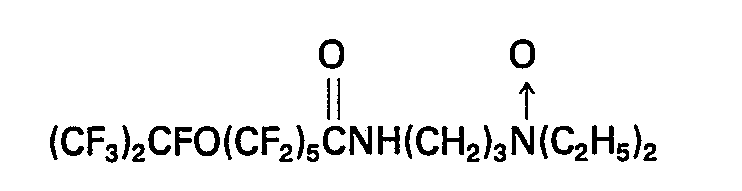

- The aqueous dispersions of the invention are prepared by any mixing technique which will provide a uniform blend of the ingredients, and preparation accordingly may be readily accomplished by the skilled formulator.
- When formulating the dispersions of the invention for systemic administration, it is important not only to add electrolytes and other materials to render the dispersions physiologically acceptable (such as isotonic with mammalian cells), but also to adjust the pH, as necessary, to offset the lowering of the pH of the hypoxic cell environment due to generation of lactic acid by the hypoxic tumor cells. A suitable pH range is 7.2-7.4. Among the additives commonly used to render fluids physiologically acceptable are buffers such as sodium bicarbonate, and mixtures such as Ringer's Solution. Other materials conventionally employed in pharmaceutical preparations and known to the skilled formulator may also be added to the dispersions. These include viscosity modifiers, stabilizers (against degradation due to freezing or contamination, for example), anti-freeze agents, diluents and encoding agents. Among such additives may be mentioned glycerin, dimethylsulfoxide ("DMSO"), various gelatins both natural and synthetic, and polyols such as sorbitol. I
- The perfluoro compound and surfactant components may be blended into water in any proportions which will provide uniform dispersions. Typical proportions are 5 to 50% perfluoro compound based on the volume of the total composition and 0.5 to 10% of the surfactant based on the total weight of the composition. Preferred proportions are 10-30% by volume of the perfluoro compound and 2-5% by weight of the surfactant, but proportions in particular cases may be varied depending on dispersability of the PFC, particle size desired, and similar considerations.
- The aqueous dispersions more usually comprise emulsions, preferably of the oil-in-water type but also including water-in-oil emulsions. In some cases the emulsions have a very fine particle size and appear transparent or solution-like to the unaided eye. The micro-emulsions which can be formulated with the dispersants of US―A―3,828,085 have this characteristic and are preferred. Colloidal suspensions, while not excluded from use in this invention, are less preferred, particularly for systemic administration, because of their larger particle size range and less stability. The above-identified blood substitute and surfactant patents provide excellent guidance to formulation of the dispersions, and attention is directed to the patents for such purpose.
- The aqueous dispersions containing the oxygen transporting perfluoro compound, when used as sensitizers in accordance with the invention, may be administered to a mammal locally or in any systemic fashion, whether intravenous, subcutaneous, intramuscular, parenteral, intraperitoneal or oral. Preferably, administration will be systemic and at a site enabling the dispersion to traverse the lungs to pick up oxygen and to transport the oxygen to the hypoxic tumor cells. Dosages of the dispersion will be predetermined in accordance with the site and character of the hypoxia, whether or not the treatment is a supplement to hyperbaric oxygen treatment, the systemic tolerance (toxicity) of the mammal to the specific formulation, and other factors known to the therapist. Generally, fluorocrits (cc of PFC per 100 ml blood) of the perfluoro compound should be in the range of 3-10%, although lower or higher fluorocrits in special circumstances may be sufficient or required. If the administration is a supplement to hyperbaric oxygen treatment, or other form of primary oxygen infusion, the fluorocrit need not be over 3.5%, and the partial pressure of oxygen in the inspired air may be up to about 200 kPa (2 atmospheres) at 100% oxygen. As a maximum in most cases, hyperbaric oxygen administration would be 30 minutes at 200 kPa (2 atmospheres) 100% oxygen pressure, and these conditions are known to be well within tolerated levels. However, the duration, content and pressure of the primary oxygenation in specific cases again will depend upon various factors, such as the health of the mammal or patient, the site of the hypoxia, and other conditions familiar to the radio- or chemotherapist.
- Contact of the PFC dispersion may be with the hypoxic cells or with the tumor cell vasculature, such that the oxygen carried by the PFC may transfer to the tumor/vasculature interface. In other words, while the ideal may be direct contact between the PFC dispersion and the hypoxic cells, this may not be achievable and in fact is not required, since excess oxygen, wherever present in the tumor mass, will tend to become distributed throughout the mass, and thus reach the hypoxic cells.
- The dosage of the sensitizing agent prior to irradiation and/or chemotherapy will also be controlled by various conditions, including the rate at which the perfluoro compound travels to the hypoxic tumor cells, the degree of sensitization desired, and the cardiovascular half-life residence time of the dispersion in the cardiovascular system and in the hypoxic tissues. For some treatments (such as brief radiation treatments) an acceptable cardiovascular (serum) half-life can be as brief as about 2 to 4 hours. This duration indicates that the perfluoro compound moves rapidly to the hypoxic tumor cells and transfers its oxygen to the cells. In this connection an outstanding property of the preferred dispersions of the invention is an extremely small particle size, which particle size is maintained over substantial periods. The small particle size enables the dispersions to quickly traverse the vasculature to the site of the hypoxia. For example, an average particle size of 0.05 to 0.2 11m has been observed and has been maintained for several months and up to a year or more.
- The dispersions may be oxygenated prior to infusion into the mammalian body and this may be expedient when injection is at or near the site of the hypoxia rather than at a site where oxygen transfer from the lungs and arteries is anticipated. Prior oxygenation in such manner may be accomplished by any means, such as flushing or blanketing a vessel containing the dispersion with oxygen or air, or bubbling oxygen or air through the dispersion prior to administration. When the treatment is a supplement to hyperbaric oxygen treatment, preoxygenation in the manner described may also be practiced. In every case of preoxygenation, however, there may be a loss of oxygen prior to entry of the dispersion into the region of the hypoxic tumor cells, that is, during transit of the dispersion to the cells; hence, preoxygenation generally is not preferred.
- The types, mode of application and sites of radiation treatments are well known and do not require detailed description. However, it will be evident that irradiation can be accomplished by external application or by internal placement of radiation sources near or at the site of the hypoxia. Accordingly, the irradiation may be achieved with x-rays, gamma rays and neutrons, or with implanted radium, iridium or cesium sources. Conventional radiation therapy (200 rads per day, five days per week for six to eight weeks) may be employed but dosage and total duration of treatment may be adjusted as required in particular circumstances.
- The sensitizing method of the invention will be effective for all types of hypoxic tumor cells, whether such cells be in suspension (as in leukemia) or in solid form, but the invention is particularly effective for solid tumors. Because systemic distribution of the dispersions is rapid, primarily due to the extremely small and stable particle size of the preferred dispersions of the invention, hypoxia at practically any site may be sensitized in accordance with the invention.
- Chemotherapy is often used in combination with radiotherapy to destroy or control hypoxic tumor cells and therefore the sensitization techniques of the invention can be applied simultaneously or sequentially to chemotherapy and radiotherapy. When dual therapy is used, a sensitizer dispersion will normally be selected which has the cardiovascular residence time effective to cover the duration of both treatments, or if the residence time is short, the sensitizer dosage can be suitably increased or adjusted. It is known that some chemotherapeutic agents are oxygen dependent in terms of requiring oxygen for active transport of the CT drug into the cell, for cell cycling control or CT enhancement. Hence, oxygen must be supplied in free form or by means of a carrier. Because the perfluoro compounds of the present invention and their dispersions are capable of transferring large quantities of oxygen, it can be expected that chemotherapy based upon drugs which are oxygen dependent will be benefited by formulating the drugs with an RS agent of the present invention, or sequentially administering the RS and CT agents. Methotrexate is an example of a CT drug thought to require oxygen for active transport into the cell. Vinblastine and Vincristine are drugs which require oxygen for cell cycling.
- CT drugs which may not be oxygen dependent may also be administered in conjunction with the sensitizing techniques of the invention. Among such drugs may be mentioned Androgens, Estrogens, Anti-estrogen, Progestins, Adrenal Steroids, Nitrogen Mustard, Chlorambucil, Phenylalanine Mustard, Cyclophosphamide, Thio-TEPA, Busulfan, 6-Mercaptopurine, 6-Thioguanine, 5 - Fluorouracil, Cytosine Arabinoside, Adriamycin, Dactinomycin, Daunomycin, Bleomycin, Mithramycin, Mitomycin-C, BCNU, CCNU, Methyl-CCNU, DTIC, Hydroxyurea, Cis-Platinum (cis-platinum (II) diamminedichloride), Procarbazine, Hexamethylmelamine and L-Asparaginase.
- - Those perfluoro compounds useful as RS agents but which also have radiopaque properties are particularly valuable for the purpose of the present invention. Such compounds include respective brominated perfluorohydrocarbons. The radioimaging properties of such compounds permit monitoring of their RS effects as well as toxicity to surrounding normal cells and hence serve as diagnostic agents as well as RS agents. However, if the perfluoro compounds do not also exhibit radiopacity, the dispersions containing the perfluoro compounds may be formulated with other, known, radiopaque agents in order to provide a similar opportunity for monitoring radiosensitization potential. The radioimaging may be practiced as in conventional radiography or computer axial tomography (CAT) radiography, or by the newer NMR techniques. The brominated compounds as RI agents may be used neat or in aqueous dispersion, for example as oil-in-water or water-in-oil emulsions containing 10-90% by volume of water and 0.5-10% by weight of a dispersant.
- Radioprotection may also be practiced in conjunction with the radiosensitization of the invention. Radioprotective agents are those which preferentially protect normal tissues from radiation injury. When practiced with radiosensitization, the objective is to reduce injury to the normal tissues, which injury may occur when the RS agents are used in the absence of the RP agents. Sulfhydryl-containing agents generally are known to be effective RP materials, such as aminoethylisothiuronium or the phosphorothioate derivatives of beta - mercaptoethylamine reviewed in the article by J. M. Yuhas, "On-the Potential Application of Radioprotective Drugs in Solid Tumor Radiotherapy", appearing in Radiation-Drug Interactions in the Treatment of Cancer, edited by G. H. Sokol and R. P. Maickel, John Wylie and Sons, Inc. (1980), pages 113-135. Another RP agent is S - 2 - (3 - aminopropylamino) ethylphosphorothioic acid, also described in the literature as WR-2721. This material provides protection both in radiotherapy and chemotherapy, as described in the article by Yuhas et al appearing in Cancer Clinical Trials (1980), 3, 211-216.
- The following examples will serve as further illustration of the invention without necessarily limiting the scope thereof. While the experimental results of Examples 2, 4 and 7 were obtained in vitro, the sensitization demonstrated by these examples is not restricted to non-mammalian systems because the MTS studies are known to correlate with patterns of the response of the cells in mammals. Specifically, the MTS are known to respond similarly to the same tumor when grown in the mammalian body.
-
- (A) A surfactant solution was prepared by dispersing in water a sufficient amount of the following amidoamine oxide surfactant ("AAO") to provide a 2% by weight solution:

- (B) A second dispersion was prepared substantially as in (A) above except for use of a nonionic polyoxyethylenepolyoxypropylene copolymer surfactant having an average molecular weight of 8200 ("Pluronic" F-68) in place of the AAO surfactant. This dispersion is hereinafter identified as "Dispersion B".
- Multicellular tumor spheroids ("MTS") are produced by placing 106 MCa-11 murine mammary tumor cells in 10 ml of Eagles Basal Medium ("EBME"), Grand Island Biological Co., catalog No. 420-1200, into a 100 mm petri dish which has been base coated with 0.75% noble agar in the EBME. Within 7-10 days spherical aggregates of tumor cells appear and are then ready for study. The PFC dispersion to be treated is adjusted to 290 milliosmoles, osmolarity with powdered tissue culture medium and adjusted to pH 7.2 to 7.4 with 0.1 N NaOH or HCI. Other details of preparation and use for the MTS are given in J. M. Yuhas et al, 1977, "A Simplified Method for Production and Growth of Multicellular Tumor Spheriods," Cancer Research 37:3639-3643; and J. M. Yuhas et al, 1978, "In Vitro Analysis of The Response of Multicellular Tumor Spheroids Exposed to Chemotherapeutic Agents in Vitro or In Vivo", Cancer Research 38:3595-3598.
- Either standard tissue culture medium (EBME) or the PFC dispersion is gassed with 100% oxygen for a period of fifteen minutes and then transferred, along with the spheroids, into non-heparinized capillary tubes and sealed. At intervals of 0 to 60 minutes later the tubes are exposed to graded doses of 250 kVp X-rays, and within 30 minutes thereafter are removed, washed with medium and placed individually in agar coated 16 mm wells along with 1.5 ml of medium. Using a dissecting scope at 40 power the spheroids are sized three times weekly and the medium is changed twice weekly. From the growth curves for each group is calculated the number of days required for each spheroid to grow 200 or 150 µm (microns) in diameter larger than the size at the beginning of the irradiation. The retardation of rate of growth of the spheroids shown by the data therefore provides a measure of RS response where the larger the difference over the irradiated controls the greater the RS effect. Toxicity of the PFC is evaluated in terms of growth delay, i.e., the retardation in growth of the spheroids after exposure to the PFC (without irradiation) relative to that observed in untreated spheroids. Table I below shows the results of experiments with Dispersions A and B.
- It will be noted that Dispersions A and B provided similar levels of toxicity and radiosensitivity. The toxicity exhibited by Dispersions A and B is considered negligible and likely to be relatively tolerable in the cardiovascular system.

- The rate of clearance of PFC Dispersions A and B from the circulation was evaluated in both Fisher 344 rats and BALB/c mice (females in both cases). The dispersions were injected intravenously to a PFC dose equal to one-third of the circulatory volume, which is equal to 6% of body weight. Within 30 minutes of injection, the animal returns to the normovolemic state as evidenced by the fact that the fluorocrit equals 3.1% compared to the theoretical estimate of 3.3% for these Dispersions. At graded intervals through 8 hours after injection, blood is drawn in microcapillary tubes from the supraorbital sinus. Following centrifugation for 15 minutes at 12,000 times gravity, the fluorocrit (PFC as a percent of the blood volume) and the hematocrit are read on a microscope. The PFC collects as a pellet in the bottom of the tubes, followed by the red blood cells and the plasma, thus forming distinct layers. All data are normalized to the 30 minute centrifugation reading and the rate of decline of the fluorocrit is estimated from a standard single compartment exponential decay curve defined by:


- The MTS experiments of Example 2 were repeated in all essential respects with Dispersion B but using spheroids derived from human tumor lines which contain hypoxic cells when grown as MTS. As shown in Table 11 below, some toxicity was observed in all cases but the levels are considered relatively tolerable. Moderate radiosensitizing is apparent for the two neuroblastoma cell lines but very high radiosensitization is shown with respect to the melanoma line. The latter is an outstanding result due to the prevalence and high risks known for this form of hypoxic tumor cells. Very littel RS effect is shown for the osteosarcoma cell line but these results are only preliminary and the exposure was at a low radiation level.

- Studies were undertaken to confirm suitability of PFC emulsions for intravascular administration and oxygen transport. The emulsion tested was Dispersion B which was held at 4°C. until use. Just prior to use the osmolarity was adjusted to approximately 300 milliosmoles with powdered tissue culture medium (Eagles Basal Medium-"EBME"), and the pH adjusted to 7.4with HCI or NaOH. Table III below summarizes the results of an acute toxicity study of Fisher-344 rats in which various doses of the emulsion were injected into the tail veins of the rats. Rats reported as surviving after injection survived for at least ten days. Deaths normally occurred in 4 to 24 hours if at all. The results indicate that the animals can tolerate large doses of PFC emulsion relative to their blood volume (about 60 to 80 ml/kg) as compared with the doses which would be administered to assess radiosensitization in vivo, normally, 20 to 30 ml/kg. In LDso (I.V.) tests it was determined that the lethal dosage was greater than 60 ml/kg for BALB/c mice and greater than 120 ml/kg for the Fischer-344 rats. The observations are consistent with those reported by other investigators in that the PFC dispersion has a low acute toxicity even when administered hypervolemically at doses exceeding the animals' normal blood volume. The deaths which occurred at the high doses probably were due to fluid overload rather inherent toxicity of the PFC dispersions.

- Radiosensitization of the 3M2N mammary tumor growing in the right hind leg of Fischer-344 rats was studied. At 10-14 days after subcutaneous transplantation in the rats the tumors were 6-8 mm in diameter and ready for treatment. The control animals either received no treatment or received various radiation doses. The other animals received I.V. infusion of 20 ml/kg of Dispersion B (20% w/v) followed by 30 minutes breathing of 95% 0215% C02 gas mixture (at 1 atm) and then by the various radiation doeses of x-rays. Prior to and three times weekly after treatment, the two orthogonal diameters of the tumors were measured in situ and averaged. Table IV below expresses the results of the study as the time required for the tumors to grow 8 mm beyond their size at the time of treatment. The data show that the enhancement produced by the PFC dispersion increases with radiation dose, and also that the growth delay per rad is significantly higher in the PFC-treated group than in the control. That the enhancement is due to the combination of the PFC dispersion and breathing of the gas mixture is evident from Table V below in that none of the control treatments were capable of producing the growth delay of the combination.


- The potentiation by PFC dispersions of chemotherapeutic agents were demonstrated by the anti-tumor effect of methotrexate ("MTX") in NB-100 neuroblastoma multicellular tumor spheroids ("MTS"). In this study, the spheroids were exposed to from 0 to 5x10⁻⁶ molar methotrexate in control medium and in Dispersion B equilibrated with a 95% O2/5% C02 mixture. The results (Table VI below) show that the PFC dispersion enhanced the effectiveness of MTX as evidenced by the delay in growth relative to the spheroids treated only with MTX. Although some sensitization to MTX in these spheroids can be achieved by gassing with the gas mixture in medium alone, such sensitization requires 1 to 2 hours pretreatment as opposed to only 30 minutes with the PFC dispersion, thus clearly demonstrating the feasibility of elevating the therapeutic index of this important anti-cancer drug with PFC.
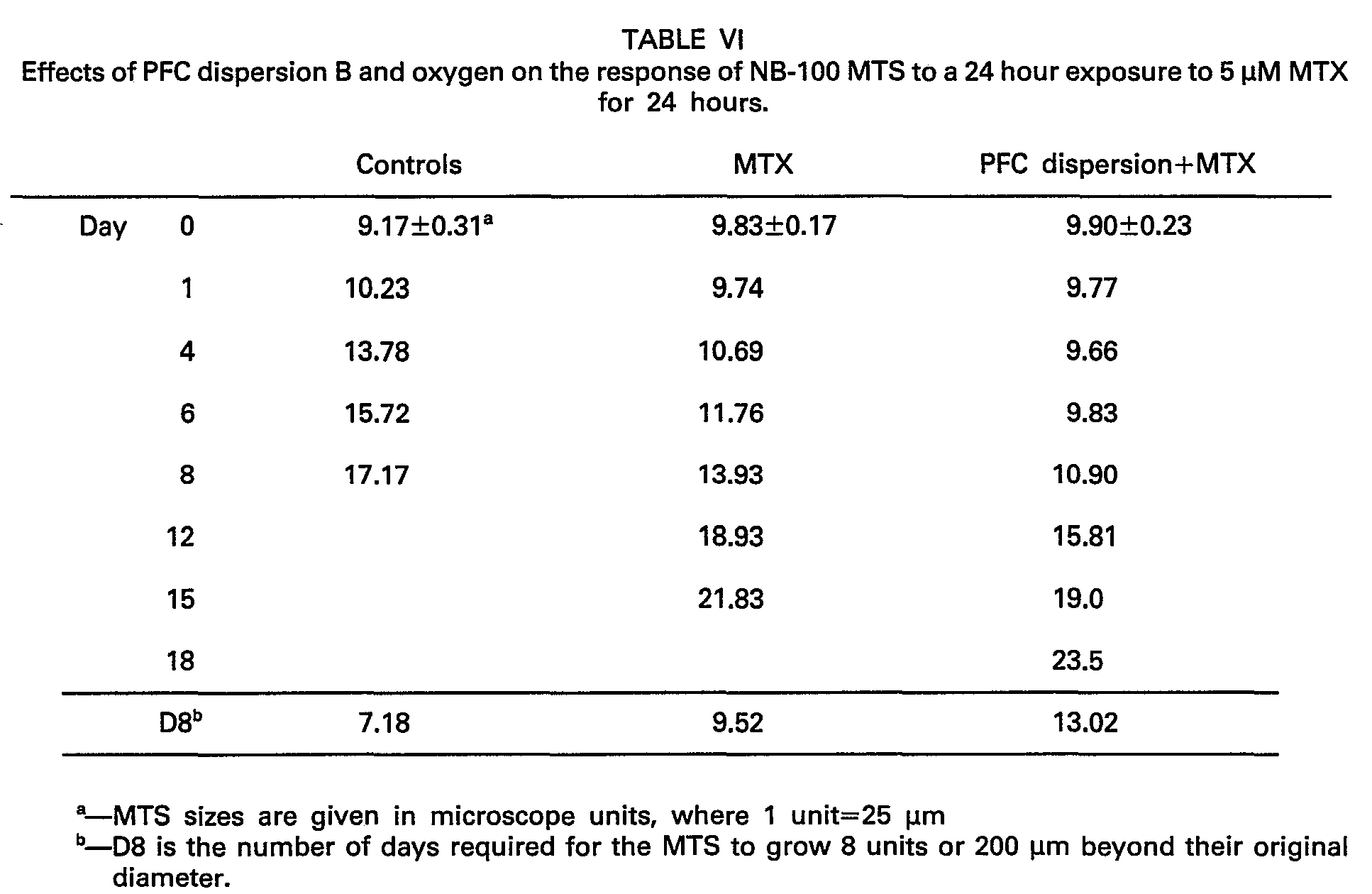
- The combined use of PFC dispersion (Dispersion B) and high oxygen breathing for enhancement of the anti-tumor effects of cyclophosphamide ("CYC") was investigated with respect to treatment of MCa-11 mammary carcinoma transplanted into the right hind leg of female BALB/c mice. The tumors were allowed to grow to 2 mm at which point the animals were treated as described in Table VII below, wherein the cyclophosphamide, obtained commercially, was dissolved in distilled water and injected in a volume equal to 0.01 ml/kg of body weight. Three to six animals per treatment group were used in the study. On the day of treatment and three to five times per week thereafter, the tumors were sized with vernier calipers.
- From the test results (Table VII); it is evident that the anti-tumor effect (growth delay) produced by the cyclophosphamide alone (absence of oxygen and/or PFC dispersion) was not detectably enhanced by oxygen breathing (of 95% Oz/5% C02 mixture) or by injection of PFC dispersion followed by oxygen breathing, but was enhanced effectively by administration of PFC dispersion in concert with oxygen breathing.

- Combined chemosensitization of hypoxic tumors to chemotherapeutic agents and protection of normal tissues is achieved by the procedure described by Yuhas et al, "Treatment of Tumours with the Combination of WR-2721 and Cis - dichlorodiammine platinum (II) or Cyclophosphamide", Br. J. Cancer (1980), 42, 574-585 and publications referenced therein, as modified by concurrent treatment with 20 ml/kg of a PFC dispersion, such as Dispersion B, as described in Example 8 above, to accommodate lower dosages of the chemotherapeutic agents (75 mg/kg), room air breathing, high oxygen (95% 02/5% C02) breathing, controls, and other conditions as appropriate.
- The sensitization of hypoxic tumors to irradiation by treatment with PFC compositions of the invention in combination with radioprotection of normal tissues in the region of treatment is achieved by the procedure described by Yuhas et al, "The Role of WR-2721 in Radiotherapy and/or Chemotherapy", Cancer Clinical Trials (1980), 3, 211-216 and publications referenced therein, modified as described in Example 6 above to provide for concurrent infusion of 20 ml/kg of a PFC composition such as Dispersion B, high oxygen (95% O2/5% C02) or air breathing, controls, and other conditions as appropriate.
- In the course of in vitro chemosensitization studies in the LAN-1 human neuroblastoma spheroid system, conducted substantially as described in Example 4 above except for Adriamycin as the chemotherapeutic agent, it was noted that the anti-tumor activity of the Adriamycin was inhibited by the PFC material (PFC Dispersion B). This suggested that the PFC may have been physically binding the Adriamycin, thereby reducing the concentration available for absorption by the spheroids. This was tested by dissolving in water a radio-labelled analogue of Adriamycin, C14-Daunomycin, adding Dispersion B (or in separate experiments, the neat PFC component of Dispersion B), blending for 30 minutes, separating the PFC phase from the aqueous phase, and determining the distribution of drug between the phases. Table VIII below reports the results of the experiment and similar experiments with three other drugs. It will be noted that the more lipophilic Duanomycin preferentially partitioned into the PFC phase whereas the other, less lipophilic, drugs favored the aqueous phase. It was concluded that although the PFC may have an inhibitory effect on less lipophilic drugs, the delivery of lipophilic drugs will be enhanced by the PFC.

- The preferential solubility of lipophilic drugs in PFC compositions not only provides a means for enhancing the delivery of such drugs in animals but also opens up opportunity for controlling residence time of the drug in the animal, for example by prolonging release of the drug from PFC circulating to the plasma and target organs. In other words, by appropriate selection of a drug from the standpoint of its relative lipophilicity in a PFC dispersion, sustained low level delivery of a drug for a prolonged period is made possible with an aqueous delivery system.
- This example illustrates enhancement of anti-tumor action of Vincristine, a lipophilic drug to which tumors are normally resistant at least to non-lethal doses thereof. The enhancement is believed due to the preferential solubility of the drug in the PFC material.
- The partitioning of the Vincristine between the PFC and aqueous phases of Dispersion B was first studied in comparison with Daunomycin, as reported in Table IX below, where "PFC" means the PFC phase of Dispersion B.

- Thereafter, in vivo chemosensitization was conducted in MCa-11 mammary carcinoma essentially as described in Example 8 above except as follows:
- The MCa-11 mammary carcinoma was transplanted into the thigh of BALB/c mice and grown to a diameter of 6 mm, at which time the mice were treated. Control mice received an injection of saline, while Vincristine treatment consisted of a single dose of 1.5 mg/kg of Vincristine administered intraperitoneally. PFC treatment consisted of an i.v. injection of 20 ml/kg of Dispersion B, followed by two hours of breathing carbogen (95% 02/5% C02), and injection of saline of Vincristine as before, followed by another two hours of carbogen breathing. It was observed that the Vincristine treatment alone had no effect on tumor growth. Similarly, administration of the PFC emulsion alone had no effects on tumor growth, but when combined with the injection of Vincristine, the growth of the tumor was delayed by approximately 5 days. Oxygen breathing was included in the experiment in order to guarantee that any stimulation of the active efflux mechanism might not override any potential benefits gained via a more advantageous delivery of drug. In vitro studies now underway indicate that the benefits of the PFC-Vincristine combination are not oxygen dependent. Moreover, enhanced host toxicity of the Vincristine when combined with the PFC dispersion could not be detected. Thus, it appears that PFC dispersions have the potential to deliver low levels of drugs over prolonged periods.
- It will also be apparent that by matching PFC materials and drugs based on their relative lipophilicity, the efficacy of drugs in a variety of treatments may be controlled. In some cases the effect may be enhancement of activity. In other cases diminished activity or prolonged activity may be the preferred result. These benefits are achievable whether or not the PFC material is also being untilized as an oxygen transporting agent.
Claims (15)
Priority Applications (1)
| Application Number | Priority Date | Filing Date | Title |
|---|---|---|---|
| AT83304632T ATE40043T1 (en) | 1982-08-17 | 1983-08-10 | EMULSIONS OF PERFLUORINATED COMPOUNDS, A PROCESS FOR THEIR PRODUCTION AND THEIR THERAPEUTIC APPLICATION. |
Applications Claiming Priority (4)
| Application Number | Priority Date | Filing Date | Title |
|---|---|---|---|
| US40858982A | 1982-08-17 | 1982-08-17 | |
| US51715083A | 1983-07-25 | 1983-07-25 | |
| US517150 | 1983-07-25 | ||
| US408589 | 1989-09-18 |
Publications (2)
| Publication Number | Publication Date |
|---|---|
| EP0105584A1 EP0105584A1 (en) | 1984-04-18 |
| EP0105584B1 true EP0105584B1 (en) | 1989-01-18 |
Family
ID=27020315
Family Applications (1)
| Application Number | Title | Priority Date | Filing Date |
|---|---|---|---|
| EP83304632A Expired EP0105584B1 (en) | 1982-08-17 | 1983-08-10 | Perfluorocarbon emulsions and their preparation and use in therapy |
Country Status (19)
| Country | Link |
|---|---|
| EP (1) | EP0105584B1 (en) |
| JP (1) | JPS59501665A (en) |
| KR (1) | KR890002204B1 (en) |
| AU (1) | AU559559B2 (en) |
| CA (1) | CA1225027A (en) |
| CH (1) | CH665952A5 (en) |
| DE (2) | DE3390172T1 (en) |
| ES (1) | ES524972A0 (en) |
| FI (1) | FI841513L (en) |
| GB (1) | GB2134787A (en) |
| GR (1) | GR79383B (en) |
| IE (1) | IE55618B1 (en) |
| IL (1) | IL69505A (en) |
| NL (1) | NL8320264A (en) |
| NO (1) | NO841519L (en) |
| PH (2) | PH25492A (en) |
| PT (1) | PT77204B (en) |
| SE (1) | SE8402098D0 (en) |
| WO (1) | WO1984000686A1 (en) |
Families Citing this family (21)
| Publication number | Priority date | Publication date | Assignee | Title |
|---|---|---|---|---|
| JPS59130813A (en) * | 1983-01-14 | 1984-07-27 | Green Cross Corp:The | Adminiculum for chemotherapy of cancer |
| JPS59130812A (en) * | 1983-01-14 | 1984-07-27 | Green Cross Corp:The | Adminiculum for chemotherapy of cancer |
| CA1257828A (en) * | 1984-04-16 | 1989-07-25 | William Mccormick | Perfluoro compound dispersions containing reduced amounts of surfactant and process of preparation |
| US4815446A (en) * | 1985-05-09 | 1989-03-28 | Alpha Therapeutic Corporation | Process for treating metastasis of cancerous tumors |
| US4781676A (en) * | 1987-02-20 | 1988-11-01 | Air Products And Chemicals, Inc. | Interstitial administration of perfluorochemical emulsions for reoxygenation of hypoxic tumor cells |
| US4956390A (en) * | 1987-08-25 | 1990-09-11 | Air Products And Chemicals, Inc. | Gas transport employing perfluorobutyldecalin |
| JP2935519B2 (en) * | 1989-08-28 | 1999-08-16 | シーキンス,ケイ・マイケル | Lung cancer hyperthermia treatment via convection with ultrasound and / or perfluorocarbon liquid |
| US5562608A (en) * | 1989-08-28 | 1996-10-08 | Biopulmonics, Inc. | Apparatus for pulmonary delivery of drugs with simultaneous liquid lavage and ventilation |
| US5518731A (en) * | 1990-09-27 | 1996-05-21 | Allergan, Inc. | Nonaqueous fluorinated drug delivery vehicle suspensions |
| US6458376B1 (en) | 1990-09-27 | 2002-10-01 | Allergan, Inc. | Nonaqueous fluorinated drug delivery suspensions |
| FR2679150A1 (en) * | 1991-07-17 | 1993-01-22 | Atta | PREPARATIONS CONSISTING OF A FLUOROCARBIDE OR HIGHLY FLUORINE COMPOUND AND A LIPOPHILIC-FLUOROPHILIC ORGANIC COMPOUND, AND THEIR USES. |
| AU3924193A (en) * | 1992-03-19 | 1993-10-21 | Allergan, Inc. | Compositions comprising a drug delivery vehicle suspended in a nonaqueous fluorinated liquid |
| DE4221268C2 (en) * | 1992-06-26 | 1997-06-12 | Lancaster Group Ag | Use of a dermatological to support the oxygen transport in the skin |
| US5643601A (en) * | 1992-06-26 | 1997-07-01 | Lancaster Group Ag | Phospholipid-and fluorocarbon-containing cosmetic |
| DE4221256C2 (en) * | 1992-06-26 | 1997-07-10 | Lancaster Group Ag | Galenic composition for topical use |
| US5480914A (en) * | 1994-05-06 | 1996-01-02 | Allergan, Inc. | Nonaqueous thixotropic drug delivery suspensions and methods of their use |
| DE69940738D1 (en) * | 1998-07-09 | 2009-05-28 | Curelight Medical Ltd | DEVICE AND METHOD FOR EFFICIENT HIGHERGETIC PHOTODYNAMIC THERAPY OF ACNE VULGARIS AND SEBORRHOE |
| US20040122492A1 (en) | 1999-07-07 | 2004-06-24 | Yoram Harth | Phototherapeutic treatment of skin conditions |
| GB0200721D0 (en) * | 2002-01-14 | 2002-02-27 | Univ Bristol | Toxicity test |
| RU2440158C2 (en) * | 2010-02-25 | 2012-01-20 | Юрий Александрович Белый | Method of photodynamic therapy of subjects with malignant tumours |
| EP2587917A4 (en) * | 2010-07-01 | 2015-05-06 | Mtm Res Llc | THERAPIES USING ANTIFIBROBLASTIC FLUOROCHEMICAL EMULSIONS |
Citations (5)
| Publication number | Priority date | Publication date | Assignee | Title |
|---|---|---|---|---|
| US3911138A (en) * | 1973-02-26 | 1975-10-07 | Children S Hospital Inc Of Cin | Artificial blood and method for supporting oxygen transport in animals |
| US4105798A (en) * | 1976-07-19 | 1978-08-08 | Sun Ventures, Inc. | Perfluoro polycyclic compounds for use as synthetic blood and perfusion media |
| US4252827A (en) * | 1979-05-23 | 1981-02-24 | The Green Cross Corporation | Oxygen-transferable fluorocarbon emulsion |
| US4366169A (en) * | 1979-06-25 | 1982-12-28 | Sun Tech, Inc. | Use of perfluorocarbons as wound treatment |
| EP0091313A2 (en) * | 1982-04-05 | 1983-10-12 | Alcon Laboratories, Inc. | Perfluorohydrocarbons as vehicles for administering drugs |
Family Cites Families (10)
| Publication number | Priority date | Publication date | Assignee | Title |
|---|---|---|---|---|
| US3828085A (en) * | 1970-07-09 | 1974-08-06 | Allied Chem | Novel amidoamine oxides |
| US3823091A (en) * | 1971-05-19 | 1974-07-09 | Green Cross Corp | Stable emulsion of fluorocarbon particles |
| US4041086A (en) * | 1972-02-07 | 1977-08-09 | Sun Ventures, Inc. | Process of manufacture of flourinated alkyladamantanes |
| JPS5331209B2 (en) * | 1973-10-05 | 1978-09-01 | ||
| DE2524363A1 (en) * | 1975-06-02 | 1976-12-16 | Boehringer Sohn Ingelheim | NEW PHARMACEUTICAL PRODUCTS |
| JPS5331209A (en) * | 1976-09-03 | 1978-03-24 | Hitachi Ltd | Small compressor cylinder for refrigerating machine and production of same |
| IE47132B1 (en) * | 1977-08-19 | 1983-12-28 | Roche Products Ltd | Novel nitroimidazoles and pharmaceutical preparations containing these as well as their manufacture |
| JPS6033367B2 (en) * | 1978-11-24 | 1985-08-02 | 株式会社ミドリ十字 | oxygen delivery infusion |
| US4282232A (en) * | 1979-04-26 | 1981-08-04 | Research Corporation | Nitroimidazole radiosensitizers for hypoxic tumor cells and compositions thereof |
| CA1181011A (en) * | 1980-05-27 | 1985-01-15 | Robert P. Geyer | Perfluorinated n,n-dimethyl cyclohexylmethylamine and emulsions containing the same |
-
1983
- 1983-08-10 JP JP58502857A patent/JPS59501665A/en active Pending
- 1983-08-10 DE DE19833390172 patent/DE3390172T1/en not_active Ceased
- 1983-08-10 AU AU19413/83A patent/AU559559B2/en not_active Ceased
- 1983-08-10 EP EP83304632A patent/EP0105584B1/en not_active Expired
- 1983-08-10 NL NL8320264A patent/NL8320264A/en unknown
- 1983-08-10 DE DE8383304632T patent/DE3378954D1/en not_active Expired
- 1983-08-10 CH CH2020/84A patent/CH665952A5/en not_active IP Right Cessation
- 1983-08-10 WO PCT/US1983/001237 patent/WO1984000686A1/en not_active Ceased
- 1983-08-10 FI FI841513A patent/FI841513L/en not_active Application Discontinuation
- 1983-08-10 GB GB08409519A patent/GB2134787A/en not_active Withdrawn
- 1983-08-16 KR KR1019830003805A patent/KR890002204B1/en not_active Expired
- 1983-08-16 CA CA000434734A patent/CA1225027A/en not_active Expired
- 1983-08-16 PT PT77204A patent/PT77204B/en not_active IP Right Cessation
- 1983-08-16 ES ES524972A patent/ES524972A0/en active Granted
- 1983-08-16 IL IL69505A patent/IL69505A/en unknown
- 1983-08-17 PH PH29411A patent/PH25492A/en unknown
- 1983-08-17 IE IE1925/83A patent/IE55618B1/en unknown
- 1983-08-17 GR GR72239A patent/GR79383B/el unknown
-
1984
- 1984-04-16 SE SE8402098A patent/SE8402098D0/en not_active Application Discontinuation
- 1984-04-16 NO NO841519A patent/NO841519L/en unknown
- 1984-05-16 PH PH30682A patent/PH25027A/en unknown
Patent Citations (6)
| Publication number | Priority date | Publication date | Assignee | Title |
|---|---|---|---|---|
| US3911138A (en) * | 1973-02-26 | 1975-10-07 | Children S Hospital Inc Of Cin | Artificial blood and method for supporting oxygen transport in animals |
| US3911138B1 (en) * | 1973-02-26 | 1996-10-29 | Childrens Hosp Medical Center | Artificial blood and method for supporting oxygen transport in animals |
| US4105798A (en) * | 1976-07-19 | 1978-08-08 | Sun Ventures, Inc. | Perfluoro polycyclic compounds for use as synthetic blood and perfusion media |
| US4252827A (en) * | 1979-05-23 | 1981-02-24 | The Green Cross Corporation | Oxygen-transferable fluorocarbon emulsion |
| US4366169A (en) * | 1979-06-25 | 1982-12-28 | Sun Tech, Inc. | Use of perfluorocarbons as wound treatment |
| EP0091313A2 (en) * | 1982-04-05 | 1983-10-12 | Alcon Laboratories, Inc. | Perfluorohydrocarbons as vehicles for administering drugs |
Non-Patent Citations (6)
| Title |
|---|
| Acta Neurochirurgica 56, pages 157-166 * |
| J. Neurosurg. 57, pages 467-471 * |
| Preparation, properties and industrial applications of Organofluorine compounds ED. RE Banks, Ellis Harwood, pages 150-153 * |
| Radiology 133(1), pages 235-237 * |
| Respir. circ. 30(20), pages 159-163 * |
| Surgical Neurology 18(4), pages 258-261 * |
Also Published As
| Publication number | Publication date |
|---|---|
| SE8402098L (en) | 1984-04-16 |
| ES8502405A1 (en) | 1985-01-01 |
| AU1941383A (en) | 1984-03-07 |
| WO1984000686A1 (en) | 1984-03-01 |
| CA1225027A (en) | 1987-08-04 |
| KR890002204B1 (en) | 1989-06-23 |
| IE831925L (en) | 1984-02-17 |
| PT77204B (en) | 1986-02-04 |
| DE3390172T1 (en) | 1984-11-29 |
| FI841513A7 (en) | 1984-04-16 |
| SE8402098D0 (en) | 1984-04-16 |
| FI841513A0 (en) | 1984-04-16 |
| CH665952A5 (en) | 1988-06-30 |
| JPS59501665A (en) | 1984-10-04 |
| GB2134787A (en) | 1984-08-22 |
| NO841519L (en) | 1984-04-16 |
| IL69505A (en) | 1990-03-19 |
| KR840005660A (en) | 1984-11-15 |
| PT77204A (en) | 1983-09-01 |
| DE3378954D1 (en) | 1989-02-23 |
| AU559559B2 (en) | 1987-03-12 |
| PH25492A (en) | 1991-07-24 |
| ES524972A0 (en) | 1985-01-01 |
| NL8320264A (en) | 1984-07-02 |
| EP0105584A1 (en) | 1984-04-18 |
| FI841513L (en) | 1984-04-16 |
| IL69505A0 (en) | 1983-11-30 |
| IE55618B1 (en) | 1990-11-21 |
| PH25027A (en) | 1991-01-28 |
| GR79383B (en) | 1984-10-22 |
Similar Documents
| Publication | Publication Date | Title |
|---|---|---|
| CA1225027A (en) | Sensitization of hypoxic tumor cells and control of growth thereof | |
| EP0625068B1 (en) | Highly fluorinated, chloro-substituted organic compound-containing emulsions and methods of making and using them | |
| US4889525A (en) | Sensitization of hypoxic tumor cells and control of growth thereof | |
| US5077036A (en) | Biocompatible stable fluorocarbon emulsions for contrast enhancement and oxygen transport comprising 40-125% wt./volume fluorocarbon combined with a phospholipid | |
| US4742050A (en) | Sensitization of hypoxic tumor cells and control of growth thereof | |
| US4815446A (en) | Process for treating metastasis of cancerous tumors | |
| EP0279379B1 (en) | Interstitial administration of perfluorchemical emulsions for reoxygenation of hypoxic tumor cells | |
| Sheldon et al. | Radiosensitization of C3H mouse mammary tumours by a 2-nitroimidazole drug | |
| Suit et al. | Pentobarbital anesthesia and the response of tumor and normal tissue in the C3Hf/Sed mouse to radiation | |
| EP0335966A1 (en) | Vasoconstrictive substances in combination with cytotoxic agents | |
| EP0480925B1 (en) | Fluorocarbon emulsions having saturated phospholipid emulsifiers | |
| Lowe | Synthetic oxygen transport fluids based on perfluorochemicals: applications in medicine and biology | |
| GB2041221A (en) | X-ray contrast compositions | |
| Milne et al. | Factors affecting hypoxic KHT tumor cells in mice breathing O2, O2+ CO2, or hyperbaric oxygen with or without anesthesia | |
| Adams et al. | Biological basis of radiosensitization by hypoxic-cell radiosensitizers | |
| JP2001523248A (en) | 1,2,4-benzotriazine oxide compound | |
| PH26149A (en) | Perfluorocarbon emulsions and their preparation | |
| Guichard | The use of fluorocarbon emulsions in cancer radiotherapy | |
| Harris et al. | Sensitization of anoxic mouse tumours to X-rays with diamide and nifuroxime | |
| JPH11511479A (en) | 1,2,4-benzotriazine oxide preparation | |
| Rockwell et al. | Effects of the perfluorochemical emulsion FMIQ on the radiation response of EMT6 tumours | |
| CA1335714C (en) | Fluorocarbon emulsions having saturated phospholipid emulsifiers | |
| ADAMS | Mount Vernon Hospital, Northwood, HA6 2RN, England | |
| JP3002486B2 (en) | Fluorocarbon emulsion containing saturated phospholipid emulsifier | |
| Mansfield et al. | The search for new hypoxic cell radiosensitizers |
Legal Events
| Date | Code | Title | Description |
|---|---|---|---|
| PUAI | Public reference made under article 153(3) epc to a published international application that has entered the european phase |
Free format text: ORIGINAL CODE: 0009012 |
|
| AK | Designated contracting states |
Designated state(s): AT BE CH DE FR GB IT LI LU NL SE |
|
| 17P | Request for examination filed |
Effective date: 19841005 |
|
| RAP1 | Party data changed (applicant data changed or rights of an application transferred) |
Owner name: ADAMANTECH, INC. |
|
| 17Q | First examination report despatched |
Effective date: 19860220 |
|
| GRAA | (expected) grant |
Free format text: ORIGINAL CODE: 0009210 |
|
| AK | Designated contracting states |
Kind code of ref document: B1 Designated state(s): AT BE CH DE FR GB IT LI LU NL SE |
|
| REF | Corresponds to: |
Ref document number: 40043 Country of ref document: AT Date of ref document: 19890215 Kind code of ref document: T |
|
| REF | Corresponds to: |
Ref document number: 3378954 Country of ref document: DE Date of ref document: 19890223 |
|
| ITF | It: translation for a ep patent filed | ||
| ET | Fr: translation filed | ||
| PLBI | Opposition filed |
Free format text: ORIGINAL CODE: 0009260 |
|
| 26 | Opposition filed |
Opponent name: FULMER YARSLEY LIMITED Effective date: 19891018 |
|
| NLR1 | Nl: opposition has been filed with the epo |
Opponent name: FULMER YARSLEY LIMITED |
|
| PGFP | Annual fee paid to national office [announced via postgrant information from national office to epo] |
Ref country code: GB Payment date: 19910717 Year of fee payment: 9 |
|
| ITTA | It: last paid annual fee | ||
| PGFP | Annual fee paid to national office [announced via postgrant information from national office to epo] |
Ref country code: NL Payment date: 19910831 Year of fee payment: 9 |
|
| PGFP | Annual fee paid to national office [announced via postgrant information from national office to epo] |
Ref country code: FR Payment date: 19911021 Year of fee payment: 9 |
|
| PGFP | Annual fee paid to national office [announced via postgrant information from national office to epo] |
Ref country code: SE Payment date: 19911022 Year of fee payment: 9 |
|
| PGFP | Annual fee paid to national office [announced via postgrant information from national office to epo] |
Ref country code: AT Payment date: 19911029 Year of fee payment: 9 |
|
| PGFP | Annual fee paid to national office [announced via postgrant information from national office to epo] |
Ref country code: BE Payment date: 19911113 Year of fee payment: 9 |
|
| PGFP | Annual fee paid to national office [announced via postgrant information from national office to epo] |
Ref country code: DE Payment date: 19911128 Year of fee payment: 9 |
|
| PGFP | Annual fee paid to national office [announced via postgrant information from national office to epo] |
Ref country code: CH Payment date: 19911209 Year of fee payment: 9 |
|
| PG25 | Lapsed in a contracting state [announced via postgrant information from national office to epo] |
Ref country code: AT Effective date: 19920810 Ref country code: LU Free format text: LAPSE BECAUSE OF NON-PAYMENT OF DUE FEES Effective date: 19920810 Ref country code: GB Effective date: 19920810 |
|
| PG25 | Lapsed in a contracting state [announced via postgrant information from national office to epo] |
Ref country code: SE Effective date: 19920811 |
|
| PG25 | Lapsed in a contracting state [announced via postgrant information from national office to epo] |
Ref country code: BE Effective date: 19920831 Ref country code: CH Free format text: LAPSE BECAUSE OF NON-PAYMENT OF DUE FEES Effective date: 19920831 Ref country code: LI Free format text: LAPSE BECAUSE OF NON-PAYMENT OF DUE FEES Effective date: 19920831 |
|
| PGFP | Annual fee paid to national office [announced via postgrant information from national office to epo] |
Ref country code: LU Payment date: 19921231 Year of fee payment: 9 |
|
| BERE | Be: lapsed |
Owner name: ADAMANTECH INC. Effective date: 19920831 |
|
| PG25 | Lapsed in a contracting state [announced via postgrant information from national office to epo] |
Ref country code: NL Effective date: 19930301 |
|
| EPTA | Lu: last paid annual fee | ||
| GBPC | Gb: european patent ceased through non-payment of renewal fee |
Effective date: 19920810 |
|
| NLV4 | Nl: lapsed or anulled due to non-payment of the annual fee | ||
| REG | Reference to a national code |
Ref country code: CH Ref legal event code: PL |
|
| RDAG | Patent revoked |
Free format text: ORIGINAL CODE: 0009271 |
|
| STAA | Information on the status of an ep patent application or granted ep patent |
Free format text: STATUS: PATENT REVOKED |
|
| REG | Reference to a national code |
Ref country code: FR Ref legal event code: ST |
|
| 27W | Patent revoked |
Effective date: 19930314 |
|
| EUG | Se: european patent has lapsed |
Ref document number: 83304632.9 Effective date: 19930307 |
|
| PG25 | Lapsed in a contracting state [announced via postgrant information from national office to epo] |
Ref country code: LU Free format text: LAPSE BECAUSE OF NON-PAYMENT OF DUE FEES Effective date: 19910831 |