EP0105468B1 - Method and apparatus of checking an arrangement of printing pages - Google Patents
Method and apparatus of checking an arrangement of printing pages Download PDFInfo
- Publication number
- EP0105468B1 EP0105468B1 EP19830109704 EP83109704A EP0105468B1 EP 0105468 B1 EP0105468 B1 EP 0105468B1 EP 19830109704 EP19830109704 EP 19830109704 EP 83109704 A EP83109704 A EP 83109704A EP 0105468 B1 EP0105468 B1 EP 0105468B1
- Authority
- EP
- European Patent Office
- Prior art keywords
- image
- page
- images
- pages
- color
- Prior art date
- Legal status (The legal status is an assumption and is not a legal conclusion. Google has not performed a legal analysis and makes no representation as to the accuracy of the status listed.)
- Expired
Links
Images



Classifications
-
- B—PERFORMING OPERATIONS; TRANSPORTING
- B41—PRINTING; LINING MACHINES; TYPEWRITERS; STAMPS
- B41F—PRINTING MACHINES OR PRESSES
- B41F33/00—Indicating, counting, warning, control or safety devices
- B41F33/0036—Devices for scanning or checking the printed matter for quality control
Definitions
- the combinations of the images on the pages displayed on the image display device are determined so as to occupy the positions as shown in Figs. 6(a) through 6(i).
- the processed content selecting device 60 is provided to determine the processed contents such as whether or not the image on the page to be color-displayed in response to the indication signal S 1 is displayed as the normal image without modification or displayed as the image with top and bottom inverted referring to the prestored reference pattern table 61 and to put the processed contents into data processors 62 and 63 as processing signals S 2 and S 3 .
- put into the processors 62 and 63 are image signals S 4 and S s for two page portions of the opened-page to be display in color after said image signals have been selected from the memory 44.
Landscapes
- Engineering & Computer Science (AREA)
- Quality & Reliability (AREA)
- Editing Of Facsimile Originals (AREA)
Description
- The present invention relates to a method and apparatus which checks, where images for a plurality of page portions are printed simultaneously, whether or not the image on each page is arranged in a predetermined position, and particularly to a method and apparatus intended to effect said checking by making use of a monitor television.
- It is known, for example from "Graphic Arts Procedures" by R. Randolph Karch, American Technical Society, 8th Printing, 1965, that where books, catalogues and the like are printed, images for a plurality of page portions are printed simultaneously. In such a case, the printed matters in which a plurality of page portions are printed are folded by a folding machine in such a way that each page is disposed in a proper order. In order that each page may be disposed in a proper order when the printed matters are folded by the folding machine, it is necessary that an image on each page formed on a printing plate is arranged in a predetermined position.
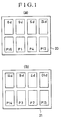
- Figs. 1 through 3 illustrate one example how an image on each page is arranged when 16 page portions are printed simultaneously. In the drawings, in pages where numerals showing the state of arrangement of images on pages are inversely indicated in the direction of the top and bottom of the pages, the images thereof are also inversely arranged, and in pages where said numerals are normally indicated in the direction of the top and bottom of the pages the images thereof are also normally arranged. Figs. 1(a) and (b) show the state in which images P1, P2, P3, ... P16 for a plurality of page portions are arranged on two sheet-
like base materials like base material 20 pages are arranged for portions to be printed on the front face whereas on the sheet-like base material 21 pages are arranged for portions to be printed on the reverse face. For the sake of simplicity, a description will be given of the example wherein transparent plastic films are used for the sheet-like base materials like base materials - Two printing plates are prepared from two films with printing flats, respectively, on which images on pages are arranged, as shown in Figs. 1 (a) and (b), and said printing plates are used to print on both front face and reverse face of paper or other materials to be printed. Fig. 2 shows printed
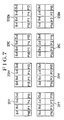
matter 22 printed by the offset printing process, wherein numerals on the printedmatter 22 indicate pages shown by the respective numerals, numerals not put in parentheses indicate pages printed on the front face of theprinted matter 22, and numerals put in parentheses indicate pages printed on the reverse face at positions where the respective numerals are arranged. That is, thepages pages - Thus, obtained printed
matter 22 is first folded along the line A-A, then folded along the line B-B and finally folded along the line C-C to thereby obtain a section (or signature) 23 in which pages from the first page to the 16th page are disposed in a proper order as shown in Fig. 3. - The thus obtained section is, if necessary, combined with other sections and a side folded along the line C-C is used as a binding portion to bind a book, and ends of other sides are cut and each page is opened for reading. Figs. 4(a) through (i) show the state how the pages appear when they are opened.
- As can be seen well from Fig. 4, the thus obtained book is so designed that one can read the book from the left page, which system is employed for English books and Japanese books with characters written laterally.
- In the case of Japanese books with characters written longitudinally conversely to the case of Fig. 4, the book can be read from the right page, in which case, images on pages are arranged as shown in Figs. 5(a) and (b), whereby after the steps of printing, folding and cutting, pages can be opened as shown in Figs. 6(a) through (i) for reading.
- As may be understood from the above- described explanation, where images (characters, pictures and the like) for a plurality of pages are printed simultaneously, it is necessary to check, in the stage of preparing the flats or printing plates with the plural paginations (see Figs. 1 and 5), whether or not an image on each page is properly arranged in a predetermined position. However, this checking involves considerably complicated elements. That is, the arrangement of the image on each page with respect to the position of the sheet-like base material depends on (a) how many page portions are printed simultaneously, (b) the kind of book, i.e. whether it should be read from the right or from the left, (c) the type of folding to be employed, and the like.
- Accordingly, it is extremely difficult to imagine whether or not the sections after completion of folding work are disposed in a proper page order from the state where the image on each page is arranged on the sheet-like base material. Nevertheless, a sole dependence has been heretofore placed upon a method of checking using imagination of human being. Therefore, if the image on each page has been arranged in the wrong position, such an error is difficult to find, and preparing of printing plates, printing and book-binding is sometimes continued without correction of such erroneous arrangement. Thus, in such a case, not only all the materials used therefor, but also tremendous times are wasted.
- In the case of multi-color printing, for example, in the case of four colors printing, sheet-
like base materials like base materials - It is hard to take notice of such an error until printing is actually carried out, and printing step proceeds under the erroneous condition, resulting in an occurrence of great damages.
- Moreover, it is often that color separation films for pages are manufactured by separate plate makers, and it is also often that these color separation films manufactured by separate plate makers are collected and arranged on a single sheet-like base material for make-up and printing. In such a case, each of the plate makers carries out color proof of only the color separation films manufactured by their own company. Thus, if the color proof standards are different between the companies, tones in pages are not in coincidence with each other when the color separation films of various companies are collected and arranged in a single base material for making a plate and for printing, and therefore, it has been necessary to stop operation of the printing machine whereby a flat is corrected and afterwards, a printing plate is newly made, or when a flat is exposed to a light source on a plate such as a PS (presensitized) plate, an exposing operation is carried out while making an adjustment such as an adjustment of the amount of exposure to make a new printing plate.
- Particularly where one image is printed over two opened-pages, a difference in density and tone tends to be conspicuous. Such a problem occurs also in the case of monochromatic printing but is particularly conspicuous in case of multi- color printing. In view of the foregoing, it has been desired to develop a method or apparatus which can easily check whether or not each page is properly arranged, and which where one image is printed over two opened-pages, can easily check a difference in density and tone.
- Accordingly, the present invention has been achieved as the result of various studies in an attempt of solving these problems noted above. An object of the invention is to provide a method which can easily perform checking whether or not the state of arrangement of pages is proper under the condition of a flat or a printing plate.
- A further object of the invention is to allow the checking of misplacement between colors in case of multi-color printing.
- Another object of the invention is to easily perform even checking of a difference in tone and density in the open pages. A still another object of the invention is to provide a new apparatus which can perform the aforesaid checking.
- These objects are solved by the features recited in
claims subclaims - In accordance with the present invention, images on pages arranged on sheet-like base materials are photographed in a predetermined order by a photographic apparatus, for example, a television camera to store images for a single section (which are the images on the pages arranged on the sheet-
like base materials like base materials - The aforementioned required processing is the process whereby when a section is prepared in accordance with the predetermined folding system, the order of the pages can be easily judged by viewing the images displayed on the aforesaid image display device. In this case, it is necessary to predesignate data such as the number of pages, the way of opening a book (right-open or left-open) and the like in addition to the folding system. In this manner, it is possible to easily confirm whether or not each page is arranged in a proper position by the image displayed, and in addition, it is possible to easily check whether or not the density or tone of the images over the opened-two pages is within the allowable range.
-
- Fig. 1 is an explanatory view of the state where images for a plurality of page portions are arranged on two sheet-like base materials;
- Fig. 2 is an explanatory view of printed matter where the images on each page arranged as shown in Fig. 1 are printed on the face and reverse of a substance to be printed;
- Fig. 3 is an explanatory view of a section in which the printed matter of Fig. 2 is folded;
- Fig. 4 is an explanatory view to explain how pages appear when a book is bound from the section of Fig. 3;
- Fig. 5 is an explanatory view of the other state where images for a plurality of page portions are arranged on two sheet-like base materials;
- Fig. 6 is an explanatory view to explain how pages appear after the images arranged as shown in Fig. 5 have been printed, folded and bound;
- Fig. 7 is an explanatory view of a sheet-like base material having images for one section portion in four colors printing;
- Fig. 8 is a schematic illustration of a television camera driving mechanism of the apparatus in accordance with the present invention;
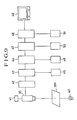
- Fig. 9 is block diagram of the apparatus in accordance with the present invention;
- Fig. 10 illustrates details of an image display control device; and
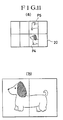
- Fig. 11 is an explanatory view showing the relation between the images arranged on the pages and the image synthesized and displayed.
- The present invention overcomes various problems as noted above with respect to the prior art and is intended, by using a monitor television, to check a position of arrangement of pages and check a difference in density and tone of open pages in a simple manner. The present invention will now be described in detail with reference to the drawings.
- Fig. 8 is an explanatory view of a television camera driving mechanism as a photographic apparatus driving mechanism in which images arranged on a sheet-like base material are photographed by a television camera used as one example of the photographic apparatus. First, the case will be described in which images for 16- page portion as shown in Figs. 1 through 3 are arranged and subjected to monochromatic printing to produce a section.
- First, images on the sheet-
like base material 20 are photographed in order of P9, P8, P5, P12, P13, P14, P1 and P16 by atelevision camera 30, the sheet-like base material 20 is then removed and another sheet-like base material 21 is set, and images thereon are photographed in order of P11, P6, P7, P10, P15, P2, P3 and P14 in a manner similar to that of the former. The thus photographed images of the pages are stored in the form of image signals in a memory. All the image signals required for one section are stored in the memory. - The
television camera 30 is mounted on alead screw 31, and thelead screw 31 is rotated by amotor 32 whereby thetelevision camera 30 may be moved along aguide bar 33 in an X-direction (in a lateral direction). On the other hand, themotor 32 is mounted on alead screw 34, and thelead screw 34 is rotated by amotor 35 whereby themotor 32 may be moved along aguide bar 36 in a Y-direction (in a longitudinal direction). Thus, the television camera can be moved freely in both X and Y directions. It is noted that rotation of themotors motor control device 37. Themotor control device 37 is given, beforehand or when necessary, data such as the number of pages arranged on the sheet-like base material, sizes of pages and the like. Thereby, themotor control device 37 moves the television camera to a predetermined photographing position. - The case of monochromatic printing has been described above. In case of multicolor printing, for example, in case of four colors printing, it is necessary, in order to print both faces of a sheet, to photograph images on pages arranged on eight sheet-like materials as shown in Fig. 7 to store them in the form of image signals in the memory. Storing of images on each page arranged on eight sheet-like materials as shown in Fig. 7 is carried out in the following manner.
- That is, the images for the first color as in the case of said monochrome, for example, the sheet-
like base materials memory 44 in a manner similar to that of the monochrome, and images of the sheet-like base materials like base materials - Alternatively, the sheet-
like base materials like base materials - The images stored in the
memory 44 as described above have been subjected to processing which will be described hereinafter and are thereafter displayed in color on a color image display device. - Fig. 9 is a schematic illustration of the apparatus in accordance with the present invention which processes the image signals of the images photographed by the television camera as described above to display the images on the image display device.
- The sheet-
like base material 20Y having the images on each page arranged thereon is illuminated by alight source 40 and the images are photographed for every page by the television camera as previously described. Thetelevision camera 30 is moved in the X and Y directions by a televisioncamera driving mechanism 41. The photographed image signals on each page are corrected in white and black level by a white and blacklevel correction circuit 42, after which they pass through amask circuit 43 and are stored in amemory 44. Themask circuit 43 is provided to cut unnecessary portions among the image signals obtained by the television camera. That is, when the images on each page are photographed by the television camera, a part of the image on the page in the periphery of the page required is also photographed at the same time, and therefore, the unnecessary image on the page in the periphery thereof is cut by themask circuit 43. The size of the mask is set by amask operating section 45. For the mask operating section, a keyboard or the like can be employed. In this manner, the image signals on all pages required for one section with respect to the entire front and reverse faces of the sheet-like base materials for each color are stored in thememory 44. Since in this case, photographing of the images on each page is carried out in a predetermined order, it is possible to discriminate that the image signal stored in the respective address correspond with the image what position it was arranged in. Or, it is also possible to designate the address for storing each image signal by thecontrol device 46 for the memory. - An image
display control device 47 is provided to select and combine necessary signals out of image signals of different colors stored in thememory 44 in accordance with a combination type determined by a folding system, the number of pages of the section and the way of opening a book (right-open or left open), and further to invert the top and bottom of the images necessary to be inverted in the direction of the top and bottom thereof and to input the images to a printingimage control device 48. This printingimage control device 48 is provided to perform processing for displaying an image approximate to a color printed matter as will be described hereinafter. Signals processed by the printingimage control device 48 are put into a colorimage display device 49 and the combined image is displayed in color. - For the
image display device 49, a color television set or the like is used. - The aforesaid image signals are combined in such a way that when pages are opened in order under the finally folded condition, each page is visible, as shown in Fig. 4. That is, as shown in Fig. 4(a), the first page is positioned on the right-hand of the screen of the image display device. whereas the left side is to be blank. Next, as shown in Fig. 4(b), the second page and the third page are combined so that the second page occupies the left-hand position whereas the third page occupies the right-hand position. Similarly, as shown in Figs. 4(c) through 4(h), the 4th page and the 5th page, the 6th page and the 7th page, the 8th page and the 9th page, the 10th page and the 11th page, the 12th page and the 13th page, and the 14th page and the 15th page are respectively combined so that among these combinations, even pages occupy the left-hand position of the screen of the image display device whereas odd pages occupy the right-hand position of said screen, and the thus combined images are displayed in color on the
image display device 49. Finally, the 16th page is occupied on the left-hand of the screen of theimage display device 47 whereas the right-hand thereof is to be blank, as shown in Fig. 4(i). - In this case, where the images on the pages are arranged as shown in Figs. 1(a) and (b), the images P9, P8, P5 and P12, and the images P11, P6, P7 and P10 are in the state of inversion in the direction of the top and bottom thereof, and therefore, the images are processed to be inverted by the image
display control device 47 so that these images are visible under the normal state when they are displayed by the image display device. - If the images on the pages are arranged as shown in Figs. 5(a) and (b) to effect printing and folding, they are as shown in Figs. 6(a) through 6(i). In this case, therefore, the combinations of the images on the pages displayed on the image display device are determined so as to occupy the positions as shown in Figs. 6(a) through 6(i).
- How images are combined and how they are displayed on the image planes are principally determined by predetermining the way of folding or the way of opening a book when sections are produced, the position of arrangement of images on pages, the number of pages of the sections and the order of input of the images on the pages. Preferably, the aforementioned predetermined data, such as the way of folding when the sections are produced, the way of opening a book (right-open or left-open), the position of arrangement of images on pages, the number of pages of the sections, the order of input of images on pages and the like are preset to the image display control device (50) in accordance with the imaginary combination so as to perform operation in a simple manner. With this arrangement, ones to be checked can be designated from among the combinations of the preset data for immediate entry into checking operation. The designation of and change in the preset data and the like as described above are made so as to be accomplished by an image
display operating device 50. For the imagedisplay operating device 50, a keyboard or the like can be used. - The printing
image control device 48 is provided to process a display of a color image approximate to a printed matter on the colorimage display device 49 in response to signals received from the imagedisplay control device 47 as previously mentioned. - The printing effect greatly varies with the printing conditions, and it is therefore preferable that a plurality of printing conditions are preset to the printing
image control device 48 so that suitable conditions may be selected by the printingimage operating device 51 whereby the color image approximate to the printing result depending on the selected various printing conditions can be displayed on the colorimage display device 49. - Fig. 10 illustrates further details of the image
display control device 47. An image to be color-displayed on the color imagedisplay operating device 49 is indicated by an indication signal S1 from an imagedisplay operating device 50. The indication signal S1 includes information, for example, such as what number the open page is. The indication signal S1 is put into adevice 60 for selecting contents to be processed. On the other hand, stored in a reference pattern table 61 are the normal images or inverted images as viewed in the form of directions of images on pages to be color-displayed, as data predetermined in accordance with the number of pages of the sections, the way of folding and the like. The processedcontent selecting device 60 is provided to determine the processed contents such as whether or not the image on the page to be color-displayed in response to the indication signal S1 is displayed as the normal image without modification or displayed as the image with top and bottom inverted referring to the prestored reference pattern table 61 and to put the processed contents intodata processors processors memory 44. - In the
data processor 62, in ease the processing signal S2 is the signal to be indicated by inverting the top and bottom of the image, the image signal S4 is processed to be inverted and put into animage synthesizing device 64 as a synthesizing signal Se. On the other hand, in case the processing signal S2 is the signal to be indicated as the normal image without inverting the direction of the top and bottom of the image, the image signal S4 is put into theimage synthesizing device 64 as the synthesizing signal S6 without inverting the direction of the top and bottom. Thedata processor 63 likewise applies necessary processing to the image signal S5 in accordance with the processing signal S3 to input the synthesizing signal S7 to theimage synthesizing device 64. - The
data processors image synthesizing device 64. In the case of multi-color printing, such a processing is carried out in respect of Y, M, C and Bk. - The
image synthesizing device 64 is provided to synthesize the synthesizing signals S6 and S7 so as they are synthesized to become same state as that of the opened-page, as shown in Fig. 4 or Fig. 6. That is, theimage synthesizing device 64 synthesizes the signals in such a way that the screen of the colorimage display device 49 is divided into two parts, left and right, in accordance with two synthesizing signals S6 and S7 to display thereon the image based on the synthesizing signal S6 and the image based on the synthesizing signal S7 together. The thus synthesized signal S8 is put into the printingimage control device 48 where the former is appropriately processed so as to provide a monitor display approximate to the printing image, after which it is color-displayed on the colorimage display device 49. - As described above, the images on the pages are combined and successively displayed on the image display device as shown in Figs. 4(a) through 4(i) of Figs. 6(a) through 6(i) to easily check whether or not the images on the pages arranged on the flats are arranged in proper order. That is, if the images on the pages arranged on the flats are arranged in proper position under the proper condition, the images displayed on the image display device are successively displayed under the conditions illustrated in Fig. 4 or Fig. 6 in accordance with the predetermined conditions (namely, right-open or left-open). On the other hand, if the images on the pages arranged on the films with printing surface are erroneously arranged, the order and the combination of the images displayed on the image display device become erroneous. It is therefore possible to very easily check whether or not the images on the pages are arranged in proper position by the images on the pages successively displayed on the image display device.
- Fig. 11 illustrates the relation between the images arranged on the sheet-
like material 20 and the image synthesized and displayed by the apparatus of the present invention. In Fig. 11(a), the images P4 and P5 onpage 4 and onpage 5 show an image of a head and an image of a tail, respectively, of a dog. - If the aforesaid arrangement is correct, the images on the opened-pages of
pages - However, if the image on P4 or P5 in Fig. 11 (a) is arranged in erroneous position or the top and bottom thereof is arranged in the inverse direction, the image to be synthesized and displayed on the screen of the color image display device is not properly displayed as in Fig. 11(b), and it is therefore possible to judge momentarily that the arrangement is erroneous.
- Furthermore, in case of color printing, for example, if the Y-separation positive flats and M-separation positive flats are misplaced with respect to the image of P5 in Fig. 11 (a), the color image to be synthesized and displayed in Fig. 11(b) becomes different in color of image in said misplaced portion. It is therefore possible to momentarily judge that the image is misplaced.
- Moreover, in case of color printing, for example, where the image of P4 and the image of P5 in Fig. 11 (a) are the ones which are made by separate plate-makers, checking whether or not the finished condition is the same, for example, checking whether or not there is a great difference in tone and density at a connected portion between P4 and P5 can be momentarily effected by synthesizing and displaying the synthesized image on the color image display device as shown in Fig. 11(b).
- While the present invention has been principally described of the section consisting of 16 pages, it will be noted that the present invention can be also applied to a section consisting of 32 pages or other number of pages. As to a way of folding various ways of folding other than those as previously described can be considered. It is of course that the present invention may also be applied to the respective ways of folding.
- In accordance with the present invention, it is possible to easily and assuredly check whether or not the images on the pages are properly arranged and attached in the stage of the flat, and therefore, loss in material and loss in time caused by misarrangement of pages can be prevented.
- In addition, in accordance with the present invention, while the apparatus thereof can be also applied even in the stage wherein an image is formed on a printing plate as in the PS plate used in the offset printing system, it is more effective to apply it in the state of the flat.
- Switchable addition of another function, for example, a function of not to display of the image by unit of two pages but to display of the image by unit of one page on the color image display device, to the apparatus of the present invention or the arrangement to make the magnification of the image displayed variable can be suitably achieved by those skilled in the art, if necessary.
- In the apparatus of the present invention, even in the case of the flat for a plurality of page portions arranged on a film of large size, four color portions are not simultaneously photographed, and therefore, the apparatus of the invention can be made to be much smaller in size than the well known apparatus which photographs four color portions simultaneously.
- It will be noted that in case of the checking device for exclusive-use of monochrome which merely performs checking for monochromic printing, the color
image display device 49 of Fig. 9 can be replaced by a monochrome image display device, and in addition, the printingimage control device 48 and the printingimage operating device 51 can be omitted.
Claims (4)
Applications Claiming Priority (4)
| Application Number | Priority Date | Filing Date | Title |
|---|---|---|---|
| JP172412/82 | 1982-09-30 | ||
| JP57172412A JPS5962153A (en) | 1982-09-30 | 1982-09-30 | Method and apparatus for inspecting page arrangement for printing |
| JP58088204A JPS59214032A (en) | 1983-05-19 | 1983-05-19 | Method and device for inspecting page array for printing |
| JP88204/83 | 1983-05-19 |
Publications (3)
| Publication Number | Publication Date |
|---|---|
| EP0105468A2 EP0105468A2 (en) | 1984-04-18 |
| EP0105468A3 EP0105468A3 (en) | 1985-11-13 |
| EP0105468B1 true EP0105468B1 (en) | 1988-09-07 |
Family
ID=26429628
Family Applications (1)
| Application Number | Title | Priority Date | Filing Date |
|---|---|---|---|
| EP19830109704 Expired EP0105468B1 (en) | 1982-09-30 | 1983-09-28 | Method and apparatus of checking an arrangement of printing pages |
Country Status (2)
| Country | Link |
|---|---|
| EP (1) | EP0105468B1 (en) |
| DE (1) | DE3377905D1 (en) |
Cited By (2)
| Publication number | Priority date | Publication date | Assignee | Title |
|---|---|---|---|---|
| DE4401901A1 (en) * | 1994-01-24 | 1995-07-27 | Heidelberger Druckmasch Ag | Control of printing machine output quality |
| DE4403861A1 (en) * | 1994-02-08 | 1995-08-10 | Heidelberger Druckmasch Ag | Multi-colour printing process using printing machine for print image |
Families Citing this family (11)
| Publication number | Priority date | Publication date | Assignee | Title |
|---|---|---|---|---|
| JPS5974558A (en) * | 1982-10-21 | 1984-04-27 | Dainippon Screen Mfg Co Ltd | Layout recording method of copy picture |
| GB2160055B (en) * | 1984-06-08 | 1987-11-04 | Gerber Scientific Instr Co | Laser imaging system for printing |
| DE3634262A1 (en) * | 1985-12-28 | 1987-07-02 | Rollei Fototechnic Gmbh | Scanner |
| US5335315A (en) * | 1990-09-17 | 1994-08-02 | Toppan Printing Co., Ltd. | Method for determining a graphic area ratio of a printing plate and an apparatus therefor |
| EP0612042B2 (en) * | 1993-02-17 | 2003-06-04 | Kba-Giori S.A. | Apparatus and method for checking printed matter |
| DE29507303U1 (en) * | 1995-05-05 | 1995-06-22 | MAN Roland Druckmaschinen AG, 63075 Offenbach | Rotary printing machine with a video camera |
| US6382101B1 (en) | 1997-03-04 | 2002-05-07 | Heidelberg Harris, Inc. & Heidelberger Druckmaschinen | Remote ink fountain selection method and apparatus |
| US5995719A (en) * | 1997-03-25 | 1999-11-30 | Barco Graphics Nv | Method for proofing imposed documents |
| WO2000023276A1 (en) * | 1998-10-21 | 2000-04-27 | Somitrack Ab | Method and apparatus for verification of impositions for printing plates |
| EP1098266A3 (en) | 1999-11-02 | 2003-01-22 | Canon Kabushiki Kaisha | Print control method and apparatus |
| DE102006005634B3 (en) | 2006-02-08 | 2007-04-05 | Hiflex Software Gmbh | Production method for printing work, involves classification of printed sheet into a running direction and transverse direction in adjacent applications by printed sheet layout |
Family Cites Families (3)
| Publication number | Priority date | Publication date | Assignee | Title |
|---|---|---|---|---|
| US3982744A (en) * | 1972-12-20 | 1976-09-28 | Me-Books Publishing Company | Personalized computer printed hard covered book |
| DE3014433A1 (en) * | 1980-04-15 | 1981-10-22 | Siemens AG, 1000 Berlin und 8000 München | ARRANGEMENT FOR SCANING TEMPLATES WITH GRAPHIC PATTERNS |
| US4561103A (en) * | 1981-07-29 | 1985-12-24 | Dai Nippon Insatsu Kabushiki Kaisha | Print inspecting method and apparatus |
-
1983
- 1983-09-28 DE DE8383109704T patent/DE3377905D1/en not_active Expired
- 1983-09-28 EP EP19830109704 patent/EP0105468B1/en not_active Expired
Cited By (3)
| Publication number | Priority date | Publication date | Assignee | Title |
|---|---|---|---|---|
| DE4401901A1 (en) * | 1994-01-24 | 1995-07-27 | Heidelberger Druckmasch Ag | Control of printing machine output quality |
| DE4403861A1 (en) * | 1994-02-08 | 1995-08-10 | Heidelberger Druckmasch Ag | Multi-colour printing process using printing machine for print image |
| DE4403861C2 (en) * | 1994-02-08 | 1998-08-20 | Heidelberger Druckmasch Ag | Method for producing a multicolored print with a printing press in at least two different runs |
Also Published As
| Publication number | Publication date |
|---|---|
| EP0105468A2 (en) | 1984-04-18 |
| DE3377905D1 (en) | 1988-10-13 |
| EP0105468A3 (en) | 1985-11-13 |
Similar Documents
| Publication | Publication Date | Title |
|---|---|---|
| US4672462A (en) | Method and system for recording plural images on a photosensitive film with layout work | |
| EP0105468A2 (en) | Method and apparatus of checking an arrangement of printing pages | |
| US5461469A (en) | Method of setting-up a finishing apparatus | |
| EP0477569B2 (en) | Electronic printing system for printing signatures | |
| US5666208A (en) | Printing system with electronic light table functionality | |
| US5995719A (en) | Method for proofing imposed documents | |
| DE69200199T2 (en) | Imager with post-processing device. | |
| CA2115466A1 (en) | Photographic Processing Method | |
| US5153737A (en) | Image forming apparatus with an editing function | |
| EP0309196B1 (en) | Page planning system | |
| EP0408056B1 (en) | Method of reproducing images of plurality of copy pages on single plate | |
| US4286385A (en) | Color screen indicator | |
| US4588291A (en) | Method of manufacture of printing plates from prepared copy | |
| JPH0227943B2 (en) | ||
| JPS641784B2 (en) | ||
| JPS59214032A (en) | Method and device for inspecting page array for printing | |
| JPS60196761A (en) | Method and device for checking page arrangement of printing | |
| JP2848064B2 (en) | Print inspection equipment | |
| JPH04247445A (en) | Method and device for printing original picture | |
| JPS6085961A (en) | Color shift detection in offset printing | |
| JPS60114078A (en) | Image processing device | |
| JPS5920147B2 (en) | Information storage method and device | |
| JP2684901B2 (en) | Layout scanner | |
| JPH0512262A (en) | Electronic filing device | |
| JPS63282831A (en) | Document printing system for electronic filing device |
Legal Events
| Date | Code | Title | Description |
|---|---|---|---|
| PUAI | Public reference made under article 153(3) epc to a published international application that has entered the european phase |
Free format text: ORIGINAL CODE: 0009012 |
|
| AK | Designated contracting states |
Designated state(s): DE GB |
|
| 17P | Request for examination filed |
Effective date: 19841005 |
|
| PUAL | Search report despatched |
Free format text: ORIGINAL CODE: 0009013 |
|
| AK | Designated contracting states |
Designated state(s): DE GB |
|
| 17Q | First examination report despatched |
Effective date: 19870702 |
|
| GRAA | (expected) grant |
Free format text: ORIGINAL CODE: 0009210 |
|
| AK | Designated contracting states |
Kind code of ref document: B1 Designated state(s): DE GB |
|
| REF | Corresponds to: |
Ref document number: 3377905 Country of ref document: DE Date of ref document: 19881013 |
|
| PLBE | No opposition filed within time limit |
Free format text: ORIGINAL CODE: 0009261 |
|
| STAA | Information on the status of an ep patent application or granted ep patent |
Free format text: STATUS: NO OPPOSITION FILED WITHIN TIME LIMIT |
|
| 26N | No opposition filed | ||
| PGFP | Annual fee paid to national office [announced via postgrant information from national office to epo] |
Ref country code: GB Payment date: 19920918 Year of fee payment: 10 |
|
| PGFP | Annual fee paid to national office [announced via postgrant information from national office to epo] |
Ref country code: DE Payment date: 19921030 Year of fee payment: 10 |
|
| PG25 | Lapsed in a contracting state [announced via postgrant information from national office to epo] |
Ref country code: GB Effective date: 19930928 |
|
| GBPC | Gb: european patent ceased through non-payment of renewal fee |
Effective date: 19930928 |
|
| PG25 | Lapsed in a contracting state [announced via postgrant information from national office to epo] |
Ref country code: DE Effective date: 19940601 |