EP0105376B1 - Color-developing sheet for use in no-carbon recording system - Google Patents
Color-developing sheet for use in no-carbon recording system Download PDFInfo
- Publication number
- EP0105376B1 EP0105376B1 EP19830900802 EP83900802A EP0105376B1 EP 0105376 B1 EP0105376 B1 EP 0105376B1 EP 19830900802 EP19830900802 EP 19830900802 EP 83900802 A EP83900802 A EP 83900802A EP 0105376 B1 EP0105376 B1 EP 0105376B1
- Authority
- EP
- European Patent Office
- Prior art keywords
- color
- developing
- sheet
- parts
- developing sheet
- Prior art date
- Legal status (The legal status is an assumption and is not a legal conclusion. Google has not performed a legal analysis and makes no representation as to the accuracy of the status listed.)
- Expired
Links
Images

Classifications
-
- B—PERFORMING OPERATIONS; TRANSPORTING
- B41—PRINTING; LINING MACHINES; TYPEWRITERS; STAMPS
- B41M—PRINTING, DUPLICATING, MARKING, OR COPYING PROCESSES; COLOUR PRINTING
- B41M5/00—Duplicating or marking methods; Sheet materials for use therein
- B41M5/124—Duplicating or marking methods; Sheet materials for use therein using pressure to make a masked colour visible, e.g. to make a coloured support visible, to create an opaque or transparent pattern, or to form colour by uniting colour-forming components
- B41M5/132—Chemical colour-forming components; Additives or binders therefor
- B41M5/155—Colour-developing components, e.g. acidic compounds; Additives or binders therefor; Layers containing such colour-developing components, additives or binders
- B41M5/1555—Inorganic mineral developers, e.g. clays
Definitions
- This invention relates to color-developing sheets in the no-carbon pressure-sensitive recording system, and more particularly to a color-developing sheet, in the same system, having an inorganic color developer.
- the pressure-sensitive recording system which comprises a combination of a color-forming sheet (hereinafter referred to as "CB” in some cases) provided with a surface layer containing microcapsules filled with a solution of an electron-donative colorless dye (hereinafter referred to as "color former”) in a high-boiling solvent and a color-developing sheet (hereinafter referred to as "CF”) provided with a surface layer containing an electron-acceptable acid material (hereinafter referred to as "color developer”), wherein an image is formed on the CF by bringing both the surface layers into contact with each other and applying printing pressure.
- CB color-forming sheet
- color former an electron-donative colorless dye
- CF color-developing sheet
- color developer an electron-acceptable acid material
- the color developer used are; inorganic developers including a natural clay mineral such as acid clay, attapulgite, and common clay and activated clay, i.e. the acid clay, which is a montmorillonite group clay mineral, merely treated with a mineral acid in a slight or medium degree; as well as organic developers including various phenol compounds, phenolic resins of novolak type, polyvalent metal salts of aromatic carboxylic acids, etc.
- inorganic developers including a natural clay mineral such as acid clay, attapulgite, and common clay and activated clay, i.e. the acid clay, which is a montmorillonite group clay mineral, merely treated with a mineral acid in a slight or medium degree
- organic developers including various phenol compounds, phenolic resins of novolak type, polyvalent metal salts of aromatic carboxylic acids, etc.
- the above inorganic color developers of clay mineral group and the color-developing paper coated therewith have disadvantages such that, when they are stored for a long period of time under high humidity atmospheric conditions, particularly under high temperature and high humidity conditions, their color developing effect will be rather lowered and these developer particles will agglomerate, thereby the dispersiveness thereof in water being deteriorated and the coating being made difficult various attempts have been made for the purpose of improving the color developing effect of the CF employing the inorganic color developer.
- an inorganic color developer (EP-A-44645) is known to provide a CF having the ability to develop a brighter and deeper color than does the usual inorganic color developer.
- the color developer of this patent is obtained by (1) acid treatment of a clay mineral such as a montmollironite group clay, kaolinite group clay, sepiolite-palygorskite group clay, or vermiculite group clay, having a layer structure built up of regular tetrahedron lattices of silica, so as to give a silica content of 82-96.5% by weight on a dry basis (dried at 105°C for 3 hours), (2) bringing the resulting day, in a water-base medium, into contact with a magnesium and/or aluminum compound soluble at least partially in said medium, (3) if the soluble compound is not in hydroxide form, neutralizing with an alkali or acid so as to transform it into the hydroxide thereby introducing the magnesium and/or aluminum component into the acid-treated clay mineral, and if desired drying the product.
- the color developer obtained thereby has the following characteristics:
- this known color developer (hereinafter referred to as "synthetic activated clay”) is effective in improving the color developing ability of CF and in retaining the developed color density under high humidity conditions; however the color-developing sheet employing such a synthetic activated clay was found to have a drawback in that the light fastness of color images formed therein is rather inferior.
- the present inventors made therefore extensive studies for a means of improving the light fastness of color images on the color-developer sheet employing a synthetic activated clay.
- this invention has been achieved through finding that the addition of various known antioxidants (hindered phenols and others) or ultraviolet absorbers is almost ineffective, but that only the addition of effective amounts of at least one alcohol ester of p-hydroxybenzoic acid to the synthetic activated clay gives a CF, really excellent for practical use, which is markedly improved in the light fastness of color images formed and undergoes no objectionable side action such as the photo-yellowing of white areas (areas other than image areas) thereof.
- Figs. 1 and 2 are graphs showing rheological behavior of the coating liquids prepared in Example 3 of this invention and in Comparative Example 4.
- Suitable examples of the p-hydroxybenzoic acid ester used in combination with the synthetic activated clay are as follows:
- the so-called activated clay chiefly used hitherto although prepared by treating acid clay, which is a montmorillonite group clay, with a mineral acid in a slight or medium degree to extract and remove acid-soluble cations naturally coexisting, such as iron, magnesium, calcium, and aluminum ions therefrom to some extent, is a silic anhydride in which these cations still remain in detectable amounts and acid sites of acid strengths PKa ⁇ -3.0, -3.0 ⁇ PKa+0.8, and +0.8 ⁇ PKa ⁇ +4.8 are respectively present (these acid cites originate from the presence of contaminating metal cations); when an electron-donative colorless dye such as crystal violet lactone, benzoyl leucomethylene glue, or the like is adsorbed on these acid sites, electron transfer takes place to ionize the dye, thus forming a color image.
- acid clay which is a montmorillonite group clay
- a mineral acid in a slight or medium degree to extract and remove acid-soluble cations naturally coexisting, such
- a typical example of the synthetic activated clay used in this invention is Silton SS-1 (tradename).
- Silton SS-1 tradename
- the CF according to this invention is prepared by the generally known method, that is, by dispersing an ester of p-hydroxybenzoic acid and the synthetic activated clay together with a known binder, dispersant, and auxiliary in water, and applying the dispersion on paper, followed by drying.
- the CB used jointly with this CF for copying is preferably a sheet having on a surface layer microcapsules that contain a solution of an electron-donative colorless dye, for example, crystal violet lactone, in an aromatic hydrocarbon. It seems a cause of improvements in the rate of color development and in the color density that the aryl or aralkyl aromatic ring of the above benzoic acid ester has a strong affinity for aromatic hydrocarbon solvents.
- a synthetic activated clay (tradename: Silton SS-1) and 50 parts of the above wet-milled benzyl p-hydroxy-benzoate suspension were dispersed in 200 parts of water containing 1 part of sodium pyrophosphate dissolved.
- a coating liquid was made up by adding 50 parts of a 10% aqueous oxydized starch solution and 50 parts of 0.48% SBR latex to the resulting dispersion. This coating liquid was applied on a 40-g/m 2 base paper to a dry coating weight of 7 g/m 2 , forming a CF sheet (designated as sample B).
- Example C Another CF sheet (sample C) was prepared by using methyl p-hydroxybenzoate in place of benzyl p-hydroxybenzoate.
- CB sheets used were prepared in the following way: A solution of an electron-donative colorless dye in a high-boiling aromatic hydrocarbon solvent, i.e. a solution of the following composition. was micro-encapsulated according to the method of U.S. Patent No. 4233178 by using a melamine- formaldehyde resin as shell material. A mixture of 100 parts (on dry basis) of the microcapsules obtained, 25 parts of wheat starch, and 150 parts of a 10% aqueous oxidized starch solution was applied on a 40 g/m 2 base paper to a dry coating weight of 5 g/m 2 .
- CF (4 types) specimens were each superposed upon the CB specimen so as to contact the coating surfaces with each other.
- the superposed specimens were first pressed through a medium- pressure calender (the nip pressure is in the range of pen tip pressures). After one minute, one hour, and 24 hours, the developed color density on the surface of the CF specimen was determined from the following equation by reflectance measurements with a colorimetric color-difference meter of Nippon Denshoku Co., Ltd. (Table 1);
- each CF-CB combination was similarly pressed through a high-pressure calender (supercalender) for obtaining images of saturated color density, and after one or more days, was subjected to tests of exposing to carbon arc light (one-hour exposure to light from a carbon arc lamp Fade-O-Meter) and to airborne oxidizing gas (10-minute exposure to 150 ppm of NO X gas).
- the color density retention was determined from the following equation by reflectance measurements with the color-difference meter (Table 2):
- sample (B) and (C) of this invention were much superior to the sample A employing the synthetic activated clay alone as color developer and were little inferior to the sample D, in light fastness and NO X gas fastness.
- the sunlight fastness of white areas was evaluated by exposing blank areas of the color-developing sheets to direct rays of sunlight for 4 hours, and measuring reflectances (%) on the areas with the color-difference meter using a blue filter.
- the nitrogen oxide gas fastness of white areas was evaluated by exposing white areas of the color-developing sheets to 3000 ppm of NOX gas for 20 minutes, and measuring reflectances (%) on the areas with the color-difference meter using a blue filter (Table 3).
- the CF according to this invention exhibits a high initial rate of color development (Table 1), the color developed thereon is good in fastness (Table 2), and additionally the white area thereof scarcely undergoes yellowing (Table 3).
- Table 1 the initial rate of color development
- Table 2 the color developed thereon is good in fastness
- Table 3 the white area thereof scarcely undergoes yellowing
- Nitrogen oxide gas is produced by filling a gas reservoir with water, putting 300 ml of sulfuric acid adjusted to a specific gravity of 1.603 in a gas generator, placing 100 ml of a saturated solution of sodium nitrite in a dropping funnel, dropping this solution into the sulfuric acid to generate nitrogen oxide gas, and leading the gas through a trap containing a 10% sodium hydroxide solution to the gas reservoir; color-developing sheets are placed in a desicator; the nitrogen oxide gas is introduced into the desicator to a prescribed concentration (ppm); and specimens of the color-developing sheets were placed and held therein for 10 or 20 minutes to see the fading.
- ppm concentration
- the white area of the CF of this invention can be more protected from the light-or NO x- caused yellowing, by further incorporation of an inorganic or organic ammonium salt into the color-developing layer.
- an inorganic or organic ammonium salt as follows: Desired objects can be achieved by adding 1-100 parts by weight of at least one of those ammonium salts for 100 parts by weight of the synthetic activated day.
- Ammonium salts of organic acids such as ammonium acetate, ammonium formate, ammonium n-butyrate, ammonium oxalate, diammonium citrate, triammonium citrate, diammonium tartrate, ammonium succinate, ammonium lactate, ammonium adipate, ammonium sebacate, ammonium phthalate, and ammonium benzoate;
- Ammonium salts of inorganic acids such as ammonium chloride, ammonium sulfate, ammonium nitrate, ammonium carbonate, ammonium thiosulfate, ammonium hydrogensulfate, ammonium persulfate, mono-ammonium phosphate, diammonium phosphate, and triammonium phosphate.
- the mixture was adjusted to pH 8.5 by adding caustic soda to make up a coating liquid.
- This coating liquid was applied on a 40 g/m 2 base paper (plain paper) by means of an air-knife coater to a dry coating weight of 5.5 g/m 2 .
- a synthetic activated clay (SS-1) was slowly added with stirring to form a dispersion. Further, 100 parts of a 10% aqueous solution of an oxidized starch (MS-3800) and 20 parts of a 48% SBR latex (Dow 670) were added. After thorough stirring the mixture was adjusted to pH 8.5 by adding caustic soda to make up a coating liquid. This coating liquid was applied on a 40 g/m 2 plain paper by means of an air-knife coater to a dry coating weight of 5.5 g/m 2 .
- a synthetic activated clay (SS-1) was slowly added with stirring to form a dispersion. Further, 50 parts of a dispersion of benzyl p-hydroxybenzoate and then 100 parts of a 10% aqueous solution of an oxidized starch (MS-3800) and 20 parts of a 48% SBR latex (Dow 670) were added and stirred. After thorough stirring, the mixture was adjusted to pH 8.5 by adding caustic soda to make up a coating liquid. This coating liquid was applied a 40 g/m 2 plain paper by means of an air-knife coater to a dry coating weight of 5.5 g/m2.
- this invention provides, by combined use of the above ammonium salt with the foregoing b-hydroxybenzoic acid ester and inorganic developer, a useful article quite excellent as a color-developing sheet for recording purposes which is superior, above all, in the fastness of developed color to sunlight, humidity, and oxidizing gas and additionally is almost completely free from the white area yellowing due to sunlight or nitrogen oxide gas.
- the coating liquid, containing the synthetic activated clay, used for producing the CF of this invention is much higher in viscosity than the coating liquid containing the usual clay mineral color-developer and exhibits therefore a notably lowered workability in paper coating.
- the method is to use as a flow improver for the coating liquid of high concentration (at least 40% by weight of solids), jointly with the synthetic activated clay, at least one inorganic filler selected from the group consisting of pyrophyllite clay (Al 2 O 3 ⁇ AS i O 2 ⁇ 2H 2 O), kaolinite clay (Al 2 O 3 ⁇ 2S i O 2 ⁇ 2H 2 O), halloysite clay (Al 2 O 3 ⁇ 2S i O ⁇ 4H 2 O), sericite clay (K 2 O ⁇ 3Al 2 O 3 ⁇ 6S i O 2 ⁇ 2H 2 O), montmollonite clay (Al 4 [M g ](S ig [Al]O 20 (OH) 4 ⁇ XH 2 O), aluminum hydroxide, gohun, chalk, heavy calcium carbonate, fine precipitated calcium carbonate, superfine precipitated calcium carbonate, super
- Suitable amount ratios of the synthetic activated clay to the inorganic filler, in this invention are in the range from 30:70 to 95:5, particularly from 50:50 to 85:15, % by weight. Amounts of the synthetic activated clay less than 30% by weight are not practically useful since the resulting color-developing ability are markedly low. If the amount exceeds 20% by weight, no coating liquid of high concentration and low viscosity can be obtained.
- the coating liquid combining, as shown above, the synthetic activated clay color-developer with an effective amount of at least one of the above-cited inorganic fillers exhibits improved flow and can be applied on paper to a light gauge (5 g/m 2 or less) without leaving any bared fiber of paper at the coating surface. Accordingly, the resulting color-developing sheet can be printed by thin deposition of a desensitizing ink. Since the thin layer of ink can be quickly dried, a speed-up of the printing becomes possible. Further, the coating liquid, applicable to a light gauge, has great advantages in cost reduction possible by productivity improvement and energy saving. These are great effects of this invention.
- the color-forming sheets used were commercial CBs for pressure sensitive recording (Mitsubishi-NCR Overlying Sheet-40 Blue) (dyes: crystal violet lactone (CVL) and Benzoyl leucomethylene blue (BLML)).
- the mixture was adjusted to pH 8.5 with 20% aqueous caustic soda to make up a coating liquid.
- This coating liquid applied on a 40 g/m 2 base paper by means of a blade coater to a dry coating weight of 4.5 g/ M 2 , giving a color-developing sheet.
- a dispersion prepared by wet-griding 100 parts of benzyl p-hydroxybenzoate and 5 parts of hydroxyethylcellulose in 145 parts of water using a ball mill and subsequently 20 parts (as solids) of a SBR latex (Dow 670) were added to the above dispersion and dispersed by good stirring.
- the mixture was adjusted to pH 8.5 with 20% aqueous caustic soda to make up a coating liquid.
- This coating liquid was applied on a 40 g/ m 2 base paper by means of a blade coater to a dry coating weight of 4.5 g/m 2 , giving a color-developing sheet.
- Table 6 shows found viscosities, solid contents, and fluid features of the coating liquids of Example 3 and Comparative Examples 3 and 4.
- Figs. 1 and 2 show viscosity curves of coating liquids of Example 3 and Comparative Example 4, respectively.
- the coating liquid of Example 3 As is shown in Table 6, the coating liquid of Example 3, as compared with that of Comparative Example 4, has markedly low viscosity and exhibits very high flow while containing nearly the same amount of solids.
- Figs. 1 and 2 it is obvious that the coating liquid of Comparative Example 4 exhibits high viscosities, as compared with that of Example 3, at high revolutions of the rotor and gels at a low revolution, exhibiting also a high viscosity.
Landscapes
- Chemical & Material Sciences (AREA)
- Dispersion Chemistry (AREA)
- Inorganic Chemistry (AREA)
- Chemical Kinetics & Catalysis (AREA)
- General Chemical & Material Sciences (AREA)
- Color Printing (AREA)
Description
- This invention relates to color-developing sheets in the no-carbon pressure-sensitive recording system, and more particularly to a color-developing sheet, in the same system, having an inorganic color developer.
- There is known the pressure-sensitive recording system which comprises a combination of a color-forming sheet (hereinafter referred to as "CB" in some cases) provided with a surface layer containing microcapsules filled with a solution of an electron-donative colorless dye (hereinafter referred to as "color former") in a high-boiling solvent and a color-developing sheet (hereinafter referred to as "CF") provided with a surface layer containing an electron-acceptable acid material (hereinafter referred to as "color developer"), wherein an image is formed on the CF by bringing both the surface layers into contact with each other and applying printing pressure.
- The color developer used are; inorganic developers including a natural clay mineral such as acid clay, attapulgite, and common clay and activated clay, i.e. the acid clay, which is a montmorillonite group clay mineral, merely treated with a mineral acid in a slight or medium degree; as well as organic developers including various phenol compounds, phenolic resins of novolak type, polyvalent metal salts of aromatic carboxylic acids, etc. Although advantageous in their higher rate of color development, the above inorganic color developers of clay mineral group and the color-developing paper coated therewith have disadvantages such that, when they are stored for a long period of time under high humidity atmospheric conditions, particularly under high temperature and high humidity conditions, their color developing effect will be rather lowered and these developer particles will agglomerate, thereby the dispersiveness thereof in water being deteriorated and the coating being made difficult various attempts have been made for the purpose of improving the color developing effect of the CF employing the inorganic color developer. Of these attempts, an inorganic color developer (EP-A-44645) is known to provide a CF having the ability to develop a brighter and deeper color than does the usual inorganic color developer. The color developer of this patent is obtained by (1) acid treatment of a clay mineral such as a montmollironite group clay, kaolinite group clay, sepiolite-palygorskite group clay, or vermiculite group clay, having a layer structure built up of regular tetrahedron lattices of silica, so as to give a silica content of 82-96.5% by weight on a dry basis (dried at 105°C for 3 hours), (2) bringing the resulting day, in a water-base medium, into contact with a magnesium and/or aluminum compound soluble at least partially in said medium, (3) if the soluble compound is not in hydroxide form, neutralizing with an alkali or acid so as to transform it into the hydroxide thereby introducing the magnesium and/or aluminum component into the acid-treated clay mineral, and if desired drying the product. The color developer obtained thereby has the following characteristics:
- (A) It shows an electron diffraction pattern based on the crystal of silica having a layer structure built up of regular tetrahedron lattices,
- (B) it does not show a X-ray diffraction pattern based on the crystal of the above layer structure; and
- (C) it contains at least silicon, magnesium, and/or aluminum as elements other than oxygen.
- Also according to the present inventors' investigations, it was recognized that this known color developer (hereinafter referred to as "synthetic activated clay") is effective in improving the color developing ability of CF and in retaining the developed color density under high humidity conditions; however the color-developing sheet employing such a synthetic activated clay was found to have a drawback in that the light fastness of color images formed therein is rather inferior.
- The present inventors made therefore extensive studies for a means of improving the light fastness of color images on the color-developer sheet employing a synthetic activated clay. As a result, this invention has been achieved through finding that the addition of various known antioxidants (hindered phenols and others) or ultraviolet absorbers is almost ineffective, but that only the addition of effective amounts of at least one alcohol ester of p-hydroxybenzoic acid to the synthetic activated clay gives a CF, really excellent for practical use, which is markedly improved in the light fastness of color images formed and undergoes no objectionable side action such as the photo-yellowing of white areas (areas other than image areas) thereof.
- The present invention comprises a color-developing sheet in a no-carbon pressure-sensitive recording system having a color-developing surface layer containing a synthetic activated clay having the following characteristics:
- (A) It shows an electron diffraction pattern based on the crystal of silica having a layer structure built up of regular tetrahedron lattices,
- (B) it does not show a X-ray diffraction pattern based on the crystal of the above layer structure; and
- (C) it contains at least silicon, magnesium, and/or aluminum as elements other than oxygen; and further
- (D) it contains silicon, magnesium, and/or aluminum in atomic ratios (silicon)/(the sum of magnesium and/ or aluminum) of 12/1.5 to 12/12, in particular 12/3 to 12/10, wherein the sum of magnesium and/or aluminum, when only one of them is contained, represents the amount of the one contained;
- Figs. 1 and 2 are graphs showing rheological behavior of the coating liquids prepared in Example 3 of this invention and in Comparative Example 4.
- Suitable examples of the p-hydroxybenzoic acid ester used in combination with the synthetic activated clay are as follows:
- Benzyl p-hydroxybenzoate
- o-Methylbenzyl p-hydroxybenzoate
- p-Chlorobenzyl p-hydroxybenzoate
- o-Chlorobenzyl p-hydroxybenzoate
- Phenethyl p-hydroxybenzoate
- Phenyl p-hydroxybenzoate
- p-Methylphenyl p-hydroxybenzoate
- Methyl p-hydroxybenzoate
- Ethyl p-hydroxybenzoate
- n-Propyl p-hydroxybenzoate
- Isopropyl p-hydroxybenzoate
- n-Butyl p-hydroxybenzoate
- Isobutyl p-hydroxybenzoate
- sec-Butyl p-hydroxybenzoate
- 2-Ethylhexyl p-hydroxybenzoate
- According to investigations of the present inventors, the so-called activated clay chiefly used hitherto, although prepared by treating acid clay, which is a montmorillonite group clay, with a mineral acid in a slight or medium degree to extract and remove acid-soluble cations naturally coexisting, such as iron, magnesium, calcium, and aluminum ions therefrom to some extent, is a silic anhydride in which these cations still remain in detectable amounts and acid sites of acid strengths PKa<-3.0, -3.0<PKa+0.8, and +0.8<PKa<+4.8 are respectively present (these acid cites originate from the presence of contaminating metal cations); when an electron-donative colorless dye such as crystal violet lactone, benzoyl leucomethylene glue, or the like is adsorbed on these acid sites, electron transfer takes place to ionize the dye, thus forming a color image. As a typical example of this type of activated clay, there may be given Silton M-140 (tradename, Mizusawa Chem. Ind. Co. Ltd.), which is produced from a Japanese acid clay. The use of this type of activated clay, together with aryl or aralkyl esters of para-hydroxybenzoic acid is disclosed in EP-A 86 636, which document constitutes prior art according to Article 54(3) and (4) EPC.
- On the other hand, a typical example of the synthetic activated clay used in this invention is Silton SS-1 (tradename). On analysis of acid sites thereof, none of strong acid sites of PKa<-3.0 and PKa<+0.8 were observed, but weak acid sites of +0.8PKa<+4.8 and +4.8<PKa<+9.0 were manifested instead, indicating that this type of activated clay is clearly distinguished from the activated clay hitherto known and used. This accounts for the strong color-developing power of the synthetic activated clay of this invention for crystal violet lactone, which is a typical example of electron-donative colorless dyes.
- The CF according to this invention is prepared by the generally known method, that is, by dispersing an ester of p-hydroxybenzoic acid and the synthetic activated clay together with a known binder, dispersant, and auxiliary in water, and applying the dispersion on paper, followed by drying.
- The CB used jointly with this CF for copying is preferably a sheet having on a surface layer microcapsules that contain a solution of an electron-donative colorless dye, for example, crystal violet lactone, in an aromatic hydrocarbon. It seems a cause of improvements in the rate of color development and in the color density that the aryl or aralkyl aromatic ring of the above benzoic acid ester has a strong affinity for aromatic hydrocarbon solvents.
- Preferred embodiments of this invention are illustrated by the following typical Examples: Hereinafter, "parts" are all by weight.
- The following mixture was ball-milled for 2 days:

- 100 parts of a synthetic activated clay (tradename: Silton SS-1) and 50 parts of the above wet-milled benzyl p-hydroxy-benzoate suspension were dispersed in 200 parts of water containing 1 part of sodium pyrophosphate dissolved. A coating liquid was made up by adding 50 parts of a 10% aqueous oxydized starch solution and 50 parts of 0.48% SBR latex to the resulting dispersion. This coating liquid was applied on a 40-g/m2 base paper to a dry coating weight of 7 g/m2, forming a CF sheet (designated as sample B).
- Similarly another CF sheet (sample C) was prepared by using methyl p-hydroxybenzoate in place of benzyl p-hydroxybenzoate.
- For comparative tests, there were similarly prepared a CF sheet (sample A) without addition of benzyl p-hydroxybenzoate (that is, the sheet contained the synthetic activated clay alone as color developer) and a CF sheet (sample D) by using the same amount of bisphenol A.
- CB sheets used were prepared in the following way: A solution of an electron-donative colorless dye in a high-boiling aromatic hydrocarbon solvent, i.e. a solution of the following composition.

- Thus obtained CF (4 types) specimens were each superposed upon the CB specimen so as to contact the coating surfaces with each other. The superposed specimens were first pressed through a medium- pressure calender (the nip pressure is in the range of pen tip pressures). After one minute, one hour, and 24 hours, the developed color density on the surface of the CF specimen was determined from the following equation by reflectance measurements with a colorimetric color-difference meter of Nippon Denshoku Co., Ltd. (Table 1);

- The results indicated that the sample (B) and (C) of this invention gave high densities particularly after one minute. This means that deep-colored images on writing can be quickly obtained; that is, very favorable results for practical use.
- In the next place, each CF-CB combination was similarly pressed through a high-pressure calender (supercalender) for obtaining images of saturated color density, and after one or more days, was subjected to tests of exposing to carbon arc light (one-hour exposure to light from a carbon arc lamp Fade-O-Meter) and to airborne oxidizing gas (10-minute exposure to 150 ppm of NOX gas). The color density retention was determined from the following equation by reflectance measurements with the color-difference meter (Table 2):

- The results revealed that the sample (B) and (C) of this invention were much superior to the sample A employing the synthetic activated clay alone as color developer and were little inferior to the sample D, in light fastness and NOX gas fastness.


- In order to see the fastness (stability) of white areas of the color-developing sheets, sunlight exposure tests and nitrogen oxide exposure tests were conducted. The sunlight fastness of white areas was evaluated by exposing blank areas of the color-developing sheets to direct rays of sunlight for 4 hours, and measuring reflectances (%) on the areas with the color-difference meter using a blue filter.
- The nitrogen oxide gas fastness of white areas was evaluated by exposing white areas of the color-developing sheets to 3000 ppm of NOX gas for 20 minutes, and measuring reflectances (%) on the areas with the color-difference meter using a blue filter (Table 3).
- From Table 3, it is seen that the color-developing sheets (B) and (C) of this invention are degraded only to very slight extents by light or airborne oxidizing gas (this means that shelf lives of these products are long) and on the contrary the sheet wherein the synthetic activated clay and bisphenol A are jointly used (sample D) undergoes heavy yellowing due to NOX gas as well as due to light.
- Thus, it can be seen that the CF according to this invention exhibits a high initial rate of color development (Table 1), the color developed thereon is good in fastness (Table 2), and additionally the white area thereof scarcely undergoes yellowing (Table 3). The sample D, wherein the synthetic activated clay and bisphenol A are jointly used, is surely excellent in the fastness of developed color (Table 2), but is not practically useful since the white area thereof is very liable to undergo yellowing (Table 3).

- When a CB having crystal violet lactone alone as color former was employed, the light stability and NOX stability of developed color were both improved further.
- The fading due to nitrogen oxide, in these Examples was examined in accordance with the JIS L0855 testing method for the fastness of color to nitrogen oxide gas, in the following manner: Nitrogen oxide gas is produced by filling a gas reservoir with water, putting 300 ml of sulfuric acid adjusted to a specific gravity of 1.603 in a gas generator, placing 100 ml of a saturated solution of sodium nitrite in a dropping funnel, dropping this solution into the sulfuric acid to generate nitrogen oxide gas, and leading the gas through a trap containing a 10% sodium hydroxide solution to the gas reservoir; color-developing sheets are placed in a desicator; the nitrogen oxide gas is introduced into the desicator to a prescribed concentration (ppm); and specimens of the color-developing sheets were placed and held therein for 10 or 20 minutes to see the fading.
- The white area of the CF of this invention can be more protected from the light-or NOx-caused yellowing, by further incorporation of an inorganic or organic ammonium salt into the color-developing layer. Examples of the ammonium salt as follows: Desired objects can be achieved by adding 1-100 parts by weight of at least one of those ammonium salts for 100 parts by weight of the synthetic activated day.
- Ammonium salts of organic acids such as ammonium acetate, ammonium formate, ammonium n-butyrate, ammonium oxalate, diammonium citrate, triammonium citrate, diammonium tartrate, ammonium succinate, ammonium lactate, ammonium adipate, ammonium sebacate, ammonium phthalate, and ammonium benzoate; Ammonium salts of inorganic acids such as ammonium chloride, ammonium sulfate, ammonium nitrate, ammonium carbonate, ammonium thiosulfate, ammonium hydrogensulfate, ammonium persulfate, mono-ammonium phosphate, diammonium phosphate, and triammonium phosphate.
- After dissolution of 0.5 part of sodium phrophosphate in 120 parts of water. 100 parts of a synthetic activated clay (Silton SS―1) was slowly added and dispersed with stirring. To this dispersion was added 50 parts of a dispersion of benzyl p-hydroxybenzoate with stirring which had been prepared by grinding for two days in boll mill a mixture of the following composition:

- After dissolution of 0.5 part of sodium pyrophosphate in 120 parts of water, 100 parts of a synthetic activated clay (SS-1) was slowly added with stirring to form a dispersion. Further, 100 parts of a 10% aqueous solution of an oxidized starch (MS-3800) and 20 parts of a 48% SBR latex (Dow 670) were added. After thorough stirring the mixture was adjusted to pH 8.5 by adding caustic soda to make up a coating liquid. This coating liquid was applied on a 40 g/m2 plain paper by means of an air-knife coater to a dry coating weight of 5.5 g/m2.
- After dissolution of 0.5 part of sodium pyrophosphate in 130 parts of water, 100 parts of a synthetic activated clay (SS-1) was slowly added with stirring to form a dispersion. Further, 50 parts of a dispersion of benzyl p-hydroxybenzoate and then 100 parts of a 10% aqueous solution of an oxidized starch (MS-3800) and 20 parts of a 48% SBR latex (Dow 670) were added and stirred. After thorough stirring, the mixture was adjusted to pH 8.5 by adding caustic soda to make up a coating liquid. This coating liquid was applied a 40 g/m2 plain paper by means of an air-knife coater to a dry coating weight of 5.5 g/m2.
- Color-developing sheets thus obtained were tested by the following measuring methods:
- Each color-developing sheet and the foregoing color-forming sheet were superposed on each other and calendered at a pressure of 96 Kg/cm2 to develop color. The color density of the color-developing sheet calender was determined according to the following equation by reflectance (%) measurements with a color-difference meter (Nippon Denshoku Co., Ltd.):

- Fastness of developed color to sunlight:
- The above color-developing sheet calendered with itself superposed on the foregoing color-forming sheet (colorless dye donor sheet) to develop color was exposed to direct rays of sunlight for one hour and the remaining color density was determined by reflectance (%) measurements with the color-difference meter. Then, the following value was calculated:

- Fastness of developed color to humidity:
- The above color-developing sheet calendered to develop color was allowed to stand for 4 days in a thermohygrostat conditioned at 50°C and 95% RH and the remaining color density was determined by reflectance (%) measurements with the color-difference meter. Then, the following value was calculated:

- Color fastness to nitrogen oxide gas (NOX gas):
- The above color-developing sheet calendered to develop color was exposed to air containing 600 ppm of NOX for 10 minutes and the remaining color density was determined by reflectance (%) measurements with the color-difference meter. Then, the following value was calculated:

- Fastness of white area to sunlight:
- White areas of the color-developing sheets were exposed to direct rays of sunlight for 3 hours and reflectances (%) on the area were measured with the color-difference meter using a blue filter.
- Fastness of white area to nitrogen oxide gas:
- White areas of the color-developing sheets were exposed to air containing 1000 ppm of NOX gas for 30 minutes and reflectances (%) on the areas were measured with the color-difference meter using a blue filter.
- Found values of the fastness of developed color are given in Table 4, wherein the values are expressed in reflectance. Therefore the lower value indicates the higher color density.

- Results of tests on the resistance of white areas to yellowing area given in Table 5, wherein the values are expressed in reflectance. Therefore the higher value indicates the less yellowing.
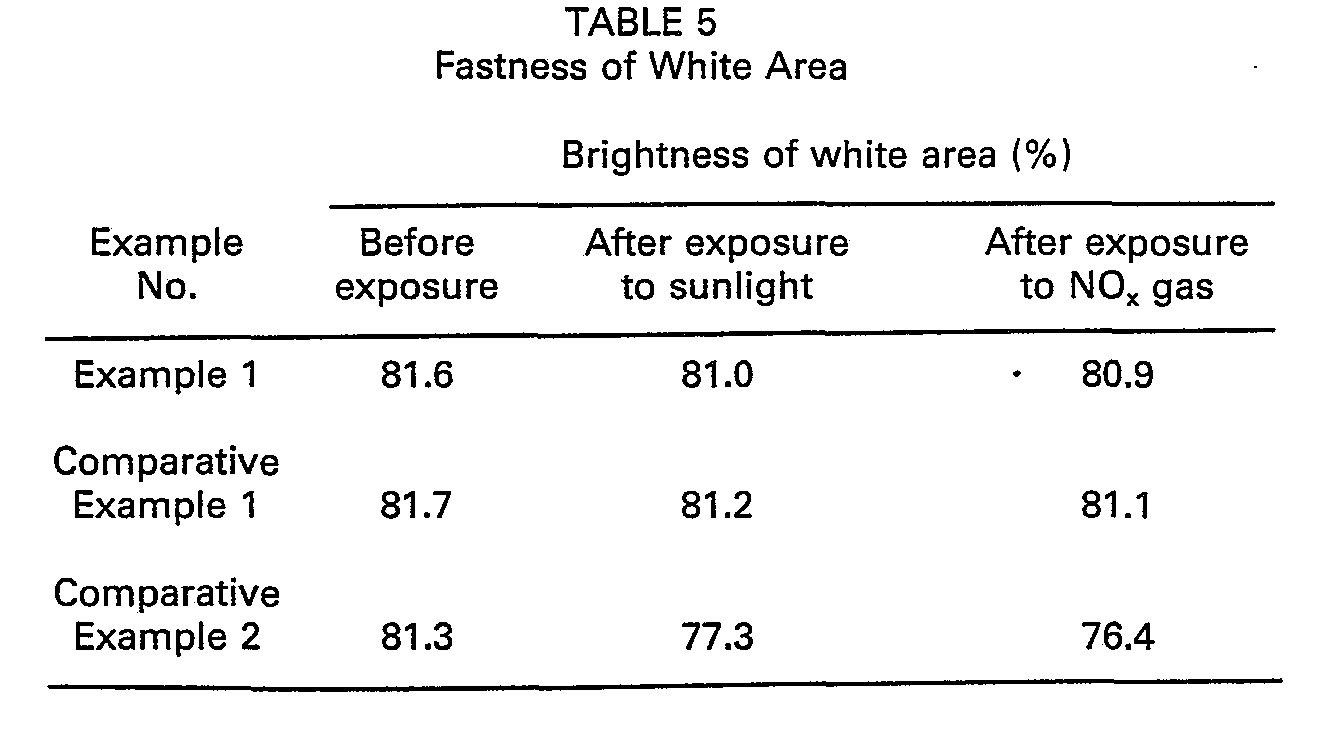
- As shown in the above Tables 4 and 5, this invention provides, by combined use of the above ammonium salt with the foregoing b-hydroxybenzoic acid ester and inorganic developer, a useful article quite excellent as a color-developing sheet for recording purposes which is superior, above all, in the fastness of developed color to sunlight, humidity, and oxidizing gas and additionally is almost completely free from the white area yellowing due to sunlight or nitrogen oxide gas.
- The coating liquid, containing the synthetic activated clay, used for producing the CF of this invention is much higher in viscosity than the coating liquid containing the usual clay mineral color-developer and exhibits therefore a notably lowered workability in paper coating.
- This is understandable in view of specific surface areas; that is, comparing the aromatic adsorption index 38 of the synthetic activated clay with the index 30 of the known conventionally used activated clay, the former has clearly a larger specific surface area, thus requiring a large amount of water for preparing the coating liquid or the resulting coating liquid of ordinary concentration is inferior in fluidity. Since a large amount of water is required for the coating liquid preparation or the coating liquid of ordinary concentration is highly viscous and liable to gelation, the application of the coating liquid on a substrate such as paper by using a blade coater, roll coater, rubber-doctor coater, or the like may form streaks on the coating surface, making the smoothness worse. Light-gauge coating of paper therewith may occasionally result in bared paper fiber at the coating surface, thus deteriorating the utility value of the product.
- This drawback has been eliminated by the present inventors with the method of adding an inorganic filler to the coating liquid. The method is to use as a flow improver for the coating liquid of high concentration (at least 40% by weight of solids), jointly with the synthetic activated clay, at least one inorganic filler selected from the group consisting of pyrophyllite clay (Al2O3·ASiO2·2H2O), kaolinite clay (Al2O3·2SiO2·2H2O), halloysite clay (Al2O3·2SiO·4H2O), sericite clay (K2O·3Al2O3·6SiO2·2H2O), montmollonite clay (Al4[Mg](Sig[Al]O20(OH)4·XH2O), aluminum hydroxide, gohun, chalk, heavy calcium carbonate, fine precipitated calcium carbonate, superfine precipitated calcium carbonate, superfine precipitated and activated calcium carbonate, zinc white, and titanium dioxide.
- Suitable amount ratios of the synthetic activated clay to the inorganic filler, in this invention, are in the range from 30:70 to 95:5, particularly from 50:50 to 85:15, % by weight. Amounts of the synthetic activated clay less than 30% by weight are not practically useful since the resulting color-developing ability are markedly low. If the amount exceeds 20% by weight, no coating liquid of high concentration and low viscosity can be obtained.
- The coating liquid combining, as shown above, the synthetic activated clay color-developer with an effective amount of at least one of the above-cited inorganic fillers exhibits improved flow and can be applied on paper to a light gauge (5 g/m2 or less) without leaving any bared fiber of paper at the coating surface. Accordingly, the resulting color-developing sheet can be printed by thin deposition of a desensitizing ink. Since the thin layer of ink can be quickly dried, a speed-up of the printing becomes possible. Further, the coating liquid, applicable to a light gauge, has great advantages in cost reduction possible by productivity improvement and energy saving. These are great effects of this invention.
- In the following Example and Comparative Examples, the color-forming sheets used were commercial CBs for pressure sensitive recording (Mitsubishi-NCR Overlying Sheet-40 Blue) (dyes: crystal violet lactone (CVL) and Benzoyl leucomethylene blue (BLML)).
- After complete dissolution of 0.5 parts of sodium hexametaphosphate in 90 parts of water, 50 parts of a 10% aqueous solution of an oxidized starch (MS-3800) was mixed therewith. Then, 15 parts of kaolinite powder (ENGELHARD MINERALS and CHEMICALS Co.), 5 parts of aluminum hydroxide powder (Showa Denko Co., Ltd.) and 10 parts of fine precipitated calcium carbonate (Shiraishi Calcium Co., Ltd.) and subsequently 60 parts of a synthetic activated clay (SS-1) were slowly added to the above mixture with stirring to disperse well. Further, 20 parts (as solids) of a SBR latex (Dow 670) was added. After dispersing by good stirring, the mixture was adjusted to pH 8.5 with 20% aqueous caustic soda to make up a coating liquid. This coating liquid applied on a 40 g/m2 base paper by means of a blade coater to a dry coating weight of 4.5 g/M 2, giving a color-developing sheet.
- After complete dissolution of 0.5 part of sodium hexametaphosphate in 90 parts of water, 50 parts of a 10% aqueous solution of an oxidized starch (MS-3800) was mixed therewith. The same amounts of the same inorganic fillers as used in Comparative Example 3 and subsequently 60 parts of a synthetic activated clay (SS-1) were slowly added to the above mixture and dispersed by well stirring. Further, 50 parts of a dispersion prepared by wet-griding 100 parts of benzyl p-hydroxybenzoate and 5 parts of hydroxyethylcellulose in 145 parts of water using a ball mill and subsequently 20 parts (as solids) of a SBR latex (Dow 670) were added to the above dispersion and dispersed by good stirring. The mixture was adjusted to pH 8.5 with 20% aqueous caustic soda to make up a coating liquid. This coating liquid was applied on a 40 g/ m2 base paper by means of a blade coater to a dry coating weight of 4.5 g/m2, giving a color-developing sheet.
- After complete dissolution of 0.5 part of sodium hexametaphosphate in 90 parts of water, 50 parts of a 10% aqueous solution of an oxidized starch (MS-3800) was mixed therewith. Then, 100 parts of a synthetic activated clay (SS-1) was slowly added to the mixture and well stirred. Further, 20 parts (as solids) of a SBR latex (Dow 670) was added to the above mixture with good stirring. The mixture was adjusted to pH 8.5 with 20% aqueous caustic soda to make up a coating liquid. This coating liquid was applied on a 40 g/m2 base paper by means of a blade coater to a dry coating weight of 4.5 g/m2, giving a color-developing sheet.
- Thus obtained coating liquids and color-developing sheets were tested by the following measuring methods:
- Values (mPa.s) at 60 rpm after 1 minute were measured with a B-type viscometer (made by Tokyo Keiki Co., Ltd.) using a rotor No. 4. In addition, viscosity curves were determined on specimens of Example 1 and of Comparative Example 1 by using a Hercules II-type of high shear viscometer (made by Nippon Rigaku-Kogyo Co., Ltd.)
- Each color-developing sheet and the foregoing color-forming sheet were superposed on each other and calendered at a pressure of 96 bar to develop color. The color density of the color-developing sheet calendered was determined according to the following equation by reflectance (%) measurements with a color difference meter (Nippon Denshoku Co., Ltd.):

- Table 6 shows found viscosities, solid contents, and fluid features of the coating liquids of Example 3 and Comparative Examples 3 and 4. Figs. 1 and 2 show viscosity curves of coating liquids of Example 3 and Comparative Example 4, respectively.

- As is shown in Table 6, the coating liquid of Example 3, as compared with that of Comparative Example 4, has markedly low viscosity and exhibits very high flow while containing nearly the same amount of solids. In Figs. 1 and 2, it is obvious that the coating liquid of Comparative Example 4 exhibits high viscosities, as compared with that of Example 3, at high revolutions of the rotor and gels at a low revolution, exhibiting also a high viscosity.
- Developed color densities of the calendered color-developing sheets are shown in Table 7. The color density of the specimen of Comparative Example 4 was somewhat low. This agrees with the result of visual observation that many uncolored areas and white spots were seen on the specimen.

- As shown in Tables 6 and 7 and Figs. 1 and 2, combined use of the synthetic activated clay with an inorganic filler, for example, clay, aluminum hydroxide, or calcium carbonate can provide a coating liquid of high fluidity with which a light-gauge coating of paper is possible without any trouble and the resulting color-developing sheet is completely free from bare paper fiber; additional use of benzyl p-hydroxy- benzoate can provide a better color-developing sheet.
and is characterized in that it contains in the surface layer also a p-hydroxybenzoic acid ester represented by the general formula:

Claims (6)

Applications Claiming Priority (6)
| Application Number | Priority Date | Filing Date | Title |
|---|---|---|---|
| JP57033237A JPS58151292A (en) | 1982-03-03 | 1982-03-03 | pressure sensitive recording system |
| JP33237/82 | 1982-03-03 | ||
| JP57076021A JPS5952690A (en) | 1982-05-08 | 1982-05-08 | Color developer sheet for carbon-free recording paper |
| JP76021/82 | 1982-05-08 | ||
| JP57143014A JPS5933190A (en) | 1982-08-18 | 1982-08-18 | Color developer sheet for image recording materials |
| JP143014/82 | 1982-08-18 |
Publications (3)
| Publication Number | Publication Date |
|---|---|
| EP0105376A1 EP0105376A1 (en) | 1984-04-18 |
| EP0105376A4 EP0105376A4 (en) | 1984-09-28 |
| EP0105376B1 true EP0105376B1 (en) | 1986-12-10 |
Family
ID=27288007
Family Applications (1)
| Application Number | Title | Priority Date | Filing Date |
|---|---|---|---|
| EP19830900802 Expired EP0105376B1 (en) | 1982-03-03 | 1983-03-02 | Color-developing sheet for use in no-carbon recording system |
Country Status (4)
| Country | Link |
|---|---|
| EP (1) | EP0105376B1 (en) |
| AU (1) | AU1330983A (en) |
| DE (1) | DE3368231D1 (en) |
| WO (1) | WO1983003077A1 (en) |
Families Citing this family (3)
| Publication number | Priority date | Publication date | Assignee | Title |
|---|---|---|---|---|
| JPS58222880A (en) * | 1982-06-22 | 1983-12-24 | Mitsubishi Paper Mills Ltd | Color developing layer for pressure-sensitive recording |
| JPH0627425Y2 (en) * | 1983-01-26 | 1994-07-27 | 三菱製紙株式会社 | No-carbon paper for kanji printer |
| AT399126B (en) * | 1987-03-31 | 1995-03-27 | Ruetgerswerke Ag | COLOR DEVELOPER DIMENSIONS FOR COLOR REACTION SYSTEMS |
Family Cites Families (1)
| Publication number | Priority date | Publication date | Assignee | Title |
|---|---|---|---|---|
| JPS5715996A (en) * | 1980-07-03 | 1982-01-27 | Mizusawa Ind Chem Ltd | Novel clay mineral based color former for heat-sensitive copying paper and production thereof |
-
1983
- 1983-03-02 AU AU13309/83A patent/AU1330983A/en not_active Abandoned
- 1983-03-02 DE DE8383900802T patent/DE3368231D1/en not_active Expired
- 1983-03-02 WO PCT/JP1983/000066 patent/WO1983003077A1/en not_active Ceased
- 1983-03-02 EP EP19830900802 patent/EP0105376B1/en not_active Expired
Also Published As
| Publication number | Publication date |
|---|---|
| WO1983003077A1 (en) | 1983-09-15 |
| DE3368231D1 (en) | 1987-01-22 |
| EP0105376A4 (en) | 1984-09-28 |
| AU1330983A (en) | 1983-10-18 |
| EP0105376A1 (en) | 1984-04-18 |
Similar Documents
| Publication | Publication Date | Title |
|---|---|---|
| US4121013A (en) | Record material | |
| US4166644A (en) | Pressure-sensitive record material containing urea-formaldehyde resin pigment | |
| US4675705A (en) | Heat sensitive coating | |
| US4416471A (en) | Color-developing sheet for pressure-sensitive recording sheet | |
| EP0060386B1 (en) | Color-developing sheet for pressure-sensitive recording sheet | |
| JPS6210271B2 (en) | ||
| US4109048A (en) | Recording material containing gamma-alumina | |
| EP0105376A1 (en) | Color-developing sheet for use in no-carbon recording system | |
| GB2028888A (en) | Colour-developing sheet for pressure-sensitive copying paper | |
| US3793075A (en) | Dialkyl tartrate-heteropolyacid developing system for dye precursor compounds | |
| JPS588686A (en) | pressure sensitive recording paper | |
| US4868152A (en) | Self-adhesive label assembly | |
| EP0111564B1 (en) | Color-developing sheet for pressure-sensitive recording | |
| US5614462A (en) | Color developer compositions for carbonless paper copying systems | |
| US3079271A (en) | Pressure sensitive sheet record material and method of making | |
| EP0076342A1 (en) | A color-developer sheet for carbonless copying | |
| JPH0151349B2 (en) | ||
| US5130289A (en) | Pressure sensitive record material | |
| JPH0362554B2 (en) | ||
| JP2991842B2 (en) | Colored sheet for pressure-sensitive copying paper | |
| EP0058263A1 (en) | Manufacture of carbonless reproduction paper | |
| EP0058262A1 (en) | Developing sheet for carbonless reproduction paper | |
| JPS6161994B2 (en) | ||
| US4142738A (en) | Base sheets for printing with reactive dyes | |
| JP2992983B2 (en) | Colored sheet for pressure-sensitive copying paper |
Legal Events
| Date | Code | Title | Description |
|---|---|---|---|
| PUAI | Public reference made under article 153(3) epc to a published international application that has entered the european phase |
Free format text: ORIGINAL CODE: 0009012 |
|
| 17P | Request for examination filed |
Effective date: 19831019 |
|
| AK | Designated contracting states |
Designated state(s): DE GB |
|
| GRAA | (expected) grant |
Free format text: ORIGINAL CODE: 0009210 |
|
| AK | Designated contracting states |
Kind code of ref document: B1 Designated state(s): DE GB |
|
| REF | Corresponds to: |
Ref document number: 3368231 Country of ref document: DE Date of ref document: 19870122 |
|
| PLBE | No opposition filed within time limit |
Free format text: ORIGINAL CODE: 0009261 |
|
| STAA | Information on the status of an ep patent application or granted ep patent |
Free format text: STATUS: NO OPPOSITION FILED WITHIN TIME LIMIT |
|
| 26N | No opposition filed | ||
| PGFP | Annual fee paid to national office [announced via postgrant information from national office to epo] |
Ref country code: GB Payment date: 19920221 Year of fee payment: 10 |
|
| PGFP | Annual fee paid to national office [announced via postgrant information from national office to epo] |
Ref country code: DE Payment date: 19920430 Year of fee payment: 10 |
|
| PG25 | Lapsed in a contracting state [announced via postgrant information from national office to epo] |
Ref country code: GB Effective date: 19930302 |
|
| GBPC | Gb: european patent ceased through non-payment of renewal fee |
Effective date: 19930302 |
|
| PG25 | Lapsed in a contracting state [announced via postgrant information from national office to epo] |
Ref country code: DE Effective date: 19931201 |