EP0103464B1 - Diaminopyrimidines and their production - Google Patents
Diaminopyrimidines and their production Download PDFInfo
- Publication number
- EP0103464B1 EP0103464B1 EP83305229A EP83305229A EP0103464B1 EP 0103464 B1 EP0103464 B1 EP 0103464B1 EP 83305229 A EP83305229 A EP 83305229A EP 83305229 A EP83305229 A EP 83305229A EP 0103464 B1 EP0103464 B1 EP 0103464B1
- Authority
- EP
- European Patent Office
- Prior art keywords
- pharmaceutically acceptable
- carbon atoms
- piperazinyl
- acceptable salts
- methyl
- Prior art date
- Legal status (The legal status is an assumption and is not a legal conclusion. Google has not performed a legal analysis and makes no representation as to the accuracy of the status listed.)
- Expired
Links
- 238000004519 manufacturing process Methods 0.000 title description 3
- MISVBCMQSJUHMH-UHFFFAOYSA-N pyrimidine-4,6-diamine Chemical class NC1=CC(N)=NC=N1 MISVBCMQSJUHMH-UHFFFAOYSA-N 0.000 title description 2
- 229940058936 antimalarials diaminopyrimidines Drugs 0.000 title 1
- 150000001875 compounds Chemical class 0.000 claims description 129
- 150000003839 salts Chemical class 0.000 claims description 80
- 125000004432 carbon atom Chemical group C* 0.000 claims description 79
- 125000000217 alkyl group Chemical group 0.000 claims description 53
- 229910052739 hydrogen Inorganic materials 0.000 claims description 41
- 239000001257 hydrogen Substances 0.000 claims description 41
- 238000000034 method Methods 0.000 claims description 26
- UFHFLCQGNIYNRP-UHFFFAOYSA-N Hydrogen Chemical compound [H][H] UFHFLCQGNIYNRP-UHFFFAOYSA-N 0.000 claims description 25
- -1 amine cation Chemical class 0.000 claims description 21
- 125000003236 benzoyl group Chemical group [H]C1=C([H])C([H])=C(C([H])=C1[H])C(*)=O 0.000 claims description 19
- 150000002431 hydrogen Chemical class 0.000 claims description 12
- VEXZGXHMUGYJMC-UHFFFAOYSA-N Hydrochloric acid Chemical compound Cl VEXZGXHMUGYJMC-UHFFFAOYSA-N 0.000 claims description 11
- 125000003545 alkoxy group Chemical group 0.000 claims description 11
- 125000003178 carboxy group Chemical group [H]OC(*)=O 0.000 claims description 11
- KDLHZDBZIXYQEI-UHFFFAOYSA-N Palladium Chemical compound [Pd] KDLHZDBZIXYQEI-UHFFFAOYSA-N 0.000 claims description 9
- 125000001589 carboacyl group Chemical group 0.000 claims description 9
- 229960002989 glutamic acid Drugs 0.000 claims description 9
- 239000002253 acid Substances 0.000 claims description 8
- 125000002887 hydroxy group Chemical group [H]O* 0.000 claims description 8
- 150000001768 cations Chemical class 0.000 claims description 7
- 125000004093 cyano group Chemical group *C#N 0.000 claims description 7
- 239000003937 drug carrier Substances 0.000 claims description 7
- 229910052751 metal Inorganic materials 0.000 claims description 7
- 239000002184 metal Substances 0.000 claims description 7
- 125000004435 hydrogen atom Chemical group [H]* 0.000 claims description 6
- 239000008194 pharmaceutical composition Substances 0.000 claims description 6
- QSASKJFASZTBLI-UHFFFAOYSA-N 4-[4-(2,4-diamino-6-propylpyrimidin-5-yl)piperazin-1-yl]benzonitrile Chemical compound CCCC1=NC(N)=NC(N)=C1N1CCN(C=2C=CC(=CC=2)C#N)CC1 QSASKJFASZTBLI-UHFFFAOYSA-N 0.000 claims description 5
- FJZAQZNUSCJDTG-UHFFFAOYSA-N 2-[[4-[4-(2,4-diamino-6-methylpyrimidin-5-yl)piperazin-1-yl]benzoyl]amino]acetic acid Chemical compound CC1=NC(N)=NC(N)=C1N1CCN(C=2C=CC(=CC=2)C(=O)NCC(O)=O)CC1 FJZAQZNUSCJDTG-UHFFFAOYSA-N 0.000 claims description 4
- XGXGPTMWBSPPPD-UHFFFAOYSA-N 4-[4-(2,4-diamino-6-ethylpyrimidin-5-yl)piperazin-1-yl]benzonitrile Chemical compound CCC1=NC(N)=NC(N)=C1N1CCN(C=2C=CC(=CC=2)C#N)CC1 XGXGPTMWBSPPPD-UHFFFAOYSA-N 0.000 claims description 4
- BQTNAFHTRSFMFB-UHFFFAOYSA-N 4-[4-(2,4-diamino-6-methylpyrimidin-5-yl)piperazin-1-yl]benzoic acid Chemical compound CC1=NC(N)=NC(N)=C1N1CCN(C=2C=CC(=CC=2)C(O)=O)CC1 BQTNAFHTRSFMFB-UHFFFAOYSA-N 0.000 claims description 4
- NLZIUVFWCGIOFK-UHFFFAOYSA-N 6-methyl-5-[4-(4-nitrophenyl)piperazin-1-yl]pyrimidine-2,4-diamine Chemical compound CC1=NC(N)=NC(N)=C1N1CCN(C=2C=CC(=CC=2)[N+]([O-])=O)CC1 NLZIUVFWCGIOFK-UHFFFAOYSA-N 0.000 claims description 4
- OKTJSMMVPCPJKN-UHFFFAOYSA-N Carbon Chemical compound [C] OKTJSMMVPCPJKN-UHFFFAOYSA-N 0.000 claims description 4
- 229910052736 halogen Inorganic materials 0.000 claims description 4
- 150000002367 halogens Chemical class 0.000 claims description 4
- 125000002496 methyl group Chemical group [H]C([H])([H])* 0.000 claims description 4
- 125000000449 nitro group Chemical group [O-][N+](*)=O 0.000 claims description 4
- 125000002023 trifluoromethyl group Chemical group FC(F)(F)* 0.000 claims description 4
- BMUSFWHOWMZIFC-UHFFFAOYSA-N 1-[4-[4-(2,4-diamino-6-methylpyrimidin-5-yl)piperazin-1-yl]phenyl]ethanone Chemical compound C1=CC(C(=O)C)=CC=C1N1CCN(C=2C(=NC(N)=NC=2C)N)CC1 BMUSFWHOWMZIFC-UHFFFAOYSA-N 0.000 claims description 3
- CWBRZJGNFXSYAM-UHFFFAOYSA-N 4-[4-(2,4-diamino-6-ethylpyrimidin-5-yl)piperazin-1-yl]benzoic acid Chemical compound CCC1=NC(N)=NC(N)=C1N1CCN(C=2C=CC(=CC=2)C(O)=O)CC1 CWBRZJGNFXSYAM-UHFFFAOYSA-N 0.000 claims description 3
- GPQAZBWKSWPING-UHFFFAOYSA-N 4-[4-(2,4-diamino-6-methylpyrimidin-5-yl)piperazin-1-yl]-n,n-dimethylbenzenesulfonamide Chemical compound C1=CC(S(=O)(=O)N(C)C)=CC=C1N1CCN(C=2C(=NC(N)=NC=2C)N)CC1 GPQAZBWKSWPING-UHFFFAOYSA-N 0.000 claims description 3
- HSXUCXLTFSERON-UHFFFAOYSA-N 4-[4-(2,4-diamino-6-propylpyrimidin-5-yl)piperazin-1-yl]benzoic acid Chemical compound CCCC1=NC(N)=NC(N)=C1N1CCN(C=2C=CC(=CC=2)C(O)=O)CC1 HSXUCXLTFSERON-UHFFFAOYSA-N 0.000 claims description 3
- LQLQRFGHAALLLE-UHFFFAOYSA-N 5-bromouracil Chemical class BrC1=CNC(=O)NC1=O LQLQRFGHAALLLE-UHFFFAOYSA-N 0.000 claims description 3
- FGIOEMDQLFNGNY-UHFFFAOYSA-N 6-methyl-5-[4-(4-methylsulfonylphenyl)piperazin-1-yl]pyrimidine-2,4-diamine Chemical compound CC1=NC(N)=NC(N)=C1N1CCN(C=2C=CC(=CC=2)S(C)(=O)=O)CC1 FGIOEMDQLFNGNY-UHFFFAOYSA-N 0.000 claims description 3
- BUIIVIQQIFPPOX-UHFFFAOYSA-N 6-methyl-5-[4-[4-(trifluoromethyl)phenyl]piperazin-1-yl]pyrimidine-2,4-diamine Chemical compound CC1=NC(N)=NC(N)=C1N1CCN(C=2C=CC(=CC=2)C(F)(F)F)CC1 BUIIVIQQIFPPOX-UHFFFAOYSA-N 0.000 claims description 3
- VWDLCZORRUXQKV-UHFFFAOYSA-N ethyl 4-[4-(2,4-diamino-6-propylpyrimidin-5-yl)piperazin-1-yl]benzoate Chemical compound CCCC1=NC(N)=NC(N)=C1N1CCN(C=2C=CC(=CC=2)C(=O)OCC)CC1 VWDLCZORRUXQKV-UHFFFAOYSA-N 0.000 claims description 3
- ONRFRUNBIREVSR-UHFFFAOYSA-N 6-methyl-5-(4-phenylpiperazin-1-yl)pyrimidine-2,4-diamine Chemical compound CC1=NC(N)=NC(N)=C1N1CCN(C=2C=CC=CC=2)CC1 ONRFRUNBIREVSR-UHFFFAOYSA-N 0.000 claims description 2
- 238000005576 amination reaction Methods 0.000 claims description 2
- 229910052799 carbon Inorganic materials 0.000 claims description 2
- VQNYSOUXJNUCTH-UHFFFAOYSA-N methyl 2-[[4-[4-(2,4-diamino-6-methylpyrimidin-5-yl)piperazin-1-yl]benzoyl]amino]acetate Chemical compound C1=CC(C(=O)NCC(=O)OC)=CC=C1N1CCN(C=2C(=NC(N)=NC=2C)N)CC1 VQNYSOUXJNUCTH-UHFFFAOYSA-N 0.000 claims description 2
- DHMQDGOQFOQNFH-UHFFFAOYSA-N Glycine Chemical compound NCC(O)=O DHMQDGOQFOQNFH-UHFFFAOYSA-N 0.000 claims 2
- KFCZGWGWUAYJIE-UHFFFAOYSA-N 4-[4-(4,6-diamino-2-methylpiperidin-3-yl)piperazin-1-yl]benzonitrile Chemical compound CC1NC(N)CC(N)C1N1CCN(C=2C=CC(=CC=2)C#N)CC1 KFCZGWGWUAYJIE-UHFFFAOYSA-N 0.000 claims 1
- 239000004471 Glycine Substances 0.000 claims 1
- 238000005660 chlorination reaction Methods 0.000 claims 1
- 125000004494 ethyl ester group Chemical group 0.000 claims 1
- 229910052763 palladium Inorganic materials 0.000 claims 1
- 239000007787 solid Substances 0.000 description 99
- LFQSCWFLJHTTHZ-UHFFFAOYSA-N Ethanol Chemical compound CCO LFQSCWFLJHTTHZ-UHFFFAOYSA-N 0.000 description 86
- ZMXDDKWLCZADIW-UHFFFAOYSA-N N,N-Dimethylformamide Chemical compound CN(C)C=O ZMXDDKWLCZADIW-UHFFFAOYSA-N 0.000 description 80
- 239000000243 solution Substances 0.000 description 72
- 239000000203 mixture Substances 0.000 description 60
- XLYOFNOQVPJJNP-UHFFFAOYSA-N water Substances O XLYOFNOQVPJJNP-UHFFFAOYSA-N 0.000 description 56
- OKKJLVBELUTLKV-UHFFFAOYSA-N Methanol Chemical compound OC OKKJLVBELUTLKV-UHFFFAOYSA-N 0.000 description 51
- HEMHJVSKTPXQMS-UHFFFAOYSA-M Sodium hydroxide Chemical compound [OH-].[Na+] HEMHJVSKTPXQMS-UHFFFAOYSA-M 0.000 description 51
- 239000000047 product Substances 0.000 description 45
- 239000005457 ice water Substances 0.000 description 35
- ZMANZCXQSJIPKH-UHFFFAOYSA-N Triethylamine Chemical compound CCN(CC)CC ZMANZCXQSJIPKH-UHFFFAOYSA-N 0.000 description 30
- IAZDPXIOMUYVGZ-UHFFFAOYSA-N Dimethylsulphoxide Chemical compound CS(C)=O IAZDPXIOMUYVGZ-UHFFFAOYSA-N 0.000 description 24
- QTBSBXVTEAMEQO-UHFFFAOYSA-N Acetic acid Chemical compound CC(O)=O QTBSBXVTEAMEQO-UHFFFAOYSA-N 0.000 description 22
- WEVYAHXRMPXWCK-UHFFFAOYSA-N Acetonitrile Chemical compound CC#N WEVYAHXRMPXWCK-UHFFFAOYSA-N 0.000 description 21
- XHXFXVLFKHQFAL-UHFFFAOYSA-N phosphoryl trichloride Chemical compound ClP(Cl)(Cl)=O XHXFXVLFKHQFAL-UHFFFAOYSA-N 0.000 description 20
- BWHMMNNQKKPAPP-UHFFFAOYSA-L potassium carbonate Chemical compound [K+].[K+].[O-]C([O-])=O BWHMMNNQKKPAPP-UHFFFAOYSA-L 0.000 description 20
- 238000010992 reflux Methods 0.000 description 20
- 239000011541 reaction mixture Substances 0.000 description 19
- 238000001953 recrystallisation Methods 0.000 description 19
- CDBYLPFSWZWCQE-UHFFFAOYSA-L Sodium Carbonate Chemical compound [Na+].[Na+].[O-]C([O-])=O CDBYLPFSWZWCQE-UHFFFAOYSA-L 0.000 description 18
- KRKNYBCHXYNGOX-UHFFFAOYSA-N citric acid Chemical compound OC(=O)CC(O)(C(O)=O)CC(O)=O KRKNYBCHXYNGOX-UHFFFAOYSA-N 0.000 description 18
- 238000001035 drying Methods 0.000 description 18
- 239000000843 powder Substances 0.000 description 18
- 239000002904 solvent Substances 0.000 description 18
- 238000002360 preparation method Methods 0.000 description 17
- QGZKDVFQNNGYKY-UHFFFAOYSA-N Ammonia Chemical compound N QGZKDVFQNNGYKY-UHFFFAOYSA-N 0.000 description 15
- XEKOWRVHYACXOJ-UHFFFAOYSA-N Ethyl acetate Chemical compound CCOC(C)=O XEKOWRVHYACXOJ-UHFFFAOYSA-N 0.000 description 15
- 0 CC(CCCCC1)(C(*)NC(*)C2*)C1C2O* Chemical compound CC(CCCCC1)(C(*)NC(*)C2*)C1C2O* 0.000 description 14
- NROKBHXJSPEDAR-UHFFFAOYSA-M potassium fluoride Chemical compound [F-].[K+] NROKBHXJSPEDAR-UHFFFAOYSA-M 0.000 description 14
- 210000004027 cell Anatomy 0.000 description 13
- CSNNHWWHGAXBCP-UHFFFAOYSA-L Magnesium sulfate Chemical compound [Mg+2].[O-][S+2]([O-])([O-])[O-] CSNNHWWHGAXBCP-UHFFFAOYSA-L 0.000 description 12
- 239000000706 filtrate Substances 0.000 description 12
- FAPWRFPIFSIZLT-UHFFFAOYSA-M Sodium chloride Chemical compound [Na+].[Cl-] FAPWRFPIFSIZLT-UHFFFAOYSA-M 0.000 description 11
- 238000006243 chemical reaction Methods 0.000 description 11
- 239000002585 base Substances 0.000 description 10
- 229910000027 potassium carbonate Inorganic materials 0.000 description 10
- 239000000725 suspension Substances 0.000 description 10
- 229940086542 triethylamine Drugs 0.000 description 10
- 229920001817 Agar Polymers 0.000 description 8
- JLTDJTHDQAWBAV-UHFFFAOYSA-N N,N-dimethylaniline Chemical compound CN(C)C1=CC=CC=C1 JLTDJTHDQAWBAV-UHFFFAOYSA-N 0.000 description 8
- 229960000583 acetic acid Drugs 0.000 description 8
- 239000004480 active ingredient Substances 0.000 description 8
- 239000008272 agar Substances 0.000 description 8
- 239000007788 liquid Substances 0.000 description 8
- 229910021529 ammonia Inorganic materials 0.000 description 7
- 239000011698 potassium fluoride Substances 0.000 description 7
- 235000003270 potassium fluoride Nutrition 0.000 description 7
- 229910000029 sodium carbonate Inorganic materials 0.000 description 7
- 239000003826 tablet Substances 0.000 description 7
- IQXXEPZFOOTTBA-UHFFFAOYSA-N 1-benzylpiperazine Chemical compound C=1C=CC=CC=1CN1CCNCC1 IQXXEPZFOOTTBA-UHFFFAOYSA-N 0.000 description 6
- YMWUJEATGCHHMB-UHFFFAOYSA-N Dichloromethane Chemical compound ClCCl YMWUJEATGCHHMB-UHFFFAOYSA-N 0.000 description 6
- PEDCQBHIVMGVHV-UHFFFAOYSA-N Glycerine Chemical compound OCC(O)CO PEDCQBHIVMGVHV-UHFFFAOYSA-N 0.000 description 6
- 230000000694 effects Effects 0.000 description 6
- 239000012458 free base Substances 0.000 description 6
- 229910052943 magnesium sulfate Inorganic materials 0.000 description 6
- 235000019341 magnesium sulphate Nutrition 0.000 description 6
- 241001465754 Metazoa Species 0.000 description 5
- 230000000844 anti-bacterial effect Effects 0.000 description 5
- 238000009835 boiling Methods 0.000 description 5
- 239000002775 capsule Substances 0.000 description 5
- 239000006285 cell suspension Substances 0.000 description 5
- ZWWWLCMDTZFSOO-UHFFFAOYSA-N diethoxyphosphorylformonitrile Chemical compound CCOP(=O)(C#N)OCC ZWWWLCMDTZFSOO-UHFFFAOYSA-N 0.000 description 5
- 239000006185 dispersion Substances 0.000 description 5
- 239000002244 precipitate Substances 0.000 description 5
- 238000000746 purification Methods 0.000 description 5
- AEKVBBNGWBBYLL-UHFFFAOYSA-N 4-fluorobenzonitrile Chemical compound FC1=CC=C(C#N)C=C1 AEKVBBNGWBBYLL-UHFFFAOYSA-N 0.000 description 4
- HEAXNUZNYDEXFG-UHFFFAOYSA-N 5-bromo-6-methyl-1h-pyrimidine-2,4-dione Chemical compound CC=1NC(=O)NC(=O)C=1Br HEAXNUZNYDEXFG-UHFFFAOYSA-N 0.000 description 4
- RTZKZFJDLAIYFH-UHFFFAOYSA-N Diethyl ether Chemical compound CCOCC RTZKZFJDLAIYFH-UHFFFAOYSA-N 0.000 description 4
- 206010028980 Neoplasm Diseases 0.000 description 4
- UIIMBOGNXHQVGW-UHFFFAOYSA-M Sodium bicarbonate Chemical compound [Na+].OC([O-])=O UIIMBOGNXHQVGW-UHFFFAOYSA-M 0.000 description 4
- QAOWNCQODCNURD-UHFFFAOYSA-N Sulfuric acid Chemical compound OS(O)(=O)=O QAOWNCQODCNURD-UHFFFAOYSA-N 0.000 description 4
- 239000003429 antifungal agent Substances 0.000 description 4
- 229940121375 antifungal agent Drugs 0.000 description 4
- JFDZBHWFFUWGJE-UHFFFAOYSA-N benzonitrile Chemical compound N#CC1=CC=CC=C1 JFDZBHWFFUWGJE-UHFFFAOYSA-N 0.000 description 4
- 239000003795 chemical substances by application Substances 0.000 description 4
- 238000000354 decomposition reaction Methods 0.000 description 4
- GGSUCNLOZRCGPQ-UHFFFAOYSA-N diethylaniline Chemical compound CCN(CC)C1=CC=CC=C1 GGSUCNLOZRCGPQ-UHFFFAOYSA-N 0.000 description 4
- 239000002552 dosage form Substances 0.000 description 4
- 239000004615 ingredient Substances 0.000 description 4
- 239000002054 inoculum Substances 0.000 description 4
- 239000000463 material Substances 0.000 description 4
- 239000002808 molecular sieve Substances 0.000 description 4
- 239000012044 organic layer Substances 0.000 description 4
- DNIAPMSPPWPWGF-UHFFFAOYSA-N propylene glycol Substances CC(O)CO DNIAPMSPPWPWGF-UHFFFAOYSA-N 0.000 description 4
- 239000012047 saturated solution Substances 0.000 description 4
- URGAHOPLAPQHLN-UHFFFAOYSA-N sodium aluminosilicate Chemical compound [Na+].[Al+3].[O-][Si]([O-])=O.[O-][Si]([O-])=O URGAHOPLAPQHLN-UHFFFAOYSA-N 0.000 description 4
- 239000000126 substance Substances 0.000 description 4
- 230000001225 therapeutic effect Effects 0.000 description 4
- PJAIMBYNTXNOCN-UHFFFAOYSA-N 3,6-dibromo-1h-indole Chemical compound BrC1=CC=C2C(Br)=CNC2=C1 PJAIMBYNTXNOCN-UHFFFAOYSA-N 0.000 description 3
- VSUOQWMVQOJINK-UHFFFAOYSA-N 4-[4-(2,4-diamino-6-methylpyrimidin-5-yl)piperazin-1-yl]benzonitrile Chemical compound CC1=NC(N)=NC(N)=C1N1CCN(C=2C=CC(=CC=2)C#N)CC1 VSUOQWMVQOJINK-UHFFFAOYSA-N 0.000 description 3
- DRJGZGUVWFHVGN-UHFFFAOYSA-N 6-methyl-5-piperazin-1-ylpyrimidine-2,4-diamine Chemical compound CC1=NC(N)=NC(N)=C1N1CCNCC1 DRJGZGUVWFHVGN-UHFFFAOYSA-N 0.000 description 3
- KWYUFKZDYYNOTN-UHFFFAOYSA-M Potassium hydroxide Chemical compound [OH-].[K+] KWYUFKZDYYNOTN-UHFFFAOYSA-M 0.000 description 3
- 229910000831 Steel Inorganic materials 0.000 description 3
- RWDASJCQRAQWCK-UHFFFAOYSA-N acetic acid;6-methyl-5-piperazin-1-ylpyrimidine-2,4-diamine Chemical compound CC(O)=O.CC(O)=O.CC(O)=O.CC1=NC(N)=NC(N)=C1N1CCNCC1 RWDASJCQRAQWCK-UHFFFAOYSA-N 0.000 description 3
- 239000011149 active material Substances 0.000 description 3
- 239000003242 anti bacterial agent Substances 0.000 description 3
- 230000015572 biosynthetic process Effects 0.000 description 3
- GGNALUCSASGNCK-UHFFFAOYSA-N carbon dioxide;propan-2-ol Chemical compound O=C=O.CC(C)O GGNALUCSASGNCK-UHFFFAOYSA-N 0.000 description 3
- 239000013078 crystal Substances 0.000 description 3
- 238000010790 dilution Methods 0.000 description 3
- 239000012895 dilution Substances 0.000 description 3
- 239000002612 dispersion medium Substances 0.000 description 3
- 239000003814 drug Substances 0.000 description 3
- 229940079593 drug Drugs 0.000 description 3
- 239000002609 medium Substances 0.000 description 3
- 244000005700 microbiome Species 0.000 description 3
- 229910052757 nitrogen Inorganic materials 0.000 description 3
- 229920001223 polyethylene glycol Polymers 0.000 description 3
- 229920006395 saturated elastomer Polymers 0.000 description 3
- 239000011780 sodium chloride Substances 0.000 description 3
- 229910001220 stainless steel Inorganic materials 0.000 description 3
- 239000010935 stainless steel Substances 0.000 description 3
- 239000010959 steel Substances 0.000 description 3
- OUVSUYLZFCBQEP-UHFFFAOYSA-N 2,4-dichloro-6-methyl-5-(4-phenylpiperazin-1-yl)pyrimidine Chemical compound CC1=NC(Cl)=NC(Cl)=C1N1CCN(C=2C=CC=CC=2)CC1 OUVSUYLZFCBQEP-UHFFFAOYSA-N 0.000 description 2
- BAOMREVNDYOTNN-UHFFFAOYSA-N 4-[4-(2,4-diamino-6-methylpyrimidin-5-yl)piperazin-1-yl]benzoic acid;hydrochloride Chemical compound Cl.CC1=NC(N)=NC(N)=C1N1CCN(C=2C=CC(=CC=2)C(O)=O)CC1 BAOMREVNDYOTNN-UHFFFAOYSA-N 0.000 description 2
- WURMPFYVFDHATI-UHFFFAOYSA-N 4-fluoro-n,n-dimethylbenzenesulfonamide Chemical compound CN(C)S(=O)(=O)C1=CC=C(F)C=C1 WURMPFYVFDHATI-UHFFFAOYSA-N 0.000 description 2
- DJJNYEXRPRQXPD-UHFFFAOYSA-N 4-piperazin-1-ylbenzonitrile Chemical compound C1=CC(C#N)=CC=C1N1CCNCC1 DJJNYEXRPRQXPD-UHFFFAOYSA-N 0.000 description 2
- IICMFKRTFJEFST-UHFFFAOYSA-N 5-(4-benzylpiperazin-1-yl)-2,4-dichloro-6-ethylpyrimidine Chemical compound CCC1=NC(Cl)=NC(Cl)=C1N1CCN(CC=2C=CC=CC=2)CC1 IICMFKRTFJEFST-UHFFFAOYSA-N 0.000 description 2
- IJNYLKRBLVVSRM-UHFFFAOYSA-N 5-(4-benzylpiperazin-1-yl)-2,4-dichloro-6-propylpyrimidine Chemical compound CCCC1=NC(Cl)=NC(Cl)=C1N1CCN(CC=2C=CC=CC=2)CC1 IJNYLKRBLVVSRM-UHFFFAOYSA-N 0.000 description 2
- OVGGYPMEPRBIIU-UHFFFAOYSA-N 5-(4-benzylpiperazin-1-yl)-6-ethyl-1h-pyrimidine-2,4-dione Chemical compound N1C(=O)NC(=O)C(N2CCN(CC=3C=CC=CC=3)CC2)=C1CC OVGGYPMEPRBIIU-UHFFFAOYSA-N 0.000 description 2
- SICABTAFZKKLSH-UHFFFAOYSA-N 5-(4-benzylpiperazin-1-yl)-6-ethylpyrimidine-2,4-diamine Chemical compound CCC1=NC(N)=NC(N)=C1N1CCN(CC=2C=CC=CC=2)CC1 SICABTAFZKKLSH-UHFFFAOYSA-N 0.000 description 2
- GROQDRCUNQCZFF-UHFFFAOYSA-N 5-(4-benzylpiperazin-1-yl)-6-methyl-1h-pyrimidine-2,4-dione Chemical compound N1C(=O)NC(=O)C(N2CCN(CC=3C=CC=CC=3)CC2)=C1C GROQDRCUNQCZFF-UHFFFAOYSA-N 0.000 description 2
- YPQXSHPRKNDTDB-UHFFFAOYSA-N 5-(4-benzylpiperazin-1-yl)-6-propyl-1h-pyrimidine-2,4-dione Chemical compound N1C(=O)NC(=O)C(N2CCN(CC=3C=CC=CC=3)CC2)=C1CCC YPQXSHPRKNDTDB-UHFFFAOYSA-N 0.000 description 2
- DNJPTDUXOPWZDE-UHFFFAOYSA-N 5-[4-(4-chlorophenyl)piperazin-1-yl]-6-methylpyrimidine-2,4-diamine Chemical compound CC1=NC(N)=NC(N)=C1N1CCN(C=2C=CC(Cl)=CC=2)CC1 DNJPTDUXOPWZDE-UHFFFAOYSA-N 0.000 description 2
- IVGPFRQYDLZFEF-UHFFFAOYSA-N 5-bromo-6-propyl-1h-pyrimidine-2,4-dione Chemical compound CCCC=1NC(=O)NC(=O)C=1Br IVGPFRQYDLZFEF-UHFFFAOYSA-N 0.000 description 2
- NCTOLCONVAWNEG-UHFFFAOYSA-N 5-piperazin-1-yl-6-propylpyrimidine-2,4-diamine Chemical compound CCCC1=NC(N)=NC(N)=C1N1CCNCC1 NCTOLCONVAWNEG-UHFFFAOYSA-N 0.000 description 2
- WNQOYLGCNGHAQN-UHFFFAOYSA-N 6-ethyl-5-piperazin-1-ylpyrimidine-2,4-diamine Chemical compound CCC1=NC(N)=NC(N)=C1N1CCNCC1 WNQOYLGCNGHAQN-UHFFFAOYSA-N 0.000 description 2
- VHUUQVKOLVNVRT-UHFFFAOYSA-N Ammonium hydroxide Chemical compound [NH4+].[OH-] VHUUQVKOLVNVRT-UHFFFAOYSA-N 0.000 description 2
- IJGRMHOSHXDMSA-UHFFFAOYSA-N Atomic nitrogen Chemical compound N#N IJGRMHOSHXDMSA-UHFFFAOYSA-N 0.000 description 2
- 208000035143 Bacterial infection Diseases 0.000 description 2
- VTYYLEPIZMXCLO-UHFFFAOYSA-L Calcium carbonate Chemical compound [Ca+2].[O-]C([O-])=O VTYYLEPIZMXCLO-UHFFFAOYSA-L 0.000 description 2
- QPLDLSVMHZLSFG-UHFFFAOYSA-N Copper oxide Chemical compound [Cu]=O QPLDLSVMHZLSFG-UHFFFAOYSA-N 0.000 description 2
- ROSDSFDQCJNGOL-UHFFFAOYSA-N Dimethylamine Chemical compound CNC ROSDSFDQCJNGOL-UHFFFAOYSA-N 0.000 description 2
- 108010010803 Gelatin Proteins 0.000 description 2
- CEAZRRDELHUEMR-URQXQFDESA-N Gentamicin Chemical compound O1[C@H](C(C)NC)CC[C@@H](N)[C@H]1O[C@H]1[C@H](O)[C@@H](O[C@@H]2[C@@H]([C@@H](NC)[C@@](C)(O)CO2)O)[C@H](N)C[C@@H]1N CEAZRRDELHUEMR-URQXQFDESA-N 0.000 description 2
- DGAQECJNVWCQMB-PUAWFVPOSA-M Ilexoside XXIX Chemical compound C[C@@H]1CC[C@@]2(CC[C@@]3(C(=CC[C@H]4[C@]3(CC[C@@H]5[C@@]4(CC[C@@H](C5(C)C)OS(=O)(=O)[O-])C)C)[C@@H]2[C@]1(C)O)C)C(=O)O[C@H]6[C@@H]([C@H]([C@@H]([C@H](O6)CO)O)O)O.[Na+] DGAQECJNVWCQMB-PUAWFVPOSA-M 0.000 description 2
- XEEYBQQBJWHFJM-UHFFFAOYSA-N Iron Chemical compound [Fe] XEEYBQQBJWHFJM-UHFFFAOYSA-N 0.000 description 2
- 208000028018 Lymphocytic leukaemia Diseases 0.000 description 2
- BAVYZALUXZFZLV-UHFFFAOYSA-N Methylamine Chemical compound NC BAVYZALUXZFZLV-UHFFFAOYSA-N 0.000 description 2
- 241001529936 Murinae Species 0.000 description 2
- ISWSIDIOOBJBQZ-UHFFFAOYSA-N Phenol Chemical compound OC1=CC=CC=C1 ISWSIDIOOBJBQZ-UHFFFAOYSA-N 0.000 description 2
- 239000002202 Polyethylene glycol Substances 0.000 description 2
- ZLMJMSJWJFRBEC-UHFFFAOYSA-N Potassium Chemical compound [K] ZLMJMSJWJFRBEC-UHFFFAOYSA-N 0.000 description 2
- 239000012980 RPMI-1640 medium Substances 0.000 description 2
- ISAKRJDGNUQOIC-UHFFFAOYSA-N Uracil Chemical compound O=C1C=CNC(=O)N1 ISAKRJDGNUQOIC-UHFFFAOYSA-N 0.000 description 2
- 238000010521 absorption reaction Methods 0.000 description 2
- 230000009471 action Effects 0.000 description 2
- 229940024606 amino acid Drugs 0.000 description 2
- 235000001014 amino acid Nutrition 0.000 description 2
- 239000000908 ammonium hydroxide Substances 0.000 description 2
- 230000000259 anti-tumor effect Effects 0.000 description 2
- 239000007864 aqueous solution Substances 0.000 description 2
- 125000003118 aryl group Chemical group 0.000 description 2
- 238000003556 assay Methods 0.000 description 2
- 239000012911 assay medium Substances 0.000 description 2
- 239000012298 atmosphere Substances 0.000 description 2
- 230000001580 bacterial effect Effects 0.000 description 2
- 208000022362 bacterial infectious disease Diseases 0.000 description 2
- WPYMKLBDIGXBTP-UHFFFAOYSA-N benzoic acid group Chemical group C(C1=CC=CC=C1)(=O)O WPYMKLBDIGXBTP-UHFFFAOYSA-N 0.000 description 2
- 230000003115 biocidal effect Effects 0.000 description 2
- 239000000969 carrier Substances 0.000 description 2
- OSASVXMJTNOKOY-UHFFFAOYSA-N chlorobutanol Chemical compound CC(C)(O)C(Cl)(Cl)Cl OSASVXMJTNOKOY-UHFFFAOYSA-N 0.000 description 2
- 238000000576 coating method Methods 0.000 description 2
- 239000006071 cream Substances 0.000 description 2
- WSEQLMQNPBNMSL-FJXQXJEOSA-N diethyl (2s)-2-aminopentanedioate;hydron;chloride Chemical compound Cl.CCOC(=O)CC[C@H](N)C(=O)OCC WSEQLMQNPBNMSL-FJXQXJEOSA-N 0.000 description 2
- 239000003085 diluting agent Substances 0.000 description 2
- ZAMPLSHITPMYBL-UHFFFAOYSA-N ethyl 4-[4-(2,4-diamino-6-methylpyrimidin-5-yl)piperazin-1-yl]benzoate Chemical compound C1=CC(C(=O)OCC)=CC=C1N1CCN(C=2C(=NC(N)=NC=2C)N)CC1 ZAMPLSHITPMYBL-UHFFFAOYSA-N 0.000 description 2
- 239000000796 flavoring agent Substances 0.000 description 2
- 125000002485 formyl group Chemical class [H]C(*)=O 0.000 description 2
- 239000008273 gelatin Substances 0.000 description 2
- 229920000159 gelatin Polymers 0.000 description 2
- 235000019322 gelatine Nutrition 0.000 description 2
- 235000011852 gelatine desserts Nutrition 0.000 description 2
- 239000012362 glacial acetic acid Substances 0.000 description 2
- 125000000623 heterocyclic group Chemical group 0.000 description 2
- 150000007529 inorganic bases Chemical class 0.000 description 2
- 150000002500 ions Chemical class 0.000 description 2
- 239000007951 isotonicity adjuster Substances 0.000 description 2
- 208000032839 leukemia Diseases 0.000 description 2
- 208000003747 lymphoid leukemia Diseases 0.000 description 2
- HQKMJHAJHXVSDF-UHFFFAOYSA-L magnesium stearate Chemical compound [Mg+2].CCCCCCCCCCCCCCCCCC([O-])=O.CCCCCCCCCCCCCCCCCC([O-])=O HQKMJHAJHXVSDF-UHFFFAOYSA-L 0.000 description 2
- 229920000609 methyl cellulose Polymers 0.000 description 2
- 239000001923 methylcellulose Substances 0.000 description 2
- 235000010981 methylcellulose Nutrition 0.000 description 2
- 230000000813 microbial effect Effects 0.000 description 2
- 125000004433 nitrogen atom Chemical group N* 0.000 description 2
- QJGQUHMNIGDVPM-UHFFFAOYSA-N nitrogen group Chemical group [N] QJGQUHMNIGDVPM-UHFFFAOYSA-N 0.000 description 2
- 150000007524 organic acids Chemical class 0.000 description 2
- 239000003208 petroleum Substances 0.000 description 2
- 230000000704 physical effect Effects 0.000 description 2
- 125000004193 piperazinyl group Chemical group 0.000 description 2
- 239000002798 polar solvent Substances 0.000 description 2
- 239000011591 potassium Substances 0.000 description 2
- 229910052700 potassium Inorganic materials 0.000 description 2
- 238000012216 screening Methods 0.000 description 2
- 239000011734 sodium Substances 0.000 description 2
- 229910052708 sodium Inorganic materials 0.000 description 2
- 235000017557 sodium bicarbonate Nutrition 0.000 description 2
- 229910000030 sodium bicarbonate Inorganic materials 0.000 description 2
- 230000001954 sterilising effect Effects 0.000 description 2
- 238000004659 sterilization and disinfection Methods 0.000 description 2
- 238000003860 storage Methods 0.000 description 2
- 235000000346 sugar Nutrition 0.000 description 2
- 239000004094 surface-active agent Substances 0.000 description 2
- 239000000375 suspending agent Substances 0.000 description 2
- 230000000699 topical effect Effects 0.000 description 2
- 229940035893 uracil Drugs 0.000 description 2
- 125000006569 (C5-C6) heterocyclic group Chemical group 0.000 description 1
- ZDPAWHACYDRYIW-UHFFFAOYSA-N 1-(4-fluorophenyl)ethanone Chemical compound CC(=O)C1=CC=C(F)C=C1 ZDPAWHACYDRYIW-UHFFFAOYSA-N 0.000 description 1
- UNNNAIWPDLRVRN-UHFFFAOYSA-N 1-fluoro-4-(trifluoromethyl)benzene Chemical compound FC1=CC=C(C(F)(F)F)C=C1 UNNNAIWPDLRVRN-UHFFFAOYSA-N 0.000 description 1
- QEUWGHZHTDDQJX-UHFFFAOYSA-N 1-fluoro-4-[(4-fluorophenyl)methylsulfonylmethyl]benzene Chemical compound C1=CC(F)=CC=C1CS(=O)(=O)CC1=CC=C(F)C=C1 QEUWGHZHTDDQJX-UHFFFAOYSA-N 0.000 description 1
- WFQDTOYDVUWQMS-UHFFFAOYSA-N 1-fluoro-4-nitrobenzene Chemical compound [O-][N+](=O)C1=CC=C(F)C=C1 WFQDTOYDVUWQMS-UHFFFAOYSA-N 0.000 description 1
- IIZPXYDJLKNOIY-JXPKJXOSSA-N 1-palmitoyl-2-arachidonoyl-sn-glycero-3-phosphocholine Chemical compound CCCCCCCCCCCCCCCC(=O)OC[C@H](COP([O-])(=O)OCC[N+](C)(C)C)OC(=O)CCC\C=C/C\C=C/C\C=C/C\C=C/CCCCC IIZPXYDJLKNOIY-JXPKJXOSSA-N 0.000 description 1
- GFEYUHWZEATPOF-UHFFFAOYSA-N 2-[[2-[4-(1,2-diamino-4-methyl-2h-pyrimidin-5-yl)piperazin-1-yl]benzoyl]amino]acetic acid Chemical compound CC1=NC(N)N(N)C=C1N1CCN(C=2C(=CC=CC=2)C(=O)NCC(O)=O)CC1 GFEYUHWZEATPOF-UHFFFAOYSA-N 0.000 description 1
- SAPTYURANIHAPE-UHFFFAOYSA-N 3-fluorobenzene-1,2-dicarbonitrile Chemical compound FC1=CC=CC(C#N)=C1C#N SAPTYURANIHAPE-UHFFFAOYSA-N 0.000 description 1
- HTSOMYTZKKCVJN-UHFFFAOYSA-N 4-[4-(2,4-dichloro-6-methylpyrimidin-5-yl)piperazin-1-yl]benzonitrile Chemical compound CC1=NC(Cl)=NC(Cl)=C1N1CCN(C=2C=CC(=CC=2)C#N)CC1 HTSOMYTZKKCVJN-UHFFFAOYSA-N 0.000 description 1
- QBIGOWFBASMKPX-UHFFFAOYSA-N 4-[4-(6-methyl-2,4-dioxo-1h-pyrimidin-5-yl)piperazin-1-yl]benzonitrile Chemical compound N1C(=O)NC(=O)C(N2CCN(CC2)C=2C=CC(=CC=2)C#N)=C1C QBIGOWFBASMKPX-UHFFFAOYSA-N 0.000 description 1
- BFXHJFKKRGVUMU-UHFFFAOYSA-N 4-fluorobenzenesulfonyl chloride Chemical compound FC1=CC=C(S(Cl)(=O)=O)C=C1 BFXHJFKKRGVUMU-UHFFFAOYSA-N 0.000 description 1
- VPVAYANNQCVNLN-UHFFFAOYSA-N 5-(4-benzylpiperazin-1-yl)-2,4-dichloro-6-methylpyrimidine Chemical compound CC1=NC(Cl)=NC(Cl)=C1N1CCN(CC=2C=CC=CC=2)CC1 VPVAYANNQCVNLN-UHFFFAOYSA-N 0.000 description 1
- WCKLIQXUUXJVQP-UHFFFAOYSA-N 5-[4-(4-chlorophenyl)piperazin-1-yl]-6-methyl-1h-pyrimidine-2,4-dione Chemical compound N1C(=O)NC(=O)C(N2CCN(CC2)C=2C=CC(Cl)=CC=2)=C1C WCKLIQXUUXJVQP-UHFFFAOYSA-N 0.000 description 1
- IATIGENTEQUFJC-UHFFFAOYSA-N 5-bromo-6-ethyl-1h-pyrimidine-2,4-dione Chemical compound CCC=1NC(=O)NC(=O)C=1Br IATIGENTEQUFJC-UHFFFAOYSA-N 0.000 description 1
- CRUSSHWJUOEYCE-UHFFFAOYSA-N 6-methyl-5-(4-phenylpiperazin-1-yl)-1h-pyrimidine-2,4-dione Chemical compound N1C(=O)NC(=O)C(N2CCN(CC2)C=2C=CC=CC=2)=C1C CRUSSHWJUOEYCE-UHFFFAOYSA-N 0.000 description 1
- SHVCSCWHWMSGTE-UHFFFAOYSA-N 6-methyluracil Chemical compound CC1=CC(=O)NC(=O)N1 SHVCSCWHWMSGTE-UHFFFAOYSA-N 0.000 description 1
- QGZKDVFQNNGYKY-UHFFFAOYSA-O Ammonium Chemical compound [NH4+] QGZKDVFQNNGYKY-UHFFFAOYSA-O 0.000 description 1
- 241000416162 Astragalus gummifer Species 0.000 description 1
- 241000194110 Bacillus sp. (in: Bacteria) Species 0.000 description 1
- 241000894006 Bacteria Species 0.000 description 1
- 239000005711 Benzoic acid Substances 0.000 description 1
- 108091003079 Bovine Serum Albumin Proteins 0.000 description 1
- WKBOTKDWSSQWDR-UHFFFAOYSA-N Bromine atom Chemical compound [Br] WKBOTKDWSSQWDR-UHFFFAOYSA-N 0.000 description 1
- WSNMPAVSZJSIMT-UHFFFAOYSA-N COc1c(C)c2COC(=O)c2c(O)c1CC(O)C1(C)CCC(=O)O1 Chemical compound COc1c(C)c2COC(=O)c2c(O)c1CC(O)C1(C)CCC(=O)O1 WSNMPAVSZJSIMT-UHFFFAOYSA-N 0.000 description 1
- DRSHXJFUUPIBHX-UHFFFAOYSA-N COc1ccc(cc1)N1N=CC2C=NC(Nc3cc(OC)c(OC)c(OCCCN4CCN(C)CC4)c3)=NC12 Chemical compound COc1ccc(cc1)N1N=CC2C=NC(Nc3cc(OC)c(OC)c(OCCCN4CCN(C)CC4)c3)=NC12 DRSHXJFUUPIBHX-UHFFFAOYSA-N 0.000 description 1
- OYPRJOBELJOOCE-UHFFFAOYSA-N Calcium Chemical compound [Ca] OYPRJOBELJOOCE-UHFFFAOYSA-N 0.000 description 1
- 239000004375 Dextrin Substances 0.000 description 1
- 229920001353 Dextrin Polymers 0.000 description 1
- GHASVSINZRGABV-UHFFFAOYSA-N Fluorouracil Chemical compound FC1=CNC(=O)NC1=O GHASVSINZRGABV-UHFFFAOYSA-N 0.000 description 1
- 241000233866 Fungi Species 0.000 description 1
- 229930182566 Gentamicin Natural products 0.000 description 1
- 229920002153 Hydroxypropyl cellulose Polymers 0.000 description 1
- GUBGYTABKSRVRQ-QKKXKWKRSA-N Lactose Natural products OC[C@H]1O[C@@H](O[C@H]2[C@H](O)[C@@H](O)C(O)O[C@@H]2CO)[C@H](O)[C@@H](O)[C@H]1O GUBGYTABKSRVRQ-QKKXKWKRSA-N 0.000 description 1
- FYYHWMGAXLPEAU-UHFFFAOYSA-N Magnesium Chemical compound [Mg] FYYHWMGAXLPEAU-UHFFFAOYSA-N 0.000 description 1
- 241000124008 Mammalia Species 0.000 description 1
- 241000699670 Mus sp. Species 0.000 description 1
- GLUUGHFHXGJENI-UHFFFAOYSA-N Piperazine Chemical class C1CNCCN1 GLUUGHFHXGJENI-UHFFFAOYSA-N 0.000 description 1
- CZPWVGJYEJSRLH-UHFFFAOYSA-N Pyrimidine Chemical compound C1=CN=CN=C1 CZPWVGJYEJSRLH-UHFFFAOYSA-N 0.000 description 1
- UIIMBOGNXHQVGW-DEQYMQKBSA-M Sodium bicarbonate-14C Chemical compound [Na+].O[14C]([O-])=O UIIMBOGNXHQVGW-DEQYMQKBSA-M 0.000 description 1
- 229920002472 Starch Polymers 0.000 description 1
- 229920001615 Tragacanth Polymers 0.000 description 1
- 241001148118 Xanthomonas sp. Species 0.000 description 1
- HCHKCACWOHOZIP-UHFFFAOYSA-N Zinc Chemical compound [Zn] HCHKCACWOHOZIP-UHFFFAOYSA-N 0.000 description 1
- 239000003070 absorption delaying agent Substances 0.000 description 1
- DPXJVFZANSGRMM-UHFFFAOYSA-N acetic acid;2,3,4,5,6-pentahydroxyhexanal;sodium Chemical compound [Na].CC(O)=O.OCC(O)C(O)C(O)C(O)C=O DPXJVFZANSGRMM-UHFFFAOYSA-N 0.000 description 1
- 125000002777 acetyl group Chemical group [H]C([H])([H])C(*)=O 0.000 description 1
- 238000005903 acid hydrolysis reaction Methods 0.000 description 1
- 230000002378 acidificating effect Effects 0.000 description 1
- 150000007513 acids Chemical class 0.000 description 1
- 239000013543 active substance Substances 0.000 description 1
- 125000002252 acyl group Chemical group 0.000 description 1
- 230000001476 alcoholic effect Effects 0.000 description 1
- 150000001298 alcohols Chemical class 0.000 description 1
- 229910052782 aluminium Inorganic materials 0.000 description 1
- XAGFODPZIPBFFR-UHFFFAOYSA-N aluminium Chemical compound [Al] XAGFODPZIPBFFR-UHFFFAOYSA-N 0.000 description 1
- 150000001408 amides Chemical class 0.000 description 1
- 150000001412 amines Chemical class 0.000 description 1
- 150000001413 amino acids Chemical class 0.000 description 1
- 125000003277 amino group Chemical group 0.000 description 1
- 230000000202 analgesic effect Effects 0.000 description 1
- 229940035676 analgesics Drugs 0.000 description 1
- 239000000730 antalgic agent Substances 0.000 description 1
- 230000000845 anti-microbial effect Effects 0.000 description 1
- 230000000794 anti-serotonin Effects 0.000 description 1
- 230000002921 anti-spasmodic effect Effects 0.000 description 1
- 239000000063 antileukemic agent Substances 0.000 description 1
- 239000004599 antimicrobial Substances 0.000 description 1
- 239000011260 aqueous acid Substances 0.000 description 1
- 239000007900 aqueous suspension Substances 0.000 description 1
- 125000003710 aryl alkyl group Chemical group 0.000 description 1
- 210000003567 ascitic fluid Anatomy 0.000 description 1
- QVGXLLKOCUKJST-UHFFFAOYSA-N atomic oxygen Chemical compound [O] QVGXLLKOCUKJST-UHFFFAOYSA-N 0.000 description 1
- WXBLLCUINBKULX-UHFFFAOYSA-N benzoic acid Chemical compound OC(=O)C1=CC=CC=C1.OC(=O)C1=CC=CC=C1 WXBLLCUINBKULX-UHFFFAOYSA-N 0.000 description 1
- 235000010233 benzoic acid Nutrition 0.000 description 1
- 125000001797 benzyl group Chemical group [H]C1=C([H])C([H])=C(C([H])=C1[H])C([H])([H])* 0.000 description 1
- 239000011230 binding agent Substances 0.000 description 1
- 238000004166 bioassay Methods 0.000 description 1
- 230000005540 biological transmission Effects 0.000 description 1
- 230000000903 blocking effect Effects 0.000 description 1
- GDTBXPJZTBHREO-UHFFFAOYSA-N bromine Substances BrBr GDTBXPJZTBHREO-UHFFFAOYSA-N 0.000 description 1
- 229910052794 bromium Inorganic materials 0.000 description 1
- 239000011575 calcium Substances 0.000 description 1
- 229910052791 calcium Inorganic materials 0.000 description 1
- 229910000019 calcium carbonate Inorganic materials 0.000 description 1
- 201000011510 cancer Diseases 0.000 description 1
- 125000002915 carbonyl group Chemical group [*:2]C([*:1])=O 0.000 description 1
- 239000001768 carboxy methyl cellulose Substances 0.000 description 1
- 150000001732 carboxylic acid derivatives Chemical class 0.000 description 1
- 125000002843 carboxylic acid group Chemical group 0.000 description 1
- 150000001734 carboxylic acid salts Chemical class 0.000 description 1
- 239000003054 catalyst Substances 0.000 description 1
- 125000002091 cationic group Chemical group 0.000 description 1
- 239000003093 cationic surfactant Substances 0.000 description 1
- 239000001913 cellulose Substances 0.000 description 1
- 229920002678 cellulose Polymers 0.000 description 1
- 238000002512 chemotherapy Methods 0.000 description 1
- 125000001309 chloro group Chemical group Cl* 0.000 description 1
- 229960004926 chlorobutanol Drugs 0.000 description 1
- 239000011248 coating agent Substances 0.000 description 1
- 229940110456 cocoa butter Drugs 0.000 description 1
- 235000019868 cocoa butter Nutrition 0.000 description 1
- 201000010897 colon adenocarcinoma Diseases 0.000 description 1
- 208000029742 colonic neoplasm Diseases 0.000 description 1
- 239000003086 colorant Substances 0.000 description 1
- 238000013329 compounding Methods 0.000 description 1
- 238000009833 condensation Methods 0.000 description 1
- 230000005494 condensation Effects 0.000 description 1
- 239000012043 crude product Substances 0.000 description 1
- 229960004643 cupric oxide Drugs 0.000 description 1
- 125000000753 cycloalkyl group Chemical group 0.000 description 1
- 230000001419 dependent effect Effects 0.000 description 1
- 235000019425 dextrin Nutrition 0.000 description 1
- UGMCXQCYOVCMTB-UHFFFAOYSA-K dihydroxy(stearato)aluminium Chemical compound CCCCCCCCCCCCCCCCCC(=O)O[Al](O)O UGMCXQCYOVCMTB-UHFFFAOYSA-K 0.000 description 1
- 201000010099 disease Diseases 0.000 description 1
- 208000037265 diseases, disorders, signs and symptoms Diseases 0.000 description 1
- 238000010410 dusting Methods 0.000 description 1
- 239000000839 emulsion Substances 0.000 description 1
- 125000004185 ester group Chemical group 0.000 description 1
- 230000032050 esterification Effects 0.000 description 1
- 238000005886 esterification reaction Methods 0.000 description 1
- BEFDCLMNVWHSGT-UHFFFAOYSA-N ethenylcyclopentane Chemical compound C=CC1CCCC1 BEFDCLMNVWHSGT-UHFFFAOYSA-N 0.000 description 1
- NLFBCYMMUAKCPC-KQQUZDAGSA-N ethyl (e)-3-[3-amino-2-cyano-1-[(e)-3-ethoxy-3-oxoprop-1-enyl]sulfanyl-3-oxoprop-1-enyl]sulfanylprop-2-enoate Chemical compound CCOC(=O)\C=C\SC(=C(C#N)C(N)=O)S\C=C\C(=O)OCC NLFBCYMMUAKCPC-KQQUZDAGSA-N 0.000 description 1
- 239000000284 extract Substances 0.000 description 1
- 239000012091 fetal bovine serum Substances 0.000 description 1
- 235000019634 flavors Nutrition 0.000 description 1
- 239000012530 fluid Substances 0.000 description 1
- 125000001207 fluorophenyl group Chemical group 0.000 description 1
- 229960002949 fluorouracil Drugs 0.000 description 1
- 235000013355 food flavoring agent Nutrition 0.000 description 1
- 238000009472 formulation Methods 0.000 description 1
- 238000004108 freeze drying Methods 0.000 description 1
- 229940072360 garamycin Drugs 0.000 description 1
- 239000000499 gel Substances 0.000 description 1
- 229960002518 gentamicin Drugs 0.000 description 1
- 239000008187 granular material Substances 0.000 description 1
- 230000026030 halogenation Effects 0.000 description 1
- 238000005658 halogenation reaction Methods 0.000 description 1
- 230000036541 health Effects 0.000 description 1
- GNOIPBMMFNIUFM-UHFFFAOYSA-N hexamethylphosphoric triamide Chemical compound CN(C)P(=O)(N(C)C)N(C)C GNOIPBMMFNIUFM-UHFFFAOYSA-N 0.000 description 1
- 238000007327 hydrogenolysis reaction Methods 0.000 description 1
- COQRGFWWJBEXRC-UHFFFAOYSA-N hydron;methyl 2-aminoacetate;chloride Chemical compound Cl.COC(=O)CN COQRGFWWJBEXRC-UHFFFAOYSA-N 0.000 description 1
- XLYOFNOQVPJJNP-UHFFFAOYSA-M hydroxide Chemical compound [OH-] XLYOFNOQVPJJNP-UHFFFAOYSA-M 0.000 description 1
- 125000002768 hydroxyalkyl group Chemical group 0.000 description 1
- 239000001863 hydroxypropyl cellulose Substances 0.000 description 1
- 235000010977 hydroxypropyl cellulose Nutrition 0.000 description 1
- 230000001771 impaired effect Effects 0.000 description 1
- 238000000338 in vitro Methods 0.000 description 1
- 230000005918 in vitro anti-tumor Effects 0.000 description 1
- 238000001727 in vivo Methods 0.000 description 1
- 238000011534 incubation Methods 0.000 description 1
- 230000005764 inhibitory process Effects 0.000 description 1
- 239000007972 injectable composition Substances 0.000 description 1
- 239000007924 injection Substances 0.000 description 1
- 238000002347 injection Methods 0.000 description 1
- 238000011081 inoculation Methods 0.000 description 1
- 239000000543 intermediate Substances 0.000 description 1
- 239000007928 intraperitoneal injection Substances 0.000 description 1
- 229910052742 iron Inorganic materials 0.000 description 1
- 239000008101 lactose Substances 0.000 description 1
- 239000000787 lecithin Substances 0.000 description 1
- 235000010445 lecithin Nutrition 0.000 description 1
- 229940067606 lecithin Drugs 0.000 description 1
- 239000006210 lotion Substances 0.000 description 1
- 239000000314 lubricant Substances 0.000 description 1
- 230000002934 lysing effect Effects 0.000 description 1
- 239000011777 magnesium Substances 0.000 description 1
- 229910052749 magnesium Inorganic materials 0.000 description 1
- ZLNQQNXFFQJAID-UHFFFAOYSA-L magnesium carbonate Chemical compound [Mg+2].[O-]C([O-])=O ZLNQQNXFFQJAID-UHFFFAOYSA-L 0.000 description 1
- 239000001095 magnesium carbonate Substances 0.000 description 1
- 229910000021 magnesium carbonate Inorganic materials 0.000 description 1
- 235000014380 magnesium carbonate Nutrition 0.000 description 1
- 235000019359 magnesium stearate Nutrition 0.000 description 1
- 238000012423 maintenance Methods 0.000 description 1
- 238000002844 melting Methods 0.000 description 1
- 230000008018 melting Effects 0.000 description 1
- 150000002739 metals Chemical class 0.000 description 1
- 150000004702 methyl esters Chemical class 0.000 description 1
- 150000007522 mineralic acids Chemical class 0.000 description 1
- 231100000252 nontoxic Toxicity 0.000 description 1
- 230000003000 nontoxic effect Effects 0.000 description 1
- 239000003921 oil Substances 0.000 description 1
- 235000019198 oils Nutrition 0.000 description 1
- 150000007530 organic bases Chemical class 0.000 description 1
- 229910052760 oxygen Inorganic materials 0.000 description 1
- 239000001301 oxygen Substances 0.000 description 1
- 125000004430 oxygen atom Chemical group O* 0.000 description 1
- UNEIHNMKASENIG-UHFFFAOYSA-N para-chlorophenylpiperazine Chemical compound C1=CC(Cl)=CC=C1N1CCNCC1 UNEIHNMKASENIG-UHFFFAOYSA-N 0.000 description 1
- 239000002245 particle Substances 0.000 description 1
- 239000001814 pectin Substances 0.000 description 1
- 235000010987 pectin Nutrition 0.000 description 1
- 229920001277 pectin Polymers 0.000 description 1
- 239000008188 pellet Substances 0.000 description 1
- 239000000825 pharmaceutical preparation Substances 0.000 description 1
- 239000002831 pharmacologic agent Substances 0.000 description 1
- 229960003742 phenol Drugs 0.000 description 1
- YZTJYBJCZXZGCT-UHFFFAOYSA-N phenylpiperazine Chemical compound C1CNCCN1C1=CC=CC=C1 YZTJYBJCZXZGCT-UHFFFAOYSA-N 0.000 description 1
- 239000003495 polar organic solvent Substances 0.000 description 1
- 229920005862 polyol Polymers 0.000 description 1
- 150000003077 polyols Chemical class 0.000 description 1
- 239000013641 positive control Substances 0.000 description 1
- 239000003755 preservative agent Substances 0.000 description 1
- 230000002335 preservative effect Effects 0.000 description 1
- 230000002265 prevention Effects 0.000 description 1
- 230000002035 prolonged effect Effects 0.000 description 1
- ALDITMKAAPLVJK-UHFFFAOYSA-N prop-1-ene;hydrate Chemical group O.CC=C ALDITMKAAPLVJK-UHFFFAOYSA-N 0.000 description 1
- 125000001501 propionyl group Chemical group O=C([*])C([H])([H])C([H])([H])[H] 0.000 description 1
- 150000008512 pyrimidinediones Chemical class 0.000 description 1
- 150000003230 pyrimidines Chemical class 0.000 description 1
- 239000011347 resin Substances 0.000 description 1
- 229920005989 resin Polymers 0.000 description 1
- 235000015424 sodium Nutrition 0.000 description 1
- 235000019812 sodium carboxymethyl cellulose Nutrition 0.000 description 1
- 229920001027 sodium carboxymethylcellulose Polymers 0.000 description 1
- 239000007909 solid dosage form Substances 0.000 description 1
- 239000004334 sorbic acid Substances 0.000 description 1
- 235000010199 sorbic acid Nutrition 0.000 description 1
- 229940075582 sorbic acid Drugs 0.000 description 1
- 230000002048 spasmolytic effect Effects 0.000 description 1
- 239000007921 spray Substances 0.000 description 1
- 239000003381 stabilizer Substances 0.000 description 1
- 230000000087 stabilizing effect Effects 0.000 description 1
- 239000008107 starch Substances 0.000 description 1
- 235000019698 starch Nutrition 0.000 description 1
- 239000011550 stock solution Substances 0.000 description 1
- 150000008163 sugars Chemical class 0.000 description 1
- 239000000829 suppository Substances 0.000 description 1
- 230000004083 survival effect Effects 0.000 description 1
- 239000000454 talc Substances 0.000 description 1
- 229910052623 talc Inorganic materials 0.000 description 1
- 235000012222 talc Nutrition 0.000 description 1
- 238000010998 test method Methods 0.000 description 1
- 239000002562 thickening agent Substances 0.000 description 1
- RTKIYNMVFMVABJ-UHFFFAOYSA-L thimerosal Chemical compound [Na+].CC[Hg]SC1=CC=CC=C1C([O-])=O RTKIYNMVFMVABJ-UHFFFAOYSA-L 0.000 description 1
- 229940033663 thimerosal Drugs 0.000 description 1
- 238000004448 titration Methods 0.000 description 1
- 239000000196 tragacanth Substances 0.000 description 1
- 235000010487 tragacanth Nutrition 0.000 description 1
- 229940116362 tragacanth Drugs 0.000 description 1
- 238000001665 trituration Methods 0.000 description 1
- 210000004881 tumor cell Anatomy 0.000 description 1
- 238000001291 vacuum drying Methods 0.000 description 1
- 235000015112 vegetable and seed oil Nutrition 0.000 description 1
- 239000008158 vegetable oil Substances 0.000 description 1
- 239000003981 vehicle Substances 0.000 description 1
- 239000011345 viscous material Substances 0.000 description 1
- 229910052725 zinc Inorganic materials 0.000 description 1
- 239000011701 zinc Substances 0.000 description 1
Classifications
-
- C—CHEMISTRY; METALLURGY
- C07—ORGANIC CHEMISTRY
- C07D—HETEROCYCLIC COMPOUNDS
- C07D239/00—Heterocyclic compounds containing 1,3-diazine or hydrogenated 1,3-diazine rings
- C07D239/02—Heterocyclic compounds containing 1,3-diazine or hydrogenated 1,3-diazine rings not condensed with other rings
- C07D239/24—Heterocyclic compounds containing 1,3-diazine or hydrogenated 1,3-diazine rings not condensed with other rings having three or more double bonds between ring members or between ring members and non-ring members
- C07D239/28—Heterocyclic compounds containing 1,3-diazine or hydrogenated 1,3-diazine rings not condensed with other rings having three or more double bonds between ring members or between ring members and non-ring members with hetero atoms or with carbon atoms having three bonds to hetero atoms with at the most one bond to halogen, directly attached to ring carbon atoms
- C07D239/32—One oxygen, sulfur or nitrogen atom
- C07D239/42—One nitrogen atom
-
- C—CHEMISTRY; METALLURGY
- C07—ORGANIC CHEMISTRY
- C07D—HETEROCYCLIC COMPOUNDS
- C07D239/00—Heterocyclic compounds containing 1,3-diazine or hydrogenated 1,3-diazine rings
- C07D239/02—Heterocyclic compounds containing 1,3-diazine or hydrogenated 1,3-diazine rings not condensed with other rings
- C07D239/24—Heterocyclic compounds containing 1,3-diazine or hydrogenated 1,3-diazine rings not condensed with other rings having three or more double bonds between ring members or between ring members and non-ring members
- C07D239/28—Heterocyclic compounds containing 1,3-diazine or hydrogenated 1,3-diazine rings not condensed with other rings having three or more double bonds between ring members or between ring members and non-ring members with hetero atoms or with carbon atoms having three bonds to hetero atoms with at the most one bond to halogen, directly attached to ring carbon atoms
- C07D239/46—Two or more oxygen, sulphur or nitrogen atoms
- C07D239/50—Three nitrogen atoms
-
- C—CHEMISTRY; METALLURGY
- C07—ORGANIC CHEMISTRY
- C07D—HETEROCYCLIC COMPOUNDS
- C07D239/00—Heterocyclic compounds containing 1,3-diazine or hydrogenated 1,3-diazine rings
- C07D239/02—Heterocyclic compounds containing 1,3-diazine or hydrogenated 1,3-diazine rings not condensed with other rings
- C07D239/24—Heterocyclic compounds containing 1,3-diazine or hydrogenated 1,3-diazine rings not condensed with other rings having three or more double bonds between ring members or between ring members and non-ring members
- C07D239/28—Heterocyclic compounds containing 1,3-diazine or hydrogenated 1,3-diazine rings not condensed with other rings having three or more double bonds between ring members or between ring members and non-ring members with hetero atoms or with carbon atoms having three bonds to hetero atoms with at the most one bond to halogen, directly attached to ring carbon atoms
- C07D239/46—Two or more oxygen, sulphur or nitrogen atoms
- C07D239/52—Two oxygen atoms
- C07D239/54—Two oxygen atoms as doubly bound oxygen atoms or as unsubstituted hydroxy radicals
- C07D239/545—Two oxygen atoms as doubly bound oxygen atoms or as unsubstituted hydroxy radicals with other hetero atoms or with carbon atoms having three bonds to hetero atoms with at the most one bond to halogen, directly attached to ring carbon atoms
-
- C—CHEMISTRY; METALLURGY
- C07—ORGANIC CHEMISTRY
- C07D—HETEROCYCLIC COMPOUNDS
- C07D239/00—Heterocyclic compounds containing 1,3-diazine or hydrogenated 1,3-diazine rings
- C07D239/02—Heterocyclic compounds containing 1,3-diazine or hydrogenated 1,3-diazine rings not condensed with other rings
- C07D239/24—Heterocyclic compounds containing 1,3-diazine or hydrogenated 1,3-diazine rings not condensed with other rings having three or more double bonds between ring members or between ring members and non-ring members
- C07D239/28—Heterocyclic compounds containing 1,3-diazine or hydrogenated 1,3-diazine rings not condensed with other rings having three or more double bonds between ring members or between ring members and non-ring members with hetero atoms or with carbon atoms having three bonds to hetero atoms with at the most one bond to halogen, directly attached to ring carbon atoms
- C07D239/46—Two or more oxygen, sulphur or nitrogen atoms
- C07D239/52—Two oxygen atoms
- C07D239/54—Two oxygen atoms as doubly bound oxygen atoms or as unsubstituted hydroxy radicals
- C07D239/545—Two oxygen atoms as doubly bound oxygen atoms or as unsubstituted hydroxy radicals with other hetero atoms or with carbon atoms having three bonds to hetero atoms with at the most one bond to halogen, directly attached to ring carbon atoms
- C07D239/553—Two oxygen atoms as doubly bound oxygen atoms or as unsubstituted hydroxy radicals with other hetero atoms or with carbon atoms having three bonds to hetero atoms with at the most one bond to halogen, directly attached to ring carbon atoms with halogen atoms or nitro radicals directly attached to ring carbon atoms, e.g. fluorouracil
Definitions
- US ⁇ A ⁇ 4166582 relates to 4-(1,4-piperazinyl)-2,5,6-substituted pyrimidines stated to be useful as psychotropes, analgesics, anti-serotonines and spasmolytics.
- US-A-2562036 relates to the preparation of 1,4-disubstituted piperazines in which one N-substituent is a five or six membered heterocyclic ring containing at least one nitrogen atom as a heterocyclic atom. The compounds are stated to show antispasmodic action and analgesic properties.
- This invention relates to diaminopyrimidine compounds having antibacterial and antitumor properties. More particularly, this invention is concerned with certain substituted-phenyl derivatives of 5-(1,4-piperazinyl)-2,4-diaminopyrimidine, with methods for producing these compounds, with pharmaceutical compositions including these compounds, and with a method employing these pharmaceutical compositions for the treatment of bacterial infections in a mammal.
- the present invention is a compound having the structural wnere
- the present invention is a compound having structural formula I wherein R 4 and R 5 are independently selected from
- the present invention is a compound having structural formula I wherein R 4 and R s are independently selected from
- the present invention is a compound having the name 4-[4-[2,4-diamino-6-methyl-5-pyrimidinyl)-1-piperazinyl]benzoic acid and the pharmaceutically acceptable salts thereof.
- the present invention is a compound having the name 4-[4-(2,4-diamino-6-methyl-5-pyrimidinyl)-I-piperazinyl]benzoic acid ethyl ester and the pharmaceutically acceptable salts thereof.
- the present invention is a compound having the name 5-[4-(4-cyanophenyl)-1-piperazinyl]-6-methyl-2,4-pyrimidinediamine and the pharmaceutically acceptable salts thereof.
- the present invention is a compound having the name N-[4-[4-(2,4-diamino-6-methyl-5-pyrimidinyl)-1-piperazinyl]-benzoyl]-L-glutamic acid and the pharmaceutically acceptable salts thereof.
- the present invention is a compound having the name N-[4-[4-(2,4-diamino-6-methyl-5-pyrimidinyl)-I-piperazinyl]-benzoyl]-L-glutamic acid diethyl ester and the pharmaceutically acceptable salts thereof.
- the present invention is a compound having the name 6-methyl-5-[4-(4-nitrophenyl)-1-piperazinyl]-2,4-pyrimidinediamine and the pharmaceutically acceptable salts thereof.
- the present invention is a compound having the name 5-[4-(4-acetylphenyl)-1-piperazinyl]-6-methyl-2,4-pyrimidinediamine and the pharmaceutically acceptable salts thereof.
- the present invention is a compound having the name 4-[4-(2,4-diamino-6-methyl-pyrimidinyl)-1-piperazinyl]-N-methyl benzamide and the pharmaceutically acceptable salts thereof.
- the present invention is a compound having the name N-[4-[4-(2,4-diamino-6-methyl-5-pyrimidinyl)-1-piperazinyl]benzoyl]glycine and the pharmaceutically acceptable salts thereof.
- the present invention is a compound having the name N-[4-4-(2,4-diamino-6-methyl-5-pyrimidinyl)-1-piperazinyl]benzoyl]giycine methyl ester and the pharmaceutically acceptable salts thereof.
- the present invention is a compound having the name 6-methyl-5-[4-[4-(methylsulfonyl)phenyl]-I-piperazinyl]-2,4-pyrimidinediamine and the pharmaceutically acceptable salts thereof.
- the present invention is a compound having the name 5-[4-(4-cyanophenyl)-I-piperazinyl]-6-ethyl-2,4-pyrimidinediamine and the pharmaceutically acceptable salts thereof.
- the present invention is a compound having the name 4-[4-(2,4-diamino-6-ethyl-5-pyrimidinyl)-1-piperazinyl]benzoic acid and the pharmaceutically acceptable salts thereof.
- the present invention is a compound having the name N-[4-[4-(2,4-diamino-6-ethyl-5-pyrimidinyl)-1-piperazinyf]benzoyl]-L-glutamic acid and the pharmaceutically acceptable salts thereof.
- the present invention is a compound having the name N-[4-[4-(2,4-diamino-6-ethyl-5-pyrimidinyl)-I-piperazinyl]benzoyl]-L-glutamic acid diethyl ester, and the pharmaceutically acceptable salts thereof.
- the present invention is a compound having the name 5-[4-(4-cyanophenyl)-1-piperazinyl]-6-propyl-2,4-pyrimidinediamine and the pharmaceutically acceptable salts thereof.
- the present invention is a compound having the name [4-[4-(2,4-diamino-6-propyl-5-pyrimidinyl)-1-piperazinyl]benzoic acid and the pharmaceutically acceptable salts thereof.
- the present invention is a compound having the name N-[4-[4-(2,4-diamino-6-propyl-5-pyrimidinyl)-1-piperazinyl]benzoyl]-L-glutamic acid and the pharmaceutically acceptable salts thereof.
- the present invention is a compound having the name N-[4-[4-(2,4-diamino-6-propyl-5-pyrimidinyl)-1-piperazinyl]benzoyl]-L-glutamic acid diethyl ester and the pharmaceutically acceptable salts thereof.
- the present invention is a compound having the name 4-[4-(2,4-diamino-6-propyl-5-pyrimidinyl)-1-piperazinyl]benzoic acid ethyl ester and the pharmaceutically acceptable salts thereof.
- the present invention is a compound having name 6-methyl-5-(4-phenyl-1-piperazinyl)-2,4- 6-pyrimidinediamine, hydrochloride and the pharmaceutically acceptable salts thereof.
- the present invention is a compound having the name 5-[4-(4-chlorophenyl)-1-piperazinyl]-6-methyl-2,4-pyrimidinediamine and the pharmaceutically acceptable salts thereof.
- the present invention is a compound having the name 5-[4-(4-aminophenyl-1-piperazinyl]-6-methyl-2,4-pyrimidinediamine and the pharmaceutically acceptable salts thereof.
- the present invention is a compound having the name N-[4-[4-(2,4-Diamino-6-methyl-5-pyrimidinyl)-1-piperazinyl]benzoyl]-glycine and the pharmaceutically acceptable salts thereof.
- the present invention is a compound having the name 4-[4-(2,4-Diamino-6-methyl-5-pyrimidinyl)-1-piperazinyl]-N,N-dimethylbenzenesulfonamide and the pharmaceutically acceptable salts thereof.
- the present invention is a compound having the name 6-Methyl-5-[4-[4-(trifluoromethyl)phenyl]-1-piperazinyl]-2,4-pyrimidinediamine and the pharmaceutically acceptable salts thereof.
- the present invention is a compound having structural formula I as defined above in combination with a pharmaceutically acceptable carrier.
- the present invention relates to the use of a compound having the structural formula I, a pharmaceutical salt thereof or a pharmaceutical composition comprising a compound having structural formula I as defined above in combination with a pharmaceutically acceptable carrier, for preparing an antibiotic or an antifungal agent.
- a compound of structural formula II is reacted with an appropriately substituted fluorophenyl compound of structural formula III to produce compounds of the present invention.
- Compound II is condensed with the appropriately substituted fluorophenyl compound by reaction in polar organic solvents such as dimethylsulfoxide in the presence of a base such as potassium carbonate.
- polar organic solvents such as dimethylsulfoxide
- a base such as potassium carbonate.
- Uracil or a 6-lower-alkyl-substituted-uracil is brominated in acetic acid at a temperature ranging from ambient to 50°C for 15-20 hours to provide the 5-bromo-analog.
- Condensation of the 5-bromouracil derivative with 1-benzylpiperazine is conducted in the presence of potassium fluoride, preferably at temperatures of between 100°C to 150°C for periods ranging between about 48-72 hours.
- the resulting piperazine-substituted uracil is chlorinated by reaction with phosphorus oxychloride in the presence of a base such as N,N-dimethylaniline under reflux for a period of from about 2-10 hours.
- the chlorine substituents are replaced by amine groups, preferably by treatment with ammonia in ethanol at temperatures of between 130°C-170°C for periods of between about 12-18 hours.
- the benzyl blocking group is removed from the piperazine moiety by hydrogenolysis over palladium/ charcoal catalyst in acetic acid to produce compounds having structural formula II.
- the cyano group or groups may be converted to compounds in accordance with the present invention in which R 4 and R 5 are carboxyl, carboxylic acid salt, and carboalkoxy (ester group) by acidic hydrolysis of the cyano group to the carboxylic acid group followed, if desired, by salt formation with a pharmaceutically acceptable metal or amine cation, or esterification with an alcohol.
- the carboxylic acid is converted to the amide or aminoacid amide by reaction with the desired amine or aminoacid by methods well known in the organic chemical art.
- alkyl group as used throughout this specification and claims, unless otherwise specified in a particular instance, is meant both straight carbon chain and branched carbon chain groups.
- alkoxy or “alkoxyl” group is meant an alkyl group as previously defined, attached to the parent molecule through a single oxygen atom.
- Alkoxyl groups can be thought of as derived from an alcohol by removal of the alcoholic hydrogen atom. Such groups include, for example, methoxyl (-OCH 3 ), ethoxyl (-OCH 2 CH 3 ), and the like.
- alkanoyl is meant an alkyl group as previously defined, attached to the parent molecule through a carbonyl group (i.e., Alkanoyl groups can be thought of as derived from an aldehyde by removal of the aldehydic hydrogen atom. Such groups include, for example, formyl, acetyl, propionyl, etc.
- carboxyl group of an organic acid esterified with a lower alcohol.
- Such groups include, for example, carbomethoxy, carboethoxy, etc.
- the compounds of the present invention where R 4 and/or R 5 are acidic functions, form pharmaceutically acceptable salts with organic and inorganic bases.
- suitable inorganic bases are ammonium hydroxide, sodium hydroxide, potassium hydroxide, sodium carbonate, calcium carbonate, sodium bicarbonate, and the like.
- Pharmaceutically acceptable salts are also formed with amine cations derived from organic nitrogenous bases strong enough to form cations.
- the pharmaceutically acceptable salts of the acid are prepared by, for example, suspending the acid in water and adjusting the pH with the pharmaceutically acceptable base, or by reacting the compound with one equivalent of the pharmaceutically acceptable base in a solvent and removing the solvent under reduced pressure.
- the term, pharmaceutically acceptable metal cation contemplates the positively charged ions derived from such metals as sodium, potassium, calcium, magnesium, aluminum, zinc, iron, and the like.
- the salts are prepared by contacting the free form of the compound with an equivalent amount of the desired base in the conventional manner.
- the free forms may be regenerated by treating the salt form with an acid.
- dilute aqueous acid solutions may be utilized to regenerate the free form from a respective salt.
- Dilute aqueous hydrocholoric acid is suitable for this purpose.
- the free forms differ from their respective salt forms somewhat in certain physical properties such as solubility in polar solvents, but the salts are otherwise equivalent to their respective free base forms for purposes of the invention.
- amine cation contemplates the positively charged ammonium ion and analogous ions derived from organic nitrogenous bases strong enough to form such cations.
- Bases useful for the purpose of forming pharmacologically acceptable nontoxic addition salts of such compounds containing free carboxyl groups form a class whose limits are readily understood by those skilled in the art.
- R a , R b , and R c independently, are hydrogen, alkyl of from about one to about six carbon atoms, cycloalkyl of from about three to about six carbon atoms, aryl of about six carbon atoms, aralkyl of from about 7 to about 11 carbon atoms, hydroxyalkyl of from about 2 to about 4 carbon atoms, or monoarylhydroxyalkyl of from about 8 to about 15 carbon atoms, or, when taken together with the nitrogen atom to which they are attached, any two of R a , R b , and R c may form part of a 5- to 6-membered heterocyclic ring containing carbon, hydrogen, oxygen, or nitrogen, said heterocyclic rings and said aryl groups being unsubstituted or mono- or dialkyl substituted said alkyl groups containing from about one to about six carbon atoms.
- the compounds of the invention form pharmaceutically acceptable salts with both organic and inorganic acids.
- suitable acids for salt formation are hydrochloric, sulfuric, phosphoric, acetic, citric, oxalic, malonic, salicylic, malic, fumaric, succinic, ascorbic, maleic, methansulfonic, isethionic, lactic, gluconic, glucuronic, sulfamic, benzoic, tartaric, pamoic, and the like.
- the salts are prepared by contacting the free base form with an equivalent amount of the desired acid in the conventional manner.
- the free base forms may be regenerated by treating the salt form with a base. For example, dilute aqueous base solutions may be utilized.
- Dilute aqueous sodium hydroxide, potassium carbonate, ammonia, and sodium bicarbonate solutions are suitable for this purpose.
- the free base forms differ from their respective salt forms somewhat in certain physical properties such as solubility in polar solvents, but the salts are otherwise equivalent to their respective free base forms for purposes of the invention.
- the compounds of the invention can exist in unsolvated as well as solvated forms, including hydrated forms.
- solvated forms with pharmaceutically acceptable solvents such as water, ethanol and the like are equivalent to the unsolvated forms for purposes of the invention.
- inert, pharmaceutically acceptable carriers can be either solid or liquid.
- Solid form preparations include powders, tablets, dispersible granules, capsules, cachets, and suppositories.
- a solid carrier can be one or more substances which may also act as diluents, flavoring agents, solubilizers, lubricants, suspending agents, binders, or tablet disintegrating agents; it can also be an encapsulating material.
- the carrier is a finely divided solid which is in admixture with the finely divided active compound.
- the active compound is mixed with carrier having the necessary binding properties in suitable proportions and compacted in the shape and size desired.
- the powders and tablets preferably contain from 5 or 10 to about 70 percent of the active ingredient.
- Suitable solid carriers are magnesium carbonate, magnesium stearate, talc, sugar, lactose, pectin, dextrin, starch, gelatin, tragacanth, methyl cellulose, sodium ca,rboxymethyl cellulose, a low melting wax, cocoa butter, and the like.
- the term "preparation" is intended to include the formulation of the active compound with encapsulating material as carrier providing a capsule in which the active component (with or without other carriers) is surrounded by carrier, which is thus in association with it.
- cachets are included. Tablets, powders, cachets, and capsules can be used as solid dosage forms suitable for oral administration.
- Liquid form preparations include solutions, suspensions, and emulsions. As an example may be mentioned water or water-propylene glycol solutions for parenteral injection. Liquid preparations can also be formulated in solution in aqueous polyethylene glycol solution.
- Aqueous solutions suitable for oral use can be prepared by dissolving the active component in water and adding suitable colorants, flavors, stabilizing, and thickening agents as desired.
- Aqueous suspensions suitable for oral use can be made by dispersing the finely divided active component in water with viscous material, i.e., natural or synthetic gums, resins, methyl cellulose, sodium carboxymethyl cellulose, and other well-known suspending agents.
- Topical preparations include dusting powders, creams, lotions, gels, and sprays. These various topical preparations may be formulated by well known procedures. See for example Remington's Pharmaceutical Sciences, Chapter 43, 14th ed. 1970, Mack Publishing Co., Easton Pennsylvania 18042, USA.
- the pharmaceutical preparation is in unit dosage form.
- the preparation is subdivided into unit doses containing appropriate quantities of the active component.
- the unit dosage form can be a packaged preparation, the package containing discrete quantities of preparation, for example, packeted tablets, capsules, and powders in vials or ampoules.
- the unit dosage form can also be a capsule, cachet, or tablet itself or it can be the appropriate number of any of these packaged form.
- the quantity of active compound in a unit dose of preparation may be varied or adjusted from 50 mg to 500 mg according to the particular application and the potency of the active ingredient.
- the compounds utilized in the pharmaceutical method of this invention are administered at the initial dosage of about 0.1 mg to about 50 mg per kilogram.
- a dose range of about 0.5 mg to about 190 mg per kilogram is preferred.
- the dosages may be varied depending upon the requirements of the patient, the severity of the condition being treated, and the compound being employed. Determination of the proper dosage for a particular situation is within the skill of the art. Generally, treatment is initiated with smaller dosages which are less than the optimum dose of the compound. Thereafter, the dosage is increased by small increments until the optimum effect under the circumstances is reached. For convenience, the total daily dosage may be divided and administered in portions during the day if desired.
- the active compounds may also be administered parenterally or intraperitoneally.
- Solutions of the active compound as a free base or pharmaceutically acceptable salt can be prepared in water suitably mixed with a surfactant such as hydroxypropylcellulose.
- Dispersions can also be prepared in glycerol, liquid polyethylene glycols, and mixtures thereof and in oils. Under ordinary conditions of storage and use, these preparations contain a preservative to prevent the growth of microorganisms.
- the pharmaceutical forms suitable for injectable use include sterile aqueous solutions or dispersions and sterile powders for the extemporaneous preparation of sterile injectable solutions or dispersions.
- the form must be sterile and must be fluid to the extent that easy syringability exists. It must be stable under the conditions of manufacture and storage and must be preserved against the contaminating action of microorganisms such as bacteria and fungi.
- the carrier can be a solvent or dispersion medium containing, for example, water, ethanol, polyol (for example, glycerol, propylene glycol, and liquid polyethylene glycol, and the like), suitable mixtures thereof and vegetable oils.
- the proper fluidity can be maintained, for example, by the use of a coating such as lecithin, by the maintenance of the required particle size in the case of dispersion and by the use of surfactants.
- the prevention of the action of microorganisms can be brought about by various antibacterial and antifungal agents, for example, parabens, chlorobutanol, phenol, sorbic acid, thimerosal, and the like. In many cases, it will be preferable to include isotonic agents, for example, sugars or sodium chloride.
- Prolonged absorption of the injectable compositions can be brought about by the use in the compositions of agents delaying absorption, for example, aluminum monostearate and gelatin.
- Sterile injectable solutions are prepared by incorporating the active compound in the required amount in the appropriate solvent with various of the other ingredients enumerated above, as required, followed by filtered sterilization.
- dispersions are prepared by incorporating the various sterilized active ingredient into a sterile vehicle which contains the basic dispersion medium and the required other ingredients from those enumerated above.
- the preferred methods of preparation are vacuum drying and the freeze-drying technique which yield a powder of the active ingredient plus any additional desired ingredient from a previously sterile-filtered solution thereof.
- pharmaceutically acceptable carrier includes any and all solvents, dispersion media, coatings, antibacterial and antifungal agents, isotonic and absorption delaying agents and the like.
- the use of such media and agents for pharmaceutically active substances is well known in the art. Except insofar as any conventional media or agent is incompatible with the active ingredient, its use in the therapeutic compositions is contemplated. Supplementary active ingredients can also be incorporated into the compositions.
- Dosage unit form refers to physically discrete units suitable as unitary dosages for the mammalian subjects to be treated; each unit containing a predetermined quantity of active material calculated to produce the desired therapeutic effect in association with the required pharmaceutical carrier.
- the specification for the novel dosage unit forms of the invention are dictated by and directly dependent on (a) the unique characteristics of the active material and the particular therapeutic effect to be achieved, and (b) the limitation inherent in the art of compounding such an active material for the treatment of disease in living subjects having a diseased condition in which bodily health is impaired as herein disclosed in detail.
- the principal active ingredient is compounded for convenient and effective administration in effective amounts with a suitable pharmaceutically-acceptable carrier in dosage unit form as hereinbefore disclosed.
- a unit dosage form can, for example, contain the principal active compound in amounts ranging from about 0.1 to about 500 mg, with from about 0.5 to about 250 mg being preferred. Expressed in proportions, the active compound is generally present in from about 0.1 to about 500 mg/ml of carrier. In the case of compositions containing supplementary active ingredients, the dosages are determined by reference to the usual dose and the manner of administration of the said ingredients.
- the daily parenteral doses for mammalian subjects to be treated ranges from 0.1 mg/kg to 100 mg/kg.
- the preferred daily dosage range is 0.3 mg/kg to 10 mg/kg.
- the compounds of the invention display antimicrobial and antitumor activity when assayed by standard test procedures.
- L1210 cells a murine leukemia cell line, were grown in RPMI 1640 supplemented with 5% fetal bovine serum and gentamicin (50 Il g/ml).
- Drug dilutions were prepared in the appropriate solvent and 20 pl of each dilution were added to 24- well Linbro tissue culture plates, followed by the addition of M 2.0 ml of cell suspension containing 3 x 10 4 cells per ml. Solvent and medium controls were included in each test. After incubation at 37°C for three days in 5% CO 2 , the contents of each well were removed and the cells counted in a ZBI Coulter counter. Percent growth was calculated relative to the controls and the levels of drug activity were expressed as ID 50 in moles per liter using probit paper.
- certain of the compounds of the invention display in vitro activity against solid tumors when tested by the following procedure.
- HCT-8 (human colon adenocarcinoma) cells are trypsinized using Trypsin-EDTA.
- a single cell suspension is achieved by passing the cells through a 26 gauge needle with a 20 cc syringe.
- a cell suspension is prepared using RPMI 1640 + 10% FCS + 50 ⁇ g/ml garamycin with a cell concentration of approximately 30,000 cells/ml.
- the cell suspension is dispensed in Linbro 24-well plates; 1 ml/well. The plates are incubated for approximately 48 hours at 37°C in a 5% C0 2 atmosphere. At this time test compounds are added in the appropriate concentration. Five pl of the 200 ⁇ g/ml stock solution is added to each well in a primary test.
- the in vivo lymphocytic leukemia P388 test is carried out using the test system of the United States National Cancer Institute.
- the animals used are either male or female CD 2 F, mice. There are six to seven animals per test group.
- the tumor transplant is by intraperitoneal injection of dilute ascitic fluid containing cells of lymphocytic leukemia P388.
- the test compounds are administered intraperitoneally in two single doses with a four-day interval between doses at various dose levels following tumor inoculation.
- the animals are weighed and survivors are recorded on a regular basis for 30 days.
- a ratio of survival time for treated (T)/control (C) animals is calculated.
- the criterion for efficacy is T/C x 100 > 125%.
- the positive control compound in this test is 5-fluorouracil. See Cancer Chemotherapy Reports, Part 3, 3, 1 (1972) for a comprehensive discussion of the protocol.
- the compounds of the invention are new chemical substances of value as pharmacological agents for the treatment of bacterial infections in warm-blooded animals. They may also be utilized as antiseptic agents such as for use in the sterilization of laboratory glassware, etc.
- antibacterial activity of representative compounds of the invention was established by the screening procedure described below.
- Vegetative bacterial isolates are maintained on agar slants or in liquid media, hereby designated as inoculum media.
- the cultures are transferred at regular intervals in such media. (See Table IV for the corresponding inoculum media of each culture.)
- the organisms are generally transferred either onto agar slants or into liquid inoculum media and incubated at 37°C (at 28°C with Xanthomonas sp.) overnight (18-20 hours).
- the microbial cells from the overnight agar slants are then scraped off and suspended in saline solution (0.85% NaCI).
- the microbial concentrations are adjusted to a light transmission of 8.6% using a Perkin Elmer Model 35 spectrophotometer (550 nm).
- a Perkin Elmer Model 35 spectrophotometer 550 nm.
- the culture suspension is first centrifuged at 5000 rpm for five minutes. The pellet is resuspended in 0.85% saline to 8.6% light transmittancy; 2) an aliquot of the culture suspension is to be added directly to the assay medium.
- Isolate spore suspensions (Bacillus sp.) are maintained at 4°C. These suspensions serve as the inoculum media for assays.
- a given molten-agar assay medium maintained in a flask at approximately 45°C, is inoculated with 0.16-10 ml of an appropriate cell or spore suspension per 100 ml of medium. Fifty ml of the inoculated medium is poured into a Bio-Assay dish (A/S Nunc; Gibco Laboratories Catalog Number 240835) and spread evenly across the bottom, then allowed to solidify at room temperature. Each agar dish is inverted and refrigerated until used.
- the compounds or samples to be tested are dissolved in suitable solvents, e.g., alcohols, dimethylsulfoxide, or N,N-dimethylformamide.
- suitable solvents e.g., alcohols, dimethylsulfoxide, or N,N-dimethylformamide.
- the samples are generally dissolved so that the final concentration of the solvent is ⁇ 10%.
- the compounds are tested at different concentrations: 3,000; 1,000; 500; 100; and 10 mcg/ml. Paper discs (12.7 mm diameter) saturated with a given concentration of test compound are placed onto the seeded agar dishes with a pair of forceps. ( * If the compound does not stay in solution at ⁇ 10% alcohol, then the full strength alcohol is used. However, the impregnated discs are air-dried before they are laid on to the seeded agar plates.)
- the disked agar dishes are incubated at 37°C (28°C for Xanthamonas sp.) for 18-20 hours.
- Active compounds show a zone of inhibition around the disc.
- the diameter of the zone is measured in mm.
- the zone diameter of active compounds ranges from a minimum of 13.5 mm to as high as 60 mm.
- the size of the zone diameter generally reflects the activity of the compound: the larger the zone the greater the activity.
- the pH of the filtrate was adjusted to pH 2 by the addition of 6N hydrochloric acid and the solid which precipitated was collected, washed with water and methanol, and dried in vacuo overnight at 67°C to yield 8.38 g of the product as a white powder, mp >310°C.
- 2,4-Dichloro-6-methyl-5-[4-benzyl)-1-piperazinyl]pyrimidine (3.40 g, 0.01 mole) was dissolved in 30 ml of cold ethanol which had been previously saturated with ammonia. The solution was heated in a closed steel container at 160°C for 16 hours. The reaction mixture was cooled and poured into 200 ml of cold 1 N aqueous sodium hydroxide solution. The solid was collected, washed with water, and then recystallized six times from ethanol to yield 0.99 g of the product as shiny beige plates, mp 209-210°C.
- a mixture of 1.0 g (5.0 mmole) of 6-methyl-5-(1-piperazinyl)-2,4-pyrimidinediamine, 0.7 g (50 mole) of p-fluoroacetophenone, 0.7 g (5.0 mmole) of cupric oxide, 0.7 g (5.0 mmole) of potassium carbonate in 20 ml of dimethylsulfoxide was heated under reflux at 150°C for three hours. The reaction mixture was cooled and filtered. The solid was triturated with 200 ml of boiling N,N-dimethylformamide and filtered. The filtrate was chilled in the refrigerator for 16 hours.
- the organic layer was separated, washed successively with 500 ml of water and 200 ml of saturated sodium chloride solution, dried over magnesium sulfate, and concentrated in vacuo to dryness.
- the oily residue was chilled in the refrigerator for 16 hours and the solid that formed was collected and washed with 200 ml of petroleum ether to give the product as a light yellow solid.
- the filtrate was acidified with citric acid to pH 6.
- the precipitate was collected, washed with water, and triturated with 200 ml of boiling methanol. After drying in vacuo at 78°C for 16 hours, 1.30 g of the product was obtained as white powder, mp >310°C.
Landscapes
- Chemical & Material Sciences (AREA)
- Organic Chemistry (AREA)
- Pharmaceuticals Containing Other Organic And Inorganic Compounds (AREA)
- Pyridine Compounds (AREA)
Description
- US―A―4166582 relates to 4-(1,4-piperazinyl)-2,5,6-substituted pyrimidines stated to be useful as psychotropes, analgesics, anti-serotonines and spasmolytics. US-A-2562036 relates to the preparation of 1,4-disubstituted piperazines in which one N-substituent is a five or six membered heterocyclic ring containing at least one nitrogen atom as a heterocyclic atom. The compounds are stated to show antispasmodic action and analgesic properties.
- This invention relates to diaminopyrimidine compounds having antibacterial and antitumor properties. More particularly, this invention is concerned with certain substituted-phenyl derivatives of 5-(1,4-piperazinyl)-2,4-diaminopyrimidine, with methods for producing these compounds, with pharmaceutical compositions including these compounds, and with a method employing these pharmaceutical compositions for the treatment of bacterial infections in a mammal.
- In its broadest chemical compound aspect, the present invention is a compound having the structural

- A. R, is hydrogen or alkyl of from one to six carbon atoms;
- B. R2 and R3 are independently hydrogen or methyl;
- C. R4 and R5 are independently:
- 1) hydrogen;
- 2) halogen;
- 3) nitro;
- 4) cyano;
- 5) trifluoromethyl;
- 6) hydroxyl;
- 7) alkyl of from one to six carbon atoms;
- 8) alkoxyl of from one to six carbon atoms;
- 9) alkanoyl of from one to six carbon atoms;
- 10) ―NR6R7, where R6 and R7 are independently
- a) hydrogen,
- b) alkyl of from one to six carbon atoms,
- c) alkanoyl of from one to six carbon atoms;
- 11) ―COOR8 where Rs is
- a) hydrogen,
- b) a pharmaceutically acceptable metal cation,
- c) a pharmaceutically acceptable amine cation,
- d) alkyl of from one to six carbon atoms;
- 12) -CONR9R10 where R9 and R10 are independently
- a) hydrogen,
- b) alkyl of from one to six carbon atoms,
- c) alkyl of from one to six carbon atoms, substituted with one or two carboxyl groups,
- d) alkyl of from one to six carbon atoms, substituted with one or two carboxyl groups and one-OH, -SH, or―NH2 group,
- e) alkyl of from one to six carbon atoms, substituted with one or two carboalkoxy groups of from one to six carbon atoms,
- f) alkyl of from one to six carbon atoms, substituted with one or two carboalkoxy groups of from one to six carbon atoms and one -OH, -SH, or―NH2 group;

- 14) ―SO2R12 where R12 is
- a) hydroxyl,
- b) alkyl of from one to six carbon atoms,
- c) alkoxy of from one to six carbon atoms, or
- d) -NR13R14 where R13 and R14 are independently hydrogen or alkyl of from one to six carbon atoms;
- In a first subgeneric chemical compound aspect, the present invention is a compound having structural formula I wherein R4 and R5 are independently selected from
- A. nitro;
- B. cyano;
- C. trifluoromethyl;
- D. alkanoyl or from one to six carbon atoms;
- E. -COORs where R8 is
- 1) hydrogen,
- 2) a pharmaceutically acceptable metal cation,
- 3) a pharmaceutically acceptable amine cation, or
- 4) alkyl of from one to six carbon atoms;
- F. ―CONR9R10 where R9 and Rlo are independently
- 1) hydrogen,
- 2) alkyl of from one to six carbon atoms,
- 3) alkyl of from one to six carbon atoms, substituted with one or two carboxyl groups,
- 4) alkyl of from one to six carbon atoms, substituted with one or two carboxyl groups and one -OH, -SH, or -NH2 group,
- 5) alkyl of from one to six carbon atoms, substituted with one or two carboalkoxy groups of from one to six carbon atoms,
- 6) alkyl of from one to six carbon atoms, substituted with one or two carboalkoxy groups of from one to six carbon atoms and one -OH, -SH, or -NH2 group;

where R11 is hydrogen or alkyl of from one to six carbon atoms; or - H. ―SO2R12 where R12 is
- 1) hydroxyl,
- 2) alkyl of from one to six carbon atoms,
- 3) alkoxy of from one to six carbon atoms, or
- 4) ―NR13R14 where R13 and R14 are independently hydrogen or alkyl of from one to six carbon atoms; and the pharmaceutically acceptable salts thereof.
- In a second subgeneric chemical compound aspect, the present invention is a compound having structural formula I wherein R4 and Rs are independently selected from
- A. hydrogen;
- B. halogen;
- C. hydroxyl;
- D. alkyl of from one to six carbon atoms;
- E. alkoxyl or from one to six carbon atoms; or
- F. -NR6R7, where R6 and R7 are independently
- 1) hydrogen,
- 2) alkyl of from one to six carbon atoms,
- 3) alkanoyl of from one to six carbon atoms;
- In a first specific chemical compound aspect, the present invention is a compound having the name 4-[4-[2,4-diamino-6-methyl-5-pyrimidinyl)-1-piperazinyl]benzoic acid and the pharmaceutically acceptable salts thereof.
- In a second specific chemical compound aspect, the present invention is a compound having the name 4-[4-(2,4-diamino-6-methyl-5-pyrimidinyl)-I-piperazinyl]benzoic acid ethyl ester and the pharmaceutically acceptable salts thereof.
- In a third specific chemical compound aspect, the present invention is a compound having the name 5-[4-(4-cyanophenyl)-1-piperazinyl]-6-methyl-2,4-pyrimidinediamine and the pharmaceutically acceptable salts thereof.
- In a fourth specific chemical compound aspect, the present invention is a compound having the name N-[4-[4-(2,4-diamino-6-methyl-5-pyrimidinyl)-1-piperazinyl]-benzoyl]-L-glutamic acid and the pharmaceutically acceptable salts thereof.
- In a fifth specific chemical compound aspect, the present invention is a compound having the name N-[4-[4-(2,4-diamino-6-methyl-5-pyrimidinyl)-I-piperazinyl]-benzoyl]-L-glutamic acid diethyl ester and the pharmaceutically acceptable salts thereof.
- In a sixth specific chemical compound aspect, the present invention is a compound having the name 6-methyl-5-[4-(4-nitrophenyl)-1-piperazinyl]-2,4-pyrimidinediamine and the pharmaceutically acceptable salts thereof.
- In a seventh specific chemical compound aspect, the present invention is a compound having the name 5-[4-(4-acetylphenyl)-1-piperazinyl]-6-methyl-2,4-pyrimidinediamine and the pharmaceutically acceptable salts thereof.
- In an eighth specific chemical compound aspect, the present invention is a compound having the name 4-[4-(2,4-diamino-6-methyl-pyrimidinyl)-1-piperazinyl]-N-methyl benzamide and the pharmaceutically acceptable salts thereof.
- In a ninth specific chemical compound aspect, the present invention is a compound having the name N-[4-[4-(2,4-diamino-6-methyl-5-pyrimidinyl)-1-piperazinyl]benzoyl]glycine and the pharmaceutically acceptable salts thereof.
- In a tenth specific chemical compound aspect, the present invention is a compound having the name N-[4-4-(2,4-diamino-6-methyl-5-pyrimidinyl)-1-piperazinyl]benzoyl]giycine methyl ester and the pharmaceutically acceptable salts thereof.
- In an eleventh specific chemical compound aspect, the present invention is a compound having the name 6-methyl-5-[4-[4-(methylsulfonyl)phenyl]-I-piperazinyl]-2,4-pyrimidinediamine and the pharmaceutically acceptable salts thereof.
- - In a twelfth specific chemical compound aspect, the present invention is a compound having the name 5-[4-(4-cyanophenyl)-I-piperazinyl]-6-ethyl-2,4-pyrimidinediamine and the pharmaceutically acceptable salts thereof.
- In a thirteenth specific chemical compound aspect, the present invention is a compound having the name 4-[4-(2,4-diamino-6-ethyl-5-pyrimidinyl)-1-piperazinyl]benzoic acid and the pharmaceutically acceptable salts thereof.
- In a fourteenth specific chemical compound aspect, the present invention is a compound having the name N-[4-[4-(2,4-diamino-6-ethyl-5-pyrimidinyl)-1-piperazinyf]benzoyl]-L-glutamic acid and the pharmaceutically acceptable salts thereof.
- In a fifteenth specific chemical compound aspect, the present invention is a compound having the name N-[4-[4-(2,4-diamino-6-ethyl-5-pyrimidinyl)-I-piperazinyl]benzoyl]-L-glutamic acid diethyl ester, and the pharmaceutically acceptable salts thereof.
- In a sixteenth specific chemical compound aspect, the present invention is a compound having the name 5-[4-(4-cyanophenyl)-1-piperazinyl]-6-propyl-2,4-pyrimidinediamine and the pharmaceutically acceptable salts thereof.
- In a seventeenth specific chemical compound aspect, the present invention is a compound having the name [4-[4-(2,4-diamino-6-propyl-5-pyrimidinyl)-1-piperazinyl]benzoic acid and the pharmaceutically acceptable salts thereof.
- In an eighteenth specific chemical compound aspect, the present invention is a compound having the name N-[4-[4-(2,4-diamino-6-propyl-5-pyrimidinyl)-1-piperazinyl]benzoyl]-L-glutamic acid and the pharmaceutically acceptable salts thereof.
- In a nineteenth specific chemical compound aspect, the present invention is a compound having the name N-[4-[4-(2,4-diamino-6-propyl-5-pyrimidinyl)-1-piperazinyl]benzoyl]-L-glutamic acid diethyl ester and the pharmaceutically acceptable salts thereof.
- In a twentieth specific chemical compound aspect, the present invention is a compound having the name 4-[4-(2,4-diamino-6-propyl-5-pyrimidinyl)-1-piperazinyl]benzoic acid ethyl ester and the pharmaceutically acceptable salts thereof.
- In a twenty-first specific chemical compound aspect, the present invention is a compound having name 6-methyl-5-(4-phenyl-1-piperazinyl)-2,4- 6-pyrimidinediamine, hydrochloride and the pharmaceutically acceptable salts thereof.
- In a twenty-second specific chemical compound aspect, the present invention is a compound having the name 5-[4-(4-chlorophenyl)-1-piperazinyl]-6-methyl-2,4-pyrimidinediamine and the pharmaceutically acceptable salts thereof.
- In a twenty-third specific chemical compound aspect, the present invention is a compound having the name 5-[4-(4-aminophenyl-1-piperazinyl]-6-methyl-2,4-pyrimidinediamine and the pharmaceutically acceptable salts thereof.
- In a twenty-fourth specific chemical compound aspect, the present invention is a compound having the name N-[4-[4-(2,4-Diamino-6-methyl-5-pyrimidinyl)-1-piperazinyl]benzoyl]-glycine and the pharmaceutically acceptable salts thereof.
- In a twenty-fifth specific chemical compound aspect, the present invention is a compound having the name 4-[4-(2,4-Diamino-6-methyl-5-pyrimidinyl)-1-piperazinyl]-N,N-dimethylbenzenesulfonamide and the pharmaceutically acceptable salts thereof.
- In a twenty-sixth specific chemical compound aspect, the present invention is a compound having the name 6-Methyl-5-[4-[4-(trifluoromethyl)phenyl]-1-piperazinyl]-2,4-pyrimidinediamine and the pharmaceutically acceptable salts thereof.
- In its pharmaceutical composition aspect, the present invention is a compound having structural formula I as defined above in combination with a pharmaceutically acceptable carrier.
- Finally, the present invention relates to the use of a compound having the structural formula I, a pharmaceutical salt thereof or a pharmaceutical composition comprising a compound having structural formula I as defined above in combination with a pharmaceutically acceptable carrier, for preparing an antibiotic or an antifungal agent.
- Compounds of the present invention are made by either of the two following methods.
- In a first alternative method, detailed by Reaction Scheme I, a compound of structural formula II is reacted with an appropriately substituted fluorophenyl compound of structural formula III to produce compounds of the present invention. Compound II is condensed with the appropriately substituted fluorophenyl compound by reaction in polar organic solvents such as dimethylsulfoxide in the presence of a base such as potassium carbonate. In structural formulas I, II, and III below, R1, R2, R3, R4, and R5 are as defined above.
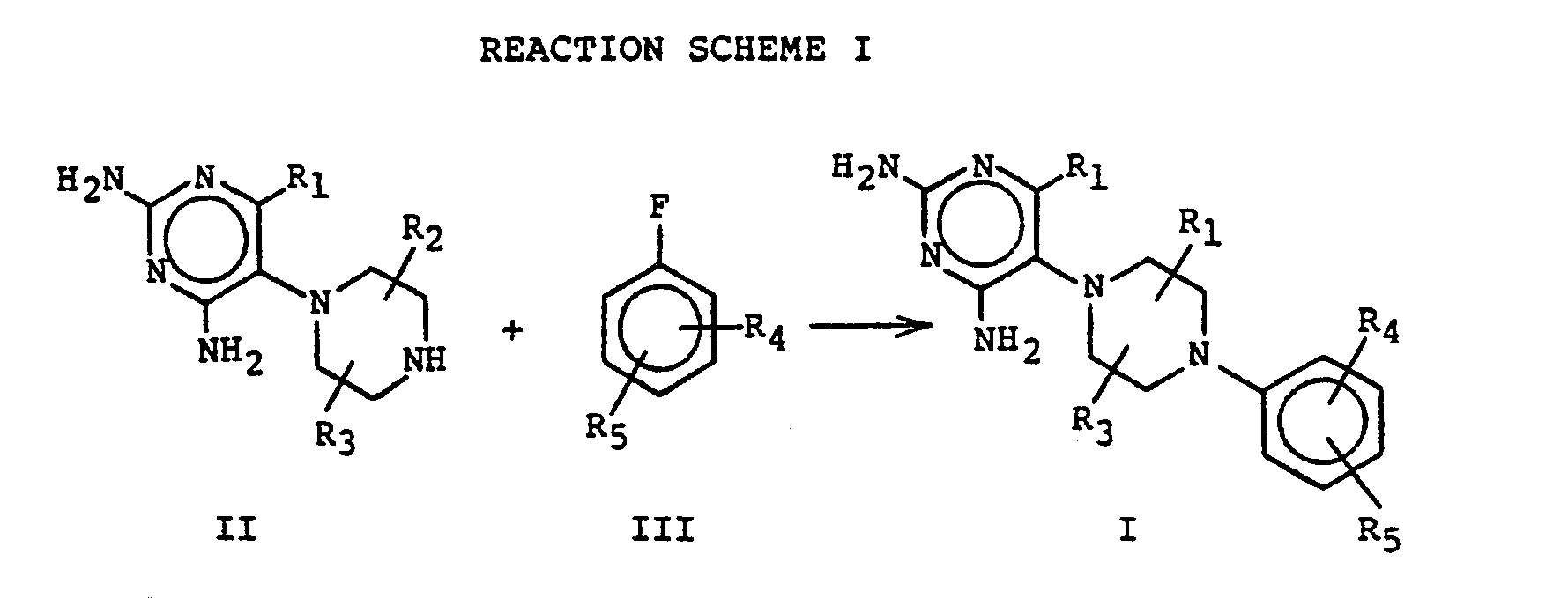
- Compounds of structural formula II may be prepared by methods detailed in Reaction Scheme II. In the structural formulas given below, Ri, R2, R3, R4, and R5 are as defined above.
- Uracil or a 6-lower-alkyl-substituted-uracil is brominated in acetic acid at a temperature ranging from ambient to 50°C for 15-20 hours to provide the 5-bromo-analog. Condensation of the 5-bromouracil derivative with 1-benzylpiperazine is conducted in the presence of potassium fluoride, preferably at temperatures of between 100°C to 150°C for periods ranging between about 48-72 hours.
- The resulting piperazine-substituted uracil is chlorinated by reaction with phosphorus oxychloride in the presence of a base such as N,N-dimethylaniline under reflux for a period of from about 2-10 hours. The chlorine substituents are replaced by amine groups, preferably by treatment with ammonia in ethanol at temperatures of between 130°C-170°C for periods of between about 12-18 hours.
- The benzyl blocking group is removed from the piperazine moiety by hydrogenolysis over palladium/ charcoal catalyst in acetic acid to produce compounds having structural formula II.
- Compounds of structural formula II are believed by the applicants to comprise a novel class of compounds serving as intermediates in the formation of the active antibacterial compounds of this invention. Thus, compounds of structure II where R, is hydrogen or alkyl of from one to six carbon atoms, and R2 and R3 are independently hydrogen or methyl are also contemplated as falling within the scope of the present invention.
- The appropriately substituted fluorophenyl compounds of structural formula III are prepared by methods well known to practitioners of the organic chemical arts.

- In the particular case where compound III is a cyano- or dicyanofluorobenzene, the cyano group or groups may be converted to compounds in accordance with the present invention in which R4 and R5 are carboxyl, carboxylic acid salt, and carboalkoxy (ester group) by acidic hydrolysis of the cyano group to the carboxylic acid group followed, if desired, by salt formation with a pharmaceutically acceptable metal or amine cation, or esterification with an alcohol.
- Alternatively, the carboxylic acid is converted to the amide or aminoacid amide by reaction with the desired amine or aminoacid by methods well known in the organic chemical art.
- In an alternative method for preparing compounds of the present invention, detailed by Reaction Scheme III, 5-bromouracil or a lower alkyl-substituted-5-bromouracil (IV) is reacted with a phenyl- substituted derivative of 1,4-piperazine of structural formula V to produce compounds of structural formula VI. Compounds of formula VI are subsequently converted to compounds in accordance with the present invention by halogenation and amination. In the structural formulas given below, R1, R2, R3, R4, and R5 are as defined above.

- By the term "alkyl group" as used throughout this specification and claims, unless otherwise specified in a particular instance, is meant both straight carbon chain and branched carbon chain groups. By the term "alkoxy" or "alkoxyl" group is meant an alkyl group as previously defined, attached to the parent molecule through a single oxygen atom. Alkoxyl groups can be thought of as derived from an alcohol by removal of the alcoholic hydrogen atom. Such groups include, for example, methoxyl (-OCH3), ethoxyl (-OCH2CH3), and the like. By the term "alkanoyl" is meant an alkyl group as previously defined, attached to the parent molecule through a carbonyl group (i.e.,

- By the term "carboalkoxy" or "carboalkoxyl" as used herein is meant the carboxyl group of an organic acid, esterified with a lower alcohol. Such groups include, for example, carbomethoxy, carboethoxy, etc.
- The compounds of the present invention, where R4 and/or R5 are acidic functions, form pharmaceutically acceptable salts with organic and inorganic bases. Examples of suitable inorganic bases are ammonium hydroxide, sodium hydroxide, potassium hydroxide, sodium carbonate, calcium carbonate, sodium bicarbonate, and the like. Pharmaceutically acceptable salts are also formed with amine cations derived from organic nitrogenous bases strong enough to form cations.
- The pharmaceutically acceptable salts of the acid are prepared by, for example, suspending the acid in water and adjusting the pH with the pharmaceutically acceptable base, or by reacting the compound with one equivalent of the pharmaceutically acceptable base in a solvent and removing the solvent under reduced pressure.
- The term, pharmaceutically acceptable metal cation contemplates the positively charged ions derived from such metals as sodium, potassium, calcium, magnesium, aluminum, zinc, iron, and the like. The salts are prepared by contacting the free form of the compound with an equivalent amount of the desired base in the conventional manner. The free forms may be regenerated by treating the salt form with an acid. For example, dilute aqueous acid solutions may be utilized to regenerate the free form from a respective salt. Dilute aqueous hydrocholoric acid is suitable for this purpose. The free forms differ from their respective salt forms somewhat in certain physical properties such as solubility in polar solvents, but the salts are otherwise equivalent to their respective free base forms for purposes of the invention.
- The term pharmaceutically acceptable amine cation contemplates the positively charged ammonium ion and analogous ions derived from organic nitrogenous bases strong enough to form such cations. Bases useful for the purpose of forming pharmacologically acceptable nontoxic addition salts of such compounds containing free carboxyl groups form a class whose limits are readily understood by those skilled in the art. Merely for illustration, they can be said to comprise, in cationic form, those of the formula:

- The compounds of the invention form pharmaceutically acceptable salts with both organic and inorganic acids. Examples of suitable acids for salt formation are hydrochloric, sulfuric, phosphoric, acetic, citric, oxalic, malonic, salicylic, malic, fumaric, succinic, ascorbic, maleic, methansulfonic, isethionic, lactic, gluconic, glucuronic, sulfamic, benzoic, tartaric, pamoic, and the like. The salts are prepared by contacting the free base form with an equivalent amount of the desired acid in the conventional manner. The free base forms may be regenerated by treating the salt form with a base. For example, dilute aqueous base solutions may be utilized. Dilute aqueous sodium hydroxide, potassium carbonate, ammonia, and sodium bicarbonate solutions are suitable for this purpose. The free base forms differ from their respective salt forms somewhat in certain physical properties such as solubility in polar solvents, but the salts are otherwise equivalent to their respective free base forms for purposes of the invention.
- The compounds of the invention can exist in unsolvated as well as solvated forms, including hydrated forms. In general, the solvated forms, with pharmaceutically acceptable solvents such as water, ethanol and the like are equivalent to the unsolvated forms for purposes of the invention.
- For preparing pharmaceutical compositions from the compounds described by this invention, inert, pharmaceutically acceptable carriers can be either solid or liquid. Solid form preparations include powders, tablets, dispersible granules, capsules, cachets, and suppositories. A solid carrier can be one or more substances which may also act as diluents, flavoring agents, solubilizers, lubricants, suspending agents, binders, or tablet disintegrating agents; it can also be an encapsulating material. In powders, the carrier is a finely divided solid which is in admixture with the finely divided active compound. In the tablet the active compound is mixed with carrier having the necessary binding properties in suitable proportions and compacted in the shape and size desired. The powders and tablets preferably contain from 5 or 10 to about 70 percent of the active ingredient. Suitable solid carriers are magnesium carbonate, magnesium stearate, talc, sugar, lactose, pectin, dextrin, starch, gelatin, tragacanth, methyl cellulose, sodium ca,rboxymethyl cellulose, a low melting wax, cocoa butter, and the like. The term "preparation" is intended to include the formulation of the active compound with encapsulating material as carrier providing a capsule in which the active component (with or without other carriers) is surrounded by carrier, which is thus in association with it. Similarly, cachets are included. Tablets, powders, cachets, and capsules can be used as solid dosage forms suitable for oral administration.
- Liquid form preparations include solutions, suspensions, and emulsions. As an example may be mentioned water or water-propylene glycol solutions for parenteral injection. Liquid preparations can also be formulated in solution in aqueous polyethylene glycol solution. Aqueous solutions suitable for oral use can be prepared by dissolving the active component in water and adding suitable colorants, flavors, stabilizing, and thickening agents as desired. Aqueous suspensions suitable for oral use can be made by dispersing the finely divided active component in water with viscous material, i.e., natural or synthetic gums, resins, methyl cellulose, sodium carboxymethyl cellulose, and other well-known suspending agents.
- Topical preparations include dusting powders, creams, lotions, gels, and sprays. These various topical preparations may be formulated by well known procedures. See for example Remington's Pharmaceutical Sciences, Chapter 43, 14th ed. 1970, Mack Publishing Co., Easton Pennsylvania 18042, USA.
- Preferably, the pharmaceutical preparation is in unit dosage form. In such form, the preparation is subdivided into unit doses containing appropriate quantities of the active component. The unit dosage form can be a packaged preparation, the package containing discrete quantities of preparation, for example, packeted tablets, capsules, and powders in vials or ampoules. The unit dosage form can also be a capsule, cachet, or tablet itself or it can be the appropriate number of any of these packaged form.
- The quantity of active compound in a unit dose of preparation may be varied or adjusted from 50 mg to 500 mg according to the particular application and the potency of the active ingredient.
- In therapeutic use as antibiotic and antifungal agents the compounds utilized in the pharmaceutical method of this invention are administered at the initial dosage of about 0.1 mg to about 50 mg per kilogram. A dose range of about 0.5 mg to about 190 mg per kilogram is preferred. The dosages, however, may be varied depending upon the requirements of the patient, the severity of the condition being treated, and the compound being employed. Determination of the proper dosage for a particular situation is within the skill of the art. Generally, treatment is initiated with smaller dosages which are less than the optimum dose of the compound. Thereafter, the dosage is increased by small increments until the optimum effect under the circumstances is reached. For convenience, the total daily dosage may be divided and administered in portions during the day if desired.
- The active compounds may also be administered parenterally or intraperitoneally. Solutions of the active compound as a free base or pharmaceutically acceptable salt can be prepared in water suitably mixed with a surfactant such as hydroxypropylcellulose. Dispersions can also be prepared in glycerol, liquid polyethylene glycols, and mixtures thereof and in oils. Under ordinary conditions of storage and use, these preparations contain a preservative to prevent the growth of microorganisms.
- The pharmaceutical forms suitable for injectable use include sterile aqueous solutions or dispersions and sterile powders for the extemporaneous preparation of sterile injectable solutions or dispersions. In all cases the form must be sterile and must be fluid to the extent that easy syringability exists. It must be stable under the conditions of manufacture and storage and must be preserved against the contaminating action of microorganisms such as bacteria and fungi. The carrier can be a solvent or dispersion medium containing, for example, water, ethanol, polyol (for example, glycerol, propylene glycol, and liquid polyethylene glycol, and the like), suitable mixtures thereof and vegetable oils. The proper fluidity can be maintained, for example, by the use of a coating such as lecithin, by the maintenance of the required particle size in the case of dispersion and by the use of surfactants. The prevention of the action of microorganisms can be brought about by various antibacterial and antifungal agents, for example, parabens, chlorobutanol, phenol, sorbic acid, thimerosal, and the like. In many cases, it will be preferable to include isotonic agents, for example, sugars or sodium chloride. Prolonged absorption of the injectable compositions can be brought about by the use in the compositions of agents delaying absorption, for example, aluminum monostearate and gelatin.
- Sterile injectable solutions are prepared by incorporating the active compound in the required amount in the appropriate solvent with various of the other ingredients enumerated above, as required, followed by filtered sterilization. Generally, dispersions are prepared by incorporating the various sterilized active ingredient into a sterile vehicle which contains the basic dispersion medium and the required other ingredients from those enumerated above. In the case of the sterile powders for the preparation of sterile injectable solutions, the preferred methods of preparation are vacuum drying and the freeze-drying technique which yield a powder of the active ingredient plus any additional desired ingredient from a previously sterile-filtered solution thereof.
- As used herein, "pharmaceutically acceptable carrier" includes any and all solvents, dispersion media, coatings, antibacterial and antifungal agents, isotonic and absorption delaying agents and the like. The use of such media and agents for pharmaceutically active substances is well known in the art. Except insofar as any conventional media or agent is incompatible with the active ingredient, its use in the therapeutic compositions is contemplated. Supplementary active ingredients can also be incorporated into the compositions.
- It is especially advantageous to formulate parenteral compositions in dosage unit form for ease of administration and uniformity of dosage. Dosage unit form as used herein refers to physically discrete units suitable as unitary dosages for the mammalian subjects to be treated; each unit containing a predetermined quantity of active material calculated to produce the desired therapeutic effect in association with the required pharmaceutical carrier. The specification for the novel dosage unit forms of the invention are dictated by and directly dependent on (a) the unique characteristics of the active material and the particular therapeutic effect to be achieved, and (b) the limitation inherent in the art of compounding such an active material for the treatment of disease in living subjects having a diseased condition in which bodily health is impaired as herein disclosed in detail.
- The principal active ingredient is compounded for convenient and effective administration in effective amounts with a suitable pharmaceutically-acceptable carrier in dosage unit form as hereinbefore disclosed. A unit dosage form can, for example, contain the principal active compound in amounts ranging from about 0.1 to about 500 mg, with from about 0.5 to about 250 mg being preferred. Expressed in proportions, the active compound is generally present in from about 0.1 to about 500 mg/ml of carrier. In the case of compositions containing supplementary active ingredients, the dosages are determined by reference to the usual dose and the manner of administration of the said ingredients. The daily parenteral doses for mammalian subjects to be treated ranges from 0.1 mg/kg to 100 mg/kg. The preferred daily dosage range is 0.3 mg/kg to 10 mg/kg.
- The following nonlimiting examples illustrate the inventors' preferred methods for preparing the compounds of the invention.
- The compounds of the invention display antimicrobial and antitumor activity when assayed by standard test procedures.
- L1210 cells, a murine leukemia cell line, were grown in RPMI 1640 supplemented with 5% fetal bovine serum and gentamicin (50 Ilg/ml).
- Drug dilutions were prepared in the appropriate solvent and 20 pl of each dilution were added to 24- well Linbro tissue culture plates, followed by the addition of M 2.0 ml of cell suspension containing 3 x 10⁴ cells per ml. Solvent and medium controls were included in each test. After incubation at 37°C for three days in 5% CO2, the contents of each well were removed and the cells counted in a ZBI Coulter counter. Percent growth was calculated relative to the controls and the levels of drug activity were expressed as ID50 in moles per liter using probit paper.
- The results of these tests are presented in Table I.

- In addition to their usefulness as antileukemic agents, certain of the compounds of the invention display in vitro activity against solid tumors when tested by the following procedure.
- HCT-8 (human colon adenocarcinoma) cells are trypsinized using Trypsin-EDTA. A single cell suspension is achieved by passing the cells through a 26 gauge needle with a 20 cc syringe. A cell suspension is prepared using RPMI 1640 + 10% FCS + 50 µg/ml garamycin with a cell concentration of approximately 30,000 cells/ml. The cell suspension is dispensed in Linbro 24-well plates; 1 ml/well. The plates are incubated for approximately 48 hours at 37°C in a 5% C02 atmosphere. At this time test compounds are added in the appropriate concentration. Five pl of the 200 µg/ml stock solution is added to each well in a primary test. Ten µl of the appropriate dilution is added to each well for a titration test. The plates are reincubated an additional 60-65 hours at 37°C in a 5% C02 atmosphere. The test is read by lysing the cells using a mix of cationic surfactant, glacial acetic acid and sodium chloride. Two ml of the lysed cell suspension from each well is added to 8 ml of diluent. Each sample is read on the Coulter counter (ZBI model). The activity of each sample is measured as a percentage of the controls and the data is reported as IDso, that is the molar quantity of drug required to kill 50% of the tumor cells.
- Utilizing this procedure, the results presented in Table II were obtained for representative compounds of the invention.

- The in vivo lymphocytic leukemia P388 test is carried out using the test system of the United States National Cancer Institute. The animals used are either male or female CD2F, mice. There are six to seven animals per test group. The tumor transplant is by intraperitoneal injection of dilute ascitic fluid containing cells of lymphocytic leukemia P388. The test compounds are administered intraperitoneally in two single doses with a four-day interval between doses at various dose levels following tumor inoculation. The animals are weighed and survivors are recorded on a regular basis for 30 days. A ratio of survival time for treated (T)/control (C) animals is calculated. The criterion for efficacy is T/C x 100 > 125%. The positive control compound in this test is 5-fluorouracil. See Cancer Chemotherapy Reports, Part 3, 3, 1 (1972) for a comprehensive discussion of the protocol.
- Utilizing this procedure, the results presented in Table III were obtained for representative compounds of the invention.

- The compounds of the invention are new chemical substances of value as pharmacological agents for the treatment of bacterial infections in warm-blooded animals. They may also be utilized as antiseptic agents such as for use in the sterilization of laboratory glassware, etc. The antibacterial activity of representative compounds of the invention was established by the screening procedure described below.
- Vegetative bacterial isolates are maintained on agar slants or in liquid media, hereby designated as inoculum media. The cultures are transferred at regular intervals in such media. (See Table IV for the corresponding inoculum media of each culture.) The organisms are generally transferred either onto agar slants or into liquid inoculum media and incubated at 37°C (at 28°C with Xanthomonas sp.) overnight (18-20 hours).
- The microbial cells from the overnight agar slants are then scraped off and suspended in saline solution (0.85% NaCI). The microbial concentrations are adjusted to a light transmission of 8.6% using a Perkin Elmer Model 35 spectrophotometer (550 nm). For the organisms that are maintained in liquid media, one or two procedures is followed: 1) the culture suspension is first centrifuged at 5000 rpm for five minutes. The pellet is resuspended in 0.85% saline to 8.6% light transmittancy; 2) an aliquot of the culture suspension is to be added directly to the assay medium.
- Isolate spore suspensions (Bacillus sp.) are maintained at 4°C. These suspensions serve as the inoculum media for assays.
- A given molten-agar assay medium, maintained in a flask at approximately 45°C, is inoculated with 0.16-10 ml of an appropriate cell or spore suspension per 100 ml of medium. Fifty ml of the inoculated medium is poured into a Bio-Assay dish (A/S Nunc; Gibco Laboratories Catalog Number 240835) and spread evenly across the bottom, then allowed to solidify at room temperature. Each agar dish is inverted and refrigerated until used.
- The compounds or samples to be tested are dissolved in suitable solvents, e.g., alcohols, dimethylsulfoxide, or N,N-dimethylformamide. The samples are generally dissolved so that the final concentration of the solvent is < 10%.* The compounds are tested at different concentrations: 3,000; 1,000; 500; 100; and 10 mcg/ml. Paper discs (12.7 mm diameter) saturated with a given concentration of test compound are placed onto the seeded agar dishes with a pair of forceps. (*If the compound does not stay in solution at < 10% alcohol, then the full strength alcohol is used. However, the impregnated discs are air-dried before they are laid on to the seeded agar plates.)
- The disked agar dishes are incubated at 37°C (28°C for Xanthamonas sp.) for 18-20 hours. Active compounds show a zone of inhibition around the disc. The diameter of the zone is measured in mm. The zone diameter of active compounds ranges from a minimum of 13.5 mm to as high as 60 mm. The size of the zone diameter generally reflects the activity of the compound: the larger the zone the greater the activity.
-


- The following preparative examples are provided to enable one skilled in the art to practice the present invention. These examples, however, are not to be viewed as limiting the scope of the invention as it is defined by the appended claims, but to be merely illustrative thereof.
- A solution of 12.10 g (0.026 mole) of 5-[4-(4-cyanophenyl)-l-piperazinyll-6-methyl-2,4- pyrimidinediamine in 200 ml of hydrochloric acid was heated under reflux for four hours. The solution was then cooled and poured into 500 ml of ice water. The solid which formed was collected and washed with water. The solid was redissolved in 1000 ml of 1 N aqueous sodium hydroxide solution and the resulting solution filtered. The pH of the filtrate was adjusted to pH 2 by the addition of 6N hydrochloric acid and the solid which precipitated was collected, washed with water and methanol, and dried in vacuo overnight at 67°C to yield 8.38 g of the product as a white powder, mp >310°C.
- A mixture of 12.5 g (0.060 mole) of 6-methyl-5-(1-piperazinyl)-2,4-pyrimidinediamine, 7.27 g (0.060 mole) of 4-fluorobenzonitrile, and 8.28 g (0.060 mole) of potassium carbonate was heated at 100°C for two hours in 100 ml of dimethylsulfoxide. The mixture was then cooled and poured into 500 ml of ice water. The solid which separated was triturated with hot dimethylsulfoxide and then dried in vacuo overnight at 67°C to give 15.56 g of the product as a white solid, mp >310°C.
- A solution of 43.73 g (0.147 mole) of 6-methyl-5-[4-benzyl]-1-piperazinyl]-2,4-pyrimidinediamine in 800 ml of acetic acid was hydrogenolyzed over 4 g of 20% palladium on charcoal under 3.5 atmospheres of hydrogen for 21.6 hours. The solvent was removed under vacuum and the residue was dissolved in 1000 ml of ice water and neutralized with 50% aqueous sodium hydroxide solution to a final pH of 8. The solid which separated was collected, washed with water and then a small amount of methanol. The solid was dried in vacuo overnight at 67°C to yeild 23.13 g of the product as an off-white solid. Recrystallization from acetonitrile gave 0.85 g of pure material, mp 226-228°C.
- 2,4-Dichloro-6-methyl-5-[4-benzyl)-1-piperazinyl]pyrimidine (3.40 g, 0.01 mole) was dissolved in 30 ml of cold ethanol which had been previously saturated with ammonia. The solution was heated in a closed steel container at 160°C for 16 hours. The reaction mixture was cooled and poured into 200 ml of cold 1 N aqueous sodium hydroxide solution. The solid was collected, washed with water, and then recystallized six times from ethanol to yield 0.99 g of the product as shiny beige plates, mp 209-210°C.
- A solution of 4.0 g (0.013 mole) of 6-methyl-5-[4-(phenylmethyl)-1-piperazinyl]-2,4(1H, 3H)-pyrimidinedione and 1 ml of N,N-dimethylaniline in 50 ml of phosphorous oxychloride was heated under reflux for three hours. The remaining excess phosphorous oxychloride was removed under vacuum and the gummy solid which remained was poured into 200 ml of ice water containing 20 g of sodium carbonate. The solid which formed was collected, washed with water, and dried in vacuo at 60°C to give 3.42 g of the product as a brownish solid which was used without further purification.
- A mixture of 20.5 g (0.10 mole) of 5-bromo-6-methyl-2,4(1 H, 3H)pyrimidinedione and 10.3 g (0.11 mole) of potassium fluoride dihydrate in 130 ml of 1-benzylpiperazine was heated under reflux for 72 hours. The reaction mixture was then cooled and poured into 800 ml of ice water. The solid which formed was collected and washed with water to give 8.10 g of the product as an off-white solid. A 1.0 g portion of the crude product was recrystallized from methanol to give an off-white solid, mp 263°C.
- Bromine (39.97 g, 0.25 mole) was added dropwise to a cooled mixture of 31.5 g (0.25 mole) of 6-methyl-2,4(1H, 3H)pyrimidinedione in 200 ml of glacial acetic acid. The resulting mixture was stirred at ambient temperature for 16 hours and then filtered. The solid which was collected was washed with water and dried in vacuo overnight at 69°C to give 39.9 g of the product as a white solid, mp 254°C (dec.).
- A mixture of 4.27 g (0.01137 mole) of 4-[4-(2,4-diamino-6-methyl-5-pyrimidinyl)-1-piperazinyl]-benzoic acid hydrochloride, 6.12 g (0.0375 mole) of diethyl phosphorocyanidate and 7.0 ml (0.050 mole) of triethylamine in 300 ml of previously dried dimethylformamide was stirred at room temperature for five hours and then at 80°C for five minutes. The solution was cooled to room termperature, and a solution of 3.00 g (0.0125 mole) of L-glutamic acid diethyl ester hydrochloride and 1.74 ml (0.0125 mole) of triethylamine was added. The resulting mixture was stirred for two hours at room temperature. The solvent was removed under high vacuum at 40°C and the gummy residue partitioned between 500 ml of dichloromethane and 500 ml of 5% sodium bicarbonate solution. The organic layer was separated, washed with water and then with saturated sodium chloride solution and dried over magnesium sulfate. The dried solution was concentrated in vacuo to give a yellow solid. Recrystallization from acetonitrile gave 3.9 g of the product as a tan solid, mp 224°C (dec.).
- A mixture of 3.00 g (0.0058 mole) of N-[4-[4-(2,4-diamino-6-methyl-5-pyrimidinyl)-1-piperazinyl]benzoyl]-L-glutamic acid diethyl ester and 12.5 ml of 1N aqueous sodium hydroxide solution in 150 ml of methanol was stirred at room temperature for four hours. The methanol was removed under vacuum at 23°C and the residue was dissolved in 100 ml of ice water and then neutralized by the addition of 2.5 g (0.0129 mole) of citric acid. The solid precipitate was collected, washed with water, and then triturated several times with ethanol. The remaining solid was dried overnight in vacuo at 67°C to give 0.75 g of the product as a white powder, mp 270°C (dec.).
- A mixture of 2.08 g (0.010 mole) of 6-methyl-5-(1-piperazinyl)-2,4-pyrimidinediamine 1.69 g (0.012 mole) of p-fluoronitrobenzene and 1.38 g (0.010 mole) of potassium carbonte in 100 ml of ethanol was heated at reflux for 16 hours. Ethanol was removed in vacuo at 40°C. The solid residue was washed with 50 ml of water. Trituration with 50 ml of boiling N,N-dimethylformamide and drying in vacuo at 67°C for 16 hours afforded 2.01 g of the product as a dull yellow solid solvated with 0.1 equivalent of water; mp >300°C.
- A mixture of 1.0 g (5.0 mmole) of 6-methyl-5-(1-piperazinyl)-2,4-pyrimidinediamine, 0.7 g (50 mole) of p-fluoroacetophenone, 0.7 g (5.0 mmole) of cupric oxide, 0.7 g (5.0 mmole) of potassium carbonate in 20 ml of dimethylsulfoxide was heated under reflux at 150°C for three hours. The reaction mixture was cooled and filtered. The solid was triturated with 200 ml of boiling N,N-dimethylformamide and filtered. The filtrate was chilled in the refrigerator for 16 hours. The crystals were collected and triturated with 20 ml of hot methanol and dried in vacuo at 78°C for five hours to give 1.0 g of the product as an off-white solid solvated with 0.18 equivalent of water; mp >300°C.
- A mixture of 5.0 g (0.016 mole) of 5-[4-(4-cyanophenyl)-1-piperazinyl]-6-methyl-2,4-pyrimidinediamine, 30 ml of 95% ethanol and 30 ml of sulfuric acid was heated under reflux at 130°C for four hours and cooled. The solution was poured into 400 g of ice. The solid was collected, washed first with 5N aqueous sodium carbonate solution and then with 50 ml of water. Recrystallization from N,N-dimethylformamide gave 1.72 g of the product as an off-white solid, mp 281-285°C.
- A mixture of 2.6 g (8.0 mmole) of 4-[4-(2,4-diamino-6-methyl-5-pyrimidinyl)-1-piperazinyl]benzoic acid, 4.3 g (26.4 mmole) of diethyl phosphorocyanidate and 3.7 ml (26.4 mmole) of triethyl amine in 500 ml of N,N-dimethylformamide (dried over 4A molecular sieves overnight) was stirred at room temperature for five hours. Gaseous monomethylamine was passed into the suspension for one hour. The suspension initially became a clear solution and then a precipitate formed. The solvent was removed under high vacuum (0.1 mm, dry ice-2-propanol trap). The gummy residue was dissolved in 200 ml of ice water and neutralized to pH 7 by adding saturated sodium carbonate solution. The solid was collected and recrystallized from N,N-dimethylformamide to afford 15 g of the product as an off-white solid, mp 305°C (with decomposition).
- A mixture of 3.9 g (0.012 mole) of 4-[4-(2,4-diamino-6-methyl-5-pyrimidinyl)-1-piperazinyl]benzoic acid, 6.5 g (0.039 mole) of diethyl phosphorocyanidate and 6.6 ml (0.047 mole) of triethyl amine in 500 ml of N,N-dimethylformamide (dried over 4H molecular sieves overnight) was stirred at room temperature for five hours. A mixture of 1.8 g (0.014 mole) of glycine methyl ester, hydrochloride, 2 ml (0.014 mole) of triethylamine and 10 ml of N,N-dimethylformamide was added to the suspension and the mixture was stirred at room temperature for another two hours. The solvent was removed under high vacuum (0.1 mm, dry ice-2-propanol trap) at 48°C. The solid residue was dissolved in 200 ml of ice water and neutralized with saturated sodium carbonate solution to pH 8. The solid was collected and washed with 100 ml of water. Recrystallization from acetonitrile gave 2.6 g of the product as a pale yellow solid, mp 225°C (with decomposition).
- A mixture of 7.8 g (0.02 mole) of 6-methyl-5-(1-piperazinyl)-2,4-pyrimidinediamine triacetate 3.8 g (0.022 mole) of p-fluorophenyl methyl sulfone, 11.70 ml (0.084 mole) of triethylamine and 150 ml of dimethyl sulfoxide was heated under reflux, at 140°C for 16 hours. The reaction mixture was cooled and poured into 500 ml of ice water. The solid was collected and washed with 100 ml of water. Recrystalization from N,N-dimethylformamide and drying in vacuo at 89°C for 16 hours gave 1.9 g of the product as a dull solid solvated with 0.2 equivalent of water; mp >310°C.
- A mixture of 2.2 g (0.010 mole) of 6-ethyl-5-(1-piperazinyl)-2,4-pyrimidinediamine, 1.33 g (0.011 mole) of a 4-fluorobenzonitrile and 1.52 g (0.011 mole) of potassium carbonate in 20 ml of dimethyl sulfoxide was heated under reflux at 140°C for two hours. The reaction mixture was cooled and poured into 100 ml of ice water. The solid was collected and recrystallized from N,N-dimethylformamide to give 2.21 g of the product as a white solid, mp >310°C.
- A solution of 33.5 g (0.107 mole) of 6-ethyl-5-[4-(phenylmethyl)-1-piperazinyl]-2,4-pyrimidinediamine in 400 ml of acetic acid was hydrogenated over 2 g of 20% palladium on charcoal under 3.5 atmospheres of hydrogen for 23 hours and filtered. The filtrate was concentrated in vacuo to dryness. The solid residue was poured into one litre of 2N soldium hydroxide solution. The solid was collected and washed with 500 ml of water. Recrystalization from acetonitrile and drying in vacuo at 59°C for 16 hours gave 19.0 g of the product as a white solid; mp 204-207°C.
- A mixture of 40.0 g (0.11 mole) of 2,4-dichloro-6-ethyl-5-[4-(phenylmethyl)-1-piperazinyl]-pyrimidine and 200 ml of saturated ammonia in ethanol solution was heated at 190°C in a high pressure stainless steel vessel for 14 hours and cooled. Ethanol was removed and the solid residue was washed first with 200 ml of 1N aqueous sodium hydroxide solution and then with 400 ml of water. Recrystallization from ethanol and drying in vacuo at 55°C for 16 hours gave 33.8 g of the product as an off-white solid solvated with 0.1 equivalent of water; mp 174-175°C.
- A mixture of 50.0 g (0.159 mole) of 6-ethyl-5-[4-(phenylmethyl)-1-piperazinyl]-2,4(1H, 3H) pyrimidinedione, 26.1 g (0.175 mole) of NN-diethylaniline and 400 ml of phosphorus oxychloride was heated under reflux for four hours and cooled. Phosphorus oxychloride was removed in vacuo. The oily residue was poured into two litres of ice water, neutralized with saturated aqueous sodium carbonate solution and extracted with ethyl acetate (1.5 litres x 2). The organic layer was separated, washed successively with water (two litres) and saturated sodium chloride solution, dried over magnesium sulfate, and concentrated in vacuo to dryness. The oily residue was chilled in the refrigerator for three hours and the solid that formed was collected and washed with 200 ml of petroleum ether to give 39.0 g of the product as a pale yellow solid. It was used in the next reaction without further purification.
- A mixture of 57.0 g (0.260 mole) of 5-bromo-6-ethyl-2,4(1H, 3H) pyrimidinedione and 26.6 g (0.286 mole) of anhydrous potassium fluoride in 176 ml (1 mole) of 1-benzylpiperazine was heated under reflux at 140°C for four hours and cooled. The reaction mixture was poured into 1000 ml of ice water. The solid was collected and washed with water. Recrystallization from N,N-dimethylformamide and drying in vacuo at 59°C for 16 hours gave the product as an off-white solid; mp 255-256°C.
- A solution of 10.0 g (0.031 mole) of 5-[4-(4-cyanophenyl)-1-piperazinyl]-6-ethyl-2,4-pyrimidinediamine in 150 ml of hydrochloric acid was heated under reflux for four hours. The solution was cooled and poured into 500 ml of ice water. The solid was collected and washed with 100 ml of water. The solid was suspended in 300 ml of ice water and 50% aqueous sodium hydroxide solution was added dropwise until solution occurred. The solution was filtered and the filtrate was acidified with 10% aqueous citric acid to pH 5. The solid was collected and washed with 100 ml of water. Recrystallization from N,N-dimethylformamide and drying in vacuo at 89°C for 16 hours gave 9.60 g of the product as a white powder, mp >300°C.
- A mixture of 4.1 g (0.012 mole) of 4-[4-(2,4-diamino-6-ethyl-5-pyrimidinyl)-1-piperazinyl]-benzoic acid, 6.5 g (0.040 mole) of diethyl phosphorocyanidate and 5.6 ml (0.040 mole) of triethylamine in 500 ml of NN- dimethylformamide (dried over 4Å molecular sieves overnight) was stirred at room temperature for two hours. To the resulting clear solution was added a mixture of 3.2 g (0013 mole) of L-diethyl glutamate hydrochloride and 1.8 ml (0013 mole) of triethylamine in 10 ml of N,N-dimethylformamide, and the mixture was stirred at ambient temperature for three hours. The solvent was removed under high vacuum (0.1 mm dry ice-2-propanoi trap) at 40°C. The gummy residue was poured into 3.00 ml of ice water and adjusted to pH 8 by adding a saturated sodium carbonate solution. The solid was collected and recrystallized from acetonitrile to give 2.8 g of the product as an off-white powder; mp 226-228°C.
- A mixture of 2.0 g (3.85 mmole) of N-[4-[4-(2,4-diamino-6-ethyl-5-pyrimidinyl)-1-piperazinyl)benzoyl]-L-glutamic acid diethyl ester and 0.6 g (7.70 mmole) of a 50% aqueous sodium hydroxide solution in 100 ml of methanol was stirred at room temperature for 16 hours. Methanol was removed in vacuo below 23°C. The residue was dissolved in 50 ml of ice water and filtered. The filtrate was acidified with citric acid to pH 5. The solid precipitate was collected, washed with water, and triturated with boiling ethanol. Aftr drying in vacuo at 67° for 16 hours, 1.3 g of the product was obtained as a white powder; mp 275°C (with decomposition).
- A mixture of 9.6 g (0.0407 mole) of 5-(1-piperazinyl)-6-propyl-2,4-pyrimidinediamine, 5.4 g (0.0448 mole) of 4-fluorobenzonitrile and 6.18 g (0.0448 mole) of sodium carbonate in 200 ml of dimethyl sulfoxide was heated at 140°C for two hours. The reaction mixture was cooled and poured into 500 ml of ice water. The solid was collected and recrystallized from N,N-dimethylformamide to give 11.7 g of the product as a white solid; mp >300°C.
- A solution of 28.6 g (0.088 mole) of 5-[4-phenylmethyl)-1-piperazinyl]-6-propyl-2,4-pyrimidinediamine in 500 ml of acetic acid was hydrogenated over 2 g of 20% palladium on charcoal under 3.5 atmospheres of hydrogen for 18.7 hours and filtered over 2 g of 20% palladium on charcoal under 3.5 atmospheres of hydrogen for 18.7 hours and filtered. The filtrate was concentrated in vacuo to dryness. The oily residue was poured into one litre of ice water and neutralized with 50% aqueous sodium hydroxide to pH 8. The solid was collected, washed with water (500 ml) and recrystallized from acetonitrile to afford 17.0 g of the product as a white solid; mp 175-176°C.
- A mixture of 70 g of 2,4-dichloro-5-[4-(phenylmethyl)-1-piperazinyl]-6-propyl-pyrimidine (from the previous step, assumed to be 0.159 mole) and 400 ml of a saturated solution of ammonia in ethanol was heated at 185°C in a stainless steel pressure vessel for 14 hours. The reaction mixture was chilled in an ice bath and the solid was collected and washed with water (200 ml). Recrystallization from acetonitrile and drying in vacuo at 59°C gave 30.8 g of the product as a white solid; mp 157-160°C.
- A mixture of 52.5 g (0.159 mole) of 5-[4-(phenylmethyl)-1-piperazinylj-6-propyl-2,4(1H,3H) pyrimidinedione, 26.1 g (0.175 mole) of N,N diethylaniline and 500 ml of phosphorus oxychloride was heated under reflux for four hours and cooled. Phosphorus oxychloride was removed in vacuo. The oily residue was poured into 1.5 liters of ice water and neutralized with saturated sodium carbonate solution to pH 7. The aqueous mixture was extracted twice with one liter portions of ethyl acetate. The organic layer was separated, washed successively with water (one liter) and saturated sodium chloride solution (400 ml), dried (magnesium sulfate), and concentrated in vacuo to give 70 g of an oily residue. It was used in the next reaction without further purification.
- A mixture of 53.3 g (0.229 mle) of 5-bromo-6-propyl-2,4(1H,3H) pyrimidinedione and 23.7 g (0.252 mole) of anhydrous potassium fluoride in 176 ml (1.0 mole) of 1-benzylpiperazine was heated under reflux at 140°C for 14 hours. The reaction mixture was cooled to 80°C and 100 ml of ethanol was added. The mixture was poured into one liter of ice water. The solid was collected and washed with one liter of water. Recrystallization from ethanol and drying in vacuo at 59°C for 16 hours gave 44.1 g of the product as an off-white solid; mp 233-235°C.
- A mixture of 53.3 g (0.229 mole) of 5-bromo-6-propyl-2,4(1H,3H) pyrimidinedione and 23.7 g (0.252 mole) of anhydrous potassium fluoride in 176 ml (1.0 mole) of 1-benzylpiperazine was heated under reflux at 140°C for 14 hours. The reaction mixture was cooled to 80°C and 100 ml of ethanol was added. The mixture was poured into one liter of ice water. The solid was collected and washed with one liter of water. Recrystallization from ethanol and drying in vacuo at 59°C for 16 hours gave 44.1 g of the product as an off-white solid; mp 233-235°C.
- A solution of 10.0 g (0.030 mole) of 5-[4-(4-cyanophenyl)-1-piperazinyl]-6-propyl-2,4-pyrimidinediamine in 150 ml of hydrochloric acid was heated under reflux forfour hours. The solution was cooled and poured into 500 ml of ice water. The solid was collected and washed with 100 ml of water. The solid was suspended in 300 ml of ice water and 50% sodium hydroxide solution was added dropwise until a clear solution formed. The solution was filtered and the filtrate was acidified with 10% citric acid to pH 5. The solid was collected and washed with 100 ml of water. Recrystallization from N,N-dimethylformamide and drying in vauco at 89°C for 16 hours gave 9.57 g of the production as a white powder; mp 285°C (with decomposition).
- A mixture of 3.2 g (0.0091 mole) of 4-[4-(2,4-diamino-6-propyl-5-pyrimidinyl]-1-piperazinyl]benzoic acid, 4.9 g (0.030 mole) of diethyl phosphorocyanidate and 4.2 ml (0.030 mole) of triethylamine in 200 ml of N,N-dimethylformamide (dried over 4A molecular sieves overnight) was stirred at room temperature for two hours. To the resulting clear solution was added a mixture of 2.4 g (0.010 mole) of diethyl glutamate hydrochloride and 1.4 ml (0.010 mole) of triethylamine in 10 ml of N,N-dimethylformamide, and the solution was stirred for another hour. The solvent was removed under high vacuum (0.1 mm, dry ice-2-propanol trap) at 40°C. The gummy residue was poured into 100 ml of ice water. The solid was collected and recrystallized from N,N-dimethylformamide to give 1.9 g of the product as an off-white powder; mp 175-180°C.
- A mixture of 1.3 g (2.47 mmole) of N [4-(2,4-diamino-6-propyl-5-pyrimidinyl)-1-piperazinyl]benzoyl]-L-glutamic acid diethyl ester and 0.4 g (4.94 mmole) of a 50% aqueous sodium hydroxide solution in 300 ml of methanol was stirred at room temeprature for four hours. One drop of 50% sodium hydroxide solution was added and the reaction mixture became a clear solution. Methanol was removed in vacuo below 23°C. The residue was dissolved in 200 ml of ice water and filtered. The filtrate was acidified with citric acid to pH 6. The precipitate was collected, washed with water, and triturated with boiling ethanol. After drying in vacuo at 78°C for 16 hours, 0.9 g of the product was obtained as white powder, mp 280-284°C.
- A mixture of 1.0 g (2.96 mmole) of 5-[4-(4-cyanophenyl)-1-piperazinyl]-6-propyl-2,4-pyrimidinediamine, 15 ml of 95% ethanol and 15 ml of sulfuric acid was heated under reflux at 100°C for four hours and cooled. The solution was poured into 200 ml of ice water and filtered. The filtrate was kept cool and neutralized with 50% aqueous sodium hydroxide solution to pH 7. The solid was collected and washed with 50 ml of water. Recrystallization from N,N-dimethylformamide and drying in vacuo at 78°C for 16 hours gave 0.7 g of the product as a white solid, mp 215-216°C.
- A mixture of 8.0 g (0.023 mole) of 2,4-dichloro-5-[4-(4-cyanophenyJ)-1-piperazinyl]-6-methyIpyridine and 200 ml of a saturated solution of ammonia in ethanol was heated at 190°C in a stainless steel pressure vessel for 14 hours and cooled. Ethanol was removed in vacuo and the solid residue was washed with 200 ml of water. Recrystallization from N,N-dimethylformamide and drying in vacuo at 78°C for 16 hours gave 4.8 g of the product as an off-white solid; mp >300°C.
- A mixture of 9.0 g (0.029 mole) of 5-(4-(4-cyanophenyl)-1-piperazinyl]-6-methyl-2,4(1H,3H)pyrimidine- done, 4.8 g (0.032 mole) of N,N-diethylaniline and 300 ml of phosphorus oxychloride was heated under reflux for three hours and cooled. Phosphorus oxychloride was removed in vacuo. The oily residue was partitioned between ethyl acetate (500 ml) and 500 ml of cold 5N sodium carbonate solution. The organic layer was separated, washed successively with 500 ml of water and 200 ml of saturated sodium chloride solution, dried over magnesium sulfate, and concentrated in vacuo to dryness. The oily residue was chilled in the refrigerator for 16 hours and the solid that formed was collected and washed with 200 ml of petroleum ether to give the product as a light yellow solid.
- A mixture of 20.5 g (0.10 mole) of 5-bromo-6-methyl-2,4-(1H,3H)-pyrimidinedione, 18.1 g (0.10 mole) of 4-(4-cyanophenyl)piperazine, 6.4 g (0.11 mole) of anhydrous potassium fluoride, 15.2 g (0.1 mole) of powdered potassium carbonate in 100 ml of hexamethyl phosphoramide was heated at 140°C for 24 hours. The mixture was cooled and poured into 500 ml of ice water. The solid was collected and washed with 100 ml of water. Recrystallization from N,N-dimethylformamide and drying in vacuo at 78°C for 16 hours gave 9.3 g of the product as a dull solid.
- A mixture of 20.0 g of 4-[1-(4-phenylmethyl)piperazinyl]benzonitrile in 400 ml of methanol was hydrogenated over 2 g of 20% palladium on charcoal under 3.5 atmospheres of hydrogen for 20 hours and filtered. The filtrate was concentrated in vacuo to dryness. The residue was used in the next reaction without further purification.
- A mixture of 17.6 g (0.10 mole) of N-benzylpiperazine, 12.1 g (0.10 mole) of p-fluorobenzonitrile, 13.8 g (0.01 mole) of potassium carbonate in 100 ml of dimethyl sulfoxide was heated at 140°C for three hours. The reaction mixture was cooled and poured into 500 ml of ice water. The solid was collected and recrystallized from ethanol to give 22.0 g of the product.
- The crude 2,4-dichloro-6-methyl-5-(4-phenyl-1-piperazinyl)pyrimidine (2.1 g, 6.5 mmole) was added to 50 ml of a saturated solution of ammonia in ethanol. The resulting mixture was heated in a steel bomb at 180° for 16 hours. Ethanol was removed and the solid residue was washed with 5N aqueous sodium carbonate solution and then with water and filtered. Recrystallization from methanol twice gave 0.87 g of the product as a dull off-white solid, mp 247-248°.
- A mixture of 5.72 g (0.020 mole) of 6-methyl-5-(4-phenyl-1-piperazinyl)-2,4(1H,3H)-pyrimidinedione, 5 ml of N,N-dimethylaniline and 30 ml of phosphorous oxychloride was heated at 80° for 16 hours. Excess phosphorous oxychloride was removed in vacuo, and the oily residue was poured into 200 ml of ice water. The solid was collected, washed with water, and dried in vacuo at 62° overnight to give 6.20 g of the product as a cream solid which was used directly in the next reaction without further purification.
- A mixture of 20.5 g (0.10 mole) of 5-bromo-6-methyl-2,4(1H,3H)-pyrimidinedione and 10.3 g (0.11 mole) of potassium fluoride dihydrate in 150 ml of 1-phenylpiperazine was heated under reflux at 105° for 72 hours and cooled. The reaction mixture was poured into 200 ml of ice water. The solid was collected, washed with water, and recrystallized from methanol to give 7.12 g of the product as a white solid, mp >300°C.
- A mixture of 5.40 g (0.0168 mole) of 5-[4-(4-chlorophenyl)-1-piperazinyl]-6-methyl-2,4(lH,3H)pyrimidinedione, 5 ml of N,N-dimethylaniline and 100 ml of phosphorous oxychloride was heated under reflux for four hours. Phosphorous oxychloride was removed in vacuo. The oily residue was poured into 200 ml of ice water, neutralized with 50% sodium hydroxide soluton to pH 8 and extracted twice with 200 ml portions of ethyl acetate. The extracts were washed first with water and then with saturated sodium chloride solution, dried over magnesium sulfate, and concentrated in vacuo to give 5.80 g of a black oily mixture. This material was dissolved in 30 ml of cold saturated solution of ammonia in ethanol and heated in a steel bomb at 185°C for 16 hours. The solvent was removed in vacuo and the solid residue was washed with water. Recrystallization of the crude solid from N,N-dimethylformamide and drying at 67°C overnight afforded 2.95 g of the product as a dull off-white solid, mp 285° dec.
- A mixture of 20.50 g (0.100 mole) of 5-bromo-6-methyl-2,4(1H,3H)pyrimidinedione, 26.96 g (0.100 mole) of 1-(4-chlorophenyl)-piperazine, 10.35 g (0.110 mole) of potassium fluoride dihydrate and 41.40 g (0.300 mole) of potassium carbonate in 200 ml of dimethylsulfoxide was heated at 80° for 72 hours. The reaction mixture was cooled and poured into 1 I of ice water. The solid was collected, washed with water, and recrystallized from ethanol to give 6.05 g of the product as a dull yellow solid.
- A suspension of 8.0 g (0.024 mole) of 6-methyl-5-[4-(4-nitrophenyl)-1-piperazinyl]-2,4-pyrimidinediamine in 100 ml of acetic acid was hydrogenated over 0.5 g of 5% palladium on charcoal under 3.5 atmospheres of hydrogen for 18 hours and filtered. The filtrate was concentrated in vacuo to dryness. The solid residue was dissolved in 500 ml of ice water and neutralized with ammonium hydroxide to pH 8. The solid was collected and washed with 20 ml of water. Recrystallization from N,N-dimethylformamide and drying in vacuo at 89°C for 16 hours gave 6.1 g of the product as light brown solid, mp 237-239°C.
- A mixture of 1.5 g (3.76 mmole) of N-[4-[4-(2,4-diamino-6-methyl-5-pyrimidinyl)-1-piperazinyl]benzoyl- glycine methyl ester and 3.8 ml (3.8 mmole of a-1N aqueous sodium hydroxide solution in 500 ml of methanol ws stirred at room temperature for 16 hours. The reaction mixture remained cloudy. A solution of 0.4 ml of 1N sodium hydroxide in 200 ml of methanol was added and the reaction mixture was stirred for another two hours and became clear solution. Methanol was removed in vacuo. The solid residue was dissolved in 200 ml of water and filtered. The filtrate was acidified with citric acid to pH 6. The precipitate was collected, washed with water, and triturated with 200 ml of boiling methanol. After drying in vacuo at 78°C for 16 hours, 1.30 g of the product was obtained as white powder, mp >310°C.
- A mixture of 10.4 g (0.05 mole) of 6-methyl-5-(1-piperazinyl)-2,4-pyrimidinediamine triacetate, 10.1 g (0.05 mole) of 4-fluoro-N,N-dimethylbenzenesulfonamide, 6.4 g (0.055 mole) of anhydrous potassium fluoride, and 27.6 g (0.2 mole) of powdered potassium carbonate in 100 ml of dimethylsulfoxide was heated at 120°C for four hours. The reaction mixture was cooled and poured into 300 ml of ice water. The solid was collected and washed with ml of water. Recrystallization from N,N-dimethylformamide gave 6.5 g of the product as an off-white solid, mp 301-304°C.
- A solution of 38.9 g (0.20 mole) of 4-fluorobenzenesulfonylchloride in 20 ml of methylene chloride was added slowly to 300 ml of a 40% aqueous dimethylamine solution during 0.5 hour period. The reaction was exothermic. After the reaction mixture was cooled a yellow solid was precipitated. The solid was collected, dissolved in 300 ml of ethyl acetate, and dried over magnesium sulfate. The solution was concentrated to 100 ml and a light yellow crystal formed. The crystal was collected and air-dried to afford 39 g of the product, mp 40-43°C.
- A mixture of 1.9 g (5.0 mmole) of 6-methyl-5-(1-piperazinyl)-2,4-pyrimidinediamine triacetate, 0.8 g (5.0 mmole) of 1-fluoro-4-(trifluoromethyl)benzene 0.4 g (6.0 mmole) of anhydrous potassium fluoride and 3.31 g (2.4 mmole) of potassium carbonate in 20 ml of dimethylsulfoxide was heated at 130°C for 16 hours. The reaction mixture was cooled and poured into 150 ml of ice water. The solid was collected and washed with water. Recrystallization from N,N-dimethylformamide gave 0.4 g of the product as an off-white solid, mp 255-258°C.
and the pharmaceutically acceptable salts thereof.
Claims (11)
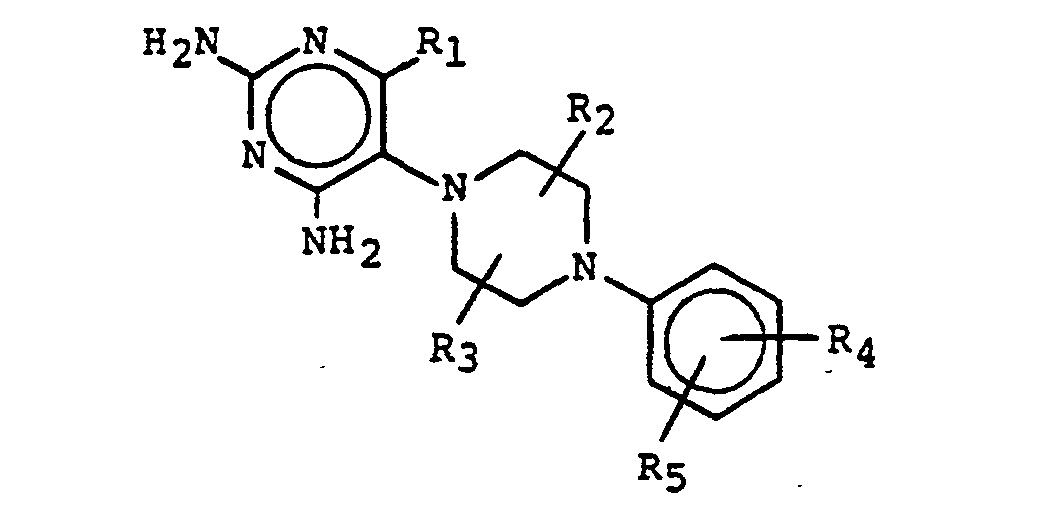

where R11 is hydrogen, or alkyl of from one to six carbon atoms; or
and the pharmaceutically acceptable salts thereof: which process comprises reacting a compound having structural formula II


where R4 and R5 are as defined above, in a polar organic solvent-in the presence of a base, and further converting said compound of structural formula I, if desired, to a pharmaceutically acceptable salt.


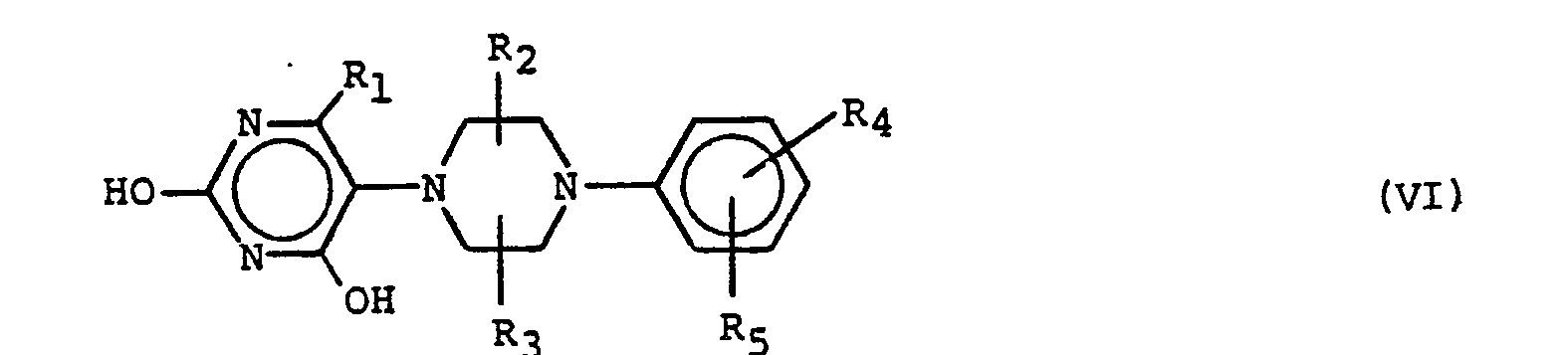
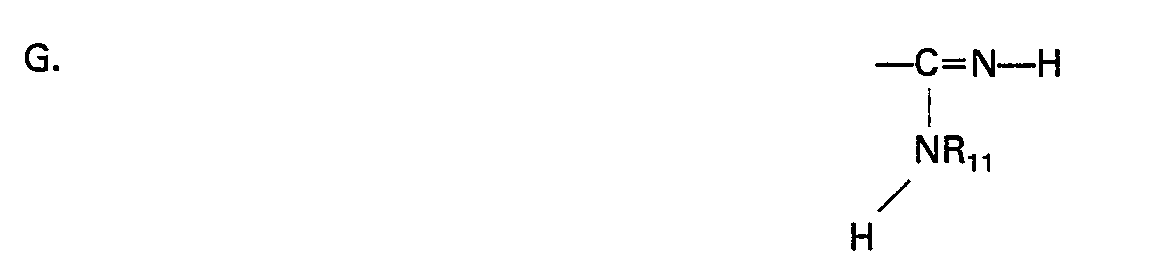
where R11 is hydrogen, or alkyl of from on to six carbon atoms; or
and the pharmaceutically acceptable salts thereof.
and the pharmaceutically acceptable salts thereof.


Priority Applications (1)
| Application Number | Priority Date | Filing Date | Title |
|---|---|---|---|
| AT83305229T ATE38666T1 (en) | 1982-09-09 | 1983-09-08 | DIAMINOPYRIMIDINES AND THEIR PRODUCTION. |
Applications Claiming Priority (4)
| Application Number | Priority Date | Filing Date | Title |
|---|---|---|---|
| US41640482A | 1982-09-09 | 1982-09-09 | |
| US416404 | 1982-09-09 | ||
| US06/520,653 US4532240A (en) | 1982-09-09 | 1983-08-09 | Diaminopyrimidines |
| US520653 | 1983-08-09 |
Publications (3)
| Publication Number | Publication Date |
|---|---|
| EP0103464A2 EP0103464A2 (en) | 1984-03-21 |
| EP0103464A3 EP0103464A3 (en) | 1985-07-03 |
| EP0103464B1 true EP0103464B1 (en) | 1988-11-17 |
Family
ID=27023342
Family Applications (1)
| Application Number | Title | Priority Date | Filing Date |
|---|---|---|---|
| EP83305229A Expired EP0103464B1 (en) | 1982-09-09 | 1983-09-08 | Diaminopyrimidines and their production |
Country Status (9)
| Country | Link |
|---|---|
| US (1) | US4532240A (en) |
| EP (1) | EP0103464B1 (en) |
| AU (2) | AU560971B2 (en) |
| CA (1) | CA1251447A (en) |
| DE (1) | DE3378469D1 (en) |
| DK (1) | DK158310C (en) |
| ES (2) | ES8502989A1 (en) |
| GR (1) | GR79058B (en) |
| IE (1) | IE56148B1 (en) |
Families Citing this family (14)
| Publication number | Priority date | Publication date | Assignee | Title |
|---|---|---|---|---|
| US5099019A (en) * | 1985-09-12 | 1992-03-24 | Upjohn Company | Amines useful in producing pharmaceutically active CNS compounds |
| USRE35053E (en) * | 1985-09-12 | 1995-10-10 | The Upjohn Company | Amines useful in producing pharmaceutically active CNS compounds |
| LU86695A1 (en) * | 1986-12-01 | 1988-07-14 | Oreal | NOVEL PIPERAZINYL-1 PYRIMIDINE DERIVATIVES, THEIR PREPARATION AND THEIR APPLICATION IN THERAPEUTICS AND COSMETICS |
| HUT64323A (en) * | 1992-06-09 | 1993-12-28 | Richter Gedeon Vegyeszet | Process for production new piperazinyl-bis(alkyl-amino)-pyrimidine derivatives |
| ATE166347T1 (en) * | 1993-02-26 | 1998-06-15 | Max Delbrueck Centrum | METHOD FOR PRODUCING C-NUCLEOSIDES AND C-NUCLEOSIDE ANALOGAS, NEW C-NUCLEOSIDES AND C-NUCLEOSIDE ANALOGAS, AND USE THEREOF |
| DE4320570C2 (en) * | 1993-02-26 | 2002-07-11 | Max Delbrueck Centrum | Process for the production of C-nucleosides and C-nucleoside analogs, new C-nucleosides and C-nucleoside analogues and their use |
| GB9801392D0 (en) | 1998-01-22 | 1998-03-18 | Smithkline Beecham Plc | Novel compounds |
| AU2076299A (en) | 1998-01-30 | 1999-08-16 | Meiji Seika Kaisha Ltd. | Phenylpiperazine derivatives as integrin alphavbeta3 antagonists |
| US20040006042A1 (en) * | 1998-08-13 | 2004-01-08 | Berry David Allen | Diaminopyrimidines and combination therapies effective for treatment of P-glycoprotein positive cancers |
| AU4690999A (en) * | 1998-08-13 | 2000-03-06 | Warner-Lambert Company | Diaminopyrimidines and combination therapies effective for treatment of p-glycoprotein positive cancers |
| BR0209932A (en) * | 2001-05-22 | 2004-10-13 | Neurogen Corp | Pharmaceutically acceptable compound or salt thereof, pharmaceutical composition, packaged pharmaceutical preparation, methods for modulating mch binding to an mch receptor and mvc, to alter the signal transduction activity of an mch receptor in a cell, to treat a disease or disorder associated with pathogenic obesity mch receptor activation and to determine the presence or absence of mch receptor in a sample, and use of a compound |
| GB0412072D0 (en) * | 2004-05-28 | 2004-06-30 | Syngenta Participations Ag | Chemical compounds |
| JP6949055B2 (en) * | 2016-02-05 | 2021-10-13 | ヴェラ ファーマシューティカルズ,エルエルシー | Compositions and methods for treating infectious diseases |
| WO2019032458A1 (en) * | 2017-08-07 | 2019-02-14 | Vyera Pharmaceuticals, LLC | Dhfr inhibitors, compositions, and methods related thereto |
Family Cites Families (7)
| Publication number | Priority date | Publication date | Assignee | Title |
|---|---|---|---|---|
| US416404A (en) | 1889-12-03 | Automatic lath-feeder for paper-carriers | ||
| BE485737A (en) * | 1947-11-12 | |||
| US2748125A (en) * | 1954-04-26 | 1956-05-29 | American Cyanamid Co | 1-substituted-4-sulfamylpiperazine and method of preparing the same |
| AT340933B (en) * | 1973-08-20 | 1978-01-10 | Thomae Gmbh Dr K | PROCESS FOR THE PRODUCTION OF NEW PYRIMIDE DERIVATIVES AND THEIR ACID ADDITIONAL SALTS |
| US4166852A (en) * | 1974-08-09 | 1979-09-04 | Produits Chimiques Ugine Kuhlmann | Piperazino-pyrimidines and their use as spasmolytic agents |
| US4287338A (en) * | 1980-03-10 | 1981-09-01 | The Upjohn Company | Sulfooxy-pyrimidinium, -pyridinium, and -triazinium hydroxide inner salts |
| US4351832A (en) * | 1980-04-18 | 1982-09-28 | American Home Products Corporation | 2-(Piperazinyl)-4-pyrimidinamines |
-
1983
- 1983-08-09 US US06/520,653 patent/US4532240A/en not_active Expired - Lifetime
- 1983-08-16 IE IE1920/83A patent/IE56148B1/en not_active IP Right Cessation
- 1983-09-05 AU AU18699/83A patent/AU560971B2/en not_active Ceased
- 1983-09-07 GR GR72395A patent/GR79058B/el unknown
- 1983-09-08 CA CA000436240A patent/CA1251447A/en not_active Expired
- 1983-09-08 EP EP83305229A patent/EP0103464B1/en not_active Expired
- 1983-09-08 DK DK407383A patent/DK158310C/en not_active IP Right Cessation
- 1983-09-08 ES ES525490A patent/ES8502989A1/en not_active Expired
- 1983-09-08 DE DE8383305229T patent/DE3378469D1/en not_active Expired
-
1984
- 1984-03-27 ES ES531004A patent/ES8504775A1/en not_active Expired
-
1987
- 1987-02-13 AU AU68787/87A patent/AU568997B2/en not_active Ceased
Also Published As
| Publication number | Publication date |
|---|---|
| ES531004A0 (en) | 1985-05-01 |
| EP0103464A3 (en) | 1985-07-03 |
| DK407383A (en) | 1984-03-10 |
| DK158310C (en) | 1990-10-15 |
| AU6878787A (en) | 1987-05-14 |
| US4532240A (en) | 1985-07-30 |
| CA1251447A (en) | 1989-03-21 |
| GR79058B (en) | 1984-10-02 |
| ES525490A0 (en) | 1985-02-01 |
| AU568997B2 (en) | 1988-01-14 |
| ES8502989A1 (en) | 1985-02-01 |
| DK158310B (en) | 1990-04-30 |
| DE3378469D1 (en) | 1988-12-22 |
| IE831920L (en) | 1984-03-09 |
| AU1869983A (en) | 1984-03-15 |
| EP0103464A2 (en) | 1984-03-21 |
| DK407383D0 (en) | 1983-09-08 |
| IE56148B1 (en) | 1991-05-08 |
| AU560971B2 (en) | 1987-04-30 |
| ES8504775A1 (en) | 1985-05-01 |
Similar Documents
| Publication | Publication Date | Title |
|---|---|---|
| RU2057131C1 (en) | Derivatives of n-(pyrrolo[2,3-d]pyrimidine-3-ylacyl)-glutamic acid or their tautomers or their pharmaceutically acceptable salts and a method of their synthesis | |
| US4438267A (en) | Monoheteroring compounds and their use | |
| US4060615A (en) | 2-Piperazinyl-6,7-dimethoxyquinazolines | |
| US3382247A (en) | 6-amino-1, 2-dihydro-1-hydroxy-2-imino-4-phenoxypyrimidines | |
| US4532240A (en) | Diaminopyrimidines | |
| US5138058A (en) | Piperazine substituted pyrimidine derivatives and physiologically tolerated salts thereof | |
| EP0574906B1 (en) | Piperazine and homopiperazine derivatives, pharmaceutical compositions containing them and process for preparing the same | |
| EP0781766B1 (en) | Heterocyclic derivative and medicine | |
| EP0168262A2 (en) | Pyrimidine derivatives, processes for preparation thereof and use thereof | |
| JP2001519416A (en) | Neurotrophic substituted pyrimidine | |
| US4515948A (en) | 2,4-Diamino-5-(4-amino and 4-dimethylamino-3,5-dimethoxy benzyl)pyrimidines | |
| US20040248922A1 (en) | Lavendamycin analogs, quinoline-5,8-diones and methods of using them | |
| US4992444A (en) | Antifolate agents | |
| EP0103381B1 (en) | Substituted anthra(1,9-cd)pyrazol-6(2h)-ones | |
| EP0177287A2 (en) | Pyrimidine derivatives, processes for preparation thereof and composition of the same | |
| EP0144730B1 (en) | 2-anilino-1,6-dihydro-6-oxo-5-pyrimidinecarboxylic acid derivatives, processes for the preparation thereof, and antiallergic agent containing the same | |
| EP0000383B1 (en) | Pyrimido (4,5-c) pyridazines, their use in pharmaceutical preparations, and process for their preparation | |
| US4590271A (en) | 2,4-diamino-5-(substituted)pyrimidines, useful as antimicrobials | |
| US3673177A (en) | Substituted 4-(anilinomethylene)-3-galanthamaninones | |
| JPS5973573A (en) | Diaminopyrimidine compound | |
| HU197001B (en) | Process for producing new pyrazine derivatives and pharmaceuticals comprising same | |
| US4156725A (en) | Bacteriostatic biologically active compositions | |
| US3133066A (en) | X-amino-z- | |
| EP0006987A1 (en) | 2,4-Diamino-5-benzylpyrimidines, especially for the treatment of microbial infections, pharmaceutical compositions containing these compounds and processes for preparing these compounds | |
| US3963719A (en) | 6-Spirocycloalkylamino 5-nitropyrimidines |
Legal Events
| Date | Code | Title | Description |
|---|---|---|---|
| PUAI | Public reference made under article 153(3) epc to a published international application that has entered the european phase |
Free format text: ORIGINAL CODE: 0009012 |
|
| AK | Designated contracting states |
Designated state(s): AT BE CH DE FR GB IT LI LU NL SE |
|
| PUAL | Search report despatched |
Free format text: ORIGINAL CODE: 0009013 |
|
| AK | Designated contracting states |
Designated state(s): AT BE CH DE FR GB IT LI LU NL SE |
|
| 17P | Request for examination filed |
Effective date: 19851219 |
|
| 17Q | First examination report despatched |
Effective date: 19870306 |
|
| ITF | It: translation for a ep patent filed | ||
| GRAA | (expected) grant |
Free format text: ORIGINAL CODE: 0009210 |
|
| AK | Designated contracting states |
Kind code of ref document: B1 Designated state(s): AT BE CH DE FR GB IT LI LU NL SE |
|
| REF | Corresponds to: |
Ref document number: 38666 Country of ref document: AT Date of ref document: 19881215 Kind code of ref document: T |
|
| REF | Corresponds to: |
Ref document number: 3378469 Country of ref document: DE Date of ref document: 19881222 |
|
| ET | Fr: translation filed | ||
| PLBE | No opposition filed within time limit |
Free format text: ORIGINAL CODE: 0009261 |
|
| STAA | Information on the status of an ep patent application or granted ep patent |
Free format text: STATUS: NO OPPOSITION FILED WITHIN TIME LIMIT |
|
| 26N | No opposition filed | ||
| ITTA | It: last paid annual fee | ||
| EPTA | Lu: last paid annual fee | ||
| EAL | Se: european patent in force in sweden |
Ref document number: 83305229.3 |
|
| REG | Reference to a national code |
Ref country code: GB Ref legal event code: IF02 |
|
| PGFP | Annual fee paid to national office [announced via postgrant information from national office to epo] |
Ref country code: NL Payment date: 20020618 Year of fee payment: 20 |
|
| PGFP | Annual fee paid to national office [announced via postgrant information from national office to epo] |
Ref country code: AT Payment date: 20020807 Year of fee payment: 20 |
|
| PGFP | Annual fee paid to national office [announced via postgrant information from national office to epo] |
Ref country code: GB Payment date: 20020808 Year of fee payment: 20 |
|
| PGFP | Annual fee paid to national office [announced via postgrant information from national office to epo] |
Ref country code: FR Payment date: 20020903 Year of fee payment: 20 Ref country code: CH Payment date: 20020903 Year of fee payment: 20 |
|
| PGFP | Annual fee paid to national office [announced via postgrant information from national office to epo] |
Ref country code: SE Payment date: 20020904 Year of fee payment: 20 |
|
| PGFP | Annual fee paid to national office [announced via postgrant information from national office to epo] |
Ref country code: LU Payment date: 20020918 Year of fee payment: 20 |
|
| PGFP | Annual fee paid to national office [announced via postgrant information from national office to epo] |
Ref country code: DE Payment date: 20020930 Year of fee payment: 20 |
|
| PGFP | Annual fee paid to national office [announced via postgrant information from national office to epo] |
Ref country code: BE Payment date: 20021017 Year of fee payment: 20 |
|
| PG25 | Lapsed in a contracting state [announced via postgrant information from national office to epo] |
Ref country code: LI Free format text: LAPSE BECAUSE OF EXPIRATION OF PROTECTION Effective date: 20030907 Ref country code: GB Free format text: LAPSE BECAUSE OF EXPIRATION OF PROTECTION Effective date: 20030907 Ref country code: CH Free format text: LAPSE BECAUSE OF EXPIRATION OF PROTECTION Effective date: 20030907 |
|
| PG25 | Lapsed in a contracting state [announced via postgrant information from national office to epo] |
Ref country code: NL Free format text: LAPSE BECAUSE OF EXPIRATION OF PROTECTION Effective date: 20030908 Ref country code: LU Free format text: LAPSE BECAUSE OF EXPIRATION OF PROTECTION Effective date: 20030908 Ref country code: AT Free format text: LAPSE BECAUSE OF EXPIRATION OF PROTECTION Effective date: 20030908 |
|
| BE20 | Be: patent expired |
Owner name: *WARNER-LAMBERT CY Effective date: 20030908 |
|
| REG | Reference to a national code |
Ref country code: GB Ref legal event code: PE20 |
|
| REG | Reference to a national code |
Ref country code: CH Ref legal event code: PL |
|
| NLV7 | Nl: ceased due to reaching the maximum lifetime of a patent |
Effective date: 20030908 |
|
| EUG | Se: european patent has lapsed |