EP0103401A2 - Recording media - Google Patents
Recording media Download PDFInfo
- Publication number
- EP0103401A2 EP0103401A2 EP83304609A EP83304609A EP0103401A2 EP 0103401 A2 EP0103401 A2 EP 0103401A2 EP 83304609 A EP83304609 A EP 83304609A EP 83304609 A EP83304609 A EP 83304609A EP 0103401 A2 EP0103401 A2 EP 0103401A2
- Authority
- EP
- European Patent Office
- Prior art keywords
- recording medium
- support
- physical development
- containing layer
- film thickness
- Prior art date
- Legal status (The legal status is an assumption and is not a legal conclusion. Google has not performed a legal analysis and makes no representation as to the accuracy of the status listed.)
- Withdrawn
Links
- 238000002310 reflectometry Methods 0.000 claims abstract description 16
- 229910052709 silver Inorganic materials 0.000 claims description 21
- 239000004332 silver Substances 0.000 claims description 21
- -1 silver halide Chemical class 0.000 claims description 16
- 229910052751 metal Inorganic materials 0.000 claims description 7
- 239000002184 metal Substances 0.000 claims description 7
- 229910052802 copper Inorganic materials 0.000 claims description 4
- 239000010949 copper Substances 0.000 claims description 4
- 229910001385 heavy metal Inorganic materials 0.000 claims description 4
- 229910000765 intermetallic Inorganic materials 0.000 claims description 4
- 230000006872 improvement Effects 0.000 claims description 3
- UCKMPCXJQFINFW-UHFFFAOYSA-N Sulphide Chemical compound [S-2] UCKMPCXJQFINFW-UHFFFAOYSA-N 0.000 claims description 2
- 229910000510 noble metal Inorganic materials 0.000 claims description 2
- 239000010410 layer Substances 0.000 description 45
- 239000002609 medium Substances 0.000 description 39
- BQCADISMDOOEFD-UHFFFAOYSA-N Silver Chemical compound [Ag] BQCADISMDOOEFD-UHFFFAOYSA-N 0.000 description 15
- 238000000034 method Methods 0.000 description 14
- 238000004833 X-ray photoelectron spectroscopy Methods 0.000 description 9
- 239000011248 coating agent Substances 0.000 description 9
- 238000000576 coating method Methods 0.000 description 9
- 239000000839 emulsion Substances 0.000 description 8
- 230000003287 optical effect Effects 0.000 description 8
- 229920003229 poly(methyl methacrylate) Polymers 0.000 description 8
- 239000004926 polymethyl methacrylate Substances 0.000 description 8
- 108010010803 Gelatin Proteins 0.000 description 7
- 229920000159 gelatin Polymers 0.000 description 7
- 239000008273 gelatin Substances 0.000 description 7
- 235000019322 gelatine Nutrition 0.000 description 7
- 235000011852 gelatine desserts Nutrition 0.000 description 7
- SQGYOTSLMSWVJD-UHFFFAOYSA-N silver(1+) nitrate Chemical compound [Ag+].[O-]N(=O)=O SQGYOTSLMSWVJD-UHFFFAOYSA-N 0.000 description 7
- PXHVJJICTQNCMI-UHFFFAOYSA-N Nickel Chemical compound [Ni] PXHVJJICTQNCMI-UHFFFAOYSA-N 0.000 description 6
- KDLHZDBZIXYQEI-UHFFFAOYSA-N Palladium Chemical compound [Pd] KDLHZDBZIXYQEI-UHFFFAOYSA-N 0.000 description 5
- 239000011133 lead Substances 0.000 description 5
- 239000002932 luster Substances 0.000 description 5
- 239000000243 solution Substances 0.000 description 5
- 230000008901 benefit Effects 0.000 description 4
- 239000011230 binding agent Substances 0.000 description 4
- 239000011521 glass Substances 0.000 description 4
- PCHJSUWPFVWCPO-UHFFFAOYSA-N gold Chemical compound [Au] PCHJSUWPFVWCPO-UHFFFAOYSA-N 0.000 description 4
- 239000000203 mixture Substances 0.000 description 4
- 238000004544 sputter deposition Methods 0.000 description 4
- 239000006087 Silane Coupling Agent Substances 0.000 description 3
- HCHKCACWOHOZIP-UHFFFAOYSA-N Zinc Chemical compound [Zn] HCHKCACWOHOZIP-UHFFFAOYSA-N 0.000 description 3
- 239000003795 chemical substances by application Substances 0.000 description 3
- 239000000084 colloidal system Substances 0.000 description 3
- 230000002349 favourable effect Effects 0.000 description 3
- 229910052759 nickel Inorganic materials 0.000 description 3
- 150000003839 salts Chemical class 0.000 description 3
- 230000035945 sensitivity Effects 0.000 description 3
- 238000001228 spectrum Methods 0.000 description 3
- 150000004763 sulfides Chemical class 0.000 description 3
- XLYOFNOQVPJJNP-UHFFFAOYSA-N water Substances O XLYOFNOQVPJJNP-UHFFFAOYSA-N 0.000 description 3
- 229910052725 zinc Inorganic materials 0.000 description 3
- 239000011701 zinc Substances 0.000 description 3
- RYGMFSIKBFXOCR-UHFFFAOYSA-N Copper Chemical compound [Cu] RYGMFSIKBFXOCR-UHFFFAOYSA-N 0.000 description 2
- QIGBRXMKCJKVMJ-UHFFFAOYSA-N Hydroquinone Chemical compound OC1=CC=C(O)C=C1 QIGBRXMKCJKVMJ-UHFFFAOYSA-N 0.000 description 2
- XEEYBQQBJWHFJM-UHFFFAOYSA-N Iron Chemical compound [Fe] XEEYBQQBJWHFJM-UHFFFAOYSA-N 0.000 description 2
- 229910021612 Silver iodide Inorganic materials 0.000 description 2
- 238000004458 analytical method Methods 0.000 description 2
- 229910052787 antimony Inorganic materials 0.000 description 2
- WATWJIUSRGPENY-UHFFFAOYSA-N antimony atom Chemical compound [Sb] WATWJIUSRGPENY-UHFFFAOYSA-N 0.000 description 2
- 229910052793 cadmium Inorganic materials 0.000 description 2
- BDOSMKKIYDKNTQ-UHFFFAOYSA-N cadmium atom Chemical compound [Cd] BDOSMKKIYDKNTQ-UHFFFAOYSA-N 0.000 description 2
- 239000002775 capsule Substances 0.000 description 2
- 150000001868 cobalt Chemical class 0.000 description 2
- 230000000052 comparative effect Effects 0.000 description 2
- 150000001879 copper Chemical class 0.000 description 2
- 208000028659 discharge Diseases 0.000 description 2
- 229910052737 gold Inorganic materials 0.000 description 2
- 239000010931 gold Substances 0.000 description 2
- PSCMQHVBLHHWTO-UHFFFAOYSA-K indium(iii) chloride Chemical compound Cl[In](Cl)Cl PSCMQHVBLHHWTO-UHFFFAOYSA-K 0.000 description 2
- 238000004519 manufacturing process Methods 0.000 description 2
- 150000002739 metals Chemical class 0.000 description 2
- 150000002815 nickel Chemical class 0.000 description 2
- 230000010355 oscillation Effects 0.000 description 2
- 229910052763 palladium Inorganic materials 0.000 description 2
- BASFCYQUMIYNBI-UHFFFAOYSA-N platinum Chemical compound [Pt] BASFCYQUMIYNBI-UHFFFAOYSA-N 0.000 description 2
- 239000011241 protective layer Substances 0.000 description 2
- 150000004771 selenides Chemical class 0.000 description 2
- 229910001961 silver nitrate Inorganic materials 0.000 description 2
- GGCZERPQGJTIQP-UHFFFAOYSA-N sodium;9,10-dioxoanthracene-2-sulfonic acid Chemical compound [Na+].C1=CC=C2C(=O)C3=CC(S(=O)(=O)O)=CC=C3C(=O)C2=C1 GGCZERPQGJTIQP-UHFFFAOYSA-N 0.000 description 2
- JKNHZOAONLKYQL-UHFFFAOYSA-K tribromoindigane Chemical compound Br[In](Br)Br JKNHZOAONLKYQL-UHFFFAOYSA-K 0.000 description 2
- JKFYKCYQEWQPTM-UHFFFAOYSA-N 2-azaniumyl-2-(4-fluorophenyl)acetate Chemical compound OC(=O)C(N)C1=CC=C(F)C=C1 JKFYKCYQEWQPTM-UHFFFAOYSA-N 0.000 description 1
- FHVDTGUDJYJELY-UHFFFAOYSA-N 6-{[2-carboxy-4,5-dihydroxy-6-(phosphanyloxy)oxan-3-yl]oxy}-4,5-dihydroxy-3-phosphanyloxane-2-carboxylic acid Chemical compound O1C(C(O)=O)C(P)C(O)C(O)C1OC1C(C(O)=O)OC(OP)C(O)C1O FHVDTGUDJYJELY-UHFFFAOYSA-N 0.000 description 1
- 102000009027 Albumins Human genes 0.000 description 1
- 108010088751 Albumins Proteins 0.000 description 1
- ZWZCHRPBZAYNQU-UHFFFAOYSA-L C(C(=O)[O-])(=S)[O-].[Ag+2] Chemical compound C(C(=O)[O-])(=S)[O-].[Ag+2] ZWZCHRPBZAYNQU-UHFFFAOYSA-L 0.000 description 1
- 229920002284 Cellulose triacetate Polymers 0.000 description 1
- 229910052684 Cerium Inorganic materials 0.000 description 1
- VYZAMTAEIAYCRO-UHFFFAOYSA-N Chromium Chemical compound [Cr] VYZAMTAEIAYCRO-UHFFFAOYSA-N 0.000 description 1
- 229910021580 Cobalt(II) chloride Inorganic materials 0.000 description 1
- 229910021592 Copper(II) chloride Inorganic materials 0.000 description 1
- 229920001353 Dextrin Polymers 0.000 description 1
- 239000004375 Dextrin Substances 0.000 description 1
- 239000004354 Hydroxyethyl cellulose Substances 0.000 description 1
- OFOBLEOULBTSOW-UHFFFAOYSA-L Malonate Chemical compound [O-]C(=O)CC([O-])=O OFOBLEOULBTSOW-UHFFFAOYSA-L 0.000 description 1
- 229920000877 Melamine resin Polymers 0.000 description 1
- 229920000881 Modified starch Polymers 0.000 description 1
- 229910021586 Nickel(II) chloride Inorganic materials 0.000 description 1
- MUBZPKHOEPUJKR-UHFFFAOYSA-N Oxalic acid Chemical compound OC(=O)C(O)=O MUBZPKHOEPUJKR-UHFFFAOYSA-N 0.000 description 1
- 206010034972 Photosensitivity reaction Diseases 0.000 description 1
- 239000004372 Polyvinyl alcohol Substances 0.000 description 1
- ZLMJMSJWJFRBEC-UHFFFAOYSA-N Potassium Chemical compound [K] ZLMJMSJWJFRBEC-UHFFFAOYSA-N 0.000 description 1
- 229910021607 Silver chloride Inorganic materials 0.000 description 1
- 229920002125 Sokalan® Polymers 0.000 description 1
- RTAQQCXQSZGOHL-UHFFFAOYSA-N Titanium Chemical compound [Ti] RTAQQCXQSZGOHL-UHFFFAOYSA-N 0.000 description 1
- NNLVGZFZQQXQNW-ADJNRHBOSA-N [(2r,3r,4s,5r,6s)-4,5-diacetyloxy-3-[(2s,3r,4s,5r,6r)-3,4,5-triacetyloxy-6-(acetyloxymethyl)oxan-2-yl]oxy-6-[(2r,3r,4s,5r,6s)-4,5,6-triacetyloxy-2-(acetyloxymethyl)oxan-3-yl]oxyoxan-2-yl]methyl acetate Chemical compound O([C@@H]1O[C@@H]([C@H]([C@H](OC(C)=O)[C@H]1OC(C)=O)O[C@H]1[C@@H]([C@@H](OC(C)=O)[C@H](OC(C)=O)[C@@H](COC(C)=O)O1)OC(C)=O)COC(=O)C)[C@@H]1[C@@H](COC(C)=O)O[C@@H](OC(C)=O)[C@H](OC(C)=O)[C@H]1OC(C)=O NNLVGZFZQQXQNW-ADJNRHBOSA-N 0.000 description 1
- NRRGDBRXNGVJMW-UHFFFAOYSA-N [Cu][I]Br Chemical compound [Cu][I]Br NRRGDBRXNGVJMW-UHFFFAOYSA-N 0.000 description 1
- 238000000862 absorption spectrum Methods 0.000 description 1
- VJHCJDRQFCCTHL-UHFFFAOYSA-N acetic acid 2,3,4,5,6-pentahydroxyhexanal Chemical compound CC(O)=O.OCC(O)C(O)C(O)C(O)C=O VJHCJDRQFCCTHL-UHFFFAOYSA-N 0.000 description 1
- 239000003929 acidic solution Substances 0.000 description 1
- 238000007754 air knife coating Methods 0.000 description 1
- 229940072056 alginate Drugs 0.000 description 1
- 235000010443 alginic acid Nutrition 0.000 description 1
- 229920000615 alginic acid Polymers 0.000 description 1
- 239000003513 alkali Substances 0.000 description 1
- 239000012670 alkaline solution Substances 0.000 description 1
- 239000007864 aqueous solution Substances 0.000 description 1
- XKRFYHLGVUSROY-UHFFFAOYSA-N argon Substances [Ar] XKRFYHLGVUSROY-UHFFFAOYSA-N 0.000 description 1
- 229910052786 argon Inorganic materials 0.000 description 1
- 229910052785 arsenic Inorganic materials 0.000 description 1
- RQNWIZPPADIBDY-UHFFFAOYSA-N arsenic atom Chemical compound [As] RQNWIZPPADIBDY-UHFFFAOYSA-N 0.000 description 1
- QVGXLLKOCUKJST-UHFFFAOYSA-N atomic oxygen Chemical compound [O] QVGXLLKOCUKJST-UHFFFAOYSA-N 0.000 description 1
- 239000002585 base Substances 0.000 description 1
- 229910052797 bismuth Inorganic materials 0.000 description 1
- JCXGWMGPZLAOME-UHFFFAOYSA-N bismuth atom Chemical compound [Bi] JCXGWMGPZLAOME-UHFFFAOYSA-N 0.000 description 1
- 229920003090 carboxymethyl hydroxyethyl cellulose Polymers 0.000 description 1
- 239000005018 casein Substances 0.000 description 1
- BECPQYXYKAMYBN-UHFFFAOYSA-N casein, tech. Chemical compound NCCCCC(C(O)=O)N=C(O)C(CC(O)=O)N=C(O)C(CCC(O)=N)N=C(O)C(CC(C)C)N=C(O)C(CCC(O)=O)N=C(O)C(CC(O)=O)N=C(O)C(CCC(O)=O)N=C(O)C(C(C)O)N=C(O)C(CCC(O)=N)N=C(O)C(CCC(O)=N)N=C(O)C(CCC(O)=N)N=C(O)C(CCC(O)=O)N=C(O)C(CCC(O)=O)N=C(O)C(COP(O)(O)=O)N=C(O)C(CCC(O)=N)N=C(O)C(N)CC1=CC=CC=C1 BECPQYXYKAMYBN-UHFFFAOYSA-N 0.000 description 1
- 235000021240 caseins Nutrition 0.000 description 1
- 229920002678 cellulose Polymers 0.000 description 1
- 239000001913 cellulose Substances 0.000 description 1
- 239000000919 ceramic Substances 0.000 description 1
- ZMIGMASIKSOYAM-UHFFFAOYSA-N cerium Chemical compound [Ce][Ce][Ce][Ce][Ce][Ce][Ce][Ce][Ce][Ce][Ce][Ce][Ce][Ce][Ce][Ce][Ce][Ce][Ce][Ce][Ce][Ce][Ce][Ce][Ce][Ce][Ce][Ce][Ce][Ce][Ce][Ce][Ce][Ce][Ce][Ce][Ce][Ce] ZMIGMASIKSOYAM-UHFFFAOYSA-N 0.000 description 1
- 230000008859 change Effects 0.000 description 1
- 229910052804 chromium Inorganic materials 0.000 description 1
- 239000011651 chromium Substances 0.000 description 1
- 229910017052 cobalt Inorganic materials 0.000 description 1
- 239000010941 cobalt Substances 0.000 description 1
- GUTLYIVDDKVIGB-UHFFFAOYSA-N cobalt atom Chemical compound [Co] GUTLYIVDDKVIGB-UHFFFAOYSA-N 0.000 description 1
- PDZKZMQQDCHTNF-UHFFFAOYSA-M copper(1+);thiocyanate Chemical compound [Cu+].[S-]C#N PDZKZMQQDCHTNF-UHFFFAOYSA-M 0.000 description 1
- ORTQZVOHEJQUHG-UHFFFAOYSA-L copper(II) chloride Chemical compound Cl[Cu]Cl ORTQZVOHEJQUHG-UHFFFAOYSA-L 0.000 description 1
- 238000003851 corona treatment Methods 0.000 description 1
- 239000007822 coupling agent Substances 0.000 description 1
- 238000007766 curtain coating Methods 0.000 description 1
- 235000019425 dextrin Nutrition 0.000 description 1
- ZASWJUOMEGBQCQ-UHFFFAOYSA-L dibromolead Chemical compound Br[Pb]Br ZASWJUOMEGBQCQ-UHFFFAOYSA-L 0.000 description 1
- 238000009792 diffusion process Methods 0.000 description 1
- 239000002612 dispersion medium Substances 0.000 description 1
- 239000000428 dust Substances 0.000 description 1
- 230000000694 effects Effects 0.000 description 1
- 239000003822 epoxy resin Substances 0.000 description 1
- VEPSWGHMGZQCIN-UHFFFAOYSA-H ferric oxalate Chemical compound [Fe+3].[Fe+3].[O-]C(=O)C([O-])=O.[O-]C(=O)C([O-])=O.[O-]C(=O)C([O-])=O VEPSWGHMGZQCIN-UHFFFAOYSA-H 0.000 description 1
- 150000004676 glycans Chemical class 0.000 description 1
- FDWREHZXQUYJFJ-UHFFFAOYSA-M gold monochloride Chemical compound [Cl-].[Au+] FDWREHZXQUYJFJ-UHFFFAOYSA-M 0.000 description 1
- ZVUZTTDXWACDHD-UHFFFAOYSA-N gold(3+);trinitrate Chemical compound [Au+3].[O-][N+]([O-])=O.[O-][N+]([O-])=O.[O-][N+]([O-])=O ZVUZTTDXWACDHD-UHFFFAOYSA-N 0.000 description 1
- LNEPOXFFQSENCJ-UHFFFAOYSA-N haloperidol Chemical compound C1CC(O)(C=2C=CC(Cl)=CC=2)CCN1CCCC(=O)C1=CC=C(F)C=C1 LNEPOXFFQSENCJ-UHFFFAOYSA-N 0.000 description 1
- 238000010438 heat treatment Methods 0.000 description 1
- 229920001477 hydrophilic polymer Polymers 0.000 description 1
- 235000019447 hydroxyethyl cellulose Nutrition 0.000 description 1
- 238000010849 ion bombardment Methods 0.000 description 1
- 150000002500 ions Chemical group 0.000 description 1
- 150000002505 iron Chemical class 0.000 description 1
- 229910052742 iron Inorganic materials 0.000 description 1
- MVFCKEFYUDZOCX-UHFFFAOYSA-N iron(2+);dinitrate Chemical compound [Fe+2].[O-][N+]([O-])=O.[O-][N+]([O-])=O MVFCKEFYUDZOCX-UHFFFAOYSA-N 0.000 description 1
- 229910052743 krypton Inorganic materials 0.000 description 1
- DNNSSWSSYDEUBZ-UHFFFAOYSA-N krypton atom Chemical compound [Kr] DNNSSWSSYDEUBZ-UHFFFAOYSA-N 0.000 description 1
- HTUMBQDCCIXGCV-UHFFFAOYSA-N lead oxide Chemical compound [O-2].[Pb+2] HTUMBQDCCIXGCV-UHFFFAOYSA-N 0.000 description 1
- HWSZZLVAJGOAAY-UHFFFAOYSA-L lead(II) chloride Chemical compound Cl[Pb]Cl HWSZZLVAJGOAAY-UHFFFAOYSA-L 0.000 description 1
- QSHDDOUJBYECFT-UHFFFAOYSA-N mercury Chemical compound [Hg] QSHDDOUJBYECFT-UHFFFAOYSA-N 0.000 description 1
- 229910052753 mercury Inorganic materials 0.000 description 1
- LWJROJCJINYWOX-UHFFFAOYSA-L mercury dichloride Chemical compound Cl[Hg]Cl LWJROJCJINYWOX-UHFFFAOYSA-L 0.000 description 1
- 235000019426 modified starch Nutrition 0.000 description 1
- QMMRZOWCJAIUJA-UHFFFAOYSA-L nickel dichloride Chemical compound Cl[Ni]Cl QMMRZOWCJAIUJA-UHFFFAOYSA-L 0.000 description 1
- KBJMLQFLOWQJNF-UHFFFAOYSA-N nickel(II) nitrate Inorganic materials [Ni+2].[O-][N+]([O-])=O.[O-][N+]([O-])=O KBJMLQFLOWQJNF-UHFFFAOYSA-N 0.000 description 1
- 239000001301 oxygen Substances 0.000 description 1
- 229910052760 oxygen Inorganic materials 0.000 description 1
- 239000002245 particle Substances 0.000 description 1
- CMCWWLVWPDLCRM-UHFFFAOYSA-N phenidone Chemical compound N1C(=O)CCN1C1=CC=CC=C1 CMCWWLVWPDLCRM-UHFFFAOYSA-N 0.000 description 1
- 239000005011 phenolic resin Substances 0.000 description 1
- 230000036211 photosensitivity Effects 0.000 description 1
- 238000007747 plating Methods 0.000 description 1
- 229910052697 platinum Inorganic materials 0.000 description 1
- 229920000191 poly(N-vinyl pyrrolidone) Polymers 0.000 description 1
- 229920002401 polyacrylamide Polymers 0.000 description 1
- 239000004584 polyacrylic acid Substances 0.000 description 1
- 239000004417 polycarbonate Substances 0.000 description 1
- 229920000515 polycarbonate Polymers 0.000 description 1
- 229920000647 polyepoxide Polymers 0.000 description 1
- 239000005020 polyethylene terephthalate Substances 0.000 description 1
- 229920000139 polyethylene terephthalate Polymers 0.000 description 1
- 239000004848 polyfunctional curative Substances 0.000 description 1
- 229920001721 polyimide Polymers 0.000 description 1
- 239000009719 polyimide resin Substances 0.000 description 1
- 229920001282 polysaccharide Polymers 0.000 description 1
- 239000005017 polysaccharide Substances 0.000 description 1
- 229920002451 polyvinyl alcohol Polymers 0.000 description 1
- 229910052700 potassium Inorganic materials 0.000 description 1
- 239000011591 potassium Substances 0.000 description 1
- 230000001376 precipitating effect Effects 0.000 description 1
- 238000002360 preparation method Methods 0.000 description 1
- 230000002265 prevention Effects 0.000 description 1
- 230000008569 process Effects 0.000 description 1
- 239000011253 protective coating Substances 0.000 description 1
- 230000009467 reduction Effects 0.000 description 1
- 229910052703 rhodium Inorganic materials 0.000 description 1
- 239000010948 rhodium Substances 0.000 description 1
- MHOVAHRLVXNVSD-UHFFFAOYSA-N rhodium atom Chemical compound [Rh] MHOVAHRLVXNVSD-UHFFFAOYSA-N 0.000 description 1
- 239000010979 ruby Substances 0.000 description 1
- 229910001750 ruby Inorganic materials 0.000 description 1
- 239000004065 semiconductor Substances 0.000 description 1
- 230000001235 sensitizing effect Effects 0.000 description 1
- 150000004760 silicates Chemical class 0.000 description 1
- ADZWSOLPGZMUMY-UHFFFAOYSA-M silver bromide Chemical compound [Ag]Br ADZWSOLPGZMUMY-UHFFFAOYSA-M 0.000 description 1
- ZUNKMNLKJXRCDM-UHFFFAOYSA-N silver bromoiodide Chemical compound [Ag].IBr ZUNKMNLKJXRCDM-UHFFFAOYSA-N 0.000 description 1
- 229940045105 silver iodide Drugs 0.000 description 1
- HKZLPVFGJNLROG-UHFFFAOYSA-M silver monochloride Chemical compound [Cl-].[Ag+] HKZLPVFGJNLROG-UHFFFAOYSA-M 0.000 description 1
- 229910000367 silver sulfate Inorganic materials 0.000 description 1
- 159000000000 sodium salts Chemical class 0.000 description 1
- SDKPSXWGRWWLKR-UHFFFAOYSA-M sodium;9,10-dioxoanthracene-1-sulfonate Chemical compound [Na+].O=C1C2=CC=CC=C2C(=O)C2=C1C=CC=C2S(=O)(=O)[O-] SDKPSXWGRWWLKR-UHFFFAOYSA-M 0.000 description 1
- 239000002904 solvent Substances 0.000 description 1
- 125000000446 sulfanediyl group Chemical group *S* 0.000 description 1
- 238000004381 surface treatment Methods 0.000 description 1
- SWLJJEFSPJCUBD-UHFFFAOYSA-N tellurium tetrachloride Chemical compound Cl[Te](Cl)(Cl)Cl SWLJJEFSPJCUBD-UHFFFAOYSA-N 0.000 description 1
- YUKQRDCYNOVPGJ-UHFFFAOYSA-N thioacetamide Chemical compound CC(N)=S YUKQRDCYNOVPGJ-UHFFFAOYSA-N 0.000 description 1
- DLFVBJFMPXGRIB-UHFFFAOYSA-N thioacetamide Natural products CC(N)=O DLFVBJFMPXGRIB-UHFFFAOYSA-N 0.000 description 1
- 239000010936 titanium Substances 0.000 description 1
- 229910052719 titanium Inorganic materials 0.000 description 1
Images

Classifications
-
- G—PHYSICS
- G11—INFORMATION STORAGE
- G11B—INFORMATION STORAGE BASED ON RELATIVE MOVEMENT BETWEEN RECORD CARRIER AND TRANSDUCER
- G11B7/00—Recording or reproducing by optical means, e.g. recording using a thermal beam of optical radiation by modifying optical properties or the physical structure, reproducing using an optical beam at lower power by sensing optical properties; Record carriers therefor
- G11B7/24—Record carriers characterised by shape, structure or physical properties, or by the selection of the material
- G11B7/241—Record carriers characterised by shape, structure or physical properties, or by the selection of the material characterised by the selection of the material
- G11B7/242—Record carriers characterised by shape, structure or physical properties, or by the selection of the material characterised by the selection of the material of recording layers
- G11B7/251—Record carriers characterised by shape, structure or physical properties, or by the selection of the material characterised by the selection of the material of recording layers comprising inorganic materials dispersed in an organic matrix
-
- G—PHYSICS
- G03—PHOTOGRAPHY; CINEMATOGRAPHY; ANALOGOUS TECHNIQUES USING WAVES OTHER THAN OPTICAL WAVES; ELECTROGRAPHY; HOLOGRAPHY
- G03C—PHOTOSENSITIVE MATERIALS FOR PHOTOGRAPHIC PURPOSES; PHOTOGRAPHIC PROCESSES, e.g. CINE, X-RAY, COLOUR, STEREO-PHOTOGRAPHIC PROCESSES; AUXILIARY PROCESSES IN PHOTOGRAPHY
- G03C5/00—Photographic processes or agents therefor; Regeneration of such processing agents
- G03C5/58—Processes for obtaining metallic images by vapour deposition or physical development
Definitions
- This invention relates to a recording medium. More particularly, it is concerned with an improved optical recording medium which is capable of writing or recording and reflective reading.
- Said recording medium has advantages of being continuously manufacturable and of comparatively less recording energy applied, unlike those recording media which are composed of Te, TeO, chalcogenide compounds and the like and prepared by means of such vacuum equipments as vacuum plating or sputtering. Moreover, they also show an advantage that track or certain data can be photographically recorded previously by utilizing photosensitivity of the silver halide emulsion.
- the technique as disclosed in the above-recited Publications is directed mainly to a recording medium wherein a recording layer surface on a support is of reflectivity.
- a recording medium it is requisite for a recording medium to prepare a protective coating layer of Si0 2 , polymethyl methacrylate (PMMA) and the like on a recording medium or to prepare the whole recording medium in the form of a capsule, in order to protect pits of the recording layer surface from dust. Accordingly, there is required the step of coating a protective layer or forming a capsule and a method for recording through a transparent support such as PMMA, glass or the like is usually applied in order to avoid the above complicated procedures, whereupon it is known to use a recording medium overlaying one sheet of a recording medium with the other layer so as to place outside the transparent supports.
- a transparent support such as PMMA, glass or the like
- a method for recording through a support by the use of an optical recording medium is disclosed in Japanese Provisional Patent Publications No. 49296/1981, No. 49297/ 1981 and No. 189060/1981, but there could not be found any disclosure therein on a method or medium wherein a reflectivity in the vicinity of an interface between a support and a recording layer becomes increased and thus a practically acceptable reflectivity is producible in the vicinity of said interface.
- a physical development nucleus layer is coated over said support to increase a reflectivity in the vicinity of an interface between a support and a recording layer and produce a practically acceptable reflectivity in the vicinity of said interface for easier reading through a support, as disclosed and claimed in our co-pending Japanese Patent Application No. 189060/1981 (which corresponds to U.S. Patent Application Serial No. 443,434 and European Patent Application No. 82 306 330), which is incorporated herein for reference.
- Our previous recording medium could show a sufficient reflectivity required for reading information with a reflected light through a support and representing said information as signal contrast.
- Another object of this invention is to provide a recording medium with easier writing and higher sensitivity.
- Still another object of this invention is to provide a recording medium which can be prepared in a continuous manner without any need for vacuum equipments.
- the present recording medium is the recording medium wherein an energy beam is irradiated onto a reflective component-containing layer provided on a support through said support to reduce a reflectivity of said reflective component-containing layer, the improvement wherein said reflective component-containing layer is formed through physical development of a physical development nucleus-containing layer on said support and said reflective component-containing layer has a film thickness of 0.01 pm to 0.5 ⁇ m.
- the film thickness of less than about 0.2 pm is preferably used. More preferably, the film thickness of less than 0.09 pm is used to obtain the good results of the present invention.
- the present recording medium can show, as one of its characteristics, an increased reflectance along with a higher sensitivity for recording.
- the physical development nucleus which may be employed in the present physical development nucleus-containing layer, there may be employed any well-known physical development nuclei.
- a group thereof may preferably include heavy metal sulfides, e.g. sulfides of zinc, chromium, potassium, iron, cadmium, cobalt, nickel, lead, antimony, bismuth, silver, cerium, arsenic, copper and rhodium, as well as selenides of heavy metals, e.g. selenides of lead, zinc, antimony and nickel.
- heavy metal sulfides e.g. sulfides of zinc, chromium, potassium, iron, cadmium, cobalt, nickel, lead, antimony, bismuth, silver, cerium, arsenic, copper and rhodium
- selenides of heavy metals e.g. selenides of lead, zinc, antimony and nickel.
- Another useful group of physical development nucleus may include noble metals, e.g., silver, gold, platinum, palladium, mercury and the like and it is preferable that said metal is present as colloidal particles in a binder.
- noble metals e.g., silver, gold, platinum, palladium, mercury and the like and it is preferable that said metal is present as colloidal particles in a binder.
- salts of said metals preferably the corresponding simple inorganic and readily reducible salts such as silver nitrate, gold chloride, gold nitrate and the like are useful as a physical development nucleus.
- thio compounds e.g. silver thiooxalate and lead or nickel complex thereof, thioacetamide and the like.
- Preferable physical development nucleus is a heavy metal sulfide, e.g. sulfides of zinc, cadmium, silver, lead and the like and a metal, e.g. silver, gold, palladium, copper and the like.
- a heavy metal sulfide e.g. sulfides of zinc, cadmium, silver, lead and the like and a metal, e.g. silver, gold, palladium, copper and the like.
- a gold salt e.g. sodium salt
- a copper salt e.g. CuCl 2 , CuSCN
- a lead salt e.g. PbO, PbCl 2 , PbBr 2
- an iron salt e.g. iron oxalate, iron nitrate
- a Pd complex e.g. oxalate, malonate
- a silver salt e.g. AgCl, AgBr, AgI, AgNO 3 , Ag 2 SO 4 , A g 2 S
- a cobalt salt e.g.
- CoCl2, CoS0 4 a nickel salt, e.g. Ni(NO 3 ) 2 , NiCl2; HgCl 2 , BiCl 2 , TeCl 4 , InCl 3 , InBr 3 ; and the like and the silver salt, copper salt, nickel salt and cobalt salt can be preferably employed in this invention with a silver halide being most preferable. In this instance, a silver halide and a copper halide may also show an advantage of non-pollution.
- physical development can be effected with a physical developer in a well-known manner.
- the physical developer there may be include all developers already known in the art; namely, any alkaline or acidic solutions containing at least a developing agent, and there may be employed any of well-known developng solutions.
- the support which may be employed in this invention, there may be used any of those which are substantially transparent to energy beam and illustrative examples thereof may include cellulose triacetate, polyethylene terephthalate, polymethyl methacrylate, polycarbonate, ceramics, polyimide resin, glasses, metals and the like.
- the support may be particularly undercoated or not, but the undercoated support is preferable.
- the undercoating agent for this purpose there may be employed, for example, silane coupling agents, silicates, titanium coupling agents and the like and the silane coupling agent disclosed in U.S. Patent No. 3,661,584 is particularly preferable.
- the support may be subjected to surface treatment, e.g., corona discharge treatment, plasma discharge treatment, ion bombardment and the like for improving adhesion.
- surface treatment e.g., corona discharge treatment, plasma discharge treatment, ion bombardment and the like for improving adhesion.
- a silver halide emulsion is used as the metallic compound in this invention
- an antifoggant e.g. hydroquinone or phenidone
- a developing agent e.g. hydroquinone or phenidone directly to a silver halide emulsion and subsequently develop it solely in an alkali bath containing a solvent for a silver halide, thereby precipitating out silver in a silver mirror-like form.
- any well-known hydrophilic colloids may include, for example, gelatin, alkali-processed gelatin, acid- processed gelatin and gelatin derivatives; colloidal albumin; casein; cellulose derivatives, e.g. carboxymethyl cellulose, hydroxyethyl cellulose and the like; polysaccharide derivatives, e.g. soldium alginate, starch derivatives and the like; synthetic hydrophilic polymers, e.g. polyvinyl alcohol, poly-N-vinylpyrrolidone, polyacrylic acid copolymers, polyacrylamide and the like.
- binder there may be also mentioned phenol resins, epoxy resins, melamine resins and the like. If necessary, these binders may be employed in combination of the two or more.
- phenol resins epoxy resins, melamine resins and the like. If necessary, these binders may be employed in combination of the two or more.
- colloid dispersion medium for this invention one may preferably use a hydrophilic colloid with a low thermal conductivity.
- the high density energy beam which may be employed in this invention for recording pit information there may be employed, for example, any of well-known beams, but laser light is preferable in view of higher density recording.
- the laser beam there may be employed any light from continuous oscillation or pulse oscillation and, illustratively, there may be used ruby laser (6943 ⁇ ), argon ion laser (4880 ⁇ , 5145 ⁇ ), glass laser (1.06 ⁇ ), He-Ne laser (6328 A), krypton laser (6471 A), He-Cd laser (4416 ⁇ , 3250 ⁇ ), color laser, semi-conductor laser and the like.
- the present recording medium may be heat-treated, if necessary, in the presence or absence of oxygen for increasing reflectivity and reducing a film thickness.
- a preferable temperature range therefor is about 250 °C to 400 °C. Heat-treatment can provide a higher improvement in reflectivity performance of a metallic luster layer and an interface.
- a film thickness of a physical development nucleus layer in the present recording medium should be in the range of 0.01 pm to 0.5 ⁇ m.
- the present recording medium can be provided with a reflectance of approximately 10 to 70 % through a support by means of He-Ne laser (6328 A) and thus is a satisfactory recording medium. If a reflectance is less than 10 %, there occur a lowered signal contrast and reading of information by reflected light becomes difficult. If a reflectance is more than 70 %, writing or recording becomes difficult to be effected, together with a lowered signal contrast.
- the present recording medium may be practically applicable as an optical disc capable of additionally writing thereinto and also as a tape for additional writing.
- the present recording medium may be widely and effectively utilized for a number of purposes.
- An aqueous solution of colloidal silver grains dispersed in gelatin as a physical development nucleus was prepared by reduction of silver nitrate with dextrin. A weight ratio of silver to gelatin was 32 % and a grain size of the colloidal grain was about 100 A.
- This solution was coated by means of a wire bar over a polymethyl methacrylate plate with a thickness of 1.0 mm, said plate being previously executed undercoating treatment by the use of a plasma discharge and a silane coupling agent, thereby forming physical development nucleus layers with a variety of film thicknesses.
- This sample was developed without exposure at 40 °C for 2 minutes with a developer having the following composition, washed with a hot water at 35 °C to strip off the emulsion layer and then washed with water.
- any required reflectance may be provided by controlling a film thickness of the recording layer, i.e. physical development nucleus layer. This is significant because of any optionally possible control of a writing energy.
- a threshold energy value for writing was 6 mW and signal contrast was 0.52 in a sample having a film thickness of 0.24 pm and a reflectance of 41 %.
- Example 2 Following the same procedures as in Example 1, there was prepared a sample having a recording layer with a film thickness of 1.0 ⁇ m. This recording medium has a low reflectance of 9 % with many noises and then optical reading was difficult.
- Example 2 Following the same procedures as in Example 1, there was prepared a recording medium having a recording layer with a film thickness of 0.009 pm. This recording medium showed a high uneveness in coating and thus did not provide a satisfactory sample.
- a sample having a film thickness of a recording layer of 0.3 pm which was prepared according to the same procedures as in Example 1, an analysis for a silver amount toward a thickness thereof was carried out according to electron spectroscopy for chemical analysis (ESCA).
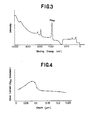
- the ESCA spectrum and profile toward the thickness are shown in the accompanied drawings which were obtained after sputtering by the use of PHI-Model-560 ESCA manufactured by Perkin-Elmer Co., Ltd. Namely, Fig. 3 shows an ESCA spectrum which was made by irradiation of an energy beam over a sample and subsequent observation an absorption spectrum of the electron orbital identified as Ag in the sample.
- Fig. 3 shows an ESCA spectrum which was made by irradiation of an energy beam over a sample and subsequent observation an absorption spectrum of the electron orbital identified as Ag in the sample.
- a sputtering speed was around 30 A/min.
- the physically developed silver was contained within about 0.1 P m from the surface thereof and a certain amount of colloidal silver was within a deeper position toward a support. Therefore, it can be seen that a film thickness of a physical development nucleus layer is made up so as to have precipitated silver deeper within a recording layer, in order to obtain a recording medium having a high reflectance on the support side thereof.
- Example 2 Following the same procedures as in Example 1 except that a physical development nucleus layer was coated to 0.2 pm by the use of a gold colloid solution prepared by the under-mentioned composition, there was prepared a sample of this invention having a metallic luster reflectivity.
- a solution having the above-defined composition was admixed and stirred at room temperature to yield a gold colloid solution.
- a reflectance through a polymethyl methacrylate support plate was 45.0 % with He-Ne laser of 6328 A.
- the so-obtained recording medium sample of this invention was subjected to recording or writing and reading in the same manner as in Example 1 to give favourable results as seen in Example 1.
- a film thickness of a physical development nucleus-containing layer was 0.05 ⁇ m.
- This sample was developed without expression at 25 °C for 3 minutes with a developer having the following composition, and washed with a hot water at 37 °C to strip off the emulsion layer, thereby producing a sample.
- a reflectance through a polymethyl methacrylate support plate was 40.0 % with He-Ne laser of 6328 A and a film thickness was 0.08 pm.
- the so-obtained recording medium of this invention was subjected to recording and reading in the same manner as in Example 1 and the good results as in Example 1 were obtained.
Landscapes
- Physics & Mathematics (AREA)
- General Physics & Mathematics (AREA)
- Chemical & Material Sciences (AREA)
- Dispersion Chemistry (AREA)
- Inorganic Chemistry (AREA)
- Mathematical Physics (AREA)
- Thermal Transfer Or Thermal Recording In General (AREA)
- Optical Record Carriers And Manufacture Thereof (AREA)
- Non-Silver Salt Photosensitive Materials And Non-Silver Salt Photography (AREA)
Abstract
Description
- This invention relates to a recording medium. More particularly, it is concerned with an improved optical recording medium which is capable of writing or recording and reflective reading.
- As a recording medium which is employable for the method wherein such information as voice, projected image and so on is recorded as change in shape, dimension and the like of pits (concave portion) or blocks (convex portion), and optically taken out and reconverted to voice or projected image signal for reproduction, there has been hitherto proposed a recording medium employing a photosensitive silver halide emulsion, for example, as disclosed in Japanese Provisional Patent Publications No. 108995/1980, No. 33995/1981, No. 49296/1981 or No. 49297/1981. Said recording medium has advantages of being continuously manufacturable and of comparatively less recording energy applied, unlike those recording media which are composed of Te, TeO, chalcogenide compounds and the like and prepared by means of such vacuum equipments as vacuum plating or sputtering. Moreover, they also show an advantage that track or certain data can be photographically recorded previously by utilizing photosensitivity of the silver halide emulsion. In summary, the technique as disclosed in the above-recited Publications is directed mainly to a recording medium wherein a recording layer surface on a support is of reflectivity.
- On the other hand, it is requisite for a recording medium to prepare a protective coating layer of Si02, polymethyl methacrylate (PMMA) and the like on a recording medium or to prepare the whole recording medium in the form of a capsule, in order to protect pits of the recording layer surface from dust. Accordingly, there is required the step of coating a protective layer or forming a capsule and a method for recording through a transparent support such as PMMA, glass or the like is usually applied in order to avoid the above complicated procedures, whereupon it is known to use a recording medium overlaying one sheet of a recording medium with the other layer so as to place outside the transparent supports.
- A method for recording through a support by the use of an optical recording medium is disclosed in Japanese Provisional Patent Publications No. 49296/1981, No. 49297/ 1981 and No. 189060/1981, but there could not be found any disclosure therein on a method or medium wherein a reflectivity in the vicinity of an interface between a support and a recording layer becomes increased and thus a practically acceptable reflectivity is producible in the vicinity of said interface.
- Under these circumstances, the present inventors had previously proposed that a physical development nucleus layer is coated over said support to increase a reflectivity in the vicinity of an interface between a support and a recording layer and produce a practically acceptable reflectivity in the vicinity of said interface for easier reading through a support, as disclosed and claimed in our co-pending Japanese Patent Application No. 189060/1981 (which corresponds to U.S. Patent Application Serial No. 443,434 and European Patent Application No. 82 306 330), which is incorporated herein for reference. Our previous recording medium could show a sufficient reflectivity required for reading information with a reflected light through a support and representing said information as signal contrast.
- As a result of our further studies on such a type of recording medium, it has been found out that there remains a disadvantage in its manufacture wherein a reflection on a support side could not yet be sufficiently increased due to physical development being initiated from the surface of a physical development nucleus layer, although the aforesaid advantages can be well seen.
- Then, it is a primary object of this invention to provide a recording medium capable of writing (or recording) and reading through a support by utilizing a reflectivity at an interface between a support and a recording layer wherein a higher reflectivity can be attained through a support and an optical reading can be well accomplished.
- Another object of this invention is to provide a recording medium with easier writing and higher sensitivity.
- Still another object of this invention is to provide a recording medium which can be prepared in a continuous manner without any need for vacuum equipments.
- These objects can be satisfactorily accomplished by an improved recording medium of this invention. The present recording medium is the recording medium wherein an energy beam is irradiated onto a reflective component-containing layer provided on a support through said support to reduce a reflectivity of said reflective component-containing layer, the improvement wherein said reflective component-containing layer is formed through physical development of a physical development nucleus-containing layer on said support and said reflective component-containing layer has a film thickness of 0.01 pm to 0.5 µm.
- In the present recording medium, uneveness of coating tends to occur and it becomes thus difficult to prepare a uniform or even film thickness by coating if said film thickness is less than 0.01 µm, while, if said film thickness is more than 0.5 µm, a reflectivity of the recording medium becomes reduced, which leads to difficulty in optical reading and lowered signal contrast. In the present invention, the film thickness of less than about 0.2 pm is preferably used. More preferably, the film thickness of less than 0.09 pm is used to obtain the good results of the present invention.
- Moreover, the present recording medium can show, as one of its characteristics, an increased reflectance along with a higher sensitivity for recording.
- For preparing the present recording medium, one may employ, for instance, the following procedures:
- a physical development nucleus layer substantially transparent to an energy beam is first provided over a support such as glass substantially transparent to said energy beam and subsequently a metal atom is provided by physical development, thereby forming a reflective component-containing layer having a reflective and metallic luster surface and containing a reflective component therein even near the interface between said support and said layer. In this instance, it is preferable for prevention of thermal diffusion that said reflective component-containing layer, i.e. said reflective metallic luster layer and said interface are not of electric conductivity. This physical development nucleus layer may be of a relief-like shape.
- Now, the present invention is illustrated in detail with reference to the accompanied drawings.
-
- Fig. 1 is a graph showing a relationship between a film thickness of a recording laysr in the sample in Example 1 and a reflectance through a support;
- Fig. 2 is a graph showing a relationship between a film thickness of said recording layer and signal contrast;
- Fig. 3 is a chart of silver analysis toward thickness according to an electron spectroscopy for chemical analysis (ESCA), namely a spectrum by ESCA of the sample in Example 2 after sputtering by means of PHI ESCA/SAM 560; and
- Fig. 4 is a chart of profile toward thickness (Depth Profile) obtained in a similar manner to Fig. 3.
- In this invention, as a method for forming a physical development nucleus-containing layer over a base or support, there may be satisfactorily utilized blade coating, air-knife coating, bar coating, roll coating, curtain coating, spinner coating and so on.
- As the physical development nucleus which may be employed in the present physical development nucleus-containing layer, there may be employed any well-known physical development nuclei. For instance, a group thereof may preferably include heavy metal sulfides, e.g. sulfides of zinc, chromium, potassium, iron, cadmium, cobalt, nickel, lead, antimony, bismuth, silver, cerium, arsenic, copper and rhodium, as well as selenides of heavy metals, e.g. selenides of lead, zinc, antimony and nickel.
- Another useful group of physical development nucleus may include noble metals, e.g., silver, gold, platinum, palladium, mercury and the like and it is preferable that said metal is present as colloidal particles in a binder. Also, salts of said metals, preferably the corresponding simple inorganic and readily reducible salts such as silver nitrate, gold chloride, gold nitrate and the like are useful as a physical development nucleus.
- Other useful group of physical development nucleus may include thio compounds, e.g. silver thiooxalate and lead or nickel complex thereof, thioacetamide and the like.
- Preferable physical development nucleus is a heavy metal sulfide, e.g. sulfides of zinc, cadmium, silver, lead and the like and a metal, e.g. silver, gold, palladium, copper and the like.
- As the metallic compound which may be used for supplying a metal atom-to a physical development nucleus through physical development, there may be employed a gold salt, e.g. sodium salt; a copper salt, e.g. CuCl2, CuSCN; a lead salt, e.g. PbO, PbCl2, PbBr2; an iron salt, e.g. iron oxalate, iron nitrate; a Pd complex, e.g. oxalate, malonate; a silver salt, e.g. AgCl, AgBr, AgI, AgNO3, Ag2SO4, Ag 2S; a cobalt salt, e.g. CoCl2, CoS04; a nickel salt, e.g. Ni(NO3)2, NiCl2; HgCl2, BiCl2, TeCl4, InCl3, InBr3; and the like and the silver salt, copper salt, nickel salt and cobalt salt can be preferably employed in this invention with a silver halide being most preferable. In this instance, a silver halide and a copper halide may also show an advantage of non-pollution.
- In this invention, physical development can be effected with a physical developer in a well-known manner. As the physical developer, there may be include all developers already known in the art; namely, any alkaline or acidic solutions containing at least a developing agent, and there may be employed any of well-known developng solutions.
- As the support which may be employed in this invention, there may be used any of those which are substantially transparent to energy beam and illustrative examples thereof may include cellulose triacetate, polyethylene terephthalate, polymethyl methacrylate, polycarbonate, ceramics, polyimide resin, glasses, metals and the like. The support may be particularly undercoated or not, but the undercoated support is preferable. As the undercoating agent for this purpose, there may be employed, for example, silane coupling agents, silicates, titanium coupling agents and the like and the silane coupling agent disclosed in U.S. Patent No. 3,661,584 is particularly preferable.
- Also, the support may be subjected to surface treatment, e.g., corona discharge treatment, plasma discharge treatment, ion bombardment and the like for improving adhesion.
- Where a silver halide emulsion is used as the metallic compound in this invention, it is desirable to incorporate therein an antifoggant, a coating aid, a hardener and the like, but it is not necessarily required to apply thereto a sensitizing treatment because of no need for sensitivity to visible light. Also, it is feasible to add a developing agent, e.g. hydroquinone or phenidone directly to a silver halide emulsion and subsequently develop it solely in an alkali bath containing a solvent for a silver halide, thereby precipitating out silver in a silver mirror-like form.
- As the binder which may be employed in this invention, there may be employed any well-known hydrophilic colloids and illustrative examples thereof may include, for example, gelatin, alkali-processed gelatin, acid- processed gelatin and gelatin derivatives; colloidal albumin; casein; cellulose derivatives, e.g. carboxymethyl cellulose, hydroxyethyl cellulose and the like; polysaccharide derivatives, e.g. soldium alginate, starch derivatives and the like; synthetic hydrophilic polymers, e.g. polyvinyl alcohol, poly-N-vinylpyrrolidone, polyacrylic acid copolymers, polyacrylamide and the like. As other binder, there may be also mentioned phenol resins, epoxy resins, melamine resins and the like. If necessary, these binders may be employed in combination of the two or more. As the aforesaid colloid dispersion medium for this invention, one may preferably use a hydrophilic colloid with a low thermal conductivity.
- As the high density energy beam which may be employed in this invention for recording pit information, there may be employed, for example, any of well-known beams, but laser light is preferable in view of higher density recording. As the laser beam, there may be employed any light from continuous oscillation or pulse oscillation and, illustratively, there may be used ruby laser (6943 Å), argon ion laser (4880 Å, 5145 Å), glass laser (1.06 µ), He-Ne laser (6328 A), krypton laser (6471 A), He-Cd laser (4416 Å, 3250 Å), color laser, semi-conductor laser and the like.
- The present recording medium may be heat-treated, if necessary, in the presence or absence of oxygen for increasing reflectivity and reducing a film thickness. A preferable temperature range therefor is about 250 °C to 400 °C. Heat-treatment can provide a higher improvement in reflectivity performance of a metallic luster layer and an interface.
- A film thickness of a physical development nucleus layer in the present recording medium should be in the range of 0.01 pm to 0.5 µm. In the above-defined film thickness range, the present recording medium can be provided with a reflectance of approximately 10 to 70 % through a support by means of He-Ne laser (6328 A) and thus is a satisfactory recording medium. If a reflectance is less than 10 %, there occur a lowered signal contrast and reading of information by reflected light becomes difficult. If a reflectance is more than 70 %, writing or recording becomes difficult to be effected, together with a lowered signal contrast.
- The present recording medium may be practically applicable as an optical disc capable of additionally writing thereinto and also as a tape for additional writing. In view of a transparent support employed as a protective layer, the present recording medium may be widely and effectively utilized for a number of purposes.
- Other embodiments of the present invention, for example, contruction of layers therein, practical process for the preparation thereof etc. can be advantageously carried out in compliance with those as disclosed in the above- mentioned co-pending Japanese Patent Application No. 189060/1981, all descriptions and drawings of which are incorporated herein for reference.
- This invention will be more fully illustrated by way of the following examples, but they are not contemplated to be limiting the scope of this invention.
- An aqueous solution of colloidal silver grains dispersed in gelatin as a physical development nucleus was prepared by reduction of silver nitrate with dextrin. A weight ratio of silver to gelatin was 32 % and a grain size of the colloidal grain was about 100 A. This solution was coated by means of a wire bar over a polymethyl methacrylate plate with a thickness of 1.0 mm, said plate being previously executed undercoating treatment by the use of a plasma discharge and a silane coupling agent, thereby forming physical development nucleus layers with a variety of film thicknesses. Over the physical development nucleus-containing layer was coated a fine grain silver iodobromide gelatin emulsion as a metallic compound dispersed layer (3 molar % as silver iodide; average grain size of 0.05 F) to a coated silver amount of 3 g/m2, thereby producing a sample.
- This sample was developed without exposure at 40 °C for 2 minutes with a developer having the following composition, washed with a hot water at 35 °C to strip off the emulsion layer and then washed with water.

- Consequently, observation through the polymethyl methacrylate support plate showed production of a siliver mirror having metallic luster and a silver mirror layer was confirmed to exist at the interface between the support. A relationship between a film thickness of the recording layer and a reflectance through the support at this point is illustrated in Fig. 1.
- As apparent from Fig. 1, it can be seen that the thinner a film thickness of the resultant recording layer is, the higher a reflectance becomes. It can be also seen in the present recording medium that any required reflectance may be provided by controlling a film thickness of the recording layer, i.e. physical development nucleus layer. This is significant because of any optionally possible control of a writing energy.
- To the present recording medium sample thus obtained was scanned a He-Ne laser beam (6328 A) having a beam diameter of 1.4 p and an output on a recording surface of 18.9 mW at a scanning rate of 4.9 m/sec using a rotating mirror and a pulse signal of 500 n sec was given with an acoustic optical modulator to effect a writing recording for forming pits. As a result, a recording surface having a remarkable difference in reflectivity was formed to provide a favourable signal contrast and make feasible an easy optical reading. A relationship between film thickness and signal contrast at this point is illustrated in Fig. 2.
- As apparent from Fig. 2, it can be seen that the thinner a film thickness is, the higher signal contrast is, and also that favourable results can be given at a film thickness of 0.01 pm to 0.5 µm. Illustratively, a threshold energy value for writing was 6 mW and signal contrast was 0.52 in a sample having a film thickness of 0.24 pm and a reflectance of 41 %.
- Following the same procedures as in Example 1, there was prepared a sample having a recording layer with a film thickness of 1.0 µm. This recording medium has a low reflectance of 9 % with many noises and then optical reading was difficult.
- Following the same procedures as in Example 1, there was prepared a recording medium having a recording layer with a film thickness of 0.009 pm. This recording medium showed a high uneveness in coating and thus did not provide a satisfactory sample.
- Employing a sample having a film thickness of a recording layer of 0.3 pm, which was prepared according to the same procedures as in Example 1, an analysis for a silver amount toward a thickness thereof was carried out according to electron spectroscopy for chemical analysis (ESCA). The ESCA spectrum and profile toward the thickness are shown in the accompanied drawings which were obtained after sputtering by the use of PHI-Model-560 ESCA manufactured by Perkin-Elmer Co., Ltd. Namely, Fig. 3 shows an ESCA spectrum which was made by irradiation of an energy beam over a sample and subsequent observation an absorption spectrum of the electron orbital identified as Ag in the sample. Fig. 4 shows a profile toward the sample thickness which was made by irradiation of an energy beam over a sample and subsequent observation of relative strength of a concentration of the secondary ion generated from the sample. In this case, a sputtering speed was around 30 A/min. In the recording layer, the physically developed silver was contained within about 0.1 Pm from the surface thereof and a certain amount of colloidal silver was within a deeper position toward a support. Therefore, it can be seen that a film thickness of a physical development nucleus layer is made up so as to have precipitated silver deeper within a recording layer, in order to obtain a recording medium having a high reflectance on the support side thereof.
- Following the same procedures as in Example 1 except that a physical development nucleus layer was coated to 0.2 pm by the use of a gold colloid solution prepared by the under-mentioned composition, there was prepared a sample of this invention having a metallic luster reflectivity.
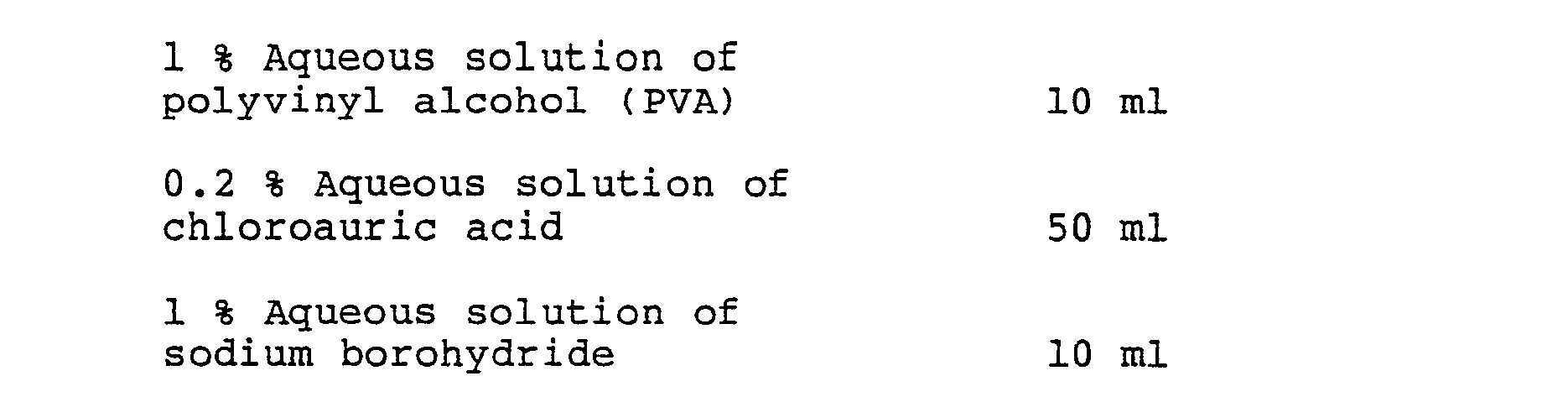
- A solution having the above-defined composition was admixed and stirred at room temperature to yield a gold colloid solution. In this sample, a reflectance through a polymethyl methacrylate support plate was 45.0 % with He-Ne laser of 6328 A.
- The so-obtained recording medium sample of this invention was subjected to recording or writing and reading in the same manner as in Example 1 to give favourable results as seen in Example 1.
- Following the same procedure as in Example 3 except that a film thickness of a physical development nucleus-containing layer was 0.05 µm. On the physical development nucleus-containing layer, a copper bromoiodide (I) emulsion (Br : I = 97 : 3) was coated with a thickness of 2 pm.
- This sample was developed without expression at 25 °C for 3 minutes with a developer having the following composition, and washed with a hot water at 37 °C to strip off the emulsion layer, thereby producing a sample.
-

- In this sample, a reflectance through a polymethyl methacrylate support plate was 40.0 % with He-Ne laser of 6328 A and a film thickness was 0.08 pm.
- The so-obtained recording medium of this invention was subjected to recording and reading in the same manner as in Example 1 and the good results as in Example 1 were obtained.
Claims (7)
Applications Claiming Priority (2)
| Application Number | Priority Date | Filing Date | Title |
|---|---|---|---|
| JP57143762A JPS5933192A (en) | 1982-08-18 | 1982-08-18 | Recording medium |
| JP143762/82 | 1982-08-18 |
Publications (2)
| Publication Number | Publication Date |
|---|---|
| EP0103401A2 true EP0103401A2 (en) | 1984-03-21 |
| EP0103401A3 EP0103401A3 (en) | 1984-11-21 |
Family
ID=15346426
Family Applications (1)
| Application Number | Title | Priority Date | Filing Date |
|---|---|---|---|
| EP83304609A Withdrawn EP0103401A3 (en) | 1982-08-18 | 1983-08-09 | Recording media |
Country Status (2)
| Country | Link |
|---|---|
| EP (1) | EP0103401A3 (en) |
| JP (1) | JPS5933192A (en) |
Cited By (1)
| Publication number | Priority date | Publication date | Assignee | Title |
|---|---|---|---|---|
| EP1274076A1 (en) * | 2001-06-28 | 2003-01-08 | Fuji Photo Film Co., Ltd. | Optical recording medium |
Families Citing this family (1)
| Publication number | Priority date | Publication date | Assignee | Title |
|---|---|---|---|---|
| JP2768981B2 (en) * | 1989-06-22 | 1998-06-25 | シャープ株式会社 | Optical memory device |
Family Cites Families (6)
| Publication number | Priority date | Publication date | Assignee | Title |
|---|---|---|---|---|
| GB2101759B (en) * | 1979-07-06 | 1983-12-21 | Drexler Tech | Reflective data storage medium |
| CA1134508A (en) * | 1980-02-15 | 1982-10-26 | Eric Bouldin | Broadband reflective laser recording and data storage medium with absorptive underlayer |
| JPS5756839A (en) * | 1981-07-10 | 1982-04-05 | Konishiroku Photo Ind Co Ltd | Manufacture of dry photographic element |
| EP0080884A3 (en) * | 1981-11-27 | 1984-02-01 | Konishiroku Photo Industry Co. Ltd. | A recording medium and a method for the production thereof |
| JPS58224794A (en) * | 1982-06-25 | 1983-12-27 | Konishiroku Photo Ind Co Ltd | Optical information recording medium |
| JPS58130454A (en) * | 1983-01-31 | 1983-08-03 | Konishiroku Photo Ind Co Ltd | Optical information recording medium |
-
1982
- 1982-08-18 JP JP57143762A patent/JPS5933192A/en active Pending
-
1983
- 1983-08-09 EP EP83304609A patent/EP0103401A3/en not_active Withdrawn
Cited By (1)
| Publication number | Priority date | Publication date | Assignee | Title |
|---|---|---|---|---|
| EP1274076A1 (en) * | 2001-06-28 | 2003-01-08 | Fuji Photo Film Co., Ltd. | Optical recording medium |
Also Published As
| Publication number | Publication date |
|---|---|
| JPS5933192A (en) | 1984-02-22 |
| EP0103401A3 (en) | 1984-11-21 |
Similar Documents
| Publication | Publication Date | Title |
|---|---|---|
| US4269917A (en) | Data storage medium having reflective particulate silver layer | |
| US4278756A (en) | Reflective data storage medium made by silver diffusion transfer | |
| US4298684A (en) | Reflective data storage medium made by silver diffusion transfer in silver-halide emulsion incorporating nuclei | |
| US4837134A (en) | Optical memory card with versatile storage medium | |
| US4025345A (en) | Method of preparing bleached phase hologram and a bleaching solution composition therefor | |
| US5578415A (en) | Optical recording materials, method for preparing the same and optical cards having the same | |
| US4762770A (en) | High contrast optical memory disk | |
| JP2865955B2 (en) | Optical recording medium | |
| US4463089A (en) | Reflective optical data storage and laser recording medium | |
| EP0075461A2 (en) | An optical information recording medium | |
| EP0098125A1 (en) | Recording media for optical information | |
| EP0080884A2 (en) | A recording medium and a method for the production thereof | |
| JPH0312646A (en) | Novel dyestuff recording material | |
| JPH0619852B2 (en) | High density recording medium | |
| JPS5933192A (en) | Recording medium | |
| JPH0352139B2 (en) | ||
| JPS58130454A (en) | Optical information recording medium | |
| JPS595098A (en) | Manufacture of optical information recording medium | |
| JPS5967089A (en) | Optical information recording medium | |
| JPS5919254A (en) | Recording medium | |
| JPH053396B2 (en) | ||
| JPS58160193A (en) | Optical information recording medium | |
| JPH0256226B2 (en) | ||
| JPS5982644A (en) | Recording medium of optical information | |
| JPS58219089A (en) | Optical information recording medium |
Legal Events
| Date | Code | Title | Description |
|---|---|---|---|
| PUAI | Public reference made under article 153(3) epc to a published international application that has entered the european phase |
Free format text: ORIGINAL CODE: 0009012 |
|
| AK | Designated contracting states |
Designated state(s): DE FR GB |
|
| PUAL | Search report despatched |
Free format text: ORIGINAL CODE: 0009013 |
|
| AK | Designated contracting states |
Designated state(s): DE FR GB |
|
| STAA | Information on the status of an ep patent application or granted ep patent |
Free format text: STATUS: THE APPLICATION IS DEEMED TO BE WITHDRAWN |
|
| 18D | Application deemed to be withdrawn |
Effective date: 19850722 |
|
| RIN1 | Information on inventor provided before grant (corrected) |
Inventor name: NISHI, SHINICHI Inventor name: SHIMADA, FUMIO Inventor name: HOGA, KINU Inventor name: SATOH, TAXEY |