EP0103039B1 - Kleidungsstück und Verfahren zur Herstellung des Kleidungsstücks - Google Patents
Kleidungsstück und Verfahren zur Herstellung des Kleidungsstücks Download PDFInfo
- Publication number
- EP0103039B1 EP0103039B1 EP82108436A EP82108436A EP0103039B1 EP 0103039 B1 EP0103039 B1 EP 0103039B1 EP 82108436 A EP82108436 A EP 82108436A EP 82108436 A EP82108436 A EP 82108436A EP 0103039 B1 EP0103039 B1 EP 0103039B1
- Authority
- EP
- European Patent Office
- Prior art keywords
- woven
- web
- further characterized
- laminate
- knitted
- Prior art date
- Legal status (The legal status is an assumption and is not a legal conclusion. Google has not performed a legal analysis and makes no representation as to the accuracy of the status listed.)
- Expired
Links
- 238000000034 method Methods 0.000 title claims description 46
- 238000004519 manufacturing process Methods 0.000 title claims description 7
- 238000000576 coating method Methods 0.000 claims description 43
- 239000011248 coating agent Substances 0.000 claims description 42
- 230000035515 penetration Effects 0.000 claims description 39
- 239000000835 fiber Substances 0.000 claims description 32
- 229920000728 polyester Polymers 0.000 claims description 18
- 239000000203 mixture Substances 0.000 claims description 17
- 239000000463 material Substances 0.000 claims description 13
- 239000004952 Polyamide Substances 0.000 claims description 10
- 229920002647 polyamide Polymers 0.000 claims description 10
- 229920000742 Cotton Polymers 0.000 claims description 9
- 244000043261 Hevea brasiliensis Species 0.000 claims description 7
- 229920001944 Plastisol Polymers 0.000 claims description 7
- 229920003052 natural elastomer Polymers 0.000 claims description 7
- 229920001194 natural rubber Polymers 0.000 claims description 7
- 239000004999 plastisol Substances 0.000 claims description 7
- 229920003051 synthetic elastomer Polymers 0.000 claims description 7
- 239000005061 synthetic rubber Substances 0.000 claims description 7
- 229920000915 polyvinyl chloride Polymers 0.000 claims description 6
- 239000004800 polyvinyl chloride Substances 0.000 claims description 6
- 229920000098 polyolefin Polymers 0.000 claims description 5
- 238000007598 dipping method Methods 0.000 claims description 4
- 229920002239 polyacrylonitrile Polymers 0.000 claims description 4
- 210000002268 wool Anatomy 0.000 claims description 4
- 229920002994 synthetic fiber Polymers 0.000 claims description 2
- 239000012209 synthetic fiber Substances 0.000 claims description 2
- 238000010345 tape casting Methods 0.000 claims 1
- 239000004753 textile Substances 0.000 claims 1
- 229920002554 vinyl polymer Polymers 0.000 claims 1
- 239000004744 fabric Substances 0.000 description 16
- 229920001971 elastomer Polymers 0.000 description 6
- 239000000806 elastomer Substances 0.000 description 6
- 238000005304 joining Methods 0.000 description 5
- -1 polypropylene Polymers 0.000 description 5
- 230000001681 protective effect Effects 0.000 description 5
- 239000002904 solvent Substances 0.000 description 5
- 230000004888 barrier function Effects 0.000 description 4
- 238000005520 cutting process Methods 0.000 description 4
- 229920000297 Rayon Polymers 0.000 description 3
- 238000010276 construction Methods 0.000 description 3
- 230000000694 effects Effects 0.000 description 3
- 238000009472 formulation Methods 0.000 description 3
- 239000007788 liquid Substances 0.000 description 3
- 239000002964 rayon Substances 0.000 description 3
- 230000037303 wrinkles Effects 0.000 description 3
- 229920000271 Kevlar® Polymers 0.000 description 2
- 239000004677 Nylon Substances 0.000 description 2
- 239000004698 Polyethylene Substances 0.000 description 2
- 239000004743 Polypropylene Substances 0.000 description 2
- 238000005299 abrasion Methods 0.000 description 2
- 150000001875 compounds Chemical class 0.000 description 2
- 239000004761 kevlar Substances 0.000 description 2
- 229920001778 nylon Polymers 0.000 description 2
- 229920000573 polyethylene Polymers 0.000 description 2
- 229920000642 polymer Polymers 0.000 description 2
- 229920001155 polypropylene Polymers 0.000 description 2
- 230000029058 respiratory gaseous exchange Effects 0.000 description 2
- 239000000758 substrate Substances 0.000 description 2
- SMZOUWXMTYCWNB-UHFFFAOYSA-N 2-(2-methoxy-5-methylphenyl)ethanamine Chemical compound COC1=CC=C(C)C=C1CCN SMZOUWXMTYCWNB-UHFFFAOYSA-N 0.000 description 1
- NIXOWILDQLNWCW-UHFFFAOYSA-N 2-Propenoic acid Natural products OC(=O)C=C NIXOWILDQLNWCW-UHFFFAOYSA-N 0.000 description 1
- 229920000784 Nomex Polymers 0.000 description 1
- 230000005540 biological transmission Effects 0.000 description 1
- 238000009960 carding Methods 0.000 description 1
- 238000007796 conventional method Methods 0.000 description 1
- 229920001577 copolymer Polymers 0.000 description 1
- 230000018044 dehydration Effects 0.000 description 1
- 238000006297 dehydration reaction Methods 0.000 description 1
- 230000001419 dependent effect Effects 0.000 description 1
- 239000003517 fume Substances 0.000 description 1
- 239000011521 glass Substances 0.000 description 1
- 231100001261 hazardous Toxicity 0.000 description 1
- 239000012212 insulator Substances 0.000 description 1
- 238000009940 knitting Methods 0.000 description 1
- 229920000126 latex Polymers 0.000 description 1
- 239000010985 leather Substances 0.000 description 1
- 239000002184 metal Substances 0.000 description 1
- 239000004763 nomex Substances 0.000 description 1
- 238000004080 punching Methods 0.000 description 1
- 230000008961 swelling Effects 0.000 description 1
- 229920001059 synthetic polymer Polymers 0.000 description 1
Images
Classifications
-
- A—HUMAN NECESSITIES
- A41—WEARING APPAREL
- A41D—OUTERWEAR; PROTECTIVE GARMENTS; ACCESSORIES
- A41D31/00—Materials specially adapted for outerwear
- A41D31/04—Materials specially adapted for outerwear characterised by special function or use
-
- A—HUMAN NECESSITIES
- A41—WEARING APPAREL
- A41D—OUTERWEAR; PROTECTIVE GARMENTS; ACCESSORIES
- A41D13/00—Professional, industrial or sporting protective garments, e.g. surgeons' gowns or garments protecting against blows or punches
- A41D13/04—Aprons; Fastening devices for aprons
-
- A—HUMAN NECESSITIES
- A41—WEARING APPAREL
- A41D—OUTERWEAR; PROTECTIVE GARMENTS; ACCESSORIES
- A41D19/00—Gloves
- A41D19/015—Protective gloves
-
- A—HUMAN NECESSITIES
- A41—WEARING APPAREL
- A41D—OUTERWEAR; PROTECTIVE GARMENTS; ACCESSORIES
- A41D31/00—Materials specially adapted for outerwear
- A41D31/04—Materials specially adapted for outerwear characterised by special function or use
- A41D31/14—Air permeable, i.e. capable of being penetrated by gases
- A41D31/145—Air permeable, i.e. capable of being penetrated by gases using layered materials
-
- B—PERFORMING OPERATIONS; TRANSPORTING
- B32—LAYERED PRODUCTS
- B32B—LAYERED PRODUCTS, i.e. PRODUCTS BUILT-UP OF STRATA OF FLAT OR NON-FLAT, e.g. CELLULAR OR HONEYCOMB, FORM
- B32B5/00—Layered products characterised by the non- homogeneity or physical structure, i.e. comprising a fibrous, filamentary, particulate or foam layer; Layered products characterised by having a layer differing constitutionally or physically in different parts
- B32B5/02—Layered products characterised by the non- homogeneity or physical structure, i.e. comprising a fibrous, filamentary, particulate or foam layer; Layered products characterised by having a layer differing constitutionally or physically in different parts characterised by structural features of a fibrous or filamentary layer
- B32B5/022—Non-woven fabric
-
- B—PERFORMING OPERATIONS; TRANSPORTING
- B32—LAYERED PRODUCTS
- B32B—LAYERED PRODUCTS, i.e. PRODUCTS BUILT-UP OF STRATA OF FLAT OR NON-FLAT, e.g. CELLULAR OR HONEYCOMB, FORM
- B32B5/00—Layered products characterised by the non- homogeneity or physical structure, i.e. comprising a fibrous, filamentary, particulate or foam layer; Layered products characterised by having a layer differing constitutionally or physically in different parts
- B32B5/02—Layered products characterised by the non- homogeneity or physical structure, i.e. comprising a fibrous, filamentary, particulate or foam layer; Layered products characterised by having a layer differing constitutionally or physically in different parts characterised by structural features of a fibrous or filamentary layer
- B32B5/024—Woven fabric
-
- B—PERFORMING OPERATIONS; TRANSPORTING
- B32—LAYERED PRODUCTS
- B32B—LAYERED PRODUCTS, i.e. PRODUCTS BUILT-UP OF STRATA OF FLAT OR NON-FLAT, e.g. CELLULAR OR HONEYCOMB, FORM
- B32B5/00—Layered products characterised by the non- homogeneity or physical structure, i.e. comprising a fibrous, filamentary, particulate or foam layer; Layered products characterised by having a layer differing constitutionally or physically in different parts
- B32B5/02—Layered products characterised by the non- homogeneity or physical structure, i.e. comprising a fibrous, filamentary, particulate or foam layer; Layered products characterised by having a layer differing constitutionally or physically in different parts characterised by structural features of a fibrous or filamentary layer
- B32B5/026—Knitted fabric
-
- B—PERFORMING OPERATIONS; TRANSPORTING
- B32—LAYERED PRODUCTS
- B32B—LAYERED PRODUCTS, i.e. PRODUCTS BUILT-UP OF STRATA OF FLAT OR NON-FLAT, e.g. CELLULAR OR HONEYCOMB, FORM
- B32B5/00—Layered products characterised by the non- homogeneity or physical structure, i.e. comprising a fibrous, filamentary, particulate or foam layer; Layered products characterised by having a layer differing constitutionally or physically in different parts
- B32B5/02—Layered products characterised by the non- homogeneity or physical structure, i.e. comprising a fibrous, filamentary, particulate or foam layer; Layered products characterised by having a layer differing constitutionally or physically in different parts characterised by structural features of a fibrous or filamentary layer
- B32B5/06—Layered products characterised by the non- homogeneity or physical structure, i.e. comprising a fibrous, filamentary, particulate or foam layer; Layered products characterised by having a layer differing constitutionally or physically in different parts characterised by structural features of a fibrous or filamentary layer characterised by a fibrous or filamentary layer mechanically connected, e.g. by needling to another layer, e.g. of fibres, of paper
-
- B—PERFORMING OPERATIONS; TRANSPORTING
- B32—LAYERED PRODUCTS
- B32B—LAYERED PRODUCTS, i.e. PRODUCTS BUILT-UP OF STRATA OF FLAT OR NON-FLAT, e.g. CELLULAR OR HONEYCOMB, FORM
- B32B5/00—Layered products characterised by the non- homogeneity or physical structure, i.e. comprising a fibrous, filamentary, particulate or foam layer; Layered products characterised by having a layer differing constitutionally or physically in different parts
- B32B5/22—Layered products characterised by the non- homogeneity or physical structure, i.e. comprising a fibrous, filamentary, particulate or foam layer; Layered products characterised by having a layer differing constitutionally or physically in different parts characterised by the presence of two or more layers which are next to each other and are fibrous, filamentary, formed of particles or foamed
- B32B5/24—Layered products characterised by the non- homogeneity or physical structure, i.e. comprising a fibrous, filamentary, particulate or foam layer; Layered products characterised by having a layer differing constitutionally or physically in different parts characterised by the presence of two or more layers which are next to each other and are fibrous, filamentary, formed of particles or foamed one layer being a fibrous or filamentary layer
- B32B5/26—Layered products characterised by the non- homogeneity or physical structure, i.e. comprising a fibrous, filamentary, particulate or foam layer; Layered products characterised by having a layer differing constitutionally or physically in different parts characterised by the presence of two or more layers which are next to each other and are fibrous, filamentary, formed of particles or foamed one layer being a fibrous or filamentary layer another layer next to it also being fibrous or filamentary
-
- D—TEXTILES; PAPER
- D04—BRAIDING; LACE-MAKING; KNITTING; TRIMMINGS; NON-WOVEN FABRICS
- D04H—MAKING TEXTILE FABRICS, e.g. FROM FIBRES OR FILAMENTARY MATERIAL; FABRICS MADE BY SUCH PROCESSES OR APPARATUS, e.g. FELTS, NON-WOVEN FABRICS; COTTON-WOOL; WADDING ; NON-WOVEN FABRICS FROM STAPLE FIBRES, FILAMENTS OR YARNS, BONDED WITH AT LEAST ONE WEB-LIKE MATERIAL DURING THEIR CONSOLIDATION
- D04H1/00—Non-woven fabrics formed wholly or mainly of staple fibres or like relatively short fibres
- D04H1/40—Non-woven fabrics formed wholly or mainly of staple fibres or like relatively short fibres from fleeces or layers composed of fibres without existing or potential cohesive properties
- D04H1/44—Non-woven fabrics formed wholly or mainly of staple fibres or like relatively short fibres from fleeces or layers composed of fibres without existing or potential cohesive properties the fleeces or layers being consolidated by mechanical means, e.g. by rolling
- D04H1/46—Non-woven fabrics formed wholly or mainly of staple fibres or like relatively short fibres from fleeces or layers composed of fibres without existing or potential cohesive properties the fleeces or layers being consolidated by mechanical means, e.g. by rolling by needling or like operations to cause entanglement of fibres
-
- D—TEXTILES; PAPER
- D04—BRAIDING; LACE-MAKING; KNITTING; TRIMMINGS; NON-WOVEN FABRICS
- D04H—MAKING TEXTILE FABRICS, e.g. FROM FIBRES OR FILAMENTARY MATERIAL; FABRICS MADE BY SUCH PROCESSES OR APPARATUS, e.g. FELTS, NON-WOVEN FABRICS; COTTON-WOOL; WADDING ; NON-WOVEN FABRICS FROM STAPLE FIBRES, FILAMENTS OR YARNS, BONDED WITH AT LEAST ONE WEB-LIKE MATERIAL DURING THEIR CONSOLIDATION
- D04H1/00—Non-woven fabrics formed wholly or mainly of staple fibres or like relatively short fibres
- D04H1/40—Non-woven fabrics formed wholly or mainly of staple fibres or like relatively short fibres from fleeces or layers composed of fibres without existing or potential cohesive properties
- D04H1/44—Non-woven fabrics formed wholly or mainly of staple fibres or like relatively short fibres from fleeces or layers composed of fibres without existing or potential cohesive properties the fleeces or layers being consolidated by mechanical means, e.g. by rolling
- D04H1/46—Non-woven fabrics formed wholly or mainly of staple fibres or like relatively short fibres from fleeces or layers composed of fibres without existing or potential cohesive properties the fleeces or layers being consolidated by mechanical means, e.g. by rolling by needling or like operations to cause entanglement of fibres
- D04H1/498—Non-woven fabrics formed wholly or mainly of staple fibres or like relatively short fibres from fleeces or layers composed of fibres without existing or potential cohesive properties the fleeces or layers being consolidated by mechanical means, e.g. by rolling by needling or like operations to cause entanglement of fibres entanglement of layered webs
-
- D—TEXTILES; PAPER
- D04—BRAIDING; LACE-MAKING; KNITTING; TRIMMINGS; NON-WOVEN FABRICS
- D04H—MAKING TEXTILE FABRICS, e.g. FROM FIBRES OR FILAMENTARY MATERIAL; FABRICS MADE BY SUCH PROCESSES OR APPARATUS, e.g. FELTS, NON-WOVEN FABRICS; COTTON-WOOL; WADDING ; NON-WOVEN FABRICS FROM STAPLE FIBRES, FILAMENTS OR YARNS, BONDED WITH AT LEAST ONE WEB-LIKE MATERIAL DURING THEIR CONSOLIDATION
- D04H13/00—Other non-woven fabrics
-
- B—PERFORMING OPERATIONS; TRANSPORTING
- B32—LAYERED PRODUCTS
- B32B—LAYERED PRODUCTS, i.e. PRODUCTS BUILT-UP OF STRATA OF FLAT OR NON-FLAT, e.g. CELLULAR OR HONEYCOMB, FORM
- B32B2262/00—Composition or structural features of fibres which form a fibrous or filamentary layer or are present as additives
- B32B2262/02—Synthetic macromolecular fibres
- B32B2262/0261—Polyamide fibres
-
- B—PERFORMING OPERATIONS; TRANSPORTING
- B32—LAYERED PRODUCTS
- B32B—LAYERED PRODUCTS, i.e. PRODUCTS BUILT-UP OF STRATA OF FLAT OR NON-FLAT, e.g. CELLULAR OR HONEYCOMB, FORM
- B32B2262/00—Composition or structural features of fibres which form a fibrous or filamentary layer or are present as additives
- B32B2262/02—Synthetic macromolecular fibres
- B32B2262/0276—Polyester fibres
-
- B—PERFORMING OPERATIONS; TRANSPORTING
- B32—LAYERED PRODUCTS
- B32B—LAYERED PRODUCTS, i.e. PRODUCTS BUILT-UP OF STRATA OF FLAT OR NON-FLAT, e.g. CELLULAR OR HONEYCOMB, FORM
- B32B2437/00—Clothing
Definitions
- This invention relates to methods for producing a laminate useful in the manufacture of wearing apparel, and particularly wearing apparel for use in a work environment such as work gloves, boots, sleeve guards and work aprons.
- the laminate includes a textured surface which is useful as a gripping surface for the work environment, and the method of the invention is such that the gripping surface may be controlled to be a liquid impervious or a breathable surface, as required.
- the invention includes joining a non-woven fibrous web, such as needled felt, to a knitted fabric web, such as knitted jersey.
- the non-woven fibrous web provides a surface which is soft and comfortable as an internal surface for the wearing apparel.
- the non-woven web also is useful in that it provides a cutting barrier for such material, as well as a "hot” and "cold” barrier.
- the two webs are joined together, utilizing a needled staple fiber, and preferably the fiber from the non-woven web itself, with the joining procedure being such that the fiber extends from the exposed surface of the knitted jersey to form a textured base surface for the reception of a subsequent coating.
- the coating is formed, preferably, from a synthetic polymer which may be knife applied or dip coated, depending upon the kind of surface required in the ultimate garment being produced. If the material is dip coated, all of the interstices of the exposed knitted surface web will be filled to provide a liquid impervious barrier for use in environments where it is important to have a "waterproof” surface. Alternatively, the coating may be knife applied or printed in order to leave uncoated interstices in the surface, to give a breathing function to the ultimate apparel being constructed.
- One approach to obtaining textured or "wrinkle finish" gloves involves dipping a jersey knit fabric glove into an elastomer coating. Before curing completely the elastomer coating, the coated glove is dipped into a solvent which causes the elastomer to swell. The swelling has the effect of causing an uneven surface to form which is the wrinkle finish.
- One disadvantage of such an approach is the use of hazardous solvents, and the commercial problems involved in producing such gloves, wherein certain handling procedures are required for solvent fumes.
- the exposure of the elastomeric coating to a solvent weakens the coating and reduces the life of the garment produced by the material so formed.
- Maris Vistins teach a laminate for use in making garments, and particularly protective garments such as work gloves, wherein the use of solvents is avoided.
- the Vistins teachings produce a textured surface on a protective garment utilizing a non-woven web.
- the non-woven web serves as the exterior surface of the protective garment and is the surface covered in the various subsequent coating techniques, whether in dipping or in the application of a knife procedure for coating the web.
- the knitted jersey is utilized as the internal surface of the garment while the non-woven fibrous web is used as the external surface.
- the non-woven fibrous web because of its "fuzzy" exterior surface, provides an uneven surface for receiving an elastomer coating which is textured to provide the desired gripping action of a subsequent garment made from the laminate so produced.
- a laminate is provided for the subsequent production of wearing apparel, such as work gloves, work boots and aprons which reverses the two webs provided in the Vistins teachings. That is, the non-woven fibrous web, such as needled felt, is joined to a woven or knitted web, such as knitted jersey with the ultimate exposed surface of the knitted jersey being utilized as the external surface of the resulting garment, while the non-wovenn fibrous web is used as the interior surface of the resulting garment.
- the two webs are joined together in a laminate by a needling procedure wherein a staple needled fiber is utilized from the non-woven web which fiber extends from the exposed surface of the knitted jersey to provide the ultimate texture for the material which is formed into a garment.
- the number, and extent of penetration, and the denier of the fiber during the needling procedure controls the resulting surface texture of a garment being produced. That is, the depth of penetration, the density of penetration and the fiber denier all are variables which can be used to control the ultimate characteristics of the surface of a garment being produced.
- the non-woven fibrous web in its unaltered state, a soft comfortable interior surface is provided for the ultimately formed wearing apparel as it is worn. In addition, it need not be napped as is the case with the prior art laminate produced for such work gloves.
- the non-woven web With the degree of needling of the non-woven web to the knitted material such as knitted jersey, the non-woven web becomes an integral part of the fabric construction and the body thereof holds in place more firmly for the subsequent handling operations.
- the non-woven web maintains its "pad" characteristics, which provide an insulator property to the ultimate garments, as well as protection from sharp objects.
- the synthetic fiber from the non-woven fiber web as the staple fiber for joining the two webs together.
- the selection of the syntheticfiberfor use in the joining procedure provides a wide latitude in the ultimate properties of the laminate for the texture of the coating, as required and desired in the ultimate apparel being produced, and the properties of that apparel.
- Representative staple fibers which may be used if selected separately from the non-woven web are polyesters, polyamides, such as Nylon, and polyolefins, such as polypropylene or polyethylene. Rayon may be used if a "wet dog" appearance is desired.
- the hydrophilic properties of rayon give this wet dog appearance. The rayon behaves like a cotton fiber in that the ultimate elastomer coating tends to coagulate by the mechanism of rapid dehydration.
- the fibrous non-woven web it may be produced on conventional carding or garnett machines.
- Representative materials which may be used are wool, polyester, polyamides, such as Kevlar or Nomex which are products of DuPont, polyolefins, such as polypropylene and polyethylene, and copolymers of acrylic acid, such as polyacrylonitrile.
- Polyester is preferred.
- the otherweb, which may be knitted orwoven may be cotton, polyester or a cotton-polyester blend, for example, if knitted, or Kevlar, Nylon or cotton, if woven, or cotton, or a cotton-polyester blend if a flannel.
- the depth of penetration, the density of penetration, and the fiber denier are the variables by which a wide selection of surface texture characteristics may be obtained.
- the ability of the coated surface to allow moisture transmission, or to form an impermeable surface is more dependent upon the method of coating application. It has been found that a very light knife or printed coating gives protection to the fibers, while all of the interstices are not filled with the polymer coating. This has the effect of giving the final garment or wearing apparel a breathing characteristic.
- the coating in orderto obtain a coating that will resist the penetration of liquids, the coating must be continuous. To achieve this kind of property, a dipped coating is utilized.
- the two webs may be joined in a conventional needle punching machine, such as a Hunter Fiber-Locker (TM) machine.
- the depth of penetration will be such so as to cause the fiber to extend from the exposed surface of the woven or knitted web, as discussed above, and preferably within the range of between about 0.64 and 1.27 cm (0.25 and 0.50 inches).
- the density of penetration will be within the range of between about 62.0 and 108.5 penetrations per cm 2 (400 and 700 penetrations per square inch).
- the denier of the fiber will be selected to give the desired degree of texture to the surface as discussed above, and will vary within the range of between about 1.5 and 15.
- the laminates produced may be utilized in various configurations for wearing apparel.
- a laminate may be utilized to provide a wrinkle surface to the palm of the glove while only a knitted jersey layer is utilized for the backside surface of the glove. Otherwise, the entire glove may be made to provide or to have a textured gripping and/or protective surface.
- certain areas of a pair of work boots will require a gripping surface, such as the soles thereof, while it may be desirable to have the liners for forming the uppers formulated only of a knitted jersey.
- certain areas of work gloves for example, may not be coated, such as the cuffs of such gloves, while other areas may have a smooth coating, as required forflexibility, appearance and/ or comfort.
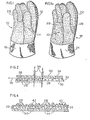
- a glove liner 10 is shown having an upper portion or backside 12 and a palm portion 14, with a cuff 16. Palm portion 14 is prepared as a laminate according to the invention here, whereas the backside 12 is comprised of a woven or knitted fabric web.
- the glove liner 18 shown in Fig. 1a a has a palm portion 20 which is the same as the backside 22, with both portions prepared from a laminate produced in accordance herewith.
- Glove liner 18 has a cuff 24 similar to the cuff 16 of glove 10 in Fig. 1.
- Fig. 2 shows a sectional view of a laminate utilized and formed in accordance with the method here for making the palm portion 14 of the glove 10 shown in Fig. 1 and both the backside and palm portion of the glove 18 shown in Fig. 1a.
- the laminate is comprised of a non-woven fibrous web 34, which may be a needled cotton felt, for example.
- Web 34 is joined to a web 26 which may be a knitted cotton jersey, for example.
- the two webs are jointed together by a needling action, in the direction of arrow 38, by needles 36 using the synthetic staple fiber from web 34.
- the procedure is such that the staple fiber extends from the surface 30 of the web 26, as shown at 28 in Fig. 2.
- the extended fibers 28 serve, ultimately, as the outer surface of the palm portion 14 of the glove liner of Fig. 1, for example.
- the fibers 28 extending from surface 30 may have varying degrees of denier, as discussed above, and as selected during the processing procedures for forming the webs 34 and 26 together. The heavier the denier the higher degree of texture that will be secured in the ultimate garment produced by the laminate, in accordance herewith.
- the exposed surface 50 of the non-woven fibrous web, because of the density of penetration of the needles 36 has the appearance of becoming a part of the web 26 and serves as a warm soft interior surface for the subsequent wearing apparel produced, such as the internal surface of a glove.
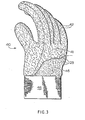
- a glove 40 is shown with the backside surface 41 thereof having an elastomeric coating 42, and with a portion 46 left uncoated with the coating line being designated by 44.
- the extended stable fibers 28 serve to provide a base for the subsequent texture of the elastomeric coating 42 as shown in Fig. 4. It will be apparent that the density of penetration, the depth of penetration and fiber denier will have an effect upon the subsequent texture of the surface 42, as can be seen in Fig. 4.
- such a coating may be a fused polyvinyl chloride plastisol, a rubber latex, or like elastomeric coating.
- Representative elastomeric compositions are as follows.
- composition 2 As purely illustrative of a natural rubber dip formulation useful in accordance with this invention, one may note the following composition 2:
- composition 3 As illustrative of a synthetic rubber dip formulation, one may note the following composition 3:
- a fabric glove is produced having a surface texture similar to a suede leather with a superior wet and dry grip and with excellent resistance to penetration, cutting and abrasion. It is desirable that these aforementioned properties be characteristic of a glove produced from the laminate, in accordance with this procedure, but also that the glove have releasing moisture characteristics entrapped inside from perspiration.
- a suitable fibrous non-woven web of a staple polyester was selected.
- a knit fabric polyester was seJected. The two webs were joined together by a conventional needling technique, utilizing the staple polyester material from the fibrous non-woven web, which resists matting down, and has a denier of 6.
- the degree of texture on the surface of the ultimate glove produced, in accordance with Example 1 may be varied according to the denier of the staple fiber utilized in the non-woven web.
- the number of penetrations per cm 2 and per square inch, respectively, and the depth of penetration may be varied for this purpose.
- the denier will be within the range of between about 1.5 and 6 denier
- the density of penetration will be within the range of between about 69.7-108.5 penetrations per cm 2 (450-700 penetrations per square inch)
- the depth of penetration will be within the range of between about 0.64 and 1.27 cm (0.25 and 0.50 inches).
- the wearing apparel desired and ultimately produced is a fabric glove having a textured surface, and a moisture barrier property.
- a fibrous non-woven web of a suitable staple was selected having a denier of 15. It was used to supply fibers for combining the non-woven web and a knit fabric web both of polyester, using a density of penetration of 62.0 penetrations per cm 2 (400 penetrations per square inch) and a depth of 1.27 cm (one-half inch), in the needling procedure.
- the fabric pieces for joining together to prepare the fabric glove are cut and joined in the usual conventional procedures with the subsequent glove liners so constructed coated by dipping in an elastomeric compound according to Composition 1 above.
- the texture of a desired ultimate moisture-proof surface may be varied by selecting a different denier which may be within the range of between about 6 and 15, by selecting a different degree of penetration which may be within the range of between about31.0 and 62.0 penetrations per cm 2 (200 and 400 penetrations per square inch) and a depth penetration which may be within the range of between about 0.64 and 1.27 cm (0.25 and 0.50 inches).
Landscapes
- Engineering & Computer Science (AREA)
- Textile Engineering (AREA)
- Mechanical Engineering (AREA)
- Health & Medical Sciences (AREA)
- General Health & Medical Sciences (AREA)
- Physical Education & Sports Medicine (AREA)
- Gloves (AREA)
- Laminated Bodies (AREA)
Claims (28)
Priority Applications (2)
| Application Number | Priority Date | Filing Date | Title |
|---|---|---|---|
| DE8282108436T DE3271777D1 (en) | 1982-09-13 | 1982-09-13 | Wearing apparel and methods for the manufacture of wearing apparel |
| EP82108436A EP0103039B1 (de) | 1982-09-13 | 1982-09-13 | Kleidungsstück und Verfahren zur Herstellung des Kleidungsstücks |
Applications Claiming Priority (1)
| Application Number | Priority Date | Filing Date | Title |
|---|---|---|---|
| EP82108436A EP0103039B1 (de) | 1982-09-13 | 1982-09-13 | Kleidungsstück und Verfahren zur Herstellung des Kleidungsstücks |
Publications (2)
| Publication Number | Publication Date |
|---|---|
| EP0103039A1 EP0103039A1 (de) | 1984-03-21 |
| EP0103039B1 true EP0103039B1 (de) | 1986-06-18 |
Family
ID=8189223
Family Applications (1)
| Application Number | Title | Priority Date | Filing Date |
|---|---|---|---|
| EP82108436A Expired EP0103039B1 (de) | 1982-09-13 | 1982-09-13 | Kleidungsstück und Verfahren zur Herstellung des Kleidungsstücks |
Country Status (2)
| Country | Link |
|---|---|
| EP (1) | EP0103039B1 (de) |
| DE (1) | DE3271777D1 (de) |
Families Citing this family (6)
| Publication number | Priority date | Publication date | Assignee | Title |
|---|---|---|---|---|
| US4849280A (en) * | 1987-10-13 | 1989-07-18 | Cairns & Brother Inc. | Laminate for fire protective gear |
| HU9303420D0 (en) * | 1991-09-27 | 1994-04-28 | Marmon Holdings Inc | Heat resistant and cut and puncture protective hand covering |
| US5827596A (en) * | 1994-07-07 | 1998-10-27 | Donohue; James | Lining material |
| FR2740304B1 (fr) * | 1995-10-30 | 1997-12-05 | Lebon Protection Ind Sa | Complexe anticoupure obtenu par contrecollage de deux supports |
| CN108741356B (zh) * | 2018-06-26 | 2019-12-06 | 常熟理工学院 | 一种无缝服装的制作方法 |
| JP7750552B2 (ja) | 2020-10-30 | 2025-10-07 | ナイキ イノベイト シーブイ | 非対称面複合不織テキスタイル及びその製造方法 |
Family Cites Families (3)
| Publication number | Priority date | Publication date | Assignee | Title |
|---|---|---|---|---|
| US4174542A (en) * | 1977-02-11 | 1979-11-20 | Becton, Dickinson And Company | Textured apron |
| US4172293A (en) * | 1977-02-11 | 1979-10-30 | Becton, Dickinson And Company | Wearing apparel and method of manufacture |
| US4089069A (en) * | 1977-02-11 | 1978-05-16 | Becton, Dickinson And Company | Wearing apparel and method of manufacture |
-
1982
- 1982-09-13 DE DE8282108436T patent/DE3271777D1/de not_active Expired
- 1982-09-13 EP EP82108436A patent/EP0103039B1/de not_active Expired
Also Published As
| Publication number | Publication date |
|---|---|
| EP0103039A1 (de) | 1984-03-21 |
| DE3271777D1 (en) | 1986-07-24 |
Similar Documents
| Publication | Publication Date | Title |
|---|---|---|
| US4359783A (en) | Wearing apparel and methods for the manufacturing of wearing apparel | |
| EP0134484B1 (de) | Rutschfeste Oberflächen | |
| US4589940A (en) | Method of making foamed slip resistant surfaces | |
| US4555813A (en) | Slip resistant gloves | |
| EP0107197B2 (de) | Arbeitshandschuh oder Arbeitsstiefel mit rutschfester Oberfläche | |
| US5236769A (en) | Fire-resistant composite lining for a garment | |
| KR101346563B1 (ko) | 내절단성 글러브 및 의류 | |
| US5925441A (en) | Breathable shell for outerwear | |
| US4089069A (en) | Wearing apparel and method of manufacture | |
| US4172293A (en) | Wearing apparel and method of manufacture | |
| EP0889697B1 (de) | Beflockte artikeln | |
| EP0445394B1 (de) | Verfahren zur Herstellung eines drapierbaren, wasserdampfdurchlässigen, wind- und wasserabweisenden Textilverbundstoffs | |
| US3173150A (en) | Gloves and methods of construction | |
| US20010008672A1 (en) | Flocked articles | |
| EP4045310A1 (de) | Textilverbundstoff und schuhwerk | |
| US4174542A (en) | Textured apron | |
| EP0103039A1 (de) | Kleidungsstück und Verfahren zur Herstellung des Kleidungsstücks | |
| US20210227906A1 (en) | Moisture wicking aluminized safety gear | |
| WO1995026650A1 (en) | Wearing apparel with improved gripability and slip-resistance | |
| CA1180175A (en) | Wearing apparel and methods for the manufacture of wearing apparel | |
| IE53414B1 (en) | Wearing apparel and methods for the manufacture of wearing apparel | |
| US20020040762A1 (en) | Textile composition | |
| US20250127249A1 (en) | Garment material | |
| GB2635597A (en) | Garment material | |
| WO2025088326A1 (en) | Garment material |
Legal Events
| Date | Code | Title | Description |
|---|---|---|---|
| PUAI | Public reference made under article 153(3) epc to a published international application that has entered the european phase |
Free format text: ORIGINAL CODE: 0009012 |
|
| AK | Designated contracting states |
Designated state(s): BE DE FR GB IT |
|
| 17P | Request for examination filed |
Effective date: 19840505 |
|
| GRAA | (expected) grant |
Free format text: ORIGINAL CODE: 0009210 |
|
| AK | Designated contracting states |
Kind code of ref document: B1 Designated state(s): BE DE FR GB IT |
|
| REF | Corresponds to: |
Ref document number: 3271777 Country of ref document: DE Date of ref document: 19860724 |
|
| ET | Fr: translation filed | ||
| ITF | It: translation for a ep patent filed | ||
| PLBE | No opposition filed within time limit |
Free format text: ORIGINAL CODE: 0009261 |
|
| STAA | Information on the status of an ep patent application or granted ep patent |
Free format text: STATUS: NO OPPOSITION FILED WITHIN TIME LIMIT |
|
| 26N | No opposition filed | ||
| ITPR | It: changes in ownership of a european patent |
Owner name: CESSIONE;EDOMONT INC. |
|
| REG | Reference to a national code |
Ref country code: FR Ref legal event code: TP Ref country code: FR Ref legal event code: CA |
|
| ITTA | It: last paid annual fee | ||
| REG | Reference to a national code |
Ref country code: GB Ref legal event code: 732 |
|
| REG | Reference to a national code |
Ref country code: FR Ref legal event code: CD Ref country code: FR Ref legal event code: CA |
|
| PGFP | Annual fee paid to national office [announced via postgrant information from national office to epo] |
Ref country code: FR Payment date: 20010817 Year of fee payment: 20 |
|
| PGFP | Annual fee paid to national office [announced via postgrant information from national office to epo] |
Ref country code: DE Payment date: 20010820 Year of fee payment: 20 |
|
| PGFP | Annual fee paid to national office [announced via postgrant information from national office to epo] |
Ref country code: GB Payment date: 20010821 Year of fee payment: 20 |
|
| PGFP | Annual fee paid to national office [announced via postgrant information from national office to epo] |
Ref country code: BE Payment date: 20010914 Year of fee payment: 20 |
|
| REG | Reference to a national code |
Ref country code: GB Ref legal event code: IF02 |
|
| PG25 | Lapsed in a contracting state [announced via postgrant information from national office to epo] |
Ref country code: GB Free format text: LAPSE BECAUSE OF EXPIRATION OF PROTECTION Effective date: 20020912 |
|
| BE20 | Be: patent expired |
Owner name: *ANSELL PROTECTIVE PRODUCTS INC. Effective date: 20020913 |
|
| REG | Reference to a national code |
Ref country code: GB Ref legal event code: PE20 Effective date: 20020912 |