EP0102118B2 - Cosmetic composition - Google Patents
Cosmetic composition Download PDFInfo
- Publication number
- EP0102118B2 EP0102118B2 EP83201182A EP83201182A EP0102118B2 EP 0102118 B2 EP0102118 B2 EP 0102118B2 EP 83201182 A EP83201182 A EP 83201182A EP 83201182 A EP83201182 A EP 83201182A EP 0102118 B2 EP0102118 B2 EP 0102118B2
- Authority
- EP
- European Patent Office
- Prior art keywords
- sub
- compounds
- compound
- residue
- formula
- Prior art date
- Legal status (The legal status is an assumption and is not a legal conclusion. Google has not performed a legal analysis and makes no representation as to the accuracy of the status listed.)
- Expired - Lifetime
Links
Images


Classifications
-
- A—HUMAN NECESSITIES
- A61—MEDICAL OR VETERINARY SCIENCE; HYGIENE
- A61Q—SPECIFIC USE OF COSMETICS OR SIMILAR TOILETRY PREPARATIONS
- A61Q19/00—Preparations for care of the skin
- A61Q19/10—Washing or bathing preparations
-
- A—HUMAN NECESSITIES
- A61—MEDICAL OR VETERINARY SCIENCE; HYGIENE
- A61K—PREPARATIONS FOR MEDICAL, DENTAL OR TOILETRY PURPOSES
- A61K8/00—Cosmetics or similar toiletry preparations
- A61K8/18—Cosmetics or similar toiletry preparations characterised by the composition
- A61K8/30—Cosmetics or similar toiletry preparations characterised by the composition containing organic compounds
- A61K8/40—Cosmetics or similar toiletry preparations characterised by the composition containing organic compounds containing nitrogen
- A61K8/45—Derivatives containing from 2 to 10 oxyalkylene groups
-
- C—CHEMISTRY; METALLURGY
- C11—ANIMAL OR VEGETABLE OILS, FATS, FATTY SUBSTANCES OR WAXES; FATTY ACIDS THEREFROM; DETERGENTS; CANDLES
- C11D—DETERGENT COMPOSITIONS; USE OF SINGLE SUBSTANCES AS DETERGENTS; SOAP OR SOAP-MAKING; RESIN SOAPS; RECOVERY OF GLYCEROL
- C11D1/00—Detergent compositions based essentially on surface-active compounds; Use of these compounds as a detergent
- C11D1/02—Anionic compounds
- C11D1/04—Carboxylic acids or salts thereof
- C11D1/06—Ether- or thioether carboxylic acids
Definitions
- This invention relates to cosmetic compositions containing detergents of the polyethercarboxylic acid type.
- Polyether carboxylic acids of the formula wherein R is a hydrophobic residue, X is oxygen or in some cases sulfur and n is a number having a value which in general is not over 10, are already known for a long time and are used in actual practice for over 25 years.
- n has an average valure of about 1
- compounds, wherein n has an average valuer of 2 or higher have a much wider use as detergent for several purposes.
- FR-A-794,012 relates to a very large group of surfactants, derived from carboxylic acid amides.
- the only compound corresponding to the above formula and specifically disclosed therein is the compound of example 9 which is used as an emulsifier for oils to be used in the first place in the textile industry.
- GB-A-1,169,496 relates to detergent compositions having controlled sudsing properties and especially suitable as general purpose detergents in washing machines.
- One of the components of the detergent mixture can be a compound of the above formula, and in example 9 a polyethercarboxylic derivative of coconut fatty acid amide is used which contains 3, 4 or 5 oxyethylene residues.
- a surfactant As regards the influence of a surfactant on the skin, it is in particular the toxicity to the bacterial flora on the skin which is of importance.
- a primary and a secondary toxicity can be noted.
- the primary toxicity is the one which is caused by the surfactants themselves.
- the secondary toxicity is the toxicity of the decomposition products of the surfactant which are formed on degradation thereof by the bacterial skin flora. Until recently this secondary toxicity was hardly taken into consideration, but of course it is of importance for the skin tolerance of a surfactant.
- the present invention accordingly, provides a cosmetic composition, characterized by the fact that it contains as detergent agent at least one compound of the formula R-CO-NH-(C 2 H 4 0) n -CH 2 COOH wherein R-CO- is the residue of at least one aliphatic acid of 6 - 22 carbon atoms and n represents a number having an average value of 2 - 10, or a salt thereof with an alkali metal, alkaline earth metal, ammonium or an amine with the exep- tions of a solution which only contains the compound and water, and of a composition containing an oleoylamino compound of this formula in combination with an oil chosen from olive oil, mineral oil and olein, and water.
- R-CO- is the residue of at least one aliphatic acid of 6 - 22 carbon atoms and n represents a number having an average value of 2 - 10, or a salt thereof with an alkali metal, alkaline earth metal, ammonium or an amine with the exep-
- the carbon chain of the aliphatic acid residue may be either straight or branched. Furthermore, the chain may be saturated or unsaturated. If R-CO- is derived from natural fats or oils, this residue in fact is a mixture of several acid residues.
- the compounds used according to the invention can be prepared simply by reacting a product of the formula in alkaline medium with a salt a haloacetic acid, usually with sodium chloroacetate, as is known per se for the preparation of the usual polyether carboxylic acids.
- the present compounds can be prepared in the form of the free acids or in the form of alkali metal, alkaline earth metal, ammonium or amine salts.
- the starting product for this reaction can be prepared in turn by reacting a suitable acid amide or mixture of acid amides with ethylene oxide. In all these cases addition only occurs to a single hydrogen atom of the amide; if more than one mole of ethylene oxide in used, each following molecule will add only to the already introduced terminal hydroxy group.
- Ethanolamides of some fatty acids are commercial products so that sometimes it may be preferred to start from these commercial products, when preparing the present compounds. However, in the case of fatty acid mixtures obtained from oils or fats, one will generally start from the unmodified amide.
- the present compounds are particularly suitable for use as a detergent in cosmetic compositions, such as shampoos, bubble baths and creams.
- the bacteria previously have been cultured in a nutrient-rich medium, they need some time to get accustomed to the new medium, which leads to an initial decrease of the number of cells during the first days. Thereafter, this decrease will continue, if the added surfactant has a high secondary toxicity. If, however, the secondary toxicity is low, the number of bacteria will increase again. After a further number of days the number of cells will start to decrease for the second time, but this time because the carbon source has been depleted.
- Figure 2 shows a graph in which the time starts after the original decrease in the number of cells, in this case to about 2.5 ⁇ 106/ml.
- the products of the present invention are clearly superior over these known products.
- the so obtained crude product is purified by adding 183 kg of 30 % HCI to 702 kg deionized water, heating the mixture and adding the crude reaction mixture of the foregoing step. The entire mixture is heated at 90°C and an oil separates. This oil is the desired carboxylic acid which is obtained in a yield of 396 kg.
- the product is initially liquid, but after standing some time is becomes solid, whereafter it can be molten and resolidified again.
- the commercial monoethanolamide of stearic acid (Rewoamid S280) (1 mole) is reacted with 7 moles of epoxyethane in the presence of 0.6 kg sodium methylate (80 %).
- the reaction is carried out in an autoclave like in Example 1 and the reaction time is about 1 / 2 hour. Thereafter, the product is reacted with about 1.5 moles of sodium monochloro acetate and about 1.5 moles of powdery NaOH.
- the reaction temperature is 60-65°C; the monochloro acetate is added in 6 portions and the NaOH in 12 portions.
- the total addition time is 6 hours, whereafter the reaction mixture is left standing for another hour.
- the conversion is about 80-85 %. From the so obtained crude product the acid is liberated by heating with the same weight amount of about 7% HCI.
- the product is obtained as a liquid which solidifies after some time and which can be melted and resolidified again.
- Perfume and dye in small amounts are added to obtain acceptable odor and color.
- the pH of the so obtained mixture is 7.4.
- This product was derived from a commercial alcohol, Dobanol, which is a mixture of C 12 and C 13 alcohols of which a part possesses a branched chain.
- Preparation The first four ingredients are stirred in water in the sequence mentioned above, and the pH of the mixture is then brought to a value of 6.5 with triethanolamine.
- perfume and dye can be added as needed.
- the so obtained concentrated product is diluted for use with 0.5-5 ports by weight of water, as needed.
- Preparation The first four ingredients are stirred into water in the indicated sequence; butyleneglycol is added and then the pH is adjusted to 6.9 with the aqueous sodiumhydroxide and finally the oil is stirred into the mixture.
- Preparation The first five components are stirred into water in the indicated sequence, then butyleneglycol is added and finally the pH is adjusted at 6.9 with triethanolamine.
- the first six ingredients which form the oil phase are mixed and heated to 65-70°C.
- the MgCl 2 , glycerol and water are separately mixed and heated at the same temperature and thereafter slowly added to the oil phase with stirring. After complete emulsification the triethanolamine which serves as neutralizing agent is added. Then the entire mixture is further stirred at 40°C and finally the preservative is added at this temperature.
- Creams for fatty skins Creams for fatty skins.
- composition A the glycerol monostearate also belongs to the fatty phase.
Landscapes
- Health & Medical Sciences (AREA)
- Life Sciences & Earth Sciences (AREA)
- Chemical & Material Sciences (AREA)
- Veterinary Medicine (AREA)
- Public Health (AREA)
- General Health & Medical Sciences (AREA)
- Animal Behavior & Ethology (AREA)
- Wood Science & Technology (AREA)
- Birds (AREA)
- Epidemiology (AREA)
- Organic Chemistry (AREA)
- Oil, Petroleum & Natural Gas (AREA)
- Chemical Kinetics & Catalysis (AREA)
- Engineering & Computer Science (AREA)
- Dermatology (AREA)
- Cosmetics (AREA)
- Detergent Compositions (AREA)
- Organic Low-Molecular-Weight Compounds And Preparation Thereof (AREA)
- Polyethers (AREA)
- Steroid Compounds (AREA)
Abstract
Description
- This invention relates to cosmetic compositions containing detergents of the polyethercarboxylic acid type.
- Polyether carboxylic acids of the formula

- A first mentioning of this class of compounds and of the preparation of compounds, wherein X is oxygen, can be found in U.S. patent 2,183,853. In the right column on page 1 of this patent a large number of formulae has been given of possible compounds which according to that patent would be useful for the same purposes. Amona them are also compounds of the formula

- Among the large group of compounds generally disclosed in U.S.-A-2,183,153 it is specifically the subgroup of compounds of the formula

- As regards the influence of a surfactant on the skin, it is in particular the toxicity to the bacterial flora on the skin which is of importance. In this respect a primary and a secondary toxicity can be noted. The primary toxicity is the one which is caused by the surfactants themselves. The secondary toxicity is the toxicity of the decomposition products of the surfactant which are formed on degradation thereof by the bacterial skin flora. Until recently this secondary toxicity was hardly taken into consideration, but of course it is of importance for the skin tolerance of a surfactant.
- The known polyether carboxylic acids of the type
-


- It should be remarked that compounds of the formula

- The present invention, accordingly, provides a cosmetic composition, characterized by the fact that it contains as detergent agent at least one compound of the formule R-CO-NH-(C2H40)n-CH2COOH wherein R-CO- is the residue of at least one aliphatic acid of 6 - 22 carbon atoms and n represents a number having an average value of 2 - 10, or a salt thereof with an alkali metal, alkaline earth metal, ammonium or an amine with the exep- tions of a solution which only contains the compound and water, and of a composition containing an oleoylamino compound of this formula in combination with an oil chosen from olive oil, mineral oil and olein, and water.
- In the compounds used according to the present invention the carbon chain of the aliphatic acid residue may be either straight or branched. Furthermore, the chain may be saturated or unsaturated. If R-CO- is derived from natural fats or oils, this residue in fact is a mixture of several acid residues.
- The compounds used according to the invention can be prepared simply by reacting a product of the formula

- The starting product for this reaction can be prepared in turn by reacting a suitable acid amide or mixture of acid amides with ethylene oxide. In all these cases addition only occurs to a single hydrogen atom of the amide; if more than one mole of ethylene oxide in used, each following molecule will add only to the already introduced terminal hydroxy group. Instead of the unmodified carbon amide, one may also start from a monoethanolamide. In this way a known product, wherein n=1, may be prepared directly by reacting the monoethanolamide with the monohaloacetic salt; the products of the present invention are prepared by first adding a further amount of ethylene oxide to this monoethanolamide, followed by the reaction with monohaloacetic salt. Ethanolamides of some fatty acids are commercial products so that sometimes it may be preferred to start from these commercial products, when preparing the present compounds. However, in the case of fatty acid mixtures obtained from oils or fats, one will generally start from the unmodified amide.
- Due to their good surfactant properties and particularly favorable primary and secondary toxicity values, the present compounds are particularly suitable for use as a detergent in cosmetic compositions, such as shampoos, bubble baths and creams.
- The testing of surfactants for the secondary toxicity on skin bacteria is carried out as follows:
- The skin bacteria are cultured at a temperature of 33°C (the optimum) in a medium containing sufficient nutrients until a concentration of 107 cells per ml has been obtained. Thereafter the cells are washed and transferred to a medium which contains all the necessary nutrients, including the trace elements, however with the exception of carbon. To this mixture 0,05% by weight of the surfactant to be tested is added and the develope- ment of the number of cells with the time is measured. A control test is carried out with the same nutrient mixture, but without any carbon addition.
- Because the bacteria previously have been cultured in a nutrient-rich medium, they need some time to get accustomed to the new medium, which leads to an initial decrease of the number of cells during the first days. Thereafter, this decrease will continue, if the added surfactant has a high secondary toxicity. If, however, the secondary toxicity is low, the number of bacteria will increase again. After a further number of days the number of cells will start to decrease for the second time, but this time because the carbon source has been depleted.
- The above is illustrated by the enclosed figure 1 which shows the number of cells for six compounds of the present invention and a control. Curves 1-4 have been obtained using compounds of the present invention and a control. Curves 1-4 have been obtained using compound

curve 5 has been obtained with the compound
curve 6 with the compound
- Figure 2 shows a graph in which the time starts after the original decrease in the number of cells, in this case to about 2.5 · 106/ml. In this case the compounds


- The invention is illustrated hereinafter with some examples of the preparations of the compounds and of formulations in which they are used.
- Preparation of C11H23-CO-NH-(C2H4O)6-CH2COOH.
- a) 1000 moles (243 kg) of the monoethanolamide of lauric acid in the form of the commercial product "Rewoamid L203" is reacted with 5000 moles (220 kg) of epoxyethane in the presence of 0.5 kg of sodium methylate as a catalyst. The reaction is carried out at 110-130°C in an autoclave under a pressure of 196-294 kPa. The reaction time is about 1/2 to 1 hour. The yield is quantitative.
- b) The product of step a) is reacted with a molar excess of sodium monochloro acetate (175 kg) and 60 kg of powdery NaOH. The monochloro acetate is added in 6 portions and the NaOH in 12 portions. The reaction temperature is 60-65°C; the addition time is 6 hours, whereafter the reaction mixture is left standing at this temperature for one more hour. The conversion of the polyetheralcohol to the polyetheracetate is about 75 to 80%.
- The so obtained crude product is purified by adding 183 kg of 30 % HCI to 702 kg deionized water, heating the mixture and adding the crude reaction mixture of the foregoing step. The entire mixture is heated at 90°C and an oil separates. This oil is the desired carboxylic acid which is obtained in a yield of 396 kg. The product is initially liquid, but after standing some time is becomes solid, whereafter it can be molten and resolidified again.
- Preparation of C17H35CO-NH-(C2H40)8-CH2COOH.
- The commercial monoethanolamide of stearic acid (Rewoamid S280) (1 mole) is reacted with 7 moles of epoxyethane in the presence of 0.6 kg sodium methylate (80 %). The reaction is carried out in an autoclave like in Example 1 and the reaction time is about 1/2 hour. Thereafter, the product is reacted with about 1.5 moles of sodium monochloro acetate and about 1.5 moles of powdery NaOH. The reaction temperature is 60-65°C; the monochloro acetate is added in 6 portions and the NaOH in 12 portions. The total addition time is 6 hours, whereafter the reaction mixture is left standing for another hour. The conversion is about 80-85 %. From the so obtained crude product the acid is liberated by heating with the same weight amount of about 7% HCI. The product is obtained as a liquid which solidifies after some time and which can be melted and resolidified again.
- Shampoo or shower composition.

- Perfume and dye in small amounts are added to obtain acceptable odor and color. The pH of the so obtained mixture is 7.4. The composition is neutralized with 37 % HCI to pH=4.2 η20=1400 mPa.s.
- Shampoo or showering composition.

- Perfume and dye as needed. η20=2000 mPa.s.
- t) This product was derived from a commercial alcohol, Dobanol, which is a mixture of C12 and C13 alcohols of which a part possesses a branched chain.
- Shampoo.

- Preparation: The first four ingredients are stirred in water in the sequence mentioned above, and the pH of the mixture is then brought to a value of 6.5 with triethanolamine. Of course, perfume and dye can be added as needed.
- Professional shampoo.

- The so obtained concentrated product is diluted for use with 0.5-5 ports by weight of water, as needed.
- Baby shampoo.
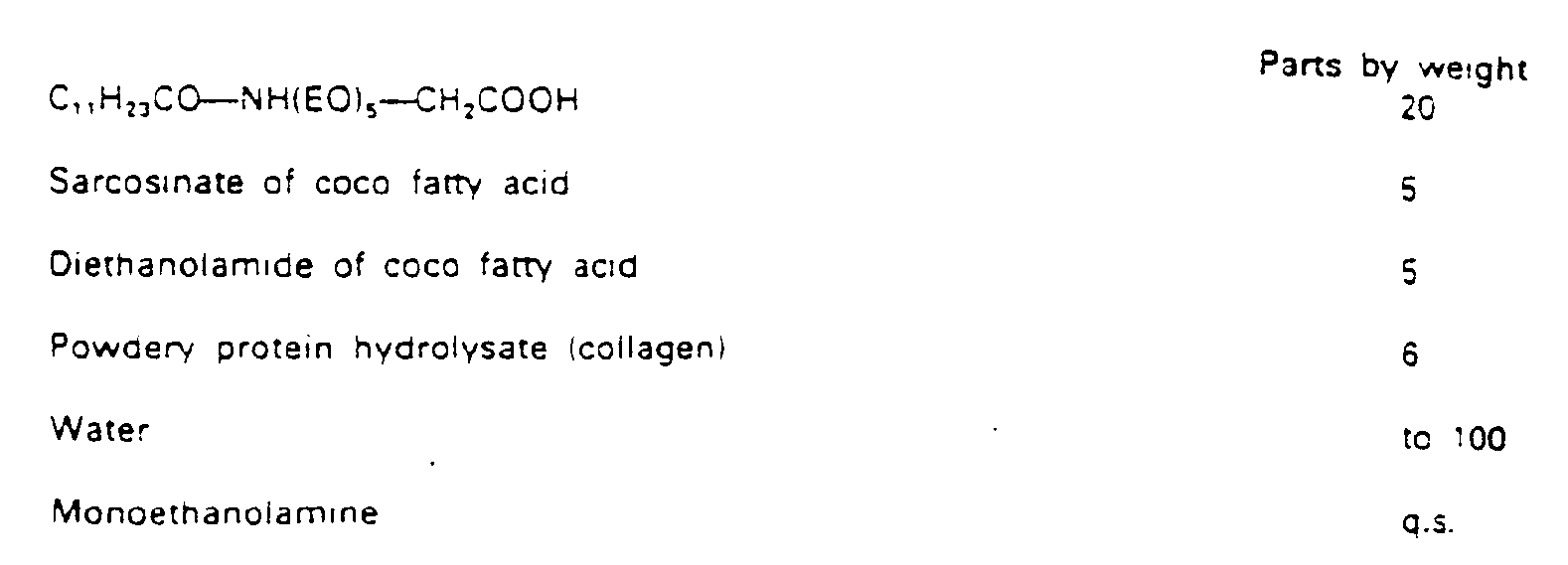
- Preparation: The protein hydrolysate is dissolved in water, thereafter the remaining components are stirred into the solution and the pH is adjusted a 7.2 with monoethanolamine.
- Protein shampoo.

- Preparation: The protein hydrolysate is added to water and when a clear solution has been obtained, the remaining components are stirred into the solution in the indicated sequence; finally the pH is adjusted to 5.5 with the aqueous sodium hydroxide.
- Anti-dandruff shampoo.

- Preparation: The products are stirred into water in the indicated sequence and finally the pH is adjusted to 6.8 with monoethanolamine. In the above examples of course perfume and/or dye can be added, also in as far as this has not been mentioned explicitly. The same is true for the compositions of the following examples.
- Bubble bath.

- Preparation: The first four ingredients are stirred into water in the indicated sequence; butyleneglycol is added and then the pH is adjusted to 6.9 with the aqueous sodiumhydroxide and finally the oil is stirred into the mixture.
- Cream bath.

- Preparation: The first above-mentioned four components (the surfactants) are mixed with heating at about 50°C and thy oils are dissolved therein at 40°C. If haziness occurs, the solution can be cleared with 1-2% of water.
- Showering foam composition.

- Preparation: The first five components are stirred into water in the indicated sequence, then butyleneglycol is added and finally the pH is adjusted at 6.9 with triethanolamine.
- Cream for normal or dry skin.

- The first six ingredients which form the oil phase are mixed and heated to 65-70°C. The MgCl2, glycerol and water are separately mixed and heated at the same temperature and thereafter slowly added to the oil phase with stirring. After complete emulsification the triethanolamine which serves as neutralizing agent is added. Then the entire mixture is further stirred at 40°C and finally the preservative is added at this temperature.
- Creams for fatty skins.

- The preparation is carried out in the same way as in Example 7. In composition A) the glycerol monostearate also belongs to the fatty phase.
Claims (4)
Priority Applications (1)
| Application Number | Priority Date | Filing Date | Title |
|---|---|---|---|
| AT83201182T ATE18395T1 (en) | 1982-08-19 | 1983-08-10 | POLYETHERCARBONIC ACID DERIVATIVES AND THEIR USE. |
Applications Claiming Priority (2)
| Application Number | Priority Date | Filing Date | Title |
|---|---|---|---|
| NL8203257 | 1982-08-19 | ||
| NL8203257A NL8203257A (en) | 1982-08-19 | 1982-08-19 | NEW POLYETHERCARBONIC ACID DERIVATIVES AND THEIR APPLICATIONS. |
Publications (4)
| Publication Number | Publication Date |
|---|---|
| EP0102118A2 EP0102118A2 (en) | 1984-03-07 |
| EP0102118A3 EP0102118A3 (en) | 1984-08-15 |
| EP0102118B1 EP0102118B1 (en) | 1986-03-05 |
| EP0102118B2 true EP0102118B2 (en) | 1992-11-11 |
Family
ID=19840158
Family Applications (1)
| Application Number | Title | Priority Date | Filing Date |
|---|---|---|---|
| EP83201182A Expired - Lifetime EP0102118B2 (en) | 1982-08-19 | 1983-08-10 | Cosmetic composition |
Country Status (7)
| Country | Link |
|---|---|
| US (1) | US4818440A (en) |
| EP (1) | EP0102118B2 (en) |
| AT (1) | ATE18395T1 (en) |
| DE (1) | DE3362437D1 (en) |
| ES (1) | ES525067A0 (en) |
| FI (1) | FI79023C (en) |
| NL (1) | NL8203257A (en) |
Cited By (1)
| Publication number | Priority date | Publication date | Assignee | Title |
|---|---|---|---|---|
| RU2619118C1 (en) * | 2015-11-25 | 2017-05-12 | федеральное государственное бюджетное образовательное учреждение высшего образования "Воронежский государственный университет" (ФГБОУ ВО "ВГУ") | A method for obtaining ethers of oxy-acids and monoethanolamids of fatty acids of vegetative oils |
Families Citing this family (30)
| Publication number | Priority date | Publication date | Assignee | Title |
|---|---|---|---|---|
| US4609493A (en) * | 1984-12-28 | 1986-09-02 | Alcon Laboratories, Inc. | Solution and method for removing inorganic and organic deposits from contact lenses |
| US5318717A (en) * | 1984-12-28 | 1994-06-07 | Alcon Laboratories, Inc. | Use of nonionic surfactant to enhance the cleaning effect of pancreatin on contact lenses |
| US5672575A (en) * | 1984-12-28 | 1997-09-30 | Alcon Laboratories, Inc. | Use of pluronic surfactant to enhance the cleaning effect of pancreatin on contact lenses |
| US4599195A (en) * | 1984-12-28 | 1986-07-08 | Alcon Laboratories, Inc. | Solution and method for removing protein, lipid, and calcium deposits from contact lenses |
| US4808239A (en) * | 1984-12-28 | 1989-02-28 | Alcon Laboratories, Inc. | Method of cleaning contact lens using compositions containing polyether carboxylic acid surfactant |
| NL8502267A (en) * | 1985-08-16 | 1987-03-16 | Chem Y | MIXTURE OF ALKYL ETHERSULPHATE AND ALKYLAMIDOPOLYGLYCOLETHERCARBONIC ACID OR SALTS. |
| NL8502587A (en) * | 1985-09-20 | 1987-04-16 | Chem Y | METHOD FOR PREPARING OXYETHYLENE GROUPS AND CARBOXYMETHYL GROUPS OR SALTS THEREOF, CONTAINING CAPILLARY-ACTIVE PRODUCTS, AND THE PRODUCTS SO PRODUCED AND THEIR USE |
| NL8600607A (en) * | 1986-03-08 | 1987-10-01 | Stamicarbon | SYNDET IN PIECE FORM. |
| DE3703258A1 (en) * | 1987-02-04 | 1988-08-18 | Eau De Cologne & Parfuemerie Fabrik 4711 | Soap-based personal care products |
| GB8814295D0 (en) * | 1988-06-16 | 1988-07-20 | Unilever Plc | Cosmetic composition |
| US5213716A (en) * | 1989-06-21 | 1993-05-25 | Colgate-Palmolive Company | Hair conditioning shampoo containing long chain alcohol component |
| DE3943522A1 (en) * | 1989-07-26 | 1991-02-07 | Boehringer Mannheim Gmbh | HETEROBIFUNCTIONAL CONNECTIONS |
| DE3924705A1 (en) * | 1989-07-26 | 1991-01-31 | Boehringer Mannheim Gmbh | HETEROBIFUNCTIONAL CONNECTIONS |
| CA2055048C (en) * | 1990-11-16 | 1996-05-14 | Kofi Ofosu-Asante | Alkaline light-duty dishwashing detergent composition containing an alkyl ethoxy carboxylate surfactant, magnesium ions, chelator and buffer |
| ATE130755T1 (en) * | 1991-09-26 | 1995-12-15 | Klaus Bous | CLEANING LIQUID, PARTICULARLY FOR EMERGENCY KIT, AND THEREOF USE. |
| DE4225626A1 (en) * | 1992-08-03 | 1994-02-10 | Henkel Kgaa | Use of ether carboxylic acids as germicidal substances |
| GB9307805D0 (en) * | 1993-04-15 | 1993-06-02 | Unilever Plc | Cleaning composition |
| WO1995008614A1 (en) * | 1993-09-24 | 1995-03-30 | Kao Corporation | Detergent composition |
| ES2146268T3 (en) | 1994-06-27 | 2000-08-01 | Kao Corp | PROCEDURE FOR THE MANUFACTURE OF AMIDOETERCARBOXILICO ACID OR OF A SALT THEREOF AND OF A MIXTURE OF AGENTS WITH SURFACE ACTIVITY THAT CONTAIN THEM. |
| EP0699435B1 (en) | 1994-08-02 | 2003-05-14 | Kao Corporation | Detergent compositions |
| WO1996005281A1 (en) * | 1994-08-10 | 1996-02-22 | Kao Corporation | Detergent composition |
| WO1996005282A1 (en) * | 1994-08-10 | 1996-02-22 | Kao Corporation | Detergent composition |
| EP0714977B1 (en) | 1994-11-28 | 2000-08-16 | Kao Corporation | Detergent composition |
| JP3532333B2 (en) | 1994-11-28 | 2004-05-31 | 花王株式会社 | Detergent composition |
| GB9500313D0 (en) * | 1995-01-07 | 1995-03-01 | Procter & Gamble | Cleansing compositions |
| US5858342A (en) * | 1995-01-07 | 1999-01-12 | The Procter & Gamble Company | Cleansing compositions |
| DE19509981C2 (en) * | 1995-03-18 | 1998-07-16 | Kao Corp | Toner shampoo |
| DE19530550A1 (en) * | 1995-08-19 | 1997-02-20 | Kao Corp Gmbh | shampoo |
| DE19540054C1 (en) * | 1995-10-27 | 1996-09-19 | Kao Corp Gmbh | Compsn. for permanent waving of human hair |
| FR2773069B1 (en) | 1997-12-29 | 2001-02-02 | Oreal | COSMETIC COMPOSITION COMPRISING AT LEAST ONE AMIDOETHERCARBOXYLIC ACID SURFACTANT AND AT LEAST ONE ASSOCIATION OF AN ANIONIC POLYMER AND A CATIONIC POLYMER |
Family Cites Families (14)
| Publication number | Priority date | Publication date | Assignee | Title |
|---|---|---|---|---|
| US2183853A (en) * | 1934-12-22 | 1939-12-19 | Ig Farbenindustrie Ag | Polyoxyalkylene ether acid compounds containing a higher aliphatic group |
| GB583031A (en) * | 1943-03-08 | 1946-12-05 | Du Pont | Surface-active compounds |
| FR903547A (en) * | 1943-04-08 | 1945-10-08 | Ste Ind Chim Bale | New amide compounds |
| BE609934A (en) * | 1967-04-07 | |||
| US3072690A (en) * | 1961-02-01 | 1963-01-08 | Nalco Chemical Co | Water-dispersible amido-quaternary ammonium salts |
| US3959460A (en) * | 1967-08-07 | 1976-05-25 | L'oreal | Cosmetic compositions containing anionic surface active agent containing mono- or polyhydroxylated mono- or poly ether chains and a terminal acid group |
| US3941710A (en) * | 1972-04-24 | 1976-03-02 | Lever Brothers Company | Phosphate - free dishwashing compositions containing an alkyl polyether carboxylate surfactant |
| GB1432137A (en) * | 1972-06-13 | 1976-04-14 | Chem Y | Detergent compositions |
| US4122043A (en) * | 1973-12-19 | 1978-10-24 | Polytrol Chemical Corporation | Amidobetaine containing detergent composition non-toxic to aquatic life |
| US3990991A (en) * | 1974-02-01 | 1976-11-09 | Revlon, Inc. | Shampoo conditioner formulations |
| GB1564508A (en) * | 1976-01-16 | 1980-04-10 | Unilever Ltd | Detergent composition |
| DE2644498A1 (en) * | 1976-10-01 | 1978-04-06 | Henkel Kgaa | Acyl-(4)-amino-(2)-oxa-butane-carboxylic acid cpds. - and salts, used as surfactants and builders in low phosphate or phosphate-free detergent compsns. |
| JPS5920718B2 (en) * | 1980-11-27 | 1984-05-15 | 花王株式会社 | hypoallergenic cleaning agent |
| US4443362A (en) * | 1981-06-29 | 1984-04-17 | Johnson & Johnson Baby Products Company | Detergent compounds and compositions |
-
1982
- 1982-08-19 NL NL8203257A patent/NL8203257A/en not_active Application Discontinuation
-
1983
- 1983-08-10 EP EP83201182A patent/EP0102118B2/en not_active Expired - Lifetime
- 1983-08-10 DE DE8383201182T patent/DE3362437D1/en not_active Expired
- 1983-08-10 AT AT83201182T patent/ATE18395T1/en active
- 1983-08-16 US US06/523,781 patent/US4818440A/en not_active Expired - Lifetime
- 1983-08-19 ES ES525067A patent/ES525067A0/en active Granted
- 1983-08-19 FI FI832973A patent/FI79023C/en not_active IP Right Cessation
Cited By (1)
| Publication number | Priority date | Publication date | Assignee | Title |
|---|---|---|---|---|
| RU2619118C1 (en) * | 2015-11-25 | 2017-05-12 | федеральное государственное бюджетное образовательное учреждение высшего образования "Воронежский государственный университет" (ФГБОУ ВО "ВГУ") | A method for obtaining ethers of oxy-acids and monoethanolamids of fatty acids of vegetative oils |
Also Published As
| Publication number | Publication date |
|---|---|
| ATE18395T1 (en) | 1986-03-15 |
| FI832973A0 (en) | 1983-08-19 |
| ES8500891A1 (en) | 1984-11-01 |
| EP0102118A3 (en) | 1984-08-15 |
| DE3362437D1 (en) | 1986-04-10 |
| ES525067A0 (en) | 1984-11-01 |
| FI79023B (en) | 1989-07-31 |
| EP0102118A2 (en) | 1984-03-07 |
| US4818440A (en) | 1989-04-04 |
| FI79023C (en) | 1989-11-10 |
| NL8203257A (en) | 1984-03-16 |
| FI832973L (en) | 1984-02-20 |
| EP0102118B1 (en) | 1986-03-05 |
Similar Documents
| Publication | Publication Date | Title |
|---|---|---|
| EP0102118B1 (en) | Cosmetic composition | |
| EP0670827B1 (en) | Alkylglyceramides and their use as surfactants | |
| EP0219893B1 (en) | Detergents containing polyether carboxylic acid derivatives, their preparation and their application | |
| US5922659A (en) | Cleanser composition | |
| EP0386826B2 (en) | Amidated fatty acid mixtures and use thereof as thickeners | |
| US3627822A (en) | Novel compounds with detergency and fabric-softening ability and method of making the same | |
| EP1062310B1 (en) | Improved alkanolamides | |
| US5693605A (en) | Detergent composition comprising an amide-ether derivative mixture and an anionic surfactant | |
| US4415487A (en) | Bis-betaines, a process for their preparation, and cleaning agents containing these compounds | |
| US4263177A (en) | Amine oxide foam stabilizers for alkyl benzene sulfonate foaming agents | |
| US3385755A (en) | Undecylenic acid alkylolamide derivatives for controlling bacteria, fungi, and dandruff | |
| US5834517A (en) | Meadowfoam sulfosuccinates in personal care applications | |
| US5034555A (en) | Novel alkoxylated amido sulfates | |
| JPH07138592A (en) | Cleaning composition | |
| DE3337026A1 (en) | Amine oxide sulphonates | |
| JPH0987289A (en) | Surfactant | |
| JP3441222B2 (en) | Detergent composition | |
| US5770751A (en) | Meadowfoam sulfosuccinates | |
| JPS61143347A (en) | Method of producing surface active preparation containing novel amineamide | |
| JPH11152260A (en) | Production of amidamine oxide compound excellent in stability and surface active composition derived from the same compound | |
| JPH0137440B2 (en) | ||
| JPS6025479B2 (en) | Surfactant composition for cosmetics and cleaning agents | |
| US3529016A (en) | N-(2-alkyl)-sulfoacetamides | |
| JP3441223B2 (en) | Detergent composition | |
| JPH05117687A (en) | Liquid detergent composition |
Legal Events
| Date | Code | Title | Description |
|---|---|---|---|
| PUAI | Public reference made under article 153(3) epc to a published international application that has entered the european phase |
Free format text: ORIGINAL CODE: 0009012 |
|
| 17P | Request for examination filed |
Effective date: 19830810 |
|
| AK | Designated contracting states |
Designated state(s): AT BE CH DE FR GB IT LI NL SE |
|
| PUAL | Search report despatched |
Free format text: ORIGINAL CODE: 0009013 |
|
| AK | Designated contracting states |
Designated state(s): AT BE CH DE FR GB IT LI NL SE |
|
| PUAF | Information related to the publication of a search report (a3 document) modified or deleted |
Free format text: ORIGINAL CODE: 0009199SEPU |
|
| PUAL | Search report despatched |
Free format text: ORIGINAL CODE: 0009013 |
|
| D17D | Deferred search report published (deleted) | ||
| AK | Designated contracting states |
Designated state(s): AT BE CH DE FR GB IT LI NL SE |
|
| ITF | It: translation for a ep patent filed | ||
| GRAA | (expected) grant |
Free format text: ORIGINAL CODE: 0009210 |
|
| AK | Designated contracting states |
Kind code of ref document: B1 Designated state(s): AT BE CH DE FR GB IT LI NL SE |
|
| REF | Corresponds to: |
Ref document number: 18395 Country of ref document: AT Date of ref document: 19860315 Kind code of ref document: T |
|
| REF | Corresponds to: |
Ref document number: 3362437 Country of ref document: DE Date of ref document: 19860410 |
|
| RAP2 | Party data changed (patent owner data changed or rights of a patent transferred) |
Owner name: STAMICARBON B.V. |
|
| ET | Fr: translation filed | ||
| PLBI | Opposition filed |
Free format text: ORIGINAL CODE: 0009260 |
|
| 26 | Opposition filed |
Opponent name: HOECHST AKTIENGESELLSCHAFT, FRANKFURT Effective date: 19860924 |
|
| NLR1 | Nl: opposition has been filed with the epo |
Opponent name: HOECHST AKTIENGESELLSCHAFT |
|
| PLBI | Opposition filed |
Free format text: ORIGINAL CODE: 0009260 |
|
| BECN | Be: change of holder's name |
Effective date: 19860305 |
|
| 26 | Opposition filed |
Opponent name: HAARKOSMETIK UND PARFUEMERIEN GMBH Effective date: 19861205 Opponent name: HENKEL KOMMANDITGESELLSCHAFT AUF AKTIEN Effective date: 19861203 |
|
| NLR1 | Nl: opposition has been filed with the epo |
Opponent name: HAARKOSMETIK UND PARFUEMERIEN GMBH Opponent name: HENKEL KOMMANDITGESELLSCHAFT AUF AKTIEN |
|
| REG | Reference to a national code |
Ref country code: CH Ref legal event code: PUE Owner name: STAMICARBON B.V. |
|
| PLAB | Opposition data, opponent's data or that of the opponent's representative modified |
Free format text: ORIGINAL CODE: 0009299OPPO |
|
| R26 | Opposition filed (corrected) |
Opponent name: HOECHST AKTIENGESELLSCHAFT, FRANKFURT * 861203 HEN Effective date: 19860924 |
|
| ITTA | It: last paid annual fee | ||
| PUAH | Patent maintained in amended form |
Free format text: ORIGINAL CODE: 0009272 |
|
| STAA | Information on the status of an ep patent application or granted ep patent |
Free format text: STATUS: PATENT MAINTAINED AS AMENDED |
|
| 27A | Patent maintained in amended form |
Effective date: 19921111 |
|
| AK | Designated contracting states |
Kind code of ref document: B2 Designated state(s): AT BE CH DE FR GB IT LI NL SE |
|
| NLR2 | Nl: decision of opposition | ||
| ITF | It: translation for a ep patent filed | ||
| ET3 | Fr: translation filed ** decision concerning opposition | ||
| NLR3 | Nl: receipt of modified translations in the netherlands language after an opposition procedure | ||
| REG | Reference to a national code |
Ref country code: GB Ref legal event code: 732E |
|
| REG | Reference to a national code |
Ref country code: CH Ref legal event code: PUE Owner name: KAO CORPORATION |
|
| ITPR | It: changes in ownership of a european patent |
Owner name: CESSIONE;KAO CORPORATION |
|
| REG | Reference to a national code |
Ref country code: FR Ref legal event code: TP |
|
| NLS | Nl: assignments of ep-patents |
Owner name: KAO CORPORATION TE TOKIO, JAPAN. |
|
| EAL | Se: european patent in force in sweden |
Ref document number: 83201182.9 |
|
| APAC | Appeal dossier modified |
Free format text: ORIGINAL CODE: EPIDOS NOAPO |
|
| APAC | Appeal dossier modified |
Free format text: ORIGINAL CODE: EPIDOS NOAPO |
|
| PGFP | Annual fee paid to national office [announced via postgrant information from national office to epo] |
Ref country code: SE Payment date: 19980806 Year of fee payment: 16 |
|
| PGFP | Annual fee paid to national office [announced via postgrant information from national office to epo] |
Ref country code: AT Payment date: 19980813 Year of fee payment: 16 |
|
| PGFP | Annual fee paid to national office [announced via postgrant information from national office to epo] |
Ref country code: CH Payment date: 19980824 Year of fee payment: 16 |
|
| PGFP | Annual fee paid to national office [announced via postgrant information from national office to epo] |
Ref country code: NL Payment date: 19980827 Year of fee payment: 16 |
|
| PGFP | Annual fee paid to national office [announced via postgrant information from national office to epo] |
Ref country code: BE Payment date: 19981016 Year of fee payment: 16 |
|
| PG25 | Lapsed in a contracting state [announced via postgrant information from national office to epo] |
Ref country code: AT Free format text: LAPSE BECAUSE OF NON-PAYMENT OF DUE FEES Effective date: 19990810 |
|
| PG25 | Lapsed in a contracting state [announced via postgrant information from national office to epo] |
Ref country code: SE Free format text: THE PATENT HAS BEEN ANNULLED BY A DECISION OF A NATIONAL AUTHORITY Effective date: 19990830 |
|
| PG25 | Lapsed in a contracting state [announced via postgrant information from national office to epo] |
Ref country code: LI Free format text: LAPSE BECAUSE OF NON-PAYMENT OF DUE FEES Effective date: 19990831 Ref country code: CH Free format text: LAPSE BECAUSE OF NON-PAYMENT OF DUE FEES Effective date: 19990831 Ref country code: BE Free format text: LAPSE BECAUSE OF NON-PAYMENT OF DUE FEES Effective date: 19990831 |
|
| BERE | Be: lapsed |
Owner name: KAO CORP. Effective date: 19990831 |
|
| PG25 | Lapsed in a contracting state [announced via postgrant information from national office to epo] |
Ref country code: NL Free format text: LAPSE BECAUSE OF NON-PAYMENT OF DUE FEES Effective date: 20000301 |
|
| REG | Reference to a national code |
Ref country code: CH Ref legal event code: PL |
|
| EUG | Se: european patent has lapsed |
Ref document number: 83201182.9 |
|
| NLV4 | Nl: lapsed or anulled due to non-payment of the annual fee |
Effective date: 20000301 |
|
| REG | Reference to a national code |
Ref country code: GB Ref legal event code: IF02 |
|
| PGFP | Annual fee paid to national office [announced via postgrant information from national office to epo] |
Ref country code: GB Payment date: 20020807 Year of fee payment: 20 |
|
| PGFP | Annual fee paid to national office [announced via postgrant information from national office to epo] |
Ref country code: FR Payment date: 20020808 Year of fee payment: 20 |
|
| PGFP | Annual fee paid to national office [announced via postgrant information from national office to epo] |
Ref country code: DE Payment date: 20020816 Year of fee payment: 20 |
|
| PG25 | Lapsed in a contracting state [announced via postgrant information from national office to epo] |
Ref country code: GB Free format text: LAPSE BECAUSE OF EXPIRATION OF PROTECTION Effective date: 20030809 |
|
| REG | Reference to a national code |
Ref country code: GB Ref legal event code: PE20 |
|
| APAH | Appeal reference modified |
Free format text: ORIGINAL CODE: EPIDOSCREFNO |