EP0101034B1 - Method for preparing 3-amino-5-(substituted)isoxazole - Google Patents
Method for preparing 3-amino-5-(substituted)isoxazole Download PDFInfo
- Publication number
- EP0101034B1 EP0101034B1 EP83107773A EP83107773A EP0101034B1 EP 0101034 B1 EP0101034 B1 EP 0101034B1 EP 83107773 A EP83107773 A EP 83107773A EP 83107773 A EP83107773 A EP 83107773A EP 0101034 B1 EP0101034 B1 EP 0101034B1
- Authority
- EP
- European Patent Office
- Prior art keywords
- amino
- range
- substituted
- isoxazole
- reaction mixture
- Prior art date
- Legal status (The legal status is an assumption and is not a legal conclusion. Google has not performed a legal analysis and makes no representation as to the accuracy of the status listed.)
- Expired
Links
- 0 CC(*)(*)c1cc(N)n[o]1 Chemical compound CC(*)(*)c1cc(N)n[o]1 0.000 description 1
Classifications
-
- C—CHEMISTRY; METALLURGY
- C07—ORGANIC CHEMISTRY
- C07D—HETEROCYCLIC COMPOUNDS
- C07D261/00—Heterocyclic compounds containing 1,2-oxazole or hydrogenated 1,2-oxazole rings
- C07D261/02—Heterocyclic compounds containing 1,2-oxazole or hydrogenated 1,2-oxazole rings not condensed with other rings
- C07D261/06—Heterocyclic compounds containing 1,2-oxazole or hydrogenated 1,2-oxazole rings not condensed with other rings having two or more double bonds between ring members or between ring members and non-ring members
- C07D261/10—Heterocyclic compounds containing 1,2-oxazole or hydrogenated 1,2-oxazole rings not condensed with other rings having two or more double bonds between ring members or between ring members and non-ring members with hetero atoms or with carbon atoms having three bonds to hetero atoms with at the most one bond to halogen, e.g. ester or nitrile radicals, directly attached to ring carbon atoms
- C07D261/14—Nitrogen atoms
Definitions
- This invention relates to a method for preparing 3-amino-5-(substituted)isoxazole.
- 3-amino-5-(substituted)isoxazoles e.g., 3-amino-5-(t-butyl)isoxazole
- 3-amino-5-(t-butyl)isoxazole are valuable intermediates used in the production of herbicidally active isoxazole derivatives.
- DE-A-2825194 discloses the preparation of 3-amino-5-(substituted)isoxazoles from ⁇ -ketonitril and NH 2 0H via a iminoether and works in the absence of water.
- AT-B-365 583 shows the preparation of 3-amino-5-(t-butyl)isoxazole by reacting hydroxyl amine or a salt thereof with pivaloyl acetonitrile in an aqueous medium at a pH range of from 5 to 8, preferably from 6.0 to 7.0. This process does not comprise an extraction of the initial reaction product with a water immiscible solvent.
- This invention provides a method for preparing 3-amino-5-(substituted)isoxazole represented by the Formula (I): wherein
- the method of this invention has been found particularly suitable for preparing 3-amino-5-(t-butyl)isoxazole, i.e., a compound of Formula (I) wherein R 1 , R 2 and R 3 are methyl; but, it is believed that any compound within the scope of Formula (I) could be prepared by the method of this invention.
- hydroxylamine can be used as such or can be used in its salt form such as hydroxylamine hydrochloride or hydroxylamine sulfate.
- the reaction time will, of course, vary inversely with temperature and the desired degree of completeness of reaction. At, for example, 50°C, the reaction is typically substantially complete in 10 to 20 hours.
- the pH of the reaction mixture can be adjusted with any suitable organic or inorganic base, such as, for example, ammonia, triethylamine, alkali metal hydroxides, such as sodium, potassium or lithium hydroxide, alkali metal carbonate, such as sodium or potassium carbonate.
- An inorganic base is preferably used.
- reaction product consists largely of a mixture of amidoxime of the Formula (III): and from 7 to 10 weight percent of 5-amino-3-(substituted)isoxazole of the Formula (IV): wherein R', R 2 , R 3 in each of the Formulae (III) and (IV) compounds are as previously defined.
- the Formula (III) amidoxime is the precursor for the desired Formula (I) compound, which latter is prepared by acid hydrolysis of the former.
- the aqueous reaction mixture from the first step is extracted with a water immiscible organic solvent or mixture of solvents.
- a water immiscible organic solvent or solvent mixture can be used, for example, benzene, toluene, carbon tetrachloride, chloroform, dichloroethane, or a mixture of such solvents, e.g., carbon tetrachloride and chloroform, hexane and chloroform, carbon tetrachloride and dichloroethane.
- the aqueous phase containing the Formula (III) amidoxime is in the third step acidified to a pH in the range of 5 to 5.5 and heated to a temperature in the range of 40°C to 60°C, preferably 50°C to 55°C, for a time sufficient to cyclicize the Formula (IV) aldoxime to the Formula (I) product.
- the quantity of acid utilized in order to adjust the pH of the said aqueous phase could be, at most, about 0.1 mole equivalent in excess of that required to arrive at a neutral pH of 7.0; and typically the amount of acid required would be less than 0.05 mole equivalent.
- the acid used to adjust the pH to within the desired range is a mineral acid, such as, hydrochloric, sulfuric or phosphoric acid, although organic acids may be used with equal efficacy.
- the precipitation of the desired Formula (I) product is completed by adjusting the pH of the reaction mixture to at least 10 and preferably in the range of 10 to 11 by addition of one or more of the aforesaid organic and preferably inorganic bases.
- the product may be separated from the aqueous alkaline reaction medium by any technique known to the art, such as, for example, filtration, centrifugation or the like.
- the process of the invention provides a straightforward means of preparing high purity 3-amino-5-(substituted)isoxazole in high yield devoid of the disadvantages of the prior art. It might also be added that the process of the invention also permits recovery of 5-amino-3-(substituted)isoxazole from the organic solvent in which the same was selectively extracted.
- 5-amino-3-(substituted)isoxazole removed from the reaction mixture by extraction in step (b) can be conveniently isolated by removal of solvent, for example, evaporation and further purified by recrystallization, which 5-amino-3-(substituted)isoxazole also is useful as an intermediate in, for example, the preparation of certain herbicidally active compounds.
- Example 2 describes the preparation of a preferred 3-(amino)-5-(substituted)isoxazole, namely, 3-amino-5-(t-butyl)isoxazole.
- the aqueous phase was acidified by addition of 10 milliliters of concentrated hydrochloric acid to pH to 5.5 and permitted to react, with stirring, at 50°C for about 2-1/2 hours. After cooling the pH of the reaction mixture was adjusted to pH 10-11 by addition of 50 percent aqueous sodium hydroxide solution. The resulting precipate was filtered, washed and dried, affording 27.8 grams (79.4 percent yield) of 98.2 percent assay, 3-amino-5-(t-butyl)isoxazole melting at 108-111°C.
- the aqueous phase was acidified by addition of 12 milliliters of concentrated hydrochloric acid to pH 5 to 5.5, and permitted to react with stirring at 50°C for about 2 hours. After cooling, the pH of the reaction mixture was adjusted to pH 11.5 by addition of 50 percent aqueous sodium hydroxide solution. The resulting precipitate was filtered, washed and dried affording 27.0 grams (77 percent yield) of 98 percent assay 3-amino-5-(t-butyl)isoxazole melting at 108 ⁇ 110°C.
Landscapes
- Chemical & Material Sciences (AREA)
- Organic Chemistry (AREA)
- Heterocyclic Carbon Compounds Containing A Hetero Ring Having Nitrogen And Oxygen As The Only Ring Hetero Atoms (AREA)
Description
- This invention relates to a method for preparing 3-amino-5-(substituted)isoxazole.
- 3-amino-5-(substituted)isoxazoles, e.g., 3-amino-5-(t-butyl)isoxazole, are valuable intermediates used in the production of herbicidally active isoxazole derivatives.
- DE-A-2825194 discloses the preparation of 3-amino-5-(substituted)isoxazoles from β-ketonitril and NH20H via a iminoether and works in the absence of water.
- AT-B-365 583 shows the preparation of 3-amino-5-(t-butyl)isoxazole by reacting hydroxyl amine or a salt thereof with pivaloyl acetonitrile in an aqueous medium at a pH range of from 5 to 8, preferably from 6.0 to 7.0. This process does not comprise an extraction of the initial reaction product with a water immiscible solvent.
- This invention provides a method for preparing 3-amino-5-(substituted)isoxazole represented by the Formula (I):

- R1 is hydrogen, C1 to C4 alkyl or up to C6 cycloalkyl;
- R2 is C1 to C4 alkyl, up to C6 cycloalkyl; and
- R3 is C1 to C4 alkyl.
- The method of this invention has been found particularly suitable for preparing 3-amino-5-(t-butyl)isoxazole, i.e., a compound of Formula (I) wherein R1, R2 and R3 are methyl; but, it is believed that any compound within the scope of Formula (I) could be prepared by the method of this invention.
- More particularly, in the first step of the method of this invention, an appropriately substituted acetonitrile of the Formula (II):

- Under the aforesaid conditions of pH and temperature at which the Formula (II) acetonitrile and hydroxylamine are reacted, it has been observed that the reaction product consists largely of a mixture of amidoxime of the Formula (III):

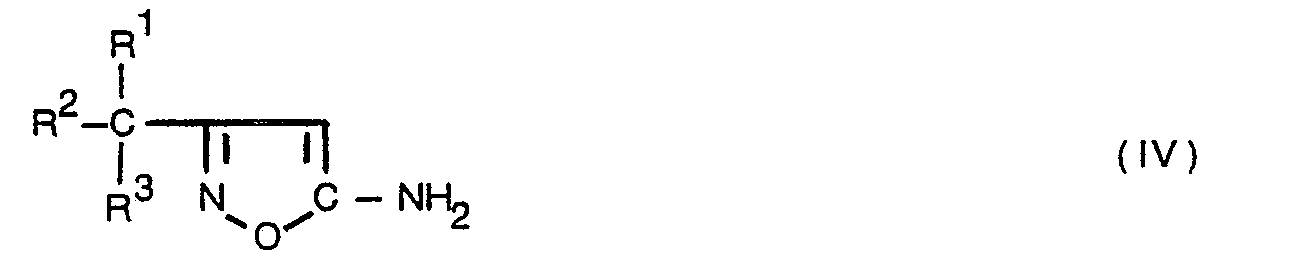
- Consequently, in the second step of the process of this invention, the aqueous reaction mixture from the first step is extracted with a water immiscible organic solvent or mixture of solvents. Any water immiscible organic solvent or solvent mixture can be used, for example, benzene, toluene, carbon tetrachloride, chloroform, dichloroethane, or a mixture of such solvents, e.g., carbon tetrachloride and chloroform, hexane and chloroform, carbon tetrachloride and dichloroethane.
- After solvent extraction and phase separation, the aqueous phase containing the Formula (III) amidoxime is in the third step acidified to a pH in the range of 5 to 5.5 and heated to a temperature in the range of 40°C to 60°C, preferably 50°C to 55°C, for a time sufficient to cyclicize the Formula (IV) aldoxime to the Formula (I) product.
- The quantity of acid utilized in order to adjust the pH of the said aqueous phase could be, at most, about 0.1 mole equivalent in excess of that required to arrive at a neutral pH of 7.0; and typically the amount of acid required would be less than 0.05 mole equivalent. Preferably the acid used to adjust the pH to within the desired range is a mineral acid, such as, hydrochloric, sulfuric or phosphoric acid, although organic acids may be used with equal efficacy.
- In the fourth step of the process of this invention, the precipitation of the desired Formula (I) product is completed by adjusting the pH of the reaction mixture to at least 10 and preferably in the range of 10 to 11 by addition of one or more of the aforesaid organic and preferably inorganic bases. The product may be separated from the aqueous alkaline reaction medium by any technique known to the art, such as, for example, filtration, centrifugation or the like.
- The process of the invention provides a straightforward means of preparing high purity 3-amino-5-(substituted)isoxazole in high yield devoid of the disadvantages of the prior art. It might also be added that the process of the invention also permits recovery of 5-amino-3-(substituted)isoxazole from the organic solvent in which the same was selectively extracted.
- To summarize the method of this invention, the same involves the steps of:
- (a) reacting, in water at a temperature in the range of from ambient to 60°C an appropriately substituted acetonitrile of the Formula (II) with hydroxylamine or a salt thereof at a basic pH in the range of from 8.3 to 8.7, preferably pH 8.4 to 8.5;
- (b) extracting the reaction mixture with a water immiscible organic solvent or solvent mixture;
- (c) acidifying the aqueous phase from step (b) to a acidic pH in the range of 5.0 to 5.5; and heating the aqueous phase from step (b) to a temperature in the range of 40° to 60°C;
- (d) adjusting the pH of the reaction mixture of step (c) to a alkaline pH of at least 10, preferably pH 10 to 11; and
- (e) isolating the precipitated product, which is 3-amino-5-(substituted)isoxazole.
- It will be further understood that 5-amino-3-(substituted)isoxazole removed from the reaction mixture by extraction in step (b) can be conveniently isolated by removal of solvent, for example, evaporation and further purified by recrystallization, which 5-amino-3-(substituted)isoxazole also is useful as an intermediate in, for example, the preparation of certain herbicidally active compounds.
- The method of this invention is illustrated by the following Example which describes the preparation of a preferred 3-(amino)-5-(substituted)isoxazole, namely, 3-amino-5-(t-butyl)isoxazole.
- A. To a suitably sized flask, provided with a mechanical stirrer and a thermometer was charged 22.5 grams of sodium hydroxide, 720 milliliters of water, 62.5 grams of pivaloyl acetonitrile and 45.1 grams of hydroxylamine sulfate. The reaction mixture, having a pH of 8.43 was heated for 10 hours at 50°C, allowed to cool to ambient (20°C) temperature and permitted to react at ambient temperature for an additional 8 hours. The reaction mixture was divided into two equal portions and one portion was extracted with a first portion of 75 milliliters of carbon tetrachloride and a second portion of 25 milliliters of carbon tetrachloride.
- Following phase separation, the aqueous phase was acidified by addition of 10 milliliters of concentrated hydrochloric acid to pH to 5.5 and permitted to react, with stirring, at 50°C for about 2-1/2 hours. After cooling the pH of the reaction mixture was adjusted to pH 10-11 by addition of 50 percent aqueous sodium hydroxide solution. The resulting precipate was filtered, washed and dried, affording 27.8 grams (79.4 percent yield) of 98.2 percent assay, 3-amino-5-(t-butyl)isoxazole melting at 108-111°C.
- The organic, i.e., carbon tetrachloride, extracts were combined, dried and concentrated on a rotary evaporator, yielding 2.49 grams of residue identified by HPLC as consisting mainly of 5-amino-3-(t-butyl)isoxazole.
- B. The second portion of the pivaloyl acetonitrilehydroxylamine sulfate reaction mixture was adjusted to pH 11.63 by addition of 2 milliliters of 50 percent aqueous sodium hydroxide solution and extracted with 100 milliliters of carbontetrachloride.
- Following phase separation, the organic layer was dried and concentrated on a rotary evaporator yielding 2.25 grams of residue identified by HPLC as consisting mainly of 5-amino-3-(t-butyl)isoxazole.
- The aqueous phase was acidified by addition of 12 milliliters of concentrated hydrochloric acid to pH 5 to 5.5, and permitted to react with stirring at 50°C for about 2 hours. After cooling, the pH of the reaction mixture was adjusted to pH 11.5 by addition of 50 percent aqueous sodium hydroxide solution. The resulting precipitate was filtered, washed and dried affording 27.0 grams (77 percent yield) of 98 percent assay 3-amino-5-(t-butyl)isoxazole melting at 108―110°C.
- It should be noted that the experiment described in part B of this Example was performed to determine whether elevating the pH after completion of the reaction between the pivaloyl acetonitrile and hydroxylamine sulfate might have a favorable effect on the solubility of the amidoxime intermediate and the yield and purity of the 3-amino-5-(t-butyl)isoxazole product. As the results indicate, this pH adjustment had no significant effect on yield or purity of 3-amino-5-(t-butyl)isoxazole product.
- Although a specific embodiment of the process of this invention has been described by the foregoing Example, it will be appreciated that many variations may be made therein, which variations would be apparent to one skilled in the art, since the said variations involve only the choice of substituted acetonitrile starting material, the choice of acid and base with which to effect the requisite pH adjustments and the choice of suitable water immiscible organic solvent or solvent mixture.
Claims (8)

by reacting in water under controlled pH conditions hydroxylamine, or a salt thereof with a substituted acetonitrile, characterized by the steps

Applications Claiming Priority (2)
| Application Number | Priority Date | Filing Date | Title |
|---|---|---|---|
| US40659382A | 1982-08-09 | 1982-08-09 | |
| US406593 | 1982-08-09 |
Publications (2)
| Publication Number | Publication Date |
|---|---|
| EP0101034A1 EP0101034A1 (en) | 1984-02-22 |
| EP0101034B1 true EP0101034B1 (en) | 1986-10-22 |
Family
ID=23608674
Family Applications (1)
| Application Number | Title | Priority Date | Filing Date |
|---|---|---|---|
| EP83107773A Expired EP0101034B1 (en) | 1982-08-09 | 1983-08-06 | Method for preparing 3-amino-5-(substituted)isoxazole |
Country Status (6)
| Country | Link |
|---|---|
| EP (1) | EP0101034B1 (en) |
| JP (1) | JPS5948470A (en) |
| DE (1) | DE3367095D1 (en) |
| DK (1) | DK361683A (en) |
| FI (1) | FI832754L (en) |
| NO (1) | NO832833L (en) |
Families Citing this family (1)
| Publication number | Priority date | Publication date | Assignee | Title |
|---|---|---|---|---|
| US4489077A (en) * | 1983-03-23 | 1984-12-18 | Warner-Lambert Company | 3-Isoxa-zolyl-2H-1,2-benzothiazine-3-carboxamide, 1,1-dioxides |
Family Cites Families (3)
| Publication number | Priority date | Publication date | Assignee | Title |
|---|---|---|---|---|
| JPS5927343B2 (en) * | 1977-06-08 | 1984-07-05 | 塩野義製薬株式会社 | Synthesis method of 3-aminoisoxazoles |
| US4259501A (en) * | 1978-02-22 | 1981-03-31 | Eli Lilly And Company | Method for preparing 3-amino-5-(t-butyl)isoxazole |
| US4336264A (en) * | 1980-06-19 | 1982-06-22 | Eli Lilly And Company | 1-Benzoyl-3-(isoxazolyl or benzisoxazolyl)-ureas and insecticidal use thereof |
-
1983
- 1983-07-29 FI FI832754A patent/FI832754L/en not_active Application Discontinuation
- 1983-08-05 NO NO832833A patent/NO832833L/en unknown
- 1983-08-06 EP EP83107773A patent/EP0101034B1/en not_active Expired
- 1983-08-06 DE DE8383107773T patent/DE3367095D1/en not_active Expired
- 1983-08-08 DK DK361683A patent/DK361683A/en not_active Application Discontinuation
- 1983-08-08 JP JP58144842A patent/JPS5948470A/en active Granted
Also Published As
| Publication number | Publication date |
|---|---|
| DE3367095D1 (en) | 1986-11-27 |
| JPS5948470A (en) | 1984-03-19 |
| DK361683D0 (en) | 1983-08-08 |
| FI832754A0 (en) | 1983-07-29 |
| DK361683A (en) | 1984-02-10 |
| FI832754A7 (en) | 1984-02-10 |
| NO832833L (en) | 1984-02-10 |
| FI832754L (en) | 1984-02-10 |
| EP0101034A1 (en) | 1984-02-22 |
| JPS619310B2 (en) | 1986-03-22 |
Similar Documents
| Publication | Publication Date | Title |
|---|---|---|
| EP0922701B1 (en) | A process for producing N-(4-fluorophenyl)-N-(1-methylethyl)-2-[(5-(trifluoromethyl)-1,3,4-thiadiazol-2-yl)-oxy]-acetamide | |
| EP0101034A1 (en) | Method for preparing 3-amino-5-(substituted)isoxazole | |
| US5382689A (en) | Process for preparation of bevantolol hydrochloride | |
| US3544582A (en) | Process for preparing aminoisoxazoles | |
| EP0471262B1 (en) | Process for the production of substituted 3-amino-acrylesters | |
| US5395945A (en) | Synthesis of 3,3-dinitroazetidine | |
| KR860001568B1 (en) | Process for the preparation of phenylenedi amine by selectively sulfonating | |
| US5852202A (en) | Process for isolating N-(4-fluorophenyl)-N-(1-methylethyl)-2- (5-trifluoromethyl)-1,3,4-thiadiazol-2-yl)oxy!acetamide | |
| EP0500952B1 (en) | Process for producing nitrogenous heterocycle | |
| US20070027324A1 (en) | Process for producing 5-substituted oxazole compounds and 5-substituted imidazole compounds | |
| US5895818A (en) | Process for making N-(4-fluorophenyl)-N-(1-methylethyl)-2- (5-trifuloromethyl)-1,3,4-thiadiazol-2-yl)oxy!acetamide using an aprotic, aromatic solvent | |
| US4540794A (en) | Method for preparing 5-mercapto-1,2,3-thiadiazole salts | |
| EP0236754B1 (en) | Novel process for preparing 4-acetyl isoquinolinone compounds | |
| EP0015631B1 (en) | ((4,5-dihydro-5-thioxo-1h-1,2,4-triazol-3-yl)thio)acetic acid and its salts | |
| EP0090203B1 (en) | Process for preparing p.chlorophenoxyacetyl-piperonylpiperazine | |
| EP0103840B1 (en) | Method for preparing 1,2,3-trihetero 5-membered heterocyclic compounds | |
| SU682128A3 (en) | Method of preparation of 1-alkyl-3-oxy-5-chloro-1,2,4-triazols or salts thereof | |
| JPH0576473B2 (en) | ||
| PL152661B1 (en) | Method of obtaining alpha-/1-methylethyl/-3,4-dimethyloxyphenylacetonitrile | |
| US4375543A (en) | N-[3-(1'-3"-Oxapentamethylene-amino-ethylideneamino)-2,4,6-triiodobenzoyl]-β-amino-α- methylpropionitrile in process to make corresponding acid | |
| US3484452A (en) | 3-amino-4-phenyl-1,2,5-thiadiazole | |
| US4515958A (en) | Process for preparing 1-alkyl-5-mercaptotetrazoles | |
| EP0233607B1 (en) | [(2,2,2-Trichloroethoxy) methoxy]amine | |
| JP4172931B2 (en) | Process for producing 1-alkyl-5-hydroxypyrazole | |
| KR101170192B1 (en) | One-pot process for producing 1,2-benzisoxazole-3-methanesulfonamide |
Legal Events
| Date | Code | Title | Description |
|---|---|---|---|
| PUAI | Public reference made under article 153(3) epc to a published international application that has entered the european phase |
Free format text: ORIGINAL CODE: 0009012 |
|
| AK | Designated contracting states |
Designated state(s): BE DE FR GB LU NL SE |
|
| RAP1 | Party data changed (applicant data changed or rights of an application transferred) |
Owner name: PPG INDUSTRIES, INC. |
|
| 17P | Request for examination filed |
Effective date: 19840425 |
|
| GRAA | (expected) grant |
Free format text: ORIGINAL CODE: 0009210 |
|
| AK | Designated contracting states |
Kind code of ref document: B1 Designated state(s): BE DE FR GB LU NL SE |
|
| REF | Corresponds to: |
Ref document number: 3367095 Country of ref document: DE Date of ref document: 19861127 |
|
| ET | Fr: translation filed | ||
| PLBE | No opposition filed within time limit |
Free format text: ORIGINAL CODE: 0009261 |
|
| STAA | Information on the status of an ep patent application or granted ep patent |
Free format text: STATUS: NO OPPOSITION FILED WITHIN TIME LIMIT |
|
| PG25 | Lapsed in a contracting state [announced via postgrant information from national office to epo] |
Ref country code: LU Free format text: LAPSE BECAUSE OF NON-PAYMENT OF DUE FEES Effective date: 19870831 |
|
| 26N | No opposition filed | ||
| PGFP | Annual fee paid to national office [announced via postgrant information from national office to epo] |
Ref country code: FR Payment date: 19900518 Year of fee payment: 8 |
|
| PGFP | Annual fee paid to national office [announced via postgrant information from national office to epo] |
Ref country code: BE Payment date: 19900531 Year of fee payment: 8 |
|
| PGFP | Annual fee paid to national office [announced via postgrant information from national office to epo] |
Ref country code: GB Payment date: 19900604 Year of fee payment: 8 |
|
| PGFP | Annual fee paid to national office [announced via postgrant information from national office to epo] |
Ref country code: LU Payment date: 19900613 Year of fee payment: 8 |
|
| PGFP | Annual fee paid to national office [announced via postgrant information from national office to epo] |
Ref country code: DE Payment date: 19900615 Year of fee payment: 8 |
|
| PGFP | Annual fee paid to national office [announced via postgrant information from national office to epo] |
Ref country code: SE Payment date: 19900716 Year of fee payment: 8 |
|
| PGFP | Annual fee paid to national office [announced via postgrant information from national office to epo] |
Ref country code: NL Payment date: 19900831 Year of fee payment: 8 |
|
| PG25 | Lapsed in a contracting state [announced via postgrant information from national office to epo] |
Ref country code: GB Effective date: 19910806 |
|
| PG25 | Lapsed in a contracting state [announced via postgrant information from national office to epo] |
Ref country code: SE Effective date: 19910807 |
|
| PG25 | Lapsed in a contracting state [announced via postgrant information from national office to epo] |
Ref country code: BE Effective date: 19910831 |
|
| BERE | Be: lapsed |
Owner name: PPG INDUSTRIES INC. Effective date: 19910831 |
|
| PG25 | Lapsed in a contracting state [announced via postgrant information from national office to epo] |
Ref country code: NL Effective date: 19920301 |
|
| GBPC | Gb: european patent ceased through non-payment of renewal fee | ||
| NLV4 | Nl: lapsed or anulled due to non-payment of the annual fee | ||
| PG25 | Lapsed in a contracting state [announced via postgrant information from national office to epo] |
Ref country code: FR Effective date: 19920430 |
|
| PG25 | Lapsed in a contracting state [announced via postgrant information from national office to epo] |
Ref country code: DE Effective date: 19920501 |
|
| REG | Reference to a national code |
Ref country code: FR Ref legal event code: ST |
|
| EUG | Se: european patent has lapsed |
Ref document number: 83107773.0 Effective date: 19920306 |