EP0100061B1 - Pharmaceutical combination composition and associated method - Google Patents
Pharmaceutical combination composition and associated method Download PDFInfo
- Publication number
- EP0100061B1 EP0100061B1 EP83107097A EP83107097A EP0100061B1 EP 0100061 B1 EP0100061 B1 EP 0100061B1 EP 83107097 A EP83107097 A EP 83107097A EP 83107097 A EP83107097 A EP 83107097A EP 0100061 B1 EP0100061 B1 EP 0100061B1
- Authority
- EP
- European Patent Office
- Prior art keywords
- ingredient
- triamterene
- hydrochlorothiazide
- granules
- finely
- Prior art date
- Legal status (The legal status is an assumption and is not a legal conclusion. Google has not performed a legal analysis and makes no representation as to the accuracy of the status listed.)
- Expired
Links
- 239000000203 mixture Substances 0.000 title claims description 95
- 238000000034 method Methods 0.000 title claims description 31
- FNYLWPVRPXGIIP-UHFFFAOYSA-N Triamterene Chemical group NC1=NC2=NC(N)=NC(N)=C2N=C1C1=CC=CC=C1 FNYLWPVRPXGIIP-UHFFFAOYSA-N 0.000 claims description 70
- 229960001288 triamterene Drugs 0.000 claims description 68
- JZUFKLXOESDKRF-UHFFFAOYSA-N Chlorothiazide Chemical group C1=C(Cl)C(S(=O)(=O)N)=CC2=C1NCNS2(=O)=O JZUFKLXOESDKRF-UHFFFAOYSA-N 0.000 claims description 65
- 229960002003 hydrochlorothiazide Drugs 0.000 claims description 64
- 239000008187 granular material Substances 0.000 claims description 45
- 239000004615 ingredient Substances 0.000 claims description 42
- 239000004480 active ingredient Substances 0.000 claims description 31
- 239000002775 capsule Substances 0.000 claims description 28
- 239000007884 disintegrant Substances 0.000 claims description 21
- 239000002245 particle Substances 0.000 claims description 21
- 239000003795 chemical substances by application Substances 0.000 claims description 13
- CPNGPNLZQNNVQM-UHFFFAOYSA-N pteridine Chemical compound N1=CN=CC2=NC=CN=C21 CPNGPNLZQNNVQM-UHFFFAOYSA-N 0.000 claims description 13
- 238000002156 mixing Methods 0.000 claims description 12
- 239000002934 diuretic Substances 0.000 claims description 9
- 230000000396 hypokalemic effect Effects 0.000 claims description 9
- 230000001882 diuretic effect Effects 0.000 claims description 8
- 230000003276 anti-hypertensive effect Effects 0.000 claims description 7
- 239000000314 lubricant Substances 0.000 claims description 7
- 239000004094 surface-active agent Substances 0.000 claims description 6
- 239000007787 solid Substances 0.000 claims description 3
- 239000007892 solid unit dosage form Substances 0.000 claims description 2
- HAVZTGSQJIEKPI-UHFFFAOYSA-N benzothiadiazine Chemical compound C1=CC=C2C=NNSC2=C1 HAVZTGSQJIEKPI-UHFFFAOYSA-N 0.000 claims 3
- 229940060367 inert ingredients Drugs 0.000 claims 2
- 230000002708 enhancing effect Effects 0.000 claims 1
- HQKMJHAJHXVSDF-UHFFFAOYSA-L magnesium stearate Chemical compound [Mg+2].CCCCCCCCCCCCCCCCCC([O-])=O.CCCCCCCCCCCCCCCCCC([O-])=O HQKMJHAJHXVSDF-UHFFFAOYSA-L 0.000 description 32
- 239000000463 material Substances 0.000 description 26
- DBMJMQXJHONAFJ-UHFFFAOYSA-M Sodium laurylsulphate Chemical compound [Na+].CCCCCCCCCCCCOS([O-])(=O)=O DBMJMQXJHONAFJ-UHFFFAOYSA-M 0.000 description 21
- 235000019333 sodium laurylsulphate Nutrition 0.000 description 19
- 235000019359 magnesium stearate Nutrition 0.000 description 16
- 208000019025 Hypokalemia Diseases 0.000 description 13
- 208000024896 potassium deficiency disease Diseases 0.000 description 13
- 239000008194 pharmaceutical composition Substances 0.000 description 12
- XZRKEDHJXXLVSK-UHFFFAOYSA-N 6-chloro-1,1-dioxo-3,4-dihydro-2h-1$l^{6},2,4-benzothiadiazine-7-sulfonamide;6-phenylpteridine-2,4,7-triamine Chemical compound C1=C(Cl)C(S(=O)(=O)N)=CC2=C1NCNS2(=O)=O.NC1=NC2=NC(N)=NC(N)=C2N=C1C1=CC=CC=C1 XZRKEDHJXXLVSK-UHFFFAOYSA-N 0.000 description 11
- 239000003814 drug Substances 0.000 description 11
- 230000002209 hydrophobic effect Effects 0.000 description 11
- 238000012360 testing method Methods 0.000 description 10
- 238000004090 dissolution Methods 0.000 description 9
- 239000003623 enhancer Substances 0.000 description 9
- 229940079593 drug Drugs 0.000 description 8
- VYPSYNLAJGMNEJ-UHFFFAOYSA-N Silicium dioxide Chemical compound O=[Si]=O VYPSYNLAJGMNEJ-UHFFFAOYSA-N 0.000 description 7
- 239000002552 dosage form Substances 0.000 description 7
- 230000000694 effects Effects 0.000 description 7
- 239000012530 fluid Substances 0.000 description 7
- 238000004519 manufacturing process Methods 0.000 description 7
- 239000007909 solid dosage form Substances 0.000 description 6
- ZLMJMSJWJFRBEC-UHFFFAOYSA-N Potassium Chemical compound [K] ZLMJMSJWJFRBEC-UHFFFAOYSA-N 0.000 description 5
- 239000003086 colorant Substances 0.000 description 5
- 238000005469 granulation Methods 0.000 description 5
- 230000003179 granulation Effects 0.000 description 5
- 239000011591 potassium Substances 0.000 description 5
- 229910052700 potassium Inorganic materials 0.000 description 5
- 239000000725 suspension Substances 0.000 description 5
- 230000009471 action Effects 0.000 description 4
- 239000000654 additive Substances 0.000 description 4
- 238000009472 formulation Methods 0.000 description 4
- 238000013467 fragmentation Methods 0.000 description 4
- 238000006062 fragmentation reaction Methods 0.000 description 4
- 239000000047 product Substances 0.000 description 4
- 230000004044 response Effects 0.000 description 4
- 239000000080 wetting agent Substances 0.000 description 4
- 229920002785 Croscarmellose sodium Polymers 0.000 description 3
- 241000282414 Homo sapiens Species 0.000 description 3
- 206010020772 Hypertension Diseases 0.000 description 3
- 238000010521 absorption reaction Methods 0.000 description 3
- 230000002411 adverse Effects 0.000 description 3
- 239000012876 carrier material Substances 0.000 description 3
- 150000001875 compounds Chemical class 0.000 description 3
- 235000010947 crosslinked sodium carboxy methyl cellulose Nutrition 0.000 description 3
- 239000010419 fine particle Substances 0.000 description 3
- 231100000252 nontoxic Toxicity 0.000 description 3
- 230000003000 nontoxic effect Effects 0.000 description 3
- 210000002966 serum Anatomy 0.000 description 3
- 210000002700 urine Anatomy 0.000 description 3
- 229910002012 Aerosil® Inorganic materials 0.000 description 2
- OKTJSMMVPCPJKN-UHFFFAOYSA-N Carbon Chemical compound [C] OKTJSMMVPCPJKN-UHFFFAOYSA-N 0.000 description 2
- 229920000168 Microcrystalline cellulose Polymers 0.000 description 2
- 206010030113 Oedema Diseases 0.000 description 2
- DPXJVFZANSGRMM-UHFFFAOYSA-N acetic acid;2,3,4,5,6-pentahydroxyhexanal;sodium Chemical compound [Na].CC(O)=O.OCC(O)C(O)C(O)C(O)C=O DPXJVFZANSGRMM-UHFFFAOYSA-N 0.000 description 2
- 229940127088 antihypertensive drug Drugs 0.000 description 2
- 210000001124 body fluid Anatomy 0.000 description 2
- 239000010839 body fluid Substances 0.000 description 2
- 230000000747 cardiac effect Effects 0.000 description 2
- 239000001913 cellulose Substances 0.000 description 2
- 229940075614 colloidal silicon dioxide Drugs 0.000 description 2
- 238000005056 compaction Methods 0.000 description 2
- 239000002131 composite material Substances 0.000 description 2
- 229960001681 croscarmellose sodium Drugs 0.000 description 2
- 230000000994 depressogenic effect Effects 0.000 description 2
- 239000003937 drug carrier Substances 0.000 description 2
- 230000001747 exhibiting effect Effects 0.000 description 2
- 235000019813 microcrystalline cellulose Nutrition 0.000 description 2
- 239000008108 microcrystalline cellulose Substances 0.000 description 2
- 229940016286 microcrystalline cellulose Drugs 0.000 description 2
- 239000000825 pharmaceutical preparation Substances 0.000 description 2
- 238000002360 preparation method Methods 0.000 description 2
- 238000011084 recovery Methods 0.000 description 2
- 239000007916 tablet composition Substances 0.000 description 2
- 230000002485 urinary effect Effects 0.000 description 2
- XLYOFNOQVPJJNP-UHFFFAOYSA-N water Substances O XLYOFNOQVPJJNP-UHFFFAOYSA-N 0.000 description 2
- JIVPVXMEBJLZRO-CQSZACIVSA-N 2-chloro-5-[(1r)-1-hydroxy-3-oxo-2h-isoindol-1-yl]benzenesulfonamide Chemical compound C1=C(Cl)C(S(=O)(=O)N)=CC([C@@]2(O)C3=CC=CC=C3C(=O)N2)=C1 JIVPVXMEBJLZRO-CQSZACIVSA-N 0.000 description 1
- HZNXXJPJGJLVDJ-UHFFFAOYSA-N 2-n,2-n-dimethyl-6-phenylpteridine-2,4,7-triamine Chemical compound NC1=NC2=NC(N(C)C)=NC(N)=C2N=C1C1=CC=CC=C1 HZNXXJPJGJLVDJ-UHFFFAOYSA-N 0.000 description 1
- GXCOXYQKWSWCGG-UHFFFAOYSA-N 6-(2-methylphenyl)pteridine-2,4,7-triamine Chemical compound CC1=CC=CC=C1C1=NC2=C(N)N=C(N)N=C2N=C1N GXCOXYQKWSWCGG-UHFFFAOYSA-N 0.000 description 1
- QWRHUIKWHMRIRM-UHFFFAOYSA-N 6-(3-methoxyphenyl)pteridine-2,4,7-triamine Chemical compound COC1=CC=CC(C=2C(=NC3=NC(N)=NC(N)=C3N=2)N)=C1 QWRHUIKWHMRIRM-UHFFFAOYSA-N 0.000 description 1
- FOOUSUZUPXOHBJ-UHFFFAOYSA-N 6-(4-ethoxyphenyl)pteridine-2,4,7-triamine Chemical compound C1=CC(OCC)=CC=C1C1=NC2=C(N)N=C(N)N=C2N=C1N FOOUSUZUPXOHBJ-UHFFFAOYSA-N 0.000 description 1
- NLVXZEDUAGHDTQ-UHFFFAOYSA-N 6-(4-fluorophenyl)pteridine-2,4,7-triamine Chemical compound NC1=NC2=NC(N)=NC(N)=C2N=C1C1=CC=C(F)C=C1 NLVXZEDUAGHDTQ-UHFFFAOYSA-N 0.000 description 1
- NTZUZSPVJKHFLN-UHFFFAOYSA-N 6-chloro-1,1-dioxo-2,3,4,5-tetrahydro-1lambda6,2,4-benzothiadiazine-6-sulfonamide Chemical compound ClC1(C=CC2=C(NCNS2(=O)=O)C1)S(=O)(=O)N NTZUZSPVJKHFLN-UHFFFAOYSA-N 0.000 description 1
- HXRKNLICUPWYLM-UHFFFAOYSA-N 6-thiophen-2-ylpteridine-2,4,7-triamine Chemical compound NC1=NC2=NC(N)=NC(N)=C2N=C1C1=CC=CS1 HXRKNLICUPWYLM-UHFFFAOYSA-N 0.000 description 1
- 241000191291 Abies alba Species 0.000 description 1
- 241000157282 Aesculus Species 0.000 description 1
- PNEYBMLMFCGWSK-UHFFFAOYSA-N Alumina Chemical compound [O-2].[O-2].[O-2].[Al+3].[Al+3] PNEYBMLMFCGWSK-UHFFFAOYSA-N 0.000 description 1
- 229920003084 Avicel® PH-102 Polymers 0.000 description 1
- 102000004190 Enzymes Human genes 0.000 description 1
- 108090000790 Enzymes Proteins 0.000 description 1
- UFHFLCQGNIYNRP-UHFFFAOYSA-N Hydrogen Chemical compound [H][H] UFHFLCQGNIYNRP-UHFFFAOYSA-N 0.000 description 1
- 241001465754 Metazoa Species 0.000 description 1
- CESYKOGBSMNBPD-UHFFFAOYSA-N Methyclothiazide Chemical compound ClC1=C(S(N)(=O)=O)C=C2S(=O)(=O)N(C)C(CCl)NC2=C1 CESYKOGBSMNBPD-UHFFFAOYSA-N 0.000 description 1
- 208000010428 Muscle Weakness Diseases 0.000 description 1
- 206010028372 Muscular weakness Diseases 0.000 description 1
- 208000025865 Ulcer Diseases 0.000 description 1
- UGLZTFAGJYBEIZ-UHFFFAOYSA-N [4-(2,4,7-triaminopteridin-6-yl)phenyl] hydrogen sulfate Chemical compound NC1=NC2=NC(N)=NC(N)=C2N=C1C1=CC=C(OS(O)(=O)=O)C=C1 UGLZTFAGJYBEIZ-UHFFFAOYSA-N 0.000 description 1
- BNOMILFMXFLECU-UHFFFAOYSA-N [4-(trifluoromethyl)pyridin-3-yl]methanamine Chemical compound NCC1=CN=CC=C1C(F)(F)F BNOMILFMXFLECU-UHFFFAOYSA-N 0.000 description 1
- 239000008186 active pharmaceutical agent Substances 0.000 description 1
- 230000000996 additive effect Effects 0.000 description 1
- 239000002220 antihypertensive agent Substances 0.000 description 1
- 239000004599 antimicrobial Substances 0.000 description 1
- 238000013459 approach Methods 0.000 description 1
- 239000007900 aqueous suspension Substances 0.000 description 1
- 230000004888 barrier function Effects 0.000 description 1
- 229960003515 bendroflumethiazide Drugs 0.000 description 1
- HDWIHXWEUNVBIY-UHFFFAOYSA-N bendroflumethiazidum Chemical compound C1=C(C(F)(F)F)C(S(=O)(=O)N)=CC(S(N2)(=O)=O)=C1NC2CC1=CC=CC=C1 HDWIHXWEUNVBIY-UHFFFAOYSA-N 0.000 description 1
- 230000009286 beneficial effect Effects 0.000 description 1
- 229960001541 benzthiazide Drugs 0.000 description 1
- NDTSRXAMMQDVSW-UHFFFAOYSA-N benzthiazide Chemical compound C1=C(Cl)C(S(=O)(=O)N)=CC(S(N2)(=O)=O)=C1N=C2CSCC1=CC=CC=C1 NDTSRXAMMQDVSW-UHFFFAOYSA-N 0.000 description 1
- 239000007963 capsule composition Substances 0.000 description 1
- 239000000969 carrier Substances 0.000 description 1
- 230000015556 catabolic process Effects 0.000 description 1
- 229920002678 cellulose Polymers 0.000 description 1
- 235000010980 cellulose Nutrition 0.000 description 1
- UHZZMRAGKVHANO-UHFFFAOYSA-M chlormequat chloride Chemical class [Cl-].C[N+](C)(C)CCCl UHZZMRAGKVHANO-UHFFFAOYSA-M 0.000 description 1
- 229960002155 chlorothiazide Drugs 0.000 description 1
- 229960001523 chlortalidone Drugs 0.000 description 1
- 238000004040 coloring Methods 0.000 description 1
- 238000007796 conventional method Methods 0.000 description 1
- 238000012937 correction Methods 0.000 description 1
- 239000001767 crosslinked sodium carboxy methyl cellulose Substances 0.000 description 1
- ORXJMBXYSGGCHG-UHFFFAOYSA-N dimethyl 2-methoxypropanedioate Chemical compound COC(=O)C(OC)C(=O)OC ORXJMBXYSGGCHG-UHFFFAOYSA-N 0.000 description 1
- 125000002147 dimethylamino group Chemical group [H]C([H])([H])N(*)C([H])([H])[H] 0.000 description 1
- 238000011863 diuretic therapy Methods 0.000 description 1
- 231100000673 dose–response relationship Toxicity 0.000 description 1
- 230000008030 elimination Effects 0.000 description 1
- 238000003379 elimination reaction Methods 0.000 description 1
- 229960003028 flumethiazide Drugs 0.000 description 1
- RGUQWGXAYZNLMI-UHFFFAOYSA-N flumethiazide Chemical compound C1=C(C(F)(F)F)C(S(=O)(=O)N)=CC2=C1NC=NS2(=O)=O RGUQWGXAYZNLMI-UHFFFAOYSA-N 0.000 description 1
- 230000002496 gastric effect Effects 0.000 description 1
- 210000001035 gastrointestinal tract Anatomy 0.000 description 1
- 231100001014 gastrointestinal tract lesion Toxicity 0.000 description 1
- 239000011361 granulated particle Substances 0.000 description 1
- 230000002440 hepatic effect Effects 0.000 description 1
- 235000010181 horse chestnut Nutrition 0.000 description 1
- 229960003313 hydroflumethiazide Drugs 0.000 description 1
- DMDGGSIALPNSEE-UHFFFAOYSA-N hydroflumethiazide Chemical compound C1=C(C(F)(F)F)C(S(=O)(=O)N)=CC2=C1NCNS2(=O)=O DMDGGSIALPNSEE-UHFFFAOYSA-N 0.000 description 1
- 230000001631 hypertensive effect Effects 0.000 description 1
- 238000009533 lab test Methods 0.000 description 1
- 239000006194 liquid suspension Substances 0.000 description 1
- 238000012423 maintenance Methods 0.000 description 1
- 230000002503 metabolic effect Effects 0.000 description 1
- 229960003739 methyclothiazide Drugs 0.000 description 1
- 238000003801 milling Methods 0.000 description 1
- 239000011236 particulate material Substances 0.000 description 1
- 230000000144 pharmacologic effect Effects 0.000 description 1
- 229940070017 potassium supplement Drugs 0.000 description 1
- 229920003124 powdered cellulose Polymers 0.000 description 1
- 235000019814 powdered cellulose Nutrition 0.000 description 1
- 230000002265 prevention Effects 0.000 description 1
- 230000008569 process Effects 0.000 description 1
- 238000012545 processing Methods 0.000 description 1
- 230000000979 retarding effect Effects 0.000 description 1
- 238000009491 slugging Methods 0.000 description 1
- 239000011734 sodium Substances 0.000 description 1
- 239000003381 stabilizer Substances 0.000 description 1
- 239000007858 starting material Substances 0.000 description 1
- 239000000126 substance Substances 0.000 description 1
- 229940124530 sulfonamide Drugs 0.000 description 1
- 239000013589 supplement Substances 0.000 description 1
- 229960004813 trichlormethiazide Drugs 0.000 description 1
- LMJSLTNSBFUCMU-UHFFFAOYSA-N trichlormethiazide Chemical compound C1=C(Cl)C(S(=O)(=O)N)=CC2=C1NC(C(Cl)Cl)NS2(=O)=O LMJSLTNSBFUCMU-UHFFFAOYSA-N 0.000 description 1
- 230000036269 ulceration Effects 0.000 description 1
Classifications
-
- A—HUMAN NECESSITIES
- A61—MEDICAL OR VETERINARY SCIENCE; HYGIENE
- A61K—PREPARATIONS FOR MEDICAL, DENTAL OR TOILETRY PURPOSES
- A61K9/00—Medicinal preparations characterised by special physical form
- A61K9/48—Preparations in capsules, e.g. of gelatin, of chocolate
- A61K9/50—Microcapsules having a gas, liquid or semi-solid filling; Solid microparticles or pellets surrounded by a distinct coating layer, e.g. coated microspheres, coated drug crystals
- A61K9/5084—Mixtures of one or more drugs in different galenical forms, at least one of which being granules, microcapsules or (coated) microparticles according to A61K9/16 or A61K9/50, e.g. for obtaining a specific release pattern or for combining different drugs
-
- A—HUMAN NECESSITIES
- A61—MEDICAL OR VETERINARY SCIENCE; HYGIENE
- A61K—PREPARATIONS FOR MEDICAL, DENTAL OR TOILETRY PURPOSES
- A61K31/00—Medicinal preparations containing organic active ingredients
- A61K31/33—Heterocyclic compounds
- A61K31/395—Heterocyclic compounds having nitrogen as a ring hetero atom, e.g. guanethidine or rifamycins
- A61K31/54—Heterocyclic compounds having nitrogen as a ring hetero atom, e.g. guanethidine or rifamycins having six-membered rings with at least one nitrogen and one sulfur as the ring hetero atoms, e.g. sulthiame
-
- A—HUMAN NECESSITIES
- A61—MEDICAL OR VETERINARY SCIENCE; HYGIENE
- A61K—PREPARATIONS FOR MEDICAL, DENTAL OR TOILETRY PURPOSES
- A61K9/00—Medicinal preparations characterised by special physical form
- A61K9/20—Pills, tablets, discs, rods
- A61K9/2072—Pills, tablets, discs, rods characterised by shape, structure or size; Tablets with holes, special break lines or identification marks; Partially coated tablets; Disintegrating flat shaped forms
- A61K9/2077—Tablets comprising drug-containing microparticles in a substantial amount of supporting matrix; Multiparticulate tablets
Definitions
- This invention relates to a novel granularly-heterogeneous pharmaceutical composition having effective combined diuretic and antihypertensive properties while also being capable of resisting or reversing hypokalemia and comprising at least a triamterene-active pteridine and a hydrochlorothiazide-active benzothiadiazide and the manufacture of this composition.
- this invention provides a novel pharmaceutical composition
- a novel pharmaceutical composition comprising at least hydrochlorothiazide (6 - chloro - 3,4 - dihydro - 2H - 1,2,4 - benzothiadiazide - 7 - sulfonamide - 1,1 - dioxide) and triamterene (2,4,7 - triamino - 6 - phenylpteridine), and exhibiting enhanced bioavailability of both ingredients with prevention or elimination of hypokalemic side effects.
- hydrochlorothiazide 6 - chloro - 3,4 - dihydro - 2H - 1,2,4 - benzothiadiazide - 7 - sulfonamide - 1,1 - dioxide
- triamterene 2,4,7 - triamino - 6 - phenylpteridine
- compositions having two or more active ingredients has been and is a common requirement in medicine. Frequently, ingredients may be simply combined without difficulties pertaining to stability or bioavailability. In other instances, the respective active ingredients have the capability of interacting with each other, introducing stability problems even in solid preparationsi which then require special preparatory measures. In other instances, care must be taken to ensure that the bioavailability of the active ingredients in combination with pharmaceutical preparations is not adversely affected by the various pharmaceutically acceptable but inert components which typically must be included in the composition when formulated into tablet or capsule form.
- the present invention is concerned with pharmaceutical preparations having the above mentioned two active ingredients, one of which is sparingly soluble in aqueous physiological fluids, and which also significantly differ from each other in their respective hydrophobicities or hydrophilicities.
- the active ingredient must typically be made available in very finely divided form to provide maximum surface area in order to aid the dissolution thereof in the physiological fluids.
- the fine particles of that ingredient will tend to cover the surface of the finely divided particles of a second, relatively hydrophilic ingredient, and thus significantly depress the ability of the latter ingredient to enter into solution in the body fluid.
- the relatively hydrophobic ingredient must be used in a relatively greater weight amount than the relatively hydrophilic ingredient, and thus statistically the hydrophilic particles will very significantly tend to be coated or covered by the greater number of fine hydrophobic particles, in a kind of small agglomerate particle formed during tableting or granulation procedures employed for making up an individual dose formulation, particularly in either tablet or capsule form.
- the result is that the bioavailability of the hydrophilic material is adversely affected, depressed, and the formulations exhibit erratic behavior in terms of the amount of medication actually received by the patient. This can cause grave difficulties in the treatment of serious illnesses.
- the hydrophobic material itself in such compositions is also only erratically bioavailable.
- the pharmacological goals are to make each of the ingredients maximally bioavailable, at the lowest administered dose level possible, and preferably in a single tablet or capsule (rather than multiple tablets or capsules).
- the formulation should also be such that the bioavailability level of the ingredients should be desirably uniform, i.e. with a relatively low coefficient of variation when multiple patient responses are statistically analyzed.
- a case in point illustrating these problems and, relating to one embodiment for the practice of this invention, is the antihypertensive medication combination of hydrochlorothiazide and triamterene.
- Hydrochlorothiazide is a known single entity pharmaceutical for administration to human patients in order to provide diuretic and antihypertensive medication and treatment.
- the diuretic action serves to relieve edema caused by renal, cardiac, hepatic ineffectiveness or other causes.
- hydrochlorothiazide in combination with the administration of triamterene.
- the latter compound has the capability of resisting hypokalemia by retarding the discharge of potassium from the patient's body.
- Description of such prior activities are found in US-A-3,081,230; "Maintenance of Potassium Balance During Diuretic Therapy” by Kohvakka et al. 205 Acta Med Scand, Vol. 205, pages 319-324 (1979) and "The Influence of Dosage Form on the Activity of a Diuretic Agent", by Tannenbaum et al., Clinical Pharmacology and Therapeutics, Volume 9, No. 5, pp. 598-604 (1968).
- prior art unit dosage forms have been.prepared with an intimate mixing together of all of the various, finely divided, components.
- hydrochlorothiazide is subsequently transferred to a triamterene-hydrochlorothiazide combination to attempt to control hypokalemia.
- a previously acceptable and effective dose level of hydrochlorothiazide may now be relatively inadequate due to depressed bioavailability.
- the present invention provides, in a presently preferred embodiment, a pharmaceutical composition containing both the hydrochlorothiazide active ingredient and the triamterene active ingredient, in solid dosage form, with the characteristics and properties of optimal bioavailability, with more uniform absorption of both ingredients, which permits optimal effective diuretic and antihypertensive activity while resisting or reversing hypokalemia at minimized dose levels of triamterene.
- An additional object of this invention is to provide a method for manufacturing pharmaceutical compositions, and the resulting compositions, having at least the said two active ingredients, at least one of which is sparingly soluble in physiological fluids, and of significantly different hydrophobic and/or hydrophilic characteristics, wherein the resulting composition exhibits enhanced bioavailability of the medication and of increased uniformity of behavior in physiological absorption.
- a further specific object of the present invention is to provide a method of manufacturing such a pharmaceutical composition, composed of hydrochlorothiazide and triamterene, the resultant pharmaceutical, and its method of use, being such that the active ingredients of the composition will be uniformly absorbed and provide high bioavailability which is comparable to that provided by a single-entity hydrochlorothiazide medication or single entity triamterene.
- the prime specific objective of the invention is to provide a composition employing a minimum dosage of triamterene, while producing effective bioavailability and avoiding or reducing or reversing hydrochlorothiazide-induced hypokalemia.
- hypokalemia may be considered to exist at a serum potassium level of about equal to or less than 3.5 mEq/L.
- hydrochlorothiazide (6 - chloro - 3,4 - dihydro - 2H - 1,2,4 - benzothiadiazine - 6 - sulfonamide - 1,1 - dioxide) is combined with triamterene (2,4,7 - triamino - 6 - phenylpteridine), and non-toxic pharmaceutically acceptable carriers or other materials to produce the desired pharmaceutical action.
- a preferred embodiment for the method of manufacturing the pharmaceutical composition of the present invention involves the steps of providing respective quantities of triamterene and hydrochlorothiazide at a weight ratio of triamterene to hydrochlorothiazide of 1.75 to 1.25:1. These ingredients are separately admixed with certain additional carrier materials which contribute to their enhanced bioavailability. The separate mixtures, after granulation, are then combined.
- the pharmaceutical composition which results is preferably provided in solid dosage form, particularly as a tablet, or alternatively as a capsule.
- triamterene weight base shall refer to the ratio of the amount on a weight basis of another component to the amount of triamterene.
- the triamterene ingredient itself in finely divided milled form, preferably such that at least about 95% pass through a 200 mesh screen, may be made up in a first mixture containing about 25 to 75 percent (on a triamterene weight basis) of a wicking agent, such as powdered cellulose, N.F., (C 6 H, 0 0 5 ), and preferably about 35 to 55 percent.
- a wicking agent such as powdered cellulose, N.F., (C 6 H, 0 0 5 ), and preferably about 35 to 55 percent.
- a suitable wicking agent is that sold under the trade designation "REXCEL" by E. Mendell Co., (now named SOLKA-FLOC BW-100) or that sold under the trade designation "EX-CEL” by Sitco Chemical.
- Such a wicking agent should be effective to induct water to within the subsequently formed granules (see below) to swell and otherwise aid in the fragmentation of the same when exposed to aqueous physiological fluid. It is preferred that this material have a longitudinal dimension greater than would pass through a screen of about 200 mesh, in order to enhance its wicking action in the composition.
- binder-disintegrant such as microcrystalline cellulose, N.F. (C 6 H 10 O 5 ) n .
- a suitable binder-disintegrant is that sold under the trade designation "AVICEL PH-102" by FMC Corporation.
- a suitable wetting agent such as sodium lauryl sulfate [dodecyl sodium sulfate [CH 3 (CH 2 ) 10 CH 2 0S0 3 Na] may also be added in quantities of about 2 to 10 percent on a triamterene weight basis and preferably about 4 to 7 percent.
- a suitable material is that sold under the trade designation "Maprofix” (Onyx Chemical Co.).
- additional non-toxic pharmaceutically-acceptable but inactive carrier materials may also be present and all of these components are admixed together to create a first mixture.
- additional components which may be included in such first mixture as pharmaceutically inactive materials may be a disintegrant such as croscarmellose sodium, N.F., (a cross linked sodium carboxymethyl cellulose material), in quantities of about 6 to 22 percent on a triamterene weight basis and preferably about 10 to 18 percent.
- Suitable materials are those sold under the trade designations "Ac-Di-Sol" (FMC Corporation) and "CLD" (Buckeye Cellulose Corp.).
- a dosage lubricant such as magnesium stearate/sodium lauryl sulfate, prepared by providing ninety-four parts, on a weight basis, of the former and six parts of the latter, preferably initially wet-mixed and then dried and milled, in quantities of about 3 to 12 percent on a triamterene weight basis and preferably about 6 to 10 percent.
- This mixture may, for instance, consist of 94 parts magnesium stearate, N.F. (Octadecanoic acid magnesium salt mg (C l8 H 35 0 2 ) 2 and 6 parts of sodium lauryl sulfate, N.F.
- a suitable lubricant of this type is that which has been marketed under the trade designation "Stear-O-Wet M”.
- a suitable flow enhancer such as colloidal silicon dioxide, N.F., may be provided in quantities of about 1 to 5 percent on a triamterene weight basis and preferably about 2.5 to 4 percent.
- Suitable materials are those sold under the trade designations "Cab-O-Sil", (Cabot Corporation) and "Aerosil", (Degussa, Inc.).
- hydrochlorothiazide weight basis shall refer to the ratio of the amount on a weight basis of another ingredient to the amount of hydrochlorothiazide.
- a second mixture is made up by mixing finely divided hydrochlorothiazide, preferably such that at least 95% passes through a 100 mesh screen, with about 120 to 240 percent (on hydrochlorothiazide weight basis) of a suitable binder-disintegrant such as the microcrystalline cellulose, N.F. (described above) and preferably about 160 to 200 percent; plus about 4 to 16 percent on a hydrochlorothiazide weight basis of a disintegrant, such as the croscarmellose sodium, N.F. (described above) and preferably about 10 to 12 percent; plus flow enhancer, such as colloidal silicon dioxide, N.F.
- a suitable binder-disintegrant such as the microcrystalline cellulose, N.F. (described above) and preferably about 160 to 200 percent
- a disintegrant such as the croscarmellose sodium, N.F. (described above) and preferably about 10 to 12 percent
- flow enhancer such as colloidal silicon dioxide, N.F.
- Suitable flow enhancers include those sold under the trade designations "Cab-O-Sil” (Cabot Corporation) and "Aerosil", (Degussa).
- Each of these two separately prepared mixtures of the respective active ingredients and carrier materials is thoroughly mixed and further milled if desired to optimum particle size for effective pharmaceutical use.
- Each of these two mixtures is next separately compacted or compressed for the purpose of making granules of each mixture.
- the separate compaction steps form compressed material composites of the respective mixtures, for instance in large disk or sheet form such that the individual active ingredient particles are now in intimate physical, substantially homogeneous, admixture with the above mentioned additive material particles.
- the compacted materials are separately subjected to a comminuting operation to divide the same into a granulated form, whereby the respective granules of each mixture will be composed of the respective active ingredient and the above-mentioned various additives.
- the granules thus-formed from the compactions should have adequate structural integrity to continue to exist as finite entities in the following operations.
- the thus-formed granules should have a size range from not more than 5% being larger than 2 mm to not more than 20% being smaller than 0.075 mm, preferably with not more than 5% having a dimension exceeding 1.5 mm, especially when a capsule is to be made.
- a further quantity of lubricant such as a mixture (preferably made up wet, dried and milled) of magnesium stearate/sodium lauryl sulfate (e.g. 94/6 weight ratio) is admixed in the third mixture.
- a mixture preferably made up wet, dried and milled
- magnesium stearate/sodium lauryl sulfate e.g. 94/6 weight ratio
- surfactants and antimicrobial agents may be present.
- a coloring agent may be added, such as D&C yellow #10 aluminum lake in suitable coloring amount, as desired.
- the combined granulated and blended mixture composition then produced by the above-described method may now be formulated into unit dosage form, e.g. as a tablet or as a capsule.
- the ultimate unit dosage form of the combined mixture may include hydrochlorothiazide in quantities of about 25 milligrams to 100 milligrams and desirably such that the combined weight of the active pharmaceutical ingredients, i.e., hydrochlorothiazide and triamterene, will be 62.5 milligrams to 250 milligrams total.
- the unit dosage breakdown of triamterene to hydrochlorothiazide might be 37.5/25 mg, 75/50 mg. or 150/100 mg. It has been found that a very effective weight ratio is 75/50.
- One of the key features of the present invention which contributes to the high bioavailability centers around the ability of said resulting unit dosage forms of this combined composition to disintegrate rapidly in the presence of physiological fluids into pre-formed separate granules, and subsequently the ability of the respective individual granules to break up rapidly in such fluids into their much smaller particulate components. This is accomplished by specific control of relative particle sizes, the blending of hydrophobic and hydrophilic materials, only after they have been separately granulated, and in a preferred embodiment, the use of wicking materials, particularly with the hydrophobic component.
- the starting materials incorporated into the first and second mixtures will have a particle size of 95% passing through a 200 mesh screen.
- the wicking agent In order to provide effective wicking action (to cause moisture to penetrate to the dosage unit interior), the wicking agent should have a longitudinal dimension greater than would pass through a 200 mesh screen.
- the (relatively hydrophilic) hydrochlorothiazide particles should also pass 95% through a 200 mesh screen, but passing 95% through a 100 mesh screen is also acceptable.
- the particle size of the ingredients and carriers in the separately formed mixtures should be substantially smaller than the size of the subsequently formed granules by at least one or more orders of magnitude.
- hydrochlorothiazide is relatively hydrophilic, while triamterene is relatively hydrophobic.
- one of the problems encountered with the prior art materials and compositions has been the rather uniform presence of fine particles of triamterene on the surface of the solid dosage form (and also of agglomerates therein), thus creating a hydrophobic barrier to passage of moisture therethrough.
- This phenomenon evidently occurred because of the blending together of the two active ingredients, and the other conventional tableting or encapsulating additives, all in finely divided form without preliminary separate composition and granulation thereof. Moisture thus fails or is inhibited from coming in contact with the hydrochlorothiazide. This has resulted in a failure of the dosage form to disintegrate rapidly and, as a result, such compositions exhibit limited and erratic bioavailability.
- the separate initial granulation of the active ingredients with other materials prior to admixture and blending of the active ingredients together serves to separate the hydrophobic and hydrophilic particulate materials from each other thereby also avoiding such surface effect, and thus also facilitating disintegration of the solid dosage form into preformed granules, which are themselves also able to disintegrate rapidly to disperse the fine particles of the active ingredients.
- This effect is further enhanced by the increased exposed surface area of the respective ground granulated particles, which in turn increases the rate of solution.
- the dissolution and bioavailability of the triamterene ingredient is also enhanced when present in the granular form of this invention.
- this method forms separate granules which are themselves essentially homogeneous, with each other, of the respective components, but that in the final composition, a heterogeneity is present in that the different granules are now blended together.
- different formulating additives may be employed with the different active ingredients, as desired, to enhance the ultimate dissolution thereof while avoiding incompatibility problems.
- granularly-heterogeneous there is meant herein the existence of individually distinct granules, one set of such granules containing the triamterene component and the other set of granules containing the hydrochlorothiazide.
- the term is thus inapposite with respect to a composition in which the respective granules were initially formed containing both the triamterene and the hydrochlorothiazide.
- granularly heterogeneous continues to be apposite to the invention even when the initial individual granules, after being blended together, may be again compressed, compacted, or slugged, together to form composite larger granules for tableting or encapsulating.
- a second stage of increasing bioavailability involves physiological fragmenting the separate preformed granules into their still smaller components.
- a wicking agent moisture is drawn into, and swells, the interior of such granules. Also, the disintegrants and the surfactant contribute to such desired fragmentation.
- one of the advantageous aspects of this embodiment of the present invention is the ability to achieve resistance to or even reversal of hydrochlorothiazide-induced hypokalemia through the action of the triamterene, as a result of the high bioavailability levels for this material being achieved by the use of finely-divided particle sizes of the active ingredients combined with independent mixing of each active ingredient with the above-described pharmaceutical carrier materials to create the separate granules.
- the hydrophobic triamterene granules are preferably provided with a wicking agent to assist with fragmentation of such granules.
- hydrophilic hydrochlorothiazide granules whether in a tablet or capsule form of the present invention also readily absorb water or other body fluids and facilitate prompt fragmentation of the solid dosage form into granules.
- the granules preferably assisted by disintegrants, a wetting agent and a wicking agent in the triamterene granules, are then broken up.
- the first mixture is made up to contain about 9.38 kilograms of triamterene, U.S.P., 4.75 kilograms of wicking agent, 15.6 kilograms of a binder-disintegrant, 1.25 kilograms of a disintegrant, 500 grams of a wetting agent or surfactant such as sodium lauryl sulfate, 750 grams magnesium stearate/sodium lauryl sulfate (94/6) and 250 grams of a flow enhancer.
- a wetting agent or surfactant such as sodium lauryl sulfate
- magnesium stearate/sodium lauryl sulfate 94/6
- the disintegrant, magnesium stearate/sodium lauryl sulfate (94/6) and flow enhancer components are thoroughly pre-mixed. This pre-mix is then passed through a 30 mesh screen.
- the triamterene, binder-disintegrant and wicking agent components are passed through a screen. All of the ingredients are then placed in a five cubic foot V-blender and blended for about 15 minutes.
- the mixed material is then passed through a Fitzmill No. 00 screen, high speed, impact forward, and the thus-milled mixture is subsequently slugged or compacted to create granules of the first mixture.
- This compressed material is then passed through a Fitzmill No. 2A screen, medium speed, knives forward to form comminuted granules.
- a Fitzmill No. 2 screen may be substituted in this final step of preparing the granulated first mixture.
- the second mixture is made by mixing together about 6.25 kilograms of finely-divided hydrochlorothiazide, U.S.P., 10.00 kilograms of a binder-disintegrant, 625 grams of a disintegrant, 125 grams of a flow enhancer and 125 grams of magnesium stearate/sodium lauryl sulfate (94/6). If a tablet is to be made, about 125 grams of a coloring agent may be added.
- the disintegrant, magnesium stearate/sodium lauryl sulfate and flow enhancer (along with any coloring agent used) may be pre-mixed and first passed through a 30 mesh screen.
- the hydrochlorothiazide and binder-disintegrant may previously be passed through an 18 or 30 mesh screen to remove any lumps.
- the subsequent mixing, milling, granulating procedure employed may be identical to that employed with the first mixture.
- the comminuted granulated mixtures thus made separately by the above-described parallel granulation of each separate mixture may be next separately milled to an approximate granular size range of from about not more than about 5% being greater than 2 mm in length (the maximum dimension) to not more than about 20% being smaller than 0.075 mm in length.
- magnesium stearate/sodium lauryl sulfate in a quantity of 250 grams, and mixed at a ratio of 94:6 on a weight basis, is passed through a 30 mesh screen.
- the two groups of first and second granules composed of the separate first and second mixtures are next admixed and blended together with the magnesium stearate/sodium lauryl sulfate in a five cubic foot V-blender for about 15 minutes.
- this final blend may then be compressed on a conventional tablet press.
- the mixed and blended material may be introduced into each capsule by appropriate, automated equipment. If a capsule is to be produced the coloring agent may be eliminated and the upper limit of granule size, may be such that not more than 5% exceeds 1.5 mm in length.
- a unit-dosage form may be a 0.4 gram tablet, as made by the above method.
- This tablet would contain from the first mixture about 75 milligrams of triamterene, U.S.P., 38 milligrams of wicking agent, 125 milligrams of a binder-disintegrant, 10 milligrams of a disintegrant, 4 milligrams of a wetting agent or surfactant such as sodium lauryl sulfate, U.S.P., 6 milligrams of magnesium stearate/sodium lauryl sulfate (94/6) and 2 milligrams of a flow enhancer; and will further contain, from the second mixture, 50 milligrams of hydrochlorothiazide, U.S.P., 80 milligrams of a binder-disintegrant, 5 milligrams of a disintegrant, 1 milligram of a flow enhancer, 1 milligram of magnesium stearate/s
- a preferred tablet formulation consisting of 50 mg hydrochlorothiazide and 75 mg triamterene in the tablet, made up according to the foregoing procedure, uses the following materials in the indicated amounts.
- magnesium stearate/sodium lauryl sulfate 94/6 were added and the final mixture thoroughly blended and then formed into tablets (or capsules) by customary methods.
- a second tablet formulation containing 50 mg hydrochlorothiazide and 100 mg triamterene in the tablet, was made up according to the foregoing procedure, using the following materials in the indicated amounts.
- magnesium stearate/sodium lauryl sulfate (94/6) were added and the same blended and then formed into tablets or capsules as above.
- a capsule formulation containing 25 mg hydrochlorothiazide and 50 mg triamterene in the capsule, was made up according to the foregoing procedure, using the following materials in the indicated amounts.
- magnesium stearate/sodium lauryl sulfate (94/6) were added to the same and blended, and then formed into No. 4 capsules by conventional methods.
- composition of the present invention In order to determine the bioavailability of the composition of the present invention as compared with a prior, currently-marketed, composition formed of an intimate admixture of hydrochlorothiazide and triamterene, and with a suspension which latter serves as an optimally bioavailable reference standard, the following tests were performed.
- Example 1-B The resulting data, similarly measured is presented in Table I-A (along with certain data from Table I for convenient comparison).
- the mean % hydrochlorothiazide bioavailability in Table II was 60.8% for the present (tablet) composition which is close to the 59.4% value of the suspension, as contrasted with only 38.0% for the prior art.
- Example 1-A a tablet made using the technique according to this invention but containing 100 mg triamterene and 50 mg hydrochlorothiazide.
- Table III The results, measured in the same manner as in Tables I, IA, II and II-A, are shown in Table III.
- this example illustrates the effectiveness of the present invention in a tablet with a ratio of triamterene:hydrochlorothiazide of 2:1 (as also with the capsules in Tables I-A and II-A); however, for clinical reasons a ratio in the range of 1.75 to 1.25:1 is more advantageously used.
- compositions formulated according to the present invention exhibit a high level of uniformity of response as evidenced by this relative low coefficient of variation (C.V.) figures (comparable to those shown by administering the same ingredients in suspension form).
- C.V. coefficient of variation
- an adequate triamterene (and hydrochlorothiazide) level is made available by administering a single (e.g. 75/50) tablet, without need to resort to a multiple tablet prescription, and with the total administered relative amount of triamterene being less than has been employed in the past.
- tablets were formulated according to this invention containing 75 mg of triamterene and 50 mg of hydrochlorothiazide. Dissolution rate studies were then performed on these tablets using USP Paddle Method in 900 mi. of artificial gastric fluid without enzymes, pH 1.2, at 37°C and at 50 RPM. This test is described under Dissolution, Method II of the 4th Supplement, United States Pharmacopeia XIX, National Formulary XIV, page 194, released January 31,1978; such dissolution results have been utilized by the Food and Drug Administration for triamterenehydrochlorothiazide combination products (V.P. Shah, F. K. Prasad, J.
- the present invention provides a unique method for manufacturing a non-toxic pharmaceutical combination composition which provides effective diuretic and antihypertensive properties while resisting or reversing undesired hydrochlorothiazide-induced hypokalemic action and minimizing the amount of triamterene which must be employed. All of this is accomplished while producing bioavailability substantially equal to or even better than single entity dosage of hydrochlorothiazide, or of triamterene.
- a patient will typically be given the composition in daily dosages such that the total triamterene consumed per day need not be greater than the desired ceiling of about 150 milligrams per day.
- Daily dosages of triamterene will generally be about 37 to 150 milligrams.
- Metabolic products of triamterene and such other pteridine may also be employed, such as the hydroxy triamterene sulfuric acid ester. It will be understood that as used herein the phrase "a triamterene-active pteridine ingredient" refers to one or more of such components.
- hydrochlorothiazide in place of hydrochlorothiazide, there may instead be used chlorothiazide, benzydroflumethiazide, trichloromethiazide, hydroflumethiazide, flumethiazide, methyclothiazide, chlorthalidone, or benzthiazide. It will be understood that as used herein one phrase "a hydrochlorothiazide-active benzothiadiazide ingredient" refers to one or more of these compounds.
- the appropriate weight ratio of such pharmaceutically active ingredients will be chosen for maximal effectiveness of the respective active ingredients by straightforward clinical and laboratory tests, e.g. as described above, or other appropriate tests as will be selected by those skilled in the art.
Landscapes
- Health & Medical Sciences (AREA)
- Epidemiology (AREA)
- Bioinformatics & Cheminformatics (AREA)
- Chemical & Material Sciences (AREA)
- Medicinal Chemistry (AREA)
- Pharmacology & Pharmacy (AREA)
- Engineering & Computer Science (AREA)
- Life Sciences & Earth Sciences (AREA)
- Animal Behavior & Ethology (AREA)
- General Health & Medical Sciences (AREA)
- Public Health (AREA)
- Veterinary Medicine (AREA)
- Medicinal Preparation (AREA)
- Pharmaceuticals Containing Other Organic And Inorganic Compounds (AREA)
Description
- This invention relates to a novel granularly-heterogeneous pharmaceutical composition having effective combined diuretic and antihypertensive properties while also being capable of resisting or reversing hypokalemia and comprising at least a triamterene-active pteridine and a hydrochlorothiazide-active benzothiadiazide and the manufacture of this composition. More specifically, this invention provides a novel pharmaceutical composition comprising at least hydrochlorothiazide (6 - chloro - 3,4 - dihydro - 2H - 1,2,4 - benzothiadiazide - 7 - sulfonamide - 1,1 - dioxide) and triamterene (2,4,7 - triamino - 6 - phenylpteridine), and exhibiting enhanced bioavailability of both ingredients with prevention or elimination of hypokalemic side effects. The process to manufacture these compositions is pointed out below in more detail.
- The preparation of pharmaceutical compositions having two or more active ingredients has been and is a common requirement in medicine. Frequently, ingredients may be simply combined without difficulties pertaining to stability or bioavailability. In other instances, the respective active ingredients have the capability of interacting with each other, introducing stability problems even in solid preparationsi which then require special preparatory measures. In other instances, care must be taken to ensure that the bioavailability of the active ingredients in combination with pharmaceutical preparations is not adversely affected by the various pharmaceutically acceptable but inert components which typically must be included in the composition when formulated into tablet or capsule form.
- The present invention is concerned with pharmaceutical preparations having the above mentioned two active ingredients, one of which is sparingly soluble in aqueous physiological fluids, and which also significantly differ from each other in their respective hydrophobicities or hydrophilicities. In such compositions, the active ingredient must typically be made available in very finely divided form to provide maximum surface area in order to aid the dissolution thereof in the physiological fluids. However, when one of the ingredients has hydrophobic characteristics, it appears that the fine particles of that ingredient will tend to cover the surface of the finely divided particles of a second, relatively hydrophilic ingredient, and thus significantly depress the ability of the latter ingredient to enter into solution in the body fluid.
- Indeed, it is sometimes the case that the relatively hydrophobic ingredient must be used in a relatively greater weight amount than the relatively hydrophilic ingredient, and thus statistically the hydrophilic particles will very significantly tend to be coated or covered by the greater number of fine hydrophobic particles, in a kind of small agglomerate particle formed during tableting or granulation procedures employed for making up an individual dose formulation, particularly in either tablet or capsule form. The result is that the bioavailability of the hydrophilic material is adversely affected, depressed, and the formulations exhibit erratic behavior in terms of the amount of medication actually received by the patient. This can cause grave difficulties in the treatment of serious illnesses. At times, also, the hydrophobic material itself in such compositions is also only erratically bioavailable.
- In any event, in such compositions the pharmacological goals are to make each of the ingredients maximally bioavailable, at the lowest administered dose level possible, and preferably in a single tablet or capsule (rather than multiple tablets or capsules). Further, the formulation should also be such that the bioavailability level of the ingredients should be desirably uniform, i.e. with a relatively low coefficient of variation when multiple patient responses are statistically analyzed.
- A case in point illustrating these problems and, relating to one embodiment for the practice of this invention, is the antihypertensive medication combination of hydrochlorothiazide and triamterene.
- Hydrochlorothiazide is a known single entity pharmaceutical for administration to human patients in order to provide diuretic and antihypertensive medication and treatment. In addition to producing beneficial effects on hypertension, the diuretic action serves to relieve edema caused by renal, cardiac, hepatic ineffectiveness or other causes.
- However, one of the problems which arises when thus administering single-entity hydrochlorothiazide is that this medication also tends to cause a loss of potassium from the patient, which may be excessive, and which may thereby create an undesired hypokalemic condition. Among the undesired results of hypokalemia in the patient are muscle weakness, general fatigue and an exaggeration of the cardiac responses to various drugs which may also be administered to the patient. While potassium supplements have been prescribed, this may cause further adverse side effects such as gastro-intestinal tract lesions, forming a site for possible ulceration and possible perforation.
- It has also been known to administer hydrochlorothiazide in combination with the administration of triamterene. The latter compound has the capability of resisting hypokalemia by retarding the discharge of potassium from the patient's body. Description of such prior activities are found in US-A-3,081,230; "Maintenance of Potassium Balance During Diuretic Therapy" by Kohvakka et al. 205 Acta Med Scand, Vol. 205, pages 319-324 (1979) and "The Influence of Dosage Form on the Activity of a Diuretic Agent", by Tannenbaum et al., Clinical Pharmacology and Therapeutics, Volume 9, No. 5, pp. 598-604 (1968). Typically such prior art unit dosage forms have been.prepared with an intimate mixing together of all of the various, finely divided, components.
- However, one of the problems which has continued to exist with such combinations as previously provided in the art is that the combined compositions have been only erratically and incompletely absorbed in patients, and have provided only relatively low bioavailability of the components, which has in turn obscured or increased the apparent amount of triamterene required by a patient.
- Another problem which has been encountered has been the _risk of loss of effective control of hypertension or edema when a patient under treatment with an optimally bioavailable single entity hydrochlorothiazide is subsequently transferred to a triamterene-hydrochlorothiazide combination to attempt to control hypokalemia. A previously acceptable and effective dose level of hydrochlorothiazide may now be relatively inadequate due to depressed bioavailability. Moreover, there has not been experienced effective control or reversal of hypokalemia. While it might be thought that such difficulties could be surmounted by administering liquid suspensions, or separate solid dose levels of the active ingredients in separate tablets or capsules, such approaches are in general undesired because, inter alia, of problems of patient compliance in taking the proper prescribed medication level at all times.
- Thus, while the properties and medicinal benefits of hydrochlorothiazide have long been known, as well as those of triamterene, as well as the expected benefits to arise from administering a combination of the two together, there has remained a need for a pharmaceutical composition combining these two materials in such a manner that each ingredient is optimally bioavailable with enhanced safety and pharmaceutical effectiveness. Specifically there has remained a need for a single, solid-form dosage unit composition containing both hydrochlorothiazide and triamterene, with combined diuretic and antihypertensive properties, while also exhibiting a bioavailability of the active ingredients at least about comparable to that of the single dosage hydrochlorothiazide and/or triamterene and which will also resist or reverse hydrochlorothiazide-induced hypokalemia while using the minimum relative amount of triamterene.
- From US―A―3,487,152 and AT-B-347039 the manufacture of certain pharmaceutical compositions having combined active ingredients are disclosed. Even though the preparation of specific unit dosage entities is described the problem of bioavailability of pteridine/thiazid combinations underlying the present specification is not mentioned in these documents.
- The present invention provides, in a presently preferred embodiment, a pharmaceutical composition containing both the hydrochlorothiazide active ingredient and the triamterene active ingredient, in solid dosage form, with the characteristics and properties of optimal bioavailability, with more uniform absorption of both ingredients, which permits optimal effective diuretic and antihypertensive activity while resisting or reversing hypokalemia at minimized dose levels of triamterene.
- It is therefore an object of the present invention to provide a safe and effective pharmaceutical composition combining the hydrochlorothiazide active ingredient and the triamterene active ingredient and which is adapted to serve as an antihypertensive and diuretic agent while resisting or reversing undesired hypokalemic side effects.
- An additional object of this invention is to provide a method for manufacturing pharmaceutical compositions, and the resulting compositions, having at least the said two active ingredients, at least one of which is sparingly soluble in physiological fluids, and of significantly different hydrophobic and/or hydrophilic characteristics, wherein the resulting composition exhibits enhanced bioavailability of the medication and of increased uniformity of behavior in physiological absorption.
- A further specific object of the present invention is to provide a method of manufacturing such a pharmaceutical composition, composed of hydrochlorothiazide and triamterene, the resultant pharmaceutical, and its method of use, being such that the active ingredients of the composition will be uniformly absorbed and provide high bioavailability which is comparable to that provided by a single-entity hydrochlorothiazide medication or single entity triamterene.
- It is yet another object of this invention to provide such a composition and associated method which will permit resistance to or reversal of hydrochlorothiazide-induced hypokalemia while employing a minimum amount of triamterene in combination therewith.
- In general, the prime specific objective of the invention is to provide a composition employing a minimum dosage of triamterene, while producing effective bioavailability and avoiding or reducing or reversing hydrochlorothiazide-induced hypokalemia. In general, hypokalemia may be considered to exist at a serum potassium level of about equal to or less than 3.5 mEq/L.
- These and other objects of the invention will become apparent from the following detailed description.
- In a preferred embodiment of the present invention, hydrochlorothiazide (6 - chloro - 3,4 - dihydro - 2H - 1,2,4 - benzothiadiazine - 6 - sulfonamide - 1,1 - dioxide) is combined with triamterene (2,4,7 - triamino - 6 - phenylpteridine), and non-toxic pharmaceutically acceptable carriers or other materials to produce the desired pharmaceutical action.
- A preferred embodiment for the method of manufacturing the pharmaceutical composition of the present invention involves the steps of providing respective quantities of triamterene and hydrochlorothiazide at a weight ratio of triamterene to hydrochlorothiazide of 1.75 to 1.25:1. These ingredients are separately admixed with certain additional carrier materials which contribute to their enhanced bioavailability. The separate mixtures, after granulation, are then combined. The pharmaceutical composition which results is preferably provided in solid dosage form, particularly as a tablet, or alternatively as a capsule.
- The quantity of triamterene, on a weight basis, should be in the range of 1.75 to 1.25 times the quantity of hydrochlorothiazide and advantageously and most preferably 1.5: 1. As used hereinafter the expression "triamterene weight base" shall refer to the ratio of the amount on a weight basis of another component to the amount of triamterene.
- The triamterene ingredient itself, in finely divided milled form, preferably such that at least about 95% pass through a 200 mesh screen, may be made up in a first mixture containing about 25 to 75 percent (on a triamterene weight basis) of a wicking agent, such as powdered cellulose, N.F., (C6H,005), and preferably about 35 to 55 percent. A suitable wicking agent is that sold under the trade designation "REXCEL" by E. Mendell Co., (now named SOLKA-FLOC BW-100) or that sold under the trade designation "EX-CEL" by Sitco Chemical. Such a wicking agent should be effective to induct water to within the subsequently formed granules (see below) to swell and otherwise aid in the fragmentation of the same when exposed to aqueous physiological fluid. It is preferred that this material have a longitudinal dimension greater than would pass through a screen of about 200 mesh, in order to enhance its wicking action in the composition.
- Also added to this mixture is about 20 to 240 percent (on a triamterene weight basis) percent and preferably about 150 to 190 percent of a finely-divided binder-disintegrant, such as microcrystalline cellulose, N.F. (C6H10O5)n. A suitable binder-disintegrant is that sold under the trade designation "AVICEL PH-102" by FMC Corporation. A suitable wetting agent such as sodium lauryl sulfate [dodecyl sodium sulfate [CH3(CH2)10CH20S03Na] may also be added in quantities of about 2 to 10 percent on a triamterene weight basis and preferably about 4 to 7 percent. A suitable material is that sold under the trade designation "Maprofix" (Onyx Chemical Co.).
- Other additional non-toxic pharmaceutically-acceptable but inactive carrier materials may also be present and all of these components are admixed together to create a first mixture. Among the additional components which may be included in such first mixture as pharmaceutically inactive materials, all in finely-divided form, may be a disintegrant such as croscarmellose sodium, N.F., (a cross linked sodium carboxymethyl cellulose material), in quantities of about 6 to 22 percent on a triamterene weight basis and preferably about 10 to 18 percent. Suitable materials are those sold under the trade designations "Ac-Di-Sol" (FMC Corporation) and "CLD" (Buckeye Cellulose Corp.).
- Also added to this first mixture is a dosage lubricant, such as magnesium stearate/sodium lauryl sulfate, prepared by providing ninety-four parts, on a weight basis, of the former and six parts of the latter, preferably initially wet-mixed and then dried and milled, in quantities of about 3 to 12 percent on a triamterene weight basis and preferably about 6 to 10 percent. (This mixture may, for instance, consist of 94 parts magnesium stearate, N.F. (Octadecanoic acid magnesium salt mg (Cl8H3502)2 and 6 parts of sodium lauryl sulfate, N.F. (dodecyl sodium sulfate, [(CH3(CH2)10CH2OSO3Nal). A suitable lubricant of this type is that which has been marketed under the trade designation "Stear-O-Wet M". Additionally, a suitable flow enhancer, such as colloidal silicon dioxide, N.F., may be provided in quantities of about 1 to 5 percent on a triamterene weight basis and preferably about 2.5 to 4 percent. Suitable materials are those sold under the trade designations "Cab-O-Sil", (Cabot Corporation) and "Aerosil", (Degussa, Inc.).
- As now used hereinafter the expression "hydrochlorothiazide weight basis" shall refer to the ratio of the amount on a weight basis of another ingredient to the amount of hydrochlorothiazide.
- A second mixture is made up by mixing finely divided hydrochlorothiazide, preferably such that at least 95% passes through a 100 mesh screen, with about 120 to 240 percent (on hydrochlorothiazide weight basis) of a suitable binder-disintegrant such as the microcrystalline cellulose, N.F. (described above) and preferably about 160 to 200 percent; plus about 4 to 16 percent on a hydrochlorothiazide weight basis of a disintegrant, such as the croscarmellose sodium, N.F. (described above) and preferably about 10 to 12 percent; plus flow enhancer, such as colloidal silicon dioxide, N.F. (Si02) in quantities of about 0.5 to 4 percent on a hydrochlorothiazide weight basis and preferably about 1 to 3 percent; plus a lubricant such as magnesium stearate/sodium lauryl sulfate (94/6) in quantities of about 0.5 to 4 percent on a hydrochlorothiazide weight basis and preferably about 1 to 3 percent. Suitable flow enhancers include those sold under the trade designations "Cab-O-Sil" (Cabot Corporation) and "Aerosil", (Degussa).
- Each of these two separately prepared mixtures of the respective active ingredients and carrier materials is thoroughly mixed and further milled if desired to optimum particle size for effective pharmaceutical use.
- Each of these two mixtures is next separately compacted or compressed for the purpose of making granules of each mixture. The separate compaction steps form compressed material composites of the respective mixtures, for instance in large disk or sheet form such that the individual active ingredient particles are now in intimate physical, substantially homogeneous, admixture with the above mentioned additive material particles.
- Next, the compacted materials are separately subjected to a comminuting operation to divide the same into a granulated form, whereby the respective granules of each mixture will be composed of the respective active ingredient and the above-mentioned various additives. The granules thus-formed from the compactions should have adequate structural integrity to continue to exist as finite entities in the following operations.
- In a preferred form of the practice of the present invention, in separate processing of each of the two mixtures they are preferably passed through a Fitzmill, No. 00 screen, and after they have been separately compacted, they are comminuted to form respective granules of the separate mixtures with the granulated materials being passed through a Fitzmill No. 2 screen for capsules or a Fitzmill No. 2A for tablets. Other equipment of comparable function may of course be used for these purposes.
- The thus-formed granules should have a size range from not more than 5% being larger than 2 mm to not more than 20% being smaller than 0.075 mm, preferably with not more than 5% having a dimension exceeding 1.5 mm, especially when a capsule is to be made.
- Thereafter the thus-formed granules of the first and second mixtures are blended together to create a third, now combined, mixture. In a preferred form of the practice of this invention, a further quantity of lubricant, such as a mixture (preferably made up wet, dried and milled) of magnesium stearate/sodium lauryl sulfate (e.g. 94/6 weight ratio) is admixed in the third mixture. This may be about 0.2 to 1.0 percent of the total blended weight of the two mixtures and preferably about 0.4 to 0.7 percent. When the combined composition is ultimately formulated in capsules suitable stabilizers, surfactants and antimicrobial agents may be present. If instead a tablet is to be made, a coloring agent may be added, such as D&C yellow #10 aluminum lake in suitable coloring amount, as desired.
- The combined granulated and blended mixture composition then produced by the above-described method may now be formulated into unit dosage form, e.g. as a tablet or as a capsule.
- In a preferred form of the practice of the invention, the ultimate unit dosage form of the combined mixture may include hydrochlorothiazide in quantities of about 25 milligrams to 100 milligrams and desirably such that the combined weight of the active pharmaceutical ingredients, i.e., hydrochlorothiazide and triamterene, will be 62.5 milligrams to 250 milligrams total. For example, at a weight ratio of 1.5: 1, the unit dosage breakdown of triamterene to hydrochlorothiazide might be 37.5/25 mg, 75/50 mg. or 150/100 mg. It has been found that a very effective weight ratio is 75/50. In general, it will be desirable to limit the amount of the total patient consumption of triamterene per day to no more than about 150 milligrams and of hydrochlorothiazide per day to no more than about 100 milligrams. (As used herein, the term "patient" shall refer to members of the animal kingdom, including human beings).
- One of the key features of the present invention which contributes to the high bioavailability centers around the ability of said resulting unit dosage forms of this combined composition to disintegrate rapidly in the presence of physiological fluids into pre-formed separate granules, and subsequently the ability of the respective individual granules to break up rapidly in such fluids into their much smaller particulate components. This is accomplished by specific control of relative particle sizes, the blending of hydrophobic and hydrophilic materials, only after they have been separately granulated, and in a preferred embodiment, the use of wicking materials, particularly with the hydrophobic component.
- In general, with two exceptions, in the preferred practice of the invention most of the starting materials incorporated into the first and second mixtures will have a particle size of 95% passing through a 200 mesh screen. In order to provide effective wicking action (to cause moisture to penetrate to the dosage unit interior), the wicking agent should have a longitudinal dimension greater than would pass through a 200 mesh screen. The (relatively hydrophilic) hydrochlorothiazide particles should also pass 95% through a 200 mesh screen, but passing 95% through a 100 mesh screen is also acceptable. The particle size of the ingredients and carriers in the separately formed mixtures should be substantially smaller than the size of the subsequently formed granules by at least one or more orders of magnitude.
- Of the active ingredients, hydrochlorothiazide, is relatively hydrophilic, while triamterene is relatively hydrophobic. As described above, it is believed that one of the problems encountered with the prior art materials and compositions has been the rather uniform presence of fine particles of triamterene on the surface of the solid dosage form (and also of agglomerates therein), thus creating a hydrophobic barrier to passage of moisture therethrough. This phenomenon evidently occurred because of the blending together of the two active ingredients, and the other conventional tableting or encapsulating additives, all in finely divided form without preliminary separate composition and granulation thereof. Moisture thus fails or is inhibited from coming in contact with the hydrochlorothiazide. This has resulted in a failure of the dosage form to disintegrate rapidly and, as a result, such compositions exhibit limited and erratic bioavailability.
- By contrast, in the present invention, the separate initial granulation of the active ingredients with other materials prior to admixture and blending of the active ingredients together serves to separate the hydrophobic and hydrophilic particulate materials from each other thereby also avoiding such surface effect, and thus also facilitating disintegration of the solid dosage form into preformed granules, which are themselves also able to disintegrate rapidly to disperse the fine particles of the active ingredients. This effect is further enhanced by the increased exposed surface area of the respective ground granulated particles, which in turn increases the rate of solution.
- As shown below, the dissolution and bioavailability of the triamterene ingredient is also enhanced when present in the granular form of this invention.
- It will also be appreciated that this method forms separate granules which are themselves essentially homogeneous, with each other, of the respective components, but that in the final composition, a heterogeneity is present in that the different granules are now blended together. Further, different formulating additives may be employed with the different active ingredients, as desired, to enhance the ultimate dissolution thereof while avoiding incompatibility problems.
- By "granularly-heterogeneous" there is meant herein the existence of individually distinct granules, one set of such granules containing the triamterene component and the other set of granules containing the hydrochlorothiazide. The term is thus inapposite with respect to a composition in which the respective granules were initially formed containing both the triamterene and the hydrochlorothiazide. The term "granularly heterogeneous" continues to be apposite to the invention even when the initial individual granules, after being blended together, may be again compressed, compacted, or slugged, together to form composite larger granules for tableting or encapsulating.
- A second stage of increasing bioavailability involves physiological fragmenting the separate preformed granules into their still smaller components. By using a wicking agent, moisture is drawn into, and swells, the interior of such granules. Also, the disintegrants and the surfactant contribute to such desired fragmentation.
- It will be appreciated that one of the advantageous aspects of this embodiment of the present invention is the ability to achieve resistance to or even reversal of hydrochlorothiazide-induced hypokalemia through the action of the triamterene, as a result of the high bioavailability levels for this material being achieved by the use of finely-divided particle sizes of the active ingredients combined with independent mixing of each active ingredient with the above-described pharmaceutical carrier materials to create the separate granules. The hydrophobic triamterene granules are preferably provided with a wicking agent to assist with fragmentation of such granules. The hydrophilic hydrochlorothiazide granules, whether in a tablet or capsule form of the present invention also readily absorb water or other body fluids and facilitate prompt fragmentation of the solid dosage form into granules. The granules preferably assisted by disintegrants, a wetting agent and a wicking agent in the triamterene granules, are then broken up.
- The following examples and data will further illustrate the method and a composition of the present invention.
- To prepare 50 kilograms of the pharmaceutical composition of the present invention, at a ratio of triamterene to hydrochlorothiazide of 1.5:1 on a weight basis, the following procedure is employed.
- The first mixture is made up to contain about 9.38 kilograms of triamterene, U.S.P., 4.75 kilograms of wicking agent, 15.6 kilograms of a binder-disintegrant, 1.25 kilograms of a disintegrant, 500 grams of a wetting agent or surfactant such as sodium lauryl sulfate, 750 grams magnesium stearate/sodium lauryl sulfate (94/6) and 250 grams of a flow enhancer.
- The disintegrant, magnesium stearate/sodium lauryl sulfate (94/6) and flow enhancer components are thoroughly pre-mixed. This pre-mix is then passed through a 30 mesh screen. The triamterene, binder-disintegrant and wicking agent components are passed through a screen. All of the ingredients are then placed in a five cubic foot V-blender and blended for about 15 minutes. The mixed material is then passed through a Fitzmill No. 00 screen, high speed, impact forward, and the thus-milled mixture is subsequently slugged or compacted to create granules of the first mixture. The slugging or compacting may either form hard discs of about 1,27 cm (=1/2") diameter or sheets of about 0,317 cm (=1/8") thickness, etc., achieved by using about 13,79-27,58 Pa (=2 to 4 tons per square inch of pressure). This compressed material is then passed through a Fitzmill No. 2A screen, medium speed, knives forward to form comminuted granules. In the event when a capsule is desired, a Fitzmill No. 2 screen may be substituted in this final step of preparing the granulated first mixture.
- The second mixture is made by mixing together about 6.25 kilograms of finely-divided hydrochlorothiazide, U.S.P., 10.00 kilograms of a binder-disintegrant, 625 grams of a disintegrant, 125 grams of a flow enhancer and 125 grams of magnesium stearate/sodium lauryl sulfate (94/6). If a tablet is to be made, about 125 grams of a coloring agent may be added. The disintegrant, magnesium stearate/sodium lauryl sulfate and flow enhancer (along with any coloring agent used) may be pre-mixed and first passed through a 30 mesh screen. The hydrochlorothiazide and binder-disintegrant may previously be passed through an 18 or 30 mesh screen to remove any lumps. The subsequent mixing, milling, granulating procedure employed may be identical to that employed with the first mixture.
- The comminuted granulated mixtures thus made separately by the above-described parallel granulation of each separate mixture may be next separately milled to an approximate granular size range of from about not more than about 5% being greater than 2 mm in length (the maximum dimension) to not more than about 20% being smaller than 0.075 mm in length.
- Next, magnesium stearate/sodium lauryl sulfate, in a quantity of 250 grams, and mixed at a ratio of 94:6 on a weight basis, is passed through a 30 mesh screen. The two groups of first and second granules composed of the separate first and second mixtures are next admixed and blended together with the magnesium stearate/sodium lauryl sulfate in a five cubic foot V-blender for about 15 minutes.
- When a tablet is desired, this final blend may then be compressed on a conventional tablet press.
- In producing a capsule solid-dosage form, the mixed and blended material may be introduced into each capsule by appropriate, automated equipment. If a capsule is to be produced the coloring agent may be eliminated and the upper limit of granule size, may be such that not more than 5% exceeds 1.5 mm in length.
- Desirably, a unit-dosage form may be a 0.4 gram tablet, as made by the above method. This tablet would contain from the first mixture about 75 milligrams of triamterene, U.S.P., 38 milligrams of wicking agent, 125 milligrams of a binder-disintegrant, 10 milligrams of a disintegrant, 4 milligrams of a wetting agent or surfactant such as sodium lauryl sulfate, U.S.P., 6 milligrams of magnesium stearate/sodium lauryl sulfate (94/6) and 2 milligrams of a flow enhancer; and will further contain, from the second mixture, 50 milligrams of hydrochlorothiazide, U.S.P., 80 milligrams of a binder-disintegrant, 5 milligrams of a disintegrant, 1 milligram of a flow enhancer, 1 milligram of magnesium stearate/sodium lauryl sulfate (94/6) and 1 milligram of a coloring agent. In addition, 2 milligrams of magnesium stearate/sodium lauryl sulfate (94/6) will be present, as introduced in the final blending operation.
- A preferred tablet formulation, consisting of 50 mg hydrochlorothiazide and 75 mg triamterene in the tablet, made up according to the foregoing procedure, uses the following materials in the indicated amounts.


- After the separate granules were prepared, 250 g of magnesium stearate/sodium lauryl sulfate (94/6) were added and the final mixture thoroughly blended and then formed into tablets (or capsules) by customary methods.
- A second tablet formulation, containing 50 mg hydrochlorothiazide and 100 mg triamterene in the tablet, was made up according to the foregoing procedure, using the following materials in the indicated amounts.


- After the separate granules were prepared, 300 g of magnesium stearate/sodium lauryl sulfate (94/6) were added and the same blended and then formed into tablets or capsules as above.
- A capsule formulation, containing 25 mg hydrochlorothiazide and 50 mg triamterene in the capsule, was made up according to the foregoing procedure, using the following materials in the indicated amounts.


- After the separate granules were prepared, 200 g of magnesium stearate/sodium lauryl sulfate (94/6) were added to the same and blended, and then formed into No. 4 capsules by conventional methods.
- In order to determine the bioavailability of the composition of the present invention as compared with a prior, currently-marketed, composition formed of an intimate admixture of hydrochlorothiazide and triamterene, and with a suspension which latter serves as an optimally bioavailable reference standard, the following tests were performed.
- An aqueous suspension containing 100 mg of triamterene and 50 mg of hydrochlorothiazide was administered to six healthy volunteers. At a different time these participants were given a single tablet (containing 75 mg of triamterene and 50 mg of hydrochlorothiazide) formed according to this invention. Other participants were given two prior art presently-marketed capsules (containing a combined total of 100 mg triamterene/50 mg hydrochlorothiazide; the only previously FDA-approved triamterene/ hydrochlorothiazide combination formulation). Following each dosing, urine was collected and the amounts of drug recovered were quantified. A summary of the triamterene urinary recovery results (in mg recovered in urine during a 72 hour period after dosing) is presented in Table I.

- These tests resulted in a mean triamterene bioavailability of 53.9% of the dose administered for the compound of this invention, comparable to the value of 54.1 % for the suspension, as contrasted with a mean of only 23.5% for the prior art capsule.
- Later a second test was performed, again with the first group of six healthy volunteer participants, using the prior art capsules and capsules formulated according to the present invention (Example 1-B). The resulting data, similarly measured is presented in Table I-A (along with certain data from Table I for convenient comparison).


- A similar summary of the hydrochlorothiazide urinary recovery results (in mg recovered in urine during a 72 hour period after dosing) corresponding respectively to Tables I and I-A, is presented in Tables II and 11-A.

- The mean % hydrochlorothiazide bioavailability in Table II was 60.8% for the present (tablet) composition which is close to the 59.4% value of the suspension, as contrasted with only 38.0% for the prior art.
- In Table II-Athe mean availability of hydrochlorothiazide was only 30.8% of the dose administered with the prior art capsule, whereas the present capsule had a mean bioavailability of 51.6%, and for the present tablet of 60.8%.

- Thus a significantly higher percentage of both active ingredients was available from the composition made according to this invention than from the prior art product.
- In still another test the same first set of six volunteer participants (see Example 2 above) were treated with a tablet made using the technique according to this invention (Example 1-A, above) but containing 100 mg triamterene and 50 mg hydrochlorothiazide. The results, measured in the same manner as in Tables I, IA, II and II-A, are shown in Table III.

- These results indicate a mean level of bioavailability and absorption of triamterene for this tablet (48 mg from 100 mg) exceeding by some 25% what has been thought to be the limit in absorptive capacity of the gastrointestinal tract of about a mean of 39% from an administration of 100 mg, as reported in independent tests with differently formulated compositions; see Tannenbaum et al, Clinical Pharmacology and Therapeutics, Vol. 5, No. 9, pp. 598-604 (1968).
- Further this example illustrates the effectiveness of the present invention in a tablet with a ratio of triamterene:hydrochlorothiazide of 2:1 (as also with the capsules in Tables I-A and II-A); however, for clinical reasons a ratio in the range of 1.75 to 1.25:1 is more advantageously used.
- It will also be seen from the foregoing tables that compositions formulated according to the present invention exhibit a high level of uniformity of response as evidenced by this relative low coefficient of variation (C.V.) figures (comparable to those shown by administering the same ingredients in suspension form). Moreover, an adequate triamterene (and hydrochlorothiazide) level is made available by administering a single (e.g. 75/50) tablet, without need to resort to a multiple tablet prescription, and with the total administered relative amount of triamterene being less than has been employed in the past.
- Other tests were performed to determine the triamterene dose response characteristics in hypertensive individuals who had become hypokalemic (serum K+ 2.9-3.5 mEq/L) under treatment with hydrochlorothiazide, 50 mg/day. In an effort to determine the minimum amount of triamterene needed to reverse the hypokalemia precipitated by hydrochlorothiazide, each subject was continued on hydrochlorothiazide, 50 mg/day administered in a separate tablet, and was also given one of the following daily dosages oftriamterene, administered in suspension form throughout the testing period: 0 mg, 25 mg, 50 mg, 75 mg, and 100 mg. The average serum potassium reading in mEq/L are shown in Table IV, with each grouping of readings representing a given dosage level.


- These data confirm the effectiveness of optimally bioavailable triamterene for reversing hydrochlorothiazide-induced hypokalemia. The effectiveness was particularly large in the upper ranges of the doses tested. At a dosage level of about 75 mg triamterene (with 50 mg hydrochlorothiazide), a near maximal response is seen.
- By comparison of these results with the data shown in Table I and I-A, it will be seen that the presently-marketed prior art composition fails to provide an adequate bioavailability of triamterene for the correction or reversal of a hypokalemic condition, in contrast to the levels provided by the compositions of the present invention.
- To further confirm the enhanced, optimal, bioavailability of the respective active ingredients of the compositions provided by this invention, tablets were formulated according to this invention containing 75 mg of triamterene and 50 mg of hydrochlorothiazide. Dissolution rate studies were then performed on these tablets using USP Paddle Method in 900 mi. of artificial gastric fluid without enzymes, pH 1.2, at 37°C and at 50 RPM. This test is described under Dissolution, Method II of the 4th Supplement, United States Pharmacopeia XIX, National Formulary XIV, page 194, released January 31,1978; such dissolution results have been utilized by the Food and Drug Administration for triamterenehydrochlorothiazide combination products (V.P. Shah, F. K. Prasad, J. Lin, G. Knapp, and B. E. Cabana, Biopharmaceutics Laboratory, in a recent paper delivered at the National Meeting of the American Pharmaceutical Association, Academy of Pharmaceutical Sciences Division, Nov. 14-18, 1982). The results of this test after 30 minutes and 60 minutes are reported in Table V. For comparison, dissolution results obtained with the prior art presently marketed (50/25) capsule are also included in Table V. It will be noted that both the triamterene dissolution and the hydrochlorothiazide dissolution rates are very high for the product made by the present invention.

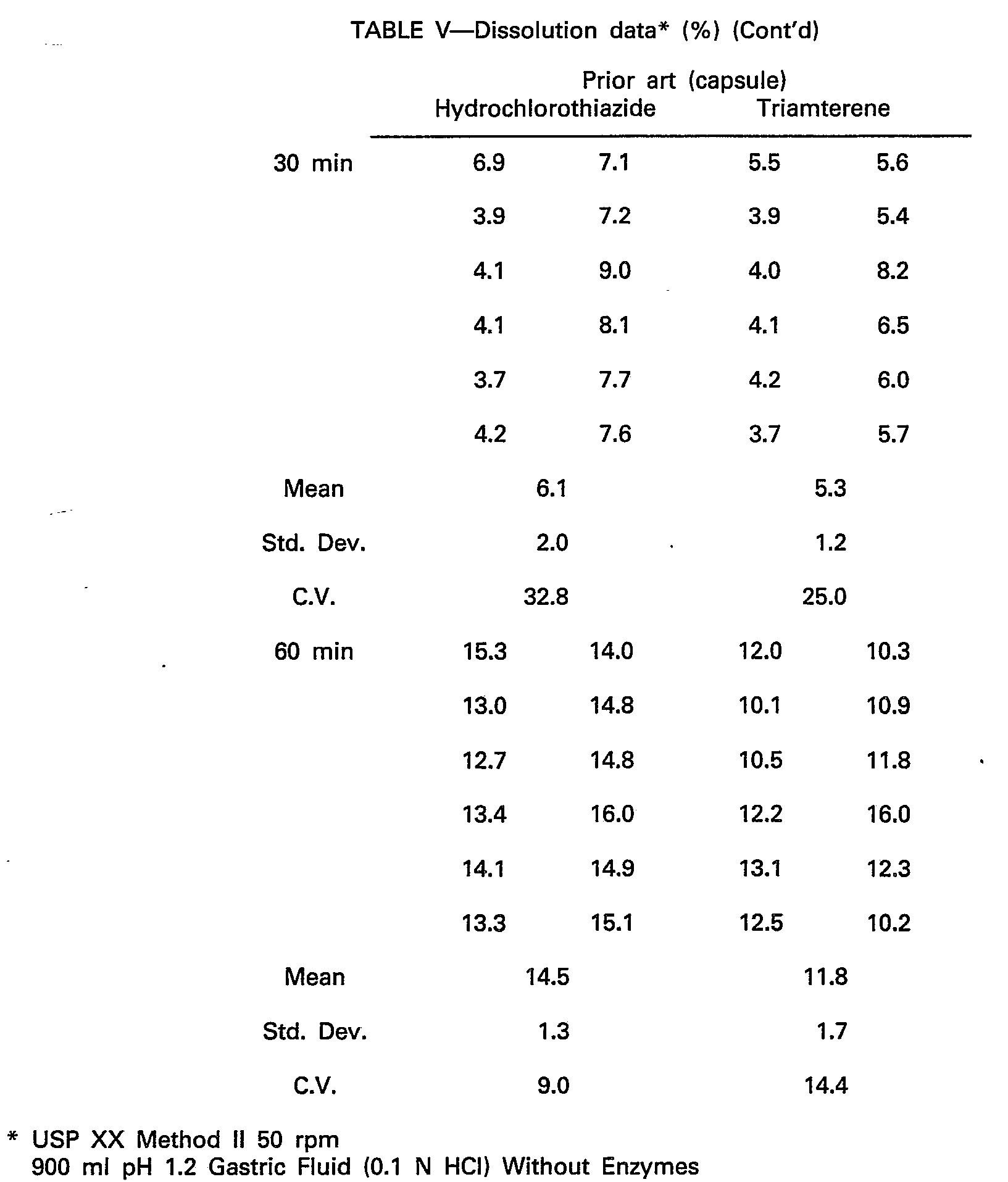
- Thus, even though the problem of formulating hydrochlorothiazide and triamterene together in a solid unit dosage form of enhanced bio-effectiveness has been recognized and is of longstanding, the advance and contribution provided by the present invention has escaped discovery by skilled workers in the field prior to the present invention.
- It will be appreciated, therefore, that the present invention provides a unique method for manufacturing a non-toxic pharmaceutical combination composition which provides effective diuretic and antihypertensive properties while resisting or reversing undesired hydrochlorothiazide-induced hypokalemic action and minimizing the amount of triamterene which must be employed. All of this is accomplished while producing bioavailability substantially equal to or even better than single entity dosage of hydrochlorothiazide, or of triamterene.
- In administering such an embodiment of the present invention, a patient will typically be given the composition in daily dosages such that the total triamterene consumed per day need not be greater than the desired ceiling of about 150 milligrams per day. Daily dosages of triamterene will generally be about 37 to 150 milligrams.
- While the foregoing examples have illustrated the practice of the invention with the preferred hydrochlorothiazide and triamterene ingredients, it will be understood that the same procedures may be followed with alternative ingredients. Thus, in place of triamterene, there may be used 2,4,7 - triamino - 6 - p - fluorophenylpteridine, 2,4,7 - triamino - 6 - p - trifluoromethylphenylpteridine, 2,4,7 - triamino - 6 - p - ethoxyphenylpteridine, 7 dimethylamino - 2,4 - bismethylamino - 6 - phenyipteridine, 2,4,7 - triamino - 6 - thienylpteridine, 2,4,7.- triamino - 6 - o - methylphenylpteridine, 4,7 - diamino - 2 - dimethylamino - 6 - phenylpteridine, 2,4,7 - triamino - 6 - m - methoxy - phenylpteridine, 2,4,7 - triamino - 6 - o - methylphenylpteridine. Metabolic products of triamterene and such other pteridine may also be employed, such as the hydroxy triamterene sulfuric acid ester. It will be understood that as used herein the phrase "a triamterene-active pteridine ingredient" refers to one or more of such components.
- Further, in place of hydrochlorothiazide, there may instead be used chlorothiazide, benzydroflumethiazide, trichloromethiazide, hydroflumethiazide, flumethiazide, methyclothiazide, chlorthalidone, or benzthiazide. It will be understood that as used herein one phrase "a hydrochlorothiazide-active benzothiadiazide ingredient" refers to one or more of these compounds.
- In general, in the present compositions, the appropriate weight ratio of such pharmaceutically active ingredients will be chosen for maximal effectiveness of the respective active ingredients by straightforward clinical and laboratory tests, e.g. as described above, or other appropriate tests as will be selected by those skilled in the art.
- Whereas particular embodiments of the invention have been described above for purposes of illustration, it will accordingly be evident to those skilled in the art that numerous variations of the details may be made within the scope of the claims.
Claims (16)
Priority Applications (1)
| Application Number | Priority Date | Filing Date | Title |
|---|---|---|---|
| AT83107097T ATE29663T1 (en) | 1982-07-27 | 1983-07-20 | COMBINED PHARMACEUTICAL COMPOSITION AND RELATED PROCESS. |
Applications Claiming Priority (4)
| Application Number | Priority Date | Filing Date | Title |
|---|---|---|---|
| US40227982A | 1982-07-27 | 1982-07-27 | |
| US402279 | 1982-07-27 | ||
| US456311 | 1983-01-06 | ||
| US06/456,311 US4444769A (en) | 1982-07-27 | 1983-01-06 | Antihypertensive diuretic combination composition and associated method |
Related Child Applications (1)
| Application Number | Title | Priority Date | Filing Date |
|---|---|---|---|
| EP86108447.3 Division-Into | 1983-07-20 |
Publications (3)
| Publication Number | Publication Date |
|---|---|
| EP0100061A2 EP0100061A2 (en) | 1984-02-08 |
| EP0100061A3 EP0100061A3 (en) | 1985-07-17 |
| EP0100061B1 true EP0100061B1 (en) | 1987-09-16 |
Family
ID=27017795
Family Applications (1)
| Application Number | Title | Priority Date | Filing Date |
|---|---|---|---|
| EP83107097A Expired EP0100061B1 (en) | 1982-07-27 | 1983-07-20 | Pharmaceutical combination composition and associated method |
Country Status (4)
| Country | Link |
|---|---|
| US (1) | US4444769A (en) |
| EP (1) | EP0100061B1 (en) |
| DE (3) | DE3381345D1 (en) |
| PH (3) | PH20531A (en) |
Families Citing this family (13)
| Publication number | Priority date | Publication date | Assignee | Title |
|---|---|---|---|---|
| US4681765A (en) * | 1984-09-13 | 1987-07-21 | American Home Products Corporation | Rapid releasing triamterene containing gelatin capsule dosage forms for once daily antihypertensive use |
| DE3517820A1 (en) * | 1985-05-17 | 1986-11-20 | Röhm Pharma GmbH, 6108 Weiterstadt | PHARMACEUTICAL PREPARATIONS WITH ANTI-HYPERTENSIVE AND CARDIOPROTECTIVE EFFECT |
| US4781925A (en) * | 1986-03-06 | 1988-11-01 | American Home Products Corporation | Calcium supplement compressed tablets |
| US4793999A (en) * | 1987-03-27 | 1988-12-27 | Sheth Prabhakar R | Method of manufacturing an antihypertensive, diuretic and antihypokalemic pharmaceutical composition with polyethylene glycol |
| DK607188A (en) * | 1987-11-02 | 1989-06-22 | Merck & Co Inc | TABLE CONTAINING A PHTHALAZINE ACETIC ACID COMPOUND |
| US4804540A (en) * | 1987-12-16 | 1989-02-14 | G. D. Searle & Co. | Process for preparing the combination products of triamterene and hydrochlorothiazide |
| EP0418596A3 (en) * | 1989-09-21 | 1991-10-23 | American Cyanamid Company | Controlled release pharmaceutical compositions from spherical granules in tabletted oral dosage unit form |
| DE19603402A1 (en) * | 1995-02-24 | 1996-08-29 | Basf Ag | Soft gelatin capsules |
| US6221390B1 (en) | 1997-08-25 | 2001-04-24 | Barr Laboratories, Inc. | Combination pharmaceutical composition and associated methods |
| IN186245B (en) | 1997-09-19 | 2001-07-14 | Ranbaxy Lab Ltd | |
| US6558699B2 (en) * | 1997-11-17 | 2003-05-06 | Smithkline Beecham Corporation | High drug load immediate and modified release oral dosage formulations and processes for their manufacture |
| EP2029112B2 (en) * | 2006-06-16 | 2014-02-19 | LEK Pharmaceuticals d.d. | Pharmaceutical composition comprising hydrochlorothiazide and telmisartan |
| US9169238B2 (en) * | 2008-07-31 | 2015-10-27 | Takeda Pharmaceutical Company Limited | Solid pharmaceutical composition |
Family Cites Families (4)
| Publication number | Priority date | Publication date | Assignee | Title |
|---|---|---|---|---|
| BE555932A (en) * | ||||
| US3081230A (en) * | 1960-09-08 | 1963-03-12 | Smith Kline French Lab | Diuretic and antihypertensive triaminoarylpteridines |
| US3487152A (en) * | 1967-02-07 | 1969-12-30 | Hoffmann La Roche | Tablets containing 7 - chloro - 2 - methylamino - 5 - phenyl - 3h - 1,4 - benzodiazepine-4-oxide and conjugated estrogenic substances |
| AT347039B (en) * | 1972-11-03 | 1978-12-11 | Ohrenberger Franz X Dr | PROCESS FOR MANUFACTURING TABLETS AND DRAGEES CONTAINING TWO DIFFERENT MEDICINAL ACTIVE SUBSTANCES WITH DELAYED RELEASE OF THE ACTIVE SUBSTANCE |
-
1983
- 1983-01-06 US US06/456,311 patent/US4444769A/en not_active Expired - Lifetime
- 1983-07-20 EP EP83107097A patent/EP0100061B1/en not_active Expired
- 1983-07-20 DE DE8686108447T patent/DE3381345D1/en not_active Expired - Fee Related
- 1983-07-20 DE DE198383107097T patent/DE100061T1/en active Pending
- 1983-07-20 DE DE8383107097T patent/DE3373623D1/en not_active Expired
- 1983-07-25 PH PH29290A patent/PH20531A/en unknown
-
1986
- 1986-06-24 PH PH33931A patent/PH21520A/en unknown
- 1986-06-24 PH PH33930A patent/PH21355A/en unknown
Also Published As
| Publication number | Publication date |
|---|---|
| DE3381345D1 (en) | 1990-04-26 |
| PH21520A (en) | 1987-11-10 |
| PH20531A (en) | 1987-02-09 |
| EP0100061A3 (en) | 1985-07-17 |
| PH21355A (en) | 1987-10-15 |
| DE3373623D1 (en) | 1987-10-22 |
| US4444769A (en) | 1984-04-24 |
| DE100061T1 (en) | 1984-07-19 |
| EP0100061A2 (en) | 1984-02-08 |
Similar Documents
| Publication | Publication Date | Title |
|---|---|---|
| EP0108218A2 (en) | Constant release rate solid oral dosage formulation of pharmaceutical compounds having a high degree of water solubility | |
| US20050276852A1 (en) | Sustained release formulations of guaifenesin and additional drug ingredients | |
| EP1435240A2 (en) | Solid oral dosage form comprising a combination of methformin and glibenclamide | |
| EP0196700A1 (en) | Devices for the controlled release of active substances, as well as process for the preparation thereof | |
| JPH07558B2 (en) | Mopidamole formulation | |
| JPH06172221A (en) | Agglomerated hydrophilic complex with multiphase release characteristic | |
| US4444769A (en) | Antihypertensive diuretic combination composition and associated method | |
| JPH01503070A (en) | Drug sustained release matrices and methods | |
| JPH05112445A (en) | Transfer system that hastens initiation of action and increases latent characteristics | |
| AU729437B2 (en) | Cefadroxil monohydrate tablet formulation | |
| EP0211946B1 (en) | Controlled release potassium chloride | |
| ZA200309289B (en) | Oxcarbazepine dosage forms. | |
| GB2105590A (en) | Flotable controlled release preparations | |
| HK58497A (en) | Methylprednisolone/sodium carboxymethyl starch tablet composition | |
| US4526777A (en) | Pharmaceutical combination composition and associated method | |
| PL190988B1 (en) | Paracetamol containing oral tablet | |
| EP0051706A1 (en) | Gelatin capsule dosage unit containing triamterene | |
| US7838032B2 (en) | Sustained release of guaifenesin | |
| EP0324725B1 (en) | A pharmaceutical composition | |
| US4547498A (en) | Pharmaceutical combination composition and associated method | |
| US7985420B2 (en) | Sustained release of guaifenesin combination drugs | |
| JPH03145418A (en) | Sustained release preparation of basic drug hydrochloride | |
| US4863743A (en) | Controlled release potassium chloride | |
| US20020028248A1 (en) | Rapid-release microdispersible ecadotril preparation | |
| EP0207405B1 (en) | Method for making pharmaceutical combination composition in granularly heterogenous solid unit dosage form with enhanced bioavailability |
Legal Events
| Date | Code | Title | Description |
|---|---|---|---|
| PUAI | Public reference made under article 153(3) epc to a published international application that has entered the european phase |
Free format text: ORIGINAL CODE: 0009012 |
|
| AK | Designated contracting states |
Designated state(s): AT BE CH DE FR GB IT LI LU NL SE |
|
| ITCL | It: translation for ep claims filed |
Representative=s name: BARZANO' E ZANARDO MILANO S.P.A. |
|
| TCNL | Nl: translation of patent claims filed | ||
| TCAT | At: translation of patent claims filed | ||
| DET | De: translation of patent claims | ||
| ET | Fr: translation filed |
Free format text: BO 6/84 LIRE 0010061 AU LIEU DE 0100061 |
|
| PUAL | Search report despatched |
Free format text: ORIGINAL CODE: 0009013 |
|
| AK | Designated contracting states |
Designated state(s): AT BE CH DE FR GB IT LI LU NL SE |
|
| 17P | Request for examination filed |
Effective date: 19860113 |
|
| 17Q | First examination report despatched |
Effective date: 19861128 |
|
| GRAA | (expected) grant |
Free format text: ORIGINAL CODE: 0009210 |
|
| AK | Designated contracting states |
Kind code of ref document: B1 Designated state(s): AT BE CH DE FR GB IT LI LU NL SE |
|
| REF | Corresponds to: |
Ref document number: 29663 Country of ref document: AT Date of ref document: 19871015 Kind code of ref document: T |
|
| ITF | It: translation for a ep patent filed | ||
| REF | Corresponds to: |
Ref document number: 3373623 Country of ref document: DE Date of ref document: 19871022 |
|
| ET | Fr: translation filed | ||
| PLBE | No opposition filed within time limit |
Free format text: ORIGINAL CODE: 0009261 |
|
| STAA | Information on the status of an ep patent application or granted ep patent |
Free format text: STATUS: NO OPPOSITION FILED WITHIN TIME LIMIT |
|
| 26N | No opposition filed | ||
| ITTA | It: last paid annual fee | ||
| EPTA | Lu: last paid annual fee | ||
| EAL | Se: european patent in force in sweden |
Ref document number: 83107097.4 |
|
| PGFP | Annual fee paid to national office [announced via postgrant information from national office to epo] |
Ref country code: FR Payment date: 19960626 Year of fee payment: 14 |
|
| PGFP | Annual fee paid to national office [announced via postgrant information from national office to epo] |
Ref country code: AT Payment date: 19960704 Year of fee payment: 14 |
|
| PGFP | Annual fee paid to national office [announced via postgrant information from national office to epo] |
Ref country code: GB Payment date: 19960709 Year of fee payment: 14 |
|
| PGFP | Annual fee paid to national office [announced via postgrant information from national office to epo] |
Ref country code: SE Payment date: 19960719 Year of fee payment: 14 |
|
| PGFP | Annual fee paid to national office [announced via postgrant information from national office to epo] |
Ref country code: NL Payment date: 19960731 Year of fee payment: 14 |
|
| PGFP | Annual fee paid to national office [announced via postgrant information from national office to epo] |
Ref country code: DE Payment date: 19960919 Year of fee payment: 14 |
|
| PGFP | Annual fee paid to national office [announced via postgrant information from national office to epo] |
Ref country code: CH Payment date: 19961031 Year of fee payment: 14 |
|
| PG25 | Lapsed in a contracting state [announced via postgrant information from national office to epo] |
Ref country code: GB Free format text: LAPSE BECAUSE OF NON-PAYMENT OF DUE FEES Effective date: 19970720 Ref country code: AT Free format text: LAPSE BECAUSE OF NON-PAYMENT OF DUE FEES Effective date: 19970720 |
|
| PG25 | Lapsed in a contracting state [announced via postgrant information from national office to epo] |
Ref country code: SE Effective date: 19970721 |
|
| PG25 | Lapsed in a contracting state [announced via postgrant information from national office to epo] |
Ref country code: LI Free format text: LAPSE BECAUSE OF NON-PAYMENT OF DUE FEES Effective date: 19970731 Ref country code: CH Free format text: LAPSE BECAUSE OF NON-PAYMENT OF DUE FEES Effective date: 19970731 |
|
| PG25 | Lapsed in a contracting state [announced via postgrant information from national office to epo] |
Ref country code: NL Free format text: LAPSE BECAUSE OF NON-PAYMENT OF DUE FEES Effective date: 19980201 |
|
| GBPC | Gb: european patent ceased through non-payment of renewal fee |
Effective date: 19970720 |
|
| REG | Reference to a national code |
Ref country code: CH Ref legal event code: PL |
|
| PG25 | Lapsed in a contracting state [announced via postgrant information from national office to epo] |
Ref country code: FR Free format text: LAPSE BECAUSE OF NON-PAYMENT OF DUE FEES Effective date: 19980331 |
|
| NLV4 | Nl: lapsed or anulled due to non-payment of the annual fee |
Effective date: 19980201 |
|
| PG25 | Lapsed in a contracting state [announced via postgrant information from national office to epo] |
Ref country code: DE Free format text: LAPSE BECAUSE OF NON-PAYMENT OF DUE FEES Effective date: 19980401 |
|
| EUG | Se: european patent has lapsed |
Ref document number: 83107097.4 |
|
| REG | Reference to a national code |
Ref country code: FR Ref legal event code: ST |
|
| PGFP | Annual fee paid to national office [announced via postgrant information from national office to epo] |
Ref country code: LU Payment date: 20020725 Year of fee payment: 20 |
|
| PGFP | Annual fee paid to national office [announced via postgrant information from national office to epo] |
Ref country code: BE Payment date: 20020916 Year of fee payment: 20 |
|
| PG25 | Lapsed in a contracting state [announced via postgrant information from national office to epo] |
Ref country code: LU Free format text: LAPSE BECAUSE OF EXPIRATION OF PROTECTION Effective date: 20030720 |