EP0097820B1 - Method for adaptively assigning index numbers to picture element array patterns - Google Patents
Method for adaptively assigning index numbers to picture element array patterns Download PDFInfo
- Publication number
- EP0097820B1 EP0097820B1 EP83105176A EP83105176A EP0097820B1 EP 0097820 B1 EP0097820 B1 EP 0097820B1 EP 83105176 A EP83105176 A EP 83105176A EP 83105176 A EP83105176 A EP 83105176A EP 0097820 B1 EP0097820 B1 EP 0097820B1
- Authority
- EP
- European Patent Office
- Prior art keywords
- pel
- pattern
- node
- input
- library
- Prior art date
- Legal status (The legal status is an assumption and is not a legal conclusion. Google has not performed a legal analysis and makes no representation as to the accuracy of the status listed.)
- Expired
Links
Images

Classifications
-
- G—PHYSICS
- G06—COMPUTING OR CALCULATING; COUNTING
- G06F—ELECTRIC DIGITAL DATA PROCESSING
- G06F18/00—Pattern recognition
- G06F18/20—Analysing
- G06F18/24—Classification techniques
- G06F18/243—Classification techniques relating to the number of classes
- G06F18/24323—Tree-organised classifiers
Definitions
- the present invention relates to a method for adaptively assigning index numbers to input array patterns as set out in the first portion of claim 1.
- Ascher et al 23 IEEE Transactions on Computers, pages 1174-79, November 1974, describes machine implementable adaptive pattern matching in order to compress optically scanned documents for facsimile transmission or storage.
- Ascher uses a stored program controlled machine in which he forms similarity classes, derives a class prototype, and achieves compression by encoding each character in the stream as the nearest class prototype.
- Ascherthe digital images are segmented into dot pattern areas or sub-arrays of black-white picture elements (PEL).
- the patterns are sequentially grouped into classes according to a measure of their similarities such as Hamming distance.
- the first pattern put into a class is registered as the class prototype.
- each new segmented pattern is compared with the prototypes accumulated up to that point. If it matches any prototype, then the class index rather than the entire pattern, is recorded in the output data stream. This thereby increases the compression ratio. If no match is found, the full segmented pattern is recorded in the output stream and the pattern is also used to form a new class and prototype which are added to the available set.
- This invention is invoked at the point in the optical character recognition (OCR) process where characters have been obtained from a document whose objects have been scanned, thresholded, and segmented. More particularly, the invention relates to machine implementable methods and means for adaptively assigning an index number unique to each distinguishable input character PEL array pattern as it is applied. Using the succession of index numbers rather than the patterns themselves results in information compression for either transmission or storage purposes.
- OCR optical character recognition
- a reliable PEL is defined to be a PEL all of whose neighbors have the same color value.
- a reliable PEL may be either "white” or "black”.
- the first input pattern is used to initialize both a pattern library and a decision tree whose leaf nodes are in concordance with index numbers assigned to the patterns.
- the method comprises the steps of classifying an input pattern as one of the library patterns; verifying the classification; upon a match, generating an index number; and upon mismatch, adding the pattern to the library, assigning an index number, and extending the decision tree.
- the step of classifying an input pattern uses a decision tree each of whose nodes identifies a PEL array location.
- the colour value of each PEL drives the branch to a successor node in a root-to-leaf node direction reiteratively until a leaf node is encountered.
- the verification of the classification is by way of overlaid comparison between the classified library and input patterns such that the weighted PEL color value difference is either within or without a predetermined correlation range. As mentioned, upon a comparison being within correlation range an index number is generated and the next input pattern is processed.
- the new pattern is added to the library.
- a reliable PEL array is formed from the input pattern.
- the decision tree is extended by identifying an insertion point, forming a node subnetwork from the reliable PEL array of the character and coupling the sub network into the tree at the insertion point.
- the insertion point is identified as the first node encountered during classification specifying an unreliable PEL at the counterpart input pattern location. After this the process returns to the classification step.
- the decision tree/network is modified only at a single node each time a pattern is added to the library. It is the case, that reliable PELs are of interest only in the update of the decision tree.
- a path from the root to the terminating node means that there exists a coincidence in PEL color value between the input pattern and the "reliable PELs" defining the class or pattern associated with the leaf node, and a disagreement in PEL color value with the "reliable PELs" defining each of the other classes.
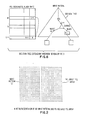
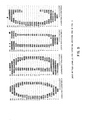
- Fig. 2 there is shown a bit representation of on input pattern and its reliable PEL array. Recalling that a reliable PEL is said to exist wherever the contiguous near neighbors all have the same color value. An input pattern of ones and zeroes on the left hand side defines the character "I". For purposes of reliable PEL determination, the input pattern is considered to be entirely surrounded by white PELs.
- a "1" represents black while a "0” denotes a white PEL.
- a "1" denotes a "reliable PEL” while a "0” denotes a so-called grey PEL (unreliable).
- a black PEL is surrounded orthogonally by black PELs.
- a white PEL is surrounded by white PELs.
- a counterpart "1" in the same location in the right hand array.
- Most of the grey PELs are at the defining edges. They would be represented by zeroes in the counterpart position of the right hand array.
- This invention has been implemented on an IBM 370/3033 CPU for running under an APL interpreter defined by the APL Language Processor. Release No. 3 published in the IBM Manual No. GC26-3847, 5th Edition, in 1978.
- dot matrix characters obtained form optically scanned, segmented, and thresholded documents are analyzed one input pattern at a time and converted to coded vectors for subsequent transmission or storage.
- the operating system of the IBM 3033 conforms to the IBM 370 systems architecture. This is described in Amdahl, US Patent 3,226,689, and in the publication "IBM Systems/370 Principles of Operation", form A22-7000-4.
- the description will be set out in two cycles. First, a qualitative cycle describing the input patterns, adaptive decision tree preclassification designating a library stored pattern, verification, and if, upon mismatch decision tree adaptation.
- the first cycle sets out the method step responses to an input series of six dissimilar patterns.
- the second cycle includes a synoptic analysis of the APL source code on any APL Language Processor.
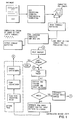
- Fig. 1 there is shown a flow chart defining the processing cycle of converting an input PEL character array into a coded vector output.
- Each input document is scanned and thresholded and the characters segmented.
- the method is initiated by using the color value of a PEL whose location is called for by a root node in a decision tree of nodes.
- the color value of the PEL determines which branch and hence successor node and location which is to be tested. Assuming that both the tree and the library of patterns has been initialized, the reiterative comparison, color value testing, invoking the successor node terminates ultimately in a leaf node each of which is concordant with an index number defining a pattern presently in the library.
- the pattern is then retrieved and over-layed onto the input pattern. If the color value differences at the character edges are within a predetermined correlation, the process is terminated and index number generated, and the next input pattern processed.
- the step of prototype matching involves a limited shifting in the row and column direction in order to reduce misclassification arising from noise PELs encrusting an input pattern.
- the decision as to whether there exists a strong correlation is actually a weighting operation in which correspondence in color value among interior reliable PELs are more heavily weighted than edge PELs. If for example the decision tree preclassification had selected library pattern "0" responsive to an input pattern "J” it is intuitively apparent that there would be no matching such that the input pattern "J” would be added to the library and assigned an index number.
- the decision tree would be extended by first identifying an appropriate insertion point in the tree, forming a sub-network whose nodes each define an array location of interior reliable PELs, and then adding the sub-network to the tree. At this point a tree comparison is made, a matching condition found, and an index number outputted. The process is then returned to the reference state ready to accept the next input pattern.
- the method of this invention consists of a preclasification step involving a sequential decision process in which a series of PELs is examined by a classifier (decision tree).
- the choice of the next PEL to be examined depends upon the values of the PELs seen previously.
- Each PEL eliminates one or more classes from consideration, and when only one candidate class remains, its identifier is inserted as an output.
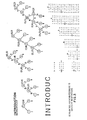
- This procedure can be represented as a binary network as shown for example in Figs. 3 and 6.
- the PEL coordinates are stored at the interior nodes and two branches leave each interior node. One branch corresponds to a white or "0" value for the PEL while the other corresponds to a black or "1" value.
- the terminal nodes contain the decisions or class identifiers.
- the network contains a single starting point called a root node.
- the decision tree is predefined on the basis of previous input character PEL array patterns. Said tree is stored as a table in memory. The decision tree and library remain fixed during routine operations as long as the decisions are verified by a subsequent pattern-matching stage.
- the tree as shown in Fig. 3 is in the form of an integer number array.
- the leftmost column is the node number.
- the next pair of columns define the input pattern PEL array address whose color value is to be tested.
- the rightmost pair of colums define the branches to the next node according to whether the current PEL color value is either white or black.
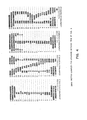
- Correlated with the tables are an arbitrary series of input PEL patterns depicted in large scale in Figs. 4 and 5. Note, that each of the input arrays has a row and column index.
- the sequence to be applied to this system is "INTRODUC".
- the decision tree grows rapidly as a function of the dissimilarity or lack of repeatability in the input patterned character array stream.
- Fig. 3 there is depicted the decision tree in graphic form counterpart to its tabular representation a the bottom of said figure.
- the first input pattern initializes both the tree and the library of patterns. Subsequent non- corresponding patterns cause the tree to grow and result in a more complex networking.
- Fig. 4 there is shown black/ white character PEL arrays. Each array has its row and column coordinates numerically monotonically indexed. Since the first pattern "I" is to be used to initialize the system it will be entered into a table describing a decision tree as an arbitrary row one. Note that the leftmost row entries "00" in Fig. 3 denotes a leaf or terminal node. The pattern itself is stored if the pattern library in its unvarnished PEL array form.
- the second pattern "N" is assumed by the decision tree to be a letter "I". This is because the tree has only one entry and that is the initial input "I”. At this point, the "I" array is withdrawn from the library and overlaid upon the "N" array. Since at this point it may be assumed that there is no substantial correlation, it is then necessary to amend the tree network. This would consist of adding a root node and a leaf node. The new leaf node will be correlated with the second input pattern "N".
- the root node is an arbitrary black reliable PEL location interior to the second pattern, the color value of which at a counterpart array part in the first pattern is a reliable white PEL location.
- the "N" input array there exists a black reliable PEL at location 7,14.
- the counterpart in the "I” array is a white reliable PEL.
- the table is modified by a second row entry labeled "for node 2" defining an array location 7,14. If the reliable PEL at that location is white then the next node to be examined is "1". If the PEL at that location is a reliable black "1" then the next node to examine is to be found in row 3. This defines a terminal or leaf node associated with the second input.
- the entry for node 3 has a 00 in the left hand column pair and an index number 2, 0 which is assigned to the second image input.
- the third input pattern is the character array for "T".
- the table at this point in time has only three entries. Starting at the root node 2 it is necessary to obtain the color value at location 7,14 in the PEL pattern associated "T" in Fig. 4. Since this is a white PEL, then the successive node is "1". This node is a leaf or terminal node and has a concordance with the library pattern "I”. "I” is now retrieved from the library and its PEL array overlain with that of the input pattern "T”.
- the step of correlating a selective library pattern with an input pattern involves overlaying one array on top of the other array and then comparing array color values at counterpart locations. Since an input pattern may be noisy, encrusted, especially at the edge of a character, it is necessary to make several comparisions. This consists of comparing the array exactly superimposed and then shifted up by one row, down by one row, left by one column and right by one column. A weighting scheme is used. These assume such values as "0" if both patterns match, a first value if a PEL is unreliable in one pattern and its counterpart is reliable, a second value if the PELs differ in color and are reliable in both patterns: This latter case is a strong mismatch indication. It is apparent that, apart from the stem, there is no strong correlation between the input pattern "T” and the library pattern "I”. Consequently, a new pattern "T” is added to the library. Also, a reliable PEL array is formed from this input pattern.
- the decision tree must be extended by identifying an insertion point, forming a node sub-network from the reliable PEL location interior to the character, and coupling the sub- network into the tree at the insertion point.
- the insertion point is identified as that node specifying an unreliable PEL at the counterpart input pattern location.
- each node in the decision tree In order to identify the insertion point, it is desirable to examine each node in the decision tree in sequence.
- the PELs at the input array location specified by the node are examined in order to ascertain whether the PEL at that location is reliable, and its color. If the PEL is unreliable, then the identity of the last node whose input pattern exhibits a reliable PEL as well as its successor node is noted.
- These two node identities specifiy a branch or a break at which a sub-network is to be inserted.
- a reliable PEL is one whose color value at location X,Y j matches the color value of those PELs at locations X,Y j-1 , X 1 Y j+1 , X 1-1 Y j , X 1+1 Y J'
- the next input pattern to consider is "0". It is to be considered with reference to its input pattern shown in Fig. 5 and the decision tree as modified starting at root node. 6.
- the PEL at 0(15,15) is white. The same is the case at locations 0(7,14) and 0(21,17).
- the tree has thus identified that the closest library pattern is "I”. Subsequently, an overlay, comparison suggests no correspondence.
- the tree must be modified and a point of insertion found. First, the point of insertion starting at 0(15,15) defines an unreliable white PEL. This is because there exists a black PEL at 0(15,16). Since node 6 is terminating at an unreliable PEL, a new node 8 is to be added.
- a reliable interior black PEL is to be found at 0(10,2).
- the counterpart reliable white PELs are indicated at 1(10,2), N(10,2), T(10,2), and R(10,2).
- the tree is modified by insertion of row 8 to finding a PEL location at 10,2 with a branch to node 6 if the PEL is white and another branch to a terminal node 9 if the PEL is black. Node 9 is in concordance with the input "0". "0" is added to the pattern library, a consecutive index is assigned. Cycling continues as before.
- the very next input pattern is "D" to be found in Fig. 5.
- Examining this pattern using the node decision tree, starting with the root node 8, it should be observed that D(10,2), D(15,15), D(7,14) are consecutive white PELs while the terminal PEL 0(21,17) is black designating the library pattern "T". Assuming there is no problem in verifying the non-correlation, the point of network modification can be seen to be between D(7,14) and D(15,15). ' That is node identifies unreliable PEL since D(7,15) is of the opposite color value.
- D(5,17) is an interior black PEL as is N(5,17) and R(5,17). 1(5,17), and 0(5,17) are white PELs.
- a white reliable interior PEL is located at D(17,9). Also, white reliable interior PELs are present in the remaining input patterns having closed apertures, namely "0" and "r". Black interior PELs may be found at T(17,9), N(17,9) while a gey PEL is at 1(17,9).
- the decision tree table is modified by the 11th row inclusion of PEL location 17,9 and a branch to node 12 if the PEL color is white and to 2 if black.
- a 12th node representing a leaf or terminus provides a concordance for pattern "D".
- the tree modification responsive to input patterns "U” and "C” employ the principles heretofore described.
- Fig. 6 there is shown a decision tree extension and insertion scheme of Fig. 3.
- the insertion of the sub-network usually involves the relabeling of two or more branches. Given a tree branch N', N which is to be broken, then appropriate labeling must be provided between the ancestor node and the new node, and the new node and the descendant node. A tabular representation of these changes is shown on the left of the figure. If the PEL in an input pattern location associated with node N' is white then a branch is made to node L+1. Likewise, if the color value at the location labeled by node L+1 is white then the next node is N.
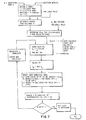
- Fig. 7 depicting a flow diagram of decision tree adaptations. This diagram is largely focused on selecting the interior black PEL location which will serve as a node by way of a weighting scheme.
- Node N is the node at which the network is to be modified in order to distinguish the new library pattern X, from the other patterns therein.
- a new node which will be called the “candidate node” is added to the decision network. Any branch into node N in the current network is replaced by a branch to the candidate node.
- a second, new node called a "successor node”, is also defined at this point.
- the next step of functional significance in Fig. 7 consists of determining which class can arrive at node end during the decision process.
- the PELs of input pattern X are numbered in an arbitrary sequence.
- a matrix, Q is created to identify PELs that are reliable in discriminating X from the library patterns representing these classes.
- the entry into row K, column N of Q is "1", if the Mth PEL is reliable in both X and the Kth library pattern, and differs in color value.
- the entry is "0" otherwise. That is, if the PEL either has the same color in both X and the case library pattern, or is unreliable for at least one of the two.
- the modificatiion process enters an interactive sequence of steps that successively chooses PELs in order to discriminate X from the other library patterns.
- Each PEL in Q is assigned a score equal to the number of library patterns from which it differs in value from X.
- the PEL having the largest score is selected fbr the network modification.
- the coordinates of this PEL are inserted into the candidate node 2.
- the branch out of the candidate node corresponding to the color of the selected PEL in X is directed to the successor node.
- the other branch is directed to node N.
- the array Q is then reduced by eliminating rows corresponding to library patterns for which the selected PEL discrimates reliably from X. If all library patterns are eliminated by this operation, then the current successor node is made a terminal node and is assigned the class numbers for X and the adaptation routine TREECOR exits. Otherwise, the successor node becomes the new candidate node, a new successor node is created and the flow returns to the PEL scoring and selection steps.
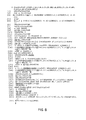
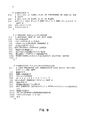
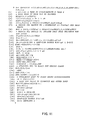
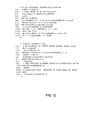
- FIGs. 8-12 there are exhibited APL source code sequences for executing the steps of the method according to the invention on a suitably equipped processor having resident therein an APL language system as heretofore has been described.
- Fig. 8 there is shown the main repeatable sequence of a complete cycle defining the classification and any tree extension responsive to each new input pattern.
- On the left hand side are consecutively numbered (in square brackets) statements. Each segment is initiated and terminated by a V.
- the topmost line defines the program name, parameters and variables global to the routine.
- [1] starts a clock to measure the amount of CPU time to execute a fragment of the routine.
- Such statements are included merely for the convenience of the experimenter, but are not mandatory for the practice of the invention.
- the output is labeled CLASS and is assigned an input pattern to either existing patterns or
- [2] is an initialization giving the dimensions of an array.
- [3] defines a row input pattern corresponding to the baseline, that is the bottom of the PEL array.
- the necessary processing occurs between [3] and [42] inclusive.
- One interation is necessary to classify each character. Note that [7], [11] are merely comment fields and do not affect execution.
- the main sequence can be partitioned as follows: [11] through [19] initialize the decision tree and library using the very first input pattern. The second and subsequent patterns are read in and processed between [3] and [10]. A skip is then made to [20]-[22] which invokes the routine TREECORR 3.
- This latter routine passes the input pattern X through decision network performing preclassifications, and second performs verification by matching the preclassification library pattern with that of the input pattern. [24] tests the output of TREECORR 3 to ascertain the match or mismatch condition. If a mismatch a skip is made to [26] NOC. If there is a match in [24] then a skip is made to [40]. After execution of [40] control is returned to [3] to process the next pattern.
- a baseline for processing each input pattern is defined [4] is a convenience instruction clearing the screen of an associated video monitor of the IBM-type 3270.
- PROTO is an array of arrays.
- the library of patterns is a data structure of the array type, since each input pattern is in itself an array.
- [7] tests the initialization process by inquiring into whether there exists any input patterns (also referenced as program types) in the library. If there is not then [8] is executed. If initialization has been completed then a branch-to-statement [20] is made. The initialization steps involve [14] through [18], since [11]-[13] executes self-evident overhead. Since this phase is an initialization, [14] invokes the routine TREEGRO set out in Fig. 9. The operative step is TREEGRO [6], which in turn invokes TREEPLUG depicted in Fig. 11.
- this routine merely assigns a termination leaf entry in the decision tree (represented by array NODES). This is executed by TREEPLUG [3] and [4]. Control is then returned to TREEGRO with the actual insertions being made by TREEGRO [10]. After this, processing continues in CLASS [15].
- S is an array of input pattern reliable PELs.
- the affect of CLASS [15] is to concatenate input pattern X into the library of patterns PROTO.
- CLASS [16]-[18] reference housekeeping function.
- CLASS [19] is a branch to [40].
- CLASS [40] is a branch to [3] conditioned upon an index defining whether a pattern is within the text line input. This concludes initializing the decision tree array NODES and the library PROTO.
- the characters are read in by CLASS [5], tested by [7] by way of a branch to [20] conditioned upon there existing a pattern in the library PROTO.
- CLASS [20]-[25] invoke preclassifying an input pattern according to one of the existing library patterns in PROTO, verifying whether they match, and in the event of mismatch branch to [26] while branching to [40] in the case of pattern matching.
- CLASS [20]-[25] invokes TREECORR 3.
- TREECORR [6] invokes segment TREEFOL 2 in Fig. 12 to process an input pattern X against the decision table NODES to arrive at an initial pattern U.
- Control passes back to TREECORR [9] which overlays the library pattern on the input X to verify the correspondence by way of a ratio measure MPTS. This yields a dissimilarity measure M.
- TREECR [11] terminates the match if the quotient M followed by a NPTS is less than a predetermined threshold otherwise it goes to TREECORR [12] which executes a conditional branch to [6].
- This loop constitutes a weighting scheme so that if colors for the same location (X ⁇ ) between patterns differ then the loop looks at surrounding PELs.
- Control returns to CLASS [24] which executes a branch to [26] conditioned upon there being no match. If there is a match [25] executes a branch to [40].
- the correspondence is tested by overlaying the patterns, comparing, and if dissimilar, relatively shifting the patterns plus or minus one row and/or plus or minus one cone and testing for a match.
- This relative shift and compare of arrays of reliable PELs for all preceding library patterns together with array Y is processed to identify insertion points in the tree, form a sub-network, and place the network in the tree. That is, TREEGRO executes the update of the tree by comparing reliable PELs of Y against all previous patterns of S.
- TREEGRAY (Fig. 10) examines each nod ⁇ ; location defined in the tree array NODES in sequence. It then compares the PEL color value at the coordinates specified by the node and ascertains whether that PEL is reliable. If the PEL is unreliable, TREEGRAY identifies the last node whose input pattern location exhibits a reliable PEL. The two nodes specify a range or break at which a sub-network is to be inserted. Returning to TREEGROW [6], there is invoked TREEPLUG at Fig.
- TREEPLUG 11 for designing a sub-network which, when included within the tree will discriminate X from S.
- the operative statements in TREEPLUG include [10]-[13]. These form a matrix FS which contains one column corresponding to each reliable PEL in the new library pattern X, whose reliable PEL array Y is one of the inputs to TREEPLUG. Each row of FS corresponds to one of the existing library patterns represented in the reliable PEL array PELs.
- TREEPLUG [14]-[28] a discriminating subnetwork Z is computed in an iterative sequence, TREEPLUG [14]-[28].
- TREEPLUG [14] tests whether SS contains any "1"'s. If not, then discrimination is not possible on the basis of reliable PELs, and the routine branches to TREEPLUG [32]-[40].
- TREEADD 3 is invoked to implement a discrimination on the basis of unreliable PELs. Such an escape path is contraindicated if the pattern has sufficient resolution. In the very largest fraction of instances such is the case.
- TREEPLUG [23] examines the selected PEL in X to determine its color.
- the branch address for the other color in the sub-network is set to zero in either [25] or [27]. Parenthetically, the branches corresponding to both colors were set to the successor node address in step [18]. In a subsequent processing step, these "0"'s will be replaced by the address of the node at which the sub-routine is incorporated in the main decision network.
- ADJNODES adds the sub-network array to the bottom of the array representing the previously existing network. Also it modifies the addresses of the sub-network to conform to its position in the overall array. With the completion of the sub-network insertion, control returns to CLASS where the appropriate concatenation in class [38] and [39] of the array occurs.
- the input patterns are a sequence of binary, two dimensional arrays representing scanned characters of the order of their occurrence on a document.
- the characters are printed on an arbitary font style, and though very little is assumed regarding their shape or appearance, assumptions can be made regarding the sample- to-sample variations within a given pattern class. The strongest assumption is that such variations occur primarily on the edges of patterns.
- the decision network is designed to discriminate on the basis only of "interior" white or black PELs.
- the adaptive classification of the inventive method is predicated on the basis of black and white interior PELs determined from a succession of previous patterns.
- an input pattern differing from a library pattern (previous pattern) only at edge PELs will be assigned to the class identified with that library pattern.
- Adaptation consists of modifying the feed network that has this property in such a way that the new network has the same property for the library patterns plus one additional member.
- a second constraint placed on the modification procedure is that is should be done only by adding nodes to the existing network. No nodes are to be altered or deleted, although exit branches from existing nodes may be redirected in order to insert new nodes. Assume that the decision tree has been constructed in such a way that for each of K patterns denoted G1, G2,...G k . Now, if a new input pattern G K+1 is designated then the network is to be extended.
- the ensemble of patterns that are to be assigned to class K+1 consist of all binary arrays .obtainable from pattern G K+ , by assigning the value "0" to white interior PELs, "1" to black interior PELs, and arbitrarily "0" or "1" values to its edge PELs. If G K+i contains E"E" edge PELs then 2 E members of the class K+1 are defined in this way.
- This set of patterns may be denoted by R K+1.
- the classifcation process is considered for a member R K+1 in N K , where N K is the decision network before adaptation to G K+1. If the root PEL, X 1 , is an interior PEL of G K+1 , then all members of R K+1 have the same value at this PEL location.
- the next PEL to be tested, X 2 will be the same for every member of R K+1 . If X 2 is interior to G K+1 , then the third PEL, X 3 will be the same for each pattern in R K+1 , as well.
- the sequence of PELs examined constitutes a path through the network. This path is the same for every member of R K+1 until a node is encountered, which node identifies an edge PEL for G K++ . Some of the members of R K+i will follow the white branch from this node, the remainder will follow the black branch. Such a node partitions R K+1 into subsets, each of which follows a different path in the network.
- the branch into node N is reconnected to a sub-network consisting of a sequence of reliable PELs that are interior to G K+1 and that discriminate G K+1 from the members of H.
- the specification of this sub-network requires that only members of H rather than the entire library collection need to be discriminated from pattern G K+1 .
- a new path is provided leading to a terminal node for class K+ 1, and the other branches are connected to node N.
- the set of input patterns may delineate objects other than the Latin alphabetic type fonts as for example characters in an idiographic language such as Japanese.
Landscapes
- Engineering & Computer Science (AREA)
- Data Mining & Analysis (AREA)
- Theoretical Computer Science (AREA)
- Computer Vision & Pattern Recognition (AREA)
- Bioinformatics & Cheminformatics (AREA)
- Bioinformatics & Computational Biology (AREA)
- Artificial Intelligence (AREA)
- Evolutionary Biology (AREA)
- Evolutionary Computation (AREA)
- Physics & Mathematics (AREA)
- General Engineering & Computer Science (AREA)
- General Physics & Mathematics (AREA)
- Life Sciences & Earth Sciences (AREA)
- Image Analysis (AREA)
- Character Discrimination (AREA)
Applications Claiming Priority (2)
| Application Number | Priority Date | Filing Date | Title |
|---|---|---|---|
| US06/392,839 US4499596A (en) | 1982-06-28 | 1982-06-28 | Adaptive facsimile compression using a dynamic extendable decision network |
| US392839 | 1982-06-28 |
Publications (2)
| Publication Number | Publication Date |
|---|---|
| EP0097820A1 EP0097820A1 (en) | 1984-01-11 |
| EP0097820B1 true EP0097820B1 (en) | 1986-12-30 |
Family
ID=23552210
Family Applications (1)
| Application Number | Title | Priority Date | Filing Date |
|---|---|---|---|
| EP83105176A Expired EP0097820B1 (en) | 1982-06-28 | 1983-05-25 | Method for adaptively assigning index numbers to picture element array patterns |
Country Status (4)
| Country | Link |
|---|---|
| US (1) | US4499596A (cg-RX-API-DMAC7.html) |
| EP (1) | EP0097820B1 (cg-RX-API-DMAC7.html) |
| JP (1) | JPS593690A (cg-RX-API-DMAC7.html) |
| DE (1) | DE3368781D1 (cg-RX-API-DMAC7.html) |
Families Citing this family (24)
| Publication number | Priority date | Publication date | Assignee | Title |
|---|---|---|---|---|
| US4541115A (en) * | 1983-02-08 | 1985-09-10 | Pattern Processing Technologies, Inc. | Pattern processing system |
| FR2559598A1 (fr) * | 1984-01-16 | 1985-08-16 | Jouanaud Louis | Systeme de traitement de texte pouvant lire n'importe quelle police de caracteres |
| JPS60262290A (ja) * | 1984-06-08 | 1985-12-25 | Hitachi Ltd | 情報認識システム |
| FR2591005B1 (fr) * | 1985-12-04 | 1988-01-08 | Thomson Csf | Procede d'identification de structure arborescentes dans des images numeriques et son application a un dispositif de traitement d'images |
| US5265244A (en) * | 1986-02-14 | 1993-11-23 | International Business Machines Corporation | Method and system for facilitating processing of statistical inquires on stored data accessible through a data access structure |
| CA1311059C (en) * | 1986-03-25 | 1992-12-01 | Bruce Allen Dautrich | Speaker-trained speech recognizer having the capability of detecting confusingly similar vocabulary words |
| US4752890A (en) * | 1986-07-14 | 1988-06-21 | International Business Machines Corp. | Adaptive mechanisms for execution of sequential decisions |
| US4769716A (en) * | 1986-10-17 | 1988-09-06 | International Business Machines Corporation | Facsimile transmission using enhanced symbol prototypes with precalculated front and back white spaces |
| JPH0727543B2 (ja) * | 1988-04-28 | 1995-03-29 | インターナシヨナル・ビジネス・マシーンズ・コーポレーション | 文字認識装置 |
| US4975975A (en) * | 1988-05-26 | 1990-12-04 | Gtx Corporation | Hierarchical parametric apparatus and method for recognizing drawn characters |
| US4831657A (en) | 1988-07-19 | 1989-05-16 | International Business Machines Corporation | Method and apparatus for establishing pixel color probabilities for use in OCR logic |
| US5131053A (en) * | 1988-08-10 | 1992-07-14 | Caere Corporation | Optical character recognition method and apparatus |
| EP0461817A3 (en) * | 1990-06-15 | 1993-11-18 | American Telephone & Telegraph | Image segmenting apparatus and methods |
| US5227893A (en) * | 1990-10-31 | 1993-07-13 | International Business Machines Corporation | Pseudo-bar code control of image transmission |
| DE69328702T2 (de) * | 1992-03-30 | 2000-10-26 | Canon K.K., Tokio/Tokyo | Gerät und Verfahren zur Bildverarbeitung |
| US5778095A (en) * | 1995-12-20 | 1998-07-07 | Xerox Corporation | Classification of scanned symbols into equivalence classes |
| JP4190610B2 (ja) * | 1998-02-18 | 2008-12-03 | 富士通株式会社 | ロードモジュールの試験ルート決定装置 |
| EP0954139B1 (en) * | 1998-05-01 | 2005-04-06 | Hewlett-Packard Company, A Delaware Corporation | Methods of altering dynamic decision trees |
| EP0954140B1 (en) | 1998-05-01 | 2003-10-29 | Hewlett-Packard Company, A Delaware Corporation | Method of managing dynamic decision trees |
| NO20051412D0 (no) * | 2005-03-17 | 2005-03-17 | Lumex As | Fremgangsmate og system for adaptiv gjenkjenning av degradert tekst i datamaskinavbildninger |
| WO2010149986A2 (en) | 2009-06-23 | 2010-12-29 | Secerno Limited | A method, a computer program and apparatus for analysing symbols in a computer |
| US20130039589A1 (en) * | 2011-08-11 | 2013-02-14 | I. R. I. S. | Pattern recognition process, computer program product and mobile terminal |
| GB201116095D0 (en) * | 2011-09-16 | 2011-11-02 | Wessex Technology Opto Electronic Products Ltd | Machine reading of printed data |
| RU2598300C2 (ru) | 2015-01-27 | 2016-09-20 | Общество с ограниченной ответственностью "Аби Девелопмент" | Способы и системы автоматического распознавания символов с использованием дерева решений |
Family Cites Families (7)
| Publication number | Priority date | Publication date | Assignee | Title |
|---|---|---|---|---|
| US3226689A (en) * | 1961-07-03 | 1965-12-28 | Bunker Ramo | Modular computer system master disconnect capability |
| US3333248A (en) * | 1963-12-20 | 1967-07-25 | Ibm | Self-adaptive systems |
| CH534927A (de) * | 1970-12-07 | 1973-03-15 | Ibm | Verfahren zur maschinellen Erkennung von Zeichen |
| DE2217500A1 (de) * | 1971-04-23 | 1972-10-26 | International Business Machines Corp., Armonk, N.Y. (V.StA.) | Verfahren und Einrichtung zum Suchen von Schlüsselwörtern in einer elektronischen Datenverarbeitungsanlage |
| US3925780A (en) * | 1973-12-26 | 1975-12-09 | Ibm | Apparatus for data compression encoding and decoding |
| FR2301051A1 (fr) * | 1975-02-14 | 1976-09-10 | Anvar | Procede et dispositifs de reconnaissance de formes |
| US4181952A (en) * | 1977-11-21 | 1980-01-01 | International Business Machines Corporation | Method and means for minimizing error between the manual digitizing of points and the actual location of said points on an _electronic data entry surface |
-
1982
- 1982-06-28 US US06/392,839 patent/US4499596A/en not_active Expired - Fee Related
-
1983
- 1983-05-25 EP EP83105176A patent/EP0097820B1/en not_active Expired
- 1983-05-25 DE DE8383105176T patent/DE3368781D1/de not_active Expired
- 1983-05-31 JP JP58095132A patent/JPS593690A/ja active Granted
Also Published As
| Publication number | Publication date |
|---|---|
| EP0097820A1 (en) | 1984-01-11 |
| JPS593690A (ja) | 1984-01-10 |
| JPH0142028B2 (cg-RX-API-DMAC7.html) | 1989-09-08 |
| US4499596A (en) | 1985-02-12 |
| DE3368781D1 (en) | 1987-02-05 |
Similar Documents
| Publication | Publication Date | Title |
|---|---|---|
| EP0097820B1 (en) | Method for adaptively assigning index numbers to picture element array patterns | |
| US4989258A (en) | Character recognition apparatus | |
| Shen et al. | A large dataset of historical japanese documents with complex layouts | |
| US5067165A (en) | Character recognition method | |
| CA2400345C (en) | System and method for creating a searchable word index of a scanned document including multiple interpretations of a word at a given document location | |
| US6081620A (en) | System and method for pattern recognition | |
| US4903312A (en) | Character recognition with variable subdivisions of a character region | |
| JP2973944B2 (ja) | 文書処理装置および文書処理方法 | |
| US5970170A (en) | Character recognition system indentification of scanned and real time handwritten characters | |
| US6763137B1 (en) | Recognition and clustering of connected components in bi-level images | |
| CA2029585C (en) | Changing characters in an image | |
| US6735335B1 (en) | Method and apparatus for discriminating between documents in batch scanned document files | |
| EP0567680B1 (en) | Pattern recognition and validation, especially for hand-written signatures | |
| US5394484A (en) | Image recognition apparatus | |
| US5999653A (en) | Fast techniques for searching images using the Hausdorff distance | |
| US5862259A (en) | Pattern recognition employing arbitrary segmentation and compound probabilistic evaluation | |
| EP0163377A1 (en) | Pattern recognition system | |
| US7627176B2 (en) | Apparatus, method, and computer program for analyzing document layout | |
| US5150425A (en) | Character recognition method using correlation search | |
| JP3917349B2 (ja) | 文字認識結果を利用して情報を検索する検索装置および方法 | |
| Viswanathan | Analysis of scanned documents—A syntactic approach | |
| US6094484A (en) | Isomorphic pattern recognition | |
| Garris et al. | NIST Scoring Package User’s Guide | |
| US5940533A (en) | Method for analyzing cursive writing | |
| US6009194A (en) | Methods, systems and computer program products for analyzing information in forms using cell adjacency relationships |
Legal Events
| Date | Code | Title | Description |
|---|---|---|---|
| PUAI | Public reference made under article 153(3) epc to a published international application that has entered the european phase |
Free format text: ORIGINAL CODE: 0009012 |
|
| AK | Designated contracting states |
Designated state(s): DE FR GB |
|
| 17P | Request for examination filed |
Effective date: 19840426 |
|
| GRAA | (expected) grant |
Free format text: ORIGINAL CODE: 0009210 |
|
| AK | Designated contracting states |
Kind code of ref document: B1 Designated state(s): DE FR GB |
|
| ET | Fr: translation filed | ||
| REF | Corresponds to: |
Ref document number: 3368781 Country of ref document: DE Date of ref document: 19870205 |
|
| PLBE | No opposition filed within time limit |
Free format text: ORIGINAL CODE: 0009261 |
|
| STAA | Information on the status of an ep patent application or granted ep patent |
Free format text: STATUS: NO OPPOSITION FILED WITHIN TIME LIMIT |
|
| 26N | No opposition filed | ||
| PGFP | Annual fee paid to national office [announced via postgrant information from national office to epo] |
Ref country code: GB Payment date: 19920409 Year of fee payment: 10 |
|
| PGFP | Annual fee paid to national office [announced via postgrant information from national office to epo] |
Ref country code: FR Payment date: 19920427 Year of fee payment: 10 |
|
| PGFP | Annual fee paid to national office [announced via postgrant information from national office to epo] |
Ref country code: DE Payment date: 19920523 Year of fee payment: 10 |
|
| PG25 | Lapsed in a contracting state [announced via postgrant information from national office to epo] |
Ref country code: GB Effective date: 19930525 |
|
| GBPC | Gb: european patent ceased through non-payment of renewal fee |
Effective date: 19930525 |
|
| PG25 | Lapsed in a contracting state [announced via postgrant information from national office to epo] |
Ref country code: FR Effective date: 19940131 |
|
| PG25 | Lapsed in a contracting state [announced via postgrant information from national office to epo] |
Ref country code: DE Effective date: 19940201 |
|
| REG | Reference to a national code |
Ref country code: FR Ref legal event code: ST |