EP0096483B1 - Pretreatment of a fresh iridium-containing catalyst - Google Patents
Pretreatment of a fresh iridium-containing catalyst Download PDFInfo
- Publication number
- EP0096483B1 EP0096483B1 EP83302771A EP83302771A EP0096483B1 EP 0096483 B1 EP0096483 B1 EP 0096483B1 EP 83302771 A EP83302771 A EP 83302771A EP 83302771 A EP83302771 A EP 83302771A EP 0096483 B1 EP0096483 B1 EP 0096483B1
- Authority
- EP
- European Patent Office
- Prior art keywords
- catalyst
- temperature
- hydrogen
- oxygen
- hours
- Prior art date
- Legal status (The legal status is an assumption and is not a legal conclusion. Google has not performed a legal analysis and makes no representation as to the accuracy of the status listed.)
- Expired
Links
Images
Classifications
-
- C—CHEMISTRY; METALLURGY
- C10—PETROLEUM, GAS OR COKE INDUSTRIES; TECHNICAL GASES CONTAINING CARBON MONOXIDE; FUELS; LUBRICANTS; PEAT
- C10G—CRACKING HYDROCARBON OILS; PRODUCTION OF LIQUID HYDROCARBON MIXTURES, e.g. BY DESTRUCTIVE HYDROGENATION, OLIGOMERISATION, POLYMERISATION; RECOVERY OF HYDROCARBON OILS FROM OIL-SHALE, OIL-SAND, OR GASES; REFINING MIXTURES MAINLY CONSISTING OF HYDROCARBONS; REFORMING OF NAPHTHA; MINERAL WAXES
- C10G35/00—Reforming naphtha
- C10G35/04—Catalytic reforming
- C10G35/06—Catalytic reforming characterised by the catalyst used
- C10G35/085—Catalytic reforming characterised by the catalyst used containing platinum group metals or compounds thereof
Definitions
- the present invention relates to a method for treating fresh iridium-containing reforming catalysts.
- the treatment consists basically of a drying step at 200-600°F (93-316°C) for 2 to 24 hours, a calcination step at 700-1100°F (371-593°C) for 5 to 10 hours, and a water-free reduction step at 800-1100°F (427-593°C).
- U.S. Patent No. 3,941,682 discloses a method of treating a catalyst which can be applied to either a spent or a fresh catalyst which comprises drying the catalyst at 220-250°F (104 ⁇ 121°C) followed by a calcination step at 500-700°F (260-371°C) optionally in the presence of both H 2 0 and HCI.
- This patent notes that calcination temperatures in excess of 700°F (371°C) should be avoided.
- the drying and calcination steps may be followed by contact with hydrogen chloride or reduction with hydrogen.
- the present invention resides in a process for the treatment of a fresh iridium-containing reforming catalyst, comprising subjecting said catalyst to the following steps under essentially water-free conditions:
- the present process is preferably carried out by treating a fresh catalyst prepared from hexachloroiridic acid with an oxygen-containing gas at elevated temperatures.
- Preferred conditions range from temperatures of 750-1000°F (399-538°C), pressures of 0.1-500 psig (0.007-35 bar) and oxygen concentrations of 0.1-50 wt.% for 0.1 to 24 hours.
- the oxygen treatment step is accomplished by treating the fresh catalyst with 0.1-21 wt.% of oxygen at temperatures of 850-950°F (454-510°C) for 0.25 to 2 hours at atmospheric pressure.
- the next step in the treatment sequence involves the addition of a dry hydrogen halide, preferably hydrogen chloride, to the catalyst.
- dry hydrogen halide is intended to mean that water is controlled to a level no greater than 1/30 the concentration of hydrogen halide. Preferably, water is present at a level no greater than 10 ppm (parts per million).
- commercially available hydrogen chloride is suitable as is, i.e. no drying step is necessary.
- the treatment with dry hydrogen halide is preferably carried out at temperatures ranging from 700-1000°F (371-538°C) and pressures ranging from about 0.1-500 psig (0.007-35 bar) for a period of time ranging from 0.5 to 24 hours utilizing at least 0.1 wt.% of hydrogen halide per weight of catalyst per hour.
- the amount of hydrogen halide used is generally no greater than 10 wt.% per weight of catalyst per hour since higher amounts, although operabte, are not necessary to obtain the desired results.
- hydrogen chloride with a concentration of about 3 vol.% in an inert gas is added at 1.5 wt.% of hydrogen chloride per weight of catalyst per hour at a temperature of 850 to 950°F (454 to 510°C) for 2 hours at atmospheric pressure.
- oxygen and hydrogen halide treatment steps may also be accomplished simultaneously with the same results.
- the final pretreatment step consists of treating the catalyst with a reducing agent, e.g. hydrogen.
- a reducing agent e.g. hydrogen.
- Suitable conditions include temperatures ranging from 400-1100°F (204-593°C) for periods of time ranging from 0.1 to 24 hours.
- this procedure is performed at a temperature of 850-950°F (454 ⁇ 510°C) for 0.5 to 2 hours at atmospheric pressure.
- this last step i.e. reduction with hydrogen, can be carried out either as a separate step in the pretreatment procedure or can be carried out as part of the reformer start-up procedure.
- the hydrogen reduction step should, however, be performed after the oxygen and hydrogen halide treatments.
- the treatment in step 1 (oxygen) and step 2 (hydrogen halide) is carried out by mixture of the same with an inert diluent such as nitrogen, neon, helium or argon.
- an inert diluent such as nitrogen, neon, helium or argon.
- the amount of inert gas is not critical and can range from 50 to 99.9 vol.% based on oxygen and can range from 90 to 99.9 vol.% based on the dry hydrogen halide.
- the iridium-containing catalysts used herein comprise a porous carrier or support material in combination with iridium and other metals such as platinum and rhenium.
- the support component of the catalyst is preferably a porous, adsorptive material having a surface area, as determined by the Brunauer-Emmit-Teller (BET) method, of 20-800, preferably 100-300 square meters per gram. This support material should be refractory at the temperature and pressure conditions utilized in any given hydrocarbon conversion process.
- Useful support materials include: (a) silicon-based materials such as silica or silica gel, silicon carbide, clays, natural or synthetic silicates such as kieselguhr, kaolin, china clay or Attapulgus clay; (b) aluminosilicate zeolite materials such as naturally occurring or synthetic erionite, mordenite or faujasite, that may or may not have been previously converted to a hydrogen or ammonium form and reduced in sodium content by virtue of an exchange reaction with various metal cations, including rare earth metal cations; (c) refractory inorganic oxides, including alumina, titanium dioxide, zinc oxide magnesia, thoria, chromia, silica-alumina, alumina-titania, silica-zirconia and alumina- chromia; and (d) mixtures of one or more of the materials referred to above.
- silicon-based materials such as silica or silica gel, silicon carbide, clays
- Refractory inorganic oxide materials are preferred catalyst support materials.
- alumina in particular the gamma or eta form
- Alumina is the preferred catalyst support material when the catalyst is employed in naphtha reforming operations.
- the support materials described above are known articles of commerce and can be prepared for use as catalyst constituents by many varied techniques. Typically, the support materials are prepared in the form of spheres, granules, powders, extrudates or pellets. It is possible to have all the metals of the iridium-containing catalyst on the same support in one particle, e.g. platinum and iridium on alumina, or as a mixture of separate particles, e.g. platinum on alumina mixed with iridium on alumina. When mixtures of separate particles are used, the supports can be the same or different.
- the catalyst preferably contains greater than 0.1 wt.% iridium, based upon the dry weight of the total catalyst.
- lesser quantities of iridium may be employed.
- iridium and platinum may each be present on the catalyst in amounts varying from 0.01 to 5.0 wt.%, preferably in amounts varying from 0.1 to 1.0 wt.%, based upon the total weight of the dry catalyst.
- Iridium/platinum naphtha reforming catalysts having maximum effectiveness normally contain 0.2 to 0.5 wt.% each, of iridium and platinum, based on total catalyst.
- the iridium-containing catalysts may be prepared employing simple impregnation techniques well in the art. Such a catalyst may be prepared by impregnating a support material with a solution of a soluble iridium compound and soluble compounds of any additional metals to be incorporated in the catalyst. Generally, an aqueous solution of the metal compounds is used. The support material may be impregnated with the various metal-containing compounds either sequentially or simultaneously. The carrier material is impregnated with solutions of appropriate concentration to provide the desired quantity of metals in the finished catalyst.
- compounds suitable for the impregnation onto the carrier include hexachloroiridic acid, iridium tribromide, iridium trichloride, and ammonium chloroiridate, with hexachloroiridic acid being preferred.
- the preferred catalyst manufacturing technique involves contacting a previously prepared support, such as alumina, with an aqueous solution of hex- chloroiridic acid of appropriate concentration to provide the desired quantity of metal in the finished catalyst.
- the composite catalyst is dried at a temperature varying from 220-250°F (104 ⁇ 121°C).
- the catalyst may be dried in air at the above stated temperatures or may be dried by treating the catalyst in a flowing stream of inert gas, e.g. nitrogen.
- the fresh catalyst is then subjected to the pretreatment steps described above.
- the catalyst is dried in an oxygen-containing gas at a temperature of from 850°-950°F (454°-510°C) for 0.25 to 2 hours.
- the drying step is followed by treatment with hydrogen chloride for 2 hours again at a temperature of from 850-950°F (424-510°C). If preferred, the foregoing steps may be accomplished simultanously.
- the catalyst is next treated with reducing agent such as hydrogen for 0.5 to 2 hours also at a temperature of 850-950°F (454-510°C).
- Iridium-containing reforming catalysts are used to improve the octane quality of naphthas and straight run gasolines. In addition they may be used to promote a wide variety of hydrocarbon conversion reactions such as hydrocracking, isomerization, dehydrogenation and cracking.
- a substantially sulfur-free naphtha stream that typically contains 15 to 80 volume percent paraffins, 15 to 80 volume percent naphthenes and 2 to 20 percent aromatics and boiling at atmospheric pressure substantially between 80°F and 450°F (27°C and 232°C), preferably between 150°F and 375°F (66°C and 191°C), is contacted with the iridium-containing catalyst composite in the presence of hydrogen.
- the reactions typically occur in the vapor phase at a temperature varying from about 650-1000°F (343-538°C), preferably about 750-980°F) (399-527°C).
- Reaction zone pressures may vary from 1 to 50 atmospheres (0,98-49 bar), preferably from 5 to 30 atmospheres (4,9-29,4 bar).
- the naphtha feed stream is conveniently passed over the catalyst composite at space velocities varying from 0.5 to 20 parts by weight of naphtha per hour per part by weight of catalyst (W/hr/W), preferably from 1 to 10 W/hr/W.
- the hydrogen to hydrocarbon mole ratio within the reaction zone is conveniently maintained between 0.5 and 20, preferably between 1 and 10.
- the hydrogen used may be in admixture with light gaseous hydrocarbons.
- the catalyst is maintained as a fixed bed within a series of adiabatically operated reactors.
- the catalyst may be used in a moving bed in which the naphtha charge stock, hydrogen and catalyst are passed in parallel through the reactor or in a fluidized system wherein the naphtha feed stock is passed upwardly through a turbulent bed of finely divided catalyst particles.
- the catalyst may be simply slurried with the charge stock and the resulting mixture conveyed to the reaction zone for further reaction.
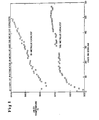
- Figure 1 is a graph of inlet temperature versus days on stream for a naphtha reforming operation using a conventional bi-metallic catalyst and a tri-metallic catalyst pretreated according to one example of the invention
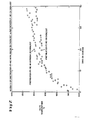
- Figure 2 is a graph similar to Figure 1 but comparing the pretreated catalyst of said one example with a pretreated Pt-Re catalyst mixed with a fresh iridium component.
- a deactivated reforming catalyst comprising: was regenerated in the following manner.
- TPD of hydrogen is a technique used for estimating metal dispersions on reforming catalysts.
- the procedure consists of chemisorbing hydrogen on the metals at room temperature and further desorbing it by applying heat at a programmed rate. By collecting the hydrogen desorbed and knowing the hydrogen to metal ratio, the metal dispersion can be calculated. Thus, a dispersion of 0.5 is equivalent to 50% of the total metal being exposed as surface metal. It has been found that a dispersion of at least 0.5 is necessary to effect reforming reactions.
- pretreated iridium-containing catalysts have dispersions in the range of 0.6 to 1.0.
- the nature of the desorption spectrum which is a plot of the rate of hydrogen release with respect to temperature as a function of temperature, provides additional information on the state of the metals on the support.
- the resulting catalyst of Example 1 had a dispersion of less than 0.5.
- the pretreatment procedure therefore does not work well with a deactivated or spent catalyst.
- a fresh reforming catalyst comprising: was pretreated in the following manner.
- a fresh reforming catalyst comprising: was pretreated in the following manner.
- the resulting catalyst had a dispersion of greater than 0.5 which indicates that the pretreatment was successful.
- a fresh reforming catalyst comprising: was pretreated in the following manner.
- the resulting catalyst had a dispersion of less than 0.5.
- the low dispersion clearly indicates the necessity of oxygen to effect the pretreatment.
- the catalyst of Comparative Example 3 was treated in the same manner as Comparative Example 3 with the exceptions of substituting temperatures of 900°F (488°C) and 950°F (510°C) in steps 1-3.
- the resulting catalysts also had a dispersion of less than 0.5 which indicates the necessity of oxygen to effect the pretreatment.
- a fresh reforming catalyst comprising: was pretreated in the following manner.
- the resulting catalyst again had a dispersion of less than 0.5.
- a fresh reforming catalyst comprising:
- the resulting catalyst had a dispersion of greater than 0.5. Therefore steps 1 and 2 of the pretreatment procedure can be accomplished sequentially (Example 1) or simultaneously.
- a fresh reforming catalyst comprising: was pretreated as in Example 2 resulting in a dispersion of greater than 0.5 as determined by hydrogen chemisorption.
- a commercial platinum-rhenium reforming catalyst (E603) having a composition of 0.35% platinum, and 0.35% rhenium was pretreated in a conventional manner using 5% oxygen in a nitrogen atmosphere for 2 hours at a temperature of 950°F (510°C) and subsequently treated with hydrogen for 1 hour at a temperature of 950°F (510°C).
- the pretreated bi-metallic and tri-metallic catalysts were then evaluated at an octane severity of 98 R+O for the reforming of a C6 350°F (177°C) Arabian Light Naphtha having the following properties:
- reaction conditions were 250 psig (18 bar), 2 WHSV and a total molar recycle ratio of 7.
- a comparison of the inlet temperatures versus days on stream is shown in Figure 1.
- the pretreated tri-metallic catalyst had improved stability as compared with the conventional bi-metallic catalyst.
- a fresh reforming catalyst comprising: was pretreated in accordance with Example 2.
- a platinum-rhenium catalyst was pretreated with 1.93% chlorine in nitrogen at 1.5 wt.% chlorine per weight of catalyst per hour for 2 hours at a temperature of 900°F (482°C). The iridium component was then added and the composite was treated in hydrogen for 1 hour at a temperature of 850°F (454°C).
- the pretreated platinum-rhenium/fresh iridium catalyst and the platinum-rhenium/iridium catalyst pretreated in accordance with this invention were evaluated at an octane severity of 98 R+O for the reforming of C 6 350°F (177°C) Arabian Light Naphtha having the following properties.
- reaction conditions were 250 psig (18 bar), 2 WHSV and a total molar recycle ratio of 7.
- a comparison of the inlet temperature versus days on stream is shown in Figure 2.
- the pretreated catalyst according to this invention had an octane advantage of 10°F (6°C) after 40 days on the stream.
- a bi-metallic catalyst comprising: was pretreated in accordance with Example 2.
- the pretreated catalyst had a dispersion of greater than 0.5 which indicates that the pretreatment procedure was successful.
- the pretreated catalyst had a dispersion of greater than 0.5 which indicates that the pretreatment procedure was successful. Comparative Example 6
- a fresh reforming catalyst comprising: was pretreated according to the procedure in Example 2 with the exception that the fresh catalyst was first reduced in hydrogen for 1 hour at 450°C.
- the resulting catalyst had a dispersion less than 0.5 as determined by hydrogen chemisorption. Therefore, the prescribed pretreatment procedure is ineffective on a previously reduced reforming catalyst.
- a fresh reforming catalyst comprising: was pretreated according to the procedure in Example 2 resulting in a dispersion of greater than 0.5 (0.7) as determined by hydrogen chemisorption.
- the reduced catalyst was again subjected to the pretreatment procedure of Example 2.
- the resulting catalyst had a dispersion of greater than 0.5 (0.8), which indicates the effectiveness of the multiple use of this procedure.
- a fresh reforming catalyst comprising: was pretreated according to the procedure in Example 2 with the exception that oxygen- chlorine was used instead of oxygen/hydrogen chloride in step 1.
- the resulting catalyst had a dispersion less than 0.5 as determined by hydrogen chemisorption which indicates the necessity of the presence of oxygen with a hydrogen halide to effect successful pretreatment.
Landscapes
- Chemical & Material Sciences (AREA)
- Oil, Petroleum & Natural Gas (AREA)
- Engineering & Computer Science (AREA)
- Chemical Kinetics & Catalysis (AREA)
- General Chemical & Material Sciences (AREA)
- Organic Chemistry (AREA)
- Catalysts (AREA)
- Production Of Liquid Hydrocarbon Mixture For Refining Petroleum (AREA)
Description
- The present invention relates to a method for treating fresh iridium-containing reforming catalysts.
- Methods of preparation of metal-containing hydrocarbons conversion catalysts, including iridium-containing reforming catalysts, are well-known in the art. Much of the patent literature in this field relates to the regeneration of spent catalysts to impart a performance similar to that of a fresh or untreated catalyst. U.S. Patent No. 3,998,755 discloses a series of treatment steps which may be performed on either a deactivated catalyst which is being regenerated or a fresh catalyst as part of a pretreatment procedure. The treatment consists basically of a drying step at 200-600°F (93-316°C) for 2 to 24 hours, a calcination step at 700-1100°F (371-593°C) for 5 to 10 hours, and a water-free reduction step at 800-1100°F (427-593°C).
- U.S. Patent No. 3,941,682 discloses a method of treating a catalyst which can be applied to either a spent or a fresh catalyst which comprises drying the catalyst at 220-250°F (104^121°C) followed by a calcination step at 500-700°F (260-371°C) optionally in the presence of both
H 20 and HCI. This patent notes that calcination temperatures in excess of 700°F (371°C) should be avoided. The drying and calcination steps may be followed by contact with hydrogen chloride or reduction with hydrogen. - The present invention resides in a process for the treatment of a fresh iridium-containing reforming catalyst, comprising subjecting said catalyst to the following steps under essentially water-free conditions:
- (1) treatment with oxygen at an elevated temperature,
- (2) treatment with hydrogen halide at an elevated temperature, and
- (3) after steps (1) and (2), treatment with a reducing agent at an elevated temperature. The oxygen and hydrogen halide treatments of the invention assure that the iridium component of the catalyst is placed in the proper oxidation state prior to final reduction.
- The present process is preferably carried out by treating a fresh catalyst prepared from hexachloroiridic acid with an oxygen-containing gas at elevated temperatures. Preferred conditions range from temperatures of 750-1000°F (399-538°C), pressures of 0.1-500 psig (0.007-35 bar) and oxygen concentrations of 0.1-50 wt.% for 0.1 to 24 hours. More preferably, the oxygen treatment step is accomplished by treating the fresh catalyst with 0.1-21 wt.% of oxygen at temperatures of 850-950°F (454-510°C) for 0.25 to 2 hours at atmospheric pressure.
- The next step in the treatment sequence involves the addition of a dry hydrogen halide, preferably hydrogen chloride, to the catalyst. The expression "dry hydrogen halide" is intended to mean that water is controlled to a level no greater than 1/30 the concentration of hydrogen halide. Preferably, water is present at a level no greater than 10 ppm (parts per million). As an example, commercially available hydrogen chloride is suitable as is, i.e. no drying step is necessary. The treatment with dry hydrogen halide is preferably carried out at temperatures ranging from 700-1000°F (371-538°C) and pressures ranging from about 0.1-500 psig (0.007-35 bar) for a period of time ranging from 0.5 to 24 hours utilizing at least 0.1 wt.% of hydrogen halide per weight of catalyst per hour. The amount of hydrogen halide used is generally no greater than 10 wt.% per weight of catalyst per hour since higher amounts, although operabte, are not necessary to obtain the desired results. Preferably, hydrogen chloride with a concentration of about 3 vol.% in an inert gas is added at 1.5 wt.% of hydrogen chloride per weight of catalyst per hour at a temperature of 850 to 950°F (454 to 510°C) for 2 hours at atmospheric pressure.
- The oxygen and hydrogen halide treatment steps may also be accomplished simultaneously with the same results.
- The final pretreatment step consists of treating the catalyst with a reducing agent, e.g. hydrogen. Suitable conditions include temperatures ranging from 400-1100°F (204-593°C) for periods of time ranging from 0.1 to 24 hours. Preferably, this procedure is performed at a temperature of 850-950°F (454^510°C) for 0.5 to 2 hours at atmospheric pressure. It is to be understood that this last step, i.e. reduction with hydrogen, can be carried out either as a separate step in the pretreatment procedure or can be carried out as part of the reformer start-up procedure. The hydrogen reduction step should, however, be performed after the oxygen and hydrogen halide treatments.
- It is important to note that the presence of water during any of the three pretreatments steps is detrimental to the formation and performance of the catalyst.
- In a particularly preferred embodiment, the treatment in step 1 (oxygen) and step 2 (hydrogen halide) is carried out by mixture of the same with an inert diluent such as nitrogen, neon, helium or argon. The amount of inert gas is not critical and can range from 50 to 99.9 vol.% based on oxygen and can range from 90 to 99.9 vol.% based on the dry hydrogen halide.
- The iridium-containing catalysts used herein comprise a porous carrier or support material in combination with iridium and other metals such as platinum and rhenium. The support component of the catalyst is preferably a porous, adsorptive material having a surface area, as determined by the Brunauer-Emmit-Teller (BET) method, of 20-800, preferably 100-300 square meters per gram. This support material should be refractory at the temperature and pressure conditions utilized in any given hydrocarbon conversion process. Useful support materials include: (a) silicon-based materials such as silica or silica gel, silicon carbide, clays, natural or synthetic silicates such as kieselguhr, kaolin, china clay or Attapulgus clay; (b) aluminosilicate zeolite materials such as naturally occurring or synthetic erionite, mordenite or faujasite, that may or may not have been previously converted to a hydrogen or ammonium form and reduced in sodium content by virtue of an exchange reaction with various metal cations, including rare earth metal cations; (c) refractory inorganic oxides, including alumina, titanium dioxide, zinc oxide magnesia, thoria, chromia, silica-alumina, alumina-titania, silica-zirconia and alumina- chromia; and (d) mixtures of one or more of the materials referred to above.
- Refractory inorganic oxide materials are preferred catalyst support materials. In general, superior results are obtained when alumina, in particular the gamma or eta form, is employed. Alumina is the preferred catalyst support material when the catalyst is employed in naphtha reforming operations. The support materials described above are known articles of commerce and can be prepared for use as catalyst constituents by many varied techniques. Typically, the support materials are prepared in the form of spheres, granules, powders, extrudates or pellets. It is possible to have all the metals of the iridium-containing catalyst on the same support in one particle, e.g. platinum and iridium on alumina, or as a mixture of separate particles, e.g. platinum on alumina mixed with iridium on alumina. When mixtures of separate particles are used, the supports can be the same or different.
- Where the iridium-containing catalyst is employed in a naphtha reforming, the catalyst preferably contains greater than 0.1 wt.% iridium, based upon the dry weight of the total catalyst. For other types of operation, lesser quantities of iridium may be employed. Specifically, iridium and platinum may each be present on the catalyst in amounts varying from 0.01 to 5.0 wt.%, preferably in amounts varying from 0.1 to 1.0 wt.%, based upon the total weight of the dry catalyst. Iridium/platinum naphtha reforming catalysts having maximum effectiveness normally contain 0.2 to 0.5 wt.% each, of iridium and platinum, based on total catalyst.
- The iridium-containing catalysts may be prepared employing simple impregnation techniques well in the art. Such a catalyst may be prepared by impregnating a support material with a solution of a soluble iridium compound and soluble compounds of any additional metals to be incorporated in the catalyst. Generally, an aqueous solution of the metal compounds is used. The support material may be impregnated with the various metal-containing compounds either sequentially or simultaneously. The carrier material is impregnated with solutions of appropriate concentration to provide the desired quantity of metals in the finished catalyst. In the case of iridium, compounds suitable for the impregnation onto the carrier include hexachloroiridic acid, iridium tribromide, iridium trichloride, and ammonium chloroiridate, with hexachloroiridic acid being preferred. The preferred catalyst manufacturing technique involves contacting a previously prepared support, such as alumina, with an aqueous solution of hex- chloroiridic acid of appropriate concentration to provide the desired quantity of metal in the finished catalyst.
- After impregnating the carrier, the composite catalyst is dried at a temperature varying from 220-250°F (104^121°C). The catalyst may be dried in air at the above stated temperatures or may be dried by treating the catalyst in a flowing stream of inert gas, e.g. nitrogen. The fresh catalyst is then subjected to the pretreatment steps described above. Preferably, the catalyst is dried in an oxygen-containing gas at a temperature of from 850°-950°F (454°-510°C) for 0.25 to 2 hours. The drying step is followed by treatment with hydrogen chloride for 2 hours again at a temperature of from 850-950°F (424-510°C). If preferred, the foregoing steps may be accomplished simultanously. The catalyst is next treated with reducing agent such as hydrogen for 0.5 to 2 hours also at a temperature of 850-950°F (454-510°C).
- Iridium-containing reforming catalysts are used to improve the octane quality of naphthas and straight run gasolines. In addition they may be used to promote a wide variety of hydrocarbon conversion reactions such as hydrocracking, isomerization, dehydrogenation and cracking.
- In a naphtha hydroforming process (reforming) a substantially sulfur-free naphtha stream that typically contains 15 to 80 volume percent paraffins, 15 to 80 volume percent naphthenes and 2 to 20 percent aromatics and boiling at atmospheric pressure substantially between 80°F and 450°F (27°C and 232°C), preferably between 150°F and 375°F (66°C and 191°C), is contacted with the iridium-containing catalyst composite in the presence of hydrogen. The reactions typically occur in the vapor phase at a temperature varying from about 650-1000°F (343-538°C), preferably about 750-980°F) (399-527°C). Reaction zone pressures may vary from 1 to 50 atmospheres (0,98-49 bar), preferably from 5 to 30 atmospheres (4,9-29,4 bar). The naphtha feed stream is conveniently passed over the catalyst composite at space velocities varying from 0.5 to 20 parts by weight of naphtha per hour per part by weight of catalyst (W/hr/W), preferably from 1 to 10 W/hr/W. The hydrogen to hydrocarbon mole ratio within the reaction zone is conveniently maintained between 0.5 and 20, preferably between 1 and 10. During the reforming process, the hydrogen used may be in admixture with light gaseous hydrocarbons. In a typical operation, the catalyst is maintained as a fixed bed within a series of adiabatically operated reactors. The product stream from each reactor (except the last) in the reactor train is reheated prior to passage to the following reactor. As an alternate to the above-described process, the catalyst may be used in a moving bed in which the naphtha charge stock, hydrogen and catalyst are passed in parallel through the reactor or in a fluidized system wherein the naphtha feed stock is passed upwardly through a turbulent bed of finely divided catalyst particles. Finally, if desired, the catalyst may be simply slurried with the charge stock and the resulting mixture conveyed to the reaction zone for further reaction.
- The invention will now be more particularly described with reference to the examples and comparative examples and with reference to the accompanying drawings in which:-
- Figure 1 is a graph of inlet temperature versus days on stream for a naphtha reforming operation using a conventional bi-metallic catalyst and a tri-metallic catalyst pretreated according to one example of the invention, and
- Figure 2 is a graph similar to Figure 1 but comparing the pretreated catalyst of said one example with a pretreated Pt-Re catalyst mixed with a fresh iridium component.
- A deactivated reforming catalyst comprising:

- 1. The spent catalyst was heated to 850°F (454°C) in the presence of 5% oxygen and 3% hydrogen chloride in a nitrogen atmosphere for 8 hours to remove the coke deposits from the catalyst.
- 2. The product of step 1 was treated with hydrogen for 0.5 hours at a temperature of 850°F (454°C).
- All of the catalysts in this and the following examples were examined by Temperature Programmed Desorption (TPD) of hydrogen. TPD of hydrogen is a technique used for estimating metal dispersions on reforming catalysts. The procedure consists of chemisorbing hydrogen on the metals at room temperature and further desorbing it by applying heat at a programmed rate. By collecting the hydrogen desorbed and knowing the hydrogen to metal ratio, the metal dispersion can be calculated. Thus, a dispersion of 0.5 is equivalent to 50% of the total metal being exposed as surface metal. It has been found that a dispersion of at least 0.5 is necessary to effect reforming reactions. Typically, pretreated iridium-containing catalysts have dispersions in the range of 0.6 to 1.0. The nature of the desorption spectrum, which is a plot of the rate of hydrogen release with respect to temperature as a function of temperature, provides additional information on the state of the metals on the support.
- The resulting catalyst of Example 1 had a dispersion of less than 0.5. The pretreatment procedure therefore does not work well with a deactivated or spent catalyst.
- A fresh reforming catalyst comprising:

- 1. The fresh catalyst was heated to a temperature of 850°F (454°C) in the presence of 5% oxygen and 3% hydrogen chloride in nitrogen and water for 2 hours. A water: hydrogen chloride molar ratio of 5.6:1 was maintained during this period.
- 2. The product of step 1 was treated in hydrogen under dry conditions for 0.5 hours at a temperature of 850°F (454°C). The resulting catalyst had a dispersion of less than 0.5.
- Therefore the presence of water is detrimental to the pretreatment procedure.
- A fresh reforming catalyst comprising:

- 1. The fresh catalyst was heated at a temperature of 950°F (510°C) in 5% oxygen in a nitrogen atmosphere for 0.5 hours..
- 2. The product of step 1 was further treated in 3.09% hydrogen chloride in nitrogen at 1.5 wt.% hydrogen chloride per weight of catalyst per hour for 2 hours at 950°F (510°C).
- 3. The product of step 2 was treated with hydrogen for 1 hour at a temperature of 950°F (510°C).
- The resulting catalyst had a dispersion of greater than 0.5 which indicates that the pretreatment was successful.
- A fresh reforming catalyst comprising:

- 1. The fresh catalyst was heated at a temperature of 850°F (454°C) in nitrogen for 0.5 hours.
- 2. The product of step 1 was treated with 3.09% hydrogen chloride in nitrogen at 1.5 wt.% hydrogen chloride per weight of catalyst per hour for 2 hours at a temperature of 850°F (454°C).
- 3. The product of step 2 was treated with hydrogen for 1 hour at a temperature of 850°F (454°C).
- The resulting catalyst had a dispersion of less than 0.5. The low dispersion clearly indicates the necessity of oxygen to effect the pretreatment.
- The catalyst of Comparative Example 3 was treated in the same manner as Comparative Example 3 with the exceptions of substituting temperatures of 900°F (488°C) and 950°F (510°C) in steps 1-3.
- The resulting catalysts also had a dispersion of less than 0.5 which indicates the necessity of oxygen to effect the pretreatment.
- A fresh reforming catalyst comprising:

- 1. The catalyst was heated to a temperature of 950°F (510°C) in the presence of 3.09% hydrogen chloride in nitrogen at 1.5 wt.% hydrogen chloride per weight of catalyst per hour.
- 2. The product of step 1 was treated with hydrogen for one hour at a temperature of 950°F (510°C).
- The resulting catalyst again had a dispersion of less than 0.5.
- A fresh reforming catalyst comprising:
-

- 1. The fresh catalyst was heated to a temperature of 850°F (454°C) in the presence of 5% oxygen in a nitrogen atmosphere and 1.5 wt.% of 3.09% hydrogen chloride per weight of catalyst per hour for 2 hours.
- 2. The product of step 1 was treated with hydrogen for 1 hour at a temperature of 850°F (454°C).
- The resulting catalyst had a dispersion of greater than 0.5. Therefore steps 1 and 2 of the pretreatment procedure can be accomplished sequentially (Example 1) or simultaneously.
- A fresh reforming catalyst comprising:

- A commercial platinum-rhenium reforming catalyst (E603) having a composition of 0.35% platinum, and 0.35% rhenium was pretreated in a conventional manner using 5% oxygen in a nitrogen atmosphere for 2 hours at a temperature of 950°F (510°C) and subsequently treated with hydrogen for 1 hour at a temperature of 950°F (510°C). The pretreated bi-metallic and tri-metallic catalysts were then evaluated at an octane severity of 98 R+O for the reforming of a C6 350°F (177°C) Arabian Light Naphtha having the following properties:

- The reaction conditions were 250 psig (18 bar), 2 WHSV and a total molar recycle ratio of 7. A comparison of the inlet temperatures versus days on stream is shown in Figure 1. As can be seen, the pretreated tri-metallic catalyst had improved stability as compared with the conventional bi-metallic catalyst.
- A fresh reforming catalyst comprising:

- A platinum-rhenium catalyst was pretreated with 1.93% chlorine in nitrogen at 1.5 wt.% chlorine per weight of catalyst per hour for 2 hours at a temperature of 900°F (482°C). The iridium component was then added and the composite was treated in hydrogen for 1 hour at a temperature of 850°F (454°C).
- The pretreated platinum-rhenium/fresh iridium catalyst and the platinum-rhenium/iridium catalyst pretreated in accordance with this invention were evaluated at an octane severity of 98 R+O for the reforming of C6 350°F (177°C) Arabian Light Naphtha having the following properties.

- The reaction conditions were 250 psig (18 bar), 2 WHSV and a total molar recycle ratio of 7. A comparison of the inlet temperature versus days on stream is shown in Figure 2. As can be seen, the pretreated catalyst according to this invention had an octane advantage of 10°F (6°C) after 40 days on the stream.
- A bi-metallic catalyst comprising:

- A commercial bi-metallic catalyst designated KX8130 having a composition comprising:

- The pretreated catalyst had a dispersion of greater than 0.5 which indicates that the pretreatment procedure was successful. Comparative Example 6
- A fresh reforming catalyst comprising:

- A fresh reforming catalyst comprising:

- A fresh reforming catalyst comprising:

Claims (10)
Applications Claiming Priority (2)
| Application Number | Priority Date | Filing Date | Title |
|---|---|---|---|
| US38515882A | 1982-06-04 | 1982-06-04 | |
| US385158 | 1982-06-04 |
Publications (2)
| Publication Number | Publication Date |
|---|---|
| EP0096483A1 EP0096483A1 (en) | 1983-12-21 |
| EP0096483B1 true EP0096483B1 (en) | 1986-06-04 |
Family
ID=23520254
Family Applications (1)
| Application Number | Title | Priority Date | Filing Date |
|---|---|---|---|
| EP83302771A Expired EP0096483B1 (en) | 1982-06-04 | 1983-05-17 | Pretreatment of a fresh iridium-containing catalyst |
Country Status (7)
| Country | Link |
|---|---|
| EP (1) | EP0096483B1 (en) |
| JP (1) | JPS59334A (en) |
| AU (1) | AU1449583A (en) |
| DE (1) | DE3363909D1 (en) |
| ES (1) | ES8500313A1 (en) |
| PT (1) | PT76801B (en) |
| ZA (1) | ZA833970B (en) |
Families Citing this family (2)
| Publication number | Priority date | Publication date | Assignee | Title |
|---|---|---|---|---|
| RU2131769C1 (en) * | 1997-06-10 | 1999-06-20 | Самарский государственный аэрокосмический университет им.С.П.Королева | Catalyst for hydrogenation of aromatic hydrocarbons and method of preparation thereof |
| JP7571375B2 (en) * | 2020-02-28 | 2024-10-23 | 市光工業株式会社 | Vehicle lighting fixtures |
Family Cites Families (3)
| Publication number | Priority date | Publication date | Assignee | Title |
|---|---|---|---|---|
| US3998755A (en) * | 1971-05-03 | 1976-12-21 | Universal Oil Products Company | Regeneration of a coke-deactivated, acidic bimetallic Pt-1r catalyst |
| US4172817A (en) * | 1978-05-22 | 1979-10-30 | Exxon Research & Engineering Co. | Process for reactivating an iridium-containing catalyst |
| AU525445B2 (en) * | 1978-08-16 | 1982-11-04 | Mobil Oil Corp. | Reforming catalyst of separate platinum-containing and iridium-containing particles |
-
1983
- 1983-05-12 AU AU14495/83A patent/AU1449583A/en not_active Abandoned
- 1983-05-17 EP EP83302771A patent/EP0096483B1/en not_active Expired
- 1983-05-17 DE DE8383302771T patent/DE3363909D1/en not_active Expired
- 1983-06-01 PT PT76801A patent/PT76801B/en unknown
- 1983-06-01 ZA ZA833970A patent/ZA833970B/en unknown
- 1983-06-03 ES ES522957A patent/ES8500313A1/en not_active Expired
- 1983-06-04 JP JP58100129A patent/JPS59334A/en active Pending
Also Published As
| Publication number | Publication date |
|---|---|
| AU1449583A (en) | 1983-12-08 |
| PT76801B (en) | 1986-02-12 |
| ES522957A0 (en) | 1984-10-01 |
| PT76801A (en) | 1983-07-01 |
| EP0096483A1 (en) | 1983-12-21 |
| ZA833970B (en) | 1984-02-29 |
| ES8500313A1 (en) | 1984-10-01 |
| JPS59334A (en) | 1984-01-05 |
| DE3363909D1 (en) | 1986-07-10 |
Similar Documents
| Publication | Publication Date | Title |
|---|---|---|
| JP3115892B2 (en) | Low temperature regeneration of coke deactivated reforming catalyst | |
| US3939062A (en) | Catalyst regeneration procedure | |
| EP0057551B1 (en) | Catalyst regeneration procedure | |
| US3937660A (en) | Regeneration procedure for iridium-containing catalyst | |
| US4619906A (en) | Catalytic composite for conversion of hydrocarbons and the method of preparation | |
| CA1037401A (en) | Regeneration procedure | |
| AU600076B2 (en) | A process for regenerating a monofunctional large-pore zeolite catalyst having high selectivity for paraffin dehydrocyclization | |
| US4046673A (en) | Simplified regeneration procedure | |
| US3941682A (en) | Regeneration procedure | |
| US4354925A (en) | Catalytic reforming process | |
| US5883031A (en) | Low temperature regeneration of coke deactivated reforming catalysts | |
| US4518708A (en) | Pretreatment of a fresh iridium-containing catalyst | |
| US4018670A (en) | Hydrocarbon conversion process | |
| WO1988004575A1 (en) | A process for regenerating sulfur contaminated reforming catalysts | |
| US4652689A (en) | Catalytic composite for conversion of hydrocarbons and the method of preparation and use thereof | |
| US3296119A (en) | Catalytic reforming process and catalyst therefor | |
| US5073529A (en) | Method of regenerating a nonacidic zeolite catalyst | |
| US3537980A (en) | Regeneration at low temperatures of platinum-rhenium reforming catalysts | |
| EP0096483A1 (en) | Pretreatment of a fresh iridium-containing catalyst | |
| US3871996A (en) | Reforming with a single platinum group metal | |
| US3278419A (en) | Platinum group hydroforming catalyst reactivation process | |
| EP0650395B1 (en) | Low temperature regeneration of coke deactivated reforming catalysts | |
| US3956190A (en) | Hydrocarbon conversion catalyst | |
| CA1193218A (en) | Plural stage reforming with catalysts having a skewed distribution of a platinum-group metal and rhenium | |
| EP0673406B1 (en) | Pretreatment method for increasing conversion of reforming catalyst |
Legal Events
| Date | Code | Title | Description |
|---|---|---|---|
| PUAI | Public reference made under article 153(3) epc to a published international application that has entered the european phase |
Free format text: ORIGINAL CODE: 0009012 |
|
| AK | Designated contracting states |
Designated state(s): BE DE FR GB IT NL SE |
|
| 17P | Request for examination filed |
Effective date: 19840524 |
|
| GRAA | (expected) grant |
Free format text: ORIGINAL CODE: 0009210 |
|
| AK | Designated contracting states |
Kind code of ref document: B1 Designated state(s): BE DE FR GB IT NL SE |
|
| PG25 | Lapsed in a contracting state [announced via postgrant information from national office to epo] |
Ref country code: NL Effective date: 19860604 Ref country code: IT Free format text: LAPSE BECAUSE OF FAILURE TO SUBMIT A TRANSLATION OF THE DESCRIPTION OR TO PAY THE FEE WITHIN THE PRESCRIBED TIME-LIMIT;WARNING: LAPSES OF ITALIAN PATENTS WITH EFFECTIVE DATE BEFORE 2007 MAY HAVE OCCURRED AT ANY TIME BEFORE 2007. THE CORRECT EFFECTIVE DATE MAY BE DIFFERENT FROM THE ONE RECORDED. Effective date: 19860604 Ref country code: FR Free format text: THE PATENT HAS BEEN ANNULLED BY A DECISION OF A NATIONAL AUTHORITY Effective date: 19860604 |
|
| REF | Corresponds to: |
Ref document number: 3363909 Country of ref document: DE Date of ref document: 19860710 |
|
| EN | Fr: translation not filed | ||
| NLV1 | Nl: lapsed or annulled due to failure to fulfill the requirements of art. 29p and 29m of the patents act | ||
| PLBE | No opposition filed within time limit |
Free format text: ORIGINAL CODE: 0009261 |
|
| STAA | Information on the status of an ep patent application or granted ep patent |
Free format text: STATUS: NO OPPOSITION FILED WITHIN TIME LIMIT |
|
| PG25 | Lapsed in a contracting state [announced via postgrant information from national office to epo] |
Ref country code: SE Effective date: 19870518 |
|
| 26N | No opposition filed | ||
| BERE | Be: lapsed |
Owner name: MOBIL OIL CORP. Effective date: 19870531 |
|
| PG25 | Lapsed in a contracting state [announced via postgrant information from national office to epo] |
Ref country code: DE Effective date: 19880202 |
|
| GBPC | Gb: european patent ceased through non-payment of renewal fee | ||
| PG25 | Lapsed in a contracting state [announced via postgrant information from national office to epo] |
Ref country code: GB Free format text: LAPSE BECAUSE OF NON-PAYMENT OF DUE FEES Effective date: 19881122 |
|
| PG25 | Lapsed in a contracting state [announced via postgrant information from national office to epo] |
Ref country code: BE Effective date: 19890531 |
|
| EUG | Se: european patent has lapsed |
Ref document number: 83302771.7 Effective date: 19880616 |