EP0095880B1 - Fluorenecarboxylic acid derivatives, their preparation and use as plant growth regulators - Google Patents
Fluorenecarboxylic acid derivatives, their preparation and use as plant growth regulators Download PDFInfo
- Publication number
- EP0095880B1 EP0095880B1 EP83302949A EP83302949A EP0095880B1 EP 0095880 B1 EP0095880 B1 EP 0095880B1 EP 83302949 A EP83302949 A EP 83302949A EP 83302949 A EP83302949 A EP 83302949A EP 0095880 B1 EP0095880 B1 EP 0095880B1
- Authority
- EP
- European Patent Office
- Prior art keywords
- salt
- cis
- acid
- fluorenecarboxylic
- fluorenecarboxylic acid
- Prior art date
- Legal status (The legal status is an assumption and is not a legal conclusion. Google has not performed a legal analysis and makes no representation as to the accuracy of the status listed.)
- Expired
Links
- 0 **1N*(*)CCC1 Chemical compound **1N*(*)CCC1 0.000 description 1
Classifications
-
- C—CHEMISTRY; METALLURGY
- C07—ORGANIC CHEMISTRY
- C07D—HETEROCYCLIC COMPOUNDS
- C07D207/00—Heterocyclic compounds containing five-membered rings not condensed with other rings, with one nitrogen atom as the only ring hetero atom
- C07D207/02—Heterocyclic compounds containing five-membered rings not condensed with other rings, with one nitrogen atom as the only ring hetero atom with only hydrogen or carbon atoms directly attached to the ring nitrogen atom
- C07D207/04—Heterocyclic compounds containing five-membered rings not condensed with other rings, with one nitrogen atom as the only ring hetero atom with only hydrogen or carbon atoms directly attached to the ring nitrogen atom having no double bonds between ring members or between ring members and non-ring members
- C07D207/08—Heterocyclic compounds containing five-membered rings not condensed with other rings, with one nitrogen atom as the only ring hetero atom with only hydrogen or carbon atoms directly attached to the ring nitrogen atom having no double bonds between ring members or between ring members and non-ring members with hydrocarbon radicals, substituted by hetero atoms, attached to ring carbon atoms
-
- A—HUMAN NECESSITIES
- A01—AGRICULTURE; FORESTRY; ANIMAL HUSBANDRY; HUNTING; TRAPPING; FISHING
- A01N—PRESERVATION OF BODIES OF HUMANS OR ANIMALS OR PLANTS OR PARTS THEREOF; BIOCIDES, e.g. AS DISINFECTANTS, AS PESTICIDES OR AS HERBICIDES; PEST REPELLANTS OR ATTRACTANTS; PLANT GROWTH REGULATORS
- A01N45/00—Biocides, pest repellants or attractants, or plant growth regulators, containing compounds having three or more carbocyclic rings condensed among themselves, at least one ring not being a six-membered ring
- A01N45/02—Biocides, pest repellants or attractants, or plant growth regulators, containing compounds having three or more carbocyclic rings condensed among themselves, at least one ring not being a six-membered ring having three carbocyclic rings
-
- C—CHEMISTRY; METALLURGY
- C07—ORGANIC CHEMISTRY
- C07C—ACYCLIC OR CARBOCYCLIC COMPOUNDS
- C07C61/00—Compounds having carboxyl groups bound to carbon atoms of rings other than six-membered aromatic rings
- C07C61/16—Unsaturated compounds
- C07C61/39—Unsaturated compounds containing six-membered aromatic rings
-
- C—CHEMISTRY; METALLURGY
- C07—ORGANIC CHEMISTRY
- C07C—ACYCLIC OR CARBOCYCLIC COMPOUNDS
- C07C62/00—Compounds having carboxyl groups bound to carbon atoms of rings other than six—membered aromatic rings and containing any of the groups OH, O—metal, —CHO, keto, ether, groups, groups, or groups
- C07C62/30—Unsaturated compounds
- C07C62/32—Unsaturated compounds containing hydroxy or O-metal groups
-
- C—CHEMISTRY; METALLURGY
- C07—ORGANIC CHEMISTRY
- C07C—ACYCLIC OR CARBOCYCLIC COMPOUNDS
- C07C63/00—Compounds having carboxyl groups bound to a carbon atoms of six-membered aromatic rings
- C07C63/33—Polycyclic acids
- C07C63/49—Polycyclic acids containing rings other than six-membered aromatic rings
-
- C—CHEMISTRY; METALLURGY
- C07—ORGANIC CHEMISTRY
- C07D—HETEROCYCLIC COMPOUNDS
- C07D295/00—Heterocyclic compounds containing polymethylene-imine rings with at least five ring members, 3-azabicyclo [3.2.2] nonane, piperazine, morpholine or thiomorpholine rings, having only hydrogen atoms directly attached to the ring carbon atoms
- C07D295/02—Heterocyclic compounds containing polymethylene-imine rings with at least five ring members, 3-azabicyclo [3.2.2] nonane, piperazine, morpholine or thiomorpholine rings, having only hydrogen atoms directly attached to the ring carbon atoms containing only hydrogen and carbon atoms in addition to the ring hetero elements
- C07D295/027—Heterocyclic compounds containing polymethylene-imine rings with at least five ring members, 3-azabicyclo [3.2.2] nonane, piperazine, morpholine or thiomorpholine rings, having only hydrogen atoms directly attached to the ring carbon atoms containing only hydrogen and carbon atoms in addition to the ring hetero elements containing only one hetero ring
-
- C—CHEMISTRY; METALLURGY
- C07—ORGANIC CHEMISTRY
- C07D—HETEROCYCLIC COMPOUNDS
- C07D295/00—Heterocyclic compounds containing polymethylene-imine rings with at least five ring members, 3-azabicyclo [3.2.2] nonane, piperazine, morpholine or thiomorpholine rings, having only hydrogen atoms directly attached to the ring carbon atoms
- C07D295/02—Heterocyclic compounds containing polymethylene-imine rings with at least five ring members, 3-azabicyclo [3.2.2] nonane, piperazine, morpholine or thiomorpholine rings, having only hydrogen atoms directly attached to the ring carbon atoms containing only hydrogen and carbon atoms in addition to the ring hetero elements
- C07D295/037—Heterocyclic compounds containing polymethylene-imine rings with at least five ring members, 3-azabicyclo [3.2.2] nonane, piperazine, morpholine or thiomorpholine rings, having only hydrogen atoms directly attached to the ring carbon atoms containing only hydrogen and carbon atoms in addition to the ring hetero elements with quaternary ring nitrogen atoms
-
- C—CHEMISTRY; METALLURGY
- C07—ORGANIC CHEMISTRY
- C07D—HETEROCYCLIC COMPOUNDS
- C07D295/00—Heterocyclic compounds containing polymethylene-imine rings with at least five ring members, 3-azabicyclo [3.2.2] nonane, piperazine, morpholine or thiomorpholine rings, having only hydrogen atoms directly attached to the ring carbon atoms
- C07D295/04—Heterocyclic compounds containing polymethylene-imine rings with at least five ring members, 3-azabicyclo [3.2.2] nonane, piperazine, morpholine or thiomorpholine rings, having only hydrogen atoms directly attached to the ring carbon atoms with substituted hydrocarbon radicals attached to ring nitrogen atoms
- C07D295/14—Heterocyclic compounds containing polymethylene-imine rings with at least five ring members, 3-azabicyclo [3.2.2] nonane, piperazine, morpholine or thiomorpholine rings, having only hydrogen atoms directly attached to the ring carbon atoms with substituted hydrocarbon radicals attached to ring nitrogen atoms substituted by carbon atoms having three bonds to hetero atoms with at the most one bond to halogen, e.g. ester or nitrile radicals
- C07D295/155—Heterocyclic compounds containing polymethylene-imine rings with at least five ring members, 3-azabicyclo [3.2.2] nonane, piperazine, morpholine or thiomorpholine rings, having only hydrogen atoms directly attached to the ring carbon atoms with substituted hydrocarbon radicals attached to ring nitrogen atoms substituted by carbon atoms having three bonds to hetero atoms with at the most one bond to halogen, e.g. ester or nitrile radicals with the ring nitrogen atoms and the carbon atoms with three bonds to hetero atoms separated by carbocyclic rings or by carbon chains interrupted by carbocyclic rings
-
- C—CHEMISTRY; METALLURGY
- C07—ORGANIC CHEMISTRY
- C07C—ACYCLIC OR CARBOCYCLIC COMPOUNDS
- C07C2603/00—Systems containing at least three condensed rings
- C07C2603/02—Ortho- or ortho- and peri-condensed systems
- C07C2603/04—Ortho- or ortho- and peri-condensed systems containing three rings
- C07C2603/06—Ortho- or ortho- and peri-condensed systems containing three rings containing at least one ring with less than six ring members
- C07C2603/10—Ortho- or ortho- and peri-condensed systems containing three rings containing at least one ring with less than six ring members containing five-membered rings
- C07C2603/12—Ortho- or ortho- and peri-condensed systems containing three rings containing at least one ring with less than six ring members containing five-membered rings only one five-membered ring
- C07C2603/18—Fluorenes; Hydrogenated fluorenes
Definitions
- This invention relates to certain new compounds derived from fluorene-9-carboxylic and fluorene 1-carboxylic acids, to plant-growth regulating compositions containing these compounds and to their use for regulating plant growth.
- methyl - 2 - chloro - 9 - hydroxyfluorene - 9 - carboxylate-(chlorflurenol-methyl) has become commercially available as Maintain CF-125 for use as a general plant growth retardant and weed suppressant, either by itself or in combination with other growth-affecting chemicals. However, in many instances, it has proved phytotoxic to the plants being treated.
- the present invention is directed to various acid, ester and salt derivatives of fluorene - 9 - carboxylic acid and fluorene - 1 - carboxylic acid which exhibit significant plant growth regulating properties.
- the fluorenecarboxylic acid derivatives of the present invention have excellent growth-regulating properties and are compounds having the structural formula: wherein each of X and X' is H, Cl, Br or I; R is H, OH or a 2,5 - dialkylpyrrolidinyl group; R 1 is H, COO ⁇ R 3 or COOR 4 , ⁇ R 3 being a salt-forming nitrogen-containing cation selected from: and R 4 being H or a C 1-4 alkyl group, and R 2 is H or COO ⁇ R 3 , where R 3 has the meaning defined above, with the provisos that, firstly, R 1 is COO ⁇ R 3 or COOR 4 when R 2 is not COO ⁇ R 3 , secondly, only one of R 1 and R can be a carboxylic acid or derivative as defined above at one time and, thirdly, when R 1 is COOR 4 , R is 2,5-dialkylpyrrolidinyl.
- the fluorenecarboxylic acid derivatives of this invention which are lower alkyl ester compounds are obtained by standard techniques from the basic acid, i.e., by the direct esterification of the acid with excess lower alkyl alcohol.
- the reaction is conducted by heating the reaction mixture at reflux for two-three hours, after which the reaction mixture is cooled and the solid product separated therefrom and purified by recrystallization.
- These ester derivatives normally solid at ambient temperature, typically are prepared at 85-95 percent yield.
- Those fluorenecarboxylic acid derivatives of this invention which may be unsubstituted as well as monoalkyl- and dialkyl-substituted pyrrolidine or piperadine salt derivatives typically are prepared by reacting, in essentially equimolar proportions, a 9-fluorenecarboxylic acid or a 1-fluorenecarboxylic acid with the appropriate pyrrolidine or piperidine compound in a solvent medium.
- the solvent medium may be an aliphatic compound such as, e.g., acetone and acetonitrile, an aromatic compound such as, e.g., benzene, or a mixture of such solvents.
- reaction solution After a slightly exothermic reaction is observed initially, the reaction solution then is briefly heated on a steam bath, e.g., for 10-30 minutes, whereupon a solid precipitates out. This is isolated, washed well and dried, preferably in air.
- pyrrolidine or piperidine salt derivatives which are white to brown colored solids at ambient temperature, are typically obtained in 50-95 percent yield.
- pyrrolidine or piperidine salt derivatives i.e., those derived from either a 1-fluorenecarboxylic acid or a 9-fluorenecarboxylic acid which is substituted with halogen radicals, particularly in the 2,7-positions of the acid ring, are prepared by reacting such a substituted acid with the appropriate pyrrolidine or piperidine compound in an organic solvent medium for 3-6 hours at the reflux temperature of the solvent. After cooling, the solid that precipitates out is isolated, washed with water and air dried. These products likewise are obtained in 50-95 percent yield.
- compounds of this invention can be incorporated into all types of formulations customarily used heretofore for transporting and delivering biologically-active chemicals to plants.
- these compounds may be formulated in solvent-water mixtures containing surfactants. They may also be formulated as concentrated, flowable aqueous suspensions which are diluted with water prior to application. They further may be formulated as wettable powders or granules, admixed with clay, Kaolin, bentonite, ground shale, talc, chalk, and/or other adjuvants customarily employed in solid preparations.
- Application of any formulation can be effected by either spraying, pouring, scattering, or dusting but application of liquid materials by, e.g., spraying plant foliage, soil, etc., is presently preferred.
- the substituted fluorenecarboxylic acid compounds of this invention may control the size, shape and/or growth rate of plants, depending upon the concentrations used. They also may control the dormancy time of plants, affecting the time of flowering and fruit maturity thereof. They may control the growth of turf grass, as well as affecting its texture and color. Also, they can improve the size, color, firmness and/or yield of fruit, including, e.g., uniform maturity thereof. Further, they can prevent preharvest drop of fruit, but they also may loosen fruit for easy harvesting in mechanical equipment. They may aid in the rooting of cuttings, as well as preventing foliage drop.
- the fluorenecarboxylic acid compounds of this invention are further characterized as being non-phytotoxic to plants at the effective concentrations employed. Another important characteristic of these compounds is their extended life-time in contact with plants, soil, etc., thereby providing long-term growth regulation to the plants with no harmful residuals remaining.
- Cis-2,5-dimethylpyrrolidine 0.61 g (0.062 mol), was mixed with 1.4 g (0.062 mol) of 9 - hydroxyfluorene - 9 - carboxylic acid in 50 mls of dry acetone. After an initial slightly exothermic reaction, the reactant solution was heated on a steam bath for about 10 minutes. The solid that precipitated out was filtered, washed with petroleum ether and air dried. Isolated was 1.52 g, or 95% of the theoretical yield, of a white solid melting at 155°C. IR spectra and elemental analytical data indicated this product to be the desired cis - 2,5 - dimethylpyrrolidine salt of 9 - hydroxyfluorene - 9 - carboxylic acid.
- fluorenecarboxylic acid salts conforming to the structure were prepared as set forth in Example 10 above, alternatively employing, as the cation-forming reactants, piperidine or 2,6 - dimethylpiperidine. The following results were obtained.
- the cis-2,5-dimethylpyrrolidine salt of 1-fluorenecarboxylic acid was tested on a six-month old Kentucky and Merion turfgrass mixture grown in 3-1/4" diameter waxed paper pots. Two known plant growth regulants were similarly tested. Some grass samples were not treated, only fertilized, as controls. Before treatment, the grass was cut and then fertilized with a 20-20-20 water-soluble fertilizer. Three pots were sprayed per treatment.
- the compound of this invention (Product of Example 1-the cis-2,5-dimethylpyrrolidine salt of 1-fluorenecarboxylic acid), was more active in controlling grass growth than either Maintain CF-125 or Mow-Less. Further, the turf treated with this compound had a fine leaf and smooth texture; it did not have the twisted, yellowish leaves that turf treated with the known chemicals developed.
Landscapes
- Chemical & Material Sciences (AREA)
- Organic Chemistry (AREA)
- Life Sciences & Earth Sciences (AREA)
- Agronomy & Crop Science (AREA)
- Pest Control & Pesticides (AREA)
- Plant Pathology (AREA)
- Health & Medical Sciences (AREA)
- Engineering & Computer Science (AREA)
- Dentistry (AREA)
- General Health & Medical Sciences (AREA)
- Wood Science & Technology (AREA)
- Zoology (AREA)
- Environmental Sciences (AREA)
- Agricultural Chemicals And Associated Chemicals (AREA)
- Organic Low-Molecular-Weight Compounds And Preparation Thereof (AREA)
- Hydrogenated Pyridines (AREA)
- Pyrrole Compounds (AREA)
Abstract
Description
- This invention relates to certain new compounds derived from fluorene-9-carboxylic and fluorene 1-carboxylic acids, to plant-growth regulating compositions containing these compounds and to their use for regulating plant growth.
- A series of patents obtained by E. Merck AG, Darmstadt, Germany, are directed to various derivatives of fluorenecarboxylic acid useful for modifying plant growth patterns. These compounds which have become known as morphactins due to their singular mode of plant growth control, are described and/or claimed in U.S. Patent Nos. 3,476,545; 3,598,564; 3,506,434; 3,746,740; 3,830,643; and 3,843,714. Of the many compounds described, methyl - 2 - chloro - 9 - hydroxyfluorene - 9 - carboxylate-(chlorflurenol-methyl), in particular, has become commercially available as Maintain CF-125 for use as a general plant growth retardant and weed suppressant, either by itself or in combination with other growth-affecting chemicals. However, in many instances, it has proved phytotoxic to the plants being treated.
- We have now discovered and developed still different, novel derivatives of fluorenecarboxylic acid which likewise are useful as plant growth modifiers, primarily for regulating flower and fruit set in cultured plants without phytotoxic effects thereto. Particularly, those of our compounds preferred for use at this time may significantly modify the growth patterns of plants and enhance commercially important crop yields therefrom, even when employed in minute quantities.
- Accordingly, the present invention is directed to various acid, ester and salt derivatives of fluorene - 9 - carboxylic acid and fluorene - 1 - carboxylic acid which exhibit significant plant growth regulating properties.
- The fluorenecarboxylic acid derivatives of the present invention have excellent growth-regulating properties and are compounds having the structural formula:


- Specific compounds encompassed within the preferred structural formula defined above (III) include:
-
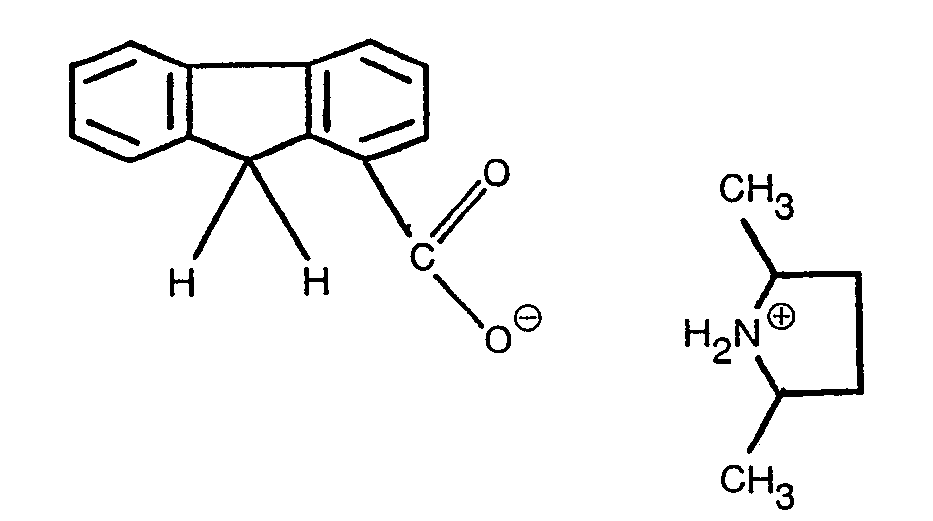
- 2-Methylpyrrolidine salt of 1-fluorenecarboxylic acid

- Cis-2,5-dimethylpyrrolidine salt of 2,7-dichloro-9-hydroxyfluorene-9-carboxylic acid

- 9-Cis-2,5-dimethyl-1-pyrrolidinyl-2-chlorofluorene-9-carboxylic acid, methyl ester

- Cis-2,5-dimethyl-1-pyrrolidine salt of 9-fluorenecarboxylic acid

- 2,6-Dimethyl piperidene salt of 1-fluorenecarboxylic acid 5

- Cis-2,5-dimethylpyrrolidene salt of 9-hydroxyfluorene-9-carboxylic acid

- The fluorenecarboxylic acid derivatives of this invention which are lower alkyl ester compounds are obtained by standard techniques from the basic acid, i.e., by the direct esterification of the acid with excess lower alkyl alcohol. The reaction is conducted by heating the reaction mixture at reflux for two-three hours, after which the reaction mixture is cooled and the solid product separated therefrom and purified by recrystallization. These ester derivatives, normally solid at ambient temperature, typically are prepared at 85-95 percent yield.
- Those fluorenecarboxylic acid derivatives of this invention which may be unsubstituted as well as monoalkyl- and dialkyl-substituted pyrrolidine or piperadine salt derivatives typically are prepared by reacting, in essentially equimolar proportions, a 9-fluorenecarboxylic acid or a 1-fluorenecarboxylic acid with the appropriate pyrrolidine or piperidine compound in a solvent medium. The solvent medium may be an aliphatic compound such as, e.g., acetone and acetonitrile, an aromatic compound such as, e.g., benzene, or a mixture of such solvents. After a slightly exothermic reaction is observed initially, the reaction solution then is briefly heated on a steam bath, e.g., for 10-30 minutes, whereupon a solid precipitates out. This is isolated, washed well and dried, preferably in air. These pyrrolidine or piperidine salt derivatives which are white to brown colored solids at ambient temperature, are typically obtained in 50-95 percent yield.
- Other pyrrolidine or piperidine salt derivatives, i.e., those derived from either a 1-fluorenecarboxylic acid or a 9-fluorenecarboxylic acid which is substituted with halogen radicals, particularly in the 2,7-positions of the acid ring, are prepared by reacting such a substituted acid with the appropriate pyrrolidine or piperidine compound in an organic solvent medium for 3-6 hours at the reflux temperature of the solvent. After cooling, the solid that precipitates out is isolated, washed with water and air dried. These products likewise are obtained in 50-95 percent yield.
- For application, compounds of this invention can be incorporated into all types of formulations customarily used heretofore for transporting and delivering biologically-active chemicals to plants. Thus, these compounds may be formulated in solvent-water mixtures containing surfactants. They may also be formulated as concentrated, flowable aqueous suspensions which are diluted with water prior to application. They further may be formulated as wettable powders or granules, admixed with clay, Kaolin, bentonite, ground shale, talc, chalk, and/or other adjuvants customarily employed in solid preparations. Application of any formulation can be effected by either spraying, pouring, scattering, or dusting but application of liquid materials by, e.g., spraying plant foliage, soil, etc., is presently preferred.
- As true plant growth regulators, the substituted fluorenecarboxylic acid compounds of this invention may control the size, shape and/or growth rate of plants, depending upon the concentrations used. They also may control the dormancy time of plants, affecting the time of flowering and fruit maturity thereof. They may control the growth of turf grass, as well as affecting its texture and color. Also, they can improve the size, color, firmness and/or yield of fruit, including, e.g., uniform maturity thereof. Further, they can prevent preharvest drop of fruit, but they also may loosen fruit for easy harvesting in mechanical equipment. They may aid in the rooting of cuttings, as well as preventing foliage drop.
- The fluorenecarboxylic acid compounds of this invention are further characterized as being non-phytotoxic to plants at the effective concentrations employed. Another important characteristic of these compounds is their extended life-time in contact with plants, soil, etc., thereby providing long-term growth regulation to the plants with no harmful residuals remaining.
- For a fuller understanding of the nature of this invention, the following examples are given to illustrate the invention but are not to be taken as limiting in any sense. Unless otherwise indicated, all parts and percentages given are by weight.
- 1-Fluorenecarboxylic acid, 5.0 g. (0.024 mole), was dissolved in 50 mls of dry acetone. To this solution was added 2.4 g. (0.024 mole) of cis-2,5-dimethylpyrrolidine (99% of the cis-isomer). The resulting mixture was heated in a steam bath for 30 minutes after which the acetone solvent was distilled off at reduced pressure. The residual solid remaining was filtered, washed with petroleum ether and air dried. There was isolated 3.6 g. (48% of the theoretical yield) of a solid melting at 155°C. The IR spectrum confirmed that the product was a salt. That the product was the desired cis-2,5-dimethyl-1-pyrrolidine salt of fluorene-1-carboxylic acid was indicated by the following elemental analytical data:

- Following the procedure outlined in Example 1 above, additional 1-fluorenecarboxylic acid salts were prepared by reacting with heat, the appropriate amine with the acid in acetone solvent. The residual solid product mixture remaining after distilling the solvent was, in each instance, washed in petroleum ether and air dried. Following are the results obtained:

- 9-Hydroxyfluorene-9-carboxylic acid, 14.0 g (0.06 mol) was dissolved in excess methyl alcohol containing 5 mls of concentrated H2S04. The resulting reaction solution was heated to reflux for 3 hours, then cooled and the excess methyl alcohol distilled off at reduced pressure. The residual solid was washed with water, air dried and then recrystallized from methyl alcohol to obtain 11 g (75% of the theoretical yield) of a yellow solid melting at 161-162°C. An infrared spectrum of this product confirmed it to be the desired intermediate compound.
- 9-Hydroxyfluorene-9-carboxylic acid, 35 g (0.154 mol), was dissolved in 300 ml glacial acetic acid. This solution was heated to 50°C and maintained while adding 23.8 g C12 (0.336 mol) over a time period of 3 hours, then for an additional 1.5 hours. The crude solid was then filtered and washed well with water. It was then boiled in water briefly, filtered and dried. A pale yellow solid with a melting point of 254^255°C was obtained. This was confirmed by infrared spectra to be the known intermediate compound, 2,7 - dichloro - 9 - hydroxyfluorene - 9 - carboxylic acid.
- The intermediate methyl ester product of Example 6, 2.0 g (0.006 mol), was mixed with 2.94 g (0.03 mol) of cis - 2,5 - dimethylpyrrolidine in 45 mls of acetonitrile. This mixture was heated to reflux for 6 hours, then cooled. The solid that precipitated out was filtered, washed with water and air dried. Recovered was 2.9 g (83% of theoretical yield) of a product which, upon recrystallization from acetonitrile, melted at 130-131°C. Elemental analysis indicated this product to be 9 - cis - 2,5 - dimethyl - 1 - pyrrolidinyl - 2 - chlorofluorene - 9 - carboxylic acid, methyl ester.
- 2,7-Dichloro-9-hydroxyfluorene-9-carboxylic acid (the kown Product of Example 7), 3.4 g (0.015 mol), was dissolved in 100 mls of acetone along with excess cis - 2,5 - dimethylpyrrolidine. This mixture was heated on a steam bath for 30 minutes, cooled and the solid that precipitated out was filtered, washed with ice cold acetone and air dried. There was isolated 3.0 g (62% of theoretical yield) of a solid which melted with decomposition at 136-137°C. Infrared spectra showed that this product was the desired cis - 2,5 - dimethylpyrrolidine salt of 2,7 - dichloro - 9 - hydroxyfluorene - 9 - carboxylic acid.
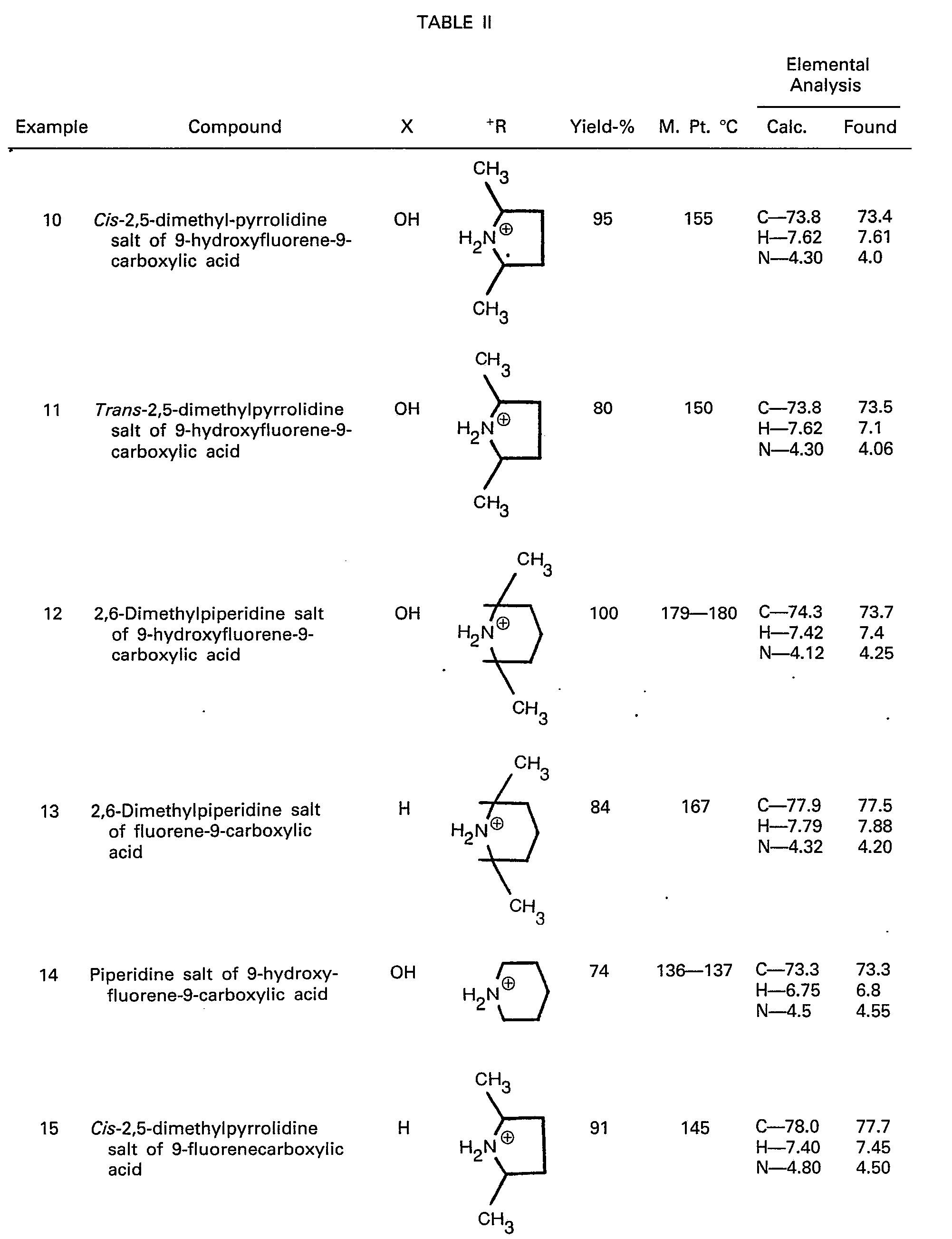
- Cis-2,5-dimethylpyrrolidine, 0.61 g (0.062 mol), was mixed with 1.4 g (0.062 mol) of 9 - hydroxyfluorene - 9 - carboxylic acid in 50 mls of dry acetone. After an initial slightly exothermic reaction, the reactant solution was heated on a steam bath for about 10 minutes. The solid that precipitated out was filtered, washed with petroleum ether and air dried. Isolated was 1.52 g, or 95% of the theoretical yield, of a white solid melting at 155°C. IR spectra and elemental analytical data indicated this product to be the desired cis - 2,5 - dimethylpyrrolidine salt of 9 - hydroxyfluorene - 9 - carboxylic acid.
- Other fluorenecarboxylic acid salts conforming to the structure

- The cis-2,5-dimethylpyrrolidine salt of 1-fluorenecarboxylic acid (Product of Example 1) was tested on a six-month old Kentucky and Merion turfgrass mixture grown in 3-1/4" diameter waxed paper pots. Two known plant growth regulants were similarly tested. Some grass samples were not treated, only fertilized, as controls. Before treatment, the grass was cut and then fertilized with a 20-20-20 water-soluble fertilizer. Three pots were sprayed per treatment. Each chemical was dissolved in 6 ml of a mixture of 50% acetone-49.9% water-0.1 % Tween-20 (polyoxyethylated sorbitan monolaurate surfactant manufactured by ICI United States, Inc., Wilmington, Del.) and then sprayed on the grass. The pots were placed in a plant growth room and were watered daily. The grass was cut at 21, 49 and 84 days after being treated; the blade. height and total fresh weight of the clippings were measured. Tables III and IV below give the % reduction of height and weight, respectively, for the compound of this invention and the known morphactin chemicals, versus the controls. Results obtained are as follows.


- As these results indicate, the compound of this invention (Product of Example 1-the cis-2,5-dimethylpyrrolidine salt of 1-fluorenecarboxylic acid), was more active in controlling grass growth than either Maintain CF-125 or Mow-Less. Further, the turf treated with this compound had a fine leaf and smooth texture; it did not have the twisted, yellowish leaves that turf treated with the known chemicals developed.
- Two 50 cm rows of soybean plants at the early flowering stage were sprayed with 100 ppm or 500 ppm of the cis-2,5-dimethylpyrrolidine salt of 9-fluorenecarboxylic acid, using a spray volume of about 375 liters/hectare (40 gallons/acre). For comparison, other rows were sprayed with like concentrations of two known compounds as designated below. Also 2 untreated rows were maintained to serve as a control: each of the plots was weeded by hand as needed. At the maturity, each plot was harvested and the yield was determined. The results obtained are as follows:

- The foregoing values show that use of the compound of this invention, the cis - 2,5 - dimethylpyrrolidine salt of 9 - fluorenecarboxylic acid, particularly at a concentration of 500 ppm, significantly enhances soybean yield over the untreated control plot and over plots treated with known morphactins, i.e., fluorenecarboxylic acids.
- To determine fruit set effects by compounds of this invention, field grown tomato plants were foliage sprayed with the cis - 2,5 - dimethylpyrrolidine salt of 1 - fluorenecarboxylic acid, 9 - cis - 2,5 - dimethyl - 1 - pyrrolidinyl - 2 - chlorofluorene - 9 - carboxylic acid, methyl ester, and the commercial plant growth regulant, Maintain CF-125 (methyl - 2 - chloro - 9 - hydroxyfluorene - 9 - carboxylate, manufactured by U.S. Borax and Chemical Corp.). Rates of application employed were 5, 25, and 100 ppm when the tomato plants were in the late blooming to early fruit setting stage. Untreated plants were included in the test as controls. Five plants were sprayed for each chemical treatment. The number of fruit set and the degree of phytotoxicity to the plants were determined 24 days after treatment. The results obtained are as follows:

- These results show that the cis-2,5-dimethylpyrrolidine salt of 9-fluorenecarboxylic acid (Product of Example 1) increased fruit set from 18 percent to 47 percent over the control, depending upon the concentration employed. This compound caused light phytoxicity to the plants at the 100 ppm concentration. The other compound of this invention tested increased fruit set 36 percent over the control at a concentration of 5 ppm, but decreased it at the 100 ppm concentration, and also caused light phytotoxicity at this concentration. The commercial product yielded less fruit set than the control at all rates tested, while causing extensive phytotoxic effects to the treated plants.
- This example illustrates the effects of compounds ofthis invention on overall yield oftomatoes. For the test, field grown tomato plants, when in the early flowering stage, were foliage sprayed with the particular compounds of the invention designated below, and with the commercial product CF-125 (Maintain), at rates of 10, 50 and 500 ppm. These rates correspond to applications of 3.69 g, 18.54 g and 185.4 g/hectare, respectively. Each treatment consisted of five plants; the experimental design was a complete randomized block with three replications. A block of untreated plants was included as the control. The fruit was harvested by hand and separated into marketable ripe fruit and marketable green fruit. The results obtained are as follows:

- These results show that the products of Examples 1 and 10 of this invention enhanced, at the rates applied, either the total yield of tomatoes and/or the percentage of red fruit vs. green fruit obtained, by comparison to the control. The product of Example 1, however, caused a decrease in all yields when applied at a rate of 500 ppm, while the product of Example 10 enhanced yields significantly at all three rates of application. The product of Example 8 stimulated the yield of red fruit at a rate of 10 ppm (61% over the control yield), but became inhibitory above the 50 ppm rate. In particular, the compound product of Example 3 increased the yield of red fruit at all rates of application, while also increasing the size of the fruit. On the average, the products of this invention provided greater total yields of fruit by comparison to those obtained from plants treated by the commercial product.
- Compounds of this invention were further tested as tomato yield enhancers as follows:
- "Walter" variety tomato plants, in the early flowering stage, were foliage sprayed at a rate of 68.8 liters/hectare with compounds of this invention, and with the commercial product, CF-125. Each plot consisted of 20 plants; the experimental design was a completed randomized block with three replications. A plot of untreated plants was included as a control. Marketable, mature red tomatoes were harvested weekly, beginning 5 weeks after treatment. Results are as follows:


- As seen from the above results, application of 10-50 ppm of the cis - 2,5 - dimethylpyrrolidine salt of 9 - hydroxyfluorene - 9 - carboxylic acid (the Product of Example 10) to the tomato plants increased the yield 50-80 percent above the yield of control plots. Application of 5-10 ppm of 9 - cis - 2,5 - dimethyl - 1 - pyrrolidinyl - 2 - chlorofluorene - 9 - carboxylic acid, methyl ester (the Product of Example 8) increased tomato yields 39-80 percent above the yield of control plots. Examination of the yield patterns indicates that treatment with the aforesaid compounds at rates less than 10 and 5 ppm, respectively, would likely be beneficial to fruit yields. In all cases, use of the aforesaid compounds of this invention at the designated application rates provided yields superior to those obtained by treating the plants with the commercial product (CF-125).
Claims (16)


Priority Applications (1)
| Application Number | Priority Date | Filing Date | Title |
|---|---|---|---|
| AT83302949T ATE17231T1 (en) | 1982-05-24 | 1983-05-23 | DERIVATIVES OF FLUORINECARBONIC ACIDS, THEIR PRODUCTION AND USE AS PLANT GROWTH REGULATORS. |
Applications Claiming Priority (2)
| Application Number | Priority Date | Filing Date | Title |
|---|---|---|---|
| US381070 | 1982-05-24 | ||
| US06/381,070 US4461899A (en) | 1982-05-24 | 1982-05-24 | Fluorenecarboxylic acid derivatives |
Publications (2)
| Publication Number | Publication Date |
|---|---|
| EP0095880A1 EP0095880A1 (en) | 1983-12-07 |
| EP0095880B1 true EP0095880B1 (en) | 1986-01-02 |
Family
ID=23503537
Family Applications (1)
| Application Number | Title | Priority Date | Filing Date |
|---|---|---|---|
| EP83302949A Expired EP0095880B1 (en) | 1982-05-24 | 1983-05-23 | Fluorenecarboxylic acid derivatives, their preparation and use as plant growth regulators |
Country Status (5)
| Country | Link |
|---|---|
| US (1) | US4461899A (en) |
| EP (1) | EP0095880B1 (en) |
| JP (1) | JPS58213731A (en) |
| AT (1) | ATE17231T1 (en) |
| DE (1) | DE3361691D1 (en) |
Family Cites Families (14)
| Publication number | Priority date | Publication date | Assignee | Title |
|---|---|---|---|---|
| GB1051654A (en) * | ||||
| US2387879A (en) * | 1940-04-20 | 1945-10-30 | Searle & Co | Piperidinol esters as antispasmodic agents |
| US2788364A (en) * | 1953-01-15 | 1957-04-09 | Searle & Co | Quaternary ammonium salts of dialkylaminoalkyl fluorene-9-carboxylates and the preparation thereof |
| US3843714A (en) * | 1962-09-22 | 1974-10-22 | Merck Patent Gmbh | Esters of 2-halogen fluorene-9-carboxylic acids |
| NL297885A (en) * | 1962-09-22 | |||
| US3598564A (en) * | 1962-09-22 | 1971-08-10 | Merck Ag E | Plant growth regulating agents |
| US3830643A (en) * | 1962-09-22 | 1974-08-20 | Merck Patent Gmbh | Regulation of flower and fruit set in cultured plants |
| DE1542955A1 (en) * | 1964-11-27 | 1970-06-04 | Merck Ag E | Plant morphoregulatory agents |
| BE704785A (en) * | 1966-10-14 | 1968-04-08 | ||
| GB1147832A (en) * | 1967-02-13 | 1969-04-10 | Wyeth John & Brother Ltd | Fluorene xanthene and thioxanthene derivatives |
| US3898239A (en) * | 1967-08-03 | 1975-08-05 | Hoffmann La Roche | Tricyclic compounds |
| ZA711333B (en) * | 1970-03-27 | 1971-11-24 | Richardson Merrell Inc | Bis-basic ketones of fluorene and fluorenone |
| US3660485A (en) * | 1970-10-05 | 1972-05-02 | Searle & Co | Fluorene-9-carboxylic acid hydrazides |
| US3905972A (en) * | 1970-10-09 | 1975-09-16 | Hoffmann La Roche | Tricyclic imines |
-
1982
- 1982-05-24 US US06/381,070 patent/US4461899A/en not_active Expired - Fee Related
-
1983
- 1983-05-23 AT AT83302949T patent/ATE17231T1/en not_active IP Right Cessation
- 1983-05-23 DE DE8383302949T patent/DE3361691D1/en not_active Expired
- 1983-05-23 EP EP83302949A patent/EP0095880B1/en not_active Expired
- 1983-05-23 JP JP58090557A patent/JPS58213731A/en active Pending
Also Published As
| Publication number | Publication date |
|---|---|
| EP0095880A1 (en) | 1983-12-07 |
| DE3361691D1 (en) | 1986-02-13 |
| JPS58213731A (en) | 1983-12-12 |
| ATE17231T1 (en) | 1986-01-15 |
| US4461899A (en) | 1984-07-24 |
Similar Documents
| Publication | Publication Date | Title |
|---|---|---|
| US4270948A (en) | Herbicidal compound, herbicidal composition containing the same, and method of use thereof | |
| EP0123001B1 (en) | New cyclohexane derivatives having plant-growth regulating activities, and uses of these derivatives | |
| US4046553A (en) | Herbicidal compound, herbicidal composition containing the same and method of use thereof | |
| EP0269656B1 (en) | Novel malonic acid derivative compounds and compositions thereof for retarding plant growth | |
| JPH0655692B2 (en) | Cyclohexanedionecarboxylic acid derivative, process for producing the same and composition containing the same | |
| US3957852A (en) | Diphenyl ether compounds | |
| HU176071B (en) | Plant growth inhibiting composition containing quaternary ammonium-alkanecarboxylic acid-anilide | |
| US4083714A (en) | Alkoxyalkyl esters of substituted pyridyloxyphenoxy-2-propanoic acids, herbicidal composition containing the same and method of use thereof | |
| EP0177450B1 (en) | Process for the preparation of cyclohexane dione carboxylic-acid derivatives with a herbicidal and plant-growth regulating effect | |
| EP0266725A1 (en) | 4-cyano-4-(fluorophenyl)-3-(substituted phenyl) butyric acids, esters and derivatives thereof, and a method of selectively controlling undesirable vegetation in rice therewith | |
| EP0382463B1 (en) | Maleimide compounds and fungicides containing them | |
| US4119667A (en) | Haloaniline derivatives as plant growth modifiers | |
| US4115102A (en) | Pyridyl compound, herbicidal composition containing the same and method of use thereof | |
| US4092151A (en) | Herbicidal compound, herbicidal composition containing the same and method of use thereof | |
| EP0269238A1 (en) | Imidazoles and their compositions for plant growth regulation | |
| US4416687A (en) | 3,5-Bis (trifluoromethyl)phenoxy carboxylic acids and derivatives thereof | |
| US4668274A (en) | Etherified 2-hydroxy-ethyl-phosphonic acid derivatives and plant growth regulating agents containing same as active ingredient | |
| US4461899A (en) | Fluorenecarboxylic acid derivatives | |
| US3766195A (en) | Polychloro derivatives of dicarboxy pyridines | |
| EP0243971A2 (en) | Fungicidal pyridyl cyclopropane carboxamides | |
| US4977164A (en) | Fungicidal N-(substituted thio)-pyridyl cyclopropane carboxamides | |
| US4033749A (en) | Alkoxycarbonylphosphonic acid derivative brush control agents | |
| US3960951A (en) | Certain oxime esters | |
| EP0243972A2 (en) | Fungicidal pyridyl cyclopropane carboximides | |
| CS214799B2 (en) | Means for regulation of the plant growth and method of making the active substances |
Legal Events
| Date | Code | Title | Description |
|---|---|---|---|
| PUAI | Public reference made under article 153(3) epc to a published international application that has entered the european phase |
Free format text: ORIGINAL CODE: 0009012 |
|
| AK | Designated contracting states |
Designated state(s): AT BE CH DE FR GB IT LI LU NL SE |
|
| 17P | Request for examination filed |
Effective date: 19840406 |
|
| RAP1 | Party data changed (applicant data changed or rights of an application transferred) |
Owner name: SDS BIOTECH CORPORATION |
|
| GRAA | (expected) grant |
Free format text: ORIGINAL CODE: 0009210 |
|
| AK | Designated contracting states |
Designated state(s): AT BE CH DE FR GB IT LI LU NL SE |
|
| PG25 | Lapsed in a contracting state [announced via postgrant information from national office to epo] |
Ref country code: LI Effective date: 19860102 Ref country code: IT Free format text: LAPSE BECAUSE OF FAILURE TO SUBMIT A TRANSLATION OF THE DESCRIPTION OR TO PAY THE FEE WITHIN THE PRESCRIBED TIME-LIMIT;WARNING: LAPSES OF ITALIAN PATENTS WITH EFFECTIVE DATE BEFORE 2007 MAY HAVE OCCURRED AT ANY TIME BEFORE 2007. THE CORRECT EFFECTIVE DATE MAY BE DIFFERENT FROM THE ONE RECORDED. Effective date: 19860102 Ref country code: CH Effective date: 19860102 Ref country code: BE Effective date: 19860102 Ref country code: AT Effective date: 19860102 |
|
| REF | Corresponds to: |
Ref document number: 17231 Country of ref document: AT Date of ref document: 19860115 Kind code of ref document: T |
|
| PG25 | Lapsed in a contracting state [announced via postgrant information from national office to epo] |
Ref country code: SE Effective date: 19860131 |
|
| REF | Corresponds to: |
Ref document number: 3361691 Country of ref document: DE Date of ref document: 19860213 |
|
| ET | Fr: translation filed | ||
| REG | Reference to a national code |
Ref country code: CH Ref legal event code: PL |
|
| PG25 | Lapsed in a contracting state [announced via postgrant information from national office to epo] |
Ref country code: LU Free format text: LAPSE BECAUSE OF NON-PAYMENT OF DUE FEES Effective date: 19860531 |
|
| PLBE | No opposition filed within time limit |
Free format text: ORIGINAL CODE: 0009261 |
|
| STAA | Information on the status of an ep patent application or granted ep patent |
Free format text: STATUS: NO OPPOSITION FILED WITHIN TIME LIMIT |
|
| 26N | No opposition filed | ||
| REG | Reference to a national code |
Ref country code: GB Ref legal event code: 732 |
|
| REG | Reference to a national code |
Ref country code: FR Ref legal event code: TP |
|
| NLS | Nl: assignments of ep-patents |
Owner name: RICERCA, INC. TE PAINESVILLE, OHIO, VER. ST. V. AM |
|
| PGFP | Annual fee paid to national office [announced via postgrant information from national office to epo] |
Ref country code: NL Payment date: 19870531 Year of fee payment: 5 |
|
| PG25 | Lapsed in a contracting state [announced via postgrant information from national office to epo] |
Ref country code: FR Free format text: LAPSE BECAUSE OF NON-PAYMENT OF DUE FEES Effective date: 19880129 |
|
| PG25 | Lapsed in a contracting state [announced via postgrant information from national office to epo] |
Ref country code: DE Effective date: 19880202 |
|
| GBPC | Gb: european patent ceased through non-payment of renewal fee | ||
| REG | Reference to a national code |
Ref country code: FR Ref legal event code: ST |
|
| PG25 | Lapsed in a contracting state [announced via postgrant information from national office to epo] |
Ref country code: GB Free format text: LAPSE BECAUSE OF NON-PAYMENT OF DUE FEES Effective date: 19881122 |
|
| PG25 | Lapsed in a contracting state [announced via postgrant information from national office to epo] |
Ref country code: NL Effective date: 19881201 |
|
| NLV4 | Nl: lapsed or anulled due to non-payment of the annual fee |