EP0094814B1 - Lubricating oil additives - Google Patents
Lubricating oil additives Download PDFInfo
- Publication number
- EP0094814B1 EP0094814B1 EP83302734A EP83302734A EP0094814B1 EP 0094814 B1 EP0094814 B1 EP 0094814B1 EP 83302734 A EP83302734 A EP 83302734A EP 83302734 A EP83302734 A EP 83302734A EP 0094814 B1 EP0094814 B1 EP 0094814B1
- Authority
- EP
- European Patent Office
- Prior art keywords
- overbased
- additive concentrate
- phenate
- lubricating oil
- acid
- Prior art date
- Legal status (The legal status is an assumption and is not a legal conclusion. Google has not performed a legal analysis and makes no representation as to the accuracy of the status listed.)
- Expired
Links
Classifications
-
- C—CHEMISTRY; METALLURGY
- C10—PETROLEUM, GAS OR COKE INDUSTRIES; TECHNICAL GASES CONTAINING CARBON MONOXIDE; FUELS; LUBRICANTS; PEAT
- C10M—LUBRICATING COMPOSITIONS; USE OF CHEMICAL SUBSTANCES EITHER ALONE OR AS LUBRICATING INGREDIENTS IN A LUBRICATING COMPOSITION
- C10M163/00—Lubricating compositions characterised by the additive being a mixture of a compound of unknown or incompletely defined constitution and a non-macromolecular compound, each of these compounds being essential
-
- C—CHEMISTRY; METALLURGY
- C10—PETROLEUM, GAS OR COKE INDUSTRIES; TECHNICAL GASES CONTAINING CARBON MONOXIDE; FUELS; LUBRICANTS; PEAT
- C10M—LUBRICATING COMPOSITIONS; USE OF CHEMICAL SUBSTANCES EITHER ALONE OR AS LUBRICATING INGREDIENTS IN A LUBRICATING COMPOSITION
- C10M159/00—Lubricating compositions characterised by the additive being of unknown or incompletely defined constitution
- C10M159/12—Reaction products
- C10M159/20—Reaction mixtures having an excess of neutralising base, e.g. so-called overbasic or highly basic products
- C10M159/22—Reaction mixtures having an excess of neutralising base, e.g. so-called overbasic or highly basic products containing phenol radicals
-
- C—CHEMISTRY; METALLURGY
- C10—PETROLEUM, GAS OR COKE INDUSTRIES; TECHNICAL GASES CONTAINING CARBON MONOXIDE; FUELS; LUBRICANTS; PEAT
- C10M—LUBRICATING COMPOSITIONS; USE OF CHEMICAL SUBSTANCES EITHER ALONE OR AS LUBRICATING INGREDIENTS IN A LUBRICATING COMPOSITION
- C10M2207/00—Organic non-macromolecular hydrocarbon compounds containing hydrogen, carbon and oxygen as ingredients in lubricant compositions
- C10M2207/02—Hydroxy compounds
- C10M2207/023—Hydroxy compounds having hydroxy groups bound to carbon atoms of six-membered aromatic rings
- C10M2207/028—Overbased salts thereof
-
- C—CHEMISTRY; METALLURGY
- C10—PETROLEUM, GAS OR COKE INDUSTRIES; TECHNICAL GASES CONTAINING CARBON MONOXIDE; FUELS; LUBRICANTS; PEAT
- C10M—LUBRICATING COMPOSITIONS; USE OF CHEMICAL SUBSTANCES EITHER ALONE OR AS LUBRICATING INGREDIENTS IN A LUBRICATING COMPOSITION
- C10M2207/00—Organic non-macromolecular hydrocarbon compounds containing hydrogen, carbon and oxygen as ingredients in lubricant compositions
- C10M2207/10—Carboxylix acids; Neutral salts thereof
- C10M2207/12—Carboxylix acids; Neutral salts thereof having carboxyl groups bound to acyclic or cycloaliphatic carbon atoms
- C10M2207/121—Carboxylix acids; Neutral salts thereof having carboxyl groups bound to acyclic or cycloaliphatic carbon atoms having hydrocarbon chains of seven or less carbon atoms
- C10M2207/123—Carboxylix acids; Neutral salts thereof having carboxyl groups bound to acyclic or cycloaliphatic carbon atoms having hydrocarbon chains of seven or less carbon atoms polycarboxylic
-
- C—CHEMISTRY; METALLURGY
- C10—PETROLEUM, GAS OR COKE INDUSTRIES; TECHNICAL GASES CONTAINING CARBON MONOXIDE; FUELS; LUBRICANTS; PEAT
- C10M—LUBRICATING COMPOSITIONS; USE OF CHEMICAL SUBSTANCES EITHER ALONE OR AS LUBRICATING INGREDIENTS IN A LUBRICATING COMPOSITION
- C10M2207/00—Organic non-macromolecular hydrocarbon compounds containing hydrogen, carbon and oxygen as ingredients in lubricant compositions
- C10M2207/10—Carboxylix acids; Neutral salts thereof
- C10M2207/12—Carboxylix acids; Neutral salts thereof having carboxyl groups bound to acyclic or cycloaliphatic carbon atoms
- C10M2207/125—Carboxylix acids; Neutral salts thereof having carboxyl groups bound to acyclic or cycloaliphatic carbon atoms having hydrocarbon chains of eight up to twenty-nine carbon atoms, i.e. fatty acids
-
- C—CHEMISTRY; METALLURGY
- C10—PETROLEUM, GAS OR COKE INDUSTRIES; TECHNICAL GASES CONTAINING CARBON MONOXIDE; FUELS; LUBRICANTS; PEAT
- C10M—LUBRICATING COMPOSITIONS; USE OF CHEMICAL SUBSTANCES EITHER ALONE OR AS LUBRICATING INGREDIENTS IN A LUBRICATING COMPOSITION
- C10M2207/00—Organic non-macromolecular hydrocarbon compounds containing hydrogen, carbon and oxygen as ingredients in lubricant compositions
- C10M2207/10—Carboxylix acids; Neutral salts thereof
- C10M2207/12—Carboxylix acids; Neutral salts thereof having carboxyl groups bound to acyclic or cycloaliphatic carbon atoms
- C10M2207/129—Carboxylix acids; Neutral salts thereof having carboxyl groups bound to acyclic or cycloaliphatic carbon atoms having hydrocarbon chains of thirty or more carbon atoms
-
- C—CHEMISTRY; METALLURGY
- C10—PETROLEUM, GAS OR COKE INDUSTRIES; TECHNICAL GASES CONTAINING CARBON MONOXIDE; FUELS; LUBRICANTS; PEAT
- C10M—LUBRICATING COMPOSITIONS; USE OF CHEMICAL SUBSTANCES EITHER ALONE OR AS LUBRICATING INGREDIENTS IN A LUBRICATING COMPOSITION
- C10M2207/00—Organic non-macromolecular hydrocarbon compounds containing hydrogen, carbon and oxygen as ingredients in lubricant compositions
- C10M2207/10—Carboxylix acids; Neutral salts thereof
- C10M2207/14—Carboxylix acids; Neutral salts thereof having carboxyl groups bound to carbon atoms of six-membered aromatic rings
- C10M2207/141—Carboxylix acids; Neutral salts thereof having carboxyl groups bound to carbon atoms of six-membered aromatic rings monocarboxylic
-
- C—CHEMISTRY; METALLURGY
- C10—PETROLEUM, GAS OR COKE INDUSTRIES; TECHNICAL GASES CONTAINING CARBON MONOXIDE; FUELS; LUBRICANTS; PEAT
- C10M—LUBRICATING COMPOSITIONS; USE OF CHEMICAL SUBSTANCES EITHER ALONE OR AS LUBRICATING INGREDIENTS IN A LUBRICATING COMPOSITION
- C10M2207/00—Organic non-macromolecular hydrocarbon compounds containing hydrogen, carbon and oxygen as ingredients in lubricant compositions
- C10M2207/10—Carboxylix acids; Neutral salts thereof
- C10M2207/14—Carboxylix acids; Neutral salts thereof having carboxyl groups bound to carbon atoms of six-membered aromatic rings
- C10M2207/142—Carboxylix acids; Neutral salts thereof having carboxyl groups bound to carbon atoms of six-membered aromatic rings polycarboxylic
-
- C—CHEMISTRY; METALLURGY
- C10—PETROLEUM, GAS OR COKE INDUSTRIES; TECHNICAL GASES CONTAINING CARBON MONOXIDE; FUELS; LUBRICANTS; PEAT
- C10M—LUBRICATING COMPOSITIONS; USE OF CHEMICAL SUBSTANCES EITHER ALONE OR AS LUBRICATING INGREDIENTS IN A LUBRICATING COMPOSITION
- C10M2207/00—Organic non-macromolecular hydrocarbon compounds containing hydrogen, carbon and oxygen as ingredients in lubricant compositions
- C10M2207/10—Carboxylix acids; Neutral salts thereof
- C10M2207/22—Acids obtained from polymerised unsaturated acids
-
- C—CHEMISTRY; METALLURGY
- C10—PETROLEUM, GAS OR COKE INDUSTRIES; TECHNICAL GASES CONTAINING CARBON MONOXIDE; FUELS; LUBRICANTS; PEAT
- C10M—LUBRICATING COMPOSITIONS; USE OF CHEMICAL SUBSTANCES EITHER ALONE OR AS LUBRICATING INGREDIENTS IN A LUBRICATING COMPOSITION
- C10M2207/00—Organic non-macromolecular hydrocarbon compounds containing hydrogen, carbon and oxygen as ingredients in lubricant compositions
- C10M2207/26—Overbased carboxylic acid salts
- C10M2207/262—Overbased carboxylic acid salts derived from hydroxy substituted aromatic acids, e.g. salicylates
-
- C—CHEMISTRY; METALLURGY
- C10—PETROLEUM, GAS OR COKE INDUSTRIES; TECHNICAL GASES CONTAINING CARBON MONOXIDE; FUELS; LUBRICANTS; PEAT
- C10M—LUBRICATING COMPOSITIONS; USE OF CHEMICAL SUBSTANCES EITHER ALONE OR AS LUBRICATING INGREDIENTS IN A LUBRICATING COMPOSITION
- C10M2219/00—Organic non-macromolecular compounds containing sulfur, selenium or tellurium as ingredients in lubricant compositions
- C10M2219/04—Organic non-macromolecular compounds containing sulfur, selenium or tellurium as ingredients in lubricant compositions containing sulfur-to-oxygen bonds, i.e. sulfones, sulfoxides
- C10M2219/046—Overbased sulfonic acid salts
-
- C—CHEMISTRY; METALLURGY
- C10—PETROLEUM, GAS OR COKE INDUSTRIES; TECHNICAL GASES CONTAINING CARBON MONOXIDE; FUELS; LUBRICANTS; PEAT
- C10M—LUBRICATING COMPOSITIONS; USE OF CHEMICAL SUBSTANCES EITHER ALONE OR AS LUBRICATING INGREDIENTS IN A LUBRICATING COMPOSITION
- C10M2219/00—Organic non-macromolecular compounds containing sulfur, selenium or tellurium as ingredients in lubricant compositions
- C10M2219/08—Thiols; Sulfides; Polysulfides; Mercaptals
- C10M2219/082—Thiols; Sulfides; Polysulfides; Mercaptals containing sulfur atoms bound to acyclic or cycloaliphatic carbon atoms
- C10M2219/087—Thiols; Sulfides; Polysulfides; Mercaptals containing sulfur atoms bound to acyclic or cycloaliphatic carbon atoms containing hydroxy groups; Derivatives thereof, e.g. sulfurised phenols
-
- C—CHEMISTRY; METALLURGY
- C10—PETROLEUM, GAS OR COKE INDUSTRIES; TECHNICAL GASES CONTAINING CARBON MONOXIDE; FUELS; LUBRICANTS; PEAT
- C10M—LUBRICATING COMPOSITIONS; USE OF CHEMICAL SUBSTANCES EITHER ALONE OR AS LUBRICATING INGREDIENTS IN A LUBRICATING COMPOSITION
- C10M2219/00—Organic non-macromolecular compounds containing sulfur, selenium or tellurium as ingredients in lubricant compositions
- C10M2219/08—Thiols; Sulfides; Polysulfides; Mercaptals
- C10M2219/082—Thiols; Sulfides; Polysulfides; Mercaptals containing sulfur atoms bound to acyclic or cycloaliphatic carbon atoms
- C10M2219/087—Thiols; Sulfides; Polysulfides; Mercaptals containing sulfur atoms bound to acyclic or cycloaliphatic carbon atoms containing hydroxy groups; Derivatives thereof, e.g. sulfurised phenols
- C10M2219/088—Neutral salts
-
- C—CHEMISTRY; METALLURGY
- C10—PETROLEUM, GAS OR COKE INDUSTRIES; TECHNICAL GASES CONTAINING CARBON MONOXIDE; FUELS; LUBRICANTS; PEAT
- C10M—LUBRICATING COMPOSITIONS; USE OF CHEMICAL SUBSTANCES EITHER ALONE OR AS LUBRICATING INGREDIENTS IN A LUBRICATING COMPOSITION
- C10M2219/00—Organic non-macromolecular compounds containing sulfur, selenium or tellurium as ingredients in lubricant compositions
- C10M2219/08—Thiols; Sulfides; Polysulfides; Mercaptals
- C10M2219/082—Thiols; Sulfides; Polysulfides; Mercaptals containing sulfur atoms bound to acyclic or cycloaliphatic carbon atoms
- C10M2219/087—Thiols; Sulfides; Polysulfides; Mercaptals containing sulfur atoms bound to acyclic or cycloaliphatic carbon atoms containing hydroxy groups; Derivatives thereof, e.g. sulfurised phenols
- C10M2219/089—Overbased salts
-
- C—CHEMISTRY; METALLURGY
- C10—PETROLEUM, GAS OR COKE INDUSTRIES; TECHNICAL GASES CONTAINING CARBON MONOXIDE; FUELS; LUBRICANTS; PEAT
- C10N—INDEXING SCHEME ASSOCIATED WITH SUBCLASS C10M RELATING TO LUBRICATING COMPOSITIONS
- C10N2070/00—Specific manufacturing methods for lubricant compositions
-
- C—CHEMISTRY; METALLURGY
- C10—PETROLEUM, GAS OR COKE INDUSTRIES; TECHNICAL GASES CONTAINING CARBON MONOXIDE; FUELS; LUBRICANTS; PEAT
- C10N—INDEXING SCHEME ASSOCIATED WITH SUBCLASS C10M RELATING TO LUBRICATING COMPOSITIONS
- C10N2070/00—Specific manufacturing methods for lubricant compositions
- C10N2070/02—Concentrating of additives
Definitions
- This invention relates to lubricating oil additives which have high basicity, commonly known as overbased additives, and concentrates and lubricating oils containing them.
- US-A-3714042 describes the addition of a high molecular weight aliphatic carboxylic acid or anhydride having at least 25 aliphatic carbon atoms per carboxy group to a basic Group I or II metal, specifically calcium or magnesium sulphonate, sulphonate-carboxylate or carboxylate complex to reduce tendency to foam and haze.
- the preferred acids are polyisobutenyl succinic acids having a molecular weight of 700 to 5000.
- the present invention therefore provides an additive concentrate having a high TBN (total base number - ASTM D664) for incorporation in a lubricating oil composition comprising lubricating oil, and from 10 to 90 wt % of an overbased alkaline earth metal hydrocarbyl sulphurized phenate which has been treated, either during or subsequent to the overbasing process, with from 0.1 to 10 wt % (based on the weight of the additive concentrate) of an unbranched, saturated fatty acid having from 18 to 24 carbon atoms or an anhydride or a salt thereof.
- TBN total base number - ASTM D664
- the concentrate will typically contain from 10 to 90 wt %, preferably from 30 to 90 wt %, of the overbased phenate, and usually comprises at least 50 wt % of active materials in solution in the lubricating oil.
- the concentrates have a high TBN - that is, a TBN of at least 235.
- the lubricating oil can be a synthetic ester lubricating oil and these include diesters such as di-octyl adipate, di-octyl sebacate, didecyl azelate, tridecyl adipate, didecyl succinate, didecyl glutarate and mixtures thereof.
- the synthetic ester can be a polyester such as that prepared by reacting polyhydric alcohols such as trimethylol propane and pentaerythritol with monocarboxylic acids such as butyric acid to give the corresponding tri- and tetra-esters.
- complex esters may be used, such as those formed by esterification reactions between a carboxylic acid, a glycol and an alcohol or a monocarboxylic acid.
- the starting alkyl phenol may contain one or more alkyl substituents. These may be branched or unbranched, and depending on the number of substituents be C 1 to C ae , preferably Cg to C 18 groups. Mixtures of alkyl phenols with different alkyl substituents may be used.
- the product may contain a minor amount (typically 10 wt % or less of the sulphurized alkyl phenol) of a number of byproducts resulting from side reactions, eg chlorination of the aromatic ring when using sulphur chloride, or formation of organo sulphur groups resulting from reaction of sulphur with overbasing reaction solvents.
- the sulphurized alkyl phenol is reacted with excess alkaline earth metal base in the presence of a dihydroxyl solvent which is usually ethylene glycol although other glycols may be used.
- a dihydroxyl solvent which is usually ethylene glycol although other glycols may be used.
- An additional mono- hydroxyl solvent eg isodecanol
- the alkaline earth metal base may be an oxide or a hydroxide.
- Carbon dioxide is then introduced to convert the excess metal base into metal carbonate.
- Volatile reaction products and solvents are then removed by distillation filtration or centrifugation.
- sulphur and alkyl metal may be charged prior to carbonation to form the sulphurized phenol in situ, which is then reacted with base and carbonated as described.
- overbased phenates are the overbased calcium phenates and overbased magnesium phenates.
- a preferred process for preparation of overbased alkaline earth metal phenates, most preferably calcium phenate, which may be used in preparing concentrates having a high TBN, is described in GB-A-1470338, which gives products having a TBN of from 150 to 500, usually 200 to 300.
- a preferred process for preparation of overbased magnesium phenate which again may be used in preparing concentrates having a high TBN is described in GB-A-1469289, which gives products usually having a TBN of from 200 to 250.
- the invention provides a process in which an unbranched, saturated fatty acid having from 18 to 24 carbon atoms or an anhydride or salt thereof is introduced into a reaction mixture for preparing an overbased alkaline earth metal sulphurized phenate and containing a lubricating oil to form the desired concentrates of the invention.
- the acid may be added to the overbasing reaction mixture in addition to conventional additives to that overbasing process such as organic sulphonic acids, sulphonates or sulphates and reaction promoters such as C 1 to C 4 acids or their derivatives e.g. salts of formic acid.
- the additive concentrates of the invention may also be combined with other lubricating oil additives and concentrates to form a lubricating oil additive package or a complete lubricating oil, e.g. with dispersants, viscosity index improvers, anti-oxidants, anti-wear additives and lubricity improvers.
- Such additive packages will typically contain from 10 to 90 wt % of active materials, and generally contain at least 50 wt % of active material.
- the amount of overbased sulphurized phenate treated with acid according to the invention which is incorporated within such packages may vary within very wide limits depending on the end-use for which the package is intended and the amount of other additives.
- Stability is measured by blending 19.8 weight % of the additive concentrate under test with 80.2 weight % of a heavy paraffinic base oil containing an overbased calcium salt of a branched chain C 24 sulphonic acid with 300 TBN and other overbased detergent additives such that the blend has an overall TBN of 70.
- the blend is made at 70°C, then poured into a 100 ml centrifuge tube and stored at room temperature (approximately 20°C). Volume % sediment is observed at initial formulation and after three weeks.
- This blend, containing both overbased phenate and overbased sulphonates has been found to present particular problems of compatibility, and thus to be an extremely severe test of the additive concentrates of the invention.
- a reaction mixture was prepared from:
Landscapes
- Chemical & Material Sciences (AREA)
- Chemical Kinetics & Catalysis (AREA)
- General Chemical & Material Sciences (AREA)
- Oil, Petroleum & Natural Gas (AREA)
- Organic Chemistry (AREA)
- Lubricants (AREA)
Description
- This invention relates to lubricating oil additives which have high basicity, commonly known as overbased additives, and concentrates and lubricating oils containing them.
- Many additive concentrates for lubricating oil compositions containing overbased additives suffer from lack of stability giving rise to sedimentation. Also such additives have a tendency to give foaming problems either during their manufacture, during formulation of lubricating oils containing them or during their use as lubricants. We have now found that the addition of certain carboxylic acids either during preparation of the overbased additive or to the formed overbased additive results in reduced tendency to sedimentation, reduced foaming and also may result in a valuable reduction in viscosity of oil solutions of the additive.
- Some attempts have been made in the past to improve stability of lubricating oil compositions containing overbased detergent additives. US-A-3714042 describes the addition of a high molecular weight aliphatic carboxylic acid or anhydride having at least 25 aliphatic carbon atoms per carboxy group to a basic Group I or II metal, specifically calcium or magnesium sulphonate, sulphonate-carboxylate or carboxylate complex to reduce tendency to foam and haze. The preferred acids are polyisobutenyl succinic acids having a molecular weight of 700 to 5000. US 3793201 discloses similar high molecular weight acids (with at least 30 carbon atoms) as solubility improvers in combination with metal salts, such as alkaline earth metal salts of bridged phenols for oil-soluble basic magnesium salts of sulphonic and/or carboxylic acids. GB-A-1471934 discloses lubricating oil compositions containing an overbased detergent additive to which is added to improve foam stability a) a mono- or dicarboxylic acid or derivative having at least 30 carbon atoms or a reaction product of a phosphorus sulphide with a hydrocarbon and b) a dihydric alcohol or glycol having 2 to 4 carbon atoms, a di- or tri-(CZ-C4) glycol or an ether alcohol having 2 to 10 carbon atoms; the combination of a polyisobutylene succinic acid and glycol is preferred. Under severe conditions none of these prior art treatments have been found totally satisfactory.
- Other treatments of overbased additives with acids have been described. US―A―3410801 describes the treatment of overbased metal sulphonates, particularly alkaline earth metal sulphonates, with from 10 to 150 weight % of a C12 to C22 fatty acid to give a friction modifier additive for a lubricating oil. US-A-3242079 discloses grease compositions comprising an overbased alkaline earth metal sulphonate and from 1 to 80 weight % of an active hydrogen compound such as a lower aliphatic carboxylic acid defined as having less than 8 carbon atoms. US-A-4328111 describes the addition of acidic compounds including organic carboxylic acids to overbased metal sulphonates, phenates or mixtures thereof to improve the properties of the overbased material in lubricating oil compositions and to improve solvent separation from the overbased material. The organic carboxylic acids may be straight or branched, saturated, unsaturated or aromatic and optionally substituted. A ratio of basic compound to acidic compound of 1.5 to 50:1, preferably 2 to 20:1 is disclosed.
- Acids have also been incorporated into the reaction mixture from which overbased detergent additives are prepared. GB-A-1297150 described the formation of basic magnesium salts of organic acids in which the reaction mixture comprises certain proportions of an organic acid for overbasing, such as an aromatic carboxylic or sulphonic acid, and a separate aliphatic carboxylic acid or sulphonic acid capable of overbasing. US-A-3671430 describes the preparation of a high alkalinity oil-soluble alkaline earth metal hydrocarbon sulphonate using an alkaline earth metal sulphonate as the dispersant and a second dispersant which may be inter alia a long chain hydrocarbon monocarboxylic acid, dicarboxylic acid or anhydride with from 20 to 200 carbon atoms in the chain. US-A-4164472 also describes the use of a saturated or unsaturated fatty acid as a dispersant in preparing a calcium-containing dispersion in a nonvolatile liquid. GB-A-1469289 describes the use of at least 0,1 weight % of a C1 to C18 carboxylic acid or derivative thereof as a promoter in the formation of an overbased magnesium detergent.
- US-A-3410798 describes the preparation of basic sulphurized alkaline earth metal phenates using as a promoter a carboxylic acid or metal salt thereof (preferably acetic acid or calcium acetate) and a polyalkylene glycol or alkylene or polyalkylene glycol alkyl ether.
- GB-A-1440261 describes the use of mixed acids in a lubricating oil particularly for tractor use which may contain an overbased sulphonate or phenate.
- We have found that certain carboxylic acids having a long, straight unbranched hydrocarbyl segment have a surprising effect in improving the properties of lubricating oil compositions containing overbased detergent additives when employed in relatively small amounts.
- The present invention therefore provides an additive concentrate having a high TBN (total base number - ASTM D664) for incorporation in a lubricating oil composition comprising lubricating oil, and from 10 to 90 wt % of an overbased alkaline earth metal hydrocarbyl sulphurized phenate which has been treated, either during or subsequent to the overbasing process, with from 0.1 to 10 wt % (based on the weight of the additive concentrate) of an unbranched, saturated fatty acid having from 18 to 24 carbon atoms or an anhydride or a salt thereof.
- The concentrate will typically contain from 10 to 90 wt %, preferably from 30 to 90 wt %, of the overbased phenate, and usually comprises at least 50 wt % of active materials in solution in the lubricating oil. The concentrates have a high TBN - that is, a TBN of at least 235.
- The lubricating oil can be any animal, vegetable or mineral oil, for example ranging from petroleum oil to SAE 30, 40 or 50 lubricating oil grades, castor oil, fish oils or oxidised mineral oil.
- Alternatively the lubricating oil can be a synthetic ester lubricating oil and these include diesters such as di-octyl adipate, di-octyl sebacate, didecyl azelate, tridecyl adipate, didecyl succinate, didecyl glutarate and mixtures thereof. Alternatively the synthetic ester can be a polyester such as that prepared by reacting polyhydric alcohols such as trimethylol propane and pentaerythritol with monocarboxylic acids such as butyric acid to give the corresponding tri- and tetra-esters. Also complex esters may be used, such as those formed by esterification reactions between a carboxylic acid, a glycol and an alcohol or a monocarboxylic acid.
- Overbased alkaline earth metal sulphurized hydrocarbyl phenates or "overbased phenates" are high alkalinity alkaline earth sulphurized hydrocarbyl phenates which contain metal base in excess of that required for neutralisation of the sulphurized hydrocarbyl phenol. The overbased phenates where the hydrocarbyl group(s) are alkyl group(s) are preferred, and the preparation of overbased phenates will be described in relation to these preferred phenates.
- The starting alkyl phenol may contain one or more alkyl substituents. These may be branched or unbranched, and depending on the number of substituents be C1 to Cae, preferably Cg to C18 groups. Mixtures of alkyl phenols with different alkyl substituents may be used.
- The alkyl phenol may be sulphurized as a separate step before the overbasing stage described hereinafter. This sulphurization may be accomplished by reacting the alkyl phenol with sulphur chloride or by reaction with sulphur in the presence of a base. Alternatively, the reaction with sulphur may be carried out as part of the overall overbasing process. In addition to the desired sulphurized alkyl phenol of the general formula:

- The sulphurized alkyl phenol is reacted with excess alkaline earth metal base in the presence of a dihydroxyl solvent which is usually ethylene glycol although other glycols may be used. An additional mono- hydroxyl solvent (eg isodecanol) may also be used. The alkaline earth metal base may be an oxide or a hydroxide. Carbon dioxide is then introduced to convert the excess metal base into metal carbonate. Volatile reaction products and solvents are then removed by distillation filtration or centrifugation. Alternatively, as indicated above, sulphur and alkyl metal may be charged prior to carbonation to form the sulphurized phenol in situ, which is then reacted with base and carbonated as described. As an alternative a metal alkoxide may be used as the starting metal base and the inclusion of water is then required to hydrolyse the alkoxides. For this modification, glycol esters are suitable solvents. A carbonated metal alkoxide can also be used.
- Highly preferred overbased phenates are the overbased calcium phenates and overbased magnesium phenates. A preferred process for preparation of overbased alkaline earth metal phenates, most preferably calcium phenate, which may be used in preparing concentrates having a high TBN, is described in GB-A-1470338, which gives products having a TBN of from 150 to 500, usually 200 to 300. A preferred process for preparation of overbased magnesium phenate which again may be used in preparing concentrates having a high TBN is described in GB-A-1469289, which gives products usually having a TBN of from 200 to 250.
- Preferred acids for use in the invention include stearic, eicosanoic and behenic acid. The fatty acids need not be pure, and commercial grades containing a range of fatty acids, including some unsaturated components, are acceptable. Mixed fatty acids such as those derived from linseed oil, soybean oil and tall oil may also be used.
- Anhydrides and salts of these acids may be employed. The choice of a salt for use in the invention should be chosen having regard to the other components of the additive and the point at which it is to be added. Generally metal salts corresponding to the metal in the overbased sulphurized phenate are preferred, provided that they are compatible with the other components under the conditions at which they are introduced.
- The acid or derivative is employed in an amount of from 0.1 to 10 weight % based on the weight of the additive concentrate, and preferably from 2 to 6 weight % acid or derivative thereof is employed.
- As an example stearic acid may be added to the reaction mixture for preparing an overbased calcium sulphurized phenate prior to carbonation in an amount of 2 to 6 weight % stearic acid, based on the weight of the resultant additive concentrate containing the overbased product. This has been found to give improved foam and sediment performance together with an improvement in viscosity.
- The acid may be used in addition to other compounds conventionally employed to enhance the properties of overbased detergent additives. In particular, it may be used in conjunction with the treatment of the overbased additive with the high molecular weight acid and glycol combination described in GB 1471934.
- It has been found most surprisingly that particularly good results are obtained by using the acid treatment of the invention in conjunction with the addition to the overbased phenate of certain glycols and ether derivatives thereof.
- The invention extends to a process for preparing an additive concentrate having a high TBN comprising adding to a lubricating oil an overbased alkaline earth metal sulphurized phenate and at least 0.1 weight % (based on the weight of the total additive concentrate) of an unbranched, saturated fatty acid having from 18 to 24 carbon atoms or an anhydride or salt thereof. The acid or its derivative is preferably introduced at a temperature of from 20 to 210°C, more preferably from 80 to 150°C. The temperature is chosen to ensure adequate fluidity and to enable ready mixing with the other components of the additive concentrate. Alternatively, the invention provides a process in which an unbranched, saturated fatty acid having from 18 to 24 carbon atoms or an anhydride or salt thereof is introduced into a reaction mixture for preparing an overbased alkaline earth metal sulphurized phenate and containing a lubricating oil to form the desired concentrates of the invention. In this alternative process the acid may be added to the overbasing reaction mixture in addition to conventional additives to that overbasing process such as organic sulphonic acids, sulphonates or sulphates and reaction promoters such as C1 to C4 acids or their derivatives e.g. salts of formic acid.
- In a preferred aspect there is added to the additive concentrate of the invention at least 0.1 wt % (based on the weight of the additive concentrate) of a polyhydric alcohol having from 2 to 4 carbon atoms, a di- or tri-(C27-C4) glycol or an ether alcohol having from 2 to 10 carbon atoms. The polyhydric alcohol may, for example, be a dihydric alcohol such as ethylene glycol or propylene glycol or a trihydric alcohol such as glycerol. Examples of di- and triglycols include diethylene glycol and triethylene glycol. Examples of ether alcohols include the alkyl ethers of the previously mentioned glycols. The preferred glycol is ethylene glycol.
- It has been found advantageous to add from 0.1 to 10 wt % (based on the weight of the additive concentrate) of the glycol or ether derivative thereof and from 0.5 to 6 wt % is preferred. The glycol or ether derivative thereof is added to the additive concentrate subsequent to the overbasing process. As indicated hereinbefore it is usual to employ a solvent such as ethylene glycol in the overbasing process and this is then removed, most usually by distillation or stripping. The giycol or ether derivative thereof may be added to the additive concentrate subsequent to the step of removing any solvent and volatile material. When the acid or its derivative is also added to the overbased phenate subsequent to the overbasing process the acid and glycol may be added separately in either order or together. In a preferred aspect of the alternative process when the acid is added to the overbasing reaction mixture, the glycol or ether derivative thereof is added to the additive concentrate subsequent to the overbasing reaction.
- The additive concentrates of the invention may also be combined with other lubricating oil additives and concentrates to form a lubricating oil additive package or a complete lubricating oil, e.g. with dispersants, viscosity index improvers, anti-oxidants, anti-wear additives and lubricity improvers.
- Such additive packages will typically contain from 10 to 90 wt % of active materials, and generally contain at least 50 wt % of active material. The amount of overbased sulphurized phenate treated with acid according to the invention which is incorporated within such packages may vary within very wide limits depending on the end-use for which the package is intended and the amount of other additives.
- The invention extends to lubricating oil compositions comprising lubricating oil and from 0.01 to 30 wt % (based on the total composition) of an additive concentrate of the invention comprising from 10 to 90 wt % of the overbased alkaline earth metal hydrocarbyl sulphurized phenate optionally with other additives as described hereinbefore. Preferably lubricating oil compositions contain from 0.5 to 20 wt % of the additive concentrate.
- The invention will now be further described, though only by way of illustration, with reference to the following Examples.
- In the following Examples, the performance of additive concentrates of the invention is evaluated in terms of their foaming tendency, viscosity and stability with other additives, and their performance is compared with that of a conventional overbased additive concentrate, alone and with conventional supplements to improve foam and stability performance. In the first series of Examples the conventional overbased additive concentrate is an oil solution of an overbased calcium sulphurized alkyl phenate prepared from dodecyl phenol containing 3.63%S and 10.4%Ca with 272 TBN (Total Base Number - ASTM D664), and approximately 27 weight % oil - it is referred to hereinafter as "additive concentrate X".
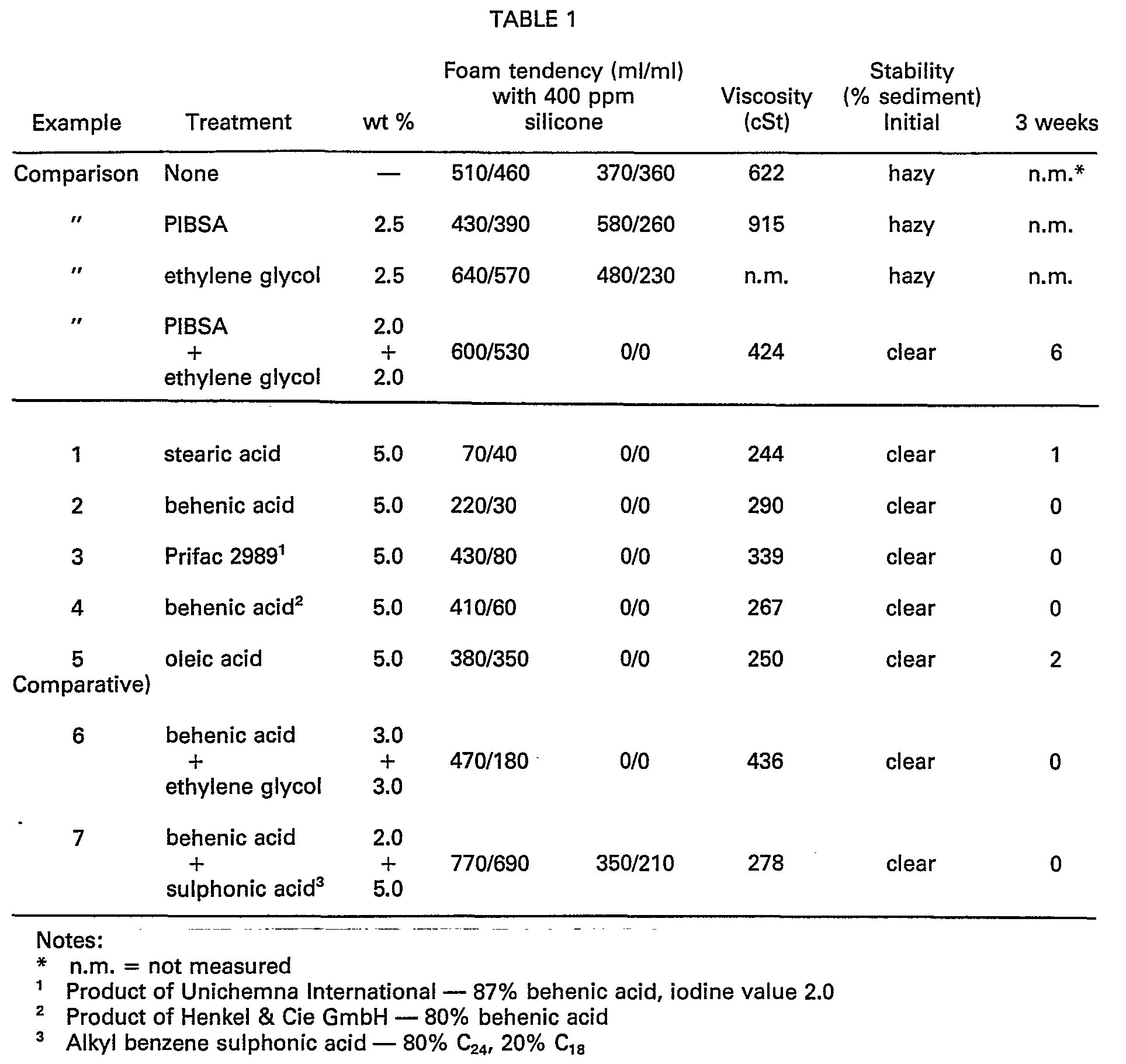
- The foaming tendency of the additive concentrate is measured according to standard method ASTM D892-74 (IP 146/73) in which a 2 wt % solution of the sample under test in a base oil is blown with air at a constant rate for five minutes and allowed to settle for ten minutes, with the foam volume being measured in ml at the end of both periods. The results are given as two numbers, the first representing the foam volume after ten minutes settling. This test is also carried out with the addition of 400 ppm of a conventional silicone anti-foaming additive.
- Viscosity of the additive concentrate is measured at 100°C using standard method ASTM D445-79 (IP71/79). The results are given in cSt. (1m2/s = 104St).
- Stability is measured by blending 19.8 weight % of the additive concentrate under test with 80.2 weight % of a heavy paraffinic base oil containing an overbased calcium salt of a branched chain C24 sulphonic acid with 300 TBN and other overbased detergent additives such that the blend has an overall TBN of 70. The blend is made at 70°C, then poured into a 100 ml centrifuge tube and stored at room temperature (approximately 20°C). Volume % sediment is observed at initial formulation and after three weeks. This blend, containing both overbased phenate and overbased sulphonates has been found to present particular problems of compatibility, and thus to be an extremely severe test of the additive concentrates of the invention.
- Samples of the additive concentrate X are mixed with various fatty acids at 110°C to form additive concentrates of the invention and comparative concentrates, which are tested as described above. To provide a comparison, tests were also carried out on additive concentrate X alone, and with the addition of PIBSA (polyisobutylene succinic acid, M.W. approx. 900) and ethylene glycol. The results are given in Table 1, and show that the compositions of the invention give improved stability and foam performance, with reduced viscosity as compared to the untreated comparison and the comparison samples treated with PIBSA alone and ethylene glycol alone. The compositions also appear to be more readily controlled by the addition of conventional silicone anti-foam additives. The comparison sample treated with a PIBSA/ ethylene glycol combination show good foaming performance when treated with a silicone additive but has a higher viscosity than most of the compositions of the invention and showed poorer stability after 3 weeks.
- An additive concentrate of the invention was prepared by adding behenic acid prior to carbonation in the synthesis of additive concentrate X.
- A reaction mixture was prepared from:
- 230 g (0.88 moles) dodecylphenol
- 40 g (0.12 moles) behenic acid
- 63 g (1.97 moles) sulphur
- 135 g (0.85 moles) isodecanol
- 95 g (17.0 moles) calcium oxide
- To provide a comparison a similar overbased calcium sulphurized phenate was prepared without behenic acid from the following reaction mixture:
- 270 g dodecylphenol
- 63 g sulphur
- 135 g isodecanol
- 95 g calcium oxide
- This clearly shows the advantage of the additive concentrate of the invention over a prior art concentrate prepared without the use of behenic acid. The concentrate of the invention gave excellent results with perfect results in the foam test as compared to a considerable foaming tendency found when behenic acid was not used. The concentrate of the invention was initially clear and remained a clear solution after 3 weeks in the stability test. The decreased viscosity of the concentrate of the invention is also an important credit.
- The procedure of Example 8 was repeated using different amounts of various acids, and in some cases with the addition of ethylene glycol subsequent to overbasing. The foam performance and stability of the products was tested as described hereinbefore, with the exceptions that a) the foam test was carried out on a 1.8 wt % solution of the sample in a lubricating oil formulated without an overbased phenate but containing the remainder of the additives chosen for the finished oil and b) the stability test was carried out over 4 weeks at 20°C and 60°C. To provide a comparison the same testing was carried out on additive concentrate X alone and on additive concentrate X to which had been added 2.0 wt % PIBSA (M.W. = 900) and 2.0 wt % ethylene glycol.
- The results are given in Table 2, and show the significant improvement in foam and stability performance for the additive of the invention against the untreated additive X and additive X post-treated with PIBSA/glycol. Moreover, the improvement is achieved with a valuable decrease in viscosity whereas the PIBSA/glycol treatment results in a viscosity increase.


- The procedure of Example 14 was repeated replacing ethylene glycol by 2 wt % of glycerol. The resulting product when treated with 400 ppm silicone had a foam tendency of 70/0.
- A further series of tests was carried out on a conventional additive concentrate comprising an oil solution of an overbased magnesium sulphurized phenate containing 5.4 wt % magnesium and 3.8 wt % sulphur with a TBN of 245.
- This was prepared as follows:
- 320 g of a 90% oil solution of sulphurized nonyl phenol having a minimum hydroxy number of 207 and containing 9 wt % sulphur was mixed with 270 g of oil 583 g of magnesium ethoxide was added under a nitrogen blanket. A mixture of 64 g of ethoxyethanol and 64 g of water were added over 1 hour at 80°C. The mixture was then carbonated at 80°C to 102°C over 2 hours then during further carbonation held at 102°C and finally heated to 150°C for a total carbonation time of 8.5 hours during which 40-45 g of carbon dioxide were added. 106 g of oil were added and the mixture was stripped to yield the product. This additive concentrate was tested for foam tendency alone and with silicone anti-foaming additives. It was also converted to an additive concentrate of the invention by the addition of 5 wt % (based on the weight of the additive concentrate) of behenic acid.

- The untreated additive gave poor foam performance which was not improved by addition of a silicone anti-foam additive. By contrast addition of behenic acid to the additive concentrate resulted in a product with excellent foam performance even without addition of silicone.
- 29.4 kg of a 72% oil solution of sulphurized nonyl phenol having a minimum hydroxy number of 130 and containing 7 wt % sulphur was mixed with 6.3 kg of oil and 2.3 kg of crude behenic acid (55% behenic, 35% C20, 7% stearic and 3% other acids) were mixed. 37.7 kg of magnesium ethoxide was added under a nitrogen blanket. A mixture of 3.8 kg of cellosolve and 3.8 kg of water were added over 1 hour at 80°C. The mixture was then carbonated at 80°C to 100°C over 2 hours then during further carbonation held at 100°C and finally heated to 150°C for a total carbonation time of 8.5 hours during which 7.1 kg of carbon dioxide are added. 3.4 kg of oil were added and the mixture was stripped to yield a product of 235 TBN at 5.4 wt % Mg with 4.0% acid.
- A generally similar procedure was carried out to prepare additive concentrates containing stearic acid (prepared from commercial acid containing 94.9 wt % stearic, 1.4 wt % C16, 2.3 wt % Cis, 0.3 wt % C19, 0.9 wt % C2o)'
- The foaming tendency of these products was measured as a 2% solution in the oil used for foam testing in Examples 1 to 7 and as a 2% solution in a high foaming base oil. The results given in Table 4 below show excellent foam performance even in a high foaming oil when compared to the comparison in Examoie 23.


and stirred at 70°C. A mixture of 162 g (2.61 moles) ethylene glycol and 6.7 g (0.37 moles) water was added dropwise over 30 minutes. The temperature was increased to 110°C. 108 g of a lubricating oil were added and carbonation was commenced by introducing 50 ml/min carbon dioxide. The temperature was increased to 150°C over 1 hour, then further increased to 160°C over 40 minutes, and to 170°C over a further 20 minutes. Carbonation was continued for about 6 hours until the end point was reached. Then carbonation was stopped and the temperature raised to 210°C, finally stripping at 60 mm Hg absolute pressure to remove solvent. The vacuum was released, 67 g of base oil were added and the whole cooled to 170°C. After filtration a composition containing an overbased calcium sulphurized phenate and approximately 6 weight % (based on the weight of the concentrate) behenic acid was obtained. TBN was 244, calcium content 10.1 weight % and sulphur content 3.85 weight %. This was tested as described above and the following results obtained:

using the procedure described above. The product had a TBN of 262 and contained 10.15 wt % calcium and 3.84 wt % sulphur. This was tested as described above and the following results obtained:

Claims (16)
Applications Claiming Priority (2)
| Application Number | Priority Date | Filing Date | Title |
|---|---|---|---|
| GB8214192 | 1982-05-14 | ||
| GB8214192 | 1982-05-14 |
Publications (3)
| Publication Number | Publication Date |
|---|---|
| EP0094814A2 EP0094814A2 (en) | 1983-11-23 |
| EP0094814A3 EP0094814A3 (en) | 1986-02-05 |
| EP0094814B1 true EP0094814B1 (en) | 1989-04-19 |
Family
ID=10530377
Family Applications (1)
| Application Number | Title | Priority Date | Filing Date |
|---|---|---|---|
| EP83302734A Expired EP0094814B1 (en) | 1982-05-14 | 1983-05-13 | Lubricating oil additives |
Country Status (6)
| Country | Link |
|---|---|
| US (2) | US5069804A (en) |
| EP (1) | EP0094814B1 (en) |
| JP (2) | JPH07103390B2 (en) |
| BR (1) | BR8302526A (en) |
| CA (1) | CA1207313A (en) |
| DE (1) | DE3379663D1 (en) |
Families Citing this family (39)
| Publication number | Priority date | Publication date | Assignee | Title |
|---|---|---|---|---|
| GB8417297D0 (en) * | 1984-07-06 | 1984-08-08 | Shell Int Research | Preparation of sulphurized overbased salicylates |
| NZ221128A (en) * | 1986-08-08 | 1989-09-27 | Chevron Res | Overbased sulphurised alkylphenols as lube oil additives |
| GB8628609D0 (en) * | 1986-11-29 | 1987-01-07 | Bp Chemicals Additives | Lubricating oil additives |
| US5716914A (en) * | 1986-11-29 | 1998-02-10 | Bp International Limited | Alkaline earth metal hydrocarbyl phenates, their sulphurized derivatives, their production and use thereof |
| US5714443A (en) * | 1986-11-29 | 1998-02-03 | Bp Chemicals (Additives) Limited | Sulphurised alkaline earth metal hydrocarbyl phenates, their production and use thereof |
| US4938880A (en) * | 1987-05-26 | 1990-07-03 | Exxon Chemical Patents Inc. | Process for preparing stable oleaginous compositions |
| GB8814008D0 (en) * | 1988-06-14 | 1988-07-20 | Bp Chemicals Additives | Lubricating oil additives |
| GB8814013D0 (en) * | 1988-06-14 | 1988-07-20 | Bp Chemicals Additives | Chemical process |
| GB8814010D0 (en) * | 1988-06-14 | 1988-07-20 | Bp Chemicals Addivites Ltd | Lubricating oil additives |
| US5292968A (en) * | 1992-02-26 | 1994-03-08 | Cosmo Research Institute | Process for producing over-based alkaline earth metal phenate |
| GB9213723D0 (en) * | 1992-06-27 | 1992-08-12 | Bp Chemicals Additives | Process for the production of lubricating oil additives |
| US5320763A (en) * | 1993-03-12 | 1994-06-14 | Chevron Research And Technology Company | Low viscosity group II metal overbased sulfurized C10 to C16 alkylphenate compositions |
| US5320762A (en) * | 1993-03-12 | 1994-06-14 | Chevron Research And Technology Company | Low viscosity Group II metal overbased sulfurized C12 to C22 alkylphenate compositions |
| US5318710A (en) * | 1993-03-12 | 1994-06-07 | Chevron Research And Technology Company | Low viscosity Group II metal overbased sulfurized C16 to C22 alkylphenate compositions |
| TW277057B (en) * | 1993-08-25 | 1996-06-01 | Cosmo Sogo Kenkyusho Kk | |
| US6008166A (en) * | 1994-01-11 | 1999-12-28 | Lubrizol Adibis Holdings Limited | Detergent compositions |
| GB9400417D0 (en) * | 1994-01-11 | 1994-03-09 | Bp Chemicals Additives | Lubricating oil composition |
| GB9400415D0 (en) * | 1994-01-11 | 1994-03-09 | Bp Chemicals Additives | Detergent compositions |
| DE69511636T2 (en) | 1994-04-20 | 2000-04-06 | Kabushiki Kaisha Topcon | Device for measuring an eyeglass frame |
| EP0778336A1 (en) * | 1995-12-08 | 1997-06-11 | Cosmo Research Institute | Petroleum additive having excellent storage stability and heat stability comprising an alkaline earth metal salt of aromatic hydroxycarboxylic acid or a sulfurized mixture thereof. |
| GB9611317D0 (en) | 1996-05-31 | 1996-08-07 | Exxon Chemical Patents Inc | Overbased metal-containing detergents |
| GB9611424D0 (en) * | 1996-05-31 | 1996-08-07 | Exxon Chemical Patents Inc | Overbased metal-containing detergents |
| GB9611318D0 (en) | 1996-05-31 | 1996-08-07 | Exxon Chemical Patents Inc | Overbased metal-containing detergents |
| US5728657A (en) * | 1996-08-20 | 1998-03-17 | Chevron Chemical Company | Production of low fine sediment high TBN phenate stearate |
| DE69925790T2 (en) | 1998-02-26 | 2005-12-01 | Crompton Corp., Greenwich | CONTROL OF VISCOSITY IN OVERBASIC DETERGENTS |
| AU2003200515B2 (en) * | 1998-02-26 | 2004-03-25 | General Electric Company | Viscosity drift control in overbased detergents |
| US5942476A (en) * | 1998-06-03 | 1999-08-24 | Chevron Chemical Company | Low-viscosity highly overbased phenate-carboxylate |
| US6348438B1 (en) | 1999-06-03 | 2002-02-19 | Chevron Oronite S.A. | Production of high BN alkaline earth metal single-aromatic ring hydrocarbyl salicylate-carboxylate |
| US7585821B2 (en) * | 2002-08-06 | 2009-09-08 | Infineum International Limited | Modified detergents and lubricating oil compositions containing same |
| US7960324B2 (en) * | 2004-09-03 | 2011-06-14 | Chevron Oronite Company Llc | Additive composition having low temperature viscosity corrosion and detergent properties |
| EP1743933B1 (en) * | 2005-07-14 | 2019-10-09 | Infineum International Limited | A use to improve the compatibility of an overbased detergent with friction modifiers in a lubricating oil composition |
| JP2010500453A (en) * | 2006-08-07 | 2010-01-07 | ザ ルブリゾル コーポレイション | Method for lubricating an internal combustion engine |
| EP1903093B1 (en) * | 2006-09-19 | 2017-12-20 | Infineum International Limited | A lubricating oil composition |
| ES2655116T3 (en) * | 2006-09-19 | 2018-02-16 | Infineum International Limited | A lubricating oil composition |
| CA2827438A1 (en) | 2011-02-17 | 2012-08-23 | The Lubrizol Corporation | Lubricants with good tbn retention |
| EP2674474B1 (en) | 2012-06-13 | 2015-09-09 | Infineum International Limited | Phenate detergent preparation |
| EP2733191B1 (en) * | 2012-11-14 | 2016-04-27 | Infineum International Limited | Phenate detergent preparation |
| US10196581B2 (en) | 2013-07-31 | 2019-02-05 | The Lubrizol Corporation | Method of lubricating a transmission which includes a synchronizer with a non-metallic surface |
| EP3199612A1 (en) * | 2016-01-26 | 2017-08-02 | Infineum International Limited | Metal detergents |
Family Cites Families (13)
| Publication number | Priority date | Publication date | Assignee | Title |
|---|---|---|---|---|
| US3336224A (en) * | 1965-04-28 | 1967-08-15 | Chevron Res | High alkalinity overbased phenate |
| GB1094609A (en) * | 1965-08-23 | 1967-12-13 | Lubrizol Corp | Oil soluble basic alkaline earth metal salts of phenol sulfides |
| GB1105217A (en) * | 1965-10-05 | 1968-03-06 | Lubrizol Corp | Process for preparing basic metal phenates |
| US3388063A (en) * | 1966-08-10 | 1968-06-11 | Chevron Res | Magnesium overbased phenate |
| FR2090130B1 (en) * | 1970-05-19 | 1974-03-08 | Agip Spa | |
| GB1440261A (en) * | 1973-02-01 | 1976-06-23 | Exxon Research Engineering Co | Lubricant compositions |
| GB1470338A (en) * | 1974-05-17 | 1977-04-14 | Exxon Research Engineering Co | Lubricating oil compositions |
| GB1469289A (en) * | 1974-07-05 | 1977-04-06 | Exxon Research Engineering Co | Detergent additives |
| US4104180A (en) * | 1975-05-23 | 1978-08-01 | Exxon Research & Engineering Co. | Production of overbased metal phenates |
| US4171269A (en) * | 1976-12-27 | 1979-10-16 | Texaco Inc. | Sulfurized lubricant composition |
| GB1597482A (en) * | 1977-01-28 | 1981-09-09 | Exxon Research Engineering Co | Metal phenates |
| US4328111A (en) * | 1978-11-20 | 1982-05-04 | Standard Oil Company (Indiana) | Modified overbased sulfonates and phenates |
| GB2055885B (en) * | 1979-07-27 | 1983-06-22 | Exxon Research Engineering Co | Overbased magnesium detergent additives |
-
1983
- 1983-05-13 JP JP58083997A patent/JPH07103390B2/en not_active Expired - Lifetime
- 1983-05-13 DE DE8383302734T patent/DE3379663D1/en not_active Expired
- 1983-05-13 CA CA000428130A patent/CA1207313A/en not_active Expired
- 1983-05-13 EP EP83302734A patent/EP0094814B1/en not_active Expired
- 1983-05-13 BR BR8302526A patent/BR8302526A/en not_active IP Right Cessation
-
1988
- 1988-08-17 US US07/232,952 patent/US5069804A/en not_active Ceased
-
1992
- 1992-06-24 JP JP4166281A patent/JPH0721152B2/en not_active Expired - Lifetime
-
1993
- 1993-12-02 US US08/162,551 patent/USRE35461E/en not_active Expired - Lifetime
Also Published As
| Publication number | Publication date |
|---|---|
| USRE35461E (en) | 1997-02-25 |
| JPH05194977A (en) | 1993-08-03 |
| EP0094814A2 (en) | 1983-11-23 |
| DE3379663D1 (en) | 1989-05-24 |
| BR8302526A (en) | 1984-01-17 |
| JPS58225197A (en) | 1983-12-27 |
| CA1207313A (en) | 1986-07-08 |
| JPH07103390B2 (en) | 1995-11-08 |
| EP0094814A3 (en) | 1986-02-05 |
| JPH0721152B2 (en) | 1995-03-08 |
| US5069804A (en) | 1991-12-03 |
Similar Documents
| Publication | Publication Date | Title |
|---|---|---|
| USRE35461E (en) | Lubricating oil additives | |
| US5433871A (en) | Process for the production of a lubricating oil additive concentrate | |
| EP0273588B1 (en) | Sulphurised alkaline earth metal hydrocarbyl phenates, their production and use thereof | |
| US5162085A (en) | Process for the production of an overbased phenate concentrate | |
| US5451331A (en) | Process for the production of a lubricating oil additive concentrate | |
| US6090759A (en) | Alkaline earth metal hydrocarbyl phenates, their sulphurized derivatives, their production and use thereof | |
| US5281345A (en) | Process for the preparation of a lubricating oil additive concentrate with an organic halide catalyst | |
| US5441652A (en) | Process for the production of a lubricating oil additive concentrate | |
| US5437803A (en) | Process for the production of a lubricating oil additive concentrate | |
| US6090760A (en) | Sulphurized alkaline earth metal hydrocarbyl phenates, their production and use thereof | |
| US5397484A (en) | Alkaline earth metal sulphurised hydrocarbyl phenate-containing additive concentrate, process for its production and use thereof | |
| US5384053A (en) | Production of a lubricating oil additive concentrate | |
| EP0657523A2 (en) | Alkaline earth metal hydrocarbyl salicylate concentrates, their preparation and use | |
| EP0680508A1 (en) | Alkaline earth metal sulphurised hydrocarbyl phenates, their preparation, and concentrates and finished lubricating oils containing them |
Legal Events
| Date | Code | Title | Description |
|---|---|---|---|
| PUAI | Public reference made under article 153(3) epc to a published international application that has entered the european phase |
Free format text: ORIGINAL CODE: 0009012 |
|
| 17P | Request for examination filed |
Effective date: 19830523 |
|
| AK | Designated contracting states |
Designated state(s): BE DE FR GB IT NL |
|
| PUAL | Search report despatched |
Free format text: ORIGINAL CODE: 0009013 |
|
| AK | Designated contracting states |
Designated state(s): BE DE FR GB IT NL |
|
| 17Q | First examination report despatched |
Effective date: 19870414 |
|
| GRAA | (expected) grant |
Free format text: ORIGINAL CODE: 0009210 |
|
| AK | Designated contracting states |
Kind code of ref document: B1 Designated state(s): BE DE FR GB IT NL |
|
| ITF | It: translation for a ep patent filed | ||
| REF | Corresponds to: |
Ref document number: 3379663 Country of ref document: DE Date of ref document: 19890524 |
|
| ET | Fr: translation filed | ||
| PLBI | Opposition filed |
Free format text: ORIGINAL CODE: 0009260 |
|
| 26 | Opposition filed |
Opponent name: BP CHEMICALS LIMITED Effective date: 19900118 |
|
| NLR1 | Nl: opposition has been filed with the epo |
Opponent name: BP CHEMICALS LIMITED. |
|
| ITTA | It: last paid annual fee | ||
| PGFP | Annual fee paid to national office [announced via postgrant information from national office to epo] |
Ref country code: FR Payment date: 19940322 Year of fee payment: 12 |
|
| PGFP | Annual fee paid to national office [announced via postgrant information from national office to epo] |
Ref country code: GB Payment date: 19940330 Year of fee payment: 12 |
|
| PGFP | Annual fee paid to national office [announced via postgrant information from national office to epo] |
Ref country code: DE Payment date: 19940331 Year of fee payment: 12 |
|
| PGFP | Annual fee paid to national office [announced via postgrant information from national office to epo] |
Ref country code: BE Payment date: 19940413 Year of fee payment: 12 |
|
| PGFP | Annual fee paid to national office [announced via postgrant information from national office to epo] |
Ref country code: NL Payment date: 19940531 Year of fee payment: 12 |
|
| RDAG | Patent revoked |
Free format text: ORIGINAL CODE: 0009271 |
|
| STAA | Information on the status of an ep patent application or granted ep patent |
Free format text: STATUS: PATENT REVOKED |
|
| 27W | Patent revoked |
Effective date: 19941025 |
|
| GBPR | Gb: patent revoked under art. 102 of the ep convention designating the uk as contracting state |
Free format text: 941025 |
|
| NLR2 | Nl: decision of opposition | ||
| APAH | Appeal reference modified |
Free format text: ORIGINAL CODE: EPIDOSCREFNO |