EP0094722B1 - 10-isopropyl-2,7-dimethyl-1-oxaspiro(4.5)deca-3,6-diene, its use in perfumes and aromas - Google Patents
10-isopropyl-2,7-dimethyl-1-oxaspiro(4.5)deca-3,6-diene, its use in perfumes and aromas Download PDFInfo
- Publication number
- EP0094722B1 EP0094722B1 EP83200674A EP83200674A EP0094722B1 EP 0094722 B1 EP0094722 B1 EP 0094722B1 EP 83200674 A EP83200674 A EP 83200674A EP 83200674 A EP83200674 A EP 83200674A EP 0094722 B1 EP0094722 B1 EP 0094722B1
- Authority
- EP
- European Patent Office
- Prior art keywords
- weight
- parts
- compound
- formula
- odour
- Prior art date
- Legal status (The legal status is an assumption and is not a legal conclusion. Google has not performed a legal analysis and makes no representation as to the accuracy of the status listed.)
- Expired
Links
Classifications
-
- C—CHEMISTRY; METALLURGY
- C11—ANIMAL OR VEGETABLE OILS, FATS, FATTY SUBSTANCES OR WAXES; FATTY ACIDS THEREFROM; DETERGENTS; CANDLES
- C11B—PRODUCING, e.g. BY PRESSING RAW MATERIALS OR BY EXTRACTION FROM WASTE MATERIALS, REFINING OR PRESERVING FATS, FATTY SUBSTANCES, e.g. LANOLIN, FATTY OILS OR WAXES; ESSENTIAL OILS; PERFUMES
- C11B9/00—Essential oils; Perfumes
- C11B9/0069—Heterocyclic compounds
- C11B9/0073—Heterocyclic compounds containing only O or S as heteroatoms
- C11B9/0088—Spiro compounds
-
- C—CHEMISTRY; METALLURGY
- C07—ORGANIC CHEMISTRY
- C07C—ACYCLIC OR CARBOCYCLIC COMPOUNDS
- C07C403/00—Derivatives of cyclohexane or of a cyclohexene or of cyclohexadiene, having a side-chain containing an acyclic unsaturated part of at least four carbon atoms, this part being directly attached to the cyclohexane or cyclohexene or cyclohexadiene rings, e.g. vitamin A, beta-carotene, beta-ionone
- C07C403/06—Derivatives of cyclohexane or of a cyclohexene or of cyclohexadiene, having a side-chain containing an acyclic unsaturated part of at least four carbon atoms, this part being directly attached to the cyclohexane or cyclohexene or cyclohexadiene rings, e.g. vitamin A, beta-carotene, beta-ionone having side-chains substituted by singly-bound oxygen atoms
- C07C403/10—Derivatives of cyclohexane or of a cyclohexene or of cyclohexadiene, having a side-chain containing an acyclic unsaturated part of at least four carbon atoms, this part being directly attached to the cyclohexane or cyclohexene or cyclohexadiene rings, e.g. vitamin A, beta-carotene, beta-ionone having side-chains substituted by singly-bound oxygen atoms by etherified hydroxy groups
-
- C—CHEMISTRY; METALLURGY
- C07—ORGANIC CHEMISTRY
- C07C—ACYCLIC OR CARBOCYCLIC COMPOUNDS
- C07C43/00—Ethers; Compounds having groups, groups or groups
- C07C43/30—Compounds having groups
- C07C43/303—Compounds having groups having acetal carbon atoms bound to acyclic carbon atoms
-
- C—CHEMISTRY; METALLURGY
- C07—ORGANIC CHEMISTRY
- C07D—HETEROCYCLIC COMPOUNDS
- C07D307/00—Heterocyclic compounds containing five-membered rings having one oxygen atom as the only ring hetero atom
- C07D307/94—Heterocyclic compounds containing five-membered rings having one oxygen atom as the only ring hetero atom spiro-condensed with carbocyclic rings or ring systems, e.g. griseofulvins
-
- C—CHEMISTRY; METALLURGY
- C07—ORGANIC CHEMISTRY
- C07C—ACYCLIC OR CARBOCYCLIC COMPOUNDS
- C07C2601/00—Systems containing only non-condensed rings
- C07C2601/12—Systems containing only non-condensed rings with a six-membered ring
- C07C2601/16—Systems containing only non-condensed rings with a six-membered ring the ring being unsaturated
Definitions
- the invention relates to 10-Isopropyl-2,7-dimethyl-1-oxaspiro[4.5]deca-3,6-diene, its use in perfumes and aromas.
- the compounds having the formulae 2, 5, 6, 7 and 8 are either found in natural products like: tea, tabacco, passion fruit and osmanthus blossom or are strongly related with compounds found therein.
- the compound according to the invention characterized by a substitution pattern which completely deviates from that of the above mentioned compounds has a so strong and qualitatively excellent odour of blackcurrant-buds absolue which surpasses yet in natural fulness the odour of the compound having formula 8.
- the compound according to the invention is also very suitable for flavouring of foods and allied products.
- the compound is characterized by a fruity somewhat woody taste strongly reminding of blackcurrant juice. It can be used advantageously for the preparation of flavourings compositions for instance fruit flavourings like blackcurrant flavourings, raspberry flavourings and other berry-like flavourings.
- the compound according to the invention can be prepared according to methods known per se for analogous compounds for instance as described in the above mentioned Dutch patent applications 77,11135 and 76,08250 and the European patent application 33,959.
- the present compound has the advantage that for the synthesis thereof the easy and cheap obtainable starting compound piperitone can be used; vide the undermentioned reaction equation:
- the compound according to the invention has three asymetric carbon atoms which are indicated in formula 1 with the symbol * .
- the invention relates to the different stereo-isoniers individually as well as mixtures thereof. Generally a mixture of stereo-isomers is obtained by the synthesis.
- the stereo chemistry with respect to the asymetric carbon atom (10) can easily be influenced by starting the synthesis with D- or L-piperitone. However, the organoleptic differences between both stereo-isomers obtained therefrom are small. For practical and economical reasons the mixture of isomers obtained by the synthesis is used as such as perfume and flavouring compound.
- the present compound When applied as a perfume compound the present compound can be used as such as odour imparting agent as well as successfully in all kinds of perfume compositions in which an odour aspect of blackcurrants is desired.
- perfume composition is used to mean a mixture of fragrances and optionally auxiliary substances that may be dissolved in an appropriate solvent or mixed with a powdery substrate and used to impart a desired odour to the skin and/or various products.
- auxiliary substances include soaps, detergents, air-fresheners, roomsprays, pommanders, candles, cosmetics like creams, ointments, colognes, pre- and after-shave lotions, talcum powders, haircare agents, body deodorants and antiperspirants.
- Fragrances and mixtures thereof which in combination with the compound according to the invention can be used for the preparation of perfume compositions include for instance: natural products such as essential oils, absolutes, resinoids, resins, concretes etc., but also synthetic fragrances, such as hydrocarbons, alcohols, aldehydes, ketones, ethers, acids, esters, acetals, ketals, nitriles etc., both saturated and unsaturated compounds, aliphatic, carbocyclic and heterocyclic compounds.
- fragrances to be used in combination with the compound according to the invention include geraniol, geranyl acetate, linalool, linalyl acetate, tetrahydrolinalool, citronellol, citronellyl acetate, myrcenol, myrcenyl acetate, dihydro myrcenol, dihydro myrcenyl acetate, tetrahydro myrcenol, terpineol, terpinyl acetate, nopol, nopyl acetate, a-phenyl ethanol, ⁇ -phenylethyl acetate, benzyl alcohol, benzyl acetate, benzyl salicylate, benzyl benzoate, amyl salicylate, styrallyl acetate, dimethylbenzyl carbinol, trichloromethylphenylcarbinyl acetate, p-tert.butyl
- perfume compositions according to the invention comprise for example ethanol, isopropanol, diethylene glycol monoethylether, diethyl phtalate etc.
- the amount of the compound of the invention that can be used in perfume compositions or in perfumed products can be varied within broad limits and depends for example on the product wherein the perfume is used, the nature and the amount of the further components of the perfume compositions and the odour effect desired. Therefore, it is only possible to indicate very rough limits. However, these limits will give a person skilled in the art sufficient information concerning the odour strength and possibilities for the use of the compounds according to the invention. In most cases a quantity of only 0.02% by weight in a perfume composition is sufficient to obtain a clearly observable odour effect. In some cases, however, concentrations of 30% by weight may be used in the compositions for obtaining special odour effects.
- the concentration of the instant compound is proportionally lower and depends on the quantity of the composition used in the product.
- the compound according to the invention When used as flavouring compound the compound according to the invention may be used advantageously in an amount of 0.01-100 ppm in the flavoured foods of allied products.
- phrases "foods and allied products” includes solid and liquid products intended for human consumption also comprising tabacco products, drugs and tooth paste.
- Boiling point 80°C/12 kPa.
- a solution of 1-propylmagnesium bromide was prepared from 120 g magnesium and 610 g 1-bromopropane in 5 I tetrahydrofuran.
- 710 g of the above mentioned dioxa-octyne was added 1 hour whereby the temperature of the reaction mixture raised to about 60°C and propane evaporated.
- the reaction mixture was stirred another hour during which the temperature dropped to 30°C.
- 700 g freshly distilled piperitone was added and the mixture was stirred 1 hour at 60°C. After cooling off the reaction mixture was poured out in a mixture consisting of 1000 g ammonium chloride and 5000 g ice/water and stirred thoroughly.
- a perfume composition for soap was prepared according to the following recipe:
- a perfumed toilet soap was prepared by thoroughly mixing of 1 kg white soap granules, 10 g of the above mentioned perfume composition and 10 g of a soap dye in a pilling machine. The obtained perfumed coloured soap flakes were pressed in a usual way to pieces of toilet soap. In this way a pleasantly smelling toilet soap was obtained having a light but stable cassis-note.
- a perfume composition for an aftershave lotion was prepared according to the following recipe:
- An aftershave lotion perfumed with a composition according to example III was prepared according to the following recipe:
- Mixture B was then added to mixture A under thoroughly stirring.
- a blackcurrant flavouring was prepared according to the recipe of Fenaroli's Handbook of Flavor Ingredients, Volume II, 2nd Edition (1975), page 586, (CRC Press, Cleveland, Ohio).
- flavouring To this flavouring one part by weight of 10-isopropyl-2,7-dimethyl-1-oxaspiro[4.5)deca-3,6-diene was added per 1000 parts by weight of flavouring was added.
- the flavouring obtained by this addition became a more fully and natural blackcurrant character than the flavouring without this addition.
Landscapes
- Chemical & Material Sciences (AREA)
- Organic Chemistry (AREA)
- Life Sciences & Earth Sciences (AREA)
- Engineering & Computer Science (AREA)
- Chemical Kinetics & Catalysis (AREA)
- Oil, Petroleum & Natural Gas (AREA)
- Wood Science & Technology (AREA)
- Fats And Perfumes (AREA)
- Seasonings (AREA)
- Furan Compounds (AREA)
- Cosmetics (AREA)
Description
- The invention relates to 10-Isopropyl-2,7-dimethyl-1-oxaspiro[4.5]deca-3,6-diene, its use in perfumes and aromas.
- There is a continuous interest for the preparation and application of synthetic fragrances because these fragrances can always be prepared in the quantity desired and with uniform quality, this contrary to naturally occurring substances. Especially there is a demand for synthetic fragrances having a natural odour character.
- Till now the characteristic odour of blackcurrants could hardly be used in a satisfying way. The odour in perfume compositions of compounds known in the flavour industry appeared to have after all a too little specific blackcurrant character and the same counts for the blackcurrant-buds-absolue. Moreover many of these flavouring components are sulphur compounds which find expression in their odour in a for the perfumery undesired so called sulphureous sub note. Finally most of these basic compounds lose their blackcurrant-odour in alcoholic solution and already for that reason these compounds are not suitable for many perfume applications.
- It was found that 10-isopropyl-2,7-dimethyl-1-oxaspiro[4.5]deca-3,6-diene having formula 1

- It is known of a number of mainly methyl substituted 1-oxaspiro[4.5]decenes and -decadienes that these compounds may be used in perfume or flavouring compositions. For instance the perfume application of 2.6.9.10.10-pentamethyi-1-oxaspiro[4.5]deca-3,6-diene having formula 2


- In the published Dutch patent application 76,01551 it is disclosed that 2,6,10,10-tetramethyl-1- oxaspiro[4.5]dec-6-ene having formula 5

- A number of 6-methylene-trimethyl- and -tetramethyioxaspiro -decenes and decadienes having formula 6

- In Dutch patent application 72,14110 it is described that a number of 6-methylene-oxaspirodecanes having formula 7


- 1. at least 2 but mostly 3 substituents at the a-position with respect to the spiro-atom:
- 2. the substituents are all methyl(ene) groups with as the only exception the ethyl group in the compound having formula 8.
- The compounds having the formulae 2, 5, 6, 7 and 8 are either found in natural products like: tea, tabacco, passion fruit and osmanthus blossom or are strongly related with compounds found therein.
- Therefore it is the more remarkable that the compound according to the invention characterized by a substitution pattern which completely deviates from that of the above mentioned compounds has a so strong and qualitatively excellent odour of blackcurrant-buds absolue which surpasses yet in natural fulness the odour of the compound having formula 8.
- The compound according to the invention is also very suitable for flavouring of foods and allied products. The compound is characterized by a fruity somewhat woody taste strongly reminding of blackcurrant juice. It can be used advantageously for the preparation of flavourings compositions for instance fruit flavourings like blackcurrant flavourings, raspberry flavourings and other berry-like flavourings.
- The compound according to the invention can be prepared according to methods known per se for analogous compounds for instance as described in the above mentioned Dutch patent applications 77,11135 and 76,08250 and the European patent application 33,959. In this respect the present compound has the advantage that for the synthesis thereof the easy and cheap obtainable starting compound piperitone can be used; vide the undermentioned reaction equation:

- On the other hand for preparing the compound having formula 8 according to the abovementioned European patent application one should dispose of the relatively difficult obtainable starting compound 2-ethyl-6,6-dimethyl-cyclohexanone.
- The compound according to the invention has three asymetric carbon atoms which are indicated in formula 1 with the symbol *. The invention relates to the different stereo-isoniers individually as well as mixtures thereof. Generally a mixture of stereo-isomers is obtained by the synthesis. The stereo chemistry with respect to the asymetric carbon atom (10) can easily be influenced by starting the synthesis with D- or L-piperitone. However, the organoleptic differences between both stereo-isomers obtained therefrom are small. For practical and economical reasons the mixture of isomers obtained by the synthesis is used as such as perfume and flavouring compound.
- When applied as a perfume compound the present compound can be used as such as odour imparting agent as well as successfully in all kinds of perfume compositions in which an odour aspect of blackcurrants is desired.
- The phrase "perfume composition" is used to mean a mixture of fragrances and optionally auxiliary substances that may be dissolved in an appropriate solvent or mixed with a powdery substrate and used to impart a desired odour to the skin and/or various products. Examples of such products are: soaps, detergents, air-fresheners, roomsprays, pommanders, candles, cosmetics like creams, ointments, colognes, pre- and after-shave lotions, talcum powders, haircare agents, body deodorants and antiperspirants.
- Fragrances and mixtures thereof which in combination with the compound according to the invention can be used for the preparation of perfume compositions include for instance: natural products such as essential oils, absolutes, resinoids, resins, concretes etc., but also synthetic fragrances, such as hydrocarbons, alcohols, aldehydes, ketones, ethers, acids, esters, acetals, ketals, nitriles etc., both saturated and unsaturated compounds, aliphatic, carbocyclic and heterocyclic compounds.
- Examples of fragrances to be used in combination with the compound according to the invention include geraniol, geranyl acetate, linalool, linalyl acetate, tetrahydrolinalool, citronellol, citronellyl acetate, myrcenol, myrcenyl acetate, dihydro myrcenol, dihydro myrcenyl acetate, tetrahydro myrcenol, terpineol, terpinyl acetate, nopol, nopyl acetate, a-phenyl ethanol, β-phenylethyl acetate, benzyl alcohol, benzyl acetate, benzyl salicylate, benzyl benzoate, amyl salicylate, styrallyl acetate, dimethylbenzyl carbinol, trichloromethylphenylcarbinyl acetate, p-tert.butyl cyclohexyl acetate, isononyl acetate, vetiveryl acetate, vetiverol, a-hexyl cinnamaldehyde, 2-methyl-3-(p-tert.butylphenyl)-propanal, 2-methyl-3-(p-isopropylphenyl)-propanal, 2-methyl-3-(p-tert.butylphenyl)-propanal, tricyclodecenyl acetate, tricyclodecenyl propionate, 4-(4-hydroxy-4-methylpentyl)-3-cyclohexene carbaldehyde, 4-(4-methyl-3-pentenyl)-3-cyclohexene carbaldehyde, 4-acetoxy-3-pentyl-tetrahydro pyran, 3-carboxymethyl-2-pentylcyclopentane, 2-n-heptyl cyclopentanone, 3-methyl-2-pentyl-2-cyclopentanone, n-decanal, n-dodecanal, 9-decenol-1, phenoxyethyl isobutyrate, phenyl acetaldehyde dimethylacetal, phenyl acetaldehyde diethylacetal, geranyl nitrile, citronellyl nitrile, cedryl acetate, 3-isocamphyl cyclohexanol, cedrylmethyl ether, isolongifolanon, aubepine nitrile, aubepine, heliotropine, coumarin, eugenol, vanillin, diphenyl oxide, hydroxy citronellal, ionones, methyl ionones, isomethyl ionones, irones, cis-3-hexenol and esters thereof, indan musk fragrances, tetralin musk fragrances, isochroman musk fragrances, macrocyclic ketones, macrolactone musk fragrances, ethylene brassylate, aromatic nitromusk fragrances.
- Auxiliary agents and solvents that may be incorporated into perfume compositions according to the invention comprise for example ethanol, isopropanol, diethylene glycol monoethylether, diethyl phtalate etc.
- The amount of the compound of the invention that can be used in perfume compositions or in perfumed products can be varied within broad limits and depends for example on the product wherein the perfume is used, the nature and the amount of the further components of the perfume compositions and the odour effect desired. Therefore, it is only possible to indicate very rough limits. However, these limits will give a person skilled in the art sufficient information concerning the odour strength and possibilities for the use of the compounds according to the invention. In most cases a quantity of only 0.02% by weight in a perfume composition is sufficient to obtain a clearly observable odour effect. In some cases, however, concentrations of 30% by weight may be used in the compositions for obtaining special odour effects.
- In products perfume d with the aid of perfume compositions according to the invention the concentration of the instant compound is proportionally lower and depends on the quantity of the composition used in the product.
- When used as flavouring compound the compound according to the invention may be used advantageously in an amount of 0.01-100 ppm in the flavoured foods of allied products.
- The phrase "foods and allied products" includes solid and liquid products intended for human consumption also comprising tabacco products, drugs and tooth paste.
- The following examples only illustrate the preparation and use of the compound according to the invention and do not restrict the invention thereto.
- Preparation of 10-isopropyl-2,7-dimethyl-1-oxaspiro[4.5]deca-3,6-diene.

- 765 g ethylvinylether was cooled down to about -10°C whereafter 1 g thionylchloride and then in 1 hour 720 g but-1-yn-3-ol were added. The mixture was stirred 1 hour at -5°C and then another hour at 45°C. After adding of 5 g triethanol the mixture was distilled in vacuo.
- Yield: 1187 g 3,5-dimethyl-4.6-dioxa-oct-1-yn.
- Boiling point: 80°C/12 kPa.
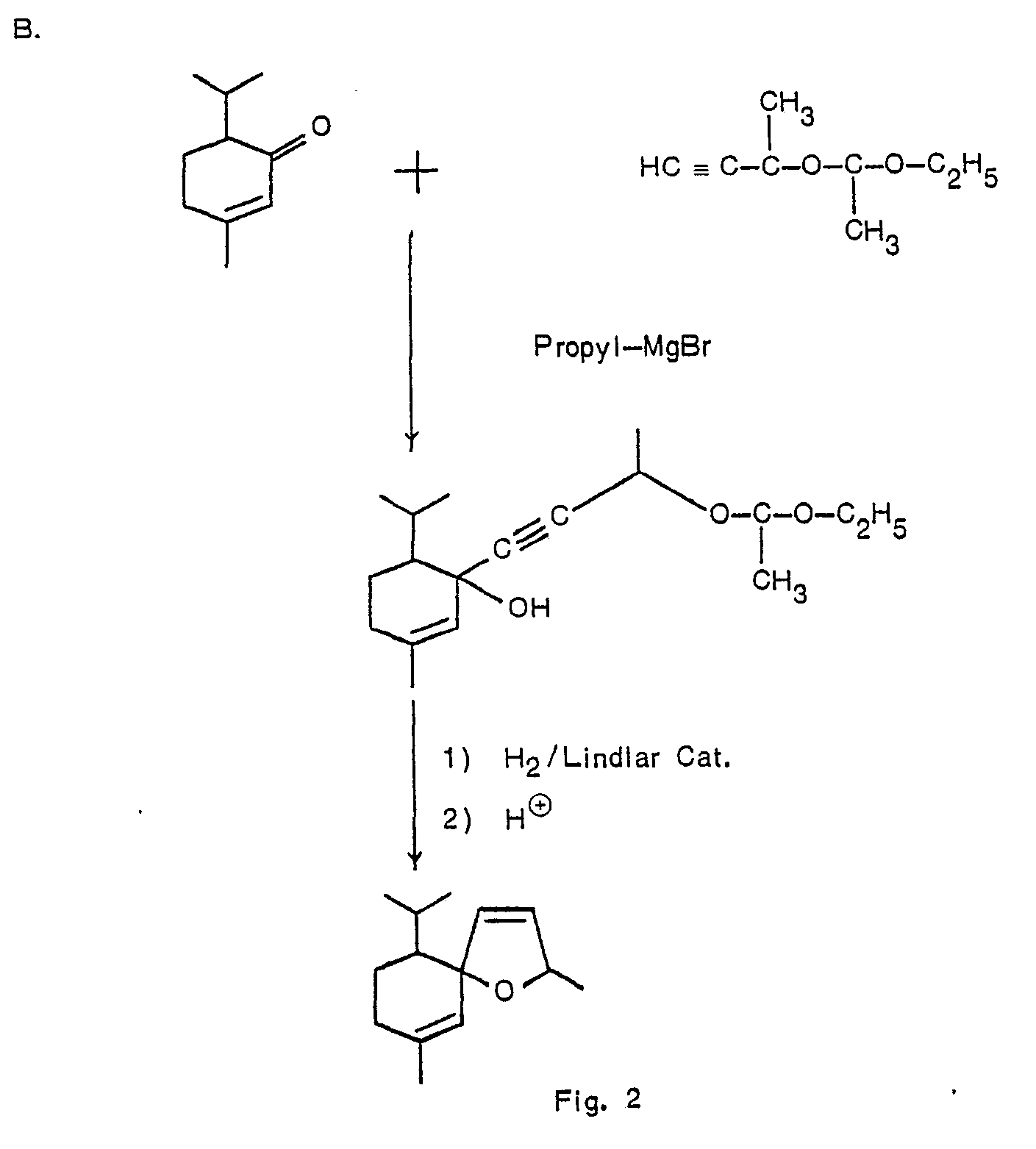
- A solution of 1-propylmagnesium bromide was prepared from 120 g magnesium and 610 g 1-bromopropane in 5 I tetrahydrofuran. To this solution 710 g of the above mentioned dioxa-octyne was added 1 hour whereby the temperature of the reaction mixture raised to about 60°C and propane evaporated. The reaction mixture was stirred another hour during which the temperature dropped to 30°C. Then in 1 hour 700 g freshly distilled piperitone was added and the mixture was stirred 1 hour at 60°C. After cooling off the reaction mixture was poured out in a mixture consisting of 1000 g ammonium chloride and 5000 g ice/water and stirred thoroughly. The layers were separated and the organic layer was washed 3 times with water and dried above Na2SO4. The solution was evaporated in vacuo and subsequently the unreacted starting material was distilled off in vacuo (max. 85°C at 0.2 kPa). Yield: 1100 g dioxy-octynyl- cyclohexenol-derivative.
- C. (Vide the above Figure indicated under (B)).
- 480 g of the last mentioned reaction product was dissolved in 350 ml methanol after which 2.5 g Lindlar-catalyst was added. This mixture was hydrogenated at 40°C and 400 kPa until no more hydrogen was taken up. Then the catalyst was filtrated off and the solvent was evaporated in vacuo. To the residue 500 g 30%'s sulphuric acid was added. This mixture was stirred during 2 hours at 20°C and subsequently 2 hours at 40°C. Then the layers were separated and the organic layer was washed twice with a soda- solution. Further the organic layer was distilled and fractionated both steps in vacuo.
- Yield: 200 g (60%) 10-isopropyl-2.7-dimethyl-1-oxaspiro[4.5]deca-3.6-diene.
- Boiling point: 83-85°C/0.2 kPa; no=1.4918.
- A perfume composition for soap was prepared according to the following recipe:
- 160 parts by weight of 4-tert.butyl-cyclohexyl acetate
- 160 parts by weight of benzylsalicylate
- 110 parts by weight of terpinylacetate
- 110 parts by weight of nopyl acetate
- 60 parts by weight of phenylethyl-amylether
- 60 parts by weight of hydroxycitronellal
- 60 parts by weight of benzyl acetate
- 50 parts by weight of 6-acetyl-1-isopropyl-2,3,3,5-tetramethylindan
- 50 parts by weight of gamma-methyljonon
- 30 parts by weight of phenylethanol
- 30 parts by weight of ylang oil
- 30 parts by weight of alpha-n.amyl cinnamaldehyde
- 15 parts by weight of cumarin
- 15 parts by weight of musk ambrette
- 15 parts by weight of alpha-jonon
- 10 parts by weight of guajak wood oil
- 5 parts by weight of undecen-10-al
- 5 parts by weight of 2-methyl-3-(p-isopropylphenyl)-propanal
- 25 parts by weight of 10-isopropyi-2,7-dimethyi-1-oxaspiro[4.5]deca-3,6-diene
- A perfumed toilet soap was prepared by thoroughly mixing of 1 kg white soap granules, 10 g of the above mentioned perfume composition and 10 g of a soap dye in a pilling machine. The obtained perfumed coloured soap flakes were pressed in a usual way to pieces of toilet soap. In this way a pleasantly smelling toilet soap was obtained having a light but stable cassis-note.
- A perfume composition for an aftershave lotion was prepared according to the following recipe:
- 240 parts by weight of bergamot oil, bergaptene-free
- 80 parts by weight of vetiveryl acetate
- 80 parts by weight of n.amylcinnamaldehyde
- 80 parts by weight of cedar wood oil
- 80 parts by weight of lemon oil, Italian
- 80 parts by weight of orange oil, Florida
- 80 parts by weight of benzyl acetate
- 30 parts by weight of 6-acetyl-1-isopropyl-2,3,3,5-tetramethylindan
- 30 parts by weight of methyl-dihydrojasmonate
- 30 parts by weight of cis-hex-3-en-1-ylsalicylate
- 30 parts by weight of 2-methyl-3-(p-isopropylphenyl)-propanal
- 20 parts by weight of musk ambrette
- 20 parts by weight of galbanum resinoid
- 20 parts by weight of styrallyl acetate
- 15 parts by weight of oil of cloves
- 10 parts by weight of heliotropine
- 10 parts by weight of cumarin
- 10 parts by weight of 11-oxahexadecanolide
- 10 parts by weight of armoise oil
- 10 parts by weight of 2-methyl-3-(3,4-dioxymethylene-phenyl)-propanal
- 35 parts by weight of 10-isopropyl-2.7-dimethyl-1-oxaspiro[4.5]deca-3,6-diene
- An aftershave lotion perfumed with a composition according to example III was prepared according to the following recipe:
- A. 0.3 part by weight of 1-menthol
- 0.5 part by weight of uvinol D 50 1)
- 30.0 parts by weight of propylene glycol
- 535 parts by weight of ethanol
- B. 2.0 parts by weight of aluminum-chlorohydrate-allantoinate
- 2.0 parts by weight of lactic acid
- 400 parts by weight of water (distilled)
- C. 20 parts by weight of perfume (example III)
- 10 parts by weight of cremophor RH40 2)
- The components mentioned under A, B and C were admixed separately to the mixtures A, B and C.
- Mixture B was then added to mixture A under thoroughly stirring.
- Then mixture C was added and the total mixture was homogenized by stirring. In this way a somewhat astringating aftershave-lotion was obtained which gave a pleasant odour with a light but stable cassis note.
- Trade mark of BASF for 2,2',4,4'-tetrahydroxybenzophenone.
- 1) Trade mark of BASF for the reaction product of hydrogenated castor oil and epoxyethane.
- A blackcurrant flavouring was prepared according to the recipe of Fenaroli's Handbook of Flavor Ingredients, Volume II, 2nd Edition (1975), page 586, (CRC Press, Cleveland, Ohio).
- To this flavouring one part by weight of 10-isopropyl-2,7-dimethyl-1-oxaspiro[4.5)deca-3,6-diene was added per 1000 parts by weight of flavouring was added. The flavouring obtained by this addition became a more fully and natural blackcurrant character than the flavouring without this addition.
Claims (6)

Applications Claiming Priority (2)
| Application Number | Priority Date | Filing Date | Title |
|---|---|---|---|
| NL8201991 | 1982-05-13 | ||
| NL8201991A NL8201991A (en) | 1982-05-13 | 1982-05-13 | PERFUME AND AROMACOMPOSITIONS, PERFUMED ARTICLES AND MATERIALS, AND FOOD AND EDIBLE PREPARATIONS CONTAINING AN OXASPIRODADADATIVATE AS A RAW MATERIAL AND THE OXATOPIEDI4,5. |
Publications (2)
| Publication Number | Publication Date |
|---|---|
| EP0094722A1 EP0094722A1 (en) | 1983-11-23 |
| EP0094722B1 true EP0094722B1 (en) | 1986-02-26 |
Family
ID=19839736
Family Applications (1)
| Application Number | Title | Priority Date | Filing Date |
|---|---|---|---|
| EP83200674A Expired EP0094722B1 (en) | 1982-05-13 | 1983-05-10 | 10-isopropyl-2,7-dimethyl-1-oxaspiro(4.5)deca-3,6-diene, its use in perfumes and aromas |
Country Status (5)
| Country | Link |
|---|---|
| US (1) | US4537702A (en) |
| EP (1) | EP0094722B1 (en) |
| JP (1) | JPH0649693B2 (en) |
| DE (1) | DE3362257D1 (en) |
| NL (1) | NL8201991A (en) |
Families Citing this family (2)
| Publication number | Priority date | Publication date | Assignee | Title |
|---|---|---|---|---|
| US6618395B1 (en) * | 1999-05-27 | 2003-09-09 | 3Com Corporation | Physical coding sub-layer for transmission of data over multi-channel media |
| ES2290393T3 (en) * | 2002-10-14 | 2008-02-16 | Firmenich Sa | SPIERS AS PERFUMING INGREDIENTS. |
Family Cites Families (7)
| Publication number | Priority date | Publication date | Assignee | Title |
|---|---|---|---|---|
| DE2250447A1 (en) * | 1971-10-18 | 1973-04-26 | Ciba Geigy Ag | METHOD OF PHOTOCYCLIZATION OF DIHYDROJONONES AND THEIR HOMOLOGIES |
| CH599757A5 (en) * | 1975-07-30 | 1978-05-31 | Firmenich & Cie | |
| US4014905A (en) * | 1974-02-04 | 1977-03-29 | Firmenich S.A. | Esters of certain tetramethyl and pentamethyl-1-oxa-spiro [4-5] decan-6-ols with certain alkanoic acids |
| NL186160C (en) * | 1975-03-11 | 1990-10-01 | Givaudan & Cie Sa | PROCESS FOR THE PREPARATION OF THEASPIRAN. |
| GB2005138B (en) * | 1977-09-07 | 1982-03-31 | Firmenich & Cie | Unsaturated spirane derivatives their use and process for their preparation |
| NL7711135A (en) * | 1977-10-05 | 1979-04-17 | Firmenich & Cie | Tetra:methyl-oxa-spiro-deca:diene cpds. - useful as perfumes and flavours |
| US4336197A (en) * | 1980-02-08 | 1982-06-22 | Firmenich Sa | 6-Ethyl-2,10,10-trimethyl-1-oxa-spiro[4.5]deca-3,6-diene |
-
1982
- 1982-05-13 NL NL8201991A patent/NL8201991A/en not_active Application Discontinuation
-
1983
- 1983-05-10 US US06/493,412 patent/US4537702A/en not_active Expired - Lifetime
- 1983-05-10 DE DE8383200674T patent/DE3362257D1/en not_active Expired
- 1983-05-10 EP EP83200674A patent/EP0094722B1/en not_active Expired
- 1983-05-13 JP JP58082879A patent/JPH0649693B2/en not_active Expired - Lifetime
Also Published As
| Publication number | Publication date |
|---|---|
| JPH0649693B2 (en) | 1994-06-29 |
| DE3362257D1 (en) | 1986-04-03 |
| US4537702A (en) | 1985-08-27 |
| JPS58206511A (en) | 1983-12-01 |
| EP0094722A1 (en) | 1983-11-23 |
| NL8201991A (en) | 1983-12-01 |
Similar Documents
| Publication | Publication Date | Title |
|---|---|---|
| JP5730754B2 (en) | Novel pyran derivatives, their preparation and their use in perfumery production | |
| EP0049545A1 (en) | High-pressure mercury vapour discharge lamp | |
| JPH0672952A (en) | Novel ester compounds, methods for improving, enhancing, imparting or modifying odor characteristics of perfume compositions and perfumed articles, perfumed compositions and articles, and methods and intermediates for producing novel compounds | |
| JP2933719B2 (en) | Dimethyl-cyclohexanecarboxylate in perfumery | |
| US4376068A (en) | Use of isomeric farnesene product-by-process for augmenting or enhancing the aroma of perfume compositions, colognes and perfumed articles | |
| JPH0581639B2 (en) | ||
| EP0162465A2 (en) | Novel compounds useful in perfumes | |
| JPS60224650A (en) | Manufacture of asymmetric ketone isomer, manufacture and composition | |
| JPS63264477A (en) | Perfume composition | |
| US5358930A (en) | 2-ethoxy-4-formyl phenyl ester of propionic acid and use in augmenting or enhancing the aroma of perfume compositions, colognes and perfumed articles | |
| US4390444A (en) | Use of isomeric mixtures of farnesene for augmenting or enhancing the aroma of detergent compositions | |
| US4537702A (en) | Perfume and flavoring compositions, perfumed articles and materials, and flavored food products containing an oxaspirodecadiene derivative as the essential compound, as well as the oxaspiro[4.5]decadiene derivative per se | |
| CN104066416B (en) | Octahydro benzofuran and its purposes in flavor compositions | |
| EP0251370B1 (en) | Cyclohexane-, cyclohexene- and cyclohexadiene, bicyclo[2.2.1]heptane and bicyclo [2.2.1]heptenecarboxylic acid esters, and also perfume compositions and perfumed products which contain one or more of said compounds as perfume component | |
| US3963648A (en) | Perfume chemicals | |
| CN101234967B (en) | Substituted hydrogenated naphthalene derivatives and use thereof in fragrance formulations | |
| JPH08916B2 (en) | Perfume composition and perfume-containing products containing one or more o-alkoxyphenols as perfume ingredients | |
| JP3009404B2 (en) | Compounded fragrances containing 2-methoxy-4-propyl-1-cyclohexanol, perfumed products containing the compounded fragrances, and methods for enhancing, improving or changing the odor characteristics of the compounded fragrances | |
| EP2904078B1 (en) | Flavor and fragrance formulation (vi) | |
| JPS62169743A (en) | Isopropyl-methyl-butenoyl-cyclohexane derivative | |
| US5227367A (en) | Oxypentamethylindane carboxaldehydes, methods for preparing same, organoleptic uses thereof and cosmetic and pharmaceutical compositions containing them | |
| EP0470426A2 (en) | 2,2,3-Trimethylcyclopentenyl acetone derivatives, organoleptic uses thereof and process for preparing same | |
| US4404127A (en) | Perfume compositions and perfumed materials and articles, containing phenyl-tetrahydrofurans as a fragrance | |
| US4512919A (en) | 2-Methoxy-4-(2-methylpropenyl) phenyl ester of isobutyric acid, and use in augmenting or enhancing aroma of perfume compositions, colognes and perfumed articles | |
| EP0157436B1 (en) | Perfume compositions and perfumed articles containing dihydro- and/or tetrahydro-naphtols as fragrance material |
Legal Events
| Date | Code | Title | Description |
|---|---|---|---|
| PUAI | Public reference made under article 153(3) epc to a published international application that has entered the european phase |
Free format text: ORIGINAL CODE: 0009012 |
|
| AK | Designated contracting states |
Designated state(s): CH DE FR GB LI NL |
|
| 17P | Request for examination filed |
Effective date: 19840508 |
|
| GRAA | (expected) grant |
Free format text: ORIGINAL CODE: 0009210 |
|
| AK | Designated contracting states |
Designated state(s): CH DE FR GB LI NL |
|
| REF | Corresponds to: |
Ref document number: 3362257 Country of ref document: DE Date of ref document: 19860403 |
|
| ET | Fr: translation filed | ||
| PLBE | No opposition filed within time limit |
Free format text: ORIGINAL CODE: 0009261 |
|
| STAA | Information on the status of an ep patent application or granted ep patent |
Free format text: STATUS: NO OPPOSITION FILED WITHIN TIME LIMIT |
|
| 26N | No opposition filed | ||
| PGFP | Annual fee paid to national office [announced via postgrant information from national office to epo] |
Ref country code: FR Payment date: 20010411 Year of fee payment: 19 |
|
| PGFP | Annual fee paid to national office [announced via postgrant information from national office to epo] |
Ref country code: GB Payment date: 20010419 Year of fee payment: 19 |
|
| PGFP | Annual fee paid to national office [announced via postgrant information from national office to epo] |
Ref country code: DE Payment date: 20010423 Year of fee payment: 19 |
|
| PGFP | Annual fee paid to national office [announced via postgrant information from national office to epo] |
Ref country code: NL Payment date: 20010424 Year of fee payment: 19 |
|
| REG | Reference to a national code |
Ref country code: GB Ref legal event code: IF02 |
|
| PGFP | Annual fee paid to national office [announced via postgrant information from national office to epo] |
Ref country code: CH Payment date: 20020416 Year of fee payment: 20 |
|
| PG25 | Lapsed in a contracting state [announced via postgrant information from national office to epo] |
Ref country code: GB Free format text: LAPSE BECAUSE OF NON-PAYMENT OF DUE FEES Effective date: 20020510 |
|
| PG25 | Lapsed in a contracting state [announced via postgrant information from national office to epo] |
Ref country code: NL Free format text: LAPSE BECAUSE OF NON-PAYMENT OF DUE FEES Effective date: 20021201 |
|
| PG25 | Lapsed in a contracting state [announced via postgrant information from national office to epo] |
Ref country code: DE Free format text: LAPSE BECAUSE OF NON-PAYMENT OF DUE FEES Effective date: 20021203 |
|
| GBPC | Gb: european patent ceased through non-payment of renewal fee |
Effective date: 20020510 |
|
| PG25 | Lapsed in a contracting state [announced via postgrant information from national office to epo] |
Ref country code: FR Free format text: LAPSE BECAUSE OF NON-PAYMENT OF DUE FEES Effective date: 20030131 |
|
| NLV4 | Nl: lapsed or anulled due to non-payment of the annual fee |
Effective date: 20021201 |
|
| REG | Reference to a national code |
Ref country code: FR Ref legal event code: ST |
|
| PG25 | Lapsed in a contracting state [announced via postgrant information from national office to epo] |
Ref country code: LI Free format text: LAPSE BECAUSE OF EXPIRATION OF PROTECTION Effective date: 20030509 Ref country code: CH Free format text: LAPSE BECAUSE OF EXPIRATION OF PROTECTION Effective date: 20030509 |
|
| REG | Reference to a national code |
Ref country code: CH Ref legal event code: PL |