EP0094419B1 - Electrical connector - Google Patents
Electrical connector Download PDFInfo
- Publication number
- EP0094419B1 EP0094419B1 EP83900133A EP83900133A EP0094419B1 EP 0094419 B1 EP0094419 B1 EP 0094419B1 EP 83900133 A EP83900133 A EP 83900133A EP 83900133 A EP83900133 A EP 83900133A EP 0094419 B1 EP0094419 B1 EP 0094419B1
- Authority
- EP
- European Patent Office
- Prior art keywords
- housing
- carriers
- pin
- connector according
- setting
- Prior art date
- Legal status (The legal status is an assumption and is not a legal conclusion. Google has not performed a legal analysis and makes no representation as to the accuracy of the status listed.)
- Expired
Links
- 238000003825 pressing Methods 0.000 claims abstract description 4
- 239000000969 carrier Substances 0.000 claims description 45
- 230000008878 coupling Effects 0.000 claims description 5
- 238000010168 coupling process Methods 0.000 claims description 5
- 238000005859 coupling reaction Methods 0.000 claims description 5
- 238000013459 approach Methods 0.000 claims 1
- 238000009877 rendering Methods 0.000 claims 1
- 230000000694 effects Effects 0.000 abstract description 8
- 239000002985 plastic film Substances 0.000 abstract 1
- 239000012528 membrane Substances 0.000 description 6
- 238000006073 displacement reaction Methods 0.000 description 4
- 239000000463 material Substances 0.000 description 3
- 230000004048 modification Effects 0.000 description 3
- 238000012986 modification Methods 0.000 description 3
- 239000012260 resinous material Substances 0.000 description 3
- OKTJSMMVPCPJKN-UHFFFAOYSA-N Carbon Chemical compound [C] OKTJSMMVPCPJKN-UHFFFAOYSA-N 0.000 description 2
- 230000009471 action Effects 0.000 description 2
- 238000005452 bending Methods 0.000 description 2
- 238000010276 construction Methods 0.000 description 2
- 238000003780 insertion Methods 0.000 description 2
- 230000037431 insertion Effects 0.000 description 2
- 229910000679 solder Inorganic materials 0.000 description 2
- BQCADISMDOOEFD-UHFFFAOYSA-N Silver Chemical compound [Ag] BQCADISMDOOEFD-UHFFFAOYSA-N 0.000 description 1
- XECAHXYUAAWDEL-UHFFFAOYSA-N acrylonitrile butadiene styrene Chemical compound C=CC=C.C=CC#N.C=CC1=CC=CC=C1 XECAHXYUAAWDEL-UHFFFAOYSA-N 0.000 description 1
- 229920000122 acrylonitrile butadiene styrene Polymers 0.000 description 1
- 239000004676 acrylonitrile butadiene styrene Substances 0.000 description 1
- 229910052799 carbon Inorganic materials 0.000 description 1
- 239000004020 conductor Substances 0.000 description 1
- 238000002788 crimping Methods 0.000 description 1
- 238000005516 engineering process Methods 0.000 description 1
- 229910002804 graphite Inorganic materials 0.000 description 1
- 239000010439 graphite Substances 0.000 description 1
- 230000000977 initiatory effect Effects 0.000 description 1
- 229910052751 metal Inorganic materials 0.000 description 1
- 239000002184 metal Substances 0.000 description 1
- 238000000034 method Methods 0.000 description 1
- 238000010137 moulding (plastic) Methods 0.000 description 1
- 238000007747 plating Methods 0.000 description 1
- 230000004044 response Effects 0.000 description 1
- 229910052709 silver Inorganic materials 0.000 description 1
- 239000004332 silver Substances 0.000 description 1
- 238000005476 soldering Methods 0.000 description 1
- 230000007480 spreading Effects 0.000 description 1
Images


Classifications
-
- H—ELECTRICITY
- H01—ELECTRIC ELEMENTS
- H01R—ELECTRICALLY-CONDUCTIVE CONNECTIONS; STRUCTURAL ASSOCIATIONS OF A PLURALITY OF MUTUALLY-INSULATED ELECTRICAL CONNECTING ELEMENTS; COUPLING DEVICES; CURRENT COLLECTORS
- H01R12/00—Structural associations of a plurality of mutually-insulated electrical connecting elements, specially adapted for printed circuits, e.g. printed circuit boards [PCB], flat or ribbon cables, or like generally planar structures, e.g. terminal strips, terminal blocks; Coupling devices specially adapted for printed circuits, flat or ribbon cables, or like generally planar structures; Terminals specially adapted for contact with, or insertion into, printed circuits, flat or ribbon cables, or like generally planar structures
- H01R12/70—Coupling devices
- H01R12/82—Coupling devices connected with low or zero insertion force
- H01R12/85—Coupling devices connected with low or zero insertion force contact pressure producing means, contacts activated after insertion of printed circuits or like structures
- H01R12/88—Coupling devices connected with low or zero insertion force contact pressure producing means, contacts activated after insertion of printed circuits or like structures acting manually by rotating or pivoting connector housing parts
-
- H—ELECTRICITY
- H01—ELECTRIC ELEMENTS
- H01R—ELECTRICALLY-CONDUCTIVE CONNECTIONS; STRUCTURAL ASSOCIATIONS OF A PLURALITY OF MUTUALLY-INSULATED ELECTRICAL CONNECTING ELEMENTS; COUPLING DEVICES; CURRENT COLLECTORS
- H01R12/00—Structural associations of a plurality of mutually-insulated electrical connecting elements, specially adapted for printed circuits, e.g. printed circuit boards [PCB], flat or ribbon cables, or like generally planar structures, e.g. terminal strips, terminal blocks; Coupling devices specially adapted for printed circuits, flat or ribbon cables, or like generally planar structures; Terminals specially adapted for contact with, or insertion into, printed circuits, flat or ribbon cables, or like generally planar structures
- H01R12/70—Coupling devices
- H01R12/77—Coupling devices for flexible printed circuits, flat or ribbon cables or like structures
Definitions
- This invention relates generally to electrical connectors and, more particularly, to connectors adapted to make electrical connection between a plurality of conductive strips, contact pads, terminals or other conductive areas on a circuit board or other carrier, and a plurality of conductive areas on another carrier.
- U.S. Patent 4,261,631 discloses electrically connecting directly a plurality of contact pads on a circuit board with registering spring contacts projecting up from an underlying base portion. This is done by a connector comprising the base portion, a pair of uprights fixedly secured to longitudinally opposite ends of the base portion, a hollow vertically movable block disposed above the base portion, and a longitudinal control shaft passing through the block.
- the movable block's transverse cross section is in the form of a "U" lying on its side, the circuit board is inserted into a slot in the free end of the lower arm of the "U", and the opposite ends of the shaft are rotatably received in holes in the two uprights.
- the movable block's transverse cross section is in the form of a hollow rectangle
- the circuit board is fixed to the undersurface of the movable block which is slidably movable up and down within a downwardly open fixed block fixedly mounted in relation to the mentioned base portion and uprights
- the opposite ends of the shaft are rotatably mounted in holes in longitudinally opposite ends of the fixed block.
- the control shaft is of a circular cross section but has longitudinally spaced therealong a plurality of cams in the form of raised segment portions extending about 90 degrees around the shaft.
- the shaft is preliminarily turned to cause one of the cams thereon to contact the upper side of the movable block and, by further turning, to raise it enough to permit the mentioned circuit board to be positioned over the mentioned base portion.
- the shaft is turned to a position at which those cams contact the upper surface of the underside of the movable block and displace downwardly both it and the circuit board attached thereto until the contact pads on the board make pressure contact with the spring contacts projecting upwards from the base portion.
- the invention provides a connector for making electrical connection between conductive areas on one carrier and conductive areas on another carrier, having:
- a forwardly open housing adapted to be placed on superimposed carriers of registering conductive areas on the carriers' adjacent surfaces, the housing having longitudinally spaced forwardly extending portions with means at their further ends for coupling the housing to the further of the carriers, the housing including pressure generating means comprising a longitudinally extending wedging body of non-circular cross section received between the forwardly extending portions of the housing, the wedging body having a greater dimension in one than in the other of its cross sectional coordinates and having rear and front contact faces on the opposite sides of the wedging body separated by the greater dimension, the housing providing a loadbearing backing behind and for the body, and the wedging body being adjustable in the housing between first and second settings at which, with such housing being on the carriers and coupled to the further one, the body is adapted to be inoperable at the first setting to produce significant force on the carriers and wedgingly inserted at the second setting between the backing and carriers with the rear and front contact faces being simultaneously engaged and in a force coupled relation to the backing and the carriers respectively, so that the rear face produces
- the reference numerals 12 and 12' designate two separate electrical connectors which are each exemplary embodiments of the invention. Since the two connectors are identical in construction, only the connector 12 will be described in detail.
- the connector 12 is shown as being placed over an assemblage of vertically superposed carriers of registering conductive areas on the carriers' adjacent surfaces. While such an assemblage may comprise three or more of such carriers, the FIG. 1 assemblage adapted to cooperate with connector 12 consists of (a) a lower carrier in the form of a circuit board 13 having conductive elements in the form of, say, solder coated conductor strips 14 deposited on its upper surface, and (b) and upper carrier in the form of a flexible synthetic resinous sheet 15 constituting a tail of a membrane switch 16 having circuit paths thereon connected to leads on the lower surface of the tail, such leads being in the form of conductive elements constituting strips 17 of silver conductive ink, carbon graphite or solder. Those strips are deposited on the lower surface of the tail 15 and are so longitudinally spaced from each other and extend transversely in such manner that conductive areas on those strips are adapted to register with corresponding conductive areas on the strips of the circuit board 13.
- the connector 12 comprises a downwardly open housing 20 constituted of synthetic resinous material and having, as a part thereof, a top panel 21 integral at its longitudinally opposite ends with a pair of longitudinally spaced downwardly extending housing portions 22a and 22b with means at their lower ends for coupling the housing to circuit board 13.
- the portion 22a is in the form of a forked leg of which the lower end is resiliently deflectable longitudinally outward in relation to its upper end, and which leg consists of two tines 23a, 24a separated from each other by a vertical slot 25a in the leg.
- the tines 23a and 24a are bridged at the lower end of slot 25a by a longitudinally outwardly projecting shoulder 26a having on its upper side a flat bearing surface 27a and having between its top and bottom an outwardly facing wedging surface 28a which, downwardly, is inclined inwardly.
- the leg 22b is constructed similarly to leg 22a.
- the shoulders 26 of legs 22 are, as will be later explained in more detail, the mentioned means by which housing 20 may be coupled to the circuit board 13.
- the top panel 21 has joined thereto on transversely opposite sides thereof a front wall 30 and a back wall 31 both of which are integral with the panel and extend downwardly therefrom by the same distance such that the bottom surfaces 32 and 33 of the walls 30 and 31 are definitive of a bottom opening 18 for the interior 19 of the housing (see FIGS. 6A and 6B). Between the upper ends of walls 30 and 31, panel 21 provides a web portion 29 forming a closure for the top of the housing's interior 19.
- the longitudinally opposite sides of walls 30 and 31 terminate short of legs 22 to be separated therefrom by gaps 34 which render those legs more resiliently deflectable outward than they would be if the front and back walls and legs were to be integrally joined together.
- the front wall 30 has integral therewith at its longitudinally opposite ends (FIGS.
- a pair of transversely inwardly turned ribs 35a and 35b which stiffen that wall against transverse resilient deflection.
- the back wall 31 has integral therewith a pair of inwardly turned ribs 36a, 36b which perform a similar function and similarly project transversely inward from the inside of the wall, but which are longitudinally displaced inwards from the longitudinally opposite ends of wall 31.
- the ribs 35 and 36 not only stiffen the mentioned walls but also are definitive or vertical guideways within housing 20 as later explained.
- the front wall 30 of housing 20 has integral therewith a pair of longitudinally spaced vertical registration pins 37a, 37b which extend downwardly beyond the bottom surface 32 of that front wall. The function of such pins will be later explained.
- Connector 12 also includes a pressure generating means comprising a pin 40 (FIG. 4) constituted of a longitudinally central section in the form of a pressure generating or wedging body 41 and, also a pair of circular cylindrical stems 42a, 42b projecting longitudinally outward from the longitudinally opposite ends of body 41.
- a pressure generating means comprising a pin 40 (FIG. 4) constituted of a longitudinally central section in the form of a pressure generating or wedging body 41 and, also a pair of circular cylindrical stems 42a, 42b projecting longitudinally outward from the longitudinally opposite ends of body 41.
- Each of such stems has a cross section of smaller size than the cross section of body 41.
- the stems 42a, 42b have respective end faces 43a, 43b in which are formed respective screw driver slots 44a, 44b.
- pin 40 is angularly adjustable about an axis 45 which longitudinally passes therethrough, but which does not necessarily remain fixed in location in relation to the cross section of the pin.
- Pin 40 has formed thereon stop means comprising a pair of lugs 50a, 50b which project in the vertical plane outward of the remainder of the pin, and which have respective surfaces 51 a, 51 b on top of the pin when in its FIG. 4 position and adapted, as later explained, to act as stop surfaces.
- the two lugs are asymmetrically located on pin 40 to the extent that lug 50b is formed on the central body 40 whereas lug 50a is formed on the stem 42a.
- the body 41 of the pin is generally longitudinally cylindrical in shape and has a front contact face 55 on the forward part or head 56 of the body and a rear contact face 57 on the rear part 58 of the body.
- the cross section of body 41 normal to axis 45 is noncircular in that it has a greater dimension in one of its orthogonal coordinates normal to such axis than it does in other of such coordinates, the faces 55 and 57 of such body being separated by such greater dimension.
- the cross section of body 41 can be considered to be made up of the rear semicircular portion 58, a central rectangular portion 59 and a front semicircular portion which constitutes the head 56.
- the pin 40 is conveniently inserted in housing 20 by turning the latter upside down (FIG. 2), longitudinally spreading apart the free ends of the resiliently deflectable legs 22 of the housing until the pin can pass between them, dropping the pin into the interior 19 of the housing such that the pin's head 56 is longitudinally contained between the internal ribs 35 of the housing (FIG. 5A) and the stems 42 of the pin are aligned with the vertical slots 25 in the legs, and, thereafter, allowing the legs 22 to resiliently spring back to original position such that the pin stems 42 enter into and are contained by the slots 45.
- the pin 40 thus becomes caged within housing 20 so that it cannot be removed therefrom except by reversing the procedure just described.
- the pin 40 cannot be placed in the housing "backward", i.e., with the head 56 of body 41 facing toward the housing's rear wall 31 rather than its front wall 30, or with the left-hand end being placed in the right-hand end of the housing.
- the ribs 35a, 36a and the ribs 35b, 36b are definitive of vertical guideways for the pin in addition to the guideways therefor provided by the vertical slots 25 in the legs 22.
- the pin as received in the housing is rotatable about pin axis 45 such that the pin is angularly adjustable between a first angular setting depicted in FIGS. 5A and 6A and a second angular setting depicted in FIGS. 5B and 6B.
- the mentioned guideways therefor permit translational movement of the pin 40 and its body 41 within, and in relation to, the housing.
- the pin 40 and its body 41 are floatingly positionable at least up and down in housing 20 in that, at least in the vertical direction, they are, to an extent and in response to force thereon,.self-adjusting in position in, and in relation to, the housing without significant structural constraint being placed on such adjustment within such extent.
- the ribs 35 of the housing cooperate with the head 56 of the body to prevent longitudinal movement of pin 40 within housing 20 in excess of the clearance between those ribs and that head.
- the ribs 36 of the housing cooperate with the longitudinally inward respective sides of the lugs 50 to prevent longitudinal movement of the pin in the housing in excess of such clearance. Midway between those two settings, longitudinal movement of the pin in the housing is prevented (except for clearance play) both by cooperation of the ribs 35 with the head 56 and of the ribs 36 with the lugs 50.
- the pin 40 is of sufficient longitudinal extent in relation to the housing that the end faces 43 of the pin project outwardly from the housings' legs 22. The amount of such projection is, however, slight, and the slots 44 in such end faces are deep enough for the bottoms of such slots to be disposed within the vertical slots 25 formed in the legs 22.
- the material of such stem will receive transverse support from the sidewalls bounding slot 25a of the tines 23a, 24a of leg 22. By virtue of such support, the torque exerted by the screw driver tip on the material of stem 42a will not tend to break that material away from the stem.
- pin 40 and its body 41 can be adjusted in setting by a screw driver tip inserted into, and turned in, either one of the slots 44a and 44b at the opposite ends of the pin.
- the membrane switch tail 15 is, as a preliminary step, placed on top of the circuit board 13 to rest thereon. Tail 15 is then shifted in the horizontal plane in relation to board 13 until there is rough registration of the conductive strips 17 on the lower surface of the tail with the conductive strips 14 on the upper surface of the board and, until further, there is approximate vertical registration of a pair of holes 60 through tail 15 with a pair of holes 61 through the board, one each of such registering holes 60 and 61 being shown in FIG. 6A.
- the holes 60 and 61 have locations on, respectively, the tail 15 and board 13 which are referenced to the locations on those carriers of the conductive strips provided respectively thereon, and the longitudinal spacing between the holes 60 and between the holes 61 is the same as the longitudinal spacing between the registration pins 37 of the connector 12.
- the connector 12 is placed above the carriers 13 and 15 such that the pins 37 of the connector are vertically aligned with the passages through the superposed holes 60 and 61.
- the connector is then lowered toward the assemblage of carriers to move the pins through such passages.
- Holes 60 and 61 are of such diameter as to have a close fit with the pins 37. Accordingly, the movement of the pins through the mentioned holes causes each superposed two of the holes 60 and 61 to line up accurately with each other, and such forced alignment of the holes in turn causes a highly accurate alignment to occur in both dimensions of the horizontal plane between the conductive strips 17 on the tail 15 and the conductive strips 14 on the circuit board 13.
- the overlying conductive strips 17 register with, and are in loose contact with the underlying strips 14. Further, the insertion of the pins 37 into the holes 60, 61 serves to reference the location of connector 12 to the locations on carriers 13 and 15 of the conductive areas to be electrically connected together.
- the described lowering of connector 12 not only moves its pins 37 through the mentioned aligning holes in the carriers but also serves to couple the connector to the lower carrier, i.e., board 13.
- its housing legs 22a, 22b (FIG. 7) are vertically aligned with a pair of corresponding vertical slot apertures 65a, 65b formed in the circuit board 13.
- the wedge faces 28 on the outwardly projecting shoulders 26 of the legs 22 strike the longitudinally outward edges of apertures 65 to cause the lower ends of the legs to be resiliently deflected longitudinally inward to an extend permitting such shoulders to pass through such apertures.
- the legs 22 resiliently spring back to their original positions so as to place the bearing faces 27 on shoulders 26 beneath regions of the underside of board 13 which are adjacent to the apertures 65.
- the lowering movement of the connector towards the superposed carriers is, however, continued until it is stopped by the coming into contact with the bottom faces 32 and 33 of, respectively, the front and rear walls 30 and 31 of the connector housing 20 with the upper surface of the upper carrier (or tail) 15, the contact between face 33 and that surface being shown in FIG. 6A.
- the connector is coupled through its legs 22 with the carriers 13 and 15, but such coupling is loose in that (FIG. 6A) there is a gap 66 between the bearing faces 27 on the legs and the underside of board 13, which gap permits some upward movement of the connector in relation to the carriers.
- the pin 40 is (FIG. 6A) at its first setting with the head 56 of the body 41 facing towards the front wall 30 of housing 20, and with body 41 exerting no pressure through its head 56 on the carriers. While FIG. 6A shows the pin as being slightly raised above carrier 15 so as to be out of contact with it, in practice it is not likely that the pin will rest on the upper carrier, but the pin will still not exert any significant pressure on the carriers, i.e., no pressure other than its own weight.
- a screw driver tip is inserted into one of the end slots 44 of pin 40, and the screw driver is then turned, as indicated by arrow 70 in FIG. 6A, to angularly adjust the pin from its first setting to its second setting.
- the turning of the pin brings the front and rear contact faces 55 and 57 of pin body 41 into simultaneous force coupled relation with, respectively, the top of the interior 19 of housing 20 and the carrier assemblage 13, 15. That force coupled relation is one which here is, but which need not be, produced by direct engagement of front contact face 55 with tail 15 and rear contact face 57 with the top web portion 29 of the housing.
- the head 56 of the body 41 will, at that point, project downwardly below such bottom opening 18.
- the pin 40 and its body 41 will floatingly shift in their vertical positioning in and relative to the housing unless perchance the pin is initially so positioned in the housing that such shift will not automatically occur.
- the body 41 is angularly adjusted further towards its second setting but can be so adjusted only by having the body exert a wedging action between the web portion 29 and the upper surface of carrier 15 so as to increase by such action the distance between them.
- Such increase of that distance can, of course be obtained only by deformation of the connector- carrier assemblage structure.
- Such deformation is represented in FIG. 6B as being provided by an upward resilient deflection by the body 41 of the housing's top web portion 29.
- the total deformation needed to permit movement of body 41 to its second setting may also be provided wholly by, or be contributed to from, deformation of other elements as, for example, by resilient bending of the shoulders 26, resilient stretching of the legs 22 or resilient deformation of the body 41 (see description of FIG. 8). Further, all or some of the needed deformation can be provided by resilient bending downward, under the head 56 of body 41, of the carrier assemblage itself.
- the deformation is, however, irrespective of how provided, preferably of such character that it does not result in vertical bowing of the head 56 of body 41 over the longitudinal extent of such head.
- the feature that web portion 29 provides a load-bearing backing for such head over all such extent is a factor tending to reduce or eliminate any possibility of such bowing occurring.
- body 41 is floatingly positionable to housing 20, that body can floatingly adjust in its up and down position to equalize the downward force thereon from housing 20 and the upward force thereon from the carrier assemblage.
- That downward pressure will be a yieldable pressure.
- Such downward pressure acts on the carriers 13, 15 together with the upward force thereon from the shoulders 26 of the housing 20, to press together registering conductive areas on the strips 14 and 17 on the carrier's adjacent surfaces and, in that manner, to provide a permanent solderless electrical connection of those areas.
- the pin 40 reaches its second angular setting when the stop surfaces 51 on the lugs 50 of pin 40 come into contact with the top web portion 29 of housing 20 so as to prevent further angular turning of the pin in the forward direction.
- Such contact preferably occurs when the line 90 between the axis 45 of the pin and the region of contact between body 41 and the upper surface of tail 15 is a few degrees past the line 91 from that axis which is perpendicular to such upper surface. In this way, there will be generated a component of force which will cause those lug stop surfaces to forcibly bear against the web portion 29 and which, accordingly, will lock the pin to be stable in its second setting.
- the tail 15' for the membrane switch 16 has its conductive strips 17' on the upper surface thereof as the tail leads out from the membrane switch, but the said tail is otherwise similar to the membrane switch tail 15.
- the front portion of tail 15' is looped over such that the front end of the tail points back towards the membrane switch rather than away from it (as does the front end of tail 15), and the strips 17' on the tail are downward facing on that portion.
- the mentioned front portion is then placed on board 13 such that strips 17' rest upon and are in loose contact with the registering upward facing strips 14' on the board.
- connector 12' is then used to effect electrical connection between registering conductive areas on the strips 17' and 14' in the same way as connector 12 is used, as earlier described, to effect electrical connection between the strips 17 and 14.
- the only difference between how the two connectors are respectively used is that connector 12' is positioned with its registration pins 37' being on a side of the housing 20' which is opposite in the transverse direction on board 13 to the side of the housing 20 on which are registration pins 37 of the connector 12.
- FIG. 8 shows the pressure pin 40 as modified to have raised lands 80 on the front contact face 55 of the wedging body 41.
- the lands are longitudinally spaced along that front face so as to be directly over the registering conductive areas on, respectively, the tail 15 and the circuit board 13 when front face 55 exerts downward pressure on the carrier assemblage.
- the effect of such lands is to localize such pressure to regions beneath them of such assemblage and, thereby, for the same downward force exerted by head 41, to increase the pressure urging together those registering conductive areas as compared to what such pressure would be in the absence of those lands.
- FIG. 9 shows the wedging body 41 as modified in cross section to the extent that its middle rectangular portion 59 (see FIG. 6B) has been replaced by a web portion 85 which longitudinally extends for the full length of the head 41, but which is of reduced transverse dimension in relation to the head 56 and upper part 58 of the body.
- the described connector may be suitably constituted of a synthetic resinous material known as acrylonitrile-butadiene-styrene, although other synthetic resinous materials may also be used.
- the housing and the pressure generating pin of the connector may be made by plastic molding.
- the connector may conveniently have a dimension of about 30 mm between the longitudinally outward extremities of its legs 22, other appropriate dimensions for the connector being obtainable by scaling from the drawings hereof on the basis of such specified dimension.
- the downward force exerted by the body 41 on the carrier assemblage may conveniently be in the range from about one to two kilogrammes.
Landscapes
- Coupling Device And Connection With Printed Circuit (AREA)
Abstract
Description
- This invention relates generally to electrical connectors and, more particularly, to connectors adapted to make electrical connection between a plurality of conductive strips, contact pads, terminals or other conductive areas on a circuit board or other carrier, and a plurality of conductive areas on another carrier.
- In electronic circuit technology, it is required in many applications to make electrical connection between circuit elements on one circuit board or other carrier of such elements and circuit elements on another physically separate carrier thereof. In the past, this has commonly been done by utilizing electrical connectors soldered to contact pads or other conductive areas on the one carrier and to leads extending away from such connector, and by other electrical connectors soldered to such leads and to contact pads or the like on the other carrier. Such mode of connection involves an undesirable large number of components and is undesirably expensive and time consuming to effect.
- - As an alternative, U.S. Patent 4,261,631 discloses electrically connecting directly a plurality of contact pads on a circuit board with registering spring contacts projecting up from an underlying base portion. This is done by a connector comprising the base portion, a pair of uprights fixedly secured to longitudinally opposite ends of the base portion, a hollow vertically movable block disposed above the base portion, and a longitudinal control shaft passing through the block. In a first embodiment, the movable block's transverse cross section is in the form of a "U" lying on its side, the circuit board is inserted into a slot in the free end of the lower arm of the "U", and the opposite ends of the shaft are rotatably received in holes in the two uprights. In a second embodiment the movable block's transverse cross section is in the form of a hollow rectangle, the circuit board is fixed to the undersurface of the movable block which is slidably movable up and down within a downwardly open fixed block fixedly mounted in relation to the mentioned base portion and uprights, and the opposite ends of the shaft are rotatably mounted in holes in longitudinally opposite ends of the fixed block. For both embodiments, the control shaft is of a circular cross section but has longitudinally spaced therealong a plurality of cams in the form of raised segment portions extending about 90 degrees around the shaft.
- In operation, the shaft is preliminarily turned to cause one of the cams thereon to contact the upper side of the movable block and, by further turning, to raise it enough to permit the mentioned circuit board to be positioned over the mentioned base portion.
- Thereafter, the shaft is turned to a position at which those cams contact the upper surface of the underside of the movable block and displace downwardly both it and the circuit board attached thereto until the contact pads on the board make pressure contact with the spring contacts projecting upwards from the base portion.
- As distinct from the foregoing, the invention provides a connector for making electrical connection between conductive areas on one carrier and conductive areas on another carrier, having:
- a forwardly open housing adapted to be placed on superimposed carriers of registering conductive areas on the carriers' adjacent surfaces, the housing having longitudinally spaced forwardly extending portions with means at their further ends for coupling the housing to the further of the carriers, the housing including pressure generating means comprising a longitudinally extending wedging body of non-circular cross section received between the forwardly extending portions of the housing, the wedging body having a greater dimension in one than in the other of its cross sectional coordinates and having rear and front contact faces on the opposite sides of the wedging body separated by the greater dimension, the housing providing a loadbearing backing behind and for the body, and the wedging body being adjustable in the housing between first and second settings at which, with such housing being on the carriers and coupled to the further one, the body is adapted to be inoperable at the first setting to produce significant force on the carriers and wedgingly inserted at the second setting between the backing and carriers with the rear and front contact faces being simultaneously engaged and in a force coupled relation to the backing and the carriers respectively, so that the rear face produces a loading force on the backing and the front face produces pressure on the carriers for pressing the registering areas together.
- For a better understanding of the invention, reference is made to the following description of a representative embodiment thereof, and to the accompanying drawings wherein:
- FIG. 1 is a perspective view of two connectors embodying the invention, together with an assemblage of superposed carriers of registering conductive areas between which the connectors are adapted to effect electrical connection;
- FIG. 2 is an upside down perspective view of the right hand connector of FIG. 1;
- FIG. 3 is a right side up perspective view of the housing of the FIG. 2 connector;
- FIG. 4 is a right side up perspective view of the pressure generating pin of the FIG. 2 connector;
- FIG. 5A is a bottom plan view of the FIG. 3 housing with the FIG. 4 pin being inserted therein (hereinafter the "FIG. 3 connector"). When such pin is at "no pressure" setting;
- FIG. 5B is the same view as FIG. 5A except that the pin is shown when at its pressure generating setting;
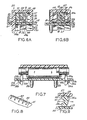
- FIG. 6A is a rightside up elevation in zig-zag cross section, taken as indicated by the
arrows 6A-6A in FIG. 3, with its pin at the FIG. 5A setting, and with the connector being coupled to the FIG. 1 carrier assemblage of which portions are shown in fragmentary cross section; - FIG. 6B is a rightside up elevation in a planar cross section, taken as indicated by the
arrows 6B-6B in FIG. 3, with its pin at the FIG. 5B setting, FIG. 6B otherwise being the same view as FIG. 6A; - FIG. 7 is a rear elevation in cross section, taken as indicated by the arrows 7-7 in FIG. 3 with its pin being at its pressure generating setting;
- FIG. 8 is an upside down perspective fragmentary view of the FIG. 4 pressure generating pin as modified to have raised lands; and FIG. 9 is a vertical cross sectional view, taken as indicated by the arrows 9-9 in FIG. 4, of the FIG. 4 pin as modified to have a resiliently deformable cross . sectional shape, such modification being usable with or without the modification of FIG. 8.
- In the description hereinafter, a description of any element identified by a reference numeral and associated alphabetical or other suffix is to be taken, unless the context otherwise requires, as applying equally to any other element identified by the same reference numeral but by a different suffix following such numeral. Also, while the exemplary connector is, for convenience, described as having a particular spatial orientation, the connector can clearly be used in any spatial orientation.
- Referring now to FIG. 1, the
reference numerals 12 and 12' designate two separate electrical connectors which are each exemplary embodiments of the invention. Since the two connectors are identical in construction, only theconnector 12 will be described in detail. - The
connector 12 is shown as being placed over an assemblage of vertically superposed carriers of registering conductive areas on the carriers' adjacent surfaces. While such an assemblage may comprise three or more of such carriers, the FIG. 1 assemblage adapted to cooperate withconnector 12 consists of (a) a lower carrier in the form of acircuit board 13 having conductive elements in the form of, say, solder coated conductor strips 14 deposited on its upper surface, and (b) and upper carrier in the form of a flexible syntheticresinous sheet 15 constituting a tail of amembrane switch 16 having circuit paths thereon connected to leads on the lower surface of the tail, such leads being in the form of conductiveelements constituting strips 17 of silver conductive ink, carbon graphite or solder. Those strips are deposited on the lower surface of thetail 15 and are so longitudinally spaced from each other and extend transversely in such manner that conductive areas on those strips are adapted to register with corresponding conductive areas on the strips of thecircuit board 13. - As well seen in FIGS. 2 and 3, the
connector 12 comprises a downwardlyopen housing 20 constituted of synthetic resinous material and having, as a part thereof, atop panel 21 integral at its longitudinally opposite ends with a pair of longitudinally spaced downwardly extendinghousing portions circuit board 13. Theportion 22a is in the form of a forked leg of which the lower end is resiliently deflectable longitudinally outward in relation to its upper end, and which leg consists of twotines vertical slot 25a in the leg. Thetines slot 25a by a longitudinally outwardly projectingshoulder 26a having on its upper side a flat bearingsurface 27a and having between its top and bottom an outwardly facingwedging surface 28a which, downwardly, is inclined inwardly. Theleg 22b is constructed similarly toleg 22a. The shoulders 26 of legs 22 are, as will be later explained in more detail, the mentioned means by whichhousing 20 may be coupled to thecircuit board 13. - The
top panel 21 has joined thereto on transversely opposite sides thereof afront wall 30 and aback wall 31 both of which are integral with the panel and extend downwardly therefrom by the same distance such that thebottom surfaces walls interior 19 of the housing (see FIGS. 6A and 6B). Between the upper ends ofwalls panel 21 provides aweb portion 29 forming a closure for the top of the housing'sinterior 19. The longitudinally opposite sides ofwalls gaps 34 which render those legs more resiliently deflectable outward than they would be if the front and back walls and legs were to be integrally joined together. Thefront wall 30 has integral therewith at its longitudinally opposite ends (FIGS. 5A and 5B) a pair of transversely inwardly turnedribs back wall 31 has integral therewith a pair of inwardly turnedribs 36a, 36b which perform a similar function and similarly project transversely inward from the inside of the wall, but which are longitudinally displaced inwards from the longitudinally opposite ends ofwall 31. The ribs 35 and 36 not only stiffen the mentioned walls but also are definitive or vertical guideways withinhousing 20 as later explained. - The
front wall 30 ofhousing 20 has integral therewith a pair of longitudinally spacedvertical registration pins 37a, 37b which extend downwardly beyond thebottom surface 32 of that front wall. The function of such pins will be later explained. -
Connector 12 also includes a pressure generating means comprising a pin 40 (FIG. 4) constituted of a longitudinally central section in the form of a pressure generating or wedgingbody 41 and, also a pair of circularcylindrical stems 42a, 42b projecting longitudinally outward from the longitudinally opposite ends ofbody 41. Each of such stems has a cross section of smaller size than the cross section ofbody 41. Thestems 42a, 42b haverespective end faces 43a, 43b in which are formed respectivescrew driver slots 44a, 44b. When withinhousing 20,pin 40 is angularly adjustable about anaxis 45 which longitudinally passes therethrough, but which does not necessarily remain fixed in location in relation to the cross section of the pin. -
Pin 40 has formed thereon stop means comprising a pair oflugs respective surfaces 51 a, 51 b on top of the pin when in its FIG. 4 position and adapted, as later explained, to act as stop surfaces. The two lugs are asymmetrically located onpin 40 to the extent that lug 50b is formed on thecentral body 40 whereaslug 50a is formed on thestem 42a. - The
body 41 of the pin is generally longitudinally cylindrical in shape and has afront contact face 55 on the forward part orhead 56 of the body and arear contact face 57 on therear part 58 of the body. The cross section ofbody 41 normal toaxis 45 is noncircular in that it has a greater dimension in one of its orthogonal coordinates normal to such axis than it does in other of such coordinates, thefaces body 41 can be considered to be made up of the rearsemicircular portion 58, a centralrectangular portion 59 and a front semicircular portion which constitutes thehead 56. - The
pin 40 is conveniently inserted inhousing 20 by turning the latter upside down (FIG. 2), longitudinally spreading apart the free ends of the resiliently deflectable legs 22 of the housing until the pin can pass between them, dropping the pin into the interior 19 of the housing such that the pin'shead 56 is longitudinally contained between the internal ribs 35 of the housing (FIG. 5A) and the stems 42 of the pin are aligned with the vertical slots 25 in the legs, and, thereafter, allowing the legs 22 to resiliently spring back to original position such that the pin stems 42 enter into and are contained by theslots 45. Thepin 40 thus becomes caged withinhousing 20 so that it cannot be removed therefrom except by reversing the procedure just described. Because of the asymmetry of the location of the lugs 50 on the pin and the respective locations of the internal ribs 35, 36 of the housing, thepin 40 cannot be placed in the housing "backward", i.e., with thehead 56 ofbody 41 facing toward the housing'srear wall 31 rather than itsfront wall 30, or with the left-hand end being placed in the right-hand end of the housing. When the pin is so positioned withinhousing 20, theribs ribs 35b, 36b are definitive of vertical guideways for the pin in addition to the guideways therefor provided by the vertical slots 25 in the legs 22. - The pin as received in the housing is rotatable about
pin axis 45 such that the pin is angularly adjustable between a first angular setting depicted in FIGS. 5A and 6A and a second angular setting depicted in FIGS. 5B and 6B. In addition to such angular movement of the pin, the mentioned guideways therefor permit translational movement of thepin 40 and itsbody 41 within, and in relation to, the housing. Thepin 40 and itsbody 41 are floatingly positionable at least up and down inhousing 20 in that, at least in the vertical direction, they are, to an extent and in response to force thereon,.self-adjusting in position in, and in relation to, the housing without significant structural constraint being placed on such adjustment within such extent. - When the
body 41 is at its first setting (FIG. 5A), the ribs 35 of the housing cooperate with thehead 56 of the body to prevent longitudinal movement ofpin 40 withinhousing 20 in excess of the clearance between those ribs and that head. After thehousing 20 has been adjusted to its second setting (FIG. 5B), the ribs 36 of the housing cooperate with the longitudinally inward respective sides of the lugs 50 to prevent longitudinal movement of the pin in the housing in excess of such clearance. Midway between those two settings, longitudinal movement of the pin in the housing is prevented (except for clearance play) both by cooperation of the ribs 35 with thehead 56 and of the ribs 36 with the lugs 50. - The
pin 40 is of sufficient longitudinal extent in relation to the housing that the end faces 43 of the pin project outwardly from the housings' legs 22. The amount of such projection is, however, slight, and the slots 44 in such end faces are deep enough for the bottoms of such slots to be disposed within the vertical slots 25 formed in the legs 22. As a result, when a screw driver tip is inserted into, say, theslot 44a and is thereafter turned to exert torque on the pin'sstem 42a for the purpose of adjusting thesetting pin body 41, the material of such stem will receive transverse support from thesidewalls bounding slot 25a of thetines stem 42a will not tend to break that material away from the stem. - Evidently,
pin 40 and itsbody 41 can be adjusted in setting by a screw driver tip inserted into, and turned in, either one of theslots 44a and 44b at the opposite ends of the pin. - The operation and use of the described connector can best be understood from a consideration of FIGS. 1, 6A, 6B and 7. Referring first to FIG. 1, the
membrane switch tail 15 is, as a preliminary step, placed on top of thecircuit board 13 to rest thereon.Tail 15 is then shifted in the horizontal plane in relation toboard 13 until there is rough registration of theconductive strips 17 on the lower surface of the tail with the conductive strips 14 on the upper surface of the board and, until further, there is approximate vertical registration of a pair of holes 60 throughtail 15 with a pair ofholes 61 through the board, one each of such registeringholes 60 and 61 being shown in FIG. 6A. - The
holes 60 and 61 have locations on, respectively, thetail 15 andboard 13 which are referenced to the locations on those carriers of the conductive strips provided respectively thereon, and the longitudinal spacing between the holes 60 and between theholes 61 is the same as the longitudinal spacing between the registration pins 37 of theconnector 12. - Next, with the
pin 40 of the connector being at its first setting (FIG. 6A), theconnector 12 is placed above thecarriers holes 60 and 61. The connector is then lowered toward the assemblage of carriers to move the pins through such passages.Holes 60 and 61 are of such diameter as to have a close fit with the pins 37. Accordingly, the movement of the pins through the mentioned holes causes each superposed two of theholes 60 and 61 to line up accurately with each other, and such forced alignment of the holes in turn causes a highly accurate alignment to occur in both dimensions of the horizontal plane between theconductive strips 17 on thetail 15 and the conductive strips 14 on thecircuit board 13. When in such alignment, the overlyingconductive strips 17 register with, and are in loose contact with the underlying strips 14. Further, the insertion of the pins 37 into theholes 60, 61 serves to reference the location ofconnector 12 to the locations oncarriers - The described lowering of
connector 12 not only moves its pins 37 through the mentioned aligning holes in the carriers but also serves to couple the connector to the lower carrier, i.e.,board 13. Specifically, when the connector is being so lowered, itshousing legs circuit board 13. As the lowering proceeds, the wedge faces 28 on the outwardly projecting shoulders 26 of the legs 22 strike the longitudinally outward edges of apertures 65 to cause the lower ends of the legs to be resiliently deflected longitudinally inward to an extend permitting such shoulders to pass through such apertures. Once such passage has been made, the legs 22 resiliently spring back to their original positions so as to place the bearing faces 27 on shoulders 26 beneath regions of the underside ofboard 13 which are adjacent to the apertures 65. The lowering movement of the connector towards the superposed carriers is, however, continued until it is stopped by the coming into contact with the bottom faces 32 and 33 of, respectively, the front andrear walls connector housing 20 with the upper surface of the upper carrier (or tail) 15, the contact betweenface 33 and that surface being shown in FIG. 6A. When such movement of the connector is so stopped, the connector is coupled through its legs 22 with thecarriers gap 66 between the bearing faces 27 on the legs and the underside ofboard 13, which gap permits some upward movement of the connector in relation to the carriers. - Having performed the steps described above, the
connector 12 and thecarriers pin 40 is (FIG. 6A) at its first setting with thehead 56 of thebody 41 facing towards thefront wall 30 ofhousing 20, and withbody 41 exerting no pressure through itshead 56 on the carriers. While FIG. 6A shows the pin as being slightly raised abovecarrier 15 so as to be out of contact with it, in practice it is not likely that the pin will rest on the upper carrier, but the pin will still not exert any significant pressure on the carriers, i.e., no pressure other than its own weight. - To complete the connection to be effected by
connector 12, a screw driver tip is inserted into one of the end slots 44 ofpin 40, and the screw driver is then turned, as indicated by arrow 70 in FIG. 6A, to angularly adjust the pin from its first setting to its second setting. In the course of such adjustment, the turning of the pin brings the front and rear contact faces 55 and 57 ofpin body 41 into simultaneous force coupled relation with, respectively, the top of the interior 19 ofhousing 20 and thecarrier assemblage front contact face 55 withtail 15 andrear contact face 57 with thetop web portion 29 of the housing. - The initial effect of the establishment of such simultaneous force coupled relation is, with further turning of the screw driver, for the
body 41, bearing on the carrier assemblage as a support, to act through the engagement of itsrear contact face 57 withportion 29 of the housing to convert the angular movement of the head into translational displacement of the entire housing upwards in relation to the carrier assemblage until (FIG. 7) the bearing faces 27 on the housings' legs 22 come into contact with the underside of thecircuit board 13 to stop further upgrade movement of the housing relative to the board, and to lock these two elements together under pressure and in fixed positional relation with each other. Very little torque on the pin from the screw driver is needed to effect such displacement. Up to that point, accordingly, the angular adjustment of thebody 41 does not have any substantial wedging effect. Since, however, the dimension of thebody 41 between its contact faces 55 and 57 is greater than the vertical distance between the bottom opening 18 of the housing and the under-surface of theweb portion 29 which forms the top over the interior 19 of the housing, thehead 56 of thebody 41 will, at that point, project downwardly below such bottom opening 18. In the course of effecting such upward displacement ofhousing 20, thepin 40 and itsbody 41 will floatingly shift in their vertical positioning in and relative to the housing unless perchance the pin is initially so positioned in the housing that such shift will not automatically occur. - Once the limit of upward displacement of
housing 20 has been reached, thebody 41 is angularly adjusted further towards its second setting but can be so adjusted only by having the body exert a wedging action between theweb portion 29 and the upper surface ofcarrier 15 so as to increase by such action the distance between them. Such increase of that distance can, of course be obtained only by deformation of the connector- carrier assemblage structure. Such deformation is represented in FIG. 6B as being provided by an upward resilient deflection by thebody 41 of the housing'stop web portion 29. In practice, however, the total deformation needed to permit movement ofbody 41 to its second setting may also be provided wholly by, or be contributed to from, deformation of other elements as, for example, by resilient bending of the shoulders 26, resilient stretching of the legs 22 or resilient deformation of the body 41 (see description of FIG. 8). Further, all or some of the needed deformation can be provided by resilient bending downward, under thehead 56 ofbody 41, of the carrier assemblage itself. The deformation is, however, irrespective of how provided, preferably of such character that it does not result in vertical bowing of thehead 56 ofbody 41 over the longitudinal extent of such head. The feature thatweb portion 29 provides a load-bearing backing for such head over all such extent is a factor tending to reduce or eliminate any possibility of such bowing occurring. - With the
body 41 being wedgingly inserted as described between the top of the interior 19 ofhousing 20 and the carrier assemblage, that body exerts on the housing'stop web portion 29 an upward loading force absorbed by that portion which, as stated, accordingly serves as a load- bearing backing for the wedging body. Such upward force is, of course, transmitted via the housing legs 22 and the shoulders 26 on those legs to thelower carrier 13. The backing 29 reactively responds to that upward force to exert a downward force onbody 41. Since that body is floatingly positionable for up and down movement withinhousing 20 and can, therefore, adjust itself in its vertical position relative to the housing, such downward force is transmitted in full through the body from itsrear contact face 57 to itsfront contact face 55 to be applied from the latter face as downward pressure on thesuperposed carriers body 41 is floatingly positionable tohousing 20, that body can floatingly adjust in its up and down position to equalize the downward force thereon fromhousing 20 and the upward force thereon from the carrier assemblage. To the extend the mentioned resilient deformation is provided by a part or parts of the connector, that downward pressure will be a yieldable pressure. Such downward pressure acts on thecarriers housing 20, to press together registering conductive areas on thestrips 14 and 17 on the carrier's adjacent surfaces and, in that manner, to provide a permanent solderless electrical connection of those areas. - After the
head 56 ofbody 41 has made contact, as described with the upper surface of thetail 15, and the body is being further adjusted towards its second setting, the tangential movement of the head is in the direction away from the registration pins 37 of the housing. To have such movement in such direction puts thetail 15 under tension and prevents its bunching up on thecircuit board 13. - The
pin 40 reaches its second angular setting when the stop surfaces 51 on the lugs 50 ofpin 40 come into contact with thetop web portion 29 ofhousing 20 so as to prevent further angular turning of the pin in the forward direction. Such contact preferably occurs when theline 90 between theaxis 45 of the pin and the region of contact betweenbody 41 and the upper surface oftail 15 is a few degrees past the line 91 from that axis which is perpendicular to such upper surface. In this way, there will be generated a component of force which will cause those lug stop surfaces to forcibly bear against theweb portion 29 and which, accordingly, will lock the pin to be stable in its second setting. - Returning now to FIG. 1, the tail 15' for the
membrane switch 16 has its conductive strips 17' on the upper surface thereof as the tail leads out from the membrane switch, but the said tail is otherwise similar to themembrane switch tail 15. For the purpose of connecting the strips 17' on the tail 15' to corresponding conductive strips 14' on thecircuit board 13, the front portion of tail 15' is looped over such that the front end of the tail points back towards the membrane switch rather than away from it (as does the front end of tail 15), and the strips 17' on the tail are downward facing on that portion. The mentioned front portion is then placed onboard 13 such that strips 17' rest upon and are in loose contact with the registering upward facing strips 14' on the board. The connector 12' is then used to effect electrical connection between registering conductive areas on the strips 17' and 14' in the same way asconnector 12 is used, as earlier described, to effect electrical connection between thestrips 17 and 14. The only difference between how the two connectors are respectively used is that connector 12' is positioned with its registration pins 37' being on a side of the housing 20' which is opposite in the transverse direction onboard 13 to the side of thehousing 20 on which are registration pins 37 of theconnector 12. - Some of the advantages of the invention are as follows. No soldering is required to make a good electrical connection thereby, and also, no screws, crimping or staking is required to produce such connection - it being made with no more than a snap-on fit of the connector to the carriers and subsequent simple adjustment of the connector. The
tails 15 and 15' cannot casually pull out from under the adjustable connector and thus break the connection. At the same time, the connector can be removed from the assembly without damage merely by turningpin 40 back to its first setting, pressing the resilient legs 22 towards each other until their shoulders 26 can pass through the apertures 65 in theboard 13, and then lifting the connector away from the assemblage of carriers. The connector does not use any costly metal parts or plating and is otherwise inexpensive. Further, while the connector requires only zero insertion force, upon its adjustment, it provides a high degree of pressure for effecting the electrical connection. - FIG. 8 shows the
pressure pin 40 as modified to have raised lands 80 on thefront contact face 55 of the wedgingbody 41. The lands are longitudinally spaced along that front face so as to be directly over the registering conductive areas on, respectively, thetail 15 and thecircuit board 13 whenfront face 55 exerts downward pressure on the carrier assemblage. The effect of such lands is to localize such pressure to regions beneath them of such assemblage and, thereby, for the same downward force exerted byhead 41, to increase the pressure urging together those registering conductive areas as compared to what such pressure would be in the absence of those lands. - FIG. 9 shows the wedging
body 41 as modified in cross section to the extent that its middle rectangular portion 59 (see FIG. 6B) has been replaced by aweb portion 85 which longitudinally extends for the full length of thehead 41, but which is of reduced transverse dimension in relation to thehead 56 andupper part 58 of the body. Whenbody 41 is wedgingly inserted, as described above, between thetop web portion 29 of the housing and thecarrier assemblage web portion 85 ofbody 41 is resiliently deformed in the direction indicated by arrow 86 to solely provide, or to contribute to, the deformation which, as earlier described, is needed to fully advance wedgingbody 41 to its second setting. - The described connector may be suitably constituted of a synthetic resinous material known as acrylonitrile-butadiene-styrene, although other synthetic resinous materials may also be used. The housing and the pressure generating pin of the connector may be made by plastic molding. The connector may conveniently have a dimension of about 30 mm between the longitudinally outward extremities of its legs 22, other appropriate dimensions for the connector being obtainable by scaling from the drawings hereof on the basis of such specified dimension. The downward force exerted by the
body 41 on the carrier assemblage may conveniently be in the range from about one to two kilogrammes.
Claims (16)
Applications Claiming Priority (2)
| Application Number | Priority Date | Filing Date | Title |
|---|---|---|---|
| US325941 | 1981-11-30 | ||
| US06/325,941 US4420206A (en) | 1981-11-30 | 1981-11-30 | Electrical connector |
Publications (2)
| Publication Number | Publication Date |
|---|---|
| EP0094419A1 EP0094419A1 (en) | 1983-11-23 |
| EP0094419B1 true EP0094419B1 (en) | 1986-09-17 |
Family
ID=23270093
Family Applications (1)
| Application Number | Title | Priority Date | Filing Date |
|---|---|---|---|
| EP83900133A Expired EP0094419B1 (en) | 1981-11-30 | 1982-11-15 | Electrical connector |
Country Status (6)
| Country | Link |
|---|---|
| US (1) | US4420206A (en) |
| EP (1) | EP0094419B1 (en) |
| JP (1) | JPS58502028A (en) |
| CA (1) | CA1185338A (en) |
| DE (1) | DE3273390D1 (en) |
| WO (1) | WO1983002040A1 (en) |
Families Citing this family (17)
| Publication number | Priority date | Publication date | Assignee | Title |
|---|---|---|---|---|
| US4770645A (en) * | 1983-08-05 | 1988-09-13 | Antes Jack E | Cable conductor to printed wiring board conductor clamp |
| FR2558992B1 (en) * | 1984-01-31 | 1986-05-02 | Thomson Csf Mat Tel | ELECTRICAL CONNECTION DEVICE |
| DE3483209D1 (en) * | 1984-02-06 | 1990-10-18 | Ibm | CONTACT MECHANISM. |
| AU563430B2 (en) * | 1984-02-21 | 1987-07-09 | Amp Incorporated | Circuit card edge connector |
| US4583800A (en) * | 1984-08-20 | 1986-04-22 | Advanced Circuit Technology, Inc. | Self-aligning electrical connection assembly |
| US4647852A (en) * | 1985-09-25 | 1987-03-03 | Burroughs Corporation | Contact probe assembly |
| USRE34190E (en) * | 1986-05-27 | 1993-03-09 | Rogers Corporation | Connector arrangement |
| US5041003A (en) * | 1989-08-04 | 1991-08-20 | Microelectronics And Computer Technology Corporation | Electrical connector system |
| US5306162A (en) * | 1993-04-14 | 1994-04-26 | Compaq Computer Corporation | Clamp connector apparatus for removably coupling a flexible ribbon cable to a printed circuit board |
| US5752851A (en) * | 1996-02-05 | 1998-05-19 | Ford Motor Company | Circuit clip connector |
| US5971772A (en) * | 1998-02-19 | 1999-10-26 | Packard Hughes Interconnect Company | Low profile clamping mechanism for connecting a printed circuit board to a flexible printed circuit |
| TW430169U (en) * | 1999-09-09 | 2001-04-11 | Hon Hai Prec Ind Co Ltd | Electrical connector |
| DE10121307C1 (en) * | 2001-05-02 | 2002-12-05 | Framatome Connectors Int | Connection system for flex ribbon cable with eccentric |
| FR2855786B1 (en) * | 2003-06-05 | 2005-07-15 | Siemens Vdo Automotive | SUPPORT, MOUNTED ON A MOTOR VEHICLE RIM, FOR ELECTRONIC TIRE PRESSURE MONITORING BOX |
| CN202262071U (en) * | 2011-09-13 | 2012-05-30 | 鸿富锦精密工业(深圳)有限公司 | Flexible circuit board |
| EP2983246B1 (en) | 2014-08-05 | 2020-03-04 | Aptiv Technologies Limited | Electric connection assembly |
| AT519377A1 (en) * | 2016-12-06 | 2018-06-15 | Avl List Gmbh | CIRCUIT BOARD ARRANGEMENT |
Family Cites Families (16)
| Publication number | Priority date | Publication date | Assignee | Title |
|---|---|---|---|---|
| US2952002A (en) * | 1958-09-19 | 1960-09-06 | Angele Wilhelm | Electrical connector for flat cables |
| GB1188676A (en) * | 1967-10-12 | 1970-04-22 | Amp Inc | Improvements in Electrical Connectors for Flat Strip Material |
| US3500285A (en) * | 1967-11-01 | 1970-03-10 | Baldwin Co D H | Multiple contact connector |
| US3648221A (en) * | 1969-08-07 | 1972-03-07 | Burndy Corp | Multilayer programmable wiring board |
| US3636499A (en) * | 1970-08-28 | 1972-01-18 | Sylvania Electric Prod | Zero force connector |
| US3686622A (en) * | 1970-11-18 | 1972-08-22 | Connectronics Corp | Rapid connection device for an electrical conductor |
| USRE27463E (en) | 1971-02-23 | 1972-08-15 | Connector block | |
| US3877774A (en) * | 1972-11-28 | 1975-04-15 | Bunker Ramo | Flat cable connector |
| US3905670A (en) * | 1974-04-05 | 1975-09-16 | Itt | Actuated printed circuit connector |
| GB1445307A (en) * | 1975-01-07 | 1976-08-11 | Hego Electric Gmbh | Spring-loaded cam-action electrical terminal |
| US4060295A (en) * | 1976-03-15 | 1977-11-29 | Molex Incorporated | Zero insertion force printed circuit board edge connector assembly |
| DE2643980A1 (en) * | 1976-09-29 | 1978-03-30 | Siemens Ag | Edge connector for ceramic circuit boards - has sprung slide releasing spring arms that contact board tracks |
| FR2408274A1 (en) * | 1977-11-08 | 1979-06-01 | Cit Alcatel | CONNECTOR FOR PRINTED CIRCUIT BOARD |
| US4181386A (en) * | 1978-06-22 | 1980-01-01 | Amp Incorporated | Zero insertion force connector clip |
| US4252392A (en) * | 1979-09-07 | 1981-02-24 | Amp Incorporated | Zero insertion force connector clip |
| EP0030639B1 (en) * | 1979-12-14 | 1984-07-04 | International Business Machines Corporation | Disconnectable electrically conductive cable connection |
-
1981
- 1981-11-30 US US06/325,941 patent/US4420206A/en not_active Expired - Lifetime
-
1982
- 1982-11-15 DE DE8383900133T patent/DE3273390D1/en not_active Expired
- 1982-11-15 JP JP83500208A patent/JPS58502028A/en active Pending
- 1982-11-15 EP EP83900133A patent/EP0094419B1/en not_active Expired
- 1982-11-15 WO PCT/US1982/001604 patent/WO1983002040A1/en not_active Ceased
- 1982-11-23 CA CA000416122A patent/CA1185338A/en not_active Expired
Also Published As
| Publication number | Publication date |
|---|---|
| DE3273390D1 (en) | 1986-10-23 |
| EP0094419A1 (en) | 1983-11-23 |
| US4420206A (en) | 1983-12-13 |
| WO1983002040A1 (en) | 1983-06-09 |
| JPS58502028A (en) | 1983-11-24 |
| CA1185338A (en) | 1985-04-09 |
Similar Documents
| Publication | Publication Date | Title |
|---|---|---|
| EP0094419B1 (en) | Electrical connector | |
| US3989336A (en) | Flexible circuit connector assembly | |
| USRE33268E (en) | Chip carrier socket having improved contact terminals | |
| EP0634060B1 (en) | Self-aligning high-density printed circuit connector | |
| US4354729A (en) | Preloaded electrical contact terminal | |
| EP0233914B1 (en) | Surface mount connector | |
| US4129351A (en) | Connector assembly for printed circuit board | |
| US6149468A (en) | Card edge connector | |
| US6093033A (en) | Connector for a circuit board | |
| US6341966B1 (en) | Electrical connector connecting system and intermediate board support for the same | |
| US6116947A (en) | Flexible board low profile electrical connector | |
| US7115005B2 (en) | Electrical connector having resilient contacts | |
| US6299458B1 (en) | Intermediate electrical connector | |
| US20040082204A1 (en) | Electrical connector with contacts having cooperating contacting portions | |
| US6116921A (en) | Electrical connector having recessed solderball foot | |
| EP1349240B1 (en) | Connector in which movement of contact portion of contact is guided by insulator | |
| US4887974A (en) | Connector | |
| US5704800A (en) | Electrical connector for connection to LSI package having preloaded and cantilevered plate type contact with L-shape slits for providing two contact points | |
| US6371803B1 (en) | Electrical connector having boardlock for securing the electrical connector to a printed circuit board | |
| US6231386B1 (en) | Electrical connector with improved solder pads | |
| JPS6317191Y2 (en) | ||
| JPH04126383A (en) | Connector for substrate | |
| JPH06231839A (en) | SMT connector | |
| JP3163441B2 (en) | FPC / FFC connector | |
| JP2767483B2 (en) | connector |
Legal Events
| Date | Code | Title | Description |
|---|---|---|---|
| PUAI | Public reference made under article 153(3) epc to a published international application that has entered the european phase |
Free format text: ORIGINAL CODE: 0009012 |
|
| AK | Designated contracting states |
Designated state(s): DE FR GB SE |
|
| 17P | Request for examination filed |
Effective date: 19831110 |
|
| GRAA | (expected) grant |
Free format text: ORIGINAL CODE: 0009210 |
|
| AK | Designated contracting states |
Kind code of ref document: B1 Designated state(s): DE FR GB SE |
|
| REF | Corresponds to: |
Ref document number: 3273390 Country of ref document: DE Date of ref document: 19861023 |
|
| ET | Fr: translation filed | ||
| PLBE | No opposition filed within time limit |
Free format text: ORIGINAL CODE: 0009261 |
|
| STAA | Information on the status of an ep patent application or granted ep patent |
Free format text: STATUS: NO OPPOSITION FILED WITHIN TIME LIMIT |
|
| 26N | No opposition filed | ||
| PG25 | Lapsed in a contracting state [announced via postgrant information from national office to epo] |
Ref country code: GB Effective date: 19881115 |
|
| GBPC | Gb: european patent ceased through non-payment of renewal fee | ||
| PG25 | Lapsed in a contracting state [announced via postgrant information from national office to epo] |
Ref country code: FR Free format text: LAPSE BECAUSE OF NON-PAYMENT OF DUE FEES Effective date: 19890731 |
|
| PG25 | Lapsed in a contracting state [announced via postgrant information from national office to epo] |
Ref country code: DE Effective date: 19890801 |
|
| REG | Reference to a national code |
Ref country code: FR Ref legal event code: ST |
|
| PG25 | Lapsed in a contracting state [announced via postgrant information from national office to epo] |
Ref country code: SE Effective date: 19891116 |
|
| EUG | Se: european patent has lapsed |
Ref document number: 83900133.6 Effective date: 19900705 |