EP0090118B1 - Keramikform und Verfahren zur Herstellung derselben - Google Patents
Keramikform und Verfahren zur Herstellung derselben Download PDFInfo
- Publication number
- EP0090118B1 EP0090118B1 EP82306346A EP82306346A EP0090118B1 EP 0090118 B1 EP0090118 B1 EP 0090118B1 EP 82306346 A EP82306346 A EP 82306346A EP 82306346 A EP82306346 A EP 82306346A EP 0090118 B1 EP0090118 B1 EP 0090118B1
- Authority
- EP
- European Patent Office
- Prior art keywords
- mould
- ceramic
- article
- mould cavity
- cavity
- Prior art date
- Legal status (The legal status is an assumption and is not a legal conclusion. Google has not performed a legal analysis and makes no representation as to the accuracy of the status listed.)
- Expired
Links
- 239000000919 ceramic Substances 0.000 title claims abstract description 32
- 238000000034 method Methods 0.000 title claims description 17
- 229910052751 metal Inorganic materials 0.000 claims abstract description 27
- 239000002184 metal Substances 0.000 claims abstract description 27
- 239000011248 coating agent Substances 0.000 claims abstract description 22
- 238000000576 coating method Methods 0.000 claims abstract description 22
- 238000004663 powder metallurgy Methods 0.000 claims abstract description 10
- 239000012255 powdered metal Substances 0.000 claims abstract description 9
- 238000005056 compaction Methods 0.000 claims abstract 3
- 238000004519 manufacturing process Methods 0.000 claims abstract 3
- PXHVJJICTQNCMI-UHFFFAOYSA-N Nickel Chemical compound [Ni] PXHVJJICTQNCMI-UHFFFAOYSA-N 0.000 claims description 29
- 229910052759 nickel Inorganic materials 0.000 claims description 15
- 238000011049 filling Methods 0.000 claims description 4
- 238000005229 chemical vapour deposition Methods 0.000 claims description 3
- 239000000843 powder Substances 0.000 description 18
- 229910045601 alloy Inorganic materials 0.000 description 6
- 239000000956 alloy Substances 0.000 description 6
- 238000011109 contamination Methods 0.000 description 5
- 238000010438 heat treatment Methods 0.000 description 4
- 239000007789 gas Substances 0.000 description 3
- 238000001513 hot isostatic pressing Methods 0.000 description 3
- 239000002245 particle Substances 0.000 description 3
- 239000000047 product Substances 0.000 description 3
- 229910000601 superalloy Inorganic materials 0.000 description 3
- XEEYBQQBJWHFJM-UHFFFAOYSA-N Iron Chemical compound [Fe] XEEYBQQBJWHFJM-UHFFFAOYSA-N 0.000 description 2
- 229910001069 Ti alloy Inorganic materials 0.000 description 2
- 239000010953 base metal Substances 0.000 description 2
- 229910010293 ceramic material Inorganic materials 0.000 description 2
- 238000007598 dipping method Methods 0.000 description 2
- 238000009713 electroplating Methods 0.000 description 2
- 238000002844 melting Methods 0.000 description 2
- 230000008018 melting Effects 0.000 description 2
- 239000002002 slurry Substances 0.000 description 2
- OKTJSMMVPCPJKN-UHFFFAOYSA-N Carbon Chemical compound [C] OKTJSMMVPCPJKN-UHFFFAOYSA-N 0.000 description 1
- 229910000997 High-speed steel Inorganic materials 0.000 description 1
- 229910000831 Steel Inorganic materials 0.000 description 1
- RTAQQCXQSZGOHL-UHFFFAOYSA-N Titanium Chemical compound [Ti] RTAQQCXQSZGOHL-UHFFFAOYSA-N 0.000 description 1
- 230000004888 barrier function Effects 0.000 description 1
- 238000005266 casting Methods 0.000 description 1
- 239000007795 chemical reaction product Substances 0.000 description 1
- 238000004140 cleaning Methods 0.000 description 1
- 150000001875 compounds Chemical class 0.000 description 1
- 238000000151 deposition Methods 0.000 description 1
- 230000008021 deposition Effects 0.000 description 1
- 238000005137 deposition process Methods 0.000 description 1
- 238000001035 drying Methods 0.000 description 1
- 229910002804 graphite Inorganic materials 0.000 description 1
- 239000010439 graphite Substances 0.000 description 1
- 239000001307 helium Substances 0.000 description 1
- 229910052734 helium Inorganic materials 0.000 description 1
- SWQJXJOGLNCZEY-UHFFFAOYSA-N helium atom Chemical compound [He] SWQJXJOGLNCZEY-UHFFFAOYSA-N 0.000 description 1
- 239000012535 impurity Substances 0.000 description 1
- 229910052742 iron Inorganic materials 0.000 description 1
- 239000000463 material Substances 0.000 description 1
- 239000007769 metal material Substances 0.000 description 1
- 239000011819 refractory material Substances 0.000 description 1
- 238000007789 sealing Methods 0.000 description 1
- 238000005507 spraying Methods 0.000 description 1
- 239000010959 steel Substances 0.000 description 1
- 239000000126 substance Substances 0.000 description 1
- 238000005979 thermal decomposition reaction Methods 0.000 description 1
- 239000010936 titanium Substances 0.000 description 1
- 229910052719 titanium Inorganic materials 0.000 description 1
Images

Classifications
-
- B—PERFORMING OPERATIONS; TRANSPORTING
- B22—CASTING; POWDER METALLURGY
- B22F—WORKING METALLIC POWDER; MANUFACTURE OF ARTICLES FROM METALLIC POWDER; MAKING METALLIC POWDER; APPARATUS OR DEVICES SPECIALLY ADAPTED FOR METALLIC POWDER
- B22F3/00—Manufacture of workpieces or articles from metallic powder characterised by the manner of compacting or sintering; Apparatus specially adapted therefor ; Presses and furnaces
- B22F3/12—Both compacting and sintering
- B22F3/1208—Containers or coating used therefor
- B22F3/1258—Container manufacturing
- B22F3/1275—Container manufacturing by coating a model and eliminating the model before consolidation
-
- B—PERFORMING OPERATIONS; TRANSPORTING
- B22—CASTING; POWDER METALLURGY
- B22F—WORKING METALLIC POWDER; MANUFACTURE OF ARTICLES FROM METALLIC POWDER; MAKING METALLIC POWDER; APPARATUS OR DEVICES SPECIALLY ADAPTED FOR METALLIC POWDER
- B22F3/00—Manufacture of workpieces or articles from metallic powder characterised by the manner of compacting or sintering; Apparatus specially adapted therefor ; Presses and furnaces
- B22F3/12—Both compacting and sintering
- B22F3/1208—Containers or coating used therefor
- B22F3/1216—Container composition
- B22F3/1241—Container composition layered
-
- B—PERFORMING OPERATIONS; TRANSPORTING
- B22—CASTING; POWDER METALLURGY
- B22F—WORKING METALLIC POWDER; MANUFACTURE OF ARTICLES FROM METALLIC POWDER; MAKING METALLIC POWDER; APPARATUS OR DEVICES SPECIALLY ADAPTED FOR METALLIC POWDER
- B22F3/00—Manufacture of workpieces or articles from metallic powder characterised by the manner of compacting or sintering; Apparatus specially adapted therefor ; Presses and furnaces
- B22F3/12—Both compacting and sintering
- B22F3/1208—Containers or coating used therefor
- B22F3/1258—Container manufacturing
- B22F3/1283—Container formed as an undeformable model eliminated after consolidation
Definitions
- This invention relates to ceramic moulds and to a method of producing same.
- the ceramic mould has an interior which conforms to the desired configuration of the article to be produced.
- the cavity is filled with powdered metal, the mould is sealed, heated and then subjected to force sufficient to compact the powdered metal therein to form a dense article.
- the preferred compacting method is to place the powder filled mould at elevated temperature in an autoclave for hot isostatic pressing by the use of a gas, such as helium.
- One practice for producing moulds of this type involves making a wax pattern of the configuration of the article to be produced and then casting the ceramic around the pattern so that the interior of the ceramic conforms to the surface configuration of the pattern and thus the article to be produced. An opening is provided in the ceramic through which upon heating the wax may be melted to expose the cavity. Thereafter the cavity is filled with powdered metal and the powder is compacted in the conventional manner as by hot isostatic compacting.
- a ceramic mould body having a mould cavity therein with the surface of the mould cavity conforming substantially to the configuration of the article to be produced.
- the mould cavity is generally somewhat "oversize" with respect to the final article to allow for shrinkage during compacting.
- An opening is provided for filling the cavity with powdered metal and thereafter sealing it prior to compacting.
- the mould cavity has a continuous metal coating covering its surface. This prevents contact between the metal powder and the ceramic material of the mould and thus acts as a barrier to prevent contamination by impurities such as oxides from entering the powder during the heating and compacting cycle.
- a preferred material for this coating is nickel or nickel-base alloys as they remain continuous during the high temperatures incident to hot compacting operations such as hot isostatic pressing.
- the alloy powders are generally superalloys, such as nickel, iron or cobalt-base alloys, and titanium- base alloys for use in high temperature applications, such as jet engine components and the like.
- the mould of the invention is also suitable for use with high speed steels and tool steels.
- the mould is segmented into at least two selectively separated parts. When separated the interior can be coated with the metal and then the parts can be joined to form the integral mould.
- a preferred method for applying the coating so that it is thin and continuous involves vapour deposition.
- Figure 1 shows two identical mould segments in cross-section identified as 10 having a ceramic body portion 12 with a mould cavity 14 conforming to the configuration of the article to be produced, which in this case is a gearwheel.
- the gear teeth 16 are defined in the interior surface of the body 12. This may be achieved by dipping a wax pattern conforming substantially to the shape of the gear wheel in a refractory slurry and then melting away the wax after drying the refractory material. Although this method is preferred, any other method may be used for producing the mould.
- the interior surfaces of the mould cavity are coated with a metal 18, as shown in Figure 2, and the segments are joined and filled with powdered metal 20. The mould is then sealed and compacted such as by hot isostatic compacting.
- a ceramic shell was internally coated with nickel using the chemical vapour deposition (CVD) process. This involved injecting nickel carbonyl gas into the heated shell, whereupon the nickel metal was deposited by thermal decomposition of the gas onto the surface of the shell cavity. A coating was produced with certain areas left bare. The coating thickness was of the order of 0.0254 to 0.254 mm (1 to 10 mils).
- the shell was then processed in a normal manner to produce a powder metallurgy part, using a conventional nickel-base superalloy powder (Rene 95). The resulting compact was normal with an unusually bright surface appearance.
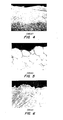
- Metallographic examination revealed a nickel surface coating, a boundary layer of interdiffusion products, and the Rene 95 base metal (see Figure 4).
- the Rene 95 powder particles are outlined by a contamination layer, a normal phenomenon with the conventional ceramic mould process (see Figure 5).
- the nickel coating is thus seen to provide protection for contamination for the Rene 95 base metal from which the final compacted superalloy is to be made.
- a ceramic shell was split and the interior of the shell conforming to the powder metallurgy article to be produced was coated with nickel by the ion deposition process wherein metal atoms are directly deposited on the target surface in a vacuum chamber.
- the coating thickness was of the order of 0.00254 mm (.1 mils).
- the shell was then processed in a normal manner to produce a powder metallurgy part, using titanium alloy powder. This included filling the shell with titanium alloy powder, evacuating, heating and hot-isostatic pressing to compact the powder to full density. The resulting compact had an unusually smooth surface appearance.
- Metallographic examination revealed a surface diffusion-products layer of the order of 0.00254 mm (.1 mil) thick (see Figure 6).
- a metal coating may be produced on the interior surfaces of a ceramic shell such as by electroplating the metal coating, which may be nickel, on a wax pattern shape and then providing a ceramic shell around this metal-coated wax pattern, as by dipping the assembly in a refractory slurry.
- the metal coating which may be nickel
- a wax pattern may be coated with nickel by first spraying the surface of the pattern with graphite to provide an electrically conductive base and then electroplating onto this conductive base a metal such as nickel.
Landscapes
- Engineering & Computer Science (AREA)
- Manufacturing & Machinery (AREA)
- Mechanical Engineering (AREA)
- Powder Metallurgy (AREA)
- Moulds, Cores, Or Mandrels (AREA)
- Compositions Of Oxide Ceramics (AREA)
Claims (10)
Priority Applications (1)
| Application Number | Priority Date | Filing Date | Title |
|---|---|---|---|
| AT82306346T ATE18364T1 (de) | 1982-03-26 | 1982-11-30 | Keramikform und verfahren zur herstellung derselben. |
Applications Claiming Priority (2)
| Application Number | Priority Date | Filing Date | Title |
|---|---|---|---|
| US36234182A | 1982-03-26 | 1982-03-26 | |
| US362341 | 1982-03-26 |
Publications (2)
| Publication Number | Publication Date |
|---|---|
| EP0090118A1 EP0090118A1 (de) | 1983-10-05 |
| EP0090118B1 true EP0090118B1 (de) | 1986-03-05 |
Family
ID=23425705
Family Applications (1)
| Application Number | Title | Priority Date | Filing Date |
|---|---|---|---|
| EP82306346A Expired EP0090118B1 (de) | 1982-03-26 | 1982-11-30 | Keramikform und Verfahren zur Herstellung derselben |
Country Status (4)
| Country | Link |
|---|---|
| EP (1) | EP0090118B1 (de) |
| AT (1) | ATE18364T1 (de) |
| CA (1) | CA1203659A (de) |
| DE (1) | DE3269719D1 (de) |
Cited By (1)
| Publication number | Priority date | Publication date | Assignee | Title |
|---|---|---|---|---|
| DE10223371A1 (de) * | 2002-05-25 | 2003-12-04 | Peter Amborn | Werkzeugform zur Herstellung von metallischen Formteilen durch Gieß-, Heiß-, Warm o. Kaltumformung sowie ein Verfahren zur Herstellung einer derartigen Werkzeugform |
Families Citing this family (5)
| Publication number | Priority date | Publication date | Assignee | Title |
|---|---|---|---|---|
| US4772450A (en) * | 1984-07-25 | 1988-09-20 | Trw Inc. | Methods of forming powdered metal articles |
| US5985207A (en) * | 1995-11-16 | 1999-11-16 | Vawter; Paul D. | Method for manufacturing powder metallurgical tooling |
| US6939508B2 (en) * | 2002-10-24 | 2005-09-06 | The Boeing Company | Method of manufacturing net-shaped bimetallic parts |
| GB0623048D0 (en) * | 2006-11-18 | 2006-12-27 | Bentley Motors Ltd | Improvements in or relating to ceramic tooling |
| US11229950B2 (en) | 2017-04-21 | 2022-01-25 | Raytheon Technologies Corporation | Systems, devices and methods for spark plasma sintering |
Family Cites Families (2)
| Publication number | Priority date | Publication date | Assignee | Title |
|---|---|---|---|---|
| NL277617A (de) * | 1961-05-01 | |||
| FR2002321A1 (de) * | 1968-02-21 | 1969-10-17 | Inst Odlewnictwa |
-
1982
- 1982-11-17 CA CA000415796A patent/CA1203659A/en not_active Expired
- 1982-11-30 AT AT82306346T patent/ATE18364T1/de not_active IP Right Cessation
- 1982-11-30 EP EP82306346A patent/EP0090118B1/de not_active Expired
- 1982-11-30 DE DE8282306346T patent/DE3269719D1/de not_active Expired
Cited By (1)
| Publication number | Priority date | Publication date | Assignee | Title |
|---|---|---|---|---|
| DE10223371A1 (de) * | 2002-05-25 | 2003-12-04 | Peter Amborn | Werkzeugform zur Herstellung von metallischen Formteilen durch Gieß-, Heiß-, Warm o. Kaltumformung sowie ein Verfahren zur Herstellung einer derartigen Werkzeugform |
Also Published As
| Publication number | Publication date |
|---|---|
| CA1203659A (en) | 1986-04-29 |
| DE3269719D1 (en) | 1986-04-10 |
| EP0090118A1 (de) | 1983-10-05 |
| ATE18364T1 (de) | 1986-03-15 |
Similar Documents
| Publication | Publication Date | Title |
|---|---|---|
| US4023966A (en) | Method of hot isostatic compaction | |
| EP3064295B1 (de) | Verfahren zur herstellung eines verdichterschaufels | |
| US5593726A (en) | Hot isostatic pressing process for applying wear and corrosion resistant coatings | |
| GB2062685A (en) | Hot pressing powder | |
| JPH042542B2 (de) | ||
| US5263530A (en) | Method of making a composite casting | |
| US20130039799A1 (en) | Method of Making Near-Net Shapes From Powdered Metals | |
| US5130084A (en) | Powder forging of hollow articles | |
| US4088046A (en) | Method of producing forming tools | |
| CA2250955C (en) | Net shaped dies and molds and method for producing the same | |
| EP0090118A1 (de) | Keramikform und Verfahren zur Herstellung derselben | |
| JP2022538983A (ja) | 技術的及び/又は装飾的機能を有する機械部品のレーザビーム付加製造の方法、並びに技術的及び/又は装飾的機能を有する機械部品 | |
| US2530853A (en) | Method of casting | |
| US4537742A (en) | Method for controlling dimensions of RSPD articles | |
| US4972898A (en) | Method of forming a piston containing a cavity | |
| US6939508B2 (en) | Method of manufacturing net-shaped bimetallic parts | |
| US3279006A (en) | Method of preparing composite castings | |
| US4941928A (en) | Method of fabricating shaped brittle intermetallic compounds | |
| US5312650A (en) | Method of forming a composite article by metal spraying | |
| CN111347046A (zh) | 使用两种或更多种来源的雾化金属颗粒的增材制造 | |
| US3342564A (en) | Composite castings | |
| US4541474A (en) | Process for manufacturing a moulding plunger for hollow glass objects | |
| CA1057485A (en) | Vitreous-metallic container for hot isostatic compaction | |
| DE3736661C1 (de) | Verfahren zur Herstellung von Schichten | |
| CA1060279A (en) | Method of producing forming tool with mold shell of metal |
Legal Events
| Date | Code | Title | Description |
|---|---|---|---|
| PUAI | Public reference made under article 153(3) epc to a published international application that has entered the european phase |
Free format text: ORIGINAL CODE: 0009012 |
|
| AK | Designated contracting states |
Designated state(s): AT BE CH DE FR GB IT LI LU NL SE |
|
| 17P | Request for examination filed |
Effective date: 19840127 |
|
| RAP1 | Party data changed (applicant data changed or rights of an application transferred) |
Owner name: CRUCIBLE MATERIALS CORPORATION |
|
| GRAA | (expected) grant |
Free format text: ORIGINAL CODE: 0009210 |
|
| AK | Designated contracting states |
Kind code of ref document: B1 Designated state(s): AT BE CH DE FR GB IT LI LU NL SE |
|
| REF | Corresponds to: |
Ref document number: 18364 Country of ref document: AT Date of ref document: 19860315 Kind code of ref document: T |
|
| ET | Fr: translation filed | ||
| REF | Corresponds to: |
Ref document number: 3269719 Country of ref document: DE Date of ref document: 19860410 |
|
| ITF | It: translation for a ep patent filed | ||
| PG25 | Lapsed in a contracting state [announced via postgrant information from national office to epo] |
Ref country code: LU Free format text: LAPSE BECAUSE OF NON-PAYMENT OF DUE FEES Effective date: 19861130 Ref country code: LI Effective date: 19861130 Ref country code: CH Effective date: 19861130 Ref country code: BE Effective date: 19861130 Ref country code: AT Effective date: 19861130 |
|
| PG25 | Lapsed in a contracting state [announced via postgrant information from national office to epo] |
Ref country code: SE Effective date: 19861201 |
|
| PLBE | No opposition filed within time limit |
Free format text: ORIGINAL CODE: 0009261 |
|
| STAA | Information on the status of an ep patent application or granted ep patent |
Free format text: STATUS: NO OPPOSITION FILED WITHIN TIME LIMIT |
|
| 26N | No opposition filed | ||
| BERE | Be: lapsed |
Owner name: CRUCIBLE MATERIALS CORP. Effective date: 19861130 |
|
| PG25 | Lapsed in a contracting state [announced via postgrant information from national office to epo] |
Ref country code: NL Effective date: 19870601 |
|
| NLV4 | Nl: lapsed or anulled due to non-payment of the annual fee | ||
| GBPC | Gb: european patent ceased through non-payment of renewal fee | ||
| PG25 | Lapsed in a contracting state [announced via postgrant information from national office to epo] |
Ref country code: FR Free format text: LAPSE BECAUSE OF NON-PAYMENT OF DUE FEES Effective date: 19870731 |
|
| REG | Reference to a national code |
Ref country code: CH Ref legal event code: PL |
|
| PG25 | Lapsed in a contracting state [announced via postgrant information from national office to epo] |
Ref country code: DE Effective date: 19870801 |
|
| REG | Reference to a national code |
Ref country code: FR Ref legal event code: ST |
|
| PG25 | Lapsed in a contracting state [announced via postgrant information from national office to epo] |
Ref country code: GB Effective date: 19881122 |
|
| EUG | Se: european patent has lapsed |
Ref document number: 82306346.6 Effective date: 19870917 |