EP0088842A1 - Organopolysiloxane photosensitizers and methods for their preparation - Google Patents
Organopolysiloxane photosensitizers and methods for their preparation Download PDFInfo
- Publication number
- EP0088842A1 EP0088842A1 EP82301336A EP82301336A EP0088842A1 EP 0088842 A1 EP0088842 A1 EP 0088842A1 EP 82301336 A EP82301336 A EP 82301336A EP 82301336 A EP82301336 A EP 82301336A EP 0088842 A1 EP0088842 A1 EP 0088842A1
- Authority
- EP
- European Patent Office
- Prior art keywords
- group
- integer
- groups
- denotes
- organopolysiloxane
- Prior art date
- Legal status (The legal status is an assumption and is not a legal conclusion. Google has not performed a legal analysis and makes no representation as to the accuracy of the status listed.)
- Granted
Links
- 229920001296 polysiloxane Polymers 0.000 title claims abstract description 55
- 239000003504 photosensitizing agent Substances 0.000 title claims abstract description 33
- 238000000034 method Methods 0.000 title claims description 27
- 238000002360 preparation method Methods 0.000 title description 11
- 125000004435 hydrogen atom Chemical group [H]* 0.000 claims abstract description 34
- RWCCWEUUXYIKHB-UHFFFAOYSA-N benzophenone Chemical compound C=1C=CC=CC=1C(=O)C1=CC=CC=C1 RWCCWEUUXYIKHB-UHFFFAOYSA-N 0.000 claims abstract description 18
- 239000012965 benzophenone Substances 0.000 claims abstract description 12
- -1 siloxane units Chemical group 0.000 claims description 60
- 239000000376 reactant Substances 0.000 claims description 35
- 150000002430 hydrocarbons Chemical group 0.000 claims description 32
- KPUWHANPEXNPJT-UHFFFAOYSA-N disiloxane Chemical group [SiH3]O[SiH3] KPUWHANPEXNPJT-UHFFFAOYSA-N 0.000 claims description 24
- 239000000203 mixture Substances 0.000 claims description 20
- 125000004432 carbon atom Chemical group C* 0.000 claims description 19
- 229910000077 silane Inorganic materials 0.000 claims description 14
- BLRPTPMANUNPDV-UHFFFAOYSA-N Silane Chemical group [SiH4] BLRPTPMANUNPDV-UHFFFAOYSA-N 0.000 claims description 13
- 238000006459 hydrosilylation reaction Methods 0.000 claims description 13
- 238000006243 chemical reaction Methods 0.000 claims description 12
- 125000002887 hydroxy group Chemical group [H]O* 0.000 claims description 10
- 125000003545 alkoxy group Chemical group 0.000 claims description 8
- 125000003277 amino group Chemical group 0.000 claims description 7
- 125000004663 dialkyl amino group Chemical group 0.000 claims description 7
- 125000005843 halogen group Chemical group 0.000 claims description 7
- 125000005309 thioalkoxy group Chemical group 0.000 claims description 6
- 125000004429 atom Chemical group 0.000 claims description 3
- 230000000379 polymerizing effect Effects 0.000 claims description 3
- 239000004215 Carbon black (E152) Substances 0.000 claims description 2
- 229930195733 hydrocarbon Natural products 0.000 claims description 2
- 229920002050 silicone resin Polymers 0.000 abstract description 11
- 150000008366 benzophenones Chemical class 0.000 abstract description 3
- 150000003377 silicon compounds Chemical class 0.000 abstract 1
- 239000007858 starting material Substances 0.000 abstract 1
- 238000001308 synthesis method Methods 0.000 abstract 1
- 125000002496 methyl group Chemical group [H]C([H])([H])* 0.000 description 23
- 229920005989 resin Polymers 0.000 description 17
- 239000011347 resin Substances 0.000 description 17
- WYURNTSHIVDZCO-UHFFFAOYSA-N Tetrahydrofuran Chemical compound C1CCOC1 WYURNTSHIVDZCO-UHFFFAOYSA-N 0.000 description 16
- 229920006136 organohydrogenpolysiloxane Polymers 0.000 description 13
- 238000006116 polymerization reaction Methods 0.000 description 10
- KWYUFKZDYYNOTN-UHFFFAOYSA-M Potassium hydroxide Chemical compound [OH-].[K+] KWYUFKZDYYNOTN-UHFFFAOYSA-M 0.000 description 9
- XUIMIQQOPSSXEZ-UHFFFAOYSA-N Silicon Chemical group [Si] XUIMIQQOPSSXEZ-UHFFFAOYSA-N 0.000 description 9
- NLKNQRATVPKPDG-UHFFFAOYSA-M potassium iodide Chemical compound [K+].[I-] NLKNQRATVPKPDG-UHFFFAOYSA-M 0.000 description 9
- 238000003756 stirring Methods 0.000 description 9
- 239000000463 material Substances 0.000 description 8
- 229920000642 polymer Polymers 0.000 description 8
- YLQBMQCUIZJEEH-UHFFFAOYSA-N tetrahydrofuran Natural products C=1C=COC=1 YLQBMQCUIZJEEH-UHFFFAOYSA-N 0.000 description 8
- 239000002253 acid Substances 0.000 description 7
- VVBLNCFGVYUYGU-UHFFFAOYSA-N 4,4'-Bis(dimethylamino)benzophenone Chemical compound C1=CC(N(C)C)=CC=C1C(=O)C1=CC=C(N(C)C)C=C1 VVBLNCFGVYUYGU-UHFFFAOYSA-N 0.000 description 6
- YXFVVABEGXRONW-UHFFFAOYSA-N Toluene Chemical compound CC1=CC=CC=C1 YXFVVABEGXRONW-UHFFFAOYSA-N 0.000 description 6
- 239000003054 catalyst Substances 0.000 description 6
- 125000004122 cyclic group Chemical group 0.000 description 6
- BASFCYQUMIYNBI-UHFFFAOYSA-N platinum Chemical compound [Pt] BASFCYQUMIYNBI-UHFFFAOYSA-N 0.000 description 6
- 239000002904 solvent Substances 0.000 description 6
- 238000007259 addition reaction Methods 0.000 description 5
- 238000007429 general method Methods 0.000 description 5
- VRWGRLFEHAONPN-UHFFFAOYSA-N phenyl-(4-prop-2-enoxyphenyl)methanone Chemical compound C1=CC(OCC=C)=CC=C1C(=O)C1=CC=CC=C1 VRWGRLFEHAONPN-UHFFFAOYSA-N 0.000 description 5
- 206010070834 Sensitisation Diseases 0.000 description 4
- 229910020388 SiO1/2 Inorganic materials 0.000 description 4
- ISAOCJYIOMOJEB-UHFFFAOYSA-N benzoin Chemical compound C=1C=CC=CC=1C(O)C(=O)C1=CC=CC=C1 ISAOCJYIOMOJEB-UHFFFAOYSA-N 0.000 description 4
- 230000008021 deposition Effects 0.000 description 4
- QSHDDOUJBYECFT-UHFFFAOYSA-N mercury Chemical compound [Hg] QSHDDOUJBYECFT-UHFFFAOYSA-N 0.000 description 4
- 229910052753 mercury Inorganic materials 0.000 description 4
- 238000002156 mixing Methods 0.000 description 4
- VLKZOEOYAKHREP-UHFFFAOYSA-N n-Hexane Chemical compound CCCCCC VLKZOEOYAKHREP-UHFFFAOYSA-N 0.000 description 4
- 125000000962 organic group Chemical group 0.000 description 4
- 230000008313 sensitization Effects 0.000 description 4
- 238000000926 separation method Methods 0.000 description 4
- 150000004756 silanes Chemical class 0.000 description 4
- 125000000391 vinyl group Chemical group [H]C([*])=C([H])[H] 0.000 description 4
- HRTPLKOYOAGKDA-UHFFFAOYSA-N (4-methoxy-2-prop-2-enoxyphenyl)-phenylmethanone Chemical compound C=CCOC1=CC(OC)=CC=C1C(=O)C1=CC=CC=C1 HRTPLKOYOAGKDA-UHFFFAOYSA-N 0.000 description 3
- OSDWBNJEKMUWAV-UHFFFAOYSA-N Allyl chloride Chemical compound ClCC=C OSDWBNJEKMUWAV-UHFFFAOYSA-N 0.000 description 3
- UHOVQNZJYSORNB-UHFFFAOYSA-N Benzene Chemical compound C1=CC=CC=C1 UHOVQNZJYSORNB-UHFFFAOYSA-N 0.000 description 3
- ZMXDDKWLCZADIW-UHFFFAOYSA-N N,N-Dimethylformamide Chemical compound CN(C)C=O ZMXDDKWLCZADIW-UHFFFAOYSA-N 0.000 description 3
- 229910020447 SiO2/2 Inorganic materials 0.000 description 3
- HEMHJVSKTPXQMS-UHFFFAOYSA-M Sodium hydroxide Chemical compound [OH-].[Na+] HEMHJVSKTPXQMS-UHFFFAOYSA-M 0.000 description 3
- ZMANZCXQSJIPKH-UHFFFAOYSA-N Triethylamine Chemical compound CCN(CC)CC ZMANZCXQSJIPKH-UHFFFAOYSA-N 0.000 description 3
- 238000004821 distillation Methods 0.000 description 3
- 125000000956 methoxy group Chemical group [H]C([H])([H])O* 0.000 description 3
- 230000001235 sensitizing effect Effects 0.000 description 3
- HJIAMFHSAAEUKR-UHFFFAOYSA-N (2-hydroxyphenyl)-phenylmethanone Chemical class OC1=CC=CC=C1C(=O)C1=CC=CC=C1 HJIAMFHSAAEUKR-UHFFFAOYSA-N 0.000 description 2
- NPFYZDNDJHZQKY-UHFFFAOYSA-N 4-Hydroxybenzophenone Chemical compound C1=CC(O)=CC=C1C(=O)C1=CC=CC=C1 NPFYZDNDJHZQKY-UHFFFAOYSA-N 0.000 description 2
- CSCPPACGZOOCGX-UHFFFAOYSA-N Acetone Chemical compound CC(C)=O CSCPPACGZOOCGX-UHFFFAOYSA-N 0.000 description 2
- IAZDPXIOMUYVGZ-UHFFFAOYSA-N Dimethylsulphoxide Chemical compound CS(C)=O IAZDPXIOMUYVGZ-UHFFFAOYSA-N 0.000 description 2
- PXHVJJICTQNCMI-UHFFFAOYSA-N Nickel Chemical compound [Ni] PXHVJJICTQNCMI-UHFFFAOYSA-N 0.000 description 2
- KDLHZDBZIXYQEI-UHFFFAOYSA-N Palladium Chemical compound [Pd] KDLHZDBZIXYQEI-UHFFFAOYSA-N 0.000 description 2
- QQONPFPTGQHPMA-UHFFFAOYSA-N Propene Chemical group CC=C QQONPFPTGQHPMA-UHFFFAOYSA-N 0.000 description 2
- CDBYLPFSWZWCQE-UHFFFAOYSA-L Sodium Carbonate Chemical compound [Na+].[Na+].[O-]C([O-])=O CDBYLPFSWZWCQE-UHFFFAOYSA-L 0.000 description 2
- 244000028419 Styrax benzoin Species 0.000 description 2
- 235000000126 Styrax benzoin Nutrition 0.000 description 2
- 235000008411 Sumatra benzointree Nutrition 0.000 description 2
- QVQLCTNNEUAWMS-UHFFFAOYSA-N barium oxide Chemical compound [Ba]=O QVQLCTNNEUAWMS-UHFFFAOYSA-N 0.000 description 2
- 229960002130 benzoin Drugs 0.000 description 2
- 229910052801 chlorine Inorganic materials 0.000 description 2
- 238000001816 cooling Methods 0.000 description 2
- 238000007334 copolymerization reaction Methods 0.000 description 2
- 239000012043 crude product Substances 0.000 description 2
- 235000019382 gum benzoic Nutrition 0.000 description 2
- 229910052739 hydrogen Inorganic materials 0.000 description 2
- 239000001257 hydrogen Substances 0.000 description 2
- 230000007062 hydrolysis Effects 0.000 description 2
- 238000006460 hydrolysis reaction Methods 0.000 description 2
- 239000007788 liquid Substances 0.000 description 2
- 230000007774 longterm Effects 0.000 description 2
- 238000002844 melting Methods 0.000 description 2
- 230000008018 melting Effects 0.000 description 2
- HMMGMWAXVFQUOA-UHFFFAOYSA-N octamethylcyclotetrasiloxane Chemical compound C[Si]1(C)O[Si](C)(C)O[Si](C)(C)O[Si](C)(C)O1 HMMGMWAXVFQUOA-UHFFFAOYSA-N 0.000 description 2
- 125000005375 organosiloxane group Chemical group 0.000 description 2
- 229910052697 platinum Inorganic materials 0.000 description 2
- BWHMMNNQKKPAPP-UHFFFAOYSA-L potassium carbonate Chemical compound [K+].[K+].[O-]C([O-])=O BWHMMNNQKKPAPP-UHFFFAOYSA-L 0.000 description 2
- 229910052710 silicon Inorganic materials 0.000 description 2
- NDVLTYZPCACLMA-UHFFFAOYSA-N silver oxide Chemical compound [O-2].[Ag+].[Ag+] NDVLTYZPCACLMA-UHFFFAOYSA-N 0.000 description 2
- 238000003786 synthesis reaction Methods 0.000 description 2
- VZGDMQKNWNREIO-UHFFFAOYSA-N tetrachloromethane Chemical compound ClC(Cl)(Cl)Cl VZGDMQKNWNREIO-UHFFFAOYSA-N 0.000 description 2
- XLYOFNOQVPJJNP-UHFFFAOYSA-N water Substances O XLYOFNOQVPJJNP-UHFFFAOYSA-N 0.000 description 2
- CKUNRVGWSWRXLG-UHFFFAOYSA-N (2-but-2-enoxy-4-methoxyphenyl)-phenylmethanone Chemical compound CC=CCOC1=CC(OC)=CC=C1C(=O)C1=CC=CC=C1 CKUNRVGWSWRXLG-UHFFFAOYSA-N 0.000 description 1
- FHIJCQANWMQRCT-UHFFFAOYSA-N (2-but-2-enoxyphenyl)-phenylmethanone Chemical compound CC=CCOC1=CC=CC=C1C(=O)C1=CC=CC=C1 FHIJCQANWMQRCT-UHFFFAOYSA-N 0.000 description 1
- CEBDIKNYBQTJJM-UHFFFAOYSA-N (2-ethenoxyphenyl)-phenylmethanone Chemical compound C=COC1=CC=CC=C1C(=O)C1=CC=CC=C1 CEBDIKNYBQTJJM-UHFFFAOYSA-N 0.000 description 1
- OQERFUGURPLBQH-UHFFFAOYSA-N (2-hydroxy-5-methylphenyl)-phenylmethanone Chemical compound CC1=CC=C(O)C(C(=O)C=2C=CC=CC=2)=C1 OQERFUGURPLBQH-UHFFFAOYSA-N 0.000 description 1
- HPTDNMHBDPOVLZ-UHFFFAOYSA-N (3,5-dichloro-4-hydroxyphenyl)-phenylmethanone Chemical compound C1=C(Cl)C(O)=C(Cl)C=C1C(=O)C1=CC=CC=C1 HPTDNMHBDPOVLZ-UHFFFAOYSA-N 0.000 description 1
- JWSWGXYCPQPISX-UHFFFAOYSA-N (4-but-2-enoxy-3,5-dichlorophenyl)-phenylmethanone Chemical compound C1=C(Cl)C(OCC=CC)=C(Cl)C=C1C(=O)C1=CC=CC=C1 JWSWGXYCPQPISX-UHFFFAOYSA-N 0.000 description 1
- GYARYIXMCQUTFI-UHFFFAOYSA-N (4-but-2-enoxyphenyl)-phenylmethanone Chemical compound C1=CC(OCC=CC)=CC=C1C(=O)C1=CC=CC=C1 GYARYIXMCQUTFI-UHFFFAOYSA-N 0.000 description 1
- BUCYOCHOLDPJFS-UHFFFAOYSA-N (4-ethenoxyphenyl)-phenylmethanone Chemical compound C1=CC(OC=C)=CC=C1C(=O)C1=CC=CC=C1 BUCYOCHOLDPJFS-UHFFFAOYSA-N 0.000 description 1
- AZQWKYJCGOJGHM-UHFFFAOYSA-N 1,4-benzoquinone Chemical compound O=C1C=CC(=O)C=C1 AZQWKYJCGOJGHM-UHFFFAOYSA-N 0.000 description 1
- UFBJCMHMOXMLKC-UHFFFAOYSA-N 2,4-dinitrophenol Chemical compound OC1=CC=C([N+]([O-])=O)C=C1[N+]([O-])=O UFBJCMHMOXMLKC-UHFFFAOYSA-N 0.000 description 1
- HIXDQWDOVZUNNA-UHFFFAOYSA-N 2-(3,4-dimethoxyphenyl)-5-hydroxy-7-methoxychromen-4-one Chemical compound C=1C(OC)=CC(O)=C(C(C=2)=O)C=1OC=2C1=CC=C(OC)C(OC)=C1 HIXDQWDOVZUNNA-UHFFFAOYSA-N 0.000 description 1
- OHXAOPZTJOUYKM-UHFFFAOYSA-N 3-Chloro-2-methylpropene Chemical compound CC(=C)CCl OHXAOPZTJOUYKM-UHFFFAOYSA-N 0.000 description 1
- RXNYJUSEXLAVNQ-UHFFFAOYSA-N 4,4'-Dihydroxybenzophenone Chemical compound C1=CC(O)=CC=C1C(=O)C1=CC=C(O)C=C1 RXNYJUSEXLAVNQ-UHFFFAOYSA-N 0.000 description 1
- ZCYVEMRRCGMTRW-UHFFFAOYSA-N 7553-56-2 Chemical compound [I] ZCYVEMRRCGMTRW-UHFFFAOYSA-N 0.000 description 1
- 239000004342 Benzoyl peroxide Substances 0.000 description 1
- OMPJBNCRMGITSC-UHFFFAOYSA-N Benzoylperoxide Chemical compound C=1C=CC=CC=1C(=O)OOC(=O)C1=CC=CC=C1 OMPJBNCRMGITSC-UHFFFAOYSA-N 0.000 description 1
- WKBOTKDWSSQWDR-UHFFFAOYSA-N Bromine atom Chemical compound [Br] WKBOTKDWSSQWDR-UHFFFAOYSA-N 0.000 description 1
- ZAMOUSCENKQFHK-UHFFFAOYSA-N Chlorine atom Chemical compound [Cl] ZAMOUSCENKQFHK-UHFFFAOYSA-N 0.000 description 1
- 239000005046 Chlorosilane Substances 0.000 description 1
- 206010011416 Croup infectious Diseases 0.000 description 1
- XTHFKEDIFFGKHM-UHFFFAOYSA-N Dimethoxyethane Chemical compound COCCOC XTHFKEDIFFGKHM-UHFFFAOYSA-N 0.000 description 1
- LFQSCWFLJHTTHZ-UHFFFAOYSA-N Ethanol Chemical compound CCO LFQSCWFLJHTTHZ-UHFFFAOYSA-N 0.000 description 1
- PXGOKWXKJXAPGV-UHFFFAOYSA-N Fluorine Chemical compound FF PXGOKWXKJXAPGV-UHFFFAOYSA-N 0.000 description 1
- CTQNGGLPUBDAKN-UHFFFAOYSA-N O-Xylene Chemical compound CC1=CC=CC=C1C CTQNGGLPUBDAKN-UHFFFAOYSA-N 0.000 description 1
- 229910020487 SiO3/2 Inorganic materials 0.000 description 1
- KEAYESYHFKHZAL-UHFFFAOYSA-N Sodium Chemical compound [Na] KEAYESYHFKHZAL-UHFFFAOYSA-N 0.000 description 1
- BZHJMEDXRYGGRV-UHFFFAOYSA-N Vinyl chloride Chemical compound ClC=C BZHJMEDXRYGGRV-UHFFFAOYSA-N 0.000 description 1
- 125000003668 acetyloxy group Chemical group [H]C([H])([H])C(=O)O[*] 0.000 description 1
- 230000002378 acidificating effect Effects 0.000 description 1
- 125000004423 acyloxy group Chemical group 0.000 description 1
- 125000000217 alkyl group Chemical group 0.000 description 1
- BHELZAPQIKSEDF-UHFFFAOYSA-N allyl bromide Chemical compound BrCC=C BHELZAPQIKSEDF-UHFFFAOYSA-N 0.000 description 1
- 150000001491 aromatic compounds Chemical class 0.000 description 1
- 125000003710 aryl alkyl group Chemical group 0.000 description 1
- 125000003118 aryl group Chemical group 0.000 description 1
- 235000019400 benzoyl peroxide Nutrition 0.000 description 1
- 125000001797 benzyl group Chemical group [H]C1=C([H])C([H])=C(C([H])=C1[H])C([H])([H])* 0.000 description 1
- 230000015572 biosynthetic process Effects 0.000 description 1
- VCHLAIYETSESJP-UHFFFAOYSA-N bis(4-but-2-enoxyphenyl)methanone Chemical compound C1=CC(OCC=CC)=CC=C1C(=O)C1=CC=C(OCC=CC)C=C1 VCHLAIYETSESJP-UHFFFAOYSA-N 0.000 description 1
- GDTBXPJZTBHREO-UHFFFAOYSA-N bromine Substances BrBr GDTBXPJZTBHREO-UHFFFAOYSA-N 0.000 description 1
- 229910052794 bromium Inorganic materials 0.000 description 1
- 239000007795 chemical reaction product Substances 0.000 description 1
- 239000000460 chlorine Substances 0.000 description 1
- 125000001309 chloro group Chemical group Cl* 0.000 description 1
- QABCGOSYZHCPGN-UHFFFAOYSA-N chloro(dimethyl)silicon Chemical compound C[Si](C)Cl QABCGOSYZHCPGN-UHFFFAOYSA-N 0.000 description 1
- 125000000068 chlorophenyl group Chemical group 0.000 description 1
- 229910017052 cobalt Inorganic materials 0.000 description 1
- 239000010941 cobalt Substances 0.000 description 1
- GUTLYIVDDKVIGB-UHFFFAOYSA-N cobalt atom Chemical compound [Co] GUTLYIVDDKVIGB-UHFFFAOYSA-N 0.000 description 1
- 238000009833 condensation Methods 0.000 description 1
- 230000005494 condensation Effects 0.000 description 1
- 238000006482 condensation reaction Methods 0.000 description 1
- YTKRILODNOEEPX-NSCUHMNNSA-N crotyl chloride Chemical compound C\C=C\CCl YTKRILODNOEEPX-NSCUHMNNSA-N 0.000 description 1
- 201000010549 croup Diseases 0.000 description 1
- 125000000113 cyclohexyl group Chemical group [H]C1([H])C([H])([H])C([H])([H])C([H])(*)C([H])([H])C1([H])[H] 0.000 description 1
- LSXWFXONGKSEMY-UHFFFAOYSA-N di-tert-butyl peroxide Chemical compound CC(C)(C)OOC(C)(C)C LSXWFXONGKSEMY-UHFFFAOYSA-N 0.000 description 1
- AONDIGWFVXEZGD-UHFFFAOYSA-N diacetyloxy(methyl)silicon Chemical compound CC(=O)O[Si](C)OC(C)=O AONDIGWFVXEZGD-UHFFFAOYSA-N 0.000 description 1
- 125000001664 diethylamino group Chemical group [H]C([H])([H])C([H])([H])N(*)C([H])([H])C([H])([H])[H] 0.000 description 1
- PKTOVQRKCNPVKY-UHFFFAOYSA-N dimethoxy(methyl)silicon Chemical compound CO[Si](C)OC PKTOVQRKCNPVKY-UHFFFAOYSA-N 0.000 description 1
- SRXOCFMDUSFFAK-UHFFFAOYSA-N dimethyl peroxide Chemical compound COOC SRXOCFMDUSFFAK-UHFFFAOYSA-N 0.000 description 1
- 125000002147 dimethylamino group Chemical group [H]C([H])([H])N(*)C([H])([H])[H] 0.000 description 1
- 238000004090 dissolution Methods 0.000 description 1
- 230000000694 effects Effects 0.000 description 1
- 238000005516 engineering process Methods 0.000 description 1
- 238000011067 equilibration Methods 0.000 description 1
- 238000012676 equilibrium polymerization Methods 0.000 description 1
- RTZKZFJDLAIYFH-UHFFFAOYSA-N ether Substances CCOCC RTZKZFJDLAIYFH-UHFFFAOYSA-N 0.000 description 1
- 125000001301 ethoxy group Chemical group [H]C([H])([H])C([H])([H])O* 0.000 description 1
- 125000001495 ethyl group Chemical group [H]C([H])([H])C([H])([H])* 0.000 description 1
- 125000000816 ethylene group Chemical group [H]C([H])([*:1])C([H])([H])[*:2] 0.000 description 1
- 239000012530 fluid Substances 0.000 description 1
- 229910052731 fluorine Inorganic materials 0.000 description 1
- 239000011737 fluorine Substances 0.000 description 1
- 238000005755 formation reaction Methods 0.000 description 1
- 238000010438 heat treatment Methods 0.000 description 1
- UQEAIHBTYFGYIE-UHFFFAOYSA-N hexamethyldisiloxane Chemical compound C[Si](C)(C)O[Si](C)(C)C UQEAIHBTYFGYIE-UHFFFAOYSA-N 0.000 description 1
- 125000004051 hexyl group Chemical group [H]C([H])([H])C([H])([H])C([H])([H])C([H])([H])C([H])([H])C([H])([H])* 0.000 description 1
- XMBWDFGMSWQBCA-UHFFFAOYSA-N hydrogen iodide Chemical compound I XMBWDFGMSWQBCA-UHFFFAOYSA-N 0.000 description 1
- 239000004615 ingredient Substances 0.000 description 1
- 229910052740 iodine Inorganic materials 0.000 description 1
- 239000011630 iodine Substances 0.000 description 1
- 150000002576 ketones Chemical class 0.000 description 1
- 229910052751 metal Inorganic materials 0.000 description 1
- 239000002184 metal Substances 0.000 description 1
- 150000002739 metals Chemical class 0.000 description 1
- WHIVNJATOVLWBW-UHFFFAOYSA-N n-butan-2-ylidenehydroxylamine Chemical compound CCC(C)=NO WHIVNJATOVLWBW-UHFFFAOYSA-N 0.000 description 1
- 125000004108 n-butyl group Chemical group [H]C([H])([H])C([H])([H])C([H])([H])C([H])([H])* 0.000 description 1
- 125000004123 n-propyl group Chemical group [H]C([H])([H])C([H])([H])C([H])([H])* 0.000 description 1
- 229910052759 nickel Inorganic materials 0.000 description 1
- 125000002347 octyl group Chemical group [H]C([*])([H])C([H])([H])C([H])([H])C([H])([H])C([H])([H])C([H])([H])C([H])([H])C([H])([H])[H] 0.000 description 1
- 150000001282 organosilanes Chemical class 0.000 description 1
- 125000005386 organosiloxy group Chemical group 0.000 description 1
- DXGLGDHPHMLXJC-UHFFFAOYSA-N oxybenzone Chemical compound OC1=CC(OC)=CC=C1C(=O)C1=CC=CC=C1 DXGLGDHPHMLXJC-UHFFFAOYSA-N 0.000 description 1
- 229910052763 palladium Inorganic materials 0.000 description 1
- 150000002978 peroxides Chemical class 0.000 description 1
- 125000001997 phenyl group Chemical group [H]C1=C([H])C([H])=C(*)C([H])=C1[H] 0.000 description 1
- 208000017983 photosensitivity disease Diseases 0.000 description 1
- 231100000434 photosensitization Toxicity 0.000 description 1
- 229920001843 polymethylhydrosiloxane Polymers 0.000 description 1
- 229910000027 potassium carbonate Inorganic materials 0.000 description 1
- 239000000047 product Substances 0.000 description 1
- 125000001436 propyl group Chemical group [H]C([*])([H])C([H])([H])C([H])([H])[H] 0.000 description 1
- 125000004805 propylene group Chemical group [H]C([H])([H])C([H])([*:1])C([H])([H])[*:2] 0.000 description 1
- 150000004053 quinones Chemical class 0.000 description 1
- 238000005510 radiation hardening Methods 0.000 description 1
- 150000003254 radicals Chemical class 0.000 description 1
- 229910052703 rhodium Inorganic materials 0.000 description 1
- 239000010948 rhodium Substances 0.000 description 1
- MHOVAHRLVXNVSD-UHFFFAOYSA-N rhodium atom Chemical compound [Rh] MHOVAHRLVXNVSD-UHFFFAOYSA-N 0.000 description 1
- 239000010703 silicon Substances 0.000 description 1
- 229910001923 silver oxide Inorganic materials 0.000 description 1
- ODZPKZBBUMBTMG-UHFFFAOYSA-N sodium amide Chemical compound [NH2-].[Na+] ODZPKZBBUMBTMG-UHFFFAOYSA-N 0.000 description 1
- 229910000029 sodium carbonate Inorganic materials 0.000 description 1
- 239000012312 sodium hydride Substances 0.000 description 1
- 229910000104 sodium hydride Inorganic materials 0.000 description 1
- 125000000999 tert-butyl group Chemical group [H]C([H])([H])C(*)(C([H])([H])[H])C([H])([H])[H] 0.000 description 1
- 125000003698 tetramethyl group Chemical group [H]C([H])([H])* 0.000 description 1
- 125000000383 tetramethylene group Chemical group [H]C([H])([*:1])C([H])([H])C([H])([H])C([H])([H])[*:2] 0.000 description 1
- 125000003396 thiol group Chemical group [H]S* 0.000 description 1
- 125000003944 tolyl group Chemical group 0.000 description 1
- ZDHXKXAHOVTTAH-UHFFFAOYSA-N trichlorosilane Chemical compound Cl[SiH](Cl)Cl ZDHXKXAHOVTTAH-UHFFFAOYSA-N 0.000 description 1
- 239000005052 trichlorosilane Substances 0.000 description 1
- ITMCEJHCFYSIIV-UHFFFAOYSA-N triflic acid Chemical compound OS(=O)(=O)C(F)(F)F ITMCEJHCFYSIIV-UHFFFAOYSA-N 0.000 description 1
- YUYCVXFAYWRXLS-UHFFFAOYSA-N trimethoxysilane Chemical compound CO[SiH](OC)OC YUYCVXFAYWRXLS-UHFFFAOYSA-N 0.000 description 1
- 229920002554 vinyl polymer Polymers 0.000 description 1
- 239000008096 xylene Substances 0.000 description 1
- 125000005023 xylyl group Chemical group 0.000 description 1
Classifications
-
- G—PHYSICS
- G03—PHOTOGRAPHY; CINEMATOGRAPHY; ANALOGOUS TECHNIQUES USING WAVES OTHER THAN OPTICAL WAVES; ELECTROGRAPHY; HOLOGRAPHY
- G03F—PHOTOMECHANICAL PRODUCTION OF TEXTURED OR PATTERNED SURFACES, e.g. FOR PRINTING, FOR PROCESSING OF SEMICONDUCTOR DEVICES; MATERIALS THEREFOR; ORIGINALS THEREFOR; APPARATUS SPECIALLY ADAPTED THEREFOR
- G03F7/00—Photomechanical, e.g. photolithographic, production of textured or patterned surfaces, e.g. printing surfaces; Materials therefor, e.g. comprising photoresists; Apparatus specially adapted therefor
- G03F7/004—Photosensitive materials
- G03F7/075—Silicon-containing compounds
- G03F7/0757—Macromolecular compounds containing Si-O, Si-C or Si-N bonds
-
- C—CHEMISTRY; METALLURGY
- C08—ORGANIC MACROMOLECULAR COMPOUNDS; THEIR PREPARATION OR CHEMICAL WORKING-UP; COMPOSITIONS BASED THEREON
- C08G—MACROMOLECULAR COMPOUNDS OBTAINED OTHERWISE THAN BY REACTIONS ONLY INVOLVING UNSATURATED CARBON-TO-CARBON BONDS
- C08G77/00—Macromolecular compounds obtained by reactions forming a linkage containing silicon with or without sulfur, nitrogen, oxygen or carbon in the main chain of the macromolecule
- C08G77/04—Polysiloxanes
- C08G77/14—Polysiloxanes containing silicon bound to oxygen-containing groups
-
- C—CHEMISTRY; METALLURGY
- C08—ORGANIC MACROMOLECULAR COMPOUNDS; THEIR PREPARATION OR CHEMICAL WORKING-UP; COMPOSITIONS BASED THEREON
- C08G—MACROMOLECULAR COMPOUNDS OBTAINED OTHERWISE THAN BY REACTIONS ONLY INVOLVING UNSATURATED CARBON-TO-CARBON BONDS
- C08G77/00—Macromolecular compounds obtained by reactions forming a linkage containing silicon with or without sulfur, nitrogen, oxygen or carbon in the main chain of the macromolecule
- C08G77/04—Polysiloxanes
- C08G77/38—Polysiloxanes modified by chemical after-treatment
-
- C—CHEMISTRY; METALLURGY
- C08—ORGANIC MACROMOLECULAR COMPOUNDS; THEIR PREPARATION OR CHEMICAL WORKING-UP; COMPOSITIONS BASED THEREON
- C08L—COMPOSITIONS OF MACROMOLECULAR COMPOUNDS
- C08L83/00—Compositions of macromolecular compounds obtained by reactions forming in the main chain of the macromolecule a linkage containing silicon with or without sulfur, nitrogen, oxygen or carbon only; Compositions of derivatives of such polymers
- C08L83/04—Polysiloxanes
-
- C—CHEMISTRY; METALLURGY
- C08—ORGANIC MACROMOLECULAR COMPOUNDS; THEIR PREPARATION OR CHEMICAL WORKING-UP; COMPOSITIONS BASED THEREON
- C08G—MACROMOLECULAR COMPOUNDS OBTAINED OTHERWISE THAN BY REACTIONS ONLY INVOLVING UNSATURATED CARBON-TO-CARBON BONDS
- C08G77/00—Macromolecular compounds obtained by reactions forming a linkage containing silicon with or without sulfur, nitrogen, oxygen or carbon in the main chain of the macromolecule
- C08G77/04—Polysiloxanes
- C08G77/12—Polysiloxanes containing silicon bound to hydrogen
-
- C—CHEMISTRY; METALLURGY
- C08—ORGANIC MACROMOLECULAR COMPOUNDS; THEIR PREPARATION OR CHEMICAL WORKING-UP; COMPOSITIONS BASED THEREON
- C08G—MACROMOLECULAR COMPOUNDS OBTAINED OTHERWISE THAN BY REACTIONS ONLY INVOLVING UNSATURATED CARBON-TO-CARBON BONDS
- C08G77/00—Macromolecular compounds obtained by reactions forming a linkage containing silicon with or without sulfur, nitrogen, oxygen or carbon in the main chain of the macromolecule
- C08G77/04—Polysiloxanes
- C08G77/14—Polysiloxanes containing silicon bound to oxygen-containing groups
- C08G77/18—Polysiloxanes containing silicon bound to oxygen-containing groups to alkoxy or aryloxy groups
-
- C—CHEMISTRY; METALLURGY
- C08—ORGANIC MACROMOLECULAR COMPOUNDS; THEIR PREPARATION OR CHEMICAL WORKING-UP; COMPOSITIONS BASED THEREON
- C08G—MACROMOLECULAR COMPOUNDS OBTAINED OTHERWISE THAN BY REACTIONS ONLY INVOLVING UNSATURATED CARBON-TO-CARBON BONDS
- C08G77/00—Macromolecular compounds obtained by reactions forming a linkage containing silicon with or without sulfur, nitrogen, oxygen or carbon in the main chain of the macromolecule
- C08G77/70—Siloxanes defined by use of the MDTQ nomenclature
Definitions
- This invention relates to novel photopolvmerization sensitizers and to methods for their preparation comprising bonding benzophenone derivatives into organopolysiloxanes.
- photosensitive resins Various photosensitive or photopolymerizable (hereafter to be called photosensitive) resins are conventionally known.
- photopolymerization sensitizers have been developed or proposed for the photopolymerization of these photosensitive resins.
- the required characteristics for these photopolymerization sensitizers are good sensitizing action and good miscibility with the photosensitive resins. If its miscibility with photosensitive resins is poor, the polymerization sensitizer will separate from the photosensitive resins and the desired sensitization action cannot then be adequatelv achieved.
- the photosensitive resin polvmerizes and hardens, nonuniformities therein are formed and the sensitizer is deposited or separated from the hardened photosensitive resin. In cases where photosensitive resins blended with the photopolymerization sensitizer are stored, long-term storage is a problem.
- Sensitizers which are miscibile with photosensitive organopolysiloxanes have been proposed in Japanese Patent Sho 51 (1976) - 48794. They arc benzophenone derivatives substituted with organosiloxy groups. However, they are not perfectly miscible with photosensitive organopolysiloxanes and their syntheses are also time-consuming. Therefore, they have no practical use. This invention was achieved as the result of research by the present inventors in order to overcome these disadvantages of the conventional technologies..
- the present invention relates to an organopolysiloxane photosensitizer comprising an average of more than two siloxane units, of which at least an average of one siloxane unit per organopolysiloxane molecule has the formula Q a SiO (4-a-b)/2 , wherein Q denotes a benzophenone-containing qroup havinq the formula and R 2 each denoto, independently, a hydrogen atom, a haloqen atom, a monnvnlcnt hvdrocarbon group having from 1 to 10 carbon atoms, an alkoxy group, a thioalkoxy group, a hydroxyl group, an amino group or a dialkylamino group; R 3 denotes a divalent hydrocarbon group having from 2 to 10 carbon atoms; R 4 denotes a monovalent hydrocarbon group or a halogenated monovalent hydrocarbon group; m is an integer of from 1 to 5, n is an integer of from
- the present invention further relates to a method for preparing an organopolysiloxane photosensitizer comprising an average of more than two siloxane units, of which at least an average of one siloxane unit per organopolysiloxane molecule has the formula Q a SiO (4-a-b)/2 , said method comprising reacting, by a hvdrosilvlation reaction, an alkenyloxvbenzophenone reactant having the formula and an orqanohycroaenpolysiloxane reactant containing more than two siloxane units and at least one silicon-bonded hydrogen atom per molecule, wherein Q denotes a benzophenone-containing group havinq the formula at each occurrence R 1 and R 2 denote, independently, a hydrogen atom, a halogen atom, a monovalent hydrocarbon group having from 1 to 10 carbon atoms, an alkoxy group, a thioalkoxy q roup, a hydroxyl group
- the present invention also relates to a method for preparing an organopolysiloxane photosensitizer comprisinq an average of more than two siloxane units, of which an average of at least one siloxane unit per organopolvsiloxane molecule has the formula O a SiO (4-a-b)/2 , said method comprising (A) reactinq, by a hydrosilvlation reaction to form an adduct, an alkenyloxybenzophenone reactant having the formula and a silane bearing at least one silicon-bonded hydrogen atom and at least one silicon-bonded hydrolyzable group or a siloxane bearing at least two siloxane units and at least one silicon-bonded hydrogen atom; and (B) polymerizing the adduct or copolymerizing the adduct with another silane sum of a + b has a value of 1, 2 or 3, thereby providing siloxane units having the formulae QSiO 3/2 , QR 4 SiO 2/2 , QR
- R 1 and R 2 each denote hydrogen atoms, hydroxyl groups, amino groups, halogen atoms such as fluorine, chlorine, bromine and iodine; monovalent hydrocarbon groups containing 1-10 carbons such as methyl groups, ethvl groups, n-propyl groups, n-butyl groups, t-butyl groups, hexyl groups and octvl groups; alkoxy groups such as methoxy groups, ethoxv groups and propoxv arou p s; thioalkoxv groups, such as thiomethoxy groups and thioethoxy groups; and dialkylamino groups, such as dimethylamino groups, diethylamino groups and methylpropylamino groups.
- R and R 2 are hydrogen atoms.
- m has a value of from 1 to 5, preferably from 1 to 3
- n has a value of from 1 to 4, preferably from 1 to 3.
- R and R 2 both are hydrogen
- the values of m and n are effectively, and equivalently, any and all values from 0 to 5 and 0 to 4 respectively.
- R 3 denotes a divalent hydrocarbon group having from 2 to 10 carbon atoms such as ethylene groups, propvlene groups, isopropylene groups and butylene groups.
- R is a propvlene group.
- a highly preferred Q group therefore, has the formula bearing at least one silicon-bonded hydrolyzabgle radical or with a silnxane, both being free of Q groups, to provide the organopolysiloxane photosensitizer, wherein Q denotes a henznphenone-containing group having the formula at each occurrence
- R 1 and R 2 denote, independently, a hvdrogen atom, a halogen atom, a monovalent hydrocarbon group having from 1 to 10 carbon atoms, an alkoxy group, a thioalkoxy group, a hydroxyl group, an amino group or a dialkylamino group
- R 3 denotes a divalent hydrocarbon group having from 2 to 10 carbon atoms
- R 4 denotes a monovalent hydrocarbon croup or a halogenated monovalent hvdrocarbon group
- R 5 denotes an aliphatically unsaturated monovalent hydrocarbon group having the same number of carbon atoms as the
- the photopolymerization sensitizers of the present invention are organopolysiloxanes having an average of at least one siloxane unit per molecule which bears a silicon-bonded benzophenone derivative group.
- This siloxane unit has the formula O a SiO (4-a-b)/2 wherein Q represents the benzophenone derivative group and has the formula
- R denotes a monovalent hydrocarbon group or a halogenated monovalent hydrocarbon group.
- suitable monovalent hydrocarbon groups include alkyl groups such as methyl groups, ethyl groups, propyl groups and octyl groups; aryl groups such as phenyl groups, tolyl groups and xylyl groups; cycloaliphatic groups such as cyclohexyl groups; and arylalkyl groups such as benzyl groups, 2-phenvlethyl groups 'and 2-phenylpropyl groups.
- suitable halogenated monovalent hydrocarbon groups include 3-chloropropyl groups, 3-chloro-2-methvlpropyl groups, 3,3,3-trifluoropropyl groups and chlorophenyl groups.
- the organopolvsiloxane sensitizers of this invention can contain, in addition to siloxane units bearing Q groups, siloxane units which are free of Q groups.
- Said siloxane units free of Q groups preferably have the formula R H d SiO (4-c-d)/2 wherein R 4 denotes those groups delineated above.
- the values of c, d and c + d can be, independently, 0, 1, 2 or 3.
- c has a value of 1, 2 or 3
- d has a value of 0 or 1 thereby providing siloxane units having the formulae R 4 SiO 3/2 , SiO 2/2 , SiO 1/2 , R 4 HSiO 2/2 and HSiO 1/2 .
- siloxane units free of Q groups include dimethylsiloxane, methylvinylsiloxane, methylphenylsiloxane, diphenvlsiloxane, methyloctyl- siloxane, methyl(3,3,3-triflooropropyl)siloxane, methyl(3-chloropropyl)siloxane, and other diorganosiloxanes; trimethylsiloxane, dimethvlvinyl- siloxane, dimeth y lphenylsilnxane, methvlphenylvinyl- siloxane, dimethyl(3,3,3-trifluoropropyl)siloxane, and other triorganosiloxanes; methylsiloxane, propylsiloxane, vinylsiloxane, phenylsiloxane, 3,3,3-trifluoropropylsiloxane, and other
- the structure of the organopolysiloxane photosensitizer can be linear, branched, cyclic, or network. Its degree of polymerization, i.e. the number of siloxane units, is greater than 2 with an upper limit as high as the maximum possible degree of polymerization, generally about 10,000. However, it is preferable for the degree of polymerization to be less than 1,000 from the viewpoint of the miscibility of the sensitizer. It is sufficient that each molecule have at least one group possessing the benzophenone derivative structure. It is also sufficient that each molecule have at least one organosiloxane unit containing this group. At the upper limit, the organosiloxane units can all contain a group possessing the benzophenone derivative structure.
- a preferred embodiment of the present invention is an organopolysiloxane photosensitizer wherein all R groups are methyl groups.
- the resulting methyl-containing photosensitizers are particularly useful in the methyl silicone photocurable resins delineated below.
- a particularly useful embodiment of the present invention is the fluid organopolysiloxane photosensitizers, illustrated by the examples disclosed below and encompassed by the general formula SiO( SiO) x (R 4 HSiO) y (R 4 QSiO) z .
- R 4 and Q are as delineated above, preferably CH 3 and respectively, and x, y and z have average values such that their sum is less than 1000 and z is at least 1.
- the values of x and v can both be zero; however the value of x is typically greater than zero.
- the organopolysiloxane photosensitizers of this invention can be prepared by two general methods, both comprising a hydrosilylation reaction between an alkenyloxybenzophenone reactant and a reactant bearing at least one siliconbonded hydrogen atom, and both comprisinq an aspect of this invention. Other methods of preparation may also be suitable.
- the alkenyloxybenzophenone reactant has the formula wherein R 1 and R 2 . denote the same general and preferred groups denoted above and m and n denote the same general and preferred integers noted above. These groups and integers are carried, unchanged in these two general methods, from the alkenyloxybenzophenone reactant into the organopolysiloxane photosensitizer.
- the R 5 group of the alkenyloxybenzophenone reactant is an aliphatically unsaturated monovalent hvdrocarbon group having the same number of carbon atoms, i.e. 2 to 10, as the R 3 qroup denoted above and becomes said R group after the hydrosilylation reaction with the silicon-bonded hydrogen atom.
- a given R 5 group provides an R 3 group having the same number of carbon atoms after the hydrosilylation reaction, the structure of the resulting R 3 group can vary.
- alkenyloxybenzophenone derivatives are o-vinyloxybenzophenone, p-vinyloxybenzophenone, o-allyloxybenzophenone, p-allyloxybenzophenone, 2-allyloxy-4-methoxybenzophenone, 4,4'-diallyloxy- benzophenone, 3,5-dichloro-4-allyloxybenzophenone, 2-allyloxy-5-methylbenzophenone, o-methallyloxybenzophenone, p-methallyloxybenzophenone, 2-methallyloxy-4-methoxybenzophenone, 4,4'-dimethallyloxybenzophenone, 3,5-dichloro-4-methallyloxybenzophenone, 2-methallyloxy--5-methylbcnzophenone, o-crotyloxybenzophenone, p-crotyloxybenzophenone, 2-crotyloxy-4-methoxybenzophenone, 4,4'-dicrot
- the alkenyloxybenzophenone derivative to be used in this synthesis can be synthesized by a conventionally known ether-linkage-formation reaction between readily available substituted or unsubstituted hydroxybenzophenone and an alkenyl halide.
- Examples of specific hvdroxvbenzophenone derivatives are o-hydroxvbenzo- phenone, p-hvdroxybenzophenone, 2-hydroxy-4-methoxvbenzo- phenone, 4,4'-dihydroxybenzophenone, 3,5-dichloro-4-hydroxybenzophenone, and 2-hydroxy-5-methylbenzophenone.
- Examples of alkenyl halides are vinyl chloride, allyl chloride, allyl bromide, methallyl chloride, and crotyl chloride.
- the alkenyloxybenzophenone reactant is reacted with an organohydrogenpolysiloxane reactant bearing at least one silicon-bonded hydrogen atom to provide the organopolysiloxane photosensitizers of this invention.
- the organohydrogenpolysiloxane reactant used in the hydrosilylation reaction can be straight chained, branched chained, cyclic or network.
- the degree of polymerization is greater than 2 and can go as high as the maximum possible degree of polymerization which can take place without destroyinq the hydrogen-silicon bonds.
- the degree of polymerization of the organohydrogenpolysiloxane reactant is likewise preferably less than 1000.
- the organohydrogenpolysiloxane reactant is preferably composed of siloxane units having the formula H d SiO (4-c-d)/2 wherein R 4 , c, d, and c + d having the same general and preferred meanings as noted above with the requirement that at least one of the siloxane units bears a silicon-bonded hydrogen atom.
- a preferred organohydrogenpolysiloxane to be used in this first method of photosensitizer preparation has the formula SiO( SiO) x (R 4 HSiO) w wherein x and w denote integers whose sum has a value of less than 1000.
- this preferred organohydrogenpolysiloxane will give rise to the preferred organopolysiloxane photosensitizer noted above and having the formula SiO( SiO) x (R 4 HSiO) y (R 4 OSiO) z - wherein the sum of y + z has a value equal to the value of w.
- all R groups in the organohydrogenpolysiloxane reactant are methyl groups.
- the alkenyloxybenzophenone reactant preferably has the formula As noted above, x can have a value of zero; however, it is typically greater than zero in the organohvdrogenpoly- siloxane reactant. Also, as noted above, y can have a value of zero, a condition resulting from the complete reaction of silicon-bonded hydrogen atoms with alkenyloxybenzophenone, and the value of w then equals the value of z.
- an alkenyloxybenzophenone reactant is first reacted, by a hydrosilylation reaction, with a silane which contains at least one silicon-bonded hydrogen atom and at least one silicon-bonded hydrolyzable group or with a siloxane bearing at least two siloxane units and at least one silicon-bonded hydrogen atom.
- the resulting reaction product herein designated as the adduct, is thereafter polymerized with itself or with another silane bearing at least one silicon-bonded hydrolyzable group or with another siloxane.
- Said another silane and said another siloxane are free of silicon-bonded benzophenone-containing groups.
- the alkenyloxvbenzophenone reactant is the same as the general and preferred structures described in the first method, above.
- the silane reactant containing hydrogen atoms bonded to silicon atoms for the addition reaction with the alkenyloxybenzophenone reactant in said second method preferably has the formula HSiZ 3-e .
- the R 4 groups in this formula are the same as noted above.
- Z denotes a hydrolyzable group such as a halogen atom, preferably a chlorine atom; or an alkoxy group such as a methoxy group or an ethoxy group, or an acyloxy group such as an acetoxy group or a propionoxy group.
- e is 0 , 1 or 2 , thereby providing silanes such as HSiZ 3 such as trichlorosilane or trimethoxysilane, R 4 HSiZ 2 such as mothyldichlorosilane or methyldimethoxysilane or methyldiacetoxysilane, and HSiZ such as dimethylchlorosilane.
- HSiZ 3 such as trichlorosilane or trimethoxysilane
- R 4 HSiZ 2 such as mothyldichlorosilane or methyldimethoxysilane or methyldiacetoxysilane
- HSiZ such as dimethylchlorosilane.
- the adduct resulting from the hydrosilylation reaction between the alkenvloxybenzophenone reactant and the preferred silane reactant has the formula QSiZ 3-e wherein R 4 , O, Z and e are as described above.
- silane adducts include, but are not limited to, QSiZ 3 such as QSiCl 3 or OSi(OCH 3 ) 3 , (CH 3 )QSiZ 2 such as (CH 3 )QSiCl 2 or (CH 3 )QSi(OCH 3 ) 2 or and (CH 3 ) 2 QSiZ such as (CH 3 ) 2 QSiCl wherein Q is most preferably the group.
- QSiZ 3 such as QSiCl 3 or OSi(OCH 3 ) 3
- (CH 3 )QSiZ 2 such as (CH 3 )QSiCl 2 or (CH 3 )QSi(OCH 3 ) 2 or and (CH 3 ) 2 QSiZ such as (CH 3 ) 2 QSiCl wherein Q is most preferably the group.
- the siloxane reactant containing at least two siloxane units and at least one silicon-bonded hydrogen atom for the hydrosilylation reaction with the alkenyloxybenzophenone reactant in said second method can be the organo-hydrogenpolysiloxane reactant denoted above in the first method of this invention.
- this preferred organohydrogenpolysiloxane can be straight chained, branched chained, cyclic or network in structure.
- the adduct resulting from a hydrosilylation reaction between the alkenylox y benzophenone reactant and this organohydrogenpolysiloxane reactant is, of course, the organopolysilxoane photosensitizer that is produced by the above-described first method of preparation; however, in the second method of preparation said adduct is further reacted by a siloxane polymerization reaction, with another silane or another siloxane, both free of silicon-bonded Q groups, to produce new organopolysiloxane photosensitizers of this invention.
- the organohydrogenpolysiloxane reactant is preferably cyclic in structure such as (CH 3 HSiO) 4 , i.e. tetramethyl-tetrah y drocyclo- tetrasiloxane, or (CH 3 HSiO) 3 , i.e. trimethyl-trihydro- cyclotrisiloxane, or larger cyclics or mixtures thereof.
- the siloxane reactant con t aininq at least two siloxane units and at least one silicon-bonded hydrogen atom can also be an orqanohydrogenpolysiloxane further containing silicon-bonded hydroxyl groups or silicon-bonded hydrolvzable groups which are convertible to silicon- bonded hydroxyl groups.
- These hydrolyzable groups are the same as the Z groups denoted above.
- organohydrogenpolysiloxane reactants containing hydrolyzable groups or hydroxyl groups include hydroxyl-endblocked organohydrogenpolysiloxane such as HO ⁇ (CH 3 ) 2 SiO ⁇ x ⁇ (CH 3 )(H)SiO ⁇ w H or methoxy-endblocked organohydrogenpolysiloxanes such as (CH 3 O) 2 (CH 3 )SiO ⁇ (CH 3 ) 2 -SiO ⁇ x ⁇ (CH 3 )(H) SiO ⁇ w Si(CH 3 )(OCH 3 ) 2 wherein x and w are as noted above.
- hydroxyl-endblocked organohydrogenpolysiloxane such as HO ⁇ (CH 3 ) 2 SiO ⁇ x ⁇ (CH 3 )(H)SiO ⁇ w H
- methoxy-endblocked organohydrogenpolysiloxanes such as (CH 3 O) 2 (CH 3
- catalysts to be used are benzoyl peroxide, di-t-butyl peroxide or other peroxides; platinum, palladium, rhodium, nickel, cobalt or other metals in powdered form or in complexes.
- Platinum sponge, platinum black, chloroplatinic acid, the reaction prdouct of chloroplatinic acid and alcohol, a complex of chloroplatinic acid and vinyl siloxane and other platinum catalysts are preferably used.
- This addition reaction is preferably carried out so that the alkenyloxybenzophenone derivative is reacted at 1 mole % or less with respect to the hydrogen atoms bonded to the silicon atoms.
- This addition reaction can he carried out in the absence or presence of a solvent.
- an alkenyloxybenzophenone derivative is first heated and melted, then mixed with a silane or siloxane containing hydrogen atoms bonded to silicon atoms. While these are being vigorously mixed, a catalyst is added to promote the reaction. The addition reaction is completed in a homogeneous system. However, it is preferable to add a solvent such as benzene, toluene or xylene to give a homogeneous starting system for the reaction.
- the adduct that is obtained in the first step of the second method of this invention is subsequently further reacted, in a siloxane polymerization reaction, with itself or with another silane bearing at least one silicon-bonded hydrolyzable group or with another siloxane.
- Said siloxane polymerization reaction can be a hydrolysis and siloxane condensation reaction and/or a siloxane equilibration reaction in the well-known manner.
- the hydrolysis and condensation can be carried out by conventionally known methods if hydrolyzable groups are present. If hvdrolyzable groups are not present, the equilibrium polymerization can be carried out in the presence of a conventionally known basic or acidic catalyst.
- Said other silanes or other siloxanes are those which do not contain groups possessing the benzophenone derivative structure.
- Examples are organotrichloro- silane, diorganodi-chlorosilane, triorganochlorosilane, organotrialkoxysilane, diorganodialkoxysilane, triorganoalkoxysilane, organotriacetoxysilane, diorganodiacetoxysilane, triorganoacetoxysilane, diorgano(methyl ethyl ketoxime)silane, tetraorganodialkoxvdi-siloxane, pentaorganotrialkoxy- trisiloxane, triorganopenta-alkoxytrisiloxane, a, ⁇ -dihydroxydiorganosiloxane oligomer, octaorganocyclote- trasiloxane and hexaorganodisiloxane.
- the photopolymerization sensitizers of the present invention can be applied to various photosensitive resins. However, their characteristics are best exhibited when they are applied specifically to photosensitive silicone resins and photosensitive organopolysiloxanes.
- the sensitizers widely used conventionally and containing benzophenone, Michler's ketone and benzoin as major ingredients have at most 2% miscibility with photosensitive silicone resins and photosensitive organopolysiloxanes.
- the sensitizers of the present invention are miscible in much larger amounts with the photosensitive silicone resins and photosensitive organopolysiloxanes.
- the miscibilities of the photopolymerization sensitizers of the present invention will be good if the sensitizers are selected so that they have molecular structures or contain orqanic groups identical or similar to the molecular structures or organic groups of photosensitive silicone resins and photosensitive organopolvsiloxanes.
- a photosensitive organopol y- siloxane has a linear structure, is liquid and contains methyl groups as the major organic groups
- a photopolymerization sensitizer of the present invention which also has a linear or cyclic structure, is liquid and contains methyl groups as the major organic groups, other than those groups possessing the benzophenone derivative structure.
- the sensitizers of the present invention can be applied to those photosensitive silicone resins and photosensitive orqanopolysiloxanes known to date, such as. organopolvsiloxanes containing acryloxy groups (Japanese Patent Sho 53(1978)-2911, Japanese Patent Sho 53(1978)-36515, and Japanese Patent Sho 55(1980)-4770), compositions of organopolysiloxanes having SiH bonds and organopolysiloxanes containing unsaturated groups such as vinyl groups (Japanese Patent Sho 52(1977)-40334), and compositions of organopolysiloxanes having mercapto groups and organopolysiloxanes containing unsaturated groups such as vinyl groups (Japanese Patent Sho 54(1979)-43017).
- organopolvsiloxanes containing acryloxy groups Japanese Patent Sho 53(1978)-2911, Japanese Patent Sho 53(1978)-36515, and Japanese Patent Sho 55(1980)-4770
- the sensitizers of the present invention are highly miscible with all of the photosensitive silicone resins and photosensitive organopolysiloxanes. They can be blended in large amounts. They show a high sensitizing action.
- photosensitization refers to sensitization by ultraviolet rays, electrons and other high-energy rays.
- This example illustrates an organopolysiloxane photosensitizer of this invention, its preparation by the second method of this invention and its use.
- This example illustrates an organopolysiloxane photosensitizer of this invention, its preparation by the first method of this invention and its use.
- This material (0.5 part) was mixed with a photosensitive siloxane resin consisting of a mixture of 6 parts of a dimethylvinylsiloxy terminated polymer of Me 2 sio units, and 4 parts of a trimethylsiloxy-terminated block polymer containing about 97% Me 2 SiO units and about 3 mole % mercaptopropylmethylsiloxy units. At this time, the vinyl groups and the mercaptopropyl groups were about 1. mole %.
- the photopolymerization sensitizer was completely miscible. This composition was made into a film of 10 m thickness and irradiated with ultraviolet rays from 160 W/cm high-voltage mercury lamps from a distance of 10 cm. It hardened rapidly in less than 1 second. Even after storage of the hardened material, no separation or deposition of the photopolymerization sensitizer was observed.
- This mixture was made into a film of 100 m thickness, and was irradiated with ultraviolet rays from 160 W/cm high-voltage mercury lamps from a distance of 10 cm. It hardened in 5 seconds. Even after storing the hardened material, no separation or deposition of the photopolymerization sensitizer was observed.
- This mixture was made into a film of 10 m thickness and irradiated with ultraviolet rays from 160 W/cm high-voltage mercury lamps from a distance of 10 cm. It hardened in 1 minute. Even after storage of the hardened material, no separation or deposition of the photopolymerization sensitizer was observed.
Landscapes
- Chemical & Material Sciences (AREA)
- Health & Medical Sciences (AREA)
- Chemical Kinetics & Catalysis (AREA)
- Medicinal Chemistry (AREA)
- Polymers & Plastics (AREA)
- Organic Chemistry (AREA)
- Physics & Mathematics (AREA)
- General Chemical & Material Sciences (AREA)
- Spectroscopy & Molecular Physics (AREA)
- General Physics & Mathematics (AREA)
- Silicon Polymers (AREA)
Abstract
Description
- This invention relates to novel photopolvmerization sensitizers and to methods for their preparation comprising bonding benzophenone derivatives into organopolysiloxanes.
- Various photosensitive or photopolymerizable (hereafter to be called photosensitive) resins are conventionally known. Several photopolymerization sensitizers have been developed or proposed for the photopolymerization of these photosensitive resins. The required characteristics for these photopolymerization sensitizers are good sensitizing action and good miscibility with the photosensitive resins. If its miscibility with photosensitive resins is poor, the polymerization sensitizer will separate from the photosensitive resins and the desired sensitization action cannot then be adequatelv achieved. When the photosensitive resin polvmerizes and hardens, nonuniformities therein are formed and the sensitizer is deposited or separated from the hardened photosensitive resin. In cases where photosensitive resins blended with the photopolymerization sensitizer are stored, long-term storage is a problem.
- There are many types of conventionally known photosensitive silicone resins and photosensitive organopolysiloxanes and it is necessary to use photopolvmerization sensitizers with these resins. For this purpose, sensitizers such as 2,6-dichloro-4- nitroamiline, 2,4-dinitrophenol and other aromatic compounds; Michler's ketone, benzophenone, benzoin, and other ketones; and benzoquinone and other quinones are known to be effective. However, these sensitizers have the drawbacks and disadvantages described above since they are poorly miscible with photosensitive organopolvsiloxanes. Sensitizers which are miscibile with photosensitive organopolysiloxanes have been proposed in Japanese Patent Sho 51 (1976) - 48794. They arc benzophenone derivatives substituted with organosiloxy groups. However, they are not perfectly miscible with photosensitive organopolysiloxanes and their syntheses are also time-consuming. Therefore, they have no practical use. This invention was achieved as the result of research by the present inventors in order to overcome these disadvantages of the conventional technologies..
- It is an object of this invention to provide novel organopolvsiloxane photosensitizers. It is another object of this invention to provide photosensitizers which are readily miscible with photosensitive silicone resins and with photosensitive organopolysiloxanes. It is a further object of this invention to provide photosensitizers which are relatively easily prepared and methods for their preparation.
- These objects, and others which will become obvious after considering the following specification and appended claims, are obtained by chemically bonding certain alkenyloxy-substituted benzophenone derivatives to organopolysiloxanes or organosilanes which bear silicon-bonded hydrogen atoms and optionally, further polymerizing the product by a siloxane-polvmerizing reaction.
- The present invention relates to an organopolysiloxane photosensitizer comprising an average of more than two siloxane units, of which at least an average of one siloxane unit per organopolysiloxane molecule has the formula Qa


- The present invention further relates to a method for preparing an organopolysiloxane photosensitizer comprising an average of more than two siloxane units, of which at least an average of one siloxane unit per organopolysiloxane molecule has the formula Qa


- The present invention also relates to a method for preparing an organopolysiloxane photosensitizer comprisinq an average of more than two siloxane units, of which an average of at least one siloxane unit per organopolvsiloxane molecule has the formula Oa


- In the above formula for Q, R1 and R2 each denote hydrogen atoms, hydroxyl groups, amino groups, halogen atoms such as fluorine, chlorine, bromine and iodine; monovalent hydrocarbon groups containing 1-10 carbons such as methyl groups, ethvl groups, n-propyl groups, n-butyl groups, t-butyl groups, hexyl groups and octvl groups; alkoxy groups such as methoxy groups, ethoxv groups and propoxv aroups; thioalkoxv groups, such as thiomethoxy groups and thioethoxy groups; and dialkylamino groups, such as dimethylamino groups, diethylamino groups and methylpropylamino groups. In a preferred embodiment of this invention, R and R2 are hydrogen atoms.
- In the above formula for Q, m has a value of from 1 to 5, preferably from 1 to 3, and n has a value of from 1 to 4, preferably from 1 to 3. Of course, in the preferred embodiment wherein R and R2 both are hydrogen, the values of m and n are effectively, and equivalently, any and all values from 0 to 5 and 0 to 4 respectively.
- R3 denotes a divalent hydrocarbon group having from 2 to 10 carbon atoms such as ethylene groups, propvlene groups, isopropylene groups and butylene groups. Preferably, R is a propvlene group.
- A highly preferred Q group, therefore, has the formula


- The photopolymerization sensitizers of the present invention are organopolysiloxanes having an average of at least one siloxane unit per molecule which bears a silicon-bonded benzophenone derivative group. This siloxane unit has the formula Oa


- Jn the above siloxane unit formula a has a value of 1, 2 or 3, b has a value of 0, 1 or 2 and the
- In the above siloxane unit formula, R denotes a monovalent hydrocarbon group or a halogenated monovalent hydrocarbon group. Examples of suitable monovalent hydrocarbon groups include alkyl groups such as methyl groups, ethyl groups, propyl groups and octyl groups; aryl groups such as phenyl groups, tolyl groups and xylyl groups; cycloaliphatic groups such as cyclohexyl groups; and arylalkyl groups such as benzyl groups, 2-phenvlethyl groups 'and 2-phenylpropyl groups. Examples of suitable halogenated monovalent hydrocarbon groups include 3-chloropropyl groups, 3-chloro-2-methvlpropyl groups, 3,3,3-trifluoropropyl groups and chlorophenyl groups.
- The organopolvsiloxane sensitizers of this invention can contain, in addition to siloxane units bearing Q groups, siloxane units which are free of Q groups. Said siloxane units free of Q groups preferably have the formula R


- Examples of suitable siloxane units free of Q groups include dimethylsiloxane, methylvinylsiloxane, methylphenylsiloxane, diphenvlsiloxane, methyloctyl- siloxane, methyl(3,3,3-triflooropropyl)siloxane, methyl(3-chloropropyl)siloxane, and other diorganosiloxanes; trimethylsiloxane, dimethvlvinyl- siloxane, dimethylphenylsilnxane, methvlphenylvinyl- siloxane, dimethyl(3,3,3-trifluoropropyl)siloxane, and other triorganosiloxanes; methylsiloxane, propylsiloxane, vinylsiloxane, phenylsiloxane, 3,3,3-trifluoropropylsiloxane, and other monoorganosiloxanes; methyl hydrogen siloxane, dimethylhydrogen siloxane, hydrogen siloxane, and other siloxanes containinq hydrogen atoms directly bonded to silicon atoms.
- The structure of the organopolysiloxane photosensitizer can be linear, branched, cyclic, or network. Its degree of polymerization, i.e. the number of siloxane units, is greater than 2 with an upper limit as high as the maximum possible degree of polymerization, generally about 10,000. However, it is preferable for the degree of polymerization to be less than 1,000 from the viewpoint of the miscibility of the sensitizer. It is sufficient that each molecule have at least one group possessing the benzophenone derivative structure. It is also sufficient that each molecule have at least one organosiloxane unit containing this group. At the upper limit, the organosiloxane units can all contain a group possessing the benzophenone derivative structure. Nevertheless, if the number of the groups possessing the benzophenone derivative structure is too low, sensitization will be insufficient. If the number is too high, the miscibility with photosensitive resins, especially with photosensitive silicone resins and photosensitive organopolysiloxanes, will decrease. Therefore, it is preferable to have this group present at 0.2% to 50% of the total number of organic groups (R + Q) in each molecule.
- A preferred embodiment of the present invention is an organopolysiloxane photosensitizer wherein all R groups are methyl groups. The resulting methyl-containing photosensitizers are particularly useful in the methyl silicone photocurable resins delineated below.
- A particularly useful embodiment of the present invention is the fluid organopolysiloxane photosensitizers, illustrated by the examples disclosed below and encompassed by the general formula


- The organopolysiloxane photosensitizers of this invention can be prepared by two general methods, both comprising a hydrosilylation reaction between an alkenyloxybenzophenone reactant and a reactant bearing at least one siliconbonded hydrogen atom, and both comprisinq an aspect of this invention. Other methods of preparation may also be suitable.
- In these two general methods of preparation the alkenyloxybenzophenone reactant has the formula
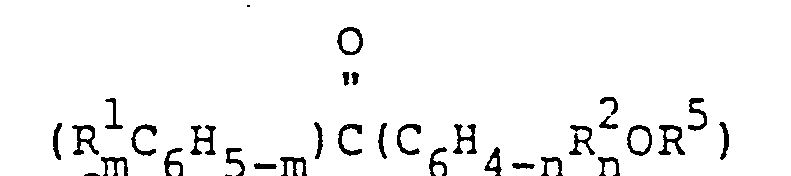
- The R 5 group of the alkenyloxybenzophenone reactant is an aliphatically unsaturated monovalent hvdrocarbon group having the same number of carbon atoms, i.e. 2 to 10, as the R3 qroup denoted above and becomes said R group after the hydrosilylation reaction with the silicon-bonded hydrogen atom. Examples of suitable R5 groups include -CH=CH2, -CH2 CH=CH 2,


- Examples of alkenyloxybenzophenone derivatives are o-vinyloxybenzophenone, p-vinyloxybenzophenone, o-allyloxybenzophenone, p-allyloxybenzophenone, 2-allyloxy-4-methoxybenzophenone, 4,4'-diallyloxy- benzophenone, 3,5-dichloro-4-allyloxybenzophenone, 2-allyloxy-5-methylbenzophenone, o-methallyloxybenzophenone, p-methallyloxybenzophenone, 2-methallyloxy-4-methoxybenzophenone, 4,4'-dimethallyloxybenzophenone, 3,5-dichloro-4-methallyloxybenzophenone, 2-methallyloxy--5-methylbcnzophenone, o-crotyloxybenzophenone, p-crotyloxybenzophenone, 2-crotyloxy-4-methoxybenzophenone, 4,4'-dicrotyloxybenzophenone, 3,5-dichloro-4- crotyloxybenzophenone, and 2-crotyloxy-5-methylbenzo- phenone.
- The alkenyloxybenzophenone derivative to be used in this synthesis can be synthesized by a conventionally known ether-linkage-formation reaction between readily available substituted or unsubstituted hydroxybenzophenone and an alkenyl halide. In other words, it can be obtained by a reaction between the substituted or unsubstituted hydroxybenzophenone and an alkenyl halide by use of a solvent such as ether, tetrahydrofuran, acetone, dimethoxy ethane, dimethylsulfoxide, or dimethylformamide in the presence of a base such as sodium amide, potassium carbonate, triethylamine, sodium hydroxide, potassium hydroxide, barium oxide, silver oxide, or sodium hydride. If necessary, a catalyst such as an iodide, for example, potassium iodide, can be added. Examples of specific hvdroxvbenzophenone derivatives are o-hydroxvbenzo- phenone, p-hvdroxybenzophenone, 2-hydroxy-4-methoxvbenzo- phenone, 4,4'-dihydroxybenzophenone, 3,5-dichloro-4-hydroxybenzophenone, and 2-hydroxy-5-methylbenzophenone. Examples of alkenyl halides are vinyl chloride, allyl chloride, allyl bromide, methallyl chloride, and crotyl chloride.
- In a first of said two general methods for preparing the organopolysiloxane photosensitizers of this invention the alkenyloxybenzophenone reactant is reacted with an organohydrogenpolysiloxane reactant bearing at least one silicon-bonded hydrogen atom to provide the organopolysiloxane photosensitizers of this invention.
- The organohydrogenpolysiloxane reactant used in the hydrosilylation reaction can be straight chained, branched chained, cyclic or network. The degree of polymerization is greater than 2 and can go as high as the maximum possible degree of polymerization which can take place without destroyinq the hydrogen-silicon bonds. For the reasons noted above for the organopolysiloxane photosensitizers of this invention, however, the degree of polymerization of the organohydrogenpolysiloxane reactant is likewise preferably less than 1000.
- The organohydrogenpolysiloxane reactant is preferably composed of siloxane units having the formula

- A preferred organohydrogenpolysiloxane to be used in this first method of photosensitizer preparation has the formula


- In a second of said two general methods for preparing the organopolysiloxane photosensitizers of this invention an alkenyloxybenzophenone reactant is first reacted, by a hydrosilylation reaction, with a silane which contains at least one silicon-bonded hydrogen atom and at least one silicon-bonded hydrolyzable group or with a siloxane bearing at least two siloxane units and at least one silicon-bonded hydrogen atom. The resulting reaction product, herein designated as the adduct, is thereafter polymerized with itself or with another silane bearing at least one silicon-bonded hydrolyzable group or with another siloxane. Said another silane and said another siloxane are free of silicon-bonded benzophenone-containing groups.
- In this second method the alkenyloxvbenzophenone reactant is the same as the general and preferred structures described in the first method, above.
- The silane reactant containing hydrogen atoms bonded to silicon atoms for the addition reaction with the alkenyloxybenzophenone reactant in said second method preferably has the formula


- The siloxane reactant containing at least two siloxane units and at least one silicon-bonded hydrogen atom for the hydrosilylation reaction with the alkenyloxybenzophenone reactant in said second method can be the organo-hydrogenpolysiloxane reactant denoted above in the first method of this invention. As noted above, this preferred organohydrogenpolysiloxane can be straight chained, branched chained, cyclic or network in structure. The adduct resulting from a hydrosilylation reaction between the alkenyloxybenzophenone reactant and this organohydrogenpolysiloxane reactant is, of course, the organopolysilxoane photosensitizer that is produced by the above-described first method of preparation; however, in the second method of preparation said adduct is further reacted by a siloxane polymerization reaction, with another silane or another siloxane, both free of silicon-bonded Q groups, to produce new organopolysiloxane photosensitizers of this invention. In this second method of preparation the organohydrogenpolysiloxane reactant is preferably cyclic in structure such as (CH3HSiO)4, i.e. tetramethyl-tetrahydrocyclo- tetrasiloxane, or (CH3HSiO)3, i.e. trimethyl-trihydro- cyclotrisiloxane, or larger cyclics or mixtures thereof.
- In this second method the siloxane reactant containinq at least two siloxane units and at least one silicon-bonded hydrogen atom can also be an orqanohydrogenpolysiloxane further containing silicon-bonded hydroxyl groups or silicon-bonded hydrolvzable groups which are convertible to silicon- bonded hydroxyl groups. These hydrolyzable groups are the same as the Z groups denoted above.
- Examples. of organohydrogenpolysiloxane reactants containing hydrolyzable groups or hydroxyl groups include hydroxyl-endblocked organohydrogenpolysiloxane such as HO {(CH3)2SiO}x {(CH3)(H)SiO}w H or methoxy-endblocked organohydrogenpolysiloxanes such as (CH3O)2(CH3)SiO{(CH3)2-SiO}x {(CH3)(H) SiO}wSi(CH3)(OCH3)2 wherein x and w are as noted above.
- For hydrosilylation addition reactions in either method of this invention between alkenyl- oxyhenzophenone derivatives and silanes or siloxanes containing hydrogen atoms bonded directly to silicon atoms, catalysts to be used are benzoyl peroxide, di-t-butyl peroxide or other peroxides; platinum, palladium, rhodium, nickel, cobalt or other metals in powdered form or in complexes. Platinum sponge, platinum black, chloroplatinic acid, the reaction prdouct of chloroplatinic acid and alcohol, a complex of chloroplatinic acid and vinyl siloxane and other platinum catalysts are preferably used. This addition reaction is preferably carried out so that the alkenyloxybenzophenone derivative is reacted at 1 mole % or less with respect to the hydrogen atoms bonded to the silicon atoms. This addition reaction can he carried out in the absence or presence of a solvent. Typically, an alkenyloxybenzophenone derivative is first heated and melted, then mixed with a silane or siloxane containing hydrogen atoms bonded to silicon atoms. While these are being vigorously mixed, a catalyst is added to promote the reaction. The addition reaction is completed in a homogeneous system. However, it is preferable to add a solvent such as benzene, toluene or xylene to give a homogeneous starting system for the reaction.
- The adduct that is obtained in the first step of the second method of this invention is subsequently further reacted, in a siloxane polymerization reaction, with itself or with another silane bearing at least one silicon-bonded hydrolyzable group or with another siloxane. Said siloxane polymerization reaction can be a hydrolysis and siloxane condensation reaction and/or a siloxane equilibration reaction in the well-known manner. The hydrolysis and condensation can be carried out by conventionally known methods if hydrolyzable groups are present. If hvdrolyzable groups are not present, the equilibrium polymerization can be carried out in the presence of a conventionally known basic or acidic catalyst.
- Said other silanes or other siloxanes are those which do not contain groups possessing the benzophenone derivative structure. Examples are organotrichloro- silane, diorganodi-chlorosilane, triorganochlorosilane, organotrialkoxysilane, diorganodialkoxysilane, triorganoalkoxysilane, organotriacetoxysilane, diorganodiacetoxysilane, triorganoacetoxysilane, diorgano(methyl ethyl ketoxime)silane, tetraorganodialkoxvdi-siloxane, pentaorganotrialkoxy- trisiloxane, triorganopenta-alkoxytrisiloxane, a, ω -dihydroxydiorganosiloxane oligomer, octaorganocyclote- trasiloxane and hexaorganodisiloxane.
- The photopolymerization sensitizers of the present invention can be applied to various photosensitive resins. However, their characteristics are best exhibited when they are applied specifically to photosensitive silicone resins and photosensitive organopolysiloxanes. In other words, the sensitizers widely used conventionally and containing benzophenone, Michler's ketone and benzoin as major ingredients have at most 2% miscibility with photosensitive silicone resins and photosensitive organopolysiloxanes. However, the sensitizers of the present invention are miscible in much larger amounts with the photosensitive silicone resins and photosensitive organopolysiloxanes. In a mixed state with photosensitive silicone resins or photosensitive organopolysiloxanes, they do not separate out or form deposits even after long-term storage. They do not have the problems of conventional sensitizers such as benzophenone and Michler's ketone, in which the sensitizers crystallize out after radiation-hardening. They can be used at high concentrations. A high sensitization effect can be expected.
- The miscibilities of the photopolymerization sensitizers of the present invention will be good if the sensitizers are selected so that they have molecular structures or contain orqanic groups identical or similar to the molecular structures or organic groups of photosensitive silicone resins and photosensitive organopolvsiloxanes.
- For example, if a photosensitive organopoly- siloxane has a linear structure, is liquid and contains methyl groups as the major organic groups, it is preferable to select a photopolymerization sensitizer of the present invention which also has a linear or cyclic structure, is liquid and contains methyl groups as the major organic groups, other than those groups possessing the benzophenone derivative structure.
- The sensitizers of the present invention can be applied to those photosensitive silicone resins and photosensitive orqanopolysiloxanes known to date, such as. organopolvsiloxanes containing acryloxy groups (Japanese Patent Sho 53(1978)-2911, Japanese Patent Sho 53(1978)-36515, and Japanese Patent Sho 55(1980)-4770), compositions of organopolysiloxanes having SiH bonds and organopolysiloxanes containing unsaturated groups such as vinyl groups (Japanese Patent Sho 52(1977)-40334), and compositions of organopolysiloxanes having mercapto groups and organopolysiloxanes containing unsaturated groups such as vinyl groups (Japanese Patent Sho 54(1979)-43017). The sensitizers of the present invention are highly miscible with all of the photosensitive silicone resins and photosensitive organopolysiloxanes. They can be blended in large amounts. They show a high sensitizing action. In the present invention, the term "photosensitization" refers to sensitization by ultraviolet rays, electrons and other high-energy rays.
- The following examples are disclosed to further illustrate, and to teach how to practice, the present invention. These examples shall not limit the present invention as delineated by the appended claims.
- All parts and percentages refer to parts by weight and percentage by weight, unless otherwise indicated. Me denotes the methyl group. Viscosities are the values at 25°C.
- This example illustrates an organopolysiloxane photosensitizer of this invention, its preparation by the second method of this invention and its use.
- 4-Hydroxybenzophenone (100 parts) was dissolved in tetrahydrofuran (100 parts). Potassium hydroxide (30.9 parts) was added, heated and stirred until completely dissolved. Allyl chloride (46.4 parts) and potassium iodide (42 parts) were added to this solution. The mixture was refluxed for 8 hours. After cooling, it was washed with water and the solvent removed by distillation. A crude product of the desired 4-allyloxybenzophenone was obtained. It was recrystallized in n-hexane to obtain 110 parts of 4-allyloxybenzophenone (melting point 71°C) at 72% yield.
- NMR (a value of δ in carbon tetrachloride) measured values were 4.20 (m, 2H), 4.65-5.20 (m, 2H), 5.30-6.00 (m, 1H) and 6.50-7.50 (m, 9H).
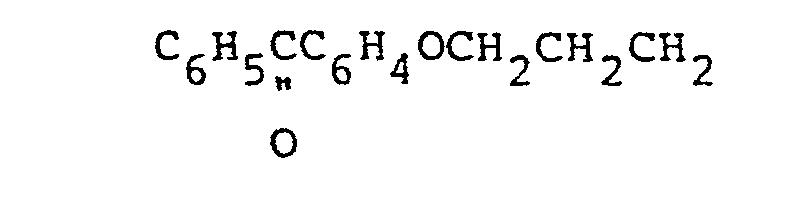
- 4-Allyloxybenzophenone (2 parts) and tetramethyl tetrahydrogen cyclotetrasiloxane (2 parts) were heated to 80°C. After mixing by stirring, 0.01 part of a 1% chloroplatinic acid solution in tetrahydrofuran (THF) was dripped into it. After stirring for 1 hour, hexamethyldisiloxane (1 part), and octamethylcyclotetrasiloxane (37 parts) were added. Trifluoromethane sulfonic acid (0.01 part) was added as a copolymerization catalyst. After the copolymerization, the solution was neutralized with sodium carbonate and filtered. A photopolymerization sensitizing organopolysiloxane (40 parts) with a viscosity of 200 cp, n 25 1.4122, and an average composition formula
- M23SiO(Me2SiO)81 (MeHSiO) 4(MeSiO)14SiMe3
- This example illustrates an organopolysiloxane photosensitizer of this invention, its preparation by the first method of this invention and its use.
- 4-Allyloxybenzophenone (1 part) and a methylpolysiloxane (10 parts), represented by an average composition formula
Me3SiO(Me2SiO)130(MeHSiO)10SiMe3
and containing hydrogen atoms bonded to silicon atoms, were heated to 90°C. After mixing by stirring, 0.01 part of a 1% chloroplatinic acid solution in THF was dripped into the mixture. After stirring for 30 minutes, the reaction solution was cooled and filtered to obtain 8 parts of a photopolymerization-sensitizing organopolysiloxane with a viscosity of 230 cp and n25 1.4224. This material (0.5 part) was mixed with a photosensitive siloxane resin consisting of a mixture of 6 parts of a dimethylvinylsiloxy terminated polymer of Me2sio units, and 4 parts of a trimethylsiloxy-terminated block polymer containing about 97% Me2SiO units and about 3 mole % mercaptopropylmethylsiloxy units. At this time, the vinyl groups and the mercaptopropyl groups were about 1. mole %. The photopolymerization sensitizer was completely miscible. This composition was made into a film of 10 m thickness and irradiated with ultraviolet rays from 160 W/cm high-voltage mercury lamps from a distance of 10 cm. It hardened rapidly in less than 1 second. Even after storage of the hardened material, no separation or deposition of the photopolymerization sensitizer was observed. - 4-Allyloxybenzophenone (1 part) and a methylpolysiloxane (20 parts) represented by the average composition formula
Me3SiO(Me2SiO)130(MeHSiO)10SiMe3 and containing hydrogen atoms bonded to silicon atoms, were heated to 90°C. After mixing by stirring, 0.01 part of a 1% chloroplatinic acid solution in THF was dripped into it. After stirring for 30 minutes, the mixture was cooled and filtered to obtain 18 parts of a photopolymerization-sensitizing organopolysiloxane with a viscosity of 210 cp and
- This mixture was made into a film of 100 m thickness, and was irradiated with ultraviolet rays from 160 W/cm high-voltage mercury lamps from a distance of 10 cm. It hardened in 5 seconds. Even after storing the hardened material, no separation or deposition of the photopolymerization sensitizer was observed.
- 2-Hydroxy-4-methoxybenzophenone (114 parts) was dissolved in tetrahydrofuran (100 parts). Potassium hydroxide (30.9 parts) was added. By heating and stirring, complete dissolution was achieved. Allyl chloride (46.4 parts) and potassium iodide (4.2 parts) were added to this solution, which was then heated and refluxed for 8 hours. After cooling, it was washed with water and the solvent was removed by distillation. A crude product of the desired 2-allyloxy-4-methoxybenzophenone was obtained. It was recrystallized in n-hexane to obtain 125 parts of 2-allyloxy-4-methoxybenzophenone (melting point 40°C) at 93% yield.
- 2-Allyl-4-methoxybenzophenone (13 parts), a methylpolysiloxane (20 parts) represented by an average composition formula
Me3SiO(Me2SiO)130(MeHSiO)10SiMe3 and containing hydrogen atoms bonded to silicon atoms, and toluene (10 parts) were heated to 90°C. After mixing by stirring, 0.01 part of a 1% chloroplatinic acid/THF solution was dripped into it. After stirring for 30 minutes, the solvent was removed by distillation. It was filtered to obtain 18 parts of a photopolymerization-sensitizing organopolysiloxane with a viscositv of 200 cp and n25 1.4075. This material (1 part) was mixed and was completely miscible, with a photosensitive siloxane resin consisting of a mixture of 5 parts of a trimethylsiloxy-terminated block polymer containing about 92 mole % Me2SiO units and about 8 mole % CH2 = CHSiMeO units and 0.5 part of a trimethylsiloxy-terminated polymer of HMeSiO units. This mixture was made into a film of 10 m thickness and irradiated with ultraviolet rays from 160 W/cm high-voltage mercury lamps from a distance of 10 cm. It hardened in 1 minute. Even after storage of the hardened material, no separation or deposition of the photopolymerization sensitizer was observed.
Claims (5)


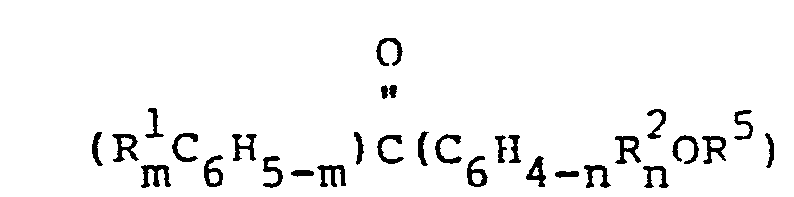

Priority Applications (2)
| Application Number | Priority Date | Filing Date | Title |
|---|---|---|---|
| DE8282301336T DE3268222D1 (en) | 1982-03-16 | 1982-03-16 | Organopolysiloxane photosensitizers and methods for their preparation |
| EP19820301336 EP0088842B1 (en) | 1982-03-16 | 1982-03-16 | Organopolysiloxane photosensitizers and methods for their preparation |
Applications Claiming Priority (1)
| Application Number | Priority Date | Filing Date | Title |
|---|---|---|---|
| EP19820301336 EP0088842B1 (en) | 1982-03-16 | 1982-03-16 | Organopolysiloxane photosensitizers and methods for their preparation |
Publications (2)
| Publication Number | Publication Date |
|---|---|
| EP0088842A1 true EP0088842A1 (en) | 1983-09-21 |
| EP0088842B1 EP0088842B1 (en) | 1986-01-02 |
Family
ID=8189608
Family Applications (1)
| Application Number | Title | Priority Date | Filing Date |
|---|---|---|---|
| EP19820301336 Expired EP0088842B1 (en) | 1982-03-16 | 1982-03-16 | Organopolysiloxane photosensitizers and methods for their preparation |
Country Status (2)
| Country | Link |
|---|---|
| EP (1) | EP0088842B1 (en) |
| DE (1) | DE3268222D1 (en) |
Cited By (14)
| Publication number | Priority date | Publication date | Assignee | Title |
|---|---|---|---|---|
| US4507187A (en) * | 1984-04-19 | 1985-03-26 | Loctite Corporation | Siloxane photoinitiators with aryoyl formate groups |
| EP0228145A1 (en) * | 1983-06-20 | 1987-07-08 | Loctite Corporation | Polyphotoinitiators |
| FR2625210A1 (en) * | 1987-12-29 | 1989-06-30 | Rhone Poulenc Chimie | DIORGANOPOLYSILOXANE FUNCTION BENZYLIDENE-3 CAMPHOR |
| EP0354146A1 (en) * | 1988-08-04 | 1990-02-07 | Rhone-Poulenc Chimie | Dibenzoylmethane group-containing diorganopolysiloxane |
| EP0478284A3 (en) * | 1990-09-25 | 1992-04-22 | Shin-Etsu Chemical Co., Ltd. | Organic silicon compounds and cosmetic compositions |
| US5407971A (en) * | 1992-02-10 | 1995-04-18 | Minnesota Mining And Manufacturing Company | Radiation crosslinked elastomers |
| WO1997049768A1 (en) * | 1996-06-27 | 1997-12-31 | Essilor International - Compagnie Generale D'optique | Cross-linked silicone based material comprising a bound photoinitiator, its method of preparation, hydrophilic polymeric product obtained from this material and its method of preparation, and novel photoinitiators |
| US6369123B1 (en) | 1995-08-14 | 2002-04-09 | 3M Innovative Properties Company | Radiation-crosslinkable elastomers and photocrosslinkers therefor |
| US6376568B1 (en) | 1999-07-29 | 2002-04-23 | Ciba Specialty Chemicals Corporation | Surface-active photoinitiators |
| WO2002048204A1 (en) * | 2000-12-13 | 2002-06-20 | Ciba Specialty Chemicals Holding Inc. | Surface-active photoinitiators |
| US7250204B2 (en) | 2002-10-15 | 2007-07-31 | Goldschmidt Ag | Use of hydroxyalkylphenone-type photoinitiators in radiation-curable organopolysiloxanes for producing abhesive coatings |
| CN114621626A (en) * | 2022-02-16 | 2022-06-14 | 华南理工大学 | Silicon dioxide particle with photoinitiation function and preparation method and application thereof |
| CN116478542A (en) * | 2023-05-22 | 2023-07-25 | 安徽国信电缆科技股份有限公司 | Preparation technology of B1-level fire-resistant power cable for urban rail transit |
| JP2025506217A (en) * | 2022-03-07 | 2025-03-07 | エルジー・ケム・リミテッド | Compound |
Citations (2)
| Publication number | Priority date | Publication date | Assignee | Title |
|---|---|---|---|---|
| GB1213779A (en) * | 1968-06-29 | 1970-11-25 | Bayer Ag | Production of organo-silicon compounds |
| GB1569681A (en) * | 1976-10-29 | 1980-06-18 | Shinetsu Chemical Co | Photocurable organopolysiloxane compositions |
-
1982
- 1982-03-16 EP EP19820301336 patent/EP0088842B1/en not_active Expired
- 1982-03-16 DE DE8282301336T patent/DE3268222D1/en not_active Expired
Patent Citations (2)
| Publication number | Priority date | Publication date | Assignee | Title |
|---|---|---|---|---|
| GB1213779A (en) * | 1968-06-29 | 1970-11-25 | Bayer Ag | Production of organo-silicon compounds |
| GB1569681A (en) * | 1976-10-29 | 1980-06-18 | Shinetsu Chemical Co | Photocurable organopolysiloxane compositions |
Cited By (24)
| Publication number | Priority date | Publication date | Assignee | Title |
|---|---|---|---|---|
| EP0228145A1 (en) * | 1983-06-20 | 1987-07-08 | Loctite Corporation | Polyphotoinitiators |
| US4507187A (en) * | 1984-04-19 | 1985-03-26 | Loctite Corporation | Siloxane photoinitiators with aryoyl formate groups |
| AU618306B2 (en) * | 1987-12-29 | 1991-12-19 | Rhone-Poulenc Chimie | Diorganosiloxanes containing a 3-benzylidenecamphor functional group |
| FR2625210A1 (en) * | 1987-12-29 | 1989-06-30 | Rhone Poulenc Chimie | DIORGANOPOLYSILOXANE FUNCTION BENZYLIDENE-3 CAMPHOR |
| EP0325881A3 (en) * | 1987-12-29 | 1989-08-16 | Rhone-Poulenc Chimie | Polydiorganosiloxane having a benzylidene-3 camphor group |
| US5025053A (en) * | 1988-08-04 | 1991-06-18 | Rhone-Poulenc Chimie | Diorganopolysiloxanes containing dibenzoylmethane functional groups |
| FR2635106A1 (en) * | 1988-08-04 | 1990-02-09 | Rhone Poulenc Chimie | DIORGANOPOLYSILOXANE WITH DIBENZOYLMETHANE FUNCTION |
| AU623422B2 (en) * | 1988-08-04 | 1992-05-14 | Rhone-Poulenc Chimie | Diorganopolysiloxane derivatives, their preparation and their use |
| EP0354146A1 (en) * | 1988-08-04 | 1990-02-07 | Rhone-Poulenc Chimie | Dibenzoylmethane group-containing diorganopolysiloxane |
| EP0478284A3 (en) * | 1990-09-25 | 1992-04-22 | Shin-Etsu Chemical Co., Ltd. | Organic silicon compounds and cosmetic compositions |
| US5254542A (en) * | 1990-09-25 | 1993-10-19 | Shin-Etsu Chemical Co., Ltd. | Organic silicon compounds and cosmetic compositions |
| US5407971A (en) * | 1992-02-10 | 1995-04-18 | Minnesota Mining And Manufacturing Company | Radiation crosslinked elastomers |
| US6369123B1 (en) | 1995-08-14 | 2002-04-09 | 3M Innovative Properties Company | Radiation-crosslinkable elastomers and photocrosslinkers therefor |
| WO1997049768A1 (en) * | 1996-06-27 | 1997-12-31 | Essilor International - Compagnie Generale D'optique | Cross-linked silicone based material comprising a bound photoinitiator, its method of preparation, hydrophilic polymeric product obtained from this material and its method of preparation, and novel photoinitiators |
| US6197842B1 (en) | 1996-06-27 | 2001-03-06 | Essilor International Compagnie Generale D'optique | Material based on crosslinked silicone polymer comprising an attached photoinitiator, process for the preparation thereof, hydrophilic polymeric product obtained from this material and process for the preparation thereof, and novel photoinitiators |
| FR2750429A1 (en) * | 1996-06-27 | 1998-01-02 | Essilor Int | CROSS-LINKED SILICONE-BASED MATERIAL CONTAINING A FIXED PHOTOINITIZER, ITS PREPARATION PROCESS, HYDROPHILIC POLYMERIC PRODUCT OBTAINED FROM THIS MATERIAL AND ITS PREPARATION PROCESS, AND NEW PHOTOINITIZERS |
| US6376568B1 (en) | 1999-07-29 | 2002-04-23 | Ciba Specialty Chemicals Corporation | Surface-active photoinitiators |
| US6693141B2 (en) | 1999-07-29 | 2004-02-17 | Ciba Specialty Chemicals Corporation | Surface-active photoinitiators |
| WO2002048204A1 (en) * | 2000-12-13 | 2002-06-20 | Ciba Specialty Chemicals Holding Inc. | Surface-active photoinitiators |
| US7250204B2 (en) | 2002-10-15 | 2007-07-31 | Goldschmidt Ag | Use of hydroxyalkylphenone-type photoinitiators in radiation-curable organopolysiloxanes for producing abhesive coatings |
| CN114621626A (en) * | 2022-02-16 | 2022-06-14 | 华南理工大学 | Silicon dioxide particle with photoinitiation function and preparation method and application thereof |
| CN114621626B (en) * | 2022-02-16 | 2022-12-16 | 华南理工大学 | Silicon dioxide particle with photoinitiation function and preparation method and application thereof |
| JP2025506217A (en) * | 2022-03-07 | 2025-03-07 | エルジー・ケム・リミテッド | Compound |
| CN116478542A (en) * | 2023-05-22 | 2023-07-25 | 安徽国信电缆科技股份有限公司 | Preparation technology of B1-level fire-resistant power cable for urban rail transit |
Also Published As
| Publication number | Publication date |
|---|---|
| EP0088842B1 (en) | 1986-01-02 |
| DE3268222D1 (en) | 1986-02-13 |
Similar Documents
| Publication | Publication Date | Title |
|---|---|---|
| US4391963A (en) | Organopolysiloxane photosensitizers and methods for their preparation | |
| US4467082A (en) | Organopolysiloxane photosensitizers and methods for their preparation | |
| EP0088842B1 (en) | Organopolysiloxane photosensitizers and methods for their preparation | |
| US3294737A (en) | Organopolysiloxanes | |
| CN100465233C (en) | Addition curable organopolysiloxane resin composition and optical material | |
| US5270423A (en) | Organosilicon compounds and compositions containing them | |
| JP2014088513A5 (en) | ||
| JP2520980B2 (en) | One-part thermosetting organopolysiloxane composition | |
| US4536265A (en) | Siloxane polyphotoinitiators of the substituted acetophenone type | |
| JP2016528340A (en) | Silicone resin composition for optical semiconductor | |
| US4786701A (en) | Curable organosiloxane composition | |
| JPH0489866A (en) | High-strength silicone rubber composition | |
| KR100194304B1 (en) | One component thermosetting organopolysiloxane composition | |
| JPH03425B2 (en) | ||
| JP3301293B2 (en) | Platinum catalyst composition, method for producing the same, and curable organopolysiloxane composition | |
| JPH09324122A5 (en) | ||
| JP2624596B2 (en) | One-part heat-curable organopolysiloxane composition | |
| JP3221893B2 (en) | Branched polyorganopolysiloxane | |
| JP2632606B2 (en) | Curable organopolysiloxane composition | |
| JP2000017176A (en) | Silicone composition for optical use and lens | |
| US5494750A (en) | Heat-curable silicone elastomer composition | |
| US5049611A (en) | Silacyclobutane functional polymers and their production | |
| JPH0748513A (en) | Elastomer-forming silicone composition | |
| JP2835529B2 (en) | Silicone rubber composition | |
| JPH023415B2 (en) |
Legal Events
| Date | Code | Title | Description |
|---|---|---|---|
| PUAI | Public reference made under article 153(3) epc to a published international application that has entered the european phase |
Free format text: ORIGINAL CODE: 0009012 |
|
| AK | Designated contracting states |
Designated state(s): DE FR GB IT |
|
| 17P | Request for examination filed |
Effective date: 19840228 |
|
| GRAA | (expected) grant |
Free format text: ORIGINAL CODE: 0009210 |
|
| AK | Designated contracting states |
Designated state(s): DE FR GB IT |
|
| ITF | It: translation for a ep patent filed | ||
| REF | Corresponds to: |
Ref document number: 3268222 Country of ref document: DE Date of ref document: 19860213 |
|
| ET | Fr: translation filed | ||
| PLBE | No opposition filed within time limit |
Free format text: ORIGINAL CODE: 0009261 |
|
| STAA | Information on the status of an ep patent application or granted ep patent |
Free format text: STATUS: NO OPPOSITION FILED WITHIN TIME LIMIT |
|
| 26N | No opposition filed | ||
| PGFP | Annual fee paid to national office [announced via postgrant information from national office to epo] |
Ref country code: FR Payment date: 19921201 Year of fee payment: 12 |
|
| PGFP | Annual fee paid to national office [announced via postgrant information from national office to epo] |
Ref country code: DE Payment date: 19921208 Year of fee payment: 12 |
|
| PGFP | Annual fee paid to national office [announced via postgrant information from national office to epo] |
Ref country code: GB Payment date: 19921218 Year of fee payment: 12 |
|
| ITTA | It: last paid annual fee | ||
| PG25 | Lapsed in a contracting state [announced via postgrant information from national office to epo] |
Ref country code: GB Effective date: 19940316 |
|
| GBPC | Gb: european patent ceased through non-payment of renewal fee |
Effective date: 19940316 |
|
| PG25 | Lapsed in a contracting state [announced via postgrant information from national office to epo] |
Ref country code: FR Effective date: 19941130 |
|
| PG25 | Lapsed in a contracting state [announced via postgrant information from national office to epo] |
Ref country code: DE Effective date: 19941201 |
|
| REG | Reference to a national code |
Ref country code: FR Ref legal event code: ST |