EP0088614B1 - Stability augmentation systems for navigable crafts - Google Patents
Stability augmentation systems for navigable crafts Download PDFInfo
- Publication number
- EP0088614B1 EP0088614B1 EP83301193A EP83301193A EP0088614B1 EP 0088614 B1 EP0088614 B1 EP 0088614B1 EP 83301193 A EP83301193 A EP 83301193A EP 83301193 A EP83301193 A EP 83301193A EP 0088614 B1 EP0088614 B1 EP 0088614B1
- Authority
- EP
- European Patent Office
- Prior art keywords
- signal
- washout
- actuator
- responsive
- providing
- Prior art date
- Legal status (The legal status is an assumption and is not a legal conclusion. Google has not performed a legal analysis and makes no representation as to the accuracy of the status listed.)
- Expired
Links
Images
Classifications
-
- G—PHYSICS
- G05—CONTROLLING; REGULATING
- G05D—SYSTEMS FOR CONTROLLING OR REGULATING NON-ELECTRIC VARIABLES
- G05D1/00—Control of position, course, altitude or attitude of land, water, air or space vehicles, e.g. using automatic pilots
- G05D1/08—Control of attitude, i.e. control of roll, pitch, or yaw
- G05D1/0808—Control of attitude, i.e. control of roll, pitch, or yaw specially adapted for aircraft
- G05D1/0816—Control of attitude, i.e. control of roll, pitch, or yaw specially adapted for aircraft to ensure stability
- G05D1/0833—Control of attitude, i.e. control of roll, pitch, or yaw specially adapted for aircraft to ensure stability using limited authority control
Definitions
- the invention relates to stability augmentation systems for navigable craft particularly, but not exclusively, those associated with flight control systems for aircraft.
- Prior art automatic pilots are known that'utilise stability augmentation systems (SAS) for providing short terms stability augmentation about the various axes of the aircraft.
- SAS stability augmentation systems
- Such systems normally utilise limited authority series actuators which operate in response to sensors such as rate gyroscopes or vertical gyroscopes providing derived rate signals.
- rate gyroscopes or vertical gyroscopes providing derived rate signals.
- rate gyroscopes or vertical gyroscopes providing derived rate signals.
- large errors can exist within the stability augmentation system which can cause the series actuator to saturate, resulting in an abrupt change in the aircraft's handling characteristics.
- this problem is common to both helicopter and fixed wing stability augmentation systems, changes in handling characteristics are much more noticeable in a helicopter because a helicopter is inherently unstable and difficult to fly.
- the stability augmentation system typically relies on a signal from a cyclic pitch stick position transducer and from a vertical gyroscope to drive a limited authority series actuator (short throw hydraulic or electric servo).
- the series actuator makes minor corrective adjustments to a swash plate in order to stabilise the aircraft.
- the authority of the actuator, and thus of the stabilising adjustments to the swash plate are typically on the order of ⁇ 10% of the cyclic pitch stick's authority, thus it is desirable that the series actuator remain relatively centred in its range of authority. This is not always possible as the pilot may initiate a trim change greater than the authority of the actuator, thus rendering the actuator grossly uncentred and no longer within its symmetrical operating range.
- the force trim release button In addition to triggering the fast washout condition, the force trim release button also actuates a clutch for recentring the conventional feel spring mechanism to its zero force position.
- the feel spring mechanism is used to impart artificial manual flight control reactions to the human pilot via the stick, as is well known.
- a problem with this arrangement is that when hovering, particularly at very low altitudes, it may be desirable to fly with the feel spring mechanism disengaged to improve the pilot's reaction time.
- the feel spring mechanism disengaged it is no longer convenient to use the force trim release button to actuate the fast washout condition.
- a washout circuit which operates automatically and not associated with the force trim release mechanism.
- the washout circuit make a gradual transition from slow to fast so that abrupt changes in aircraft response are eliminated.
- a stability augmentation system for a navigable craft including body mounted attitude sensor means for providing an attitude signal representative of motion of the craft about an axis thereof, the system comprising actuator means responsive to the attitude signal for stabilising the craft about said axis, the actuator means having a limited displacement capacity from a reference position and tending to reach the limit of the displacement capacity in response to large amplitude error signals, and manoeuvre control means for manoeuvring the craft about the axis, characterised in that the system further comprises apparatus for preventing the actuator means from reaching said limit, the apparatus comprising error sensing means responsive to the attitude signal and to the manoeuvre control means for providing an error signal for driving the actuator means, first washout means coupled to the actuator means for providing a first washout signal of opposite polarity to the error signal and of variable magnitude, so as to reposition the actuator means towards the reference position, and control means providing a control signal for controlling the magnitude of the washout signal in accordane with the displacement of the actuator means, the control signal causing the magnitude to increase
- the present invention provides an adaptive washout for automatically recentring an actuator, such as a series actuator, of a stability augmentation system.
- the washout time constant is continuously variable as a function of actuator displacement or attitude error.
- the invention comprises error sensing means responsive to an attitude sensor, such as a rate gyroscope or vertical gyroscope, and also responsive to a position sensor coupled to a conventional pilot operated manoeuvre control system, such as a control stick.
- the error signal is applied to a limited authority series actuator of the stability augmentation system which in turn adjusts a control surface to stabilise the craft.
- the washout circuit provides a washout signal of opposite polarity to the error signal and of a variable magnitude depending on the relative displacement of the series actuator.
- the system further comprises means for controlling the magnitude of the washout signal in accordance with displacement of the actuator so that the magnitude increases as the actuator approaches the limits of its authority or its capacity.
- the washout circuit thereby provides a gradually increasing washout gain, or in other words, a gradually decreasing washout time constant, for relatively large amplitude error signals which would otherwise drive the series actuator towards the limits of its authority and into saturation.
- the present invention is applicable to a wide variety of navigable craft having numerous types of limited authority stabilisation system as well as a wide variety of long term reference sources.
- the invention will be explained in terms of a helicopter having a stability augmentation system (SAS) with a limited authority series actuator for providing short term stability augmentation of the aircraft.
- SAS stability augmentation system
- the invention is applicable to the control of a plurality of aircraft types about a plurality of axis, the invention will be described with regard to one axis of the aircraft type, i.e. the pitch axis of the helicopter.
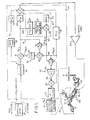
- a portion of a typical helicopter manoeuvre control system is illustrated at 10, the system including a cyclic pitch stick 12 which is illustrated as schematically mounted to the helicopter airframe 13 to impart control motion to a connecting rod 15.
- a conventional feel spring mechanism 16 Connected to the connecting rod 15 is a conventional feel spring mechanism 16 to impart artificial manual flight control reactions to the human pilot via the stick 12 in a well known manner.
- the central or zero force position for the mechanism 16 is determined in a conventional manner by a force trim release clutch mechanism 17 through appropriate linkages.
- the trim mechanism 17 is actuated in a well known manner by manipulation by the human pilot of a conventional force trim release button on the grip of the cyclic pitch control stick 12.
- a pitch control stick position sensor or transducer 21 is coupled to the control stick 12 to provide a signal representative of the displacement of the stick 12 from a central position.
- the output of the transducer 21 may be provided in terms of either stick force, stick displacement, or the like, in a well known manner.
- the output of the connecting rod 15 is applied to the input of a conventional power boost actuator 22 which, in turn, applies control motion to the helicopter swash plate via appropriate linkages.
- a stability augmentation system comprising a stability augmentation circuit 23, a vertical gyroscope 24 and a limited authority SAS actuator 25.
- the limited authority actuator 25 may be of the type disclosed in U.S. Patent Specification No. 3,269,199.
- the actuator 25 includes a motor 26 and a feedback device such as a potentiometer 27 which provide a signal in accordance with the position of the actuator 25.
- the actuator 25 is appropriately fastened to the connecting rod 15 on one end thereof and provides its output to the power boost actuator 22 at the other end thereof.
- the actuator 25 is connected as a series element in the system as illustrated, but may be installed in other manners to achieve the same effect.
- the actuator 25 has a movable piston output which can extend and retract in such a way as to move the swashplate without moving the pilot's controls.
- the actuator's authority is generally small compared to that of the pilot's control input.
- the cyclic pitch stick might move a point designated by the letter A in Figure 1, a total of 50 mm when going to full aft to full forward.
- the actuator 25 when going from full retract to full extend might move the same point a total of 10 mm.
- the actuator is said to have an authority of plus or minus 10%.
- the vertical gyro 24 provides a pitch displacement signal or pitch attitude signal to a demodulator 30 which provides an attitude signal 8 representative of the pitch attitude of the aircraft.
- the pitch attitude signal ⁇ from the demodulator 30 is applied to the input of a summing junction 31 and also is applied as an input to a rate taking circuit 32 which provides an attitude rate signal 6 reflecting short term changes in the pitch attitude signal ⁇ .
- the output of rate taker 32 is processed through gain scaling circuitry 33 to impart a gain scale factor Kg.
- the output of.the gain scaling circuit 33 is applied to one input of summing junction 34 whose output is in turn applied as an input to a conventional servo amplifier 35.
- the output of the summing junction 31, which may be considered as representative of an attitude error 8g, is processed through a gain scaling circuit 36 which imparts a gain scale factor of K e to the attitude error signal. This gain scaled attitude error signal is applied to another input of the summing junction 34.
- the output of the servo amplifier 35 is applied to drive the motor 26 of the actuator 25 in the usual fashion.
- the components 31 to 36 comprise the servo system for driving the actuator 25 in accordance with pitch information derived from the vertical gyro 24.
- the output of the pitch control stick position transducer 21 provides an output ⁇ 8 which is applied to a shaping network 37 which provides lag compensation according to the transfer function shown within the block.
- the output of the shaping network 37 is applied as an input to a summing junction 38 the output of which is applied to a gain scaling circuit 39 which imparts a gain scale factor K C2 .
- the gain scaled output of the circuit 39 is applied as another input to the summing junction 34, thereby providing a direct path, subject to the parameters of shaping network 37 and gain scaling circuit 39, between the pitch control position sensor 21 and the servo amplifier 35. It will be appreciated that this direct path provides increased response sensitivity.
- the invention includes a first washout circuit 40 which receives the attitude error signal BE via a lead 41, which signal is applied to the input of a multiplier circuit 42 the output of which is applied as one input to a summing junction 43.
- the output of the summing junction 43 is applied to a first integrator 44 the output of which is in turn applied to a negative or inverting input 45 of the summing junction 31.
- a signal from the output of the summing junction 38 is applied via lead 46 as another input to the summing junction 43.
- This signal hereinafter referred to as reference signal ⁇ ref , serves as a pitch rate reference input to the integrator 44.
- An adaptive washout biasing circuit, or control circuit 47 receives the attitude error signal BE on a lead 48 and provides a washout control signal K W/o on a lead 49 which is in turn applied as an input to the multiplier 42.
- the washout control circuit 47 comprises a shaping network 50 for providing lag compensation according to the transfer function shown within the block.
- the output of the shaping network 50 is applied to an absolute value amplifier 51 which provides an absolute value signal in proportion to the magnitude of the attitude error signal 9 E .
- the output of the absolute value amplifier 51 is applied as an input to a summing junction 52 the output of which is the washout control signal K w/o on lead 49.
- a bias signal such as a d.c. voltage, for providing a nominal washout control signal when the attitude error signal BE is of small magnitude.
- the invention further includes a second washout circuit 54 which comprises a second integrator 55 the output of which is applied to a negative or inverting input 56 of the summing junction 38.
- a multiplier 57 receptive of the reference signal ⁇ ref on lead 46 and also receptive of the washout control signal K w/o provides a control signal to the integrator 55 of the second washout circuit.
- the error sensing circuit including the summing junction 31 is provided with a reference signal ⁇ ref at the negative or inverting terminal 45 thereof. This is needed to assure that the stability augmentation system will not countermand the pilot initiated manoeuvres.
- This reference signal is produced by integrating the reference signal ⁇ ref on line 46 through the integrator 44, and in practice the parameters (K C1' K C2' and T1 ) of shaping network 37 and scaling circuit 39 are selected such that for most manoeuvres the reference signal 8 ref is equal to the pitch attitude signal 8.
- the error signal 8 e is equal to zero. This achieves the desired result of inhibiting any sensed attitude changes from opposing the pilot selected manoeuvre.
- the washout control signal K w/o on line 49 is dominated by the bias voltage 53.
- the series actuator 26 is driven by the servo amplifier 35 in response to the attitude error signal 6 e .
- the attitude error signal is a measure of the actuator displacement.
- the washout control signal on lead 49 is dependent on the attitude error.
- the washout control signal K w/o may be seen as directly affecting the washout gain of washout circuits 40 and 54 in the sense that increasing the control signal tends to increase the washout rate from a relatively slow washout condition to a relatively fast washout condition.
- the washout gain parameter is often expressed in terms of its reciprocal I/K w/o' called the washout time constant.
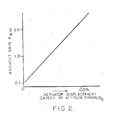
- the magnitude of the washout gain is plotted along the abscissa as a function of actuator displacement. From Figure 2 it will be seen that for zero actuator displacement, that is for zero attitude error, the washout gain takes on a nominal value as provided by the bias voltage 53. This mominal value may be for example, 0.1 sec. -1 . In terms of the washout time constant, this nominal washout gain corresponds to a washout time constant of the order of 10 seconds. In this slow washout condition, any short term displacement of the aircraft about the relevant axis, due to gusting winds for example, will be sensed by the vertical gyro 24, which will in turn produce a non zero attitude error 8 e and attitude rate ⁇ .
- the shaping network 50 is selected to have lag compensation parameters which will filter out the short term attitude error signals, as caused by gusting winds for example.
- the washout control circuit 47 is relatively insensitive to such short term attitude error signals.
- the shaping network 50 may have lag delays of approximately 1/2 to 1 second, or in other words, a non-zero attitude error condition needs to exist for longer than 1/2 to 1 second for the washout control circuit substantially to effect any change in the washout gain or time constant.
- the servo amplifier 35 will initially drive the actuator 25 off centre from its reference position.
- the washout circuit 44 begins to inject a signal of opposite polarity to the attitude, error signal which ultimately drives the actuator back towards it centred position.
- the attitude error signal ⁇ e is multiplied by the washout control signal K w/o in the multiplier 42. It will be appreciated that the product thus formed is proportional to the square of the attitude error signal 8 e and has the same sense or polarity as the attitude error signal. Integrating this product through the integrator 44 produces a washout signal which increases in magnitude according to the integration process, whilst retaining the same sense or polarity of the attitude error signal. This washout signal is then subtracted from the error signal in the summing junction 31. Thus it will be seen that the washout signal acting through the summing junction 31 opposes the polarity of the error signal. Because the magnitude of the washout signal is essentially proportional to the square of the error signal, the washout signal dominates, thereby repositioning the series actuator 25 towards its centred or referenced position.
- the reference signal 6 ref is applied to the summing junction 43.
- the reference signal ⁇ ref is selected so that when the pilot manoeuvres the aircraft, the output of the integrator 44 (8ref) is equal to the pitch attitude 0. This is accomplished by properly selecting the constants K C1' K c2 , and ⁇ according to well known linear aircraft models. However, as is also well known, for gross manoeuvres such as steep banked turns, or during large power changes such as changing the throttle setting or changing the collective pitch stick setting, the abovementioned parameters may no longer be adequate to assure that the error signal 8 e remains at or near zero.
- the present invention provides a circuit for automatically reducing the effective system washout time constant I/K w/o as a function of attitude error.
- the circuit has been explained in terms of analogue block diagram elements, in practice digital circuit techniques may be implemented.
- Figure 2 exemplifies a typical washout gain versus attitude error function, the specific gain values and the slope of the resulting function may vary from aircraft to aircraft,
- Figure 2 illustrates the general principles, namely, that for small errors and for disturbances of sufficiently high frequency so as to be filtered by the compensation network 50, the system washout time constants are slow. This provides the needed low frequency bandwidth necessary for good stability under typical gusting conditions.
- the circuit smoothly reduces the time constants to keep the actuators from saturating.
Landscapes
- Engineering & Computer Science (AREA)
- Computer Security & Cryptography (AREA)
- Aviation & Aerospace Engineering (AREA)
- Radar, Positioning & Navigation (AREA)
- Remote Sensing (AREA)
- Physics & Mathematics (AREA)
- General Physics & Mathematics (AREA)
- Automation & Control Theory (AREA)
- Control Of Position, Course, Altitude, Or Attitude Of Moving Bodies (AREA)
- Feedback Control In General (AREA)
Applications Claiming Priority (2)
| Application Number | Priority Date | Filing Date | Title |
|---|---|---|---|
| US06/356,549 US4481586A (en) | 1982-03-09 | 1982-03-09 | Adaptive washout circuit for use in a stability augmentation system |
| US356549 | 1982-03-09 |
Publications (2)
| Publication Number | Publication Date |
|---|---|
| EP0088614A1 EP0088614A1 (en) | 1983-09-14 |
| EP0088614B1 true EP0088614B1 (en) | 1986-08-06 |
Family
ID=23401912
Family Applications (1)
| Application Number | Title | Priority Date | Filing Date |
|---|---|---|---|
| EP83301193A Expired EP0088614B1 (en) | 1982-03-09 | 1983-03-07 | Stability augmentation systems for navigable crafts |
Country Status (4)
| Country | Link |
|---|---|
| US (1) | US4481586A (cg-RX-API-DMAC7.html) |
| EP (1) | EP0088614B1 (cg-RX-API-DMAC7.html) |
| JP (1) | JPS58166403A (cg-RX-API-DMAC7.html) |
| DE (1) | DE3365062D1 (cg-RX-API-DMAC7.html) |
Families Citing this family (6)
| Publication number | Priority date | Publication date | Assignee | Title |
|---|---|---|---|---|
| DE3200839C1 (de) * | 1982-01-14 | 1983-08-25 | Messerschmitt-Bölkow-Blohm GmbH, 8000 München | Vorrichtung zum Trimmen von Flugzeugen |
| US4659035A (en) * | 1985-01-25 | 1987-04-21 | The United States As Represented By The Secretary Of The Navy | Rate estimation by mixing two independent rate signals |
| US5170969A (en) * | 1988-11-23 | 1992-12-15 | The Boeing Company | Aircraft rudder command system |
| US5593109A (en) * | 1995-01-10 | 1997-01-14 | Lucas Western, Inc. | Actuator system and method |
| US7988089B2 (en) * | 2008-03-27 | 2011-08-02 | Sikorsky Aircraft Corporation | Swashplate trajectory control |
| CN110471290B (zh) * | 2019-09-05 | 2022-05-27 | 山东科技大学 | 一种具有抗饱和功能的无人机直接自适应容错控制方法 |
Family Cites Families (12)
| Publication number | Priority date | Publication date | Assignee | Title |
|---|---|---|---|---|
| US3752420A (en) * | 1971-01-04 | 1973-08-14 | Sperry Rand Corp | Augmented washout circuit for use in automatic pilots |
| US4012018A (en) * | 1973-10-04 | 1977-03-15 | The United States Of America As Represented By The Administrator Of The National Aeronautics And Space Administration | All sky pointing attitude control system |
| US4129275A (en) * | 1974-11-22 | 1978-12-12 | The Boeing Company | Automatic flight control apparatus for aircraft |
| CA1050633A (en) * | 1974-12-19 | 1979-03-13 | Ronald J. Miller | Semi-automatic flight control system utilizing limited authority stabilization system |
| US4071211A (en) * | 1976-09-23 | 1978-01-31 | Rca Corporation | Momentum biased active three-axis satellite attitude control system |
| US4106094A (en) * | 1976-12-13 | 1978-08-08 | Turpin Systems Company | Strap-down attitude and heading reference system |
| US4095271A (en) * | 1977-04-20 | 1978-06-13 | Sundstrand Data Control, Inc. | Aircraft pitch attitude signal generator |
| US4294420A (en) * | 1978-01-30 | 1981-10-13 | Matra | Attitude control systems for space vehicles |
| US4277041A (en) * | 1978-09-11 | 1981-07-07 | Lockheed Corporation | Aircraft cruise speed control system |
| US4382283A (en) * | 1980-08-08 | 1983-05-03 | United Technologies Corporation | Helicopter attitude and airspeed acquisition and retention system |
| US4383299A (en) * | 1981-03-30 | 1983-05-10 | United Technologies Corporation | Command-inhibited aircraft attitude reference adjustment |
| US4385356A (en) * | 1981-03-30 | 1983-05-24 | United Technologies Corporation | Non-saturating airspeed/attitude controls |
-
1982
- 1982-03-09 US US06/356,549 patent/US4481586A/en not_active Expired - Fee Related
-
1983
- 1983-02-23 JP JP58029200A patent/JPS58166403A/ja active Granted
- 1983-03-07 DE DE8383301193T patent/DE3365062D1/de not_active Expired
- 1983-03-07 EP EP83301193A patent/EP0088614B1/en not_active Expired
Also Published As
| Publication number | Publication date |
|---|---|
| US4481586A (en) | 1984-11-06 |
| DE3365062D1 (en) | 1986-09-11 |
| JPS58166403A (ja) | 1983-10-01 |
| EP0088614A1 (en) | 1983-09-14 |
| JPH0519723B2 (cg-RX-API-DMAC7.html) | 1993-03-17 |
Similar Documents
| Publication | Publication Date | Title |
|---|---|---|
| US5979835A (en) | Aircraft pitch-axis stability and command augmentation system | |
| EP0003947B1 (en) | Pitch bias actuator system for helicopter longitudinal cyclic pitch | |
| CA1050633A (en) | Semi-automatic flight control system utilizing limited authority stabilization system | |
| EP0659640B1 (en) | Active hand controller system | |
| EP0253614A2 (en) | Vertical flight path and airspeed control system for aircraft | |
| US5036469A (en) | Pitch attitude command flight control system for landing flare | |
| EP0082661B1 (en) | Cruise speed control for aircraft performance management system | |
| JPS5820840B2 (ja) | コウクウキヨウジドウヒコウセイギヨソウチ ナラビニ セイギヨホウホウ | |
| US4709336A (en) | Descent flight path control for aircraft | |
| US4198017A (en) | Control augmentation system for flight vehicles | |
| US4490794A (en) | Altitude preselect system for aircraft without air data computer | |
| EP0150122A2 (en) | Cruise airspeed control of aircraft during altitude capture | |
| US4758958A (en) | Method and apparatus for trimming and stabilizing an aircraft | |
| EP0125746A2 (en) | Altitude hold system with automatic ground effect compensation for vertical take-off and landing aircraft | |
| EP0088614B1 (en) | Stability augmentation systems for navigable crafts | |
| US3175786A (en) | Helicopter flight control system | |
| EP0290532B1 (en) | Synthetic speed stability flight control system | |
| EP0022847B1 (en) | Desensitizing helicopter control response to inadvertent pilot input | |
| US5863012A (en) | Cyclic stick system giving a helicopter speed stability | |
| JPH0331639B2 (cg-RX-API-DMAC7.html) | ||
| US4563743A (en) | Maneuver-force gradient system | |
| US4460964A (en) | Multiaxis hardover protection apparatus for automatic flight control systems | |
| US4460858A (en) | Autopilot roll control wheel steering system | |
| EP0372660A2 (en) | Flight path angle command, flight control system for landing flare | |
| RU8813U1 (ru) | Система управления положением вертолета |
Legal Events
| Date | Code | Title | Description |
|---|---|---|---|
| PUAI | Public reference made under article 153(3) epc to a published international application that has entered the european phase |
Free format text: ORIGINAL CODE: 0009012 |
|
| AK | Designated contracting states |
Designated state(s): DE FR GB IT |
|
| 17P | Request for examination filed |
Effective date: 19840126 |
|
| ITF | It: translation for a ep patent filed | ||
| GRAA | (expected) grant |
Free format text: ORIGINAL CODE: 0009210 |
|
| AK | Designated contracting states |
Kind code of ref document: B1 Designated state(s): DE FR GB IT |
|
| ET | Fr: translation filed | ||
| REF | Corresponds to: |
Ref document number: 3365062 Country of ref document: DE Date of ref document: 19860911 |
|
| PLBE | No opposition filed within time limit |
Free format text: ORIGINAL CODE: 0009261 |
|
| STAA | Information on the status of an ep patent application or granted ep patent |
Free format text: STATUS: NO OPPOSITION FILED WITHIN TIME LIMIT |
|
| 26N | No opposition filed | ||
| ITTA | It: last paid annual fee | ||
| PGFP | Annual fee paid to national office [announced via postgrant information from national office to epo] |
Ref country code: FR Payment date: 19931214 Year of fee payment: 12 |
|
| PGFP | Annual fee paid to national office [announced via postgrant information from national office to epo] |
Ref country code: GB Payment date: 19931220 Year of fee payment: 12 Ref country code: DE Payment date: 19931220 Year of fee payment: 12 |
|
| PG25 | Lapsed in a contracting state [announced via postgrant information from national office to epo] |
Ref country code: GB Effective date: 19950307 |
|
| GBPC | Gb: european patent ceased through non-payment of renewal fee |
Effective date: 19950307 |
|
| PG25 | Lapsed in a contracting state [announced via postgrant information from national office to epo] |
Ref country code: FR Free format text: LAPSE BECAUSE OF NON-PAYMENT OF DUE FEES Effective date: 19951130 |
|
| PG25 | Lapsed in a contracting state [announced via postgrant information from national office to epo] |
Ref country code: DE Effective date: 19951201 |
|
| REG | Reference to a national code |
Ref country code: FR Ref legal event code: ST |