EP0087102B1 - Liquid crystal compound and liquid crystal composition - Google Patents
Liquid crystal compound and liquid crystal composition Download PDFInfo
- Publication number
- EP0087102B1 EP0087102B1 EP83101410A EP83101410A EP0087102B1 EP 0087102 B1 EP0087102 B1 EP 0087102B1 EP 83101410 A EP83101410 A EP 83101410A EP 83101410 A EP83101410 A EP 83101410A EP 0087102 B1 EP0087102 B1 EP 0087102B1
- Authority
- EP
- European Patent Office
- Prior art keywords
- liquid crystal
- trans
- compound
- carboxylate
- phenyl
- Prior art date
- Legal status (The legal status is an assumption and is not a legal conclusion. Google has not performed a legal analysis and makes no representation as to the accuracy of the status listed.)
- Expired
Links
- 150000001875 compounds Chemical class 0.000 title claims description 72
- 239000004973 liquid crystal related substance Substances 0.000 title claims description 62
- 239000000203 mixture Substances 0.000 title claims description 41
- 125000000217 alkyl group Chemical group 0.000 claims description 5
- 125000004432 carbon atom Chemical group C* 0.000 claims description 3
- UHOVQNZJYSORNB-UHFFFAOYSA-N Benzene Chemical compound C1=CC=CC=C1 UHOVQNZJYSORNB-UHFFFAOYSA-N 0.000 description 108
- JUJWROOIHBZHMG-UHFFFAOYSA-N Pyridine Chemical compound C1=CC=NC=C1 JUJWROOIHBZHMG-UHFFFAOYSA-N 0.000 description 32
- XLYOFNOQVPJJNP-UHFFFAOYSA-N water Substances O XLYOFNOQVPJJNP-UHFFFAOYSA-N 0.000 description 19
- 238000000862 absorption spectrum Methods 0.000 description 17
- 238000010521 absorption reaction Methods 0.000 description 16
- 150000002148 esters Chemical class 0.000 description 16
- 238000001819 mass spectrum Methods 0.000 description 16
- 239000000047 product Substances 0.000 description 16
- UMJSCPRVCHMLSP-UHFFFAOYSA-N pyridine Natural products COC1=CC=CN=C1 UMJSCPRVCHMLSP-UHFFFAOYSA-N 0.000 description 16
- 239000007858 starting material Substances 0.000 description 16
- 150000001793 charged compounds Chemical class 0.000 description 15
- VLKZOEOYAKHREP-UHFFFAOYSA-N n-Hexane Chemical compound CCCCCC VLKZOEOYAKHREP-UHFFFAOYSA-N 0.000 description 15
- CSCPPACGZOOCGX-UHFFFAOYSA-N Acetone Chemical compound CC(C)=O CSCPPACGZOOCGX-UHFFFAOYSA-N 0.000 description 14
- LFQSCWFLJHTTHZ-UHFFFAOYSA-N Ethanol Chemical compound CCO LFQSCWFLJHTTHZ-UHFFFAOYSA-N 0.000 description 14
- 230000007704 transition Effects 0.000 description 10
- YMWUJEATGCHHMB-UHFFFAOYSA-N Dichloromethane Chemical compound ClCCl YMWUJEATGCHHMB-UHFFFAOYSA-N 0.000 description 6
- 235000019441 ethanol Nutrition 0.000 description 5
- FYSNRJHAOHDILO-UHFFFAOYSA-N thionyl chloride Chemical compound ClS(Cl)=O FYSNRJHAOHDILO-UHFFFAOYSA-N 0.000 description 4
- WFDIJRYMOXRFFG-UHFFFAOYSA-N Acetic anhydride Chemical compound CC(=O)OC(C)=O WFDIJRYMOXRFFG-UHFFFAOYSA-N 0.000 description 3
- VEXZGXHMUGYJMC-UHFFFAOYSA-N Hydrochloric acid Chemical compound Cl VEXZGXHMUGYJMC-UHFFFAOYSA-N 0.000 description 3
- OKKJLVBELUTLKV-UHFFFAOYSA-N Methanol Chemical compound OC OKKJLVBELUTLKV-UHFFFAOYSA-N 0.000 description 3
- KWYUFKZDYYNOTN-UHFFFAOYSA-M Potassium hydroxide Chemical compound [OH-].[K+] KWYUFKZDYYNOTN-UHFFFAOYSA-M 0.000 description 3
- HEMHJVSKTPXQMS-UHFFFAOYSA-M Sodium hydroxide Chemical compound [OH-].[Na+] HEMHJVSKTPXQMS-UHFFFAOYSA-M 0.000 description 3
- NZNMSOFKMUBTKW-UHFFFAOYSA-M cyclohexanecarboxylate Chemical compound [O-]C(=O)C1CCCCC1 NZNMSOFKMUBTKW-UHFFFAOYSA-M 0.000 description 3
- 239000007788 liquid Substances 0.000 description 3
- 239000002244 precipitate Substances 0.000 description 3
- 239000000758 substrate Substances 0.000 description 3
- 230000002378 acidificating effect Effects 0.000 description 2
- VSCWAEJMTAWNJL-UHFFFAOYSA-K aluminium trichloride Chemical compound Cl[Al](Cl)Cl VSCWAEJMTAWNJL-UHFFFAOYSA-K 0.000 description 2
- 238000001816 cooling Methods 0.000 description 2
- 230000003028 elevating effect Effects 0.000 description 2
- 239000011521 glass Substances 0.000 description 2
- 230000001965 increasing effect Effects 0.000 description 2
- 238000011835 investigation Methods 0.000 description 2
- 239000011159 matrix material Substances 0.000 description 2
- BDAGIHXWWSANSR-UHFFFAOYSA-N methanoic acid Natural products OC=O BDAGIHXWWSANSR-UHFFFAOYSA-N 0.000 description 2
- 125000003367 polycyclic group Chemical group 0.000 description 2
- 239000002904 solvent Substances 0.000 description 2
- 238000003756 stirring Methods 0.000 description 2
- GNNXXRLXGRTWKZ-UHFFFAOYSA-N 1-phenyl-4-propylbenzene;2-(4-propylphenyl)benzoic acid Chemical compound C1=CC(CCC)=CC=C1C1=CC=CC=C1.C1=CC(CCC)=CC=C1C1=CC=CC=C1C(O)=O GNNXXRLXGRTWKZ-UHFFFAOYSA-N 0.000 description 1
- CMSGUKVDXXTJDQ-UHFFFAOYSA-N 4-(2-naphthalen-1-ylethylamino)-4-oxobutanoic acid Chemical compound C1=CC=C2C(CCNC(=O)CCC(=O)O)=CC=CC2=C1 CMSGUKVDXXTJDQ-UHFFFAOYSA-N 0.000 description 1
- OSWFIVFLDKOXQC-UHFFFAOYSA-N 4-(3-methoxyphenyl)aniline Chemical compound COC1=CC=CC(C=2C=CC(N)=CC=2)=C1 OSWFIVFLDKOXQC-UHFFFAOYSA-N 0.000 description 1
- UMNPVQGJCRGSJD-OJBMAJLDSA-N CCC[C@H](CC1)CC[C@@H]1C(C=C1)=CC(C(C=C2)=CC=C2C2=CC=C(CCC)C=C2)=C1C(O)=O Chemical compound CCC[C@H](CC1)CC[C@@H]1C(C=C1)=CC(C(C=C2)=CC=C2C2=CC=C(CCC)C=C2)=C1C(O)=O UMNPVQGJCRGSJD-OJBMAJLDSA-N 0.000 description 1
- YKICVDDZLFKVRI-WHLKPCPKSA-N CCC[C@H](CC1)CC[C@@H]1C(C=C1)=CC([C@H](CC2)CC[C@@H]2C2=CC=C(CCC)C=C2)=C1C(O)=O Chemical compound CCC[C@H](CC1)CC[C@@H]1C(C=C1)=CC([C@H](CC2)CC[C@@H]2C2=CC=C(CCC)C=C2)=C1C(O)=O YKICVDDZLFKVRI-WHLKPCPKSA-N 0.000 description 1
- MHAJPDPJQMAIIY-UHFFFAOYSA-N Hydrogen peroxide Chemical compound OO MHAJPDPJQMAIIY-UHFFFAOYSA-N 0.000 description 1
- 239000004988 Nematic liquid crystal Substances 0.000 description 1
- WETWJCDKMRHUPV-UHFFFAOYSA-N acetyl chloride Chemical compound CC(Cl)=O WETWJCDKMRHUPV-UHFFFAOYSA-N 0.000 description 1
- 239000012346 acetyl chloride Substances 0.000 description 1
- WPYMKLBDIGXBTP-UHFFFAOYSA-N benzoic acid Chemical compound OC(=O)C1=CC=CC=C1 WPYMKLBDIGXBTP-UHFFFAOYSA-N 0.000 description 1
- 230000015572 biosynthetic process Effects 0.000 description 1
- 239000003153 chemical reaction reagent Substances 0.000 description 1
- 239000013078 crystal Substances 0.000 description 1
- 238000004821 distillation Methods 0.000 description 1
- 125000004185 ester group Chemical group 0.000 description 1
- 238000005886 esterification reaction Methods 0.000 description 1
- 235000019253 formic acid Nutrition 0.000 description 1
- 230000009878 intermolecular interaction Effects 0.000 description 1
- 150000002500 ions Chemical class 0.000 description 1
- 238000000034 method Methods 0.000 description 1
- 125000001997 phenyl group Chemical group [H]C1=C([H])C([H])=C(*)C([H])=C1[H] 0.000 description 1
- 239000011541 reaction mixture Substances 0.000 description 1
- 238000010992 reflux Methods 0.000 description 1
- QAOWNCQODCNURD-UHFFFAOYSA-N sulfuric acid Substances OS(O)(=O)=O QAOWNCQODCNURD-UHFFFAOYSA-N 0.000 description 1
- 238000003786 synthesis reaction Methods 0.000 description 1
Images

Classifications
-
- C—CHEMISTRY; METALLURGY
- C09—DYES; PAINTS; POLISHES; NATURAL RESINS; ADHESIVES; COMPOSITIONS NOT OTHERWISE PROVIDED FOR; APPLICATIONS OF MATERIALS NOT OTHERWISE PROVIDED FOR
- C09K—MATERIALS FOR MISCELLANEOUS APPLICATIONS, NOT PROVIDED FOR ELSEWHERE
- C09K19/00—Liquid crystal materials
- C09K19/04—Liquid crystal materials characterised by the chemical structure of the liquid crystal components, e.g. by a specific unit
- C09K19/06—Non-steroidal liquid crystal compounds
- C09K19/08—Non-steroidal liquid crystal compounds containing at least two non-condensed rings
- C09K19/30—Non-steroidal liquid crystal compounds containing at least two non-condensed rings containing saturated or unsaturated non-aromatic rings, e.g. cyclohexane rings
- C09K19/3001—Cyclohexane rings
- C09K19/3066—Cyclohexane rings in which the rings are linked by a chain containing carbon and oxygen atoms, e.g. esters or ethers
- C09K19/3068—Cyclohexane rings in which the rings are linked by a chain containing carbon and oxygen atoms, e.g. esters or ethers chain containing -COO- or -OCO- groups
-
- C—CHEMISTRY; METALLURGY
- C09—DYES; PAINTS; POLISHES; NATURAL RESINS; ADHESIVES; COMPOSITIONS NOT OTHERWISE PROVIDED FOR; APPLICATIONS OF MATERIALS NOT OTHERWISE PROVIDED FOR
- C09K—MATERIALS FOR MISCELLANEOUS APPLICATIONS, NOT PROVIDED FOR ELSEWHERE
- C09K19/00—Liquid crystal materials
- C09K19/04—Liquid crystal materials characterised by the chemical structure of the liquid crystal components, e.g. by a specific unit
- C09K19/06—Non-steroidal liquid crystal compounds
- C09K19/08—Non-steroidal liquid crystal compounds containing at least two non-condensed rings
- C09K19/10—Non-steroidal liquid crystal compounds containing at least two non-condensed rings containing at least two benzene rings
- C09K19/20—Non-steroidal liquid crystal compounds containing at least two non-condensed rings containing at least two benzene rings linked by a chain containing carbon and oxygen atoms as chain links, e.g. esters or ethers
- C09K19/2007—Non-steroidal liquid crystal compounds containing at least two non-condensed rings containing at least two benzene rings linked by a chain containing carbon and oxygen atoms as chain links, e.g. esters or ethers the chain containing -COO- or -OCO- groups
Definitions
- the present invention relates to a liquid crystal compound and a liquid crystal composition containing the liquid crystal compound.
- liquid crystal compound herein include also compound which do not exhibit a liquid crystal phase by themselves but are useful as a component of liquid crystal compositions.
- phase transition temperature means a temperature range of a nematic phase about the liquid crystal compound
- liquid crystal temperature range means the temperature range of a nematic phase in the liquid crystal composition
- Display means made of nematic liquid crystals have been used practically in the fields of wrist-watches and desk computers. There has been proposed the idea of using such a display means for the display of gauge panelboards of automobiles. As well known, such panelboards should be resistant to a broad range of temperatures ranging from those of cold districts to those of the tropics. It is now required to obtain a liquid crystal composition which works at a broad liquid crystal temperature range of from -30°C to 80°C.
- Liquid crystal compositions which are practically used comprise generally mixtures of several liquid crystal compounds. These liquid crystal compositions exhibit the characteristic properties of the respective liquid crystal compounds and they exhibit the satisfactory properties required.
- phase transition temperature 251-312 °C
- This compound is used for elevating the upper limit in the liquid crystal temperature range (i.e. the temperature at which the transition from the nematic phase to isotropic liquid occurs) so as to broaden the liquid crystal temperature range of a liquid crystal composition.
- the viscosity and the lower limit of the liquid crystal temperature range are elevated significantly which is undesirable.
- An object of the present invention is to provide a liquid crystal compound whose upper limit of the liquid crystal temperature is elevated without elevating the viscosity and the lower limit of a liquid crystal composition containing the liquid crystal compound and the respective liquid crystal composition.
- the inventors made investigations of the compatability and molecular structures for the purpose of broadening the range of the phase transition temperature. After the investigation, the inventors have found that if an ester group imparting high polarizability is introduced in the center of the polycyclic liquid crystalline compound, the intermolecular interaction is accelerated to form the liquid crystal easily.
- the present invention has been attained on the basis of this finding.
- the liquid crystal compound of the present invention is characterized by having the general formula: wherein R and R' each represent an alkyl group, and X, X', Y and Y' each represent These compounds are colorless and chemically stable.
- R and R' have 1 to 8 carbon atoms.
- liquid crystal compound of the present invention can be synthesized from commercially available reagents by known methods. Embodiments of the synthesis by using the esterification reaction are as shown below:
- the liquid crystal composition of the present invention is characterized by containing the liquid crystal compound of the invention as one of the components thereof.
- the figure shows the infrared absorption spectrum of a liquid crystal compound of an embodiment of the present invention.
- the phase transition temperature of this compound was 120-330°C.
- This compound had a phase transition temperature of 179 to 283°C.
- This compound had a phase transition temperature of 133 to 327°C.
- This compound had a phase transition temperature of 174 to 325°C.
- This compound had a phase transition temperature of 223 to 318°C.
- This compound had a phase transition temperature of 208 to 318°C.
- the liquid crystal compound prepared in Example 1 was added to known liquid crystal compounds, i.e. mixture A (comprising in a ratio of 50:50 wt%) and mixture B (comprising in a ratio of 50:50 wt%) and the liquid crystal temperature ranges and viscosities of them were examined.
- the results are shown in the following table.
- the liquid crystal compositions in this example had a liquid crystal temperature range remarkably broadened by about 30 to 60°C as compared with A and B, while the increase in viscosity was as small as about 6 to 11CP.
- ATN-type liquid crystal device was prepared by using the mixture as a liquid crystal layer.
- the liquid crystal device comprised upper and lower glass substrates, a transparent NESA electrode formed on the inner surface of each of the glass substrates and an orientation-control film made of a polymide compound so as to orient the liquid crystal molecules.
- a gap between the upper and lower substrates was controlled so that the thickness of the liquid crystal layer would be about 10 pm.
- a voltage of 6 V was applied to the liquid crystal display device at an ambient temperature of -30°C. Response time was 1.7 sec.
- a liquid crystal display device in which the liquid crystal layer comprised only the matrix liquid crystal B had a response time of 3.6 sec under the same conditions as above.
- the liquid crystal temperature range can be broadened remarkably and particularly the upper limit of the temperature can be raised without increasing viscosity of the liquid crystal composition significantly. If the liquid crystal compositions containing these compounds are used, the response of liquid crystal display devices can be improved.
Landscapes
- Chemical & Material Sciences (AREA)
- Crystallography & Structural Chemistry (AREA)
- Engineering & Computer Science (AREA)
- Materials Engineering (AREA)
- Organic Chemistry (AREA)
- Organic Low-Molecular-Weight Compounds And Preparation Thereof (AREA)
- Liquid Crystal Substances (AREA)
Description
- The present invention relates to a liquid crystal compound and a liquid crystal composition containing the liquid crystal compound.
- The term "liquid crystal compound" herein include also compound which do not exhibit a liquid crystal phase by themselves but are useful as a component of liquid crystal compositions.
- The term "phase transition temperature" means a temperature range of a nematic phase about the liquid crystal compound, and the term "liquid crystal temperature range" means the temperature range of a nematic phase in the liquid crystal composition.
- Display means made of nematic liquid crystals have been used practically in the fields of wrist-watches and desk computers. There has been proposed the idea of using such a display means for the display of gauge panelboards of automobiles. As well known, such panelboards should be resistant to a broad range of temperatures ranging from those of cold districts to those of the tropics. It is now required to obtain a liquid crystal composition which works at a broad liquid crystal temperature range of from -30°C to 80°C.
- Liquid crystal compositions which are practically used comprise generally mixtures of several liquid crystal compounds. These liquid crystal compositions exhibit the characteristic properties of the respective liquid crystal compounds and they exhibit the satisfactory properties required.
- Among the liquid crystal compounds, the following compound has been known.

- This compound is used for elevating the upper limit in the liquid crystal temperature range (i.e. the temperature at which the transition from the nematic phase to isotropic liquid occurs) so as to broaden the liquid crystal temperature range of a liquid crystal composition. However, as the amount of the polycyclic liquid crystal compound is increased, the viscosity and the lower limit of the liquid crystal temperature range (temperature at which the crystalline phase is converted into a nematic phase) are elevated significantly which is undesirable.
- From European patent application 0044646 liquid crystal compounds of the formula

- An object of the present invention is to provide a liquid crystal compound whose upper limit of the liquid crystal temperature is elevated without elevating the viscosity and the lower limit of a liquid crystal composition containing the liquid crystal compound and the respective liquid crystal composition.
- The inventors made investigations of the compatability and molecular structures for the purpose of broadening the range of the phase transition temperature. After the investigation, the inventors have found that if an ester group imparting high polarizability is introduced in the center of the polycyclic liquid crystalline compound, the intermolecular interaction is accelerated to form the liquid crystal easily. The present invention has been attained on the basis of this finding.
- The liquid crystal compound of the present invention is characterized by having the general formula:


- Preferably R and R' have 1 to 8 carbon atoms.
- The liquid crystal compound of the present invention can be synthesized from commercially available reagents by known methods. Embodiments of the synthesis by using the esterification reaction are as shown below:


- The liquid crystal composition of the present invention is characterized by containing the liquid crystal compound of the invention as one of the components thereof.
- The figure shows the infrared absorption spectrum of a liquid crystal compound of an embodiment of the present invention.
- The following examples will further illustrate the present invention.
- To 22g of


- 100 g of thionyl chloride were added dropwise to 30 g of the obtained


- 195 g of anhydrous aluminum chloride was dissolved in 1.51 of methylene chloride and cooled in an ice bath in another flask 100 g of


- 70 g of


- 8gof


- The infrared absorption spectrum of the compound obtained as above is shown in an attached figure. In the figure, an absorption due to the ester is observed at 1750 cm-1. In a mass spectrum, it was recognized that a molecule ion peak appears at m/e 440. From these two facts and the starting materials, it was recognized that the compound thus synthesized was p-(trans-4-propylcyclohexyl)phenyl-4'-propylbiphenyl-4"-carboxylate of the following formula:

- The phase transition temperature of this compound was 120-330°C.
- The following compounds may be synthesized in the same manner as above:
- (1) p-(trans-4-propylcyclohexyl)phenyl-4'-butyl-biphenyl-4"-carboxylate,
- (2) p-(trans-4-propylcyclohexyl)phenyl-4'-pentyl-biphenyl-4"-carboxylate,
- (3) p-(trans-4-propylcyclohexyl)phenyl-4'-heptyl-biphenyl-4"-carboxylate,
- (4) p-(trans-4-propylcyclohexyl)phenyl-4'-octyl-biphenyl-4"-carboxylate,
- (5) p-(trans-4-butylcyclohexyl)phenyl-4'-butyl-biphenyl-4"-carboxylate,
- (6) p-(trans-4-butylcyclohexyl)phenyl-4'-pentyl-biphenyl-4"-carboxylate,
- (7) p-(trans-4-butylcyclohexyl)phenyl-4'-heptyl-biphenyl-4"-carboxylate,
- (8) p-(trans-4-butylcyclohexyl)phenyl-4'-octyl-biphenyl-4"-carboxylate,
- (9) p-(trans-4-pentylcyclohexyl)phenyl-4'-butyl-biphenyl-4"-carboxylate,
- (10) p-(trans-4-pentylcyclohexyl)phenyl-4'-pentyl-biphenyl-4"-carboxylate,
- (11) p-(trans-4-pentylcyclohexyl)phenyl-4'-heptyl-biphenyl-4"-carboxylate,
- (12) p-(trans-4-pentylcyclohexyl)phenyl-4'-octyl-biphenyl-4"-carboxylate,
- (13) p-(trans-4-heptylcyclohexyl)phenyl-4'-butyl-biphenyl-4"-carboxylate,
- (14) p-(trans-4-heptylcyclohexyl)phenyl-4'-pentyl-biphenyl-4"-carboxylate,
- (15) p-(trans-4-heptylcyclohexyl)phenyl-4'-heptyl-biphenyl-4"-carboxylate,
- (16) p-(trans-4-heptylcyclohexyl)phenyl-4'-octyl-biphenyl-4"-carboxylate,
- (17) p-(trans-4-octylcyclohexyl)phenyl-4'-butyl-biphenyl-4"-carboxylate,
- (18) p-(trans-4-octylcyclohexyl)phenyl-4'-pentyl-biphenyl-4"-carboxylate,
- (19) p-(trans-4-octylcyclohexyl)phenyl-4'-heptyl-biphenyl-4"-carboxylate,
- (20) p-(trans-4-octylcyclohexyl)phenyl-4'-octyl-biphenyl-4"-carboxylate,
- (21) p-(trans-4-propylcyclohexyl)phenyl-4'-hexyl-biphenyl-4"-carboxylate,
- (22) p-(trans-4-butylcyclohexyl)phenyl-4'-propyl-biphenyl-4"-carboxylate,
- (23) p-(trans-4-butylcyclohexyl)phenyl-4'-hexyl-biphenyl-4"-carboxylate,
- (24) p-(trans-4-pentylcyclohexyl)phenyl-4'-propyl-biphenyl-4"-carboxylate,
- (25) p-(trans-4-pentylcyclohexyl)phenyl-4'-hexyl-biphenyl-4"-carboxylate,
- (26) p-(trans-4-hexylcyclohexyl)phenyl-4'-propyl-biphenyl-4"-carboxylate,
- (27) p-(trans-4-hexylcyclohexyl)phenyl-4'-butyl-biphenyl-4"-carboxylate,
- (28) p-(trans-4-hexylcyclohexyl)phenyl-4'-pentyl-biphenyl-4"-carboxylate,
- (29) p-(trans-4-hexylcyclohexyl)phenyl-4'-hexyl-biphenyl-4"-carboxylate,
- (30) p-(trans-4-hexylcyclohexyl)phenyl-4'-heptyl-biphenyl-4"-carboxylate,
- (31) p-(trans-4-hexylcyclohexyl)phenyl-4'-octyl-biphenyl-4"-carboxylate,
- (32) p-(trans-4-hexylcyclohexyl)phenyl-4'-propyl-biphenyl-4"-carboxylate,
- (33) p-(trans-4-heptylcyclohexyl)phenyl-4'-hexyl-biphenyl-4"-carboxylate,
- (34) p-(trans-4-octylcyclohexyl)phenyl-4'-propyl-biphenyl-4"-carboxylate,
- (35) p-(trans-4-octylcyclohexyl)phenyl-4'-hexyl-biphenyl-4"-carboxylate.
- Further, other compounds of the above general formula can be synthesized in the same manner as above.
- A 60% solution of 8 g of


- In an infrared absorption spectrum of the compound obtained above, an absorption due to ester was observed at 1750 cm-1. In the mass spectrum, a molecular ion peak appeared at m/e 434. From the relationship between these two facts and the starting compounds, it was recognized that the compound thus synthesized was 4-propylbiphenyl 4'-propyl-biphenylcarboxylate of the following formula:

- An 80% solution of 8 g of
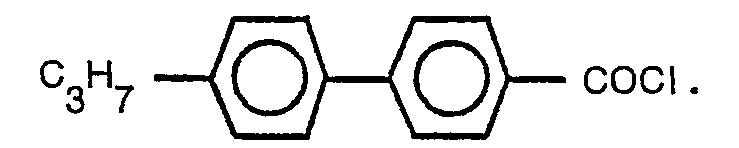
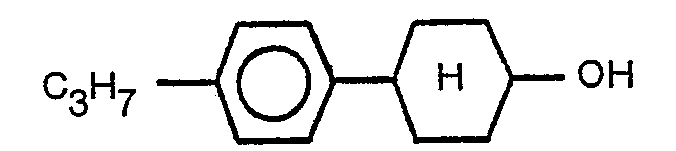
- In an infrared absorption spectrum of the compound obtained above, an absorption due to ester was observed at 1755 cm-1. In the mass spectrum, a molecular ion peak appeared at m/e 440. From the relationship between these two facts and the starting compounds, it was recognized that the compound thus synthesized was trans-4-(p-propylphenyl)cyclohexyl-4'-propyl-biphenyl-4"-carboxylate of the following formula:

- A 20% solution of 8 g of


- In an infrared absorption spectrum of the compound obtained above, an absorption due to ester was observed at 1755 cm-1. In the mass spectrum, a molecular ion peak appeared at m/e 446. From the relationship between these two facts and the starting compounds, it was recognised that the compound thus synthesized was trans, trans-4-propylbicyclohexane-4'-yl-4"-propylbiphenyl-4"'-carboxylate of the following formula:

- A 50% solution of 8.2 g of


- In an infrared absorption spectrum of the compound obtained above, an absorption due to ester was observed at 1740 cm-1. In the mass spectrum, a molecular ion peak appeared at m/e 440. From the relationship between these two facts and the starting compounds, it was recognized that the compound thus synthesized was 4-propylbiphenyl-4'-yl-trans-4-(p-propylphenyl) cyclohexanecarboxylate of the following formula:

- A 30% solution of 8.2 g of


- In an infrared absorption spectrum of the compound obtained above, an absorption due to ester was observed at 1745 cm-1. In the mass spectrum, a molecular ion peak appeared at m/e 446. From the relationship between these two facts and the starting compounds, it was recognized that the compound thus synthesized was p-(trans-4-propylcyclohexyl)phenyl-trans-4'-(p'-propylphenyl)cyclohexanecarboxylate of the following formula:

- This compound had a phase transition temperature of 179 to 283°C.
- A 50% solution of 8.2 g of


- In an infrared absorption spectrum of the compound obtained above, an absorption due to ester was observed at 1750 cm-1. In the mass spectrum, a molecular ion peak appeared at m/e 446. From the relationship between these two facts and the starting compounds, it was recognized that the compound thus synthesized was trans-4-(p-propylphenyl)cyclohexyl-trans-4'-(p'-propylphenyl)cyclohexanecarboxylate of the following formula:

- A 50% solution of 8.2 g of


- In an infrared absorption spectrum of the compound obtained above, an absorption due to ester was observed at 1740 cm-1. In the mass spectrum, a molecular ion peak appeared at m/e 452. From the relationship between these two facts and the starting compounds, it was recognized that the compound thus synthesized was trans, trans-4-propylbicyclohexane-4'-yl-trans-4"-(p-propy;phenyl)-cyclohexane-carboxylate of the following formula:

- A 30% solution of 8.2 g of


- In an infrared absorption spectrum of the compound obtained above, an absorption due to ester was observed at 1745 cm-1. In the mass spectrum, a molecular ion peak appeared at m/e 440. From the relationship between these two facts and the starting compounds, it was recognized that the compound thus synthesized was 4-propylbiphenyl-4'-yl-p-(trans-4-propylcyclohexyl)benzoate of the following formula:

- This compound had a phase transition temperature of 133 to 327°C.
- A 20% solution of 8.2 g of

- In an infrared absorption spectrum of the compound obtained above, an absorption due to ester was observed at 1740 cm-1. In the mass spectrum, molecular ion peak appeared at m/e 446. From the relationship between these two facts and the starting compounds, it was recognized that the compound thus synthesized was p-(trans-4-propylcyclohexyl)phenyl-p'-(trans-4'-propylcyclohexyl)benzoate of the following formula:

- This compound had a phase transition temperature of 174 to 325°C.
- A 30% solution of 8.2 g of


- In an infrared absorption spectrum of the compound obtained above, an absorption due to ester was observed at 1735 cm-1. In the mass spectrum, a molecular ion peak appeared at m/e 446. From the relationship between these two facts and the starting compound, it was recognized that the compound thus synthesized was trans-4-(p-propylphenyl)cyclohexyl-p-(trans-4'-propylcyclohexyl)-benzoate of the following formula:

- A 50% solution of 8.2 g of


- In an infrared absorption spectrum of the compound obtained above, an absorption due to ester was observed at 1730 cm-1. In the mass spectrum, a molecular ion peak appeared at m/e 452. From the relationship between these two facts and the starting compounds, it was recognized that the compound thus synthesized was trans, trans-4-propylbicyclohexane-4'-yl-p-(trans-4"-propylcyclohexyl)-benzoate of the following formula:

- A 30% solution of 8.4 g of


- In an infrared absorption spectrum of the compound obtained above, an absorption due to ester was observed at 1740 cm-1. In the mass spectrum, a molecular ion peak appeared at m/e 446. From the relationship between these two facts and the starting compound, it was recognized that the compound thus synthesized was 4-propylbiphenyl-4'-yl- trans, trans-4"-propylbicyclohexane-4"'-carboxylate of the following formula:

- This compound had a phase transition temperature of 223 to 318°C.
- A 20% solution of 8.4 g of


- In an infrared absorption spectrum of the compound obtained above, an absorption due to ester was observed at 1750 cm-1. In the mass spectrum, a molecular ion peak appeared at m/e 452. From the relationship between these two facts and the starting compounds, it was recognized that the compound thus synthesized was p-(trans-4-propylcyclohexyl)phenyl-trans, trans-4'-propylbicyclohexane-4"- carboxylate of the following formula:

- This compound had a phase transition temperature of 208 to 318°C.
- A 50% solution of 8.4 g of


- In an absorption spectrum of the compound obtained above, an absorption due to ester was observed at 1730 cm-1. In the mass spectrum, a molecular ion peak appeared at m/e 452. From the relationship between these two facts and the starting compounds, it was recognized that the compounds thus synthesized was trans-4-(p-propylphenyl)cyclohexyl-trans, trans-4'-propylbicyclohexane-4"-carboxylate of the following formula:

- A 40% solution of 8.4 g of


- In an infrared absorption spectrum of the compound obtained above, an absorption due to ester was observed at 1745 cm-1. In the mass spectrum, a molecular ion peak appeared at m/e 458. From the relationship between these two facts and the starting compounds, it was recognized that the compound thus synthesized was trans, trans-4-propylbicyclohexane-4'-yl trans'trans-4"-propylbicyclohexane-4"'-carboxylate of the following formula:

- The liquid crystal compound prepared in Example 1 was added to known liquid crystal compounds, i.e. mixture A (comprising


- 20 wt% of the liquid crystal compound shown in Example 1 was added to the matrix liquid crystal B shown in Example 17. ATN-type liquid crystal device was prepared by using the mixture as a liquid crystal layer. The liquid crystal device comprised upper and lower glass substrates, a transparent NESA electrode formed on the inner surface of each of the glass substrates and an orientation-control film made of a polymide compound so as to orient the liquid crystal molecules. A gap between the upper and lower substrates was controlled so that the thickness of the liquid crystal layer would be about 10 pm. A voltage of 6 V was applied to the liquid crystal display device at an ambient temperature of -30°C. Response time was 1.7 sec. A liquid crystal display device in which the liquid crystal layer comprised only the matrix liquid crystal B had a response time of 3.6 sec under the same conditions as above.
- As described above in detail, if the liquid crystal compounds of the present invention are used, the liquid crystal temperature range can be broadened remarkably and particularly the upper limit of the temperature can be raised without increasing viscosity of the liquid crystal composition significantly. If the liquid crystal compositions containing these compounds are used, the response of liquid crystal display devices can be improved.
Claims (4)


Applications Claiming Priority (2)
| Application Number | Priority Date | Filing Date | Title |
|---|---|---|---|
| JP57021083A JPS58140045A (en) | 1982-02-15 | 1982-02-15 | Liquid crystal compound, liquid crystal composition and liquid crystal display element |
| JP21083/82 | 1982-02-15 |
Publications (2)
| Publication Number | Publication Date |
|---|---|
| EP0087102A1 EP0087102A1 (en) | 1983-08-31 |
| EP0087102B1 true EP0087102B1 (en) | 1985-12-18 |
Family
ID=12044984
Family Applications (1)
| Application Number | Title | Priority Date | Filing Date |
|---|---|---|---|
| EP83101410A Expired EP0087102B1 (en) | 1982-02-15 | 1983-02-14 | Liquid crystal compound and liquid crystal composition |
Country Status (4)
| Country | Link |
|---|---|
| US (1) | US4584120A (en) |
| EP (1) | EP0087102B1 (en) |
| JP (1) | JPS58140045A (en) |
| DE (1) | DE3361514D1 (en) |
Families Citing this family (18)
| Publication number | Priority date | Publication date | Assignee | Title |
|---|---|---|---|---|
| DE3206269A1 (en) * | 1982-02-20 | 1983-09-01 | Merck Patent Gmbh, 6100 Darmstadt | BICYCLOHEXYL DERIVATIVES |
| DE3211601A1 (en) * | 1982-03-30 | 1983-10-06 | Merck Patent Gmbh | HYDROTERPHENYLE |
| JPS5959648A (en) * | 1982-07-28 | 1984-04-05 | エフ・ホフマン―ラ ロシユ アーゲー | Liquid crystal compound |
| US4550981A (en) * | 1982-09-30 | 1985-11-05 | Hoffmann-La Roche Inc. | Liquid crystalline esters and mixtures |
| GB2132612B (en) * | 1982-10-30 | 1986-01-22 | Dainippon Ink & Chemicals | Nematic liquid crystalline cyclohexyl esters |
| EP0115693B1 (en) * | 1983-01-06 | 1987-08-26 | Chisso Corporation | Liquid crystalline compounds and mixtures thereof |
| EP0144648B1 (en) * | 1983-11-02 | 1987-10-21 | F. HOFFMANN-LA ROCHE & CO. Aktiengesellschaft | Liquid crystals: derivatives of cyclohexylbenzene and cyclohexylbiphenyl |
| US4680137A (en) * | 1985-06-10 | 1987-07-14 | Chisso Corporation | Liquid crystal ester compound |
| US4864033A (en) * | 1985-11-27 | 1989-09-05 | Brigham Young University | Novel liquid crystalline compounds and polymers |
| DE3604898A1 (en) * | 1986-02-17 | 1987-08-20 | Hoechst Ag | CHIRAL IMPLEMENTATION PRODUCTS MESOGENIC MOLECULE BLOCKS AND BIFUNCTIONALLY REACTIVE WINE ACID DERIVATIVES AND THEIR USE AS DOPE IN LIQUID CRYSTAL PHASES |
| DE3604899A1 (en) * | 1986-02-17 | 1987-08-20 | Hoechst Ag | CHIRAL IMPLEMENTATION PRODUCTS FROM MESOGENIC MOLECULE BLOCKS AND BIFUNCTIONAL REACTIVE BUTANTETRAOL DERIVATIVES AND THEIR USE AS DOPE IN LIQUID CRYSTAL PHASES |
| DE3788243D1 (en) * | 1986-05-22 | 1994-01-05 | Hoffmann La Roche | Liquid crystalline derivatives of phenyl benzoate. |
| US5082589A (en) * | 1986-05-22 | 1992-01-21 | Hoffmann-La Roche Inc. | Liquid crystalline esters |
| US5288427A (en) * | 1987-02-18 | 1994-02-22 | Merck Patent Gesellschaft Mit Beschrankter Haftung | Electrooptical display element |
| JP2917286B2 (en) * | 1989-03-28 | 1999-07-12 | セイコーエプソン株式会社 | Liquid crystal device |
| US7767279B2 (en) | 2007-03-22 | 2010-08-03 | Chisso Petrochemical Corporation | Liquid crystal composition and liquid crystal display device |
| DE102010005038A1 (en) | 2009-02-14 | 2010-08-19 | Lofo High Tech Film Gmbh | Optical compensation films |
| TWI535829B (en) | 2009-05-29 | 2016-06-01 | Jnc Corp | Liquid crystal composition and liquid crystal display element |
Family Cites Families (25)
| Publication number | Priority date | Publication date | Assignee | Title |
|---|---|---|---|---|
| GB1456359A (en) * | 1974-10-22 | 1976-11-24 | Merck Patent Gmbh | Biphenyl carboxylic esters |
| US4113647A (en) * | 1976-08-13 | 1978-09-12 | The Secretary Of State For Defence In Her Britannic Majesty's Government Of The United Kingdom Of Great Britain And Northern Ireland | Liquid crystalline materials |
| JPS5421978A (en) * | 1977-07-19 | 1979-02-19 | Canon Inc | Liquid crystal composition |
| GB2009219B (en) * | 1977-11-02 | 1982-04-28 | Secr Defence | Liquid ctystal material mixtures and devices incorporating such mixtures |
| DE2800553A1 (en) * | 1978-01-07 | 1979-07-12 | Merck Patent Gmbh | CYCLOHEXAN DERIVATIVES |
| JPS5521429A (en) * | 1978-07-31 | 1980-02-15 | Seiko Epson Corp | Liquid crystal composition |
| US4261652A (en) * | 1978-08-04 | 1981-04-14 | The Secretary Of State For Defence In Her Britannic Majesty's Government Of The United Kingdom Of Great Britain And Northern Ireland | Liquid crystal compounds and materials and devices containing them |
| EP0008956B1 (en) * | 1978-09-13 | 1983-10-12 | The Secretary of State for Defence in Her Britannic Majesty's Government of the United Kingdom of Great Britain and | Improvements in or relating to liquid crystal materials and devices |
| DE2933611A1 (en) * | 1979-07-18 | 1981-02-12 | Bbc Brown Boveri & Cie | CYCLOHEXYLCYCLOHEXANOATE |
| DE2933563A1 (en) * | 1979-07-18 | 1981-02-05 | Bbc Brown Boveri & Cie | ANISOTROPE CONNECTIONS WITH NEGATIVE DK ANISOTROPY |
| JPS574960A (en) * | 1980-06-09 | 1982-01-11 | Chisso Corp | 4'''-cyanobiphenyl trans-4-(trans-4'-alkylcyclohexyl)- cyclohexanecarboxylate |
| JPS5721359A (en) * | 1980-07-15 | 1982-02-04 | Chisso Corp | 4'''-cyano-4"-biphenylyl 4-(trans-4'-alkylcyclohexyl)benzoate |
| JPS5770839A (en) * | 1980-10-21 | 1982-05-01 | Chisso Corp | Trans-4-substituted cyclohexanecarboxylic acid trans-4'-(trans-4"-alkylcyclohexyl) cyclohexyl ester |
| JPS57209252A (en) * | 1981-06-18 | 1982-12-22 | Chisso Corp | Trans-4-substituted cyclohexanecarboxylic ester derivative of trans-4-(4'-substituted alkylphenyl) cyclohexanol |
| JPS57159743A (en) * | 1981-03-28 | 1982-10-01 | Chisso Corp | Trans-4-(4'alkylphenyl)cyclohexanol benzoic acid ester derivative |
| DE3131593A1 (en) * | 1980-09-29 | 1982-06-24 | VEB Werk für Fernsehelektronik im VEB Kombinat Mikroelektronik, DDR 1160 Berlin | CRYSTALLINE LIQUID SUBSTANCES |
| JPS5764645A (en) * | 1980-10-09 | 1982-04-19 | Chisso Corp | 4-fluoro-4'-hydroxybiphenyl cyclohexanecarboxylate derivative |
| JPS5791953A (en) * | 1980-11-28 | 1982-06-08 | Chisso Corp | 4-fluoro-4'-hydroxybiphenyl benzoic acid ester derivative |
| EP0056501B1 (en) * | 1981-01-19 | 1984-05-02 | MERCK PATENT GmbH | Liquid crystal mixture |
| US4406814A (en) * | 1981-04-10 | 1983-09-27 | Eaton Corporation | Liquid crystalline materials and optical displays utilizing same |
| JPS5813546A (en) * | 1981-07-20 | 1983-01-26 | Chisso Corp | Carboxylic acid ester derivative containing optically active 2-methylbutyloxyphenyl group |
| JPS5855447A (en) * | 1981-09-25 | 1983-04-01 | Chisso Corp | Cyclohexanol derivative of carboxylic acid having optically active 2-methylbutylphenyl group |
| DE3206269A1 (en) * | 1982-02-20 | 1983-09-01 | Merck Patent Gmbh, 6100 Darmstadt | BICYCLOHEXYL DERIVATIVES |
| DE3364938D1 (en) * | 1982-07-28 | 1986-09-04 | Hoffmann La Roche | Tetra- and pentacyclic monoesters |
| EP0107759B1 (en) * | 1982-08-26 | 1992-12-16 | MERCK PATENT GmbH | Cyclohexane derivatives and their use as components for liquid crystals |
-
1982
- 1982-02-15 JP JP57021083A patent/JPS58140045A/en active Granted
-
1983
- 1983-02-14 EP EP83101410A patent/EP0087102B1/en not_active Expired
- 1983-02-14 DE DE8383101410T patent/DE3361514D1/en not_active Expired
-
1984
- 1984-05-15 US US06/610,439 patent/US4584120A/en not_active Expired - Lifetime
Also Published As
| Publication number | Publication date |
|---|---|
| JPS58140045A (en) | 1983-08-19 |
| JPS6126980B2 (en) | 1986-06-23 |
| DE3361514D1 (en) | 1986-01-30 |
| US4584120A (en) | 1986-04-22 |
| EP0087102A1 (en) | 1983-08-31 |
Similar Documents
| Publication | Publication Date | Title |
|---|---|---|
| EP0087102A1 (en) | Liquid crystal compound and liquid crystal composition | |
| US4200580A (en) | Dioxanylphenyl benzoate liquid crystal compounds | |
| KR0140712B1 (en) | A cyclohexane derivative | |
| JP2777885B2 (en) | Smectic liquid crystal phase | |
| US4013582A (en) | Liquid crystal compounds and electro-optic devices incorporating them | |
| US4387038A (en) | 4-(Trans-4'-alkylcyclohexyl) benzoic acid 4'"-cyano-4"-biphenylyl esters | |
| JPS6239136B2 (en) | ||
| US4548731A (en) | 2,4-Difluorobenzene derivatives | |
| US4610805A (en) | Nematic liquid crystal mixtures | |
| US5370822A (en) | 2-fluorobenzonitrile derivative | |
| US4839091A (en) | Tolan derivative and liquid crystal composition containing the same | |
| EP0422958B1 (en) | Dicyclohexylethylene derivatives | |
| EP0198714B1 (en) | Liquid cristalline compositions containing cyclohexylcyclohexene derivatives, and their use | |
| JP2897397B2 (en) | Difluorobenzonitrile derivative, liquid crystal composition containing the same, and liquid crystal display using the same | |
| JP2829436B2 (en) | Cyclobutane derivative | |
| JP2829438B2 (en) | 3-halogeno-4-bicyclohexylbenzotrifluoride derivative | |
| JPS5916834A (en) | 2,4-dimethyl-1-(trans-4'-(trans-4"-alkylcyclohexyl)cyclohexyl) benzene | |
| JP2822079B2 (en) | Cyclopropane derivative | |
| JP3716436B2 (en) | 5-substituted alkylbenzene derivatives | |
| JP3360329B2 (en) | 3-fluoroalkylbenzene derivative | |
| JPS59141540A (en) | Tricyclic carboxylic acid ester derivative | |
| JP2750468B2 (en) | Fluorine compounds | |
| JP2854406B2 (en) | β-ketocarboxylic acid derivative | |
| JPS60204769A (en) | Halogenopyrimidine derivative | |
| JP3592364B2 (en) | p-Substituted cyanodihydrobenzene compounds |
Legal Events
| Date | Code | Title | Description |
|---|---|---|---|
| PUAI | Public reference made under article 153(3) epc to a published international application that has entered the european phase |
Free format text: ORIGINAL CODE: 0009012 |
|
| AK | Designated contracting states |
Designated state(s): CH DE FR GB IT LI |
|
| 17P | Request for examination filed |
Effective date: 19830930 |
|
| GRAA | (expected) grant |
Free format text: ORIGINAL CODE: 0009210 |
|
| AK | Designated contracting states |
Designated state(s): CH DE FR GB IT LI |
|
| REF | Corresponds to: |
Ref document number: 3361514 Country of ref document: DE Date of ref document: 19860130 |
|
| ITF | It: translation for a ep patent filed | ||
| ET | Fr: translation filed | ||
| PLBE | No opposition filed within time limit |
Free format text: ORIGINAL CODE: 0009261 |
|
| STAA | Information on the status of an ep patent application or granted ep patent |
Free format text: STATUS: NO OPPOSITION FILED WITHIN TIME LIMIT |
|
| 26N | No opposition filed | ||
| ITTA | It: last paid annual fee | ||
| REG | Reference to a national code |
Ref country code: GB Ref legal event code: IF02 |
|
| PGFP | Annual fee paid to national office [announced via postgrant information from national office to epo] |
Ref country code: GB Payment date: 20020204 Year of fee payment: 20 |
|
| PGFP | Annual fee paid to national office [announced via postgrant information from national office to epo] |
Ref country code: FR Payment date: 20020219 Year of fee payment: 20 |
|
| PGFP | Annual fee paid to national office [announced via postgrant information from national office to epo] |
Ref country code: DE Payment date: 20020423 Year of fee payment: 20 |
|
| PGFP | Annual fee paid to national office [announced via postgrant information from national office to epo] |
Ref country code: CH Payment date: 20020425 Year of fee payment: 20 |
|
| PG25 | Lapsed in a contracting state [announced via postgrant information from national office to epo] |
Ref country code: LI Free format text: LAPSE BECAUSE OF EXPIRATION OF PROTECTION Effective date: 20030213 Ref country code: GB Free format text: LAPSE BECAUSE OF EXPIRATION OF PROTECTION Effective date: 20030213 Ref country code: CH Free format text: LAPSE BECAUSE OF EXPIRATION OF PROTECTION Effective date: 20030213 |
|
| REG | Reference to a national code |
Ref country code: GB Ref legal event code: PE20 Effective date: 20030213 |
|
| REG | Reference to a national code |
Ref country code: CH Ref legal event code: PL |