EP0086173B1 - Fungizid wirkende und den Pflanzenwuchs regulierende Triazolcarbinolderivate - Google Patents
Fungizid wirkende und den Pflanzenwuchs regulierende Triazolcarbinolderivate Download PDFInfo
- Publication number
- EP0086173B1 EP0086173B1 EP83810007A EP83810007A EP0086173B1 EP 0086173 B1 EP0086173 B1 EP 0086173B1 EP 83810007 A EP83810007 A EP 83810007A EP 83810007 A EP83810007 A EP 83810007A EP 0086173 B1 EP0086173 B1 EP 0086173B1
- Authority
- EP
- European Patent Office
- Prior art keywords
- alkyl
- formula
- alkoxy
- plants
- halogen
- Prior art date
- Legal status (The legal status is an assumption and is not a legal conclusion. Google has not performed a legal analysis and makes no representation as to the accuracy of the status listed.)
- Expired
Links
- 230000008635 plant growth Effects 0.000 title claims description 10
- 230000001105 regulatory effect Effects 0.000 title claims description 7
- 230000000855 fungicidal effect Effects 0.000 title description 4
- 239000004480 active ingredient Substances 0.000 claims description 59
- 150000001875 compounds Chemical class 0.000 claims description 59
- -1 triazole radical Chemical group 0.000 claims description 52
- 239000000203 mixture Substances 0.000 claims description 47
- 229910052736 halogen Inorganic materials 0.000 claims description 27
- 150000002367 halogens Chemical class 0.000 claims description 27
- 230000012010 growth Effects 0.000 claims description 23
- 125000004093 cyano group Chemical group *C#N 0.000 claims description 21
- 125000000449 nitro group Chemical group [O-][N+](*)=O 0.000 claims description 19
- 125000006677 (C1-C3) haloalkoxy group Chemical group 0.000 claims description 16
- 125000004455 (C1-C3) alkylthio group Chemical group 0.000 claims description 15
- 229910052757 nitrogen Inorganic materials 0.000 claims description 15
- 125000001997 phenyl group Chemical group [H]C1=C([H])C([H])=C(*)C([H])=C1[H] 0.000 claims description 15
- 238000002360 preparation method Methods 0.000 claims description 14
- 229910052739 hydrogen Inorganic materials 0.000 claims description 13
- 235000013339 cereals Nutrition 0.000 claims description 12
- 244000005700 microbiome Species 0.000 claims description 12
- 150000003839 salts Chemical class 0.000 claims description 12
- ZUOUZKKEUPVFJK-UHFFFAOYSA-N diphenyl Chemical compound C1=CC=CC=C1C1=CC=CC=C1 ZUOUZKKEUPVFJK-UHFFFAOYSA-N 0.000 claims description 11
- 125000006552 (C3-C8) cycloalkyl group Chemical group 0.000 claims description 10
- 239000002253 acid Chemical group 0.000 claims description 10
- 239000001257 hydrogen Substances 0.000 claims description 9
- 125000001624 naphthyl group Chemical group 0.000 claims description 8
- 150000003254 radicals Chemical class 0.000 claims description 8
- 125000001797 benzyl group Chemical group [H]C1=C([H])C([H])=C(C([H])=C1[H])C([H])([H])* 0.000 claims description 7
- 238000000034 method Methods 0.000 claims description 7
- NSPMIYGKQJPBQR-UHFFFAOYSA-N 4H-1,2,4-triazole Chemical compound C=1N=CNN=1 NSPMIYGKQJPBQR-UHFFFAOYSA-N 0.000 claims description 6
- ATUOYWHBWRKTHZ-UHFFFAOYSA-N Propane Chemical compound CCC ATUOYWHBWRKTHZ-UHFFFAOYSA-N 0.000 claims description 6
- 239000000969 carrier Substances 0.000 claims description 6
- 229920006395 saturated elastomer Polymers 0.000 claims description 6
- NINIDFKCEFEMDL-UHFFFAOYSA-N Sulfur Chemical compound [S] NINIDFKCEFEMDL-UHFFFAOYSA-N 0.000 claims description 5
- 239000004305 biphenyl Substances 0.000 claims description 5
- 235000010290 biphenyl Nutrition 0.000 claims description 5
- 239000000460 chlorine Substances 0.000 claims description 5
- 239000001301 oxygen Substances 0.000 claims description 5
- 229910052760 oxygen Inorganic materials 0.000 claims description 5
- 230000003032 phytopathogenic effect Effects 0.000 claims description 5
- 239000001294 propane Substances 0.000 claims description 5
- 125000001424 substituent group Chemical group 0.000 claims description 5
- 125000004178 (C1-C4) alkyl group Chemical group 0.000 claims description 4
- 125000000229 (C1-C4)alkoxy group Chemical group 0.000 claims description 4
- SLRMQYXOBQWXCR-UHFFFAOYSA-N 2154-56-5 Chemical compound [CH2]C1=CC=CC=C1 SLRMQYXOBQWXCR-UHFFFAOYSA-N 0.000 claims description 4
- QVGXLLKOCUKJST-UHFFFAOYSA-N atomic oxygen Chemical compound [O] QVGXLLKOCUKJST-UHFFFAOYSA-N 0.000 claims description 4
- 125000003943 azolyl group Chemical group 0.000 claims description 4
- 229910052717 sulfur Inorganic materials 0.000 claims description 4
- 239000011593 sulfur Substances 0.000 claims description 4
- ZAMOUSCENKQFHK-UHFFFAOYSA-N Chlorine atom Chemical compound [Cl] ZAMOUSCENKQFHK-UHFFFAOYSA-N 0.000 claims description 3
- 229910052801 chlorine Inorganic materials 0.000 claims description 3
- CZZYITDELCSZES-UHFFFAOYSA-N diphenylmethane Chemical group C=1C=CC=CC=1CC1=CC=CC=C1 CZZYITDELCSZES-UHFFFAOYSA-N 0.000 claims description 3
- 125000000623 heterocyclic group Chemical group 0.000 claims description 3
- 125000004435 hydrogen atom Chemical group [H]* 0.000 claims description 3
- 125000004433 nitrogen atom Chemical group N* 0.000 claims description 3
- 150000007524 organic acids Chemical class 0.000 claims description 3
- 239000003960 organic solvent Substances 0.000 claims description 3
- 230000008569 process Effects 0.000 claims description 3
- 125000004169 (C1-C6) alkyl group Chemical group 0.000 claims description 2
- OLNAOVLIWAXPSL-UHFFFAOYSA-N 1-[2-[(4-chlorophenoxy)methyl]-2-methoxy-3,3-dimethylbutyl]-1,2,4-triazole Chemical compound C1=NC=NN1CC(C(C)(C)C)(OC)COC1=CC=C(Cl)C=C1 OLNAOVLIWAXPSL-UHFFFAOYSA-N 0.000 claims description 2
- 239000003085 diluting agent Substances 0.000 claims description 2
- 125000005843 halogen group Chemical group 0.000 claims description 2
- 125000000858 thiocyanato group Chemical group *SC#N 0.000 claims 7
- 230000001276 controlling effect Effects 0.000 claims 2
- 230000002401 inhibitory effect Effects 0.000 claims 2
- 239000002671 adjuvant Substances 0.000 claims 1
- 125000005078 alkoxycarbonylalkyl group Chemical group 0.000 claims 1
- 125000005038 alkynylalkyl group Chemical group 0.000 claims 1
- 125000003277 amino group Chemical group 0.000 claims 1
- 150000004696 coordination complex Chemical group 0.000 claims 1
- 241000196324 Embryophyta Species 0.000 description 77
- KRKNYBCHXYNGOX-UHFFFAOYSA-N citric acid Chemical compound OC(=O)CC(O)(C(O)=O)CC(O)=O KRKNYBCHXYNGOX-UHFFFAOYSA-N 0.000 description 42
- RTZKZFJDLAIYFH-UHFFFAOYSA-N Diethyl ether Chemical compound CCOCC RTZKZFJDLAIYFH-UHFFFAOYSA-N 0.000 description 35
- ZMXDDKWLCZADIW-UHFFFAOYSA-N N,N-Dimethylformamide Chemical compound CN(C)C=O ZMXDDKWLCZADIW-UHFFFAOYSA-N 0.000 description 32
- XEKOWRVHYACXOJ-UHFFFAOYSA-N Ethyl acetate Chemical compound CCOC(C)=O XEKOWRVHYACXOJ-UHFFFAOYSA-N 0.000 description 24
- 239000003630 growth substance Substances 0.000 description 19
- 125000000217 alkyl group Chemical group 0.000 description 17
- XLYOFNOQVPJJNP-UHFFFAOYSA-N water Substances O XLYOFNOQVPJJNP-UHFFFAOYSA-N 0.000 description 17
- IAZDPXIOMUYVGZ-UHFFFAOYSA-N Dimethylsulphoxide Chemical compound CS(C)=O IAZDPXIOMUYVGZ-UHFFFAOYSA-N 0.000 description 15
- 239000000243 solution Substances 0.000 description 15
- 239000005995 Aluminium silicate Substances 0.000 description 14
- IJGRMHOSHXDMSA-UHFFFAOYSA-N Atomic nitrogen Chemical compound N#N IJGRMHOSHXDMSA-UHFFFAOYSA-N 0.000 description 14
- 241000233866 Fungi Species 0.000 description 14
- WYURNTSHIVDZCO-UHFFFAOYSA-N Tetrahydrofuran Chemical compound C1CCOC1 WYURNTSHIVDZCO-UHFFFAOYSA-N 0.000 description 14
- 235000012211 aluminium silicate Nutrition 0.000 description 14
- NLYAJNPCOHFWQQ-UHFFFAOYSA-N kaolin Chemical compound O.O.O=[Al]O[Si](=O)O[Si](=O)O[Al]=O NLYAJNPCOHFWQQ-UHFFFAOYSA-N 0.000 description 14
- 239000002904 solvent Substances 0.000 description 14
- LYCAIKOWRPUZTN-UHFFFAOYSA-N Ethylene glycol Chemical compound OCCO LYCAIKOWRPUZTN-UHFFFAOYSA-N 0.000 description 13
- IAYPIBMASNFSPL-UHFFFAOYSA-N Ethylene oxide Chemical compound C1CO1 IAYPIBMASNFSPL-UHFFFAOYSA-N 0.000 description 13
- 239000013543 active substance Substances 0.000 description 12
- 239000007921 spray Substances 0.000 description 12
- 239000000725 suspension Substances 0.000 description 12
- FAPWRFPIFSIZLT-UHFFFAOYSA-M Sodium chloride Chemical compound [Na+].[Cl-] FAPWRFPIFSIZLT-UHFFFAOYSA-M 0.000 description 11
- 238000006243 chemical reaction Methods 0.000 description 11
- 239000003795 chemical substances by application Substances 0.000 description 11
- 235000013399 edible fruits Nutrition 0.000 description 11
- 239000002689 soil Substances 0.000 description 11
- 239000000126 substance Substances 0.000 description 11
- SNOOUWRIMMFWNE-UHFFFAOYSA-M sodium;6-[(3,4,5-trimethoxybenzoyl)amino]hexanoate Chemical compound [Na+].COC1=CC(C(=O)NCCCCCC([O-])=O)=CC(OC)=C1OC SNOOUWRIMMFWNE-UHFFFAOYSA-M 0.000 description 10
- WBYWAXJHAXSJNI-VOTSOKGWSA-M .beta-Phenylacrylic acid Natural products [O-]C(=O)\C=C\C1=CC=CC=C1 WBYWAXJHAXSJNI-VOTSOKGWSA-M 0.000 description 9
- WBYWAXJHAXSJNI-SREVYHEPSA-N Cinnamic acid Chemical compound OC(=O)\C=C/C1=CC=CC=C1 WBYWAXJHAXSJNI-SREVYHEPSA-N 0.000 description 9
- 240000005979 Hordeum vulgare Species 0.000 description 9
- 206010061217 Infestation Diseases 0.000 description 9
- 239000002202 Polyethylene glycol Substances 0.000 description 9
- VYPSYNLAJGMNEJ-UHFFFAOYSA-N Silicium dioxide Chemical compound O=[Si]=O VYPSYNLAJGMNEJ-UHFFFAOYSA-N 0.000 description 9
- 125000004432 carbon atom Chemical group C* 0.000 description 9
- 235000013985 cinnamic acid Nutrition 0.000 description 9
- 229930016911 cinnamic acid Natural products 0.000 description 9
- 238000003306 harvesting Methods 0.000 description 9
- 238000004519 manufacturing process Methods 0.000 description 9
- 229910052751 metal Chemical class 0.000 description 9
- 239000002184 metal Chemical class 0.000 description 9
- WBYWAXJHAXSJNI-UHFFFAOYSA-N methyl p-hydroxycinnamate Natural products OC(=O)C=CC1=CC=CC=C1 WBYWAXJHAXSJNI-UHFFFAOYSA-N 0.000 description 9
- 229920001223 polyethylene glycol Polymers 0.000 description 9
- 239000011541 reaction mixture Substances 0.000 description 9
- 239000011734 sodium Substances 0.000 description 9
- 239000007787 solid Substances 0.000 description 9
- 239000000654 additive Substances 0.000 description 8
- JHIVVAPYMSGYDF-UHFFFAOYSA-N cyclohexanone Chemical compound O=C1CCCCC1 JHIVVAPYMSGYDF-UHFFFAOYSA-N 0.000 description 8
- 239000000839 emulsion Substances 0.000 description 8
- 239000008187 granular material Substances 0.000 description 8
- 239000003921 oil Substances 0.000 description 8
- 235000019198 oils Nutrition 0.000 description 8
- 239000004094 surface-active agent Substances 0.000 description 8
- 238000012360 testing method Methods 0.000 description 8
- 239000004563 wettable powder Substances 0.000 description 8
- UHOVQNZJYSORNB-UHFFFAOYSA-N Benzene Chemical compound C1=CC=CC=C1 UHOVQNZJYSORNB-UHFFFAOYSA-N 0.000 description 7
- UFHFLCQGNIYNRP-UHFFFAOYSA-N Hydrogen Chemical compound [H][H] UFHFLCQGNIYNRP-UHFFFAOYSA-N 0.000 description 7
- 230000009471 action Effects 0.000 description 7
- 244000038559 crop plants Species 0.000 description 7
- 238000009472 formulation Methods 0.000 description 7
- 239000003208 petroleum Substances 0.000 description 7
- 239000000047 product Substances 0.000 description 7
- 230000001681 protective effect Effects 0.000 description 7
- IGFHQQFPSIBGKE-UHFFFAOYSA-N 4-nonylphenol Chemical compound CCCCCCCCCC1=CC=C(O)C=C1 IGFHQQFPSIBGKE-UHFFFAOYSA-N 0.000 description 6
- QTBSBXVTEAMEQO-UHFFFAOYSA-N Acetic acid Chemical compound CC(O)=O QTBSBXVTEAMEQO-UHFFFAOYSA-N 0.000 description 6
- YMWUJEATGCHHMB-UHFFFAOYSA-N Dichloromethane Chemical compound ClCCl YMWUJEATGCHHMB-UHFFFAOYSA-N 0.000 description 6
- YXFVVABEGXRONW-UHFFFAOYSA-N Toluene Chemical compound CC1=CC=CC=C1 YXFVVABEGXRONW-UHFFFAOYSA-N 0.000 description 6
- ZMANZCXQSJIPKH-UHFFFAOYSA-N Triethylamine Chemical compound CCN(CC)CC ZMANZCXQSJIPKH-UHFFFAOYSA-N 0.000 description 6
- 239000012141 concentrate Substances 0.000 description 6
- 229910052731 fluorine Inorganic materials 0.000 description 6
- 239000007788 liquid Substances 0.000 description 6
- 239000011780 sodium chloride Substances 0.000 description 6
- 229910000104 sodium hydride Inorganic materials 0.000 description 6
- YLQBMQCUIZJEEH-UHFFFAOYSA-N tetrahydrofuran Natural products C=1C=COC=1 YLQBMQCUIZJEEH-UHFFFAOYSA-N 0.000 description 6
- 235000007340 Hordeum vulgare Nutrition 0.000 description 5
- XEEYBQQBJWHFJM-UHFFFAOYSA-N Iron Chemical compound [Fe] XEEYBQQBJWHFJM-UHFFFAOYSA-N 0.000 description 5
- SECXISVLQFMRJM-UHFFFAOYSA-N N-Methylpyrrolidone Chemical compound CN1CCCC1=O SECXISVLQFMRJM-UHFFFAOYSA-N 0.000 description 5
- KEAYESYHFKHZAL-UHFFFAOYSA-N Sodium Chemical compound [Na] KEAYESYHFKHZAL-UHFFFAOYSA-N 0.000 description 5
- 241000209140 Triticum Species 0.000 description 5
- 239000003513 alkali Substances 0.000 description 5
- 235000008504 concentrate Nutrition 0.000 description 5
- 235000014113 dietary fatty acids Nutrition 0.000 description 5
- MTHSVFCYNBDYFN-UHFFFAOYSA-N diethylene glycol Chemical group OCCOCCO MTHSVFCYNBDYFN-UHFFFAOYSA-N 0.000 description 5
- 230000000694 effects Effects 0.000 description 5
- 239000000194 fatty acid Substances 0.000 description 5
- 229930195729 fatty acid Natural products 0.000 description 5
- 125000001188 haloalkyl group Chemical group 0.000 description 5
- 125000004995 haloalkylthio group Chemical group 0.000 description 5
- 208000015181 infectious disease Diseases 0.000 description 5
- OFBQJSOFQDEBGM-UHFFFAOYSA-N n-pentane Natural products CCCCC OFBQJSOFQDEBGM-UHFFFAOYSA-N 0.000 description 5
- 239000012074 organic phase Substances 0.000 description 5
- 239000012312 sodium hydride Substances 0.000 description 5
- 230000009105 vegetative growth Effects 0.000 description 5
- 239000008096 xylene Substances 0.000 description 5
- 244000105624 Arachis hypogaea Species 0.000 description 4
- 229920002134 Carboxymethyl cellulose Polymers 0.000 description 4
- 235000010469 Glycine max Nutrition 0.000 description 4
- CTQNGGLPUBDAKN-UHFFFAOYSA-N O-Xylene Chemical compound CC1=CC=CC=C1C CTQNGGLPUBDAKN-UHFFFAOYSA-N 0.000 description 4
- 244000046052 Phaseolus vulgaris Species 0.000 description 4
- 241000209504 Poaceae Species 0.000 description 4
- 241000221300 Puccinia Species 0.000 description 4
- JUJWROOIHBZHMG-UHFFFAOYSA-N Pyridine Chemical compound C1=CC=NC=C1 JUJWROOIHBZHMG-UHFFFAOYSA-N 0.000 description 4
- PMZURENOXWZQFD-UHFFFAOYSA-L Sodium Sulfate Chemical compound [Na+].[Na+].[O-]S([O-])(=O)=O PMZURENOXWZQFD-UHFFFAOYSA-L 0.000 description 4
- 239000001768 carboxy methyl cellulose Substances 0.000 description 4
- 235000010948 carboxy methyl cellulose Nutrition 0.000 description 4
- 239000008112 carboxymethyl-cellulose Substances 0.000 description 4
- MVPPADPHJFYWMZ-UHFFFAOYSA-N chlorobenzene Chemical compound ClC1=CC=CC=C1 MVPPADPHJFYWMZ-UHFFFAOYSA-N 0.000 description 4
- 239000011248 coating agent Substances 0.000 description 4
- 238000000576 coating method Methods 0.000 description 4
- 238000005520 cutting process Methods 0.000 description 4
- 238000005516 engineering process Methods 0.000 description 4
- 150000002170 ethers Chemical class 0.000 description 4
- 150000004665 fatty acids Chemical class 0.000 description 4
- 230000002349 favourable effect Effects 0.000 description 4
- 239000003337 fertilizer Substances 0.000 description 4
- 230000002538 fungal effect Effects 0.000 description 4
- 230000005764 inhibitory process Effects 0.000 description 4
- 238000002156 mixing Methods 0.000 description 4
- 230000017066 negative regulation of growth Effects 0.000 description 4
- 239000002736 nonionic surfactant Substances 0.000 description 4
- 229920003023 plastic Polymers 0.000 description 4
- 239000004033 plastic Substances 0.000 description 4
- 239000000843 powder Substances 0.000 description 4
- 239000004576 sand Substances 0.000 description 4
- 230000009758 senescence Effects 0.000 description 4
- 239000000377 silicon dioxide Substances 0.000 description 4
- 229910052938 sodium sulfate Inorganic materials 0.000 description 4
- 235000011152 sodium sulphate Nutrition 0.000 description 4
- 238000009331 sowing Methods 0.000 description 4
- 238000003756 stirring Methods 0.000 description 4
- 230000009885 systemic effect Effects 0.000 description 4
- 125000000008 (C1-C10) alkyl group Chemical group 0.000 description 3
- 125000006273 (C1-C3) alkyl group Chemical group 0.000 description 3
- ZWEHNKRNPOVVGH-UHFFFAOYSA-N 2-Butanone Chemical compound CCC(C)=O ZWEHNKRNPOVVGH-UHFFFAOYSA-N 0.000 description 3
- CSCPPACGZOOCGX-UHFFFAOYSA-N Acetone Chemical compound CC(C)=O CSCPPACGZOOCGX-UHFFFAOYSA-N 0.000 description 3
- WEVYAHXRMPXWCK-UHFFFAOYSA-N Acetonitrile Chemical compound CC#N WEVYAHXRMPXWCK-UHFFFAOYSA-N 0.000 description 3
- 241001157813 Cercospora Species 0.000 description 3
- 229920000742 Cotton Polymers 0.000 description 3
- 241000221787 Erysiphe Species 0.000 description 3
- LFQSCWFLJHTTHZ-UHFFFAOYSA-N Ethanol Chemical compound CCO LFQSCWFLJHTTHZ-UHFFFAOYSA-N 0.000 description 3
- 244000068988 Glycine max Species 0.000 description 3
- 244000299507 Gossypium hirsutum Species 0.000 description 3
- 235000002637 Nicotiana tabacum Nutrition 0.000 description 3
- 244000061176 Nicotiana tabacum Species 0.000 description 3
- 241000209056 Secale Species 0.000 description 3
- HEMHJVSKTPXQMS-UHFFFAOYSA-M Sodium hydroxide Chemical compound [OH-].[Na+] HEMHJVSKTPXQMS-UHFFFAOYSA-M 0.000 description 3
- QAOWNCQODCNURD-UHFFFAOYSA-N Sulfuric acid Chemical compound OS(O)(=O)=O QAOWNCQODCNURD-UHFFFAOYSA-N 0.000 description 3
- DTQVDTLACAAQTR-UHFFFAOYSA-N Trifluoroacetic acid Chemical compound OC(=O)C(F)(F)F DTQVDTLACAAQTR-UHFFFAOYSA-N 0.000 description 3
- 235000021307 Triticum Nutrition 0.000 description 3
- 240000008042 Zea mays Species 0.000 description 3
- 235000002017 Zea mays subsp mays Nutrition 0.000 description 3
- 239000003905 agrochemical Substances 0.000 description 3
- 125000003342 alkenyl group Chemical group 0.000 description 3
- 125000003545 alkoxy group Chemical group 0.000 description 3
- 238000004458 analytical method Methods 0.000 description 3
- JFDZBHWFFUWGJE-UHFFFAOYSA-N benzonitrile Chemical compound N#CC1=CC=CC=C1 JFDZBHWFFUWGJE-UHFFFAOYSA-N 0.000 description 3
- 239000011230 binding agent Substances 0.000 description 3
- 230000015572 biosynthetic process Effects 0.000 description 3
- 238000009835 boiling Methods 0.000 description 3
- 239000012267 brine Substances 0.000 description 3
- 239000004359 castor oil Substances 0.000 description 3
- 235000019438 castor oil Nutrition 0.000 description 3
- 239000003240 coconut oil Substances 0.000 description 3
- 125000000753 cycloalkyl group Chemical group 0.000 description 3
- 238000011161 development Methods 0.000 description 3
- 230000018109 developmental process Effects 0.000 description 3
- 238000010790 dilution Methods 0.000 description 3
- 239000012895 dilution Substances 0.000 description 3
- XBDQKXXYIPTUBI-UHFFFAOYSA-N dimethylselenoniopropionate Natural products CCC(O)=O XBDQKXXYIPTUBI-UHFFFAOYSA-N 0.000 description 3
- 230000003628 erosive effect Effects 0.000 description 3
- 235000019441 ethanol Nutrition 0.000 description 3
- ZEMPKEQAKRGZGQ-XOQCFJPHSA-N glycerol triricinoleate Natural products CCCCCC[C@@H](O)CC=CCCCCCCCC(=O)OC[C@@H](COC(=O)CCCCCCCC=CC[C@@H](O)CCCCCC)OC(=O)CCCCCCCC=CC[C@H](O)CCCCCC ZEMPKEQAKRGZGQ-XOQCFJPHSA-N 0.000 description 3
- VLKZOEOYAKHREP-UHFFFAOYSA-N n-Hexane Chemical compound CCCCCC VLKZOEOYAKHREP-UHFFFAOYSA-N 0.000 description 3
- 239000012299 nitrogen atmosphere Substances 0.000 description 3
- 229920000151 polyglycol Polymers 0.000 description 3
- 239000010695 polyglycol Substances 0.000 description 3
- 230000002829 reductive effect Effects 0.000 description 3
- 229910052708 sodium Inorganic materials 0.000 description 3
- HPALAKNZSZLMCH-UHFFFAOYSA-M sodium;chloride;hydrate Chemical compound O.[Na+].[Cl-] HPALAKNZSZLMCH-UHFFFAOYSA-M 0.000 description 3
- 150000003871 sulfonates Chemical class 0.000 description 3
- 150000003467 sulfuric acid derivatives Chemical class 0.000 description 3
- 239000000454 talc Substances 0.000 description 3
- 229910052623 talc Inorganic materials 0.000 description 3
- 150000003852 triazoles Chemical class 0.000 description 3
- 125000006274 (C1-C3)alkoxy group Chemical group 0.000 description 2
- RYHBNJHYFVUHQT-UHFFFAOYSA-N 1,4-Dioxane Chemical compound C1COCCO1 RYHBNJHYFVUHQT-UHFFFAOYSA-N 0.000 description 2
- UMPKNHLBWNCWJP-UHFFFAOYSA-N 1-(2h-triazol-4-yl)propan-2-ol Chemical class CC(O)CC=1C=NNN=1 UMPKNHLBWNCWJP-UHFFFAOYSA-N 0.000 description 2
- FAQABKOWOHNPRY-UHFFFAOYSA-N 1-(4-fluorophenoxy)-3,3-dimethyl-2-(1h-1,2,4-triazol-5-ylmethyl)butan-2-ol Chemical compound N=1C=NNC=1CC(O)(C(C)(C)C)COC1=CC=C(F)C=C1 FAQABKOWOHNPRY-UHFFFAOYSA-N 0.000 description 2
- XXXLORRWMVVONW-UHFFFAOYSA-N 1-[3-(4-chlorophenoxy)-2-(4-fluorophenyl)-2-methoxypropyl]-1,2,4-triazole Chemical compound C1=NC=NN1CC(C=1C=CC(F)=CC=1)(OC)COC1=CC=C(Cl)C=C1 XXXLORRWMVVONW-UHFFFAOYSA-N 0.000 description 2
- 125000004201 2,4-dichlorophenyl group Chemical group [H]C1=C([H])C(*)=C(Cl)C([H])=C1Cl 0.000 description 2
- XNWFRZJHXBZDAG-UHFFFAOYSA-N 2-METHOXYETHANOL Chemical group COCCO XNWFRZJHXBZDAG-UHFFFAOYSA-N 0.000 description 2
- SZEXTDZAAOZNLP-UHFFFAOYSA-N 3-(4-chlorophenoxy)-2-(2,4-dichlorophenyl)-1-(1,2,4-triazol-1-yl)pentan-2-ol Chemical compound C1=NC=NN1CC(O)(C=1C(=CC(Cl)=CC=1)Cl)C(CC)OC1=CC=C(Cl)C=C1 SZEXTDZAAOZNLP-UHFFFAOYSA-N 0.000 description 2
- VHYFNPMBLIVWCW-UHFFFAOYSA-N 4-Dimethylaminopyridine Chemical compound CN(C)C1=CC=NC=C1 VHYFNPMBLIVWCW-UHFFFAOYSA-N 0.000 description 2
- 244000099147 Ananas comosus Species 0.000 description 2
- 235000007119 Ananas comosus Nutrition 0.000 description 2
- XKRFYHLGVUSROY-UHFFFAOYSA-N Argon Chemical compound [Ar] XKRFYHLGVUSROY-UHFFFAOYSA-N 0.000 description 2
- 235000016068 Berberis vulgaris Nutrition 0.000 description 2
- 241000335053 Beta vulgaris Species 0.000 description 2
- WKBOTKDWSSQWDR-UHFFFAOYSA-N Bromine atom Chemical compound [Br] WKBOTKDWSSQWDR-UHFFFAOYSA-N 0.000 description 2
- 229910021532 Calcite Inorganic materials 0.000 description 2
- 244000025254 Cannabis sativa Species 0.000 description 2
- CURLTUGMZLYLDI-UHFFFAOYSA-N Carbon dioxide Chemical compound O=C=O CURLTUGMZLYLDI-UHFFFAOYSA-N 0.000 description 2
- HEDRZPFGACZZDS-UHFFFAOYSA-N Chloroform Chemical compound ClC(Cl)Cl HEDRZPFGACZZDS-UHFFFAOYSA-N 0.000 description 2
- 235000013162 Cocos nucifera Nutrition 0.000 description 2
- 244000060011 Cocos nucifera Species 0.000 description 2
- 240000007154 Coffea arabica Species 0.000 description 2
- RYGMFSIKBFXOCR-UHFFFAOYSA-N Copper Chemical compound [Cu] RYGMFSIKBFXOCR-UHFFFAOYSA-N 0.000 description 2
- KRHYYFGTRYWZRS-UHFFFAOYSA-N Fluorane Chemical compound F KRHYYFGTRYWZRS-UHFFFAOYSA-N 0.000 description 2
- PXGOKWXKJXAPGV-UHFFFAOYSA-N Fluorine Chemical compound FF PXGOKWXKJXAPGV-UHFFFAOYSA-N 0.000 description 2
- 240000009088 Fragaria x ananassa Species 0.000 description 2
- 206010017533 Fungal infection Diseases 0.000 description 2
- 244000043261 Hevea brasiliensis Species 0.000 description 2
- 244000025221 Humulus lupulus Species 0.000 description 2
- VEXZGXHMUGYJMC-UHFFFAOYSA-N Hydrochloric acid Chemical compound Cl VEXZGXHMUGYJMC-UHFFFAOYSA-N 0.000 description 2
- 235000003228 Lactuca sativa Nutrition 0.000 description 2
- 240000008415 Lactuca sativa Species 0.000 description 2
- 229920001732 Lignosulfonate Polymers 0.000 description 2
- 235000007688 Lycopersicon esculentum Nutrition 0.000 description 2
- 244000070406 Malus silvestris Species 0.000 description 2
- AFVFQIVMOAPDHO-UHFFFAOYSA-N Methanesulfonic acid Chemical compound CS(O)(=O)=O AFVFQIVMOAPDHO-UHFFFAOYSA-N 0.000 description 2
- 208000031888 Mycoses Diseases 0.000 description 2
- PXHVJJICTQNCMI-UHFFFAOYSA-N Nickel Chemical compound [Ni] PXHVJJICTQNCMI-UHFFFAOYSA-N 0.000 description 2
- 229910019142 PO4 Inorganic materials 0.000 description 2
- 235000010627 Phaseolus vulgaris Nutrition 0.000 description 2
- NBIIXXVUZAFLBC-UHFFFAOYSA-N Phosphoric acid Chemical compound OP(O)(O)=O NBIIXXVUZAFLBC-UHFFFAOYSA-N 0.000 description 2
- 229920003171 Poly (ethylene oxide) Polymers 0.000 description 2
- 229920001214 Polysorbate 60 Polymers 0.000 description 2
- KAESVJOAVNADME-UHFFFAOYSA-N Pyrrole Chemical compound C=1C=CNC=1 KAESVJOAVNADME-UHFFFAOYSA-N 0.000 description 2
- 206010037888 Rash pustular Diseases 0.000 description 2
- 240000000111 Saccharum officinarum Species 0.000 description 2
- 235000007201 Saccharum officinarum Nutrition 0.000 description 2
- 235000007238 Secale cereale Nutrition 0.000 description 2
- 240000003768 Solanum lycopersicum Species 0.000 description 2
- ATJFFYVFTNAWJD-UHFFFAOYSA-N Tin Chemical compound [Sn] ATJFFYVFTNAWJD-UHFFFAOYSA-N 0.000 description 2
- 241000317942 Venturia <ichneumonid wasp> Species 0.000 description 2
- 235000016383 Zea mays subsp huehuetenangensis Nutrition 0.000 description 2
- HCHKCACWOHOZIP-UHFFFAOYSA-N Zinc Chemical compound [Zn] HCHKCACWOHOZIP-UHFFFAOYSA-N 0.000 description 2
- 150000001242 acetic acid derivatives Chemical class 0.000 description 2
- 230000000996 additive effect Effects 0.000 description 2
- 239000000853 adhesive Substances 0.000 description 2
- 230000001070 adhesive effect Effects 0.000 description 2
- 150000001298 alcohols Chemical class 0.000 description 2
- 150000001338 aliphatic hydrocarbons Chemical class 0.000 description 2
- 229910052783 alkali metal Inorganic materials 0.000 description 2
- 150000001340 alkali metals Chemical group 0.000 description 2
- 229910052784 alkaline earth metal Inorganic materials 0.000 description 2
- 125000004453 alkoxycarbonyl group Chemical group 0.000 description 2
- 150000008055 alkyl aryl sulfonates Chemical class 0.000 description 2
- 125000004448 alkyl carbonyl group Chemical group 0.000 description 2
- 125000004414 alkyl thio group Chemical group 0.000 description 2
- 150000003863 ammonium salts Chemical class 0.000 description 2
- 239000003945 anionic surfactant Substances 0.000 description 2
- RDOXTESZEPMUJZ-UHFFFAOYSA-N anisole Chemical compound COC1=CC=CC=C1 RDOXTESZEPMUJZ-UHFFFAOYSA-N 0.000 description 2
- 150000004945 aromatic hydrocarbons Chemical class 0.000 description 2
- 125000003118 aryl group Chemical group 0.000 description 2
- 229960000892 attapulgite Drugs 0.000 description 2
- 239000002585 base Substances 0.000 description 2
- 230000008901 benefit Effects 0.000 description 2
- 125000003785 benzimidazolyl group Chemical class N1=C(NC2=C1C=CC=C2)* 0.000 description 2
- WPYMKLBDIGXBTP-UHFFFAOYSA-N benzoic acid Chemical compound OC(=O)C1=CC=CC=C1 WPYMKLBDIGXBTP-UHFFFAOYSA-N 0.000 description 2
- 235000021028 berry Nutrition 0.000 description 2
- GDTBXPJZTBHREO-UHFFFAOYSA-N bromine Substances BrBr GDTBXPJZTBHREO-UHFFFAOYSA-N 0.000 description 2
- 229910052794 bromium Inorganic materials 0.000 description 2
- 239000003093 cationic surfactant Substances 0.000 description 2
- 235000020971 citrus fruits Nutrition 0.000 description 2
- 235000019864 coconut oil Nutrition 0.000 description 2
- 235000016213 coffee Nutrition 0.000 description 2
- 235000013353 coffee beverage Nutrition 0.000 description 2
- 229910052802 copper Inorganic materials 0.000 description 2
- 239000010949 copper Substances 0.000 description 2
- 230000035613 defoliation Effects 0.000 description 2
- 201000010099 disease Diseases 0.000 description 2
- 208000037265 diseases, disorders, signs and symptoms Diseases 0.000 description 2
- 229940071161 dodecylbenzenesulfonate Drugs 0.000 description 2
- 238000001704 evaporation Methods 0.000 description 2
- 239000011737 fluorine Substances 0.000 description 2
- 239000000417 fungicide Substances 0.000 description 2
- 239000007789 gas Substances 0.000 description 2
- 238000000227 grinding Methods 0.000 description 2
- 230000009036 growth inhibition Effects 0.000 description 2
- 239000003966 growth inhibitor Substances 0.000 description 2
- 150000004820 halides Chemical class 0.000 description 2
- 238000010438 heat treatment Methods 0.000 description 2
- WGCNASOHLSPBMP-UHFFFAOYSA-N hydroxyacetaldehyde Natural products OCC=O WGCNASOHLSPBMP-UHFFFAOYSA-N 0.000 description 2
- 125000001841 imino group Chemical group [H]N=* 0.000 description 2
- 238000011534 incubation Methods 0.000 description 2
- 239000011261 inert gas Substances 0.000 description 2
- 239000012442 inert solvent Substances 0.000 description 2
- INQOMBQAUSQDDS-UHFFFAOYSA-N iodomethane Chemical compound IC INQOMBQAUSQDDS-UHFFFAOYSA-N 0.000 description 2
- 150000002576 ketones Chemical class 0.000 description 2
- JVTAAEKCZFNVCJ-UHFFFAOYSA-N lactic acid Chemical compound CC(O)C(O)=O JVTAAEKCZFNVCJ-UHFFFAOYSA-N 0.000 description 2
- 235000021374 legumes Nutrition 0.000 description 2
- 235000009973 maize Nutrition 0.000 description 2
- 239000000463 material Substances 0.000 description 2
- 238000002844 melting Methods 0.000 description 2
- 230000008018 melting Effects 0.000 description 2
- 230000004060 metabolic process Effects 0.000 description 2
- 150000002739 metals Chemical class 0.000 description 2
- 230000003641 microbiacidal effect Effects 0.000 description 2
- 239000002855 microbicide agent Substances 0.000 description 2
- 239000002480 mineral oil Substances 0.000 description 2
- 235000010446 mineral oil Nutrition 0.000 description 2
- 150000007522 mineralic acids Chemical class 0.000 description 2
- LQNUZADURLCDLV-UHFFFAOYSA-N nitrobenzene Chemical compound [O-][N+](=O)C1=CC=CC=C1 LQNUZADURLCDLV-UHFFFAOYSA-N 0.000 description 2
- 239000004533 oil dispersion Substances 0.000 description 2
- 150000002924 oxiranes Chemical class 0.000 description 2
- 229910052625 palygorskite Inorganic materials 0.000 description 2
- 230000036961 partial effect Effects 0.000 description 2
- FDPIMTJIUBPUKL-UHFFFAOYSA-N pentan-3-one Chemical compound CCC(=O)CC FDPIMTJIUBPUKL-UHFFFAOYSA-N 0.000 description 2
- 239000012071 phase Substances 0.000 description 2
- 235000021317 phosphate Nutrition 0.000 description 2
- 150000003013 phosphoric acid derivatives Chemical class 0.000 description 2
- KWYUFKZDYYNOTN-UHFFFAOYSA-M potassium hydroxide Inorganic materials [OH-].[K+] KWYUFKZDYYNOTN-UHFFFAOYSA-M 0.000 description 2
- 230000003449 preventive effect Effects 0.000 description 2
- 208000029561 pustule Diseases 0.000 description 2
- UMJSCPRVCHMLSP-UHFFFAOYSA-N pyridine Natural products COC1=CC=CN=C1 UMJSCPRVCHMLSP-UHFFFAOYSA-N 0.000 description 2
- 238000010992 reflux Methods 0.000 description 2
- YGSDEFSMJLZEOE-UHFFFAOYSA-N salicylic acid Chemical compound OC(=O)C1=CC=CC=C1O YGSDEFSMJLZEOE-UHFFFAOYSA-N 0.000 description 2
- 239000000344 soap Substances 0.000 description 2
- 238000001228 spectrum Methods 0.000 description 2
- 239000004575 stone Substances 0.000 description 2
- 238000003860 storage Methods 0.000 description 2
- 235000021012 strawberries Nutrition 0.000 description 2
- 239000004546 suspension concentrate Substances 0.000 description 2
- VZGDMQKNWNREIO-UHFFFAOYSA-N tetrachloromethane Chemical compound ClC(Cl)(Cl)Cl VZGDMQKNWNREIO-UHFFFAOYSA-N 0.000 description 2
- ZMZDMBWJUHKJPS-UHFFFAOYSA-N thiocyanic acid Chemical compound SC#N ZMZDMBWJUHKJPS-UHFFFAOYSA-N 0.000 description 2
- 239000011135 tin Substances 0.000 description 2
- 229910052718 tin Inorganic materials 0.000 description 2
- YNJBWRMUSHSURL-UHFFFAOYSA-N trichloroacetic acid Chemical compound OC(=O)C(Cl)(Cl)Cl YNJBWRMUSHSURL-UHFFFAOYSA-N 0.000 description 2
- GETQZCLCWQTVFV-UHFFFAOYSA-N trimethylamine Chemical compound CN(C)C GETQZCLCWQTVFV-UHFFFAOYSA-N 0.000 description 2
- 235000013311 vegetables Nutrition 0.000 description 2
- 238000005406 washing Methods 0.000 description 2
- 238000004383 yellowing Methods 0.000 description 2
- 229910052725 zinc Inorganic materials 0.000 description 2
- 239000011701 zinc Substances 0.000 description 2
- 125000004209 (C1-C8) alkyl group Chemical group 0.000 description 1
- WRIDQFICGBMAFQ-UHFFFAOYSA-N (E)-8-Octadecenoic acid Natural products CCCCCCCCCC=CCCCCCCC(O)=O WRIDQFICGBMAFQ-UHFFFAOYSA-N 0.000 description 1
- DSSYKIVIOFKYAU-XCBNKYQSSA-N (R)-camphor Chemical compound C1C[C@@]2(C)C(=O)C[C@@H]1C2(C)C DSSYKIVIOFKYAU-XCBNKYQSSA-N 0.000 description 1
- 125000001376 1,2,4-triazolyl group Chemical class N1N=C(N=C1)* 0.000 description 1
- WSLDOOZREJYCGB-UHFFFAOYSA-N 1,2-Dichloroethane Chemical compound ClCCCl WSLDOOZREJYCGB-UHFFFAOYSA-N 0.000 description 1
- VXNZUUAINFGPBY-UHFFFAOYSA-N 1-Butene Chemical compound CCC=C VXNZUUAINFGPBY-UHFFFAOYSA-N 0.000 description 1
- QDKWLJJOYIFEBS-UHFFFAOYSA-N 1-fluoro-4-$l^{1}-oxidanylbenzene Chemical group [O]C1=CC=C(F)C=C1 QDKWLJJOYIFEBS-UHFFFAOYSA-N 0.000 description 1
- QWENRTYMTSOGBR-UHFFFAOYSA-N 1H-1,2,3-Triazole Chemical compound C=1C=NNN=1 QWENRTYMTSOGBR-UHFFFAOYSA-N 0.000 description 1
- SNTWKPAKVQFCCF-UHFFFAOYSA-N 2,3-dihydro-1h-triazole Chemical compound N1NC=CN1 SNTWKPAKVQFCCF-UHFFFAOYSA-N 0.000 description 1
- LBLYYCQCTBFVLH-UHFFFAOYSA-N 2-Methylbenzenesulfonic acid Chemical compound CC1=CC=CC=C1S(O)(=O)=O LBLYYCQCTBFVLH-UHFFFAOYSA-N 0.000 description 1
- SQABTRRPKYYREU-UHFFFAOYSA-N 2-[1-(4-chlorophenoxy)propyl]-2-(2,4-dichlorophenyl)oxirane Chemical compound C1OC1(C=1C(=CC(Cl)=CC=1)Cl)C(CC)OC1=CC=C(Cl)C=C1 SQABTRRPKYYREU-UHFFFAOYSA-N 0.000 description 1
- JDSQBDGCMUXRBM-UHFFFAOYSA-N 2-[2-(2-butoxypropoxy)propoxy]propan-1-ol Chemical group CCCCOC(C)COC(C)COC(C)CO JDSQBDGCMUXRBM-UHFFFAOYSA-N 0.000 description 1
- WBIQQQGBSDOWNP-UHFFFAOYSA-N 2-dodecylbenzenesulfonic acid Chemical class CCCCCCCCCCCCC1=CC=CC=C1S(O)(=O)=O WBIQQQGBSDOWNP-UHFFFAOYSA-N 0.000 description 1
- PKRSYEPBQPFNRB-UHFFFAOYSA-N 2-phenoxybenzoic acid Chemical compound OC(=O)C1=CC=CC=C1OC1=CC=CC=C1 PKRSYEPBQPFNRB-UHFFFAOYSA-N 0.000 description 1
- 125000003903 2-propenyl group Chemical group [H]C([*])([H])C([H])=C([H])[H] 0.000 description 1
- 125000001494 2-propynyl group Chemical group [H]C#CC([H])([H])* 0.000 description 1
- LQJBNNIYVWPHFW-UHFFFAOYSA-N 20:1omega9c fatty acid Natural products CCCCCCCCCCC=CCCCCCCCC(O)=O LQJBNNIYVWPHFW-UHFFFAOYSA-N 0.000 description 1
- BMYNFMYTOJXKLE-UHFFFAOYSA-N 3-azaniumyl-2-hydroxypropanoate Chemical compound NCC(O)C(O)=O BMYNFMYTOJXKLE-UHFFFAOYSA-N 0.000 description 1
- WUBBRNOQWQTFEX-UHFFFAOYSA-N 4-aminosalicylic acid Chemical compound NC1=CC=C(C(O)=O)C(O)=C1 WUBBRNOQWQTFEX-UHFFFAOYSA-N 0.000 description 1
- KDDQRKBRJSGMQE-UHFFFAOYSA-N 4-thiazolyl Chemical group [C]1=CSC=N1 KDDQRKBRJSGMQE-UHFFFAOYSA-N 0.000 description 1
- UHPMCKVQTMMPCG-UHFFFAOYSA-N 5,8-dihydroxy-2-methoxy-6-methyl-7-(2-oxopropyl)naphthalene-1,4-dione Chemical compound CC1=C(CC(C)=O)C(O)=C2C(=O)C(OC)=CC(=O)C2=C1O UHPMCKVQTMMPCG-UHFFFAOYSA-N 0.000 description 1
- RTJICCDWLYJUEI-UHFFFAOYSA-N 5-[2-[(4-fluorophenoxy)methyl]-3,3-dimethyl-2-phenylmethoxybutyl]-1h-1,2,4-triazole Chemical compound N=1C=NNC=1CC(OCC=1C=CC=CC=1)(C(C)(C)C)COC1=CC=C(F)C=C1 RTJICCDWLYJUEI-UHFFFAOYSA-N 0.000 description 1
- RJCHCFQTUKAYAA-UHFFFAOYSA-N 5-[[2-amino-5-[(4-methoxyphenyl)methyl]-3-methylimidazol-4-yl]methyl]-2-methoxybenzene-1,3-diol Chemical compound C1=CC(OC)=CC=C1CC1=C(CC=2C=C(O)C(OC)=C(O)C=2)N(C)C(=N)N1 RJCHCFQTUKAYAA-UHFFFAOYSA-N 0.000 description 1
- QSBYPNXLFMSGKH-UHFFFAOYSA-N 9-Heptadecensaeure Natural products CCCCCCCC=CCCCCCCCC(O)=O QSBYPNXLFMSGKH-UHFFFAOYSA-N 0.000 description 1
- 244000291564 Allium cepa Species 0.000 description 1
- 235000002732 Allium cepa var. cepa Nutrition 0.000 description 1
- 241000223600 Alternaria Species 0.000 description 1
- 244000144725 Amygdalus communis Species 0.000 description 1
- 241000235349 Ascomycota Species 0.000 description 1
- 244000003416 Asparagus officinalis Species 0.000 description 1
- 235000005340 Asparagus officinalis Nutrition 0.000 description 1
- BSYNRYMUTXBXSQ-UHFFFAOYSA-N Aspirin Chemical compound CC(=O)OC1=CC=CC=C1C(O)=O BSYNRYMUTXBXSQ-UHFFFAOYSA-N 0.000 description 1
- 235000007319 Avena orientalis Nutrition 0.000 description 1
- 244000075850 Avena orientalis Species 0.000 description 1
- 235000000832 Ayote Nutrition 0.000 description 1
- 241000894006 Bacteria Species 0.000 description 1
- 241000221198 Basidiomycota Species 0.000 description 1
- 239000005711 Benzoic acid Substances 0.000 description 1
- 241000219310 Beta vulgaris subsp. vulgaris Species 0.000 description 1
- BVKZGUZCCUSVTD-UHFFFAOYSA-M Bicarbonate Chemical compound OC([O-])=O BVKZGUZCCUSVTD-UHFFFAOYSA-M 0.000 description 1
- LSNNMFCWUKXFEE-UHFFFAOYSA-M Bisulfite Chemical compound OS([O-])=O LSNNMFCWUKXFEE-UHFFFAOYSA-M 0.000 description 1
- 241001465180 Botrytis Species 0.000 description 1
- 241000123650 Botrytis cinerea Species 0.000 description 1
- 241000167854 Bourreria succulenta Species 0.000 description 1
- 244000056139 Brassica cretica Species 0.000 description 1
- 235000003351 Brassica cretica Nutrition 0.000 description 1
- 240000002791 Brassica napus Species 0.000 description 1
- 240000007124 Brassica oleracea Species 0.000 description 1
- 235000003899 Brassica oleracea var acephala Nutrition 0.000 description 1
- 235000011301 Brassica oleracea var capitata Nutrition 0.000 description 1
- 235000001169 Brassica oleracea var oleracea Nutrition 0.000 description 1
- 235000003343 Brassica rupestris Nutrition 0.000 description 1
- 235000004977 Brassica sinapistrum Nutrition 0.000 description 1
- XCHFNEFLOKPNOX-UHFFFAOYSA-N CN(C)N(C)OC Chemical compound CN(C)N(C)OC XCHFNEFLOKPNOX-UHFFFAOYSA-N 0.000 description 1
- 0 CO*(*=*=N)=**C* Chemical compound CO*(*=*=N)=**C* 0.000 description 1
- 235000012766 Cannabis sativa ssp. sativa var. sativa Nutrition 0.000 description 1
- 235000012765 Cannabis sativa ssp. sativa var. spontanea Nutrition 0.000 description 1
- 235000002566 Capsicum Nutrition 0.000 description 1
- 239000004215 Carbon black (E152) Substances 0.000 description 1
- 241001086557 Centrosema plumieri Species 0.000 description 1
- 241001098036 Centrosema pubescens Species 0.000 description 1
- VYZAMTAEIAYCRO-UHFFFAOYSA-N Chromium Chemical compound [Cr] VYZAMTAEIAYCRO-UHFFFAOYSA-N 0.000 description 1
- 241000723346 Cinnamomum camphora Species 0.000 description 1
- 235000005979 Citrus limon Nutrition 0.000 description 1
- 244000131522 Citrus pyriformis Species 0.000 description 1
- 241001672694 Citrus reticulata Species 0.000 description 1
- 240000000560 Citrus x paradisi Species 0.000 description 1
- 240000000491 Corchorus aestuans Species 0.000 description 1
- 235000011777 Corchorus aestuans Nutrition 0.000 description 1
- 235000010862 Corchorus capsularis Nutrition 0.000 description 1
- 241000219112 Cucumis Species 0.000 description 1
- 235000015510 Cucumis melo subsp melo Nutrition 0.000 description 1
- 240000008067 Cucumis sativus Species 0.000 description 1
- 235000010799 Cucumis sativus var sativus Nutrition 0.000 description 1
- 235000009854 Cucurbita moschata Nutrition 0.000 description 1
- 240000001980 Cucurbita pepo Species 0.000 description 1
- 235000009804 Cucurbita pepo subsp pepo Nutrition 0.000 description 1
- 241000219104 Cucurbitaceae Species 0.000 description 1
- 241000371644 Curvularia ravenelii Species 0.000 description 1
- XDTMQSROBMDMFD-UHFFFAOYSA-N Cyclohexane Chemical compound C1CCCCC1 XDTMQSROBMDMFD-UHFFFAOYSA-N 0.000 description 1
- 244000052363 Cynodon dactylon Species 0.000 description 1
- 235000002767 Daucus carota Nutrition 0.000 description 1
- 244000000626 Daucus carota Species 0.000 description 1
- ZAFNJMIOTHYJRJ-UHFFFAOYSA-N Diisopropyl ether Chemical compound CC(C)OC(C)C ZAFNJMIOTHYJRJ-UHFFFAOYSA-N 0.000 description 1
- MYMOFIZGZYHOMD-UHFFFAOYSA-N Dioxygen Chemical compound O=O MYMOFIZGZYHOMD-UHFFFAOYSA-N 0.000 description 1
- VGGSQFUCUMXWEO-UHFFFAOYSA-N Ethene Chemical compound C=C VGGSQFUCUMXWEO-UHFFFAOYSA-N 0.000 description 1
- 239000005977 Ethylene Substances 0.000 description 1
- 241000234642 Festuca Species 0.000 description 1
- 239000004606 Fillers/Extenders Substances 0.000 description 1
- WSFSSNUMVMOOMR-UHFFFAOYSA-N Formaldehyde Chemical compound O=C WSFSSNUMVMOOMR-UHFFFAOYSA-N 0.000 description 1
- 241000223218 Fusarium Species 0.000 description 1
- 241000208818 Helianthus Species 0.000 description 1
- 235000003222 Helianthus annuus Nutrition 0.000 description 1
- 241001181537 Hemileia Species 0.000 description 1
- 235000008694 Humulus lupulus Nutrition 0.000 description 1
- KFZMGEQAYNKOFK-UHFFFAOYSA-N Isopropanol Chemical class CC(C)O KFZMGEQAYNKOFK-UHFFFAOYSA-N 0.000 description 1
- 241000218195 Lauraceae Species 0.000 description 1
- 240000004322 Lens culinaris Species 0.000 description 1
- 235000014647 Lens culinaris subsp culinaris Nutrition 0.000 description 1
- 235000004431 Linum usitatissimum Nutrition 0.000 description 1
- 240000006240 Linum usitatissimum Species 0.000 description 1
- 240000004296 Lolium perenne Species 0.000 description 1
- 244000081841 Malus domestica Species 0.000 description 1
- PWHULOQIROXLJO-UHFFFAOYSA-N Manganese Chemical compound [Mn] PWHULOQIROXLJO-UHFFFAOYSA-N 0.000 description 1
- BZLVMXJERCGZMT-UHFFFAOYSA-N Methyl tert-butyl ether Chemical compound COC(C)(C)C BZLVMXJERCGZMT-UHFFFAOYSA-N 0.000 description 1
- 241001518729 Monilinia Species 0.000 description 1
- 240000005561 Musa balbisiana Species 0.000 description 1
- 235000018290 Musa x paradisiaca Nutrition 0.000 description 1
- FXHOOIRPVKKKFG-UHFFFAOYSA-N N,N-Dimethylacetamide Chemical compound CN(C)C(C)=O FXHOOIRPVKKKFG-UHFFFAOYSA-N 0.000 description 1
- GRYLNZFGIOXLOG-UHFFFAOYSA-N Nitric acid Chemical compound O[N+]([O-])=O GRYLNZFGIOXLOG-UHFFFAOYSA-N 0.000 description 1
- 241000207836 Olea <angiosperm> Species 0.000 description 1
- 239000005642 Oleic acid Substances 0.000 description 1
- ZQPPMHVWECSIRJ-UHFFFAOYSA-N Oleic acid Natural products CCCCCCCCC=CCCCCCCCC(O)=O ZQPPMHVWECSIRJ-UHFFFAOYSA-N 0.000 description 1
- 240000007594 Oryza sativa Species 0.000 description 1
- 235000007164 Oryza sativa Nutrition 0.000 description 1
- 235000008753 Papaver somniferum Nutrition 0.000 description 1
- 241000315044 Passalora arachidicola Species 0.000 description 1
- CYTYCFOTNPOANT-UHFFFAOYSA-N Perchloroethylene Chemical group ClC(Cl)=C(Cl)Cl CYTYCFOTNPOANT-UHFFFAOYSA-N 0.000 description 1
- 244000025272 Persea americana Species 0.000 description 1
- 235000008673 Persea americana Nutrition 0.000 description 1
- 241000758706 Piperaceae Species 0.000 description 1
- 235000010582 Pisum sativum Nutrition 0.000 description 1
- 240000004713 Pisum sativum Species 0.000 description 1
- 241000209049 Poa pratensis Species 0.000 description 1
- 241000896242 Podosphaera Species 0.000 description 1
- DNIAPMSPPWPWGF-UHFFFAOYSA-N Propylene glycol Chemical group CC(O)CO DNIAPMSPPWPWGF-UHFFFAOYSA-N 0.000 description 1
- 240000005809 Prunus persica Species 0.000 description 1
- 235000006040 Prunus persica var persica Nutrition 0.000 description 1
- 241000221301 Puccinia graminis Species 0.000 description 1
- 241000220324 Pyrus Species 0.000 description 1
- 241001361634 Rhizoctonia Species 0.000 description 1
- 240000000528 Ricinus communis Species 0.000 description 1
- 235000004443 Ricinus communis Nutrition 0.000 description 1
- 206010039509 Scab Diseases 0.000 description 1
- 239000004113 Sepiolite Substances 0.000 description 1
- 241001533598 Septoria Species 0.000 description 1
- BQCADISMDOOEFD-UHFFFAOYSA-N Silver Chemical compound [Ag] BQCADISMDOOEFD-UHFFFAOYSA-N 0.000 description 1
- 235000002595 Solanum tuberosum Nutrition 0.000 description 1
- 244000061456 Solanum tuberosum Species 0.000 description 1
- PRXRUNOAOLTIEF-ADSICKODSA-N Sorbitan trioleate Chemical compound CCCCCCCC\C=C/CCCCCCCC(=O)OC[C@@H](OC(=O)CCCCCCC\C=C/CCCCCCCC)[C@H]1OC[C@H](O)[C@H]1OC(=O)CCCCCCC\C=C/CCCCCCCC PRXRUNOAOLTIEF-ADSICKODSA-N 0.000 description 1
- 239000004147 Sorbitan trioleate Substances 0.000 description 1
- 235000009337 Spinacia oleracea Nutrition 0.000 description 1
- 244000300264 Spinacia oleracea Species 0.000 description 1
- 235000021355 Stearic acid Nutrition 0.000 description 1
- VBIIFPGSPJYLRR-UHFFFAOYSA-M Stearyltrimethylammonium chloride Chemical compound [Cl-].CCCCCCCCCCCCCCCCCC[N+](C)(C)C VBIIFPGSPJYLRR-UHFFFAOYSA-M 0.000 description 1
- KDYFGRWQOYBRFD-UHFFFAOYSA-N Succinic acid Natural products OC(=O)CCC(O)=O KDYFGRWQOYBRFD-UHFFFAOYSA-N 0.000 description 1
- 235000021536 Sugar beet Nutrition 0.000 description 1
- 244000269722 Thea sinensis Species 0.000 description 1
- 244000299461 Theobroma cacao Species 0.000 description 1
- 235000009470 Theobroma cacao Nutrition 0.000 description 1
- GSEJCLTVZPLZKY-UHFFFAOYSA-N Triethanolamine Chemical class OCCN(CCO)CCO GSEJCLTVZPLZKY-UHFFFAOYSA-N 0.000 description 1
- 241000510929 Uncinula Species 0.000 description 1
- 244000078534 Vaccinium myrtillus Species 0.000 description 1
- 241000228452 Venturia inaequalis Species 0.000 description 1
- 241000219094 Vitaceae Species 0.000 description 1
- 235000005824 Zea mays ssp. parviglumis Nutrition 0.000 description 1
- CBSHMHURFJNJQS-UHFFFAOYSA-N [1-(4-fluorophenoxy)-3,3-dimethyl-2-(1,2,4-triazol-1-ylmethyl)butan-2-yl] acetate Chemical compound C1=NC=NN1CC(C(C)(C)C)(OC(=O)C)COC1=CC=C(F)C=C1 CBSHMHURFJNJQS-UHFFFAOYSA-N 0.000 description 1
- RBVGUHBKSXBGTP-UHFFFAOYSA-N [1-(4-fluorophenoxy)-3,3-dimethyl-2-(1h-1,2,4-triazol-5-ylmethyl)butan-2-yl] acetate Chemical compound N=1C=NNC=1CC(C(C)(C)C)(OC(=O)C)COC1=CC=C(F)C=C1 RBVGUHBKSXBGTP-UHFFFAOYSA-N 0.000 description 1
- FJJCIZWZNKZHII-UHFFFAOYSA-N [4,6-bis(cyanoamino)-1,3,5-triazin-2-yl]cyanamide Chemical compound N#CNC1=NC(NC#N)=NC(NC#N)=N1 FJJCIZWZNKZHII-UHFFFAOYSA-N 0.000 description 1
- CIUQDSCDWFSTQR-UHFFFAOYSA-N [C]1=CC=CC=C1 Chemical class [C]1=CC=CC=C1 CIUQDSCDWFSTQR-UHFFFAOYSA-N 0.000 description 1
- 239000002250 absorbent Substances 0.000 description 1
- 230000002745 absorbent Effects 0.000 description 1
- WETWJCDKMRHUPV-UHFFFAOYSA-N acetyl chloride Chemical compound CC(Cl)=O WETWJCDKMRHUPV-UHFFFAOYSA-N 0.000 description 1
- 239000012346 acetyl chloride Substances 0.000 description 1
- 150000007513 acids Chemical class 0.000 description 1
- 230000000274 adsorptive effect Effects 0.000 description 1
- 230000002411 adverse Effects 0.000 description 1
- 230000032683 aging Effects 0.000 description 1
- 239000012872 agrochemical composition Substances 0.000 description 1
- 125000001931 aliphatic group Chemical group 0.000 description 1
- 150000001342 alkaline earth metals Chemical class 0.000 description 1
- 125000004691 alkyl thio carbonyl group Chemical group 0.000 description 1
- 125000002947 alkylene group Chemical group 0.000 description 1
- 125000000304 alkynyl group Chemical group 0.000 description 1
- 235000020224 almond Nutrition 0.000 description 1
- 229910052782 aluminium Inorganic materials 0.000 description 1
- XAGFODPZIPBFFR-UHFFFAOYSA-N aluminium Chemical compound [Al] XAGFODPZIPBFFR-UHFFFAOYSA-N 0.000 description 1
- 229910000147 aluminium phosphate Inorganic materials 0.000 description 1
- 150000001408 amides Chemical class 0.000 description 1
- 229960004909 aminosalicylic acid Drugs 0.000 description 1
- 230000000844 anti-bacterial effect Effects 0.000 description 1
- 235000021016 apples Nutrition 0.000 description 1
- 229910052786 argon Inorganic materials 0.000 description 1
- 239000012298 atmosphere Substances 0.000 description 1
- 125000004429 atom Chemical group 0.000 description 1
- 150000003851 azoles Chemical class 0.000 description 1
- 239000003899 bactericide agent Substances 0.000 description 1
- 239000000440 bentonite Substances 0.000 description 1
- 229910000278 bentonite Inorganic materials 0.000 description 1
- SVPXDRXYRYOSEX-UHFFFAOYSA-N bentoquatam Chemical compound O.O=[Si]=O.O=[Al]O[Al]=O SVPXDRXYRYOSEX-UHFFFAOYSA-N 0.000 description 1
- 235000010233 benzoic acid Nutrition 0.000 description 1
- 150000001558 benzoic acid derivatives Chemical class 0.000 description 1
- AGEZXYOZHKGVCM-UHFFFAOYSA-N benzyl bromide Chemical compound BrCC1=CC=CC=C1 AGEZXYOZHKGVCM-UHFFFAOYSA-N 0.000 description 1
- BCOZLGOHQFNXBI-UHFFFAOYSA-M benzyl-bis(2-chloroethyl)-ethylazanium;bromide Chemical compound [Br-].ClCC[N+](CC)(CCCl)CC1=CC=CC=C1 BCOZLGOHQFNXBI-UHFFFAOYSA-M 0.000 description 1
- QKSKPIVNLNLAAV-UHFFFAOYSA-N bis(2-chloroethyl) sulfide Chemical compound ClCCSCCCl QKSKPIVNLNLAAV-UHFFFAOYSA-N 0.000 description 1
- 235000021029 blackberry Nutrition 0.000 description 1
- 239000011449 brick Substances 0.000 description 1
- 230000001680 brushing effect Effects 0.000 description 1
- KDKYADYSIPSCCQ-UHFFFAOYSA-N but-1-yne Chemical class CCC#C KDKYADYSIPSCCQ-UHFFFAOYSA-N 0.000 description 1
- 239000001273 butane Substances 0.000 description 1
- KDYFGRWQOYBRFD-NUQCWPJISA-N butanedioic acid Chemical compound O[14C](=O)CC[14C](O)=O KDYFGRWQOYBRFD-NUQCWPJISA-N 0.000 description 1
- IAQRGUVFOMOMEM-UHFFFAOYSA-N butene Natural products CC=CC IAQRGUVFOMOMEM-UHFFFAOYSA-N 0.000 description 1
- 125000000484 butyl group Chemical group [H]C([*])([H])C([H])([H])C([H])([H])C([H])([H])[H] 0.000 description 1
- 229940105847 calamine Drugs 0.000 description 1
- 235000009120 camo Nutrition 0.000 description 1
- 229960000846 camphor Drugs 0.000 description 1
- 229930008380 camphor Natural products 0.000 description 1
- 239000001569 carbon dioxide Substances 0.000 description 1
- 229910002092 carbon dioxide Inorganic materials 0.000 description 1
- BVKZGUZCCUSVTD-UHFFFAOYSA-N carbonic acid Chemical class OC(O)=O BVKZGUZCCUSVTD-UHFFFAOYSA-N 0.000 description 1
- 150000004649 carbonic acid derivatives Chemical class 0.000 description 1
- 239000012876 carrier material Substances 0.000 description 1
- 125000002091 cationic group Chemical group 0.000 description 1
- 230000034303 cell budding Effects 0.000 description 1
- 230000008859 change Effects 0.000 description 1
- 235000005607 chanvre indien Nutrition 0.000 description 1
- 239000007795 chemical reaction product Substances 0.000 description 1
- 235000019693 cherries Nutrition 0.000 description 1
- 229910052804 chromium Inorganic materials 0.000 description 1
- 239000011651 chromium Substances 0.000 description 1
- 229910017052 cobalt Inorganic materials 0.000 description 1
- 239000010941 cobalt Substances 0.000 description 1
- GUTLYIVDDKVIGB-UHFFFAOYSA-N cobalt atom Chemical compound [Co] GUTLYIVDDKVIGB-UHFFFAOYSA-N 0.000 description 1
- 239000002131 composite material Substances 0.000 description 1
- 239000002361 compost Substances 0.000 description 1
- 229940126214 compound 3 Drugs 0.000 description 1
- 239000007859 condensation product Substances 0.000 description 1
- 239000000470 constituent Substances 0.000 description 1
- 235000005822 corn Nutrition 0.000 description 1
- 239000012043 crude product Substances 0.000 description 1
- 239000013078 crystal Substances 0.000 description 1
- 125000004122 cyclic group Chemical group 0.000 description 1
- 125000001995 cyclobutyl group Chemical group [H]C1([H])C([H])([H])C([H])(*)C1([H])[H] 0.000 description 1
- 125000000582 cycloheptyl group Chemical group [H]C1([H])C([H])([H])C([H])([H])C([H])([H])C([H])(*)C([H])([H])C1([H])[H] 0.000 description 1
- 125000000113 cyclohexyl group Chemical group [H]C1([H])C([H])([H])C([H])([H])C([H])(*)C([H])([H])C1([H])[H] 0.000 description 1
- 125000000640 cyclooctyl group Chemical group [H]C1([H])C([H])([H])C([H])([H])C([H])([H])C([H])(*)C([H])([H])C([H])([H])C1([H])[H] 0.000 description 1
- 125000001511 cyclopentyl group Chemical group [H]C1([H])C([H])([H])C([H])([H])C([H])(*)C1([H])[H] 0.000 description 1
- 125000001559 cyclopropyl group Chemical group [H]C1([H])C([H])([H])C1([H])* 0.000 description 1
- 230000018044 dehydration Effects 0.000 description 1
- 238000006297 dehydration reaction Methods 0.000 description 1
- 230000003111 delayed effect Effects 0.000 description 1
- 239000003599 detergent Substances 0.000 description 1
- 150000001983 dialkylethers Chemical class 0.000 description 1
- GUJOJGAPFQRJSV-UHFFFAOYSA-N dialuminum;dioxosilane;oxygen(2-);hydrate Chemical compound O.[O-2].[O-2].[O-2].[Al+3].[Al+3].O=[Si]=O.O=[Si]=O.O=[Si]=O.O=[Si]=O GUJOJGAPFQRJSV-UHFFFAOYSA-N 0.000 description 1
- 239000002270 dispersing agent Substances 0.000 description 1
- MOTZDAYCYVMXPC-UHFFFAOYSA-N dodecyl hydrogen sulfate Chemical compound CCCCCCCCCCCCOS(O)(=O)=O MOTZDAYCYVMXPC-UHFFFAOYSA-N 0.000 description 1
- 229940043264 dodecyl sulfate Drugs 0.000 description 1
- 229940060296 dodecylbenzenesulfonic acid Drugs 0.000 description 1
- 239000010459 dolomite Substances 0.000 description 1
- 229910000514 dolomite Inorganic materials 0.000 description 1
- 238000001035 drying Methods 0.000 description 1
- 239000000428 dust Substances 0.000 description 1
- 238000010410 dusting Methods 0.000 description 1
- 239000003995 emulsifying agent Substances 0.000 description 1
- 230000001804 emulsifying effect Effects 0.000 description 1
- 238000005538 encapsulation Methods 0.000 description 1
- 150000002148 esters Chemical class 0.000 description 1
- 125000001495 ethyl group Chemical group [H]C([H])([H])C([H])([H])* 0.000 description 1
- 150000005452 ethyl sulfates Chemical class 0.000 description 1
- 238000011156 evaluation Methods 0.000 description 1
- 230000008020 evaporation Effects 0.000 description 1
- 238000002474 experimental method Methods 0.000 description 1
- 239000000284 extract Substances 0.000 description 1
- 239000000835 fiber Substances 0.000 description 1
- 238000001914 filtration Methods 0.000 description 1
- 239000008098 formaldehyde solution Substances 0.000 description 1
- NVVZQXQBYZPMLJ-UHFFFAOYSA-N formaldehyde;naphthalene-1-sulfonic acid Chemical compound O=C.C1=CC=C2C(S(=O)(=O)O)=CC=CC2=C1 NVVZQXQBYZPMLJ-UHFFFAOYSA-N 0.000 description 1
- 150000002334 glycols Chemical class 0.000 description 1
- 235000021021 grapes Nutrition 0.000 description 1
- 125000004438 haloalkoxy group Chemical group 0.000 description 1
- 150000008282 halocarbons Chemical class 0.000 description 1
- 239000001307 helium Substances 0.000 description 1
- 229910052734 helium Inorganic materials 0.000 description 1
- SWQJXJOGLNCZEY-UHFFFAOYSA-N helium atom Chemical compound [He] SWQJXJOGLNCZEY-UHFFFAOYSA-N 0.000 description 1
- 239000011487 hemp Substances 0.000 description 1
- 125000003187 heptyl group Chemical group [H]C([*])([H])C([H])([H])C([H])([H])C([H])([H])C([H])([H])C([H])([H])C([H])([H])[H] 0.000 description 1
- 239000004009 herbicide Substances 0.000 description 1
- 125000005842 heteroatom Chemical group 0.000 description 1
- 125000004051 hexyl group Chemical group [H]C([H])([H])C([H])([H])C([H])([H])C([H])([H])C([H])([H])C([H])([H])* 0.000 description 1
- 150000004678 hydrides Chemical class 0.000 description 1
- 229930195733 hydrocarbon Natural products 0.000 description 1
- 150000002431 hydrogen Chemical class 0.000 description 1
- 239000012433 hydrogen halide Substances 0.000 description 1
- 229910000039 hydrogen halide Inorganic materials 0.000 description 1
- XMBWDFGMSWQBCA-UHFFFAOYSA-N hydrogen iodide Chemical compound I XMBWDFGMSWQBCA-UHFFFAOYSA-N 0.000 description 1
- 229940071870 hydroiodic acid Drugs 0.000 description 1
- 150000004679 hydroxides Chemical class 0.000 description 1
- RAXXELZNTBOGNW-UHFFFAOYSA-N imidazole Substances C1=CNC=N1 RAXXELZNTBOGNW-UHFFFAOYSA-N 0.000 description 1
- 238000011065 in-situ storage Methods 0.000 description 1
- 239000003701 inert diluent Substances 0.000 description 1
- 238000002329 infrared spectrum Methods 0.000 description 1
- 150000007529 inorganic bases Chemical class 0.000 description 1
- 229910052500 inorganic mineral Inorganic materials 0.000 description 1
- 239000002917 insecticide Substances 0.000 description 1
- 239000013067 intermediate product Substances 0.000 description 1
- PNDPGZBMCMUPRI-UHFFFAOYSA-N iodine Chemical compound II PNDPGZBMCMUPRI-UHFFFAOYSA-N 0.000 description 1
- 229910052742 iron Inorganic materials 0.000 description 1
- JEIPFZHSYJVQDO-UHFFFAOYSA-N iron(III) oxide Inorganic materials O=[Fe]O[Fe]=O JEIPFZHSYJVQDO-UHFFFAOYSA-N 0.000 description 1
- 238000003973 irrigation Methods 0.000 description 1
- 230000002262 irrigation Effects 0.000 description 1
- 125000000959 isobutyl group Chemical group [H]C([H])([H])C([H])(C([H])([H])[H])C([H])([H])* 0.000 description 1
- QXJSBBXBKPUZAA-UHFFFAOYSA-N isooleic acid Natural products CCCCCCCC=CCCCCCCCCC(O)=O QXJSBBXBKPUZAA-UHFFFAOYSA-N 0.000 description 1
- 125000001972 isopentyl group Chemical group [H]C([H])([H])C([H])(C([H])([H])[H])C([H])([H])C([H])([H])* 0.000 description 1
- 125000001449 isopropyl group Chemical group [H]C([H])([H])C([H])(*)C([H])([H])[H] 0.000 description 1
- 239000004310 lactic acid Substances 0.000 description 1
- 235000014655 lactic acid Nutrition 0.000 description 1
- 239000004816 latex Substances 0.000 description 1
- 229920000126 latex Polymers 0.000 description 1
- 230000002015 leaf growth Effects 0.000 description 1
- 239000003446 ligand Substances 0.000 description 1
- 229920005610 lignin Polymers 0.000 description 1
- 238000012423 maintenance Methods 0.000 description 1
- 229910052748 manganese Inorganic materials 0.000 description 1
- 239000011572 manganese Substances 0.000 description 1
- WPBNNNQJVZRUHP-UHFFFAOYSA-L manganese(2+);methyl n-[[2-(methoxycarbonylcarbamothioylamino)phenyl]carbamothioyl]carbamate;n-[2-(sulfidocarbothioylamino)ethyl]carbamodithioate Chemical compound [Mn+2].[S-]C(=S)NCCNC([S-])=S.COC(=O)NC(=S)NC1=CC=CC=C1NC(=S)NC(=O)OC WPBNNNQJVZRUHP-UHFFFAOYSA-L 0.000 description 1
- 230000007246 mechanism Effects 0.000 description 1
- QSHDDOUJBYECFT-UHFFFAOYSA-N mercury Chemical compound [Hg] QSHDDOUJBYECFT-UHFFFAOYSA-N 0.000 description 1
- 229910052753 mercury Inorganic materials 0.000 description 1
- 229940098779 methanesulfonic acid Drugs 0.000 description 1
- UZKWTJUDCOPSNM-UHFFFAOYSA-N methoxybenzene Substances CCCCOC=C UZKWTJUDCOPSNM-UHFFFAOYSA-N 0.000 description 1
- 125000002496 methyl group Chemical group [H]C([H])([H])* 0.000 description 1
- HAMGRBXTJNITHG-UHFFFAOYSA-N methyl isocyanate Chemical compound CN=C=O HAMGRBXTJNITHG-UHFFFAOYSA-N 0.000 description 1
- 150000005451 methyl sulfates Chemical class 0.000 description 1
- 229940124561 microbicide Drugs 0.000 description 1
- 235000010755 mineral Nutrition 0.000 description 1
- 239000011707 mineral Substances 0.000 description 1
- 239000002808 molecular sieve Substances 0.000 description 1
- 239000003750 molluscacide Substances 0.000 description 1
- 230000002013 molluscicidal effect Effects 0.000 description 1
- 238000009343 monoculture Methods 0.000 description 1
- 229910052901 montmorillonite Inorganic materials 0.000 description 1
- 235000010460 mustard Nutrition 0.000 description 1
- IJDNQMDRQITEOD-UHFFFAOYSA-N n-butane Chemical compound CCCC IJDNQMDRQITEOD-UHFFFAOYSA-N 0.000 description 1
- LHMUZCNPQGLQPE-UHFFFAOYSA-N n-pyrrolidin-1-ylpyridin-4-amine Chemical compound C1CCCN1NC1=CC=NC=C1 LHMUZCNPQGLQPE-UHFFFAOYSA-N 0.000 description 1
- 150000002790 naphthalenes Chemical class 0.000 description 1
- 229920003052 natural elastomer Polymers 0.000 description 1
- 229920001194 natural rubber Polymers 0.000 description 1
- 229910052759 nickel Inorganic materials 0.000 description 1
- 150000002823 nitrates Chemical class 0.000 description 1
- 229910017604 nitric acid Inorganic materials 0.000 description 1
- 150000002825 nitriles Chemical class 0.000 description 1
- 238000000655 nuclear magnetic resonance spectrum Methods 0.000 description 1
- 235000015097 nutrients Nutrition 0.000 description 1
- 235000014571 nuts Nutrition 0.000 description 1
- QIQXTHQIDYTFRH-UHFFFAOYSA-N octadecanoic acid Chemical class CCCCCCCCCCCCCCCCCC(O)=O QIQXTHQIDYTFRH-UHFFFAOYSA-N 0.000 description 1
- OQCDKBAXFALNLD-UHFFFAOYSA-N octadecanoic acid Chemical class CCCCCCCC(C)CCCCCCCCC(O)=O OQCDKBAXFALNLD-UHFFFAOYSA-N 0.000 description 1
- 125000002347 octyl group Chemical group [H]C([*])([H])C([H])([H])C([H])([H])C([H])([H])C([H])([H])C([H])([H])C([H])([H])C([H])([H])[H] 0.000 description 1
- UYDLBVPAAFVANX-UHFFFAOYSA-N octylphenoxy polyethoxyethanol Chemical compound CC(C)(C)CC(C)(C)C1=CC=C(OCCOCCOCCOCCO)C=C1 UYDLBVPAAFVANX-UHFFFAOYSA-N 0.000 description 1
- 150000002888 oleic acid derivatives Chemical class 0.000 description 1
- 239000002420 orchard Substances 0.000 description 1
- 235000005985 organic acids Nutrition 0.000 description 1
- 150000007530 organic bases Chemical class 0.000 description 1
- 150000002923 oximes Chemical group 0.000 description 1
- FJKROLUGYXJWQN-UHFFFAOYSA-N papa-hydroxy-benzoic acid Natural products OC(=O)C1=CC=C(O)C=C1 FJKROLUGYXJWQN-UHFFFAOYSA-N 0.000 description 1
- 244000052769 pathogen Species 0.000 description 1
- 230000001717 pathogenic effect Effects 0.000 description 1
- 235000020232 peanut Nutrition 0.000 description 1
- 235000021017 pears Nutrition 0.000 description 1
- 125000001147 pentyl group Chemical group C(CCCC)* 0.000 description 1
- 239000000546 pharmaceutical excipient Substances 0.000 description 1
- 150000003014 phosphoric acid esters Chemical class 0.000 description 1
- 230000000243 photosynthetic effect Effects 0.000 description 1
- 150000003021 phthalic acid derivatives Chemical class 0.000 description 1
- 230000000704 physical effect Effects 0.000 description 1
- 230000035790 physiological processes and functions Effects 0.000 description 1
- 235000017807 phytochemicals Nutrition 0.000 description 1
- 230000008121 plant development Effects 0.000 description 1
- 239000005648 plant growth regulator Substances 0.000 description 1
- 229930000223 plant secondary metabolite Natural products 0.000 description 1
- 235000021018 plums Nutrition 0.000 description 1
- 239000002798 polar solvent Substances 0.000 description 1
- 229920000642 polymer Polymers 0.000 description 1
- 229920001451 polypropylene glycol Polymers 0.000 description 1
- 229910052700 potassium Inorganic materials 0.000 description 1
- LPNYRYFBWFDTMA-UHFFFAOYSA-N potassium tert-butoxide Chemical compound [K+].CC(C)(C)[O-] LPNYRYFBWFDTMA-UHFFFAOYSA-N 0.000 description 1
- 235000012015 potatoes Nutrition 0.000 description 1
- 230000002028 premature Effects 0.000 description 1
- 230000002265 prevention Effects 0.000 description 1
- NCNISYUOWMIOPI-UHFFFAOYSA-N propane-1,1-dithiol Chemical compound CCC(S)S NCNISYUOWMIOPI-UHFFFAOYSA-N 0.000 description 1
- 235000019260 propionic acid Nutrition 0.000 description 1
- FVSKHRXBFJPNKK-UHFFFAOYSA-N propionitrile Chemical compound CCC#N FVSKHRXBFJPNKK-UHFFFAOYSA-N 0.000 description 1
- 125000001436 propyl group Chemical group [H]C([*])([H])C([H])([H])C([H])([H])[H] 0.000 description 1
- 239000008262 pumice Substances 0.000 description 1
- 235000015136 pumpkin Nutrition 0.000 description 1
- 150000003242 quaternary ammonium salts Chemical class 0.000 description 1
- IUVKMZGDUIUOCP-BTNSXGMBSA-N quinbolone Chemical compound O([C@H]1CC[C@H]2[C@H]3[C@@H]([C@]4(C=CC(=O)C=C4CC3)C)CC[C@@]21C)C1=CCCC1 IUVKMZGDUIUOCP-BTNSXGMBSA-N 0.000 description 1
- 230000009467 reduction Effects 0.000 description 1
- 230000002787 reinforcement Effects 0.000 description 1
- 239000011347 resin Substances 0.000 description 1
- 229920005989 resin Polymers 0.000 description 1
- 230000033764 rhythmic process Effects 0.000 description 1
- 235000009566 rice Nutrition 0.000 description 1
- 230000005070 ripening Effects 0.000 description 1
- 230000002786 root growth Effects 0.000 description 1
- 150000003873 salicylate salts Chemical class 0.000 description 1
- 229960004889 salicylic acid Drugs 0.000 description 1
- 150000004671 saturated fatty acids Chemical class 0.000 description 1
- 235000003441 saturated fatty acids Nutrition 0.000 description 1
- 230000007226 seed germination Effects 0.000 description 1
- 229910052624 sepiolite Inorganic materials 0.000 description 1
- 235000019355 sepiolite Nutrition 0.000 description 1
- 238000004904 shortening Methods 0.000 description 1
- 229920002545 silicone oil Polymers 0.000 description 1
- 229910052709 silver Inorganic materials 0.000 description 1
- 239000004332 silver Substances 0.000 description 1
- 238000002791 soaking Methods 0.000 description 1
- URGAHOPLAPQHLN-UHFFFAOYSA-N sodium aluminosilicate Chemical compound [Na+].[Al+3].[O-][Si]([O-])=O.[O-][Si]([O-])=O URGAHOPLAPQHLN-UHFFFAOYSA-N 0.000 description 1
- PYODKQIVQIVELM-UHFFFAOYSA-M sodium;2,3-bis(2-methylpropyl)naphthalene-1-sulfonate Chemical compound [Na+].C1=CC=C2C(S([O-])(=O)=O)=C(CC(C)C)C(CC(C)C)=CC2=C1 PYODKQIVQIVELM-UHFFFAOYSA-M 0.000 description 1
- 235000019337 sorbitan trioleate Nutrition 0.000 description 1
- 229960000391 sorbitan trioleate Drugs 0.000 description 1
- 235000012424 soybean oil Nutrition 0.000 description 1
- 239000003549 soybean oil Substances 0.000 description 1
- 241000894007 species Species 0.000 description 1
- 238000005507 spraying Methods 0.000 description 1
- 235000020354 squash Nutrition 0.000 description 1
- 239000003381 stabilizer Substances 0.000 description 1
- 239000007858 starting material Substances 0.000 description 1
- 239000008117 stearic acid Chemical class 0.000 description 1
- 230000000638 stimulation Effects 0.000 description 1
- BDHFUVZGWQCTTF-UHFFFAOYSA-M sulfonate Chemical compound [O-]S(=O)=O BDHFUVZGWQCTTF-UHFFFAOYSA-M 0.000 description 1
- 150000003460 sulfonic acids Chemical class 0.000 description 1
- 239000006228 supernatant Substances 0.000 description 1
- 239000003760 tallow Substances 0.000 description 1
- 150000003892 tartrate salts Chemical class 0.000 description 1
- 235000013616 tea Nutrition 0.000 description 1
- ISIJQEHRDSCQIU-UHFFFAOYSA-N tert-butyl 2,7-diazaspiro[4.5]decane-7-carboxylate Chemical compound C1N(C(=O)OC(C)(C)C)CCCC11CNCC1 ISIJQEHRDSCQIU-UHFFFAOYSA-N 0.000 description 1
- 125000000999 tert-butyl group Chemical group [H]C([H])([H])C(*)(C([H])([H])[H])C([H])([H])[H] 0.000 description 1
- 150000003512 tertiary amines Chemical class 0.000 description 1
- 229950011008 tetrachloroethylene Drugs 0.000 description 1
- 239000002562 thickening agent Substances 0.000 description 1
- 238000004809 thin layer chromatography Methods 0.000 description 1
- 239000011573 trace mineral Substances 0.000 description 1
- 235000013619 trace mineral Nutrition 0.000 description 1
- 238000012549 training Methods 0.000 description 1
- 125000005270 trialkylamine group Chemical group 0.000 description 1
- BPLKQGGAXWRFOE-UHFFFAOYSA-M trimethylsulfoxonium iodide Chemical compound [I-].C[S+](C)(C)=O BPLKQGGAXWRFOE-UHFFFAOYSA-M 0.000 description 1
- YFTHZRPMJXBUME-UHFFFAOYSA-N tripropylamine Chemical compound CCCN(CCC)CCC YFTHZRPMJXBUME-UHFFFAOYSA-N 0.000 description 1
- 238000001665 trituration Methods 0.000 description 1
- 150000004670 unsaturated fatty acids Chemical class 0.000 description 1
- 235000021122 unsaturated fatty acids Nutrition 0.000 description 1
- 235000015112 vegetable and seed oil Nutrition 0.000 description 1
- 239000008158 vegetable oil Substances 0.000 description 1
- 230000003442 weekly effect Effects 0.000 description 1
- 238000009736 wetting Methods 0.000 description 1
- 239000000080 wetting agent Substances 0.000 description 1
- 239000002023 wood Substances 0.000 description 1
- 150000003738 xylenes Chemical class 0.000 description 1
- CPYIZQLXMGRKSW-UHFFFAOYSA-N zinc;iron(3+);oxygen(2-) Chemical compound [O-2].[O-2].[O-2].[O-2].[Fe+3].[Fe+3].[Zn+2] CPYIZQLXMGRKSW-UHFFFAOYSA-N 0.000 description 1
Classifications
-
- C—CHEMISTRY; METALLURGY
- C07—ORGANIC CHEMISTRY
- C07D—HETEROCYCLIC COMPOUNDS
- C07D303/00—Compounds containing three-membered rings having one oxygen atom as the only ring hetero atom
- C07D303/02—Compounds containing oxirane rings
- C07D303/12—Compounds containing oxirane rings with hydrocarbon radicals, substituted by singly or doubly bound oxygen atoms
- C07D303/18—Compounds containing oxirane rings with hydrocarbon radicals, substituted by singly or doubly bound oxygen atoms by etherified hydroxyl radicals
- C07D303/20—Ethers with hydroxy compounds containing no oxirane rings
- C07D303/22—Ethers with hydroxy compounds containing no oxirane rings with monohydroxy compounds
-
- A—HUMAN NECESSITIES
- A01—AGRICULTURE; FORESTRY; ANIMAL HUSBANDRY; HUNTING; TRAPPING; FISHING
- A01N—PRESERVATION OF BODIES OF HUMANS OR ANIMALS OR PLANTS OR PARTS THEREOF; BIOCIDES, e.g. AS DISINFECTANTS, AS PESTICIDES OR AS HERBICIDES; PEST REPELLANTS OR ATTRACTANTS; PLANT GROWTH REGULATORS
- A01N43/00—Biocides, pest repellants or attractants, or plant growth regulators containing heterocyclic compounds
- A01N43/48—Biocides, pest repellants or attractants, or plant growth regulators containing heterocyclic compounds having rings with two nitrogen atoms as the only ring hetero atoms
- A01N43/50—1,3-Diazoles; Hydrogenated 1,3-diazoles
-
- A—HUMAN NECESSITIES
- A01—AGRICULTURE; FORESTRY; ANIMAL HUSBANDRY; HUNTING; TRAPPING; FISHING
- A01N—PRESERVATION OF BODIES OF HUMANS OR ANIMALS OR PLANTS OR PARTS THEREOF; BIOCIDES, e.g. AS DISINFECTANTS, AS PESTICIDES OR AS HERBICIDES; PEST REPELLANTS OR ATTRACTANTS; PLANT GROWTH REGULATORS
- A01N43/00—Biocides, pest repellants or attractants, or plant growth regulators containing heterocyclic compounds
- A01N43/64—Biocides, pest repellants or attractants, or plant growth regulators containing heterocyclic compounds having rings with three nitrogen atoms as the only ring hetero atoms
- A01N43/647—Triazoles; Hydrogenated triazoles
- A01N43/653—1,2,4-Triazoles; Hydrogenated 1,2,4-triazoles
-
- C—CHEMISTRY; METALLURGY
- C07—ORGANIC CHEMISTRY
- C07D—HETEROCYCLIC COMPOUNDS
- C07D231/00—Heterocyclic compounds containing 1,2-diazole or hydrogenated 1,2-diazole rings
- C07D231/02—Heterocyclic compounds containing 1,2-diazole or hydrogenated 1,2-diazole rings not condensed with other rings
- C07D231/10—Heterocyclic compounds containing 1,2-diazole or hydrogenated 1,2-diazole rings not condensed with other rings having two or three double bonds between ring members or between ring members and non-ring members
- C07D231/12—Heterocyclic compounds containing 1,2-diazole or hydrogenated 1,2-diazole rings not condensed with other rings having two or three double bonds between ring members or between ring members and non-ring members with only hydrogen atoms, hydrocarbon or substituted hydrocarbon radicals, directly attached to ring carbon atoms
-
- C—CHEMISTRY; METALLURGY
- C07—ORGANIC CHEMISTRY
- C07D—HETEROCYCLIC COMPOUNDS
- C07D233/00—Heterocyclic compounds containing 1,3-diazole or hydrogenated 1,3-diazole rings, not condensed with other rings
- C07D233/54—Heterocyclic compounds containing 1,3-diazole or hydrogenated 1,3-diazole rings, not condensed with other rings having two double bonds between ring members or between ring members and non-ring members
- C07D233/56—Heterocyclic compounds containing 1,3-diazole or hydrogenated 1,3-diazole rings, not condensed with other rings having two double bonds between ring members or between ring members and non-ring members with only hydrogen atoms or radicals containing only hydrogen and carbon atoms, attached to ring carbon atoms
-
- C—CHEMISTRY; METALLURGY
- C07—ORGANIC CHEMISTRY
- C07D—HETEROCYCLIC COMPOUNDS
- C07D249/00—Heterocyclic compounds containing five-membered rings having three nitrogen atoms as the only ring hetero atoms
- C07D249/02—Heterocyclic compounds containing five-membered rings having three nitrogen atoms as the only ring hetero atoms not condensed with other rings
- C07D249/08—1,2,4-Triazoles; Hydrogenated 1,2,4-triazoles
Definitions
- the present invention relates to new, substituted 2-hydroxy-3-triazolyl-propane derivatives, their acid addition salts, quaternary azolium salts and metal complexes.
- the invention further relates to the production of these substances and fungicidal and plant growth-regulating agents which contain at least one of these compounds as active ingredient.
- the invention also relates to the production of the agents mentioned and the use of the active compounds or agents for regulating plant growth and for combating harmful microorganisms.
- X means oxygen or sulfur. including the acid addition salts, quaternary azolium salts and metal complexes, with the exception of 1 [1H-1,2,4-triazole] -2-methoxy-2-tert.butyl-3- (4-fluorophenoxy) propane.
- Triazoles are understood to mean heterocyclic five-membered rings with nitrogen as heteroatoms and with an aromatic character. The representatives are 1H-1,2,4-triazole and 4H-1,2,4-triazole.
- alkyl itself or as a constituent of another substituent means, for example, the following groups: methyl, ethyl, propyl, butyl, pentyl, hexyl, heptyl, octyl etc. and their isomers, such as isopropyl, isobutyl , tert-butyl, isopentyl, etc.
- Haloalkyl represents a single to perhalogenated alkyl substituent, such as, for example, CHCI 2 , CHF 2 , CH 2 Cl, CC1 3 , CH 2 F, CH 2 CH 2 Cl, CHBr 2, etc.
- Naphthyl represents ⁇ - or ⁇ -naphthyl, preferably ⁇ -naphthyl.
- alkylene stands for an unbranched or branched alkylene bridge such as methylene, ethylene, propylene etc., preferably for a bridge member with 4 to 6 carbon atoms, alkenyl means for example propenyl- (1), allyl, butenyl- (2) or butenyl- ( 3), Alkynyl stands for example for propargyl.
- Aryl means, for example, naphthyl, especially phenyl and benzyl.
- cycloalkyl means, for example, cyclopropyl, cyclobutyl, cyclopentyl, cycloheptyl, cyclooctyl, etc.
- the present invention thus relates to the free organic molecules of the formula I, their acid addition salts, quaternary azolium salts and metal complexes.
- the free molecules are preferred.
- salt-forming acids are inorganic acids: hydrohalic acid such as Hydrofluoric acid, hydrochloric acid, hydrobromic acid or hydroiodic acid, as well as sulfuric acid, phosphoric acid, phosphorous acid, nitric acid and organic acids such as acetic acid, trifluoroacetic acid, trichloroacetic acid, propionic acid, cyclic acid, thiocyanic acid, lactic acid, succinic acid, citric acid, benzoic acid, acetic acid, citric acid, cinnamic acid, cinnamic acid, citric acid, citric acid, citric acid, citric acid, cinnamic acid, citric acid, cinnamic acid, cinnamic acid, citric acid, citric acid, cinnamic acid, citric acid, citric acid, cinnamic acid, citric acid, citric acid, cinnamic acid, citric acid, citric acid, cinnamic
- Metal complexes of formula 1 consist of the underlying organic molecule and an inorganic or organic metal salt, for example the halides, nitrates, sulfates, phosphates, acetates, trifluoroacetates, trichloroacetates, propionates, tartrates, sulfonates, salicylates, benzoates etc. of the elements of the third and fourth Main group such as aluminum, tin or lead and the first to eighth subgroup such as chromium, manganese, iron, cobalt, nickel, copper, zinc, silver, mercury etc. The subgroup elements of the 4th period are preferred.
- the metals can be present in the various valences that come with them.
- the metal complexes of the formula 1 can be mononuclear or polynuclear, ie they can contain one or more organic molecule parts as ligands. Complexes with the metals copper, zinc, manganese and tin are preferred.
- the compounds of the formula I are oils, resins or predominantly solids which are stable at room temperature and are distinguished by very valuable microbicidal and growth-regulating properties. They can be used preventively and curatively in the agricultural sector or related fields for combating plant-damaging microorganisms and for regulating plant growth, the triazolylmethyl derivatives in the scope of formula 1 being preferred.
- the active compounds of formula 1 according to the invention are notable for very good tolerance in crop plants.
- US-A-4 036 970 1-imidazole-2,3-propane diol and dithiol ether are described, which are etherified by phenyl and benzyl radicals.
- US-A-4 036 973 and US-A-4 036 974 describe 1-imidazole-2,3-propane diol and dithiol ethers which are etherified by alkyl and cyclohexyl (alkyl) radicals. These compounds act against fungi, bacteria and protozoa.
- EP-A 52 424 describes I-imidazole and 1-triazole butane, butene and butyne compounds with fungicidal activity.
- EP-A-61 835 describes 1-imidazole- and 1-triazole-propan-2-ol, -3-ol or -thiols, which may be etherified, with phytofungicidal properties.
- the compound 1- (1H-1,2,4-triazole) -2-methoxy-2-tert.butyl-3- (4-fluorophenoxy) propane is expressly mentioned there, while the other compounds listed in detail 1- ( Are di and triazole) propan-2-ols.
- R 1 , R 2 and R 6 have the meaning given under formula I and A is halogen, cyano, C 1 -C 3 alkyl, C 1 -C 3 haloalkyl, C 1 -C 3 alkoxy, C 1 -C 3 haloalkoxy, C l -C 3 alkylthio, C i -C 3 haloalkylthio, nitro and / or rhodano, while
- n zero or a number from 1 to 3; wherein A, n, R 2 and R 6 have the meaning given above;
- R ' 6 is C 1 -C 10 alkyl unsubstituted or substituted by halogen, cyano, C 1 -C 4 alkoxy, C 1 -C 4 alkoxycarbonyl, C 1 -C 4 alkylthio or C 1 -C 4 alkylthiocarbonyl or one in the core by halogen, cyano, C 1 -C 3 alkyl, C 1 -C 3 haloalkyl, C 1 -C 3 alkoxy, C 1 -C 3 haloalkoxy, C 1 -C 3 alkylthio, C 1 -C 3 haloalkylthio, nitro and / or rhodano substituted benzyl; wherein A, n, R 1 , R 2 , R 7 and R 8 have the meaning given above; wherein A, n, R 1 , R 2 , and Rg have the meaning given above; wherein A, n, R 1 , R 2 , and R
- R 3 , R 4 and R 6 have the meaning given above, while R 5 'is unsubstituted or substituted by halogen, cyano, C 1 -C 3 alkyl, C 1 -C 3 haloalkyl, C 1 -C 3 Alkoxy, C 1 -C 3 haloalkoxy, C 1 -C 3 alkylthio, C 1 -C 3 haloalkylthio, nitro and rhodano substituted C 1 -C 8 alkyl, C 3 -C 8 cycloalkyl, C 3 -C 6 alkenyl Is C 3 -C 6 alkynyl or benzyl;
- R 2 is a C 1 -C 10 alkyl or C 3 -C 10 cycloalkyl radical
- R 6 has the meaning given above and Y represents a halogen atom or an organic or inorganic acid residue.
- Organic and inorganic bases are suitable as such, for example tertiary amines such as trialkylamines (trimethylamine, triethylamine, tripropylamine, etc.), pyridine and pyridine bases (4-dimethylaminopyridine, 4-pyrrolidylamino pyridine, etc.), oxides, hydrides and hydroxides, carbonates and Hydrogen carbonates of alkali and alkaline earth metals (CaO BaO NaOH, KOH, NaH, Ca (OH) 2 , KHC0 3 NaHC0 3 Ca (HC0 3 ) 2 , K 2 C0 3 ' Na 2 C0 3 ), as well as alkali acetates such as CH 3 COONa or CH 3 COOK.
- tertiary amines such as trialkylamines (trimethylamine, triethylamine, tripropylamine, etc.)
- pyridine and pyridine bases (4-dimethylaminopyridine, 4-pyrrolid
- alkali metal alcoholates such as C 2 H 5 0Na, C 3 H 7 -nONa etc. are also suitable.
- 1,2,4-triazolyl derivatives 1,3,4-triazolyl isomers are generally also produced in parallel and can be separated from one another in the customary manner, for example using different solvents.
- hydrogen halide formed can also be expelled from the reaction mixture by passing an inert gas, for example nitrogen, or can be absorbed by adding molecular sieve.
- the reaction (11 with 111) is preferably carried out in a relatively polar but inert organic solvent, e.g. N, N-dimethylformamide, N, N-dimethylacetamide, dimethyl sulfoxide, acetomitrile, benzonitrile and others.
- a relatively polar but inert organic solvent e.g. N, N-dimethylformamide, N, N-dimethylacetamide, dimethyl sulfoxide, acetomitrile, benzonitrile and others.
- solvents can be used in combination with other inert solvents, e.g. Benzene, toluene, xylene, hexane, petroleum ether, chlorobenzene, nitrobenzene and others be performed.
- the reaction temperatures are in a temperature range from 0 ° to 150 ° C., preferably 20 ° to 100 ° C.
- this reaction can be carried out analogously to the already known reactions of other oxiranes with azoles [cf. EP-A-0 015 756 and DE-A-29 12 288] can be carried out.
- the oxiranes of formula 11 are partly new and are produced by known methods, see e.g. EP-A-40 345.
- one or more inert solvents or diluents may be present in the preparation of all starting, intermediate and end products mentioned herein.
- aliphatic and aromatic hydrocarbons such as benzene, toluene, xylenes, petroleum ether; halogenated hydrocarbons such as chlorobenzene, methylene chloride, ethylene chloride, chloroform, carbon tetrachloride, tetrachlorethylene; Ethers and ethereal compounds such as dialkyl ether (diethyl ether, diisopropyl ether, tert-butyl methyl ether, etc.), anisole, dioxane, tetrahydrofuran; Nitriles such as acetonitrile, propionitrile; N, N-dialkylated amides such as dimethylformamide; Dimethyl sulfoxide; Ketones such as acetone, diethyl ketone, methyl
- reaction or partial steps of a reaction are carried out under a protective gas atmosphere and / or absolute solvents.
- Inert gases such as nitrogen, helium, argon or, in certain cases, carbon dioxide are suitable as protective gases.
- the manufacturing method described, including all partial cuts, is an important part of the present invention.
- the mode of action of plant growth regulators is that an active ingredient can have one or more different effects on plants.
- the effects of the substances essentially depend on the time of application, based on the development stage of the seed or the plant, on the amounts of active ingredient applied to the plants or their surroundings and on the type of application. In any case, growth regulators should have a positive influence on the crop plants in the desired manner.
- Plant growth regulating substances can, for example, inhibit vegetative plant growth be used. Such inhibition of growth is of economic interest, among other things, in the case of grasses, because it can, for example, reduce the frequency of grass cuts in ornamental gardens, park and sports facilities or on the side of the road. It is also important to inhibit the growth of herbaceous and woody plants on the side of the road and in the vicinity of overhead lines or in general in areas where heavy growth is undesirable.
- growth regulators it is also important to use growth regulators to inhibit the growth in length of cereals, because shortening the stalk reduces or completely eliminates the risk of the plants twisting ("storing") before harvesting.
- growth regulators in cereals can cause stalk reinforcement, which also counteracts storage.
- An inhibition of vegetative growth allows a denser cultivation of the crop in many crop plants, so that an additional yield can be achieved based on the soil area.
- Another mechanism of increasing yield with growth inhibitors is based on the fact that the nutrients benefit the bloom and fruit formation to a greater extent, while vegetative growth is restricted.
- Growth regulators can often also be used to promote vegetative growth. This is of great benefit when the vegetative parts of the plant are harvested. A promotion of vegetative growth can also lead to a promotion of generative growth, so that e.g. more or bigger fruits come to training.
- increases in yield can also be achieved by intervening in plant metabolism without any changes in vegetative growth being noticeable.
- Growth regulators can also cause a change in the composition of the plants, so that a better quality of the harvested products is brought about. For example, it is possible to increase the sugar content in sugar beet, sugar cane, pineapple and citrus fruits or to increase the protein content in soybeans or cereals.
- Parthenocarpic fruits can develop under the influence of growth regulators.
- the gender of the flowers can also be influenced.
- Growth regulators can also have a positive impact on the production or outflow of phytochemicals.
- One example is the stimulation of latex flow in rubber trees.
- growth regulators can also be used to increase the lateral branching by chemically breaking the apical dominance. This is e.g. Interest in plant propagation. However, it is also possible to inhibit the growth of the side shoots, e.g. to prevent the formation of side shoots in tobacco plants after decapitation and thus to promote leaf growth.
- the number of leaves on plants can be controlled in such a way that defoliation of the plants is achieved at a desired point in time.
- defoliation is of interest for mechanical harvesting, e.g. for wine or cotton, to facilitate or to reduce perspiration at a time when the plant is to be transplanted.
- the use of growth regulators can prevent premature fruiting.
- Growth regulators can also be used to reduce the force required to detach the fruit from crops at the time of harvesting, so that mechanical harvesting of the plants is made possible or manual harvesting is facilitated.
- growth regulators it is also possible to accelerate or delay the ripening of the crop before or after the harvest. This is particularly advantageous because it can be optimally adapted to the needs of the market. Furthermore, growth regulators can improve fruit coloration in some cases. In addition, growth regulators can also be used to concentrate the maturity over time. This creates the conditions for e.g. for tobacco, tomatoes or coffee, a complete mechanical or manual harvesting can be carried out in just one operation.
- growth regulators can also influence the seeds or bud rest of the plants, i.e. the endogenous annual rhythm, so that the plants, e.g. Pineapples or ornamental plants in nurseries, germinate, sprout or bloom at a time when they are usually not ready to do so.
- Growth regulators can also be used to delay bud budding or seed germination, e.g. to avoid damage from late frosts in areas at risk of frost. On the other hand, it is possible to stimulate root growth and / or the formation of sprouts, so that growth can be restricted to a shorter period of time. Growth regulators can also produce halophilia in crops. This creates the conditions for cultivating plants on saline soils.
- growth inhibitors are their use to inhibit excessive growth in tropical soil cover plants, the so-called covet crops.
- tropical and subtropical monocultures e.g. In palm plantations, cotton, maize fields, etc.
- land cover plants in particular legume species, are often planted, which serve to maintain or increase the soil quality (preventing drying out, supply with nitrogen) and preventing erosion (erosion by wind and water) .
- the active compounds according to the invention By applying the active compounds according to the invention, the growth of these cover crops can now be controlled and the growth height of these ground covering plants can thus be kept at a low level, so that healthy growth of the crop plants and the maintenance of a favorable soil quality is ensured.
- the active substances of the formula or corresponding agents in addition to advantageous growth-regulating properties, additionally have a microbicide spectrum which is very favorable for practical needs. Therefore, another area of application of compounds of the formula is in the control of harmful microorganisms, especially phytopathogenic fungi.
- the compounds of the formula I have a curative, preventive and systemic action which is very favorable for practical needs in order to protect plants, in particular crop plants, without adversely affecting them.
- the microorganisms that occur on plants or on parts of plants (fruits, flowers, leaves, stems, tubers, roots) of different crops can be contained or destroyed, with parts of the plants that are growing later being spared by such microorganisms.
- the active substances are active against the phytopathogenic fungi belonging to the following classes: Ascomycetes (e.g. Venturia, Podosphaera, Erysiphe, Monilinia, Uncinula); Basidiomycetes (e.g. the genera Hemileia, Rhizoctonia, Puccinia); Fungi imperfecti (e.g. Bortrytis, Helminthosporium, Fusarium, Septoria, Cercospora and Alternaria).
- the compounds of the formula act systemically. They can also be used as dressings for the treatment of seeds (fruits, tubers, grains) and plant cuttings to protect against fungal infections and against phytopathogenic fungi occurring in the soil.
- the active compounds according to the invention are notable for particularly good plant tolerance.
- the invention thus also relates to microbicidal agents and to the use of the compounds of the formula I for combating phytopathogenic microorganisms, in particular fungi which damage plants, and the preventive prevention of an attack on plants.
- the present invention also includes the production of agrochemical compositions, which is characterized by the intimate mixing of the active substance with one or more substances or groups of substances described herein. Also included is a process for the treatment of plants which is characterized by the application of the compounds of the formula or the new agents.
- cereals (wheat, barley, rye, oats, rice, sorhum and relatives); Beets: (sugar and fodder beets); Pome, stone and berry fruit: (apples, pears, plums, peaches, almonds, cherries, strawberries, strawberries and blackberries); Legumes: (beans, lentils, peas, soy); Oil cultures: (rapeseed, mustard, poppy seeds, olives, sunflowers, coconut, castor bean, cocoa, peanuts); Cucumber Family: (Pumpkin, Cucumber, Melon); Fiber plants: (cotton, flax, hemp, jute); Citrus fruits: (oranges, lemons, grapefruit, mandarins); Vegetables: (spinach, lettuce, asparagus, cabbage, carrots, onions, tomatoes, potatoes, peppers); Laurel family: (avocado, cinnamonum, camphor):
- plants are also all types of other green vegetation, be it ornamental plants (composites), grassy areas, embankments or generally low ground coverings (cover crops) which counteract erosion or dehydration of the ground or ground coverings such as those found in tree and perennial crops (Orchards, hop crops, maize fields, vineyards, etc.) are desired.
- Active ingredients of the formula I are usually used in the form of compositions and can be applied simultaneously or in succession to the area or plant to be treated with further active ingredients.
- These further active ingredients can be both fertilizers, trace element mediators or other preparations which influence plant growth, but they can also be selective herbicides, insecticides, fungicides, bactericides, nenaticides, molluscicides or mixtures of several of these preparations, together with any other excipients customary in formulation technology , Surfactants or other application-promoting additives.
- Suitable carriers and additives can be solid or liquid and correspond to the substances useful in formulation technology, e.g. natural or regenerated mineral substances, solvents, dispersants, wetting agents, adhesives, thickeners, binders or fertilizers.
- a preferred method for applying an active ingredient of the formula I or an agrochemical composition which contains at least one of these active ingredients is application to the foliage (leaf application).
- the number of applications depends on the infestation pressure for the relevant pathogen (type of fungus) or the type of growth influencing.
- the active ingredients of formula I can also reach the plants via the soil through the root system (systemic effect) by soaking the location of the plants with a liquid preparation or by introducing the substances into the soil in solid form, e.g. in the form of granules (soil application).
- the compounds of the formula I can also be applied to seeds (coating) by either impregnating the grains with a liquid preparation of the active ingredient or coating them with a solid preparation.
- other types of application are possible in special cases, such as the targeted treatment of plant stems or buds.
- the compounds of the formula are used in unchanged form or preferably together with the auxiliaries customary in formulation technology and are therefore used, for example, to emulsion concentrates, spreadable pastes, directly sprayable or dilutable solutions, diluted emulsions, wettable powders, soluble powders, dusts, granules, by encapsulation in e.g. polymeric materials processed in a known manner.
- the application methods such as spraying, atomizing, dusting, scattering, brushing or pouring, are selected in the same way as the type of agent, in accordance with the intended objectives and the prevailing conditions.
- Favorable application rates are generally 10 g to 5 kg of active ingredient (AS) per ha; preferably 100 g to 2 kg ai / ha, in particular at 200 g to 600 g ai / ha.
- formulations i.e. the agents, preparations or compositions containing the active ingredient of formula I and optionally a solid or liquid additive are prepared in a known manner, e.g. by intimately mixing and / or grinding the active ingredients with extenders, e.g. with solvents, solid carriers, and optionally surface-active compounds (surfactants).
- extenders e.g. with solvents, solid carriers, and optionally surface-active compounds (surfactants).
- Aromatic hydrocarbons preferably fractions C 8 to C 12 , such as xylene mixtures or substituted naphthalenes, phthalic acid esters such as dibutyl or dioctyiphthalate, aliphatic hydrocarbons such as cyclohexane or paraffins, alcohols and glycols and their ethers and esters, such as Ethanol, ethylene glycol, ethylene glycol monomethyl or ethyl ether, ketones such as cyclohexanone, strongly polar solvents such as N-methyl-2-pyrrolidone, dimethyl sulfoxide or dimethylformamide, and optionally epoxidized vegetable oils such as epoxidized coconut oil or soybean oil; or water.
- Aromatic hydrocarbons preferably fractions C 8 to C 12 , such as xylene mixtures or substituted naphthalenes, phthalic acid esters such as dibutyl or dioctyiphthalate, aliphatic hydrocarbon
- solid carriers e.g. natural dust, such as calcite, talc, kaolin, montmorillonite or attapulgite
- solid carriers e.g. natural dust, such as calcite, talc, kaolin, montmorillonite or attapulgite
- highly disperse silica or highly disperse absorbent polymers can also be added.
- adsorptive granulate carriers come porous types such as Pumice stone, broken brick, sepiolite or bentonite, as non-sorptive carrier materials e.g. Calcite or sand in question.
- a large number of pregranulated materials of inorganic or organic nature such as, in particular, dolomite or comminuted plant residues can be used.
- suitable surface-active compounds are nonionic, cationic and / or anionic surfactants with good emulsifying, dispersing and wetting properties.
- surfactants are also to be understood as mixtures of surfactants.
- Suitable anionic surfactants can be both so-called water-soluble soaps and water-soluble synthetic surface-active compounds.
- the soaps are the alkali, alkaline earth or optionally substituted ammonium salts of higher fatty acids (Clo-C22), e.g. the Na or K salts of oleic or stearic acid, or of natural fatty acid mixtures, e.g. can be obtained from coconut or tallow oil.
- the fatty acid methyl laurium salts should also be mentioned.
- synthetic surfactants are more frequently used, in particular fatty sulfonates, fatty sulfates, sulfonated benzimidazole derivatives or alkylarylsulfonates.
- the fatty sulfonates or sulfates are usually present as alkali, alkaline earth or optionally substituted ammonium salts and have an alkali radical with 8 to 22 carbon atoms, alkyl also including the alkyl part of acyl radicals, e.g. the Na or Ca salt of lignin sulfonic acid, dodecylsulfuric acid ester or a fatty alcohol sulfate mixture made from natural fatty acids.
- the salts of the sulfuric acid esters and sulfonic acids of fatty alcohol-ethylene oxide adducts also belong here.
- the sulfonated benzimidazole derivatives contain, preferably 2-sulfonic acid groups and a fatty acid residue with 8-22 carbon atoms.
- Alkylarylsulfonates are e.g. the Na, Ca or triethanolamine salts of dodecylbenzenesulfonic acid, dibutylnaphthalenesulfonic acid, or a naphthalenesulfonic acid-formaldehyde condensation product.
- Corresponding phosphates such as e.g. Salts of the phosphoric acid ester of a p-nonylphenol (4-14) ethylene oxide adduct in question.
- Suitable nonionic surfactants are primarily polyglycol ether derivatives of aliphatic or cycloaliphatic alcohols, saturated or unsaturated fatty acids and alkylphenols, which can contain 3 to 30 glycol ether groups and 8 to 20 carbon atoms in the (aliphatic) hydrocarbon radical and 6 to 18 carbon atoms in the alkyl radical of the alkylphenols.
- nonionic surfactants are the water-soluble polyethylene oxide adducts containing 20 to 250 ethylene glycol ether groups and 10 to 100 propylene glycol ether groups with polypropylene glycol, ethylenediaminopolypropylene glycol and alkylpolypropylene glycol with 1 to 10 carbon atoms in the alkyl chain.
- the compounds mentioned usually contain 1 to 5 ethylene glycol units per propylene glycol unit.
- nonionic surfactants are nonylphenol polyethoxyethanols, castor oil polyglycol ethers, polypropylene-polyethylene oxide adducts, tributylphenoxypolyethoxyethanol, polyethylene glycol and octylphenoxypolyethoxyethanol.
- Fatty acid esters of polyoxyethylene sorbitan such as polyoxyethylene sorbitan trioleate, are also suitable.
- the cationic surfactants are primarily quaternary ammonium salts which contain at least one alkyl radical having 8 to 22 carbon atoms as N substituents and, as further substituents, have lower, optionally halogenated alkyl, benzyl or lower hydroxyalkyl radicals.
- the salts are preferably in the form of halides, methyl sulfates or ethyl sulfates, e.g. the stearyltrimethylammonium chloride or the benzyldi (2-chloroethyl) ethylammonium bromide.
- the agrochemical preparations generally contain 0.1 to 99%, in particular 0.1 to 95% active ingredient of the formula I, 99.9 to 1%, in particular 99.8 to 5% of a solid or liquid additive and 0 to 25% , in particular 0.1 to 25% of a surfactant.
- the agents can also contain other additives such as stabilizers, defoamers, viscosity regulators, binders, adhesives and fertilizers or other active ingredients to achieve special effects.
- additives such as stabilizers, defoamers, viscosity regulators, binders, adhesives and fertilizers or other active ingredients to achieve special effects.
- Such agrochemicals are part of the present invention.
- RT room temperature
- h stands for hour
- min for minute
- DMSO dimethyl sulfoxide
- THF tetrahydrofuran
- DMF dimethylformamide
- a solution obtained by heating 10 g of 1- (4-fluorophenoxy) -2-tert-butyl-2-hydroxy-3- (4H-1,2,4-triazolyl) propane in 50 ml of dimethylformamide is added dropwise to a solution Suspension of 1.6 g sodium hydride (as a 50% oil dispersion) in 30 ml tetrahydrofuran.
- the mixture is then heated to 40 ° C. for about 1/2 hour until no more hydrogen evolution can be determined.
- 3 g of acetyl chloride are added dropwise to the reaction mixture and this is stirred at the reflux temperature for about 14 hours. Then pour the whole thing on a mixture of Na bicarbonate and ice.
- a solution obtained by heating 10 g of 1- (4-fluorophenoxy) -2-tert-butyl-2-hydroxy-3- (4H-1,2,4-triazolyl) propane in 60 ml of dimethylformamide is added dropwise a suspension of 1.6 g of sodium hydride (as a 50% oil dispersion) in 30 ml of tetrahydrofuran.
- the mixture is then heated to 40 ° C for about 1/2 hour until no more hydrogen evolution can be determined.
- 6.1 g of benzyl bromide are added dropwise to the reaction mixture, the mixture is stirred at 50 ° C. for about 14 hours and the whole is poured into water.
- a suspension of 3.0 g of sodium hydride (55% in mineral oil) is stirred with 50 ml of petroleum ether under a nitrogen atmosphere, the supernatant petroleum ether is decanted off and the residue is provided with 65 ml of absolute dimethyl sulfoxide. 15.4 g of trimethyloxosulfonium iodide are then added dropwise in portions with stirring. The reaction is exothermic. After the addition has ended, the mixture is stirred at room temperature for a further 20-30 minutes before a further solution of 22 g of a- (4-chlorophenoxy) -2,4-dichlorobutyrophenone in 50 ml of dimethyl sulfoxide is added dropwise.
- reaction mixture is stirred for 2 hours at 55-60 ° C. and then poured into 200 ml of ice / water.
- the aqueous mixture is saturated with sodium chloride and then extracted with ethyl acetate.
- the organic phase is washed three times with sodium chloride solution, dried, filtered and evaporated receives 22 g of a light-colored oil which is uniform after thin-layer chromatography and whose IR and NMR spectra match those for the oxime structure indicated.
- the active ingredient is dissolved in methylene chloride, sprayed onto the carrier and the solvent is then evaporated off in vacuo.
- the active ingredient is mixed well with the additives and ground well in a suitable mill.
- Spray powder is obtained which can be diluted with water to form suspensions of any desired concentration.
- Emulsions of any desired concentration can be prepared from this concentrate by dilution with water.
- Ready-to-use dusts are obtained by mixing the active ingredient with the carrier and grinding it on a suitable mill.
- the active ingredient is mixed with the additives, ground and moistened with water. This mixture is extruded and then dried in an air stream.
- the finely ground active ingredient is applied evenly in a mixer to the kaolin moistened with polyethylene glycol. In this way, dust-free coating granules are obtained.
- a suspension concentrate is thus obtained, from which suspensions of any desired concentration can be prepared by dilution with water.
- Example 8 Action against Puccinia graminis on wheat
- Wheat plants were sprayed 6 days after sowing with a spray mixture (0.002% active ingredient) prepared from wettable powder of the active ingredient. After 24 hours, the treated plants were infected with an uredospore suspension of the fungus. After incubation for 48 hours at 95-100% relative atmospheric humidity and approx. 20 ° C, the infected plants were placed in a greenhouse at approx. 22 ° C. The red pustule development was assessed 12 days after the infection.
- a spray mixture 0.002% active ingredient
- a spray liquor prepared from wettable powder of the active ingredient was poured into wheat plants 5 days after sowing (0.006% of active ingredient based on the volume of the soil). After 48 hours, the treated plants were infected with an ureidospore suspension of the fungus. After incubation for 48 hours at 95-100% relative air humidity and approx. 20 ° C, the infected plants were placed in a greenhouse at approx. 22 ° C. The rust pustule development was assessed 12 days after infection.
- Peanut plants 10-15 cm high were sprayed with a spray mixture (0.02% active substance) made from wettable powder of the active substance and infected with a conidia suspension of the fungus 48 hours later.
- the infected plants were incubated for 72 hours at about 21.degree. C. and high atmospheric humidity and then placed in a greenhouse until the typical leaf spots appeared.
- the fungicidal activity was assessed 12 days after infection based on the number and size of the spots that appeared.
- Barley plants 8 cm high were sprayed with a spray mixture (0.002% active substance) prepared from wettable powder of the active ingredient. After 3-4 hours, the treated plants were dusted with conidia of the fungus. The infected barley plants were placed in a greenhouse at about 22 ° C. and the fungal attack was assessed after 10 days.
- a spray mixture prepared from wettable powder of the active ingredient was poured into barley plants about 8 cm high (0.002% of active substance based on the volume of the earth). Care was taken to ensure that the spray mixture did not come into contact with the parts of the plants above ground. After 48 hours, the treated plants were dusted with conidia of the fungus. The infected barley plants were placed in a greenhouse at approx. 22 ° C. and the fungal attack was assessed after 10 days.
- Apple cuttings with 10-20 cm long fresh shoots were sprayed with a spray mixture (0.06% active substance) made from wettable powder of the active ingredient. After 24 hours, the treated plants were infected with a conidia suspension of the fungus. The plants were then incubated for 5 days at 90-100% relative atmospheric humidity and placed in a greenhouse at 20-24 ° C. for a further 10 days. Scab infestation was assessed 15 days after infection. Compounds of formula 1 and others inhibited the disease infestation to less than 10%. Untreated but infected shoots showed 100% Venturia infestation.
- Example 12 Action against Botrytis cinerea on beans Residual protective action
- the cereals Hordeum vulgare (summer barley) and Secale (summer rye) were sown in plastic pots with sterilized soil in the greenhouse and watered as required.
- the sprouts were sprayed about 21 days after sowing with the aqueous spray mixture of an active ingredient of the formula I.
- the amount of active ingredient was the equivalent of 0.5 or 2.5 kg of active ingredient per hectare.
- the growth of the grain was assessed 10 and 21 days after application. It was found that cereal plants that had been treated with active compounds of the formula I had a strong reduction in growth compared to untreated control plants.
- the compounds of Example 4 and compound 3 proved to be particularly effective. Growth rates of less than 10% were found.
- the grasses Lolium perenne, Poa pratensis, Festuca orina and Cynodon dactylon were sown in plastic trays with soil-peat-sand mixture (6: 3: 1) in the greenhouse and watered as required.
- the accumulated grasses were cut back weekly to a height of 4 cm and sprayed with the aqueous spray mixture of an active ingredient of the formula I about 50 days after sowing and one day after the last cut.
- the amount of active ingredient was the equivalent of 0.5 or 2.5 kg of active ingredient per product.
- the growth of the grasses was assessed 10 and 21 days after application, and it was found that the active compounds according to the invention from Tables 1 to 3 brought about a noticeable growth inhibition. Particularly significant growth inhibition was achieved with the compounds from Tables 1 and 3, the compounds of formula 1 reduced further growth almost completely (growth rate 0 to 10%).
- Example 16 Inhibition of growth in soil-covering plants (cover crops)
- Test plants of the cultivars Centrosema plumieri and Centrosema pubescens from cuttings are grown in plastic trays with a soil-peat-sand mixture (1: 1: 1). After rooting, the plantlets are repotted in 9 cm pots and watered as needed. The plants are further grown in the greenhouse at a day temperature of 27 ° C. and a night temperature of 21 ° C., with an average light duration of 14 h (6000 lux) and a humidity of 70%. The test plants are at one level cut back from approx. 15 cm and sprayed 7 days after cutting back with a spray mixture of the active ingredient (equivalent to 0.3 or 3 kg of active ingredient per hectare).
- Example 17 Inhibition of senescence in cereal plants
Landscapes
- Organic Chemistry (AREA)
- Chemical & Material Sciences (AREA)
- Life Sciences & Earth Sciences (AREA)
- Dentistry (AREA)
- Health & Medical Sciences (AREA)
- Engineering & Computer Science (AREA)
- Plant Pathology (AREA)
- General Health & Medical Sciences (AREA)
- Wood Science & Technology (AREA)
- Zoology (AREA)
- Environmental Sciences (AREA)
- Pest Control & Pesticides (AREA)
- Agronomy & Crop Science (AREA)
- Agricultural Chemicals And Associated Chemicals (AREA)
- Plural Heterocyclic Compounds (AREA)
Description
- Die vorliegende Erfindung betrifft neue, substituierte 2-Hydroxy-3-triazolyl-propan-derivate, deren Säureadditionssalze, quaternäre Azoliumsalze und Metallkomplexe. Die Erfindung betrifft ferner die Herstellung dieser Substanzen sowie fungizide und pflanzenwuchsregulierende Mittel, die als Wirkstoff mindestens eine dieser Verbindungen enthalten. Die Erfindung betrifft auch die Herstellung der genannten Mittel und die Verwendung der Wirkstoffe oder der Mittel zur Regulierung des Pflanzenwachstums und zur Bekämpfung von schädlichen Mikroorganismen.
- Es werden hierin Verbindungen der allgemeinen Formel I
-

- R1 einen über Stickstoff gebundenen Di- oder Triazolrest,
- R2 C1-C10 Alkyl, C3-C10 Cycloalkyl, einen unsubstituiertenoder im Kern durch Halogen, Cyan, C1-C3 Alkyl, C1-C3 Haloalkyl, Cl-C3 Alkoxy, C1-C3 Haloalkoxy, C1-C3 Alkylthio, C1-C3 Haloalkylthio, Nitro und/oder Rhodano substituierten Phenyl-, Naphthyl-, Biphenyl-, Phenoxyphenyl- oder Benzylrest
- R3 und R4 unabhängig voneinander je Wasserstoff, C1-C4 Alkyl oder zusammen eine 2-10 gliedrige Alkylenbrücke,
- R5 einen unsubstituierten oder ein- oder mehrfach substituierten Rest, ausgewählt aus der Reihe C1-C8 Alkyl, C3-C8 Cycloalkyl, C3-C6 Alkenyl, C3-C6-Alkinyl, Phenyl, Naphthyl, Biphenyl, Benzylphenyl, Benzyloxyphenyl, Phenoxyphenyl und Benzyl, wobei die Substituenten aus der Reihe Halogen, Cyano, C1-C3 Alkyl, C1-C5 Alkoxy, C1-C5 Haloalkoxy, C1-C3 Alkylthio, C1-C3 Haloalkyl, C1-C3 Haloalkylthio, Nitro und/oder Rhodano ausgewählt sind,
- R6 C1-C10 Alkyl, unsubstituiert oder substituiert durch Halogen, Cyan, C1-C4 Alkoxy, C1-C4 Alkylcarbonyl, C1-C4 Alkoxycarbonyl, C1-C4 Alkylthio oder C1-C4 Alkylthiocarbonyl;
- C3-C4 Alkenyl, C3-C4Alkinyl, C3-C8 Cycloalkyl;
- einen im Kern durch Halogen, Cyan, Cl-C3 Alkyl, C1-C3 Haloalkyl, C1-C3 Alkoxy, C1-C3 Haloalkoxy, Cl-C3 Alkylthio, C1-C3 Haloalkylthio, Nitro und/oder Rhodano substituierten Benzylrest oder einen Rest -Si(C1-C4 Alkyl)3, -CONR7R8, -CORg, -SO2NR7R8 oder -SO2R10,
- worin
- R7 und R8 je einzelnen Wasserstoff oder C1-C6 Alkyl oder zusammen mit dem Stickstoffatom, an das sie gebunden sind einen gesättigten 5-6 gliedrigen Heterocyclus, der auch Sauerstoff, Schwefel die Imino oder eine C1-C4 Alkyliminogruppe enthalten kann,
- Rg C1-C10 Alkyl unsubstituiert oder substituiert durch Halogen, Cyan, C1-C4 Alkoxy, Cl-C4 Alkylcarbonyl, C1-C4 Alkoxycarbonyl, Phenyl oder C3-C8 Cycloalkyl, oder einen unsubstituierten oder durch Halogen, Cyan, Cl-C3 Alkyl, C1-C3 Haloalkyl, C1-C3 Alkoxy, C1-C3 Haloalkoxy, C1-C3 Alkylthio, C1-C3 Haloalkylthio, Nitro und/oder Rhodano substituierten Phenylrest,
- R10 C1-C4 Alkyl oder Phenyl, unsubstituiert oder substituiert durch Halogen, Cyan, C1-C3 Alkyl, C -C3 Alkoxy, C1-C3 Haloalkoxy, C1-C3 Alkylthio, C1-C3 Haloalkylthio, Nitro und/oder Rhodano und
- X Sauerstoff oder Schwefel bedeutet. unter Einschluss der Säureadditionssalze, quaternären Azoliumsalze und Metallkomplexe, mit Ausnahme von 1[1H-1,2,4-Triazol]-2-methoxy-2-tert.butyl-3-(4-fluorphenoxy)-propan. Unter Triazolen werden heterocyclische Fünfringe mit Stickstoffen als Heteroatome und mit aromatischem Charakter verstanden. Die Vertreter sind 1H-1,2,4-Triazol und 4H-1,2,4-Triazol. Unter dem Begriff Alkyl selbst oder als Bestandteil eines anderen Substituenten sind je nach Zahl der angegebenen Kohlenstoffatome beispeilsweise folgende Gruppen zu verstehen: Methyl, Ethyl, Propyl, Butyl, Pentyl, Hexyl, Heptyl, Octyl usw. sowie ihre Isomeren, wie z.B. Isopropyl, Isobutyl, tert.-Butyl, Isopentyl usw.. Haloalkyl steht für einen einfach bis perhalogenierten Alkylsubstituenten, wie z.B. CHCI2, CHF2, CH2Cl, CC13, CH2F, CH2CH2Cl, CHBr2 usw.. Unter Halogen soll hier und im folgenden Fluor, Chlor, Brom oder Jod, vorzugsweise Fluor, Chlor oder Brom, verstanden werden. Naphthyl steht für α- oder β-Naphthyl, vorzugsweise α-Naphthyl. Der Ausdruck Alkylen steht für eine unverzweigte oder verzweigte Alkylenbrücke wie z.B. Methylen, Ethylen, Propylen usw., bevorzugt für ein Brückenglied mit 4 bis 6 Kohlenstoffatomen, Alkenyl bedeutet z.B. Propenyl-(1), Allyl, Butenyl-(2) oder Butenyl-(3), Alkinyl steht z.B. für Propargyl. Aryl bedeutet z.B. Naphthyl, insbesondere Phenyl - und Benzylrest. Cycloalkyl bedeutet je nach Zahl der Kohlenstoffatome z.B. Cyclopropyl, Cyclobutyl, Cyclopentyl, Cycloheptyl, Cyclooctyl usw.
- Die vorliegende Erfindung betrifft somit die freien organischen Moleküle der Formel I, deren Säureadditionssalze, quaternären Azoliumsalze und Metallkomplexe. Die freien Moleküle sind bevorzugt.
- Beispiele salzbildender Säuren sind anorganische Säuren: Halogenwasserstoffsäure wie Fluorwasserstoffsäure, Chlorwasserstoffsäure, Bromwasserstoffsäure oder Jodwasserstoffsäure sowie Schwefelsäure, Phosphorsäure, phosphorige Säure, Salpetersäure und organische Säuren wie Essigsäure, Trifluoressigsäure, Trichloressigsäure, Propionsäure, Clycolsäure, Thiocyansäure, Milchsäure, Bernsteinsäure, Zitronensäure, Benzoesäure, Zimtsäure, Oxalsäure, Ameisensäure, Benzolsulfonsäure, p-Toluolsulfonsäure, Methansulfonsäure, Salicylsäure, p-Aminosalicylsäure, 2-Phenoxybenzoesäure oder 2-Acetoxyben-zoesaure. Metallkomplexe der Formel 1 bestehen aus dem zugrundeliegenden organischen Molekül und einem anorganischen oder organischen Metallsalz, beispielsweise den Halogeniden, Nitraten, Sulfaten, Phosphaten, Acetaten, Trifluoracetaten, Trichloracetaten, Propionaten, Tartraten, Sulfonaten, Salicylaten, Benzoaten usw. der Elemente der dritten und vierten Hauptgruppe wie Aluminium, Zinn oder Blei sowie der ersten bis achten Nebengruppe wie Chrom, Mangan, Eisen, Kobalt, Nickel, Kupfer, Zink, Silber, Quecksilber usw. Bevorzugt sind die Nebengruppen-Elemente der 4. Periode. Die Metalle können dabei in den verschiedenen ihnen zukommenden Wertigkeiten vorliegen. Die Metallkomplexe der Formel 1 können ein- oder mehrkernig auftreten, d.h. sie können ein oder mehrere organische Molekülanteile als Liganden enthalten. Komplexe mit den Metallem Kupfer, Zink, Mangan und Zinn sind bevorzugt.
- Die Verbindungen der Formel I sind bei Raumtemperatur stabile Oele, Harze oder überwiegend Feststoffe, die sich durch sehr wertvolle mikrobizide und wuchsregulierende Eigenschaften auszeichnen. Sie lassen sich auf dem Agrarsektor oder verwandten Gebieten präventiv und kurativ zur Bekämpfung von pflanzenschädigenden Mikroorganismen und zur Regulierung des Pflanzenwuchses einsetzen, dabei sind die Triazolylmethylderivate im Umfang der Formel 1 bevorzugt. Die erfindungsgemässen Wirkstoffe der Formel 1 zeichnen sich durch eine sehr gute Verträglichkeit bei Kulturpflanzen aus.
- In US-A-4 036 970 sind 1-Imidazol-2,3-propan diolund dithioläther beschrieben, welche durch Phenyl- und Benzylreste veräthert sind. Die US-A-4 036 973 und US-A-4 036 974 beschreiben 1-lmidazol-2,3-propan diol- und dithioläther, welche durch Alkyl und Cyclohexyl(alkyl)reste veräthert sind. Diese Verbindungen wirken gegen Pilze, Bakterien und Protozoen. In der EP-A 52 424 sind I-Imidazol- und 1-Triazolbutan, -buten - und -butinverbindungen mit fungizider Wirkung beschrieben. Die EP-A-61 835 beschreibt 1-Imidazol- und 1-Tria-zol- propan-2-ol, -3-ol oder -thiole, die veräthert sein können, mit phytofungiziden Eigenschaften. Die Verbindung 1-(1H-1,2,4-Triazol)-2-methoxy-2-tert.butyl-3-(4-fluorphenoxy)-propan ist dort ausdrücklich genannt, während die übrigen im einzelnen aufgeführten Verbindungen 1-(Di und Triazol)-propan-2-ole sind.
- Auf Grund ihrer Wirkung als Fungizide oder ihren den Pflanzenwuchs regulierenden Eigenschaften sind folgende Gruppen von Wirksubstanzen der Formel la bevorzugt:
-

- n Null oder eine Zahl von 1 bis 3 bedeutet;


- worin A, n, RI und R2 die oben gegebene Bedeutung haben, während R'6 C1-C10 Alkyl unsubstituiert oder substituiert durch Halogen, Cyan, C1-C4 Alkoxy, C1-C4 Alkoxycarbonyl, C1-C4 Alkylthio oder C1-C4 Alkylthiocarbonyl oder einen im Kern durch Halogen, Cyan, C1-C3 Alkyl, C1-C3 Haloalkyl, C1-C3 Alkoxy, C1-C3 Haloalkoxy, C1-C3 Alkylthio, C1-C3 Haloalkylthio, Nitro und/oder Rhodano substituierten Benzyl bedeutet;


- worin A, n. R3, R4 und R6 die oben gegebene Bedeutung haben, während R5' einen unsubstituierten oder durch Halogen, Cyan, C1 -C3 Alkyl, C1-C3 Haloalkyl, C1-C3 Alkoxy, C1-C3 Haloalkoxy, C1-C3 Alkylthio, C1-C3 Haloalkylthio, Nitro und Rhodano substituierten C1 -C8 Alkyl-, C3-C8 Cycloalkyl-, C3-C6 Alkenyl-, C3-C6 AlkinyloderBenzylrest bedeutet;

- worin A, n, R3, R4 und R6 die oben gegebene Bedeutung haben, während R2' einen C1-C10 Alkyl- oder C3-C10 Cycloalkylrest bedeutet;

- worin R3, R4, R5' und R6 die oben gegebene Bedeutung haben, während R"2 einen C1-C10 Alkyl- oder C3-C10 Cycloalkylrest bedeutet;


Speziell wirksam sind die Verbindungen: - 1-(4-Chlorphenoxy)-2-tert.-butyt-2-(N-Methylcarbamoyloxy)-3-(1H-1,2,4-triazol)-propan,
- 1-(4-Fluorphenoxy)-2-tert.-butyl-2-acetyloxy-3-(1H-1,2,4-triazolyl)-propan,
- 1-(4-Fluorphenoxy)-2-tert.-butyl-2-benzyloxy-3-(1H-1,2,4-triazolyl)-propan,
- 1-(4-Chlorphenoxy)-2-tert.-butyl-2-acetyloxy-3-(1H-1,3,4-triazolyl)-propan,
- 1-(4-Chlorphenoxy)-2-tert.-butyl-2-methoxy-3-(1H-1,2,4-triazolyl)-propan,
- 1-(4-Isopropylphenoxy)-2-tert.-butyl-2-methoxy-3-(1H-1,2,4-triazolyl)-propan,
- 1-(4-Bromphenoxy)-2-tert.-butyl-2-allyloxy-3-(1H-1,2,4-triazolyl)-propan,
- 1-(4-Chlorphenoxy)-2-(4-fluorphenyl)-2-methoxy-3-(1H-1,2,4-triazolyl)-propan,
- 1-(1H-1,2,4-triazolyl)-2-(2,4-dichlorphenyl)-2-methoxy-3-(4-Chlor-phenoxy)-pentan,
- 1-n-Butoxy-2-(2,4-dichlorphenyl)-2-benzyloxy-3-(1H-1,2,4-triazolyl)-propan.
- Die Verbindungen der Formel I werden in an sich bekannter Weise durch Reaktion eines Oxirans

- wo'in R2, R3, R4, X und R5 die unter Formel angegebenen Bedeutungen
- h aoen, mit einem Triazol der Formel 111
- M - R1 (111),
- worin M für Wasserstoff oder bevorzugt ein Metallatom, insbesondere ein Alkalimetallatom, bedeutet und R1 die unter Formel I gegebene Bedeutung hat, und Umsetzen des entstandenen 2-Hydroxy-3-triazolyl-propan- derivates der Formel IV

- Y - R6 (V),
- worin R6 die obem gegebene Bedeutung hat und Y ein Halogenatom oder einen organischen oder anorganischen Säurerest bedeutet.
- Diese Umsetzung wird vorteilhafterweise in einem inerten organischen Lösungs- oder Verdünnungsmittel vorgenommen und in Gegenwart von Kondensationsmitteln oder von säurebindenden Mitteln. Als solche kommen organische und anorganische Basen in Betracht, z.B. tertiäre Amine wie Trialkylamine (Trimethylamin, Triethylamin, Tripropylamin usw.), Pyridin und Pyridinbasen (4-Dimethylaminopyridin, 4-Pyrrolidyl-aminopyridin usw.), Oxide, Hydride und Hydroxide, Carbonate und Hydrogencarbonate von Alkali- und Erdalkalimetallen (CaO BaO NaOH, KOH, NaH, Ca(OH)2, KHC03 NaHC03 Ca(HC03)2, K2C03' Na2C03), sowie Alkaliacetate wie CH3COONa oder CH3COOK. Darüberhinaus eignen sich auch Alkalialkoholate wie C2H50Na, C3H7-nONa usw. In einigen Fällen kann es von Vorteil sein, wenn man das freie Azol 111 (M = Wasserstoff) zuerst, z.B. in situ mit einem Alkoholat, in das entsprechende Salz überführt und anschliessend in Gegenwart einer der genannten Basen mit dem Oxiran der Formel 11 umsetzt. Bei der Herstellung der 1,2,4-Triazolylderivate entstehen im allgemeinen parallel auch 1,3,4-Triazolylisomere, die sich auf übliche Weise, z.B. mit unterschiedlichen Lösungsmitteln, voneinander trennen lassen. Entstehender Halogenwasserstoff kann in manchen Fällen auch mittels Durchleiten von Inertgas, z.B. Stickstoff, aus dem Reaktionsgemisch vertrieben oder durch Zugabe von Molekularsieb absorbiert werden.
- Die Reaktion (11 mit 111) wird bevorzugt in einem relativ polaren, jedoch reaktionsinerten organischen Lösungsmittel, durchgeführt, z.B. N,N-Dimethylformamid, N,N-Dimethylacetamid, Dimethylsulfoxid, Acetomitril, Benzonitril und anderen. Derartige Lösungsmittel können in Kombination mit anderen reaktionsinerten Lösungsmitteln, z.B. Benzol, Toluol, Xylol, Hexan, Petrolether, Chlorbenzol, Nitrobenzol u.a. durchgeführt werden. Die Reaktionstemperaturen liegen in einem Temperaturbereich von 0° bis 150° C, vorzugsweise 20° bis 100° C.
- Im übrigen kann diese Reaktion analog zu bereits bekannten Umsetzungen von anderen Oxiranen mit Azolen [vgl. EP-A-0 015 756 und DE-A-29 12 288] durchgeführt werden.
- Die Oxirane der Formel 11 sind teilweise neu, und werden nach bekannten Methoden hergestellt, siehe z.B. die EP-A-40 345.
- Bei der Herstellung aller hierin genannten Ausgangs-, Zwischen- und Endprodukte können grundsätzlich, sofern nicht ausdrücklich im einzelnen spezifiziert, ein oder mehrere reaktionsinerte Lösungs- oder Verdünnungsmittel anwesend sein. In Frage kommen beispielsweise aliphatische und aromatische Kohlenwasserstoffe wie Benzol, Toluol, Xylole, Petrolether; halogenierte Kohlenwasserstoffe wie Chlorbenzol, Methylenchlorid, Ethylenchlorid, Chloroform, Tetrachlorkohlenstoff, Tetrachlorethylen; Ether und etherartige Verbindungen wie Dialkylether (Diethylether, Diisopropylether, tert.-Butylmethylether usw.), Anisol, Dioxan, Tetrahydrofuran; Nitrile wie Acetonitril, Propionitril; N,N-dialkylierte Amide wie Dimethylformamid; Dimethylsulfoxid; Ketone wie Aceton, Diethylketon, Methylethylketon und Gemische solcher Lösungsmittel untereinander. In manchen Fällen kann es auch von Vorteil sein, wenn die Reaktion oder Teilschritte einer Reaktion unter Schutzgasatmosphäre und/oder absoluten Lösungsmitteln durchgeführt werden. Als Schutzgase eignen sich inerte Gase wie Stickstoff, Helium, Argon oder in gewissen Fällen auch Kohlendioxid. Das beschriebene Herstellungsverfahren ist, einschliesslich aller Teilschnitte, ein wichtiger Bestandteil der vorliegenden Erfindung.
- Es wurde nun überraschend gefunden, dass die neuen Wirkstoffe der Formel I bzw. Mittel, die diese Wirkstoffe enthalten, sich vor allem dadurch auszeichnen, dass sie gezielt in den Metabolismus der Pflanzen eingreifen. Dieser gezielte Eingriff in die physiologischen Vorgänge der Pflanzenentwicklung macht die Wirkstoffe der Formel 1 für verschiedene Zwecke verwendbar, insbesondere für solche, die mit der Ertragssteigerung bei Nutzpflanzen, der Ernteerleichterung und der Arbeitseinsparung bei Massnahmen an Pflanzenkulturen im Zusammenhang stehen.
- Für die Wirkungsweise von Pflanzenwachstumsregulatoren gilt nach der bisherigen Erfahrung, dass ein Wirkstoff eine oder auch mehrere verschiedenartige Wirkungen auf Pflanzen ausüben kann. Die Wirkungen der Stoffe hängen im wesentlichen ab von dem Zeitpunkt der Anwendung, bezogen auf das Entwicklungsstadium des Samens oder der Pflanze sowie von den auf die Pflanzen oder ihre Umgebung ausgebrachten Wirkstoffmengen und von der Art der Applikation. In jedem Fall sollen Wachstumsregulatoren die Kulturpflanzen in gewünschter Weise positiv beeinflussen.
- Pflanzenwuchsregulierende Stoffe können zum Beispiel zur Hemmung des vegetativen Pflanzenwachstums eingesetzt werden. Eine derartige Wuchshemmung ist unter anderem bei Gräsern von wirtschaftlichem Interesse, denn dadurch kann z.B. die Häufigkeit der Grasschnitte in Ziergärten, Park- und Sportanlagen oder an Strassenrändern reduziert werden. Von Bedeutung ist auch die Hemmung des Wuchses von krautigen und holzigen Pflanzen an Strassenrändern und in der Nähe von Ueberlandleitungen oder ganz allgemein in Bereichen, in denen ein starker Bewuchs unerwünscht ist.
- Wichtig ist auch die Anwendung von Wachstumsregulatoren zur Hemmung des Längenwachstums bei Getreide, denn durch eine Halmverkürzung wird die Gefahr des Umknickens ("Lagerns") der Pflanzen vor der Ernte verringert oder vollkommen beseitigt. Ausserdem können Wachstumsregulatoren bei Getreide eine Halmverstärkung hervorrufen, die ebenfalls dem Lagern entgegenwirkt.
- Eine Hemmung des vegetativen Wachstums erlaubt bei vielen Kulturpflanzen eine dichtere Anpflanzung der Kultur, so dass ein Mehrertrag bezogen auf die Bodenfläche erzielt werden kann.
- Ein weiterer Mechanismus der Ertragssteigerung mit Wachstumshemmern beruht darauf, dass die Nährstoffe in stärkerem Masse der Blüten- und Fruchtbildung zugute kommen, während das vegetative Wachstum eingeschränkt wird.
- Mit Wachstumsregulatoren lässt sich häufig auch eine Förderung des vegetativen Wachstums erzielen. Dies ist von grossem Nutzen, wenn die vegetativen Pflanzenteile geerntet werden. Eine Förderung des vegetativen Wachstums kann aber auch gleichzeitig zu einer Förderung des generativen Wachstums führen, so dass z.B. mehr oder grössere Früchte zur Ausbildung kommen.
- Ertragssteigerungen können in manchen Fällen auch durch einen Eingriff in den pflanzlichen Stoffwechsel erreicht werden, ohne dass sich Aenderungen des vegetativen Wachstums bemerkbar machen. Wachstumsregulatoren können ferner eine Veränderung der Zusammensetzung der Pflanzen bewirken, so dass eine bessere Qualität der Ernteprodukte herbeigeführt wird. So ist es beispielsweise möglich, den Gehalt an Zucker in Zuckerrüben, Zuckerrohr, Ananas sowie Zitrusfrüchten zu erhöhen oder den Proteingehalt in Soja oder Getreide zu steigern.
- Unter dem Einfluss von Wachstumsregulatoren kann es zur Ausbildung parthenokarper Früchte kommen. Ferner kann das Geschlecht der Blüten beeinflusst werden.
- Mit Wachstumsregulatoren lässt sich auch die Produktion oder der Abfluss von sekundären Pflanzenstoffen positiv beeinflussen. Als Beispiel sei die Stimulierung des Latexflusses bei Gummibäumen genannt.
- Während des Wachstums der Pflanze kann durch Einsatz von Wachstumsregulatoren auch die seitliche Verzweigung durch eine chemische Brechung der Apikaldominanz vermehrt werden. Daran besteht z.B. Interesse bei der Stecklingsvermehrung von Pflanzen. Es ist jedoch auch möglich, das Wachstum der Seitentriebe zu hemmen, z.B. um bei Tabakpflanzen nach der Dekapitierung die Ausbildung von Seitentrieben zu verhindern und damit das Blattwachstum zu fördern.
- Unter dem Einfluss von Wachstumsregulatoren kann der Blattbestand von Pflanzen so gesteuert werden, dass ein Entblättern der Pflanzen zu einem gewünschten Zeitpunkt erreicht wird. Eine derartige Entlaubung ist von Interesse, um eine mechanische Beerntung, z.B. bei Wein oder Baumwolle, zu erleichtern oder um die Transpiration zu einem Zeitpunkt herabzusetzen, an dem die Pflanze verpflanzt werden soll. Durch Einsatz von Wachstumsregulatoren lässt sich der vorzeitige Fruchtfall verhindern. Es ist jedoch auch möglich, den Fruchtfall, - zum Beispiel bei Obst -, im Sinne einer chemischen Ausdünnung bis zu einem bestimmten Ausmass zu fördern. Wachstumsregulatoren können auch dazu dienen, um bei Kulturpflanzen zum Zeitpunkt der Ernte die zum Ablösen der Früchte erforderliche Kraft zu vermindern, so dass eine mechanische Beerntung der Pflanzen ermöglicht, beziehungsweise eine manuelle Beerntung erleichtert wird.
- Mit Wachstumsregulatoren lässt sich ferner eine Beschleunigung oder auch eine Verzögerung der Reife des Erntegutes vor oder nach der Ernte erreichen. Dieses ist von besonderem Vorteil, weil sich dadurch eine optimale Anpassung an die Bedürfnisse des Marktes herbeiführen lässt. Weiterhin können Wachstumsregulatoren in manchen Fällen die Fruchtausfärbung verbessern. Darüberhinaus kann mit Hilfe von Wachstumsregulatoren auch eine zeitliche Konzentrierung der Reife erzielt werden. Damit werden Voraussetzungen dafür geschaffen, dass z.B. bei Tabak, Tomaten oder Kaffee, eine vollständige mechanische oder manuelle Beerntung in nur einem Arbeitsgang vorgenommen werden kann.
- Durch die Anwendung von Wachstumsregulatoren kann auch die Samenoder Knospenruhe der Pflanzen, also die endogene Jahresrhythmik, beeinflusst werden, so dass die Pflanzen, wie z.B. Ananas oder Zierpflanzen in Gärtnereien, zu einem Zeitpunkt keimen, austreiben oder blühen, an dem sie normalerweise hierzu keine Bereitschaft zeigen.
- Mit Wachstumsregulatoren kann auch erreicht werden, dass der Austrieb von Knospen oder die Keimung von Samen verzögert wird, z.B. um in frostgefährdeten Gebieten eine Schädigung durch Spätfröste zu vermeiden. Andererseits gelingt es, das Wurzelwachstum zu und/oder die Ausbildung von Sprösslingen zu stimulieren, so dass das Wachstum auf eine kürzere Zeitdauer beschränkt werden kann. Wachstumsregulatoren können auch eine Halophilie bei den Kulturpflanzen erzeugen. Damit werden die Voraussetzungen dafür geschaffen, dass eine Kultivierung von Pflanzen auf salzhaltigen Böden durchgeführt werden kann.
- Mit Wachstumsregulatoren kann auch eine Frost- und Trockenresistenz bei Pflanzen induziert werden.
- Unter dem Einfluss von Wachstumsregulatoren kann das Altern (die Seneszenz) von Pflanzen oder Pflanzenteilen gehemmt respektive verzögert werden. Eine solche Wirkung kann von hohem wirtschaftlichem Interesse sein, dadurch, dass bei behandelten Pflanzenteilen oder ganzen Pflanzen wie Obst, Beeren, Gemüse, Salat oder Zierpflanzen deren Lagerfähigkeit nach der Ernte verbessert oder verlängert werden kann. Ebenso kann durch Behandlung von Kulturpflanzen über eine Verlängerung der Phase photosynthetischer Aktivität eine beachtliche Ertragssteigerung erzielt werden.
- Ein weiteres wichtiges Anwendungsgebiet für Wuchshemmer ist deren Einsatz zur Hemmung eines übermässigen Wachstums bei tropischen Bodenbeckungspflanzen, den sogenannten Covet crops. In tropischen und subtropischen Monokulturen, wie z.B. in Palmplantagen, Baumwoll-, Maisfeldern usw. werden neben den eigentlichen Kulturpflanzen oftmals Bodenbedeckungspflanzen, insbesondere Leguminosenarten angepflanzt, die zur Erhaltung oder Steigerung der Bodenqualität (Verhinderung der Austrocknung, Versorgung mit Stickstoff) und zur Verhinderung von Erosion (Abtragung durch Wind und Wasser) dienen. Durch Applikation der erfindungsgemässen Wirkstoffe kann nunmehr das Wachstum dieser Cover crops kontrolliert und somit die Wuchshöhe dieser Bodenbedeckungspflanzen auf einem niedrigen Niveau gehalten werden, so dass ein gesundes Gedeihen der Kulturpflanzen und die Aufrechterhaltung einer günstigen Bodenbeschaffenheit gewährleistet ist.
- Weiter hat es sich überraschenderweise gezeigt, dass die Aktivsubstanzen der Formel bzw. entsprechende Mittel, ausser vorteilhaften wuchsregulierenden Eigenschaften zusätzlich ein für praktische Bedürfnisse sehr günstiges Mikrobizidspektrum aufweisen. Deshalb liegt ein weiteres Einsatzgebiet von Verbindungen der Formel in der Bekämpfung von schädlichen Mikroorganismen, vor allem von phytopathogegen Pilzen. So besitzen die Verbindungen der Formel I eine für praktische Bedürfnisse sehr günstige kurative, präventive und systemische Wirkung zum Schutz von Pflanzen, insbesondere Kulturpflanzen, ohne diese nachteilig zu beeinflussen.
- Mit den Wirkstoffen der Formel 1 können an Pflanzen oder an Pflanzenteilen (Früchte, Blüten, Laubwerk, Stengel, Knollen, Wurzeln) von unterschiedlichen Nutzkulturen die auftretenden Mikroorganismen eingedämmt oder vernichtet werden, wobei auch später zuwachsende Pflanzenteile von derartigen Mikroorganismen verschont bleiben.
- Die Wirkstoffe sind gegen die den folgenden Klassen angehörenden phytopathogenen Pilze wirksam: Ascomyceten (z.B. Venturia, Podosphaera, Erysiphe, Monilinia, Uncinula); Basidiomyceten (z.B. die Gattungen Hemileia, Rhizoctonia, Puccinia); Fungi imperfecti (z.B. Bortrytis, Helminthosporium, Fusarium, Septoria, Cercospora und Alternaria). Ueberdies wirken die Verbindungen der Formel systemisch. Sie können ferner als Beizmittel zur Behandlung von Saatgut (Früchte, Knollen, Körner) und Pflanzenstecklingen zum Schutz vor Pilzinfektionen sowie gegen im Erdboden auftretende phytopathogene Pilze eingesetzt werden. Die erfindungsgemässen Wirkstoffe zeichnen sich durch besonders gute Pflanzenverträglichkeit aus.
- Die Erfindung betrifft somit auch mikrobizide Mittel sowie die Verwendung der Verbindungen der Formel I zur Bekämpfung phytopathogener Mikroorganismen, insbesondere pflanzenschädigender Pilze bzw. die präventive Verhütung eines Befalls an Pflanzen.
- Darüberhinaus schliesst die vorliegende Erfindung auch die Herstellung agrochemischer Mittel ein, die gekennzeichnet ist durch das innige Vermischen der Aktivsubstanz mit einem oder mehrereb hierin beschriebenen Substanzen bzw. Substanzgruppen. Eingeschlossen ist auch ein Verfahren zur Behandlung von Pflanzen, das sich durch Applikation der Verbindungen der Formel bzw. der neuen Mittel auszeichnet.
- Als Zielkulturen für die hierin offenbarten Indikationsgebiete gelten im Rahmen dieser Erfindung beispielsweise folgende Pflanzenarten: Getreide: (Weizen, Gerste, Roggen, Hafer, Reis, Sorhum und Verwandte); Rüben: (Zucker- und Futterrüben); Kern-, Stein- und Beerenobst: (Aepfel, Birnen, Pflaumen, Pfirsiche, Mandeln, Kirschen, Erd-, Hirn- und Brombeeren); Hülsenfrüchte: (Bohnen, Linsen, Erbsen, Soja); Oelkulturen: (Raps, Senf, Mohn, Oliven, Sonnenblumen, Kokos, Rizinus, Kakao, Erdnüsse); Gurkengewächse: (Kürbis, Gurken, Melonen); Fasergewächse: (Baumwolle, Flachs, Hanf, Jute); Citrusfrüchte: (Orangen, Zitronen, Pampelmusen, Mandarinen); Gemüsesorten: (Spinat, Kopfsalat, Spargel, Kohlarten, Möhren, Zwiebeln, Tomaten, Kartoffeln, Paprika); Lorbeergewächse: (Avocado, Cinnamonum, Kampfer): oder Pflanzen wie Mais, Tabak, Nüsse, Kaffee, Zuckerrohr, Tee, Weintrauben, Hopfen, Bananen- und Naturkautschukgewächse. Pflanzen seien im Rahmen vorliegender Erfindung aber auch alle Arten von sonstigen Grünbewachsungen, seien es Zierpflanzen (Compositen), Grasflächen, Böschungen oder allgemeine niedrige Bodenbedeckungen (cover crops), die einer Erosion oder Austrocknung des Bodens entgegenwirken oder Bodenbedeckungen wie sie in Baum- und Staudenkulturen (Obstplantagen, Hopfenkulturen, Maisfeldern, Weingärten usw.) erwünscht sind.
- Wirkstoffe der Formel I werden üblicherweise in Form von Zusammensetzungen verwendet und können gleichzeitig oder nacheinander mit weiteren Wirkstoffen auf die zu behandelnde Fläche oder Pflanze gegeben werden. Diese weiteren Wirkstoffe können sowohl Düngemittel, Spurenelement-Vermittler oder andere das Pflanzenwachstum beeinflussende Präparate sein, Es können aber auch selektive Herbizide, Insektizide, Fungizide, Bakterizide, Nenatizide, Molluskizide oder Gemische mehrerer dieser Präparate sein, zusammen mit gegebenenfalls weiteren in der Formulierungstechnik üblichen Trägerstoffen, Tensiden oder anderen applikationsfördernden Zusätzen.
- Geeignete Träger und Zusätze können fest oder flüssig sein und entsprechen den in der Formulierungstechnik zweckdienlichen Stoffen, wie z.B. natürlichen oder regenerierten mineralischen Stoffen, Lösungs-, Dispergier-, Netz-, Haft-, Verdickungs-, Binde- oder Düngemitteln.
- Ein bevorzugtes Verfahren zum Aufbringen eines Wirkstoffes der Formel I bzw. eines agrochemischen Mittels, das mindestens einen dieser Wirkstoffe enthält, ist das Aufbringen auf das Blattwerk (Blattapplikation). Anzahl der Applikationen richten sich dabei nach dem Befallsdruck für den entsprechenden Erreger (Pilzsorte) oder der Art der Wachstumsbeeinflussung. Die Wirkstoffe der Formel I können aber auch über den Erdboden durch das Wurzelwerk in die Pflanzen gelangen (systemische Wirkung), indem man den Standort der Pflanzen mit einer flüssigen Zubereitung tränkt oder die Substanzen in fester Form in den Boden einbringt, z.B. in Form von Granulat (Bodenapplikation). Die Verbindungen der Formel I können aber auch auf Samenkörner aufgebracht werden (Coating), indem man die Körner entweder mit einer flüssigen Zubereitung des Wirkstoffs tränkt oder sie mit einer festen Zubereitung beschichtet. Darüberhinaus sind in besonderen Fällen weitere Applikationsarten möglich, so z.B. die gezielte Behandlung der Pflanzenstengel oder der Knospen.
- Die Verbindungen der Formel werden dabei in unveränderter Form oder vorzugsweise zusammen mit den in der Formulierungstechnik üblichen Hilfsmitteln eingesetzt und werden daher z.B. zu Emulsionskonzentraten, streichfähigen Pasten, direkt versprühbaren oder verdünnbaren Lösungen, verdünnten Emulsionen, Spritzpulvern, lösliche Pulvern, Stäubemitteln, Granulaten, durch Verkapselungn in z.B. polymeren Stoffen in bekannter Weise verarbeitet. Die Anwendungsverfahren wie Versprühen, Vernebeln, Verstäuben, Verstreuen, Bestreichen oder Giessen werden gleich wie die Art der Mittel den angestrebten Zielen und den gegebenen Verhältnissen entsprechend gewählt. Günstige Aufwandmengen liegen im allgemeinen bei 10 g bis 5 kg Aktivsubstanz (AS) je ha; bevorzugt 100g bis 2 kg AS/ha, insbesondere bei 200 g bis 600 g AS/ha.
- Die Formulierungen d.h. die den Wirkstoff der Formel I und gegebenenfalls einen festen oder flüssigen Zusatzstoff enthaltenden Mittel, Zubereitungen oder Zusammensetzungen werden in bekannter Weise hergestellt, z.B. durch inniges Vermischen und/oder Vermahlen der Wirkstoffe mit Streckmitteln, wie z.B. mit Lösungsmitteln, festen Trägerstoffen, und gegebenenfalls oberflächenaktiven Verbindungen (Tensiden).
- Als Lösungsmittel können in Frage kommen: Aromatische Kohlenwasserstoffe, bevorzugt die Fraktionen C8 bis C12, wie z.B. Xylolgemische oder substituierte Naphthaline, Phthalsäureester wie Dibutyl- oder Dioctyiphthalat, aliphatische Kohlenwasserstoffe wie Cyclohexan oder Paraffine, Alkohole und Glykole sowie deren Ether und Ester, wie Ethanol, Ethylenglykol, Ethylenglykolmonomethyl- oder Ethylether, Ketone wie Cyclohexanon, stark polare Lösungsmittel wie N-Methyl-2-pyrrolidon, Dimethylsulfoxid oder Dimethylformamid, sowie gegegenenfalls epoxydierte Pflanzenöle wie epoxydiertes Kokosnussöl oder Sojaöl; oder Wasser.
- Als feste Trägerstoffe, z.B. für Stäubemittel und dispergierbare Pulver, werden in der Regel natürliche Gesteinsmehle verwendet, wie Calcit, Talkum, Kaolin, Montmorillonit oder Attapulgit. Zur Verbesserung der physikalischen Eigenschaften können auch hochdisperse Kieselsäure oder hochdisperse saugfähige Polymerisate zugesetzt werden. Als gekörnte, adsorptive Granulatträger kommen poröse Typen wie z.B. Bimsstein, Ziegelbruch, Sepiolit oder Bentonit, als nicht sorptive Trägermaterialien z.B. Calcit oder Sand in Frage. Darüberhinaus kann eine Vielzahl von vorgranulierten Materialien anorganischer oder organischer Natur wie insbesondere Dolomit oder zerkleinerte Pflanzenrückstände verwendet werden.
- Als oberflächenaktive Verbindungen kommen je nach Art des zu formulierenden Wirkstoffes der Formel 1 nichtionogene, kation- und/oder anionaktive Tenside mit guten Emulgier-, Dispergier- und Netzeigenschaften in Betracht. Unter Tensiden sind auch Tensidgemische zu verstehen.
- Geeignete anionische Tenside können sowohl sog. wasserlösliche Seifen, als auch wasserlösliche synthetische oberfläcenaktive Verbindungen sein.
- Als Seifen seien die Alkali-, Erdalkali- oder gegebenenfalls substituierten Ammoniumsalze von höheren Fettsäuren (Clo-C22), wie z.B. die Na- oder K-Salze der Oel- oder Stearinsäure, oder von natürlichen Fettsäuregemischen, die z.B. aus Kokosnuss- oder Talgöl gewonnen werden können. Ferner sind auch die Fettsäure-methyllaur-nsalze zu erwähnen. > >äufiger werden jedoch sog. synthetische Tenside verwendet, insbesondere Fettsulfonate, Fettsulfate, sulfonierte Benzimidazolderivate oder Alkylarylsulfonate.
- Die Fettsulfonate oder -sulfate liegen in der Regel als Alkali-, Erdalkali- oder gegebenenfalls substituierte Ammoniumsalze vor und weisen einen Alkalirest mit 8 bis 22 C-Atomen auf, wobei Alkyl auch den Alkylteil von Acylresten einschliesst, z.B. das Na- oder Ca-Salz der Ligninsulfonsäure, des Dodecylschwefelsäureesters oder eines aus natürlichen Fettsäuren hergestellten Fettalkoholsulfatgemisches. Hierhier gehören auch die Salze der Schwefelsäureester und Sulfonsäuren von Fettalkohol-Ethylenoxyd-Addukten. Die sulfonierten Benzimidazolderivate enthalten, vorzugsweise 2-Sulfonsäuregruppen und einen Fettsäurerest mit 8-22 C-Atomen. Alkylarylsulfonate sind z.B. die Na-, Ca- oder Triethanolaminsalze der Dodecylbenzolsulfonsäure, der Dibutylnaphthalinsulfonsäure, oder eines Naphthalinsulfonsäure-Formaldehydkondensationsproduktes.
- Ferner kommen auch entsprechende Phosphate wie z.B. Salze des Phosphorsäureesters eines p-Nonylphenol-(4-14)-Ethylenoxyd-Adduktes in Frage.
- Als nichtionische Tenside kommen in erster Linie Polyglykoletherderivate von aliphatischen oder cycloaliphatischen Alkoholen, gesättigten oder ungesättigten Fettsäuren und Alkylphenolen in Frage, die 3 bis 30 Glykolethergruppen und 8 bis 20 Kohlenstoffatome im (aliphatischen) Kohlenwasserstoffrest und 6 bis 18 Kohlenstoffatome im Alkylrest der Alkylphenole enthalten können.
- Weitere geeignete nichtionische Tenside sind die wasserlöslichen, 20 bis 250 Aethylenglykoläthergruppen und 10 bis 100 Propylenglykolethergruppen enthaltenden Polyethylenoxidaddukte an Polypropylenglykol, Aethylendiaminopolypropylenglykol und Alkylpolypropylenglykol mit 1 bis 10 Kohlenstoffatomen in der Alkylkette. Die genannten Verbindungen enthalten üblicherweise pro Propylenglykol-Einheit 1 bis 5 Ethylenglykoleinheiten.
- Als Beispiele nichtionischer Tenside seien Nonylphenolpolyethoxyethanole, Ricinusölpolyglycolether, Polypropylen-Polyethylenoxydaddukte, Tributylphenoxypolyethoxyethanol, Polyethylenglykol und Octylphenoxypolyethoxyethanol erwähnt.
- Ferner kommen auch Fettsäureester von Polyoxyethylensorbitam wie das Polyoxyethylensorbitan-trioleat in Betracht.
- Bei den kationischen Tensiden handelt es sich vor allem um quartäre Ammoniumsalze, welche als N-Substituenten mindestens einen Alkylrest mit 8 bis 22 C-Atomen enthalten und als weitere Substituenten niedrige, gegebenenfalls halogenierte Alkyl-, Benzyl- oder niedrige Hydroxyalkylreste aufweisen. Die Salze liegen vorzugsweise als Halogenide, Methylsulfate oder Ethylsulfate vor, z.B. das Stearyltrimethylammoniumchlorid oder das Benzyldi(2-chlorethyl)ethylammonium-bromid.
- Die in der Formulierungstechnik gebräuchlichen Tenside sind u.a. in folgenden Publikationcn beschrieben:
- "Mc Cutcheon's Detergents and Emulsifiers Annual" MC Publishing Corp., Ringwood New Jersey, 1980 Sisely and Wood, "Encyclopedia of Surface Active Agents", Chemical Publishing Co., Inc. New York, 1980.
- Die agrochemischen Zubereitungen enthalten in der Regel 0,1 bis 99%, insbesondere 0,1 bis 95% Wirkstoff der Formel I, 99,9 bis 1%, insbesondere 99,8 bis 5% eines festen oder flüssigen Zusatzstoffes und 0 bis 25%, insbesondere 0,1 bis 25% eines Tensides.
- Während als Handelsware eher konzentrierte Mittel bevorzugt werden, verwendet der Endverbraucher in der Regel verdünnte Mittel.
- Die Mittel können auch weitere Zusätze wie Stabilisatoren, Entschäumer, Viskositätsregulatoren, Bindemittel, Haftmittel sowie Dünger oder andere Wirkstoffe zur Erzielung spezieller Effekte enthalten. Derartige agrochemische Mittel sind ein Bestandteil der vorliegenden Erfindung.
- Die nachfolgenden Beispiele dienen zur näheren Erläuterung der Erfindung, ohne dieselbe zu beschränken. Temperaturen sind in Celsiusgraden angegeben. Prozente und Teile beziehen sich auf das Gewicht. RT bedeutet Raumtemperatur, h steht für Stunde, min für Minute, DMSO für Dimethylsulfoxid, THF für Tetrahydrofuran, DMF für Dimethylformamid.
-

- 1-(4-Chlorphenoxy)-2-tert.-butyl-2-(N-Methylcarbamoyloxy)-3-[1 H-1,2,4-triazol]-propan.
- Man erhitzt unter Rückfluss während 15 Stunden ein Gemisch von 7,7 g (0.025 Mol) 1-(4-Chlorphenoxy)-2-tert.-butyl-2-hydroxy-3-(1H-1,2 4-triazol)-propan, 1,6 g (0.0028 Mol) Methylisocyanat und 2,8 g (0.0028 Mol) Triäthylamin in 100 ml Dioxan. Das Lösungsmittel wird dann abdestilliert, der Rückstand in Aether aufgenommen und mit Wasser ausgeschüttelt. Die Aetherphase wird über Natriumsulfat getrocknet und dann eingeengt worauf ein gelbes Oel zurückbleibt, das beim Zerreibem in Petroläther kristallisiert. Man erhält so 1,9 g (20.7% d.Theorie) Titelprodukt mit einen Schmelzpunkt von 159-162° C.
-

- Man tropft eine durch Erwärmen von 10 g 1-(4-Fluorphenoxy)-2-tert.-butyl-2-hydroxy-3-(4H-1,2,4-triazolyl)-propan in 50 ml Dimethylformamid erhaltene Lösung zu einer Suspension von 1,6 g Natriumhydrid (als 50%ige Oel-Dispersion) in 30 ml Tetrahydrofuran. Anschliessend wird während ca. 1/2 Stunde auf 40°C erwärmt, bis keine Wasserstoffentwicklung mehr festzustellen ist. Dann werden 3 g Acetylchlorid in das Reaktionsgemisch getropft und dieses während ca. 14 Stunden bei Rückflusstemperatur gerührt. Danach giesst man das Ganze auf ein Gemisch aus Na-bicarbonat und Eis. Die organische Phase wird mit Aethylacetat extrahiert, mit Salzsole und Wasser gewaschen und über Natriumsulfat getrocknet. Nach dem Abdampfen des Lösungsmittels verbleibt ein kristallin anfallendes Rohprodukt. Dieses wird in Aethylacetat gelöst, filtriert. Nach dem Verdampfen des Lösungsmittels verbleiben 3,6 g reines Titelprodukt vom Smp. 118-120° C.
- Analyse ber. C 61,07% H 6,33% N 12,5% F 5,68%
- gef. C 60,5% H 6,5% N 12,2% F 5,7%
- Analog zu diesem Beispiel wurde auch I-(4-Fluorphenoxy)-2-t.-butyl-2-acetyloxy-3-(1H-1,2,4-triazolyl)-propan hergestellt, welches als zähes Oel anfällt.
-

- 1-(4-Fluorphenoxy)-2-tert.-butyl-2-benzyloxy-3-(4H-1,2,4-triazolyl)-propan.
- Man tropft eine, durch Erwärmen von 10 g 1-(4-Fluorphenoxy)-2-tert.-butyl-2-hydroxy-3-(4H-1,2,4-triazolyl)-propan in 60 ml Dimethylformamid erhaltene Lösung zu einer Suspension von 1,6 g Natriumhydrid (als 50%ige Oel-Dispersion) in 30 ml Tetrahydrofuran. Anschliessend wird während ca. 1/2 Stunde auf 40°C erwärmt bis keine Wasserstoffentwicklung mehr festzustellen ist. Dann tropft man 6,1 g Benzylbromid zum Reaktionsgemisch, rührt während ca. 14 Stunden bei 50°C und giesst das Ganze in Wasser. Die organische Phase wird mit Aethylacetat extrahiert und mehrmals mit Salzsole und Wasser gewaschen. Dann wird über Natriumsulfat getrocknet, und das Lösungsmittel abgedampft. Es verbleibt ein öliger Rückstand, der beim Stehen kristallisiert. Dieser wird über Nacht bei Raumtemperatur mit Aethylacetat gerührt. Nach Filtrieren und dem Verdampfen des Lösungsmittels verbleiben 5,5 g Titelprodukt vom Smp. 140-141° C.
- Analyse ber. C 68,91 % H 6,83% N 10,96% F 4,95%
- gef. C 68,9% H 6,8% N 10,7% F 5,0%.
-

- 1-(4-Fluorphenoxy)-2-tert.-butyl-2-methoxy-3-[1 H-1,2,4-triazolyl]-propan.
- Man reinigt 2,2 g Natriumhydrid durch Waschen mit Petroläther und dekantieren desselben, bevor man es in Suspension mit 45 ml Dimethylformanid gibt. Dazu tropft man bei Raumtemperatur unter Stickstoffatmosphäre und Rühren innerhalb von 15 Minutem eine Lösung von 14 g (0.05 Mol) 1-(4-Fluorphenoxy-2-tert.-butyl-2-hydroxy-3-[4H-1,2,4-triazolyl]-propan in 14 ml Tetrahydrofuran abs. und 43 ml Tetrahydrofuram abs. Die Reaktion verläuft schwach exothern. Nachdem alles zugetropft ist wird bei 40°C 1/2 Stunde weitergerührt, bis die Wasserstoffentwicklung aufgehört hat. Man kühlt dann ab und tropft innerhalb von 15 Minuten 3,45 ml (0.05 Mol) Methyljodid zum Reaktionsgemisch. Die Reaktion verläuft lebhaft, exotherm. Man lässt während 5 Stunden bei Raumtemperatur ausrühren. Dann wird das Reaktionsgemisch auf eine 1/2 gesättigte wässrige Natriumchloridlösung gegossen. Die organische Phase word 2-3 mal mit Aethylacetat extrahiert, dann gewaschen, über Natriumsulfat getrocknet, filtriert, vom Lösungsmittel befreit und im Hochvakuum destilliert. Man erhält 12,7 g (68% der Theorie) Titelprodukt als gelbes visköses Oel. Siedepunkt 245-2500 C/0.04 mbar.
-

- 1-(1 H-1,2,4-Thiazolyl)-2-methoxy-2-(2,4-dichlorphenyl)-3-(4-chlor-phenoxy)-pentan.
- Zu einer vom Mineralöl befreiten (durch Waschen mit Pentan) Suspension von 1,2 g Natriumhydrid (55%ig) in 20 ml abs. Dimethylformamid gibt man tropfenweise unter Stickstoffatmosphäre eine Lösung von 9,4 g 1-(lH-1,2,4-Triazolyl)-2-hydroxy-2-(2,4-dichlorphenyl)-3-(4-chlor-phenoxy)-pentan in 30 ml Dimethylformamid. Nachdem die exotherme Reaktion und Stickstoffentwicklung abgeklungen sind, rührt man das Reaktionsgemisch noch eine Stunde bei 40°C und tropft dann 1,7 ml Methyljodid zu. Man rührt weitere 4-5 Stunden bei 40-50°C und giesst dass Reaktionsgemisch dann auf Eis. Das wässrige Gemisch wird mit Kochsalz gesättigt und dann mit Aether und Aethylacetat extrahiert. Die Extrakte werden getrocknet filtriert und eingedampft. Es verbleiben 7,5 g eines viskosen Oeles, das bei 230° C (Siedebadtemperatur) und 0,6 millibar destilliert. Die analytischen und spektrographischen Daten entsprechen den für die Titelverbindung angenommenen Struktur.
- Das als Ausgangsprodukt verwendete 1-(1H-1,2,4-Triazolyl-2-hydroxy-2-(2,4-dichlorphenyl)-3-(4- chlorphenoxy)-pentan wurde wie folgt hergestellt:
- a) Herstellung von 2-(2,4-Dichlorphenyl)-2-[1-(4-chlorphenoxy)-propyl]-oxiran (Zwischenprodukt)

- Eine Suspension von 3,0 g Natriumhydrid (55%ig in Mineralöl) wird unter Stickstoffatmosphäre mit 50 ml Petroläther gerührt, der überstehende Petroläther wird abdekantiert und der Rückstand mit 65 ml absolutem Dimethylsulfoxid versehen. Anschliessend wird dazu unter Rühren portionenweise 15,4 g Trimethyloxosulfoniumjodid getropft. Die Reaktion verläuft exotherm. Nach Beendigung der Zugabe rührt man noch 20-30 Minuten bei Raumtemperatur, bevor man eine weitere Lösung von 22 g a-(4-Chlorphenoxy)-2,4-dichlorbutyrophenon in 50 ml Dimethylsulfoxid zugetropft. Das Reaktionsgemisch wird 2 Stunden bei 55-60" C gerührt und anschliessend in 200 ml Eis/Wasser gegossen. Das wässrige Gemisch wird mit Kochsalz gesättigt und dann mit Aethylacetat extrahiert. Die organische Phase wird dreimal mit Kochsalzlösung gewaschen, getrocknet filtriert und eingedampft. Man erhält 22 g eines hellen Oeles, das nach Dünnschichtchromatographie einheitlich ist und dessen IR- und NMR-Spektrum mit den für die angegebene Oximstruktur übereinstimmen.
- b) Herstellung von 2-(1H-1,2,4-Triazolyl)-2-hydroxy-2-(2,4-dichlor-phenyl)-3-(4-chlorphenoxy]-pentan (Zwischenprodukt)
-

- Zu einer Lösung von 2 g Kalium-tert.Butanolat und 8,8 g 1,2,4-Triazol in 70 ml absolutem Dimethylformamid tropft man eine Lösung von 2-(2,4-Dichlorphenyl)-2-[1-(4-chlorphenoxy)-propyl]-oxiran in 60 ml absolutem Dimethylformamid. Man rührt das Reaktionsgemisch während 8 Stunden bei 90-100° C, kühlt ab und gibt 350 ml 10%ige wässrige Kochsalzlösung dazu. Dann extrahiert man mit Aethylacetat, wäscht die organische Phase mit Kochsalzlösung, trocknet, filtriert und dampft sie ein. Das verbleibende Oel kristallisiert nach dem Zerreiben mit Aether/Petroläther. Man erhält 14 g weisse Kristalle vom Schmelzpunkt 133-134°C deren Analysendaten und Spektren mit der für die Titelverbindung angenommenen Struktur übereinstimmen.
- In analoger Weise zu diesen Beispielen werden die nachfolgenden Verbindungen der Formel I und Ausgangsprodukte der Formel IV hergestellt:
-


- Emulsions-Konzentrate a) b) c)
- Wirkstoff aus den Tabellen 1 bis 4 25% 40% 50%
- Ca-Dodecylbenzolsulfonat 5% 8% 6% Ricinusöl-polyethylenglykolether 5% -
- (36 Mol Ethylenoxid)
- Tributylphenoyl-polyethylenglykol- - 12% 4%
- ether (30 Mol Ethylenoxid)
- Cyclohexanon - 15% 20%
- Xylolgemisch 65% 25% 20%
- Aus solchen Konzentraten können durch Verdünnen mit Wasser-Emulsionen jeder gewünschten Konzentration hergestellt werden.
- Lösungen a) b) c) d)
- Wirkstoff aus den Tabellen 1 bis 4 80% 10% 5% 95%
- Ethylenglykol-monomethyl-ether 20% - -
- Polyethylenglykol M G 400 - 70% -
- N-Methyl-2-pyrrolidon - 20% -
- Epoxydiertes Kokosnussöl - - 1% 5%
- Benzin (Siedegrenzen 160-190° C) - - 94%
- (MG = Molekulargewicht)
- Die Lösungen sind zur Anwendung in Form kleinster Tropfen geeignet.
- Granulate a) b)
- Wirkstoff aus den Tabellen 1 bis 4 5% 10%
- Kaolin 94%-> > ochdisperse Kieselsäure 1%
- Attapulgit - 90%
- Der Wirkstoff wird in Methylenchlorid gelöst, auf den Träger aufgesprüht und das Lösungsmittel anschliessend im Vakuum abgedampft.
- Stäubemittel a) b)
- Wirkstoff aus den Tabellen 1 bis 4 2% 5% > > ochdisperse Kieselsäure 1 % 5%
- Talkum 97%
- Kaolin - 90%
- Durch inniges Vermischen auf Trägerstoffe mit dem Wirkstoff erhältman gebrauchsfertige Stäubemittel.
- Spritzpulver a) b) c)
- Wirkstoff aus den Tabellen 1 bis 4 25% 50% 75%
- Na-Ligninsulfonat 5% 5%
- Na-Laurylsulfat 3% - 5%
- Na-Diisobutylnaphthalinsulfonat - 6% 10%
- Octylphenolpolyethylenglykolether - 2%
- (7-8 Mol Ethylenoxid) > > ochdisperse Kieselsäure 5% 10% 10%
- Kaolin 62% 27%
- Der Wirkstoff wird mit den Zusatzstoffen gut vermischt und in einergeeigneten Mühle gut vermahlen. Man erhält Spritzpulver die sich mit Wasser zu Suspensionen jeder gewünschten Konzentration verdünnen lassen.
- Wirkstoff aus den Tabellen 1 bis 4 10%
- Octylphenolpolyethylenglykolether 3%
- (4-5 Mol Ethylenoxid)
- Ca-Dodecylbenzolsulfonat 3%
- Ricinusölpolyglykolether (35 Mol Ethylen- 4%
- oxid)
- Cyclohexanon 30%
- Xylolgemisch 50%
- Aus diesem Konzentrat können durch Verdünnen mit Wasser Emulsionen jeder gewünschten Konzentration hergestellt werden.
- Stäubemittel a) b)
- Wirkstoff aus den Tabellen 1 bis 4 5% 8%
- Talkum 95%
- Kaolin - 92%
- Man erhält anwendungsfertige Stäubemittel, indem der Wirkstoff mitden Träger vermischt und auf einer geeigneten Mühle vermahlen wird.
- Wirkstoff aus den Tabellen 1 bis 4 10%
- Na-Ligninsulfonat 2%
- Carboxymethylcellulose 1%
- Kaolin 87%
- Der Wirkstoff wird mit den Zusatzstoffen vermischt, vermahlen und mit Wasser angefeuchtet. Dieses Gemisch wird extrudiert und anschliessend im Luftstrom getrocknet.
- Wirkstoff aus den Tabellen 1 bis 4 3%
- Polyethylenglykol (M G 200) 3%
- Kaolin 94%
- (MG = Molekulargewicht)
- Der fein gemahlene Wirkstoff wird in einem Mischer auf das mit Polyethylenglykol angefeuchtete Kaolin gleichmässig aufgetragen. Auf diese Weise erhält man staubfreie Umhüllungs-Granulate.
- Wirkstoff aus den Tabellen 1 bis 4 40%
- Ethylenglykol 10%
- Nonylphenolpolyethylenglykolether 6%
- (15 Mol Ethylenoxid)
- N-Lingninsulfonat 10%
- Carboxymethylcellulose 1%
- 37%ige wässrige Formaldehyd-Lösung 0,2%
- Silikonöl in Form einer 75%igen 0,8%
- wässrigen Emulsion
- Wasser 32%
- Der fein gemahlene Wirkstoff wird mit den Zusatzstoffen innig vermischt. Man erhält so ein SuspensionsKonzentrat, aus welchem durch Verdünnen mit Wasser Suspensionen jeder gewünschten Konzentration hergestellt werden können.
- Weizenpflanzen wurden 6 Tage nach der Aussaat mit einer aus Spritzpulver des Wirkstoffes hergestellten Spritzbrühe (0,002% Aktivsubstanz) besprüht. Nach 24 Stunden wurden die behandelten Pflanzen mit einer Uredosporensuspension des Pilzes infiziert. Nach einer Inkubation während 48 Stunden bei 95-100% relativer Luftfeuchtigkeit und ca 20° C wurden die infizierten Pflanzen in einem Gewächshaus bei ca 22° C aufgestellt Die Beurteilung der Rotpustelnentwicklung erfolgte 12 Tage nach der Infektion.
- Zu Weizenpflanzen wurde 5 Tage nach der Aussaat eine aus Spritzpulver des Wirkstoffes hergestellte Spritzbrühe gegossen (0,006% Aktivsubstanz bezogen auf das Bodenvolumen). Nach 48 Stunden wurden die behandelten Pflanzen mit einer Ureidosporensuspension des Pilzes infiziert. Nach einer Inkubation während 48 Stunden bei 95-100% relativer Luftfeuchtigkeit und ca. 20°C wurden die infizierten Pflanzen in einem Gewächshaus bei ca. 22°C aufgestellt. Die Beurteilung der Rostpustelnentwicklung erfolgte 12 Tage nach der Infektion.
- Verbindungen aus den Tabellen 1 bis 3 zeigten gegen Puccinia-Pilze eine gute Wirkung. Unbehandelte aber infizierte Kontrollpflanzen zeigten einen Puccinia-Befall von 100%. Unter anderem hemmten die Verbindungen der Formel den Puccinia-Befall auf 0 bis 5%.
- Die Verbindungen Nr. 3 und 36 hemmten in Test (a) sogar bei einer Verdünnung auf 0,0002% den Befall ncoh vollständig (0%).
- 10-15 cm hohe Erdnusspflanzen wurden mit einer aus Spritzpulver der Wirksubstanz hergestellten Spritzbrühe (0,02% Aktivsubstanz) besprüht und 48 Stunden später mit einer Konidiensuspension des Pilzes infiziert. Die infizierten Pflanzen wurden während 72 Stunden bei ca. 21°C und hoher Luftfeuchtigkeit inkubiert und anschliessend bis zum Auftraten der typischen Blattflecken in einem Gewächshaus aufgestellt. Die Beurteilung der fungiziden Wirkung erfolgte 12 Tage nach der Infektion basierend auf Anzahl und Grösse der auftretenden Flecken.
- Im Vergleich zu unbehandelten, aber infizierten Kontrollpflanzen (Anzahl und Grösse der Flecken = 100%), zeigten Erdnusspflanzen, die mit Wirkstoffen aus den Tabellen 1 bis 3 behandelt wurden, einen stark reduzierten Cercospora-Befall. So verhinderten die Verbindungen der Formel 1 in obigen Versuchen das Auftreten von Flecken fast vollständig (0-10%). Besonders wirksam warendie Substanzen 3 und 36, die bei dieser Aufwandmenge der Cercosporabefall völlig (0%) unterdrückten.
- Ca. 8 cm hohe Gerstenpflanzen wurden mit einer aus Spritzpulver des Wirkstoffes hergestellten Spritzbrühe (0,002% Aktivsubstanz) besprüht. Nach 3-4 Stunden wurden die behandelten Pflanzen mit Konidien des Pilzes bestäubt. Die infizierten Gerstenpfkanzen wurden in einem Gewächshaus bei ca. 22°C aufgestellt und der Pilzbefall nach 10 Tagen beurteilt.
- Zu ca. 8 cm hohen Gerstenpflanzen wurde eine aus Spritzpulver des Wirkstoffes hergestellte Spritzbrühe gegossen (0,002% Aktivsubstanz bezogen auf das Erdvolumen). Es wurde dabei darauf geachtet, dass die Spritzbrühe nicht mit den oberirdischen Pflanzenteilen in Berührung kam. Nach 48 Stunden wurden die behandelten Pflanzen mit Konidien des Pilzes bestäubt. Die infizierten Gerstenpflanzen wurden in einem Gewächshaus bei ca. 22° C aufgestellt und der Pilzbefall nach 10 Tagen beurteilt.
- Verbindungen der Formel I zeigten eine gute Wirkung gegen Erysiphe-Pilze. Unbehandelte, aber infizierte Kontrollpflanzen zeigten einen Erysiphe-Befall von 100%. Unter anderen Verbindungen aus den Tabellen 1 bis 3 hemmten die Verbindungen der Formel 1 z.B. Nr. 3 und Nr. 36 den Pilzbefall bei Gerste auf 0 bis 5%.
- Apfelstecklinge mit 10-20 cm langen Frischtrieben wurden mit einer aus Spritzpulver des Wirkstoffes hergestellten Spritzbrühe (0,06% Aktivsubstanz) besprüht. Nach 24 Stunden wurden die behandelten Pflanzen mit einer Konidiensuspension des Pilzes infiziert. Die Pflanzen wurden dann während 5 Tagen bei 90-100% relativer Luftfeuchtigkeit inkubiert und während 10 weiteren Tagen in einem Gewächshaus bei 20-24° C aufgestellt. Der Schorfbefall wurde 15 Tage nach der Infektion beurteilt. Verbindungen der Formel 1 und andere hemmten den Krankheitsbefall auf weniger als 10%. Unbehandelte aber infizierte Triebe zeigten einen 100%igen Venturia-Befall.
- Ca. 10 cm hohe Bohnen-Pflanzen wurden mit einer aus Spritzpulver des Wirkstoffes hergestellten Spritzbrühe (0,002% Aktivsubtanz) besprüht. Nach 48 Stunden wurden die behandelten Pflanzen mit einer Konidiensuspension des Pilzes infiziert. Nach einer Inkubation der infizierten Pflanzen während 3 Tagen bei 95.100% relativer Luftfeuchtigkeit und 21°C erfolgte die Beurteilung des Pilzbefalls. Die Verbindungen aus den Tabellen 1 bis 3 hemmten in vielen Fällen die Pilzinfektion sehr stark. Bei einer Konzentration von 0,02% erwiesen sich die Verbindungender Formel 1 wirksam (Krankheitsbefall 0 bis 5%). Der Botrytis-Befall unbehandelter aber infizierter Bohnenpflanzen betrug 100%.
- In Kunststofftöpfen mit sterilisierter Erde wurden die Getreidearten Hordeum vulgare (Sommergerste) und Secale (Sommerroggen) im Gewächshaus angesät und nach Bedarf bewässert. Die Sprösslinge wurden ca. 21 Tage nach der Aussaat mit der wässrigen Spritzbrühe eines Wirkstoffes der Formel I besprüht. Die Wirkstoffmenge betrug umgerechnet 0,5 bzw. 2,5 kg Aktivsubstanz pro Hektar. 10 und 21 Tage nach Applikation wurde das Wachstum des Getreides beurteilt. Hierbei konnte festgestellt werden, dass Getreidepflanzen, die mit Wirkstoffen der Formel I behandelt worden waren, im Vergleich zu unbehandelten Kontrollpflanzen eine starke Wuchsreduktion aufweisen. Als besonders wirksam erwiesen sich die Verbindungen vom Beispiel 4 und die Verbindung 3. Es wurden Zuwachsraten von weniger als 10% festgestellt.
- In Kunststoffschalen mit Erde-Torf-Sand-Gemisch (6:3:1) wurden die Gräser Lolium perenne, Poa pratensis, Festuca orina und Cynodon dactylon im Gewächshaus angesät und nach Bedarf bewässert. Die aufgelaufenen Gräser wurden wöchentlich bis auf 4 cm Höhe zurückgeschnitten und ca. 50 Tage nach der Aussaat und einen Tag nach dem letzten Schnitt mit der wässrigen Spritzbrühe eines Wirkstoffes der Formel I besprüht. Die Wirkstoffmenge betrug umgerechnet 0,5 bzw. 2,5 kg Aktivsubstanz pro Hgktar. 10 und 21 Tage nach Applikation wurde das Wachstum der Gräser beurteilt, dabei zeigte es sich, dass die erfindungsgemässen Wirkstoffe aus den Tabellen 1 bis 3 eine merkliche Wuchshemmung bewirkten. Besonders deutliche Wuchshemmung wurde mit den Verbindungcn aus den Tabellen 1 und 3 bewirkt, so reduzierten die Verbindungen der Formel 1 Weiterwachsen fast vollständig (Zuwachsrate 0 bis 10%).
- In Kunststoffbehältern mit einem Erde-Torf-Sandgemisch im Verhältnis 6:3:1 wurden Sojabohnen der Sorte "Hark" angesät und in eine Klimakammer gegeben. Durch optimale Temperaturwahl, Beleuchtung, Düngerzugabe und Bewässerung entwickelten sich die Pflanzen nach ca. 5 Wochen in dem 5-6 Trifola-Blattstadium. Zu diesem Zeitpunkt wurden die Pflanzen mit der wässrigen grühe eines Wirkstoffes der Formel bis zur guten Benetzung besprüht. Die Wirkstoffkonzentration betrug bis zu 500 ppm Aktivsubstanz. Die Auswertung erfolgte ca. 5 Wochen nach der Applikation des Wirkstoffs. Im Vergleich zu unbehandelten Kontrollpflanzen bewirkten die erfindungsgemässen Wirkstoffe der Formel I eine merkliche Erhöhung der Anzahl und des Gewichts der geernteten Schoten. Als besonders wirksam erwiesen sich die Verbindungen aus den Tabellen 1 und 3.
- In Kunststoffschalen mit Erde-Torf-Sand-Gemisch (1:1:1) werden Testpflanzen der Sorte Centrosema plumieri und Centrosema pubescens aus Stecklingen angezogen. Nach dem Anwurzeln werden die Pflänzchen in 9-cm-Töpfe umgetopft und nach Bedarf gewässert. Die weitere Anzucht der Pflanzen findet im Gewächshaus bei einer Tagestemperatur von 27°C und einer Nachttemperatur von 21°C, bei einer mittleren Lichtdauer von 14 h (6000 Lux) und einer Luftfeuchtigkeit von 70% statt. Die Testpflanzen werden auf eine Höhe von ca. 15 cm zurückgeschnitten und 7 Tage nach dem Zurückschneiden mit einer Spritzbrühe des Wirkstoffes (umgerechnet 0,3 bzw. 3 kg Aktivsubstanz je Hektar) besprüht. 4 Wochen nach Applikation wird das Wachstum der behandelten Pflanzen im Vergleich zu gestutzten, aber unbehandelten Kontrollpflanzen verglichen. Hierbei kann festgestellt werden, dass Verbindungen aus den Tabellen 1 bis 3 eine deutliche Wuchshemmung der Bodenbedecker-Pflanzen auslösen. Die Verbindung Nr. 3 bewirkte eine starke Wuchshemmung und reduzierte die Zuwachsrate auf weniger als 10%.
- Im Gewächshaus wird Sonmerweizen der Sorte "Svenno" in Töpfen mit Komposterde angesät und ohne spezielle klimatische Anforderungen gezogen. Ca. 10 Tage nach dem Auflaufen werden 10 bis 12 cm lange Primärblätter abgeschnitten und einzeln in Reagenzgläser mit 10 ml einer Wirkstoffsuspension (1,25 bis 10 ppm Aktivsubstanz) gegeben. Die Reagenzgläser werden in einem klimatisierten Raum bei 23°C, 70% relativer Luftfeuchtigkeit aufgestellt und täglich durchschnittlich 14 Stunden (10 000 Lux) bestrahlt. Die Beurteilung der Seneszenzhemmung erfolgt 7 Tage nach Einstellen der Blätter durch Vergleich des Vergilbungsgrades im Verhältnis zu noch frischen, grünen Blättern. Bei diesem Versuch kann beobachtet werden, dass Verbindungen aus den Tabellen 1 bis 3 eine deutliche Inhibierung der Seneszenz der Testpflanzen hervorrufen. Die Verbindungen der Formel 1 hemmten das Vergilben der Blätter im Versuchszeitraum um mehr als 80%.
Claims (11)


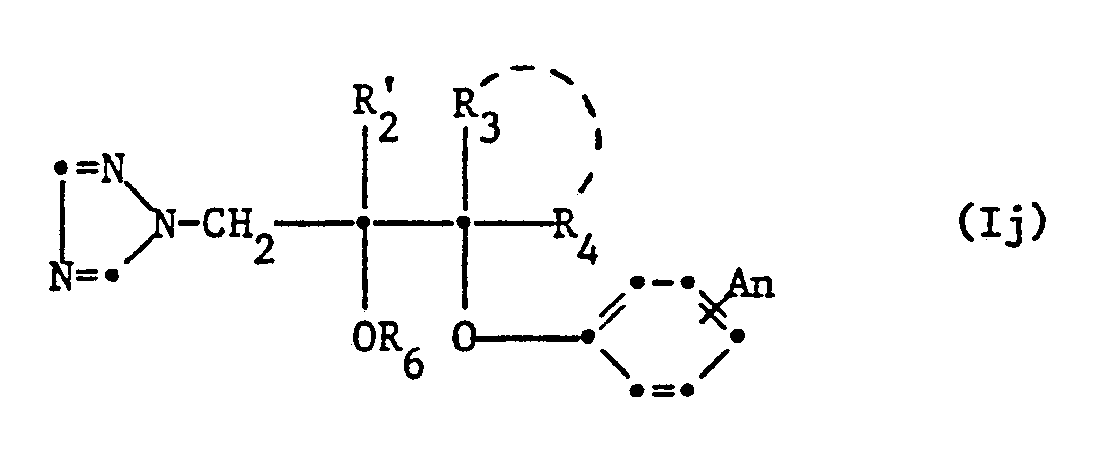

Applications Claiming Priority (2)
| Application Number | Priority Date | Filing Date | Title |
|---|---|---|---|
| CH240/82 | 1982-01-15 | ||
| CH24082 | 1982-01-15 |
Publications (2)
| Publication Number | Publication Date |
|---|---|
| EP0086173A1 EP0086173A1 (de) | 1983-08-17 |
| EP0086173B1 true EP0086173B1 (de) | 1986-09-03 |
Family
ID=4182480
Family Applications (1)
| Application Number | Title | Priority Date | Filing Date |
|---|---|---|---|
| EP83810007A Expired EP0086173B1 (de) | 1982-01-15 | 1983-01-10 | Fungizid wirkende und den Pflanzenwuchs regulierende Triazolcarbinolderivate |
Country Status (6)
| Country | Link |
|---|---|
| EP (1) | EP0086173B1 (de) |
| JP (1) | JPS58124772A (de) |
| BR (1) | BR8300177A (de) |
| DE (1) | DE3365739D1 (de) |
| IL (1) | IL67677A (de) |
| ZA (1) | ZA83250B (de) |
Families Citing this family (16)
| Publication number | Priority date | Publication date | Assignee | Title |
|---|---|---|---|---|
| DE3202604A1 (de) * | 1982-01-27 | 1983-08-04 | Bayer Ag, 5090 Leverkusen | Ether-derivate von substituierten 1-hydroxyalkyl-azolen, verfahren zu ihrer herstellung sowie ihre verwendung als fungizide und pflanzenwachstumsregulatoren |
| US4533659A (en) * | 1982-06-09 | 1985-08-06 | Ciba-Geigy Corporation | Microbicidal 2-(1H-1,2,4-triazolylmethyl-1'-yl)-2-siloxy-2-phenyl-acetates |
| EP0145663B1 (de) * | 1983-12-08 | 1989-06-21 | Ciba-Geigy Ag | 1-Di- oder Triazo1-2,3-diphenyl-propan-2,3-diole als Herbizide und Wuchsregulatoren |
| CN1008735B (zh) * | 1984-11-02 | 1990-07-11 | 拜尔公司 | 以取代的氮杂茂基甲基-环丙基-甲醇衍生物为活性成分的组合物 |
| NL8601189A (nl) * | 1985-05-23 | 1986-12-16 | Sandoz Ag | Nieuwe azoolderivaten, werkwijzen voor het bereiden van deze derivaten en voor hun toepassing. |
| GB8603951D0 (en) * | 1986-02-18 | 1986-03-26 | Ici Plc | Heterocyclic compounds |
| DE3608792A1 (de) * | 1986-03-15 | 1987-09-24 | Hoechst Ag | 1,1-disubstituierte cyclopropanderivate, verfahren zu ihrer herstellung und ihre verwendung |
| DE3630129A1 (de) * | 1986-09-04 | 1988-03-17 | Bayer Ag | Mercapto-substituierte hydroxyethyl-(triazol-1-yl)-derivate |
| DE3720756A1 (de) * | 1987-06-24 | 1989-01-05 | Bayer Ag | Azolylmethyl-cyclopropyl-carbinol-derivate |
| IE903395A1 (en) * | 1989-09-26 | 1991-04-10 | Takeda Chemical Industries Ltd | Triazole compounds, their production and use |
| DE3942417A1 (de) * | 1989-12-21 | 1991-06-27 | Bayer Ag | Triazolylmethyl-cyclopropyl-derivate |
| CA2031892C (en) * | 1989-12-25 | 2000-08-01 | Minoru Tokizawa | Triazole derivatives |
| NO913302L (no) * | 1990-08-26 | 1992-03-02 | Sankyo Co | Anti-fungale triazolderivater, samt fremstilling og anvendelse derav |
| US5188683A (en) * | 1991-04-22 | 1993-02-23 | The Goodyear Tire & Rubber Company | Pneumatic tire for agricultural or logging use |
| EA021808B1 (ru) * | 2009-07-08 | 2015-09-30 | Байер Интеллектуэль Проперти Гмбх | Производные фенил(окси/тио)алканола, способ борьбы с фитопатогенными вредными грибами, средство для борьбы с фитопатогенными вредными грибами и способы получения производных фенил(окси/тио)алканола |
| BR112012000170A2 (pt) | 2009-07-08 | 2019-09-24 | Bayer Cropscience Ag | derivados de fenil (oxi/tio) alcanol substituídos |
Family Cites Families (5)
| Publication number | Priority date | Publication date | Assignee | Title |
|---|---|---|---|---|
| US4036970A (en) * | 1975-07-28 | 1977-07-19 | Syntex (U.S.A.) Inc. | Imidazol-1-yl propane derivatives |
| US4036974A (en) * | 1975-07-28 | 1977-07-19 | Syntex (U.S.A.) Inc. | 1-{2'-[R'-Thio(oxy)]-3'-(R2 -thio(oxy)]propyl}imidazoles |
| US4036973A (en) * | 1975-07-28 | 1977-07-19 | Syntex (U.S.A.) Inc. | Imidazol-1-yl propane derivatives |
| EP0052424B2 (de) * | 1980-11-19 | 1990-02-28 | Imperial Chemical Industries Plc | Triazol-Derivate, Verfahren zu ihrer Herstellung, ihre Verwendung als Pflanzenfungizide und diese enthaltende Fungizide |
| DE3279417D1 (en) * | 1981-03-18 | 1989-03-09 | Ici Plc | Triazole compounds, a process for preparing them, their use as plant fungicides and fungicidal compositions containing them |
-
1983
- 1983-01-10 DE DE8383810007T patent/DE3365739D1/de not_active Expired
- 1983-01-10 EP EP83810007A patent/EP0086173B1/de not_active Expired
- 1983-01-13 IL IL67677A patent/IL67677A/xx unknown
- 1983-01-14 BR BR8300177A patent/BR8300177A/pt unknown
- 1983-01-14 JP JP58005160A patent/JPS58124772A/ja active Pending
- 1983-01-14 ZA ZA83250A patent/ZA83250B/xx unknown
Also Published As
| Publication number | Publication date |
|---|---|
| IL67677A0 (en) | 1983-05-15 |
| ZA83250B (en) | 1983-10-26 |
| BR8300177A (pt) | 1983-10-11 |
| DE3365739D1 (en) | 1986-10-09 |
| IL67677A (en) | 1986-02-28 |
| EP0086173A1 (de) | 1983-08-17 |
| JPS58124772A (ja) | 1983-07-25 |
Similar Documents
| Publication | Publication Date | Title |
|---|---|---|
| EP0275955B1 (de) | Mikrobizides Mittel | |
| EP0297345B2 (de) | Azolylmethyl-cyclopropyl-Derivate | |
| EP0040350B1 (de) | Neue Azolverbindungen, ihre Herstellung, ihre Verwendung zur Pflanzenbehandlung und Mittel dafür | |
| EP0126430B1 (de) | Verfahren zur Herstellung von 1-Triazolylethylether-Derivaten, sowie mikrobizide Mittel enthaltende neue 1-triazolyl-phenoxyphenylethylether-derivate als Wirkstoffe und deren Verwendung | |
| EP0015387B1 (de) | 1-Vinyltriazol-Derivate, Verfahren zu ihrer Herstellung sowie ihre Verwendung als Wachstumsregulatoren und Fungizide | |
| EP0085333B1 (de) | Ether-Derivate von substituierten 1-Hydroxyalkyl-azolen, Verfahren zu ihrer Herstellung sowie ihre Verwendung als Fungizide und Pflanzenwachstumsregulatoren | |
| EP0114567B1 (de) | 1-Carbonyl-1-phenyl-2-azolyl-ethanol Derivate als Mikrobizide und Wuchsregulatoren, sowie ihre Zwischenprodukte | |
| EP0040345A1 (de) | 1-Hydroxyethyl-azol-Derivate, Verfahren zu ihrer Herstellung sowie ihre Verwendung als Pflanzenwachstumsregulatoren und Fungizide | |
| EP0086173B1 (de) | Fungizid wirkende und den Pflanzenwuchs regulierende Triazolcarbinolderivate | |
| DD208752A5 (de) | Pflanzenschutzmittel, verfahren zu ihrer herstellung sowie verwendung von substituierten 1--hydroxyalkyl-azolyl-derivaten | |
| DE3224129A1 (de) | Substituierte azolyl-ketone und -alkohole | |
| EP0044425B1 (de) | Halogenierte Triazolylvinyl-keto- und -carbinol-Derivate, Verfahren zu ihrer Herstellung sowie ihre Verwendung als Pflanzenwachstumsregulatoren und Fungizide | |
| EP0091398B1 (de) | Mikrobizide und wuchsregulierende Azolylpropan-Derivate | |
| EP0112292B1 (de) | Neue Wuchsregulatoren und Mikrobizide | |
| EP0070798A2 (de) | Mikrobizide und wuchsregulierende Mittel | |
| EP0116262B1 (de) | Fluorazolyl-propanol-Derivate als Mikrobizide und wuchsregulierende Mittel | |
| DE2943631A1 (de) | Azolylketale, verfahren zu ihrer herstellung und ihre verwendung als mikrobizide | |
| EP0044276A2 (de) | 4-(1H-Azolylmethyl)-1,3-dioxolan-5-on-derivate, Verfahren zu deren Herstellung und deren Verwendung als wachstumsregulierende und/oder mikrobizide Mittel | |
| EP0113644A2 (de) | Halogenazolyl-propan-Derivate als mikrobizide und wuchsregulierende Mittel | |
| EP0229642A2 (de) | Azolverbindungen und diese enthaltende Fungizide und Wachstumsregulatoren | |
| EP0089920B1 (de) | Mikrobizide und wuchsregulierende Mittel | |
| EP0145663B1 (de) | 1-Di- oder Triazo1-2,3-diphenyl-propan-2,3-diole als Herbizide und Wuchsregulatoren | |
| EP0228343A2 (de) | Mikrobizide 2-(1-Triazolyl)1-phenyl-ethanon-(1)-Ketalderivate | |
| DE3224186A1 (de) | Mikrobizide und wuchsregulierende mittel | |
| EP0060962A1 (de) | Mikrobizide Triazolylmethyldioxolane und deren Herstellung |
Legal Events
| Date | Code | Title | Description |
|---|---|---|---|
| PUAI | Public reference made under article 153(3) epc to a published international application that has entered the european phase |
Free format text: ORIGINAL CODE: 0009012 |
|
| 17P | Request for examination filed |
Effective date: 19830112 |
|
| AK | Designated contracting states |
Designated state(s): BE CH DE FR GB IT LI NL |
|
| GRAA | (expected) grant |
Free format text: ORIGINAL CODE: 0009210 |
|
| AK | Designated contracting states |
Kind code of ref document: B1 Designated state(s): BE CH DE FR GB IT LI NL |
|
| REF | Corresponds to: |
Ref document number: 3365739 Country of ref document: DE Date of ref document: 19861009 |
|
| ITF | It: translation for a ep patent filed | ||
| ET | Fr: translation filed | ||
| PGFP | Annual fee paid to national office [announced via postgrant information from national office to epo] |
Ref country code: NL Payment date: 19870131 Year of fee payment: 5 |
|
| PLBE | No opposition filed within time limit |
Free format text: ORIGINAL CODE: 0009261 |
|
| STAA | Information on the status of an ep patent application or granted ep patent |
Free format text: STATUS: NO OPPOSITION FILED WITHIN TIME LIMIT |
|
| 26N | No opposition filed | ||
| PG25 | Lapsed in a contracting state [announced via postgrant information from national office to epo] |
Ref country code: GB Effective date: 19890110 |
|
| PG25 | Lapsed in a contracting state [announced via postgrant information from national office to epo] |
Ref country code: LI Effective date: 19890131 Ref country code: CH Effective date: 19890131 Ref country code: BE Effective date: 19890131 |
|
| BERE | Be: lapsed |
Owner name: CIBA-GEIGY A.G. Effective date: 19890131 |
|
| PG25 | Lapsed in a contracting state [announced via postgrant information from national office to epo] |
Ref country code: NL Effective date: 19890801 |
|
| NLV4 | Nl: lapsed or anulled due to non-payment of the annual fee | ||
| GBPC | Gb: european patent ceased through non-payment of renewal fee | ||
| PG25 | Lapsed in a contracting state [announced via postgrant information from national office to epo] |
Ref country code: FR Free format text: LAPSE BECAUSE OF NON-PAYMENT OF DUE FEES Effective date: 19890929 |
|
| REG | Reference to a national code |
Ref country code: CH Ref legal event code: PL |
|
| PG25 | Lapsed in a contracting state [announced via postgrant information from national office to epo] |
Ref country code: DE Effective date: 19891003 |
|
| REG | Reference to a national code |
Ref country code: FR Ref legal event code: ST |