EP0085522B1 - Solvent extraction - Google Patents
Solvent extraction Download PDFInfo
- Publication number
- EP0085522B1 EP0085522B1 EP83300350A EP83300350A EP0085522B1 EP 0085522 B1 EP0085522 B1 EP 0085522B1 EP 83300350 A EP83300350 A EP 83300350A EP 83300350 A EP83300350 A EP 83300350A EP 0085522 B1 EP0085522 B1 EP 0085522B1
- Authority
- EP
- European Patent Office
- Prior art keywords
- hydroxy
- carbon atoms
- aldoxime
- formula
- copper
- Prior art date
- Legal status (The legal status is an assumption and is not a legal conclusion. Google has not performed a legal analysis and makes no representation as to the accuracy of the status listed.)
- Expired
Links
Classifications
-
- C—CHEMISTRY; METALLURGY
- C01—INORGANIC CHEMISTRY
- C01G—COMPOUNDS CONTAINING METALS NOT COVERED BY SUBCLASSES C01D OR C01F
- C01G3/00—Compounds of copper
- C01G3/003—Preparation involving a liquid-liquid extraction, an adsorption or an ion-exchange
-
- C—CHEMISTRY; METALLURGY
- C22—METALLURGY; FERROUS OR NON-FERROUS ALLOYS; TREATMENT OF ALLOYS OR NON-FERROUS METALS
- C22B—PRODUCTION AND REFINING OF METALS; PRETREATMENT OF RAW MATERIALS
- C22B3/00—Extraction of metal compounds from ores or concentrates by wet processes
- C22B3/20—Treatment or purification of solutions, e.g. obtained by leaching
- C22B3/26—Treatment or purification of solutions, e.g. obtained by leaching by liquid-liquid extraction using organic compounds
- C22B3/30—Oximes
-
- C—CHEMISTRY; METALLURGY
- C22—METALLURGY; FERROUS OR NON-FERROUS ALLOYS; TREATMENT OF ALLOYS OR NON-FERROUS METALS
- C22B—PRODUCTION AND REFINING OF METALS; PRETREATMENT OF RAW MATERIALS
- C22B3/00—Extraction of metal compounds from ores or concentrates by wet processes
- C22B3/20—Treatment or purification of solutions, e.g. obtained by leaching
- C22B3/26—Treatment or purification of solutions, e.g. obtained by leaching by liquid-liquid extraction using organic compounds
- C22B3/306—Ketones or aldehydes
-
- Y—GENERAL TAGGING OF NEW TECHNOLOGICAL DEVELOPMENTS; GENERAL TAGGING OF CROSS-SECTIONAL TECHNOLOGIES SPANNING OVER SEVERAL SECTIONS OF THE IPC; TECHNICAL SUBJECTS COVERED BY FORMER USPC CROSS-REFERENCE ART COLLECTIONS [XRACs] AND DIGESTS
- Y02—TECHNOLOGIES OR APPLICATIONS FOR MITIGATION OR ADAPTATION AGAINST CLIMATE CHANGE
- Y02P—CLIMATE CHANGE MITIGATION TECHNOLOGIES IN THE PRODUCTION OR PROCESSING OF GOODS
- Y02P10/00—Technologies related to metal processing
- Y02P10/20—Recycling
Definitions
- the present invention relates generally to solvent extraction processes for recovery of copper values from aqueous solutions and, more particularly, to improved solvent extraction reagents and their use in recovery of, e.g., copper values.
- the starting material for large scale solvent extraction processing of copper is an aqueous leach solution obtained from a body of ore which contains a mixture of metals in addition to copper.
- the leaching medium dissolves salts of copper and other metals as it trickles through the ore, to provide an aqueous solution of the mixture of metal values.
- the metal values are usually leached with sulfuric acid medium, providing an acidic aqueous solution, but can also be leached by ammonia to provide a basic aqueous solution.
- the aqueous solution is mixed in tanks with an extraction reagent which is dissolved in an organic solvent, e.g., a kerosene.
- the reagent includes an extractant chemical which selectively forms metal-extractant complex with the ions of the metal to be recovered, e.g. copper ions, in preference to ions of other metals.
- the step of forming the complex is called the extraction or loading stage of the solvent extraction process.
- the outlet of the mixer continuously feeds to a large settling tank, where the organic solvent (organic phase), now containing the metal-extractant, e.g. copper-extractant, complex in solution, is separated from the depleted aqueous solution (aqueous phase).
- organic phase now containing the metal-extractant, e.g. copper-extractant, complex in solution
- phase separation usually, the process of extraction is repeated through two or more mixer/settler stages, in order to more completely extract the desired metal.
- the depleted aqueous feedstock (raffinate) is either discharged or recirculated to the ore body for further leaching.
- the loaded organic phase containing the dissolved metal-extractant, e.g. copper-extractant, complex is fed to another set of mixer tanks, where it is mixed with an aqueous strip solution of concentrated sulfuric acid.
- the highly acid strip solution breaks apart the metal-extractant complex and permits the purified and concentrated metal to pass to the strip aqueous phase.
- the mixture is fed to another settler tank for phase separation. This process of breaking the metal-extractant complex is called the stripping stage, and the stripping operation is repeated through two or more mixer-settler stages to more completely strip the metal, e.g. copper, from the organic phase.
- the regenerated stripped organic phase is recycled to the extraction mixers to begin extraction again, and the strip aqueous phase is customarily fed to an electrowinning tankhouse, where the metal values, e.g. copper values, are deposited on plates by a process of electrodeposition.
- the solution known as spent electrolyte, is returned to the stripping mixers to begin stripping again.
- Reagents frequently employed in commercial processes for copper recovery are included among those offered by Henkel Corporation under their LIX° trademark viz., LIX° 63, LIX ® 65N, LIX ® 64, LIX ® 64N, LIX ® 70, LIX® 71, LIX ® 73, LIX ® 34, LIX ® 54, LIX ® 605, LIX® 617, LIX® 622 and LIX® 6022.
- LIX ® 63 includes, in addition to a liquid hydrocarbon diluent, an aliphatic a-hydroxy oxime extractant (5,8-diethyl-7-hydroxy-dodecan-6-oxime) of the type illustrated in Swanson U.S. Patent 3,224,873.
- LIX ® 65N includes an alkyl substituted hydroxy benzophenone oxime (2-hydroxy-5-nonyl benzophenone oxime) as set out in Swanson U.S. Patent No.
- LIX® 64 and 64N incorporate benzophenone oxime extractants (2-hydroxy-5-dodecyl benzophenone oxime and 2-hydroxy-5-nonyl benzophenone oxime, respectively) in combination with an aliphatic a-hydroxy oxime as described in U.S. Patent No. 3,428,449.
- Formulation of LIX ® 70 involves combination of a benzophenone oxime extractant containing an electron withdrawing substituent (2-hydroxy-3-chloro-5-nonyl benzophenone oxime) with an aliphatic a-hydroxy oxime.
- LIX ® 71 and LIX ® 73 formulations both include a mixture of two benzophenone oximes, one of which has an electron withdrawing substituent (i.e., a mixture of 2-hydroxy-5-nonyl benzophenone oxime and 2-hydroxy-3-chloro-5-nonyl benzophenone oxime) with the latter reagent further including an aliphatic a-hydroxy oxime.
- LIX ® 34 and LIX ® 54 incorporate alkaryl sulfonamido quinoline and ß-diketone extractants, respectively.
- LIX ® 605, LIX ® 617, LlX® 622 and LIX ® 6022 employ alkyl substituted hydroxy benzaldoxime (salicylaldoxime) extractants according to Parrish, J. South African Chem. Inst., 23, pp. 129-135 (1970).
- LIX° 605 and LIX° 617 include 2-hydroxy-5-nonyl benzaldoxime extractants with, respectively, nonylphenol and tridecanol additives.
- LIX° 622 and LIX ⁇ 6022 comprise formulations of 2-hydroxy-5-dodecyl benzaldoxime and a tridecanol additive in approximately 4:1 and 1:1 ratios by weight, respectively.
- ACORGA PT-5050 is offered for sale by Acorga, Ltd., Hamilton, Bermuda, as a formulation comprising 2-hydroxy-5-nonyl benzaldoxime and a tridecanol additive in an approximately 2:1 ratio by weight. (See also, Ackerley, et al., U.S. Patent 4,020,105; Ackerley, et al., U.S. Patent 4,020,106; and Dalton, U.S. Patent 4,142,952).
- reagents offered for commercial use in copper recovery by solvent extraction have included extractants of the hydroxy phenyl benzyl ketone oxime type (e.g., 2-hydroxy-5-nonyl phenyl benzyl ketoxime as illustrated in Anderson, U.S. Patent No. 4,029,704, and offered for sale as P-17 by Acorga, Ltd.) and the hydroxy phenyl alkyl ketone oxime type (e.g., 2-hydroxy-5-nonyl phenyl methyl ketone oxime as described in U.K. Patent 1,322,532 and offered for sale as SME 529 and SME 530 by Shell Chemical Company).
- SME 529 and SME 530 differ in that the latter contains an ⁇ , ⁇ -dioxime additive.
- KELEX @ 100 and KELEX° 120 reagents of Ashland Chemical Company which have included an hydroxy quinoline extractant (7-[3-(5,5,7,7-tetramethyl-1-octenyl)]-8-hydroxyquinoline as described in Buddie, et al., U.S. Patent No. 3,637,711) either with a nonylphenol additive (KELEX O 120 as described in Hartiage, U.S. Patent No. 3,725,046) or without the additive (KELEX @ 100).
- additive chemicals are included in commercial copper extraction reagents. Principal among the additives incorporated in the reagents are (1) kinetic additives and (2) modifiers of extraction and stripping equilibria.
- the kinetic additives (frequently referred to as “accelerators”, “catalysts”, “kinetic catalysts” or “kinetic synergists”) may be defined as chemical substances included in solvent extraction reagents for the purpose of increasing the rate of transfer of metal values between organic and aqueous phases without materially affecting the position of equilibrium.
- Kinetic additives function to alter transfer rates in a variety of ways which are as yet far from completely understood.
- Reagent formulations such as LIX® 64N incorporate a major proportion of benzophenone oxime and a minor proportion of an aliphatic a-hydroxy oxime with the result that the rate of extraction for the reagent under specified conditions may be significantly greater than that of the benzophenone oxime alone.
- Modifiers of extraction and stripping equilibria are frequently incorporated in those commercial reagent formulations which include the so-called "strong" extractants. Such extractants are capable of forming a very stable complex association with copper at quite low pH's and, consequently, require the use of very highly acidic aqueous stripping solutions in order to effect the breakdown of the copper-extractant complex. Where extreme acidity of stripping solutions generates problems in employing conventional electrodeposition processes, modifiers are incorporated to shift equilibria in a manner facilitating stripping at lower acidities and to enhance overall metal extraction efficiency. A wide variety of modifier chemicals has been proposed for use in formulation of solvent extraction reagents for copper.
- long chain (C 6 to C 20 ) aliphatic alcohols such as isodecanol, 2-ethylhexanol, and tridecanol
- long chain alkyl phenols such as nonylphenol (see, e.g., Hartlage, U.S. Patent 3,725,046)
- organophosphorous compounds such as tributylphosphate (see, e.g., Ritcey, et al., Transactions of the International Solvent Extraction Conference, 1974, pp. 2437-2481).
- Equilibrium modifiers most frequently employed in commercial reagents include nonylphenol (e.g., LIX' 9 120, LIX° 605) and tridecanol (e.g., LIX ® 617, LIX° 622, LIX ® 6022, PT-5050).
- nonylphenol e.g., LIX' 9 120, LIX° 605
- tridecanol e.g., LIX ® 617, LIX° 622, LIX ® 6022, PT-5050.
- kinetic additives and equilibrium modifiers has not been without drawbacks in the overall efficiency of solvent extraction processes in terms of the long range stability of reagents and the sensitivity of reagents to contaminants in aqueous feedstocks.
- minor proportion of kinetic additive present with the hydroxy aryl ketoxime extractant in the LIX O 64N reagent formulation provides for kinetic enhancement in the use of the ketoxime, the additive is less stable toward hydrolytic degradation than the ketoxime.
- the aliphatic a-hydroxy oxime thus tends to be depleted from continuous systems more rapidly than the ketoxime.
- hydroxy aryl aldoxime extractants are less stable in use than ketoximes and are rendered even more unstable by the presence of large quantities of nonylphenol or other alcoholic modifiers.
- Alkyl phenol equilibrium modifiers when entrained in aqueous phases have been noted to have severe deleterious effects on structural components of solvent extraction facilities, such as rubber linings, fittings, valves and the like.
- leach solutions containing dissolved silica frequently tend to form emulsions with active metal extractants and their diluents and the sensitivity of reagents to silica has been noted to be enhanced by the presence of equilibrium modifiers.
- reagents which include minimal quantities of kinetic additives and/or equilibrium modifiers (or none of these additives at all) are among the most preferred and sought-after for commercial use in recovery of copper.
- Ashbrook, et al., U.S. Patent No. 3,455,680 states that superior copper extraction results are obtained through use of assertedly synergistic combinations of aliphatic a-hydroxy oxime extractants and organophosphoric acid extractants. More particularly, the mixture of the two "weak" extractants, which ordinarily form stable copper-extractant complexes at relatively high acid pH's, is said to provide for more efficient extraction at lower pH levels than can be obtained with either extractant alone with the apparent elimination of the need for equilibrium modification.
- German Offenlegungsschrift 2,407,200 states that mixtures of two or more hydroxyphenyl alkyl ketoximes (of the type disclosed in the previously-noted U.K. Patent No.
- 1,322,532 are distinguished by greatly improved extraction kinetics over the individual components and the apparent elimination of the need for use of kinetic additives.
- U.K. 1,537,828 asserts that synergistic kinetic effects attend incorporation of hydrocarbyl hydroxymethyl ketone oximes in reagent formulations including 2-hydroxy phenyl alkyl ketone oximes and/or 2-hydroxy phenyl aldoximes and/or 2-hydroxy benzophenone oximes.
- the report cites experimental studies relating to a proposed plant changeover from a "present generation [LIX® 64N] oxime" to a benzaldoxime reagent having a 3:1 nonylphenol/oxime weight ratio (ACORGA P-5300).
- US-Patent 4173616 discloses the use of ⁇ , ⁇ -dioximes such as a mixture of 1-(4'-alkylphenyl)-1,2-propanedione dioximes in combination with mixed ketoximes and aldoximes.
- the US-Patent is silent on extraction and stripping equilibrium modifier substances and merely comprises ⁇ , ⁇ -dioximes and the use of these oximes without further additives.
- One object of the present invention is therefore to provide a composition useful for extracting copper from an aqueous solution and containing a reagent composition comprising:
- Preferred compounds of Formula I are those wherein a is 1, b is 0, R is a straight or branched chain alkyl group having from 7 to 12 carbon atoms, and wherein R is attached in a position para to the hydroxyl group. Among these, the more preferred are those wherein R is a mixture of isomers.
- Preferred compounds of Formula II are those wherein R'" is methyl and R and a are as designated as being preferred for compounds of Formula I.
- Compounds of Formulae I and II which are especially useful in practice of the invention include: 2-hydroxy-5-nonyl benzophenone oxime; 2-hydroxy-5-dodecyl benzophenone oxime; 2-hydroxy-5-nonyl phenyl benzyl ketone oxime; and 2-hydroxy-5-nonyl phenyl methyl ketone oxime.
- Preferred hydroxy aryl aldoxime extractants of Formula III useful in formulation of reagents of the invention are those wherein c is 1, R is a straight or branched chain alkyl group having from 7 to 12 carbon atoms, and wherein R is attached in a position para to the hydroxyl group. Among these, the more preferred are those wherein R is a mixture of isomers.
- Compounds of Formula III which are especially useful in practice of the invention include 2-hydroxy-5-heptyl benzaldoxime, 2-hydroxy-5-octyl benzaldoxime, 2-hydroxy-5-nonyl benzaldoxime and 2-hydroxy-5-dodecyl benzaldoxime.
- Reagents of the invention comprise mixtures of one or more ketoximes of Formulae I and 11 with one or more aldoximes of Formula III in molar ratios ranging from 1:100 to 100:1 and preferably from 1:4 to 4:1 with particularly good results being obtained at ratios of 1:1.
- Kinetic additive substances may be present in amounts ranging from 0 to 20 mole percent based on ketoxime content and preferably about 5 mole percent.
- Preferred kinetic additives include a-hydroxy oximes described in Swanson, U.S. Patent 3,224,873 and ⁇ , ⁇ -dioximes described in Koenders, et al., U.S. Patent 4,173,616.
- Equilibrium modifiers may be present in amounts providing a degree of modification of the aldoxime component of from about 0.66 to 1.0 and preferably from about 0.75 to 0.99.
- Preferred equilibrium modifier chemicals include aliphatic alcohols such as tridecanol, alkyl phenols such as nonyl-phenol and organophosphorus compounds such as tributyl phosphate.
- Reagent formulations may optionally include a diluent substance.
- the reagents as above-described may be used in the recovery of metal values, especially copper values, from aqueous solutions by solvent extraction processing.
- n has a value of 0 i.e., hydroxy benzophenone oxime compounds
- preferred benzophenone oxime compounds of Formula I include those having a single alkyl ring substituent having from 7 to 12 carbon atoms in a position para to the hydroxyl group, which alkyl substituent is a mixture of isomers.
- Examples of such compounds are 2-hydroxy-5-nonyl benzophenone oxime and 2-hydroxy-5-dodecyl benzophenone oxime which are obtained as mixtures of alkyl isomeric forms when commercial nonylphenol and dodecyl phenol are respectively employed in their synthesis.
- phenyl benzyl ketone oximes like the above-noted benzophenone oximes, are those having an isomeric mixture of 7 to 12 carbon alkyl groups as a single substituent on the ring para to the hydroxyl group.
- phenyl benzyl ketone oxime as manufactured from a commercial nonylphenol comprising a mixture of nonyl isomeric forms.
- phenyl alkyl ketone oxime compounds may suitably be prepared according to the procedures disclosed in U.K. Patent No. 1,322,532.
- preferred phenyl alkyl ketone oxime compounds of Formula II are those having an isomeric mixture of 7 to 12 carbon alkyl groups as a single substituent on the ring para to the hydroxyl group.
- R'" alkyl group is methyl. Consequently, illustrative of preferred phenyl alkyl ketone oxime compounds is 2-hydroxy-5-nonyl phenyl methyl ketone oxime manufactured through use of commercial nonylphenol.
- Compounds of Formula III may suitably be prepared according to the methods described in Ackerley, et al., U.S. Patent No. 4,020,105 or Ackerley, et al., U.S. Patent No. 4,020,106 or by oximation of aldehydes prepared according to Beswick, U.S. Patent No. 4,085,146.
- preferred compounds are those having an isomeric mixture of isomeric 7 to 12 carbon alkyl groups as a single substituent para to the hydroxyl group.
- Preparation of the reagents according to the invention involves preparing an admixture of one or more hydroxy aryl ketoxime compounds of Formula I and/or II with one or more hydroxy aryl aldoxime compounds of Formula III in molar ratios of ketoxime to aldoxime ranging from 1:100 to 100:1 and preferably from about 1:4 to about 4:1 with particularly good results being obtained at ratios of 1:1.
- Reagents of the invention may optionally include an aliphatic, or aromatic, or mixed aliphatic/aromatic liquid hydrocarbon diluent of the kerosene type commonly employed in solvent extraction processing. Incorporation of a diluent frequently aids the transport and handling of the extractants which may be highly viscous.
- effective reagents for solvent extraction of copper may be prepared which include hydroxy aryl ketoxime extractants but which either do not include kinetic additive substances of the type commonly employed to enhance kinetic characteristics of such extractants or which include less of such kinetic additives than is ordinarily employed.
- reagents of the invention can include as much kinetic additive as is ordinarily employed in combination with an hydroxy aryl ketoxime extractant in commercial copper extraction processes, i.e., up to about 20 mole percent based on ketoxime content
- the incorporation of an hydroxy aryl aldoxime extractant in the reagent results in there being a lesser kinetic additive to total active hydroxy aryl oxime ratio than ordinarily present for effective recovery from a given copper-containing aqueous solution.
- This is expected to provide for diminished formulation costs and a lessened disparity in overall rates of hydrolytic degradation among reagent constituents.
- kinetic additives may be incorporated in reagent formulations of the invention in amounts ranging from 0 to 20 mole percent based on hydroxy aryl ketoxime content and preferably from about 0.01 to 5 mole percent, i.e. if present at all, as little as 0.01 mole percent of the kinetic additive may be used.
- Suitable kinetic additive substances include aliphatic a-hydroxy oximes prepared according to Swanson, U.S. Patent 3,224,873 or U.K. 1,537,828 and ⁇ , ⁇ -dioximes according to Koenders, et al., U.S. Patent 4,173,616.
- a preferred a-hydroxy oxime kinetic additive is 5,8-diethyl-7-hydroxydodecan-6-oxime and a preferred dioxime kinetic additive is a mixture of 1-(4'-alkylphenyl)-1,2-propanedione dioximes according to Example 3 of U.S. Patent No. 4,173,616.
- effective reagents for solvent extraction of copper may be prepared which include hydroxy aryl aldoxime extractants but which either do not include equilibrium modifier substances of the type commonly employed to alter aldoxime extraction and stripping equilibria or which include less of such modifiers than ordinarily employed.
- reagents of the invention may include as much equilibrium modifier as has been employed in combination with an hydroxy aryl aldoxime extractant in commercial copper extraction processes, the incorporation of an hydroxy aryl ketoxime extractant in the reagent will result in there being a lesser equilibrium modifier to total active hydroxy aryl oxime ratio than ordinarily present for the effective recovery of copper from a given copper-containing aqueous solution. This is expected to result in diminished acceleration of aldoxime degradation as brought about by reagent modifier chemicals as well as diminished susceptibility to the adverse effects of aqueous feedstock solution contaminants such as dissolved silicates.
- equilibrium modifier substances may be incorporated in reagent formulations of the invention in amounts providing a degree of modification of the hydroxyl aryl aldoxime constituent, in the absence of any hydroxy aryl ketoxime, of from about 0.66 to 1.0 and preferably from 0.75 to 0.99.
- Equilibrium modifiers suitable for use in the present invention include: long chain (preferably C S- C 2o ) aliphatic alcohols such as n-hexanol, n-octanol, 2-ethylhexanol, isodecanol, dodecanol, tridecanol, hexadecanol, and octadecanol; long chain alkylphenols such as heptylphenol, octylphenol, nonylphenol and dodecylphenol; and organophosphorus compounds such as triloweralkyl (C 4 to C a ) phosphates, especially, tributyl phosphate and tri(2-ethylhexyl)phosphate.
- long chain (preferably C S- C 2o ) aliphatic alcohols such as n-hexanol, n-octanol, 2-ethylhexanol, isodecanol, dode
- degree of modification designates the inverse ratio of (a) the stripped solvent copper value, level of an hydroxy aryl aldoxime extractant at equilibrium (expressed in terms of grams per liter of copper value extracted) with an aqueous solution containing a fixed concentration of the copper value and sulfuric acid to (b) the stripped solvent copper value level of the same extractant under the same conditions when a selected equilibrium modifier additive is present.
- the presence of relatively small quantities of an equilibrium modifier will shift the extraction equilibrium slightly, resulting in minor diminution of aldoxime stripped solvent copper value level at equilibrium, as will be reflected by a degree of modification value closely approaching 1.0, e.g., 0.99.
- Increased effective quantities of modifier under otherwise identical conditions will result in a more pronounced shift in extraction equilibrium and a more pronounced diminution of aldoxime stripper solvent copper value level at equilibrium, as will be reflected by a degree of modification corresponding less than 1.0.
- the degree of modification resulting from a given molar ratio of equilibrium modifier to aldoxime in a reagent will vary depending on such factors as the degree of purity of the extractant composition employed in formulation of the reagent, the aromaticity of the solvent, and, perhaps most significantly, the chemical identity of the equilibrium modifier employed. It will also depend significantly on the conditions involved in determination of stripped solvent copper value levels. Consequently, for purposes of determining degree of modification of an aldoxime by a given equilibrium modifier, the following test conditions should be adhered to.
- the temperature at which the determination for the degree of modification is made is about 24°C.
- the molar concentration of aldoxime (or mixture of aldoximes) in the diluent should be about 0.184 as determined by copper value loading and titration, an aldoxime stock of approximately 94 percent purity, with the remainder being substantially alkyl phenol starting material residue is employed, the diluent is Escaid @ 100 or a mixture of aliphatic and aromatic hydrocarbons closely approximating the constitution of Escaid° 100.
- An atomic absorption methodology is employed for determining copper value content.
- the composition of the strip solution is 150 g/I sulfuric acid and 30 g/I Cu +2 .
- the foregoing conditions are employed in determining degree of modification according to the invention because they represent conditions closely resembling those commonly existant in commercial solvent extraction facilities for recovery of copper.
- Tables I, II and III below provide an illustrative showing of the degree of modification provided by differing mole ratios of three representative equilibrium modifiers vis-a-vis a representative hydroxy aryl aldoxime. More specifically, the Tables provide the results of copper loading determinations of solutions of 2-hydroxy-5-nonyl benzaldoxime extractant alone and with varying quantities of nonylphenol, tridecanol and tributyl phosphate modifier.
- the stock benzaldoxime employed was preliminarily determined to be 94% pure (bytitration) with the remaining stock components principally comprising a nonylphenol residue from synthesis.
- the diluent employed was prepared by admixture of 20 volume percent of the highly aromatic kerosene solvent Exxon Aromatic 150 with 80 volume percent of the highly aliphatic kerosene solvent Escaid® 200 and thus closely resembled the constitution of the mixed aromatic/aliphatic kerosene solvent, Escaid® 100. Solutions were prepared to be 0.184 molar in active aldoxime (corresponding to a concentration of about 48.4 g/I).
- Table II presents the results of procedures addition of a tridecanol modifier to 2-hydroxy-5-nonyl benzaldoxime.
- Table III presents the results of procedures involving addition of a tributyl phosphate modifier to 2-hydroxy-5-nonyl benzaldoxime.
- an aldoxime employed in formulation of reagents of the invention is insufficiently soluble in Escaid 100 diluent to allow preparation of a 0.184 molar solution
- a more highly aromatic diluent can be employed to determine the degree of modification. It may be the case that an empirically determined translation factor may appropriately be applied to values determined to obtain degree of modification values corrected for diluent effects, but this had not been the case in the procedures performed to date.
- reagents comprehended by the present invention are seen to comprise mixtures of one or more hydroxyl aryl ketoxime extractants of Formulae I and/or II with one or more hydroxy aryl aldoxime extractants of Formula III, with ketoxime to aldoxime molar ratios of from 1:100 to 100:1.
- the reagents further comprise from 0 to 20 mole percent of a kinetic additive based on ketoxime content.
- the reagents also comprise a modifier of extraction and stripping in an amount providing a degree of modification of the aldoxime constituent of from about 0.66 to 1.0.
- reagents which consist of a mixture of specified aldoxime and ketoxime extractants and which include neither a kinetic additive (i.e., 0 mole percent kinetic additive based on ketoxime content) nor an added equilibrium modifier (i.e., a modifier content providing a degree of modification of 1.0).
- Comprehended by the present invention are processes for recovery of copper from an aqueous solution comprising: contacting the aqueous solution with an organic phase comprising a water immiscible organic solvent (such as liquid hydrocarbon) and a reagent as specified above to extract at least a portion of the copper values into the organic phase; separating the resultant copper-pregnant organic phase from the resultant copper-barren aqueous phase; and recovering copper values from the copper-pregnant organic phase.
- Processes of the present invention most advantageously further involve use of a kerosene solvent and stripping of copper values from the copper-pregnant organic phase by means of an acid.
- Aqueous solutions from which copper values may be recovered by processes are preferably acidic, having a pH of from about 0.5 to 7.0, but may also be basic.
- reagent formulations individually including three different hydroxy aryl aldoximes of Formula III (5-octyl-, 5-nonyl-, and 5-dodecyl salicylaldoxime) and three different hydroxy aryl ketoximes of Formulae I and II (2-hydroxy-5-nonyl benzophenone oxime, 2-hydroxy-5-nonyl phenyl benzyl ketone oxime and 2-hydroxy-5-nonyl phenyl methyl ketone oxime).
- Formula III 5-octyl-, 5-nonyl-, and 5-dodecyl salicylaldoxime
- hydroxy aryl ketoximes of Formulae I and II (2-hydroxy-5-nonyl benzophenone oxime, 2-hydroxy-5-nonyl phenyl benzyl ketone oxime and 2-hydroxy-5-nonyl phenyl methyl ketone oxime.
- representative kinetic additives (5,8-diethyl-7-hydroxy-4-dodecan-6-oxime according to U.S. Patent No. 3,224,873 and an ⁇ , ⁇ -dioxime according to U.S. Patent No. 4,173,616) are present and in some examples they are not included in the reagent.
- representative equilibrium modifiers (tridecanol, dodecylphenol) are present while in other examples no equilibrium modifier is present beyond small quantities of phenolic starting materials remaining as a residue in aldoxime stocks.
- This example relates to the properties of two extractant solutions (and reagents comprising mixtures of the solutions) wherein the active extractant chemical of one solution is a ketoxime of Formula I and the active extractant of the other is an aldoxime of Formula III.
- the reagent solutions tested were: (1) a 32 v/v percent solution of LlX @ 64N (0.36 molar in 2-hydroxy-5-nonyl benzophenone oxime and 0.0225 molar in 5-8-diethyl-7-hydroxydodecan-6-oxime) in Escaid @ 100; and (2) a 20 v/v percent solution of 2-hydroxy-5-nonyl benzaldoxime (0.32 molar and prepared using a 94% pure stock oxime) in Escaid @ 100.
- This Example relates to properties of two extractant solutions (and reagent mixtures of these solutions) wherein the active extractant in one is a ketoxime of Formula I and the active extractant of the other is an aldoxime of Formula III.
- the solutions tested were: (1) a 19.2 v/v percent solution of SME 530 (0.36 molar in 2-hydroxy-5-nonyl phenyl methyl ketone oxime and approximately 0.02 molar in an ⁇ , ⁇ -dioxime of the type illustrated in Example 3 of U.S. 4,173,616); and (2) a 2-hydroxy-5-nonyl benzaldoxime solution as in Example 1.
- Solutions were tested individually and as mixtures under the conditions and according to the procedures of Example 1. Experimental data set out in Table V below indicate significant departures in properties of mixed solution reagents as compared to those predicted on the basis of properties of unmixed solutions. -
- Example 1 was repeated using an hydroxy phenyl benzyl ketone oxime of Formula I (an 18 v/v percent solution Acorga P-17 reagent which contains about 60 weight/weight percent 2-hydroxy-5-nonyl phenyl benzyl ketone oxime in Kermac 627) in place of the indicated benzophenone oxime. Stripped organic data are set out in Table VI below.
- Example 1 was repeated but using a different hydroxy aryl aldoxime of Formula III in place of the aldoxime indicated.
- the aldoxime solution employed (#2) was a 20 v/v percent solution of 2-hydroxy-5-dodecyl benzaldoxime (0.32 molar) and 0.063 molar in dodecylphenol in Escaid 100.
- Experimental data obtained are set out in Table VII below.
- Example 1 was repeated using an aldoxime solution (in Escaid ® 100) which was 0.33 molar in 2-hydroxy-5-nonyl benzaldoxime and 0.23 molar in tridecanol. Experimental data obtained are set out in Table VIII below.
- Extractant solutions employed were: (1) a 0.36 molar solution of 2-hydroxy-5-nonyl benzophenone oxime in Escaid @ 100; and (2) a 0.32 molar solution of 2-hydroxy-5-nonyl benzaldoxime in Escaid ® 100.
- the individual solutions and reagent mixtures thereof were equilibrated with 2 acid copper solutions, one containing 180 g/l sulfuric acid and 30 g/I Cu +2 and the other containing 150 g/I sulfuric acid and 30 g/I Cu +2 , by contacting each organic 3 times with the proper fresh aqueous solution for 3 minutes each contact.
- Extractant solutions employed were: (1) a 12.4 weight/volume percent solution of 2-hydroxy-5-nonyl (0.36 molar) in Exxon Aromatic 150; and (2) an 8.25 weight/volume percent solution of 2-hydroxy-8-octyl benzaldoxime (0.26 M) in Exxon Aromatic 150.
- the aldoxime stock employed was prepared using a predominantly single isomeric form of octylphenol as a starting material and had a purity of 74%, with the balance of the stock predominantly octyl phenol starting material. Solutions and mixtures thereof were tested as in Example 1 and the stripped organic data obtained is set out in Table X below.
- Example 6 The organic solutions described in Example 6 were equilibrated with stripping solution as described in Example 1. 100 ml of the respective filtered organic solution and 100 ml of an aqueous solution containing 6.0 g/I Cu +2 , 3 g/I Fe +3 at a pH of 2.0, were carefully added to a 21/ 4 by 2 1 / 4 by.4 inch (5.72 x 5.72 x 10.16 cm) mixer box. Mixing at 1800 rpm's with a 1 1 / 4 inch (3.18 cm) impeller was started and samples of the emulsion removed at the indicated times. After the phases separated the organic phase was filtered and analyzed for copper. The results are shown below.
- the expected % equilibrium values for the 50/50 mix at 30 and 60. seconds are 82.3 and 88.7, respectively, thus the 50/50 mix extracts copper at a faster rate than expected.
- Example 3 The organic solutions described in Example 3 were studied kinetically.using the method described in Example 8. The results are shown below.
- the 30 and 60 second % equilibrium expected values for the 50/50 mix would be 82.8 and 89.8% respectively, thus the kinetics of the 50/50 mix are significantly faster than expected.
- This example relates to the properties of two extractant solutions (and of mixtures of these solutions) wherein the active extractant chemicals of both are hydroxy aryl ketoximes comprehended by Formulas I or II and wherein no hydroxy aryl aldoxime extractant of Formula III is included.
- the solutions tested were: (1) a 32 v/v percent solution of LIX ® 64N (0.36 molar in 2-hydroxy-5-nonyl benzophenone oxime and 0.0225 molar in 5-8-diethyl-7-hydroxydodecan-6-oxime) in Escaid ® 100; and (2) a 19.2 v/v percent solution of SME 530 (as described in Example 2, above) in Escaid @ 100.
- This example relates to properties of two extractant solutions (and of mixtures of these solutions) wherein the active extractant in one is an hydoxy aryl aldoxime of Formula I and the active extractant of the other is an hydroxy aryl ketoxime not comprehended by Formulas I and II.
- the solutions tested were: (1) a 31 v/v percent solution of LIX ® 70 (0.35 molar in 2-hydroxy-3-chloro-5-nonyl benzophenone oxime and 0.0218 molar in Escaid® 100; and (2) a 20 v/v percent solution of 94 percent acitve 2-hydroxy-5-nonyl benzaldoxime (0.32 molar) in Escaid @ 100.
- the reagents solutions tested were: (1) 25 v/v percent solution of LIX ® 64N (0.28 molar in 2-hydroxy-5-nonyl benzophenone oxime and 0.0176 molar in 5-8-diethyl-7-hydroxy dodecan-6-oxime); and (2) v/v percent solution of Acorga P-5300 (0.225 molar in 2-hydroxy-5-nonyl benzaldoxime and 0.80 molar in nonylphenol modifier) in Ecaid @ 100.
- Reagent solutions were reported to have been tested individually and as mixtures in volume/volume ratios of 75/25, 50/50 and 25/75 under specified conditions. Stripped organic values from Table 4 of the publication are set out in Table XV below and indicate no significant 'departure in properties of the mixed solutions from those properties predicted on the basis of results for the individual solutions.
- the reagent solutions tested were: (1) a 7 v/v percent solution of LIX ® 64N (0.079 molar in 2-hydroxy-5-nonyl benzophenone oxime and 0.005 molar in 5,8-diethyl-7-hydroxydodecan-6-oxime) in Escaid O 100; and (2) a 7 v/v percent solution of Kelex 100 (0.175 molar in 7-[3-(5,5,7,7-tetramethyl-1-octenyl)]-8-hydroxyquinoline) in Escaid @ 100.
- Reagent solutions were reported to have been tested individually and as mixtures in volume/volume ratios of 10/90, 30/70, 50/50, 70/30 and 90/10 under specified conditions.
- Example 1 through 9 illustrate reagents of the invention comprising mixtures of a single hydroxy aryl ketoxime extractant and a single hydroxy aryl aldoxime, reagents comprising more than one ketoxime and/or more than one aldoxime are certainly contemplated.
Landscapes
- Chemical & Material Sciences (AREA)
- Engineering & Computer Science (AREA)
- Organic Chemistry (AREA)
- Metallurgy (AREA)
- Geology (AREA)
- Geochemistry & Mineralogy (AREA)
- Manufacturing & Machinery (AREA)
- General Life Sciences & Earth Sciences (AREA)
- Materials Engineering (AREA)
- Mechanical Engineering (AREA)
- Life Sciences & Earth Sciences (AREA)
- Environmental & Geological Engineering (AREA)
- Inorganic Chemistry (AREA)
- Manufacture And Refinement Of Metals (AREA)
- Saccharide Compounds (AREA)
- Extraction Or Liquid Replacement (AREA)
- Medicines Containing Material From Animals Or Micro-Organisms (AREA)
- Amplifiers (AREA)
- Detergent Compositions (AREA)
- Fats And Perfumes (AREA)
Abstract
Description
- The present invention relates generally to solvent extraction processes for recovery of copper values from aqueous solutions and, more particularly, to improved solvent extraction reagents and their use in recovery of, e.g., copper values.
- The starting material for large scale solvent extraction processing of copper is an aqueous leach solution obtained from a body of ore which contains a mixture of metals in addition to copper. The leaching medium dissolves salts of copper and other metals as it trickles through the ore, to provide an aqueous solution of the mixture of metal values. The metal values are usually leached with sulfuric acid medium, providing an acidic aqueous solution, but can also be leached by ammonia to provide a basic aqueous solution.
- The aqueous solution is mixed in tanks with an extraction reagent which is dissolved in an organic solvent, e.g., a kerosene. The reagent includes an extractant chemical which selectively forms metal-extractant complex with the ions of the metal to be recovered, e.g. copper ions, in preference to ions of other metals. The step of forming the complex is called the extraction or loading stage of the solvent extraction process.
- The outlet of the mixer continuously feeds to a large settling tank, where the organic solvent (organic phase), now containing the metal-extractant, e.g. copper-extractant, complex in solution, is separated from the depleted aqueous solution (aqueous phase). This part of the process is called phase separation. Usually, the process of extraction is repeated through two or more mixer/settler stages, in order to more completely extract the desired metal.
- After extraction, the depleted aqueous feedstock (raffinate) is either discharged or recirculated to the ore body for further leaching. The loaded organic phase containing the dissolved metal-extractant, e.g. copper-extractant, complex is fed to another set of mixer tanks, where it is mixed with an aqueous strip solution of concentrated sulfuric acid. The highly acid strip solution breaks apart the metal-extractant complex and permits the purified and concentrated metal to pass to the strip aqueous phase. As in the extraction process described above, the mixture is fed to another settler tank for phase separation. This process of breaking the metal-extractant complex is called the stripping stage, and the stripping operation is repeated through two or more mixer-settler stages to more completely strip the metal, e.g. copper, from the organic phase.
- From the stripping settler tank, the regenerated stripped organic phase is recycled to the extraction mixers to begin extraction again, and the strip aqueous phase is customarily fed to an electrowinning tankhouse, where the metal values, e.g. copper values, are deposited on plates by a process of electrodeposition. After the electrowinning of the metal values from the aqueous solution, the solution, known as spent electrolyte, is returned to the stripping mixers to begin stripping again.
- Many reagent formulations have been proposed for use in recovery of copper by solvent extraction in the prior art. See, e.g., Flett, D. S., "Solvent Extraction in Hydrometallurgy", Chemistry and Industry, No. 17, September 3,1977, pp. 707-712.
- Reagents frequently employed in commercial processes for copper recovery are included among those offered by Henkel Corporation under their LIX° trademark viz., LIX° 63, LIX® 65N, LIX® 64, LIX® 64N, LIX® 70, LIX® 71, LIX® 73, LIX® 34, LIX® 54, LIX® 605, LIX® 617, LIX® 622 and LIX® 6022.
- Briefly noted, LIX® 63 includes, in addition to a liquid hydrocarbon diluent, an aliphatic a-hydroxy oxime extractant (5,8-diethyl-7-hydroxy-dodecan-6-oxime) of the type illustrated in Swanson U.S. Patent 3,224,873. LIX® 65N includes an alkyl substituted hydroxy benzophenone oxime (2-hydroxy-5-nonyl benzophenone oxime) as set out in Swanson U.S. Patent No. 3,592,775, while LIX® 64 and 64N incorporate benzophenone oxime extractants (2-hydroxy-5-dodecyl benzophenone oxime and 2-hydroxy-5-nonyl benzophenone oxime, respectively) in combination with an aliphatic a-hydroxy oxime as described in U.S. Patent No. 3,428,449. Formulation of LIX® 70 involves combination of a benzophenone oxime extractant containing an electron withdrawing substituent (2-hydroxy-3-chloro-5-nonyl benzophenone oxime) with an aliphatic a-hydroxy oxime. LIX® 71 and LIX® 73 formulations both include a mixture of two benzophenone oximes, one of which has an electron withdrawing substituent (i.e., a mixture of 2-hydroxy-5-nonyl benzophenone oxime and 2-hydroxy-3-chloro-5-nonyl benzophenone oxime) with the latter reagent further including an aliphatic a-hydroxy oxime.
- LIX® 34 and LIX® 54 incorporate alkaryl sulfonamido quinoline and ß-diketone extractants, respectively. LIX® 605, LIX® 617, LlX® 622 and LIX® 6022, on the other hand, employ alkyl substituted hydroxy benzaldoxime (salicylaldoxime) extractants according to Parrish, J. South African Chem. Inst., 23, pp. 129-135 (1970). Thus, LIX° 605 and LIX° 617 include 2-hydroxy-5-nonyl benzaldoxime extractants with, respectively, nonylphenol and tridecanol additives. LIX° 622 and LIX© 6022 comprise formulations of 2-hydroxy-5-dodecyl benzaldoxime and a tridecanol additive in approximately 4:1 and 1:1 ratios by weight, respectively. ACORGA PT-5050 is offered for sale by Acorga, Ltd., Hamilton, Bermuda, as a formulation comprising 2-hydroxy-5-nonyl benzaldoxime and a tridecanol additive in an approximately 2:1 ratio by weight. (See also, Ackerley, et al., U.S. Patent 4,020,105; Ackerley, et al., U.S. Patent 4,020,106; and Dalton, U.S. Patent 4,142,952).
- Other reagents offered for commercial use in copper recovery by solvent extraction have included extractants of the hydroxy phenyl benzyl ketone oxime type (e.g., 2-hydroxy-5-nonyl phenyl benzyl ketoxime as illustrated in Anderson, U.S. Patent No. 4,029,704, and offered for sale as P-17 by Acorga, Ltd.) and the hydroxy phenyl alkyl ketone oxime type (e.g., 2-hydroxy-5-nonyl phenyl methyl ketone oxime as described in U.K. Patent 1,322,532 and offered for sale as SME 529 and SME 530 by Shell Chemical Company). SME 529 and SME 530 differ in that the latter contains an α,β-dioxime additive.
- Also offered for commercial use in copper recovery are the KELEX@ 100 and KELEX° 120 reagents of Ashland Chemical Company, which have included an hydroxy quinoline extractant (7-[3-(5,5,7,7-tetramethyl-1-octenyl)]-8-hydroxyquinoline as described in Buddie, et al., U.S. Patent No. 3,637,711) either with a nonylphenol additive (KELEXO 120 as described in Hartiage, U.S. Patent No. 3,725,046) or without the additive (KELEX@ 100).
- As may be noted from the above formulations, it is frequently the case that additive chemicals are included in commercial copper extraction reagents. Principal among the additives incorporated in the reagents are (1) kinetic additives and (2) modifiers of extraction and stripping equilibria. The kinetic additives (frequently referred to as "accelerators", "catalysts", "kinetic catalysts" or "kinetic synergists") may be defined as chemical substances included in solvent extraction reagents for the purpose of increasing the rate of transfer of metal values between organic and aqueous phases without materially affecting the position of equilibrium. Kinetic additives function to alter transfer rates in a variety of ways which are as yet far from completely understood. Reagent formulations such as LIX® 64N incorporate a major proportion of benzophenone oxime and a minor proportion of an aliphatic a-hydroxy oxime with the result that the rate of extraction for the reagent under specified conditions may be significantly greater than that of the benzophenone oxime alone.
- Modifiers of extraction and stripping equilibria are frequently incorporated in those commercial reagent formulations which include the so-called "strong" extractants. Such extractants are capable of forming a very stable complex association with copper at quite low pH's and, consequently, require the use of very highly acidic aqueous stripping solutions in order to effect the breakdown of the copper-extractant complex. Where extreme acidity of stripping solutions generates problems in employing conventional electrodeposition processes, modifiers are incorporated to shift equilibria in a manner facilitating stripping at lower acidities and to enhance overall metal extraction efficiency. A wide variety of modifier chemicals has been proposed for use in formulation of solvent extraction reagents for copper. These have included: long chain (C6 to C20) aliphatic alcohols such as isodecanol, 2-ethylhexanol, and tridecanol; long chain alkyl phenols such as nonylphenol (see, e.g., Hartlage, U.S. Patent 3,725,046); and various organophosphorous compounds such as tributylphosphate (see, e.g., Ritcey, et al., Transactions of the International Solvent Extraction Conference, 1974, pp. 2437-2481). Equilibrium modifiers most frequently employed in commercial reagents include nonylphenol (e.g., LIX'9 120, LIX° 605) and tridecanol (e.g., LIX® 617, LIX° 622, LIX® 6022, PT-5050).
- The use of kinetic additives and equilibrium modifiers has not been without drawbacks in the overall efficiency of solvent extraction processes in terms of the long range stability of reagents and the sensitivity of reagents to contaminants in aqueous feedstocks. As an example, while the minor proportion of kinetic additive present with the hydroxy aryl ketoxime extractant in the LIXO 64N reagent formulation provides for kinetic enhancement in the use of the ketoxime, the additive is less stable toward hydrolytic degradation than the ketoxime. When used under operating conditions which are optimal for ketoxime extractant efficiency the aliphatic a-hydroxy oxime thus tends to be depleted from continuous systems more rapidly than the ketoxime. Similarly, hydroxy aryl aldoxime extractants are less stable in use than ketoximes and are rendered even more unstable by the presence of large quantities of nonylphenol or other alcoholic modifiers. Alkyl phenol equilibrium modifiers, when entrained in aqueous phases have been noted to have severe deleterious effects on structural components of solvent extraction facilities, such as rubber linings, fittings, valves and the like. Finally, leach solutions containing dissolved silica frequently tend to form emulsions with active metal extractants and their diluents and the sensitivity of reagents to silica has been noted to be enhanced by the presence of equilibrium modifiers. On the whole, therefore, reagents which include minimal quantities of kinetic additives and/or equilibrium modifiers (or none of these additives at all) are among the most preferred and sought-after for commercial use in recovery of copper.
- Of interest to the background of the present invention are those prior patents and publications which disclose reagent formulations which are kinetic additive and/or equilibrium modifier free.
- Ashbrook, et al., U.S. Patent No. 3,455,680 states that superior copper extraction results are obtained through use of assertedly synergistic combinations of aliphatic a-hydroxy oxime extractants and organophosphoric acid extractants. More particularly, the mixture of the two "weak" extractants, which ordinarily form stable copper-extractant complexes at relatively high acid pH's, is said to provide for more efficient extraction at lower pH levels than can be obtained with either extractant alone with the apparent elimination of the need for equilibrium modification. German Offenlegungsschrift 2,407,200, states that mixtures of two or more hydroxyphenyl alkyl ketoximes (of the type disclosed in the previously-noted U.K. Patent No. 1,322,532) are distinguished by greatly improved extraction kinetics over the individual components and the apparent elimination of the need for use of kinetic additives. U.K. 1,537,828 asserts that synergistic kinetic effects attend incorporation of hydrocarbyl hydroxymethyl ketone oximes in reagent formulations including 2-hydroxy phenyl alkyl ketone oximes and/or 2-hydroxy phenyl aldoximes and/or 2-hydroxy benzophenone oximes.
- By and large, the literature has been less encouraging in its proposals for any enhanced effects resulting from the admixture of extractants with consequent decrease in relative content or elimination of kinetic additives or equilibrium modifiers.
- In published evaluations of the LIX® 71 and LIX° 73 reagents (which, as noted above, comprise equimolar mixtures of a "strong", chlorine-substituted hydroxy benzophenone oxime with a relatively "weaker" benzophenone oxime not having an electron-withdrawing substituent), no kinetic or equilibrium shifting efficiencies in solvent extraction processing were noted. Properties of the mixed-extractant reagent were noted to be simply intermediate those of the individual components. See, Agers, et al., TMS Paper No. A72-87, The Metallurgical Society of AIME, New York, New York (1972). In discussion of combinations of (3-diketone extractants for copper and other metals, Marcus, et al., noted that most combinations provide no marked synergistic effects and maintained that this is in keeping with a prior hypothesis of synergistic effects only in the combination of one strong and one weak β-diketone extractant. [See, "Ion Exchange and Solvent Extraction of Metal Complexes", pp. 853-854, Wiley-Interscience, London (1969)]. The hypothesis is apparently inconsistent with the synergistic results assertedly obtained by admixture of equal strength hydroxy phenyl alkyl ketoximes in German Offenlegungsschrift 2,407,200 (kinetic enhancement) or admixture of two weak extractants in Ashbrook, et al., U.S. Patent 3,455,680 (equilibrium shifting).
- An evaluation of mixtures of LIX® 34 (containing a quinoline extractant and no kinetic additive or equilibrium modifier) with LIX® 64N (containing an hydroxy aryl ketoxime with an aliphatic a-hydroxy oxime kinetic additive) was provided by Kordosky in CIM Special Volume 21, pp, 486-495 (1979) and the mixture of extractants was noted weaker in extractive power than either of the components individually. In Dissertation Abstracts International, Vol. 41, No. 11, p. 4233, May 1981, Valdes reports that mixtures of LIX® 64N and SME 529 (containing an hydroxy phenyl alkyl ketoxime and no kinetic additive) were completely compatible but that no synergistic effects were noted.
- Finally, Tumilty, et al., [Adv. in Extractive Metallurgy lnt'I. Symp. 3rd, pp. 123-131, 1977 (London)] reported the properties of a reagent series comprising an alkyl substituted hydroxy benzaldoxime extractant and varying quantities of an nonylphenol equilibrium modifier. The report cites experimental studies relating to a proposed plant changeover from a "present generation [LIX® 64N] oxime" to a benzaldoxime reagent having a 3:1 nonylphenol/oxime weight ratio (ACORGA P-5300). The studies indicated that over the course of the gradual replacement of LIX° 64N with the "strong" extractant- containing P-5300, there was a gradual and essentially linear progression in stripped solvent copper level and stage efficiencies from the levels and efficiencies of the original reagent until 100 percent replacement with the substitute was attained. These results substantially mirrored those reported in Ritcey, et al., CIM Bulletin, February, 1974, pp. 87-92, wherein mixtures of a "strong", 8-hydroxyquinoline extractant (KELEXO 100) and LIX® 64N were noted to be compatible, but not to display either synergism or antagonism.
- US-Patent 4173616 discloses the use of α,β-dioximes such as a mixture of 1-(4'-alkylphenyl)-1,2-propanedione dioximes in combination with mixed ketoximes and aldoximes. The US-Patent is silent on extraction and stripping equilibrium modifier substances and merely comprises α,β-dioximes and the use of these oximes without further additives.
- Whewell et al (Degradation in Hydroxime Solvent Extraction Systems, Hydrometallurgy (June 1981), Vol. 7, pages 7 to 26) and Hanson (AIME Preprint No. 80 to 93 (Feb. 24 to 28, 1980)), generally deal with oxime extractant losses through degradation. Both references do not provide any hint whatever one ought to purposely employ mixtures of hydroxy aryl ketoxime- and hydroxy aryl aldoxime extractants for recovery of copper or that any benefits might attend to such use in terms of diminution or elimination of the need for kinetic additives of equilibrium modifiers. The only aldoxime-containing reagent referred to is P-5100 and it includes, as formulated, a high amount of added nonylphenol equilibrium modifier.
- There continues to exist, therefore, a general need in the art for reagents for solvent extraction processes for the recovery of metal values such as copper values which display efficient kinetic and equilibrium characteristics but which include diminished quantities of kinetic additives and/or equilibrium modifiers.
- One object of the present invention is therefore to provide a composition useful for extracting copper from an aqueous solution and containing a reagent composition comprising:
- (a) one or more hydroxy aryl ketoxime compounds of Formula I


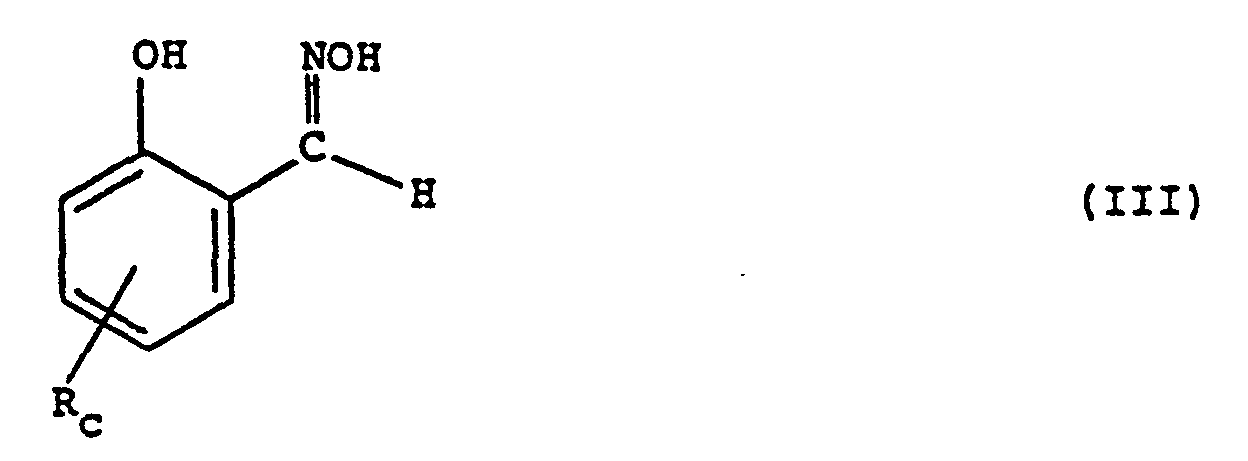
- (b) one or more hydroxy aryl aldoxime compounds of Formula III
- (c) a kinetic additive substance in an amount of from 0 to 20 mole percent based on the hydroxy aryl ketoxime present; and,
- (d) an extraction and stripping equilibrium modifier substance in an amount providing for a degree of modification of the hydroxy aryl aldoxime present of from about 0.66 to about 1.0; where the said modifier is other than nonylphenol and from about 0.898 to 1.0 where the said modifier is nonylphenol;
- (e) the mole ratio of the hydroxy aryl ketoxime present to the hydroxy aryl aldoxime present being from 1:100 to 100:1, whereby said degree of modification designates the inverse ratio of
- (i) the stripped solvent copper level of the hydroxy aryl aldoxime at equilibrium with an aqueous strip solution being 150 g/I sulfuric acid and 30 g/I Cu2+ to
- (ii) the stripped solvent copper level of the said aldoxime under the same conditions when the equilibrium modifier additive is present, and whereby for the determination of the degree of modification, the temperature is of about 24°C, the molar concentration of aldoxime or mixture of aldoximes in the diluent is about 0.184 as determined by copper value loading and titration, an aldoxime stock of approximately 94 percent purity, the remainder being substantially alkyl phenol starting material residue employed, the diluent for the hydroxy aryl aldoxime is Escaid@ 100 or a mixture of aliphatic and aromatic hydrocarbons closely approximating the constitution of Escaid® 100, an atomic absorption methodology being employed for determining copper value content.
- Efficient copper value recovery is achieved by the use of the reagent compositions of the invention despite diminished use of kinetic additive and/or equilibrium modifier content and even under circumstances wherein these additives are completely eliminated.
- According to a further aspect of the present invention we provide the use for the recovery of metal values from aqueous solutions of reagents containing at least one hydroxy aryl ketoxime of Formula I and/ or II (as hereinbefore defined) and at least one hydroxy aryl aldoxime of Formula III (as hereinbefore defined).
- Preferred compounds of Formula I are those wherein a is 1, b is 0, R is a straight or branched chain alkyl group having from 7 to 12 carbon atoms, and wherein R is attached in a position para to the hydroxyl group. Among these, the more preferred are those wherein R is a mixture of isomers. Preferred compounds of Formula II are those wherein R'" is methyl and R and a are as designated as being preferred for compounds of Formula I. Compounds of Formulae I and II which are especially useful in practice of the invention include: 2-hydroxy-5-nonyl benzophenone oxime; 2-hydroxy-5-dodecyl benzophenone oxime; 2-hydroxy-5-nonyl phenyl benzyl ketone oxime; and 2-hydroxy-5-nonyl phenyl methyl ketone oxime.
- Preferred hydroxy aryl aldoxime extractants of Formula III useful in formulation of reagents of the invention are those wherein c is 1, R is a straight or branched chain alkyl group having from 7 to 12 carbon atoms, and wherein R is attached in a position para to the hydroxyl group. Among these, the more preferred are those wherein R is a mixture of isomers. Compounds of Formula III which are especially useful in practice of the invention include 2-hydroxy-5-heptyl benzaldoxime, 2-hydroxy-5-octyl benzaldoxime, 2-hydroxy-5-nonyl benzaldoxime and 2-hydroxy-5-dodecyl benzaldoxime.
- Reagents of the invention comprise mixtures of one or more ketoximes of Formulae I and 11 with one or more aldoximes of Formula III in molar ratios ranging from 1:100 to 100:1 and preferably from 1:4 to 4:1 with particularly good results being obtained at ratios of 1:1. Kinetic additive substances may be present in amounts ranging from 0 to 20 mole percent based on ketoxime content and preferably about 5 mole percent. Preferred kinetic additives include a-hydroxy oximes described in Swanson, U.S. Patent 3,224,873 and α,β-dioximes described in Koenders, et al., U.S. Patent 4,173,616. Equilibrium modifiers may be present in amounts providing a degree of modification of the aldoxime component of from about 0.66 to 1.0 and preferably from about 0.75 to 0.99. Preferred equilibrium modifier chemicals include aliphatic alcohols such as tridecanol, alkyl phenols such as nonyl-phenol and organophosphorus compounds such as tributyl phosphate. Reagent formulations may optionally include a diluent substance.
- The reagents as above-described may be used in the recovery of metal values, especially copper values, from aqueous solutions by solvent extraction processing.
- According to a yet further aspect of the present invention there is provided a process for the recovery of copper values from an aqueous solution comprising:
- 1. contacting the aqueous solution with an organic phase comprising a water-immiscible solvent and a reagent composition according to the invention as hereinbefore defined to extract at least a portion of the copper values into the organic phase;
- 2. separating the resultant copper value pregnant organic phase from the aqueous phase; and
- 3. recovering copper values from the metal value pregnant organic phase.
- Compounds of Formula I wherein n has a value of 0 (i.e., hydroxy benzophenone oxime compounds) may suitably be prepared according to the methods disclosed in Swanson U.S. Patent Nos. 3,952,775 and 3,428,449. By reason of ease and economy of synthesis from available starting materials, ready solubility in organic diluents commonly employed in solvent extraction and desirable properties of complexes of the compounds with copper, preferred benzophenone oxime compounds of Formula I include those having a single alkyl ring substituent having from 7 to 12 carbon atoms in a position para to the hydroxyl group, which alkyl substituent is a mixture of isomers. Examples of such compounds are 2-hydroxy-5-nonyl benzophenone oxime and 2-hydroxy-5-dodecyl benzophenone oxime which are obtained as mixtures of alkyl isomeric forms when commercial nonylphenol and dodecyl phenol are respectively employed in their synthesis.
- Compounds of Formula I wherein n has a value of 1 (i.e., hydroxy phenyl benzyl ketone oxime compounds) may suitably be prepared according to the methods described in Anderson, U.S. Patent No. 4,029,704. Preferred phenyl benzyl ketone oximes, like the above-noted benzophenone oximes, are those having an isomeric mixture of 7 to 12 carbon alkyl groups as a single substituent on the ring para to the hydroxyl group. These preferred compounds are exemplified by the compound, 2-hydroxy-5-nonylphenyl benzyl ketone oxime, as manufactured from a commercial nonylphenol comprising a mixture of nonyl isomeric forms.
- Compounds of Formula 11 (i.e., hydroxy phenyl alkyl ketone oxime compounds) may suitably be prepared according to the procedures disclosed in U.K. Patent No. 1,322,532. As noted with regard to benzophenone oxime and phenyl benzyl ketone oxime compounds of Formula I, preferred phenyl alkyl ketone oxime compounds of Formula II are those having an isomeric mixture of 7 to 12 carbon alkyl groups as a single substituent on the ring para to the hydroxyl group. Also preferred are compounds wherein the R'" alkyl group is methyl. Consequently, illustrative of preferred phenyl alkyl ketone oxime compounds is 2-hydroxy-5-nonyl phenyl methyl ketone oxime manufactured through use of commercial nonylphenol.
- Compounds of Formula III (i.e., hydroxy benzaldoxime compounds, sometimes referred to as "salicylaldoximes") may suitably be prepared according to the methods described in Ackerley, et al., U.S. Patent No. 4,020,105 or Ackerley, et al., U.S. Patent No. 4,020,106 or by oximation of aldehydes prepared according to Beswick, U.S. Patent No. 4,085,146. Again, preferred compounds are those having an isomeric mixture of isomeric 7 to 12 carbon alkyl groups as a single substituent para to the hydroxyl group. Mixed alkyl isomeric forms of 2-hydroxy-5-heptyl benzaldoxime, 2-hydroxy-5-octyl benzaldoxine, 2-hydroxy-5-nonyl benzaldoxime and 2-hydroxy-5-dodecyl benzaldoxime are thus preferred.
- Preparation of the reagents according to the invention involves preparing an admixture of one or more hydroxy aryl ketoxime compounds of Formula I and/or II with one or more hydroxy aryl aldoxime compounds of Formula III in molar ratios of ketoxime to aldoxime ranging from 1:100 to 100:1 and preferably from about 1:4 to about 4:1 with particularly good results being obtained at ratios of 1:1.
- Reagents of the invention may optionally include an aliphatic, or aromatic, or mixed aliphatic/aromatic liquid hydrocarbon diluent of the kerosene type commonly employed in solvent extraction processing. Incorporation of a diluent frequently aids the transport and handling of the extractants which may be highly viscous.
- In one aspect of the invention, effective reagents for solvent extraction of copper may be prepared which include hydroxy aryl ketoxime extractants but which either do not include kinetic additive substances of the type commonly employed to enhance kinetic characteristics of such extractants or which include less of such kinetic additives than is ordinarily employed. While reagents of the invention can include as much kinetic additive as is ordinarily employed in combination with an hydroxy aryl ketoxime extractant in commercial copper extraction processes, i.e., up to about 20 mole percent based on ketoxime content, the incorporation of an hydroxy aryl aldoxime extractant in the reagent results in there being a lesser kinetic additive to total active hydroxy aryl oxime ratio than ordinarily present for effective recovery from a given copper-containing aqueous solution. This, in turn, is expected to provide for diminished formulation costs and a lessened disparity in overall rates of hydrolytic degradation among reagent constituents.
- Accordingly, kinetic additives may be incorporated in reagent formulations of the invention in amounts ranging from 0 to 20 mole percent based on hydroxy aryl ketoxime content and preferably from about 0.01 to 5 mole percent, i.e. if present at all, as little as 0.01 mole percent of the kinetic additive may be used. Suitable kinetic additive substances include aliphatic a-hydroxy oximes prepared according to Swanson, U.S. Patent 3,224,873 or U.K. 1,537,828 and α,β-dioximes according to Koenders, et al., U.S. Patent 4,173,616. A preferred a-hydroxy oxime kinetic additive is 5,8-diethyl-7-hydroxydodecan-6-oxime and a preferred dioxime kinetic additive is a mixture of 1-(4'-alkylphenyl)-1,2-propanedione dioximes according to Example 3 of U.S. Patent No. 4,173,616.
- In another aspect of the invention, effective reagents for solvent extraction of copper may be prepared which include hydroxy aryl aldoxime extractants but which either do not include equilibrium modifier substances of the type commonly employed to alter aldoxime extraction and stripping equilibria or which include less of such modifiers than ordinarily employed. While reagents of the invention may include as much equilibrium modifier as has been employed in combination with an hydroxy aryl aldoxime extractant in commercial copper extraction processes, the incorporation of an hydroxy aryl ketoxime extractant in the reagent will result in there being a lesser equilibrium modifier to total active hydroxy aryl oxime ratio than ordinarily present for the effective recovery of copper from a given copper-containing aqueous solution. This is expected to result in diminished acceleration of aldoxime degradation as brought about by reagent modifier chemicals as well as diminished susceptibility to the adverse effects of aqueous feedstock solution contaminants such as dissolved silicates.
- Accordingly, equilibrium modifier substances may be incorporated in reagent formulations of the invention in amounts providing a degree of modification of the hydroxyl aryl aldoxime constituent, in the absence of any hydroxy aryl ketoxime, of from about 0.66 to 1.0 and preferably from 0.75 to 0.99. Equilibrium modifiers suitable for use in the present invention include: long chain (preferably CS-C2o) aliphatic alcohols such as n-hexanol, n-octanol, 2-ethylhexanol, isodecanol, dodecanol, tridecanol, hexadecanol, and octadecanol; long chain alkylphenols such as heptylphenol, octylphenol, nonylphenol and dodecylphenol; and organophosphorus compounds such as triloweralkyl (C4 to Ca) phosphates, especially, tributyl phosphate and tri(2-ethylhexyl)phosphate.
- As employed herein, "degree of modification" designates the inverse ratio of (a) the stripped solvent copper value, level of an hydroxy aryl aldoxime extractant at equilibrium (expressed in terms of grams per liter of copper value extracted) with an aqueous solution containing a fixed concentration of the copper value and sulfuric acid to (b) the stripped solvent copper value level of the same extractant under the same conditions when a selected equilibrium modifier additive is present. Consistent with this definition, the presence of relatively small quantities of an equilibrium modifier will shift the extraction equilibrium slightly, resulting in minor diminution of aldoxime stripped solvent copper value level at equilibrium, as will be reflected by a degree of modification value closely approaching 1.0, e.g., 0.99. Increased effective quantities of modifier under otherwise identical conditions will result in a more pronounced shift in extraction equilibrium and a more pronounced diminution of aldoxime stripper solvent copper value level at equilibrium, as will be reflected by a degree of modification corresponding less than 1.0.
- Expectedly, the degree of modification resulting from a given molar ratio of equilibrium modifier to aldoxime in a reagent will vary depending on such factors as the degree of purity of the extractant composition employed in formulation of the reagent, the aromaticity of the solvent, and, perhaps most significantly, the chemical identity of the equilibrium modifier employed. It will also depend significantly on the conditions involved in determination of stripped solvent copper value levels. Consequently, for purposes of determining degree of modification of an aldoxime by a given equilibrium modifier, the following test conditions should be adhered to. The temperature at which the determination for the degree of modification is made is about 24°C. The molar concentration of aldoxime (or mixture of aldoximes) in the diluent should be about 0.184 as determined by copper value loading and titration, an aldoxime stock of approximately 94 percent purity, with the remainder being substantially alkyl phenol starting material residue is employed, the diluent is Escaid@ 100 or a mixture of aliphatic and aromatic hydrocarbons closely approximating the constitution of Escaid° 100. An atomic absorption methodology is employed for determining copper value content. The composition of the strip solution is 150 g/I sulfuric acid and 30 g/I Cu+2. The foregoing conditions are employed in determining degree of modification according to the invention because they represent conditions closely resembling those commonly existant in commercial solvent extraction facilities for recovery of copper.
- Tables I, II and III below provide an illustrative showing of the degree of modification provided by differing mole ratios of three representative equilibrium modifiers vis-a-vis a representative hydroxy aryl aldoxime. More specifically, the Tables provide the results of copper loading determinations of solutions of 2-hydroxy-5-nonyl benzaldoxime extractant alone and with varying quantities of nonylphenol, tridecanol and tributyl phosphate modifier.
- Each determination involved use of a reagent solution comprising 2-hydroxy-5-nonyl benzaldoxime dissolved in a kerosene diluent. The stock benzaldoxime employed was preliminarily determined to be 94% pure (bytitration) with the remaining stock components principally comprising a nonylphenol residue from synthesis. The diluent employed was prepared by admixture of 20 volume percent of the highly aromatic kerosene solvent Exxon Aromatic 150 with 80 volume percent of the highly aliphatic kerosene solvent Escaid® 200 and thus closely resembled the constitution of the mixed aromatic/aliphatic kerosene solvent, Escaid® 100. Solutions were prepared to be 0.184 molar in active aldoxime (corresponding to a concentration of about 48.4 g/I).
- A control solution was equilibrated by multiple agitated contacts (at 24°C) with a strip solution containing 150 g/I sulfuric acid and 30 g/I Cu+2 (organic/aqueous volume ratio, "O/A" = 1/1). Three separate 3 minute contacts with fresh strip solution were performed and the copper content of the resulting organic solution was determined. Solutions were then prepared including varying quantities of modifier and an identical quantity of aldoxime and tested for stripped solvent copper content under the same conditions.

- The data set out above illustrate that a degree of modification greater than 0.66 for the aldoxime tested is provided by formulation with nonylphenol at a molar ratio to the oxime of about 2:1. Correspondingly greater or lesser of nonylphenol/oxime will provide correspondingly lower or higher degrees of modification. It should be noted that the actual quantity of nonylphenol present in each solution tested is somewhat greater (by about 2.9 g/I) than reflected by the quantity added owing to the above-noted residual nonylphenol in the aldoxime stocks employed to make the solutions.
- Table II presents the results of procedures addition of a tridecanol modifier to 2-hydroxy-5-nonyl benzaldoxime.

- The data set out above illustrate that a degree of modification of greater than 0.66 for the aldoxime tested will be provided by about 1:1 molar ratio of tridecanol to aldoxime. It should again be noted that the total equilibrium modifier present in the above solutions consisted of about 2.9 g/I nonylphenol and the indicated added tridecanol.
- Table III presents the results of procedures involving addition of a tributyl phosphate modifier to 2-hydroxy-5-nonyl benzaldoxime.

- The data set out above illustrate that a degree of modification of greater than 0.60 for the aldoxime tested will be provided by about a 1:2 molar ratio of tributyl phosphate to aldoxime. Again, the modifier content of the test solutions should be noted as comprising a mixture of about 2.9 g/I nonylphenol and the indicated added quantities of tributyl phosphate.
- In the event that an aldoxime employed in formulation of reagents of the invention is insufficiently soluble in Escaid 100 diluent to allow preparation of a 0.184 molar solution, a more highly aromatic diluent can be employed to determine the degree of modification. It may be the case that an empirically determined translation factor may appropriately be applied to values determined to obtain degree of modification values corrected for diluent effects, but this had not been the case in the procedures performed to date. When, for example, procedures resulting in the data in Table I were repeated using Exxon Aromatic 150 as the sole diluent, grams/liter copper loading values were depressed (2.19 g/I as versus 3.16 g/I for the system having no added nonyl phenol) but the degree of modification values were substantially the same for nonylphenol additions of 25, 50, and 100 grams/liter.
- In view of the above, reagents comprehended by the present invention are seen to comprise mixtures of one or more hydroxyl aryl ketoxime extractants of Formulae I and/or II with one or more hydroxy aryl aldoxime extractants of Formula III, with ketoxime to aldoxime molar ratios of from 1:100 to 100:1. The reagents further comprise from 0 to 20 mole percent of a kinetic additive based on ketoxime content. The reagents also comprise a modifier of extraction and stripping in an amount providing a degree of modification of the aldoxime constituent of from about 0.66 to 1.0. Among the reagents comprehended by the present invention, therefore, are reagents which consist of a mixture of specified aldoxime and ketoxime extractants and which include neither a kinetic additive (i.e., 0 mole percent kinetic additive based on ketoxime content) nor an added equilibrium modifier (i.e., a modifier content providing a degree of modification of 1.0).
- Comprehended by the present invention are processes for recovery of copper from an aqueous solution comprising: contacting the aqueous solution with an organic phase comprising a water immiscible organic solvent (such as liquid hydrocarbon) and a reagent as specified above to extract at least a portion of the copper values into the organic phase; separating the resultant copper-pregnant organic phase from the resultant copper-barren aqueous phase; and recovering copper values from the copper-pregnant organic phase. Processes of the present invention most advantageously further involve use of a kerosene solvent and stripping of copper values from the copper-pregnant organic phase by means of an acid. Aqueous solutions from which copper values may be recovered by processes are preferably acidic, having a pH of from about 0.5 to 7.0, but may also be basic.
- The following examples are provided for the purpose of illustrating reagents and processes of the invention. More particularly, the examples relate to reagent formulations individually including three different hydroxy aryl aldoximes of Formula III (5-octyl-, 5-nonyl-, and 5-dodecyl salicylaldoxime) and three different hydroxy aryl ketoximes of Formulae I and II (2-hydroxy-5-nonyl benzophenone oxime, 2-hydroxy-5-nonyl phenyl benzyl ketone oxime and 2-hydroxy-5-nonyl phenyl methyl ketone oxime). In some examples, representative kinetic additives (5,8-diethyl-7-hydroxy-4-dodecan-6-oxime according to U.S. Patent No. 3,224,873 and an α,β-dioxime according to U.S. Patent No. 4,173,616) are present and in some examples they are not included in the reagent. In some examples, representative equilibrium modifiers (tridecanol, dodecylphenol) are present while in other examples no equilibrium modifier is present beyond small quantities of phenolic starting materials remaining as a residue in aldoxime stocks. Certain examples provide experimental data indicating highly advantageous net copper transfer properties for the reagents and certain others indicate advantageous kinetic properties.
- In each illustrative example of the present invention, experimental data establish significant departures in properties of reagents from the properties which would be predicted for the reagents based upon characteristics of the component hydroxy aryl ketoxime and hydroxy aryl aldoxime extractants. To further illustrate the present invention, comparative examples relating to reagent formulations outside the scope of the invention are provided.
- This example relates to the properties of two extractant solutions (and reagents comprising mixtures of the solutions) wherein the active extractant chemical of one solution is a ketoxime of Formula I and the active extractant of the other is an aldoxime of Formula III. The reagent solutions tested were: (1) a 32 v/v percent solution of LlX@ 64N (0.36 molar in 2-hydroxy-5-nonyl benzophenone oxime and 0.0225 molar in 5-8-diethyl-7-hydroxydodecan-6-oxime) in Escaid@ 100; and (2) a 20 v/v percent solution of 2-hydroxy-5-nonyl benzaldoxime (0.32 molar and prepared using a 94% pure stock oxime) in Escaid@ 100. The respective solutions and mixtures thereof in volume/volume ratios of 90/10, 80/20, 70/30, 60/40, 50/50, 40/ 60, 30/70, 20/80 and 10/90 were equilibrated with a solution containing 180 g/I sulfuric acid and 30 g/I Cu+2 by three separate, three minute agitated contacts with fresh solution employed for each contact. The respective equilibrated stripped organics were then filtered and a portion of each sampled' for analysis before the remainder was equilibrated with an aqueous copper sulfate solution containing 5.4 g/I Cu+2, 1 g/I ferric ion at a pH of 1.90 using a vigorous 3 minute contact at 0/A=1/1. The respective organic and aqueous phases were then analyzed. The results are shown in Table IV below and indicate significant departures in copper extraction properties for the mixed reagents from those properties predicted on the results obtained for the unmixed extractant solutions.

- This Example relates to properties of two extractant solutions (and reagent mixtures of these solutions) wherein the active extractant in one is a ketoxime of Formula I and the active extractant of the other is an aldoxime of Formula III. The solutions tested were: (1) a 19.2 v/v percent solution of SME 530 (0.36 molar in 2-hydroxy-5-nonyl phenyl methyl ketone oxime and approximately 0.02 molar in an α,β-dioxime of the type illustrated in Example 3 of U.S. 4,173,616); and (2) a 2-hydroxy-5-nonyl benzaldoxime solution as in Example 1. Solutions were tested individually and as mixtures under the conditions and according to the procedures of Example 1. Experimental data set out in Table V below indicate significant departures in properties of mixed solution reagents as compared to those predicted on the basis of properties of unmixed solutions. -

- Example 1 was repeated using an hydroxy phenyl benzyl ketone oxime of Formula I (an 18 v/v percent solution Acorga P-17 reagent which contains about 60 weight/weight percent 2-hydroxy-5-nonyl phenyl benzyl ketone oxime in Kermac 627) in place of the indicated benzophenone oxime. Stripped organic data are set out in Table VI below.

- Example 1 was repeated but using a different hydroxy aryl aldoxime of Formula III in place of the aldoxime indicated. The aldoxime solution employed (#2) was a 20 v/v percent solution of 2-hydroxy-5-dodecyl benzaldoxime (0.32 molar) and 0.063 molar in dodecylphenol in Escaid 100. Experimental data obtained are set out in Table VII below.

- Example 1 was repeated using an aldoxime solution (in Escaid® 100) which was 0.33 molar in 2-hydroxy-5-nonyl benzaldoxime and 0.23 molar in tridecanol. Experimental data obtained are set out in Table VIII below.

- Extractant solutions employed were: (1) a 0.36 molar solution of 2-hydroxy-5-nonyl benzophenone oxime in Escaid@ 100; and (2) a 0.32 molar solution of 2-hydroxy-5-nonyl benzaldoxime in Escaid® 100. The individual solutions and reagent mixtures thereof were equilibrated with 2 acid copper solutions, one containing 180 g/l sulfuric acid and 30 g/I Cu+2 and the other containing 150 g/I sulfuric acid and 30 g/I Cu+2, by contacting each organic 3 times with the proper fresh aqueous solution for 3 minutes each contact. The respective stripped organics from the equilibration with the 180 g/I H2S04, 30 g/I Cu+z contact were then contacted at an O/A of 1/2 with a copper sulfate solution containing 5.36 g/I Cu, 1 g/I Fe3+, pH=1.9 for 3 minutes. The organic and aqueous phases were then analyzed and the data obtained are set out in Table IX below.

- Extractant solutions employed were: (1) a 12.4 weight/volume percent solution of 2-hydroxy-5-nonyl (0.36 molar) in Exxon Aromatic 150; and (2) an 8.25 weight/volume percent solution of 2-hydroxy-8-octyl benzaldoxime (0.26 M) in Exxon Aromatic 150. The aldoxime stock employed was prepared using a predominantly single isomeric form of octylphenol as a starting material and had a purity of 74%, with the balance of the stock predominantly octyl phenol starting material. Solutions and mixtures thereof were tested as in Example 1 and the stripped organic data obtained is set out in Table X below.

- The organic solutions described in Example 6 were equilibrated with stripping solution as described in Example 1. 100 ml of the respective filtered organic solution and 100 ml of an aqueous solution containing 6.0 g/I Cu+2, 3 g/I Fe+3 at a pH of 2.0, were carefully added to a 21/4 by 21/4 by.4 inch (5.72 x 5.72 x 10.16 cm) mixer box. Mixing at 1800 rpm's with a 11/4 inch (3.18 cm) impeller was started and samples of the emulsion removed at the indicated times. After the phases separated the organic phase was filtered and analyzed for copper. The results are shown below.

- The expected % equilibrium values for the 50/50 mix at 30 and 60. seconds are 82.3 and 88.7, respectively, thus the 50/50 mix extracts copper at a faster rate than expected.
- The organic solutions described in Example 3 were studied kinetically.using the method described in Example 8. The results are shown below.

- The 30 and 60 second % equilibrium expected values for the 50/50 mix would be 82.8 and 89.8% respectively, thus the kinetics of the 50/50 mix are significantly faster than expected.
- The following examples 10 through 13 provide an illustration of properties of reagent formulations which are outside the scope of the present invention.
- This example relates to the properties of two extractant solutions (and of mixtures of these solutions) wherein the active extractant chemicals of both are hydroxy aryl ketoximes comprehended by Formulas I or II and wherein no hydroxy aryl aldoxime extractant of Formula III is included. The solutions tested were: (1) a 32 v/v percent solution of LIX® 64N (0.36 molar in 2-hydroxy-5-nonyl benzophenone oxime and 0.0225 molar in 5-8-diethyl-7-hydroxydodecan-6-oxime) in Escaid® 100; and (2) a 19.2 v/v percent solution of SME 530 (as described in Example 2, above) in Escaid@ 100. Solutions were tested individually and as mixtures in volume/volume ratios of 70/30, 50/50 and 30/70 under the conditions and according to the procedures of Example 1. Stripped organic and raffinate values in grams/liter copper are set out in Table XIII below and indicate no significant departure in properties of the mixed solutions from those properties predicted on the basis of results for the individual solutions.

- This example relates to properties of two extractant solutions (and of mixtures of these solutions) wherein the active extractant in one is an hydoxy aryl aldoxime of Formula I and the active extractant of the other is an hydroxy aryl ketoxime not comprehended by Formulas I and II. The solutions tested were: (1) a 31 v/v percent solution of LIX® 70 (0.35 molar in 2-hydroxy-3-chloro-5-nonyl benzophenone oxime and 0.0218 molar in Escaid® 100; and (2) a 20 v/v percent solution of 94 percent acitve 2-hydroxy-5-nonyl benzaldoxime (0.32 molar) in Escaid@ 100. Solutions were tested individually and as mixtures in volume/ volume ratios of 70/30, 50/50 and 30/70 under conditions and according to the procedures of Example 1. Stripped organic values in grams/liter copper are set out in Table XIV below and indicate no significant departure from those properties predicted on the basis of results for individual solutions.

- This example republishes experimental results reported in Tumilty, et al., [Adv. in Extractive Metallurgy lnt'l. Symp. 3rd, pp. 123-131, 1977 (London)] for use of two reagents (and mixtures thereof) wherein the active extractant chemical in one was an hydroxy aryl ketoxime according to Formula I and the active extractant of the other was an hydroxy aryl aldoxime comprehended by Formula III, but wherein the equilibrium modifier content was such as provided a degree of modification for the atdoxime which was less than 0.60. The reagents solutions tested were: (1) 25 v/v percent solution of LIX® 64N (0.28 molar in 2-hydroxy-5-nonyl benzophenone oxime and 0.0176 molar in 5-8-diethyl-7-hydroxy dodecan-6-oxime); and (2) v/v percent solution of Acorga P-5300 (0.225 molar in 2-hydroxy-5-nonyl benzaldoxime and 0.80 molar in nonylphenol modifier) in Ecaid@ 100. Reagent solutions were reported to have been tested individually and as mixtures in volume/volume ratios of 75/25, 50/50 and 25/75 under specified conditions. Stripped organic values from Table 4 of the publication are set out in Table XV below and indicate no significant 'departure in properties of the mixed solutions from those properties predicted on the basis of results for the individual solutions.

- It is additionally noteworthy that Table 4 of the publication reports a series of variations in extraction stage efficiencies for above noted solution mixtures which are precisely linear (86.0, 87.5, 89.0, 90.5 and 92.0 percent) indicating no departure in kinetic properties of the mixed solutions from those predicted on the basis of kinetic characteristics of the individual reagents:
- This example republishes experimental results reported by Ritcey, et al., in C/M Bulletin, pp. 87-92, February, 1974, for use of two reagents (and mixtures thereof) wherein the active extractant chemical in one was an hydroxy aryl ketoxime according to Formula I and the active extractant of the other was an hydroxy quinoline compound. The reagent solutions tested were: (1) a 7 v/v percent solution of LIX® 64N (0.079 molar in 2-hydroxy-5-nonyl benzophenone oxime and 0.005 molar in 5,8-diethyl-7-hydroxydodecan-6-oxime) in EscaidO 100; and (2) a 7 v/v percent solution of Kelex 100 (0.175 molar in 7-[3-(5,5,7,7-tetramethyl-1-octenyl)]-8-hydroxyquinoline) in Escaid@ 100. Reagent solutions were reported to have been tested individually and as mixtures in volume/volume ratios of 10/90, 30/70, 50/50, 70/30 and 90/10 under specified conditions. Loaded organic values from Figure 2 of the publication are set out in Table XVI below and indicate no significant departure in properties predicted on the basis of results for individual solutions.

Claims (19)


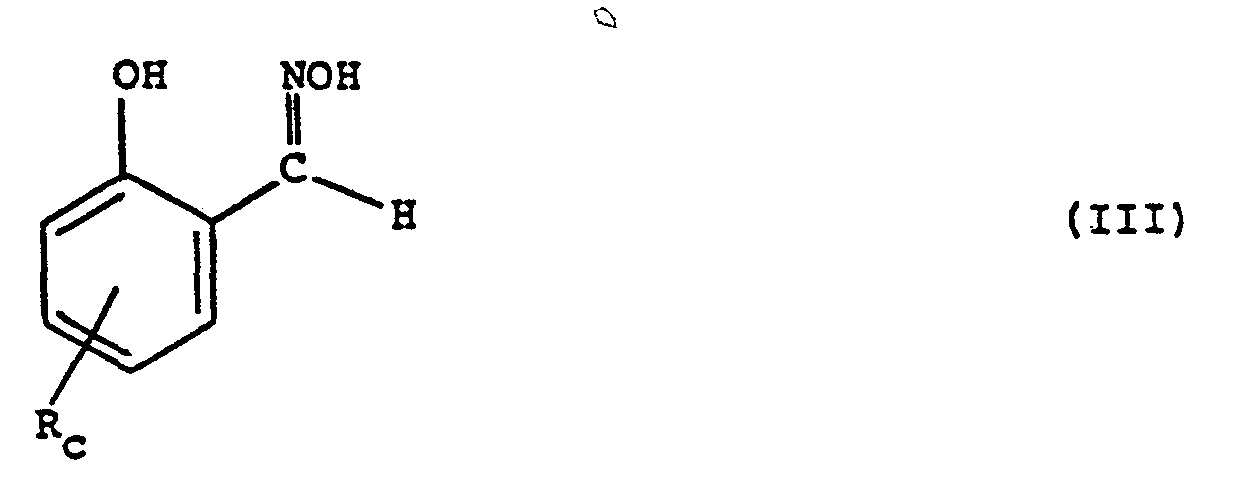
Priority Applications (1)
| Application Number | Priority Date | Filing Date | Title |
|---|---|---|---|
| AT83300350T ATE42575T1 (en) | 1982-01-25 | 1983-01-24 | SOLVENT EXTRACTION. |
Applications Claiming Priority (2)
| Application Number | Priority Date | Filing Date | Title |
|---|---|---|---|
| US34099182A | 1982-01-25 | 1982-01-25 | |
| US340991 | 1982-01-25 |
Publications (3)
| Publication Number | Publication Date |
|---|---|
| EP0085522A2 EP0085522A2 (en) | 1983-08-10 |
| EP0085522A3 EP0085522A3 (en) | 1984-04-11 |
| EP0085522B1 true EP0085522B1 (en) | 1989-04-26 |
Family
ID=23335798
Family Applications (1)
| Application Number | Title | Priority Date | Filing Date |
|---|---|---|---|
| EP83300350A Expired EP0085522B1 (en) | 1982-01-25 | 1983-01-24 | Solvent extraction |
Country Status (12)
| Country | Link |
|---|---|
| EP (1) | EP0085522B1 (en) |
| AT (1) | ATE42575T1 (en) |
| AU (1) | AU555973B2 (en) |
| BR (1) | BR8207595A (en) |
| CA (1) | CA1185406A (en) |
| DE (1) | DE3379736D1 (en) |
| ES (1) | ES8407113A1 (en) |
| FI (1) | FI81382C (en) |
| IE (1) | IE55241B1 (en) |
| MX (1) | MX163823B (en) |
| ZA (1) | ZA828233B (en) |
| ZM (1) | ZM8982A1 (en) |
Families Citing this family (11)
| Publication number | Priority date | Publication date | Assignee | Title |
|---|---|---|---|---|
| US4563256A (en) * | 1984-12-31 | 1986-01-07 | Henkel Corporation | Solvent extraction process for recovery of zinc |
| EP0202833B1 (en) * | 1985-05-16 | 1991-01-23 | Imperial Chemical Industries Plc | Composition and use of the composition for the extraction of metals from aqueous solutions |
| US5281336A (en) | 1985-05-16 | 1994-01-25 | Imperial Chemical Industries Plc | Composition and use of the composition for the extraction of metals from aqueous solution |
| US5176843A (en) * | 1985-05-16 | 1993-01-05 | Imperial Chemical Industries Plc | Composition and use of the composition for the extraction of metals from aqueous solution |
| GB8512454D0 (en) * | 1985-05-16 | 1985-06-19 | Ici Plc | Extraction of metal from aqueous solution |
| ES2004072A6 (en) * | 1986-01-23 | 1988-12-01 | France Mokta Comp | Process for the separation of molybdenum by a resin route |
| US4957714A (en) * | 1988-04-28 | 1990-09-18 | Henkel Corporation | Solvent extraction process |
| CA1338345C (en) * | 1988-06-14 | 1996-05-28 | Gary A. Kordosky | Nickel extraction with oxime extractants |
| WO1993016204A2 (en) * | 1992-01-31 | 1993-08-19 | Cognis, Inc. | Process and apparatus for extracting solutes from their aqueous solutions |
| US5578217A (en) * | 1994-11-30 | 1996-11-26 | Alliedsignal Inc. | Use a solvent impregnated crosslinked matrix for metal recovery |
| RU2155818C1 (en) * | 1999-10-06 | 2000-09-10 | Воропанова Лидия Алексеевна | Method of extraction of copper from aqueous solutions |
Family Cites Families (9)
| Publication number | Priority date | Publication date | Assignee | Title |
|---|---|---|---|---|
| US3428449A (en) * | 1965-02-15 | 1969-02-18 | Gen Mills Inc | Extraction of copper from acidic liquors with a phenolic oxime |
| US3592775A (en) * | 1965-10-19 | 1971-07-13 | Gen Mills Inc | Compositions containing phenolic oximes and certain alpha-hydroxy aliphatic oximes |
| GB1411545A (en) * | 1971-12-31 | 1975-10-29 | Shell Int Research | Separation of metal values by liquid-liquid extraction |
| US4029704A (en) * | 1972-08-25 | 1977-06-14 | Imperial Chemical Industries Limited | Oximes |
| DE2407200C3 (en) * | 1974-02-15 | 1978-03-02 | Hoechst Ag, 6000 Frankfurt | Mixtures of ketoximes, processes for their preparation and use of the same for the extraction of copper from aqueous solutions |
| GB1537828A (en) * | 1975-03-26 | 1979-01-04 | Shell Int Research | Extraction of copper values from aqueous solutions with hydroxy-oximes |
| DE2518631A1 (en) * | 1975-04-26 | 1976-11-04 | Hoechst Ag | Benzophenone oxime substd. by halogen in right phenyl - used as complexing agents in metal extn. from salt solns. |
| IE44327B1 (en) * | 1976-01-30 | 1981-10-21 | Ici Ltd | Extracting metal values with o-hydroxyaryloximes |
| US4173616A (en) * | 1978-03-07 | 1979-11-06 | Shell Oil Company | Extraction of copper values from aqueous solution |
-
1982
- 1982-11-04 CA CA000414938A patent/CA1185406A/en not_active Expired
- 1982-11-10 ZA ZA828233A patent/ZA828233B/en unknown
- 1982-11-10 AU AU90344/82A patent/AU555973B2/en not_active Expired
- 1982-12-13 ZM ZM89/82A patent/ZM8982A1/en unknown
- 1982-12-17 MX MX195738A patent/MX163823B/en unknown
- 1982-12-30 BR BR8207595A patent/BR8207595A/en not_active IP Right Cessation
-
1983
- 1983-01-21 FI FI830217A patent/FI81382C/en not_active IP Right Cessation
- 1983-01-24 EP EP83300350A patent/EP0085522B1/en not_active Expired
- 1983-01-24 ES ES519228A patent/ES8407113A1/en not_active Expired
- 1983-01-24 IE IE139/83A patent/IE55241B1/en not_active IP Right Cessation
- 1983-01-24 AT AT83300350T patent/ATE42575T1/en active
- 1983-01-24 DE DE8383300350T patent/DE3379736D1/en not_active Expired
Non-Patent Citations (2)
| Title |
|---|
| AIME preprint No. 80-93 (February 1980) * |
| Hydrometallurgy (June 1981), vol. 7, pp. 7-26 * |
Also Published As
| Publication number | Publication date |
|---|---|
| ZM8982A1 (en) | 1984-11-21 |
| FI81382C (en) | 1990-10-10 |
| FI830217A0 (en) | 1983-01-21 |
| DE3379736D1 (en) | 1989-06-01 |
| IE55241B1 (en) | 1990-07-18 |
| ES519228A0 (en) | 1984-08-16 |
| ES8407113A1 (en) | 1984-08-16 |
| FI830217L (en) | 1983-07-26 |
| EP0085522A2 (en) | 1983-08-10 |
| IE830139L (en) | 1983-07-25 |
| AU9034482A (en) | 1983-08-04 |
| MX163823B (en) | 1992-06-22 |
| CA1185406A (en) | 1985-04-16 |
| ATE42575T1 (en) | 1989-05-15 |
| ZA828233B (en) | 1984-01-25 |
| EP0085522A3 (en) | 1984-04-11 |
| BR8207595A (en) | 1983-10-25 |
| AU555973B2 (en) | 1986-10-16 |
| FI81382B (en) | 1990-06-29 |
Similar Documents
| Publication | Publication Date | Title |
|---|---|---|
| US4507268A (en) | Solvent extraction | |
| US4544532A (en) | Solvent extraction | |
| US4582689A (en) | Solvent extraction process | |
| EP0202833B1 (en) | Composition and use of the composition for the extraction of metals from aqueous solutions | |
| US4957714A (en) | Solvent extraction process | |
| US6395062B2 (en) | Process for recovery of metals from metal-containing ores | |
| US6277300B1 (en) | Composition and use of composition for the extraction of metal values | |
| AU609615B2 (en) | Nickel extraction process | |
| US5908605A (en) | Copper recovery process | |
| CA2602595C (en) | Modification of copper/iron selectivity in oxime-based copper solvent extraction systems | |
| CA1185406A (en) | Solvent extraction | |
| AU2414492A (en) | Copper recovery process | |
| US4432951A (en) | Process for separating germanium from an aqueous solution | |
| US6242625B1 (en) | Process for extracting copper values from copper containing ores | |
| US5788844A (en) | Process for removing and recovering ammonia from organic metal extractant solutions in a liquid-liquid metal extraction process | |
| AU2002330990B2 (en) | Improvements in solvent extraction processes for metal recovery | |
| US3872209A (en) | Ion exchange process for the recovery of metals | |
| AU2002330990A1 (en) | Improvements in solvent extraction processes for metal recovery | |
| US20030061910A1 (en) | Processes for the recovery of copper from aqueous solutions containing nitrate ions | |
| US6702872B1 (en) | Processes for the recovery of copper from aqueous solutions containing nitrate ions | |
| WO2000015595A1 (en) | Ketoximes, processes therefor, and copper extraction process | |
| US20080175772A1 (en) | More efficient ether modifiers for copper extractant formulations | |
| US6156280A (en) | Process for removing manganese from organic solutions of oximes and nickel ore treatment process | |
| EP0879301B1 (en) | Improved beta-diketones for the extraction of copper from aqueous ammoniacal solutions |
Legal Events
| Date | Code | Title | Description |
|---|---|---|---|
| PUAI | Public reference made under article 153(3) epc to a published international application that has entered the european phase |
Free format text: ORIGINAL CODE: 0009012 |
|
| AK | Designated contracting states |
Designated state(s): AT BE DE FR GB NL SE |
|
| PUAL | Search report despatched |
Free format text: ORIGINAL CODE: 0009013 |
|
| RAP1 | Party data changed (applicant data changed or rights of an application transferred) |
Owner name: HENKEL CORPORATION |
|
| AK | Designated contracting states |
Designated state(s): AT BE DE FR GB NL SE |
|
| 17P | Request for examination filed |
Effective date: 19841009 |
|
| GRAA | (expected) grant |
Free format text: ORIGINAL CODE: 0009210 |
|
| AK | Designated contracting states |
Kind code of ref document: B1 Designated state(s): AT BE DE FR GB NL SE |
|
| REF | Corresponds to: |
Ref document number: 42575 Country of ref document: AT Date of ref document: 19890515 Kind code of ref document: T |
|
| REF | Corresponds to: |
Ref document number: 3379736 Country of ref document: DE Date of ref document: 19890601 |
|
| ET | Fr: translation filed | ||
| PGFP | Annual fee paid to national office [announced via postgrant information from national office to epo] |
Ref country code: SE Payment date: 19891130 Year of fee payment: 8 Ref country code: FR Payment date: 19891130 Year of fee payment: 8 |
|
| PGFP | Annual fee paid to national office [announced via postgrant information from national office to epo] |
Ref country code: NL Payment date: 19900131 Year of fee payment: 8 |
|
| PLBE | No opposition filed within time limit |
Free format text: ORIGINAL CODE: 0009261 |
|
| STAA | Information on the status of an ep patent application or granted ep patent |
Free format text: STATUS: NO OPPOSITION FILED WITHIN TIME LIMIT |
|
| 26N | No opposition filed | ||
| PGFP | Annual fee paid to national office [announced via postgrant information from national office to epo] |
Ref country code: AT Payment date: 19910115 Year of fee payment: 9 |
|
| PG25 | Lapsed in a contracting state [announced via postgrant information from national office to epo] |
Ref country code: SE Effective date: 19910125 |
|
| PG25 | Lapsed in a contracting state [announced via postgrant information from national office to epo] |
Ref country code: NL Effective date: 19910801 |
|
| NLV4 | Nl: lapsed or anulled due to non-payment of the annual fee | ||
| PG25 | Lapsed in a contracting state [announced via postgrant information from national office to epo] |
Ref country code: FR Effective date: 19910930 |
|
| REG | Reference to a national code |
Ref country code: FR Ref legal event code: ST |
|
| PG25 | Lapsed in a contracting state [announced via postgrant information from national office to epo] |
Ref country code: AT Effective date: 19920124 |
|
| EUG | Se: european patent has lapsed |
Ref document number: 83300350.2 Effective date: 19910910 |
|
| PGFP | Annual fee paid to national office [announced via postgrant information from national office to epo] |
Ref country code: DE Payment date: 19990104 Year of fee payment: 17 |
|
| PGFP | Annual fee paid to national office [announced via postgrant information from national office to epo] |
Ref country code: BE Payment date: 19990118 Year of fee payment: 17 |
|
| PGFP | Annual fee paid to national office [announced via postgrant information from national office to epo] |
Ref country code: GB Payment date: 20000105 Year of fee payment: 18 |
|
| PG25 | Lapsed in a contracting state [announced via postgrant information from national office to epo] |
Ref country code: BE Free format text: LAPSE BECAUSE OF NON-PAYMENT OF DUE FEES Effective date: 20000131 |
|
| BERE | Be: lapsed |
Owner name: HENKEL CORP. Effective date: 20000131 |
|
| PG25 | Lapsed in a contracting state [announced via postgrant information from national office to epo] |
Ref country code: DE Free format text: LAPSE BECAUSE OF NON-PAYMENT OF DUE FEES Effective date: 20001101 |
|
| PG25 | Lapsed in a contracting state [announced via postgrant information from national office to epo] |
Ref country code: GB Free format text: LAPSE BECAUSE OF NON-PAYMENT OF DUE FEES Effective date: 20010124 |
|
| GBPC | Gb: european patent ceased through non-payment of renewal fee |
Effective date: 20010124 |