EP0082636A1 - Luminescent labelling materials and procedures - Google Patents
Luminescent labelling materials and procedures Download PDFInfo
- Publication number
- EP0082636A1 EP0082636A1 EP82306557A EP82306557A EP0082636A1 EP 0082636 A1 EP0082636 A1 EP 0082636A1 EP 82306557 A EP82306557 A EP 82306557A EP 82306557 A EP82306557 A EP 82306557A EP 0082636 A1 EP0082636 A1 EP 0082636A1
- Authority
- EP
- European Patent Office
- Prior art keywords
- compound
- luminescent
- linked
- moiety
- antibodies
- Prior art date
- Legal status (The legal status is an assumption and is not a legal conclusion. Google has not performed a legal analysis and makes no representation as to the accuracy of the status listed.)
- Granted
Links
- 238000000034 method Methods 0.000 title claims description 19
- 238000002372 labelling Methods 0.000 title claims description 11
- 239000000463 material Substances 0.000 title claims description 9
- 150000001875 compounds Chemical class 0.000 claims abstract description 27
- 238000006243 chemical reaction Methods 0.000 claims abstract description 16
- 102000004169 proteins and genes Human genes 0.000 claims abstract description 16
- 108090000623 proteins and genes Proteins 0.000 claims abstract description 16
- -1 aryl acridinium ester Chemical compound 0.000 claims abstract description 14
- 239000000427 antigen Substances 0.000 claims abstract description 9
- 102000036639 antigens Human genes 0.000 claims abstract description 9
- 108091007433 antigens Proteins 0.000 claims abstract description 9
- 230000008105 immune reaction Effects 0.000 claims abstract description 3
- 239000003153 chemical reaction reagent Substances 0.000 claims description 24
- 238000003556 assay Methods 0.000 claims description 18
- 239000000126 substance Substances 0.000 claims description 13
- DZBUGLKDJFMEHC-UHFFFAOYSA-N acridine Chemical compound C1=CC=CC2=CC3=CC=CC=C3N=C21 DZBUGLKDJFMEHC-UHFFFAOYSA-N 0.000 claims description 9
- 150000002148 esters Chemical group 0.000 claims description 6
- 229920001184 polypeptide Polymers 0.000 claims description 5
- 108090000765 processed proteins & peptides Proteins 0.000 claims description 5
- 102000004196 processed proteins & peptides Human genes 0.000 claims description 5
- IJGRMHOSHXDMSA-UHFFFAOYSA-N Atomic nitrogen Chemical compound N#N IJGRMHOSHXDMSA-UHFFFAOYSA-N 0.000 claims description 4
- 150000001251 acridines Chemical class 0.000 claims description 3
- 230000032050 esterification Effects 0.000 claims description 3
- 238000005886 esterification reaction Methods 0.000 claims description 3
- 238000013198 immunometric assay Methods 0.000 claims description 3
- 230000011987 methylation Effects 0.000 claims description 3
- 238000007069 methylation reaction Methods 0.000 claims description 3
- ISWSIDIOOBJBQZ-UHFFFAOYSA-N phenol group Chemical group C1(=CC=CC=C1)O ISWSIDIOOBJBQZ-UHFFFAOYSA-N 0.000 claims description 3
- 125000001997 phenyl group Chemical group [H]C1=C([H])C([H])=C(*)C([H])=C1[H] 0.000 claims description 3
- 125000001424 substituent group Chemical group 0.000 claims description 3
- 230000001960 triggered effect Effects 0.000 claims description 3
- OKTJSMMVPCPJKN-UHFFFAOYSA-N Carbon Chemical compound [C] OKTJSMMVPCPJKN-UHFFFAOYSA-N 0.000 claims description 2
- XFXPMWWXUTWYJX-UHFFFAOYSA-N Cyanide Chemical compound N#[C-] XFXPMWWXUTWYJX-UHFFFAOYSA-N 0.000 claims description 2
- 230000010933 acylation Effects 0.000 claims description 2
- 238000005917 acylation reaction Methods 0.000 claims description 2
- 125000003342 alkenyl group Chemical group 0.000 claims description 2
- 125000003545 alkoxy group Chemical group 0.000 claims description 2
- 125000000304 alkynyl group Chemical group 0.000 claims description 2
- 230000009435 amidation Effects 0.000 claims description 2
- 238000007112 amidation reaction Methods 0.000 claims description 2
- 125000003118 aryl group Chemical group 0.000 claims description 2
- QVGXLLKOCUKJST-UHFFFAOYSA-N atomic oxygen Chemical compound [O] QVGXLLKOCUKJST-UHFFFAOYSA-N 0.000 claims description 2
- 229910052799 carbon Inorganic materials 0.000 claims description 2
- 125000003178 carboxy group Chemical group [H]OC(*)=O 0.000 claims description 2
- 239000001257 hydrogen Substances 0.000 claims description 2
- 229910052739 hydrogen Inorganic materials 0.000 claims description 2
- 125000004435 hydrogen atom Chemical class [H]* 0.000 claims description 2
- 125000002887 hydroxy group Chemical group [H]O* 0.000 claims description 2
- 125000005647 linker group Chemical group 0.000 claims description 2
- 229910052757 nitrogen Inorganic materials 0.000 claims description 2
- 239000001301 oxygen Substances 0.000 claims description 2
- 229910052760 oxygen Inorganic materials 0.000 claims description 2
- 125000005843 halogen group Chemical group 0.000 claims 2
- 125000000217 alkyl group Chemical group 0.000 claims 1
- 238000003018 immunoassay Methods 0.000 abstract description 5
- 238000005259 measurement Methods 0.000 abstract description 4
- 230000000977 initiatory effect Effects 0.000 abstract 1
- 239000000243 solution Substances 0.000 description 17
- 239000000203 mixture Substances 0.000 description 13
- 239000007790 solid phase Substances 0.000 description 12
- HEMHJVSKTPXQMS-UHFFFAOYSA-M Sodium hydroxide Chemical compound [OH-].[Na+] HEMHJVSKTPXQMS-UHFFFAOYSA-M 0.000 description 9
- XLYOFNOQVPJJNP-UHFFFAOYSA-N water Substances O XLYOFNOQVPJJNP-UHFFFAOYSA-N 0.000 description 9
- 230000015572 biosynthetic process Effects 0.000 description 7
- ZMXDDKWLCZADIW-UHFFFAOYSA-N N,N-Dimethylformamide Chemical compound CN(C)C=O ZMXDDKWLCZADIW-UHFFFAOYSA-N 0.000 description 6
- FAPWRFPIFSIZLT-UHFFFAOYSA-M Sodium chloride Chemical compound [Na+].[Cl-] FAPWRFPIFSIZLT-UHFFFAOYSA-M 0.000 description 6
- 239000000872 buffer Substances 0.000 description 6
- 239000012153 distilled water Substances 0.000 description 6
- 239000000047 product Substances 0.000 description 6
- FYSNRJHAOHDILO-UHFFFAOYSA-N thionyl chloride Chemical compound ClS(Cl)=O FYSNRJHAOHDILO-UHFFFAOYSA-N 0.000 description 6
- RTZKZFJDLAIYFH-UHFFFAOYSA-N Diethyl ether Chemical compound CCOCC RTZKZFJDLAIYFH-UHFFFAOYSA-N 0.000 description 5
- 238000004020 luminiscence type Methods 0.000 description 5
- 210000002966 serum Anatomy 0.000 description 5
- MHAJPDPJQMAIIY-UHFFFAOYSA-N Hydrogen peroxide Chemical compound OO MHAJPDPJQMAIIY-UHFFFAOYSA-N 0.000 description 4
- IMNFDUFMRHMDMM-UHFFFAOYSA-N N-Heptane Chemical compound CCCCCCC IMNFDUFMRHMDMM-UHFFFAOYSA-N 0.000 description 4
- 230000000694 effects Effects 0.000 description 4
- 239000008363 phosphate buffer Substances 0.000 description 4
- 230000002285 radioactive effect Effects 0.000 description 4
- LPXPTNMVRIOKMN-UHFFFAOYSA-M sodium nitrite Chemical compound [Na+].[O-]N=O LPXPTNMVRIOKMN-UHFFFAOYSA-M 0.000 description 4
- KYRUKRFVOACELK-UHFFFAOYSA-N (2,5-dioxopyrrolidin-1-yl) 3-(4-hydroxyphenyl)propanoate Chemical compound C1=CC(O)=CC=C1CCC(=O)ON1C(=O)CCC1=O KYRUKRFVOACELK-UHFFFAOYSA-N 0.000 description 3
- YMWUJEATGCHHMB-UHFFFAOYSA-N Dichloromethane Chemical compound ClCCl YMWUJEATGCHHMB-UHFFFAOYSA-N 0.000 description 3
- OKKJLVBELUTLKV-UHFFFAOYSA-N Methanol Chemical compound OC OKKJLVBELUTLKV-UHFFFAOYSA-N 0.000 description 3
- QAOWNCQODCNURD-UHFFFAOYSA-N Sulfuric acid Chemical compound OS(O)(=O)=O QAOWNCQODCNURD-UHFFFAOYSA-N 0.000 description 3
- IYRYQBAAHMBIFT-UHFFFAOYSA-N acridine-9-carboxylic acid Chemical compound C1=CC=C2C(C(=O)O)=C(C=CC=C3)C3=NC2=C1 IYRYQBAAHMBIFT-UHFFFAOYSA-N 0.000 description 3
- 150000001412 amines Chemical class 0.000 description 3
- PASDCCFISLVPSO-UHFFFAOYSA-N benzoyl chloride Chemical compound ClC(=O)C1=CC=CC=C1 PASDCCFISLVPSO-UHFFFAOYSA-N 0.000 description 3
- 239000003085 diluting agent Substances 0.000 description 3
- VAYGXNSJCAHWJZ-UHFFFAOYSA-N dimethyl sulfate Chemical compound COS(=O)(=O)OC VAYGXNSJCAHWJZ-UHFFFAOYSA-N 0.000 description 3
- 239000000706 filtrate Substances 0.000 description 3
- 238000001914 filtration Methods 0.000 description 3
- RXNXLAHQOVLMIE-UHFFFAOYSA-N phenyl 10-methylacridin-10-ium-9-carboxylate Chemical class C12=CC=CC=C2[N+](C)=C2C=CC=CC2=C1C(=O)OC1=CC=CC=C1 RXNXLAHQOVLMIE-UHFFFAOYSA-N 0.000 description 3
- 230000035945 sensitivity Effects 0.000 description 3
- 239000011780 sodium chloride Substances 0.000 description 3
- 239000007787 solid Substances 0.000 description 3
- 241000894007 species Species 0.000 description 3
- 239000012086 standard solution Substances 0.000 description 3
- 239000001117 sulphuric acid Substances 0.000 description 3
- 235000011149 sulphuric acid Nutrition 0.000 description 3
- 239000000725 suspension Substances 0.000 description 3
- LFQSCWFLJHTTHZ-UHFFFAOYSA-N Ethanol Chemical compound CCO LFQSCWFLJHTTHZ-UHFFFAOYSA-N 0.000 description 2
- 102000004641 Fetal Proteins Human genes 0.000 description 2
- 108010003471 Fetal Proteins Proteins 0.000 description 2
- VEXZGXHMUGYJMC-UHFFFAOYSA-N Hydrochloric acid Chemical compound Cl VEXZGXHMUGYJMC-UHFFFAOYSA-N 0.000 description 2
- 241001494479 Pecora Species 0.000 description 2
- JUJWROOIHBZHMG-UHFFFAOYSA-N Pyridine Chemical compound C1=CC=NC=C1 JUJWROOIHBZHMG-UHFFFAOYSA-N 0.000 description 2
- 238000004458 analytical method Methods 0.000 description 2
- 229920002678 cellulose Polymers 0.000 description 2
- 239000001913 cellulose Substances 0.000 description 2
- 239000012467 final product Substances 0.000 description 2
- 150000004820 halides Chemical group 0.000 description 2
- 229940027941 immunoglobulin g Drugs 0.000 description 2
- 238000002955 isolation Methods 0.000 description 2
- 230000001590 oxidative effect Effects 0.000 description 2
- NNFCIKHAZHQZJG-UHFFFAOYSA-N potassium cyanide Chemical compound [K+].N#[C-] NNFCIKHAZHQZJG-UHFFFAOYSA-N 0.000 description 2
- 239000002244 precipitate Substances 0.000 description 2
- 238000006862 quantum yield reaction Methods 0.000 description 2
- 230000000717 retained effect Effects 0.000 description 2
- 238000000926 separation method Methods 0.000 description 2
- 235000010288 sodium nitrite Nutrition 0.000 description 2
- 239000011343 solid material Substances 0.000 description 2
- 238000003786 synthesis reaction Methods 0.000 description 2
- 238000001665 trituration Methods 0.000 description 2
- 108091003079 Bovine Serum Albumin Proteins 0.000 description 1
- 0 CC(C(CC(CC1)C2CCC2)C1C(C*O[N+](C)[O-])=O)=O Chemical compound CC(C(CC(CC1)C2CCC2)C1C(C*O[N+](C)[O-])=O)=O 0.000 description 1
- 108010044091 Globulins Proteins 0.000 description 1
- 102000006395 Globulins Human genes 0.000 description 1
- 108091006905 Human Serum Albumin Proteins 0.000 description 1
- 102000008100 Human Serum Albumin Human genes 0.000 description 1
- BVHLGVCQOALMSV-JEDNCBNOSA-N L-lysine hydrochloride Chemical compound Cl.NCCCC[C@H](N)C(O)=O BVHLGVCQOALMSV-JEDNCBNOSA-N 0.000 description 1
- KDXKERNSBIXSRK-UHFFFAOYSA-N Lysine Natural products NCCCCC(N)C(O)=O KDXKERNSBIXSRK-UHFFFAOYSA-N 0.000 description 1
- 239000004472 Lysine Substances 0.000 description 1
- NQTADLQHYWFPDB-UHFFFAOYSA-N N-Hydroxysuccinimide Chemical compound ON1C(=O)CCC1=O NQTADLQHYWFPDB-UHFFFAOYSA-N 0.000 description 1
- 108010039918 Polylysine Proteins 0.000 description 1
- 229920005654 Sephadex Polymers 0.000 description 1
- 239000012507 Sephadex™ Substances 0.000 description 1
- 239000002253 acid Substances 0.000 description 1
- 230000002378 acidificating effect Effects 0.000 description 1
- ZBCDNEFWYPYAGB-UHFFFAOYSA-N acridine-9-carbonitrile Chemical compound C1=CC=C2C(C#N)=C(C=CC=C3)C3=NC2=C1 ZBCDNEFWYPYAGB-UHFFFAOYSA-N 0.000 description 1
- POZJERCVPSQRFG-UHFFFAOYSA-N acridine-9-carbonyl chloride Chemical compound C1=CC=C2C(C(=O)Cl)=C(C=CC=C3)C3=NC2=C1 POZJERCVPSQRFG-UHFFFAOYSA-N 0.000 description 1
- KUKONHWWHFEDCS-UHFFFAOYSA-N acridine-9-carbonyl chloride;hydrochloride Chemical compound Cl.C1=CC=C2C(C(=O)Cl)=C(C=CC=C3)C3=NC2=C1 KUKONHWWHFEDCS-UHFFFAOYSA-N 0.000 description 1
- DZBUGLKDJFMEHC-UHFFFAOYSA-O acridine;hydron Chemical compound C1=CC=CC2=CC3=CC=CC=C3[NH+]=C21 DZBUGLKDJFMEHC-UHFFFAOYSA-O 0.000 description 1
- 150000001263 acyl chlorides Chemical class 0.000 description 1
- 125000005001 aminoaryl group Chemical group 0.000 description 1
- 239000007864 aqueous solution Substances 0.000 description 1
- 125000001797 benzyl group Chemical group [H]C1=C([H])C([H])=C(C([H])=C1[H])C([H])([H])* 0.000 description 1
- 238000009835 boiling Methods 0.000 description 1
- 229940098773 bovine serum albumin Drugs 0.000 description 1
- 239000007853 buffer solution Substances 0.000 description 1
- 150000001732 carboxylic acid derivatives Chemical class 0.000 description 1
- 239000003054 catalyst Substances 0.000 description 1
- 239000003610 charcoal Substances 0.000 description 1
- 230000002860 competitive effect Effects 0.000 description 1
- 230000003226 decolorizating effect Effects 0.000 description 1
- 238000010511 deprotection reaction Methods 0.000 description 1
- 238000001514 detection method Methods 0.000 description 1
- IJGRMHOSHXDMSA-UHFFFAOYSA-O diazynium Chemical class [NH+]#N IJGRMHOSHXDMSA-UHFFFAOYSA-O 0.000 description 1
- 238000007865 diluting Methods 0.000 description 1
- 238000004821 distillation Methods 0.000 description 1
- 231100000673 dose–response relationship Toxicity 0.000 description 1
- 230000005284 excitation Effects 0.000 description 1
- 238000002270 exclusion chromatography Methods 0.000 description 1
- 108010074605 gamma-Globulins Proteins 0.000 description 1
- 238000005227 gel permeation chromatography Methods 0.000 description 1
- 239000011521 glass Substances 0.000 description 1
- 231100001261 hazardous Toxicity 0.000 description 1
- 230000007062 hydrolysis Effects 0.000 description 1
- 238000006460 hydrolysis reaction Methods 0.000 description 1
- 238000010348 incorporation Methods 0.000 description 1
- 230000003993 interaction Effects 0.000 description 1
- 238000011835 investigation Methods 0.000 description 1
- 230000000155 isotopic effect Effects 0.000 description 1
- HWYHZTIRURJOHG-UHFFFAOYSA-N luminol Chemical compound O=C1NNC(=O)C2=C1C(N)=CC=C2 HWYHZTIRURJOHG-UHFFFAOYSA-N 0.000 description 1
- 150000004702 methyl esters Chemical class 0.000 description 1
- MBXNQZHITVCSLJ-UHFFFAOYSA-N methyl fluorosulfonate Chemical compound COS(F)(=O)=O MBXNQZHITVCSLJ-UHFFFAOYSA-N 0.000 description 1
- 125000002496 methyl group Chemical group [H]C([H])([H])* 0.000 description 1
- 238000002156 mixing Methods 0.000 description 1
- 231100001185 nonradiotoxic Toxicity 0.000 description 1
- 239000003960 organic solvent Substances 0.000 description 1
- NMHMNPHRMNGLLB-UHFFFAOYSA-N phloretic acid Chemical compound OC(=O)CCC1=CC=C(O)C=C1 NMHMNPHRMNGLLB-UHFFFAOYSA-N 0.000 description 1
- 229920000656 polylysine Polymers 0.000 description 1
- 238000002360 preparation method Methods 0.000 description 1
- 238000000159 protein binding assay Methods 0.000 description 1
- UMJSCPRVCHMLSP-UHFFFAOYSA-N pyridine Natural products COC1=CC=CN=C1 UMJSCPRVCHMLSP-UHFFFAOYSA-N 0.000 description 1
- 230000005855 radiation Effects 0.000 description 1
- 239000011541 reaction mixture Substances 0.000 description 1
- 238000001953 recrystallisation Methods 0.000 description 1
- 238000010992 reflux Methods 0.000 description 1
- 239000013049 sediment Substances 0.000 description 1
- 238000003756 stirring Methods 0.000 description 1
- 125000000547 substituted alkyl group Chemical group 0.000 description 1
- 239000006228 supernatant Substances 0.000 description 1
- 238000012360 testing method Methods 0.000 description 1
- RTKIYNMVFMVABJ-UHFFFAOYSA-L thimerosal Chemical compound [Na+].CC[Hg]SC1=CC=CC=C1C([O-])=O RTKIYNMVFMVABJ-UHFFFAOYSA-L 0.000 description 1
- 229960004906 thiomersal Drugs 0.000 description 1
Classifications
-
- C—CHEMISTRY; METALLURGY
- C07—ORGANIC CHEMISTRY
- C07D—HETEROCYCLIC COMPOUNDS
- C07D401/00—Heterocyclic compounds containing two or more hetero rings, having nitrogen atoms as the only ring hetero atoms, at least one ring being a six-membered ring with only one nitrogen atom
- C07D401/02—Heterocyclic compounds containing two or more hetero rings, having nitrogen atoms as the only ring hetero atoms, at least one ring being a six-membered ring with only one nitrogen atom containing two hetero rings
- C07D401/12—Heterocyclic compounds containing two or more hetero rings, having nitrogen atoms as the only ring hetero atoms, at least one ring being a six-membered ring with only one nitrogen atom containing two hetero rings linked by a chain containing hetero atoms as chain links
-
- G—PHYSICS
- G01—MEASURING; TESTING
- G01N—INVESTIGATING OR ANALYSING MATERIALS BY DETERMINING THEIR CHEMICAL OR PHYSICAL PROPERTIES
- G01N33/00—Investigating or analysing materials by specific methods not covered by groups G01N1/00 - G01N31/00
- G01N33/48—Biological material, e.g. blood, urine; Haemocytometers
- G01N33/50—Chemical analysis of biological material, e.g. blood, urine; Testing involving biospecific ligand binding methods; Immunological testing
- G01N33/53—Immunoassay; Biospecific binding assay; Materials therefor
- G01N33/531—Production of immunochemical test materials
- G01N33/532—Production of labelled immunochemicals
- G01N33/533—Production of labelled immunochemicals with fluorescent label
-
- Y—GENERAL TAGGING OF NEW TECHNOLOGICAL DEVELOPMENTS; GENERAL TAGGING OF CROSS-SECTIONAL TECHNOLOGIES SPANNING OVER SEVERAL SECTIONS OF THE IPC; TECHNICAL SUBJECTS COVERED BY FORMER USPC CROSS-REFERENCE ART COLLECTIONS [XRACs] AND DIGESTS
- Y10—TECHNICAL SUBJECTS COVERED BY FORMER USPC
- Y10S—TECHNICAL SUBJECTS COVERED BY FORMER USPC CROSS-REFERENCE ART COLLECTIONS [XRACs] AND DIGESTS
- Y10S435/00—Chemistry: molecular biology and microbiology
- Y10S435/968—High energy substrates, e.g. fluorescent, chemiluminescent, radioactive
-
- Y—GENERAL TAGGING OF NEW TECHNOLOGICAL DEVELOPMENTS; GENERAL TAGGING OF CROSS-SECTIONAL TECHNOLOGIES SPANNING OVER SEVERAL SECTIONS OF THE IPC; TECHNICAL SUBJECTS COVERED BY FORMER USPC CROSS-REFERENCE ART COLLECTIONS [XRACs] AND DIGESTS
- Y10—TECHNICAL SUBJECTS COVERED BY FORMER USPC
- Y10S—TECHNICAL SUBJECTS COVERED BY FORMER USPC CROSS-REFERENCE ART COLLECTIONS [XRACs] AND DIGESTS
- Y10S530/00—Chemistry: natural resins or derivatives; peptides or proteins; lignins or reaction products thereof
- Y10S530/802—Chromogenic or luminescent peptides
Definitions
- This invention relates to methods designed for use in the analysis, assay, or location of proteins, polypeptideS j and other substances of biological interest by linking ("labelling") them to another molecule or molecules which can take part in a reaction resulting in the emission of light.
- the labelled substance to be termed "luminescent reagent”
- the amount of the "luminescent reagent” is measured by recording the light emitted after producing the appropriate conditions required for the luminescent reaction to take place.
- the luminescent reaction is one which generates chemiluminescence which is distinguished from fluorescence or phosphorescence.
- the use of the "luminescent reagent" enables the analysis, assay, or location of proteins or other substances of biological interest to be carried out without experiencing any of the disadvantages associated with the use of radioactive labelled substances such as are commonly used at present.
- These disadvantages are as follows. Firstly, the formation of such a radioactive reagent involves the use of highly radioactive and hence potentially hazardous species. Secondly, the shelf-life of such a radioactive reagent is often short because of its continuous decay. Further, the emission of radiation from the radio-isotope may be deliterious to the substance to which the radio-isotope is linked. Thirdly, it is often difficult to label proteins sufficiently to provide a sensitively and rapidly detectable reagent.
- the "luminescent reagent” is non-radiotoxic, stable, and can be quantified both rapidly and in small amounts.
- the invention comprises a compound consisting of aryl acridinium ester, linkage and N-succinimidyl ester moieties.
- This compound undergoes a light emitting reaction in the presence of a dilute aqueous solution of sodium hydroxide and hydrogen peroxide and the amount of compound can be quantified by measurement of the intensity of the emitted light or rate of photon emission. Further the compound reacts with other substances containing primary and second aliphatic amines to yield chemiluminescent derivatives.
- the compound has the advantage of being stable under normal storage conditions and of reacting with the aforementioned amines under mild reaction conditions.
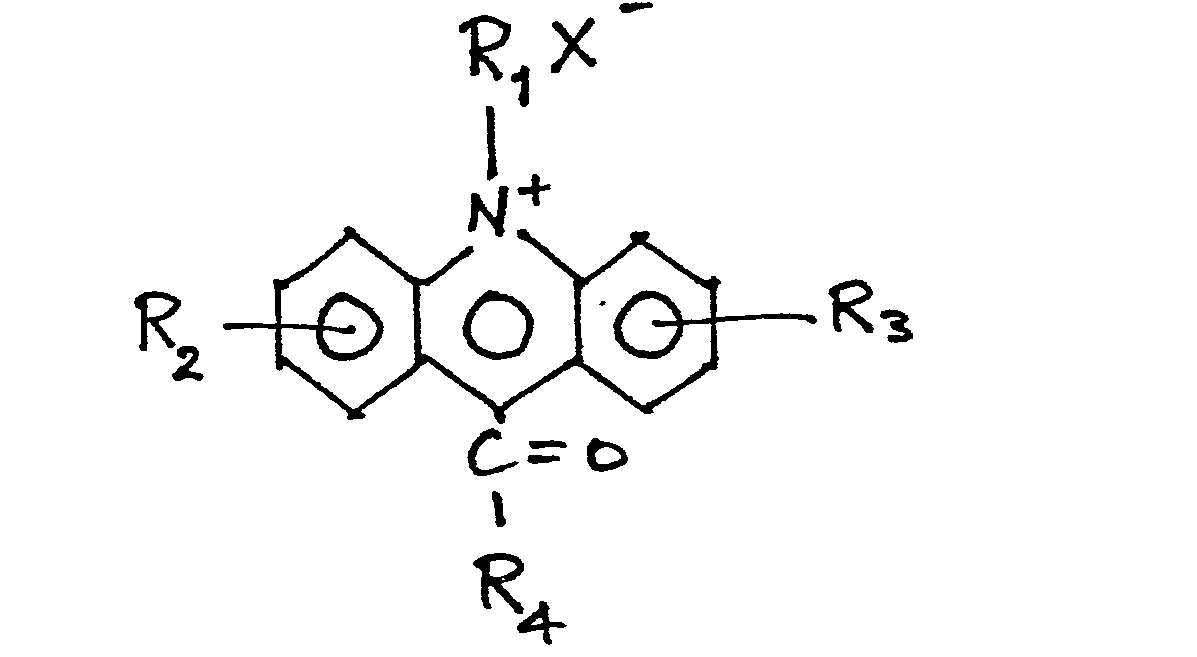
- the compound can be represented by the general formula: in which R 1 represents H, C 1 - C 10 optionally substituted alkyl, alkenyl, alkynyl or aryl, R 2 , R 3 are preferably, hydrogen, amino, substituted amino, carboxyl, hydroxyl, alkoxyl, nitro-, or halide substituents, and R 4 is preferably an optionally substituted phenoxy-moiety.
- R 1 represents H, C 1 - C 10 optionally substituted alkyl, alkenyl, alkynyl or aryl
- R 2 , R 3 are preferably, hydrogen, amino, substituted amino, carboxyl, hydroxyl, alkoxyl, nitro-, or halide substituents
- R 4 is preferably an optionally substituted phenoxy-moiety.
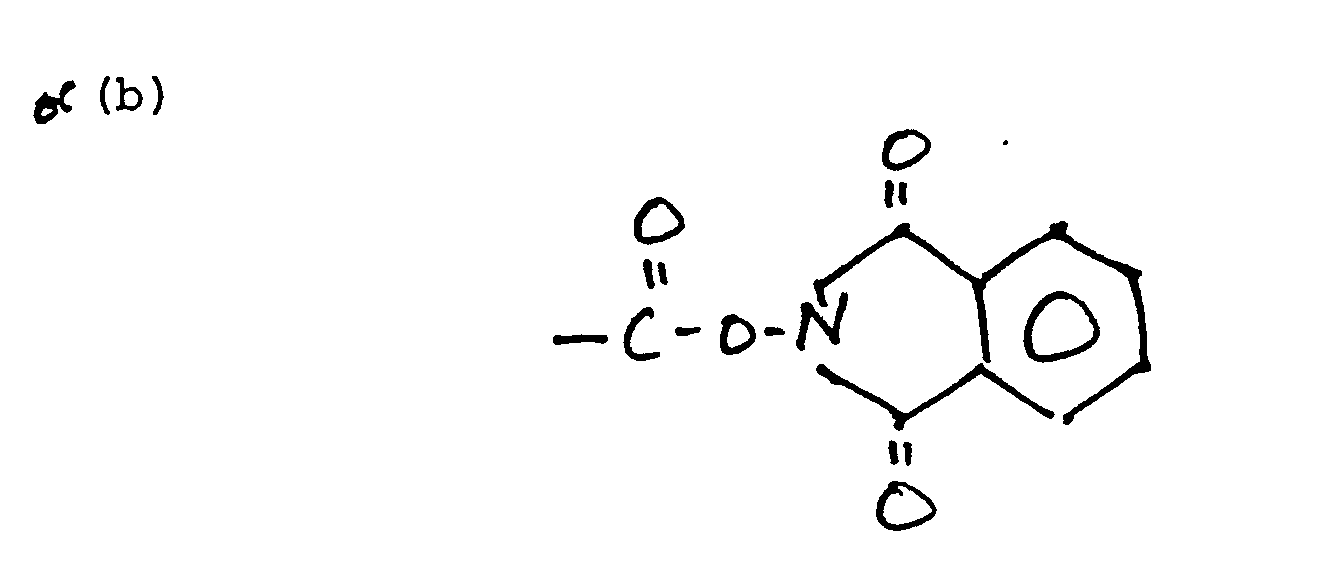
- an ester linkage exists between the acridinium and phenyl moieties as exemplified in the following formula: where R 5 comprises one of the following: where R 6 represents
- the labelling compound is prepared by reacting an acridine with a cyanide, and thencedonverting the product via a carboxy derivative to a halocarbonyl acridine derivative.
- the acridine derivative may be further reacted with a phenolic moiety substituted with one of the groups defined above as R 5 , and the product may be methylated at position 10 .
- R 5 moiety, or part thereof, or the linking group is protected before methylation, for example by amidation, esterification or acylation.
- N-hydroxysuccinimidyl ester is synthesised via the following route.
- Acridine is reacted with potassium cyanide and benzoyl chloride so as to yield a 9-cyano-derivative which is subsequently purified by recrystallisation.
- the material so obtained is reacted with sulphuric acid, thence sodium nitrite to yield the 9-carboxy-derivative which is purified, dried and reacted with thionyl chloride to give the 9-chlorocarbonyl-derivative.
- This is allowed to react with N-succinimidyl 3-(4-hydroxyphenyl) propionate to yield the corresponding ester of 9-carboxyacridine.
- the product is methylated at the 10-position, preferably using dimethyl sulphate or methyl pluorosulphonate to yield the final chemiluminescent product which is isolated by trituration with ether followed by filtration and dessication.
- An alternative method involves the formation of 9-chlorocarbonyl acridine as described above thence formation of the corresponding methyl ester using methanol followed by methylation at the 10-position preferably using dimethyl sulphate or methyl fluorosulphonate. This is then converted to the corresponding carboxylic acid by hydrolysis thence to the corresponding acyl chloride by reaction with thionyl chloride. The product of this reaction is then mixed with N-succinimidyl-3(4-hydroxyphenyl) propionate to yield the final product which is isolated by trituration.
- a luminescent labelling material comprises an acridinium compound as defined, linked to a protein or polypeptide or other organic substance of biological interest to provide a stable immunologically reactive luminescent reagent.
- the compounds represented by formulae(l) and (2) above are capable of reacting with proteins at temperatures between O and 40 0 C under aqueous conditions optionally in the presence of organic solvents to yield "luminescent reagents" which are preferably stable and immunologically active.
- the reaction whick results in the formation of the "luminescent reagent" is complete preferaby within 30 minutes, more preferably within 5 minutes,such that at least one mole, and preferably at least three or ten moles of chemiluminescent compound are incorporated into each 1 mole of protein, excess chemiluminescent label is inactivated with lysine which also acts to dissociate non-covalent interactions between chemiluminescent compound and protein.
- the labelled reagents are antibodies more preferably monoclonal antibodies which, when labelled, can be purified so as to be free of excess chmiluminescent compound by gel permeation chromatography preferably in a buffer system containing non-immune gamma globulins.
- the invention consists in an assay procedure in which a luminescent labelling compound as defined above is linked with a substance of biological interest, a light emitting reaction is triggered and the amount of the substance is quantified or detected by measuring or sensing the emitted light.
- the invention is especially applicable to immuno assy, and preferably two-site immunometric assays for the quantitation of polypeptide antigens.
- a solid phase derivative of a polyclonal or monoclonal antibody which may be an antibody coated tube, microtiter plate well or particulate solid phase, preferably a cellulose derivative, is used to bind antigen molecules.
- the uptake of antigen is measured by allowing the resultant solid phase to come into contact with the labelled reagent and measuring the luminescence activity associated with the solid phase following its separation from the assay mixture.
- Such an assay is preferably performed by adding the solid phase antibody and the "labelled reagent" simultaneously to the antigen containing solution thence allowing the immunological reaction to proceed, preferably for 4 hours, more preferably for 1 hour, before isolation and luminometric measurement of the solid phase.
- the antigen amy be reacted first with labelled antibody for a short period of sav k to 11 2 hours and then subsequently with solid phase antibody for a similar period. After isolation of the solid phase, the luminescence activity associated with the solid phase is quantified.
- indirect determination of the antigen concentration may be performed by using a labelled second antibody which selectively binds the soluble antibody used initially, that is, using unlabelled soluble first antibody.
- a labelled anti (globulin) antibody has the advantage of being a universal labelled reagent.
- 9-carboxyacridine (1.5 g) is added to freshly distilled thionyl chloride (11 cm 3 ) and the mixture heated under reflux for 4 hours. Boiling dichloromethane (100 cm 3 ) is added and the resulting solution filtered. The filtrate is concentrated by distillation and dry heptane added in order to precipitate the 9-chlorocarbonvlacridine hydrochloride which is subsequently filtered, washed withdry heptane and dried in vacuo. A portion of the resultant material (0.5 g) is added to dry pyridine (5 cm 3 ) and the mixture stirred for fifteen minutes.
- a solution of compound (A) in dry dimethylformamide is made at a concentration of 0.1 mg cm -3 .
- Ten microlitres of a 5 mg cm solution of monoclonal mouse (anti-human ⁇ 1 fetoprotein) antibodies re diluted with 300 ⁇ l of 0.1 molar phosphate buffer (pH 8.0) containing sodium chloride at a concentration of 0.15 moles per litre.
- Ten microlitres of the above solution of compound (A) is added to 100 ⁇ l of dimethyl formamide and a 10 ⁇ l aliquot of this solution removed to a glass test tube.
- the solution of monoclonal antibodies is then transferred to this tube and the mixture set aside for 15 minutes in the dark at room temperature.
- the labelled reagent mixture is transferred to the top of the gel column and eluted with the protein-containing buffer whilst collecting 1 c m 3 fractions of the column effluent.
- a 10 ⁇ l aliquot of each fraction is measured luminometrically by diluting it to 0.5 cm 3 with distilled water and then adding 1 cm 3 of a solution of 0.1 moles 1 -1 sodium hydroxide containing 1% by volume of a 100 volume solution of hydrogen peroxide, thence measuring the emitted light by means of a photon counter.
- the fraction yielding the greatest emission of light is further purified in a similar manner to that described above and the fraction containing the greatest chemiluminescence emission retained for further use.
- the purified "labelled reagent" is used in a two-site immunochemi- luminometric assay in the following manner.
- a solid phase antibody is prepared by linking an immunoglobulin G fraction of sheep (anti-human ⁇ 1 fetoprotein) antiserum to a diazonium derivative of reprecipitated aminoaryl cellulose and is stored as a 2 mg cm -3 suspension.
- the "labelled reagent" diluted with the same buffer such that 100 ⁇ l in each assay tube yields approximately 30,000 luminescent counts in twenty seconds.
- a standard solution of human ⁇ 1 -fetoprotein in the same buffer is serially diluted by a factor of two to yield a series of solutions ranging from 400 ng cm to 3.2 ng cm -3 .
- each of 30 assay tubes is placed 100 ⁇ l of the "labelled reagent" solution.
- One hundred microlitres of the immunoadsorbent suspension is placed into 27 of the same tubes followed by 100 ⁇ l of normal male human serum.
- Into each of 50 assay tubes is placed 100 ⁇ l each of the "labelled reagent” solution and immunoadsorbent suspension followed by 100 ⁇ l of the diluent buffer.
- One hundred microlitre aliquots of the standard solutions are added to the human serum containing tubes such that each standard solution was determined in triplicate, three of the first 27 tubes possessed 100 ⁇ l of diluent buffer so as to act as a zero ⁇ , fetoprotein standard.
- Two 100 ⁇ l aliquots are taken from each of 25 serum samples obtained from pregnant women at between 14 and 18 weeks gestational age and added to the remaining 50 assay tubes such that each serum sample is determined in duplicate.
- a dose response curve is constructed for the standards and used to convert the luminescence emission from the serum sample assay tubes to ⁇ 1 fetoprotein concentration.
- the yield and purity of the final product may be improved by incorporating protection and subsequent deprotection stages in the synthesis.
- An example of this aspect involves the reaction of the benzylester of 4-hydroxyphenyl propanoic acid with the halocarbonyl acridine followed by removal of the protecting benzyl group and subsequent formation of the N-succinimidyl moiety by esterification of the free acid with N-hydroxysuccinimide.
- separation of non-protein bound label can also be achieved by prior reaction with other amine containing species such as polylysine or certain solid phase derivatives of amine containing species.
- This invention enables the preparation of a chemiluminescent label suitable for use in immuno assay systems which has a sensitivity of detection close to or better than that of the widely used radioisotope label 125 I .
- luminol has been used as a non-isotopic luminescent label for immuno assays it suffers the disadvantages that it is difficult to link to proteins without loss of quantum yield and it requires a catalyst for its oxidative excitation which may generate high background luminescence.
- the acridinium ester derivative described here is stable, it can be coupled to proteins under mild conditions such that the quantum yield is unaffected and the immunoreactivity of the protein is preserved and it reacts under mild oxidative conditions where background luminescence is minimal.
- the assay procedure carried out with acridinium ester labelled antibody is a two-site immunometric assay.
- Such assays offer advantages over conventional competitive techniques in terms of speed and sensitivity by their use of excess binding reagent as opposed to limiting binding reagent.
- the advantages of the two-site assay have not been fully realised since incorporation of large amounts of 125 I to increase specific activity inevitably results in radiolytic damage to antibodies.
- the chemiluminescent label described in the present invention does not have this disadvantage so that high specific activity labelled antibodies can be prepared without loss of immunoreactivity.
- the use of acridinium ester labelled antibodies in two-site assays provides a means of improving the sensitivity of measurement of proteins and polypeptides by one to two orders of magnitude by comparison with existing techniques.
Landscapes
- Health & Medical Sciences (AREA)
- Chemical & Material Sciences (AREA)
- Immunology (AREA)
- Life Sciences & Earth Sciences (AREA)
- Organic Chemistry (AREA)
- Engineering & Computer Science (AREA)
- Biomedical Technology (AREA)
- Urology & Nephrology (AREA)
- Molecular Biology (AREA)
- Hematology (AREA)
- Microbiology (AREA)
- Cell Biology (AREA)
- Biotechnology (AREA)
- Food Science & Technology (AREA)
- Medicinal Chemistry (AREA)
- Physics & Mathematics (AREA)
- Analytical Chemistry (AREA)
- Biochemistry (AREA)
- General Health & Medical Sciences (AREA)
- General Physics & Mathematics (AREA)
- Pathology (AREA)
- Investigating Or Analysing Materials By The Use Of Chemical Reactions (AREA)
- Investigating Or Analysing Biological Materials (AREA)
Abstract
Description
- This invention relates to methods designed for use in the analysis, assay, or location of proteins, polypeptideSj and other substances of biological interest by linking ("labelling") them to another molecule or molecules which can take part in a reaction resulting in the emission of light. The labelled substance, to be termed "luminescent reagent", may be used in various types of biological investigations, preferably immunoassays and protein binding assays. The amount of the "luminescent reagent" is measured by recording the light emitted after producing the appropriate conditions required for the luminescent reaction to take place. Here, the luminescent reaction is one which generates chemiluminescence which is distinguished from fluorescence or phosphorescence. The use of the "luminescent reagent" enables the analysis, assay, or location of proteins or other substances of biological interest to be carried out without experiencing any of the disadvantages associated with the use of radioactive labelled substances such as are commonly used at present. These disadvantages are as follows. Firstly, the formation of such a radioactive reagent involves the use of highly radioactive and hence potentially hazardous species. Secondly, the shelf-life of such a radioactive reagent is often short because of its continuous decay. Further, the emission of radiation from the radio-isotope may be deliterious to the substance to which the radio-isotope is linked. Thirdly, it is often difficult to label proteins sufficiently to provide a sensitively and rapidly detectable reagent.
- In contrast, the "luminescent reagent" is non-radiotoxic, stable, and can be quantified both rapidly and in small amounts.
- In a preferred form the invention comprises a compound consisting of aryl acridinium ester, linkage and N-succinimidyl ester moieties. This compound undergoes a light emitting reaction in the presence of a dilute aqueous solution of sodium hydroxide and hydrogen peroxide and the amount of compound can be quantified by measurement of the intensity of the emitted light or rate of photon emission. Further the compound reacts with other substances containing primary and second aliphatic amines to yield chemiluminescent derivatives. The compound has the advantage of being stable under normal storage conditions and of reacting with the aforementioned amines under mild reaction conditions.
- The compound can be represented by the general formula:


- From another aspect of the invention the labelling compound is prepared by reacting an acridine with a cyanide, and thencedonverting the product via a carboxy derivative to a halocarbonyl acridine derivative. The acridine derivative may be further reacted with a phenolic moiety substituted with one of the groups defined above as R5, and the product may be methylated at position 10. In some cases the R5 moiety, or part thereof, or the linking group is protected before methylation, for example by amidation, esterification or acylation.
- Thus in a particular example a N-hydroxysuccinimidyl ester is synthesised via the following route. Acridine is reacted with potassium cyanide and benzoyl chloride so as to yield a 9-cyano-derivative which is subsequently purified by recrystallisation. The material so obtained is reacted with sulphuric acid, thence sodium nitrite to yield the 9-carboxy-derivative which is purified, dried and reacted with thionyl chloride to give the 9-chlorocarbonyl-derivative.This is allowed to react with N-succinimidyl 3-(4-hydroxyphenyl) propionate to yield the corresponding ester of 9-carboxyacridine. The product is methylated at the 10-position, preferably using dimethyl sulphate or methyl pluorosulphonate to yield the final chemiluminescent product which is isolated by trituration with ether followed by filtration and dessication. An alternative method involves the formation of 9-chlorocarbonyl acridine as described above thence formation of the corresponding methyl ester using methanol followed by methylation at the 10-position preferably using dimethyl sulphate or methyl fluorosulphonate. This is then converted to the corresponding carboxylic acid by hydrolysis thence to the corresponding acyl chloride by reaction with thionyl chloride. The product of this reaction is then mixed with N-succinimidyl-3(4-hydroxyphenyl) propionate to yield the final product which is isolated by trituration.
- According to a further aspect of the invention a luminescent labelling material comprises an acridinium compound as defined, linked to a protein or polypeptide or other organic substance of biological interest to provide a stable immunologically reactive luminescent reagent. The compounds represented by formulae(l) and (2) above are capable of reacting with proteins at temperatures between O and 400C under aqueous conditions optionally in the presence of organic solvents to yield "luminescent reagents" which are preferably stable and immunologically active. The reaction whick results in the formation of the "luminescent reagent" is complete preferaby within 30 minutes, more preferably within 5 minutes,such that at least one mole, and preferably at least three or ten moles of chemiluminescent compound are incorporated into each 1 mole of protein, excess chemiluminescent label is inactivated with lysine which also acts to dissociate non-covalent interactions between chemiluminescent compound and protein.
- Preferably the labelled reagents are antibodies more preferably monoclonal antibodies which, when labelled, can be purified so as to be free of excess chmiluminescent compound by gel permeation chromatography preferably in a buffer system containing non-immune gamma globulins.
- From a further aspect the invention consists in an assay procedure in which a luminescent labelling compound as defined above is linked with a substance of biological interest, a light emitting reaction is triggered and the amount of the substance is quantified or detected by measuring or sensing the emitted light. The invention is especially applicable to immuno assy, and preferably two-site immunometric assays for the quantitation of polypeptide antigens. Here a solid phase derivative of a polyclonal or monoclonal antibody, which may be an antibody coated tube, microtiter plate well or particulate solid phase, preferably a cellulose derivative, is used to bind antigen molecules. The uptake of antigen, which depends on the antigen concentration, is measured by allowing the resultant solid phase to come into contact with the labelled reagent and measuring the luminescence activity associated with the solid phase following its separation from the assay mixture. Such an assay is preferably performed by adding the solid phase antibody and the "labelled reagent" simultaneously to the antigen containing solution thence allowing the immunological reaction to proceed, preferably for 4 hours, more preferably for 1 hour, before isolation and luminometric measurement of the solid phase. Alternatively the antigen amy be reacted first with labelled antibody for a short period of sav k to 11 2 hours and then subsequently with solid phase antibody for a similar period. After isolation of the solid phase, the luminescence activity associated with the solid phase is quantified.
- Alternatively indirect determination of the antigen concentration may be performed by using a labelled second antibody which selectively binds the soluble antibody used initially, that is, using unlabelled soluble first antibody. Such a labelled anti (globulin) antibody has the advantage of being a universal labelled reagent.
- Acridine (lOg) is suspended in water (133 cm3) in which is dissolved potassium cyanide (22g). Benzoyl chloride (27.5 cm3) is added in a dropwise manner with vigorous shaking of the reaction flask after the addition of each 1 cm3 of benzoyl chloride. The mixture is left to stand for several hours at room temperature, thence filtered and the residual solid washed with distilled water. The solid is then recrystallised from ethanol containing activated decolourising charcoal.
- Part of the product of the above procedure, that is, 9-cyano acridine (4g) is dissolved in sulphuric acid containing 10% by weight of distilled water (total volume equals 40 cm3). The mixture thus obtained is heated at a temperature of 100°C for 2 hours after which time sodium nitrite (10.7g) is added slowly with continuous stirring. The resulting mixture is heated at 100 C for 2 hours then poured into cold, distilled water (650 cm3) The solid material which precipitates at this stage is isolated by filtration and allowed to dissolve in the minimum quantity of one molar sodium hydroxide solution; the solution thus obtained is filtered and the filtrate made slightly acidic by the addition of a 50%, by volume, solution of sulphuric acid in water. The 9-carboxy-acridine so formed is then dried in vacuo.
- 9-carboxyacridine (1.5 g) is added to freshly distilled thionyl chloride (11 cm3) and the mixture heated under reflux for 4 hours. Boiling dichloromethane (100 cm3) is added and the resulting solution filtered. The filtrate is concentrated by distillation and dry heptane added in order to precipitate the 9-chlorocarbonvlacridine hydrochloride which is subsequently filtered, washed withdry heptane and dried in vacuo. A portion of the resultant material (0.5 g) is added to dry pyridine (5 cm3) and the mixture stirred for fifteen minutes. Then a molar equivalent of N-succinimidyl 3(4-hydroxyphenyl)-propionate is added. The mixture is stirred at room temperature for twelve hours under anhydrous conditions. The reaction mixture is poured into cold distilled water (100 cm3) acidified to pH2 with hydrochloric acid and the solid material which precipitates collected by filtration and dried in vacuo. Part of the dried material (200 mg) is suspended in freshly distilled dimethyl sulphate (1 cm3) and the mixture heated at 100°C for ten minutes, the solution formed at this stage is cooled in ice and triturated with dry diethyl ether. The mixture is then filtered and the solid dried in vacuo. The filtrate is retained and evaporated to dryness in vacuo. Both fractions contain chiefly 4- (2-Succinimidyl-oxycarbonylethyl) - phenl 1-10-methycridium-9-carboxylate methosulphate· hereinafter referred to as compound (A).
-

- A solution of compound (A) in dry dimethylformamide is made at a concentration of 0.1 mg cm-3. Ten microlitres of a 5 mg cm solution of monoclonal mouse (anti-human α1fetoprotein) antibodies re diluted with 300 µl of 0.1 molar phosphate buffer (pH 8.0) containing sodium chloride at a concentration of 0.15 moles per litre. Ten microlitres of the above solution of compound (A) is added to 100 µl of dimethyl formamide and a 10 µl aliquot of this solution removed to a glass test tube. The solution of monoclonal antibodies is then transferred to this tube and the mixture set aside for 15 minutes in the dark at room temperature. One hundred microlitres of a solution of lysine mono-hydrochloride, in the phosphate buffer described above, at a concentration of 10 mg cm-3, is then added and the mixture left for a further 15 minutes as described above. The resulting mixture is purified by gel exclusion chromatography using a column of pre-swollen "Sephadex G50", medium grade, of height 250 mm and diameter 10 mm, which has been previously equilibrated with a 0.1 molar phosphate buffer (pH 6.5) containing sodium chloride at a concentration of 0.15 moles per litre, sheep immunoglobulin G at a concentration of 20 mg 1-1, 0.1% by weight of human serum albumin and 0.01% by weight of thiomersal. The labelled reagent mixture is transferred to the top of the gel column and eluted with the protein-containing buffer whilst collecting 1 cm 3 fractions of the column effluent. A 10 µl aliquot of each fraction is measured luminometrically by diluting it to 0.5 cm3 with distilled water and then adding 1 cm3 of a solution of 0.1 moles 1-1 sodium hydroxide containing 1% by volume of a 100 volume solution of hydrogen peroxide, thence measuring the emitted light by means of a photon counter.
- The fraction yielding the greatest emission of light is further purified in a similar manner to that described above and the fraction containing the greatest chemiluminescence emission retained for further use.
- The purified "labelled reagent" is used in a two-site immunochemi- luminometric assay in the following manner. A solid phase antibody is prepared by linking an immunoglobulin G fraction of sheep (anti-human α1 fetoprotein) antiserum to a diazonium derivative of reprecipitated aminoaryl cellulose and is stored as a 2 mg cm-3 suspension.
- This is diluted by a factor of ten such that 100 µl in each assay tube gives 20 pg of solid phase suspended in 0.1 m phosphate buffer (pH 7.4) containing 0.15 moles 1-1 of sodium chloride and 0.1% by weight of bovine serum albumin.
- The "labelled reagent" diluted with the same buffer such that 100 µl in each assay tube yields approximately 30,000 luminescent counts in twenty seconds. A standard solution of human α1-fetoprotein in the same buffer is serially diluted by a factor of two to yield a series of solutions ranging from 400 ng cm to 3.2 ng cm-3.
- Into each of 30 assay tubes is placed 100 µl of the "labelled reagent" solution. One hundred microlitres of the immunoadsorbent suspension is placed into 27 of the same tubes followed by 100 µl of normal male human serum. Into each of 50 assay tubes is placed 100 µl each of the "labelled reagent" solution and immunoadsorbent suspension followed by 100 µl of the diluent buffer. One hundred microlitre aliquots of the standard solutions are added to the human serum containing tubes such that each standard solution was determined in triplicate, three of the first 27 tubes possessed 100 µl of diluent buffer so as to act as a zero α, fetoprotein standard.
- Two 100 µl aliquots are taken from each of 25 serum samples obtained from pregnant women at between 14 and 18 weeks gestational age and added to the remaining 50 assay tubes such that each serum sample is determined in duplicate.
- All tubes are incubated for one hour at room temperature after which 2 cm3 of diluent buffer added to each tube except for those three tubes containing "labelled reagent" only. The tubes are centrifuged to sediment the immunoadsorbent, then gently inverted to discard the supernatant. 0.5 cm3 of distilled water is added in turn, with mixing, to each tube which is then placed in the luminometer and the "labelled reagent" determined as described previously.
- A dose response curve is constructed for the standards and used to convert the luminescence emission from the serum sample assay tubes to α1fetoprotein concentration.
- Referring to the example above of a synthesis of a N-hydroxysuccinimidyl ester the yield and purity of the final product may be improved by incorporating protection and subsequent deprotection stages in the synthesis. An example of this aspect involves the reaction of the benzylester of 4-hydroxyphenyl propanoic acid with the halocarbonyl acridine followed by removal of the protecting benzyl group and subsequent formation of the N-succinimidyl moiety by esterification of the free acid with N-hydroxysuccinimide.
- In the labelling procedure referred to above involving reaction between excess chemiluminescent label and protein, separation of non-protein bound label can also be achieved by prior reaction with other amine containing species such as polylysine or certain solid phase derivatives of amine containing species.
- This invention enables the preparation of a chemiluminescent label suitable for use in immuno assay systems which has a sensitivity of detection close to or better than that of the widely used radioisotope label 125 I.
- While luminol has been used as a non-isotopic luminescent label for immuno assays it suffers the disadvantages that it is difficult to link to proteins without loss of quantum yield and it requires a catalyst for its oxidative excitation which may generate high background luminescence. The acridinium ester derivative described here is stable, it can be coupled to proteins under mild conditions such that the quantum yield is unaffected and the immunoreactivity of the protein is preserved and it reacts under mild oxidative conditions where background luminescence is minimal.
- The assay procedure carried out with acridinium ester labelled antibody is a two-site immunometric assay. Such assays offer advantages over conventional competitive techniques in terms of speed and sensitivity by their use of excess binding reagent as opposed to limiting binding reagent. In the past the advantages of the two-site assay have not been fully realised since incorporation of large amounts of 125 I to increase specific activity inevitably results in radiolytic damage to antibodies. The chemiluminescent label described in the present invention does not have this disadvantage so that high specific activity labelled antibodies can be prepared without loss of immunoreactivity. The use of acridinium ester labelled antibodies in two-site assays provides a means of improving the sensitivity of measurement of proteins and polypeptides by one to two orders of magnitude by comparison with existing techniques.
Claims (19)




Applications Claiming Priority (2)
| Application Number | Priority Date | Filing Date | Title |
|---|---|---|---|
| GB8137522 | 1981-12-11 | ||
| GB8137522 | 1981-12-11 |
Publications (3)
| Publication Number | Publication Date |
|---|---|
| EP0082636A1 true EP0082636A1 (en) | 1983-06-29 |
| EP0082636B1 EP0082636B1 (en) | 1988-09-14 |
| EP0082636B2 EP0082636B2 (en) | 2006-10-18 |
Family
ID=10526563
Family Applications (1)
| Application Number | Title | Priority Date | Filing Date |
|---|---|---|---|
| EP82306557A Expired - Lifetime EP0082636B2 (en) | 1981-12-11 | 1982-12-08 | Luminescent labelling materials and procedures |
Country Status (4)
| Country | Link |
|---|---|
| US (1) | US4946958A (en) |
| EP (1) | EP0082636B2 (en) |
| DE (1) | DE3279029D1 (en) |
| GB (1) | GB2112779B (en) |
Cited By (32)
| Publication number | Priority date | Publication date | Assignee | Title |
|---|---|---|---|---|
| US4687747A (en) * | 1984-07-02 | 1987-08-18 | Mallinckrodt, Inc. | Phenanthridinium ester as a labelling compound in luminometric immunoassay |
| DE3628573A1 (en) * | 1986-08-22 | 1988-02-25 | Hoechst Ag | CHEMILUMINESCENT ACRIDINE DERIVATIVES AND THEIR USE IN LUMINESCENCE IMMUNOASSAYS |
| EP0212951A3 (en) * | 1985-08-15 | 1988-05-04 | Integrated Genetics, Inc. | Labelled nucleic acids |
| EP0273115A3 (en) * | 1986-10-22 | 1988-10-26 | Abbott Laboratories | Chemiluminescent acridinium and phenantridinium salts chemiluminescent acridinium and phenantridinium salts |
| EP0263657A3 (en) * | 1986-10-06 | 1988-11-30 | Ciba Corning Diagnostics Corp. | Polysubstituted aryl acridinium esters |
| EP0216553A3 (en) * | 1985-09-06 | 1989-03-15 | Integrated Genetics, Inc. | Acridine ester and acridinium ester synthesis |
| WO1989002439A1 (en) * | 1987-09-21 | 1989-03-23 | Ml Technology Ventures, L.P. | Non-nucleotide linking reagents for nucleotide probes |
| WO1989006231A1 (en) * | 1987-12-31 | 1989-07-13 | London Diagnostics, Inc. | Assays utilizing improved chemiluminescent esters, thioesters and amides |
| EP0324202A1 (en) * | 1987-12-18 | 1989-07-19 | Mochida Pharmaceutical Co., Ltd. | Acridinium compounds as chemiluminogenic label |
| US4918192A (en) * | 1986-10-06 | 1990-04-17 | Ciba Corning Diagnostics Corp. | Polysubstituted aryl acridinium esters |
| EP0369344A1 (en) * | 1988-11-15 | 1990-05-23 | Abbott Laboratories | N-arylation of isatins |
| EP0309230A3 (en) * | 1987-09-21 | 1990-07-11 | M.L. Technology Ventures, L.P. | Homogeneous protection assay |
| US4946958A (en) * | 1981-12-11 | 1990-08-07 | The Welsh National School Of Medicine | Chemiluminescent acridinium labelling compounds |
| EP0361817A3 (en) * | 1988-09-26 | 1990-10-03 | Ciba Corning Diagnostics Corp. | Nucleophilic polysubstituted aryl acridinium esters, conjugates, production and uses thereof |
| EP0353971A3 (en) * | 1988-08-01 | 1990-10-10 | Ciba Corning Diagnostics Corp. | Acridinium esters and method for detection of an analyte using acridinium esters and liposomes |
| EP0330050A3 (en) * | 1988-02-20 | 1991-11-06 | Hoechst Aktiengesellschaft | Special chemiluminescent acridine derivatives and their use in luminescence immunoassays |
| WO1992009580A1 (en) * | 1990-11-21 | 1992-06-11 | Beckman Instruments, Inc. | Chemiluminescent compounds |
| US5155216A (en) * | 1985-08-15 | 1992-10-13 | Amoco Corporation | Nucleic acids labeled with a chemiluminescent acridine ester |
| EP0149565B1 (en) * | 1984-01-19 | 1992-12-23 | Ortho-Clinical Diagnostics | Assay method |
| WO1994028420A1 (en) * | 1993-05-22 | 1994-12-08 | Rhone Poulenc Diagnostics Ltd | Method of detection of bacteria |
| WO1995027702A1 (en) * | 1994-04-08 | 1995-10-19 | Ciba Corning Diagnostics Corp. | Novel functionalized hydrophilic acridinium esters |
| EP0617107A4 (en) * | 1992-09-09 | 1996-08-21 | Iatron Lab | METHOD OF MAKING LUMINESCENT ACRIDINIUM DERIVATIVE AND METHOD OF DETECTING TEST MATERIALS USING SAID DERIVATIVE. |
| US5639604A (en) * | 1987-09-21 | 1997-06-17 | Gen-Probe Incorporated | Homogeneous protection assay |
| US5731148A (en) * | 1995-06-07 | 1998-03-24 | Gen-Probe Incorporated | Adduct protection assay |
| US5783696A (en) * | 1988-02-20 | 1998-07-21 | Hoechst Aktiengesellschaft | Special chemiluminescent acridine derivatives |
| EP0844246A4 (en) * | 1996-03-15 | 1999-06-02 | Ss Pharmaceutical Co | REAGENTS FOR MARKING SH GROUPS, METHOD FOR THE PRODUCTION THEREOF AND METHOD FOR MARKING WITH THESE REAGENTS |
| US6004745A (en) * | 1987-09-21 | 1999-12-21 | Gen-Probe Incorporated | Hybridization protection assay |
| US6080591A (en) * | 1988-09-26 | 2000-06-27 | Bayer Corporation | Nucleophilic polysubstituted aryl acridinium ester conjugates and syntheses thereof |
| US6087502A (en) * | 1995-08-01 | 2000-07-11 | Mochida Pharmaceuticals Co., Ltd. | Acridinium compound having a plurality of luminescent groups and binding groups, and conjugate thereof |
| US6414152B1 (en) * | 1981-12-11 | 2002-07-02 | University Of Wales College Of Medicine Of Heath Park | Luminescent labelling material and procedures |
| EP0656005B1 (en) * | 1992-08-21 | 2003-04-23 | Nichols Institute Diagnostics | Biotinylated chemiluminescent label, conjugates, assays, assay kits |
| CN109852669A (en) * | 2019-01-04 | 2019-06-07 | 南京航思生物科技有限公司 | A kind of method of acridinium ester label nucleic acid |
Families Citing this family (50)
| Publication number | Priority date | Publication date | Assignee | Title |
|---|---|---|---|---|
| US7122671B1 (en) * | 1979-07-19 | 2006-10-17 | University College Cardiff Consultants Limited | Luminescent labelling materials and procedures |
| US5221605A (en) * | 1984-10-31 | 1993-06-22 | Igen, Inc. | Luminescent metal chelate labels and means for detection |
| US5310687A (en) * | 1984-10-31 | 1994-05-10 | Igen, Inc. | Luminescent metal chelate labels and means for detection |
| US5238808A (en) * | 1984-10-31 | 1993-08-24 | Igen, Inc. | Luminescent metal chelate labels and means for detection |
| US5110932A (en) * | 1986-10-06 | 1992-05-05 | Ciba Corning Diagnostics Corp. | Polysubstituted aryl acridinium esters |
| US5935779A (en) * | 1988-11-03 | 1999-08-10 | Igen International Inc. | Methods for improved particle electrochemiluminescence assay |
| US5185439A (en) * | 1987-10-05 | 1993-02-09 | Gen-Probe Incorporated | Acridinium ester labelling and purification of nucleotide probes |
| US5283334A (en) * | 1987-12-31 | 1994-02-01 | London Diagnostics, Inc. | Side-chain functional chemiluminescent labels and their conjugates, and assays therefrom |
| US5321136A (en) * | 1987-12-31 | 1994-06-14 | London Diagnostics, Inc. | Peri substituted fused ring chemiluminescent labels and their conjugates, and assays therefrom |
| US5338847A (en) * | 1987-12-31 | 1994-08-16 | London Diagnostics, Inc. | Hydrolytically stable chemiluminescent labels and their conjugates, and assays therefrom by adduct formation |
| DE3805318C2 (en) * | 1988-02-20 | 1998-07-23 | Hoechst Ag | Special chemiluminescent acridine derivatives and their use in luminescent immunoassays |
| US4950613A (en) * | 1988-02-26 | 1990-08-21 | Gen-Probe Incorporated | Proteted chemiluminescent labels |
| US5227489A (en) * | 1988-08-01 | 1993-07-13 | Ciba Corning Diagnostics Corp. | Stable hydrophilic acridinium esters suitable for liposome encapsulation |
| US5241070A (en) * | 1988-09-26 | 1993-08-31 | Ciba Corning Diagnostics Corp. | Nucleophilic polysubstituted aryl acridinium esters and uses thereof |
| GB2233450B (en) * | 1989-06-24 | 1993-06-30 | Univ Wales Medicine | Detecting or quantifing multiple analytes with luminescent reagents |
| US6436349B1 (en) | 1991-03-04 | 2002-08-20 | Bayer Corporation | Fluid handling apparatus for an automated analyzer |
| US6498037B1 (en) | 1991-03-04 | 2002-12-24 | Bayer Corporation | Method of handling reagents in a random access protocol |
| CA2384523C (en) * | 1991-03-04 | 2007-01-09 | Bayer Corporation | Automated analyzer |
| EP0522677B1 (en) * | 1991-07-10 | 1996-12-18 | TDK Corporation | Method of measuring concentration of immunoreactant using electrochemiluminescence |
| US6087188A (en) * | 1992-11-13 | 2000-07-11 | Alk A/S | Two-site immunoassay for an antibody with chemiluminescent label and biotin bound ligand |
| US5395752A (en) * | 1993-03-19 | 1995-03-07 | Ciba Corning Diagnostics Corp. | Long emission wavelength chemiluminescent compounds and their use in test assays |
| US5491072A (en) * | 1993-05-17 | 1996-02-13 | Lumigen, Inc. | N-alkylacridan carboxyl derivatives useful for chemiluminescent detection |
| US5523212A (en) * | 1993-05-17 | 1996-06-04 | Lumigen, Inc. | Aryl N-alkylacridanthiocarboxylate derivatives useful for chemiluminescent detection |
| GB2280265B (en) * | 1993-07-21 | 1997-06-04 | Molecular Light Technology Lim | Monitoring of chemical additives |
| GB2289334B (en) * | 1994-05-10 | 1998-08-26 | Molecular Light Technology Lim | Enzyme linked chemiluminescent assay |
| DE69535240T2 (en) * | 1994-10-28 | 2007-06-06 | Gen-Probe Inc., San Diego | Compositions and methods for the simultaneous detection and quantification of a majority of specific nucleic acid sequences |
| US5705365A (en) * | 1995-06-07 | 1998-01-06 | Gen-Probe Incorporated | Kits for determining pre-amplification levels of a nucleic acid target sequence from post-amplification levels of product |
| US5710029A (en) * | 1995-06-07 | 1998-01-20 | Gen-Probe Incorporated | Methods for determining pre-amplification levels of a nucleic acid target sequence from post-amplification levels of product |
| EP1019379B1 (en) | 1997-08-21 | 2005-10-19 | Maine Medical Center | Peroxide-based chemiluminescent assays and chemiluminescent compounds used therein |
| US6126870A (en) * | 1997-09-12 | 2000-10-03 | Lumigen, Inc. | Chemiluminescent labeling compounds |
| US7632651B2 (en) | 1997-09-15 | 2009-12-15 | Mds Analytical Technologies (Us) Inc. | Molecular modification assays |
| US7745142B2 (en) | 1997-09-15 | 2010-06-29 | Molecular Devices Corporation | Molecular modification assays |
| US7070921B2 (en) | 2000-04-28 | 2006-07-04 | Molecular Devices Corporation | Molecular modification assays |
| US6180340B1 (en) | 1997-10-31 | 2001-01-30 | Gen-Probe Incorporated | Extended dynamic range assays |
| ES2322859T3 (en) | 1998-05-01 | 2009-06-30 | Gen-Probe Incorporated | AUTOMATED DIAGNOSTIC ANALYZER. |
| US20030027234A1 (en) * | 2001-07-30 | 2003-02-06 | Pandian Murugan R. | Methods for detecting Down's syndrome |
| US6627457B2 (en) | 2001-07-30 | 2003-09-30 | Quest Diagnostics Investments Incorporated | Methods for detecting pregnancy |
| WO2003012445A1 (en) | 2001-07-30 | 2003-02-13 | Quest Diagnostics Investments Incorporated | Methods and kits for detecting ita in a biological sample |
| US6867005B2 (en) * | 2001-10-24 | 2005-03-15 | Beckman Coulter, Inc. | Method and apparatus for increasing the dynamic range and accuracy of binding assays |
| US6723851B2 (en) * | 2001-10-31 | 2004-04-20 | Quest Diagnostics Investment Incorporated | Chemiluminescent compounds and use thereof |
| KR20050008720A (en) * | 2002-05-17 | 2005-01-21 | 벡톤 디킨슨 앤드 컴퍼니 | Automated system for isolating, amplifying and detecting a target nucleic acid sequence |
| US7309615B2 (en) * | 2002-09-27 | 2007-12-18 | Siemens Medical Solutions Diagnostic | High quantum yield acridinium compounds and their uses in improving assay sensitivity |
| US7319041B2 (en) * | 2002-09-27 | 2008-01-15 | Siemens Medical Solutions Diagnostic | Applications of acridinium compounds and derivatives in homogeneous assays |
| US7390670B2 (en) | 2003-02-20 | 2008-06-24 | Lumigen, Inc. | Signalling compounds and methods for detecting hydrogen peroxide |
| US20050148096A1 (en) * | 2004-01-07 | 2005-07-07 | Cole Laurence A. | Methods for detecting pregnancy |
| US7781229B2 (en) * | 2004-04-14 | 2010-08-24 | Michigan Diagnostics, Llc | Ultra-sensitive chemiluminescent substrates for enzymes and their conjugates |
| EP1909108B1 (en) | 2005-03-10 | 2019-05-29 | Gen-Probe Incorporated | Systems and methods to perform assays for detecting or quantifiying analytes |
| CA2842402C (en) | 2005-03-10 | 2016-02-23 | Gen-Probe Incorporated | Systems and methods to perform assays for detecting or quantifying analytes within samples |
| WO2019116234A1 (en) | 2017-12-12 | 2019-06-20 | Nestec S.A. | Methods for determining microbiome ribosomal rna composition changes |
| US11237170B2 (en) | 2018-12-04 | 2022-02-01 | Aat Bioquest, Inc. | Styryl phenols, derivatives and their use in methods of analyte detection |
Citations (5)
| Publication number | Priority date | Publication date | Assignee | Title |
|---|---|---|---|---|
| US3352791A (en) * | 1965-01-22 | 1967-11-14 | American Cyanamid Co | Generation of light by the reaction of peroxide with heterocyclic derivatives |
| US3431264A (en) * | 1965-11-05 | 1969-03-04 | American Cyanamid Co | 9-cyanoacridans and process for their production |
| GB1316363A (en) * | 1969-05-28 | 1973-05-09 | Roussel Uclaf | Alkoxycarbonyl-acridan derivatives and the preparation thereof |
| GB2008247A (en) * | 1977-11-17 | 1979-05-31 | Welsh Nat School Med | Detecting or quantifying substances using labelling techniques |
| GB2025609A (en) * | 1978-06-14 | 1980-01-23 | Univ Birmingham | Determination of concentration of an analyte in a sample |
Family Cites Families (15)
| Publication number | Priority date | Publication date | Assignee | Title |
|---|---|---|---|---|
| US3689391A (en) * | 1970-05-13 | 1972-09-05 | Synvar Ass | Method for chemically initiating photochemical reactions |
| US3817837A (en) * | 1971-05-14 | 1974-06-18 | Syva Corp | Enzyme amplification assay |
| GB1461877A (en) * | 1974-02-12 | 1977-01-19 | Wellcome Found | Assay method utilizing chemiluminescence |
| US4199559A (en) * | 1974-08-12 | 1980-04-22 | Syva Company | Fluorescence quenching with immunological pairs in immunoassays |
| IN142734B (en) * | 1975-04-28 | 1977-08-20 | Miles Lab | |
| SE7811630L (en) * | 1977-11-17 | 1979-05-18 | Welsh Nat School Med | METHOD OF DETECTION OR QUANTITATION OF SUBSTANCES USING LABELING TECHNIQUES |
| US4277437A (en) * | 1978-04-05 | 1981-07-07 | Syva Company | Kit for carrying out chemically induced fluorescence immunoassay |
| US4238195A (en) * | 1979-01-18 | 1980-12-09 | Miles Laboratories, Inc. | Fluorescer-labeled specific binding assays |
| US4376110A (en) * | 1980-08-04 | 1983-03-08 | Hybritech, Incorporated | Immunometric assays using monoclonal antibodies |
| GB2112779B (en) * | 1981-12-11 | 1986-10-15 | Welsh Nat School Med | Aryl acridinium esters as luminescent labelling materials |
| US4767718A (en) * | 1984-06-18 | 1988-08-30 | Southern Illinois University Foundation | Fluorescent opioid reagents and methods of use thereof in the detection of opioid receptors |
| JP2509574B2 (en) * | 1985-08-15 | 1996-06-19 | アモコ・コーポレーション | Labeled nucleic acid |
| JPS6261969A (en) * | 1985-09-06 | 1987-03-18 | アモコ・コーポレーション | Synthesis of acridinium ester |
| DE3645292C2 (en) * | 1986-08-22 | 1997-12-11 | Hoechst Ag | New chemiluminescent 9-carboxy-acridinium cpds. |
| US4745181A (en) * | 1986-10-06 | 1988-05-17 | Ciba Corning Diagnostics Corp. | Polysubstituted aryl acridinium esters |
-
1982
- 1982-12-08 GB GB08235019A patent/GB2112779B/en not_active Expired
- 1982-12-08 DE DE8282306557T patent/DE3279029D1/en not_active Expired
- 1982-12-08 EP EP82306557A patent/EP0082636B2/en not_active Expired - Lifetime
-
1988
- 1988-09-26 US US07/251,954 patent/US4946958A/en not_active Expired - Lifetime
Patent Citations (5)
| Publication number | Priority date | Publication date | Assignee | Title |
|---|---|---|---|---|
| US3352791A (en) * | 1965-01-22 | 1967-11-14 | American Cyanamid Co | Generation of light by the reaction of peroxide with heterocyclic derivatives |
| US3431264A (en) * | 1965-11-05 | 1969-03-04 | American Cyanamid Co | 9-cyanoacridans and process for their production |
| GB1316363A (en) * | 1969-05-28 | 1973-05-09 | Roussel Uclaf | Alkoxycarbonyl-acridan derivatives and the preparation thereof |
| GB2008247A (en) * | 1977-11-17 | 1979-05-31 | Welsh Nat School Med | Detecting or quantifying substances using labelling techniques |
| GB2025609A (en) * | 1978-06-14 | 1980-01-23 | Univ Birmingham | Determination of concentration of an analyte in a sample |
Cited By (57)
| Publication number | Priority date | Publication date | Assignee | Title |
|---|---|---|---|---|
| US4946958A (en) * | 1981-12-11 | 1990-08-07 | The Welsh National School Of Medicine | Chemiluminescent acridinium labelling compounds |
| US6414152B1 (en) * | 1981-12-11 | 2002-07-02 | University Of Wales College Of Medicine Of Heath Park | Luminescent labelling material and procedures |
| EP0149565B1 (en) * | 1984-01-19 | 1992-12-23 | Ortho-Clinical Diagnostics | Assay method |
| US4687747A (en) * | 1984-07-02 | 1987-08-18 | Mallinckrodt, Inc. | Phenanthridinium ester as a labelling compound in luminometric immunoassay |
| EP0212951A3 (en) * | 1985-08-15 | 1988-05-04 | Integrated Genetics, Inc. | Labelled nucleic acids |
| US5155216A (en) * | 1985-08-15 | 1992-10-13 | Amoco Corporation | Nucleic acids labeled with a chemiluminescent acridine ester |
| EP0216553A3 (en) * | 1985-09-06 | 1989-03-15 | Integrated Genetics, Inc. | Acridine ester and acridinium ester synthesis |
| DE3628573A1 (en) * | 1986-08-22 | 1988-02-25 | Hoechst Ag | CHEMILUMINESCENT ACRIDINE DERIVATIVES AND THEIR USE IN LUMINESCENCE IMMUNOASSAYS |
| EP0257541A3 (en) * | 1986-08-22 | 1988-11-30 | Hoechst Aktiengesellschaft | Chemilumuniscent acridine derivatives and their use in luminescence immunoassays |
| EP0647628A1 (en) * | 1986-08-22 | 1995-04-12 | Hoechst Aktiengesellschaft | Acridmium derivatives and their use in luminescence immunoassays |
| DE3645292C2 (en) * | 1986-08-22 | 1997-12-11 | Hoechst Ag | New chemiluminescent 9-carboxy-acridinium cpds. |
| AU595644B2 (en) * | 1986-10-06 | 1990-04-05 | Ciba Corning Diagnostics Corp. | Polysubstituted aryl acridinium esters |
| US4918192A (en) * | 1986-10-06 | 1990-04-17 | Ciba Corning Diagnostics Corp. | Polysubstituted aryl acridinium esters |
| EP0263657A3 (en) * | 1986-10-06 | 1988-11-30 | Ciba Corning Diagnostics Corp. | Polysubstituted aryl acridinium esters |
| US5468646A (en) * | 1986-10-22 | 1995-11-21 | Abbott Laboratories | Chemiluminescent acridinium salts |
| US5543524A (en) * | 1986-10-22 | 1996-08-06 | Abbott Laboratories | Chemiluminescent acridinium salts |
| US5783699A (en) * | 1986-10-22 | 1998-07-21 | Abbott Laboratories | Chemiluminescent acridinium salts |
| US5545739A (en) * | 1986-10-22 | 1996-08-13 | Abbott Laboratories | Chemiluminescent phenanthridinium salts |
| US5669819A (en) * | 1986-10-22 | 1997-09-23 | Abbott Laboratories | Chemiluminescent phenanthridinium |
| US5565570A (en) * | 1986-10-22 | 1996-10-15 | Abbott Laboratories | Chemiluminescent acridinium salts |
| EP0273115A3 (en) * | 1986-10-22 | 1988-10-26 | Abbott Laboratories | Chemiluminescent acridinium and phenantridinium salts chemiluminescent acridinium and phenantridinium salts |
| US5948899A (en) * | 1987-09-21 | 1999-09-07 | Gen-Probe Incorporated | Compositions for homogenous protection assay |
| US5639604A (en) * | 1987-09-21 | 1997-06-17 | Gen-Probe Incorporated | Homogeneous protection assay |
| EP0309230A3 (en) * | 1987-09-21 | 1990-07-11 | M.L. Technology Ventures, L.P. | Homogeneous protection assay |
| EP0638807A1 (en) * | 1987-09-21 | 1995-02-15 | Gen-Probe Incorporated | Protection assay |
| US6004745A (en) * | 1987-09-21 | 1999-12-21 | Gen-Probe Incorporated | Hybridization protection assay |
| WO1989002439A1 (en) * | 1987-09-21 | 1989-03-23 | Ml Technology Ventures, L.P. | Non-nucleotide linking reagents for nucleotide probes |
| US5521103A (en) * | 1987-12-18 | 1996-05-28 | Mochida Pharmaceutical Co., Ltd. | Acridinium compounds as chemiluminogenic label |
| US6018047A (en) * | 1987-12-18 | 2000-01-25 | Zomer; Gijsbert | Acridinium compounds as chemiluminogenic label |
| EP0324202A1 (en) * | 1987-12-18 | 1989-07-19 | Mochida Pharmaceutical Co., Ltd. | Acridinium compounds as chemiluminogenic label |
| EP0322926B2 (en) † | 1987-12-31 | 2004-03-31 | Nichols Institute Diagnostics | Assays utilizing improved chemiluminescent esters, thioesters and amides |
| WO1989006231A1 (en) * | 1987-12-31 | 1989-07-13 | London Diagnostics, Inc. | Assays utilizing improved chemiluminescent esters, thioesters and amides |
| GB2232995B (en) * | 1987-12-31 | 1992-10-14 | London Diagnostics Inc | Chemiluminescent esters thioesters and amides and their use in assays |
| DE3891212T1 (en) * | 1987-12-31 | 1991-01-10 | London Diagnostics Inc | ASSAYS USING IMPROVED CHEMILUMINESCENT ESTERS, THIOESTERS AND AMIDES |
| EP0916658A1 (en) * | 1987-12-31 | 1999-05-19 | Nichols Institute Diagnostics | Assays utilizing improved chemiluminescent esters, thioesters and amides |
| US5783696A (en) * | 1988-02-20 | 1998-07-21 | Hoechst Aktiengesellschaft | Special chemiluminescent acridine derivatives |
| EP0330050A3 (en) * | 1988-02-20 | 1991-11-06 | Hoechst Aktiengesellschaft | Special chemiluminescent acridine derivatives and their use in luminescence immunoassays |
| US6002007A (en) * | 1988-02-20 | 1999-12-14 | Dade Behring Marburg Gmbh | Special chemiluminescent acridine derivatives and the use thereof in luminescence immunoassays |
| US5879953A (en) * | 1988-02-20 | 1999-03-09 | Hoechst Aktiengesellschaft | Special chemiluminescent acridine derivatives and the use thereof in luminescence immunoassays |
| DE3844954C2 (en) * | 1988-02-20 | 1998-07-16 | Hoechst Ag | Special chemiluminescent acridine derivatives and their use in luminescent immunoassays |
| US5656426A (en) * | 1988-08-01 | 1997-08-12 | Chiron Diagnostics Corporation | Functionaized hydrophilic acridinium esters |
| EP0353971A3 (en) * | 1988-08-01 | 1990-10-10 | Ciba Corning Diagnostics Corp. | Acridinium esters and method for detection of an analyte using acridinium esters and liposomes |
| US6080591A (en) * | 1988-09-26 | 2000-06-27 | Bayer Corporation | Nucleophilic polysubstituted aryl acridinium ester conjugates and syntheses thereof |
| EP0661270A1 (en) * | 1988-09-26 | 1995-07-05 | Ciba Corning Diagnostics Corp. | Nucleophilic polysubstituted aryl acridinium esters, conjugates, production and uses thereof |
| EP0361817A3 (en) * | 1988-09-26 | 1990-10-03 | Ciba Corning Diagnostics Corp. | Nucleophilic polysubstituted aryl acridinium esters, conjugates, production and uses thereof |
| EP0369344A1 (en) * | 1988-11-15 | 1990-05-23 | Abbott Laboratories | N-arylation of isatins |
| WO1992009580A1 (en) * | 1990-11-21 | 1992-06-11 | Beckman Instruments, Inc. | Chemiluminescent compounds |
| EP0656005B1 (en) * | 1992-08-21 | 2003-04-23 | Nichols Institute Diagnostics | Biotinylated chemiluminescent label, conjugates, assays, assay kits |
| EP0617107A4 (en) * | 1992-09-09 | 1996-08-21 | Iatron Lab | METHOD OF MAKING LUMINESCENT ACRIDINIUM DERIVATIVE AND METHOD OF DETECTING TEST MATERIALS USING SAID DERIVATIVE. |
| WO1994028420A1 (en) * | 1993-05-22 | 1994-12-08 | Rhone Poulenc Diagnostics Ltd | Method of detection of bacteria |
| EP0982298A1 (en) * | 1994-04-08 | 2000-03-01 | Ciba Corning Diagnostics Corp. | Novel functionalized hydrophilic acridinium esters |
| WO1995027702A1 (en) * | 1994-04-08 | 1995-10-19 | Ciba Corning Diagnostics Corp. | Novel functionalized hydrophilic acridinium esters |
| US5731148A (en) * | 1995-06-07 | 1998-03-24 | Gen-Probe Incorporated | Adduct protection assay |
| US6087502A (en) * | 1995-08-01 | 2000-07-11 | Mochida Pharmaceuticals Co., Ltd. | Acridinium compound having a plurality of luminescent groups and binding groups, and conjugate thereof |
| US6171520B1 (en) | 1996-03-15 | 2001-01-09 | Ss Pharmaceutical Co., Ltd. | Reagents for labeling SH groups, process for the preparation of them and method for labeling with them |
| EP0844246A4 (en) * | 1996-03-15 | 1999-06-02 | Ss Pharmaceutical Co | REAGENTS FOR MARKING SH GROUPS, METHOD FOR THE PRODUCTION THEREOF AND METHOD FOR MARKING WITH THESE REAGENTS |
| CN109852669A (en) * | 2019-01-04 | 2019-06-07 | 南京航思生物科技有限公司 | A kind of method of acridinium ester label nucleic acid |
Also Published As
| Publication number | Publication date |
|---|---|
| EP0082636B1 (en) | 1988-09-14 |
| GB2112779A (en) | 1983-07-27 |
| GB2112779B (en) | 1986-10-15 |
| US4946958A (en) | 1990-08-07 |
| EP0082636B2 (en) | 2006-10-18 |
| DE3279029D1 (en) | 1988-10-20 |
Similar Documents
| Publication | Publication Date | Title |
|---|---|---|
| US4946958A (en) | Chemiluminescent acridinium labelling compounds | |
| US5464741A (en) | Palladium (II) octaethylporphine alpha-isothiocyanate as a phosphorescent label for immunoassays | |
| Weeks et al. | Acridinium esters as high-specific-activity labels in immunoassay. | |
| US4478817A (en) | Detecting or quantifying substances using labelling techniques | |
| Smith | Enhancement fluoroimmunoassay of thyroxine | |
| US4687747A (en) | Phenanthridinium ester as a labelling compound in luminometric immunoassay | |
| EP0354847A2 (en) | Multiple fluorescence labelling with europium chelators | |
| EP0201751A2 (en) | 4'-aminomethyfluorescein derivatives for use in fluorescence polarization immunoassys | |
| JPH06509797A (en) | Reagents and methods for quantifying total doxepin in biological fluids | |
| JP4068137B2 (en) | Biotinylated chemiluminescent label, conjugate, assay and assay kit | |
| CA2306752C (en) | Chemiluminescent reagent and chemiluminescent analysis using the same | |
| CA1137974A (en) | Chemiluminescent naphthalene-1,2-dicarboxylic acid hydrazide-labeled conjugates | |
| Pratt et al. | Chemiluminescence-linked immunoassay | |
| CA1096774A (en) | Radioimmunoassay for methadone | |
| EP0593956A2 (en) | Agglutination assays using multivalent ligands | |
| US6414152B1 (en) | Luminescent labelling material and procedures | |
| Bertoft et al. | Competitive solid-phase immunoassay of testosterone using time-resolved fluorescence | |
| Richardson et al. | Chemiluminescence immunoassay of plasma progesterone, with progesterone-acridinium ester used as the labeled antigen. | |
| US5380825A (en) | AZT immunoassays, derivatives, conjugates and antibodies | |
| US7122671B1 (en) | Luminescent labelling materials and procedures | |
| CA1279260C (en) | Homogeneous process for the detection and/or determination by luminescence of an analyte in a medium in which it may be present | |
| CA1330061C (en) | Multiple fluorescence labelling with europium chelators | |
| US5221611A (en) | Ddi immunoassays, derivatives, conjugates and antibodies | |
| Papanastasiou-Diamandi et al. | Immunoassay of triiodothyronine in serum by time-resolved fluorometric measurement of europium-chelate complexes in solution | |
| JPS6225263A (en) | Fluorescent polarizing immunity analyzing method for measuring c reactive protein and reagent for said method |
Legal Events
| Date | Code | Title | Description |
|---|---|---|---|
| PUAI | Public reference made under article 153(3) epc to a published international application that has entered the european phase |
Free format text: ORIGINAL CODE: 0009012 |
|
| AK | Designated contracting states |
Designated state(s): CH DE FR LI NL |
|
| 17P | Request for examination filed |
Effective date: 19831208 |
|
| GRAA | (expected) grant |
Free format text: ORIGINAL CODE: 0009210 |
|
| AK | Designated contracting states |
Kind code of ref document: B1 Designated state(s): CH DE FR LI NL |
|
| REF | Corresponds to: |
Ref document number: 3279029 Country of ref document: DE Date of ref document: 19881020 |
|
| ET | Fr: translation filed | ||
| RAP4 | Party data changed (patent owner data changed or rights of a patent transferred) |
Owner name: THE WELSH NATIONAL SCHOOL OF MEDICINE |
|
| PLBI | Opposition filed |
Free format text: ORIGINAL CODE: 0009260 |
|
| 26 | Opposition filed |
Opponent name: ECKART H.OTTO, DR. Effective date: 19890614 |
|
| NLR1 | Nl: opposition has been filed with the epo |
Opponent name: ECKART |
|
| RDAH | Patent revoked |
Free format text: ORIGINAL CODE: EPIDOS REVO |
|
| APAC | Appeal dossier modified |
Free format text: ORIGINAL CODE: EPIDOS NOAPO |
|
| APAE | Appeal reference modified |
Free format text: ORIGINAL CODE: EPIDOS REFNO |
|
| APAC | Appeal dossier modified |
Free format text: ORIGINAL CODE: EPIDOS NOAPO |
|
| PGFP | Annual fee paid to national office [announced via postgrant information from national office to epo] |
Ref country code: DE Payment date: 20011210 Year of fee payment: 20 |
|
| PGFP | Annual fee paid to national office [announced via postgrant information from national office to epo] |
Ref country code: FR Payment date: 20011212 Year of fee payment: 20 |
|
| PGFP | Annual fee paid to national office [announced via postgrant information from national office to epo] |
Ref country code: CH Payment date: 20011227 Year of fee payment: 20 |
|
| PGFP | Annual fee paid to national office [announced via postgrant information from national office to epo] |
Ref country code: NL Payment date: 20011228 Year of fee payment: 20 |
|
| PG25 | Lapsed in a contracting state [announced via postgrant information from national office to epo] |
Ref country code: LI Free format text: LAPSE BECAUSE OF EXPIRATION OF PROTECTION Effective date: 20021207 Ref country code: CH Free format text: LAPSE BECAUSE OF EXPIRATION OF PROTECTION Effective date: 20021207 |
|
| PG25 | Lapsed in a contracting state [announced via postgrant information from national office to epo] |
Ref country code: NL Free format text: LAPSE BECAUSE OF EXPIRATION OF PROTECTION Effective date: 20021208 |
|
| REG | Reference to a national code |
Ref country code: CH Ref legal event code: PL |
|
| NLV7 | Nl: ceased due to reaching the maximum lifetime of a patent | ||
| APBU | Appeal procedure closed |
Free format text: ORIGINAL CODE: EPIDOSNNOA9O |
|
| PLAT | Information related to reply to examination report in opposition deleted |
Free format text: ORIGINAL CODE: EPIDOSDORE3 |
|
| PLAY | Examination report in opposition despatched + time limit |
Free format text: ORIGINAL CODE: EPIDOSNORE2 |
|
| PLBC | Reply to examination report in opposition received |
Free format text: ORIGINAL CODE: EPIDOSNORE3 |
|
| APAH | Appeal reference modified |
Free format text: ORIGINAL CODE: EPIDOSCREFNO |
|
| PUAH | Patent maintained in amended form |
Free format text: ORIGINAL CODE: 0009272 |
|
| STAA | Information on the status of an ep patent application or granted ep patent |
Free format text: STATUS: PATENT MAINTAINED AS AMENDED |
|
| 27A | Patent maintained in amended form |
Effective date: 20061018 |
|
| AK | Designated contracting states |
Kind code of ref document: B2 Designated state(s): CH DE FR LI NL |
|
| ET3 | Fr: translation filed ** decision concerning opposition |