EP0080187B1 - Perfluorodioxole and its polymers - Google Patents
Perfluorodioxole and its polymers Download PDFInfo
- Publication number
- EP0080187B1 EP0080187B1 EP82110713A EP82110713A EP0080187B1 EP 0080187 B1 EP0080187 B1 EP 0080187B1 EP 82110713 A EP82110713 A EP 82110713A EP 82110713 A EP82110713 A EP 82110713A EP 0080187 B1 EP0080187 B1 EP 0080187B1
- Authority
- EP
- European Patent Office
- Prior art keywords
- dioxole
- perfluoro
- dioxolane
- copolymer
- tetrafluoro
- Prior art date
- Legal status (The legal status is an assumption and is not a legal conclusion. Google has not performed a legal analysis and makes no representation as to the accuracy of the status listed.)
- Expired
Links
- HFNSTEOEZJBXIF-UHFFFAOYSA-N 2,2,4,5-tetrafluoro-1,3-dioxole Chemical compound FC1=C(F)OC(F)(F)O1 HFNSTEOEZJBXIF-UHFFFAOYSA-N 0.000 title claims description 89
- 229920000642 polymer Polymers 0.000 title claims description 22
- 229920001577 copolymer Polymers 0.000 claims description 32
- BFKJFAAPBSQJPD-UHFFFAOYSA-N tetrafluoroethene Chemical group FC(F)=C(F)F BFKJFAAPBSQJPD-UHFFFAOYSA-N 0.000 claims description 29
- WYURNTSHIVDZCO-UHFFFAOYSA-N Tetrahydrofuran Chemical compound C1CCOC1 WYURNTSHIVDZCO-UHFFFAOYSA-N 0.000 claims description 27
- 239000000178 monomer Substances 0.000 claims description 25
- 229920001897 terpolymer Polymers 0.000 claims description 16
- QIMFRZPDPFVAOT-UHFFFAOYSA-N 4,5-dichloro-2,2,4,5-tetrafluoro-1,3-dioxolane Chemical compound FC1(F)OC(F)(Cl)C(F)(Cl)O1 QIMFRZPDPFVAOT-UHFFFAOYSA-N 0.000 claims description 13
- 229920001519 homopolymer Polymers 0.000 claims description 13
- YLQBMQCUIZJEEH-UHFFFAOYSA-N tetrahydrofuran Natural products C=1C=COC=1 YLQBMQCUIZJEEH-UHFFFAOYSA-N 0.000 claims description 12
- KRHYYFGTRYWZRS-UHFFFAOYSA-N Fluorane Chemical compound F KRHYYFGTRYWZRS-UHFFFAOYSA-N 0.000 claims description 9
- 229910000040 hydrogen fluoride Inorganic materials 0.000 claims description 9
- IHFHXHCEXDIKMG-UHFFFAOYSA-N 4,4,5,5-tetrachloro-2,2-difluoro-1,3-dioxolane Chemical compound FC1(F)OC(Cl)(Cl)C(Cl)(Cl)O1 IHFHXHCEXDIKMG-UHFFFAOYSA-N 0.000 claims description 8
- TXQPIYKVIOKFAB-UHFFFAOYSA-N 4,4,5,5-tetrachloro-1,3-dioxolan-2-one Chemical compound ClC1(Cl)OC(=O)OC1(Cl)Cl TXQPIYKVIOKFAB-UHFFFAOYSA-N 0.000 claims description 7
- 238000000034 method Methods 0.000 claims description 7
- BQCIDUSAKPWEOX-UHFFFAOYSA-N 1,1-Difluoroethene Chemical compound FC(F)=C BQCIDUSAKPWEOX-UHFFFAOYSA-N 0.000 claims description 6
- XVUDWORUEKWHGH-UHFFFAOYSA-N 2,2,4,4,5,5-hexachloro-1,3-dioxolane Chemical compound ClC1(Cl)OC(Cl)(Cl)C(Cl)(Cl)O1 XVUDWORUEKWHGH-UHFFFAOYSA-N 0.000 claims description 6
- GUNJVIDCYZYFGV-UHFFFAOYSA-K Antimony trifluoride Inorganic materials F[Sb](F)F GUNJVIDCYZYFGV-UHFFFAOYSA-K 0.000 claims description 6
- WNXJIVFYUVYPPR-UHFFFAOYSA-N 1,3-dioxolane Chemical compound C1COCO1 WNXJIVFYUVYPPR-UHFFFAOYSA-N 0.000 claims description 5
- ODNBVEIAQAZNNM-UHFFFAOYSA-N 1-(6-chloroimidazo[1,2-b]pyridazin-3-yl)ethanone Chemical compound C1=CC(Cl)=NN2C(C(=O)C)=CN=C21 ODNBVEIAQAZNNM-UHFFFAOYSA-N 0.000 claims description 5
- KMTRUDSVKNLOMY-UHFFFAOYSA-N Ethylene carbonate Chemical compound O=C1OCCO1 KMTRUDSVKNLOMY-UHFFFAOYSA-N 0.000 claims description 5
- VMPVEPPRYRXYNP-UHFFFAOYSA-I antimony(5+);pentachloride Chemical compound Cl[Sb](Cl)(Cl)(Cl)Cl VMPVEPPRYRXYNP-UHFFFAOYSA-I 0.000 claims description 5
- 125000000524 functional group Chemical group 0.000 claims description 5
- 239000007788 liquid Substances 0.000 claims description 5
- QHMQWEPBXSHHLH-UHFFFAOYSA-N sulfur tetrafluoride Chemical compound FS(F)(F)F QHMQWEPBXSHHLH-UHFFFAOYSA-N 0.000 claims description 4
- KZBUYRJDOAKODT-UHFFFAOYSA-N Chlorine Chemical compound ClCl KZBUYRJDOAKODT-UHFFFAOYSA-N 0.000 claims description 3
- FYYHWMGAXLPEAU-UHFFFAOYSA-N Magnesium Chemical compound [Mg] FYYHWMGAXLPEAU-UHFFFAOYSA-N 0.000 claims description 3
- 150000001336 alkenes Chemical group 0.000 claims description 3
- 238000006298 dechlorination reaction Methods 0.000 claims description 3
- 230000009477 glass transition Effects 0.000 claims description 3
- JRZJOMJEPLMPRA-UHFFFAOYSA-N olefin Natural products CCCCCCCC=C JRZJOMJEPLMPRA-UHFFFAOYSA-N 0.000 claims description 3
- ZCYVEMRRCGMTRW-UHFFFAOYSA-N 7553-56-2 Chemical compound [I] ZCYVEMRRCGMTRW-UHFFFAOYSA-N 0.000 claims description 2
- 150000001875 compounds Chemical class 0.000 claims description 2
- 229910052740 iodine Inorganic materials 0.000 claims description 2
- 239000011630 iodine Substances 0.000 claims description 2
- 239000011777 magnesium Substances 0.000 claims description 2
- 229910052749 magnesium Inorganic materials 0.000 claims description 2
- VEXZGXHMUGYJMC-UHFFFAOYSA-M Chloride anion Chemical compound [Cl-] VEXZGXHMUGYJMC-UHFFFAOYSA-M 0.000 claims 1
- IJGRMHOSHXDMSA-UHFFFAOYSA-N Atomic nitrogen Chemical compound N#N IJGRMHOSHXDMSA-UHFFFAOYSA-N 0.000 description 18
- XLYOFNOQVPJJNP-UHFFFAOYSA-N water Substances O XLYOFNOQVPJJNP-UHFFFAOYSA-N 0.000 description 18
- 239000000047 product Substances 0.000 description 13
- 239000007787 solid Substances 0.000 description 11
- AJDIZQLSFPQPEY-UHFFFAOYSA-N 1,1,2-Trichlorotrifluoroethane Chemical compound FC(F)(Cl)C(F)(Cl)Cl AJDIZQLSFPQPEY-UHFFFAOYSA-N 0.000 description 10
- VEXZGXHMUGYJMC-UHFFFAOYSA-N Hydrochloric acid Chemical compound Cl VEXZGXHMUGYJMC-UHFFFAOYSA-N 0.000 description 10
- BWHMMNNQKKPAPP-UHFFFAOYSA-L potassium carbonate Chemical compound [K+].[K+].[O-]C([O-])=O BWHMMNNQKKPAPP-UHFFFAOYSA-L 0.000 description 10
- 239000000243 solution Substances 0.000 description 10
- CURLTUGMZLYLDI-UHFFFAOYSA-N Carbon dioxide Chemical compound O=C=O CURLTUGMZLYLDI-UHFFFAOYSA-N 0.000 description 9
- 235000011089 carbon dioxide Nutrition 0.000 description 9
- 229910052757 nitrogen Inorganic materials 0.000 description 9
- 229910001220 stainless steel Inorganic materials 0.000 description 9
- 239000010935 stainless steel Substances 0.000 description 9
- 239000000126 substance Substances 0.000 description 8
- 239000000203 mixture Substances 0.000 description 7
- 238000006243 chemical reaction Methods 0.000 description 6
- 239000010408 film Substances 0.000 description 6
- 238000006116 polymerization reaction Methods 0.000 description 6
- ZAMOUSCENKQFHK-UHFFFAOYSA-N Chlorine atom Chemical compound [Cl] ZAMOUSCENKQFHK-UHFFFAOYSA-N 0.000 description 5
- 238000005481 NMR spectroscopy Methods 0.000 description 5
- 239000000460 chlorine Substances 0.000 description 5
- 229910052801 chlorine Inorganic materials 0.000 description 5
- 238000001816 cooling Methods 0.000 description 5
- 238000002844 melting Methods 0.000 description 5
- 230000008018 melting Effects 0.000 description 5
- 229910000027 potassium carbonate Inorganic materials 0.000 description 5
- NOBYOEQUFMGXBP-UHFFFAOYSA-N (4-tert-butylcyclohexyl) (4-tert-butylcyclohexyl)oxycarbonyloxy carbonate Chemical compound C1CC(C(C)(C)C)CCC1OC(=O)OOC(=O)OC1CCC(C(C)(C)C)CC1 NOBYOEQUFMGXBP-UHFFFAOYSA-N 0.000 description 4
- 230000015572 biosynthetic process Effects 0.000 description 4
- 238000005660 chlorination reaction Methods 0.000 description 4
- 238000000576 coating method Methods 0.000 description 4
- 230000006835 compression Effects 0.000 description 4
- 238000007906 compression Methods 0.000 description 4
- 238000004821 distillation Methods 0.000 description 4
- -1 ethylene, propylene, isobutylene Chemical group 0.000 description 4
- 239000011347 resin Substances 0.000 description 4
- 229920005989 resin Polymers 0.000 description 4
- BOSAWIQFTJIYIS-UHFFFAOYSA-N 1,1,1-trichloro-2,2,2-trifluoroethane Chemical compound FC(F)(F)C(Cl)(Cl)Cl BOSAWIQFTJIYIS-UHFFFAOYSA-N 0.000 description 3
- KTCQQCLZUOZFEI-UHFFFAOYSA-N 1,1,2,2-tetrafluoro-2-[1,1,1,2,3,3-hexafluoro-3-(1,2,2-trifluoroethenoxy)propan-2-yl]oxyethanesulfonyl fluoride Chemical compound FC(F)=C(F)OC(F)(F)C(F)(C(F)(F)F)OC(F)(F)C(F)(F)S(F)(=O)=O KTCQQCLZUOZFEI-UHFFFAOYSA-N 0.000 description 3
- 150000004862 dioxolanes Chemical class 0.000 description 3
- 239000007789 gas Substances 0.000 description 3
- 238000004817 gas chromatography Methods 0.000 description 3
- 238000010438 heat treatment Methods 0.000 description 3
- 238000010992 reflux Methods 0.000 description 3
- 239000002904 solvent Substances 0.000 description 3
- 238000003786 synthesis reaction Methods 0.000 description 3
- VXNZUUAINFGPBY-UHFFFAOYSA-N 1-Butene Chemical compound CCC=C VXNZUUAINFGPBY-UHFFFAOYSA-N 0.000 description 2
- NHJFHUKLZMQIHN-UHFFFAOYSA-N 2,2,3,3,3-pentafluoropropanoyl 2,2,3,3,3-pentafluoropropaneperoxoate Chemical compound FC(F)(F)C(F)(F)C(=O)OOC(=O)C(F)(F)C(F)(F)F NHJFHUKLZMQIHN-UHFFFAOYSA-N 0.000 description 2
- NNQCMPWKGDDQEL-UHFFFAOYSA-N 4,4,5-trichloro-2,2,5-trifluoro-1,3-dioxolane Chemical compound FC1(F)OC(F)(Cl)C(Cl)(Cl)O1 NNQCMPWKGDDQEL-UHFFFAOYSA-N 0.000 description 2
- VGGSQFUCUMXWEO-UHFFFAOYSA-N Ethene Chemical compound C=C VGGSQFUCUMXWEO-UHFFFAOYSA-N 0.000 description 2
- 239000005977 Ethylene Substances 0.000 description 2
- CDBYLPFSWZWCQE-UHFFFAOYSA-L Sodium Carbonate Chemical compound [Na+].[Na+].[O-]C([O-])=O CDBYLPFSWZWCQE-UHFFFAOYSA-L 0.000 description 2
- 239000002253 acid Substances 0.000 description 2
- 238000013019 agitation Methods 0.000 description 2
- 238000004458 analytical method Methods 0.000 description 2
- 239000007864 aqueous solution Substances 0.000 description 2
- 238000009835 boiling Methods 0.000 description 2
- 239000003989 dielectric material Substances 0.000 description 2
- 239000012153 distilled water Substances 0.000 description 2
- 229910000856 hastalloy Inorganic materials 0.000 description 2
- IXCSERBJSXMMFS-UHFFFAOYSA-N hydrogen chloride Substances Cl.Cl IXCSERBJSXMMFS-UHFFFAOYSA-N 0.000 description 2
- 229910000041 hydrogen chloride Inorganic materials 0.000 description 2
- 238000002329 infrared spectrum Methods 0.000 description 2
- 239000000543 intermediate Substances 0.000 description 2
- 239000012263 liquid product Substances 0.000 description 2
- 239000000463 material Substances 0.000 description 2
- 229960002523 mercuric chloride Drugs 0.000 description 2
- LWJROJCJINYWOX-UHFFFAOYSA-L mercury dichloride Chemical compound Cl[Hg]Cl LWJROJCJINYWOX-UHFFFAOYSA-L 0.000 description 2
- 238000002360 preparation method Methods 0.000 description 2
- 239000000725 suspension Substances 0.000 description 2
- TXEYQDLBPFQVAA-UHFFFAOYSA-N tetrafluoromethane Chemical compound FC(F)(F)F TXEYQDLBPFQVAA-UHFFFAOYSA-N 0.000 description 2
- YSYRISKCBOPJRG-UHFFFAOYSA-N 4,5-difluoro-2,2-bis(trifluoromethyl)-1,3-dioxole Chemical compound FC1=C(F)OC(C(F)(F)F)(C(F)(F)F)O1 YSYRISKCBOPJRG-UHFFFAOYSA-N 0.000 description 1
- XDTMQSROBMDMFD-UHFFFAOYSA-N Cyclohexane Chemical compound C1CCCCC1 XDTMQSROBMDMFD-UHFFFAOYSA-N 0.000 description 1
- PXGOKWXKJXAPGV-UHFFFAOYSA-N Fluorine Chemical compound FF PXGOKWXKJXAPGV-UHFFFAOYSA-N 0.000 description 1
- 229910001209 Low-carbon steel Inorganic materials 0.000 description 1
- 229920001774 Perfluoroether Polymers 0.000 description 1
- 239000004698 Polyethylene Substances 0.000 description 1
- 239000004809 Teflon Substances 0.000 description 1
- 229920006362 Teflon® Polymers 0.000 description 1
- 238000002441 X-ray diffraction Methods 0.000 description 1
- 238000002835 absorbance Methods 0.000 description 1
- 238000000862 absorption spectrum Methods 0.000 description 1
- 150000001462 antimony Chemical class 0.000 description 1
- 239000008346 aqueous phase Substances 0.000 description 1
- RBHJBMIOOPYDBQ-UHFFFAOYSA-N carbon dioxide;propan-2-one Chemical compound O=C=O.CC(C)=O RBHJBMIOOPYDBQ-UHFFFAOYSA-N 0.000 description 1
- UUAGAQFQZIEFAH-UHFFFAOYSA-N chlorotrifluoroethylene Chemical group FC(F)=C(F)Cl UUAGAQFQZIEFAH-UHFFFAOYSA-N 0.000 description 1
- 239000011248 coating agent Substances 0.000 description 1
- 239000000356 contaminant Substances 0.000 description 1
- 239000012043 crude product Substances 0.000 description 1
- 230000003247 decreasing effect Effects 0.000 description 1
- 238000004455 differential thermal analysis Methods 0.000 description 1
- 238000007599 discharging Methods 0.000 description 1
- 238000001035 drying Methods 0.000 description 1
- 229920013728 elastomeric terpolymer Polymers 0.000 description 1
- 238000010292 electrical insulation Methods 0.000 description 1
- 238000000605 extraction Methods 0.000 description 1
- 239000012530 fluid Substances 0.000 description 1
- 238000003682 fluorination reaction Methods 0.000 description 1
- 229910052731 fluorine Inorganic materials 0.000 description 1
- 239000011737 fluorine Substances 0.000 description 1
- 238000004508 fractional distillation Methods 0.000 description 1
- 239000011521 glass Substances 0.000 description 1
- 231100000206 health hazard Toxicity 0.000 description 1
- HCDGVLDPFQMKDK-UHFFFAOYSA-N hexafluoropropylene Chemical group FC(F)=C(F)C(F)(F)F HCDGVLDPFQMKDK-UHFFFAOYSA-N 0.000 description 1
- 229920006247 high-performance elastomer Polymers 0.000 description 1
- 239000005457 ice water Substances 0.000 description 1
- 238000005286 illumination Methods 0.000 description 1
- 238000007654 immersion Methods 0.000 description 1
- 239000012535 impurity Substances 0.000 description 1
- PNDPGZBMCMUPRI-UHFFFAOYSA-N iodine Chemical compound II PNDPGZBMCMUPRI-UHFFFAOYSA-N 0.000 description 1
- 239000000314 lubricant Substances 0.000 description 1
- 239000000155 melt Substances 0.000 description 1
- QSHDDOUJBYECFT-UHFFFAOYSA-N mercury Chemical compound [Hg] QSHDDOUJBYECFT-UHFFFAOYSA-N 0.000 description 1
- 125000001160 methoxycarbonyl group Chemical group [H]C([H])([H])OC(*)=O 0.000 description 1
- OVAULROCPRKKJF-UHFFFAOYSA-N methyl 2,2,3,3-tetrafluoro-3-[1,1,1,2,3,3-hexafluoro-3-(1,2,2-trifluoroethenoxy)propan-2-yl]oxypropanoate Chemical compound COC(=O)C(F)(F)C(F)(F)OC(F)(C(F)(F)F)C(F)(F)OC(F)=C(F)F OVAULROCPRKKJF-UHFFFAOYSA-N 0.000 description 1
- 239000002808 molecular sieve Substances 0.000 description 1
- 238000000655 nuclear magnetic resonance spectrum Methods 0.000 description 1
- 239000012074 organic phase Substances 0.000 description 1
- RVZRBWKZFJCCIB-UHFFFAOYSA-N perfluorotributylamine Chemical compound FC(F)(F)C(F)(F)C(F)(F)C(F)(F)N(C(F)(F)C(F)(F)C(F)(F)C(F)(F)F)C(F)(F)C(F)(F)C(F)(F)C(F)(F)F RVZRBWKZFJCCIB-UHFFFAOYSA-N 0.000 description 1
- 230000000704 physical effect Effects 0.000 description 1
- 239000004033 plastic Substances 0.000 description 1
- 229920003023 plastic Polymers 0.000 description 1
- 239000002985 plastic film Substances 0.000 description 1
- 229920006255 plastic film Polymers 0.000 description 1
- 229920000573 polyethylene Polymers 0.000 description 1
- 238000010926 purge Methods 0.000 description 1
- 239000000376 reactant Substances 0.000 description 1
- 239000011541 reaction mixture Substances 0.000 description 1
- 230000001105 regulatory effect Effects 0.000 description 1
- 238000005201 scrubbing Methods 0.000 description 1
- URGAHOPLAPQHLN-UHFFFAOYSA-N sodium aluminosilicate Chemical compound [Na+].[Al+3].[O-][Si]([O-])=O.[O-][Si]([O-])=O URGAHOPLAPQHLN-UHFFFAOYSA-N 0.000 description 1
- 229910000029 sodium carbonate Inorganic materials 0.000 description 1
- 239000011122 softwood Substances 0.000 description 1
- 238000001228 spectrum Methods 0.000 description 1
- 238000009987 spinning Methods 0.000 description 1
- 238000003756 stirring Methods 0.000 description 1
- 238000003860 storage Methods 0.000 description 1
- 239000010409 thin film Substances 0.000 description 1
- 230000001988 toxicity Effects 0.000 description 1
- 231100000419 toxicity Toxicity 0.000 description 1
- 238000007514 turning Methods 0.000 description 1
- 239000002023 wood Substances 0.000 description 1
Classifications
-
- C—CHEMISTRY; METALLURGY
- C08—ORGANIC MACROMOLECULAR COMPOUNDS; THEIR PREPARATION OR CHEMICAL WORKING-UP; COMPOSITIONS BASED THEREON
- C08F—MACROMOLECULAR COMPOUNDS OBTAINED BY REACTIONS ONLY INVOLVING CARBON-TO-CARBON UNSATURATED BONDS
- C08F34/00—Homopolymers and copolymers of cyclic compounds having no unsaturated aliphatic radicals in a side chain and having one or more carbon-to-carbon double bonds in a heterocyclic ring
- C08F34/02—Homopolymers and copolymers of cyclic compounds having no unsaturated aliphatic radicals in a side chain and having one or more carbon-to-carbon double bonds in a heterocyclic ring in a ring containing oxygen
-
- C—CHEMISTRY; METALLURGY
- C07—ORGANIC CHEMISTRY
- C07D—HETEROCYCLIC COMPOUNDS
- C07D317/00—Heterocyclic compounds containing five-membered rings having two oxygen atoms as the only ring hetero atoms
- C07D317/08—Heterocyclic compounds containing five-membered rings having two oxygen atoms as the only ring hetero atoms having the hetero atoms in positions 1 and 3
- C07D317/10—Heterocyclic compounds containing five-membered rings having two oxygen atoms as the only ring hetero atoms having the hetero atoms in positions 1 and 3 not condensed with other rings
- C07D317/32—Heterocyclic compounds containing five-membered rings having two oxygen atoms as the only ring hetero atoms having the hetero atoms in positions 1 and 3 not condensed with other rings with hetero atoms or with carbon atoms having three bonds to hetero atoms with at the most one bond to halogen, e.g. ester or nitrile radicals, directly attached to ring carbon atoms
- C07D317/42—Halogen atoms or nitro radicals
-
- C—CHEMISTRY; METALLURGY
- C08—ORGANIC MACROMOLECULAR COMPOUNDS; THEIR PREPARATION OR CHEMICAL WORKING-UP; COMPOSITIONS BASED THEREON
- C08F—MACROMOLECULAR COMPOUNDS OBTAINED BY REACTIONS ONLY INVOLVING CARBON-TO-CARBON UNSATURATED BONDS
- C08F214/00—Copolymers of compounds having one or more unsaturated aliphatic radicals, each having only one carbon-to-carbon double bond, and at least one being terminated by a halogen
- C08F214/18—Monomers containing fluorine
- C08F214/26—Tetrafluoroethene
- C08F214/262—Tetrafluoroethene with fluorinated vinyl ethers
Definitions
- This invention is directed to perfluoro-1,3-dioxole (sometimes referred to hereafter as perfluorodioxole or PD), its preparation, and its polymerization products.
- perfluoro-1,3-dioxole sometimes referred to hereafter as perfluorodioxole or PD
- PD perfluorodioxole
- perfluoro-1,3-dioxole perfluoro-1,3-dioxole, homopolymers and copolymers of perfluoro-1,3-dioxole, and processes for making perfluoro-1,3-dioxole.
- PD can be conveniently made in four steps from ethylene carbonate, as shown in the following reaction sequence:
- ethylene carbonate (2) is chlorinated in the presence of light to tetrachloroethylene carbonate (3), which is fluorinated with sulfur tetrafluoride in the presence of hydrogen fluoride to 4,4,5,5 - tetrachloro - 2,2 - difluoro - 1,3 - dioxolane (4).
- This compound reacts with either antimony trifluoride or hydrogen fluoride in the presence of antimony pentachloride to yield 4,5 - dichloro - 2,2,4,5 - tetrafluoro - 1,3 - dioxolane (5), which is dechlorinated with magnesium to PD (1).
- This last step is preferably carried out in the presence of mercuric chloride and iodine.
- Perfluorodioxole is a gas which boils at about 0°C. Since its toxicity is unknown, it should be treated as a potential health hazard. In addition, it is flammable at volume concentrations of about 5-40% in air.
- PD forms with tetrafluoroethylene (TFE) tough, crystalline copolymers, suitable as dielectrics in electrical and electronic equipment.
- TFE tetrafluoroethylene
- the PD content in these copolymers ranges from less than 1 to about 12 mole percent, as determined by nuclear magnetic resonance (NMR) spectroscopy. As the PD content increases beyond approximately 12 mole percent, its copolymers with TFE become amorphous. They can be used in coatings and finishes resistant to chemicals, stains, and weather.
- Such third monomer may be among others an olefin, such as ethylene, propylene, isobutylene, or butene-1; a fluoroolefin, such as vinylidene fluoride, hexafluoropropylene, or chlorotrifluoroethylene; or a monomer carrying a functional group, such as a perfluoro(alkyl vinyl ether), methyl 3 - [1 - [difluoro[(trifluoroethenyl)oxy]methyl] - 1,2,2,2 - tetrafluoroethoxy] - 2,2,3,3 - tetrafluoro - propanoate, and 2 - [1 - [difluoro[(trifluoroethenyl)oxy]methyl] - 1,2,2,2 - tetrafluoroethoxy
- a third monomer in the copolymer may lower the copolymer cost, for example when either PD or TFE is replaced in part by an olefin. It may change the copolymer's properties, for example, from crystalline to amorphous or from non-elastomeric to elastomeric. Finally, the third monomer permits the introduction of functional groups, for example fluorosulfonyl or methoxycarbonyl.
- the terpolymer may or may not be crystalline. There is no absolute numerical line of demarcation which would permit to predict the crystalline character of a terpolymer from the relative proportions of monomers. As a general guideline, the crystalline character of a terpolymer increases as the proportion of TFE increases. Moreover, it is possible to have amorphous terpolymers in which the proportion of PD is considerably less than 12 mole % as well as crystalline terpolymers in which it is well above 12 mole %.
- Terpolymers of PD with TFE and another monomer will thus have a broad range of applications in coatings, in high performance elastomers and plastics and as intermediates to polymers having other functional groups.
- Dipolymers of PD with monomers other than TFE also are possible, although not all ethylenically unsaturated monomers will copolymerize with PD in the absence of a third monomer.
- a-olefins will not form dipolymers with PD, but fluoroolefins and monomers carrying a functional group, such as those recited above in connection with terpolymers of PD will copolymerize with PD to form dipolymers.
- the preferred such comonomer, both in PD dipolymers and in terpolymers with PD and TFE is vinylidene fluoride.
- the last step in the preparation of PD dechlorination of 4,5 - dichloro - 2,2,4,5 - tetrafluoro - 1,3 - dioxolane (5), is preferably carried out in a tetrahydrofuran solution.
- a small amount of tetrahydrofuran (about 1% or less) is usually present in distilled PD.
- PD is further purified, for example, by aqueous extraction followed by distillation on a spinning band column, it has a tendency to polymerize spontaneously at temperatures of about room temperature to about -5°C.
- PD homopolymers are amorphous solids. When made in the presence of small amounts of tetrahydrofuran, for example, 2% of the weight of PD or less, they have a glass transition temperature, Tg, within the range of about 84-92°C, while the homopolymers made in the absence of tetrahydrofuran have two Tg's, at about 172-179°C and 212°C.
- Amorphous homopolymers and copolymers of PD are useful in glazing reactors for hydrogen fluoride reactions.
- Amorphous homopolymers and amorphous or crystalline copolymers of PD form self- supporting films and can be used for coatings and linings which are inert to most chemicals and are stain and weather resistant and as dielectrics for electrical and electronic equipment.
- PD When allowed to stand at room temperature with modest amounts of tetrahydrofuran, for example, 10-100% of the weight of PD, PD forms low molecular weight polymers, which are greases or liquids. They are suitable in such applications as hydraulic fluids, lubricants, and heat exchange media.
- the apparatus was purged with nitrogen while stirring and heating to 50°C. After turning off the nitrogen, chlorine was introduced at a rapid rate and, when the solution turned yellow, a sunlamp was lit. The flow of chlorine and the intensity of the light were adjusted so that the solution remained yellow and the temperature did not exceed 80°C during the first few hours of chlorination. Later, the temperature could be increased to 100°-120°C.
- Tetrachloroethylene carbonate boils at 46°C at about 666 Pa. The pure product was recovered in yields as high as 94%.
- a 360 mL "Hastelloy" C shaker tube was charged with 113 g (0.5 mole) of tetrachloroethylene carbonate, sealed under nitrogen, cooled in a dry ice acetone mixture, evacuated, flushed with nitrogen, reevacuated and charged with 18 g (0.9 mole) of hydrogen fluoride and 194 g (1.8 mole) of sulfur tetrafluoride.
- the tube was agitated for 10 hours at 200°C.
- the tube was next chilled in an ice-water bath and then slowly vented to remove the excess SF 4 and HF.
- the product was dumped from the tube into wet ice and allowed to stand a day.
- the flask contents were distilled directly from the residual solid antimony salts at reduced pressures down to about 130 Pa with slight heating of the flask at the end of the distillation.
- the distillate was then extracted with two 10 mL portions of 21% aqueous hydrochloric acid after which it was distilled from solid K Z C0 3 or molecular sieves.
- Crude PD can be purified by slowly passing it through a cold 2% aqueous solution of potassium carbonate and through cold water to remove tetrahydrofuran and other water-soluble impurities, then collecting the purified PD in a glass container maintained at a dry ice temperature.
- PD is best dissolved in 1,1,2 - trichloro - 1,2,2 - trifluoroethane and kept in solution at a low temperature until needed.
- the solutions can be used in polymerization reactions.
- a 300 mL creased, 3-neck borosilicate flask equipped with a thermometer, a gas inlet tube, and a water condenser topped by a dry ice condenser leading to a drying tower and then to a water scrubber was charged with 37 g (0.5 mole) of 1,3-dioxolane and 200 g (1.07 mole) of 1,1,2 - trichloro - 1,2,2 - trifluoroethane. After purging the system with nitrogen, chlorine gas was introduced into the flask at 19°C. The solution was then irradiated with a mercury vapor ultraviolet lamp.
- the rate of chlorine flow was such that the solution was yellow at all times and the illumination intensity was regulated so that the temperature did not rise above 35°C during the first few hours of chlorination.
- the chlorination was continued for 21 hours while the maximum temperature was maintained between 44 and 50°C.
- the 1,1,2 - trichloro -1,2,2 - trifluoroethane and small amounts of chlorine and hydrogen chloride were distilled off at the pressure of a water aspirator.
- the crude product was extracted with distilled water containing a small amount of tetrahydrofuran, then again with water, finally stirred with solid potassium carbonate.
- the product was then distilled at a pressure of about 133 Pa and a temperature of 29°C to yield 52.8 g of (7); the infrared absorbance spectrum was consistent with the chemical structure of this dioxolane.
- a 250 mL, 3 neck, round bottom flask equipped with a mechanical stirrer, thermometer and a reflux condenser leading to a dry ice trap under 0.1 MPa of nitrogen was charged with 107.3 g (0.6 mole) of antimony trifluoride and 69.4 g (0.232 mole) of antimony pentachloride.
- the mixture was stirred and hexachloro-1,3-dioxolane, 28 g (0.1 mole), was introduced into the flask by syringe; the flask was heated to 55°C, but the temperature gradually dropped to 49°C. Heating was continued for 7 hours.
- the product was distilled through a short Vigreux column at room temperature and pressures gradually decreasing to about 260 Pa and was collected in a receiver cooled with dry ice.
- the distillate was extracted twice with 5 mL portions of 21% aqueous hydrochloric acid and redistilled at a reduced pressure from solid potassium carbonate to give 6.9 g of a clear, colorless, liquid product. Its infrared and NMR spectra were consistent with the chemical structure of (5).
- a 110 mL stainless steel shaker tube was charged with 120 g (0.64 mole) of 1,1,2 - trichloro - 1,2,2 - trifluoroethane, 7.0 g (0.049 mole) of PD, 0.015 g (0.000046 mole) of perfluoropropionyl peroxide, 0.08 mL of cyclohexane, and 3 g (0.03 mole) of TFE.
- the tube was agitated one hour at 50°C and one hour at 55°C.
- the unchanged monomers and the 1,1,2 - trichloro - 1,2,2 - trifluoroethane were distilled off, and the polymer remaining in the tube was dried in a vacuum oven at 110°C.
- the yield was 4.7 g of colorless material (a 47% conversion), which was found by NMR spectroscopy to be a copolymer of 81.7 mole % of PD and 18.3 mole % of TFE. It had a Tg of 135°C; its 230°C melt viscosity was 1.42x10 3 Pa.s.
- a 110 mL stainless steel shaker tube was charged with 110 g (0.59 mole) of 1,1,2 - trichloro - 1,2,2 - trifluoroethane, 1.5 g (0.01 mole) of PD, 0.03 g (0.000075 mole) of bis(4 - t - butylcyclohexyl)peroxydicarbonate, and 10 g (0.1 mole) of TFE.
- the tube was agitated for 3 hours at 55-65°C.
- the unpolymerized monomers were vented, and the polymer suspension was transferred to a 355 mL stainless steel shaker tube, which was charged with 0.2 g of water and pressurized to 1.1 MPa with a mixture of 25 vol.
- the tube was agitated 8 hours at 200°C.
- the clear solvent was decanted after cooling.
- the residual polymer was dried. It weighed 6.2 g.
- the above fluorination step was necessary to break up the difficulty filterable suspension of the polymer in the solvent.
- the polymer had a melting point of 309°C, as determined by differential thermal analysis, and a melt viscosity of 6.8x 10 3 Pa.s at 380°C.
- the TFE/PD copolymer of this invention has the same tensile strength as the commercial resin but lower elongation.
- a 110 mL stainless steel shaker tube is charged with 100 g of 1,1,2 - trichlorotrifluoroethane, 2.0 g of PD, 0.02 g of bis(4 - t - butylcyclohexyl)peroxydicarbonate, 6.0 g of vinylidene fluoride and 5.0 g of TFE.
- the polymerization is carried out under autogeneous pressure for 3 hours at 55°-65°C. After cooling, the tube contents are transferred to a still; after distilling off the unchanged monomers and trichlorotrifluoroethane a white, solid polymer, 5.1 g; is obtained.
- a portion of the polymer is compression formed at 230°C to give a thin, tough, elastomeric, clear, self supporting film.
- a 110 mL stainless steel shaker tube is charged with 100 g of 1,1,2 - trichlorotrifluoroethane, 1.0 g of PD, 0.03 g of bis(4 - t - butylcyclohexyl)peroxydicarbonate, 1.0 g of ethylene and 12 g of TFE.
- the agitated tube is heated at 55°-65°C for three hours under autogenous pressure.
- the trichlorotrifluoroethane and unchanged monomers are distilled off leaving 9.8 g of a white crystalline solid. This polymer is compression formed at 350°C into thin, tough, plastic films.
- a 110 mL stainless steel shaker tube is charged with 100 g of 1,1,2 - trichlorotrifluoroethane, 0.03 g of bis(4 - t - butylcyclohexyl)peroxydicarbonate, 4 g of PD, 10 g of TFE, and 1 g of 2 - [1[difluoro[(trifluoroethenyl)oxy]methyl] - 1,2,2,2 - tetrafluoroethoxy] - 1,1,2,2 - tetrafluoroethanesulfonyl fluoride.
- the tube is agitated and the polymerization is carried out at 55°-65°C under autogenous pressure for three hours.
- a mild steel wire was immersed in concentrated hydrochloric acid; chemical attack on the wire was evident in less than 10 seconds by the formation of bubbles on the wire.
- the wire was removed from the acid, washed with water and dried.
- a solution of 1 g of a 125°C Tg TFE/PD copolymer in 20 mL "Fluorinert Electronic Liquid” FC75 (a 3M product) was made by shaking the polymer in the liquid. The wire was then dip-coated with this solution and dried at 90°C in a vacuum oven. The coated wire when immersed in concentrated hydrochloric acid for several minutes was not attacked.
Landscapes
- Chemical & Material Sciences (AREA)
- Organic Chemistry (AREA)
- Health & Medical Sciences (AREA)
- Chemical Kinetics & Catalysis (AREA)
- Medicinal Chemistry (AREA)
- Polymers & Plastics (AREA)
- Addition Polymer Or Copolymer, Post-Treatments, Or Chemical Modifications (AREA)
- Inorganic Compounds Of Heavy Metals (AREA)
- Low-Molecular Organic Synthesis Reactions Using Catalysts (AREA)
Description
- This invention is directed to perfluoro-1,3-dioxole (sometimes referred to hereafter as perfluorodioxole or PD), its preparation, and its polymerization products.
- While perfluoro(2,2-dimethyl-1,3-dioxole) and its polymers are known from U.S. Patents 3,865,845 and 3,978,030 to Resnick, the simplest member of the family, PD, shown in Formula (1) below, has never been reported:

- According to this invention, there are now provided: perfluoro-1,3-dioxole, homopolymers and copolymers of perfluoro-1,3-dioxole, and processes for making perfluoro-1,3-dioxole.
- PD can be conveniently made in four steps from ethylene carbonate, as shown in the following reaction sequence:

- Thus, ethylene carbonate (2) is chlorinated in the presence of light to tetrachloroethylene carbonate (3), which is fluorinated with sulfur tetrafluoride in the presence of hydrogen fluoride to 4,4,5,5 - tetrachloro - 2,2 - difluoro - 1,3 - dioxolane (4). This compound reacts with either antimony trifluoride or hydrogen fluoride in the presence of antimony pentachloride to yield 4,5 - dichloro - 2,2,4,5 - tetrafluoro - 1,3 - dioxolane (5), which is dechlorinated with magnesium to PD (1). This last step is preferably carried out in the presence of mercuric chloride and iodine.
- Another synthetic route starts with 1,3-dioxolane (6), which is perchlorinated to hexachloro-1,3-dioxolane (7), then fluorinated either with antimony trifluoride or with hydrogen fluoride in the presence of SbCls to (5), which then is dechlorinated as before. This reaction sequence is shown below:

- Perfluorodioxole is a gas which boils at about 0°C. Since its toxicity is unknown, it should be treated as a potential health hazard. In addition, it is flammable at volume concentrations of about 5-40% in air.
- PD forms with tetrafluoroethylene (TFE) tough, crystalline copolymers, suitable as dielectrics in electrical and electronic equipment. The PD content in these copolymers ranges from less than 1 to about 12 mole percent, as determined by nuclear magnetic resonance (NMR) spectroscopy. As the PD content increases beyond approximately 12 mole percent, its copolymers with TFE become amorphous. They can be used in coatings and finishes resistant to chemicals, stains, and weather.
- It sometimes is advantageous to copolymerize PD with TFE and a third ethylenically unsaturated monomer. Such third monomer may be among others an olefin, such as ethylene, propylene, isobutylene, or butene-1; a fluoroolefin, such as vinylidene fluoride, hexafluoropropylene, or chlorotrifluoroethylene; or a monomer carrying a functional group, such as a perfluoro(alkyl vinyl ether), methyl 3 - [1 - [difluoro[(trifluoroethenyl)oxy]methyl] - 1,2,2,2 - tetrafluoroethoxy] - 2,2,3,3 - tetrafluoro - propanoate, and 2 - [1 - [difluoro[(trifluoroethenyl)oxy]methyl] - 1,2,2,2 - tetrafluoroethoxy] - 1,1,2,2 - tetrafluoroethanesulfonyl fluoride.
- The presence of a third monomer in the copolymer may lower the copolymer cost, for example when either PD or TFE is replaced in part by an olefin. It may change the copolymer's properties, for example, from crystalline to amorphous or from non-elastomeric to elastomeric. Finally, the third monomer permits the introduction of functional groups, for example fluorosulfonyl or methoxycarbonyl.
- Depending on the specific third monomer as well as on the relative proportions of all comonomers, the terpolymer may or may not be crystalline. There is no absolute numerical line of demarcation which would permit to predict the crystalline character of a terpolymer from the relative proportions of monomers. As a general guideline, the crystalline character of a terpolymer increases as the proportion of TFE increases. Moreover, it is possible to have amorphous terpolymers in which the proportion of PD is considerably less than 12 mole % as well as crystalline terpolymers in which it is well above 12 mole %.
- Terpolymers of PD with TFE and another monomer will thus have a broad range of applications in coatings, in high performance elastomers and plastics and as intermediates to polymers having other functional groups.
- Dipolymers of PD with monomers other than TFE also are possible, although not all ethylenically unsaturated monomers will copolymerize with PD in the absence of a third monomer. For example, a-olefins will not form dipolymers with PD, but fluoroolefins and monomers carrying a functional group, such as those recited above in connection with terpolymers of PD will copolymerize with PD to form dipolymers. The preferred such comonomer, both in PD dipolymers and in terpolymers with PD and TFE is vinylidene fluoride.
- While copolymers of PD with TFE and another ethylenically unsaturated monomer are the most likely of all terpolymers to find industrial applications, terpolymers of PD with other ethylenically unsaturated monomers also can be made, and this invention is not limited to the use of any specific type or number of monomers that can be copolymerized with PD. Obviously, for practical reasons one would not wish to run the polymerization with an excessive number of monomers, but that is only a practical limitation, rather than a limitation of the invention.
- The last step in the preparation of PD, dechlorination of 4,5 - dichloro - 2,2,4,5 - tetrafluoro - 1,3 - dioxolane (5), is preferably carried out in a tetrahydrofuran solution. In spite of the large difference between the boiling points of PD and tetrahydrofuran, which boils at 65-66°C, a small amount of tetrahydrofuran (about 1% or less) is usually present in distilled PD. When PD is further purified, for example, by aqueous extraction followed by distillation on a spinning band column, it has a tendency to polymerize spontaneously at temperatures of about room temperature to about -5°C. Highly purified PD polymerizes spontaneously even in a dry ice chest. PD homopolymers are amorphous solids. When made in the presence of small amounts of tetrahydrofuran, for example, 2% of the weight of PD or less, they have a glass transition temperature, Tg, within the range of about 84-92°C, while the homopolymers made in the absence of tetrahydrofuran have two Tg's, at about 172-179°C and 212°C.
- Amorphous homopolymers and copolymers of PD are useful in glazing reactors for hydrogen fluoride reactions. Amorphous homopolymers and amorphous or crystalline copolymers of PD form self- supporting films and can be used for coatings and linings which are inert to most chemicals and are stain and weather resistant and as dielectrics for electrical and electronic equipment.
- When allowed to stand at room temperature with modest amounts of tetrahydrofuran, for example, 10-100% of the weight of PD, PD forms low molecular weight polymers, which are greases or liquids. They are suitable in such applications as hydraulic fluids, lubricants, and heat exchange media.
- This invention is now illustrated by the following examples of certain representative embodiments thereof, where all parts, proportions, and percentages are by weight unless otherwise indicated.
- A 1000 mL creased flask equipped with a stirrer, a thermometer, a gas inlet tube, and a water condenser topped by a dry ice condenser, was charged with 352.4 g (4 moles) of melted ethylene carbonate. The apparatus was purged with nitrogen while stirring and heating to 50°C. After turning off the nitrogen, chlorine was introduced at a rapid rate and, when the solution turned yellow, a sunlamp was lit. The flow of chlorine and the intensity of the light were adjusted so that the solution remained yellow and the temperature did not exceed 80°C during the first few hours of chlorination. Later, the temperature could be increased to 100°-120°C.
- Periodically, a sample of the reaction mixture was analyzed by gas chromatography. The chlorination was continued until gas chromatography showed that incompletely chlorinated intermediates were absent in the product. The product was distilled at a reduced pressure on a water aspirator. After the removal of chlorine and hydrogen chloride, the distillation could be continued using a high vacuum pump.
- Tetrachloroethylene carbonate boils at 46°C at about 666 Pa. The pure product was recovered in yields as high as 94%.
- A 360 mL "Hastelloy" C shaker tube was charged with 113 g (0.5 mole) of tetrachloroethylene carbonate, sealed under nitrogen, cooled in a dry ice acetone mixture, evacuated, flushed with nitrogen, reevacuated and charged with 18 g (0.9 mole) of hydrogen fluoride and 194 g (1.8 mole) of sulfur tetrafluoride. The tube was agitated for 10 hours at 200°C. The tube was next chilled in an ice-water bath and then slowly vented to remove the excess SF4 and HF. The product was dumped from the tube into wet ice and allowed to stand a day. The organic phase was separated from the aqueous phase in a polyethylene separatory funnel, then stirred with a 30% aqueous solution of potassium carbonate to neutralize free acid. The product was dried over potassium carbonate and distilled at a reduced pressure. It boils at 126°C at atmospheric pressure. The best yield of 4,4,5,5 - tetrachloro - 2,2 - difluoro - 1,3 - dioxolane was 73%. Infrared and nuclear magnetic resonance (NMR) spectra support the chemical structure (4) of this dioxolane.
- A 500 mL, 3-neck, borosilicate, round bottom flask equipped with a mechanical stirrer, water condenser topped by a small dry ice trap, a nitrogen bubbler, and a thermometer was charged with 193 g (1.08 moles) of SbF3, 124 g (0.415 mole) of SbC15, and 99 g (0.4 mole) of 4,4,5,5 - tetrachloro - 2,2 - difluoro - 1,3 - dioxolane. The stirred reactants were heated to reflux with vigorous agitation for 7 hours.
- The flask contents were distilled directly from the residual solid antimony salts at reduced pressures down to about 130 Pa with slight heating of the flask at the end of the distillation. The distillate was then extracted with two 10 mL portions of 21% aqueous hydrochloric acid after which it was distilled from solid KZC03 or molecular sieves.
- The best yield was over 90%, but yields were erratic. The pure product boils at 46°C at atmospheric pressure. Infrared and NMR analyses support the chemical structure of this dioxolane.
- A 300 mL distilling flask with two side arms, equipped with a magnetic stirrer, a thermometer, a syringe needle entrance, and a distilling column topped by a water condenser and a dry ice condenser arrangement leading to a stainless steel cylinder collector in series with a nitrogen bubbler, was charged with 7.3 g (0.3 mole) of magnesium turnings, 0.2 g (.00074 mole) of mercuric chloride, 0.2 g (.00079 mole) of iodine, and 80 mL (1 mole) of tetrahydrofuran.
- The mixture was heated to about 60-650C, and the color of the mixture changed from red to gray. 4,5 - Dichloro - 2,2,4,5 - tetrafluoro - 1,3 - dioxole (21.5 g, 0.1 mole) was pumped into the flask through a syringe needle at the rate of 0.24 mUmin. After the introduction of about 4 mL, the mixture turned dark, and the reaction heat was sufficient to cause vigorous refluxing in the dry ice condenser. The product, perfluorodioxole, was distilled from the mixture at about -5 to +5°C (head temperature) and collected in the stainless steel cylinder.
- Crude PD can be purified by slowly passing it through a cold 2% aqueous solution of potassium carbonate and through cold water to remove tetrahydrofuran and other water-soluble impurities, then collecting the purified PD in a glass container maintained at a dry ice temperature. PD is best dissolved in 1,1,2 - trichloro - 1,2,2 - trifluoroethane and kept in solution at a low temperature until needed. The solutions can be used in polymerization reactions.
- A 300 mL creased, 3-neck borosilicate flask equipped with a thermometer, a gas inlet tube, and a water condenser topped by a dry ice condenser leading to a drying tower and then to a water scrubber was charged with 37 g (0.5 mole) of 1,3-dioxolane and 200 g (1.07 mole) of 1,1,2 - trichloro - 1,2,2 - trifluoroethane. After purging the system with nitrogen, chlorine gas was introduced into the flask at 19°C. The solution was then irradiated with a mercury vapor ultraviolet lamp. The rate of chlorine flow was such that the solution was yellow at all times and the illumination intensity was regulated so that the temperature did not rise above 35°C during the first few hours of chlorination. The chlorination was continued for 21 hours while the maximum temperature was maintained between 44 and 50°C. The 1,1,2 - trichloro -1,2,2 - trifluoroethane and small amounts of chlorine and hydrogen chloride were distilled off at the pressure of a water aspirator. The crude product was extracted with distilled water containing a small amount of tetrahydrofuran, then again with water, finally stirred with solid potassium carbonate. The product was then distilled at a pressure of about 133 Pa and a temperature of 29°C to yield 52.8 g of (7); the infrared absorbance spectrum was consistent with the chemical structure of this dioxolane.
- A 250 mL, 3 neck, round bottom flask equipped with a mechanical stirrer, thermometer and a reflux condenser leading to a dry ice trap under 0.1 MPa of nitrogen was charged with 107.3 g (0.6 mole) of antimony trifluoride and 69.4 g (0.232 mole) of antimony pentachloride. The mixture was stirred and hexachloro-1,3-dioxolane, 28 g (0.1 mole), was introduced into the flask by syringe; the flask was heated to 55°C, but the temperature gradually dropped to 49°C. Heating was continued for 7 hours. The product was distilled through a short Vigreux column at room temperature and pressures gradually decreasing to about 260 Pa and was collected in a receiver cooled with dry ice. The distillate was extracted twice with 5 mL portions of 21% aqueous hydrochloric acid and redistilled at a reduced pressure from solid potassium carbonate to give 6.9 g of a clear, colorless, liquid product. Its infrared and NMR spectra were consistent with the chemical structure of (5).
- A 330 mL "Hastelloy" C shaker tube was charged under anhydrous conditions with 81.3 g (0.33 mole) of 4,4,5,5 - tetrachloro - 2,2 - difluoro - 1,3 - dioxolane, 9.0 g (0.03 mole) of SbCl,, and 20 g (1 mole) of hydrogen fluoride. The tube was heated to 70°C and mechanically shaken for 7 hours. After cooling to room temperature the product was washed with distilled water, then with an aqueous 10% solution of sodium carbonate, and finally distilled to yield 19.5 g of a clear, colorless liquid product. Gas chromatography showed that 67% of this product was the desired 4,5 - dichloro - 2,2,4,5 - tetrafluoro - 1,3 - dioxolane (5), while about 25% was 4,4,5 trichloro - 2,2,5 - trifluoro - 1,3 - dioxolane, and about 8% of other materials, most of them higher boiling. The dioxolane (5), which boils at 46°C at atmospheric pressure, can be separated by fractional distillation from the trichlorotrifluorodioxolane (b.p. 83-84°C) and the other contaminants, which also include some unchanged starting dioxolane (4).
- The same method of dechlorination is used as described above under "Synthesis of PD", step (d).
- A 110 mL stainless steel shaker tube was charged with 120 g (0.64 mole) of 1,1,2 - trichloro - 1,2,2 - trifluoroethane, 7.0 g (0.049 mole) of PD, 0.015 g (0.000046 mole) of perfluoropropionyl peroxide, 0.08 mL of cyclohexane, and 3 g (0.03 mole) of TFE. The tube was agitated one hour at 50°C and one hour at 55°C. After cooling and discharging the contents, the unchanged monomers and the 1,1,2 - trichloro - 1,2,2 - trifluoroethane were distilled off, and the polymer remaining in the tube was dried in a vacuum oven at 110°C. The yield was 4.7 g of colorless material (a 47% conversion), which was found by NMR spectroscopy to be a copolymer of 81.7 mole % of PD and 18.3 mole % of TFE. It had a Tg of 135°C; its 230°C melt viscosity was 1.42x10³ Pa.s.
- Additional amorphous copolymers of PD with TFE were obtained by the same technique from different proportions of the starting monomers and at different conversions. The following table summarizes those runs:

- The following physical properties were determined at 23°C/50% relative humidity for the 76.1/23.9 PD/TFE copolymer of Table 1:

- The modulus and stress values for these amorphous perfluorodioxole copolymers are higher than reported in the literature for any other perfluorocarbon resin. In addition, these copolymers have an outstanding cut through resistance and low creep characteristics for perfluorocarbon resins, which makes them useful in electrical insulation and in various mechanical parts.
- A 110 mL stainless steel shaker tube was charged with 110 g (0.59 mole) of 1,1,2 - trichloro - 1,2,2 - trifluoroethane, 1.5 g (0.01 mole) of PD, 0.03 g (0.000075 mole) of bis(4 - t - butylcyclohexyl)peroxydicarbonate, and 10 g (0.1 mole) of TFE. The tube was agitated for 3 hours at 55-65°C. The unpolymerized monomers were vented, and the polymer suspension was transferred to a 355 mL stainless steel shaker tube, which was charged with 0.2 g of water and pressurized to 1.1 MPa with a mixture of 25 vol. % of fluorine and 75 vol. % of nitrogen. The tube was agitated 8 hours at 200°C. The clear solvent was decanted after cooling. The residual polymer was dried. It weighed 6.2 g. The above fluorination step was necessary to break up the difficulty filterable suspension of the polymer in the solvent. The polymer had a melting point of 309°C, as determined by differential thermal analysis, and a melt viscosity of 6.8x 10³ Pa.s at 380°C.
- Other crystalline copolymers of PD with TFE were prepared by this technique. Their melting points were in the range of 306-326°C. In all cases the amount of PD incorporated into the copolymer was less than about 12 mole %. When the amount of PD was increased beyond this value, the copolymers were either substantially or completely amorphous.
- The copolymer melting at 309°C was pressed at 380°C into a thin film. The tensile properties of this film were compared with those of a film made from a commercial resin, "Teflon" PFA 350, which is a fluorocarbon copolymer having perfluoroalkoxy side chains. The results are shown in the following table:

- As can be seen, the TFE/PD copolymer of this invention has the same tensile strength as the commercial resin but lower elongation.
- A 110 mL stainless steel shaker tube is charged with 100 g of 1,1,2 - trichlorotrifluoroethane, 2.0 g of PD, 0.02 g of bis(4 - t - butylcyclohexyl)peroxydicarbonate, 6.0 g of vinylidene fluoride and 5.0 g of TFE. The polymerization is carried out under autogeneous pressure for 3 hours at 55°-65°C. After cooling, the tube contents are transferred to a still; after distilling off the unchanged monomers and trichlorotrifluoroethane a white, solid polymer, 5.1 g; is obtained. A portion of the polymer is compression formed at 230°C to give a thin, tough, elastomeric, clear, self supporting film.
- A 110 mL stainless steel shaker tube is charged with 100 g of 1,1,2 - trichlorotrifluoroethane, 1.0 g of PD, 0.03 g of bis(4 - t - butylcyclohexyl)peroxydicarbonate, 1.0 g of ethylene and 12 g of TFE. The agitated tube is heated at 55°-65°C for three hours under autogenous pressure. Following the polymerization the trichlorotrifluoroethane and unchanged monomers are distilled off leaving 9.8 g of a white crystalline solid. This polymer is compression formed at 350°C into thin, tough, plastic films.
- A 110 mL stainless steel shaker tube is charged with 100 g of 1,1,2 - trichlorotrifluoroethane, 0.03 g of bis(4 - t - butylcyclohexyl)peroxydicarbonate, 4 g of PD, 10 g of TFE, and 1 g of 2 - [1[difluoro[(trifluoroethenyl)oxy]methyl] - 1,2,2,2 - tetrafluoroethoxy] - 1,1,2,2 - tetrafluoroethanesulfonyl fluoride. The tube is agitated and the polymerization is carried out at 55°-65°C under autogenous pressure for three hours. After distilling off the unchanged monomers and trichlorotrifluoroethane, there is obtained 10.2 g of a white, granular, solid polymer. This polymer is compression formed at 230°C into a thin, tough, transparent film. The polymer has no crystalline melting point and thus is amorphous.
-
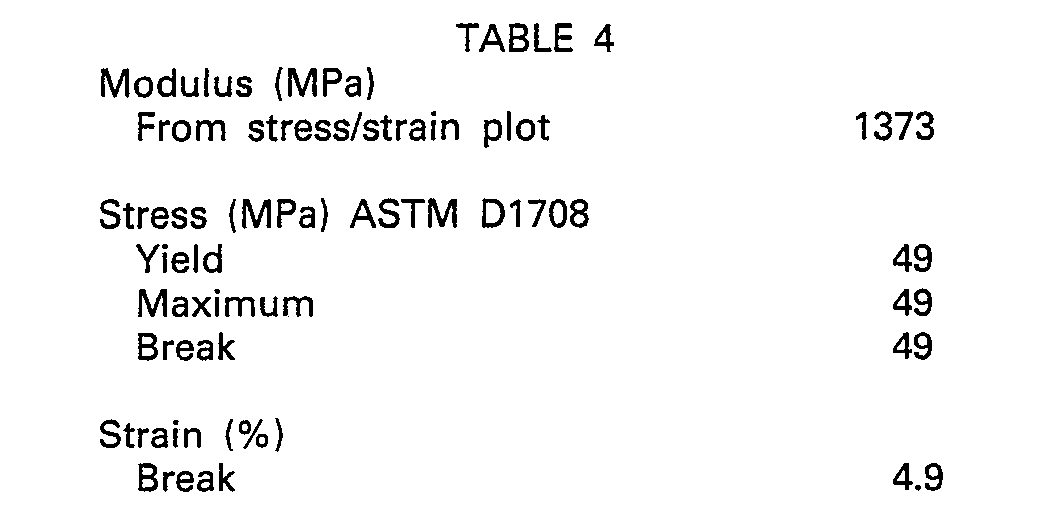
- (a) A 110 mL stainless steel shaker tube was charged with 120 g of 1,1,2 - trichloro - 1,2,2 - trifluoroethane, 0.02 g of perfluoropropionyl peroxide, and 6.2 g of PD (purified by water scrubbing) and heated for 3 hours with agitation at 50-55°C. After cooling to room temperature, the tube was discharged; the solvent was distilled off, and the solid was dried at 110°C in a vacuum oven to give 5.1 g of a homopolymer which exhibited Tg's at 173°C and 212°C. The absence of a crystalline melting point and X-ray analysis demonstrated that the polymer was amorphous. The PD homopolymer was compression formed at 340°C into a film which had the following tensile characteristics, determined at 23°C/50% relative humidity:
- (b) In the homopolymerization of PD which was distilled but not water-scrubbed (and thus contained a minor amount of tetrahydrofuran), the solid polymer formed under similar conditions had low Tg's, within the range of 84-92°C. It was determined by infrared analysis that a small amount of THF was incorporated in the polymer chain.
- (c) Small amounts of tetrahydrofuran (say, 10 to 100 vol. % of PD) inhibit homopolymerization of PD to solid homopolymer during storage. However, low molecular weight polymers or oligomers of PD formed spontaneously on standing at room temperature. These were liquids from which unpolymerized PD could be readily separated by distillation. These low molecular weight polymers were readily identifiable by their characteristic infrared spectra, which were consistent with a chemical structure containing perfluorodioxole units as well as tetrahydrofuran units.
- A mild steel wire was immersed in concentrated hydrochloric acid; chemical attack on the wire was evident in less than 10 seconds by the formation of bubbles on the wire. The wire was removed from the acid, washed with water and dried. A solution of 1 g of a 125°C Tg TFE/PD copolymer in 20 mL "Fluorinert Electronic Liquid" FC75 (a 3M product) was made by shaking the polymer in the liquid. The wire was then dip-coated with this solution and dried at 90°C in a vacuum oven. The coated wire when immersed in concentrated hydrochloric acid for several minutes was not attacked.
- A section of soft wood was similarly coated and dried. Immersion of this in water for several minutes failed to show any water absorbance. However, uncoated wood absorbed water in less than 10 seconds.
Claims (16)
Applications Claiming Priority (2)
| Application Number | Priority Date | Filing Date | Title |
|---|---|---|---|
| US323096 | 1981-11-19 | ||
| US06/323,096 US4399264A (en) | 1981-11-19 | 1981-11-19 | Perfluorodioxole and its polymers |
Publications (3)
| Publication Number | Publication Date |
|---|---|
| EP0080187A2 EP0080187A2 (en) | 1983-06-01 |
| EP0080187A3 EP0080187A3 (en) | 1984-04-25 |
| EP0080187B1 true EP0080187B1 (en) | 1987-01-14 |
Family
ID=23257711
Family Applications (1)
| Application Number | Title | Priority Date | Filing Date |
|---|---|---|---|
| EP82110713A Expired EP0080187B1 (en) | 1981-11-19 | 1982-11-19 | Perfluorodioxole and its polymers |
Country Status (5)
| Country | Link |
|---|---|
| US (1) | US4399264A (en) |
| EP (1) | EP0080187B1 (en) |
| JP (3) | JPS58103385A (en) |
| CA (1) | CA1197347A (en) |
| DE (1) | DE3275089D1 (en) |
Cited By (1)
| Publication number | Priority date | Publication date | Assignee | Title |
|---|---|---|---|---|
| CN110003165A (en) * | 2019-03-28 | 2019-07-12 | 浙江省化工研究院有限公司 | A kind of synthetic method of chloro -2,2- two (perfluorinated substituents) -1,3- dioxolane class compound |
Families Citing this family (72)
| Publication number | Priority date | Publication date | Assignee | Title |
|---|---|---|---|---|
| US4565855A (en) * | 1981-09-28 | 1986-01-21 | E. I. Du Pont De Nemours And Company | Polymers of dioxolanes |
| US4560778A (en) * | 1982-09-23 | 1985-12-24 | E. I. Du Pont De Nemours And Company | Oligomers of perfluoro(2,2-dimethyl-1,3-dioxole) and their fluorination products |
| JPS59115314A (en) * | 1982-12-13 | 1984-07-03 | イ−・アイ・デユポン・デ・ニモアス・アンド・カンパニ− | Reformed granular polytetrafluoroethylene |
| US5057586A (en) * | 1987-07-31 | 1991-10-15 | E. I. Du Pont De Nemours And Company | Halogenated 1,3-dioxolanes and derivatives |
| US4810806A (en) * | 1987-07-31 | 1989-03-07 | E. I. Du Pont De Nemours And Company | Halogenated 1,3-dioxolanes and derivatives |
| US5227500A (en) * | 1987-07-31 | 1993-07-13 | E. I. Du Pont De Nemours And Company | Halogenated 1,3-dioxolanes and derivatives |
| US4973714A (en) * | 1987-07-31 | 1990-11-27 | E. I. Du Pont De Nemours And Company | Halogenated 1,3-dioxolanes and derivatives |
| JP2615176B2 (en) * | 1988-05-31 | 1997-05-28 | イー・アイ・デユポン・デ・ニモアス・アンド・カンパニー | Amorphous copolymer of perfluoro-2,2-dimethyl-1,3-dioxole |
| JPH01302303A (en) * | 1988-05-31 | 1989-12-06 | Mitsubishi Rayon Co Ltd | Optical fiber having plastic clad and its production |
| EP0645406B1 (en) * | 1988-05-31 | 2001-04-11 | E.I. Du Pont De Nemours And Company | Amorphous copolymers of perfluoro-2,2-dimethyl-1,3-dioxole |
| US4908410A (en) * | 1989-01-27 | 1990-03-13 | E. I. Du Pont De Nemours And Company | Modified polytetrafluoroethylene fine powder and preparation thereof |
| JP3027606B2 (en) * | 1989-06-15 | 2000-04-04 | デユポン・カナダ・インコーポレーテツド | Perfluorodioxole membrane |
| US5250709A (en) * | 1991-08-15 | 1993-10-05 | E. I. Du Pont De Nemours And Company | Dioxolane-containing fluoroepoxides |
| IT1263955B (en) * | 1993-02-23 | 1996-09-05 | Ausimont Spa | RADICAL (CO) POLYMERIZATION PROCESS OF FLUORINATED OLEPHINE MONOMERS |
| IT1271136B (en) * | 1993-03-23 | 1997-05-27 | Ausimont Spa | PROCESS OF (CO) POLYMERIZATION IN AQUEOUS EMULSION OF FLUORINATED OLEFINIC MONOMERS |
| IT1265068B1 (en) * | 1993-05-18 | 1996-10-30 | Ausimont Spa | PROCESS OF (CO) RADICAL POLYMERIZATION OF FLUORINATED OLEFINIC MONOMERS IN WATER EMULSION |
| IT1264662B1 (en) * | 1993-07-05 | 1996-10-04 | Ausimont Spa | PERFLURODIOSSOLS THEIR HOMOPOLYMERS AND COPOLYMERS AND THEIR USE FOR THE COATING OF ELECTRIC CABLES |
| IT1266647B1 (en) * | 1993-10-29 | 1997-01-09 | Ausimont Spa | PROCESS OF (CO) POLYMERIZATION OF FLUORINATED OLEPHINE MONOMERS IN AQUEOUS EMULSION |
| IT1265460B1 (en) * | 1993-12-29 | 1996-11-22 | Ausimont Spa | FLUORINATED THERMOPLASTIC ELASTOMERS WITH IMPROVED MECHANICAL AND ELASTIC PROPERTIES, AND RELATED PREPARATION PROCESS |
| IT1271622B (en) * | 1994-03-21 | 1997-06-04 | Ausimont Spa | SUSPENSION (CO) POLYMERIZATION PROCESS FOR THE PREPARATION OF THERMOPLASTIC FLUOROPOLYMERS CONTAINING HYDROGEN |
| IT1271621B (en) * | 1994-03-21 | 1997-06-04 | Ausimont Spa | PROCESS FOR THE PREPARATION OF THERMOPLASTIC FLUOROPOLYMERS CONTAINING HYDROGEN |
| IT1269513B (en) * | 1994-05-18 | 1997-04-01 | Ausimont Spa | FLUORINATED THERMOPLASTIC ELASTOMERS EQUIPPED WITH IMPROVED MECHANICAL AND ELASTIC PROPERTIES, AND THE RELATED PREPARATION PROCESS |
| US5523422A (en) * | 1994-10-14 | 1996-06-04 | E. I. Du Pont De Nemours And Company | Monomer precursor isomerization |
| IT1270703B (en) | 1994-11-17 | 1997-05-07 | Ausimont Spa | MICROEMULSIONS OF FLUOROPOLYXIALKYLENES IN A MIXTURE WITH HYDROCARBONS, AND THEIR USE IN PROCESSES OF (CO) POLYMERIZATION OF FLUORINATED MONOMERS |
| JP2713867B2 (en) * | 1994-11-24 | 1998-02-16 | イー・アイ・デュポン・ドウ・ヌムール・アンド・カンパニー | Film, sheet or coating of amorphous copolymer of perfluoro-2,2-dimethyl-1,3-dioxole |
| IT1272863B (en) * | 1995-01-04 | 1997-07-01 | Ausimont Spa | THERMOPROCESSABLE COPOLYMERS OF TETRAFLUOROETHYLENE |
| IT1272861B (en) * | 1995-01-04 | 1997-07-01 | Ausimont Spa | COPOLYMERS OF ETHYLENE WITH TETRAFLUOROETHYLENE AND / OR CHLOROTRIFLUOROETHYLENE, WITH IMPROVED MECHANICAL PROPERTIES AT HIGH TEMPERATURES |
| IT1282378B1 (en) * | 1996-04-24 | 1998-03-20 | Ausimont Spa | DIOXIDE-BASED PERFLUOROELASTOMERS |
| IT1288121B1 (en) * | 1996-07-01 | 1998-09-10 | Ausimont Spa | THERMOPLASTIC COPOLYMERS OF VINYLIDENFLUORIDE (VDF) |
| IT1284112B1 (en) * | 1996-07-05 | 1998-05-08 | Ausimont Spa | FLUORINATED COPOLYMERS OF ETHYLENE |
| IT1286028B1 (en) * | 1996-07-09 | 1998-07-07 | Ausimont Spa | SUSPENSION POLYMERIZATION PROCESS OF FLUORINATED MONOMERS |
| IT1292391B1 (en) * | 1997-06-20 | 1999-02-08 | Ausimont Spa | THERMOPLASTIC ELASTOMERS |
| IT1296968B1 (en) | 1997-12-15 | 1999-08-03 | Ausimont Spa | FLUORINATED THERMOPLASTIC ELASTOMERS |
| US6469185B1 (en) | 1998-02-17 | 2002-10-22 | Ausimont S.P.A. | Perfluorodioxoles |
| IT1298257B1 (en) | 1998-02-17 | 1999-12-20 | Ausimont Spa | perfluorodioxols |
| US6770202B1 (en) | 1999-04-14 | 2004-08-03 | Pall Corporation | Porous membrane |
| JP4547735B2 (en) | 1999-07-14 | 2010-09-22 | ダイキン工業株式会社 | Method for curing fluorine-containing polymer |
| US6361583B1 (en) | 2000-05-19 | 2002-03-26 | Membrane Technology And Research, Inc. | Gas separation using organic-vapor-resistant membranes |
| US6544316B2 (en) | 2000-05-19 | 2003-04-08 | Membrane Technology And Research, Inc. | Hydrogen gas separation using organic-vapor-resistant membranes |
| US6361582B1 (en) | 2000-05-19 | 2002-03-26 | Membrane Technology And Research, Inc. | Gas separation using C3+ hydrocarbon-resistant membranes |
| US6572679B2 (en) | 2000-05-19 | 2003-06-03 | Membrane Technology And Research, Inc. | Gas separation using organic-vapor-resistant membranes in conjunction with organic-vapor-selective membranes |
| US6592650B2 (en) | 2000-05-19 | 2003-07-15 | Membrane Technology And Research, Inc. | Gas separation using organic-vapor-resistant membranes and PSA |
| US6572680B2 (en) | 2000-05-19 | 2003-06-03 | Membrane Technology And Research, Inc. | Carbon dioxide gas separation using organic-vapor-resistant membranes |
| US6579341B2 (en) | 2000-05-19 | 2003-06-17 | Membrane Technology And Research, Inc. | Nitrogen gas separation using organic-vapor-resistant membranes |
| DE60135080D1 (en) † | 2000-12-26 | 2008-09-11 | Asahi Glass Co Ltd | Solid polymer electrolyte material, liquid composition, solid polymer fuel cell and fluoropolymer |
| US7247313B2 (en) | 2001-06-27 | 2007-07-24 | Advanced Cardiovascular Systems, Inc. | Polyacrylates coatings for implantable medical devices |
| US6566021B2 (en) | 2001-07-26 | 2003-05-20 | Micro Lithography, Inc. | Fluoropolymer-coated photomasks for photolithography |
| US7026043B2 (en) | 2001-10-12 | 2006-04-11 | Owens Corning Composites Sprl | Sheet molding compound having improved surface characteristics |
| FR2832411A1 (en) * | 2001-11-19 | 2003-05-23 | Atofina | PARTIALLY FLUORATED AMORPHOUS COPOLYMER FOR THE MANUFACTURE OF LIGHT-CONDUCTIVE MATERIALS |
| FR2832412B1 (en) * | 2001-11-19 | 2003-12-19 | Atofina | CROSSLINKABLE FUNCTIONAL POLYMER FOR THE MANUFACTURE OF LIGHT CONDUCTING MATERIALS |
| US7396539B1 (en) | 2002-06-21 | 2008-07-08 | Advanced Cardiovascular Systems, Inc. | Stent coatings with engineered drug release rate |
| US7217426B1 (en) | 2002-06-21 | 2007-05-15 | Advanced Cardiovascular Systems, Inc. | Coatings containing polycationic peptides for cardiovascular therapy |
| US7005137B1 (en) | 2002-06-21 | 2006-02-28 | Advanceed Cardiovascular Systems, Inc. | Coating for implantable medical devices |
| US6896717B2 (en) * | 2002-07-05 | 2005-05-24 | Membrane Technology And Research, Inc. | Gas separation using coated membranes |
| US7491233B1 (en) | 2002-07-19 | 2009-02-17 | Advanced Cardiovascular Systems Inc. | Purified polymers for coatings of implantable medical devices |
| ITMI20030774A1 (en) | 2003-04-15 | 2004-10-16 | Solvay Solexis Spa | FLUORINATED POLYMERS. |
| US7563454B1 (en) | 2003-05-01 | 2009-07-21 | Advanced Cardiovascular Systems, Inc. | Coatings for implantable medical devices |
| US8791171B2 (en) | 2003-05-01 | 2014-07-29 | Abbott Cardiovascular Systems Inc. | Biodegradable coatings for implantable medical devices |
| US7244443B2 (en) | 2004-08-31 | 2007-07-17 | Advanced Cardiovascular Systems, Inc. | Polymers of fluorinated monomers and hydrophilic monomers |
| US20060171845A1 (en) * | 2005-01-31 | 2006-08-03 | Dakota Technologies, Inc. | Sensors for measuring analytes |
| WO2007043672A1 (en) | 2005-10-11 | 2007-04-19 | Fujifilm Corporation | Novel fluorine-containing spiroacetal compound and method of producing the same |
| US9028859B2 (en) | 2006-07-07 | 2015-05-12 | Advanced Cardiovascular Systems, Inc. | Phase-separated block copolymer coatings for implantable medical devices |
| US8197578B2 (en) | 2006-07-26 | 2012-06-12 | Busek Company, Inc. | Liquid degasser for a space device |
| CA2669279C (en) | 2006-10-27 | 2017-01-03 | Cms Technologies Holdings, Inc. | Removal of water and methanol from fluids |
| KR20120083485A (en) | 2009-10-21 | 2012-07-25 | 솔베이 플루오르 게엠베하 | Method for the manufacture of fluorinated ethylene carbonates |
| CN104448097A (en) * | 2014-11-19 | 2015-03-25 | 中昊晨光化工研究院有限公司 | Perfluor dioxole-modified fluorine-containing polymer |
| CN112375173B (en) * | 2020-11-23 | 2022-08-19 | 杭州师范大学 | Low-refractive-index transparent material and preparation method and application thereof |
| JP2024525113A (en) | 2021-06-24 | 2024-07-10 | ヴィチ メトロニクス,インコーポレイテッド | Laminates and 3D printers |
| CN113620925B (en) * | 2021-09-14 | 2022-04-15 | 四川轻化工大学 | Synthetic method of fluorine-containing monomer 2, 2-difluoro-4, 5-bis (trifluoromethyl) -1, 3-dioxyheterocycle |
| CN114213569A (en) * | 2021-11-22 | 2022-03-22 | 浙江巨化技术中心有限公司 | Suspension polymerization preparation method of perfluorosulfonic acid resin |
| CN114085309A (en) * | 2021-11-22 | 2022-02-25 | 浙江巨化技术中心有限公司 | Solution polymerization preparation method of perfluorosulfonic acid resin |
| CN114276482A (en) * | 2021-11-22 | 2022-04-05 | 浙江巨化技术中心有限公司 | Emulsion polymerization preparation method of perfluorosulfonic acid resin |
Family Cites Families (5)
| Publication number | Priority date | Publication date | Assignee | Title |
|---|---|---|---|---|
| US3308107A (en) * | 1965-04-30 | 1967-03-07 | Du Pont | Perfluoro(2-methylene-4-methyl-1, 3-dioxolane) and polymers thereof |
| NL7103057A (en) * | 1970-03-12 | 1971-09-14 | ||
| US3734862A (en) * | 1971-01-27 | 1973-05-22 | American Cyanamid Co | Novel polychloro-1,3-dioxolanes |
| US3978030A (en) * | 1973-08-01 | 1976-08-31 | E. I. Du Pont De Nemours And Company | Polymers of fluorinated dioxoles |
| DE2604350A1 (en) * | 1975-09-22 | 1977-03-24 | Stanford Research Inst | Inhalation-type anaesthetic (2,2)-difluoro-(1,3)-dioxolane derivs. - prepd. by reacting ethylene carbonate cpds. with sulphur tetrafluoride |
-
1981
- 1981-11-19 US US06/323,096 patent/US4399264A/en not_active Expired - Lifetime
-
1982
- 1982-11-17 JP JP57200509A patent/JPS58103385A/en active Granted
- 1982-11-18 CA CA000415866A patent/CA1197347A/en not_active Expired
- 1982-11-19 EP EP82110713A patent/EP0080187B1/en not_active Expired
- 1982-11-19 DE DE8282110713T patent/DE3275089D1/en not_active Expired
-
1990
- 1990-11-30 JP JP2336839A patent/JPH03179009A/en active Granted
- 1990-11-30 JP JP2336840A patent/JPH03184971A/en active Granted
Cited By (2)
| Publication number | Priority date | Publication date | Assignee | Title |
|---|---|---|---|---|
| CN110003165A (en) * | 2019-03-28 | 2019-07-12 | 浙江省化工研究院有限公司 | A kind of synthetic method of chloro -2,2- two (perfluorinated substituents) -1,3- dioxolane class compound |
| CN110003165B (en) * | 2019-03-28 | 2020-07-07 | 浙江省化工研究院有限公司 | A kind of synthetic method of chloro-2,2-bis (perfluoro substituent)-1,3-dioxolane compounds |
Also Published As
| Publication number | Publication date |
|---|---|
| EP0080187A2 (en) | 1983-06-01 |
| EP0080187A3 (en) | 1984-04-25 |
| JPS58103385A (en) | 1983-06-20 |
| DE3275089D1 (en) | 1987-02-19 |
| US4399264A (en) | 1983-08-16 |
| CA1197347A (en) | 1985-11-26 |
| JPH03179009A (en) | 1991-08-05 |
| JPH0549692B2 (en) | 1993-07-27 |
| JPH0347273B2 (en) | 1991-07-18 |
| JPH0368030B2 (en) | 1991-10-25 |
| JPH03184971A (en) | 1991-08-12 |
Similar Documents
| Publication | Publication Date | Title |
|---|---|---|
| EP0080187B1 (en) | Perfluorodioxole and its polymers | |
| US4558141A (en) | Perfluorodioxole and its polymers | |
| US4485250A (en) | Perfluorodioxole and its polymers | |
| RU2139866C1 (en) | Perfluorodioxols, method of preparing thereof (variants), perfluorodioxole homopolymers and copolymers, thermally processible tetrafluoroethylene copolymers | |
| RU2144044C1 (en) | Fluorinated derivatives of bis-vinyloximemetane (versions), and based on them polymers and copolymers | |
| CA1211890A (en) | Amorphous copolymers of perfluoro(2,2-dimethyl-1,3- dioxole) | |
| EP0628059B1 (en) | Hydrofluorocarbon solvents for fluoromonomer polymerization | |
| EP0338755B1 (en) | Process for preparation of perfluorinated copolymer | |
| US4522995A (en) | Fluorinated alkyl ether-containing ethylenes, precursors thereto, and copolymers thereof with tetrafluoroethylene | |
| ITMI20000902A1 (en) | FLUOROVINYLETERS AND POLYMERS THAT CAN BE OBTAINED. | |
| US3083238A (en) | Fluorinated hydrocarbon polymers and preparation thereof | |
| US6335408B1 (en) | Copolymers of perfluorodioxoles | |
| US4533741A (en) | 4,5-Dichloro-2,2,4,5,-tetrafluoro-1,3-dioxolane | |
| JP2763860B2 (en) | Method for producing halogenated 2,2-bis (perhaloalkyl) -1,3-dioxolane | |
| US6469185B1 (en) | Perfluorodioxoles | |
| CA1198119A (en) | 4,5-dichloro-2,2,4,5 tetrafluoro-1,3-dioxolane | |
| JPH04504131A (en) | Polyhalodihydrodioxins and polyhalodioxoles | |
| US20060025635A1 (en) | TFE-based thermoprocessable copolymers | |
| USRE29534E (en) | Purification of perfluorosulfonyl fluoride perfluorovinyl ethers by thermal decomposition of unstable isomers | |
| US2837580A (en) | Telomerization with sulfuryl halide and a sulfur dioxide modifying agent | |
| EP0785931B1 (en) | Monomer precursor isomerization |
Legal Events
| Date | Code | Title | Description |
|---|---|---|---|
| PUAI | Public reference made under article 153(3) epc to a published international application that has entered the european phase |
Free format text: ORIGINAL CODE: 0009012 |
|
| AK | Designated contracting states |
Designated state(s): BE DE FR GB IT LU NL |
|
| PUAL | Search report despatched |
Free format text: ORIGINAL CODE: 0009013 |
|
| AK | Designated contracting states |
Designated state(s): BE DE FR GB IT LU NL |
|
| 17P | Request for examination filed |
Effective date: 19841023 |
|
| GRAA | (expected) grant |
Free format text: ORIGINAL CODE: 0009210 |
|
| AK | Designated contracting states |
Kind code of ref document: B1 Designated state(s): BE DE FR GB IT LU NL |
|
| ITF | It: translation for a ep patent filed | ||
| REF | Corresponds to: |
Ref document number: 3275089 Country of ref document: DE Date of ref document: 19870219 |
|
| ET | Fr: translation filed | ||
| PLBE | No opposition filed within time limit |
Free format text: ORIGINAL CODE: 0009261 |
|
| STAA | Information on the status of an ep patent application or granted ep patent |
Free format text: STATUS: NO OPPOSITION FILED WITHIN TIME LIMIT |
|
| 26N | No opposition filed | ||
| ITTA | It: last paid annual fee | ||
| EPTA | Lu: last paid annual fee | ||
| PGFP | Annual fee paid to national office [announced via postgrant information from national office to epo] |
Ref country code: FR Payment date: 19950922 Year of fee payment: 14 |
|
| PGFP | Annual fee paid to national office [announced via postgrant information from national office to epo] |
Ref country code: LU Payment date: 19951001 Year of fee payment: 14 |
|
| PGFP | Annual fee paid to national office [announced via postgrant information from national office to epo] |
Ref country code: GB Payment date: 19951002 Year of fee payment: 14 |
|
| PGFP | Annual fee paid to national office [announced via postgrant information from national office to epo] |
Ref country code: NL Payment date: 19951005 Year of fee payment: 14 |
|
| PGFP | Annual fee paid to national office [announced via postgrant information from national office to epo] |
Ref country code: DE Payment date: 19951013 Year of fee payment: 14 |
|
| PGFP | Annual fee paid to national office [announced via postgrant information from national office to epo] |
Ref country code: BE Payment date: 19951023 Year of fee payment: 14 |
|
| PG25 | Lapsed in a contracting state [announced via postgrant information from national office to epo] |
Ref country code: LU Free format text: LAPSE BECAUSE OF NON-PAYMENT OF DUE FEES Effective date: 19961119 Ref country code: GB Effective date: 19961119 |
|
| PG25 | Lapsed in a contracting state [announced via postgrant information from national office to epo] |
Ref country code: BE Effective date: 19961130 |
|
| BERE | Be: lapsed |
Owner name: E.I. DU PONT DE NEMOURS AND CY Effective date: 19961130 |
|
| PG25 | Lapsed in a contracting state [announced via postgrant information from national office to epo] |
Ref country code: NL Effective date: 19970601 |
|
| GBPC | Gb: european patent ceased through non-payment of renewal fee |
Effective date: 19961119 |
|
| PG25 | Lapsed in a contracting state [announced via postgrant information from national office to epo] |
Ref country code: FR Effective date: 19970731 |
|
| NLV4 | Nl: lapsed or anulled due to non-payment of the annual fee |
Effective date: 19970601 |
|
| PG25 | Lapsed in a contracting state [announced via postgrant information from national office to epo] |
Ref country code: DE Effective date: 19970801 |
|
| REG | Reference to a national code |
Ref country code: FR Ref legal event code: ST |