EP0077181A2 - Artikulierter Aufbau für Lastenträger - Google Patents
Artikulierter Aufbau für Lastenträger Download PDFInfo
- Publication number
- EP0077181A2 EP0077181A2 EP82305339A EP82305339A EP0077181A2 EP 0077181 A2 EP0077181 A2 EP 0077181A2 EP 82305339 A EP82305339 A EP 82305339A EP 82305339 A EP82305339 A EP 82305339A EP 0077181 A2 EP0077181 A2 EP 0077181A2
- Authority
- EP
- European Patent Office
- Prior art keywords
- aperture
- axis
- elongated
- articular
- surface segment
- Prior art date
- Legal status (The legal status is an assumption and is not a legal conclusion. Google has not performed a legal analysis and makes no representation as to the accuracy of the status listed.)
- Withdrawn
Links
Images

Classifications
-
- F—MECHANICAL ENGINEERING; LIGHTING; HEATING; WEAPONS; BLASTING
- F16—ENGINEERING ELEMENTS AND UNITS; GENERAL MEASURES FOR PRODUCING AND MAINTAINING EFFECTIVE FUNCTIONING OF MACHINES OR INSTALLATIONS; THERMAL INSULATION IN GENERAL
- F16M—FRAMES, CASINGS OR BEDS OF ENGINES, MACHINES OR APPARATUS, NOT SPECIFIC TO ENGINES, MACHINES OR APPARATUS PROVIDED FOR ELSEWHERE; STANDS; SUPPORTS
- F16M11/00—Stands or trestles as supports for apparatus or articles placed thereon ; Stands for scientific apparatus such as gravitational force meters
- F16M11/02—Heads
- F16M11/04—Means for attachment of apparatus; Means allowing adjustment of the apparatus relatively to the stand
- F16M11/06—Means for attachment of apparatus; Means allowing adjustment of the apparatus relatively to the stand allowing pivoting
- F16M11/12—Means for attachment of apparatus; Means allowing adjustment of the apparatus relatively to the stand allowing pivoting in more than one direction
- F16M11/14—Means for attachment of apparatus; Means allowing adjustment of the apparatus relatively to the stand allowing pivoting in more than one direction with ball-joint
-
- F—MECHANICAL ENGINEERING; LIGHTING; HEATING; WEAPONS; BLASTING
- F16—ENGINEERING ELEMENTS AND UNITS; GENERAL MEASURES FOR PRODUCING AND MAINTAINING EFFECTIVE FUNCTIONING OF MACHINES OR INSTALLATIONS; THERMAL INSULATION IN GENERAL
- F16M—FRAMES, CASINGS OR BEDS OF ENGINES, MACHINES OR APPARATUS, NOT SPECIFIC TO ENGINES, MACHINES OR APPARATUS PROVIDED FOR ELSEWHERE; STANDS; SUPPORTS
- F16M2200/00—Details of stands or supports
- F16M2200/02—Locking means
- F16M2200/021—Locking means for rotational movement
- F16M2200/022—Locking means for rotational movement by friction
-
- F—MECHANICAL ENGINEERING; LIGHTING; HEATING; WEAPONS; BLASTING
- F16—ENGINEERING ELEMENTS AND UNITS; GENERAL MEASURES FOR PRODUCING AND MAINTAINING EFFECTIVE FUNCTIONING OF MACHINES OR INSTALLATIONS; THERMAL INSULATION IN GENERAL
- F16M—FRAMES, CASINGS OR BEDS OF ENGINES, MACHINES OR APPARATUS, NOT SPECIFIC TO ENGINES, MACHINES OR APPARATUS PROVIDED FOR ELSEWHERE; STANDS; SUPPORTS
- F16M2200/00—Details of stands or supports
- F16M2200/08—Foot or support base
-
- Y—GENERAL TAGGING OF NEW TECHNOLOGICAL DEVELOPMENTS; GENERAL TAGGING OF CROSS-SECTIONAL TECHNOLOGIES SPANNING OVER SEVERAL SECTIONS OF THE IPC; TECHNICAL SUBJECTS COVERED BY FORMER USPC CROSS-REFERENCE ART COLLECTIONS [XRACs] AND DIGESTS
- Y10—TECHNICAL SUBJECTS COVERED BY FORMER USPC
- Y10S—TECHNICAL SUBJECTS COVERED BY FORMER USPC CROSS-REFERENCE ART COLLECTIONS [XRACs] AND DIGESTS
- Y10S248/00—Supports
- Y10S248/917—Video display screen support
- Y10S248/919—Adjustably orientable video screen support
- Y10S248/921—Plural angular
Definitions
- the present invention relates generally to articulated load supporting structures and, more particularly, to a compact load supporting structure permitting complex movements of a supported load that is inexpensive and simple to manufacture.
- Articulated load supporting structures are commonly employed to enable supported devices to be positioned in a variety orientations. - Frequently, articulations must be capable of complex movements to accommodate a variety of widely different orientations. Usually, the complex movement require the articulated members to be capable of a combination of relative rotational movements. As the movements required of the articulation become more complex and the size and weight of the supported load greater, load support stability becomes more critical in the design of the articulation.
- quality articulated load supporting structures permitting complex load movements with a high degree of load support stability have been achieved at the expense of complex and costly articulation constructions. Inferior structures permitting such movements tend to provide less stable support for their loads, to be intolerant of the misalignment of the articulated members, to bind easily upon movement of the supported load and to have a short useful life.
- One type of articulated load supporting structure that has been used in such devices includes an axially located shaft extending vertically from a base member through a slotted travel in a load bearing member.
- the load bearing member is mounted for rotational movement about the shaft and for movement of its slotted travel relative to the shaft.
- a circular bearing surface defined by a separate cylindrical body extending vertically from the base member, coaxially with the shaft supports the load bearing member for the movements at a convex surface defined by one of opposite sides of the load bearing member.
- a flat bearing plate extends perpendicularly from the shaft to engage the perimeter of a concave surface defined by the other of the opposite sides of the load bearing member and hold the structure together.
- Such structures are complex and costly, and tend to be massive in order to provide the desired support stability for the loads.
- the present invention is a articulated load supporting structure having three members defining nested articular spherical surface segments.
- One of the two members defining one of the two outermost nested articular surface segments forms a load support structure and the other of the two members defining the other of the two outermost nested articular surface segments forms a retainer.
- the third member defines articular spherical surface segments at opposite sides nested between the articular surface segments defined by the other two members. The third member serves to carry the load to be supported by the articulated load supporting structure.
- an elongated aperture is provided through the third member at a location along the articular surfaces. Stops are located to define limits of movement of the third number.
- the three members are secured together by a fastening means that extends through the elongated aperture and fastens together the two members defining the two outermost articular surfaces against relative movement.
- Two bearing members are provided, one being interposed each of the articular surfaces defined at opposite sides of the third member and a facing outermost articular surface with which it is nested to support relative movement between the nested surfaces at a location off the axis.
- the aforesaid articulated load supporting structure has the advantage of permitting the articular surfaces to be formed as unitary parts of the load supporting member and load carrying member, respectively. This lends the structure to the manufacture by inexpensive simple molding techniques with inexpensive plastic materials. Furthermore, the nested articular surface arrangement enables the construction of a highly compact articulated load supporting structure capable of complex movements of the supported load.
- a particularly stable and compact load supporting structure is obtained by forming the articular surfaces so that the load support or first member defines a concave spherical articular surface segment, the retainer or second member defines a convex spherical articular surface segment, and the load carrying or third member defines complementary, i.e., convex and concave, spherical articular surface segments at its opposite sides for nesting with the surface segments defined by the other two members.
- the surface segments are thusly formed to have a common center of curvature, preferably, proximate the location of the center of mass of the load supported by the structure.
- the articulated load supporting structure of the present invention will be described in connection with a preferred embodiment arranged to support a load with respect to a horizontally disposed surface for complex movements relative to the surface.
- the articulated load supporting structure is arranged to permit rotational movement of the supported load through a limited angular range about an axis that is perpendicular to the horizontal surface, while at the same time permitting angular or tilting movements through a limited angular range in a vertically-extending plane at any rotational position of the supported load.
- the articulated load supporting structure of the present invention can be adapted to various other uses for supporting loads for complex movements.
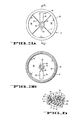
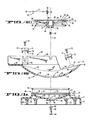
- the assembly of the components forming the articulated load supporting structure 10 of the present invention is illustrated by the combined FIGURES 4A, 4B and 4C, with the certain views of the principal components forming the articulated structure 10 illustrated in FIGURES 1, 2 and 3.
- the articulated load supporting structure 10 includes a base member 11 (FIG. 4A), a load carrying member 12 (FIG. 4B) and a retainer member 13 (FIG. 4C).
- the base member 11 and retainer member 13 are joined together through an elongated aperture or slot 14 defined by the load carrying member 12 to be fixed against relative movement.
- the load carrying member 12 is supported between the base and retainer members 11 and 13, respectively, by a pair of bearing members 16 and 17 for limited rotational movement about an axis 18 and limited angular or tilting movement in a vertical plane extending along the axis at any rotational position.
- the base member 11 illustrated in FIGURES 1 and 4A it includes a rectangular platform 19 supported by a perimeter wall 21 to stand off a surface (not shown).
- a plurality of bosses 22 are joined to the underside 23 of the platform 19 to permit fastening of the base member 11 to a surface defined, for example, by some larger structure.
- the base member 11 has a central articular spherical segment 24 for supporting the load carrying member 12 for relative movement therewith.
- the articular segment 24 defines a socket having an articular concave spherical surface 26 coaxially disposed with respect to the axis 18 to face away from the platform 19 towards the load carrying member 12.
- the axis 18 extends through the center of curvature of the concave spherical surface 26.
- a concave spherical surface 26 having its center of curvature located proximate the center of mass of the load supported above the surface by the load carrying member 12 is preferred. Locating the center of curvature and center of mass in this manner results in an articulated load supporting structure 10 that is capable of supporting loads with a high degree of stability regardless of the combined rotational and tilted position of the supported load.
- the load carrying member 12 is supported for movement relative to the base member 11 by a bearing member 16 seated about the articular surface 26.
- the bearing member 16 is retained in a seat 27 defined by a channel having a U-shaped cross-section that encircles the axis 18 at the perimeter 25 of the articular surface 26.
- the channel is formed by a pair of inward and outward spaced walls 28 and 29 that extend a short distance above the articular surface 26 toward the load carrying member 12 in a direction parallel to the axis 18 to form a recess therebetween.
- the walls 28 and 29 extend to ends 31 and 32, respectively, defining a concave spherical surface segment that has the same center of curvature as the articular surface 26.
- a strip of low friction material, such as Teflon, of circular cross-section is seated in the channel 27 to form a bearing member 16 that supports the load carrying member 12 about the entire perimeter 25 of the articular surface 26.
- An enlarged view of channel 27 and bearing member 16 can be had by reference to FIGURE 5.
- the single strip of low friction material can be replaced by several segments of low friction material.
- the segments can be positioned in various ways along the articular surface 26, such as at circumferentially spaced locations about the perimeter of the articular surface or at locations extending along the surface 26 from its perimeter towards the axis 18.
- other bearing types such as ball bearings can be used.
- the bearing configuration of the preferred embodiment of the articulated load supporting structure 10 has the advantages of simplicity, ease of manufacture, minimum friction and noise-free operation.
- the perimeter 25 of the spherically-shaped articular segment 24 is supported above the platform 19 by a circular wall 33 extending from the platform 19 towards the load carrying member 12.
- the circular wall 33 serves to enclose the joint cavity formed by the articular segment 24, improving the attractiveness of the articulated load supporting structure.
- the segment 24 defines a circular recess 34, best seen in FIGURE 1, that is coaxial with the axis 18 for receiving a mating hub 36 of the retainer member 13 (FIG. 4C) extending coaxially with the axis 18.
- the articular segment 24 defines a keyway 37 at one side of the recess 34 for receiving a mating key 38 located at the corresponding side of the hub 36 of the retainer member 13 (FIG. 4C).
- the engaged keyway 37 and key 38 lock the base member 11 and the retainer member 13 together against relative movement.
- the hub and key can be interchanged with the recess and keyway, i.e., the retainer member 13 can be constructed to form a centrally disposed recess and offset keyway and the articular segment 24 constructed to form the mating hub and key.
- an aperture or trough 39 is defined by the articular segment 24 at one side of the recess 34 opposite the keyway 37.
- trough 39 has two segments.
- a first narrow trough segment 41 is located nearer the center of the articular segment 24 and defines a passage when the articulated load supporting structure 10 is assembled.
- a second wider trough segment 42 is located farther from the center of the articular segment 24 for facilitating threading items through the base member 11 into the passage during the assembly of the load supporting structure 10.
- the trough 39 cooperates with a similar trough 43 provided in the retainer member 13 (FIGS.
- the passage defined through the structure is conveniently employed for passing electrical cables and larger connectors to the supported equipment.
- trough 43 also has two segments like segments 41 and 42 of trough 39, namely, narrow trough segment 44 near the center of the retainer member 13 and wider trough segment 46 farther from the center of the retainer member.
- These two trough segments serve the same purpose as described hereinbefore for the two trough segments 41 and 42 of the articular segment 24 of the base member 11, namely, passage and threading of items through the retainer member 13.
- the two troughs 39 and 43 are oriented along lines that are perpendicular, to each other and are vertically aligned in a direction parallel to the axis 18 so that the narrow trough segments 41 and 44 of the troughs 39 and 43, respectively, are vertically aligned with each other and the elongated slot 14 extending through the load carrying member 12 along a line parallel to and displaced from axis 18. With the two troughs 39 and 43 aligned in this manner, the two narrow trough segments 41 and 44 define a confined passage for cables or other items through the assembled articulated load supporting structure 10.
- the load carrying member includes two principal parts: a double-sided articular segment 51 and a load carrying segment 52.
- a first side 53 thereof defines an articular spherical surface of a shape for nesting with the articular surface 26 of the base member 11.
- the two nested surfaces 26 and 53 define a first articulating pair.
- the articular surface 53 of the load carrying member 12 defines a segment of a ball to mate and nest with the socket defined by the articular surface 26 of the base member 11.
- the other side 54 of the double-sided articular segment 51 also defines an articular surface of a shape for nesting with the retainer member 13.
- the articular surface defined by the side 54 is in the form of a socket having a concave spherical surface that nests with a mating ball segment having a convex spherical surface defined by the side 56 of the retainer member 13 (FIG. 4C).
- the two nested surfaces 54 and 56 define a second articulating pair.
- the double-sided articular segment 51 defines the slot 14 centrally thereof at a location through which the axis 18, hence hub 36 passes.
- the slot 14 is orientated so that its long dimension extends in a direction along the load carrying member 12 with respect to which it is desired to provide tilting movement of the supported load.
- the slot 14 forms a moving travel in which the hub 36 extending from the retainer member 13 follows as the load carrying member 12 is moved.
- the length of the slot 14 determines the angular range through which the load carrying member 12 can be tilted.
- the load carrying member 12 is restrained against tilting movement in the direction of the width of the slot 14. This restraint is achieved by selecting the width of the slot 14 to be just large enough to pass the hub 36.
- the hub 36 permits the load bearing member 12 to rotate about the axis 18. If the segment of the hub-residing within the slot 14 is circular, the load bearing member 12 is able to rotate through an angle of 360°.
- the hub 36 is provided with a axially offset segment 57 that serves as a stop that engages the long sides 58 and 59 of the elongated slot 14 to limit the angular range of rotation of the load bearing member 12.
- the offset segment 57 has opposite sides facing the long sides 58 and 59 of the slot 14, which taper towards each other at the free end of the offset segment.
- the angular range of permissible rotation of the load bearing member 12 about axis 18 is determined by the separation of and angle of taper of the opposite sides of the offset segment 57.
- the load carrying member 12 and retainer member 13 are supported for relative movement with respect to each other by the bearing member 17 seated about the articular surface 56 defined by the retainer member 13.
- the structure of the bearing member 17 is the same as that of the bearing member 16, namely, strip of low friction material, such as r eflon retained in a seat 91 encircling the axis 18 at the perimeter of the retainer member 13.
- other bearing supports such as the types described hereinbefore with reference to bearing member 16, can be employed in the articulated load supporting structure 10 of the present invention between the load carrying member 12 and retainer member 13.
- An enlarged view of the bearing member 17 and its relationship with the retainer member 13 is shown in FIGURE 5.
- the lengths of the articular surfaces 53 and 54 need only be large enough in the direction of the width of the slot 14 to engage, respectively, the bearing members 16 and 17.
- the length of the articular surfaces 53 and 54 must be longer in the direction of the slot 14, which is the direction of permitted tilting movement. The lengths are selected so that the articular surfaces 53 and 54 always engage the bearing members 16 and 17, respectively, regardless of the tilt position of the articulated load supporting structure 10.
- the long sides 58 and 59 of the elongated slot 14 defined by the double-sided articular segment 51 cooperate with the stop defined by the offset segment 57 extending from the hub 36 of the retainer member 13 to limit the angle through which the load carrying member 12 can be rotated about the axis 18. Stops are also provided to limit the angle through which the load carrying member 12 can be tilted.
- One of the stops is provided by an end wall 61 of the slot 14 located at the side of the hub 36 opposite the trough 43. The end wall 61 determines the limit of backward angular tilt.
- the limit of forward angular tilt is determined by a stop defined by a boss 62 located on the surface 54 of the articular segment 51 in-line with the slot 14 on the side of the axis 18 opposite the end wall 61.
- the stop 62 is positioned on the surface 54 to engage the edge 63 of the retainer member 13 before the end wall 64 of the slot 14 engages items, such as a cable passing through the trough 43. This protects the cable from damage by repeated contact with the end wall 64.
- the boss 62 can be omitted and the end wall 64 employed as the stop to limit the forward angular tilt.
- the boss 62 can be omitted and the end wall 64 employed as a stop in embodiments of the load supporting structure 10 where the trough 43 is closed so that the end wall cannot contact items passed through the trough, or the items passed through trough are otherwise protected from harmful contact with the end wall or not susceptible to damage by such contacts.
- the platform segment 52 of the preferred embodiment of the articulated load supporting structure 10 is arranged to carry a video display monitor so that the screen of the monitor faces to the right of FIGURE 4B.
- the platform segment 52 of the load carrying member 12 has lower and upper sections 66 and 67, upstanding slotted side walls 68 and 69 and a pair of U-shaped channels 71 and 72, all cooperating to secure the video display monitor to the load carrying member 12.
- the U-shaped channels 71 and 72 are secured by screws 73 to bosses 74.
- One channel 71 is secured to bosses 74 located proximate opposite sides of the upper section 67 of the platform segment 52.
- the other channel 72 is secured to bosses 74 located proximate opposite sides of the lower section 66 of the platform segment 52.
- Apertured appendages 70 and 75 vertically extend from each of the channels 71 and 72 at its opposite ends for securing the supported load to the channels, hence, platform segment 52.
- the retainer member 13 is a thin, dish-shaped member defining the articular surface 56 at one of its opposite sides for mating and nesting with the articular surface 54 of the load carrying member 12.
- the articular surface 56 defines a segment of a ball that nests and mates with the socket defined by the articular surface 54 of the load carrying member 12.
- the other opposite side 86 is concave to conserve material.
- Ribs 87 extend from the edge 63 of the retainer member 13 to an axial extension 89 of the hub 36. The ribs 87 add strength to the thin retainer member 13, thereby permitting less material to be used in its construction.
- the strip of bearing material 17 is retained in a seat 91 defined by a channel having a U-shaped cross-section and encircling the articular surface 5_6 at the edge 63 of the retainer member 13.
- the channel is formed by a pair of inward and outward spaced walls 92 and 93 that extend in a direction parallel to the axis 18 a short distance below the articular surface 56 toward the load carrying member 12 to form a recess therebetween.
- the walls 92 and 93 extend to ends 90 and 95, respectively, defining a spherical surface segment that has the same center of curvature as the articular surface 56.
- the nested articular surfaces 26, 53, 54 and 56 are formed to have a common center of curvature located along the axis 18 extending through the center of the articular concave spherical surface segment 26 defined by the base member 11.
- the curvatures of the articular surfaces are selected so that the common center of curvature is located proximate, and most desirably at the center of mass of the load supported by the load bearing member 12 above the articulated load supporting structure 10.
- Stable support is provided for the load by selecting the curvatures and positioning the load relative to the load bearing member 12 so that the load's center of mass is located proximate the common center of curvature above the articulated load supporting stucture 10 within an area defined by a projection along the axis 18 of the surface segment 26 defined by the base member 11.
- a tension spring serves as the opposing force applying means 76.
- One end of the spring 77 has a first hook 82 anchored by a self-threading screw 83 to a boss 84 joined to the stationary retainer member 13 at its upper side 86.
- the other end of the spring 77 has a second hook 78 which is secured to the load bearing member 12 at a location to the side of the axis 18 opposite the side to which the center of mass of the supported load is displaced relative to the common center of curvature.
- the second hook 78 is inserted in an aperture 79 formed in the side wall 81 of the U-shaped channel 71.
- the required opposing force is obtained by selecting a tension spring 77 having the appropriate spring constant.
- the spring constant is selected so that the opposing force established by the spring 77 reduces the net force tending to move the load bearing member 12 relative to the stationary base and retainer members 11 and 13 to less than the net sliding friction force established at the bearing members 16 and 17.
- the sliding friction force at each bearing member (which is a product of the coefficient of sliding friction and resultant normal force at the bearing member) is adjustable in the preferred embodiment of the articulated load supporting structure 10 to facilitate obtaining the desired opposing force from the tension spring 77, while at the same time enabling ease of movement of the supported load by the user. More specifically and with reference to FIGURE 4, a bolt 94 is passed through an aperture 96 located coaxially in the end wall of the recess 84 to engage an internally threaded bushing 97 seated coaxially in the hub 36. A washer 98 and tension spring 99 are provided between the head of the bolt 94 and the underside of the end wall of the recess 34.
- FIGURE 5 illustrates the relationship of the two bearing members 16 and 17, the base, load bearing and retainer members 11, 12 and 13, and the two seats 27 and 91 defined by the base and retainer members for retaining the bearing members.
- bearing members 16 and 17 are out of vertical alignment. While vertical alignment of the bearing members is preferred, the articulated load supporting structure 10 of the present invention is not detrimentally effected by a small amount of vertical misalignment. In the preferred embodiment of the load supporting structure 10, the slight vertical misalignment was provided to facilitate construction of the load bearing member 12 and retainer member 13 with the boss 62 located on the load bearing member to interact with the edge 63 of the retainer member 13 and provide the desired angular tilt limit.
- the articulated load supporting structure 11 is assembled by placing the load carrying member 12 on the base member 11, with the bearing member 16 properly seated therebetween.
- the retainer member 13 is placed on the load carrying member 12, with the bearing member 17 properly seated therebetween, so that the hub 36 is seated in the circular recess 34 with the key 38 in keyway 37.
- the members are secured together by passing the bolt 94 through the aperture 96 located coaxially in the end wall of the recess 34 to engage the internally threaded bushing 97 seated coaxially in the hub 36.
- the washer 98 and tension spring 99 are placed on the bolt 94 before the bolt is engaged with the bushing 97.
- the counter balancing spring 77 is hooked tc the channel member 71 and anchored to the retainer 13.
- the construction of the articulated load supporting structure 10 permits the articulating members to be conveniently and inexpensively manufactured by molding processes. More importantly, however, the construction permits articulating members to be formed as unitary parts of the load supporting member 11 and the load carrying member 12, resulting in an articulated load supporting structure 10 of simplified construction. Furthermore, the articulated supporting structure 10 is readily adaptable to the articulating support of a wide variety of loads with a high degree of stability. The high degree of stability is obtained by selecting a radius of curvature for each articulating surface of the structure 10 according to the load supported so that the surfaces have same the center of curvature located proximate the center of mass of the supported load.
- the structure is characterized by several features that individually and cooperatively enable the construction of various articulated load supporting structures permitting complex movements with a high degree of stability that are inexpensive and simple to manufacture.
Landscapes
- Engineering & Computer Science (AREA)
- General Engineering & Computer Science (AREA)
- Mechanical Engineering (AREA)
- Pivots And Pivotal Connections (AREA)
- Supports For Pipes And Cables (AREA)
Applications Claiming Priority (2)
| Application Number | Priority Date | Filing Date | Title |
|---|---|---|---|
| US309944 | 1981-10-09 | ||
| US06/309,944 US4473206A (en) | 1981-10-09 | 1981-10-09 | Articulated structure for supporting loads |
Publications (2)
| Publication Number | Publication Date |
|---|---|
| EP0077181A2 true EP0077181A2 (de) | 1983-04-20 |
| EP0077181A3 EP0077181A3 (de) | 1985-03-27 |
Family
ID=23200334
Family Applications (1)
| Application Number | Title | Priority Date | Filing Date |
|---|---|---|---|
| EP82305339A Withdrawn EP0077181A3 (de) | 1981-10-09 | 1982-10-07 | Artikulierter Aufbau für Lastenträger |
Country Status (3)
| Country | Link |
|---|---|
| US (1) | US4473206A (de) |
| EP (1) | EP0077181A3 (de) |
| JP (1) | JPS5874994A (de) |
Cited By (2)
| Publication number | Priority date | Publication date | Assignee | Title |
|---|---|---|---|---|
| EP0170055A1 (de) * | 1984-07-02 | 1986-02-05 | BURROUGHS CORPORATION (a Michigan corporation) | Aufnahmevorrichtung für ein Datensichtgerät |
| DE8813958U1 (de) * | 1988-11-08 | 1989-01-12 | Steelform AB, Lammhult | Verstellbare Tragvorrichtung für Datenterminalen u.dgl. |
Families Citing this family (15)
| Publication number | Priority date | Publication date | Assignee | Title |
|---|---|---|---|---|
| US4564166A (en) * | 1983-01-21 | 1986-01-14 | Delta Data Systems Corporation | Rotary tilt base for video terminal |
| US4589713A (en) * | 1984-04-09 | 1986-05-20 | Raytheon Company | Video display support joint |
| US4570892A (en) * | 1984-12-11 | 1986-02-18 | Zenith Electronics Corporation | Tiltable rotating display monitor mount |
| US4645153A (en) * | 1985-05-23 | 1987-02-24 | Ncr Corporation | Tilt and swivel support |
| US4781347A (en) * | 1986-03-17 | 1988-11-01 | Dickie Robert G | Video display monitor |
| US4731030A (en) * | 1987-01-09 | 1988-03-15 | Unisys Corporation | Tilt and swivel assembly for terminal monitor |
| US5024415A (en) * | 1989-10-30 | 1991-06-18 | At&T Bell Laboratories | Tilt and swivel apparatus for a display monitor |
| US5228791A (en) * | 1991-09-05 | 1993-07-20 | Chris Fort | Bifurcated keyboard arrangement |
| US6062523A (en) * | 1999-01-28 | 2000-05-16 | Lu; William | Structure of a rotatable base for computer monitors |
| US7138997B2 (en) * | 2002-06-28 | 2006-11-21 | Autodesk, Inc. | System for physical rotation of volumetric display enclosures to facilitate viewing |
| EP1498316B1 (de) * | 2003-07-17 | 2007-01-10 | Harman Becker Automotive Systems GmbH | Anzeigemodul |
| US20080099420A1 (en) * | 2006-11-01 | 2008-05-01 | Inventec Multimedia & Telecom Corporation | Rotatable Stand with Adjustable Tightness |
| TR201111079A2 (tr) * | 2011-11-04 | 2012-06-21 | Arikan Kr�Ko Ve Mak�Na Sanay� T�Caret Anon�M ��Rket� | Krikolar için döner yük dayama başlığı. |
| US9049925B1 (en) * | 2013-01-14 | 2015-06-09 | Russell L. Winchester | Tool mounting structure |
| US11399639B1 (en) * | 2021-02-05 | 2022-08-02 | Harbor Freight Tools Usa, Inc. | Self-righting packaging for display of item with aperture |
Family Cites Families (10)
| Publication number | Priority date | Publication date | Assignee | Title |
|---|---|---|---|---|
| CA452486A (en) * | 1948-11-09 | Fiori Irving | Adjustable support structure | |
| US1794726A (en) * | 1927-12-14 | 1931-03-03 | Mitchell Camera Corp | Camera mounting |
| US2375690A (en) * | 1943-06-11 | 1945-05-08 | Arthur E Reeves | Tripod head |
| US2652648A (en) * | 1948-11-17 | 1953-09-22 | Charles E Morley | Rearview mirror construction |
| US3970792A (en) * | 1975-02-18 | 1976-07-20 | International Telephone And Telegraph Corporation | Adjustable mounting structure for video telephone unit |
| US4068961A (en) * | 1976-08-23 | 1978-01-17 | Milgo Electronic Corporation | Swivel joint |
| US4206983A (en) * | 1978-08-25 | 1980-06-10 | Continental Camera Systems, Inc. | Camera stabilizing body mount |
| US4365779A (en) * | 1980-06-16 | 1982-12-28 | International Business Machines Corp. | Tilt and rotate apparatus for a display monitor |
| US4349173A (en) * | 1980-06-24 | 1982-09-14 | Burroughs Corporation | Tilt device for use with cathode ray tube display units |
| US4372515A (en) * | 1980-09-08 | 1983-02-08 | Xerox Corporation | CRT Housing support and rocking tilt apparatus |
-
1981
- 1981-10-09 US US06/309,944 patent/US4473206A/en not_active Expired - Lifetime
-
1982
- 1982-10-07 EP EP82305339A patent/EP0077181A3/de not_active Withdrawn
- 1982-10-08 JP JP57176468A patent/JPS5874994A/ja active Pending
Cited By (2)
| Publication number | Priority date | Publication date | Assignee | Title |
|---|---|---|---|---|
| EP0170055A1 (de) * | 1984-07-02 | 1986-02-05 | BURROUGHS CORPORATION (a Michigan corporation) | Aufnahmevorrichtung für ein Datensichtgerät |
| DE8813958U1 (de) * | 1988-11-08 | 1989-01-12 | Steelform AB, Lammhult | Verstellbare Tragvorrichtung für Datenterminalen u.dgl. |
Also Published As
| Publication number | Publication date |
|---|---|
| JPS5874994A (ja) | 1983-05-06 |
| US4473206A (en) | 1984-09-25 |
| EP0077181A3 (de) | 1985-03-27 |
Similar Documents
| Publication | Publication Date | Title |
|---|---|---|
| US4473206A (en) | Articulated structure for supporting loads | |
| CA1264716A (en) | Tilt and swivel support | |
| US4415136A (en) | Pedestal for consoles | |
| US4621782A (en) | Arrangement for mounting apparatus | |
| US4068961A (en) | Swivel joint | |
| US4564166A (en) | Rotary tilt base for video terminal | |
| US6347433B1 (en) | Flat panel display tilt and swivel mechanism | |
| EP1455328B1 (de) | Richtungsregler einer anzeige | |
| US4703909A (en) | Ergonomic equipment arm | |
| US5195213A (en) | Hinge device for coupling rotatable member to another member | |
| US5333356A (en) | Assembly for controlling turn of a hinge pivot | |
| US6874738B2 (en) | Elevation regulator of display | |
| US5092552A (en) | Ergonomic equipment arm | |
| US6912120B2 (en) | Tilting and shielding apparatus of monitor | |
| US5209446A (en) | Rotary stand | |
| EP2171338B1 (de) | Dreh- und schwenkbare befestigung für monitore und andere geräte | |
| EP0402924A1 (de) | Scharniervorrichtung zur Drehkupplung zweier Elemente | |
| US6116560A (en) | Monitor stand with smooth tilting and rotating movements | |
| US11603962B2 (en) | Supporting mechanism and supporting device having the same | |
| EP1252452A2 (de) | Kippvorrichtung zum positionieren von elektronischen vorrichtungen | |
| CA1211094A (en) | Ergonomic equipment arm | |
| JP3442005B2 (ja) | 中立平衡の基台 | |
| US5505422A (en) | Top adjustable kinematic mount | |
| KR100443870B1 (ko) | 영상 표시 기기용 힌지 장치 | |
| JPH11257343A (ja) | ヒンジ装置 |
Legal Events
| Date | Code | Title | Description |
|---|---|---|---|
| PUAI | Public reference made under article 153(3) epc to a published international application that has entered the european phase |
Free format text: ORIGINAL CODE: 0009012 |
|
| AK | Designated contracting states |
Designated state(s): DE FR GB |
|
| PUAL | Search report despatched |
Free format text: ORIGINAL CODE: 0009013 |
|
| AK | Designated contracting states |
Designated state(s): DE FR GB |
|
| 17P | Request for examination filed |
Effective date: 19850820 |
|
| 17Q | First examination report despatched |
Effective date: 19860526 |
|
| STAA | Information on the status of an ep patent application or granted ep patent |
Free format text: STATUS: THE APPLICATION IS DEEMED TO BE WITHDRAWN |
|
| 18D | Application deemed to be withdrawn |
Effective date: 19861007 |
|
| RIN1 | Information on inventor provided before grant (corrected) |
Inventor name: STILLINGER, SCOTT H. |