EP0072722B1 - A method for preparing ganglioside derivatives and use thereof in pharmaceutical compositions - Google Patents
A method for preparing ganglioside derivatives and use thereof in pharmaceutical compositions Download PDFInfo
- Publication number
- EP0072722B1 EP0072722B1 EP82401385A EP82401385A EP0072722B1 EP 0072722 B1 EP0072722 B1 EP 0072722B1 EP 82401385 A EP82401385 A EP 82401385A EP 82401385 A EP82401385 A EP 82401385A EP 0072722 B1 EP0072722 B1 EP 0072722B1
- Authority
- EP
- European Patent Office
- Prior art keywords
- moiety
- ganglioside
- acid
- gangliosides
- ester
- Prior art date
- Legal status (The legal status is an assumption and is not a legal conclusion. Google has not performed a legal analysis and makes no representation as to the accuracy of the status listed.)
- Expired
Links
- 150000002270 gangliosides Chemical class 0.000 title claims description 102
- 238000000034 method Methods 0.000 title claims description 30
- 239000008194 pharmaceutical composition Substances 0.000 title claims description 21
- 239000000203 mixture Substances 0.000 claims description 51
- 150000002148 esters Chemical group 0.000 claims description 50
- -1 ester ganglioside Chemical class 0.000 claims description 42
- 150000001720 carbohydrates Chemical class 0.000 claims description 26
- CSCPPACGZOOCGX-UHFFFAOYSA-N Acetone Chemical compound CC(C)=O CSCPPACGZOOCGX-UHFFFAOYSA-N 0.000 claims description 23
- SQVRNKJHWKZAKO-PFQGKNLYSA-N N-acetyl-beta-neuraminic acid Chemical compound CC(=O)N[C@@H]1[C@@H](O)C[C@@](O)(C(O)=O)O[C@H]1[C@H](O)[C@H](O)CO SQVRNKJHWKZAKO-PFQGKNLYSA-N 0.000 claims description 22
- 239000000243 solution Substances 0.000 claims description 21
- 235000014633 carbohydrates Nutrition 0.000 claims description 18
- SQVRNKJHWKZAKO-UHFFFAOYSA-N beta-N-Acetyl-D-neuraminic acid Natural products CC(=O)NC1C(O)CC(O)(C(O)=O)OC1C(O)C(O)CO SQVRNKJHWKZAKO-UHFFFAOYSA-N 0.000 claims description 17
- WYURNTSHIVDZCO-UHFFFAOYSA-N Tetrahydrofuran Chemical compound C1CCOC1 WYURNTSHIVDZCO-UHFFFAOYSA-N 0.000 claims description 16
- 239000002253 acid Substances 0.000 claims description 15
- 239000002904 solvent Substances 0.000 claims description 14
- WQZGKKKJIJFFOK-GASJEMHNSA-N Glucose Natural products OC[C@H]1OC(O)[C@H](O)[C@@H](O)[C@@H]1O WQZGKKKJIJFFOK-GASJEMHNSA-N 0.000 claims description 13
- OVRNDRQMDRJTHS-CBQIKETKSA-N N-Acetyl-D-Galactosamine Chemical compound CC(=O)N[C@H]1[C@@H](O)O[C@H](CO)[C@H](O)[C@@H]1O OVRNDRQMDRJTHS-CBQIKETKSA-N 0.000 claims description 13
- JUJWROOIHBZHMG-UHFFFAOYSA-N Pyridine Chemical compound C1=CC=NC=C1 JUJWROOIHBZHMG-UHFFFAOYSA-N 0.000 claims description 12
- 239000003153 chemical reaction reagent Substances 0.000 claims description 12
- 125000003178 carboxy group Chemical group [H]OC(*)=O 0.000 claims description 11
- 125000002887 hydroxy group Chemical group [H]O* 0.000 claims description 10
- 238000011084 recovery Methods 0.000 claims description 10
- ZMXDDKWLCZADIW-UHFFFAOYSA-N N,N-Dimethylformamide Chemical compound CN(C)C=O ZMXDDKWLCZADIW-UHFFFAOYSA-N 0.000 claims description 9
- 210000000653 nervous system Anatomy 0.000 claims description 9
- FAPWRFPIFSIZLT-UHFFFAOYSA-M Sodium chloride Chemical compound [Na+].[Cl-] FAPWRFPIFSIZLT-UHFFFAOYSA-M 0.000 claims description 8
- 238000006243 chemical reaction Methods 0.000 claims description 8
- 230000001537 neural effect Effects 0.000 claims description 8
- YLQBMQCUIZJEEH-UHFFFAOYSA-N tetrahydrofuran Natural products C=1C=COC=1 YLQBMQCUIZJEEH-UHFFFAOYSA-N 0.000 claims description 8
- 210000004556 brain Anatomy 0.000 claims description 7
- IAZDPXIOMUYVGZ-UHFFFAOYSA-N dimethyl sulfoxide Natural products CS(C)=O IAZDPXIOMUYVGZ-UHFFFAOYSA-N 0.000 claims description 7
- 125000002791 glucosyl group Chemical group C1([C@H](O)[C@@H](O)[C@H](O)[C@H](O1)CO)* 0.000 claims description 7
- QJGQUHMNIGDVPM-UHFFFAOYSA-N nitrogen group Chemical group [N] QJGQUHMNIGDVPM-UHFFFAOYSA-N 0.000 claims description 7
- YDNKGFDKKRUKPY-JHOUSYSJSA-N C16 ceramide Natural products CCCCCCCCCCCCCCCC(=O)N[C@@H](CO)[C@H](O)C=CCCCCCCCCCCCCC YDNKGFDKKRUKPY-JHOUSYSJSA-N 0.000 claims description 6
- CRJGESKKUOMBCT-VQTJNVASSA-N N-acetylsphinganine Chemical compound CCCCCCCCCCCCCCC[C@@H](O)[C@H](CO)NC(C)=O CRJGESKKUOMBCT-VQTJNVASSA-N 0.000 claims description 6
- WQZGKKKJIJFFOK-PHYPRBDBSA-N alpha-D-galactose Chemical group OC[C@H]1O[C@H](O)[C@H](O)[C@@H](O)[C@H]1O WQZGKKKJIJFFOK-PHYPRBDBSA-N 0.000 claims description 6
- 229940106189 ceramide Drugs 0.000 claims description 6
- ZVEQCJWYRWKARO-UHFFFAOYSA-N ceramide Natural products CCCCCCCCCCCCCCC(O)C(=O)NC(CO)C(O)C=CCCC=C(C)CCCCCCCCC ZVEQCJWYRWKARO-UHFFFAOYSA-N 0.000 claims description 6
- WMYNMYVRWWCRPS-UHFFFAOYSA-N ethynoxyethane Chemical group CCOC#C WMYNMYVRWWCRPS-UHFFFAOYSA-N 0.000 claims description 6
- 239000008103 glucose Substances 0.000 claims description 6
- VVGIYYKRAMHVLU-UHFFFAOYSA-N newbouldiamide Natural products CCCCCCCCCCCCCCCCCCCC(O)C(O)C(O)C(CO)NC(=O)CCCCCCCCCCCCCCCCC VVGIYYKRAMHVLU-UHFFFAOYSA-N 0.000 claims description 6
- IJGRMHOSHXDMSA-UHFFFAOYSA-N nitrogen Substances N#N IJGRMHOSHXDMSA-UHFFFAOYSA-N 0.000 claims description 6
- UMJSCPRVCHMLSP-UHFFFAOYSA-N pyridine Natural products COC1=CC=CN=C1 UMJSCPRVCHMLSP-UHFFFAOYSA-N 0.000 claims description 6
- 150000003839 salts Chemical class 0.000 claims description 6
- 241000283690 Bos taurus Species 0.000 claims description 5
- WQZGKKKJIJFFOK-VFUOTHLCSA-N beta-D-glucose Chemical compound OC[C@H]1O[C@@H](O)[C@H](O)[C@@H](O)[C@@H]1O WQZGKKKJIJFFOK-VFUOTHLCSA-N 0.000 claims description 5
- 150000001718 carbodiimides Chemical class 0.000 claims description 5
- 229930182830 galactose Natural products 0.000 claims description 5
- 238000007273 lactonization reaction Methods 0.000 claims description 5
- JUJWROOIHBZHMG-UHFFFAOYSA-O pyridinium Chemical compound C1=CC=[NH+]C=C1 JUJWROOIHBZHMG-UHFFFAOYSA-O 0.000 claims description 5
- ZNPNOVHKCAAQCG-UHFFFAOYSA-N 2-chloro-1-methylpyridin-1-ium Chemical class C[N+]1=CC=CC=C1Cl ZNPNOVHKCAAQCG-UHFFFAOYSA-N 0.000 claims description 4
- MWOOKDULMBMMPN-UHFFFAOYSA-N 3-(2-ethyl-1,2-oxazol-2-ium-5-yl)benzenesulfonate Chemical compound O1[N+](CC)=CC=C1C1=CC=CC(S([O-])(=O)=O)=C1 MWOOKDULMBMMPN-UHFFFAOYSA-N 0.000 claims description 4
- MBLBDJOUHNCFQT-UHFFFAOYSA-N N-acetyl-D-galactosamine Natural products CC(=O)NC(C=O)C(O)C(O)C(O)CO MBLBDJOUHNCFQT-UHFFFAOYSA-N 0.000 claims description 4
- OVRNDRQMDRJTHS-FMDGEEDCSA-N N-acetyl-beta-D-glucosamine Chemical group CC(=O)N[C@H]1[C@H](O)O[C@H](CO)[C@@H](O)[C@@H]1O OVRNDRQMDRJTHS-FMDGEEDCSA-N 0.000 claims description 4
- SUHQNCLNRUAGOO-UHFFFAOYSA-N N-glycoloyl-neuraminic acid Natural products OCC(O)C(O)C(O)C(NC(=O)CO)C(O)CC(=O)C(O)=O SUHQNCLNRUAGOO-UHFFFAOYSA-N 0.000 claims description 4
- FDJKUWYYUZCUJX-UHFFFAOYSA-N N-glycolyl-beta-neuraminic acid Natural products OCC(O)C(O)C1OC(O)(C(O)=O)CC(O)C1NC(=O)CO FDJKUWYYUZCUJX-UHFFFAOYSA-N 0.000 claims description 4
- FDJKUWYYUZCUJX-KVNVFURPSA-N N-glycolylneuraminic acid Chemical compound OC[C@H](O)[C@H](O)[C@@H]1O[C@](O)(C(O)=O)C[C@H](O)[C@H]1NC(=O)CO FDJKUWYYUZCUJX-KVNVFURPSA-N 0.000 claims description 4
- 150000007942 carboxylates Chemical group 0.000 claims description 4
- 230000003412 degenerative effect Effects 0.000 claims description 4
- 208000015181 infectious disease Diseases 0.000 claims description 4
- 210000005036 nerve Anatomy 0.000 claims description 4
- 229910052757 nitrogen Inorganic materials 0.000 claims description 4
- 239000003960 organic solvent Substances 0.000 claims description 4
- 239000011780 sodium chloride Substances 0.000 claims description 4
- 230000000638 stimulation Effects 0.000 claims description 4
- 230000000472 traumatic effect Effects 0.000 claims description 4
- QOSSAOTZNIDXMA-UHFFFAOYSA-N Dicylcohexylcarbodiimide Chemical group C1CCCCC1N=C=NC1CCCCC1 QOSSAOTZNIDXMA-UHFFFAOYSA-N 0.000 claims description 3
- DHMQDGOQFOQNFH-UHFFFAOYSA-N Glycine Natural products NCC(O)=O DHMQDGOQFOQNFH-UHFFFAOYSA-N 0.000 claims description 3
- 208000015114 central nervous system disease Diseases 0.000 claims description 3
- 239000007979 citrate buffer Substances 0.000 claims description 3
- 239000003085 diluting agent Substances 0.000 claims description 3
- 239000003937 drug carrier Substances 0.000 claims description 3
- 230000002232 neuromuscular Effects 0.000 claims description 3
- 208000027232 peripheral nervous system disease Diseases 0.000 claims description 3
- 230000008929 regeneration Effects 0.000 claims description 3
- 238000011069 regeneration method Methods 0.000 claims description 3
- 230000009466 transformation Effects 0.000 claims description 3
- ZMANZCXQSJIPKH-UHFFFAOYSA-O triethylammonium ion Chemical compound CC[NH+](CC)CC ZMANZCXQSJIPKH-UHFFFAOYSA-O 0.000 claims description 3
- NWUYHJFMYQTDRP-UHFFFAOYSA-N 1,2-bis(ethenyl)benzene;1-ethenyl-2-ethylbenzene;styrene Chemical compound C=CC1=CC=CC=C1.CCC1=CC=CC=C1C=C.C=CC1=CC=CC=C1C=C NWUYHJFMYQTDRP-UHFFFAOYSA-N 0.000 claims description 2
- FBPFZTCFMRRESA-KVTDHHQDSA-N D-Mannitol Chemical group OC[C@@H](O)[C@@H](O)[C@H](O)[C@H](O)CO FBPFZTCFMRRESA-KVTDHHQDSA-N 0.000 claims description 2
- XTHFKEDIFFGKHM-UHFFFAOYSA-N Dimethoxyethane Chemical compound COCCOC XTHFKEDIFFGKHM-UHFFFAOYSA-N 0.000 claims description 2
- 239000004471 Glycine Substances 0.000 claims description 2
- 241000124008 Mammalia Species 0.000 claims description 2
- 229930195725 Mannitol Natural products 0.000 claims description 2
- 229940102223 injectable solution Drugs 0.000 claims description 2
- 239000003456 ion exchange resin Substances 0.000 claims description 2
- 229920003303 ion-exchange polymer Polymers 0.000 claims description 2
- 239000000594 mannitol Substances 0.000 claims description 2
- 235000010355 mannitol Nutrition 0.000 claims description 2
- DUZPCMXUYQIWCZ-UHFFFAOYSA-N n'-(3-phenylpropyl)methanediimine Chemical compound N=C=NCCCC1=CC=CC=C1 DUZPCMXUYQIWCZ-UHFFFAOYSA-N 0.000 claims description 2
- LUKVNUBQLMJEOI-UHFFFAOYSA-N n-benzyl-n'-propan-2-ylmethanediimine Chemical compound CC(C)N=C=NCC1=CC=CC=C1 LUKVNUBQLMJEOI-UHFFFAOYSA-N 0.000 claims description 2
- 239000011356 non-aqueous organic solvent Substances 0.000 claims description 2
- HXJUTPCZVOIRIF-UHFFFAOYSA-N sulfolane Chemical compound O=S1(=O)CCCC1 HXJUTPCZVOIRIF-UHFFFAOYSA-N 0.000 claims description 2
- 239000012439 solid excipient Substances 0.000 claims 3
- IAZDPXIOMUYVGZ-WFGJKAKNSA-N Dimethyl sulfoxide Chemical group [2H]C([2H])([2H])S(=O)C([2H])([2H])[2H] IAZDPXIOMUYVGZ-WFGJKAKNSA-N 0.000 claims 1
- 239000000010 aprotic solvent Substances 0.000 claims 1
- 125000003630 glycyl group Chemical group [H]N([H])C([H])([H])C(*)=O 0.000 claims 1
- 238000005342 ion exchange Methods 0.000 claims 1
- OKKJLVBELUTLKV-UHFFFAOYSA-N Methanol Chemical compound OC OKKJLVBELUTLKV-UHFFFAOYSA-N 0.000 description 39
- HEDRZPFGACZZDS-UHFFFAOYSA-N Chloroform Chemical compound ClC(Cl)Cl HEDRZPFGACZZDS-UHFFFAOYSA-N 0.000 description 26
- 230000000694 effects Effects 0.000 description 20
- 239000000047 product Substances 0.000 description 15
- 108091006112 ATPases Proteins 0.000 description 14
- 102000057290 Adenosine Triphosphatases Human genes 0.000 description 14
- PPBRXRYQALVLMV-UHFFFAOYSA-N Styrene Chemical compound C=CC1=CC=CC=C1 PPBRXRYQALVLMV-UHFFFAOYSA-N 0.000 description 14
- 239000007858 starting material Substances 0.000 description 14
- 208000037265 diseases, disorders, signs and symptoms Diseases 0.000 description 12
- 239000008188 pellet Substances 0.000 description 11
- 208000035475 disorder Diseases 0.000 description 10
- 210000002241 neurite Anatomy 0.000 description 10
- 239000012528 membrane Substances 0.000 description 9
- 238000002360 preparation method Methods 0.000 description 8
- 239000011347 resin Substances 0.000 description 8
- 229920005989 resin Polymers 0.000 description 8
- SQVRNKJHWKZAKO-OQPLDHBCSA-N sialic acid Chemical compound CC(=O)N[C@@H]1[C@@H](O)C[C@@](O)(C(O)=O)OC1[C@H](O)[C@H](O)CO SQVRNKJHWKZAKO-OQPLDHBCSA-N 0.000 description 8
- 125000005629 sialic acid group Chemical group 0.000 description 8
- 238000004809 thin layer chromatography Methods 0.000 description 8
- LSNNMFCWUKXFEE-UHFFFAOYSA-M Bisulfite Chemical compound OS([O-])=O LSNNMFCWUKXFEE-UHFFFAOYSA-M 0.000 description 7
- 102000004190 Enzymes Human genes 0.000 description 7
- 108090000790 Enzymes Proteins 0.000 description 7
- 241001465754 Metazoa Species 0.000 description 7
- VYPSYNLAJGMNEJ-UHFFFAOYSA-N Silicium dioxide Chemical compound O=[Si]=O VYPSYNLAJGMNEJ-UHFFFAOYSA-N 0.000 description 7
- 238000010521 absorption reaction Methods 0.000 description 7
- 210000004027 cell Anatomy 0.000 description 7
- 238000004587 chromatography analysis Methods 0.000 description 7
- 150000001875 compounds Chemical class 0.000 description 7
- 239000000741 silica gel Substances 0.000 description 7
- 229910002027 silica gel Inorganic materials 0.000 description 7
- 229910000029 sodium carbonate Inorganic materials 0.000 description 7
- ZMANZCXQSJIPKH-UHFFFAOYSA-N Triethylamine Chemical compound CCN(CC)CC ZMANZCXQSJIPKH-UHFFFAOYSA-N 0.000 description 6
- 239000013543 active substance Substances 0.000 description 6
- 239000012153 distilled water Substances 0.000 description 6
- 238000002329 infrared spectrum Methods 0.000 description 6
- 159000000000 sodium salts Chemical class 0.000 description 6
- XLYOFNOQVPJJNP-UHFFFAOYSA-N water Chemical compound O XLYOFNOQVPJJNP-UHFFFAOYSA-N 0.000 description 6
- UXVMQQNJUSDDNG-UHFFFAOYSA-L Calcium chloride Chemical compound [Cl-].[Cl-].[Ca+2] UXVMQQNJUSDDNG-UHFFFAOYSA-L 0.000 description 5
- 210000005013 brain tissue Anatomy 0.000 description 5
- 239000001110 calcium chloride Substances 0.000 description 5
- 229910001628 calcium chloride Inorganic materials 0.000 description 5
- QTBSBXVTEAMEQO-UHFFFAOYSA-N Acetic acid Chemical compound CC(O)=O QTBSBXVTEAMEQO-UHFFFAOYSA-N 0.000 description 4
- 108010025020 Nerve Growth Factor Proteins 0.000 description 4
- 102000015336 Nerve Growth Factor Human genes 0.000 description 4
- CDBYLPFSWZWCQE-UHFFFAOYSA-L Sodium Carbonate Chemical compound [Na+].[Na+].[O-]C([O-])=O CDBYLPFSWZWCQE-UHFFFAOYSA-L 0.000 description 4
- 239000012736 aqueous medium Substances 0.000 description 4
- 229940053128 nerve growth factor Drugs 0.000 description 4
- 210000000944 nerve tissue Anatomy 0.000 description 4
- 244000186140 Asperula odorata Species 0.000 description 3
- 235000008526 Galium odoratum Nutrition 0.000 description 3
- 230000003213 activating effect Effects 0.000 description 3
- 238000003556 assay Methods 0.000 description 3
- 230000037396 body weight Effects 0.000 description 3
- 230000000052 comparative effect Effects 0.000 description 3
- 229940079593 drug Drugs 0.000 description 3
- 239000003814 drug Substances 0.000 description 3
- 238000001914 filtration Methods 0.000 description 3
- 239000012467 final product Substances 0.000 description 3
- 230000006870 function Effects 0.000 description 3
- 239000001963 growth medium Substances 0.000 description 3
- 238000000338 in vitro Methods 0.000 description 3
- 239000008176 lyophilized powder Substances 0.000 description 3
- 239000000463 material Substances 0.000 description 3
- 230000008760 nerve sprouting Effects 0.000 description 3
- 230000000144 pharmacologic effect Effects 0.000 description 3
- 102000004169 proteins and genes Human genes 0.000 description 3
- 108090000623 proteins and genes Proteins 0.000 description 3
- 239000011541 reaction mixture Substances 0.000 description 3
- 230000004936 stimulating effect Effects 0.000 description 3
- 238000012360 testing method Methods 0.000 description 3
- 230000001225 therapeutic effect Effects 0.000 description 3
- KCXVZYZYPLLWCC-UHFFFAOYSA-N EDTA Chemical compound OC(=O)CN(CC(O)=O)CCN(CC(O)=O)CC(O)=O KCXVZYZYPLLWCC-UHFFFAOYSA-N 0.000 description 2
- 238000004566 IR spectroscopy Methods 0.000 description 2
- 102000003855 L-lactate dehydrogenase Human genes 0.000 description 2
- 108700023483 L-lactate dehydrogenases Proteins 0.000 description 2
- TWRXJAOTZQYOKJ-UHFFFAOYSA-L Magnesium chloride Chemical compound [Mg+2].[Cl-].[Cl-] TWRXJAOTZQYOKJ-UHFFFAOYSA-L 0.000 description 2
- 102000013009 Pyruvate Kinase Human genes 0.000 description 2
- 108020005115 Pyruvate Kinase Proteins 0.000 description 2
- 241000700159 Rattus Species 0.000 description 2
- 229930006000 Sucrose Natural products 0.000 description 2
- CZMRCDWAGMRECN-UGDNZRGBSA-N Sucrose Chemical compound O[C@H]1[C@H](O)[C@@H](CO)O[C@@]1(CO)O[C@@H]1[C@H](O)[C@@H](O)[C@H](O)[C@@H](CO)O1 CZMRCDWAGMRECN-UGDNZRGBSA-N 0.000 description 2
- 239000004809 Teflon Substances 0.000 description 2
- 229920006362 Teflon® Polymers 0.000 description 2
- 150000001450 anions Chemical class 0.000 description 2
- 230000015572 biosynthetic process Effects 0.000 description 2
- 238000004891 communication Methods 0.000 description 2
- MJKYGUXBFYGLLM-UHFFFAOYSA-N cyclohexanamine;2-phosphonooxyprop-2-enoic acid Chemical compound NC1CCCCC1.NC1CCCCC1.NC1CCCCC1.OC(=O)C(=C)OP(O)(O)=O MJKYGUXBFYGLLM-UHFFFAOYSA-N 0.000 description 2
- 201000010099 disease Diseases 0.000 description 2
- 238000001035 drying Methods 0.000 description 2
- 239000011521 glass Substances 0.000 description 2
- XMBWDFGMSWQBCA-UHFFFAOYSA-N hydrogen iodide Chemical compound I XMBWDFGMSWQBCA-UHFFFAOYSA-N 0.000 description 2
- 238000010253 intravenous injection Methods 0.000 description 2
- 210000001640 nerve ending Anatomy 0.000 description 2
- 230000007170 pathology Effects 0.000 description 2
- 230000008569 process Effects 0.000 description 2
- 238000000746 purification Methods 0.000 description 2
- 210000001525 retina Anatomy 0.000 description 2
- 238000003756 stirring Methods 0.000 description 2
- UCSJYZPVAKXKNQ-HZYVHMACSA-N streptomycin Chemical compound CN[C@H]1[C@H](O)[C@@H](O)[C@H](CO)O[C@H]1O[C@@H]1[C@](C=O)(O)[C@H](C)O[C@H]1O[C@@H]1[C@@H](NC(N)=N)[C@H](O)[C@@H](NC(N)=N)[C@H](O)[C@H]1O UCSJYZPVAKXKNQ-HZYVHMACSA-N 0.000 description 2
- 239000005720 sucrose Substances 0.000 description 2
- 238000001356 surgical procedure Methods 0.000 description 2
- 239000000725 suspension Substances 0.000 description 2
- 238000002560 therapeutic procedure Methods 0.000 description 2
- JOXIMZWYDAKGHI-UHFFFAOYSA-N toluene-4-sulfonic acid Chemical compound CC1=CC=C(S(O)(=O)=O)C=C1 JOXIMZWYDAKGHI-UHFFFAOYSA-N 0.000 description 2
- ITMCEJHCFYSIIV-UHFFFAOYSA-M triflate Chemical compound [O-]S(=O)(=O)C(F)(F)F ITMCEJHCFYSIIV-UHFFFAOYSA-M 0.000 description 2
- WRIDQFICGBMAFQ-UHFFFAOYSA-N (E)-8-Octadecenoic acid Natural products CCCCCCCCCC=CCCCCCCC(O)=O WRIDQFICGBMAFQ-UHFFFAOYSA-N 0.000 description 1
- ADFXKUOMJKEIND-UHFFFAOYSA-N 1,3-dicyclohexylurea Chemical compound C1CCCCC1NC(=O)NC1CCCCC1 ADFXKUOMJKEIND-UHFFFAOYSA-N 0.000 description 1
- LQJBNNIYVWPHFW-UHFFFAOYSA-N 20:1omega9c fatty acid Natural products CCCCCCCCCCC=CCCCCCCCC(O)=O LQJBNNIYVWPHFW-UHFFFAOYSA-N 0.000 description 1
- FPQQSJJWHUJYPU-UHFFFAOYSA-N 3-(dimethylamino)propyliminomethylidene-ethylazanium;chloride Chemical compound Cl.CCN=C=NCCCN(C)C FPQQSJJWHUJYPU-UHFFFAOYSA-N 0.000 description 1
- QSBYPNXLFMSGKH-UHFFFAOYSA-N 9-Heptadecensaeure Natural products CCCCCCCC=CCCCCCCCC(O)=O QSBYPNXLFMSGKH-UHFFFAOYSA-N 0.000 description 1
- LPMXVESGRSUGHW-UHFFFAOYSA-N Acolongiflorosid K Natural products OC1C(O)C(O)C(C)OC1OC1CC2(O)CCC3C4(O)CCC(C=5COC(=O)C=5)C4(C)CC(O)C3C2(CO)C(O)C1 LPMXVESGRSUGHW-UHFFFAOYSA-N 0.000 description 1
- 206010002091 Anaesthesia Diseases 0.000 description 1
- 108091003079 Bovine Serum Albumin Proteins 0.000 description 1
- YYLBVDDOSAASRP-UHFFFAOYSA-N CC1C=C=C(C)C1 Chemical compound CC1C=C=C(C)C1 YYLBVDDOSAASRP-UHFFFAOYSA-N 0.000 description 1
- 102000008186 Collagen Human genes 0.000 description 1
- 108010035532 Collagen Proteins 0.000 description 1
- 241000557626 Corvus corax Species 0.000 description 1
- OYHQOLUKZRVURQ-HZJYTTRNSA-N Linoleic acid Chemical compound CCCCC\C=C/C\C=C/CCCCCCCC(O)=O OYHQOLUKZRVURQ-HZJYTTRNSA-N 0.000 description 1
- 241000551546 Minerva Species 0.000 description 1
- OVRNDRQMDRJTHS-UHFFFAOYSA-N N-acelyl-D-glucosamine Natural products CC(=O)NC1C(O)OC(CO)C(O)C1O OVRNDRQMDRJTHS-UHFFFAOYSA-N 0.000 description 1
- MBLBDJOUHNCFQT-LXGUWJNJSA-N N-acetylglucosamine Natural products CC(=O)N[C@@H](C=O)[C@@H](O)[C@H](O)[C@H](O)CO MBLBDJOUHNCFQT-LXGUWJNJSA-N 0.000 description 1
- SQVRNKJHWKZAKO-LUWBGTNYSA-N N-acetylneuraminic acid Chemical compound CC(=O)N[C@@H]1[C@@H](O)CC(O)(C(O)=O)O[C@H]1[C@H](O)[C@H](O)CO SQVRNKJHWKZAKO-LUWBGTNYSA-N 0.000 description 1
- ZQPPMHVWECSIRJ-UHFFFAOYSA-N Oleic acid Natural products CCCCCCCCC=CCCCCCCCC(O)=O ZQPPMHVWECSIRJ-UHFFFAOYSA-N 0.000 description 1
- 241000283977 Oryctolagus Species 0.000 description 1
- 241000283973 Oryctolagus cuniculus Species 0.000 description 1
- LPMXVESGRSUGHW-GHYGWZAOSA-N Ouabain Natural products O([C@@H]1[C@@H](O)[C@@H](O)[C@@H](O)[C@H](C)O1)[C@H]1C[C@@H](O)[C@@]2(CO)[C@@](O)(C1)CC[C@H]1[C@]3(O)[C@@](C)([C@H](C4=CC(=O)OC4)CC3)C[C@@H](O)[C@H]21 LPMXVESGRSUGHW-GHYGWZAOSA-N 0.000 description 1
- 229930182555 Penicillin Natural products 0.000 description 1
- JGSARLDLIJGVTE-MBNYWOFBSA-N Penicillin G Chemical compound N([C@H]1[C@H]2SC([C@@H](N2C1=O)C(O)=O)(C)C)C(=O)CC1=CC=CC=C1 JGSARLDLIJGVTE-MBNYWOFBSA-N 0.000 description 1
- 229920005654 Sephadex Polymers 0.000 description 1
- 208000010346 Sphingolipidoses Diseases 0.000 description 1
- 201000001307 Sphingolipidosis Diseases 0.000 description 1
- 235000021355 Stearic acid Nutrition 0.000 description 1
- 244000166550 Strophanthus gratus Species 0.000 description 1
- 241000906446 Theraps Species 0.000 description 1
- 238000001949 anaesthesia Methods 0.000 description 1
- 230000037005 anaesthesia Effects 0.000 description 1
- 238000004458 analytical method Methods 0.000 description 1
- 239000003957 anion exchange resin Substances 0.000 description 1
- 230000004071 biological effect Effects 0.000 description 1
- 244000309464 bull Species 0.000 description 1
- 210000003169 central nervous system Anatomy 0.000 description 1
- 125000001549 ceramide group Chemical group 0.000 description 1
- 210000001638 cerebellum Anatomy 0.000 description 1
- 235000013351 cheese Nutrition 0.000 description 1
- 229920001436 collagen Polymers 0.000 description 1
- 239000000470 constituent Substances 0.000 description 1
- 230000001419 dependent effect Effects 0.000 description 1
- 238000011161 development Methods 0.000 description 1
- 230000018109 developmental process Effects 0.000 description 1
- 235000014113 dietary fatty acids Nutrition 0.000 description 1
- 230000004069 differentiation Effects 0.000 description 1
- 150000002085 enols Chemical class 0.000 description 1
- 238000000605 extraction Methods 0.000 description 1
- 239000004744 fabric Substances 0.000 description 1
- 239000000194 fatty acid Substances 0.000 description 1
- 229930195729 fatty acid Natural products 0.000 description 1
- 150000004665 fatty acids Chemical class 0.000 description 1
- 239000012894 fetal calf serum Substances 0.000 description 1
- 239000012530 fluid Substances 0.000 description 1
- 150000002339 glycosphingolipids Chemical class 0.000 description 1
- 230000035876 healing Effects 0.000 description 1
- 208000014617 hemorrhoid Diseases 0.000 description 1
- 238000001727 in vivo Methods 0.000 description 1
- 238000011534 incubation Methods 0.000 description 1
- 239000000411 inducer Substances 0.000 description 1
- 238000001802 infusion Methods 0.000 description 1
- QXJSBBXBKPUZAA-UHFFFAOYSA-N isooleic acid Natural products CCCCCCCC=CCCCCCCCCC(O)=O QXJSBBXBKPUZAA-UHFFFAOYSA-N 0.000 description 1
- 239000000644 isotonic solution Substances 0.000 description 1
- 235000020778 linoleic acid Nutrition 0.000 description 1
- OYHQOLUKZRVURQ-IXWMQOLASA-N linoleic acid Natural products CCCCC\C=C/C\C=C\CCCCCCCC(O)=O OYHQOLUKZRVURQ-IXWMQOLASA-N 0.000 description 1
- 229910001629 magnesium chloride Inorganic materials 0.000 description 1
- 230000007246 mechanism Effects 0.000 description 1
- 239000002609 medium Substances 0.000 description 1
- 210000003470 mitochondria Anatomy 0.000 description 1
- 230000002438 mitochondrial effect Effects 0.000 description 1
- 229950006780 n-acetylglucosamine Drugs 0.000 description 1
- 230000007830 nerve conduction Effects 0.000 description 1
- 229940060155 neuac Drugs 0.000 description 1
- CERZMXAJYMMUDR-UHFFFAOYSA-N neuraminic acid Natural products NC1C(O)CC(O)(C(O)=O)OC1C(O)C(O)CO CERZMXAJYMMUDR-UHFFFAOYSA-N 0.000 description 1
- 230000000926 neurological effect Effects 0.000 description 1
- 230000004031 neuronal differentiation Effects 0.000 description 1
- 229930027945 nicotinamide-adenine dinucleotide Natural products 0.000 description 1
- BOPGDPNILDQYTO-NNYOXOHSSA-N nicotinamide-adenine dinucleotide Chemical compound C1=CCC(C(=O)N)=CN1[C@H]1[C@H](O)[C@H](O)[C@@H](COP(O)(=O)OP(O)(=O)OC[C@@H]2[C@H]([C@@H](O)[C@@H](O2)N2C3=NC=NC(N)=C3N=C2)O)O1 BOPGDPNILDQYTO-NNYOXOHSSA-N 0.000 description 1
- QIQXTHQIDYTFRH-UHFFFAOYSA-N octadecanoic acid Chemical compound CCCCCCCCCCCCCCCCCC(O)=O QIQXTHQIDYTFRH-UHFFFAOYSA-N 0.000 description 1
- OQCDKBAXFALNLD-UHFFFAOYSA-N octadecanoic acid Natural products CCCCCCCC(C)CCCCCCCCC(O)=O OQCDKBAXFALNLD-UHFFFAOYSA-N 0.000 description 1
- 150000002888 oleic acid derivatives Chemical class 0.000 description 1
- LPMXVESGRSUGHW-HBYQJFLCSA-N ouabain Chemical compound O[C@@H]1[C@H](O)[C@@H](O)[C@H](C)O[C@H]1O[C@@H]1C[C@@]2(O)CC[C@H]3[C@@]4(O)CC[C@H](C=5COC(=O)C=5)[C@@]4(C)C[C@@H](O)[C@@H]3[C@@]2(CO)[C@H](O)C1 LPMXVESGRSUGHW-HBYQJFLCSA-N 0.000 description 1
- 229960003343 ouabain Drugs 0.000 description 1
- PRGUDWLMFLCODA-UHFFFAOYSA-N oxybuprocaine hydrochloride Chemical compound [Cl-].CCCCOC1=CC(C(=O)OCC[NH+](CC)CC)=CC=C1N PRGUDWLMFLCODA-UHFFFAOYSA-N 0.000 description 1
- 229940049954 penicillin Drugs 0.000 description 1
- 230000002093 peripheral effect Effects 0.000 description 1
- 210000001428 peripheral nervous system Anatomy 0.000 description 1
- 208000033808 peripheral neuropathy Diseases 0.000 description 1
- 239000000546 pharmaceutical excipient Substances 0.000 description 1
- 239000000825 pharmaceutical preparation Substances 0.000 description 1
- 230000002980 postoperative effect Effects 0.000 description 1
- 239000008057 potassium phosphate buffer Substances 0.000 description 1
- 239000000843 powder Substances 0.000 description 1
- 239000002244 precipitate Substances 0.000 description 1
- 238000001556 precipitation Methods 0.000 description 1
- 230000035755 proliferation Effects 0.000 description 1
- 230000008439 repair process Effects 0.000 description 1
- 230000002207 retinal effect Effects 0.000 description 1
- 210000002966 serum Anatomy 0.000 description 1
- 150000003408 sphingolipids Chemical class 0.000 description 1
- 238000012453 sprague-dawley rat model Methods 0.000 description 1
- 229960005322 streptomycin Drugs 0.000 description 1
- 239000006228 supernatant Substances 0.000 description 1
- 210000001519 tissue Anatomy 0.000 description 1
- YNJBWRMUSHSURL-UHFFFAOYSA-N trichloroacetic acid Chemical compound OC(=O)C(Cl)(Cl)Cl YNJBWRMUSHSURL-UHFFFAOYSA-N 0.000 description 1
- 238000005303 weighing Methods 0.000 description 1
Classifications
-
- C—CHEMISTRY; METALLURGY
- C07—ORGANIC CHEMISTRY
- C07H—SUGARS; DERIVATIVES THEREOF; NUCLEOSIDES; NUCLEOTIDES; NUCLEIC ACIDS
- C07H15/00—Compounds containing hydrocarbon or substituted hydrocarbon radicals directly attached to hetero atoms of saccharide radicals
- C07H15/02—Acyclic radicals, not substituted by cyclic structures
- C07H15/04—Acyclic radicals, not substituted by cyclic structures attached to an oxygen atom of the saccharide radical
- C07H15/10—Acyclic radicals, not substituted by cyclic structures attached to an oxygen atom of the saccharide radical containing unsaturated carbon-to-carbon bonds
-
- A—HUMAN NECESSITIES
- A61—MEDICAL OR VETERINARY SCIENCE; HYGIENE
- A61P—SPECIFIC THERAPEUTIC ACTIVITY OF CHEMICAL COMPOUNDS OR MEDICINAL PREPARATIONS
- A61P25/00—Drugs for disorders of the nervous system
-
- A—HUMAN NECESSITIES
- A61—MEDICAL OR VETERINARY SCIENCE; HYGIENE
- A61P—SPECIFIC THERAPEUTIC ACTIVITY OF CHEMICAL COMPOUNDS OR MEDICINAL PREPARATIONS
- A61P25/00—Drugs for disorders of the nervous system
- A61P25/02—Drugs for disorders of the nervous system for peripheral neuropathies
Definitions
- the present invention relates to a method for preparing inner ester derivatives of gangliosides and pharmaceutical compositions containing such derivatives.
- the pharmaceutical compositions of the present invention are used to treat disorders of the nervous system resulting from accidents or diseases which have in some way damaged the nerve tissue.
- Gangliosides are a group of glycosphingolipids and have a structure containing a carbohydrate portion to which is linked a ceramide and a sialic acid moiety.
- the carbohydrate portion includes at least one galactose or glucose moiety and at least one N-acetylglucosamine or N-acetylgalactosamine moiety.
- ganglioside The general structure of a ganglioside can then be represented by the following formula: where all of the moieties are linked by a glucosidic bond.
- gangliosides Numerous gangliosides have been identified and have been found to be particularly abundant in nerve tissue, especially in brain tissue. Various studies have shown that the most important of the sialic acids found in gangliosides are N-acetyl-neuraminic acid (NANA) and, to a lesser degree, N-glycolylneuraminic acid. Of the numerous gangliosides which have been identified, the following gangliosides, labeled by their international symbols, have been found to exist in significant amount in ganglioside mixtures extracted from bovine brain tissue: where:
- gangliosides play an important role in the nervous system and it has recently been demonstrated that gangliosides are useful in the treatment of disorders of the peripheral nervous system and pathologies of the central nervous system-
- the therapeutic action of the gangliosides appears to consist mainly in stimulating sprouting phenomena in the nerve tissue and in activating the membrane enzymes involved in the conduction of nervous stimuli, such as the enzyme (Na + ,K + )ATPase [Brain Res., 197, 236, (1980); Leon et al. J. of Neurochem., 37 350 (1981)]. Nerve sprouting stimulated by the gangliosides will then encourage regeneration and healing of damaged nerve tissue.
- certain derivatives of gangliosides are more active than the gangliosides themselves in stimulating nerve sprouting and in activating the enzymes of membranes involved in the conduction of the nervous stimulus, such as the enzyme (Na + ,K + )ATPase.
- the inner ester derivatives of gangliosides are particularly active in treating disorders of the nervous system and are more active than the starting parent gangliosides. In vitro and in vivo testing have shown that the inner ester derivatives are superior to the parent gangliosides in stimulating nerve sprouting and in activating the (Na + ,K + )ATPase membrane enzyme involved in nerve conduction.
- the inner esters of gangliosides are formed by the reaction between the carboxyl group of a sialic acid moiety with a hydroxyl group of one of the carbohydrate moieties or another adjoining sialic acid within the same ganglioside molecule [J. of Neurochemistry, 34, 1351, (1980); Bull. of Molecular Biology and Medicine, 3, 170, (1978)].
- the inner ester ganglioside derivative (I) is an example of derivative in which the carboxyl group of the sialic acid is ester bonded to a hydroxyl group of one of the carbohydrate moieties, specifically galactose.
- the inner ester ganglioside derivatives can also be formed when the carboxyl group of a sialic acid ester bonds to an adjoining sialic acid to which it is glucosidically bonded in the starting parent ganglioside.
- Formula (III) then represents an inner ester ganglioside derivative in which a sialic acid is ester bonded to an adjoining sialic acid which is itself ester bonded to a carbohydrate moiety.
- the inner ester derivatives of gangliosides are generally formed of a carbohydrate portion, at least one ceramide and at least one sialic acid moiety wherein one or more of the sialic acids are ester bonded to a carbohydrate moiety and/or one or more of the sialic acids are ester bonded to an adjoining sialic acid.
- the inner ester ganglioside derivative of the present invention comprises:
- the method of the present invention comprises reacting under anhydrous conditions in a non aqueous organic solvent, a ganglioside or a mixture of gangliosides or a salt of such ganglioside or mixture of gangliosides with a tertiary nitrogen base, with a lactonization reagent to form at least one lactonic bond in said inner ester ganglioside derivatives.
- Suitable organic solvents to be used in the present invention include dimethyl sulfoxide (DMSO), dimethylformamide (DMF), sulfolane, tetrahydrofuran, dimethoxyethane and pyridine or mixtures thereof.
- Suitable lactonization reagents include carbodiimides soluble in organic solvents such as dicyclohexylcarbodiimide, benzyl-isopropylcarbodiimide and benzylethylcarbodiimide, 2-chloro-1-methyl- pyridinium salts, ethoxyacetylene and Woodward reagent (N-ethyl-5-phenyl-isoxazolium-3'sulfonate).
- the starting ganglioside compounds used in the process of the present invention are extracted from the brain tissue of mammals, most preferably from bovines.
- a mixture of gangliosides sodium salts is obtained by extraction from bovine brains and 5g of this mixture are dissolved in 50 ml of DMSO. Then, 4g of anhydrous styrene type resin (sulfonic acid) (50-100 mesh), H + form) are added to the mixture and the resulting system is stirred for 30 minutes at room temperature. This treatment with an anionic exchange resin converts all of the ganglioside carboxylate groups to -COOH (carboxyl) groups.
- the R, of the final products exceeds the R f of the mixture of the starting compounds.
- ganglioside mixture sodium salt
- styrene type resin sulfonic acid
- This product rendered anhydrous in high vacuum, is dissolved (with the aid of a sonicator bath) in 200 ml of anhydrous tetrahydrofuran containing 8 ml of triethylamine.
- This reaction is carried out for 18 hours at 45°C.
- the R f of the.final products exceeds the R f of the mixture of the starting compounds.
- GM 1 sodium salt
- styrene type resin sulfonic acid
- This product rendered anhydrous in high vacuum, is dissolved (with the aid of a sonicator bath) in 200 ml of anhydrous tetrahydrofuran containing 4 ml of triethylamine.
- This reaction is carried out for 18 hours at 45°C.
- ganglioside mixture sodium salt
- styrene type resin sulfonic acid
- This product rendered anhydrous in high vacuum, is dissolved in 800 ml of anhydrous tetrahydrofuran containing 4.2g (60 mM) of ethoxyacetylene.
- This mixture is refluxed for 3 hours, the refluxer is cooled at -10°C and equipped with a drying valve.
- the R f of the final products exceeds the R f of the mixture of the starting compounds.
- GM 1 sodium salt
- styrene type resin sulfonic acid
- This mixture is refluxed for 3 hours, the refluxer is cooled at -10°C and equipped with a drying valve.
- This product rendered anhydrous in high vacuum and dissolved in 200 ml of anhydrous pyridine, is added to a suspension of 5.52g (10 mM) of the Zwitterionic Woodward reagent [N-ethyl-5-phenylisoxazolium-3'-sulfonate, Woodward et al., J. Am. Chem. Soc. 83, 1010-1012, (1961)] in 200 ml of anhydrous pyridine. This reaction mixture is stirred for 10 days at room temperature.
- the R f of the final products exceeds the R f of the mixture of the starting compounds.
- GM 1 sodium salt
- styrene type resin sulfonic acid
- This product rendered anhydrous in high vacuum and dissolved in 200 ml of anhydrous pyridine, is added to a suspension of 1.26g (5 mM) of the Zwitterionic Woodward reagent (N-ethyl-5-phenyl- isoxazolium-3'-sulfonate), in 200 ml of anhydrous pyridine. This reaction mixture is stirred for 10 days at room temperature.
- the Zwitterionic Woodward reagent N-ethyl-5-phenyl- isoxazolium-3'-sulfonate
- inner ester ganglioside derivatives While some inner ester derivatives of gangliosides and methods for making such derivatives have been discussed in the prior art, there has been no previous disclosure of biological activity or possible pharmaceutical uses for the inner ester derivatives. However, according to the present invention, it has been found that inner ester ganglioside derivatives have a very high activity in treating disorders of the nervous system and, in fact, have a much higher activity than that of the ganglioside themselves.
- the inner ester ganglioside derivatives may be used to treat a variety of nerve disorders including peripheral and central nervous system disorders resulting from diseases or accidents. The compounds may also be used in post-operative therapy following surgery which affects the nerves, such as hemorrhoid surgery.
- Neurite sprouting may be considered as localized neuronal differentiation and the biochemical mechanism by which the ganglioside molecules produce the above effect can be studied by evaluating an in vitro cel culture model IPC 12 cell line derived from a 1A subclone supplied by Dr. P. Calissano (C.N.R. - Laboratorio di Biologia Cellulare - Roma, Italy)] - ["Gangliosides in Neurological and Neuromuscular Function, Development and Repair", Ed. by M. M. Rapport and A. Gorio, Raven Press, New York (1981)].
- the gangliosides or inner ester ganglioside derivatives are added to the PC 12 culture medium together with the nerve growth factor (NGF), a specific inducer of PC 12 differentiation to stimulate neurite sprouting.
- NGF nerve growth factor
- the neurite sprouting stimulated by the gangliosides can then be compared to that stimulated by the inner ester ganglioside derivatives.
- the cells (100,000/plate) were maintained at 37°C in an Heraeus incubator (5% C0 2 and 95% humidified air) and plated in a Collagen-coated tissue culture, 60 mm Integrid Falcon Plates, in the presence of the following culture medium:
- the cells divide but do not form neurites.
- Addition of NGF causes the cells to cease proliferation, form neurites and differentiate within 5-10 days. This effect was evaluated by counting the number of cells with neurites beginning on day 5 and then on every alternate day.
- the gangliosides and their derivatives (1 mM) were added to the culture medium simultaneously with NGF and their effect was assessed on days 7 and 9 by counting the number of cells containing neurites.
- gangliosides or inner ester ganglioside derivatives to activate the membrane enzyme (Na + ,K + )ATPase can be evaluated in vitro in a neuronal membrane preparation [J. of Neurochem., cited supra].
- the procedure used for preparing the P z fraction was derived from that of Morgan and al, Biochem. Biophys. Acta 241, 737 (1971). (All operations were performed at 0° ⁇ 4°C; the x g values are average centrifugal forces). Sprague Dawley (from Charles River) adult male rats (150-175g body weight) were decapitated and their brains rapidly removed and washed in ice-cold isotonic solution. After excision of the cerebellum, the brains were homogenized by 12 up-and-down strokes of a motor-operated Teflon®-glass homogenizer (stated radial clearance, 0.25 mm; 800 r.p.m.) using 4 vol. of the homogenizing solution (0.32M sucrose containing 1 mM potassium phosphate buffer and 0.1 nM bisodium EDTA, pH 7.27).
- the homogenate was diluted to 10% (wN) in the homogenizing solution, filtered through four layers of cheese cloth, and centrifuged at 1000 x g for 15 minutes.
- the resulting pellet was washed with the same starting volume of homogenizing solution and centrifuged as above.
- the combined supernatants were centrifuged at 17,500 x g for 25 minutes (these gravitational conditions were employed in order to have the maximal enrichment of nerve endings in the fraction) and the pellet was washed four times with 9 volumes (each time) of homogenizing solution and centrifuged (17,500 x g for 25 minutes).
- the final pellet referred to as the "P 2 fraction" contains, as the major constituents, unruptured mitochondria and nerve endings.
- the final pellet was homogenously resuspended with an appropriate volume of homogenizing solution with the above Teflon®-glass homogenizer and immediately used for assay. In order to avoid inconsistencies associated with storage, fresh P 2 fractions were always prepared prior to use.
- the P 2 fraction preparations had a ganglioside content of 33.9 ⁇ 2.8 (S.D.) nmoles bound NeuAc/mg protein.
- ATPase activity was measured spectrophotometrically according to Wallick et al [(J. Pharm. Exptl. Therap. 189, 434, (1974)].
- the reaction was started by the addition of 50-75 ⁇ g (as protein) of P 2 fraction.
- (Na + ,K + )ATPase activity was obtained by the difference between total ATPase and Mg 2+ dependent ATPase measured in the presence of 3x10- 5 M ouabain. The time required for each individual assay 3-5 minutes.
- ATPase activity was expressed as International Units (IU) ( ⁇ moles ATP hydrolyzed/mg protein/min).
- the activity of the ganglioside derivatives was assayed following incubation with the neuronal membranes at 37°C for two hours.
- gangliosides or inner ester ganglioside derivatives to accelerate the recovery of the retinal electrical activity can be evaluated after physical damage (dazzling) in rabbits.
- gangliosides or inner ester ganglioside derivatives are administered parenterally (intravenously) ["Int. Symposium on the Neurochemistry of the Retina", Athens, August 28-September 1 (1979) (Communication)] - [("Satellite Meeting on Biochemical and Pharmacological Implications of Gangliosides Functions", Cortona, August 28-31 (1975) (Communications)].
- Corneal anaesthesia was induced by a local application-of 0.4% novesine.
- the electroretinogramme was registered by applying a corneal electrode (according to Henkes) fixed with a mild suction.
- the reference electrode consisted of a needle inserted subcutaneously into the frontal area.
- Photostimulation was carried out with five flashes of 0.2 watts/sec. of 10 sec. of duration and 0.5 Hertz of frequency.
- the animals were kept in a dark room for 30 minutes to adapt to darkness in conditions of constant air, temperature and noise.
- the electroretinogramme (ERG) recovery was determined by measuring the amplitude of the ERG at 20, 40 and 60 minutes following the dazzling period. This permitted an assessment of the animals' basal condition to be made.
- the animals were subsequently treated with the compounds and 30 minutes later were once again subjected to dazzling and the registration of the ERG took place in identical conditions as mentioned above.
- the compounds were administered at 33 nmole/kg by an intravenous injection.
- the inner ester ganglioside derivatives of the present invention can be used as drugs for different therapies for treating the nervous system, particularly peripheral nerve disorders and pathologies of the central nervous system. More particularly, the inner ester ganglioside derivatives can be used in the treatment of peripheral nervous system disorders due to traumatic, compressive, degenerative or toxic-infectious causes where the stimulation of nerve regeneration and recovery of neuromuscular function is necessary, and in central nervous system disorders due to traumatic, anoxic, degenerative or toxic-infectious causes where the stimulation of neuronal sprouting is necessary for functional recovery.
- the inner ester ganglioside compounds of the present invention can be utilized as drugs in pharmaceutical preparations administered to humans or animals intramuscularly, subcutaneously or intradermally, by intravenous injection or infusion.
- the preparations can be solutions of the compounds or a lyophilized powder of the compounds in association with one or more pharmaceutically acceptable carriers or diluents, and contained in buffered media at a suitable pH and isohosmotic with physiological fluids.
- the dosage administered will depend upon the desired effect and upon the desired administration route. For example (which is not limitative) the dosage can be between 0.05 and 5 mg of active compound per kg of body weight by day with a unitary dosage between 0.05 and 2 mg/kg of body weight.
- compositions of the present invention are usually prepared with a mixture of different inner ester ganglioside derivatives but could be prepared containing only one isolated active derivative.
- Table 4 shows some possible pharmaceutical composition preparations which could be prepared in the form of a solution for treating disorders of the nervous system.
- compositions shown in Table IV can be directly administered to animals or humans by any of the above-described routes. Additionally, the compositions may contain from about 2% to about 50% by weight of active substance.
- Table V shows some possible pharmaceutical composition systems which could be prepared for treating disorders of the nervous system.
- the pharmaceutical composition systems shown in Table V are prepared as two vial systems.
- a first active substance vial is prepared containing from about 10 to about 90% by weight of a lyophilized powder of the active substance together with a pharmaceutically acceptable excipient, such as glycine and mannitol.
- a second solvent vial is prepared containing the desired amount of solvent, such as sodium chloride and a citrate buffer.
- the contents of the two vials are admixed and the lyophilized active substance powder quickly dissolves to produce an injectable solution.
- the pharmaceutical composition system including a first vial containing the lyophilized powder of the active substance, is the preferred pharmaceutical composition of the present invention since the active substance inner ester ganglioside derivatives are more stable in this state as compared to the pharmaceutical composition solutions per se.
Landscapes
- Chemical & Material Sciences (AREA)
- Health & Medical Sciences (AREA)
- Organic Chemistry (AREA)
- Engineering & Computer Science (AREA)
- General Health & Medical Sciences (AREA)
- Life Sciences & Earth Sciences (AREA)
- Molecular Biology (AREA)
- Genetics & Genomics (AREA)
- Biotechnology (AREA)
- Biochemistry (AREA)
- Crystallography & Structural Chemistry (AREA)
- Chemical Kinetics & Catalysis (AREA)
- Neurology (AREA)
- Nuclear Medicine, Radiotherapy & Molecular Imaging (AREA)
- Animal Behavior & Ethology (AREA)
- Medicinal Chemistry (AREA)
- Public Health (AREA)
- Veterinary Medicine (AREA)
- General Chemical & Material Sciences (AREA)
- Neurosurgery (AREA)
- Pharmacology & Pharmacy (AREA)
- Biomedical Technology (AREA)
- Bioinformatics & Cheminformatics (AREA)
- Pharmaceuticals Containing Other Organic And Inorganic Compounds (AREA)
- Saccharide Compounds (AREA)
- Enzymes And Modification Thereof (AREA)
- Medicines Containing Antibodies Or Antigens For Use As Internal Diagnostic Agents (AREA)
- Medicinal Preparation (AREA)
Description
- The present invention relates to a method for preparing inner ester derivatives of gangliosides and pharmaceutical compositions containing such derivatives. The pharmaceutical compositions of the present invention are used to treat disorders of the nervous system resulting from accidents or diseases which have in some way damaged the nerve tissue.
- Gangliosides are a group of glycosphingolipids and have a structure containing a carbohydrate portion to which is linked a ceramide and a sialic acid moiety. The carbohydrate portion includes at least one galactose or glucose moiety and at least one N-acetylglucosamine or N-acetylgalactosamine moiety.
- The general structure of a ganglioside can then be represented by the following formula:where all of the moieties are linked by a glucosidic bond.

- Numerous gangliosides have been identified and have been found to be particularly abundant in nerve tissue, especially in brain tissue. Various studies have shown that the most important of the sialic acids found in gangliosides are N-acetyl-neuraminic acid (NANA) and, to a lesser degree, N-glycolylneuraminic acid. Of the numerous gangliosides which have been identified, the following gangliosides, labeled by their international symbols, have been found to exist in significant amount in ganglioside mixtures extracted from bovine brain tissue:


- Glc represents glucose,
- GalNAC represents N-acetylgalactosamine,
- Gal represents galactose,
- NANA represents N-acetyl-neuraminic acid,
- It is known that gangliosides play an important role in the nervous system and it has recently been demonstrated that gangliosides are useful in the treatment of disorders of the peripheral nervous system and pathologies of the central nervous system-
- [Acta psychiat. Scand., 55, 102, (1977);
- Eur. Med. Phys., 13, 1, (1977);
- Ric. Sci. Educ. Perm. 9, 115, (1978);
- Adv. Exp. Biol. 71, 275, (1976);
- Electromyogr. Clin. Neurophysiol., 19, 353, (1979);
- Minerva Medica, 69, 3277, (1978);
- Minerva Stomat., 27, 177, (1978);
- Med. del Lavoro, 68, 296 (1977);
- Brain Res. 197, 236, (1980)].
- The therapeutic action of the gangliosides appears to consist mainly in stimulating sprouting phenomena in the nerve tissue and in activating the membrane enzymes involved in the conduction of nervous stimuli, such as the enzyme (Na+,K+)ATPase [Brain Res., 197, 236, (1980); Leon et al. J. of Neurochem., 37 350 (1981)]. Nerve sprouting stimulated by the gangliosides will then encourage regeneration and healing of damaged nerve tissue.
- Further studies have been directed to finding compounds which may be even more effective than the gangliosides in treating disorders of the nervous system.
- It has now been determined according to the present invention that certain derivatives of gangliosides are more active than the gangliosides themselves in stimulating nerve sprouting and in activating the enzymes of membranes involved in the conduction of the nervous stimulus, such as the enzyme (Na+,K+)ATPase. Specifically, it has been found that the inner ester derivatives of gangliosides are particularly active in treating disorders of the nervous system and are more active than the starting parent gangliosides. In vitro and in vivo testing have shown that the inner ester derivatives are superior to the parent gangliosides in stimulating nerve sprouting and in activating the (Na+,K+)ATPase membrane enzyme involved in nerve conduction.
- Only some of the possible inner ester derivatives of the gangliosides have thus far been isolated and these only in very small quantities in brain tissue.
- The inner esters of gangliosides are formed by the reaction between the carboxyl group of a sialic acid moiety with a hydroxyl group of one of the carbohydrate moieties or another adjoining sialic acid within the same ganglioside molecule [J. of Neurochemistry, 34, 1351, (1980); Bull. of Molecular Biology and Medicine, 3, 170, (1978)].
- For exemplary purposes, one possible inner ester derivative of a ganglioside could be represented by the following structure:

- R in the sialic acid moiety is H or OH, and
- R1 in the ceramide group is a fatty acid such as oleic, stearic or linoleic acid.
- The inner ester ganglioside derivative (I) is an example of derivative in which the carboxyl group of the sialic acid is ester bonded to a hydroxyl group of one of the carbohydrate moieties, specifically galactose. The formation of the inner ester bond, together with the normal glucosidic bond between the sialic acid and carbohydrate moiety, creates a lactonic ring, typically five or six-membered, characteristic of the structure of the inner ester ganglioside derivatives. While Formula (I) has been shown for exemplary purposes, it is to be noted that other lactonic rings having 5 or more membered ring structures could be formed as the sialic acid carboxyl group ester bonds with the hydroxyl group of a carbohydrate moiety.
- As noted above, the inner ester ganglioside derivatives can also be formed when the carboxyl group of a sialic acid ester bonds to an adjoining sialic acid to which it is glucosidically bonded in the starting parent ganglioside.
- Such a structure could be represented by the following formula:

- R2 represents the carbohydrate moiety which is glucosidally linked to the sialic acid moiety.
- Another possible inner ester ganglioside derivative could be represented by the following formula:

- R3 represents the carbohydrate moiety to which the adjoining sialic acid is ester bonded.
- Formula (III) then represents an inner ester ganglioside derivative in which a sialic acid is ester bonded to an adjoining sialic acid which is itself ester bonded to a carbohydrate moiety.
- It is therefore apparent that many variations of the above described derivatives could be formed, so that the inner ester derivatives of gangliosides are generally formed of a carbohydrate portion, at least one ceramide and at least one sialic acid moiety wherein one or more of the sialic acids are ester bonded to a carbohydrate moiety and/or one or more of the sialic acids are ester bonded to an adjoining sialic acid.
- Numerous inner ester derivatives of gangliosides are thus possible, of which the above described are shown for exemplary purposes only.
- Some prior art methods for the preparation of inner ester ganglioside derivatives are known and include the following:
- 1. The formation of internal esters by simply allowing the gangliosides to stand in an acetic or trichloroacetic acid solution [Sphingolipids, Sphingolipidoses and Allied Disorders, Adv. Exp. Med. Biol. 19, 95 (1972); J. Neurochem. 28, 1133, (1977)].
- According to this method, it is necessary to operate at a very high ratio of acetic acid to ganglioside and a complete transformation of the gangliosides is not obtained.
- For this reason, a final purification step is necessary and is usually performed by an ion exchange resin, such as Sephadex@.
- 2. The reaction of a water soluble carbodiimide with gangliosides in an aqueous medium [Carbohydr. Res. 41, 344, (1975)].
- By this method, a complete transformation of the gangliosides is also not obtained because the reaction is performed in an aqueous medium. Utilization of this method results in very low yields and a final purification of the inner ester product is necessary.
- According to the present invention, a new and improved method for preparing inner ester ganglioside derivatives is described whereby high yields of the derivatives are obtained.
- The inner ester ganglioside derivative of the present invention comprises:
- (a) a carbohydrate portion, at least one ceramide and at least one acid moiety;
- (b) said carbohydrate portion including at least one N-acetylgalactosamine or N-acetylglucosamine moiety and at least one glucose or galactose moiety;
- (c) said acid moiety including at least one N-acetyl-neuramic acid or N-glycolylneuraminic acid; and
- (d) the carboxyl group of at least one of said acid moieties being ester bonded to a hydroxyl group of one of said carbohydrates or one of said acid moieties to form a lactonic ring.
- The method of the present invention comprises reacting under anhydrous conditions in a non aqueous organic solvent, a ganglioside or a mixture of gangliosides or a salt of such ganglioside or mixture of gangliosides with a tertiary nitrogen base, with a lactonization reagent to form at least one lactonic bond in said inner ester ganglioside derivatives. Suitable organic solvents to be used in the present invention include dimethyl sulfoxide (DMSO), dimethylformamide (DMF), sulfolane, tetrahydrofuran, dimethoxyethane and pyridine or mixtures thereof.
- Suitable lactonization reagents include carbodiimides soluble in organic solvents such as dicyclohexylcarbodiimide, benzyl-isopropylcarbodiimide and benzylethylcarbodiimide, 2-chloro-1-methyl- pyridinium salts, ethoxyacetylene and Woodward reagent (N-ethyl-5-phenyl-isoxazolium-3'sulfonate).
- While the prior art methods of reacting gangliosides with a carbodiimide in an aqueous medium result in very low yields of the inner ester derivatives, it has been found that the process of the present invention which comprises reacting gangliosides in a non-aqueous medium, results in very high, that is, substantially quantitative yields of the desired inner ester derivatives in amounts superior to that possible with the prior art methods.
- The starting ganglioside compounds used in the process of the present invention are extracted from the brain tissue of mammals, most preferably from bovines.
- The following examples represent methods according to the present invention for preparing inner ester derivatives of gangliosides.
- A mixture of gangliosides sodium salts is obtained by extraction from bovine brains and 5g of this mixture are dissolved in 50 ml of DMSO. Then, 4g of anhydrous styrene type resin (sulfonic acid) (50-100 mesh), H+ form) are added to the mixture and the resulting system is stirred for 30 minutes at room temperature. This treatment with an anionic exchange resin converts all of the ganglioside carboxylate groups to -COOH (carboxyl) groups.
- Complete conversion of the carboxylate groups is confirmed by an appropriate physical analytical method, such as atomic absorption. The resin is then filtered under suction and the solution is treated with 1.5g of dicyclohexylcarbodiimide and allowed to stand for one hour. The dicyclohexylurea which precipitates is removed by filtration and the remaining solution is treated with 100 ml of acetone causing precipitation of the product inner ester ganglioside derivatives.
- The method vields 4.6q of inner ester product (about 90-95% of the theoretical value).
- The presence of the inner ester derivatives is confirmed by infrared spectroscopy and by thin layer chromatography.
- - IR Spectroscopy: Performed on a KBr pellet, the ester-lactone bond produces a band at 1750 cm-1.
- - Thin Layer Chromatography: On silica gel plates, solvent system CHCl3/MeOH/CaCl2 0.3% (55/45/10, v/v/v), the R, of the mixture of internal esters ranges between 0.7 and 0.85.
- The R, of the final products exceeds the Rf of the mixture of the starting compounds.
- The chromatography results thus show the absence of any starting material. By treatment with a 0.1 N solution of Na2C03 at 60°C of 1 hour, the ester bonds are cleaved and the original mixture of starting ganglioside compounds can be obtained.
- 9g of a ganglioside mixture (sodium salt) are dissolved in 80 ml of distilled water and passed through a column filled with 20g of styrene type resin (sulfonic acid) (100-200 mesh triethylammonium form).
- This product, rendered anhydrous in high vacuum, is dissolved (with the aid of a sonicator bath) in 200 ml of anhydrous tetrahydrofuran containing 8 ml of triethylamine.
- This solution is slowly added to 600 ml of anhydrous tetrahydrofuran (4 hours) containing 40 mM of 2-chloro-1-methyl-pyridinium salt (where the anion could be, for example, iodide, toluene-4-sulfonate and trifluoromethane sulfonate), under continuous stirring and maintaining a constant temperature of 45°C.
- This reaction is carried out for 18 hours at 45°C.
- The excess reagent is filtered off and the mixture is concentrated in a stream of nitrogen, the residue is redissolved in 90 ml of chloroform/methanol 1/1 and precipitated in 450 ml of acetone. The product is finally dried in high vacuum.
- Yield - 7.9g (89.7% of the theoretical value).
- - Thin layer chromatography: On silica gel plates, solvent system chloroform/methanol/CaCI2 0.3% (55/45/10), the Rf of the mixture of inner esters ranges between 0.7 and 0.85.
- The Rf of the.final products exceeds the Rf of the mixture of the starting compounds.
- The chromatography results thus show the absence of any starting material. By treatment with 0.1 N solution of Na2CO3 at 60°C for one hour, the ester bonds are cleaved and the original ganglioside compounds can be obtained.
- ―The IR spectrum of the inner or internal esters of the ganglioside mixture, performed on a KBr pellet, shows the typical ester absorption of 1750 cm-1.
- 8g of GM1 (sodium salt) are dissolved in 80 ml of distilled water and passed through a column filled with 10g of styrene type resin (sulfonic acid) (100-200 mesh triethylammonium form).
- This product, rendered anhydrous in high vacuum, is dissolved (with the aid of a sonicator bath) in 200 ml of anhydrous tetrahydrofuran containing 4 ml of triethylamine.
- This solution is slowly added to 600 ml of anhydrous tetrahydrofuran (4 hours) containing 20 mM of 2-chloro-1-methyl-pyridinium salt (where the anion could be, for example, iodide, toluene-4-sulfonate, trifluoromethane sulfonate, etc.), under continuous stirring and maintaining a constant temperature of 45°C.
- This reaction is carried out for 18 hours at 45°C.
- The excess reagent is filtered off and the mixture is concentrated in a stream of nitrogen, the residue is redissolved in 80 ml of chloroform/methanol 1/1 and precipitated in 400 ml of acetone. The product is finally dried in high vacuum.
- Yield - 7.0g (88.4% of the theoretical value).
- ―Thin layer chromatography: On silica gel plates, solvent system chloroform/methanol/CaCl2 0.3% (55/45/10), the Rf of the final product (0.70) exceeds the Rf of the starting compound.
- The chromatography results thus show the absence of any starting material. By treatment with 0.1 N solution of Na2CO3 at 60°C for one hour, the ester bond is cleaved and the original ganglioside can be obtained.
- - The IR spectrum of the inner ester of GM,, performed on a KBr pellet, shows the typical ester absorption of 1750 cm-1.
- 9g of a ganglioside mixture (sodium salt) are dissolved in 80 ml of distilled water and passed through a column filled with 20g of styrene type resin (sulfonic acid) (100-200 mesh pyridinium form).
- This product, rendered anhydrous in high vacuum, is dissolved in 800 ml of anhydrous tetrahydrofuran containing 4.2g (60 mM) of ethoxyacetylene.
- This mixture is refluxed for 3 hours, the refluxer is cooled at -10°C and equipped with a drying valve.
- After removing the solvents and excess of ethoxyacetylene, the residue is dissolved in 80 ml of chloroform/methanol 1/1 and precipitated in 400 ml of acetone.
- Yield - 8.1g (92.0% of the theoretical value).
- ―Thin layer chromatography: On silica gel plates, solvent system chloroform/methanol/CaCl2 0.3% (55/45/10), the Rf of the mixture of inner esters ranges between 0.7 and 0.85.
- The Rf of the final products exceeds the Rf of the mixture of the starting compounds.
- The chromatography results thus show the absence of any starting material. By treatment with 0.1N solution of Na2C03 at 60°C for one hour, the ester bonds are cleaved and the original ganglioside compounds can be obtained.
- ―The IR spectrum of the inner esters of the ganglioside mixture, performed on a KBr pellet, shows the typical ester absorption of 1750 cm-1.
- 8g of GM1 (sodium salt) are dissolved in 80 ml of distilled water and passed through a column filled with 10g of styrene type resin (sulfonic acid) (100-200 mesh pyridinium form).
- This product, rendered anhydrous in high vacuum, is dissolved in 800 ml of anhydrous tetrahydrofuran and 2.1g (30mM) of ethoxyacetylene.
- This mixture is refluxed for 3 hours, the refluxer is cooled at -10°C and equipped with a drying valve.
- After removing the solvents and excess of ethoxyacetylene, the residue is dissolved in 80 ml of chloroform/methanol 1/1 and precipitated in 400 ml of acetone.
- Yield - 7.2g (91.0% of the theoretical value).
- - Thin layer chromatography: On silica gel plates, solvent system chloroform/methanol/CaCl2 0.3% (55/45/10), the Rf of the final product (0.70) exceeds the Rf (0.65) of the starting compound.
- The chromatography results thus show the absence of any starting material. By treatment with 0.1 N solution of Na2C03 at 60°C for one hour, the ester bond is cleaved and the original ganglioside can be obtained.
- - The IR spectrum of the inner ester of GM1, performed on a KBr pellet, shows the typical ester absorption of 1750 cm-1.
- 9g of ganglioside.mixture (sodium salt) are dissolved in 80 ml of distilled water and passed through a column filled with 20g of styrene type resin (sulfonic acid) (100-200 mesh pyridinium form).
- This product, rendered anhydrous in high vacuum and dissolved in 200 ml of anhydrous pyridine, is added to a suspension of 5.52g (10 mM) of the Zwitterionic Woodward reagent [N-ethyl-5-phenylisoxazolium-3'-sulfonate, Woodward et al., J. Am. Chem. Soc. 83, 1010-1012, (1961)] in 200 ml of anhydrous pyridine. This reaction mixture is stirred for 10 days at room temperature.
- After filtration of the excess reagent and complete removal of the solvent, the residue is dissolved in 90 ml of chloroform/methanol 1/1 and precipitated in 450 ml of acetone.
- Yield - 7.2g (81.8% of the theoretical value).
- - Thin layer chromatography: On silica gel plates, solvent system chloroform/methanol/CaCl2 0.3% (55/45/10), the Rf of the mixture of inner esters ranges between 0.7 and 0.85.
- The Rf of the final products exceeds the Rf of the mixture of the starting compounds.
- The chromatography results thus show the absence of any starting material. By treatment with 0.1 N solution of Na2C03 at 60°C for one hour, the ester bonds are cleaved and the original ganglioside compounds can be obtained.
- ―The IR spectrum of the inner esters of the ganglioside mixture, performed on a KBr pellet, shows the typical ester absorption of 1750 cm-1.
- 8g of GM1 (sodium salt) are dissolved in 80 ml of distilled water and passed through a column filled with 10g of styrene type resin (sulfonic acid) (100-200 mesh pyridinium form).
- This product, rendered anhydrous in high vacuum and dissolved in 200 ml of anhydrous pyridine, is added to a suspension of 1.26g (5 mM) of the Zwitterionic Woodward reagent (N-ethyl-5-phenyl- isoxazolium-3'-sulfonate), in 200 ml of anhydrous pyridine. This reaction mixture is stirred for 10 days at room temperature.
- After filtration of the excess reagent and complete removal of the solvent, the residue is dissolved in 80 ml of chloroform/methanol 1/1 and precipitated in 400 ml of acetone.
- Yield - 6.3g (79.5% of the theoretical value).
- - Thin layer chromatography: On silica gel plates, solvent system chloroform/methanol/CaCI2 0.3% (55/45/10), the Rf of the final product (0.70) exceeds the Rf (0.65) of the starting compound.
- The chromatography results thus show the absence of any starting material. By treatment with 0.1 N solution of Na2C03 at 60°C for one hour, the ester bond is cleaved and the original ganglioside can be obtained.
- - The IR spectrum of the inner ester of GM1 performed on a KBr pellet, shows the typical ester absorption of 1750 cm-1.
- While some inner ester derivatives of gangliosides and methods for making such derivatives have been discussed in the prior art, there has been no previous disclosure of biological activity or possible pharmaceutical uses for the inner ester derivatives. However, according to the present invention, it has been found that inner ester ganglioside derivatives have a very high activity in treating disorders of the nervous system and, in fact, have a much higher activity than that of the ganglioside themselves. The inner ester ganglioside derivatives may be used to treat a variety of nerve disorders including peripheral and central nervous system disorders resulting from diseases or accidents. The compounds may also be used in post-operative therapy following surgery which affects the nerves, such as hemorrhoid surgery.
- The superior pharmacological properties of the inner ester ganglioside derivatives which are the subject of this invention can be evaluated in comparison with gangliosides by the following tests:
- 1 - Neurite sprouting in pheocromocitoma cell line (PC12).
- 2 - Neuronal membrane (Na+K+)ATPase activity.
- 3 - Recovery of the electroretinogramme following dazzling.
- Neurite sprouting may be considered as localized neuronal differentiation and the biochemical mechanism by which the ganglioside molecules produce the above effect can be studied by evaluating an in vitro cel culture model IPC12 cell line derived from a 1A subclone supplied by Dr. P. Calissano (C.N.R. - Laboratorio di Biologia Cellulare - Roma, Italy)] - ["Gangliosides in Neurological and Neuromuscular Function, Development and Repair", Ed. by M. M. Rapport and A. Gorio, Raven Press, New York (1981)].
- In this model, the gangliosides or inner ester ganglioside derivatives are added to the PC12 culture medium together with the nerve growth factor (NGF), a specific inducer of PC12 differentiation to stimulate neurite sprouting. The neurite sprouting stimulated by the gangliosides can then be compared to that stimulated by the inner ester ganglioside derivatives.
- Specifically, the cells (100,000/plate) were maintained at 37°C in an Heraeus incubator (5% C02 and 95% humidified air) and plated in a Collagen-coated tissue culture, 60 mm Integrid Falcon Plates, in the presence of the following culture medium:
- - 85% RPM 1640 (Gibco),
- - 10% heat-inactivated horse serum (Gibco),
- - 5% fetal calf serum (Gibco),
- - 50 U/ml penicillin, and
- - 25 mg/ml streptomycin.
- In such conditions, the cells divide but do not form neurites. Addition of NGF (50 ng/ml) causes the cells to cease proliferation, form neurites and differentiate within 5-10 days. This effect was evaluated by counting the number of cells with neurites beginning on day 5 and then on every alternate day.
- The gangliosides and their derivatives (1 mM) were added to the culture medium simultaneously with NGF and their effect was assessed on days 7 and 9 by counting the number of cells containing neurites.
- The results of the comparative studies on neurite sprouting are summarized in Table I, hereinafter.
- The results obtained show that the inner ester ganglioside derivatives of the present invention have the capability to stimulate neuronal sprouting and proved to be much more active than gangliosides in producing the effect both in seven days, and in nine days.

- The capability of the gangliosides or inner ester ganglioside derivatives to activate the membrane enzyme (Na+,K+)ATPase can be evaluated in vitro in a neuronal membrane preparation [J. of Neurochem., cited supra].
- The procedure used for preparing the Pz fraction was derived from that of Morgan and al, Biochem. Biophys. Acta 241, 737 (1971). (All operations were performed at 0°―4°C; the x g values are average centrifugal forces). Sprague Dawley (from Charles River) adult male rats (150-175g body weight) were decapitated and their brains rapidly removed and washed in ice-cold isotonic solution. After excision of the cerebellum, the brains were homogenized by 12 up-and-down strokes of a motor-operated Teflon®-glass homogenizer (stated radial clearance, 0.25 mm; 800 r.p.m.) using 4 vol. of the homogenizing solution (0.32M sucrose containing 1 mM potassium phosphate buffer and 0.1 nM bisodium EDTA, pH 7.27).
- The homogenate was diluted to 10% (wN) in the homogenizing solution, filtered through four layers of cheese cloth, and centrifuged at 1000 x g for 15 minutes.
- The resulting pellet was washed with the same starting volume of homogenizing solution and centrifuged as above. The combined supernatants were centrifuged at 17,500 x g for 25 minutes (these gravitational conditions were employed in order to have the maximal enrichment of nerve endings in the fraction) and the pellet was washed four times with 9 volumes (each time) of homogenizing solution and centrifuged (17,500 x g for 25 minutes). The final pellet, referred to as the "P2 fraction" contains, as the major constituents, unruptured mitochondria and nerve endings. The final pellet was homogenously resuspended with an appropriate volume of homogenizing solution with the above Teflon®-glass homogenizer and immediately used for assay. In order to avoid inconsistencies associated with storage, fresh P2 fractions were always prepared prior to use.
- The P2 fraction preparations had a ganglioside content of 33.9±2.8 (S.D.) nmoles bound NeuAc/mg protein.
- ATPase activity was measured spectrophotometrically according to Wallick et al [(J. Pharm. Exptl. Therap. 189, 434, (1974)].
- The reaction mixture, unless otherwise stated, consisted of:
- - 50 mM sucrose,
- - 0.2 mM bisodium EDTA (adjusted to pH 7.4),
- ―100 mM NaCl,
- - 5 mM MgCl2
- - 10 mM KCL,
- - 2 mM phospho(enol)pyruvate monopotassium salt (PEP) (adjusted to pH 7.4),
- - 3 mM ATP,
- - 50 mM TRIS-HCI (pH 7.4),
- - 0.33 mM NADH,
- - 30 µg/ml pyruvate-kinase (PK), and
- - 10 µg/ml lactate-dehydrogenase (LDH),
- The reaction was started by the addition of 50-75 µg (as protein) of P2 fraction. (Na+,K+)ATPase activity was obtained by the difference between total ATPase and Mg2+ dependent ATPase measured in the presence of 3x10⁻⁵ M ouabain. The time required for each individual assay 3-5 minutes.
- ATPase activity was expressed as International Units (IU) (µmoles ATP hydrolyzed/mg protein/min).
- The activity of the ganglioside derivatives (50 nM) was assayed following incubation with the neuronal membranes at 37°C for two hours.
- The results of the comparative studies on ATPase activity are summarized in Table II, hereinafter.
- The results obtained show that the inner ester ganglioside derivatives of the present invention have the capability to activate the neuronal membrane enzyme (Na+,K+)ATPase and proved to be much more active than gangliosides under the same conditions of molar concentration.

- The capability of gangliosides or inner ester ganglioside derivatives to accelerate the recovery of the retinal electrical activity can be evaluated after physical damage (dazzling) in rabbits.
- In this model, gangliosides or inner ester ganglioside derivatives are administered parenterally (intravenously) ["Int. Symposium on the Neurochemistry of the Retina", Athens, August 28-September 1 (1979) (Communication)] - [("Satellite Meeting on Biochemical and Pharmacological Implications of Gangliosides Functions", Cortona, August 28-31 (1975) (Communications)].
- Male New Zealand rabbits weighing between 1.9 and 2 kg were utilized. ["Int. Symp. on the Neurochemistry of the Retina", Athens, August 28-September 1 (1979)].
- Corneal anaesthesia was induced by a local application-of 0.4% novesine. The electroretinogramme was registered by applying a corneal electrode (according to Henkes) fixed with a mild suction. The reference electrode consisted of a needle inserted subcutaneously into the frontal area.
- The following apparatus was used:
- - AC preamplifier 5A22N Tektronics (10 Hz DC filters);
- - Neuroaverager 1172 OTE Biomedica analyzer;
- - XY plotter L800 Linseis recorder;
- - 1273 OTE Biomedica photostimulator.
- Photostimulation was carried out with five flashes of 0.2 watts/sec. of 10 sec. of duration and 0.5 Hertz of frequency.
- Base time for the registration was 100 msec (pre-set=5).
- The animals were kept in a dark room for 30 minutes to adapt to darkness in conditions of constant air, temperature and noise.
- The following determinations were performed:
- 1. Three base controls, one every 15 minutes, were evaluated in all animals. The mean of waves a+b (peak to peak) was calculated.
- 2. The animals were then subjected to dazzling for 20 minutes by utilizing a Schott Mainz KL150B lamp positioned at a distance of 1 cm from the corneal electrode.

- After this period, the electroretinogramme (ERG) recovery was determined by measuring the amplitude of the ERG at 20, 40 and 60 minutes following the dazzling period. This permitted an assessment of the animals' basal condition to be made.
- The animals were subsequently treated with the compounds and 30 minutes later were once again subjected to dazzling and the registration of the ERG took place in identical conditions as mentioned above.
- The compounds were administered at 33 nmole/kg by an intravenous injection.
- The results of the comparative studies on electroretinogramme recovery are summarized in Table III, hereinabove.
- The results thus obtained show that the internal ester derivatives of the present ivnention do increase recovery in electroretinograms and show a larger activity than the gangliosides at all of the examined times.
- The inner ester ganglioside derivatives of the present invention can be used as drugs for different therapies for treating the nervous system, particularly peripheral nerve disorders and pathologies of the central nervous system. More particularly, the inner ester ganglioside derivatives can be used in the treatment of peripheral nervous system disorders due to traumatic, compressive, degenerative or toxic-infectious causes where the stimulation of nerve regeneration and recovery of neuromuscular function is necessary, and in central nervous system disorders due to traumatic, anoxic, degenerative or toxic-infectious causes where the stimulation of neuronal sprouting is necessary for functional recovery.
- These disorders have previously been treated by the use of gangliosides; however, the above described tests show that the inner ester derivatives of gangliosides have much greater activity than that of the gangliosides themselves.
- The inner ester ganglioside compounds of the present invention can be utilized as drugs in pharmaceutical preparations administered to humans or animals intramuscularly, subcutaneously or intradermally, by intravenous injection or infusion. The preparations can be solutions of the compounds or a lyophilized powder of the compounds in association with one or more pharmaceutically acceptable carriers or diluents, and contained in buffered media at a suitable pH and isohosmotic with physiological fluids. The dosage administered will depend upon the desired effect and upon the desired administration route. For example (which is not limitative) the dosage can be between 0.05 and 5 mg of active compound per kg of body weight by day with a unitary dosage between 0.05 and 2 mg/kg of body weight.
- The therapeutic compositions of the present invention are usually prepared with a mixture of different inner ester ganglioside derivatives but could be prepared containing only one isolated active derivative.
- For exemplary purposes only, Table 4, hereinafter, shows some possible pharmaceutical composition preparations which could be prepared in the form of a solution for treating disorders of the nervous system.
- The preparations shown in Table IV can be directly administered to animals or humans by any of the above-described routes. Additionally, the compositions may contain from about 2% to about 50% by weight of active substance.

- Again for exemplary purposes, Table V shows some possible pharmaceutical composition systems which could be prepared for treating disorders of the nervous system. The pharmaceutical composition systems shown in Table V are prepared as two vial systems.
- A first active substance vial is prepared containing from about 10 to about 90% by weight of a lyophilized powder of the active substance together with a pharmaceutically acceptable excipient, such as glycine and mannitol.
- A second solvent vial is prepared containing the desired amount of solvent, such as sodium chloride and a citrate buffer.
- Just prior to administration, the contents of the two vials are admixed and the lyophilized active substance powder quickly dissolves to produce an injectable solution.
- The pharmaceutical composition system, including a first vial containing the lyophilized powder of the active substance, is the preferred pharmaceutical composition of the present invention since the active substance inner ester ganglioside derivatives are more stable in this state as compared to the pharmaceutical composition solutions per se.

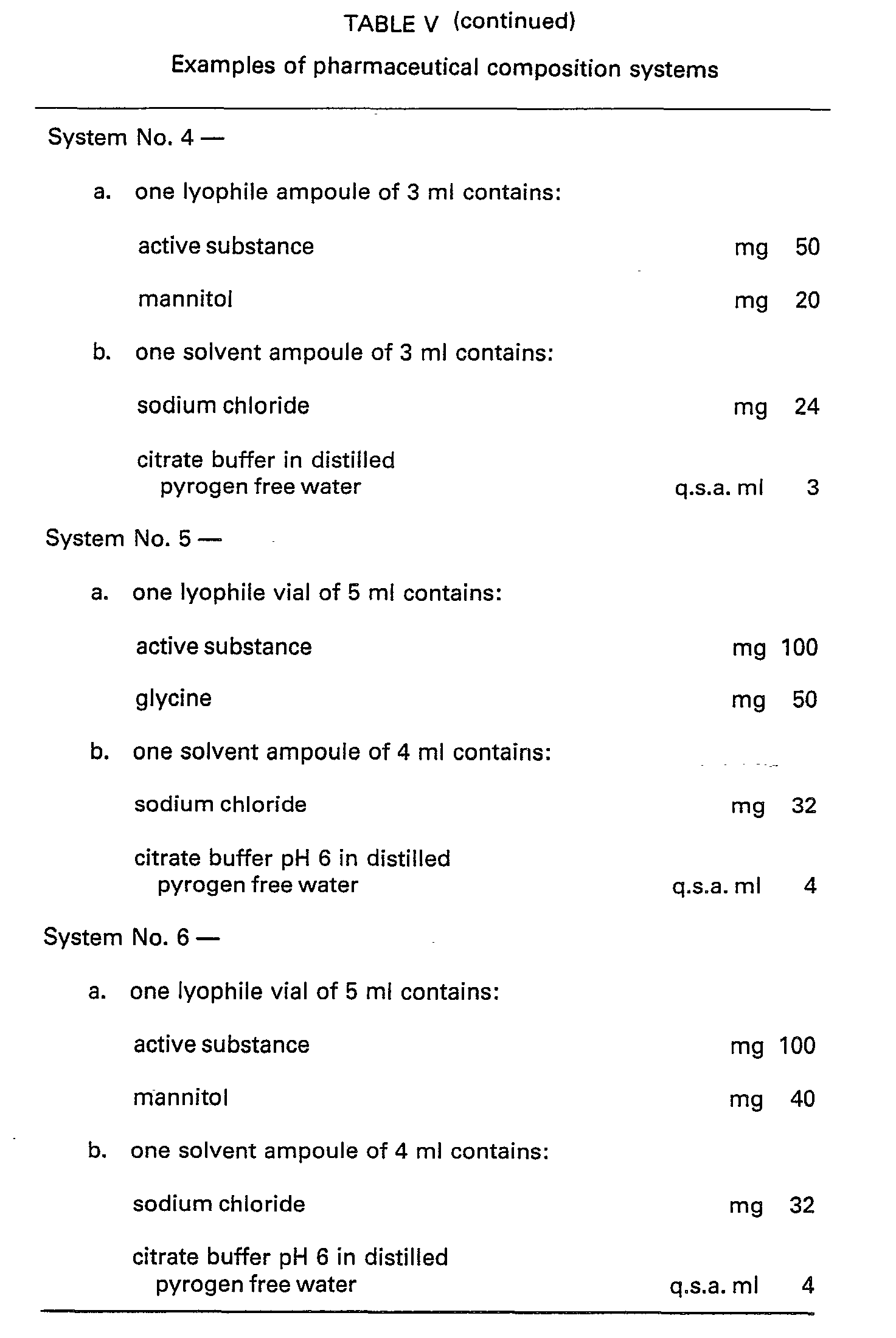
and the percentages in parenthesis indicate the amount of each ganglioside found in the ganglioside mixture extracted from bovine brain tissue.
The medium was changed every 48 hours.
in a final volume-of 3 ml and a final pH of 7.2
Claims (33)


and wherein:


where:


Priority Applications (1)
| Application Number | Priority Date | Filing Date | Title |
|---|---|---|---|
| AT82401385T ATE20238T1 (en) | 1981-08-04 | 1982-07-27 | PROCESSES FOR THE PRODUCTION OF GANGLIOSIDE DERIVATIVES AND THEIR USE IN PHARMACEUTICAL COMPOSITIONS. |
Applications Claiming Priority (2)
| Application Number | Priority Date | Filing Date | Title |
|---|---|---|---|
| US290106 | 1981-08-04 | ||
| US06/290,106 US4476119A (en) | 1981-08-04 | 1981-08-04 | Method for preparing ganglioside derivatives and use thereof in pharmaceutical compositions |
Publications (3)
| Publication Number | Publication Date |
|---|---|
| EP0072722A2 EP0072722A2 (en) | 1983-02-23 |
| EP0072722A3 EP0072722A3 (en) | 1983-05-11 |
| EP0072722B1 true EP0072722B1 (en) | 1986-06-04 |
Family
ID=23114556
Family Applications (1)
| Application Number | Title | Priority Date | Filing Date |
|---|---|---|---|
| EP82401385A Expired EP0072722B1 (en) | 1981-08-04 | 1982-07-27 | A method for preparing ganglioside derivatives and use thereof in pharmaceutical compositions |
Country Status (30)
| Country | Link |
|---|---|
| US (1) | US4476119A (en) |
| EP (1) | EP0072722B1 (en) |
| JP (2) | JPS5829796A (en) |
| KR (1) | KR860000274B1 (en) |
| AR (1) | AR229853A1 (en) |
| AT (1) | ATE20238T1 (en) |
| AU (1) | AU552609B2 (en) |
| BE (1) | BE894024A (en) |
| CA (1) | CA1230596A (en) |
| CH (1) | CH663617A5 (en) |
| DE (1) | DE3271547D1 (en) |
| DK (1) | DK151967C (en) |
| ES (1) | ES514684A0 (en) |
| FI (1) | FI72522C (en) |
| FR (1) | FR2511005B1 (en) |
| GR (1) | GR77228B (en) |
| HK (1) | HK86987A (en) |
| HU (1) | HU193151B (en) |
| IE (1) | IE53432B1 (en) |
| IL (1) | IL66457A0 (en) |
| IN (2) | IN156247B (en) |
| IT (1) | IT1217327B (en) |
| LU (1) | LU84314A1 (en) |
| NO (1) | NO160518C (en) |
| NZ (1) | NZ201440A (en) |
| PL (1) | PL143207B1 (en) |
| PT (1) | PT75369B (en) |
| SG (1) | SG57887G (en) |
| YU (1) | YU168882A (en) |
| ZA (1) | ZA825586B (en) |
Families Citing this family (36)
| Publication number | Priority date | Publication date | Assignee | Title |
|---|---|---|---|---|
| US4716223A (en) * | 1981-08-04 | 1987-12-29 | Fidia, S.P.A. | Method for preparing ganglioside derivatives and use thereof in pharmaceutical compositions |
| US4593091A (en) * | 1981-08-04 | 1986-06-03 | Fidia, S.P.A. | Method for preparing ganglioside derivatives and use thereof in pharmaceutical compositions |
| IT1212896B (en) * | 1983-11-08 | 1989-11-30 | Della Valle Francesco | METHOD OF INHALATORY ADMINISTRATION OF GANGLIOSIDES AND DERIVATIVES, AND RELATED PHARMACEUTICAL COMPOSITIONS |
| IT1199116B (en) * | 1984-07-03 | 1988-12-30 | Fidia Farmaceutici | GANGLIOSIDE DERIVATIVES |
| US4868161A (en) * | 1984-06-29 | 1989-09-19 | City Of Hope | Method for promoting nerve regeneration |
| DK17885D0 (en) * | 1985-01-14 | 1985-01-14 | Karlsson Karl Anders | ANTIVIRAL AGENT |
| IT1182209B (en) * | 1985-02-18 | 1987-09-30 | Fidia Farmaceutici | THERAPEUTIC USE OF MONOSIALOGANGLIOSIDE GM1 AND ITS DERIVATIVES IN SERIOUS DISEASES OF CEREBRAL INFARTI |
| JPH0653764B2 (en) * | 1985-07-31 | 1994-07-20 | 三井東圧化学株式会社 | Method for producing monosialoganglioside |
| US4762822A (en) * | 1985-08-08 | 1988-08-09 | Ettinger Anna C | Reduction of gastrointestinal disease-producing organisms with sialic acid and gangliosides |
| US4769362A (en) * | 1985-10-01 | 1988-09-06 | Trustees Of Boston University | Increased vascular perfusion following administration of lipids |
| US4710490A (en) * | 1985-10-01 | 1987-12-01 | Angio Medical Corporation | Compositions containing ganglioside molecules with enhanced angiogenic activity |
| US4766111A (en) * | 1985-10-31 | 1988-08-23 | Trustees Of Boston University | Lipids with plasmin inhibitory properties |
| US4673667A (en) * | 1985-10-31 | 1987-06-16 | Trustees Of Boston University | Lipids with plasmin inhibitory properties |
| US4767746A (en) * | 1985-12-04 | 1988-08-30 | Trustees Of Boston University | Method for enhancement of healing of epithelial wounds in mammals |
| US4778787A (en) * | 1985-12-20 | 1988-10-18 | Trustees Of Boston University | Method for treatment of angina and myocardial infarctions with omental lipids |
| FR2598434B1 (en) * | 1986-05-12 | 1988-09-16 | Pf Medicament | NEW IMMUNOMODULATORS OBTAINED BY HEMISYNTHESIS FROM A BACTERIAL POLYSACCHARIDE ISOLATED FROM AN UNCAPSULATED MUTANT STRAIN OF KLEBSIELLA PNEUMONIAE |
| US4816450A (en) * | 1986-09-15 | 1989-03-28 | Duke University | Inhibition of protein kinase C by long-chain bases |
| US4937232A (en) * | 1986-09-15 | 1990-06-26 | Duke University | Inhibition of protein kinase C by long-chain bases |
| FR2614306B1 (en) * | 1987-04-22 | 1989-07-28 | Pf Medicament | NOVEL D.25 DERIVATIVE, PROCESS FOR THE PREPARATION THEREOF, USE AS AN IMMUNOSTIMULATING AGENT AND PHARMACEUTICAL COMPOSITIONS CONTAINING THE SAME. |
| IT1212041B (en) * | 1987-11-02 | 1989-11-08 | Fidia Farmaceutici | INTERNAL FOREIGN GANGLIOSIDES AS THERAPEUTIC AGENTS CAPABLE OF ELIMINATING PAIN IN PERIPHERAL NEUROPATHIES |
| US4952567A (en) * | 1988-05-09 | 1990-08-28 | City Of Hope | Inhibition of lipogenesis |
| US5164298A (en) * | 1988-06-24 | 1992-11-17 | Hsc Research Development Corporation | Verocytotoxin receptor assay |
| US6407072B1 (en) | 1988-12-02 | 2002-06-18 | Fidia S.P.A. | Lysoganglioside derivatives |
| IT1232175B (en) * | 1989-07-27 | 1992-01-25 | Fidia Farmaceutici | SEMISYNTHETIC ANALOGUES OF GANGLIOSIDES |
| IT1232176B (en) | 1989-07-27 | 1992-01-25 | Fidia Farmaceutici | DI-LYSOGANGLIOSIDES DERIVATIVES |
| IT1238346B (en) * | 1989-11-14 | 1993-07-13 | MODIFIED GANGLIOSIDES AND THEIR FUNCTIONAL DERIVATIVES. | |
| IT1249034B (en) * | 1990-06-29 | 1995-02-11 | Fidia Spa | USE OF MONOSIALOGANGLIOSIDE GM1 AND ITS INTERNAL FOREIGN DERIVATIVE TO PREVENT THE ESTABLISHMENT OF TOLERANCE IN HUMANS FROM THE ANALGESIC EFFECT OF MORFINA AND ANALOGS |
| US5212075A (en) * | 1991-04-15 | 1993-05-18 | The Regents Of The University Of California | Compositions and methods for introducing effectors to pathogens and cells |
| IT1251991B (en) * | 1991-11-08 | 1995-05-27 | Fidia Spa | USE OF GANGLIOSIDES FOR THE PREPARATION OF ACTIVE PHARMACEUTICAL COMPOSITIONS IN THE PREVENTION OF DYSFUNCTIONS ASSOCIATED WITH THE ABUSE OF COCAINE AND PSYCHOSTIMULANTS RELATED TO IT |
| IT1258310B (en) * | 1992-04-10 | 1996-02-22 | Fidia Spa | PHARMACEUTICAL COMPOSITIONS INCLUDING MONOSIAL-GANGLIOSIDIC DERIVATIVES FOR THE TREATMENT OF DAMAGE TO THE SPINAL CORD. |
| IT1302530B1 (en) * | 1998-12-16 | 2000-09-05 | Fidia Spa In Amministrazione S | PREPARATION PROCESS FOR GANGLIOSIDE GM3 AND ITS LYSODERIVATES TO START FROM GANGLIOSIDE GM1. |
| JP2005527467A (en) | 2001-08-29 | 2005-09-15 | ネオーズ テクノロジーズ, インコーポレイテッド | Novel synthetic ganglioside derivatives and compositions thereof |
| WO2004080960A2 (en) | 2003-03-06 | 2004-09-23 | Neose Technologies Inc. | Methods and compositions for the enzymatic synthesis of gangliosides |
| JP4005115B1 (en) * | 2007-02-08 | 2007-11-07 | 日本臓器製薬株式会社 | Pain disease treatment |
| US20120035120A1 (en) | 2009-03-25 | 2012-02-09 | Seneb Biosciences, Inc. | Glycolipids as treatment for disease |
| CN108498523B (en) * | 2017-02-24 | 2023-06-20 | 上海交通大学 | Preparation method and application of ganglioside derivatives containing unsaturated fatty acid chains |
Family Cites Families (2)
| Publication number | Priority date | Publication date | Assignee | Title |
|---|---|---|---|---|
| US4207414A (en) * | 1978-08-16 | 1980-06-10 | President And Fellows Of Harvard College | Polysaccharide antigens |
| IE51174B1 (en) * | 1980-04-14 | 1986-10-29 | Merck & Co Inc | Group b streptococcal capsular polysaccharides |
-
1981
- 1981-08-04 US US06/290,106 patent/US4476119A/en not_active Expired - Fee Related
-
1982
- 1982-07-27 FR FR828213073A patent/FR2511005B1/en not_active Expired
- 1982-07-27 DE DE8282401385T patent/DE3271547D1/en not_active Expired
- 1982-07-27 AT AT82401385T patent/ATE20238T1/en not_active IP Right Cessation
- 1982-07-27 EP EP82401385A patent/EP0072722B1/en not_active Expired
- 1982-07-28 GR GR68896A patent/GR77228B/el unknown
- 1982-07-28 CH CH4572/82A patent/CH663617A5/en not_active IP Right Cessation
- 1982-07-28 IT IT48898/82A patent/IT1217327B/en active Protection Beyond IP Right Term
- 1982-07-29 IN IN887/CAL/82A patent/IN156247B/en unknown
- 1982-07-29 IN IN886/CAL/82A patent/IN156298B/en unknown
- 1982-07-30 NZ NZ201440A patent/NZ201440A/en unknown
- 1982-07-30 CA CA000408559A patent/CA1230596A/en not_active Expired
- 1982-07-30 FI FI822673A patent/FI72522C/en not_active IP Right Cessation
- 1982-08-02 DK DK346382A patent/DK151967C/en not_active IP Right Cessation
- 1982-08-03 LU LU84314A patent/LU84314A1/en unknown
- 1982-08-03 YU YU01688/82A patent/YU168882A/en unknown
- 1982-08-03 ES ES514684A patent/ES514684A0/en active Granted
- 1982-08-03 KR KR8203485A patent/KR860000274B1/en not_active Expired
- 1982-08-03 AU AU86727/82A patent/AU552609B2/en not_active Ceased
- 1982-08-03 PT PT75369A patent/PT75369B/en not_active IP Right Cessation
- 1982-08-03 JP JP57136204A patent/JPS5829796A/en active Granted
- 1982-08-03 IE IE1862/82A patent/IE53432B1/en not_active IP Right Cessation
- 1982-08-03 NO NO822648A patent/NO160518C/en unknown
- 1982-08-03 ZA ZA825586A patent/ZA825586B/en unknown
- 1982-08-03 BE BE6/47690A patent/BE894024A/en not_active IP Right Cessation
- 1982-08-03 AR AR290191A patent/AR229853A1/en active
- 1982-08-03 IL IL66457A patent/IL66457A0/en not_active IP Right Cessation
- 1982-08-04 HU HU822509A patent/HU193151B/en not_active IP Right Cessation
- 1982-08-04 PL PL1982237770A patent/PL143207B1/en unknown
-
1987
- 1987-07-09 SG SG578/87A patent/SG57887G/en unknown
- 1987-11-19 HK HK869/87A patent/HK86987A/en unknown
-
1989
- 1989-04-17 JP JP1098636A patent/JPH01308292A/en active Granted
Non-Patent Citations (1)
| Title |
|---|
| CARBOHYDRATE RESEARCH, vol. 41, 1975, pages 344-350, Elsevier Scientific Publishing Company, Amsterdam (NL); S.K. GROSS et al.: "Identification of the internal acetal 5-acetamido-2,7-anhydro-3,5-dideoxy-D-glycero-nonulopyranose" * |
Also Published As
Similar Documents
| Publication | Publication Date | Title |
|---|---|---|
| US4593091A (en) | Method for preparing ganglioside derivatives and use thereof in pharmaceutical compositions | |
| HK86987A (en) | A method for preparing ganglioside derivatives and use thereof in pharmaceutical compositions | |
| CA1263954A (en) | Ganglioside derivatives | |
| US4716223A (en) | Method for preparing ganglioside derivatives and use thereof in pharmaceutical compositions | |
| EP0145209B1 (en) | A kit or device and method for administering gangliosides and derivatives thereof of inhalation and pharmaceutical compositions suitable therefor | |
| JPH064667B2 (en) | Polysulfate esters of bis-aldamides and their derivatives, and method for producing them | |
| EP0267297B1 (en) | Sialosylcholesterol, process for its preparation, and drug for treating diseases of nervous system | |
| GB2179945A (en) | New saccharides, their preparation and pharmacetical compositions containing them | |
| EP0373039A2 (en) | New lysoganglioside derivatives | |
| EP0410881A2 (en) | Semisynthetic ganglioside analogues | |
| EP0410883B1 (en) | Di-lysogangliosides derivatives | |
| KR890004136B1 (en) | Sialoxyl cholesterol, a method for producing the same, and a therapeutic agent for neurological diseases consisting of sialosil cholesterol | |
| JPH0696535B2 (en) | Sialosyl cholesterol therapeutic agent for neurological disorders |
Legal Events
| Date | Code | Title | Description |
|---|---|---|---|
| PUAI | Public reference made under article 153(3) epc to a published international application that has entered the european phase |
Free format text: ORIGINAL CODE: 0009012 |
|
| AK | Designated contracting states |
Designated state(s): AT DE GB NL SE |
|
| PUAL | Search report despatched |
Free format text: ORIGINAL CODE: 0009013 |
|
| 17P | Request for examination filed |
Effective date: 19830131 |
|
| AK | Designated contracting states |
Designated state(s): AT DE GB NL SE |
|
| GRAA | (expected) grant |
Free format text: ORIGINAL CODE: 0009210 |
|
| AK | Designated contracting states |
Kind code of ref document: B1 Designated state(s): AT DE GB NL SE |
|
| REF | Corresponds to: |
Ref document number: 20238 Country of ref document: AT Date of ref document: 19860615 Kind code of ref document: T |
|
| REF | Corresponds to: |
Ref document number: 3271547 Country of ref document: DE Date of ref document: 19860710 |
|
| PLBE | No opposition filed within time limit |
Free format text: ORIGINAL CODE: 0009261 |
|
| STAA | Information on the status of an ep patent application or granted ep patent |
Free format text: STATUS: NO OPPOSITION FILED WITHIN TIME LIMIT |
|
| 26N | No opposition filed | ||
| EAL | Se: european patent in force in sweden |
Ref document number: 82401385.8 |
|
| PGFP | Annual fee paid to national office [announced via postgrant information from national office to epo] |
Ref country code: SE Payment date: 19950717 Year of fee payment: 14 |
|
| PGFP | Annual fee paid to national office [announced via postgrant information from national office to epo] |
Ref country code: GB Payment date: 19950718 Year of fee payment: 14 |
|
| PGFP | Annual fee paid to national office [announced via postgrant information from national office to epo] |
Ref country code: AT Payment date: 19950728 Year of fee payment: 14 |
|
| PGFP | Annual fee paid to national office [announced via postgrant information from national office to epo] |
Ref country code: NL Payment date: 19950731 Year of fee payment: 14 |
|
| PGFP | Annual fee paid to national office [announced via postgrant information from national office to epo] |
Ref country code: DE Payment date: 19950929 Year of fee payment: 14 |
|
| PG25 | Lapsed in a contracting state [announced via postgrant information from national office to epo] |
Ref country code: GB Effective date: 19960727 Ref country code: AT Effective date: 19960727 |
|
| PG25 | Lapsed in a contracting state [announced via postgrant information from national office to epo] |
Ref country code: SE Effective date: 19960728 |
|
| PG25 | Lapsed in a contracting state [announced via postgrant information from national office to epo] |
Ref country code: NL Effective date: 19970201 |
|
| GBPC | Gb: european patent ceased through non-payment of renewal fee |
Effective date: 19960727 |
|
| NLV4 | Nl: lapsed or anulled due to non-payment of the annual fee |
Effective date: 19970201 |
|
| PG25 | Lapsed in a contracting state [announced via postgrant information from national office to epo] |
Ref country code: DE Effective date: 19970402 |
|
| EUG | Se: european patent has lapsed |
Ref document number: 82401385.8 |