EP0071716B1 - Allophone vocoder - Google Patents
Allophone vocoder Download PDFInfo
- Publication number
- EP0071716B1 EP0071716B1 EP19820105168 EP82105168A EP0071716B1 EP 0071716 B1 EP0071716 B1 EP 0071716B1 EP 19820105168 EP19820105168 EP 19820105168 EP 82105168 A EP82105168 A EP 82105168A EP 0071716 B1 EP0071716 B1 EP 0071716B1
- Authority
- EP
- European Patent Office
- Prior art keywords
- phoneme
- analog
- speech
- speech signal
- allophone
- Prior art date
- Legal status (The legal status is an assumption and is not a legal conclusion. Google has not performed a legal analysis and makes no representation as to the accuracy of the status listed.)
- Expired
Links
Images






Classifications
-
- G—PHYSICS
- G10—MUSICAL INSTRUMENTS; ACOUSTICS
- G10L—SPEECH ANALYSIS TECHNIQUES OR SPEECH SYNTHESIS; SPEECH RECOGNITION; SPEECH OR VOICE PROCESSING TECHNIQUES; SPEECH OR AUDIO CODING OR DECODING
- G10L19/00—Speech or audio signals analysis-synthesis techniques for redundancy reduction, e.g. in vocoders; Coding or decoding of speech or audio signals, using source filter models or psychoacoustic analysis
- G10L19/0018—Speech coding using phonetic or linguistical decoding of the source; Reconstruction using text-to-speech synthesis
-
- G—PHYSICS
- G10—MUSICAL INSTRUMENTS; ACOUSTICS
- G10L—SPEECH ANALYSIS TECHNIQUES OR SPEECH SYNTHESIS; SPEECH RECOGNITION; SPEECH OR VOICE PROCESSING TECHNIQUES; SPEECH OR AUDIO CODING OR DECODING
- G10L19/00—Speech or audio signals analysis-synthesis techniques for redundancy reduction, e.g. in vocoders; Coding or decoding of speech or audio signals, using source filter models or psychoacoustic analysis
Definitions
- This invention relates to a vocoder system as defined in the precharacterizing part of claim 1.
- a vocoder system as defined in the precharacterizing part of claim 1.
- Such a system is known from IEEE INTERNATIONAL CONFERENCE ON ACOUSTIC, Speech and Signal Processing, April 10-12, 1978, V.N. GUPTA et al.: "Speaker-independent vowel identification in continuous speech", pages 546-548.
- the invention relates to a method of analyzing a speech signal and producing audible synthesized speech as defined in the precharacterizing part of claim 4.
- Intrinsic to the recognition of an analog speech is the use of a methodology which breaks the analog speech into its component parts which may be compared to some library for identification. Numerous methods and apparatuses have evolved so as to approximate the human speech and to model it. These modeling techniques include the vocoder, linear predictive filters, and other devices.
- Flanagan discusses two electronic devices which automatically extract the first three formant frequencies from continuous speech. These devices yield continuous DC output voltages whose magnitudes as functions of time represent the formant frequencies of the speech. Although the formant frequencies are in an analog form, use of an analog-digital (AD) converter readily transforms these formant frequencies into digital form which is more suitable for use in an electronic environment.
- AD analog-digital
- this allophone vocoder device Some applications of this allophone vocoder device are found in a digital dictating machine, a store and play telephone, voice memos, multichannel voice communications, voice recorded exams, etc. In the situation of a dictating machine, the erroneous matching of the phonemes is more visible than in the synthesized speech situation; but it provides a rough draft or first cut to the document so as to be edited later.
- This invention uses a phoneme-to-allophone matching algorithm, such that the quality of synthesized speech is vastely improved since allophones more closely map the human utterances.
- This vocoder accepts the analog speech input and matches it to a set of phoneme templates; the phonemes each contain a phoneme code which is compressed into a sequence of phoneme codes and communicated via a channel. This channel should be as noise free as possible so as to provide accurate transmission.
- the sequence of phonemes is received and then translated to an analogous allophone sequence and synthesized through known electronic synthesis means.
- the phoneme recognizer contains an automatic gain control (AGC).
- AGC automatic gain control
- the phoneme recognizer receives the voice input and automatically controls the gain of the voice and sends a signal to the formant-determining means for analysis and formant extraction.
- the algorithm operates on the formants and features of the utterance requiring the detection of the phoneme boundary within the speech.
- the detected phoneme is matched to a phoneme in a library of phoneme templates. Each phoneme template has a corresponding identification code.
- the selected identification code is sequentially packed and transmitted via a transmission channel to a receiver.
- the transmission channel may be either a wired or wireless communication medium. Ideally the transmission channel is as noiseless as possible so as to reduce errors.
- the phoneme-to-allophone synthesizer receives the phoneme codes from the channel.
- the algorithm converts the phoneme sequence into an analogous allophone sequence and thereby produces quality speech.
- a control means sequentially directs a library of allophone characteristics to be communicated to a speech synthesizer.
- a formant is a frequency component in the spectrum of speech which has large amplitude energy. It also has a resonant frequency of the pitch and a voiced sound. This resonant frequency is a multiple of a fundamental frequency.
- the first formant occurs between 200 to 850 Hertz (Hz), and the second formant occurs between 850 and 2,500 Hz, the third formant occurs between 2,500 and 3,500 Hz.
- FIGURE 1 illustrates in block diagram the capabilities of an embodiment of the invention.
- Analog speech 101 is picked up by the microphone 102 and transmitted in analog form to the analog to digital (A/D) converter 103. Once the signal has been translated into digital form, it is converted to a perceived phoneme via the conversion means 104. Each perceived phoneme is communicated to the comparator 105 and referenced to templates in the library 106 so that a match is obtained. Once a matched phoneme is determined, its code is communicated via the bus 107 to either the phoneme sequencer 108, the storage means 109, or the transmitter 110.
- A/D analog to digital
- the code sequence which matches to the phoneme sequence totally identifies the analog speech 101.
- This code sequence is more susceptible to being packed or for storage than the original analog speech 101 due to its digital nature.
- the phoneme sequencer 108 utilizes the code communicated via the bus 107 to obtain the appropriate phoneme from the library 106.
- This phoneme from the library 106 has associated with it a set of allophone characteristics which are communicated to the synthesizer 114.
- the synthesizer 114 communicates an analog signal to operate speaker 115 in the generation of speech 116.
- a more intelligible and higher quality speech 116 is generated. This translation ability permits the encoding of the data in a phoneme base so as to facilitate a lower bit per second transmission rate and thus requires less time and storage medium for the recordation of the original analog speech 101.
- the phoneme codes are stored via storage means 109 for later retrieval. This later retrieval is optionally used by the phoneme sequencer 108, synthesizer 114, and speaker 115 sequence to again synthesize the phoneme sequence in allophone form for generation of speech 116.
- the storage means 109 communicates the phoneme codes to the phoneme-to-alphabet converter 111 which translates the phonemes to their equivalent alphanumeric parts. Once the phonemes have been translated to the alphanumeric parts, such as in ASCII code, they are readily transmitted to the printer 112 so as to produce a paper copy 113 of the original analog speech 101.
- the storage means 109 allows the invention to generate printed text from a speech input so as to permit an automatic dictating device.
- Another alternative is for the phoneme codes from the bus 107 to be communicated to a transmitter 110.
- the transmitter generates signals 117 representative of the phoneme codes which are perceived by a remote unit 120 at its receiver 118.
- the remote unit 120 contains the same capabilities as the local unit 121. This entails the transmission of the phoneme code via a bus 119 from the receiver 118. Again, once the phoneme code is transmitted via the bus 119, it is susceptible for the remote storage means 109' or the remote sequencer 108'. In another embodiment of the invention the phoneme codes transmitted via the bus 119 are also communicatable to a remote transmitter, not shown.
- the remote unit 120 utilizes the phoneme codes in the same manner as the local unit 121.
- the phoneme codes are utilized by the remote sequencer 108' in conjunction with the data in the remote library 106' to generate an analogous allophone sequence which is communicated to the remote synthesizer 114'.
- the remote synthesizer 114' controls the operation of the remote speaker 115' in generating the speech 116'.
- the remote unit 120 also has the option of storing the phoneme code at the remote storage means 109' for later use by the remote sequencer 108' or the phoneme to alphabet converter 111'.
- the phoneme-to-alphabet converter 111' translates the phoneme code to its equivalent alphanumeric symbols which are communicated to the printer 112' to generate a paper copy 113'.
- the analog speech is translated to a phoneme code which is more susceptible to storage or for manipulation as a data string.
- the phoneme code permits easy storage, transmission, generation of a printed copy or eventual synthesis by translation to an analogous allophone sequence.
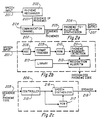
- FIGURE 2a illustrates, in block form, an embodiment of the invention which receives the analog speech input and results in a speech output.
- the original analog speech signal input 201 is communicated to a phoneme recognizer 202 which generates a sequence of phonemes 203 via a communication channel 204.
- the sequence of phonemes 205 is communicated to a phoneme-to-allophone synthesizer 206 which translates the phoneme sequence into its analogous allophone sequence so as to generate the speech output 207.
- the phoneme recognizer 202 and the phoneme-to-allophone synthesizer 206 are alternatively in the same unit or are remote one from the other.
- the communication channel 204 is either a hard wired device such as bus or a telephone line or a radio transmitter with receiver.
- FIGURE 2b illustrates an embodiment of the phoneme recognizer 202 illustrated in FIGURE 2a.
- the analog speech signal input 201 is communicated to an automatic gain control circuit (AGC) 208 so as to regulate the speech signal into a certain desirable balance.
- AGC automatic gain control circuit
- the formant tracker 209 breaks the analog signal into its formant components which are stored in a random access memory (RAM) 210.
- RAM random access memory
- the formants stored in RAM 210 are communicated to the phoneme boundary detection means 211 so as to group the formants into perceived phoneme components.
- Each perceived phoneme is communicated to the recognition algorithm 212 which utilizes the phoneme templates from the library 213 which is comprised of known phonemes. A best match is made between the perceived phoneme from the phoneme boundary detection means 211 and the templates found in the phoneme template library 213 by the recognition algorithm 212 so as to generate a recognized phoneme code 214.
- the recognition algorithm 212 provides a continuous sequence of phoneme codes so that a blank or non-recognized phoneme does not exist in the sequence. A blank for a non-recognition determination only results in an increase in the noise of the invention.
- FIGURE 2c illustrates an embodiment of a phoneme-to-allophone synthesizer 206.
- the sequence of phoneme codes 205 is communicated to the controller 215.
- the controller 215 utilizes these codes and its prompting of the read only memory (ROM) 217 to communicate to the speech synthesizer 216 the appropriate bit sequence indicative of the analogous allophone sequence.
- This data communicated from the ROM 217 to the speech synthesizer 216 establishes the parameters necessary for the modulation of the speaker 218 in the generation of the synthesized speech.
- the speech synthesizer is chosen from a wide variety of speech synthesis means, including, but not limited to, the use of a linear predictive filter.
- FIGURE 3 is a block diagram of an embodiment of the invention which generates indicia representative of the analog speech.
- the automatic gain control circuit (AGC) 301 communicates an analog speech signal to the pitch tracker 302 and the integration means 304, 314, and 324.
- the pitch tracker 302 generates a fundamental frequency F0.
- a respective set of integers is determined for which the fundamental frequency F0, when multiplied by the integer falls within the formant range.
- the respective sets of integers are broadened to include an overlap in the sets so that the entire formant is defined.
- the integer set for the first formant may contain (0, 1, 2, 3, 4); the second formant integer set contains (4, 5, 6, 7); the third formant integer set contains (7, 8, 9).
- the formant determiner 308 accepts the fundamental frequency FO and utilizes it with an integer value from the integer set for n in the sinusoidal oscillator 303.
- the sinusoidal oscillator 303 generates a sinusoidal signal, s(t), which is centered at the product n and the fundamental frequency.
- the sinusoidal signal is communicated to the integrator 304 which integrates the product of the sinusoidal signal s(t) and the analog speech signal, f(t) over the chosen frequency of the formant. This integration by the integrator 304 creates a convolution of the analog speech signal f(t).
- This operation involving the generation of a sinusoidal signal by the sinusoidal oscillator 303 and the communication thereof to the integrator 304 is continued for all integer values within the integer set by the incrementer 306.
- the value of n which generates the maximum amplitude from the integrator 304 is chosen by the determinator 305.
- This product additionally is determinative of the bandwidth BW1, of the first formant and the pair F1 and BW1 are communicated via channel 307.
- the formant determiners 318 and 328 generate a sinusoidal signal via the sinusoidal oscillators 313 and 323 respectively and subsequently integrate by the integrators 314 and 324 so as to obtain the optimal values M' and K', 315 and 325 respectively.
- the indicia BW1, F1, BW2, F2, BW3, F3, and F0 represent the perceived phoneme indicia from the analog speech from the AGC circuit 301. This perceived indicia is used to match the perceived phoneme to a phoneme template in a library so as to obtain a best match.
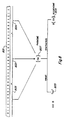
- FIGURE 4 indicates the relationship of the bandwidth to the optimal formant.
- the optimal integer value N' Once the optimal integer value N' is determined, its amplitude is plotted relative to the surrounding integers.
- the independent axis 402 contains the frequencies as dictated by the product of the integer value with the fundamental frequency.
- the dependent axis 403 contains the amplitude generated by the product in the convolution with the analog speech signal. As illustrated, the optimal value N' generates an amplitude 404.
- a bandwidth BW1 is determined for the appropriate optimal value N'.
- this bandwidth forms another indicia for determining the perceived phoneme relationship to the phoneme templates of the library. Similar analysis is done for each formant.
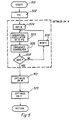
- FIGURE 5 is a flow chart of an embodiment for determining the optimal formant positions.
- the algorithm is started at 501 and a fundamental frequency, F0, 502 is determined. This fundamental frequency is utilized to optimize on N 503.
- the optimization on N 503 entails the initialization of the N value 504 followed by the sinusoidal oscillation based at the product of N FO 505.
- the frequency convolver 506 generates the convolution of the fundamental frequency FO and the inputted analog speech signal over the chosen frequency of the formant.
- the convolution is optimized at 507 wherein if it is not the optimal value, the N value is incremented at 508 and the process is repeated until an optimal N value is determined.
- the algorithm proceeds to optimize on the value of M 513 and then to optimize on the value K 523.
- the optimization on N 503, the optimization of M 513, and the optimization of K 523 are identical in structure and performance.
- three formant frequency ranges are utilized to define the human language. It has been found that three ranges accurately described the human speech, but this methodology is either extendable or contractable at the will of the designer. No loss in generality is encountered when the algorithm is extended to apply to a single formant or similarly to extend to more than three formants.
- FIGURE 6 graphically illustrates another methodology for the encoding of the analog speech signal in the formants.
- the analog speech signal 608 is plotted over the independent axis 601 of frequency.
- the dependent axis 602 is the amplitude.
- the frequency range lies between 200 and 700 Hz.
- the second formant 604 has a frequency range of 850 to 2500 Hz; and the third formant 605 has a frequency range of 2700 to 3500 Hz.
- a method similar to the methodology discussed in FIGURE 3 and FIGURE 5 is used to determine the location of the maximum amplitude within the formant range. These maxima yield a distance between maxima, 606 and 607 respectively.
- the distance, d,, between the optimal first and second formants is used to characterize the perceived phoneme for matching to a phoneme template. This methodology allows two integer values d, and d 2 to describe what previously necessitated the use of three integer values (for the first, second and third formants).
- FIGURE 7 is an embodiment of the encoding scheme for establishing a word for matching to the phoneme template.
- the data word 701 in this example is an 8 bit word but any length of word which is capable of adequately describing the perceived phoneme is acceptable.
- the 8 bits are broken up into four basic components, 702, 703, 704, and 705.
- the first component 702 is indicative of a pause or no pause situation.
- b o is set to a value of 1, a pause has been perceived and the appropriate steps will therefore be taken; similarly a 0 at b o indicates lack of a pause.
- bit b i 703 which indicates a voiced or unvoiced phoneme.
- Bits b 2 -b 3 , 704 indicate the contour of the analog speech signal; its assigned value indicates a level slope, a positive slope or a negative slope.
- Bits b 4- b 7 , 705, indicate a mixture of the relative energy, relative pitch, first distance, and second distance.
- FIGURE 8 illustrates the translation of the phoneme code sequence into its appropriate allophone sequence or alternately its alphanumeric counterpart.
- the phoneme sequence 801 is broken into its phoneme codes such as phoneme code 802.
- the phoneme code 802 distinctly describes a particular phoneme 807.
- This phoneme 807 is either printed as at 805 in its ASCII alphanumeric character or it is translated to its analogous allophone sequence when it is taken in conjunction with the surrounding phoneme codes 803 and 804.
- the allophone sequence 806 is generated through the knowledge of the target phoneme 807 and its relationship to its surrounding phonemes.
- the phonemes which precede, 803, and follow, 804, the target phoneme 802 are retained in memory so as to generate the appropriate allophone sequence 806.
- FIGURE 9 illustrates the characteristics of an embodiment of a decisional tree which determines the best approximation of the phoneme template in matching the perceived phoneme.
- the decisional tree is broken up into multiple stages 901, 902, etc. Each stage of the tree breaks the perceived phoneme into a feasible and infeasible matches. As the perceived phoneme is further broken into feasible and infeasible states, the infeasible state becomes absorbing and the feasible state decreases so that eventually a single phoneme template is the only possible choice. Hence, the final stage of the tree must consist of as many nodes as there are templates.
- the original decision 903 is made on whether the first bit, b o , is either set or not set. If the first bit is set, transition is made to node 905; the nodes which follow node 904, B1, are ignored. This determination on the b o level results in translating the available phoneme templates into an infeasible set, those lying exclusively behind node 904 and a feasible set, those lying behind node B2, 905. A similar determination is made for each component part of the indicia. In this example, another separation is made on b 1 and then on the value of b 2- b 3 . This separation into nodes is continued until a final or terminating node is encountered which uniquely identifies the phoneme template chosen.
- Movement is acceptable laterally between nodes such as between nodes E1, 908, and E2, 909 via the ray 907. This movement is permissible so long as a cycle is not thereby created.
- ray 910 indicates a cycle between D1 and C1. For example, a sequence containing C1-D1-C1-D1-C1 is not acceptable since it is a cycle. This sequence causes a never ending cycle which results in a decision never being made.
- the one qualification of the tree illustrated in this embodiment is that a decision must eventually be reached.
- the algorithm illustrated in FIGURE 9 is but one embodiment to identify the best match between the perceived phoneme and the phoneme template. Another approach is to generate a comparison value for each phoneme template relative to the perceived phoneme and then choose the optimal value accordingly. This approach requires more computation and a longer time for its operation.
- FIGURES 10a and 10b illustrate a phoneme to allophone transformation wherein a phoneme is translated to its analogous allophone sequence.
- FIGURE 10a a list of the rules in defining the allophone is set forth.
- 1001 illustrates a blank or a word boundary.
- the different symbols illustrated indicate different allophonic characteristics which are attachable to a phoneme.
- the syllables are broken by a period ".”, 1002.
- These allophonic rules are combined with the phonemes to generate the appropriate allophone sequence.
- FIGURE 10b illustrates how the phoneme "CH", 1003, translates into an appropriate allophone sequence.
- the phoneme "CH” is either a “b CH", 1004, as in “chain” or lies within a word as illustrated by "CH", 1005, as in "bewitching".
- Each phoneme maps into a unique allophone sequence. This allophone sequence is determined through knowledge of the preceding phoneme and the following phoneme within the phoneme sequence.
- the invention as described herein details the use of a voice recognition system which translates the analog speech signal into a phoneme sequence which is more susceptible to compaction, storage, transmission, or translation to an analogous allophone sequence for speech synthesis.
- the phoneme perception allows for an un- limitable vocabulary to be used and also for a best match to be generated.
- the use of a best match is acceptable since the human ear acts as a filtering mechanism and the human brain ignores random noise so as to also filter the synthesized speech.
- the synthesized speech is enhanced dramatically through the translation of the phoneme sequence to an analogous allophone sequence.
- the stored phoneme sequence is susceptible to being translated to an alphanumeric sequence or for transmission via the radio or telephone lines.
- This invention makes it possible for a direct speech to text dictating machine to be implemented and also can be advantageously employed to produce a highly efficient speech data transmission rate.
Landscapes
- Engineering & Computer Science (AREA)
- Computational Linguistics (AREA)
- Signal Processing (AREA)
- Health & Medical Sciences (AREA)
- Audiology, Speech & Language Pathology (AREA)
- Human Computer Interaction (AREA)
- Physics & Mathematics (AREA)
- Acoustics & Sound (AREA)
- Multimedia (AREA)
- Compression, Expansion, Code Conversion, And Decoders (AREA)
- Machine Translation (AREA)
Applications Claiming Priority (6)
| Application Number | Priority Date | Filing Date | Title |
|---|---|---|---|
| US28969081A | 1981-08-03 | 1981-08-03 | |
| US06/289,603 US4424415A (en) | 1981-08-03 | 1981-08-03 | Formant tracker |
| US289690 | 1981-08-03 | ||
| US06/289,604 US4661915A (en) | 1981-08-03 | 1981-08-03 | Allophone vocoder |
| US289604 | 1981-08-03 | ||
| US289603 | 2002-11-07 |
Publications (3)
| Publication Number | Publication Date |
|---|---|
| EP0071716A2 EP0071716A2 (en) | 1983-02-16 |
| EP0071716A3 EP0071716A3 (en) | 1983-05-11 |
| EP0071716B1 true EP0071716B1 (en) | 1987-08-26 |
Family
ID=27403910
Family Applications (1)
| Application Number | Title | Priority Date | Filing Date |
|---|---|---|---|
| EP19820105168 Expired EP0071716B1 (en) | 1981-08-03 | 1982-06-14 | Allophone vocoder |
Country Status (3)
| Country | Link |
|---|---|
| EP (1) | EP0071716B1 (enExample) |
| JP (1) | JPS5827200A (enExample) |
| DE (1) | DE3277095D1 (enExample) |
Families Citing this family (13)
| Publication number | Priority date | Publication date | Assignee | Title |
|---|---|---|---|---|
| US4707858A (en) * | 1983-05-02 | 1987-11-17 | Motorola, Inc. | Utilizing word-to-digital conversion |
| FR2547146B1 (fr) * | 1983-06-02 | 1987-03-20 | Texas Instruments France | Procede et dispositif pour l'audition de messages parles synthetises et pour la visualisation de messages graphiques correspondants |
| DE3513243A1 (de) * | 1985-04-13 | 1986-10-16 | Telefonbau Und Normalzeit Gmbh, 6000 Frankfurt | Verfahren zur sprachuebertragung und sprachspeicherung |
| JPS62231300A (ja) * | 1986-03-31 | 1987-10-09 | 郵政省通信総合研究所長 | 音声の処理単位への自動区分と処理の方法 |
| FR2642882B1 (fr) * | 1989-02-07 | 1991-08-02 | Ripoll Jean Louis | Appareil de traitement de la parole |
| AU684872B2 (en) * | 1994-03-10 | 1998-01-08 | Cable And Wireless Plc | Communication system |
| EP0706172A1 (en) * | 1994-10-04 | 1996-04-10 | Hughes Aircraft Company | Low bit rate speech encoder and decoder |
| US5680512A (en) * | 1994-12-21 | 1997-10-21 | Hughes Aircraft Company | Personalized low bit rate audio encoder and decoder using special libraries |
| WO1999040568A1 (de) * | 1998-02-03 | 1999-08-12 | Siemens Aktiengesellschaft | Verfahren zum übermitteln von sprachdaten |
| US7353173B2 (en) * | 2002-07-11 | 2008-04-01 | Sony Corporation | System and method for Mandarin Chinese speech recognition using an optimized phone set |
| US7353172B2 (en) * | 2003-03-24 | 2008-04-01 | Sony Corporation | System and method for cantonese speech recognition using an optimized phone set |
| US7353174B2 (en) * | 2003-03-31 | 2008-04-01 | Sony Corporation | System and method for effectively implementing a Mandarin Chinese speech recognition dictionary |
| CN111147444B (zh) * | 2019-11-20 | 2021-08-06 | 维沃移动通信有限公司 | 一种交互方法及电子设备 |
Family Cites Families (1)
| Publication number | Priority date | Publication date | Assignee | Title |
|---|---|---|---|---|
| JPS5326761A (en) * | 1976-08-26 | 1978-03-13 | Babcock Hitachi Kk | Injecting device for reducing agent for nox |
-
1982
- 1982-06-14 EP EP19820105168 patent/EP0071716B1/en not_active Expired
- 1982-06-14 DE DE8282105168T patent/DE3277095D1/de not_active Expired
- 1982-08-02 JP JP57135070A patent/JPS5827200A/ja active Granted
Also Published As
| Publication number | Publication date |
|---|---|
| DE3277095D1 (en) | 1987-10-01 |
| JPS5827200A (ja) | 1983-02-17 |
| EP0071716A3 (en) | 1983-05-11 |
| EP0071716A2 (en) | 1983-02-16 |
| JPH0576040B2 (enExample) | 1993-10-21 |
Similar Documents
| Publication | Publication Date | Title |
|---|---|---|
| US4661915A (en) | Allophone vocoder | |
| US4424415A (en) | Formant tracker | |
| EP1704558B1 (en) | Corpus-based speech synthesis based on segment recombination | |
| EP0302663B1 (en) | Low cost speech recognition system and method | |
| US7035794B2 (en) | Compressing and using a concatenative speech database in text-to-speech systems | |
| EP0140777B1 (en) | Process for encoding speech and an apparatus for carrying out the process | |
| US5165008A (en) | Speech synthesis using perceptual linear prediction parameters | |
| JPH10260692A (ja) | 音声の認識合成符号化/復号化方法及び音声符号化/復号化システム | |
| CA2085895A1 (en) | Continuous speech processing system | |
| JPH09500223A (ja) | 多言語音声認識システム | |
| JP2001166789A (ja) | 初頭/末尾の音素類似度ベクトルによる中国語の音声認識方法及びその装置 | |
| EP0071716A2 (en) | Allophone vocoder | |
| Abe et al. | Statistical analysis of bilingual speaker’s speech for cross‐language voice conversion | |
| EP0191531B1 (en) | A method and an arrangement for the segmentation of speech | |
| Wagner | Automatic labelling of continuous speech with a given phonetic transcription using dynamic programming algorithms | |
| Bu et al. | Perceptual speech processing and phonetic feature mapping for robust vowel recognition | |
| Blomberg | Adaptation to a speaker's voice in a speech recognition system based on synthetic phoneme references | |
| JPH0215080B2 (enExample) | ||
| JPH01202798A (ja) | 音声認識方法 | |
| Itahashi et al. | Discrete-word recognition utilizing a word dictionary and phonological rules | |
| US12451125B2 (en) | Speech recognition apparatus and method | |
| EP0681729B1 (en) | Speech synthesis and recognition system | |
| JPH1185196A (ja) | 音声符号化/復号化方式 | |
| Blomberg | A common phone model representation for speech recognition and synthesis | |
| Holmes | Speech technology in the next decades |
Legal Events
| Date | Code | Title | Description |
|---|---|---|---|
| PUAI | Public reference made under article 153(3) epc to a published international application that has entered the european phase |
Free format text: ORIGINAL CODE: 0009012 |
|
| AK | Designated contracting states |
Designated state(s): DE FR GB NL |
|
| PUAL | Search report despatched |
Free format text: ORIGINAL CODE: 0009013 |
|
| AK | Designated contracting states |
Designated state(s): DE FR GB NL |
|
| 17P | Request for examination filed |
Effective date: 19831104 |
|
| GRAA | (expected) grant |
Free format text: ORIGINAL CODE: 0009210 |
|
| AK | Designated contracting states |
Kind code of ref document: B1 Designated state(s): DE FR GB NL |
|
| REF | Corresponds to: |
Ref document number: 3277095 Country of ref document: DE Date of ref document: 19871001 |
|
| ET | Fr: translation filed | ||
| PLBE | No opposition filed within time limit |
Free format text: ORIGINAL CODE: 0009261 |
|
| STAA | Information on the status of an ep patent application or granted ep patent |
Free format text: STATUS: NO OPPOSITION FILED WITHIN TIME LIMIT |
|
| 26N | No opposition filed | ||
| PGFP | Annual fee paid to national office [announced via postgrant information from national office to epo] |
Ref country code: NL Payment date: 20010319 Year of fee payment: 20 |
|
| PGFP | Annual fee paid to national office [announced via postgrant information from national office to epo] |
Ref country code: GB Payment date: 20010502 Year of fee payment: 20 |
|
| PGFP | Annual fee paid to national office [announced via postgrant information from national office to epo] |
Ref country code: FR Payment date: 20010531 Year of fee payment: 20 |
|
| PGFP | Annual fee paid to national office [announced via postgrant information from national office to epo] |
Ref country code: DE Payment date: 20010627 Year of fee payment: 20 |
|
| REG | Reference to a national code |
Ref country code: GB Ref legal event code: IF02 |
|
| PG25 | Lapsed in a contracting state [announced via postgrant information from national office to epo] |
Ref country code: GB Free format text: LAPSE BECAUSE OF EXPIRATION OF PROTECTION Effective date: 20020613 |
|
| PG25 | Lapsed in a contracting state [announced via postgrant information from national office to epo] |
Ref country code: NL Free format text: LAPSE BECAUSE OF EXPIRATION OF PROTECTION Effective date: 20020614 |
|
| NLV7 | Nl: ceased due to reaching the maximum lifetime of a patent |
Effective date: 20020614 |