EP0071225B1 - Process for forming alkyl vanadates using a catalyst - Google Patents
Process for forming alkyl vanadates using a catalyst Download PDFInfo
- Publication number
- EP0071225B1 EP0071225B1 EP82106731A EP82106731A EP0071225B1 EP 0071225 B1 EP0071225 B1 EP 0071225B1 EP 82106731 A EP82106731 A EP 82106731A EP 82106731 A EP82106731 A EP 82106731A EP 0071225 B1 EP0071225 B1 EP 0071225B1
- Authority
- EP
- European Patent Office
- Prior art keywords
- catalyst
- reaction
- run
- ammonium
- urea
- Prior art date
- Legal status (The legal status is an assumption and is not a legal conclusion. Google has not performed a legal analysis and makes no representation as to the accuracy of the status listed.)
- Expired
Links
Classifications
-
- C—CHEMISTRY; METALLURGY
- C07—ORGANIC CHEMISTRY
- C07C—ACYCLIC OR CARBOCYCLIC COMPOUNDS
- C07C29/00—Preparation of compounds having hydroxy or O-metal groups bound to a carbon atom not belonging to a six-membered aromatic ring
- C07C29/68—Preparation of metal alcoholates
- C07C29/70—Preparation of metal alcoholates by converting hydroxy groups to O-metal groups
-
- C—CHEMISTRY; METALLURGY
- C07—ORGANIC CHEMISTRY
- C07C—ACYCLIC OR CARBOCYCLIC COMPOUNDS
- C07C31/00—Saturated compounds having hydroxy or O-metal groups bound to acyclic carbon atoms
- C07C31/28—Metal alcoholates
Definitions
- the present invention is a process for forming alkyl vanadates by the reaction of an alkanol and vanadium pentoxide in an azeotroping solvent.
- Alkyl vanadates which are useful as catalysts, can be formed by the reaction of vanadium pentoxide and an alkanol.
- a recent patent which describes this type of reaction is U.S.-A-3,987,074. In such processes, by-product water is removed to help drive the reaction to completion, for example, by the incorporation of a suitable azeotroping solvent.
- the FR-A-1 271 641 A1 describes a process for the preparation of alkyl vanadates which comprises heating ammonium metavanadate in the presence of an alcohol until the ammonium metavanadate decomposes to form vanadium pentoxide and ammonia the latter being immediately removed from the reaction mixture.
- the invention concerns a process for the formation of alkyl vanadates by the reaction of an alkanol and vanadium pentoxide in an azeotroping solvent, characterized by the use of an alkanol comprising 2 to 6 carbon atoms and having a boiling point high enough to retain it in the reaction mixture during the reaction and simultaneously low enough not to decompose the alkyl vanadate product to be formed and the use of a catalytically effective amount of a basic nitrogenous catalyst which is capable of providing a basic nucleophilic entity to the reaction medium to catalyse the reaction.
- the reactants that are used in practicing the present invention are vanadium pentoxide and an alkanol comprising two to six carbon atoms.
- alkanols containing any of the C 2 to C 6 straight or branched alkyl groups is contemplated in accordance with the present invention.
- Branched chain alcohols are generally preferred, since they yield a vanadate product having improved thermal stability.
- Representative examples of such alkanols include ethanol, butanol, isobutanol, amyl alcohol, and isoamyl alcohol.
- the use of an excess amount of alcohol is preferred since it tends to increase the rate of reaction.
- the mole ratio of alkyl alcohol to vanadium pentoxide can vary from about 3:1 to 12:1.
- a suitable azeotroping agent is used to assist in the removal of by-product water from the reaction medium and thus help drive the reaction to completion.
- suitable aromatic solvents include toluene and benzene. It is, however, preferred to use an alkane azeotroping solvent, such as heptane.
- the particular azeotroping agent In selecting the particular azeotroping agent, one should select one which insures that by-product water from the reaction will preferentially co-distill with the solvent at a high concentration of water.
- the boiling point of the alcohol should also be high enough to ensure that it is present to assist in the removal of the water when the reaction is taking place. Its boiling point should not be so high as to decompose the desired vanadate product or to require the input of excessive amounts of heat energy to initiate and sustain the desired reaction. It is also preferred, in certain embodiments, that the solvent be less dense than water to produce water as the bottom phase in the separation apparatus to assist in its removal.
- the amount of azeotroping solvent to alcohol for example, can range from about 0.05:1. to about 3:1 on a weight basis.
- the present invention is specifically directed to catalysis of the aforementioned type of reaction by use of a catalytically effective amount of a basic nitrogenous compound.
- the basic nitrogenous compound is one which is capable of providing a basic nucleophilic entity to the reaction medium to catalyze the reaction.
- Compounds having a structure in which the electron pair on the nitrogen atom is readily available are preferred.
- Basic nitrogenous compounds having double bonds between the nitrogen atom or atoms and an adjacent carbon atom, or which have a carbonyl group on the adjacent carbon atom are not preferred since they are less effective as catalysts. Also, the use of relatively insoluble basic nitrogenous compounds is not preferred for the same reason.
- the amount of such catalyst can range from 0.1% to 25%, by weight, or more, of the vanadium pentoxide content.
- the upper limit is principally dictated by enconomic considerations and also by the possibility that at such higher concentrations, the compound may release excessive amounts of ammonia from the reaction.
- Examples of some suitable basic nitrogenous compounds include ammonia; ammonium compounds, such as ammonium hydroxide, ammonium carbonate, ammonium phosphate (dibasic), and ammonium metavanadate; amine compounds, such as triethylamine; the dialkyl formamide compounds, such as dimethyl formamide; urea; pyridine; guanidine carbonate.
- ammonia ammonium compounds, such as ammonium hydroxide, ammonium carbonate, ammonium phosphate (dibasic), and ammonium metavanadate
- amine compounds such as triethylamine
- the dialkyl formamide compounds such as dimethyl formamide
- urea urea
- pyridine guanidine carbonate.
- the reaction is conducted by admixing the desired quantities of vanadium pentoxide, alkanol, solvent, and catalyst in a reaction vessel and refluxing the contents of the reactor while preferably maintaining an inert gas blanket over the reaction mixture during the initial stages of the reaction.
- the condensed liquid is passed through a trap where a hydrocarbaon rich layer will form. Drawing off the water rich layer will remove a portion of the water of formation while the remaining liquid (a mixture of alcohol and solvent) is returned to the reactor.
- use of a packed column having a large diameter to encourage high throughputs of liquid is preferred.
- vanadium components for example, vanadium pentoxide
- this can be readily accomplished 'by filtering the contents of the reactor after the reaction is performed. If desired, the filtrate containing alcohol, solvent and possibly some product can be distilled to remove alcohol and solvent from the product to achieve the highest yield desired.
- This Example comprises a series of runs which illustrate the improvement obtained by using the present invention.
- Run A was a control run in which no catalyst was used.
- Run B employed urea as a catalyst.
- Run C used ammonium carbonate as a catalyst.
- Run D employs both urea and ammonium carbonate as catalysts.
- Runs A-C were conducted in a 1 liter flask equipped with a reflux condenser and Dean-Stark trap, whereas Run D was conducted in a 5 liter flask equipped with reflux condenser, Dean-Stark trap and packed distillation column.
- the reagents for the reaction as described in the following Table, were added to the flask, and the agitator was turned on. Heat was applied so that refluxing began, and the reaction was run until no more water was formed. The resulting mixture was cooled to 25°C., and the unreacted vanadium pentoxide was filtered to yield a filter cake.
- the filtrate was then recharged to the initial flask, and the n-heptane and isobutanol were distilled under vacuum, applying heat gradually to avoid foaming.
- the product in the flask was cooled to 25°C. and (for Runs B to D) filtered to retrive the unused catalyst.
- the remaining tri(isobutyl)vanadate endproduct was weighed, and the percent yield determined.
- Run A in which no catalyst was employed, the yield was 50% under the conditions employed.
- Use of urea in Run B gave two advantages: A higher yield (70.8%) and faster filtration rate for the unreacted vanadium pentoxide.
- the ammonium carbonate catalyst in Run C gave a very high yield (85.6%) but produced a slower filtration rate for the unreacted vanadium pentoxide.
- Run D a combined urea/ammonium carbonate catalyst and use of a distillation column gave the highest yield (90.0%) and the fastest filtration time for the unreacted pentoxide.
- Example 2 illustrates the results obtained by using ammonium hydroxide as a catalyst.
- the procedure described in Example 1 was employed.
- the Table sets forth the data:
- the ammonium hydroxide was found to be approximately as effective a catalyst, under the conditions employed, as the urea catalyst used in Example 1, Run B, but a less effective one than the ammonium carbonate catalyst used in Example 1, Run C.
- the product formed by this reaction was of a blackish color.
- the filtration time in this Example was longer than for Run B of Example 1, but shorter than for Run C of Example 1.
- Run A employed dimethyl formamide, Run B, pyridine, and Run C, ammonium carbonate.
- the Table sets forth the data:
- Dimethyl formamide and pyridine were less effective as catalysts than ammonium carbonate under the test conditions that were employed although they gave an improvement over the use of no catalyst (e.g., Example 1, Run A).
- Run A The amount of water collected in Run A amounted to 78% of theoretical. Run B was turned off at a relatively early point when the reaction began to slow down. If completed, it was estimated that the yield would be about 5-10% above the yield obtained using no catalyst.
- Example 1 illustrates the catalytic effect for ammonium metavanadate (Run A) and ammonium carbonate (Run B) and illustrates (in Run C), for comparative reasons, that an acidic nitrogen catalyst, ammonium phosphate, monobasic [(NH 4 )H 2 PO 4 ], does not function as a catalyst.
- An acidic nitrogen catalyst, ammonium phosphate, monobasic [(NH 4 )H 2 PO 4 ] does not function as a catalyst.
- the procedure of Example 1 was used.
- Example 1 The procedure used in Example 1 was employed to test the effectiveness of a series of compounds as catalysts in accordance with the present invention.
- the Tables set forth below illustrate the results obtained.
- Example 66 utilized a Vigreaux Column (30.48 cm. length; 2.54 cm. diameter). All other runs used a vacuum jacketed, Goodloe packed column (30.48 cm. length; 2.54 cm. diameter). The catalyst in Example 66 was 5 g. ammonium carbonate and 4.5 g. urea. In all other runs it was 20.25 g. ammonium carbonate and 22.5 g. urea. Examples 67-72 were on a five liter scale.
- This Example illustrates a particularly preferred embodiment of the present invention utilizing a 378.53 liter reactor equipped with a glass-lined distillation column having a 15.24 cm. inner diameter and a height of 1.83 meters, which had been packed with a high performance stainless steel mesh.
- the reactor was first charged with the following:
- the resulting mixture was heated to reflux so that the heptane entrained the water of reaction as it forms. Vapor comprising isobutanol, heptane and water was condensed, and the water was further phase separated in a trap. The isobutanol and heptane were returned to the reaction vessel.
- reaction was allowed to continue for 32 hours until the rate of water removal fell to about 0.045 to 0.068 kg. per hour.
- the reactor's contents were allowed to cool to 75°C., and they were then filtered over a period of about 2 hours through a pressure filter.
- the unreacted vanadium pentoxide was washed with 4.54-6.8 kg. of heptane.
- the filtrate was returned to the reactor, and the solvents were stripped at atmospheric pressure first, then at pressures down to 2700 Pa vacuum.
- the resulting product was cooled to about 20-25°C. so that all remaining catalyst crystallized. After filtration about 72.57 kg. of a clear, yellow triisobutyl vanadate liquid was obtained at a yield of about 84%. Approximately 1.81 kg of wet cake remained in the filter.
Landscapes
- Chemical & Material Sciences (AREA)
- Organic Chemistry (AREA)
- Catalysts (AREA)
- Organic Low-Molecular-Weight Compounds And Preparation Thereof (AREA)
Description
- The present invention is a process for forming alkyl vanadates by the reaction of an alkanol and vanadium pentoxide in an azeotroping solvent.
- Alkyl vanadates, which are useful as catalysts, can be formed by the reaction of vanadium pentoxide and an alkanol. A recent patent which describes this type of reaction is U.S.-A-3,987,074. In such processes, by-product water is removed to help drive the reaction to completion, for example, by the incorporation of a suitable azeotroping solvent.
- In the U.S.-A-3,657,295, it is pointed out that high yields of tri-n-butylvanadate can be obtained by a procedure in which condensed vapour of butanol and toluene acting as a azeotroping solvent pass through a quantity of vanadium pentoxide and are returned to a refluxing quantity of butanol and toluene.
- The FR-A-1 271 641 A1 describes a process for the preparation of alkyl vanadates which comprises heating ammonium metavanadate in the presence of an alcohol until the ammonium metavanadate decomposes to form vanadium pentoxide and ammonia the latter being immediately removed from the reaction mixture.
- The prior art has suggested the use of certain catalysts in the above-described reaction. U.S..-A-3,652,617 indicates that strongly acidic substances are useful as catalysts, whereas DE-A-1,816,386 also indicates the use of acidic substances as catalysts, including sulfuric and hydrochloric acids, phenyl sulfonic acid, and paramethyl phenyl sulfonic acid.
- The invention concerns a process for the formation of alkyl vanadates by the reaction of an alkanol and vanadium pentoxide in an azeotroping solvent, characterized by the use of an alkanol comprising 2 to 6 carbon atoms and having a boiling point high enough to retain it in the reaction mixture during the reaction and simultaneously low enough not to decompose the alkyl vanadate product to be formed and the use of a catalytically effective amount of a basic nitrogenous catalyst which is capable of providing a basic nucleophilic entity to the reaction medium to catalyse the reaction.
- The reactants that are used in practicing the present invention are vanadium pentoxide and an alkanol comprising two to six carbon atoms. Use of alkanols containing any of the C2 to C6 straight or branched alkyl groups is contemplated in accordance with the present invention. Branched chain alcohols are generally preferred, since they yield a vanadate product having improved thermal stability. Representative examples of such alkanols include ethanol, butanol, isobutanol, amyl alcohol, and isoamyl alcohol. The use of an excess amount of alcohol is preferred since it tends to increase the rate of reaction. Generally, the mole ratio of alkyl alcohol to vanadium pentoxide can vary from about 3:1 to 12:1.
- In accordance with the present invention a suitable azeotroping agent is used to assist in the removal of by-product water from the reaction medium and thus help drive the reaction to completion. Examples of suitable aromatic solvents that have been proposed by various prior art investigators include toluene and benzene. It is, however, preferred to use an alkane azeotroping solvent, such as heptane.
- In selecting the particular azeotroping agent, one should select one which insures that by-product water from the reaction will preferentially co-distill with the solvent at a high concentration of water. The boiling point of the alcohol should also be high enough to ensure that it is present to assist in the removal of the water when the reaction is taking place. Its boiling point should not be so high as to decompose the desired vanadate product or to require the input of excessive amounts of heat energy to initiate and sustain the desired reaction. It is also preferred, in certain embodiments, that the solvent be less dense than water to produce water as the bottom phase in the separation apparatus to assist in its removal. Generally, the amount of azeotroping solvent to alcohol, for example, can range from about 0.05:1. to about 3:1 on a weight basis.
- The present invention is specifically directed to catalysis of the aforementioned type of reaction by use of a catalytically effective amount of a basic nitrogenous compound. The basic nitrogenous compound is one which is capable of providing a basic nucleophilic entity to the reaction medium to catalyze the reaction. Compounds having a structure in which the electron pair on the nitrogen atom is readily available are preferred. Basic nitrogenous compounds having double bonds between the nitrogen atom or atoms and an adjacent carbon atom, or which have a carbonyl group on the adjacent carbon atom, are not preferred since they are less effective as catalysts. Also, the use of relatively insoluble basic nitrogenous compounds is not preferred for the same reason. In general terms, the amount of such catalyst can range from 0.1% to 25%, by weight, or more, of the vanadium pentoxide content. The upper limit is principally dictated by enconomic considerations and also by the possibility that at such higher concentrations, the compound may release excessive amounts of ammonia from the reaction.
- Examples of some suitable basic nitrogenous compounds include ammonia; ammonium compounds, such as ammonium hydroxide, ammonium carbonate, ammonium phosphate (dibasic), and ammonium metavanadate; amine compounds, such as triethylamine; the dialkyl formamide compounds, such as dimethyl formamide; urea; pyridine; guanidine carbonate.
- The reaction is conducted by admixing the desired quantities of vanadium pentoxide, alkanol, solvent, and catalyst in a reaction vessel and refluxing the contents of the reactor while preferably maintaining an inert gas blanket over the reaction mixture during the initial stages of the reaction. During the refluxing operation, the condensed liquid is passed through a trap where a hydrocarbaon rich layer will form. Drawing off the water rich layer will remove a portion of the water of formation while the remaining liquid (a mixture of alcohol and solvent) is returned to the reactor. In order to achieve the highest yield in the shortest possible time, use of a packed column having a large diameter to encourage high throughputs of liquid is preferred. If it is desired to recover unused vanadium components (for example, vanadium pentoxide) from the reaction vessel, this can be readily accomplished 'by filtering the contents of the reactor after the reaction is performed. If desired, the filtrate containing alcohol, solvent and possibly some product can be distilled to remove alcohol and solvent from the product to achieve the highest yield desired.
- The present invention is illustrated by the Examples which follow:
- This Example comprises a series of runs which illustrate the improvement obtained by using the present invention.
- Run A was a control run in which no catalyst was used.
- Run B employed urea as a catalyst.
- Run C used ammonium carbonate as a catalyst.
- Run D employs both urea and ammonium carbonate as catalysts.
- Runs A-C were conducted in a 1 liter flask equipped with a reflux condenser and Dean-Stark trap, whereas Run D was conducted in a 5 liter flask equipped with reflux condenser, Dean-Stark trap and packed distillation column. The reagents for the reaction, as described in the following Table, were added to the flask, and the agitator was turned on. Heat was applied so that refluxing began, and the reaction was run until no more water was formed. The resulting mixture was cooled to 25°C., and the unreacted vanadium pentoxide was filtered to yield a filter cake. The filtrate was then recharged to the initial flask, and the n-heptane and isobutanol were distilled under vacuum, applying heat gradually to avoid foaming. The product in the flask was cooled to 25°C. and (for Runs B to D) filtered to retrive the unused catalyst. The remaining tri(isobutyl)vanadate endproduct was weighed, and the percent yield determined.

- In Run A, in which no catalyst was employed, the yield was 50% under the conditions employed. Use of urea in Run B gave two advantages: A higher yield (70.8%) and faster filtration rate for the unreacted vanadium pentoxide. The ammonium carbonate catalyst in Run C gave a very high yield (85.6%) but produced a slower filtration rate for the unreacted vanadium pentoxide. In Run D, a combined urea/ammonium carbonate catalyst and use of a distillation column gave the highest yield (90.0%) and the fastest filtration time for the unreacted pentoxide.
- This Example illustrates the results obtained by using ammonium hydroxide as a catalyst. The procedure described in Example 1 was employed. ·The Table sets forth the data:

- The ammonium hydroxide was found to be approximately as effective a catalyst, under the conditions employed, as the urea catalyst used in Example 1, Run B, but a less effective one than the ammonium carbonate catalyst used in Example 1, Run C. The product formed by this reaction was of a blackish color. The filtration time in this Example was longer than for Run B of Example 1, but shorter than for Run C of Example 1.
- In this Example, dimethyl formamide, pyridine, and ammonium carbonate were tested as catalysts using the procedure described in Example 1.
- Run A employed dimethyl formamide, Run B, pyridine, and Run C, ammonium carbonate. The Table sets forth the data:

- Dimethyl formamide and pyridine were less effective as catalysts than ammonium carbonate under the test conditions that were employed although they gave an improvement over the use of no catalyst (e.g., Example 1, Run A).
- This Example shows a run using an ammonium carbonate catalyst utilizing the procedure shown in Example 1. The following data was obtained:

- This Example shows the use of ammonium meta-vanadate (Run A) and ammonium phosphate, dibasic (Run B) as catalysts. The following data was obtained:
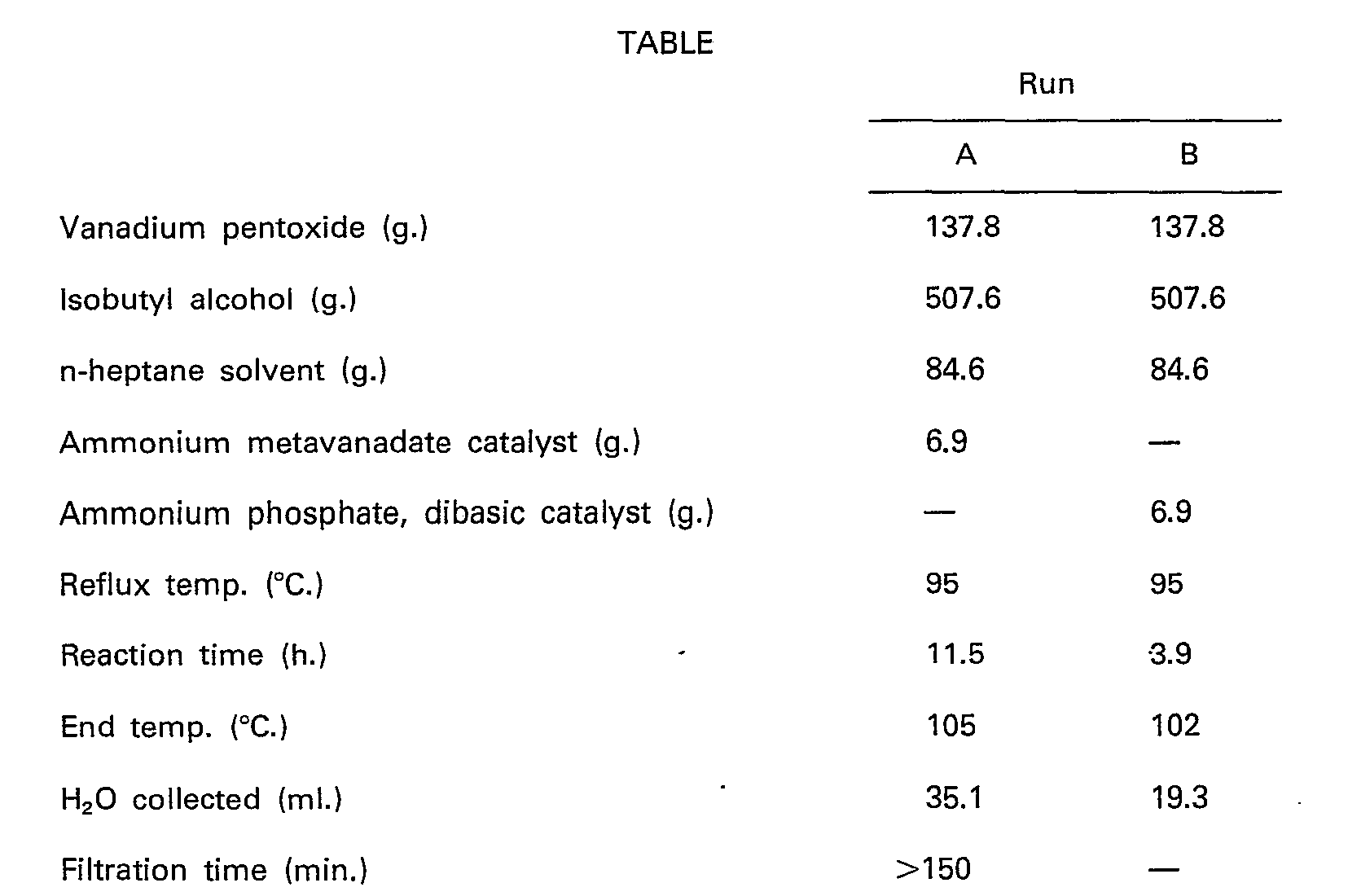
- The amount of water collected in Run A amounted to 78% of theoretical. Run B was turned off at a relatively early point when the reaction began to slow down. If completed, it was estimated that the yield would be about 5-10% above the yield obtained using no catalyst.
- This Example illustrates the catalytic effect for ammonium metavanadate (Run A) and ammonium carbonate (Run B) and illustrates (in Run C), for comparative reasons, that an acidic nitrogen catalyst, ammonium phosphate, monobasic [(NH4)H2PO4], does not function as a catalyst. The procedure of Example 1 was used.

- The procedure used in Example 1 was employed to test the effectiveness of a series of compounds as catalysts in accordance with the present invention. The Tables set forth below illustrate the results obtained.


- These Examples illustrate the present invention using the procedure described in Examples 7-14. In these runs, various reaction conditions and reagent combinations were changed.


- These Examples illustrate additional testing of compounds as catalysts under a variety of reaction conditions in accordance with the present invention.

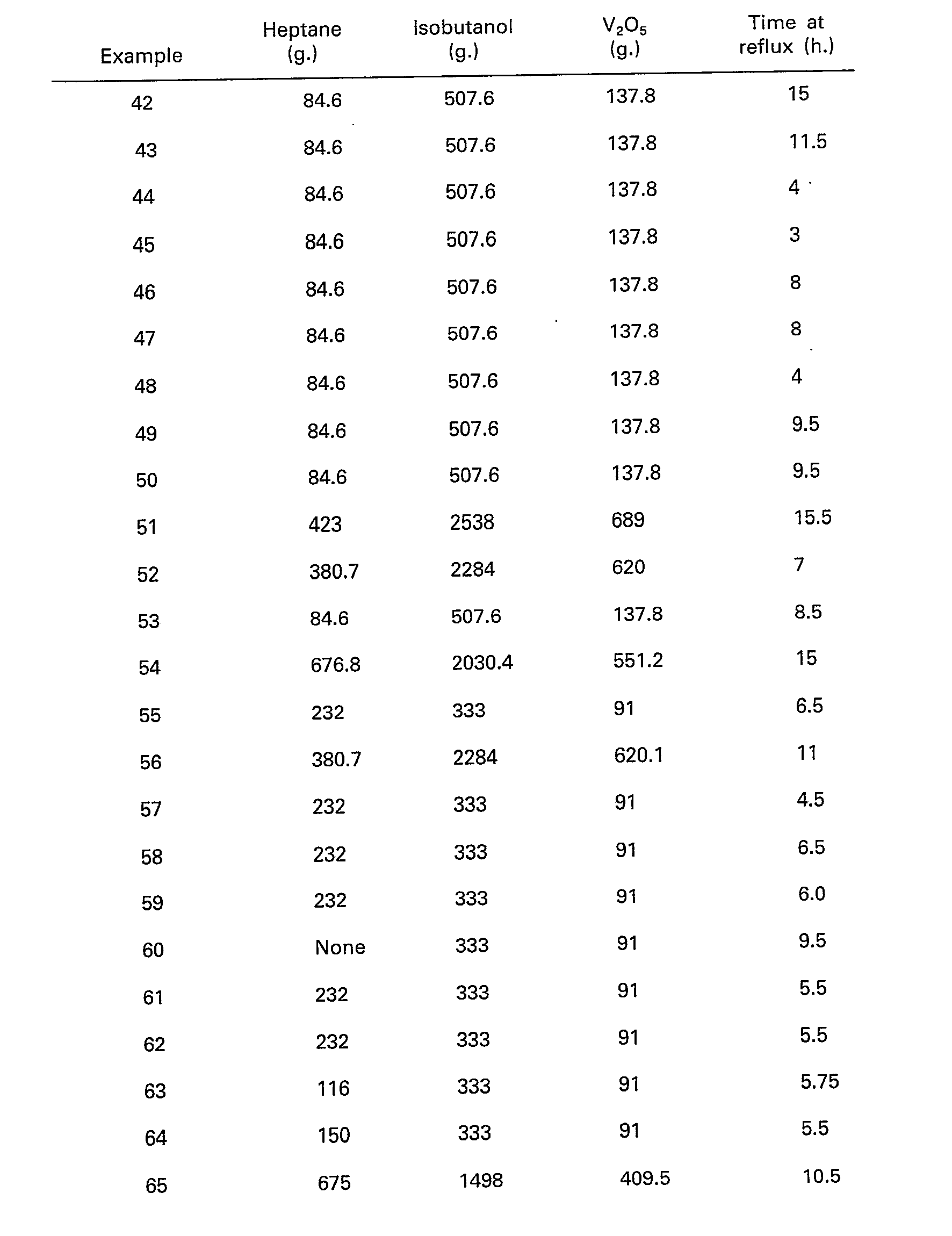

- The following Table illustrates a further series of reactions using the present invention. Example 66 utilized a Vigreaux Column (30.48 cm. length; 2.54 cm. diameter). All other runs used a vacuum jacketed, Goodloe packed column (30.48 cm. length; 2.54 cm. diameter). The catalyst in Example 66 was 5 g. ammonium carbonate and 4.5 g. urea. In all other runs it was 20.25 g. ammonium carbonate and 22.5 g. urea. Examples 67-72 were on a five liter scale.


- This Example illustrates a particularly preferred embodiment of the present invention utilizing a 378.53 liter reactor equipped with a glass-lined distillation column having a 15.24 cm. inner diameter and a height of 1.83 meters, which had been packed with a high performance stainless steel mesh.
- The reactor was first charged with the following:

- The resulting mixture was heated to reflux so that the heptane entrained the water of reaction as it forms. Vapor comprising isobutanol, heptane and water was condensed, and the water was further phase separated in a trap. The isobutanol and heptane were returned to the reaction vessel.
- The reaction was allowed to continue for 32 hours until the rate of water removal fell to about 0.045 to 0.068 kg. per hour.
- The temperatures (in °C.) that were recorded during the reaction were as follows:

- The reactor's contents were allowed to cool to 75°C., and they were then filtered over a period of about 2 hours through a pressure filter. The unreacted vanadium pentoxide was washed with 4.54-6.8 kg. of heptane.
- The filtrate was returned to the reactor, and the solvents were stripped at atmospheric pressure first, then at pressures down to 2700 Pa vacuum. The resulting product was cooled to about 20-25°C. so that all remaining catalyst crystallized. After filtration about 72.57 kg. of a clear, yellow triisobutyl vanadate liquid was obtained at a yield of about 84%. Approximately 1.81 kg of wet cake remained in the filter.
- The foregoing examples are merely illustrative of certain preferred embodiments of the present invention.
Claims (8)
Applications Claiming Priority (2)
| Application Number | Priority Date | Filing Date | Title |
|---|---|---|---|
| US06/287,390 US4412956A (en) | 1981-07-27 | 1981-07-27 | Process for forming alkyl vanadates using a catalyst |
| US287390 | 1999-04-06 |
Publications (3)
| Publication Number | Publication Date |
|---|---|
| EP0071225A2 EP0071225A2 (en) | 1983-02-09 |
| EP0071225A3 EP0071225A3 (en) | 1984-04-11 |
| EP0071225B1 true EP0071225B1 (en) | 1986-10-08 |
Family
ID=23102679
Family Applications (1)
| Application Number | Title | Priority Date | Filing Date |
|---|---|---|---|
| EP82106731A Expired EP0071225B1 (en) | 1981-07-27 | 1982-07-26 | Process for forming alkyl vanadates using a catalyst |
Country Status (4)
| Country | Link |
|---|---|
| US (1) | US4412956A (en) |
| EP (1) | EP0071225B1 (en) |
| JP (1) | JPS5829791A (en) |
| DE (1) | DE3273627D1 (en) |
Families Citing this family (2)
| Publication number | Priority date | Publication date | Assignee | Title |
|---|---|---|---|---|
| US4667045A (en) * | 1984-03-28 | 1987-05-19 | Union Carbide Corporation | Organosalts of metalate anions and process for the production of alkylene glycols therewith |
| US4585883A (en) * | 1984-03-28 | 1986-04-29 | Union Carbide Corporation | Preparation of organometalates |
Family Cites Families (7)
| Publication number | Priority date | Publication date | Assignee | Title |
|---|---|---|---|---|
| FR1271641A (en) * | 1960-08-02 | 1961-09-15 | Stable esters of orthovanadic acid, their preparation process, application to the improvement of hydrocarbons and hydrocarbons in accordance with those obtained | |
| DE1816386C3 (en) * | 1968-12-21 | 1978-08-31 | Dynamit Nobel Ag, 5210 Troisdorf | Process for the production of Vanadiumoxitri alcoholates |
| CH536323A (en) * | 1970-08-11 | 1973-04-30 | Ciba Geigy Ag | Process for the production of tertiary butylates |
| US3657295A (en) * | 1970-11-23 | 1972-04-18 | Texaco Inc | Preparation of tri-n-butyl vanadate |
| DE2343056A1 (en) * | 1973-08-25 | 1975-03-06 | Dynamit Nobel Ag | PROCESS FOR THE PRODUCTION OF VANADYL ALCOHOLATES |
| US4014911A (en) * | 1975-10-16 | 1977-03-29 | Stauffer Chemical Company | Method for preparing ethyl vanadate |
| US4014912A (en) * | 1975-10-16 | 1977-03-29 | Stauffer Chemical Company | Method for preparing organic vanadates |
-
1981
- 1981-07-27 US US06/287,390 patent/US4412956A/en not_active Expired - Lifetime
-
1982
- 1982-07-26 EP EP82106731A patent/EP0071225B1/en not_active Expired
- 1982-07-26 DE DE8282106731T patent/DE3273627D1/en not_active Expired
- 1982-07-27 JP JP57129730A patent/JPS5829791A/en active Pending
Also Published As
| Publication number | Publication date |
|---|---|
| JPS5829791A (en) | 1983-02-22 |
| US4412956A (en) | 1983-11-01 |
| EP0071225A2 (en) | 1983-02-09 |
| EP0071225A3 (en) | 1984-04-11 |
| DE3273627D1 (en) | 1986-11-13 |
Similar Documents
| Publication | Publication Date | Title |
|---|---|---|
| EP0786444B1 (en) | Process for producing acetaldehyde dimethylacetal | |
| JPH0150220B2 (en) | ||
| NL8302020A (en) | PROCESS FOR THE PREPARATION OF ETHYLENE GLYCOL. | |
| US4092353A (en) | Process for the purification of benzoic acid | |
| US4360453A (en) | Preparation of vanadium phosphorus catalysts | |
| EP0017183B1 (en) | Hydroformylation medium, process of production thereof and process for producing aldehydes using the hydroformylation medium | |
| EP0897905B1 (en) | Process for producing maleic anhydride | |
| EP0098039A2 (en) | Preparation of improved mixed vanadium phosphorus oxide catalysts and their use in oxidation processes | |
| US3897503A (en) | Glyoxal hemiacetals, their preparation and use | |
| EP0071225A2 (en) | Process for forming alkyl vanadates using a catalyst | |
| JPH053455B2 (en) | ||
| US3360541A (en) | Manufacture of adiponitrile | |
| US3217027A (en) | Purification of cyanoaliphatic acids | |
| US4855516A (en) | Method of manufacturing 2-propyn-1-ol | |
| US6593501B2 (en) | Process for the preparation of 2,6-xylenol | |
| US1738659A (en) | Aldehyde manufacture | |
| US4351775A (en) | Method for preparation of alkyl vanadates | |
| US3131209A (en) | Preparation of isophthalonitriles and terephthalonitriles | |
| US4465636A (en) | Process for the manufacture of alkyl vanadates | |
| US4400522A (en) | Preparation of maleic anhydride | |
| US3061608A (en) | Preparation of hexamethylenetetramine | |
| JPS5912102B2 (en) | Method for producing acrylic ester | |
| JPH0788353B2 (en) | Method for producing aziridine compound | |
| JPH0514707B2 (en) | ||
| EP1611087B1 (en) | Process for recovery of pure acrylonitrile |
Legal Events
| Date | Code | Title | Description |
|---|---|---|---|
| PUAI | Public reference made under article 153(3) epc to a published international application that has entered the european phase |
Free format text: ORIGINAL CODE: 0009012 |
|
| AK | Designated contracting states |
Designated state(s): BE DE FR |
|
| PUAL | Search report despatched |
Free format text: ORIGINAL CODE: 0009013 |
|
| AK | Designated contracting states |
Designated state(s): BE DE FR |
|
| 17P | Request for examination filed |
Effective date: 19840810 |
|
| GRAA | (expected) grant |
Free format text: ORIGINAL CODE: 0009210 |
|
| AK | Designated contracting states |
Kind code of ref document: B1 Designated state(s): BE DE FR |
|
| REF | Corresponds to: |
Ref document number: 3273627 Country of ref document: DE Date of ref document: 19861113 |
|
| ET | Fr: translation filed | ||
| PLBE | No opposition filed within time limit |
Free format text: ORIGINAL CODE: 0009261 |
|
| STAA | Information on the status of an ep patent application or granted ep patent |
Free format text: STATUS: NO OPPOSITION FILED WITHIN TIME LIMIT |
|
| 26N | No opposition filed | ||
| PG25 | Lapsed in a contracting state [announced via postgrant information from national office to epo] |
Ref country code: BE Effective date: 19880731 |
|
| BERE | Be: lapsed |
Owner name: STAUFFER CHEMICAL CY Effective date: 19880731 |
|
| PGFP | Annual fee paid to national office [announced via postgrant information from national office to epo] |
Ref country code: FR Payment date: 19980528 Year of fee payment: 17 |
|
| PGFP | Annual fee paid to national office [announced via postgrant information from national office to epo] |
Ref country code: DE Payment date: 19980612 Year of fee payment: 17 |
|
| PG25 | Lapsed in a contracting state [announced via postgrant information from national office to epo] |
Ref country code: FR Free format text: THE PATENT HAS BEEN ANNULLED BY A DECISION OF A NATIONAL AUTHORITY Effective date: 19990731 |
|
| PG25 | Lapsed in a contracting state [announced via postgrant information from national office to epo] |
Ref country code: DE Free format text: LAPSE BECAUSE OF NON-PAYMENT OF DUE FEES Effective date: 20000503 |
|
| REG | Reference to a national code |
Ref country code: FR Ref legal event code: ST |