EP0069313B1 - Reduction processor for executing programs stored as treelike graphs employing variable-free applicative language codes - Google Patents
Reduction processor for executing programs stored as treelike graphs employing variable-free applicative language codes Download PDFInfo
- Publication number
- EP0069313B1 EP0069313B1 EP82105702A EP82105702A EP0069313B1 EP 0069313 B1 EP0069313 B1 EP 0069313B1 EP 82105702 A EP82105702 A EP 82105702A EP 82105702 A EP82105702 A EP 82105702A EP 0069313 B1 EP0069313 B1 EP 0069313B1
- Authority
- EP
- European Patent Office
- Prior art keywords
- nodes
- node
- reduction
- graph
- memory
- Prior art date
- Legal status (The legal status is an assumption and is not a legal conclusion. Google has not performed a legal analysis and makes no representation as to the accuracy of the status listed.)
- Expired
Links
Images

Classifications
-
- G—PHYSICS
- G06—COMPUTING OR CALCULATING; COUNTING
- G06F—ELECTRIC DIGITAL DATA PROCESSING
- G06F9/00—Arrangements for program control, e.g. control units
- G06F9/06—Arrangements for program control, e.g. control units using stored programs, i.e. using an internal store of processing equipment to receive or retain programs
- G06F9/44—Arrangements for executing specific programs
- G06F9/448—Execution paradigms, e.g. implementations of programming paradigms
- G06F9/4494—Execution paradigms, e.g. implementations of programming paradigms data driven
Definitions
- This invention relates to a digital processor which is adapted to execute programs employing abstracted applicative language code, and more particularly to such a processor which reduces higher order functions by progressive substitutions of equivalent expressions.
- Pure applicative program languages such as pure LISP differ from the more conventional imperative languages, such as FORTRAN and COBOL, in that the latter specify a sequence of steps to be carried out in a particular order while the former do not.
- Applicative languages generally are based on the lambda calculus of A. Church and are very concise. However, they do not provide for storage and are not history sensitive. Thus, practical implementations of such languages as LISP take on many iterative features and the programmer is still responsible for control-flow sequencing as well as the basic algorithm design (cf., J. McCarthy et al, LISP 1.5 Programmers' Manual, M.I.T. Press, 1962).
- SASL Saint Andrews Static Language
- This language can be implemented by employing a number of "combinators” and also primitive functions to transform SASL source code into a notation in which bound variables do not occur to produce a variable-free object code, (D. A. Turner, "A New Implementation Technique for Applicative Languages", Software-Practice and Experience, Vol. 9, pp. 31-49,1979).
- This language is particularly advantageous for handling higher order functions, including nested functions and non-strict functions in which an answer may be returned even though one of its arguments is undefined.
- two-cell nodes may be stored in memory as a treelike graph where some cells specify either a function such as a combinator or a primitive function and other cells specify a value or pointers or addresses to other cells.
- a node may contain both a function and a value.
- Such programs may be said to be demand- driven in that only those functions are evaluated as are necessary and the language is completely concurrent in that the respective functions can be evaluated independently of one another subject to the constraint that, for a given graph, some functions may terminate and others may not.
- Such programs may be executed by a network of reduction processors operating either simultaneously or independently of one another. In this manner the programmer is relieved of both storage management responsibilities as well as the responsibilities for the control-flow management.
- the SKIM processor of the above document was built to explore pure functional programming, combinators as a machine language and the use of hardware to provide direct support for a high level language. Its architecture is briefly outlined, the design is described at micro instruction level, fairly rough results are provided and certain conclusions are drawn.
- An object of the present invention is to provide an improved reduction processing system.
- the S combinator when applied to two functions, f and g, of single argumentx, results in the function f(x) being applied to g(x); the K combinator, when applied to one argument as a function of a second argument, results in the first argument.
- the I combinator is an identity combinator.
- other combinators are postulated such as B and C combinators which are combinations of the S and K combinators.
- a P combinator is a pairing operation and a U combinator is an "uncurry" function where a curry operation is an abstraction operation.
- Other combinators and their definitions are to be found in the above-referenced Turner publication.
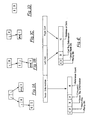
- FIG. 1A shows a plurality of such cells in which the above compiled expression code is stored where the arrows represent pointers or addresses to related cells.
- Figure 1B illustrates the storage cell arrangement after the first transformation given above.
- Figure 1C illustrates the cell arrangement after the second transformation specified above.
- Figure 1D illustrates the storage cell arrangement after the third transformation with the final result.
- incoming expressions are transformed into combinations which are stored as binary trees with nodes representing functional applications.
- the reduction processor of the present invention then proceeds to evaluate the expression through progressive transformations until a result is achieved. Furthermore, as was indicated above, it can be theoretically shown that different expressions can be evaluated independently or concurrently of one another so as to accommodate a network of such processors each of which may be simultaneously evaluating or executing different portions of a program or different programs.
- the function of the reduction processor of the present invention is to reduce the S-K graphs of which Figures 1A,..., D are but an example. These graphs are so referred to because of the principal substitution rules that were described above.
- This reduction results in a series of output values or functions.
- the result of a sequence of such reductions is independent of the order in which the reductions are carried out, subject to the constraint that on a given graph some reduction orders may terminate whereas others may not.
- the reductions normally can be performed in any order and readily lend themselves to a concurrent network of such reduction processors, one or more of which may be operating on the same graph, in which case the reduction scheme is referred to as a multi-thread reduction scheme.
- the present invention uses a single-thread reduction scheme known as normal-order reduction, in which the leftmost instance of a reduction rule, present at each step, is evaluated.
- the reduction processor traverses left subtrees of the graph until it encounters an operator.
- the appropriate reduction rule is applied and the left subtree of the transformed graph is again traversed.
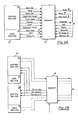
- FIG. 2A One embodiment of the present invention is illustrated in Figure 2A wherein reduction processor 10 communicates with memory 11 which in turn communicates with the outside world by way of interface 13.
- Processor 10 consists of a control section 14 and data section 15 as will be more thoroughly described below.
- the reduction processor of the present invention When the reduction processor of the present invention is not employed in a network of such processors, then it is desirable to employ two such processors as indicated in Figure 2B, both of which communicate with memory 12 that in turn communicates with the outside world by way of interface 13.
- the function of the two processor embodiment is to allow for the monitoring of the outputs of both processors and to indicate an error if they disagree.
- the function of the memory associated with each processor is to store the nodes of the graph that are to be reduced by the processor.
- the processor removes nodes from memory and performs various operations with them.
- the processor can also create new nodes in memory and delete unused ones as will be more thoroughly described below.
- the S-K processor's node memory contains three categories of nodes. There are the nodes which compose the graph being reduced, the nodes on the "free list" (a linked list of unused nodes), and there are discarded nodes. During reduction, nodes on the free list are incorporated into the graph as needed. Other nodes and groups of nodes are detached from the graph, becoming discarded nodes. "Garbage collection” is the process of finding these discarded nodes and returning them to the free list.
- mark-scan is implemented by traversing the graph and marking all reachable nodes. When the mark phase is completed, the node memory is scanned (all nodes in the memory are read). Unmarked nodes found during the scan are returned to the free list.
- the disadvantages of mark-scan are that the entire graph must be marked and the entire node memory must be scanned. This takes a great deal of time, causing pause in the operation of the processor.
- the reference count algorithm works by maintaining counters in each node in the graph of the number of other nodes pointing to that node. Every time a reference to a node is removed, its reference count is decremented. When the reference count is equal to zero, the node is garbage and is added to the free list.
- the reference count garbage collector can collect each node of garbage as it is generated, thus avoiding the pauses of the mark-scan collector. Furthermore, reference counting can do this with very little overhead.
- the disadvantage of the reference count scheme is that a collection of nodes may point to each other (e.g., A points to B which points to A) but are not pointed to from outside the cycle.
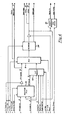
- control section of an embodiment of the reduction processor of the present invention will now be described in relation to Figure 3.
- This control section responds to the various function and primitive operators to generate the control signals required to activate the various units of the processor, which control signals are stored in a microcode memory.
- This microcode serves to interpret the SASL language for which the present invention is adapted.
- microcode memory 20 which stores the microcode that has been generated for the interpretation of the compiled code which makes up the various nodes of the S-K graph stored in memory 12 of Figures 2A and B.
- Microcode memory 20 may be formed of a plurality of ROMs, PROMs, or EPROMs. Such a microcode memory would normally contain 2K words of 40 bits each.
- Microcode memory 20 is addressed by address multiplexer 21 which selects the microcode memory address between three possible address sources.
- One such source is program counter 27 which allows for sequential execution of microcode memory words.
- a second source is the top of stack 28 which is used for returning from subroutines and the third source is the output of the branch address multiplexer 22.
- Branch address multiplexer 22 selects between two possible branch addresses.
- the first is a branch address literal coming from control register 26 as will be more thoroughly described below.
- the microcode memory address in one embodiment of the present invention is 11 bits in width.
- the second possible branch address is a concatenation of the output of literal register 23 (in the least significant 6 bits) and the branch address literal from control register 26 (in the most significant 5 bits). This permits a case on the value from the data section as will be described below.
- Condition module 24 stores and selects the various data section conditions and is implemented with programmable array logic (PAL) and consists of a condition register and a condition multiplexer (not shown).
- the condition register is divided into two sections, one of which simply stores the data section conditions on each system clock.
- the second section controls the carry flip-flop which can be set, reset, updated or left unchanged.
- the CARRY IN signal from this section goes to the arithmetic logic unit of the data section as will be more thoroughly described below.
- the condition multiplexer selects a condition from the stored version of the various data section conditions stored in the condition register.
- Control section Other units of the control section include literal register 23 which stores 6-bit literals coming from the data section as well as stack 28 which is used to store the return address for subroutines.
- Stack 28 is five words deep and therefore can support five levels of subroutine nesting.
- Program counter 27 is a register which is loaded to each clock time with the output of address multiplexer 21 incremented by one. On a subroutine call the output of this register is pushed onto the top of stack 28.
- Control decoder 25 provides the control signals for the stack 28, branch address multiplexer 22, and address multiplexer 21. These signals are created by decoding the CONTROL lines while taking the state of the select condition into account.
- Error detect module 30 is provided to force the processor into a reset state if there is a parity error or if, in the two-processor mode, the two processors disagree.
- Control register 26 is a register which is loaded with the output of microcode memory 20 on each system clock and contains all the contol signals for both the data and control sections. The control register fields are discussed below.
- microoperators are really those fields which are read out of control register 26 and will now be generally described. They include register file addresses for addressing one of the other sides of a word location in the register file 32 of the data section; write enable signals which indicate which portions of word locations in the registers file should be written into; the selection of control section literals or the output of one side of the register file as was described above in regard to the use of literals; arithmetic logic unit (ALU) controls which are described below; rotator control signals; memory selection for memory addressing and node selection; condition module controls; data literal selections; control literal selections; and branch address literal selections.
- register file addresses for addressing one of the other sides of a word location in the register file 32 of the data section
- write enable signals which indicate which portions of word locations in the registers file should be written into
- the selection of control section literals or the output of one side of the register file as was described above in regard to the use of literals
- arithmetic logic unit (ALU) controls which are described below
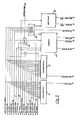
- This data section transfers nodes to and from memory and also stores and performs various operations as required on those nodes.
- the principal instrument for these operations is ALU 31 which performs all standard arithmetic and Boolean logic operations.
- Register file 32 stores 16 words of 16 bits each. The most significant bit of the word has no logical use. However, it must be considered when doing some operations with ALU 31.
- the register file has two outputs which can be separately addressed. Information to be stored in the register file uses one of these addresses. Of the two output ports of register file 32, one is always used as a main memory address. The respective halves of the register file word can be written independently or they can be written together using appropriate write enable signals.
- Rotator 34 has the ability to rotate an output word from the ALU one bit in either direction. This rotation is done only on the least significant 15 bits of the word as the most signicant bit is ignored. Rotator 34 also indicates if its output is equal to zero. Actually there are two zero indications, one for each half of the output word. Parity generate and check module 35 generates parity for the data being written into main memory and also checks parity for data being read from main memory.
- this feature can be implemented by representing numbers as lists of digits. In this manner arbitrary precision may be obtained.
- the algorithms required for arithmetic operations on lists are implemented in the firmware or microcode of the processor. When arithmetic is performed in this way, the processor requires only primitive hardware arithmetic capabilities.
- This processor is designed to support both list arithmetic and conventional scalar arithmetic. List arithmetic will be carried out using lists of 8-bit Unsigned binary integers. Scalar arithmetic will use 8-bit Two's complement integer.
- Figures 2A and 2B illustrate the memory unit of embodiments of the present invention to be accessed by both the processor of the present invention and external sources.
- the actual memory interface is illustrated in Figure 5.
- Memory 40 is accessible to receive and supply data on the bidirectional data line in response to addresses provided on the memory address line, which addresses are supplied from the register file 32 of the processor of Figure 4.
- data may be transferred to and from the processor and interface module 42 for transmission to devices external to the processor and memory.
- the respective transfer modes of memory 40 and interface 42 are determined by control decode unit 43 in response to four control signals received from the control section of the processor.
- the memory interface of Figure 5 includes comparators 41 to compare the output of two different processors when the two-processor configuration of Figure 2B is adopted.
- each node as stored in main memory is illustrated in Figure 6.
- the respective cell fields include an 11-bit field for address or data which may be either an 11-bit address or eight bits of data preceded by a 3-bit type field.
- the data types specified by this latter 3- bit field are Unsigned binary integer, Two's complement binary integer, Operator, EBCDIC character, Boolean, Error, or Special.
- the 3-bit cell tag information field specifies whether the cell is an atom or contains a pointer forward in the graph or pointers either back left or back right up the graph.
- the cells include a one-bit graph node bit which indicates whether the cell is contained in a functional application node or if the node information field must be consulted to find the node type.
- the node information field includes an 8-bit field which is used for reference counting; a 3-bit field which specifies whether the node is a functional application node, a list node, a function node (i.e., partially reduced graph), or an arithmetic list node.
- a 2-bit mark field which indicates whether either the right cell has been marked, the left cell has been marked, both cells have been marked, or neither cell has been marked.
- a parity bit is also provided.
- the operator codes that may be found in either of the left or right cells of the node format include all the operators representing the SASL transformations indicated above plus certain other such transformations as well as arithmetic and Boolean operations such as greater than or equal, less than or equal, AND, OR, negative, and NOT or negate.
- Macros are a number of microinstructions which are inserted into the object code at assembly time. Macros are chosen to perform operations which are convenient for performing S-K reduction, but for which no single microinstruction exists. These macroinstructions include MOVE, STORE, and GET instructions which specify either the moving of contents from one data section register to another, storing the contents of one data section register in a node cell, or calling the contents of a node cell of a memory address contained in one data section register to be stored in another data section register.
- these macroinstructions specify a Branch, Branch on Condition, Branch to a Reduction Routine for One of the Reduction Operators, Branch to a Subroutine in the Control Memory and to Store the Return Address on Top of the Stack, Branch to the Control Memory Address on the Top of the Stack for Return, Addition, Subtraction, and various Boolean operations.
- a reduction processor has been disclosed above for the evaluation of one or more functions which are stored in memory in the form of a series of nodes of a treelike graph where the nodes implement a variable-free applicative language.
- the respective function operators are reduced through a progressive series of transformations or substitutions until a result is obtained.
- the processor transfers nodes to and from memory and performs various operations as required on those nodes.
- the processor can also create new nodes in memory and delete unused ones. Difference in arithmetic precision is accommodated by implementing only variable-length integer arithmetic by representing numbers as lists of digits and the processor is designed to support both list arithmetic and conventional scalar arithmetic.
Landscapes
- Engineering & Computer Science (AREA)
- Software Systems (AREA)
- Theoretical Computer Science (AREA)
- Physics & Mathematics (AREA)
- General Engineering & Computer Science (AREA)
- General Physics & Mathematics (AREA)
- Devices For Executing Special Programs (AREA)
Applications Claiming Priority (2)
| Application Number | Priority Date | Filing Date | Title |
|---|---|---|---|
| US281064 | 1981-07-07 | ||
| US06/281,064 US4447875A (en) | 1981-07-07 | 1981-07-07 | Reduction processor for executing programs stored as treelike graphs employing variable-free applicative language codes |
Publications (3)
| Publication Number | Publication Date |
|---|---|
| EP0069313A2 EP0069313A2 (en) | 1983-01-12 |
| EP0069313A3 EP0069313A3 (en) | 1983-03-30 |
| EP0069313B1 true EP0069313B1 (en) | 1987-08-12 |
Family
ID=23075792
Family Applications (1)
| Application Number | Title | Priority Date | Filing Date |
|---|---|---|---|
| EP82105702A Expired EP0069313B1 (en) | 1981-07-07 | 1982-06-28 | Reduction processor for executing programs stored as treelike graphs employing variable-free applicative language codes |
Country Status (4)
| Country | Link |
|---|---|
| US (1) | US4447875A (enExample) |
| EP (1) | EP0069313B1 (enExample) |
| JP (1) | JPS588358A (enExample) |
| DE (1) | DE3276970D1 (enExample) |
Families Citing this family (26)
| Publication number | Priority date | Publication date | Assignee | Title |
|---|---|---|---|---|
| US4887235A (en) * | 1982-12-17 | 1989-12-12 | Symbolics, Inc. | Symbolic language data processing system |
| JPS6074029A (ja) * | 1983-09-30 | 1985-04-26 | Fujitsu Ltd | Lisp言語プログラム学習援助装置 |
| US4644464A (en) * | 1984-06-05 | 1987-02-17 | Burroughs Corporation | Graph manager for a reduction processor evaluating programs stored as binary directed graphs employing variable-free applicative language codes |
| US4615003A (en) * | 1984-06-05 | 1986-09-30 | Burroughs Corporation | Condition concentrator and control store for a reduction processor evaluating programs stored as binary directed graphs employing variable-free applicative language codes |
| US4654780A (en) * | 1984-06-05 | 1987-03-31 | Burroughs Corporation | Parallel register transfer mechanism for a reduction processor evaluating programs stored as binary directed graphs employing variable-free applicative language codes |
| US4734848A (en) * | 1984-07-17 | 1988-03-29 | Hitachi, Ltd. | Combination reduction processing method and apparatus |
| US4695949A (en) * | 1984-07-19 | 1987-09-22 | Texas Instruments Incorporated | Method for efficient support for reference counting |
| GB8529890D0 (en) * | 1985-12-04 | 1986-01-15 | Watson P | Garbage collection in computer system |
| US5047918A (en) * | 1985-12-31 | 1991-09-10 | Tektronix, Inc. | File management system |
| US5021947A (en) * | 1986-03-31 | 1991-06-04 | Hughes Aircraft Company | Data-flow multiprocessor architecture with three dimensional multistage interconnection network for efficient signal and data processing |
| US4912629A (en) * | 1986-06-26 | 1990-03-27 | The United States Of America As Represented By The Administrator Of The National Aeronautics And Space Administration | Real-time garbage collection for list processing using restructured cells for increased reference counter size |
| US4814978A (en) * | 1986-07-15 | 1989-03-21 | Dataflow Computer Corporation | Dataflow processing element, multiprocessor, and processes |
| US5127104A (en) * | 1986-12-29 | 1992-06-30 | Dataflow Computer Corporation | Method and product involving translation and execution of programs by automatic partitioning and data structure allocation |
| US5053952A (en) * | 1987-06-05 | 1991-10-01 | Wisc Technologies, Inc. | Stack-memory-based writable instruction set computer having a single data bus |
| US5121495A (en) * | 1988-02-02 | 1992-06-09 | Bell Communications Research, Inc. | Methods and apparatus for information storage and retrieval utilizing hashing techniques |
| US4996663A (en) * | 1988-02-02 | 1991-02-26 | Bell Communications Research, Inc. | Methods and apparatus for decontaminating hash tables |
| US5093916A (en) * | 1988-05-20 | 1992-03-03 | International Business Machines Corporation | System for inserting constructs into compiled code, defining scoping of common blocks and dynamically binding common blocks to tasks |
| US5099450A (en) * | 1988-09-22 | 1992-03-24 | Syracuse University | Computer for reducing lambda calculus expressions employing variable containing applicative language code |
| JP2534360B2 (ja) * | 1988-09-26 | 1996-09-11 | インターナシヨナル・ビジネス・マシーンズ・コーポレーシヨン | 接続方法、ノ―ド接続方法、デ―タ処理方法、及び木内にノ―ドを挿入する方法 |
| US5175843A (en) * | 1989-10-30 | 1992-12-29 | General Electric Company | Computer-aided design method for restructuring computational networks to minimize shimming delays |
| JPH0391117U (enExample) * | 1989-12-25 | 1991-09-17 | ||
| SE9002558D0 (sv) * | 1990-08-02 | 1990-08-02 | Carlstedt Elektronik Ab | Processor |
| US5249274A (en) * | 1990-10-24 | 1993-09-28 | Vanderbilt University | Simultaneous data-driven and demand-driven computational model for dynamically configured systems |
| IE920032A1 (en) * | 1991-01-11 | 1992-07-15 | Marconi Gec Ltd | Parallel processing apparatus |
| US6480865B1 (en) | 1998-10-05 | 2002-11-12 | International Business Machines Corporation | Facility for adding dynamism to an extensible markup language |
| DE102024204829A1 (de) | 2024-05-24 | 2025-11-27 | Robert Bosch Gesellschaft mit beschränkter Haftung | Vorrichtung und computerimplementiertes Verfahren zur Bestimmung eines Speicherplans zur Ausführung von Operationen |
Family Cites Families (5)
| Publication number | Priority date | Publication date | Assignee | Title |
|---|---|---|---|---|
| US3343135A (en) * | 1964-08-13 | 1967-09-19 | Ibm | Compiling circuitry for a highly-parallel computing system |
| US3646523A (en) * | 1969-09-24 | 1972-02-29 | Ibm | Computer |
| US4149240A (en) * | 1974-03-29 | 1979-04-10 | Massachusetts Institute Of Technology | Data processing apparatus for highly parallel execution of data structure operations |
| GB1540299A (en) * | 1975-02-15 | 1979-02-07 | Mathematik Datenverarbeitung G | Computer employing reduction language |
| GB1548401A (en) * | 1975-10-08 | 1979-07-11 | Plessey Co Ltd | Data processing memory space allocation and deallocation arrangements |
-
1981
- 1981-07-07 US US06/281,064 patent/US4447875A/en not_active Expired - Lifetime
-
1982
- 1982-06-11 JP JP57101267A patent/JPS588358A/ja active Granted
- 1982-06-28 DE DE8282105702T patent/DE3276970D1/de not_active Expired
- 1982-06-28 EP EP82105702A patent/EP0069313B1/en not_active Expired
Non-Patent Citations (2)
| Title |
|---|
| Proceedings of the International Symposium on Functional Programming Languages and Computer Architecture; June 1981; Göteborg, Sweden; pages 32-62; Darlington et al.: "A Multiprocessor Reduction Machine for Parallel Evaluation of Applicative Languages" * |
| Proceedings of the LISP-80 Conference, August 1980; Stanford, California, USA; pages 128-135, Clarke et al.: "SKIM - The S, K, I Reduction Machine" * |
Also Published As
| Publication number | Publication date |
|---|---|
| EP0069313A2 (en) | 1983-01-12 |
| JPS588358A (ja) | 1983-01-18 |
| DE3276970D1 (en) | 1987-09-17 |
| US4447875A (en) | 1984-05-08 |
| EP0069313A3 (en) | 1983-03-30 |
| JPH0253810B2 (enExample) | 1990-11-19 |
Similar Documents
| Publication | Publication Date | Title |
|---|---|---|
| EP0069313B1 (en) | Reduction processor for executing programs stored as treelike graphs employing variable-free applicative language codes | |
| US4502118A (en) | Concurrent network of reduction processors for executing programs stored as treelike graphs employing variable-free applicative language codes | |
| Grundgeiger | Programming Visual Basic. NET | |
| JP2001166949A (ja) | シンボリック実行を用いてソースコードをコンパイルするための方法及び装置 | |
| US5274820A (en) | Method and system for eliminating operation codes from intermediate prolog instructions | |
| US4654780A (en) | Parallel register transfer mechanism for a reduction processor evaluating programs stored as binary directed graphs employing variable-free applicative language codes | |
| EP0069314B1 (en) | A concurrent network of reduction processors for executing programs stored as treelike graphs employing vaiable-free applicative language codes | |
| Bergeron et al. | Systems programming languages | |
| US4644464A (en) | Graph manager for a reduction processor evaluating programs stored as binary directed graphs employing variable-free applicative language codes | |
| US5099450A (en) | Computer for reducing lambda calculus expressions employing variable containing applicative language code | |
| Haddon et al. | Experience with the universal intermediate language janus | |
| CA1211221A (en) | Reduction processor for executing programs stored as treelike graphs employing variable-free applicative language codes | |
| EP0414651A1 (en) | Prolog interrupt processing | |
| US5386520A (en) | Prolog addressing | |
| Iliffe | Elements of BLM | |
| CA1210156A (en) | Concurrent network of reduction processors for executing programs stored as treelike graphs employing variable-free applicative language codes | |
| Crespi-Reghizzi et al. | PLZ-SYS PL/65 PL/M RPL/2 Mistral PLZ Special Feature A Survey of Microprocessor Languages | |
| Brooker | Influence of high-level languages on computer design | |
| EP0415895A1 (en) | Communication between prolog and an external process | |
| Melenk | Reduce symbolic mode primer | |
| McNeil et al. | PL/I program efficiency | |
| Sarcar | Fundamentals of. NET and C# | |
| Huggins et al. | The static and dynamic semantics of c: Preliminary version | |
| Streib et al. | Binary Trees | |
| EP0417054B1 (en) | Implicit prolog arguments |
Legal Events
| Date | Code | Title | Description |
|---|---|---|---|
| PUAI | Public reference made under article 153(3) epc to a published international application that has entered the european phase |
Free format text: ORIGINAL CODE: 0009012 |
|
| 17P | Request for examination filed |
Effective date: 19820715 |
|
| AK | Designated contracting states |
Designated state(s): BE DE FR GB IT NL |
|
| PUAL | Search report despatched |
Free format text: ORIGINAL CODE: 0009013 |
|
| AK | Designated contracting states |
Designated state(s): BE DE FR GB IT NL |
|
| RAP1 | Party data changed (applicant data changed or rights of an application transferred) |
Owner name: BURROUGHS CORPORATION (A DELAWARE CORPORATION) |
|
| GRAA | (expected) grant |
Free format text: ORIGINAL CODE: 0009210 |
|
| AK | Designated contracting states |
Kind code of ref document: B1 Designated state(s): BE DE FR GB IT NL |
|
| REF | Corresponds to: |
Ref document number: 3276970 Country of ref document: DE Date of ref document: 19870917 |
|
| ET | Fr: translation filed | ||
| ITF | It: translation for a ep patent filed | ||
| PLBE | No opposition filed within time limit |
Free format text: ORIGINAL CODE: 0009261 |
|
| STAA | Information on the status of an ep patent application or granted ep patent |
Free format text: STATUS: NO OPPOSITION FILED WITHIN TIME LIMIT |
|
| NLT1 | Nl: modifications of names registered in virtue of documents presented to the patent office pursuant to art. 16 a, paragraph 1 |
Owner name: UNISYS CORPORATION TE DETROIT, MICHIGAN, VER. ST. |
|
| 26N | No opposition filed | ||
| PGFP | Annual fee paid to national office [announced via postgrant information from national office to epo] |
Ref country code: BE Payment date: 19920708 Year of fee payment: 11 |
|
| ITTA | It: last paid annual fee | ||
| PG25 | Lapsed in a contracting state [announced via postgrant information from national office to epo] |
Ref country code: BE Effective date: 19930630 |
|
| BERE | Be: lapsed |
Owner name: BURROUGHS CORP. Effective date: 19930630 |
|
| PGFP | Annual fee paid to national office [announced via postgrant information from national office to epo] |
Ref country code: FR Payment date: 19940613 Year of fee payment: 13 |
|
| PGFP | Annual fee paid to national office [announced via postgrant information from national office to epo] |
Ref country code: NL Payment date: 19940630 Year of fee payment: 13 |
|
| PG25 | Lapsed in a contracting state [announced via postgrant information from national office to epo] |
Ref country code: NL Effective date: 19960101 |
|
| PG25 | Lapsed in a contracting state [announced via postgrant information from national office to epo] |
Ref country code: FR Effective date: 19960229 |
|
| NLV4 | Nl: lapsed or anulled due to non-payment of the annual fee |
Effective date: 19960101 |
|
| REG | Reference to a national code |
Ref country code: FR Ref legal event code: ST |
|
| PGFP | Annual fee paid to national office [announced via postgrant information from national office to epo] |
Ref country code: GB Payment date: 19960509 Year of fee payment: 15 |
|
| PGFP | Annual fee paid to national office [announced via postgrant information from national office to epo] |
Ref country code: DE Payment date: 19960625 Year of fee payment: 15 |
|
| PG25 | Lapsed in a contracting state [announced via postgrant information from national office to epo] |
Ref country code: GB Free format text: LAPSE BECAUSE OF NON-PAYMENT OF DUE FEES Effective date: 19970628 |
|
| GBPC | Gb: european patent ceased through non-payment of renewal fee |
Effective date: 19970628 |
|
| PG25 | Lapsed in a contracting state [announced via postgrant information from national office to epo] |
Ref country code: DE Free format text: LAPSE BECAUSE OF NON-PAYMENT OF DUE FEES Effective date: 19980303 |