EP0068898B1 - Method for producing low sulfur premium coke from high sulfur decant oils - Google Patents
Method for producing low sulfur premium coke from high sulfur decant oils Download PDFInfo
- Publication number
- EP0068898B1 EP0068898B1 EP82303429A EP82303429A EP0068898B1 EP 0068898 B1 EP0068898 B1 EP 0068898B1 EP 82303429 A EP82303429 A EP 82303429A EP 82303429 A EP82303429 A EP 82303429A EP 0068898 B1 EP0068898 B1 EP 0068898B1
- Authority
- EP
- European Patent Office
- Prior art keywords
- sulfur
- coke
- catalyst
- decant oil
- weight
- Prior art date
- Legal status (The legal status is an assumption and is not a legal conclusion. Google has not performed a legal analysis and makes no representation as to the accuracy of the status listed.)
- Expired
Links
- NINIDFKCEFEMDL-UHFFFAOYSA-N Sulfur Chemical compound [S] NINIDFKCEFEMDL-UHFFFAOYSA-N 0.000 title claims description 49
- 229910052717 sulfur Inorganic materials 0.000 title claims description 42
- 239000011593 sulfur Substances 0.000 title claims description 42
- 239000000571 coke Substances 0.000 title claims description 34
- 239000003921 oil Substances 0.000 title description 40
- 238000004519 manufacturing process Methods 0.000 title description 8
- 239000003054 catalyst Substances 0.000 claims description 36
- 238000004939 coking Methods 0.000 claims description 21
- 238000000034 method Methods 0.000 claims description 21
- UFHFLCQGNIYNRP-UHFFFAOYSA-N Hydrogen Chemical compound [H][H] UFHFLCQGNIYNRP-UHFFFAOYSA-N 0.000 claims description 20
- 229910052739 hydrogen Inorganic materials 0.000 claims description 20
- 239000001257 hydrogen Substances 0.000 claims description 20
- 230000003111 delayed effect Effects 0.000 claims description 17
- 239000011148 porous material Substances 0.000 claims description 12
- 238000004523 catalytic cracking Methods 0.000 claims description 4
- 239000003208 petroleum Substances 0.000 claims description 4
- 239000005864 Sulphur Substances 0.000 description 7
- VYPSYNLAJGMNEJ-UHFFFAOYSA-N Silicium dioxide Chemical compound O=[Si]=O VYPSYNLAJGMNEJ-UHFFFAOYSA-N 0.000 description 6
- UCKMPCXJQFINFW-UHFFFAOYSA-N Sulphide Chemical compound [S-2] UCKMPCXJQFINFW-UHFFFAOYSA-N 0.000 description 5
- 239000003112 inhibitor Substances 0.000 description 5
- 229910052751 metal Inorganic materials 0.000 description 5
- 239000002184 metal Substances 0.000 description 5
- 230000001007 puffing effect Effects 0.000 description 5
- 239000000203 mixture Substances 0.000 description 4
- 239000011331 needle coke Substances 0.000 description 4
- 239000010453 quartz Substances 0.000 description 4
- RWSOTUBLDIXVET-UHFFFAOYSA-N Dihydrogen sulfide Chemical compound S RWSOTUBLDIXVET-UHFFFAOYSA-N 0.000 description 3
- 229910000831 Steel Inorganic materials 0.000 description 3
- 229910000428 cobalt oxide Inorganic materials 0.000 description 3
- IVMYJDGYRUAWML-UHFFFAOYSA-N cobalt(ii) oxide Chemical compound [Co]=O IVMYJDGYRUAWML-UHFFFAOYSA-N 0.000 description 3
- 230000000694 effects Effects 0.000 description 3
- 229910000037 hydrogen sulfide Inorganic materials 0.000 description 3
- 238000005984 hydrogenation reaction Methods 0.000 description 3
- 229910000476 molybdenum oxide Inorganic materials 0.000 description 3
- 229910000480 nickel oxide Inorganic materials 0.000 description 3
- PQQKPALAQIIWST-UHFFFAOYSA-N oxomolybdenum Chemical compound [Mo]=O PQQKPALAQIIWST-UHFFFAOYSA-N 0.000 description 3
- 239000010959 steel Substances 0.000 description 3
- IJGRMHOSHXDMSA-UHFFFAOYSA-N Atomic nitrogen Chemical compound N#N IJGRMHOSHXDMSA-UHFFFAOYSA-N 0.000 description 2
- PXHVJJICTQNCMI-UHFFFAOYSA-N Nickel Chemical compound [Ni] PXHVJJICTQNCMI-UHFFFAOYSA-N 0.000 description 2
- 238000004517 catalytic hydrocracking Methods 0.000 description 2
- 238000006243 chemical reaction Methods 0.000 description 2
- 238000010960 commercial process Methods 0.000 description 2
- 230000007423 decrease Effects 0.000 description 2
- 238000006477 desulfuration reaction Methods 0.000 description 2
- 230000023556 desulfurization Effects 0.000 description 2
- 238000009826 distribution Methods 0.000 description 2
- 239000007789 gas Substances 0.000 description 2
- 239000007788 liquid Substances 0.000 description 2
- GNRSAWUEBMWBQH-UHFFFAOYSA-N oxonickel Chemical compound [Ni]=O GNRSAWUEBMWBQH-UHFFFAOYSA-N 0.000 description 2
- 229910001220 stainless steel Inorganic materials 0.000 description 2
- 239000010935 stainless steel Substances 0.000 description 2
- OKTJSMMVPCPJKN-UHFFFAOYSA-N Carbon Chemical compound [C] OKTJSMMVPCPJKN-UHFFFAOYSA-N 0.000 description 1
- ZOKXTWBITQBERF-UHFFFAOYSA-N Molybdenum Chemical compound [Mo] ZOKXTWBITQBERF-UHFFFAOYSA-N 0.000 description 1
- PNEYBMLMFCGWSK-UHFFFAOYSA-N aluminium oxide Inorganic materials [O-2].[O-2].[O-2].[Al+3].[Al+3] PNEYBMLMFCGWSK-UHFFFAOYSA-N 0.000 description 1
- 229910052799 carbon Inorganic materials 0.000 description 1
- 238000003763 carbonization Methods 0.000 description 1
- 230000003197 catalytic effect Effects 0.000 description 1
- INPLXZPZQSLHBR-UHFFFAOYSA-N cobalt(2+);sulfide Chemical compound [S-2].[Co+2] INPLXZPZQSLHBR-UHFFFAOYSA-N 0.000 description 1
- 230000002939 deleterious effect Effects 0.000 description 1
- 230000001419 dependent effect Effects 0.000 description 1
- 238000005087 graphitization Methods 0.000 description 1
- 238000010438 heat treatment Methods 0.000 description 1
- 150000002484 inorganic compounds Chemical class 0.000 description 1
- 229910010272 inorganic material Inorganic materials 0.000 description 1
- 150000002605 large molecules Chemical class 0.000 description 1
- 229920002521 macromolecule Polymers 0.000 description 1
- 239000000463 material Substances 0.000 description 1
- 238000005259 measurement Methods 0.000 description 1
- 238000002844 melting Methods 0.000 description 1
- 230000008018 melting Effects 0.000 description 1
- 230000004048 modification Effects 0.000 description 1
- 238000012986 modification Methods 0.000 description 1
- 229910052750 molybdenum Inorganic materials 0.000 description 1
- 239000011733 molybdenum Substances 0.000 description 1
- CWQXQMHSOZUFJS-UHFFFAOYSA-N molybdenum disulfide Chemical compound S=[Mo]=S CWQXQMHSOZUFJS-UHFFFAOYSA-N 0.000 description 1
- 229910052757 nitrogen Inorganic materials 0.000 description 1
- QGLKJKCYBOYXKC-UHFFFAOYSA-N nonaoxidotritungsten Chemical compound O=[W]1(=O)O[W](=O)(=O)O[W](=O)(=O)O1 QGLKJKCYBOYXKC-UHFFFAOYSA-N 0.000 description 1
- 239000002245 particle Substances 0.000 description 1
- 230000000737 periodic effect Effects 0.000 description 1
- 238000010926 purge Methods 0.000 description 1
- 239000000377 silicon dioxide Substances 0.000 description 1
- 150000003384 small molecules Chemical class 0.000 description 1
- 238000003860 storage Methods 0.000 description 1
- WWNBZGLDODTKEM-UHFFFAOYSA-N sulfanylidenenickel Chemical compound [Ni]=S WWNBZGLDODTKEM-UHFFFAOYSA-N 0.000 description 1
- WFKWXMTUELFFGS-UHFFFAOYSA-N tungsten Chemical compound [W] WFKWXMTUELFFGS-UHFFFAOYSA-N 0.000 description 1
- 229910052721 tungsten Inorganic materials 0.000 description 1
- 239000010937 tungsten Substances 0.000 description 1
- ITRNXVSDJBHYNJ-UHFFFAOYSA-N tungsten disulfide Chemical compound S=[W]=S ITRNXVSDJBHYNJ-UHFFFAOYSA-N 0.000 description 1
- 229910001930 tungsten oxide Inorganic materials 0.000 description 1
Images
Classifications
-
- C—CHEMISTRY; METALLURGY
- C10—PETROLEUM, GAS OR COKE INDUSTRIES; TECHNICAL GASES CONTAINING CARBON MONOXIDE; FUELS; LUBRICANTS; PEAT
- C10B—DESTRUCTIVE DISTILLATION OF CARBONACEOUS MATERIALS FOR PRODUCTION OF GAS, COKE, TAR, OR SIMILAR MATERIALS
- C10B55/00—Coking mineral oils, bitumen, tar, and the like or mixtures thereof with solid carbonaceous material
-
- C—CHEMISTRY; METALLURGY
- C10—PETROLEUM, GAS OR COKE INDUSTRIES; TECHNICAL GASES CONTAINING CARBON MONOXIDE; FUELS; LUBRICANTS; PEAT
- C10B—DESTRUCTIVE DISTILLATION OF CARBONACEOUS MATERIALS FOR PRODUCTION OF GAS, COKE, TAR, OR SIMILAR MATERIALS
- C10B57/00—Other carbonising or coking processes; Features of destructive distillation processes in general
- C10B57/04—Other carbonising or coking processes; Features of destructive distillation processes in general using charges of special composition
- C10B57/045—Other carbonising or coking processes; Features of destructive distillation processes in general using charges of special composition containing mineral oils, bitumen, tar or the like or mixtures thereof
-
- B—PERFORMING OPERATIONS; TRANSPORTING
- B01—PHYSICAL OR CHEMICAL PROCESSES OR APPARATUS IN GENERAL
- B01J—CHEMICAL OR PHYSICAL PROCESSES, e.g. CATALYSIS OR COLLOID CHEMISTRY; THEIR RELEVANT APPARATUS
- B01J23/00—Catalysts comprising metals or metal oxides or hydroxides, not provided for in group B01J21/00
- B01J23/70—Catalysts comprising metals or metal oxides or hydroxides, not provided for in group B01J21/00 of the iron group metals or copper
- B01J23/76—Catalysts comprising metals or metal oxides or hydroxides, not provided for in group B01J21/00 of the iron group metals or copper combined with metals, oxides or hydroxides provided for in groups B01J23/02 - B01J23/36
- B01J23/84—Catalysts comprising metals or metal oxides or hydroxides, not provided for in group B01J21/00 of the iron group metals or copper combined with metals, oxides or hydroxides provided for in groups B01J23/02 - B01J23/36 with arsenic, antimony, bismuth, vanadium, niobium, tantalum, polonium, chromium, molybdenum, tungsten, manganese, technetium or rhenium
- B01J23/85—Chromium, molybdenum or tungsten
- B01J23/88—Molybdenum
- B01J23/882—Molybdenum and cobalt
-
- B—PERFORMING OPERATIONS; TRANSPORTING
- B01—PHYSICAL OR CHEMICAL PROCESSES OR APPARATUS IN GENERAL
- B01J—CHEMICAL OR PHYSICAL PROCESSES, e.g. CATALYSIS OR COLLOID CHEMISTRY; THEIR RELEVANT APPARATUS
- B01J35/00—Catalysts, in general, characterised by their form or physical properties
- B01J35/60—Catalysts, in general, characterised by their form or physical properties characterised by their surface properties or porosity
- B01J35/61—Surface area
- B01J35/615—100-500 m2/g
-
- B—PERFORMING OPERATIONS; TRANSPORTING
- B01—PHYSICAL OR CHEMICAL PROCESSES OR APPARATUS IN GENERAL
- B01J—CHEMICAL OR PHYSICAL PROCESSES, e.g. CATALYSIS OR COLLOID CHEMISTRY; THEIR RELEVANT APPARATUS
- B01J35/00—Catalysts, in general, characterised by their form or physical properties
- B01J35/60—Catalysts, in general, characterised by their form or physical properties characterised by their surface properties or porosity
- B01J35/63—Pore volume
- B01J35/633—Pore volume less than 0.5 ml/g
-
- B—PERFORMING OPERATIONS; TRANSPORTING
- B01—PHYSICAL OR CHEMICAL PROCESSES OR APPARATUS IN GENERAL
- B01J—CHEMICAL OR PHYSICAL PROCESSES, e.g. CATALYSIS OR COLLOID CHEMISTRY; THEIR RELEVANT APPARATUS
- B01J35/00—Catalysts, in general, characterised by their form or physical properties
- B01J35/60—Catalysts, in general, characterised by their form or physical properties characterised by their surface properties or porosity
- B01J35/63—Pore volume
- B01J35/635—0.5-1.0 ml/g
-
- B—PERFORMING OPERATIONS; TRANSPORTING
- B01—PHYSICAL OR CHEMICAL PROCESSES OR APPARATUS IN GENERAL
- B01J—CHEMICAL OR PHYSICAL PROCESSES, e.g. CATALYSIS OR COLLOID CHEMISTRY; THEIR RELEVANT APPARATUS
- B01J35/00—Catalysts, in general, characterised by their form or physical properties
- B01J35/60—Catalysts, in general, characterised by their form or physical properties characterised by their surface properties or porosity
- B01J35/64—Pore diameter
- B01J35/647—2-50 nm
-
- B—PERFORMING OPERATIONS; TRANSPORTING
- B01—PHYSICAL OR CHEMICAL PROCESSES OR APPARATUS IN GENERAL
- B01J—CHEMICAL OR PHYSICAL PROCESSES, e.g. CATALYSIS OR COLLOID CHEMISTRY; THEIR RELEVANT APPARATUS
- B01J35/00—Catalysts, in general, characterised by their form or physical properties
- B01J35/60—Catalysts, in general, characterised by their form or physical properties characterised by their surface properties or porosity
- B01J35/66—Pore distribution
Definitions
- the invention relates to a method of making a premium coke and particularly to making a premium coke suitable for the commercial production of electrodes used in the melting of steel.
- needle coke is referred to as "premium coke” or “premium needle coke”.
- Needle coke results in an electrode possessing a low coefficient of thermal expansion (CTE) which is necessary to use the electrodes at the elevated temperatures present during the production of steel.
- CTE coefficient of thermal expansion
- the low sulfur content of the premium coke is important because the commercial processes for graphitizing the electrodes include a rapid increase in temperature. Sulfur in the coke is vaporized during the graphitization and the resulting internal pressure can damage the electrode. The phenomenon is commonly called "puffing".
- the inhibitors are inorganic compounds and the amount of the inhibitor is limited due to the deleterious effects on the properties of the electrodes.
- Decant oils having less than about 1 % by weight sulfur are used in prior art methods for making low sulfur premium coke using delayed coking.
- the critical criterion is that the premium coke should have less than about 0.8% by weight sulfur to be suitable for the commercial production of electrodes.
- the present invention is directed to decant oils having sulfur contents of at least about 1 % by weight and generally at least about 1.5% by weight. These decant oils can contain as much as about 4% by weight although decant oils having the higher amounts are not desirable.
- hydrodesulfurization should be directed to the heavy molecules because the low molecules containing sulfur are vaporized off with their respective sulfur during the delayed coking.
- the invention is directed to a method of producing a low sulfur or premium coke from a high sulfur decant oil resulting from the catalytic cracking of petroleum and features the steps of hydrodesulfurizing the decant oil with a catalyst having relatively large pores in order to be effective for removing sulfur from the heavier molecules of the decant oil, and delayed coking the hydrodesulfurized decant oil to produce the premium coke.
- a method of producing low sulfur coke from decant oil having a sulfur content of from 1 % to 4% by weight and resulting from the catalytic cracking of petroleum features the steps of selectively hydrodesulfurizing the decant oil with hydrogen and a porous catalyst having at least 80% of its pores with diameters greater than 70x 10-'°m at a temperature of from 340°C to 450°C at a reactor pressure of from 3447.5 to 20685 kPa (500 to 3000 psig) and a space velocity for the decant oil being from 0.1 to 10 hour-' and delayed coking the hydrodesulfurized decant oil to produce the low sulfur coke.
- the low sulfur or premium coke should contain less than 0.8% by weight sulfur in order to provide a quality feedstock for the production of electrodes.
- the hydrodesùlfurization must have parameters in conjunction with the delayed coking to produce the low sulfur coke. It is known that during delayed coking the elevated temperature and other treatment conditions result in the loss of sulphur content, particularly the sulphur associated with relatively small molecules. The extent of the sulphur loss and the size of the molecules which are most affected by the delayed coking can vary with respect to the delayed coking conditions.
- the hydrodesulphurization removes sulphur with the relatively large molecules. The overall loss in sulphur is a result of the combination of the hydrodesulphurization and delayed coking.
- the delay coking is carried out under conditions which could remove a considerable amount of the sulphur content then the amount of hydrodesulphurization need not be a greater extent because the delayed coking will tend to compensate for the shortcomings of the hydrodesulphurization. Thus, the interrelationship between these steps determines the final sulphur content.
- high sulfur decant oil is a decant oil containing at least 1% by weight to 4% by weight sulfur, and preferably from 1.5% to 2.5% by weight sulfur.
- the porous catalyst comprises, for example, a hydrogenation component of at least one Group VIB metal component and at least one Group VIII metal component on a refractory oxide support.
- the Groups VI and VIII referred to herein are the groups of the Periodic Table of Elements.
- a preferred catalyst comprises the oxide or sulfide of a Group VIB metal and the oxide or sulfide of a Group VIII metal deposited upon a support material comprising a silica-stabilized alumina containing 1 % to 6% by weight silica.
- the active metallic components in the preferred catalyst for the Group VIB oxide or sulfide is selected from the group consisting of molybdenum or tungsten such as for example molybdenum oxide, molybdenum sulfide, tungsten oxide, tungsten sulfide, or a mixture thereof.
- the preferred Group VIII oxide or sulfide is selected from the Group consisting of nickel or cobalt oxide or sulfide such as for example nickel oxide, cobalt oxide, nickel sulfide, cobalt sulfide, or a mixture thereof.
- the most preferred metal components are nickel oxide with molybdenum oxide and cobalt oxide with molybdenum oxide.
- the distribution of pore diameters for the catalyst is critical for obtaining the selective hydrodesulfurization in accordance with the invention. At least 80% of the pore diameters must be greater than 70x 10 -10 m becaus# the removal of sulfur from the larger molecules can only be accomplished effectively by the use of relatively larger pore diameters. Preferably, 80% of the pore diameters are greater than about 170 X 10- 10 m. Nevertheless, a considerable amount of hydrodesulfurization occurs for the decant oil molecules in the medium to low molecular weight range.
- the amount of hydrogen reacted in the process of the invention or "hydrogen consumption” depends on many factors besides the decant oil. Some of these factors are the reactor temperature, the catalyst composition, the pore diameter distribution, and the catalyst particle sizes.
- the hydrogen should be supplied at a sufficient rate to maintain the reactor pressure at a predetermined level.
- the hydrogen would be supplied at a rate which considerably exceeded the rate of hydrogen consumption.
- the unreacted hydrogen would be separated from the gases removed from the reactor and recycled into the reactor.
- the catalyst should be activated using a mixture of hydrogen and hydrogen sulfide.
- the laboratory reactor for carrying out the invention operated in a trickle-bed mode with the decant oil entering at the top.
- the catalyst was diluted with quartz chips (12/16 mesh) to vary the residence time. Typically, 100 ml of catalyst was diluted with 200 ml of quartz chips.
- the essential operating parameters of the hydrodesulfurizing process are:
- hydrodesulfurization increases, hydro- denitrogenation increases, and hydrocracking increases to a maximum and then decreases.
- the residence time is measured as the reciprocal of the space velocity which is defined as:
- the quartz chips used in conjunction with the catalyst are not considered as part of the volume of the catalyst.
- LHSV liquid hourly space velocity
- Catalyst temperature and space velocity are the most important process variables that determine the reaction rate. High pressures work to maintain catalyst activity over a long period of time.
- the operating temperature range is generally from 340°C to 450°C and preferably from 370°C to 420°C.
- the space velocity can be from 0.1 to 10 hours-' but preferably from 1 to 3 hours- 1 .
- the reactor pressure can range from 3447.5 to 20685 kPa (500 to 3000 psig) and preferably from 5171.25 to 10342.5 kPa (750 to 1500 psig).
- the hydrogen/feed ratio is preferably from 71.25 to 2850 (corresponding to 300 to 12,000 standard cubic feet per barrel (scf.bbl)) while the typical hydrogen consumption is from 47.5 to 237.5 litres of hydrogen per litre of oil (corresponding to 200 to 1000 scf/bbl).
- the hydrogen which is not consumed is recovered and recycled in a commercial embodiment.
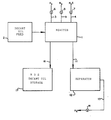
- a reactor 1 comprises a stainless steel tube having an inside diameter of 32 mm and heated with a resistance furnace (not shown).
- the reactor 1 operates in a trickle-bed mode with the decant oil from a decant oil feed 2 entering from the top.
- the catalyst in the reactor 1 amounts to 100 ml and is diluted with 200 ml of quartz chips (12/16 mesh) and loaded into the stainless steel tube.
- the resulting catalyst bed is 370 mm long.
- a fresh catalyst bed is activated with hydrogen and hydrogen sulfide which are supplied through lines 3 and 4 and controlled by valves 6 and 7.
- the nitrogen supplied by line 9 and controlled by valve 8 is used to purge the catalyst of any dissolved hydrogen sulfide.
- Examples 1 to 3 were carried out with a decant oil having a sulfur content of about 2.35% by weight and catalyst A.
- Example 1 processed the decant oil to a coke and then an electrode without hydrodesulfurization while Examples 2 and 3 included hydrodesulfurization using catalyst A.
- the sulfur contents after hydrodesulfurization for Examples 2 and 3 were 1.04% and 0.79% by weight.
- Table 2 shows the results of Examples 2 and 3 as compared to Example 1.
- the coking was carried out by the delayed coking process and the electrode was made from the coke using a commercial process.
- the same amount of weight of puffing inhibitor was used in these Examples as well as in all of the subsequent Examples.
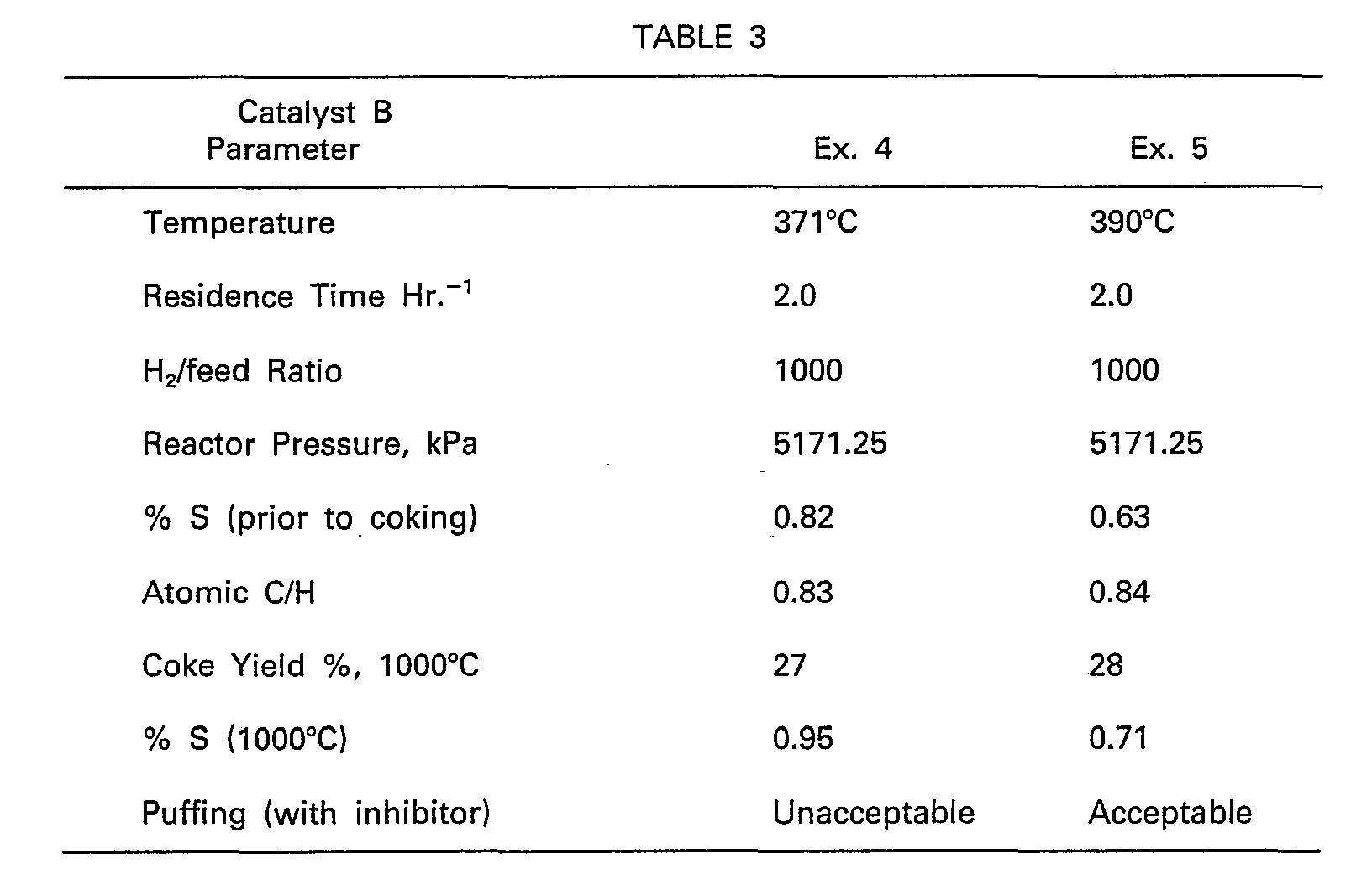
- Examples 4 and 5 were carried out with the same decant oil as in Examples 1 to 3 except that the hydrodesulfurization was with catalyst B.
- the electrodes were made by the same process.
- Table 3 shows the result of Examples 4 and 5.
- Examples 6 to 8 were carried out with the same decant oil as in Examples 1 to 3 except that the hydrodesulfurization was with catalyst C.
- the electrodes were made by the same process.
- Table 4 shows the results of Examples 6 to 8.
- Examples 9 to 12 were carried out with the same decant oil as in Examples 1 to 3 except that the hydrodesulfurization was with catalyst D.
- the electrodes were made by the same process.
- Table 5 shows the results of Examples 9 to 12.
- Examples 13 and 14 were carried out using a decant oil having a sulfur content of about 1.12% by weight.
- the hydrodesulfurization was carried out using catalyst A.
- Table 6 shows the results of Examples 13 and 14.
- the decant oil had an atomic C/H of 0.98 and the coke yield for a 1000°C heat treatment of delayed coking was 35%.
- the electrode had a CTE of 0.35 10- 6 /°C but the puffing was unacceptable.
- the hydrodesulfurization dearomatizes the decant oils as is evident from the decrease in C/H. This is expected and would discourage in general the use of hydrodesulfurization in a process for producing premium coke for electrodes because dearomatizing is expected to result in high values of CTE.
- the measured values of CTE for the electrodes produced according to the invention showed excellent values of CTE and Examples 13 and 14 showed improvements in the values of CTE as compared to electrodes made from untreated decant oil.
- the coke yield was best for the catalyst having the largest mean pore diameter as well as the highest number of large pores 80% of the pore diameters exceeded 170 Angstroms.
Landscapes
- Chemical & Material Sciences (AREA)
- Engineering & Computer Science (AREA)
- Oil, Petroleum & Natural Gas (AREA)
- Materials Engineering (AREA)
- Organic Chemistry (AREA)
- Chemical Kinetics & Catalysis (AREA)
- General Chemical & Material Sciences (AREA)
- Production Of Liquid Hydrocarbon Mixture For Refining Petroleum (AREA)
- Coke Industry (AREA)
Description
- The invention relates to a method of making a premium coke and particularly to making a premium coke suitable for the commercial production of electrodes used in the melting of steel.
- It is well known to use low sulfur decant oil resulting from the catalytic cracking of petroleum to produce premium coke using delayed coking. It is known in the art that in order to produce high quality electrodes suitable for the production of steel the coke should be so-called "needle coke" and should not contain very much sulfur. Sometimes, the needle coke is referred to as "premium coke" or "premium needle coke".
- Needle coke results in an electrode possessing a low coefficient of thermal expansion (CTE) which is necessary to use the electrodes at the elevated temperatures present during the production of steel.
- The low sulfur content of the premium coke is important because the commercial processes for graphitizing the electrodes include a rapid increase in temperature. Sulfur in the coke is vaporized during the graphitization and the resulting internal pressure can damage the electrode. The phenomenon is commonly called "puffing".
- It is a common practice to use an inhibitorto reduce puffing in the coke. There are, however, limitations on the effectiveness of the inhibitors for coke having a sulfur content of more than a given level, as determined by the rate of temperature increase and other factors.
- The inhibitors are inorganic compounds and the amount of the inhibitor is limited due to the deleterious effects on the properties of the electrodes.
- U.S. Patent No. 3,624,231 to Juel et al discusses puffing in coke and tl'ie use of inhibitors.
- Decant oils having less than about 1 % by weight sulfur are used in prior art methods for making low sulfur premium coke using delayed coking.
- It has now been determined that the critical criterion is that the premium coke should have less than about 0.8% by weight sulfur to be suitable for the commercial production of electrodes.
- Because of strong demands in other commercial markets, low sulfur decant oils are becoming unavailable for the economical production of premium coke.
- The present invention is directed to decant oils having sulfur contents of at least about 1 % by weight and generally at least about 1.5% by weight. These decant oils can contain as much as about 4% by weight although decant oils having the higher amounts are not desirable.
- We have discovered that because the sulfur content in the decant oil is distributed throughout the various molecules from the low weight molecules to the heavy weight molecules and that the prior art desulfurization of decant oil is ineffective for producing low sulfur premium coke. We have found that the primary action of the prior art of reducing the sulfur content of a decant oil is the removal of sulfur from the low weight molecules and the coke produced by the delayed coking is primarily derived from the heaviest molecules. That is, the low weight molecules are volatilized off. As a result of this, a decant oil which has been treated according to the prior art will produce a coke having a higher sulfur content by weight than the hydrodesulfurized decant oil of this invention.
- We have realized that the hydrodesulfurization should be directed to the heavy molecules because the low molecules containing sulfur are vaporized off with their respective sulfur during the delayed coking.
- In its broadest embodiment, the invention is directed to a method of producing a low sulfur or premium coke from a high sulfur decant oil resulting from the catalytic cracking of petroleum and features the steps of hydrodesulfurizing the decant oil with a catalyst having relatively large pores in order to be effective for removing sulfur from the heavier molecules of the decant oil, and delayed coking the hydrodesulfurized decant oil to produce the premium coke.
- According to the present invention there is provided a method of producing low sulfur coke from decant oil having a sulfur content of from 1 % to 4% by weight and resulting from the catalytic cracking of petroleum, and features the steps of selectively hydrodesulfurizing the decant oil with hydrogen and a porous catalyst having at least 80% of its pores with diameters greater than 70x 10-'°m at a temperature of from 340°C to 450°C at a reactor pressure of from 3447.5 to 20685 kPa (500 to 3000 psig) and a space velocity for the decant oil being from 0.1 to 10 hour-' and delayed coking the hydrodesulfurized decant oil to produce the low sulfur coke.
- Preferably, the low sulfur or premium coke should contain less than 0.8% by weight sulfur in order to provide a quality feedstock for the production of electrodes. It is implicit that the hydrodesùlfurization must have parameters in conjunction with the delayed coking to produce the low sulfur coke. It is known that during delayed coking the elevated temperature and other treatment conditions result in the loss of sulphur content, particularly the sulphur associated with relatively small molecules. The extent of the sulphur loss and the size of the molecules which are most affected by the delayed coking can vary with respect to the delayed coking conditions. The hydrodesulphurization, according to the invention, removes sulphur with the relatively large molecules. The overall loss in sulphur is a result of the combination of the hydrodesulphurization and delayed coking. If the delayed coking is carried out under conditions which could remove a considerable amount of the sulphur content then the amount of hydrodesulphurization need not be a greater extent because the delayed coking will tend to compensate for the shortcomings of the hydrodesulphurization. Thus, the interrelationship between these steps determines the final sulphur content.
- As used herein, "high sulfur decant oil" is a decant oil containing at least 1% by weight to 4% by weight sulfur, and preferably from 1.5% to 2.5% by weight sulfur.
- The term "delayed coking" used herein refers to the conventional process generally identified by that designation.
- The porous catalyst comprises, for example, a hydrogenation component of at least one Group VIB metal component and at least one Group VIII metal component on a refractory oxide support. The Groups VI and VIII referred to herein are the groups of the Periodic Table of Elements. A preferred catalyst comprises the oxide or sulfide of a Group VIB metal and the oxide or sulfide of a Group VIII metal deposited upon a support material comprising a silica-stabilized alumina containing 1 % to 6% by weight silica. The active metallic components in the preferred catalyst for the Group VIB oxide or sulfide is selected from the group consisting of molybdenum or tungsten such as for example molybdenum oxide, molybdenum sulfide, tungsten oxide, tungsten sulfide, or a mixture thereof. Similarly, the preferred Group VIII oxide or sulfide is selected from the Group consisting of nickel or cobalt oxide or sulfide such as for example nickel oxide, cobalt oxide, nickel sulfide, cobalt sulfide, or a mixture thereof. The most preferred metal components are nickel oxide with molybdenum oxide and cobalt oxide with molybdenum oxide.
- The methods for preparing these catalysts are disclosed in U.S. Patents No. 3,770,618 and No. 3,509,044. The teachings of these patents are incorporated herein.
- The distribution of pore diameters for the catalyst is critical for obtaining the selective hydrodesulfurization in accordance with the invention. At least 80% of the pore diameters must be greater than 70x 10-10m becaus# the removal of sulfur from the larger molecules can only be accomplished effectively by the use of relatively larger pore diameters. Preferably, 80% of the pore diameters are greater than about 170X10-10m. Nevertheless, a considerable amount of hydrodesulfurization occurs for the decant oil molecules in the medium to low molecular weight range.
- The amount of hydrogen reacted in the process of the invention or "hydrogen consumption" depends on many factors besides the decant oil. Some of these factors are the reactor temperature, the catalyst composition, the pore diameter distribution, and the catalyst particle sizes. The hydrogen should be supplied at a sufficient rate to maintain the reactor pressure at a predetermined level.
- In commercial practice, the hydrogen would be supplied at a rate which considerably exceeded the rate of hydrogen consumption. The unreacted hydrogen would be separated from the gases removed from the reactor and recycled into the reactor.
- The economy of the operation of the process of the invention is strongly dependent on the hydrogen consumption.
- In accordance with the prior art, the catalyst should be activated using a mixture of hydrogen and hydrogen sulfide.
- The laboratory reactor for carrying out the invention operated in a trickle-bed mode with the decant oil entering at the top. The catalyst was diluted with quartz chips (12/16 mesh) to vary the residence time. Typically, 100 ml of catalyst was diluted with 200 ml of quartz chips.
- The essential operating parameters of the hydrodesulfurizing process are:
- 1. Temperature of the catalyst,
- 2. Residence time over the catalyst,
- 3. Reactor pressure.
- Generally, as the operating temperature increases hydrodesulfurization increases, hydro- denitrogenation increases, and hydrocracking increases to a maximum and then decreases.
- Extensive hydrogenation is undesirable for decant oils to be used in coking because it reduces the coke yield. Hydrogenation can be minimized by operating at temperatures above 370°C. Hydrocracking becomes noticeable for temperatures above about 400°C and results in undesirable carbon deposits on the catalyst surface. High pressures impede the carbonization. To maintain a long catalyst life, temperatures above 420°C are generally avoided.
- The residence time is measured as the reciprocal of the space velocity which is defined as:

- For liquid feeds, the term "liquid hourly space velocity" (LHSV) is commonly used and expressed in units of hour-I. This measurement provides a convenient means of comparison for different feedstocks under various conditions of a trickle bed reactor.
- Catalyst temperature and space velocity are the most important process variables that determine the reaction rate. High pressures work to maintain catalyst activity over a long period of time.
- In addition, both the operating temperature and pressure independent of the sulfur content of the decant oil.
- In commercial operation, the operating temperature range is generally from 340°C to 450°C and preferably from 370°C to 420°C.
- The space velocity can be from 0.1 to 10 hours-' but preferably from 1 to 3 hours-1.
- In commercial operation the reactor pressure can range from 3447.5 to 20685 kPa (500 to 3000 psig) and preferably from 5171.25 to 10342.5 kPa (750 to 1500 psig).
- Large hydrogen/feed ratios are desirable to maintain catalyst activity over a long period of time. A large excess of hydrogen is preferably maintained in the reactor, particularly with heavy feedstocks which are only partially vaporized at the operating temperatures.
- Above some minimum value, which can be experimentally determined, the hydrogen/feed ratio has little effect on the desulfurization process.
- The hydrogen/feed ratio is preferably from 71.25 to 2850 (corresponding to 300 to 12,000 standard cubic feet per barrel (scf.bbl)) while the typical hydrogen consumption is from 47.5 to 237.5 litres of hydrogen per litre of oil (corresponding to 200 to 1000 scf/bbl). The hydrogen which is not consumed is recovered and recycled in a commercial embodiment.
- For a fuller understanding of the nature of the invention, reference should be had to the detailed description, taken in connection with the accompanying drawing which is a simplified flow sheet of the catalytic unit used to carry out the hydrodesulfurization according to the invention.
- Illustrative, non-limiting Examples of the practice of the invention are set out below. Numerous other examples can readily be evolved in the light of the guiding principles and teachings contained herein. The Examples given herein are intended to illustrate the invention and not in any sense to limit the manner in which the invention can be practiced.
- The catalysts used in the Examples are described in Table 1.

- In the drawing a reactor 1 comprises a stainless steel tube having an inside diameter of 32 mm and heated with a resistance furnace (not shown). The reactor 1 operates in a trickle-bed mode with the decant oil from a
decant oil feed 2 entering from the top. - The catalyst in the reactor 1 amounts to 100 ml and is diluted with 200 ml of quartz chips (12/16 mesh) and loaded into the stainless steel tube. The resulting catalyst bed is 370 mm long.
- A fresh catalyst bed is activated with hydrogen and hydrogen sulfide which are supplied through
lines 3 and 4 and controlled byvalves 6 and 7. - The nitrogen supplied by line 9 and controlled by valve 8 is used to purge the catalyst of any dissolved hydrogen sulfide.
- Gases from the reactor 1 are removed over line 11 to a separator 12 and recovered hydrogen is removed over
line 13 throughvalve 14. Hydrodesulfurized (HDS) decant oil is removed from the reactor 1 overline 16 tostorage 17. - Examples 1 to 3 were carried out with a decant oil having a sulfur content of about 2.35% by weight and catalyst A.
- Example 1 processed the decant oil to a coke and then an electrode without hydrodesulfurization while Examples 2 and 3 included hydrodesulfurization using catalyst A. The sulfur contents after hydrodesulfurization for Examples 2 and 3 were 1.04% and 0.79% by weight.
- Table 2 shows the results of Examples 2 and 3 as compared to Example 1. The coking was carried out by the delayed coking process and the electrode was made from the coke using a commercial process. The same amount of weight of puffing inhibitor was used in these Examples as well as in all of the subsequent Examples.
- It can be seen in Examples 2 and 3 that the sulfur content expressed as weight percent increased after coking as compared to prior to coking. That is, 1.04% and 0.79% increased to 1.27% and 0.93% respectively. This is due to the loss of low molecular weight molecules which have been desulfurized substantially due to the catalyst.

- Examples 4 and 5 were carried out with the same decant oil as in Examples 1 to 3 except that the hydrodesulfurization was with catalyst B. The electrodes were made by the same process.
- Table 3 shows the result of Examples 4 and 5.
- Examples 6 to 8 were carried out with the same decant oil as in Examples 1 to 3 except that the hydrodesulfurization was with catalyst C. The electrodes were made by the same process.
- Table 4 shows the results of Examples 6 to 8.

- Examples 9 to 12 were carried out with the same decant oil as in Examples 1 to 3 except that the hydrodesulfurization was with catalyst D. The electrodes were made by the same process.
- Table 5 shows the results of Examples 9 to 12.

- Examples 13 and 14 were carried out using a decant oil having a sulfur content of about 1.12% by weight. The hydrodesulfurization was carried out using catalyst A.
- Table 6 shows the results of Examples 13 and 14.

- Without hydrodesulfurization, the decant oil had an atomic C/H of 0.98 and the coke yield for a 1000°C heat treatment of delayed coking was 35%. The electrode had a CTE of 0.35 10-6/°C but the puffing was unacceptable.
- The Examples show the guidelines for carrying out the present invention.
- It can be seen that the hydrodesulfurization dearomatizes the decant oils as is evident from the decrease in C/H. This is expected and would discourage in general the use of hydrodesulfurization in a process for producing premium coke for electrodes because dearomatizing is expected to result in high values of CTE. Surprisingly, the measured values of CTE for the electrodes produced according to the invention showed excellent values of CTE and Examples 13 and 14 showed improvements in the values of CTE as compared to electrodes made from untreated decant oil.
- Generally, it has been found that the use of high reaction temperatures, from about 370°C to about 420°C tend to minimize hydrogen consumption and to improve coke yield as well as to minimize the dearomatization.
- The coke yield was best for the catalyst having the largest mean pore diameter as well as the highest number of large pores 80% of the pore diameters exceeded 170 Angstroms.
- We wish it to be understood that we do not wish to be limited to the exact details shown and described because obvious modifications will occur to a person skilled in the art.
Claims (5)
Applications Claiming Priority (2)
| Application Number | Priority Date | Filing Date | Title |
|---|---|---|---|
| US27909681A | 1981-06-30 | 1981-06-30 | |
| US279096 | 1981-06-30 |
Publications (3)
| Publication Number | Publication Date |
|---|---|
| EP0068898A2 EP0068898A2 (en) | 1983-01-05 |
| EP0068898A3 EP0068898A3 (en) | 1984-06-06 |
| EP0068898B1 true EP0068898B1 (en) | 1986-12-30 |
Family
ID=23067617
Family Applications (1)
| Application Number | Title | Priority Date | Filing Date |
|---|---|---|---|
| EP82303429A Expired EP0068898B1 (en) | 1981-06-30 | 1982-06-30 | Method for producing low sulfur premium coke from high sulfur decant oils |
Country Status (4)
| Country | Link |
|---|---|
| US (1) | US5167796A (en) |
| EP (1) | EP0068898B1 (en) |
| JP (1) | JPS5840386A (en) |
| DE (1) | DE3274878D1 (en) |
Families Citing this family (16)
| Publication number | Priority date | Publication date | Assignee | Title |
|---|---|---|---|---|
| JPH0618366B2 (en) * | 1985-02-28 | 1994-03-09 | 日本電気株式会社 | Timing recovery circuit for modem |
| DE3719659A1 (en) * | 1987-06-12 | 1988-12-29 | Standard Elektrik Lorenz Ag | DEVICE FOR FAST FRAME AND PHASE SYNCHRONIZATION |
| USD364257S (en) | 1993-11-19 | 1995-11-14 | Sunbeam Corporation | Grill cart with a condiment basket and a front panel |
| US7959888B2 (en) | 2005-12-27 | 2011-06-14 | Nippon Oil Corporation | Raw coke for electricity storage carbon material and needle coke |
| EP2166062B1 (en) | 2007-06-22 | 2018-09-12 | Nippon Petroleum Refining Company Limited | Process for producing petroleum coke |
| US8007658B2 (en) * | 2008-06-03 | 2011-08-30 | Graftech International Holdings Inc. | Reduced puffing needle coke from coal tar |
| US8007660B2 (en) | 2008-06-03 | 2011-08-30 | Graftech International Holdings Inc. | Reduced puffing needle coke from decant oil |
| US8007659B2 (en) | 2008-06-03 | 2011-08-30 | Graftech International Holdings Inc. | Reduced puffing needle coke from coal tar distillate |
| JP6651305B2 (en) | 2015-07-09 | 2020-02-19 | Jxtgエネルギー株式会社 | Manufacturing method of petroleum needle coke for graphite electrode |
| US12559689B2 (en) | 2017-02-12 | 2026-02-24 | Magēmā Technology LLC | Multi-stage process and device for treatment heavy marine fuel and resultant composition and the removal of detrimental solids |
| US12025435B2 (en) | 2017-02-12 | 2024-07-02 | Magēmã Technology LLC | Multi-stage device and process for production of a low sulfur heavy marine fuel oil |
| US11788017B2 (en) | 2017-02-12 | 2023-10-17 | Magëmã Technology LLC | Multi-stage process and device for reducing environmental contaminants in heavy marine fuel oil |
| US20180230389A1 (en) | 2017-02-12 | 2018-08-16 | Magēmā Technology, LLC | Multi-Stage Process and Device for Reducing Environmental Contaminates in Heavy Marine Fuel Oil |
| US12281266B2 (en) | 2017-02-12 | 2025-04-22 | Magẽmã Technology LLC | Heavy marine fuel oil composition |
| US10604709B2 (en) | 2017-02-12 | 2020-03-31 | Magēmā Technology LLC | Multi-stage device and process for production of a low sulfur heavy marine fuel oil from distressed heavy fuel oil materials |
| US12071592B2 (en) | 2017-02-12 | 2024-08-27 | Magēmā Technology LLC | Multi-stage process and device utilizing structured catalyst beds and reactive distillation for the production of a low sulfur heavy marine fuel oil |
Family Cites Families (24)
| Publication number | Priority date | Publication date | Assignee | Title |
|---|---|---|---|---|
| US2871182A (en) * | 1956-08-17 | 1959-01-27 | Socony Mobil Oil Co Inc | Hydrogenation and coking of heavy petroleum fractions |
| US2963416A (en) * | 1957-10-09 | 1960-12-06 | Gen Carbon And Chemical Corp | Coke production from petroleum stocks |
| US3112181A (en) * | 1958-05-08 | 1963-11-26 | Shell Oil Co | Production of graphite from petroleum |
| US3770618A (en) * | 1967-06-26 | 1973-11-06 | Exxon Research Engineering Co | Hydrodesulfurization of residua |
| US3624231A (en) * | 1969-05-29 | 1971-11-30 | Great Lakes Carbon Corp | Method for producing a useful carbon aggregate from a puffing petroleum coke |
| US3817853A (en) * | 1972-05-30 | 1974-06-18 | Union Oil Co | Coking of pyrolysis tars |
| CA1020478A (en) * | 1972-07-14 | 1977-11-08 | Gulf Research And Development Company | Hydrodesulfurization of petroleum distillates |
| US3891538A (en) * | 1973-06-21 | 1975-06-24 | Chevron Res | Integrated hydrocarbon conversion process |
| US3876523A (en) * | 1973-08-29 | 1975-04-08 | Mobil Oil Corp | Catalyst for residua demetalation and desulfurization |
| GB1452802A (en) * | 1974-03-25 | 1976-10-20 | British Petroleum Co | Desulphurisation process |
| US3923635A (en) * | 1974-06-17 | 1975-12-02 | Exxon Research Engineering Co | Catalytic upgrading of heavy hydrocarbons |
| JPS518642A (en) * | 1974-07-12 | 1976-01-23 | Matsushita Electric Industrial Co Ltd | Judokanetsuchoriki |
| US4177133A (en) * | 1974-09-25 | 1979-12-04 | Maruzen Petrochem Co Ltd | Process for producing high-crystalline petroleum coke |
| US4075084A (en) * | 1977-02-17 | 1978-02-21 | Union Oil Company Of California | Manufacture of low-sulfur needle coke |
| JPS5850636B2 (en) * | 1977-07-15 | 1983-11-11 | 千代田化工建設株式会社 | Desulfurization treatment method for heavy hydrocarbon oil |
| JPS5431483A (en) * | 1977-08-15 | 1979-03-08 | Matsushita Electric Works Ltd | Manufacturing of pvc tile |
| US4177163A (en) * | 1978-03-08 | 1979-12-04 | Mobil Oil Corporation | Supported catalyst for demetalation and desulfurization of hydrocarbon oils |
| US4178229A (en) * | 1978-05-22 | 1979-12-11 | Conoco, Inc. | Process for producing premium coke from vacuum residuum |
| US4213846A (en) * | 1978-07-17 | 1980-07-22 | Conoco, Inc. | Delayed coking process with hydrotreated recycle |
| US4251493A (en) * | 1978-07-21 | 1981-02-17 | Ciba-Geigy Corporation | Gas purification process |
| US4176046A (en) * | 1978-10-26 | 1979-11-27 | Conoco, Inc. | Process for utilizing petroleum residuum |
| US4224144A (en) * | 1979-03-19 | 1980-09-23 | Standard Oil Company (Indiana) | Hydrotreating a hydrocarbon stream to remove nitrogen and sulfur |
| US4267033A (en) * | 1979-10-22 | 1981-05-12 | Mobil Oil Corporation | Upgrading of aromatic liquids |
| JPS58118889A (en) * | 1981-12-29 | 1983-07-15 | ユニオン・カ−バイド・コ−ポレ−シヨン | High quality coke from mixture of pyrolytic tar and hydrogenated decant oil |
-
1982
- 1982-06-29 JP JP57112451A patent/JPS5840386A/en active Pending
- 1982-06-30 EP EP82303429A patent/EP0068898B1/en not_active Expired
- 1982-06-30 DE DE8282303429T patent/DE3274878D1/en not_active Expired
-
1989
- 1989-05-22 US US07/355,833 patent/US5167796A/en not_active Expired - Lifetime
Also Published As
| Publication number | Publication date |
|---|---|
| US5167796A (en) | 1992-12-01 |
| EP0068898A3 (en) | 1984-06-06 |
| DE3274878D1 (en) | 1987-02-05 |
| EP0068898A2 (en) | 1983-01-05 |
| JPS5840386A (en) | 1983-03-09 |
Similar Documents
| Publication | Publication Date | Title |
|---|---|---|
| US5167796A (en) | Method of forming an electrode from a sulfur containing decant oil feedstock | |
| US4297242A (en) | Process for demetallation and desulfurization of heavy hydrocarbons | |
| US4306964A (en) | Multi-stage process for demetalation and desulfurization of petroleum oils | |
| US4657663A (en) | Hydrotreating process employing a three-stage catalyst system wherein a titanium compound is employed in the second stage | |
| EP0665282B1 (en) | Method and apparatus for hydrogenating heavy oil | |
| US4225421A (en) | Process for hydrotreating heavy hydrocarbons | |
| US4066574A (en) | Hydrocarbon hydrotreating catalyst composition | |
| US4016067A (en) | Process for demetalation and desulfurization of petroleum oils | |
| US7169294B2 (en) | Hydroprocessing catalyst and use thereof | |
| US4054508A (en) | Demetalation and desulfurization of residual oil utilizing hydrogen and trickle beds of catalysts in three zones | |
| US4447314A (en) | Demetalation, desulfurization, and decarbonization of petroleum oils by hydrotreatment in a dual bed system prior to cracking | |
| US5158668A (en) | Preparation of recarburizer coke | |
| US4340466A (en) | Process for hydrotreating heavy oils containing metals | |
| JPS6326157B2 (en) | ||
| US4729826A (en) | Temperature controlled catalytic demetallization of hydrocarbons | |
| CA1097244A (en) | Hydrotreating of pyrolysis gasoline | |
| US3732155A (en) | Two-stage hydrodesulfurization process with hydrogen addition in the first stage | |
| US4133777A (en) | Hydrodesulfurization catalyst | |
| JPH0249783B2 (en) | ||
| US4342641A (en) | Maximizing jet fuel from shale oil | |
| US4576710A (en) | Catalyst desulfurization of petroleum residua feedstocks | |
| CA2266460C (en) | Hydroconversion process | |
| US4420388A (en) | Hydrotreating vacuum gas oils with catalyst and added organic fluorine compound | |
| US4560466A (en) | Hydrodemetallization of heavy oils in the presence of water | |
| JP4578182B2 (en) | Method for hydrotreating heavy hydrocarbon oil |
Legal Events
| Date | Code | Title | Description |
|---|---|---|---|
| PUAI | Public reference made under article 153(3) epc to a published international application that has entered the european phase |
Free format text: ORIGINAL CODE: 0009012 |
|
| AK | Designated contracting states |
Designated state(s): DE GB NL |
|
| PUAL | Search report despatched |
Free format text: ORIGINAL CODE: 0009013 |
|
| AK | Designated contracting states |
Designated state(s): DE GB NL |
|
| 17P | Request for examination filed |
Effective date: 19840903 |
|
| GRAA | (expected) grant |
Free format text: ORIGINAL CODE: 0009210 |
|
| AK | Designated contracting states |
Kind code of ref document: B1 Designated state(s): DE GB NL |
|
| REF | Corresponds to: |
Ref document number: 3274878 Country of ref document: DE Date of ref document: 19870205 |
|
| PLBE | No opposition filed within time limit |
Free format text: ORIGINAL CODE: 0009261 |
|
| STAA | Information on the status of an ep patent application or granted ep patent |
Free format text: STATUS: NO OPPOSITION FILED WITHIN TIME LIMIT |
|
| 26N | No opposition filed | ||
| PGFP | Annual fee paid to national office [announced via postgrant information from national office to epo] |
Ref country code: DE Payment date: 19960528 Year of fee payment: 15 |
|
| PGFP | Annual fee paid to national office [announced via postgrant information from national office to epo] |
Ref country code: NL Payment date: 19960529 Year of fee payment: 15 Ref country code: GB Payment date: 19960529 Year of fee payment: 15 |
|
| PG25 | Lapsed in a contracting state [announced via postgrant information from national office to epo] |
Ref country code: GB Free format text: LAPSE BECAUSE OF NON-PAYMENT OF DUE FEES Effective date: 19970630 |
|
| PG25 | Lapsed in a contracting state [announced via postgrant information from national office to epo] |
Ref country code: NL Effective date: 19980101 |
|
| GBPC | Gb: european patent ceased through non-payment of renewal fee |
Effective date: 19970630 |
|
| NLV4 | Nl: lapsed or anulled due to non-payment of the annual fee |
Effective date: 19980101 |
|
| PG25 | Lapsed in a contracting state [announced via postgrant information from national office to epo] |
Ref country code: DE Free format text: LAPSE BECAUSE OF NON-PAYMENT OF DUE FEES Effective date: 19980303 |