EP0068506B1 - Process for the preparation of enamines or imines - Google Patents
Process for the preparation of enamines or imines Download PDFInfo
- Publication number
- EP0068506B1 EP0068506B1 EP82105826A EP82105826A EP0068506B1 EP 0068506 B1 EP0068506 B1 EP 0068506B1 EP 82105826 A EP82105826 A EP 82105826A EP 82105826 A EP82105826 A EP 82105826A EP 0068506 B1 EP0068506 B1 EP 0068506B1
- Authority
- EP
- European Patent Office
- Prior art keywords
- formula
- carbon atoms
- prepared
- group containing
- fraction
- Prior art date
- Legal status (The legal status is an assumption and is not a legal conclusion. Google has not performed a legal analysis and makes no representation as to the accuracy of the status listed.)
- Expired
Links
- 150000002081 enamines Chemical class 0.000 title claims description 23
- 150000002466 imines Chemical class 0.000 title claims description 13
- 238000000034 method Methods 0.000 title description 20
- 238000002360 preparation method Methods 0.000 title description 12
- 239000010948 rhodium Substances 0.000 claims description 36
- 239000003054 catalyst Substances 0.000 claims description 29
- 229910052703 rhodium Inorganic materials 0.000 claims description 26
- MHOVAHRLVXNVSD-UHFFFAOYSA-N rhodium atom Chemical compound [Rh] MHOVAHRLVXNVSD-UHFFFAOYSA-N 0.000 claims description 26
- VVJKKWFAADXIJK-UHFFFAOYSA-N Allylamine Chemical class NCC=C VVJKKWFAADXIJK-UHFFFAOYSA-N 0.000 claims description 12
- -1 phosphorus compound Chemical class 0.000 claims description 11
- 229910052757 nitrogen Inorganic materials 0.000 claims description 10
- 125000004432 carbon atom Chemical group C* 0.000 claims description 9
- KAKZBPTYRLMSJV-UHFFFAOYSA-N Butadiene Chemical compound C=CC=C KAKZBPTYRLMSJV-UHFFFAOYSA-N 0.000 claims description 8
- 125000000217 alkyl group Chemical group 0.000 claims description 6
- 239000001257 hydrogen Substances 0.000 claims description 6
- 229910052739 hydrogen Inorganic materials 0.000 claims description 6
- 125000004435 hydrogen atom Chemical class [H]* 0.000 claims description 6
- 239000005977 Ethylene Substances 0.000 claims description 5
- 150000001336 alkenes Chemical class 0.000 claims description 5
- 229910001914 chlorine tetroxide Inorganic materials 0.000 claims description 5
- SJYNFBVQFBRSIB-UHFFFAOYSA-N norbornadiene Chemical compound C1=CC2C=CC1C2 SJYNFBVQFBRSIB-UHFFFAOYSA-N 0.000 claims description 5
- VGGSQFUCUMXWEO-UHFFFAOYSA-N Ethene Chemical compound C=C VGGSQFUCUMXWEO-UHFFFAOYSA-N 0.000 claims description 4
- 125000000753 cycloalkyl group Chemical group 0.000 claims description 4
- JRZJOMJEPLMPRA-UHFFFAOYSA-N olefin Natural products CCCCCCCC=C JRZJOMJEPLMPRA-UHFFFAOYSA-N 0.000 claims description 4
- 229910052698 phosphorus Inorganic materials 0.000 claims description 4
- 239000011574 phosphorus Substances 0.000 claims description 4
- VYXHVRARDIDEHS-QGTKBVGQSA-N (1z,5z)-cycloocta-1,5-diene Chemical compound C\1C\C=C/CC\C=C/1 VYXHVRARDIDEHS-QGTKBVGQSA-N 0.000 claims description 3
- 125000003342 alkenyl group Chemical group 0.000 claims description 2
- 125000003118 aryl group Chemical group 0.000 claims description 2
- 125000002887 hydroxy group Chemical group [H]O* 0.000 claims description 2
- 125000004433 nitrogen atom Chemical group N* 0.000 claims description 2
- 125000004430 oxygen atom Chemical group O* 0.000 claims description 2
- 238000004519 manufacturing process Methods 0.000 claims 1
- 125000001814 trioxo-lambda(7)-chloranyloxy group Chemical group *OCl(=O)(=O)=O 0.000 claims 1
- WYURNTSHIVDZCO-UHFFFAOYSA-N Tetrahydrofuran Chemical compound C1CCOC1 WYURNTSHIVDZCO-UHFFFAOYSA-N 0.000 description 46
- 239000000243 solution Substances 0.000 description 26
- YLQBMQCUIZJEEH-UHFFFAOYSA-N tetrahydrofuran Natural products C=1C=COC=1 YLQBMQCUIZJEEH-UHFFFAOYSA-N 0.000 description 23
- IJGRMHOSHXDMSA-UHFFFAOYSA-N Atomic nitrogen Chemical compound N#N IJGRMHOSHXDMSA-UHFFFAOYSA-N 0.000 description 20
- 238000006317 isomerization reaction Methods 0.000 description 20
- 230000003287 optical effect Effects 0.000 description 20
- 238000006243 chemical reaction Methods 0.000 description 19
- NEHNMFOYXAPHSD-UHFFFAOYSA-N citronellal Chemical compound O=CCC(C)CCC=C(C)C NEHNMFOYXAPHSD-UHFFFAOYSA-N 0.000 description 18
- UHOVQNZJYSORNB-UHFFFAOYSA-N Benzene Chemical compound C1=CC=CC=C1 UHOVQNZJYSORNB-UHFFFAOYSA-N 0.000 description 15
- 238000005481 NMR spectroscopy Methods 0.000 description 14
- 238000004458 analytical method Methods 0.000 description 14
- 238000009835 boiling Methods 0.000 description 14
- 239000000203 mixture Substances 0.000 description 14
- VLKZOEOYAKHREP-UHFFFAOYSA-N n-Hexane Chemical compound CCCCCC VLKZOEOYAKHREP-UHFFFAOYSA-N 0.000 description 13
- MUALRAIOVNYAIW-UHFFFAOYSA-N binap Chemical group C1=CC=CC=C1P(C=1C(=C2C=CC=CC2=CC=1)C=1C2=CC=CC=C2C=CC=1P(C=1C=CC=CC=1)C=1C=CC=CC=1)C1=CC=CC=C1 MUALRAIOVNYAIW-UHFFFAOYSA-N 0.000 description 11
- 238000004821 distillation Methods 0.000 description 11
- QTBSBXVTEAMEQO-UHFFFAOYSA-N Acetic acid Chemical compound CC(O)=O QTBSBXVTEAMEQO-UHFFFAOYSA-N 0.000 description 9
- OKKJLVBELUTLKV-UHFFFAOYSA-N Methanol Chemical compound OC OKKJLVBELUTLKV-UHFFFAOYSA-N 0.000 description 9
- 239000003446 ligand Substances 0.000 description 9
- 150000003283 rhodium Chemical class 0.000 description 9
- QAOWNCQODCNURD-UHFFFAOYSA-N Sulfuric acid Chemical compound OS(O)(=O)=O QAOWNCQODCNURD-UHFFFAOYSA-N 0.000 description 8
- 229930003633 citronellal Natural products 0.000 description 8
- 235000000983 citronellal Nutrition 0.000 description 8
- 239000002904 solvent Substances 0.000 description 7
- 238000003756 stirring Methods 0.000 description 7
- XKRFYHLGVUSROY-UHFFFAOYSA-N Argon Chemical compound [Ar] XKRFYHLGVUSROY-UHFFFAOYSA-N 0.000 description 6
- XDEJHXKVKISANH-KAMYIIQDSA-N (2z)-n,n-diethyl-3,7-dimethylocta-2,6-dien-1-amine Chemical compound CCN(CC)C\C=C(\C)CCC=C(C)C XDEJHXKVKISANH-KAMYIIQDSA-N 0.000 description 5
- RBWNDBNSJFCLBZ-UHFFFAOYSA-N 7-methyl-5,6,7,8-tetrahydro-3h-[1]benzothiolo[2,3-d]pyrimidine-4-thione Chemical compound N1=CNC(=S)C2=C1SC1=C2CCC(C)C1 RBWNDBNSJFCLBZ-UHFFFAOYSA-N 0.000 description 5
- 229910021607 Silver chloride Inorganic materials 0.000 description 5
- 239000007864 aqueous solution Substances 0.000 description 5
- HKZLPVFGJNLROG-UHFFFAOYSA-M silver monochloride Chemical compound [Cl-].[Ag+] HKZLPVFGJNLROG-UHFFFAOYSA-M 0.000 description 5
- CSCPPACGZOOCGX-UHFFFAOYSA-N Acetone Chemical compound CC(C)=O CSCPPACGZOOCGX-UHFFFAOYSA-N 0.000 description 4
- GLZPCOQZEFWAFX-UHFFFAOYSA-N Geraniol Chemical compound CC(C)=CCCC(C)=CCO GLZPCOQZEFWAFX-UHFFFAOYSA-N 0.000 description 4
- CDBYLPFSWZWCQE-UHFFFAOYSA-L Sodium Carbonate Chemical compound [Na+].[Na+].[O-]C([O-])=O CDBYLPFSWZWCQE-UHFFFAOYSA-L 0.000 description 4
- 150000001875 compounds Chemical class 0.000 description 4
- 229910001873 dinitrogen Inorganic materials 0.000 description 4
- 239000000706 filtrate Substances 0.000 description 4
- 238000001914 filtration Methods 0.000 description 4
- VLTRZXGMWDSKGL-UHFFFAOYSA-M perchlorate Chemical compound [O-]Cl(=O)(=O)=O VLTRZXGMWDSKGL-UHFFFAOYSA-M 0.000 description 4
- RIOQSEWOXXDEQQ-UHFFFAOYSA-N triphenylphosphine Chemical compound C1=CC=CC=C1P(C=1C=CC=CC=1)C1=CC=CC=C1 RIOQSEWOXXDEQQ-UHFFFAOYSA-N 0.000 description 4
- XLYOFNOQVPJJNP-UHFFFAOYSA-N water Substances O XLYOFNOQVPJJNP-UHFFFAOYSA-N 0.000 description 4
- ZWEHNKRNPOVVGH-UHFFFAOYSA-N 2-Butanone Chemical compound CCC(C)=O ZWEHNKRNPOVVGH-UHFFFAOYSA-N 0.000 description 3
- YMWUJEATGCHHMB-UHFFFAOYSA-N Dichloromethane Chemical compound ClCCl YMWUJEATGCHHMB-UHFFFAOYSA-N 0.000 description 3
- YXFVVABEGXRONW-UHFFFAOYSA-N Toluene Chemical compound CC1=CC=CC=C1 YXFVVABEGXRONW-UHFFFAOYSA-N 0.000 description 3
- 229910052786 argon Inorganic materials 0.000 description 3
- 239000000284 extract Substances 0.000 description 3
- 239000007789 gas Substances 0.000 description 3
- 238000010438 heat treatment Methods 0.000 description 3
- 150000002576 ketones Chemical class 0.000 description 3
- 238000005259 measurement Methods 0.000 description 3
- 150000003839 salts Chemical class 0.000 description 3
- AFMZGMJNKXOLEM-JXMROGBWSA-N (2e)-3,7-dimethylocta-2,6-dien-1-amine Chemical class CC(C)=CCC\C(C)=C\CN AFMZGMJNKXOLEM-JXMROGBWSA-N 0.000 description 2
- HZNVUJQVZSTENZ-UHFFFAOYSA-N 2,3-dichloro-5,6-dicyano-1,4-benzoquinone Chemical compound ClC1=C(Cl)C(=O)C(C#N)=C(C#N)C1=O HZNVUJQVZSTENZ-UHFFFAOYSA-N 0.000 description 2
- YGHRJJRRZDOVPD-UHFFFAOYSA-N 3-methylbutanal Chemical compound CC(C)CC=O YGHRJJRRZDOVPD-UHFFFAOYSA-N 0.000 description 2
- SUSANAYXICMXBL-UHFFFAOYSA-N 4-prop-2-enylmorpholine Chemical compound C=CCN1CCOCC1 SUSANAYXICMXBL-UHFFFAOYSA-N 0.000 description 2
- IKHGUXGNUITLKF-UHFFFAOYSA-N Acetaldehyde Chemical compound CC=O IKHGUXGNUITLKF-UHFFFAOYSA-N 0.000 description 2
- LFQSCWFLJHTTHZ-UHFFFAOYSA-N Ethanol Chemical compound CCO LFQSCWFLJHTTHZ-UHFFFAOYSA-N 0.000 description 2
- RRHGJUQNOFWUDK-UHFFFAOYSA-N Isoprene Chemical compound CC(=C)C=C RRHGJUQNOFWUDK-UHFFFAOYSA-N 0.000 description 2
- CSNNHWWHGAXBCP-UHFFFAOYSA-L Magnesium sulfate Chemical compound [Mg+2].[O-][S+2]([O-])([O-])[O-] CSNNHWWHGAXBCP-UHFFFAOYSA-L 0.000 description 2
- MZRVEZGGRBJDDB-UHFFFAOYSA-N N-Butyllithium Chemical compound [Li]CCCC MZRVEZGGRBJDDB-UHFFFAOYSA-N 0.000 description 2
- WCUXLLCKKVVCTQ-UHFFFAOYSA-M Potassium chloride Chemical compound [Cl-].[K+] WCUXLLCKKVVCTQ-UHFFFAOYSA-M 0.000 description 2
- BQCADISMDOOEFD-UHFFFAOYSA-N Silver Chemical compound [Ag] BQCADISMDOOEFD-UHFFFAOYSA-N 0.000 description 2
- 150000001299 aldehydes Chemical class 0.000 description 2
- UAHWPYUMFXYFJY-UHFFFAOYSA-N beta-myrcene Chemical compound CC(C)=CCCC(=C)C=C UAHWPYUMFXYFJY-UHFFFAOYSA-N 0.000 description 2
- 239000001273 butane Substances 0.000 description 2
- MVPPADPHJFYWMZ-UHFFFAOYSA-N chlorobenzene Chemical compound ClC1=CC=CC=C1 MVPPADPHJFYWMZ-UHFFFAOYSA-N 0.000 description 2
- 238000013375 chromatographic separation Methods 0.000 description 2
- 239000013078 crystal Substances 0.000 description 2
- 125000001495 ethyl group Chemical group [H]C([H])([H])C([H])([H])* 0.000 description 2
- 238000000605 extraction Methods 0.000 description 2
- 239000000543 intermediate Substances 0.000 description 2
- 239000000463 material Substances 0.000 description 2
- AIOQXVQKIGBKFD-UHFFFAOYSA-N n,n,4-trimethylpent-2-en-3-amine Chemical compound CC=C(C(C)C)N(C)C AIOQXVQKIGBKFD-UHFFFAOYSA-N 0.000 description 2
- BFDPXFZBIPJJLO-UHFFFAOYSA-N n,n-dimethyl-3-phenylbut-1-en-2-amine Chemical compound CN(C)C(=C)C(C)C1=CC=CC=C1 BFDPXFZBIPJJLO-UHFFFAOYSA-N 0.000 description 2
- 238000010926 purge Methods 0.000 description 2
- 229920006395 saturated elastomer Polymers 0.000 description 2
- 229910052709 silver Inorganic materials 0.000 description 2
- 239000004332 silver Substances 0.000 description 2
- 229910000029 sodium carbonate Inorganic materials 0.000 description 2
- 239000007858 starting material Substances 0.000 description 2
- NOOLISFMXDJSKH-KXUCPTDWSA-N (-)-Menthol Chemical compound CC(C)[C@@H]1CC[C@@H](C)C[C@H]1O NOOLISFMXDJSKH-KXUCPTDWSA-N 0.000 description 1
- WLAUCMCTKPXDIY-JXMROGBWSA-N (2e)-1-chloro-3,7-dimethylocta-2,6-diene Chemical compound CC(C)=CCC\C(C)=C\CCl WLAUCMCTKPXDIY-JXMROGBWSA-N 0.000 description 1
- IICFUFUBZHBPBU-JUCMHCFKSA-N (2e,6e)-8-(diethylamino)-2,6-dimethylocta-2,6-dien-1-ol Chemical compound CCN(CC)C\C=C(/C)CC\C=C(/C)CO IICFUFUBZHBPBU-JUCMHCFKSA-N 0.000 description 1
- GCRXMENNJOTMKB-BXIATTARSA-N (2e,6e)-9-(cyclohexylamino)-2,6-dimethylnona-2,6-dien-1-ol Chemical compound OCC(/C)=C/CC\C(C)=C\CCNC1CCCCC1 GCRXMENNJOTMKB-BXIATTARSA-N 0.000 description 1
- WLAUCMCTKPXDIY-YFHOEESVSA-N (2z)-1-chloro-3,7-dimethylocta-2,6-diene Chemical compound CC(C)=CCC\C(C)=C/CCl WLAUCMCTKPXDIY-YFHOEESVSA-N 0.000 description 1
- NMRPBPVERJPACX-UHFFFAOYSA-N (3S)-octan-3-ol Natural products CCCCCC(O)CC NMRPBPVERJPACX-UHFFFAOYSA-N 0.000 description 1
- KZPYGQFFRCFCPP-UHFFFAOYSA-N 1,1'-bis(diphenylphosphino)ferrocene Chemical compound [Fe+2].C1=CC=C[C-]1P(C=1C=CC=CC=1)C1=CC=CC=C1.C1=CC=C[C-]1P(C=1C=CC=CC=1)C1=CC=CC=C1 KZPYGQFFRCFCPP-UHFFFAOYSA-N 0.000 description 1
- VDFVNEFVBPFDSB-UHFFFAOYSA-N 1,3-dioxane Chemical compound C1COCOC1 VDFVNEFVBPFDSB-UHFFFAOYSA-N 0.000 description 1
- KOFIDSXHWGFEMO-UHFFFAOYSA-N 1-(2-methylpropyl)pyrrolidine Chemical compound CC(C)CN1CCCC1 KOFIDSXHWGFEMO-UHFFFAOYSA-N 0.000 description 1
- WOFPPJOZXUTRAU-UHFFFAOYSA-N 2-Ethyl-1-hexanol Natural products CCCCC(O)CCC WOFPPJOZXUTRAU-UHFFFAOYSA-N 0.000 description 1
- YIWUKEYIRIRTPP-UHFFFAOYSA-N 2-ethylhexan-1-ol Chemical compound CCCCC(CC)CO YIWUKEYIRIRTPP-UHFFFAOYSA-N 0.000 description 1
- 0 CC(*)C(C(*)=N*)S Chemical compound CC(*)C(C(*)=N*)S 0.000 description 1
- JGLMVXWAHNTPRF-CMDGGOBGSA-N CCN1N=C(C)C=C1C(=O)NC1=NC2=CC(=CC(OC)=C2N1C\C=C\CN1C(NC(=O)C2=CC(C)=NN2CC)=NC2=CC(=CC(OCCCN3CCOCC3)=C12)C(N)=O)C(N)=O Chemical compound CCN1N=C(C)C=C1C(=O)NC1=NC2=CC(=CC(OC)=C2N1C\C=C\CN1C(NC(=O)C2=CC(C)=NN2CC)=NC2=CC(=CC(OCCCN3CCOCC3)=C12)C(N)=O)C(N)=O JGLMVXWAHNTPRF-CMDGGOBGSA-N 0.000 description 1
- 241000191368 Chlorobi Species 0.000 description 1
- 244000166675 Cymbopogon nardus Species 0.000 description 1
- 235000018791 Cymbopogon nardus Nutrition 0.000 description 1
- 239000005792 Geraniol Substances 0.000 description 1
- GLZPCOQZEFWAFX-YFHOEESVSA-N Geraniol Natural products CC(C)=CCC\C(C)=C/CO GLZPCOQZEFWAFX-YFHOEESVSA-N 0.000 description 1
- DGAQECJNVWCQMB-PUAWFVPOSA-M Ilexoside XXIX Chemical compound C[C@@H]1CC[C@@]2(CC[C@@]3(C(=CC[C@H]4[C@]3(CC[C@@H]5[C@@]4(CC[C@@H](C5(C)C)OS(=O)(=O)[O-])C)C)[C@@H]2[C@]1(C)O)C)C(=O)O[C@H]6[C@@H]([C@H]([C@@H]([C@H](O6)CO)O)O)O.[Na+] DGAQECJNVWCQMB-PUAWFVPOSA-M 0.000 description 1
- MPCRDALPQLDDFX-UHFFFAOYSA-L Magnesium perchlorate Chemical compound [Mg+2].[O-]Cl(=O)(=O)=O.[O-]Cl(=O)(=O)=O MPCRDALPQLDDFX-UHFFFAOYSA-L 0.000 description 1
- GLZPCOQZEFWAFX-JXMROGBWSA-N Nerol Natural products CC(C)=CCC\C(C)=C\CO GLZPCOQZEFWAFX-JXMROGBWSA-N 0.000 description 1
- CTQNGGLPUBDAKN-UHFFFAOYSA-N O-Xylene Chemical compound CC1=CC=CC=C1C CTQNGGLPUBDAKN-UHFFFAOYSA-N 0.000 description 1
- IICFUFUBZHBPBU-UHFFFAOYSA-N OCC(=CCCC(=C/CN(CC)CC)C)C Chemical compound OCC(=CCCC(=C/CN(CC)CC)C)C IICFUFUBZHBPBU-UHFFFAOYSA-N 0.000 description 1
- 229910021604 Rhodium(III) chloride Inorganic materials 0.000 description 1
- 101100020289 Xenopus laevis koza gene Proteins 0.000 description 1
- 239000002253 acid Substances 0.000 description 1
- 150000007513 acids Chemical class 0.000 description 1
- 150000001298 alcohols Chemical class 0.000 description 1
- 150000001339 alkali metal compounds Chemical class 0.000 description 1
- VYBREYKSZAROCT-UHFFFAOYSA-N alpha-myrcene Natural products CC(=C)CCCC(=C)C=C VYBREYKSZAROCT-UHFFFAOYSA-N 0.000 description 1
- 150000001412 amines Chemical class 0.000 description 1
- 150000004945 aromatic hydrocarbons Chemical class 0.000 description 1
- 239000002585 base Substances 0.000 description 1
- 230000015572 biosynthetic process Effects 0.000 description 1
- 235000010290 biphenyl Nutrition 0.000 description 1
- 239000004305 biphenyl Substances 0.000 description 1
- 150000001722 carbon compounds Chemical class 0.000 description 1
- 239000003153 chemical reaction reagent Substances 0.000 description 1
- 238000004587 chromatography analysis Methods 0.000 description 1
- 239000010632 citronella oil Substances 0.000 description 1
- 150000001868 cobalt Chemical class 0.000 description 1
- 239000012141 concentrate Substances 0.000 description 1
- 238000001816 cooling Methods 0.000 description 1
- NNGAQKAUYDTUQR-UHFFFAOYSA-N cyclohexanimine Chemical compound N=C1CCCCC1 NNGAQKAUYDTUQR-UHFFFAOYSA-N 0.000 description 1
- SBZXBUIDTXKZTM-UHFFFAOYSA-N diglyme Chemical compound COCCOCCOC SBZXBUIDTXKZTM-UHFFFAOYSA-N 0.000 description 1
- 229940079593 drug Drugs 0.000 description 1
- 239000003814 drug Substances 0.000 description 1
- 150000002170 ethers Chemical class 0.000 description 1
- 239000000796 flavoring agent Substances 0.000 description 1
- 235000019634 flavors Nutrition 0.000 description 1
- 235000019256 formaldehyde Nutrition 0.000 description 1
- 229940113087 geraniol Drugs 0.000 description 1
- 150000004820 halides Chemical class 0.000 description 1
- 230000007062 hydrolysis Effects 0.000 description 1
- 238000006460 hydrolysis reaction Methods 0.000 description 1
- 230000003301 hydrolyzing effect Effects 0.000 description 1
- WPFVBOQKRVRMJB-UHFFFAOYSA-N hydroxycitronellal Chemical compound O=CCC(C)CCCC(C)(C)O WPFVBOQKRVRMJB-UHFFFAOYSA-N 0.000 description 1
- 238000011065 in-situ storage Methods 0.000 description 1
- 238000011835 investigation Methods 0.000 description 1
- 229910044991 metal oxide Inorganic materials 0.000 description 1
- 150000004706 metal oxides Chemical class 0.000 description 1
- 238000012986 modification Methods 0.000 description 1
- 230000004048 modification Effects 0.000 description 1
- XEYNHSVMSMJHMC-UHFFFAOYSA-N n,n,4-trimethylpent-2-en-2-amine Chemical compound CC(C)C=C(C)N(C)C XEYNHSVMSMJHMC-UHFFFAOYSA-N 0.000 description 1
- UCVVPIPOSJOJAT-UHFFFAOYSA-N n,n-diethyl-3-phenylbut-1-en-2-amine Chemical compound CCN(CC)C(=C)C(C)C1=CC=CC=C1 UCVVPIPOSJOJAT-UHFFFAOYSA-N 0.000 description 1
- KKNGZIHXUXYCHX-UHFFFAOYSA-N n,n-dimethyl-3-phenylbut-1-en-1-amine Chemical compound CN(C)C=CC(C)C1=CC=CC=C1 KKNGZIHXUXYCHX-UHFFFAOYSA-N 0.000 description 1
- DDCVREGVKUIOSZ-UHFFFAOYSA-N n,n-dimethylprop-1-en-2-amine Chemical compound CN(C)C(C)=C DDCVREGVKUIOSZ-UHFFFAOYSA-N 0.000 description 1
- 239000012299 nitrogen atmosphere Substances 0.000 description 1
- 150000002894 organic compounds Chemical class 0.000 description 1
- 150000002940 palladium Chemical class 0.000 description 1
- 239000002304 perfume Substances 0.000 description 1
- ZUOUZKKEUPVFJK-UHFFFAOYSA-N phenylbenzene Natural products C1=CC=CC=C1C1=CC=CC=C1 ZUOUZKKEUPVFJK-UHFFFAOYSA-N 0.000 description 1
- UHZYTMXLRWXGPK-UHFFFAOYSA-N phosphorus pentachloride Chemical compound ClP(Cl)(Cl)(Cl)Cl UHZYTMXLRWXGPK-UHFFFAOYSA-N 0.000 description 1
- 239000001103 potassium chloride Substances 0.000 description 1
- 235000011164 potassium chloride Nutrition 0.000 description 1
- 150000003141 primary amines Chemical class 0.000 description 1
- 238000012545 processing Methods 0.000 description 1
- 239000002994 raw material Substances 0.000 description 1
- SONJTKJMTWTJCT-UHFFFAOYSA-K rhodium(iii) chloride Chemical compound [Cl-].[Cl-].[Cl-].[Rh+3] SONJTKJMTWTJCT-UHFFFAOYSA-K 0.000 description 1
- 150000003335 secondary amines Chemical class 0.000 description 1
- 229910052708 sodium Inorganic materials 0.000 description 1
- 239000011734 sodium Substances 0.000 description 1
- BAZAXWOYCMUHIX-UHFFFAOYSA-M sodium perchlorate Chemical compound [Na+].[O-]Cl(=O)(=O)=O BAZAXWOYCMUHIX-UHFFFAOYSA-M 0.000 description 1
- 229910001488 sodium perchlorate Inorganic materials 0.000 description 1
- 239000000126 substance Substances 0.000 description 1
- 238000003786 synthesis reaction Methods 0.000 description 1
- 238000003419 tautomerization reaction Methods 0.000 description 1
- 150000003505 terpenes Chemical class 0.000 description 1
- 235000007586 terpenes Nutrition 0.000 description 1
- COIOYMYWGDAQPM-UHFFFAOYSA-N tris(2-methylphenyl)phosphane Chemical compound CC1=CC=CC=C1P(C=1C(=CC=CC=1)C)C1=CC=CC=C1C COIOYMYWGDAQPM-UHFFFAOYSA-N 0.000 description 1
- 229940088594 vitamin Drugs 0.000 description 1
- 229930003231 vitamin Natural products 0.000 description 1
- 235000013343 vitamin Nutrition 0.000 description 1
- 239000011782 vitamin Substances 0.000 description 1
- 239000000341 volatile oil Substances 0.000 description 1
- 239000008096 xylene Substances 0.000 description 1
Classifications
-
- C—CHEMISTRY; METALLURGY
- C07—ORGANIC CHEMISTRY
- C07D—HETEROCYCLIC COMPOUNDS
- C07D295/00—Heterocyclic compounds containing polymethylene-imine rings with at least five ring members, 3-azabicyclo [3.2.2] nonane, piperazine, morpholine or thiomorpholine rings, having only hydrogen atoms directly attached to the ring carbon atoms
- C07D295/02—Heterocyclic compounds containing polymethylene-imine rings with at least five ring members, 3-azabicyclo [3.2.2] nonane, piperazine, morpholine or thiomorpholine rings, having only hydrogen atoms directly attached to the ring carbon atoms containing only hydrogen and carbon atoms in addition to the ring hetero elements
- C07D295/023—Preparation; Separation; Stabilisation; Use of additives
-
- C—CHEMISTRY; METALLURGY
- C07—ORGANIC CHEMISTRY
- C07C—ACYCLIC OR CARBOCYCLIC COMPOUNDS
- C07C209/00—Preparation of compounds containing amino groups bound to a carbon skeleton
- C07C209/68—Preparation of compounds containing amino groups bound to a carbon skeleton from amines, by reactions not involving amino groups, e.g. reduction of unsaturated amines, aromatisation, or substitution of the carbon skeleton
-
- C—CHEMISTRY; METALLURGY
- C07—ORGANIC CHEMISTRY
- C07C—ACYCLIC OR CARBOCYCLIC COMPOUNDS
- C07C45/00—Preparation of compounds having >C = O groups bound only to carbon or hydrogen atoms; Preparation of chelates of such compounds
- C07C45/51—Preparation of compounds having >C = O groups bound only to carbon or hydrogen atoms; Preparation of chelates of such compounds by pyrolysis, rearrangement or decomposition
- C07C45/516—Preparation of compounds having >C = O groups bound only to carbon or hydrogen atoms; Preparation of chelates of such compounds by pyrolysis, rearrangement or decomposition involving transformation of nitrogen-containing compounds to >C = O groups
-
- C—CHEMISTRY; METALLURGY
- C07—ORGANIC CHEMISTRY
- C07C—ACYCLIC OR CARBOCYCLIC COMPOUNDS
- C07C45/00—Preparation of compounds having >C = O groups bound only to carbon or hydrogen atoms; Preparation of chelates of such compounds
- C07C45/56—Preparation of compounds having >C = O groups bound only to carbon or hydrogen atoms; Preparation of chelates of such compounds from heterocyclic compounds
Definitions
- the present invention relates to a process for the preparation of enamines or imines represented by, respectively, formula (II) or formula (III) as later specified.
- enamines or imines can be hydrolyzed quantitatively by, for example, dilute acids to form aldehydes or ketones, which aldehydes or ketones can be used to synthesize terpene compounds which are useful as, for example, flavor components or drugs such as vitamins. Thus, they are very important intermediates.
- Known methods for the preparation of enamines or imines by the isomerization of allylamine derivatives include a method in which strong bases are used as catalysts (H. Sauer et al., Chem. Ber., 102, 1917 (1969)), a method in which metal oxides are used as catalysts (Tanabe et al., Chem. Lett., 1465 (1977)), a method in which cobalt complexes are used as catalysts (Japanese Patent Application (OPI) Nos.
- the object of the invention is to provide a process for the preparation of enamines or imines represented by, respectively, formula (II) or formula (III) given hereafter by isomerization of allylamine derivatives represented by formula (I) given hereafter.
- the present invention therefore, relates to a process for producing enamines or imines represented by, respectively, formula (II) or formula (III): (all symbols are hereafter identified) by the isomerization of allylamine derivatives represented by formula (I): by the use of rhodium complexes represented by formula (IV): (all symbols are hereafter identified).
- the starting materials for use in the process of the invention are the allylamine derivatives represented by formula (I), wherein R,, R 2 , R 3 and R 4 are each hydrogen, an alkyl or alkenyl group, both of which contain from 1 to 12 carbon atoms, or an aryl group; R 1 may be substituted by one hydroxy group; R 5 is hydrogen, or an alkyl or cycloalkyl group, both of which contain from 1 to 8 carbon atoms; R 6 is an alkyl or cycloalkyl group, both of which contain from 1 to 8 carbon atoms; or R 5 and R 6 may combine together in combination with the adjacent nitrogen atom to form a 5- or 6-membered ring, or a 6-membered ring containing an oxygen atom.
- R, R 2 , R 3 and R 4 are each hydrogen, an alkyl or alkenyl group, both of which contain from 1 to 12 carbon atoms, or an aryl group
- R 1 may be substituted by one hydroxy group
- Suitable allylamine derivatives are propene-2-yl-dimethylamine, 2-methyl-propene-2-yl-diethylamine, neryldiethylamine, geranyldiethylamine, 7-hydroxyneryldiethylamine, 7-hydroxygeranyldiethylamine, geranyl-cyclohexylamine, 1,3-dimethyl-butene-2-yl-dimethylamine, 3-phenyl- butene-2-yl-dimethylamine, 3-phenyl-butene-2-yl-diethylamine, 3,7,11-trimethyl-dodeca-2,6,10- trienyldiethylamine(farnesyidiethylamine), 2-methyl-propene-2-yl-pyrroldine, hydroxygeranylmethyl- cyclohexylamine, neryl-di-n-butylamine, geranyl-di(2-ethylhexyl
- geranylamine derivatives and nerylamine derivatives are easily prepared by, for example, a method in which geranyl chloride or neryl chloride is prepared from geraniol or nerol by the use of phosphorus pentachloride and, thereafter, are reacted with amine lithium compounds derived from amine compounds and butyl lithium, or a method comprising teromerization of myrcene or isoprene with primary or secondary amines, catalyzed by an alkali metal compound (see, for example, K. Takabe et al., Tetrahedron Letter, 4009 (1972)).
- the rhodium complexes for use in the invention are represented by formula (IV), wherein the symbol "olefin” indicates ethylene, 1,3-butadiene, norbornadiene, or cycloocta-1,5-diene; X indicates C10 4 , BF 4 , or PF 6 ; and L indicates two monodentate triarylphosphines, or bidentate tri-valent phosphorus compound derivatives represented by formula (V): where Y is __ or
- rhodium complexes have been isolated as crystals, and their chemical structures have been analyzed (see A. Miyashita et al., J. Am. Chem. Soc., 102, 7932 (1980)).
- Such rhodium complexes isolated as crystals and "in situ" prepared rhodium complexes e.g., described in J.A.C.S., 94, 6433 (1972) by H. B. Kagan
- the rhodium complexes of the invention can be prepared from mono-valent rhodium-olefin complexes, about 2 moles of monodentate ligands or about 1 mole of bidentate ligands per mole of the mono-valent rhodium-olefin complex, and about 1 mole of a salt containing a negative group per mole of the mono-valent rhodium-olefin complex.
- Mono-valent rhodium-olefin complexes as used herein can be easily prepared by reacting rhodium trichloride with an olefin(s) in a solvent, e.g., methanol or ethanol.
- a solvent e.g., methanol or ethanol.
- ethylene used as the olefin
- di- ⁇ -chlorotetra( ⁇ -ethylene)-dirhodium (I) according to the following reaction:
- Olefins which can be used in the preparation of the present rhodium complex catalysts include, in addition to ethylene, 1,3-butadiene, norbornadiene, and cycloocta-1,5-diene (hereinafter referred to as "COD"). They are used in the form of the corresponding monovalent rhodium complex to prepare the rhodium complex catalysts of the invention.
- Monodentate ligands which can be used in the preparation of the present rhodium complex catalysts include triphenyl phosphine, tri-o-tolyl phosphine, and diphenyl ⁇ -naphthyl phosphine.
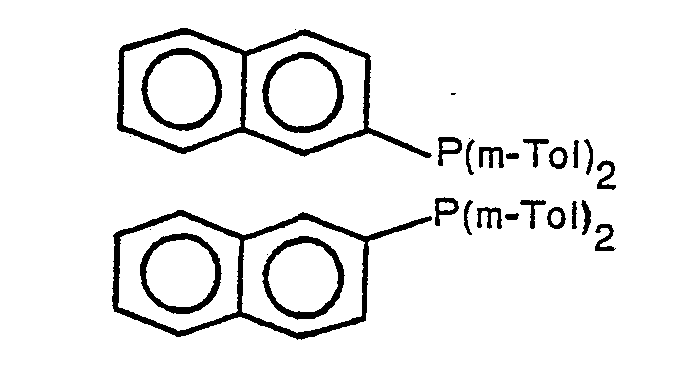
- Bidentate ligands which can be used in the preparation of the present rhodium complex catalysts include the following compounds: : Bis(1,4-di-ortho-tolylphosphino)-butane; [bis(a,a'-diphenylphosphino)-ortho-xylylene]; : [1,1'-bis(diphenylphosphino)-ferrocene]; : [2,3-o-isopropylidene-2,3-dihydroxy-1,4-bis(diphenyl- phosphino)-butane]; [2,3-o-isopropylidene-2,3-dihydroxy-1,4-bis(dibenzo- phosphoryl)-butane]; [2,2'-bis(diphenylphosphino)-1,1'-binaphthyl]; and [2,2'-bis(di-meta-tolylphosphino)-1,1'-bin
- Salts containing a negative group which can be used in the preparation of the present rhodium complex catalysts include sodium perchlorate, magnesium perchlorate, silver perchlorate, sodium borofluoride, silver borofluoride, and potassium hexafluorophosphate. These salts are used to introduce the corresponding negative group into the rhodium complexes.
- the optimum method and conditions are chosen depending on the type of the reagent used, the molar ratio, the type of the solvent, etc.
- the isomerization reaction of the invention is achieved by adding a rhodium complex to the allylamine derivative in a proportion of 1/2,000 to 1/6,000 mole per mole of the allylamine derivative, and then maintaining the resulting mixture at a temprature of from 20° to 150°C for a period of from 2 to 10 hours.
- Solvents which can be used usually from 0.3 to 2 times per raw material amine for that purpose include aromatic hydrocarbons such as benzene, toluene, and xylene; ethers such as tetrahydrofuran, diethylene glycol dimethyl ether, and 1,3-dioxane; halides such as dichloromethane and chlorobenzene; alcohols such as methanol and 2-ethyl-1-hexanol; and ketones such as acetone and methyl ethyl ketone.
- aromatic hydrocarbons such as benzene, toluene, and xylene
- ethers such as tetrahydrofuran, diethylene glycol dimethyl ether, and 1,3-dioxane
- halides such as dichloromethane and chlorobenzene
- alcohols such as methanol and 2-ethyl-1-hexanol
- ketones such as acetone and methyl ethyl
- an enamine or imine having optical activity can be prepared.
- an optically active tri- valent phosphorus compound having plane asymmetry see the Japanese version (translated by Shimamura et al.) of E. L. Eliel, Stereochemistry of Carbon Compounds, page 180, Tokyo Kagakudojin (1965)
- BINAP represented by the following formula: (wherein the heavy line indicates plane asymmetry) is used, "enantiomer excess" (optical yield) reaching 95% is obtained.
- the isomerization of neryldiethylamine is performed by the use of a rhodium complex comprising an optically active tri-valent phosphorus compound to prepare an enamine, and by hydrolyzing the thus-prepared enamine with dilute sulfuric acid, there can be prepared optically active citronellal having an optical purity of 95% at a high yield of 93%.
- optical purity of citronellal contained in natural citronella oil is about 85%, it can be seen that the above results are excellent.
- Optically active citronellal is used as an intermediate for the synthesis of I-menthol.
- the process of the invention enables one to prepare enamines or imines in high yield by isomerization of allylamine derivatives and, thus, it can be widely used and is useful not only in the preparation of terpenoids but also in the preparation of general organic compounds.
- a 100 ml pressure bomb was purged with nitrogen, and after the introduction of 20 ml of tetrahydrofuran, 5 ml of the above-prepared rhodium complex catalyst solution and 26 g of neryldiethylamine, it was sealed and heated at 100°C for 17 hours while stirring to perform isomerization.
- the thus prepared citronella enamine was poured into 300 ml of water and cooled with ice, and 8 g of acetic acid was dropwise added thereto at a temperature of from 5 to 10°C while stirring. After the dropwise addition was completed, the resulting mixture was stirred for 10 minutes.
- the reaction solution was then subjected to extraction using 200 ml of n-hexane.
- the extract thus- obtained was washed with water and subsequently with a saturated aqueous solution of sodium carbonate, and it was then dried over anhydrous magnesium sulfate.
- the n-hexane was distilled off, and the residue was subjected to distillation to yield 16.8 g of a fraction having a boiling point of from 53 to 55°C/1 mmHg.
- a 200 ml pressure bomb was purged with nitrogen, and, after the introduction of 50 ml of tetrahydrofuran, 12.5 ml of the rhodium complex catalyst solution prepared in Example 1 and 52 g of geranyldiethylamine, it was sealed and heated at 100°C for 17 hours to perform isomerization.
- the thus prepared I-citronellal enamine was poured into 300 ml of water, and then 15 g of acetic acid was dropwise added at a temperature of from 5 to 10°C while cooling with ice and stirring. The resulting mixture was stirred for 15 minutes to perform hydrolysis of the enamine and, thereafter, the reaction solution was subjected three times to extraction using 100 ml of n-hexane. The thus obtained extract was treated in the same manner as in Example 1 to yield 33 g of a fraction having a boiling point of from 54 to 55°C.
- the thus prepared hydroxycitronellal enamine was treated in the same manner as in Example 1, and the resulting hydrolyzed solution was extracted three times with 200 ml of benzene each time.
- the extracts were combined, washed with 300 ml of a 5% aqueous solution of sulfuric acid, twice with water, and finally, with a saturated aqueous solution of sodium carbonate and dried over anhydrous magnesium sulfate.
- the benzene was distilled off, and the residue subjected to distillation to yield 73 g of a fraction having a boiling point of from 85 to 90°C/2 mmHg.
- Example 3 was repeated to yield 70 g of a fraction having a boiling point of from 75 to 80°C/1 mmHg.
- the enamine was first converted into the corresponding aldehyde by the same procedure as in Example 1 and, thereafter, in accordance with the method described in:
- the thus prepared rhodium complex catalyst was transferred into a 100 ml pressure bomb which had been purged with nitrogen gas, and, after the introduction of 12.5 g of 2-methyl- propene-2-yl-pyrrolidine, the bomb was sealed. Isomerization was completed by stirring the mixture at 100°C for 16 hours. After the reaction, the tetrahydrofuran was distilled off and, subsequently, 11 g of a fraction having a boiling point of from 130 to 132°C/760 mmHg was obtained by the distillation.
- a rhodium complex catalyst solution (10 ml) prepared in the same manner as in Example 1 was placed in a 100 ml pressure bomb which had previously been purged with nitrogen gas. Then, 20 ml of tetrahydrofuran was added thereto, and, finally, 6.4 g of 1,3-dimethylbutene-2-yl-dimethylamine was added. They were reacted at 110°C for 20 hours. After the reaction was completed, the tetrahydrofuran was distilled off, and 5.6 g of a fraction having a boiling point of from 117 to 120°C/760 mmHg was obtained by the distillation.
- Chlorobis(1,3-butadiene)rhodium, RhCl(C 4 H 6 ) 2 (61.5 mg), and 111 mg of triphenylphosphine were placed in a 50 ml flask equipped with a three-way cock, and, after the addition of 25 ml of tetrahydrofuran under a stream of nitrogen, they were stirred for 10 minutes. Thereafter, 2.5 ml of a tetrahydrofuran solution containing 46.0 mg of potassium hexafluorophosphate was added thereto, and the resulting mixture was stirred at 20°C for 30 minutes. Potassium chloride thus formed was removed by filtration to provide a catalyst solution.
- the thus prepared catalyst solution (2 ml) was added to 20 ml of a methanol solution containing 25 g of N-allyl morpholine in a 100 ml bomb, and, after purging with nitrogen gas, they were reacted by heating at 50°C for 2 hours.
- reaction solution prepared as above was subsequently dropwise added to 200 ml of a 5% aqueous solution of sulfuric acid.
- the resulting mixture was stirred and allowed to stand short time, an oily fraction was separated.
- GLC analysis showed that the oily fraction contained 7.5 g of acetaldehyde. Yield was 85.3% based on the weight of N-allyl- morpholine.
- a catalyst solution (2 ml) prepared in the same manner as in Example 1 was added to 30 ml of an acetone solution containing 31 g of N-3,3-dimethylallylpiperidine in a 100 ml autoclave, and, after purging with nitrogen gas, they were reacted by heating at 70°C for 2 hours.
- reaction solution prepared as above was subsequently dropwise added to 100 m of a 10% aqueous solution of sulfuric acid.
- the resulting mixture was stirred and allowed to stand short time, an oily fraction was separated.
- GLC analysis showed that the oily fraction was isovaleraldehyde (15.1 g) having a purity of 98%. Yield was 86.7% based on the weight of N-3,3-dimethylallylpiperidine.
- a ligand as shown in the following Table (20 millimoles in the case of a monodentate ligand; 10 millimoles in the case of a bidentate ligand) was mixed with 10 millimoles of Rh(COD)CI 2 .
- To the resulting mixture was then added 10 millimoles of silver perchlorate in tetrahydrofuran.
- the silver chloride formed was removed by filtration, and the filtrate was used as a catalyst.
- Neryldiethylamine was used as the allylamine derivative. With regard to the amount of the catalyst used, the ratio of neryldiethylamine to Rh was adjusted to 1,000/1 in molar ratio.
Landscapes
- Chemical & Material Sciences (AREA)
- Organic Chemistry (AREA)
- Chemical Kinetics & Catalysis (AREA)
- Organic Low-Molecular-Weight Compounds And Preparation Thereof (AREA)
- Low-Molecular Organic Synthesis Reactions Using Catalysts (AREA)
Description
- The present invention relates to a process for the preparation of enamines or imines represented by, respectively, formula (II) or formula (III) as later specified.
- It is known that enamines or imines can be hydrolyzed quantitatively by, for example, dilute acids to form aldehydes or ketones, which aldehydes or ketones can be used to synthesize terpene compounds which are useful as, for example, flavor components or drugs such as vitamins. Thus, they are very important intermediates.
- Known methods for the preparation of enamines or imines by the isomerization of allylamine derivatives include a method in which strong bases are used as catalysts (H. Sauer et al., Chem. Ber., 102, 1917 (1969)), a method in which metal oxides are used as catalysts (Tanabe et al., Chem. Lett., 1465 (1977)), a method in which cobalt complexes are used as catalysts (Japanese Patent Application (OPI) Nos. 5906/79 and 5907/79 (the term "OPI" as used herein refers to a "published unexamined Japanese Patent Application")), and a method in which palladium complexes are used as catalysts (Japanese Patent Application (OPI) No. 162730/80).
- As a result of extensive investigations on catalysts for use in such isomerization, it has been found that rhodium complexes permit isomerization of allylamine derivatives into enamines or imines in high yield.
- The object of the invention is to provide a process for the preparation of enamines or imines represented by, respectively, formula (II) or formula (III) given hereafter by isomerization of allylamine derivatives represented by formula (I) given hereafter.
- The present invention, therefore, relates to a process for producing enamines or imines represented by, respectively, formula (II) or formula (III):


- The starting materials for use in the process of the invention are the allylamine derivatives represented by formula (I), wherein R,, R2, R3 and R4 are each hydrogen, an alkyl or alkenyl group, both of which contain from 1 to 12 carbon atoms, or an aryl group; R1 may be substituted by one hydroxy group; R5 is hydrogen, or an alkyl or cycloalkyl group, both of which contain from 1 to 8 carbon atoms; R6 is an alkyl or cycloalkyl group, both of which contain from 1 to 8 carbon atoms; or R5 and R6 may combine together in combination with the adjacent nitrogen atom to form a 5- or 6-membered ring, or a 6-membered ring containing an oxygen atom.
- Examples of suitable allylamine derivatives are propene-2-yl-dimethylamine, 2-methyl-propene-2-yl-diethylamine, neryldiethylamine, geranyldiethylamine, 7-hydroxyneryldiethylamine, 7-hydroxygeranyldiethylamine, geranyl-cyclohexylamine, 1,3-dimethyl-butene-2-yl-dimethylamine, 3-phenyl- butene-2-yl-dimethylamine, 3-phenyl-butene-2-yl-diethylamine, 3,7,11-trimethyl-dodeca-2,6,10- trienyldiethylamine(farnesyidiethylamine), 2-methyl-propene-2-yl-pyrroldine, hydroxygeranylmethyl- cyclohexylamine, neryl-di-n-butylamine, geranyl-di(2-ethylhexyl)amine, geranyl-di-sec-butylamine, and farnesyl-tert-butylamine.
- These compounds are all commercially available or easily synthesized. Of these compounds, geranylamine derivatives and nerylamine derivatives are easily prepared by, for example, a method in which geranyl chloride or neryl chloride is prepared from geraniol or nerol by the use of phosphorus pentachloride and, thereafter, are reacted with amine lithium compounds derived from amine compounds and butyl lithium, or a method comprising teromerization of myrcene or isoprene with primary or secondary amines, catalyzed by an alkali metal compound (see, for example, K. Takabe et al., Tetrahedron Letter, 4009 (1972)).
- The rhodium complexes for use in the invention are represented by formula (IV), wherein the symbol "olefin" indicates ethylene, 1,3-butadiene, norbornadiene, or cycloocta-1,5-diene; X indicates C104, BF4, or PF6; and L indicates two monodentate triarylphosphines, or bidentate tri-valent phosphorus compound derivatives represented by formula (V):


- These rhodium complexes can be easily synthesized by the methods described in R. Richard et al.. J. Am. Chem. Soc., 93, 2397 (1971), Shin Jikken Kagaku Koza, Vol. 12, page 193, Maruzen Co., Ltd. (Tokyo), and H. Takaya et al., J. Am. Chem. Soc., 102, 7932-4 (1980).
- Some rhodium complexes have been isolated as crystals, and their chemical structures have been analyzed (see A. Miyashita et al., J. Am. Chem. Soc., 102, 7932 (1980)). Such rhodium complexes isolated as crystals and "in situ" prepared rhodium complexes (e.g., described in J.A.C.S., 94, 6433 (1972) by H. B. Kagan) can be used in the isomerization reaction of this invention.
- The rhodium complexes of the invention can be prepared from mono-valent rhodium-olefin complexes, about 2 moles of monodentate ligands or about 1 mole of bidentate ligands per mole of the mono-valent rhodium-olefin complex, and about 1 mole of a salt containing a negative group per mole of the mono-valent rhodium-olefin complex.
- Mono-valent rhodium-olefin complexes as used herein can be easily prepared by reacting rhodium trichloride with an olefin(s) in a solvent, e.g., methanol or ethanol. When ethylene is used as the olefin, there is prepared di-µ-chlorotetra(η-ethylene)-dirhodium (I) according to the following reaction:

- Olefins which can be used in the preparation of the present rhodium complex catalysts include, in addition to ethylene, 1,3-butadiene, norbornadiene, and cycloocta-1,5-diene (hereinafter referred to as "COD"). They are used in the form of the corresponding monovalent rhodium complex to prepare the rhodium complex catalysts of the invention.
- Monodentate ligands which can be used in the preparation of the present rhodium complex catalysts include triphenyl phosphine, tri-o-tolyl phosphine, and diphenyl β-naphthyl phosphine.
- Bidentate ligands which can be used in the preparation of the present rhodium complex catalysts include the following compounds:


- Salts containing a negative group which can be used in the preparation of the present rhodium complex catalysts include sodium perchlorate, magnesium perchlorate, silver perchlorate, sodium borofluoride, silver borofluoride, and potassium hexafluorophosphate. These salts are used to introduce the corresponding negative group into the rhodium complexes.
- Preparation of a rhodium complex will hereinafter be explained in detail.
- A mixture of 0.0616 g (0.25 millimole) of [Rh(COD)CI]2' 0.078 g (0.375 millimole) of silver perchlorate, and 0.17 g (0.275 millimole) of 2,2'-bis-(diphenylphosphino)-1,1'-binaphthyl (hereinafter referred to as "BINAP") was dissolved in 10 ml of tetrahydrofuran and stirred at 20°C for 1 hour in a nitrogen atmosphere. At the end of this period, the silver chloride thus formed and excess of silver perchlorate were filtered off. The filtrate thus obtained is used as a catalyst in the isomerization reaction of the invention.
- In the preparation of the rhodium complex catalysts of the invention, the optimum method and conditions are chosen depending on the type of the reagent used, the molar ratio, the type of the solvent, etc.
- The isomerization reaction of the invention is achieved by adding a rhodium complex to the allylamine derivative in a proportion of 1/2,000 to 1/6,000 mole per mole of the allylamine derivative, and then maintaining the resulting mixture at a temprature of from 20° to 150°C for a period of from 2 to 10 hours.
- This isomerization reaction does not always require a solvent. In order to dissolve the rhodium complex and to make the reaction proceed smoothly, it may be advantageous to use a solvent, however. Solvents which can be used usually from 0.3 to 2 times per raw material amine for that purpose include aromatic hydrocarbons such as benzene, toluene, and xylene; ethers such as tetrahydrofuran, diethylene glycol dimethyl ether, and 1,3-dioxane; halides such as dichloromethane and chlorobenzene; alcohols such as methanol and 2-ethyl-1-hexanol; and ketones such as acetone and methyl ethyl ketone.
- After the reaction is completed, the solvent is recovered in a conventional manner and, thereafter, the desired enamine or imine is obtained by distillation. When there are used, as starting materials, allylamine derivatives represented by formula (I) wherein R5 is a susbtituent other than hydrogen, enamines are formed, whereas when R5 is hydrogen, imines are formed, and hydrotropy tautomerism occurs, forming imines in a stable form.
- When an asymmetric reaction is carried out in the isomerization reaction of this invention, if there is used a rhodium complex where its ligand, i.e., L of formula (IV), is an optionally active compound, an enamine or imine having optical activity can be prepared. For example, when an optically active tri- valent phosphorus compound having plane asymmetry (see the Japanese version (translated by Shimamura et al.) of E. L. Eliel, Stereochemistry of Carbon Compounds, page 180, Tokyo Kagakudojin (1965)), e.g., BINAP represented by the following formula:

- The process of the invention enables one to prepare enamines or imines in high yield by isomerization of allylamine derivatives and, thus, it can be widely used and is useful not only in the preparation of terpenoids but also in the preparation of general organic compounds.
- Unless otherwise indicated, in the following Examples all temperatures are at room temperature. Further, unless otherwise indicated, all pressures were at atmospheric pressure except, of course, when processing was in a sealed vessel, in which case pressure was autogenous.
- The following Examples are given to illustrate the invention in greater detail.
- A mixture of 61.5 mg [Rh(COD)Cl]2 and 171 mg

- A 100 ml pressure bomb was purged with nitrogen, and after the introduction of 20 ml of tetrahydrofuran, 5 ml of the above-prepared rhodium complex catalyst solution and 26 g of neryldiethylamine, it was sealed and heated at 100°C for 17 hours while stirring to perform isomerization.
- After the reaction was completed, the bomb was opened, the tetrahydrofuran was distilled off, and the resulting reaction concentrate was distilled to yield 24.8 g of a fraction having a boiling point of 75 to 80°C/1 mmHg.
- It was confirmed from GLC and NMR analyses and measurement of optical rotation that the fraction was d-citronellal enamine.
-

- (a) 0 1.0 (t, 6H, CH2-CH3),
- (e) δ 1.0 (d, 3H, CH-CH3),
- (g) δ 1.6 (d, 6H,

- (b) δ 2.85 (q, 4H, N-CH2-CH3),
- (c) δ 5.68 (d, 1H,

- (d) δ 3.85 (q, 1H),

- (f) a 5.05 (t, 1H,

- Subsequently, the thus prepared citronella enamine was poured into 300 ml of water and cooled with ice, and 8 g of acetic acid was dropwise added thereto at a temperature of from 5 to 10°C while stirring. After the dropwise addition was completed, the resulting mixture was stirred for 10 minutes. The reaction solution was then subjected to extraction using 200 ml of n-hexane. The extract thus- obtained was washed with water and subsequently with a saturated aqueous solution of sodium carbonate, and it was then dried over anhydrous magnesium sulfate. The n-hexane was distilled off, and the residue was subjected to distillation to yield 16.8 g of a fraction having a boiling point of from 53 to 55°C/1 mmHg.
- Gas chromatographic analysis showed that the above prepared fraction was composed of 97% of citronellal. The optical rotation thereof was measured at a purity of 100%, which was achieved by gas chromatographic separation and found to be

- Comparison with the absolute optical rotation

- A 200 ml pressure bomb was purged with nitrogen, and, after the introduction of 50 ml of tetrahydrofuran, 12.5 ml of the rhodium complex catalyst solution prepared in Example 1 and 52 g of geranyldiethylamine, it was sealed and heated at 100°C for 17 hours to perform isomerization.
- After the reaction was completed, the bomb was opened, the tetrahydrofuran was distilled off, and the residue was subjected to distillation to yield 49.2 g of a fraction having a boiling point of 75 to 79°C/1 mmHg.
- GLC analysis and measurement of the optical rotation thereof confirmed that the fraction was I-citronellal enamine having an optical rotation of

- Subsequently, the thus prepared I-citronellal enamine was poured into 300 ml of water, and then 15 g of acetic acid was dropwise added at a temperature of from 5 to 10°C while cooling with ice and stirring. The resulting mixture was stirred for 15 minutes to perform hydrolysis of the enamine and, thereafter, the reaction solution was subjected three times to extraction using 100 ml of n-hexane. The thus obtained extract was treated in the same manner as in Example 1 to yield 33 g of a fraction having a boiling point of from 54 to 55°C.
- GLC analysis showed that the fraction was composed of 97% of citronellal. At a purity of 100%, achieved by gas chromatographic separation, the optical rotation was measured and found to be

- While flowing nitrogen through a 400 ml pressure vessel there was placed therein 229 mg (0.25 millimole) of a rhodium complex, [Rh(R)-(+)BINAP)(norbornadiene)]+ClO4 - (prepared by the method described in H. Takaya et al., J. Am. Chem. Soc., 102, 7932-4 (1980)), 70 ml of tetrahydrofuran was then added with stirring to dissolve therein the rhodium complex and subsequently 114 g of hydroxyneryldiethylamine was added thereto. The vessel was then sealed and heated at 100°C for 15 hours to perform isomerization.
- After the reaction was completed, the vessel was opened, the tetrahydrofuran was recovered by distillation, and the residue was then subjected to distillation to yield 112 g of a fraction having a boiling point of 105 to 110°C/1 mmHg.
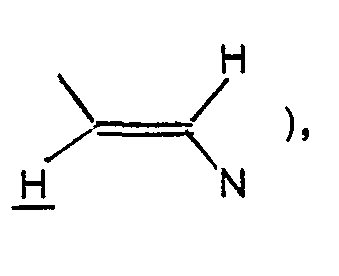
- GLC analysis and NMR analysis confirmed that the fraction was hydroxycitronellal enamine having a purity of 98%.
-

- (a) 8 1 (t, 6H, CH2CH3),
- (e) δ 1 (d, 3H, CH-CH3),
- (f) 8 1.1 (s, 6H, HO

- (d) δ 3.85 (q, 1H,
- (c) δ 5.68 (d, 1H,


- The thus prepared hydroxycitronellal enamine was treated in the same manner as in Example 1, and the resulting hydrolyzed solution was extracted three times with 200 ml of benzene each time. The extracts were combined, washed with 300 ml of a 5% aqueous solution of sulfuric acid, twice with water, and finally, with a saturated aqueous solution of sodium carbonate and dried over anhydrous magnesium sulfate. The benzene was distilled off, and the residue subjected to distillation to yield 73 g of a fraction having a boiling point of from 85 to 90°C/2 mmHg.
- GLC analysis showed that the fraction was hydroxycitronellal having a purity of 99.9%, and the optical rotation was

- The optical rotation of d-hydroxycitronellal as described in W. Skorianetz, H. Giger, and G. Ohloff, Helvetica Chimica Acta., 54, 1797-1801 (1971) is

- While flowing nitrogen through a 400 ml pressure vessel there was placed 229 mg of a rhodium complex, [Rh((S)-(―)BINAP)(norbornadiene)]+ClO4 -, prepared in the same manner as in Example 3, and 60 ml of tetrahydrofuran was added thereto to dissolve the rhodium complex, forming a uniform solution thereof. After the addition of 112 g of hydroxygeranyldiethylamine to the uniform solution, the vessel was sealed and reaction performed by heating at 100°C for 17 hours to yield 110 g of an enamine having a boiling point of from 105 to 108°C/1 mmHg.
- Subsequently, the procedure of Example 3 was repeated to yield 70 g of a fraction having a boiling point of from 75 to 80°C/1 mmHg.
- GLC analysis and measurement of optical rotation confirmed that the fraction was d-hydroxycitronellal having a purity of 99.95% and

- To a mixture of 24.6 mg [Rh(COD)Cl]2 and 52.1 mg

- In a 100 ml pressure vessel maintained under a stream of nitrogen were placed 20 ml of tetrahydrofuran, 10 ml of the catalyst solution as prepared above, and 12 g of 2(Z)6(E)-farnesyldiethyl- amine. The vessel was then sealed, and they were reacted at 100°C for 18 hours. Distillation was performed to yield 10 g of an enamine having a boiling point of from 115 to 120°C/1 mmHg.
- The thus prepared enamine was hydrolyzed using acetic acid and treated in the same manner as in Example 1 to yield 7.2 g of a fraction having a boiling point of from 95 to 100°C/1 mmHg.
- GLC and NMR analyses showed that the fraction was 6(E)-3,7,11-trimethyl-6,11-dodecadien-1-al having a purity of 98%.
-

- (b) δ 1.0 (d, 3H, CH-CH3),
- (e) 8 1.6 (d, 6H,

- (d) 0 1.63 (s, 3H,

- (c) δ 5.04 (t, 2H,

- (f) δ 2.3 (q, 2H, -CH2-CHO),
- (a) 8 9.66 (t, 1H, -CH2-CHO)
- A rhodium complex catalyst, [Rh(COD)((R)-(+)BINAP)]+ClO4 - (0.028 g), which had been prepared in the same manner as in Example 1, was weighed and placed in a flask equipped with a three-way cock, into which was introduced 6 ml of tetrahydrofuran under a stream of argon to dissolve the catalyst. Additionally, 0.71 g of geranylcyclohexylamine was added thereto, and they were reacted at 40°C for 23 hours.
- After the reaction was completed, the tetrahydrofuran was recovered, and an oily fraction was distilled off under reduced pressure to yield 0.7 g of an oily material having a boiling point of 130°C/2 mmHg.
- GLC and NMR analyses showed that the material was the cyclohexylimine of citronellal. The optical rotation was

-

- (a) δ 1.0 (d, 3H, CH-CH3),
- (b) 8 1.6 (d, 6H,

- (c) B 2.9 (m, 1H,

- (e) δ 5.2 (t, 1H, =CH-),
- (e) 8 7.6 (t, 1H, -N=CH-)
- In a pressure bomb which had been purged with argon there was placed 0.28 g of a rhodium complex, [Rh(COD)((R)-(+)BINAP)]+ClO4 -, and 70 ml of tetrahydrofuran was added to dissolve the rhodium complex, forming a uniform solution. Subsequently, 5.3 g of 3-phenylbutene-2-yldimethyl- amine was added and the bomb was sealed and maintained at 60°C for 48 hours to complete isomerization. After the reaction, the solvent was recovered by distillation, and the residue was subjected to distillation to yield 5 g of a fraction having a boiling point of from 117 to 120°C/2 mmHg.
- GLC and NMR analyses showed that the fraction was 3-phenyl-butene-1-yldimethylamine. NMR (CDCI3):

- (f) δ 1.15 (d, 3H, CH-CH3),
- (a) δ 2.5 (s, 6H, N-CH3),
- (d) δ 3.4 (1H, CH-CH=CH-),
- (c) δ 4.4 (q, 1H, CH-CH=CH-N),
- (d) 8 5.9 (d, 1H, CH=CH-N),
- (e) δ 7.2 (5H,

- In order to determine the optical purity of the enamine prepared by the isomerization, the enamine was first converted into the corresponding aldehyde by the same procedure as in Example 1 and, thereafter, in accordance with the method described in:
- (1) A. I. Pearl, Journal of Organic Chemistry, 12, 85 (1947);
- (2) O. Schindler, Pharm. Acta. Helv., 20, 79 (1945): or
- (3) E. Campaigne, Organic Synthesis, 33, 94 (1953),
- (―) -2,3 - o - Isopropylidene - 2,3 - dihydroxy - 1,4 - bis(diortho - tolylphosphino) - butane (66.48 mg), which had been prepared by the method described in H. B. Kagan, Journal of Organometal Chemistry, 91, 105 (1975), and 24.6 mg [Rh(COD)CI]2 were placed in a 20 ml flask equipped with a three-way cock, which was then purged with nitrogen. Then, 10 ml of tetrahydrofuran was added thereto to form a uniform solution, and then 19.5 mg of silver borofluoride was added. The resulting mixture was stirred for 30 minutes. Silver chloride formed was removed by filtration to prepare a rhodium complex catalyst.
- The thus prepared rhodium complex catalyst was transferred into a 100 ml pressure bomb which had been purged with nitrogen gas, and, after the introduction of 12.5 g of 2-methyl- propene-2-yl-pyrrolidine, the bomb was sealed. Isomerization was completed by stirring the mixture at 100°C for 16 hours. After the reaction, the tetrahydrofuran was distilled off and, subsequently, 11 g of a fraction having a boiling point of from 130 to 132°C/760 mmHg was obtained by the distillation.
- GLC and NMR analyses showed that the fraction was 2-methyl-propane-1-yl-pyrrolidine having a purity of 98%.
-

- (c) δ 1.7 (d, 6H,

- (a) 8 2.6 (m, 4H,

- (b) 8 5.06 (t, 1H,

- A rhodium complex catalyst solution (10 ml) prepared in the same manner as in Example 1 was placed in a 100 ml pressure bomb which had previously been purged with nitrogen gas. Then, 20 ml of tetrahydrofuran was added thereto, and, finally, 6.4 g of 1,3-dimethylbutene-2-yl-dimethylamine was added. They were reacted at 110°C for 20 hours. After the reaction was completed, the tetrahydrofuran was distilled off, and 5.6 g of a fraction having a boiling point of from 117 to 120°C/760 mmHg was obtained by the distillation.
- GLC and NMR analyses showed that the fraction was 1,3-dimethyl-butene-1-yl-dimethylamine having a purity of 95%.
-

- (d) 0 1.0 (d, 6H,

- (b) s 1.9 (s, 3H,

- (a) 8 2.5 (s, 6H,

- (c) δ 3.8 (d, 1H,

- Chlorobis(1,3-butadiene)rhodium, RhCl(C4H6)2 (61.5 mg), and 111 mg of triphenylphosphine were placed in a 50 ml flask equipped with a three-way cock, and, after the addition of 25 ml of tetrahydrofuran under a stream of nitrogen, they were stirred for 10 minutes. Thereafter, 2.5 ml of a tetrahydrofuran solution containing 46.0 mg of potassium hexafluorophosphate was added thereto, and the resulting mixture was stirred at 20°C for 30 minutes. Potassium chloride thus formed was removed by filtration to provide a catalyst solution.
- The thus prepared catalyst solution (2 ml) was added to 20 ml of a methanol solution containing 25 g of N-allyl morpholine in a 100 ml bomb, and, after purging with nitrogen gas, they were reacted by heating at 50°C for 2 hours.
- In order to confirm the isomerization reaction, the reaction solution prepared as above was subsequently dropwise added to 200 ml of a 5% aqueous solution of sulfuric acid. The resulting mixture was stirred and allowed to stand short time, an oily fraction was separated. GLC analysis showed that the oily fraction contained 7.5 g of acetaldehyde. Yield was 85.3% based on the weight of N-allyl- morpholine.
- A catalyst solution (2 ml) prepared in the same manner as in Example 1 was added to 30 ml of an acetone solution containing 31 g of N-3,3-dimethylallylpiperidine in a 100 ml autoclave, and, after purging with nitrogen gas, they were reacted by heating at 70°C for 2 hours.
- In order to confirm the isomerization reaction, the reaction solution prepared as above was subsequently dropwise added to 100 m of a 10% aqueous solution of sulfuric acid. The resulting mixture was stirred and allowed to stand short time, an oily fraction was separated. GLC analysis showed that the oily fraction was isovaleraldehyde (15.1 g) having a purity of 98%. Yield was 86.7% based on the weight of N-3,3-dimethylallylpiperidine.
- In preparing a catalyst solution in the same manner as in Examples 1 to 11, the type of the ligand was changed.
- A ligand as shown in the following Table (20 millimoles in the case of a monodentate ligand; 10 millimoles in the case of a bidentate ligand) was mixed with 10 millimoles of Rh(COD)CI2. To the resulting mixture was then added 10 millimoles of silver perchlorate in tetrahydrofuran. The silver chloride formed was removed by filtration, and the filtrate was used as a catalyst.
- Neryldiethylamine was used as the allylamine derivative. With regard to the amount of the catalyst used, the ratio of neryldiethylamine to Rh was adjusted to 1,000/1 in molar ratio.
- Reaction was performed at 100°C for 5 hours. The reaction solution was subjected to GLC analysis, and the amount of enamine formed was calculated. The results are shown in the Table below.

- While the invention has been described in detail and with reference to specific embodiments thereof, it will be apparent to one skilled in the art that various changes and modifications can be made therein without departing from the spirit and scope thereof.
the aldehyde was converted into the corresponding carboxylic acid and its optical rotation was measured as:


Claims (1)
- A process for preparing an enamine represented by formula (II):


Applications Claiming Priority (2)
| Application Number | Priority Date | Filing Date | Title |
|---|---|---|---|
| JP56102039A JPS584748A (en) | 1981-06-30 | 1981-06-30 | Preparation of enamine or imine |
| JP102039/81 | 1981-06-30 |
Publications (2)
| Publication Number | Publication Date |
|---|---|
| EP0068506A1 EP0068506A1 (en) | 1983-01-05 |
| EP0068506B1 true EP0068506B1 (en) | 1984-11-21 |
Family
ID=14316623
Family Applications (1)
| Application Number | Title | Priority Date | Filing Date |
|---|---|---|---|
| EP82105826A Expired EP0068506B1 (en) | 1981-06-30 | 1982-06-30 | Process for the preparation of enamines or imines |
Country Status (5)
| Country | Link |
|---|---|
| US (1) | US4695631A (en) |
| EP (1) | EP0068506B1 (en) |
| JP (1) | JPS584748A (en) |
| DE (1) | DE3261287D1 (en) |
| IN (1) | IN156506B (en) |
Families Citing this family (21)
| Publication number | Priority date | Publication date | Assignee | Title |
|---|---|---|---|---|
| DE3347905C2 (en) * | 1982-04-30 | 1992-03-12 | Ricoh Co., Ltd., Tokio/Tokyo, Jp | |
| DK350283A (en) * | 1982-08-27 | 1984-02-28 | Hoffmann La Roche | PROCEDURE FOR THE MANUFACTURING OF OPTICAL ACTIVE RELATIONS |
| JPS6127949A (en) * | 1984-07-17 | 1986-02-07 | Takasago Corp | Preparation of optically active enamine or imine |
| ATE82745T1 (en) * | 1986-08-21 | 1992-12-15 | Hoffmann La Roche | PROCESSES FOR THE PREPARATION OF OPTICALLY ACTIVE ENAMINES OR THE CORRESPONDING ALDEHYDES. |
| JPS63253062A (en) * | 1988-03-12 | 1988-10-20 | Takasago Kogyo Kk | Production of optically active imine |
| FR2636625B1 (en) * | 1988-09-01 | 1990-11-09 | Jouveinal Sa | DISUBSTITUTED BENZYLAMINES, PROCESS FOR THEIR PREPARATION, THEIR USE AS A MEDICAMENT AND THEIR SYNTHESIS INTERMEDIATES |
| EP0445013B1 (en) * | 1990-02-26 | 1994-06-08 | Jouveinal S.A. | C-cycloalkyl-alkylamines, process for their preparation, their use as therapeutic agents and intermediates for their synthesis |
| JP2960183B2 (en) * | 1991-03-12 | 1999-10-06 | エーザイ株式会社 | Novel terpene derivative and method for producing the same |
| DE4431528A1 (en) * | 1994-09-03 | 1996-03-07 | Basf Ag | Process for the preparation of n-butyraldehyde and / or n-butanol |
| ES2213306T3 (en) * | 1998-04-07 | 2004-08-16 | Firmenich Sa | STEREO-SPECIFIC ISOMERIZATION OF ALILIC AMINAS WITH THE HELP OF QUIRAL PHOSPHORATED LIGANDS. |
| DE60020775T8 (en) | 1999-06-17 | 2006-09-28 | Firmenich S.A. | Stereospecific isomerization of allylic amines using immobilized chiral phospho ligands |
| DE10002976A1 (en) * | 2000-01-24 | 2001-07-26 | Degussa | Molecular weight-increased ligands for asymmetric, homogeneously soluble hydrogenation catalysts, processes for their preparation and use |
| US20050101813A1 (en) * | 2003-09-08 | 2005-05-12 | Degussa Ag, | Molecular weight-enlarged ligands for asymmetric, homogeneously soluble hydrogenation catalysts, process for the production thereof and use |
| US7355075B2 (en) * | 2005-06-16 | 2008-04-08 | The University Of Connecticut | Method of producing imines |
| US7271295B1 (en) * | 2006-10-13 | 2007-09-18 | Lyondell Chemical Technology, L.P. | Hydroformylation process |
| ES2762873T3 (en) | 2012-03-29 | 2020-05-26 | Translate Bio Inc | Ionizable Cationic Lipids |
| JP6054108B2 (en) | 2012-09-07 | 2016-12-27 | 高砂香料工業株式会社 | Process for producing optically active 2,3-dihydrofarnesal |
| EP2969020B1 (en) * | 2013-03-15 | 2017-11-29 | The Procter and Gamble Company | Specific unsaturated and branched functional materials for use in consumer products |
| CN103570515A (en) * | 2013-10-26 | 2014-02-12 | 合肥禾味食品有限公司 | Process for hydrolyzing enamine |
| CN103772170B (en) * | 2013-11-21 | 2015-10-14 | 黄山天香科技股份有限公司 | A kind of catalyzed hydrolytic methods of enamine |
| JP2017081933A (en) * | 2016-11-30 | 2017-05-18 | 高砂香料工業株式会社 | Process for producing optically active 2,3-dihydrofarnesal |
Family Cites Families (2)
| Publication number | Priority date | Publication date | Assignee | Title |
|---|---|---|---|---|
| JPS52133905A (en) * | 1976-04-30 | 1977-11-09 | Sumitomo Chem Co Ltd | Preparation of enamides |
| DE2718666B2 (en) * | 1977-04-27 | 1981-05-21 | Hoechst Ag, 6000 Frankfurt | Process for the preparation of cyclic enamides |
-
1981
- 1981-06-30 JP JP56102039A patent/JPS584748A/en active Granted
-
1982
- 1982-06-30 EP EP82105826A patent/EP0068506B1/en not_active Expired
- 1982-06-30 US US06/393,982 patent/US4695631A/en not_active Expired - Lifetime
- 1982-06-30 DE DE8282105826T patent/DE3261287D1/en not_active Expired
- 1982-12-28 IN IN1500/CAL/82A patent/IN156506B/en unknown
Non-Patent Citations (3)
| Title |
|---|
| J. AM. CHEM. SOC., vol. 102, 1980, Washington D.C. (US) A. MIYASHITA et al.: "Synthesis of 2,2'-Bis(diphenylphosphino)-1,1'-binaphthyl (BINAP), an atropisomeric chiral Bis(triaryl)phosphine, and its use in the rhodium(I)-catalyzed asymmetric hydrogenation of alpha-(acylamino)acrylic acids", pages 7932-7934 * |
| J. ORG. CHEM., vol. 45, 1980, Washington D.C. (US) J.K. STILLE et al.: "Isomerization of N-allylamides and -imides to aliphatic enamides by iron rhodium, and ruthenium complexes", pages 2139-2143 * |
| TETRAHEDRON LETTERS, no. 30, 1977, Pergamon Press, Oxford (US) B. MOREAU et al.: "Utilisation du groupe allyle comme groupe protecteur d'amines application à la synthèse de la biotine", pages 2591-2594 * |
Also Published As
| Publication number | Publication date |
|---|---|
| IN156506B (en) | 1985-08-17 |
| JPS6251945B2 (en) | 1987-11-02 |
| JPS584748A (en) | 1983-01-11 |
| EP0068506A1 (en) | 1983-01-05 |
| DE3261287D1 (en) | 1985-01-03 |
| US4695631A (en) | 1987-09-22 |
Similar Documents
| Publication | Publication Date | Title |
|---|---|---|
| US4695631A (en) | Process for the preparation of enamines or imines | |
| Van Leeuwen et al. | Characterization of the intermediates in the hydroformylation reaction catalyzed by platinum diphenylphosphinous acid complexes | |
| US4119652A (en) | Catalytic asymmetric hydrogenation | |
| Delogu et al. | Hydrocarbonylation of unsaturated nitrogen compounds. Synthesis of N-protected aminoacid derivatives from N-substituted phthalimides | |
| JPH0733392B2 (en) | 2,2'-bis [di (m-tolyl) phosphino] -1,1'-binaphthyl | |
| Takahashi et al. | On olefin synthesis with phosphonate carbanions | |
| EP0271310B1 (en) | Ruthenium-phosphine complexes | |
| Amma et al. | Chiral 1, 2-diphosphine ligands. Synthesis and application to rhodium-catalyzed asymmetric hydrogenations | |
| US7291753B2 (en) | Transfer hydrogenation processes and catalysts | |
| US4343741A (en) | Chiral phosphines | |
| Butler et al. | The synthesis of α-N, N-dimethyl-1′-diphenylphosphinoferrocenylethylamine and related ligands | |
| US2842599A (en) | Carotenoids and intermediates therefor | |
| Mukaiyama et al. | ENANTIOFACE-DIFFERENTIATING (ASYMMETRIC) ADDITION OF ALKYLLITHIUM TO ALDEHYDES BY USING (2 S, 2′ S)-2-HYDROXYMETHYL-1-[(1-METHYLPYRROLIDIN-2-YL) METHYL] PYRROLIDINE AS CHIRAL LIGAND | |
| Inch | Asymmetric synthesis | |
| US5324850A (en) | Preparation of chiral catalysts based on ruthenium and phosphorus complexes | |
| US8124805B2 (en) | Allyl acetate hydroformylation process | |
| JPH0625035A (en) | Preparation of isoprene derivative | |
| US4306082A (en) | Optically active tertiary phosphine oxides and tertiary phosphines and processes for their preparation | |
| EP0170470A2 (en) | Process for the preparation of optically active enamines or imines | |
| JPH1180179A (en) | Phosphine compounds and rhodium complexes using them as ligands | |
| JP3861567B2 (en) | Method for producing cyclododecene | |
| FR2649109A1 (en) | ORGANIC COMPOUNDS OF PHOSPHORUS COMPLEXED BY BORON, THEIR PREPARATION AND APPLICATIONS | |
| US4179579A (en) | Substituted propargyl alcohols, allylic alcohols and unsaturated ketones, and methods for the production thereof | |
| CA1244023A (en) | Amination of conjugated dienes | |
| JP2502936B2 (en) | Novel acetylene derivative |
Legal Events
| Date | Code | Title | Description |
|---|---|---|---|
| PUAI | Public reference made under article 153(3) epc to a published international application that has entered the european phase |
Free format text: ORIGINAL CODE: 0009012 |
|
| AK | Designated contracting states |
Designated state(s): CH DE FR GB LI NL |
|
| 17P | Request for examination filed |
Effective date: 19830505 |
|
| GRAA | (expected) grant |
Free format text: ORIGINAL CODE: 0009210 |
|
| AK | Designated contracting states |
Designated state(s): CH DE FR GB LI NL |
|
| REF | Corresponds to: |
Ref document number: 3261287 Country of ref document: DE Date of ref document: 19850103 |
|
| ET | Fr: translation filed | ||
| PLBE | No opposition filed within time limit |
Free format text: ORIGINAL CODE: 0009261 |
|
| STAA | Information on the status of an ep patent application or granted ep patent |
Free format text: STATUS: NO OPPOSITION FILED WITHIN TIME LIMIT |
|
| 26N | No opposition filed | ||
| PGFP | Annual fee paid to national office [announced via postgrant information from national office to epo] |
Ref country code: FR Payment date: 20010611 Year of fee payment: 20 |
|
| PGFP | Annual fee paid to national office [announced via postgrant information from national office to epo] |
Ref country code: DE Payment date: 20010625 Year of fee payment: 20 |
|
| PGFP | Annual fee paid to national office [announced via postgrant information from national office to epo] |
Ref country code: GB Payment date: 20010627 Year of fee payment: 20 |
|
| PGFP | Annual fee paid to national office [announced via postgrant information from national office to epo] |
Ref country code: NL Payment date: 20010628 Year of fee payment: 20 Ref country code: CH Payment date: 20010628 Year of fee payment: 20 |
|
| REG | Reference to a national code |
Ref country code: GB Ref legal event code: IF02 |
|
| PG25 | Lapsed in a contracting state [announced via postgrant information from national office to epo] |
Ref country code: LI Free format text: LAPSE BECAUSE OF EXPIRATION OF PROTECTION Effective date: 20020629 Ref country code: GB Free format text: LAPSE BECAUSE OF EXPIRATION OF PROTECTION Effective date: 20020629 Ref country code: CH Free format text: LAPSE BECAUSE OF EXPIRATION OF PROTECTION Effective date: 20020629 |
|
| PG25 | Lapsed in a contracting state [announced via postgrant information from national office to epo] |
Ref country code: NL Free format text: LAPSE BECAUSE OF EXPIRATION OF PROTECTION Effective date: 20020630 |
|
| REG | Reference to a national code |
Ref country code: GB Ref legal event code: PE20 Effective date: 20020629 |
|
| REG | Reference to a national code |
Ref country code: CH Ref legal event code: PL |
|
| NLV7 | Nl: ceased due to reaching the maximum lifetime of a patent |
Effective date: 20020630 |