EP0064821B1 - Promoted bismuth cerium molybdate catalysts and use thereof in oxidation-type reactions - Google Patents
Promoted bismuth cerium molybdate catalysts and use thereof in oxidation-type reactions Download PDFInfo
- Publication number
- EP0064821B1 EP0064821B1 EP82301991A EP82301991A EP0064821B1 EP 0064821 B1 EP0064821 B1 EP 0064821B1 EP 82301991 A EP82301991 A EP 82301991A EP 82301991 A EP82301991 A EP 82301991A EP 0064821 B1 EP0064821 B1 EP 0064821B1
- Authority
- EP
- European Patent Office
- Prior art keywords
- catalyst
- alkali metal
- catalysts
- acrylonitrile
- propylene
- Prior art date
- Legal status (The legal status is an assumption and is not a legal conclusion. Google has not performed a legal analysis and makes no representation as to the accuracy of the status listed.)
- Expired
Links
- 239000003054 catalyst Substances 0.000 title claims description 101
- MEFBJEMVZONFCJ-UHFFFAOYSA-N molybdate Chemical compound [O-][Mo]([O-])(=O)=O MEFBJEMVZONFCJ-UHFFFAOYSA-N 0.000 title claims description 16
- IOXJQRFUAXWORF-UHFFFAOYSA-N bismuth cerium Chemical compound [Ce].[Bi] IOXJQRFUAXWORF-UHFFFAOYSA-N 0.000 title claims description 12
- 238000006243 chemical reaction Methods 0.000 title description 21
- 238000000034 method Methods 0.000 claims description 31
- 239000000203 mixture Substances 0.000 claims description 27
- QGZKDVFQNNGYKY-UHFFFAOYSA-N Ammonia Chemical compound N QGZKDVFQNNGYKY-UHFFFAOYSA-N 0.000 claims description 25
- NLHHRLWOUZZQLW-UHFFFAOYSA-N Acrylonitrile Chemical compound C=CC#N NLHHRLWOUZZQLW-UHFFFAOYSA-N 0.000 claims description 22
- QQONPFPTGQHPMA-UHFFFAOYSA-N propylene Natural products CC=C QQONPFPTGQHPMA-UHFFFAOYSA-N 0.000 claims description 19
- 229910052783 alkali metal Inorganic materials 0.000 claims description 17
- 150000001340 alkali metals Chemical class 0.000 claims description 17
- 125000004805 propylene group Chemical group [H]C([H])([H])C([H])([*:1])C([H])([H])[*:2] 0.000 claims description 17
- 229910052772 Samarium Inorganic materials 0.000 claims description 16
- 229910021529 ammonia Inorganic materials 0.000 claims description 11
- 238000007254 oxidation reaction Methods 0.000 claims description 11
- 229910052709 silver Inorganic materials 0.000 claims description 11
- QVGXLLKOCUKJST-UHFFFAOYSA-N atomic oxygen Chemical compound [O] QVGXLLKOCUKJST-UHFFFAOYSA-N 0.000 claims description 10
- 229910052802 copper Inorganic materials 0.000 claims description 10
- 230000003647 oxidation Effects 0.000 claims description 10
- 229910052760 oxygen Inorganic materials 0.000 claims description 10
- 239000001301 oxygen Substances 0.000 claims description 10
- 229910052684 Cerium Inorganic materials 0.000 claims description 9
- 229910052700 potassium Inorganic materials 0.000 claims description 9
- 229910052804 chromium Inorganic materials 0.000 claims description 8
- 229910052776 Thorium Inorganic materials 0.000 claims description 7
- 229910052787 antimony Inorganic materials 0.000 claims description 7
- 229910052726 zirconium Inorganic materials 0.000 claims description 7
- 239000000463 material Substances 0.000 claims description 6
- 230000001737 promoting effect Effects 0.000 claims description 6
- 229910052792 caesium Inorganic materials 0.000 claims description 5
- 239000007789 gas Substances 0.000 claims description 5
- 229910052746 lanthanum Inorganic materials 0.000 claims description 5
- 229910052761 rare earth metal Inorganic materials 0.000 claims description 5
- 229910052701 rubidium Inorganic materials 0.000 claims description 5
- ZLMJMSJWJFRBEC-UHFFFAOYSA-N Potassium Chemical compound [K] ZLMJMSJWJFRBEC-UHFFFAOYSA-N 0.000 claims description 4
- 239000011591 potassium Substances 0.000 claims description 4
- 150000002910 rare earth metals Chemical class 0.000 claims description 4
- FZLIPJUXYLNCLC-UHFFFAOYSA-N lanthanum atom Chemical compound [La] FZLIPJUXYLNCLC-UHFFFAOYSA-N 0.000 claims description 3
- TVFDJXOCXUVLDH-UHFFFAOYSA-N caesium atom Chemical compound [Cs] TVFDJXOCXUVLDH-UHFFFAOYSA-N 0.000 claims 1
- 229910052759 nickel Inorganic materials 0.000 claims 1
- XLYOFNOQVPJJNP-UHFFFAOYSA-N water Substances O XLYOFNOQVPJJNP-UHFFFAOYSA-N 0.000 description 12
- WEVYAHXRMPXWCK-UHFFFAOYSA-N Acetonitrile Chemical compound CC#N WEVYAHXRMPXWCK-UHFFFAOYSA-N 0.000 description 9
- 230000000052 comparative effect Effects 0.000 description 9
- 150000001336 alkenes Chemical class 0.000 description 8
- 239000002585 base Substances 0.000 description 7
- JRZJOMJEPLMPRA-UHFFFAOYSA-N olefin Natural products CCCCCCCC=C JRZJOMJEPLMPRA-UHFFFAOYSA-N 0.000 description 7
- 239000012071 phase Substances 0.000 description 7
- 229910052714 tellurium Inorganic materials 0.000 description 7
- PORWMNRCUJJQNO-UHFFFAOYSA-N tellurium atom Chemical compound [Te] PORWMNRCUJJQNO-UHFFFAOYSA-N 0.000 description 6
- 150000001299 aldehydes Chemical class 0.000 description 5
- 229910052797 bismuth Inorganic materials 0.000 description 5
- JCXGWMGPZLAOME-UHFFFAOYSA-N bismuth atom Chemical compound [Bi] JCXGWMGPZLAOME-UHFFFAOYSA-N 0.000 description 5
- 230000003197 catalytic effect Effects 0.000 description 5
- 238000010348 incorporation Methods 0.000 description 5
- HGINCPLSRVDWNT-UHFFFAOYSA-N Acrolein Chemical compound C=CC=O HGINCPLSRVDWNT-UHFFFAOYSA-N 0.000 description 4
- 150000001298 alcohols Chemical class 0.000 description 4
- 239000006227 byproduct Substances 0.000 description 4
- 239000007795 chemical reaction product Substances 0.000 description 4
- 150000002825 nitriles Chemical class 0.000 description 4
- 239000012041 precatalyst Substances 0.000 description 4
- 239000000047 product Substances 0.000 description 4
- 239000002002 slurry Substances 0.000 description 4
- RDQSSKKUSGYZQB-UHFFFAOYSA-N bismuthanylidyneiron Chemical compound [Fe].[Bi] RDQSSKKUSGYZQB-UHFFFAOYSA-N 0.000 description 3
- GWXLDORMOJMVQZ-UHFFFAOYSA-N cerium Chemical compound [Ce] GWXLDORMOJMVQZ-UHFFFAOYSA-N 0.000 description 3
- 230000007423 decrease Effects 0.000 description 3
- 239000012153 distilled water Substances 0.000 description 3
- 230000000694 effects Effects 0.000 description 3
- LELOWRISYMNNSU-UHFFFAOYSA-N hydrogen cyanide Chemical compound N#C LELOWRISYMNNSU-UHFFFAOYSA-N 0.000 description 3
- 238000002360 preparation method Methods 0.000 description 3
- 239000000376 reactant Substances 0.000 description 3
- IJGRMHOSHXDMSA-UHFFFAOYSA-N Atomic nitrogen Chemical compound N#N IJGRMHOSHXDMSA-UHFFFAOYSA-N 0.000 description 2
- MYMOFIZGZYHOMD-UHFFFAOYSA-N Dioxygen Chemical compound O=O MYMOFIZGZYHOMD-UHFFFAOYSA-N 0.000 description 2
- VQTUBCCKSQIDNK-UHFFFAOYSA-N Isobutene Chemical compound CC(C)=C VQTUBCCKSQIDNK-UHFFFAOYSA-N 0.000 description 2
- KFZMGEQAYNKOFK-UHFFFAOYSA-N Isopropanol Chemical compound CC(C)O KFZMGEQAYNKOFK-UHFFFAOYSA-N 0.000 description 2
- GYCMBHHDWRMZGG-UHFFFAOYSA-N Methylacrylonitrile Chemical compound CC(=C)C#N GYCMBHHDWRMZGG-UHFFFAOYSA-N 0.000 description 2
- 229910052779 Neodymium Inorganic materials 0.000 description 2
- 229910052777 Praseodymium Inorganic materials 0.000 description 2
- DKGAVHZHDRPRBM-UHFFFAOYSA-N Tert-Butanol Chemical compound CC(C)(C)O DKGAVHZHDRPRBM-UHFFFAOYSA-N 0.000 description 2
- PNEYBMLMFCGWSK-UHFFFAOYSA-N aluminium oxide Inorganic materials [O-2].[O-2].[O-2].[Al+3].[Al+3] PNEYBMLMFCGWSK-UHFFFAOYSA-N 0.000 description 2
- QGAVSDVURUSLQK-UHFFFAOYSA-N ammonium heptamolybdate Chemical compound N.N.N.N.N.N.O.O.O.O.O.O.O.O.O.O.O.O.O.O.O.O.O.O.O.O.O.O.O.O.[Mo].[Mo].[Mo].[Mo].[Mo].[Mo].[Mo] QGAVSDVURUSLQK-UHFFFAOYSA-N 0.000 description 2
- 229910001882 dioxygen Inorganic materials 0.000 description 2
- 238000004821 distillation Methods 0.000 description 2
- 229930195733 hydrocarbon Natural products 0.000 description 2
- 150000002430 hydrocarbons Chemical class 0.000 description 2
- 239000004615 ingredient Substances 0.000 description 2
- 239000007791 liquid phase Substances 0.000 description 2
- 229910000069 nitrogen hydride Inorganic materials 0.000 description 2
- BDERNNFJNOPAEC-UHFFFAOYSA-N propan-1-ol Chemical compound CCCO BDERNNFJNOPAEC-UHFFFAOYSA-N 0.000 description 2
- 238000010992 reflux Methods 0.000 description 2
- 229930195734 saturated hydrocarbon Natural products 0.000 description 2
- RMAQACBXLXPBSY-UHFFFAOYSA-N silicic acid Chemical compound O[Si](O)(O)O RMAQACBXLXPBSY-UHFFFAOYSA-N 0.000 description 2
- 239000000126 substance Substances 0.000 description 2
- 239000002699 waste material Substances 0.000 description 2
- 229910052727 yttrium Inorganic materials 0.000 description 2
- SMZOUWXMTYCWNB-UHFFFAOYSA-N 2-(2-methoxy-5-methylphenyl)ethanamine Chemical compound COC1=CC=C(C)C=C1CCN SMZOUWXMTYCWNB-UHFFFAOYSA-N 0.000 description 1
- NIXOWILDQLNWCW-UHFFFAOYSA-N 2-Propenoic acid Natural products OC(=O)C=C NIXOWILDQLNWCW-UHFFFAOYSA-N 0.000 description 1
- OKTJSMMVPCPJKN-UHFFFAOYSA-N Carbon Chemical compound [C] OKTJSMMVPCPJKN-UHFFFAOYSA-N 0.000 description 1
- STNJBCKSHOAVAJ-UHFFFAOYSA-N Methacrolein Chemical compound CC(=C)C=O STNJBCKSHOAVAJ-UHFFFAOYSA-N 0.000 description 1
- ZOKXTWBITQBERF-UHFFFAOYSA-N Molybdenum Chemical compound [Mo] ZOKXTWBITQBERF-UHFFFAOYSA-N 0.000 description 1
- 229910017974 NH40H Inorganic materials 0.000 description 1
- GRYLNZFGIOXLOG-UHFFFAOYSA-N Nitric acid Chemical compound O[N+]([O-])=O GRYLNZFGIOXLOG-UHFFFAOYSA-N 0.000 description 1
- -1 SbP04 Inorganic materials 0.000 description 1
- 230000001668 ameliorated effect Effects 0.000 description 1
- 230000015572 biosynthetic process Effects 0.000 description 1
- PPNKDDZCLDMRHS-UHFFFAOYSA-N bismuth(III) nitrate Inorganic materials [Bi+3].[O-][N+]([O-])=O.[O-][N+]([O-])=O.[O-][N+]([O-])=O PPNKDDZCLDMRHS-UHFFFAOYSA-N 0.000 description 1
- 229910000149 boron phosphate Inorganic materials 0.000 description 1
- 229910052799 carbon Inorganic materials 0.000 description 1
- 125000004432 carbon atom Chemical group C* 0.000 description 1
- 239000000969 carrier Substances 0.000 description 1
- 229910052681 coesite Inorganic materials 0.000 description 1
- 238000007796 conventional method Methods 0.000 description 1
- 239000002826 coolant Substances 0.000 description 1
- 229910052906 cristobalite Inorganic materials 0.000 description 1
- 230000002939 deleterious effect Effects 0.000 description 1
- DKUYEPUUXLQPPX-UHFFFAOYSA-N dibismuth;molybdenum;oxygen(2-) Chemical compound [O-2].[O-2].[O-2].[O-2].[O-2].[O-2].[O-2].[O-2].[O-2].[Mo].[Mo].[Bi+3].[Bi+3] DKUYEPUUXLQPPX-UHFFFAOYSA-N 0.000 description 1
- 238000007865 diluting Methods 0.000 description 1
- 239000003085 diluting agent Substances 0.000 description 1
- 238000002474 experimental method Methods 0.000 description 1
- 239000007792 gaseous phase Substances 0.000 description 1
- XEEYBQQBJWHFJM-UHFFFAOYSA-N iron Substances [Fe] XEEYBQQBJWHFJM-UHFFFAOYSA-N 0.000 description 1
- 229910052742 iron Inorganic materials 0.000 description 1
- 239000007788 liquid Substances 0.000 description 1
- 229910052744 lithium Inorganic materials 0.000 description 1
- 229910052751 metal Inorganic materials 0.000 description 1
- 239000002184 metal Substances 0.000 description 1
- 229910001960 metal nitrate Inorganic materials 0.000 description 1
- 150000002739 metals Chemical class 0.000 description 1
- 229910052750 molybdenum Inorganic materials 0.000 description 1
- 239000011733 molybdenum Substances 0.000 description 1
- 229910017604 nitric acid Inorganic materials 0.000 description 1
- 229910052757 nitrogen Inorganic materials 0.000 description 1
- 239000000843 powder Substances 0.000 description 1
- 239000002244 precipitate Substances 0.000 description 1
- 239000011541 reaction mixture Substances 0.000 description 1
- VYPSYNLAJGMNEJ-UHFFFAOYSA-N silicon dioxide Inorganic materials O=[Si]=O VYPSYNLAJGMNEJ-UHFFFAOYSA-N 0.000 description 1
- 229910052708 sodium Inorganic materials 0.000 description 1
- 239000011734 sodium Substances 0.000 description 1
- 229910000162 sodium phosphate Inorganic materials 0.000 description 1
- 239000001488 sodium phosphate Substances 0.000 description 1
- 239000007858 starting material Substances 0.000 description 1
- 229910052682 stishovite Inorganic materials 0.000 description 1
- 229910052719 titanium Inorganic materials 0.000 description 1
- 229910052905 tridymite Inorganic materials 0.000 description 1
- RYFMWSXOAZQYPI-UHFFFAOYSA-K trisodium phosphate Chemical compound [Na+].[Na+].[Na+].[O-]P([O-])([O-])=O RYFMWSXOAZQYPI-UHFFFAOYSA-K 0.000 description 1
- 238000003809 water extraction Methods 0.000 description 1
Classifications
-
- C—CHEMISTRY; METALLURGY
- C07—ORGANIC CHEMISTRY
- C07C—ACYCLIC OR CARBOCYCLIC COMPOUNDS
- C07C253/00—Preparation of carboxylic acid nitriles
- C07C253/24—Preparation of carboxylic acid nitriles by ammoxidation of hydrocarbons or substituted hydrocarbons
- C07C253/26—Preparation of carboxylic acid nitriles by ammoxidation of hydrocarbons or substituted hydrocarbons containing carbon-to-carbon multiple bonds, e.g. unsaturated aldehydes
-
- B—PERFORMING OPERATIONS; TRANSPORTING
- B01—PHYSICAL OR CHEMICAL PROCESSES OR APPARATUS IN GENERAL
- B01J—CHEMICAL OR PHYSICAL PROCESSES, e.g. CATALYSIS OR COLLOID CHEMISTRY; THEIR RELEVANT APPARATUS
- B01J23/00—Catalysts comprising metals or metal oxides or hydroxides, not provided for in group B01J21/00
- B01J23/16—Catalysts comprising metals or metal oxides or hydroxides, not provided for in group B01J21/00 of arsenic, antimony, bismuth, vanadium, niobium, tantalum, polonium, chromium, molybdenum, tungsten, manganese, technetium or rhenium
- B01J23/24—Chromium, molybdenum or tungsten
- B01J23/31—Chromium, molybdenum or tungsten combined with bismuth
-
- B—PERFORMING OPERATIONS; TRANSPORTING
- B01—PHYSICAL OR CHEMICAL PROCESSES OR APPARATUS IN GENERAL
- B01J—CHEMICAL OR PHYSICAL PROCESSES, e.g. CATALYSIS OR COLLOID CHEMISTRY; THEIR RELEVANT APPARATUS
- B01J23/00—Catalysts comprising metals or metal oxides or hydroxides, not provided for in group B01J21/00
- B01J23/38—Catalysts comprising metals or metal oxides or hydroxides, not provided for in group B01J21/00 of noble metals
- B01J23/54—Catalysts comprising metals or metal oxides or hydroxides, not provided for in group B01J21/00 of noble metals combined with metals, oxides or hydroxides provided for in groups B01J23/02 - B01J23/36
- B01J23/66—Silver or gold
- B01J23/68—Silver or gold with arsenic, antimony, bismuth, vanadium, niobium, tantalum, polonium, chromium, molybdenum, tungsten, manganese, technetium or rhenium
- B01J23/683—Silver or gold with arsenic, antimony, bismuth, vanadium, niobium, tantalum, polonium, chromium, molybdenum, tungsten, manganese, technetium or rhenium with chromium, molybdenum or tungsten
- B01J23/686—Silver or gold with arsenic, antimony, bismuth, vanadium, niobium, tantalum, polonium, chromium, molybdenum, tungsten, manganese, technetium or rhenium with chromium, molybdenum or tungsten with molybdenum
-
- B—PERFORMING OPERATIONS; TRANSPORTING
- B01—PHYSICAL OR CHEMICAL PROCESSES OR APPARATUS IN GENERAL
- B01J—CHEMICAL OR PHYSICAL PROCESSES, e.g. CATALYSIS OR COLLOID CHEMISTRY; THEIR RELEVANT APPARATUS
- B01J23/00—Catalysts comprising metals or metal oxides or hydroxides, not provided for in group B01J21/00
- B01J23/70—Catalysts comprising metals or metal oxides or hydroxides, not provided for in group B01J21/00 of the iron group metals or copper
- B01J23/76—Catalysts comprising metals or metal oxides or hydroxides, not provided for in group B01J21/00 of the iron group metals or copper combined with metals, oxides or hydroxides provided for in groups B01J23/02 - B01J23/36
- B01J23/84—Catalysts comprising metals or metal oxides or hydroxides, not provided for in group B01J21/00 of the iron group metals or copper combined with metals, oxides or hydroxides provided for in groups B01J23/02 - B01J23/36 with arsenic, antimony, bismuth, vanadium, niobium, tantalum, polonium, chromium, molybdenum, tungsten, manganese, technetium or rhenium
- B01J23/85—Chromium, molybdenum or tungsten
- B01J23/88—Molybdenum
- B01J23/885—Molybdenum and copper
-
- C—CHEMISTRY; METALLURGY
- C07—ORGANIC CHEMISTRY
- C07C—ACYCLIC OR CARBOCYCLIC COMPOUNDS
- C07C45/00—Preparation of compounds having >C = O groups bound only to carbon or hydrogen atoms; Preparation of chelates of such compounds
- C07C45/27—Preparation of compounds having >C = O groups bound only to carbon or hydrogen atoms; Preparation of chelates of such compounds by oxidation
- C07C45/32—Preparation of compounds having >C = O groups bound only to carbon or hydrogen atoms; Preparation of chelates of such compounds by oxidation with molecular oxygen
- C07C45/33—Preparation of compounds having >C = O groups bound only to carbon or hydrogen atoms; Preparation of chelates of such compounds by oxidation with molecular oxygen of CHx-moieties
- C07C45/34—Preparation of compounds having >C = O groups bound only to carbon or hydrogen atoms; Preparation of chelates of such compounds by oxidation with molecular oxygen of CHx-moieties in unsaturated compounds
-
- C—CHEMISTRY; METALLURGY
- C07—ORGANIC CHEMISTRY
- C07C—ACYCLIC OR CARBOCYCLIC COMPOUNDS
- C07C45/00—Preparation of compounds having >C = O groups bound only to carbon or hydrogen atoms; Preparation of chelates of such compounds
- C07C45/27—Preparation of compounds having >C = O groups bound only to carbon or hydrogen atoms; Preparation of chelates of such compounds by oxidation
- C07C45/32—Preparation of compounds having >C = O groups bound only to carbon or hydrogen atoms; Preparation of chelates of such compounds by oxidation with molecular oxygen
- C07C45/33—Preparation of compounds having >C = O groups bound only to carbon or hydrogen atoms; Preparation of chelates of such compounds by oxidation with molecular oxygen of CHx-moieties
- C07C45/34—Preparation of compounds having >C = O groups bound only to carbon or hydrogen atoms; Preparation of chelates of such compounds by oxidation with molecular oxygen of CHx-moieties in unsaturated compounds
- C07C45/35—Preparation of compounds having >C = O groups bound only to carbon or hydrogen atoms; Preparation of chelates of such compounds by oxidation with molecular oxygen of CHx-moieties in unsaturated compounds in propene or isobutene
-
- C—CHEMISTRY; METALLURGY
- C07—ORGANIC CHEMISTRY
- C07C—ACYCLIC OR CARBOCYCLIC COMPOUNDS
- C07C45/00—Preparation of compounds having >C = O groups bound only to carbon or hydrogen atoms; Preparation of chelates of such compounds
- C07C45/27—Preparation of compounds having >C = O groups bound only to carbon or hydrogen atoms; Preparation of chelates of such compounds by oxidation
- C07C45/32—Preparation of compounds having >C = O groups bound only to carbon or hydrogen atoms; Preparation of chelates of such compounds by oxidation with molecular oxygen
- C07C45/37—Preparation of compounds having >C = O groups bound only to carbon or hydrogen atoms; Preparation of chelates of such compounds by oxidation with molecular oxygen of >C—O—functional groups to >C=O groups
-
- C—CHEMISTRY; METALLURGY
- C07—ORGANIC CHEMISTRY
- C07C—ACYCLIC OR CARBOCYCLIC COMPOUNDS
- C07C45/00—Preparation of compounds having >C = O groups bound only to carbon or hydrogen atoms; Preparation of chelates of such compounds
- C07C45/27—Preparation of compounds having >C = O groups bound only to carbon or hydrogen atoms; Preparation of chelates of such compounds by oxidation
- C07C45/32—Preparation of compounds having >C = O groups bound only to carbon or hydrogen atoms; Preparation of chelates of such compounds by oxidation with molecular oxygen
- C07C45/37—Preparation of compounds having >C = O groups bound only to carbon or hydrogen atoms; Preparation of chelates of such compounds by oxidation with molecular oxygen of >C—O—functional groups to >C=O groups
- C07C45/38—Preparation of compounds having >C = O groups bound only to carbon or hydrogen atoms; Preparation of chelates of such compounds by oxidation with molecular oxygen of >C—O—functional groups to >C=O groups being a primary hydroxyl group
-
- C—CHEMISTRY; METALLURGY
- C07—ORGANIC CHEMISTRY
- C07C—ACYCLIC OR CARBOCYCLIC COMPOUNDS
- C07C5/00—Preparation of hydrocarbons from hydrocarbons containing the same number of carbon atoms
- C07C5/42—Preparation of hydrocarbons from hydrocarbons containing the same number of carbon atoms by dehydrogenation with a hydrogen acceptor
- C07C5/48—Preparation of hydrocarbons from hydrocarbons containing the same number of carbon atoms by dehydrogenation with a hydrogen acceptor with oxygen as an acceptor
-
- B—PERFORMING OPERATIONS; TRANSPORTING
- B01—PHYSICAL OR CHEMICAL PROCESSES OR APPARATUS IN GENERAL
- B01J—CHEMICAL OR PHYSICAL PROCESSES, e.g. CATALYSIS OR COLLOID CHEMISTRY; THEIR RELEVANT APPARATUS
- B01J2523/00—Constitutive chemical elements of heterogeneous catalysts
-
- C—CHEMISTRY; METALLURGY
- C07—ORGANIC CHEMISTRY
- C07C—ACYCLIC OR CARBOCYCLIC COMPOUNDS
- C07C2521/00—Catalysts comprising the elements, oxides or hydroxides of magnesium, boron, aluminium, carbon, silicon, titanium, zirconium or hafnium
- C07C2521/06—Silicon, titanium, zirconium or hafnium; Oxides or hydroxides thereof
-
- C—CHEMISTRY; METALLURGY
- C07—ORGANIC CHEMISTRY
- C07C—ACYCLIC OR CARBOCYCLIC COMPOUNDS
- C07C2523/00—Catalysts comprising metals or metal oxides or hydroxides, not provided for in group C07C2521/00
- C07C2523/02—Catalysts comprising metals or metal oxides or hydroxides, not provided for in group C07C2521/00 of the alkali- or alkaline earth metals or beryllium
- C07C2523/04—Alkali metals
-
- C—CHEMISTRY; METALLURGY
- C07—ORGANIC CHEMISTRY
- C07C—ACYCLIC OR CARBOCYCLIC COMPOUNDS
- C07C2523/00—Catalysts comprising metals or metal oxides or hydroxides, not provided for in group C07C2521/00
- C07C2523/08—Catalysts comprising metals or metal oxides or hydroxides, not provided for in group C07C2521/00 of gallium, indium or thallium
-
- C—CHEMISTRY; METALLURGY
- C07—ORGANIC CHEMISTRY
- C07C—ACYCLIC OR CARBOCYCLIC COMPOUNDS
- C07C2523/00—Catalysts comprising metals or metal oxides or hydroxides, not provided for in group C07C2521/00
- C07C2523/10—Catalysts comprising metals or metal oxides or hydroxides, not provided for in group C07C2521/00 of rare earths
-
- C—CHEMISTRY; METALLURGY
- C07—ORGANIC CHEMISTRY
- C07C—ACYCLIC OR CARBOCYCLIC COMPOUNDS
- C07C2523/00—Catalysts comprising metals or metal oxides or hydroxides, not provided for in group C07C2521/00
- C07C2523/12—Catalysts comprising metals or metal oxides or hydroxides, not provided for in group C07C2521/00 of actinides
-
- C—CHEMISTRY; METALLURGY
- C07—ORGANIC CHEMISTRY
- C07C—ACYCLIC OR CARBOCYCLIC COMPOUNDS
- C07C2523/00—Catalysts comprising metals or metal oxides or hydroxides, not provided for in group C07C2521/00
- C07C2523/16—Catalysts comprising metals or metal oxides or hydroxides, not provided for in group C07C2521/00 of arsenic, antimony, bismuth, vanadium, niobium, tantalum, polonium, chromium, molybdenum, tungsten, manganese, technetium or rhenium
- C07C2523/18—Arsenic, antimony or bismuth
-
- C—CHEMISTRY; METALLURGY
- C07—ORGANIC CHEMISTRY
- C07C—ACYCLIC OR CARBOCYCLIC COMPOUNDS
- C07C2523/00—Catalysts comprising metals or metal oxides or hydroxides, not provided for in group C07C2521/00
- C07C2523/16—Catalysts comprising metals or metal oxides or hydroxides, not provided for in group C07C2521/00 of arsenic, antimony, bismuth, vanadium, niobium, tantalum, polonium, chromium, molybdenum, tungsten, manganese, technetium or rhenium
- C07C2523/24—Chromium, molybdenum or tungsten
- C07C2523/26—Chromium
-
- C—CHEMISTRY; METALLURGY
- C07—ORGANIC CHEMISTRY
- C07C—ACYCLIC OR CARBOCYCLIC COMPOUNDS
- C07C2523/00—Catalysts comprising metals or metal oxides or hydroxides, not provided for in group C07C2521/00
- C07C2523/16—Catalysts comprising metals or metal oxides or hydroxides, not provided for in group C07C2521/00 of arsenic, antimony, bismuth, vanadium, niobium, tantalum, polonium, chromium, molybdenum, tungsten, manganese, technetium or rhenium
- C07C2523/24—Chromium, molybdenum or tungsten
- C07C2523/28—Molybdenum
-
- C—CHEMISTRY; METALLURGY
- C07—ORGANIC CHEMISTRY
- C07C—ACYCLIC OR CARBOCYCLIC COMPOUNDS
- C07C2523/00—Catalysts comprising metals or metal oxides or hydroxides, not provided for in group C07C2521/00
- C07C2523/16—Catalysts comprising metals or metal oxides or hydroxides, not provided for in group C07C2521/00 of arsenic, antimony, bismuth, vanadium, niobium, tantalum, polonium, chromium, molybdenum, tungsten, manganese, technetium or rhenium
- C07C2523/24—Chromium, molybdenum or tungsten
- C07C2523/31—Chromium, molybdenum or tungsten combined with bismuth
-
- C—CHEMISTRY; METALLURGY
- C07—ORGANIC CHEMISTRY
- C07C—ACYCLIC OR CARBOCYCLIC COMPOUNDS
- C07C2523/00—Catalysts comprising metals or metal oxides or hydroxides, not provided for in group C07C2521/00
- C07C2523/38—Catalysts comprising metals or metal oxides or hydroxides, not provided for in group C07C2521/00 of noble metals
- C07C2523/48—Silver or gold
- C07C2523/50—Silver
-
- C—CHEMISTRY; METALLURGY
- C07—ORGANIC CHEMISTRY
- C07C—ACYCLIC OR CARBOCYCLIC COMPOUNDS
- C07C2523/00—Catalysts comprising metals or metal oxides or hydroxides, not provided for in group C07C2521/00
- C07C2523/70—Catalysts comprising metals or metal oxides or hydroxides, not provided for in group C07C2521/00 of the iron group metals or copper
- C07C2523/72—Copper
-
- C—CHEMISTRY; METALLURGY
- C07—ORGANIC CHEMISTRY
- C07C—ACYCLIC OR CARBOCYCLIC COMPOUNDS
- C07C2527/00—Catalysts comprising the elements or compounds of halogens, sulfur, selenium, tellurium, phosphorus or nitrogen; Catalysts comprising carbon compounds
- C07C2527/02—Sulfur, selenium or tellurium; Compounds thereof
- C07C2527/057—Selenium or tellurium; Compounds thereof
-
- Y—GENERAL TAGGING OF NEW TECHNOLOGICAL DEVELOPMENTS; GENERAL TAGGING OF CROSS-SECTIONAL TECHNOLOGIES SPANNING OVER SEVERAL SECTIONS OF THE IPC; TECHNICAL SUBJECTS COVERED BY FORMER USPC CROSS-REFERENCE ART COLLECTIONS [XRACs] AND DIGESTS
- Y02—TECHNOLOGIES OR APPLICATIONS FOR MITIGATION OR ADAPTATION AGAINST CLIMATE CHANGE
- Y02P—CLIMATE CHANGE MITIGATION TECHNOLOGIES IN THE PRODUCTION OR PROCESSING OF GOODS
- Y02P20/00—Technologies relating to chemical industry
- Y02P20/50—Improvements relating to the production of bulk chemicals
- Y02P20/52—Improvements relating to the production of bulk chemicals using catalysts, e.g. selective catalysts
Definitions
- the present invention relates to new catalyst systems for ammoxidizing propylene to produce acrylonitrile.
- GB-A-1,445,512 there is disclosed a process for the preparation of methacrylonitrile in which isobutene, ammonia and oxygen or a molecular oxygen containing gas are reacted in a gaseous phase in the presence of a catalyst, the catalyst containing the elements in such amounts that its empirical formula is:- in which Me represents one or more of the elements Li, Na, K, Rb, and Cs, v is from 0.1 to 6, x and y are each from 1 to 12, and z has a value taken to satisfy the average valences of the elements in the oxidation states in which they exist in the catalyst.
- a catalyst of use in the preparation of acrylonitrile or methacrylonitrile which catalyst has tellurium as a promoter.
- This catalyst has the formula: in which A represents Fe, Cr, AI, Bi or a mixture of two or more of these metals
- known bismuth cerium molybdate redox catalysts are improved by the incorporation therein of a promoting amount of an alkali metal, TI, Sm, Ag, Cu, Cr, Sb, rare earth, other than Ce and Sm, Te, Ti, Zr, Th or mixture thereof in certain ratios.
- the present invention provides a process for ammoxidizing propylene to produce acrylonitrile wherein propylene, ammonia and an oxygen-containing gas are contacted with an oxidation catalyst at elevated temperature to produce said acrylonitrile, characterised in that there is used as catalyst a bismuth cerium molybdate oxide complex oxidation catalyst containing a promoting amount of an alkali metal, TI, Sm, Ag, Cu, Cr, Sb, rare earth metal other than Ce and Sm, Te, Ti, Zr, Th or mixture thereof, wherein the molar ratios of (Bi+Ce):(W+V+Mo) is in the range from 1/2 to 5/6, inclusive, which catalyst is a single phase material isostructural with lanthanum molybdate.
- Bismuth cerium molybdate redox catalysts are known. See, for example, U.S. Patents 3,173,957; 3,262,962 and 3,316,182.
- this improvement will be reflected in an increase in product yields, which is a measure of the amount of product produced based on the amount of reactant fed.
- this improvement will be reflected in an increase in product selectivity, which is a measure of the ability of the catalyst preferentially to form the desired product as opposed to unwanted byproducts.
- catalysts of the invention produce byproduct effluents with very low chemical oxidation demand (COD) and are thus environmentally superior to many known redox catalysts such as the iron bismuth molybdates.
- the elements found to be effective promoters in accordance with the invention are (I) Sm or a monovalent element such as alkali metals, TI, Ag and Cu, preferably K, Rb and/or Cs, (2) elements whose most common valence state is 4+, e.g. Te, Ti, Zr and Th, and (3) Cr, Sb and rare earths other than Ce and Sm, such as La, Y, Pr, Nd and Di. These elements can be incorporated into the bismuth cerium molybdate base systems alone or in admixture.
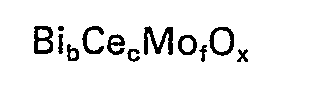
- the catalysts of the invention preferably correspond to the following general formula wherein
- catalysts of special interest are those containing Sm or a monovalent promoter, i.e. an A element and optionally Cr and/or Sb. These catalysts can be defined by the formula: wherein
- the catalysts of the invention satisfy the relation Of these catalyst even more preferred are those in which
- the exact amount of A, R or Q promoter element to be incorporated therein must also be appropriately selected.
- the incorporation of the above-described A, R and Q elements into known bismuth cerium molybdate catalysts will exhibit a promoting effect on the catalysts in various oxidation-type reactions.
- Those skilled in the art can easily determine how much of a particular A, Q or R elements should be incorporated into a particular bismuth cerium molybdate base system to promote a particular oxidation-type reaction by simple routine experimentation, especially in view of the following working examples.
- the catalysts of the invention are essentially single-phase systems being isostructural with lanthanum molybdate (La 2 Mo 3 0, 2 ). See W. Jeitschko, Acta, Cryst. B29, 2074 (1973). They are therefore different from the known iron bismuth molybdates which are multi-phase materials.
- the catalysts of the invention can be used either in unsupported form or supported on suitable carriers such as Si0 2 , AI 2 0 3 , BP0 4 , SbP0 4 , Zr0 2 , Ti0 2 , Alundum and the like.
- suitable carriers such as Si0 2 , AI 2 0 3 , BP0 4 , SbP0 4 , Zr0 2 , Ti0 2 , Alundum and the like.
- the catalysts can also be coated on these supports by special techniques known in the art.
- These catalysts can be prepared by conventional techniques such as disclosed in U.S. Patent No. 3,642,930. These catalysts are most easily prepared by slurry techniques wherein an aqueous slurry containing all of the elements in the objective catalyst is produced, the water removed from the aqueous slurry to form a precatalyst precipitate or powder and the precatalyst then heated in the presence of an oxygen-containing gas such as air at elevated temperature to calcine the precatalyst thereby forming the catalyst.
- Liquids other than water, such as C, to C 8 alcohols can also be used to form the precatalyst slurry.
- the catalysts of the invention find significant use in the ammoxidation of propylene to produce acrylonitrile.
- This reaction is well known and described, for example, in the above-noted U.S. Patent 3,642,930.
- the ammoxidation reaction is accomplished by contacting the reactant, oxygen and ammonia with a particular catalyst in the vapour phase.
- the reaction according to the invention is carried out in the same manner and under the conditions generally set forth in that patent.
- the process of the invention comprises contacting a mixture comprising propylene, ammonia and oxygen with the catalyst according to the invention at an elevated temperature and at atmospheric or near atmospheric pressure.
- the molar ratio of oxygen to the olefin in the feed to the reaction vessel should be in the range of 0.5:1 to 4:1 and a ratio of about 1:1 to 3:1 is preferred.
- the molar ratio of ammonia to olefin in the feed to the reactor may vary between about 0.05:1 to 5:1. There is no real upper limit for the ammonia/olefin ratio, but there is generally no reason to exceed the 5:1 ratio. At ammonia/olefin ratios appreciably less than the stoichiometric ratio of 1:1, various amounts of oxygenated derivatives of the olefin will be formed.
- Water can also be included in the feed although it is not essential. In some instances, e.g. fixed-bed systems, water may improve the selectivity of the reaction and the yield of nitrile. However, reactions not including water in the feed are within the scope of the present invention and are preferred in the fluid-bed operation.
- the molar ratio of added water to olefin, when water is added is in the neighbourhood of 0.1:1 or higher. Ratios on the order of 1:1 to 6:1 are particularly desirable, but higher ratios may be employed, i.e. up to about 10:1.
- the reaction is carried out at an elevated temperature such as 200 to 600°C, preferably 400°C to 550°C, more preferably 420°C to 500°C.
- the reaction should be carried out at about atmospheric or slightly above atmospheric (2 to 3 atmospheres (2.02 to 3.03 bars)) pressure. In general, high pressure, i.e. above 15 atmospheres (15.19 bars) are not suitable since higher pressures tend to favour the formation of undesirable byproducts.
- the apparent contact time is not critical, and contact times in the range from 0.1-40 seconds may be employed.
- the optimal contact time will, of course, vary depending upon the reactant being used, but in general, contact time of from 1-15 seconds is preferred.
- the inventive ammoxidation reaction is carried out in the vapour phase. Normally, the process is conducted on a continuous basis using either a fixed-bed or a fluid-bed catalyst. However, a batch operation can be employed.
- the reaction product passing out of the reactor is normally in the form of a vapour.
- this gaseous reaction product is treated to remove NH 3 and then partially condensed either by indirect contact with a cooling medium or direct contact with water to form a liquid phase containing acrylonitrile, acrolein, acrylic acid, HCN and acetonitrile and a vapour phase containing C0 2 , CO, N 2 and 0 2 .
- the acrylonitrile is then separated from the liquid phase by a number of different techniques such as, for example, distillation or water extraction/distillation. Additional steps can be employed to separately recover HCN and/or acetonitrile from the gross reaction product.
- hydrocarbons and oxygenated hydrocarbons can be ammoxidized with the catalysts of the invention.
- alcohols such as isopropanol, n-propanol, t-butyl alcohol, and aldehydes such as acrolein and methacrolein can be readily converted to nitriles in accordance with the present invention.
- other preferred starting materials are aldehydes and alcohols containing three or four carbon atoms. The general ammoxidation process for converting olefins, alcohols and aldehydes to nitrile is well known and described for example in U.S. 3,456,138.
- any apparatus of the type suitable for carrying out the oxidation reactions in the vapour phase may be employed.
- the processes may be conducted either continuously or intermittently.
- the catalyst may be a fixed-bed employing a particulate or pelleted catalyst or, in the alternative, a fluid-bed catalyst may be employed which is normally micro-spheroidal.
- a catalyst having the composition set forth in the following tables was prepared in accordance with a standard laboratory preparation.
- the catalyst of Examples 1 to 3 was prepared as follows:
- the catalysts of the invention provide significant yields of acrylonitrile when used in the conventional ammoxidation reaction.
- these catalysts are of significant commercial interest in this field.
- these catalysts are also advantageous because they are redox stable and they provide an environmentally acceptable effluent (i.e. a byproduct effluent with a very low COD).
- Example 3 was repeated except that the bismuth content of the catalyst was replaced with tellurium.
- the results obtained, as well as the results of Example 3 and Comparative Example B, are set forth in the following Table 2.
- Examples 1 to 10 were repeated using various different R and Q promoters of the invention. In these examples a portion of the cerium and/or bismuth was replaced with the R or Q element so that a stoichiometric balance with respect of molybdenum could be maintained. The results are set forth in the following Table 3.
- Table 4 shows that the catalysts of the invention are vastly superior to known complex bismuth molybdate in terms of producing environmentally acceptable effluents.
- the catalysts of the invention are particularly attractive from a commercial standpoint in that they provide both excellent produce yields (Example 3 and 9 above) and much cleaner waste effluents than known bismuth molybdates.
Landscapes
- Chemical & Material Sciences (AREA)
- Organic Chemistry (AREA)
- Engineering & Computer Science (AREA)
- Materials Engineering (AREA)
- Chemical Kinetics & Catalysis (AREA)
- Organic Low-Molecular-Weight Compounds And Preparation Thereof (AREA)
- Catalysts (AREA)
- Low-Molecular Organic Synthesis Reactions Using Catalysts (AREA)
Description
- The present invention relates to new catalyst systems for ammoxidizing propylene to produce acrylonitrile.
- The catalytic ammoxidation of propylene to produce acrylonitrile is a well known process. Many different catalysts have been proposed for this process. While such catalysts are capable of providing excellent yields of acrylonitrile, it is always desirable to provide new catalysts especially effective in this reaction.
- In GB-A-1,445,512, there is disclosed a process for the preparation of methacrylonitrile in which isobutene, ammonia and oxygen or a molecular oxygen containing gas are reacted in a gaseous phase in the presence of a catalyst, the catalyst containing the elements in such amounts that its empirical formula is:-

- In FR-A-2,257,571 there is described a catalyst of use in the preparation of acrylonitrile or methacrylonitrile, which catalyst has tellurium as a promoter. This catalyst has the formula:

- x is between 0.3 and 4;
- y is between 1.0 and 10; and
- v is between 1.0 and 10.
- Accordingly, it is an object of the present invention to provide new catalysts which are especially useful in the ammoxidation of propylene to produce acrylonitrile.
- We have found that the incorporation of certain elements into known bismuth cerium molybdate redox catalysts remarkably enhances the catalytic properties of such catalysts for use in various oxidation-type reactions such as the ammoxidation of propylene to produce acrylonitrile.
- Thus, according to the present invention, known bismuth cerium molybdate redox catalysts are improved by the incorporation therein of a promoting amount of an alkali metal, TI, Sm, Ag, Cu, Cr, Sb, rare earth, other than Ce and Sm, Te, Ti, Zr, Th or mixture thereof in certain ratios.
- The present invention provides a process for ammoxidizing propylene to produce acrylonitrile wherein propylene, ammonia and an oxygen-containing gas are contacted with an oxidation catalyst at elevated temperature to produce said acrylonitrile, characterised in that there is used as catalyst a bismuth cerium molybdate oxide complex oxidation catalyst containing a promoting amount of an alkali metal, TI, Sm, Ag, Cu, Cr, Sb, rare earth metal other than Ce and Sm, Te, Ti, Zr, Th or mixture thereof, wherein the molar ratios of (Bi+Ce):(W+V+Mo) is in the range from 1/2 to 5/6, inclusive, which catalyst is a single phase material isostructural with lanthanum molybdate.
- Bismuth cerium molybdate redox catalysts are known. See, for example, U.S. Patents 3,173,957; 3,262,962 and 3,316,182. In accordance with the invention it has been found that the incorporation of certain additional elements into such catalysts will improve the catalytic properties of these materials. Usually this improvement will be reflected in an increase in product yields, which is a measure of the amount of product produced based on the amount of reactant fed. In some instances, however, this improvement will be reflected in an increase in product selectivity, which is a measure of the ability of the catalyst preferentially to form the desired product as opposed to unwanted byproducts. In any event, incorporation of one or more of these elements, either by adding such elements to a known bismuth cerium molybdate base system or substituting these elements for a part of the bismuth and/or cerium in the known base system, will provide a catalyst with better catalytic properties than the corresponding base system. Furthermore, catalysts of the invention produce byproduct effluents with very low chemical oxidation demand (COD) and are thus environmentally superior to many known redox catalysts such as the iron bismuth molybdates.
- The elements found to be effective promoters in accordance with the invention are (I) Sm or a monovalent element such as alkali metals, TI, Ag and Cu, preferably K, Rb and/or Cs, (2) elements whose most common valence state is 4+, e.g. Te, Ti, Zr and Th, and (3) Cr, Sb and rare earths other than Ce and Sm, such as La, Y, Pr, Nd and Di. These elements can be incorporated into the bismuth cerium molybdate base systems alone or in admixture.
- The catalysts of the invention preferably correspond to the following general formula

- A is alkali metal, TI, Sm, Ag, Cu or mixtures thereof, preferably K, Rb, Cs or mixtures thereof,
- Q is Ti, Zr, Th, Te or mixtures thereof,
- R is Cr, Sb or a rare earth element other than Sm and Ce, preferably La, Y, Pr, Nd, Di or mixtures thereof, and
wherein- a is 0 to 6,
- b is at least 0,01,
- c is at least 0,01,
- O≤d+e≤f,
- d+e+f is 8 to 16,
- q is 0 to 24,
- r is 0 to 24,
- a+q+r>0
- x is a number sufficient to satisfy the valence requirements of the other elements present, said catalyst being free of the combination of A and Te.
- Preferred catalysts are those in which a+q+r≤b+c+2. Also preferred are catalysts which satisfy the relationship 2d+2e+2f=a+3b+3c+4q+3r±z wherein zS10, preferably zS4. Of these, those in which a>0 are especially preferred.
- In this regard, catalysts of special interest are those containing Sm or a monovalent promoter, i.e. an A element and optionally Cr and/or Sb. These catalysts can be defined by the formula:

- A is alkali metal, TI, Sm, Ag, Cu or mixtures thereof, preferably K, Rb, Cs or mixture thereof; and
- R=Cr and/or Sb wherein
- a is greter than zero to 6;
- b is at least 0,01;
- c is at least 0,01;
- r is 0 to 12
- 0≤d+e≤f;
- d+e+f=8 to 16; and
- x is a number sufficient so that the valence requirements of the other elements present are satisfied.
- The catalysts of the invention satisfy the relation

- d+e+f=12 to 12.5;
- a is 0.01 to 2;
- b is at least 1; and
- c is at least 1;
- r is 0 to 5.
- Still more preferred are those of the above catalysts in which a is 0.02 to less than 0.3, preferably 0.02 to 0.2.
- Another interesting group of catalysts containing the monovalent A promoter is those of the above formula (2) which satisfy the relation 2d+2e+2f=a+3b+3c+3r±z, wherein zS6, preferably <2.
- The above formulae in general describe the catalysts produced by the invention. However, as will be appreciated by those skilled in the art, such formulae descriptions do not connote that every material following therein will exhibit superior effectiveness as a catalyst. Rather such descriptions connote only that catalysts of the invention will have compositions corresponding to the above formulas. Those skilled in the art readily understand that a catalyst in order to exhibit good catalytic properties must have an appropriate balance of ingredients and that too much of any one element can drastically reduce its effectiveness or even inactivate the catalyst. The same considerations apply to this invention. The base catalyst systems must be compounded so as to have an appropriate balance of ingredients for catalyzing the specific reaction of interest. In addition, the exact amount of A, R or Q promoter element to be incorporated therein, either by adding the promoter to the existing system or substituting some of the Bi and/or Ce content of the base system with promoter, must also be appropriately selected. In accordance with the invention, the incorporation of the above-described A, R and Q elements into known bismuth cerium molybdate catalysts will exhibit a promoting effect on the catalysts in various oxidation-type reactions. Those skilled in the art can easily determine how much of a particular A, Q or R elements should be incorporated into a particular bismuth cerium molybdate base system to promote a particular oxidation-type reaction by simple routine experimentation, especially in view of the following working examples.
- Also, it has been found that some combinations of A, Q and R elements do not result in catalyst improvements but may indeed drastically reduce catalyst effectiveness. For example, the inclusion of even very small amounts of potassium in a tellurium-containing catalyst will essentially inactivate the catalyst. Obviously, such combinations should also be avoided.
- The catalysts of the invention are essentially single-phase systems being isostructural with lanthanum molybdate (La2Mo30,2). See W. Jeitschko, Acta, Cryst. B29, 2074 (1973). They are therefore different from the known iron bismuth molybdates which are multi-phase materials.
- The catalysts of the invention can be used either in unsupported form or supported on suitable carriers such as Si02, AI203, BP04, SbP04, Zr02, Ti02, Alundum and the like. The catalysts can also be coated on these supports by special techniques known in the art.
- These catalysts can be prepared by conventional techniques such as disclosed in U.S. Patent No. 3,642,930. These catalysts are most easily prepared by slurry techniques wherein an aqueous slurry containing all of the elements in the objective catalyst is produced, the water removed from the aqueous slurry to form a precatalyst precipitate or powder and the precatalyst then heated in the presence of an oxygen-containing gas such as air at elevated temperature to calcine the precatalyst thereby forming the catalyst. Liquids other than water, such as C, to C8 alcohols can also be used to form the precatalyst slurry.
- The catalysts of the invention find significant use in the ammoxidation of propylene to produce acrylonitrile. This reaction is well known and described, for example, in the above-noted U.S. Patent 3,642,930. In general, the ammoxidation reaction is accomplished by contacting the reactant, oxygen and ammonia with a particular catalyst in the vapour phase. The reaction according to the invention is carried out in the same manner and under the conditions generally set forth in that patent.
- In a preferred aspect, the process of the invention comprises contacting a mixture comprising propylene, ammonia and oxygen with the catalyst according to the invention at an elevated temperature and at atmospheric or near atmospheric pressure.
- Any source of oxygen may be employed in this process. For economic reasons, however, it is preferred that air be employed as the source of oxygen. From a purely technical view point, relatively pure molecular oxygen will give similar results. The molar ratio of oxygen to the olefin in the feed to the reaction vessel should be in the range of 0.5:1 to 4:1 and a ratio of about 1:1 to 3:1 is preferred.
- Low molecular weight saturated hydrocarbons do not appear to influence the reaction to an appreciable degree, and these materials can be present; consequently, the addition of saturated hydrocarbons to the reaction feed is within the scope of this invention. Likewise, diluents such as nitrogen and the oxides of carbon may be present in the reaction mixture without deleterious effect.
- The molar ratio of ammonia to olefin in the feed to the reactor may vary between about 0.05:1 to 5:1. There is no real upper limit for the ammonia/olefin ratio, but there is generally no reason to exceed the 5:1 ratio. At ammonia/olefin ratios appreciably less than the stoichiometric ratio of 1:1, various amounts of oxygenated derivatives of the olefin will be formed.
- Significant amounts of unsaturated aldehydes, as well as nitriles, will be obtained at ammonia-olefin ratios substantially below 1:1, i.e. in the range of 0.15:1 to 0.75:1. Above the upper limit of this range, the amount of aldehydes produced rapidly decreases. Within the ammonia-olefin range stated, maximum utilization of ammonia is obtained and this is highly desirable. It is generally possible to recycle any unreacted olefin and unconverted ammonia.
- Water can also be included in the feed although it is not essential. In some instances, e.g. fixed-bed systems, water may improve the selectivity of the reaction and the yield of nitrile. However, reactions not including water in the feed are within the scope of the present invention and are preferred in the fluid-bed operation.
- In general, the molar ratio of added water to olefin, when water is added, is in the neighbourhood of 0.1:1 or higher. Ratios on the order of 1:1 to 6:1 are particularly desirable, but higher ratios may be employed, i.e. up to about 10:1.
- The reaction is carried out at an elevated temperature such as 200 to 600°C, preferably 400°C to 550°C, more preferably 420°C to 500°C. The reaction should be carried out at about atmospheric or slightly above atmospheric (2 to 3 atmospheres (2.02 to 3.03 bars)) pressure. In general, high pressure, i.e. above 15 atmospheres (15.19 bars) are not suitable since higher pressures tend to favour the formation of undesirable byproducts.
- The apparent contact time is not critical, and contact times in the range from 0.1-40 seconds may be employed. The optimal contact time will, of course, vary depending upon the reactant being used, but in general, contact time of from 1-15 seconds is preferred.
- The inventive ammoxidation reaction is carried out in the vapour phase. Normally, the process is conducted on a continuous basis using either a fixed-bed or a fluid-bed catalyst. However, a batch operation can be employed.
- The reaction product passing out of the reactor is normally in the form of a vapour. Conventionally, this gaseous reaction product is treated to remove NH3 and then partially condensed either by indirect contact with a cooling medium or direct contact with water to form a liquid phase containing acrylonitrile, acrolein, acrylic acid, HCN and acetonitrile and a vapour phase containing C02, CO, N2 and 02. The acrylonitrile is then separated from the liquid phase by a number of different techniques such as, for example, distillation or water extraction/distillation. Additional steps can be employed to separately recover HCN and/or acetonitrile from the gross reaction product.
- In addition to propylene, other hydrocarbons and oxygenated hydrocarbons can be ammoxidized with the catalysts of the invention. For example, alcohols such as isopropanol, n-propanol, t-butyl alcohol, and aldehydes such as acrolein and methacrolein can be readily converted to nitriles in accordance with the present invention. In addition to propylene, other preferred starting materials are aldehydes and alcohols containing three or four carbon atoms. The general ammoxidation process for converting olefins, alcohols and aldehydes to nitrile is well known and described for example in U.S. 3,456,138.
- In carrying out the foregoing processes, any apparatus of the type suitable for carrying out the oxidation reactions in the vapour phase may be employed. The processes may be conducted either continuously or intermittently. The catalyst may be a fixed-bed employing a particulate or pelleted catalyst or, in the alternative, a fluid-bed catalyst may be employed which is normally micro-spheroidal.
- In order to more thoroughly describe the present invention, the following working examples are presented. In these examples, the following definitions apply:


- In each of the examples and comparative example, a catalyst having the composition set forth in the following tables was prepared in accordance with a standard laboratory preparation. For example, the catalyst of Examples 1 to 3 was prepared as follows:
- 42.55 gms. of ammonium heptamolybdate was dissolved in about 100 ml. of distilled water. To this was added 41.59 gms. of a 40% silica sol. In a separate beaker, 38.81 gms. of Bi(N03)35H20, 43.86 gms. of (NH4)4Ce(N03)6 and 0.20 gms KN03 were dissolved in 10% aqueous nitric acid. The metal nitrate solution was then slowly added to the ammonium heptamolybdate/silica sol mixture along with approximately 50 ml. of distilled water and the pH of the mixture was adjusted to 3.0 by the addition of concentrated NH40H. The mixture was then refluxed for 3 hours. After approximately 30 minutes of refluxing, the mixture began to thicken and accordingly an additional 150 ml. of distilled water was added. After refluxing, the mixture was evaporated to dryness on a hotplate, dried at 120°C for 16 hours and then calcined at 290°C for 3 hours and then at 425°C for 3 hours. The partially calcined catalyst was then ground, screened to 25 to 35 mesh and then calcined at 550°C for 16 hours to produce the desired catalyst.
- Eight catalysts according to the invention and three comparative catalysts were tested in the known ammoxidation reaction for producing acrylonitrile from propylene. In each example and comparative example, 5 ml of the catalyst was charged into a 6 ml reactor and contacted with a feed comprising 1 propylene/1.1 NH3/10.6 air/4 H20 at elevated temperature for a contact time of 3 seconds. The gross reaction product recovered from each experiment was then analyzed.
- The composition of the catalysts, the reaction temperatures and the results obtained are set forth in the following Table 1.

- From the foregoing, it can be seen that the catalysts of the invention provide significant yields of acrylonitrile when used in the conventional ammoxidation reaction. Thus, these catalysts are of significant commercial interest in this field. Moreover, these catalysts are also advantageous because they are redox stable and they provide an environmentally acceptable effluent (i.e. a byproduct effluent with a very low COD).
- Example 3 was repeated except that the bismuth content of the catalyst was replaced with tellurium. The results obtained, as well as the results of Example 3 and Comparative Example B, are set forth in the following Table 2.

- The above table shows that the addition of alkali metal to the known bismuth cerium molybdate catalyst significantly improves the ability of the catalyst to produce acrylonitrile. In addition, this table further shows that the addition of alkali metal to a corresponding tellurium cerium molybdate catalyst effectively inactivates the catalyst. Specifically, Example 3 and Comparative Example E show that bismuth and tellurium are not equivalent in this system.
- Examples 1 to 10 were repeated using various different R and Q promoters of the invention. In these examples a portion of the cerium and/or bismuth was replaced with the R or Q element so that a stoichiometric balance with respect of molybdenum could be maintained. The results are set forth in the following Table 3.

- From the above Table 3 it can be seen that the various R and Q elements set forth above also exert a promoting effect on bismuth cerium molybdate catalysts. In addition, it can be seen that alkali metal, specifically potassium, tends to decrease the activity (conversion) of catalysts but that this activity decline can be largely ameliorated by increasing the temperature without significant loss of acrylonitrile selectivity. However, even at very low concentrations, potassium essentially inactivates a tellurium containing catalyst in that not only is the activity of the catalyst significantly reduced but also its selectivity.
- A number of catalysts were used to ammoxidize propylene to produce acrylonitrile and a waste effluent, which was tested to determine chemical oxidation demand. In each example, the gross reactor effluent was scrubbed with aqueous sodium phosphate and the scrubber solution then vacuum distilled to remove acrylonitrile, HCN and acetonitrile. After diluting with water back to original volume, the scrubber solutions were analysed for COD by a technique essentially the same as ASTM D1252. The compositions of the catalyst and the relative COD's obtained are set forth in the following Table 4. In this table, the COD of the prior art iron bismuth molybdate catalyst is taken as 1.00 and the COD's of the other catalysts compared thereto.

- Table 4 shows that the catalysts of the invention are vastly superior to known complex bismuth molybdate in terms of producing environmentally acceptable effluents. Thus, it will be appreciated that the catalysts of the invention are particularly attractive from a commercial standpoint in that they provide both excellent produce yields (Example 3 and 9 above) and much cleaner waste effluents than known bismuth molybdates.
Claims (16)


Applications Claiming Priority (2)
| Application Number | Priority Date | Filing Date | Title |
|---|---|---|---|
| US25870881A | 1981-04-29 | 1981-04-29 | |
| US258708 | 1981-04-29 |
Publications (3)
| Publication Number | Publication Date |
|---|---|
| EP0064821A2 EP0064821A2 (en) | 1982-11-17 |
| EP0064821A3 EP0064821A3 (en) | 1983-05-18 |
| EP0064821B1 true EP0064821B1 (en) | 1986-04-09 |
Family
ID=22981784
Family Applications (1)
| Application Number | Title | Priority Date | Filing Date |
|---|---|---|---|
| EP82301991A Expired EP0064821B1 (en) | 1981-04-29 | 1982-04-19 | Promoted bismuth cerium molybdate catalysts and use thereof in oxidation-type reactions |
Country Status (12)
| Country | Link |
|---|---|
| EP (1) | EP0064821B1 (en) |
| JP (1) | JPS57180431A (en) |
| KR (1) | KR890002757B1 (en) |
| AT (1) | AT389104B (en) |
| BR (1) | BR8202409A (en) |
| CA (1) | CA1188287A (en) |
| DE (1) | DE3270356D1 (en) |
| ES (1) | ES8305312A1 (en) |
| IN (1) | IN157545B (en) |
| MX (1) | MX158019A (en) |
| PT (1) | PT74817B (en) |
| TR (1) | TR21838A (en) |
Families Citing this family (4)
| Publication number | Priority date | Publication date | Assignee | Title |
|---|---|---|---|---|
| US4837233A (en) * | 1986-07-21 | 1989-06-06 | The Standard Oil Company | Catalyst system for ammoxidation of paraffins |
| JP3214975B2 (en) * | 1994-04-25 | 2001-10-02 | 旭化成株式会社 | Ammoxidation catalyst composition and production method |
| EP2121185A4 (en) * | 2007-01-19 | 2014-04-16 | Evernu Technology Llc | Selective oxidation of alkanes and/or alkenes to valuable oxygenates |
| JP7814030B2 (en) * | 2020-07-15 | 2026-02-16 | 国立大学法人東京科学大学 | Functional materials and articles |
Family Cites Families (12)
| Publication number | Priority date | Publication date | Assignee | Title |
|---|---|---|---|---|
| CA714082A (en) * | 1961-07-14 | 1965-07-20 | Ferlazzo Natale | Process for the catalytic preparation of nitriles starting from olefinic hydrocarbons |
| US3173957A (en) * | 1961-08-21 | 1965-03-16 | Eastman Kodak Co | Process for the preparation of acrolein |
| CH445468A (en) * | 1962-08-23 | 1967-10-31 | Edison Soc | Process for the production of unsaturated nitriles |
| NL6611998A (en) * | 1965-09-22 | 1967-03-23 | ||
| US3316182A (en) * | 1966-01-19 | 1967-04-25 | Eastman Kodak Co | Catalysts for synthesis of acrylonitrile from olefins, ammonia and oxygen |
| AU467895B2 (en) * | 1970-12-21 | 1975-12-18 | Monsanto Company | Ammoxidation of saturated hydrocarbons |
| IT983431B (en) * | 1973-01-30 | 1974-10-31 | Montedison Spa | CATALYTIC PROCEDURE FOR THE PREPARATION OF METHACRYLONITRILE |
| NL7500148A (en) * | 1974-01-11 | 1975-07-15 | Montedison Spa | PROCEDURE FOR THE PREPARATION OF UNSATURATED LEN. |
| JPS5186092A (en) * | 1975-01-27 | 1976-07-28 | Toray Industries | |
| JPS54103819A (en) * | 1978-02-03 | 1979-08-15 | Nippon Zeon Co Ltd | Production of unsaturated carboxylic acid |
| JPS54124885A (en) * | 1978-03-22 | 1979-09-28 | Mitsubishi Chem Ind Ltd | Catalyst composition |
| US4212766A (en) * | 1978-04-21 | 1980-07-15 | Standard Oil Company | Process for forming multi-component oxide complex catalysts |
-
1982
- 1982-01-29 CA CA000395180A patent/CA1188287A/en not_active Expired
- 1982-02-03 IN IN90/DEL/82A patent/IN157545B/en unknown
- 1982-02-26 ES ES509940A patent/ES8305312A1/en not_active Expired
- 1982-03-03 JP JP57033736A patent/JPS57180431A/en active Pending
- 1982-03-04 AT AT0084682A patent/AT389104B/en not_active IP Right Cessation
- 1982-04-16 MX MX192295A patent/MX158019A/en unknown
- 1982-04-19 EP EP82301991A patent/EP0064821B1/en not_active Expired
- 1982-04-19 DE DE8282301991T patent/DE3270356D1/en not_active Expired
- 1982-04-22 TR TR21838A patent/TR21838A/en unknown
- 1982-04-26 KR KR8201830A patent/KR890002757B1/en not_active Expired
- 1982-04-27 BR BR8202409A patent/BR8202409A/en not_active IP Right Cessation
- 1982-04-29 PT PT74817A patent/PT74817B/en not_active IP Right Cessation
Also Published As
| Publication number | Publication date |
|---|---|
| TR21838A (en) | 1985-09-05 |
| BR8202409A (en) | 1983-04-12 |
| MX158019A (en) | 1988-12-29 |
| PT74817A (en) | 1982-05-01 |
| CA1188287A (en) | 1985-06-04 |
| PT74817B (en) | 1983-10-26 |
| IN157545B (en) | 1986-04-19 |
| EP0064821A3 (en) | 1983-05-18 |
| EP0064821A2 (en) | 1982-11-17 |
| KR890002757B1 (en) | 1989-07-27 |
| AT389104B (en) | 1989-10-25 |
| ES509940A0 (en) | 1983-04-01 |
| DE3270356D1 (en) | 1986-05-15 |
| ES8305312A1 (en) | 1983-04-01 |
| KR830009805A (en) | 1983-12-23 |
| JPS57180431A (en) | 1982-11-06 |
| ATA84682A (en) | 1989-03-15 |
Similar Documents
| Publication | Publication Date | Title |
|---|---|---|
| US4424141A (en) | Process for producing an oxide complex catalyst containing molybdenum and one of bismuth and tellurium | |
| US4309361A (en) | Ammoxidation of olefins with novel antimonate catalysts | |
| US4155938A (en) | Oxidation of olefins | |
| EP0223877B1 (en) | Process for the production of methacrolein and methacrylic acid | |
| US3522299A (en) | Process for the oxidation of olefins to aldehydes and acids and catalyst therefor | |
| US4052450A (en) | Catalytic oxidation of α-olefins | |
| US4746753A (en) | Preparation of acrylonitrile from propylene, oxygen and ammonia in the presence of an alkali metal promoted bismuth, cerium, molybdenum, tungsten catalyst | |
| EP0446644B1 (en) | Process for preparing a catalyst, the catalyst and its use | |
| WO2002013963A2 (en) | Improved catalyst for the manufacture of acrylonitrile | |
| US4377534A (en) | Production of unsaturated nitriles | |
| US4316856A (en) | Molybdenum-promoted antimony phosphate oxide complex catalysts also containing at least one of bismuth and tellurium | |
| US4760159A (en) | Method for ammoxidation of paraffins and catalyst therefor | |
| US4485079A (en) | Ammoxidation of methanol to produce hydrogen cyanide | |
| US3965163A (en) | Process for preparing unsaturated carboxylic acids from the corresponding unsaturated aldehydes | |
| US4316855A (en) | Multiply promoted Sn-Sb oxide catalysts | |
| US4139552A (en) | Production of unsaturated nitriles | |
| JPS5950667B2 (en) | A method for producing unsaturated nitriles using catalysts with various metals as co-catalysts | |
| JPH0813332B2 (en) | Preparation of catalysts for the production of methacrolein and methacrylic acid | |
| KR930005306B1 (en) | Method for producing a catalyst for producing methacrylic acid. | |
| US4939286A (en) | Promoted bismuth cerium molybdate catalysts | |
| US4017547A (en) | Oxidation of p-xylene to terephthalaldehyde | |
| EP0424900B1 (en) | Process for preparing catalysts for producing methacrylic acid | |
| EP0350862B1 (en) | Process for producing methacrylic acid | |
| US4921828A (en) | Antimony promoted bismuth cerium molybdate catalysts | |
| US4339394A (en) | Process of ammoxidation of olefins in the presence of multiply promoted Sn-Sb oxide catalysts |
Legal Events
| Date | Code | Title | Description |
|---|---|---|---|
| PUAI | Public reference made under article 153(3) epc to a published international application that has entered the european phase |
Free format text: ORIGINAL CODE: 0009012 |
|
| AK | Designated contracting states |
Designated state(s): BE DE FR GB IT NL |
|
| PUAL | Search report despatched |
Free format text: ORIGINAL CODE: 0009013 |
|
| AK | Designated contracting states |
Designated state(s): BE DE FR GB IT NL |
|
| 17P | Request for examination filed |
Effective date: 19831018 |
|
| GRAA | (expected) grant |
Free format text: ORIGINAL CODE: 0009210 |
|
| AK | Designated contracting states |
Kind code of ref document: B1 Designated state(s): BE DE FR GB IT NL |
|
| ITF | It: translation for a ep patent filed | ||
| REF | Corresponds to: |
Ref document number: 3270356 Country of ref document: DE Date of ref document: 19860515 |
|
| ET | Fr: translation filed | ||
| PLBE | No opposition filed within time limit |
Free format text: ORIGINAL CODE: 0009261 |
|
| STAA | Information on the status of an ep patent application or granted ep patent |
Free format text: STATUS: NO OPPOSITION FILED WITHIN TIME LIMIT |
|
| 26N | No opposition filed | ||
| PGFP | Annual fee paid to national office [announced via postgrant information from national office to epo] |
Ref country code: GB Payment date: 19930319 Year of fee payment: 12 |
|
| PGFP | Annual fee paid to national office [announced via postgrant information from national office to epo] |
Ref country code: FR Payment date: 19930412 Year of fee payment: 12 |
|
| PGFP | Annual fee paid to national office [announced via postgrant information from national office to epo] |
Ref country code: DE Payment date: 19930428 Year of fee payment: 12 |
|
| ITTA | It: last paid annual fee | ||
| PGFP | Annual fee paid to national office [announced via postgrant information from national office to epo] |
Ref country code: NL Payment date: 19930430 Year of fee payment: 12 |
|
| PGFP | Annual fee paid to national office [announced via postgrant information from national office to epo] |
Ref country code: BE Payment date: 19930510 Year of fee payment: 12 |
|
| PG25 | Lapsed in a contracting state [announced via postgrant information from national office to epo] |
Ref country code: GB Effective date: 19940419 |
|
| PG25 | Lapsed in a contracting state [announced via postgrant information from national office to epo] |
Ref country code: BE Effective date: 19940430 |
|
| BERE | Be: lapsed |
Owner name: THE STANDARD OIL CY Effective date: 19940430 |
|
| PG25 | Lapsed in a contracting state [announced via postgrant information from national office to epo] |
Ref country code: NL Effective date: 19941101 |
|
| GBPC | Gb: european patent ceased through non-payment of renewal fee |
Effective date: 19940419 |
|
| NLV4 | Nl: lapsed or anulled due to non-payment of the annual fee | ||
| PG25 | Lapsed in a contracting state [announced via postgrant information from national office to epo] |
Ref country code: FR Effective date: 19941229 |
|
| PG25 | Lapsed in a contracting state [announced via postgrant information from national office to epo] |
Ref country code: DE Effective date: 19950103 |
|
| REG | Reference to a national code |
Ref country code: FR Ref legal event code: ST |