EP0062561B1 - Dosimètre pour les photons X et gamma, pour les rayons alpha et pour les neutrons rapides, utilisable en particulier pour la mesure de fortes doses - Google Patents
Dosimètre pour les photons X et gamma, pour les rayons alpha et pour les neutrons rapides, utilisable en particulier pour la mesure de fortes doses Download PDFInfo
- Publication number
- EP0062561B1 EP0062561B1 EP19820400525 EP82400525A EP0062561B1 EP 0062561 B1 EP0062561 B1 EP 0062561B1 EP 19820400525 EP19820400525 EP 19820400525 EP 82400525 A EP82400525 A EP 82400525A EP 0062561 B1 EP0062561 B1 EP 0062561B1
- Authority
- EP
- European Patent Office
- Prior art keywords
- dosimeter
- crystal
- measurement
- sensitive element
- doses
- Prior art date
- Legal status (The legal status is an assumption and is not a legal conclusion. Google has not performed a legal analysis and makes no representation as to the accuracy of the status listed.)
- Expired
Links
- 238000005259 measurement Methods 0.000 title claims description 13
- 239000013078 crystal Substances 0.000 claims description 40
- NLZUEZXRPGMBCV-UHFFFAOYSA-N Butylhydroxytoluene Chemical compound CC1=CC(C(C)(C)C)=C(O)C(C(C)(C)C)=C1 NLZUEZXRPGMBCV-UHFFFAOYSA-N 0.000 claims description 6
- BUGBHKTXTAQXES-UHFFFAOYSA-N Selenium Chemical compound [Se] BUGBHKTXTAQXES-UHFFFAOYSA-N 0.000 claims description 3
- 229910052740 iodine Inorganic materials 0.000 claims description 3
- 239000011630 iodine Substances 0.000 claims description 3
- 229910052711 selenium Inorganic materials 0.000 claims description 3
- 239000011669 selenium Substances 0.000 claims description 3
- 238000012546 transfer Methods 0.000 claims description 3
- ZCYVEMRRCGMTRW-UHFFFAOYSA-N 7553-56-2 Chemical compound [I] ZCYVEMRRCGMTRW-UHFFFAOYSA-N 0.000 claims description 2
- 150000005837 radical ions Chemical class 0.000 claims description 2
- 150000003839 salts Chemical class 0.000 claims 1
- PEDCQBHIVMGVHV-UHFFFAOYSA-N Glycerine Chemical compound OCC(O)CO PEDCQBHIVMGVHV-UHFFFAOYSA-N 0.000 description 12
- 230000035945 sensitivity Effects 0.000 description 9
- 230000007547 defect Effects 0.000 description 6
- 239000000463 material Substances 0.000 description 5
- 230000005855 radiation Effects 0.000 description 5
- -1 radical ion salts Chemical class 0.000 description 5
- 229910052778 Plutonium Inorganic materials 0.000 description 4
- 230000008901 benefit Effects 0.000 description 4
- 150000001875 compounds Chemical class 0.000 description 4
- 238000000034 method Methods 0.000 description 4
- OYEHPCDNVJXUIW-UHFFFAOYSA-N plutonium atom Chemical compound [Pu] OYEHPCDNVJXUIW-UHFFFAOYSA-N 0.000 description 4
- OKTJSMMVPCPJKN-UHFFFAOYSA-N Carbon Chemical compound [C] OKTJSMMVPCPJKN-UHFFFAOYSA-N 0.000 description 3
- 229920000297 Rayon Polymers 0.000 description 3
- BQCADISMDOOEFD-UHFFFAOYSA-N Silver Chemical compound [Ag] BQCADISMDOOEFD-UHFFFAOYSA-N 0.000 description 3
- 231100000987 absorbed dose Toxicity 0.000 description 3
- 238000010521 absorption reaction Methods 0.000 description 3
- 125000004429 atom Chemical group 0.000 description 3
- 230000003416 augmentation Effects 0.000 description 3
- 239000004020 conductor Substances 0.000 description 3
- 238000010586 diagram Methods 0.000 description 3
- 238000004980 dosimetry Methods 0.000 description 3
- 230000004907 flux Effects 0.000 description 3
- 230000001869 rapid Effects 0.000 description 3
- 239000002964 rayon Substances 0.000 description 3
- PCCVSPMFGIFTHU-UHFFFAOYSA-N tetracyanoquinodimethane Chemical compound N#CC(C#N)=C1C=CC(=C(C#N)C#N)C=C1 PCCVSPMFGIFTHU-UHFFFAOYSA-N 0.000 description 3
- IJGRMHOSHXDMSA-UHFFFAOYSA-N Atomic nitrogen Chemical compound N#N IJGRMHOSHXDMSA-UHFFFAOYSA-N 0.000 description 2
- RYGMFSIKBFXOCR-UHFFFAOYSA-N Copper Chemical compound [Cu] RYGMFSIKBFXOCR-UHFFFAOYSA-N 0.000 description 2
- 229910052799 carbon Inorganic materials 0.000 description 2
- 230000007423 decrease Effects 0.000 description 2
- 230000000694 effects Effects 0.000 description 2
- 238000011065 in-situ storage Methods 0.000 description 2
- 239000004922 lacquer Substances 0.000 description 2
- 239000003758 nuclear fuel Substances 0.000 description 2
- BASFCYQUMIYNBI-UHFFFAOYSA-N platinum Chemical compound [Pt] BASFCYQUMIYNBI-UHFFFAOYSA-N 0.000 description 2
- 239000004065 semiconductor Substances 0.000 description 2
- 229910052709 silver Inorganic materials 0.000 description 2
- 239000004332 silver Substances 0.000 description 2
- 238000012360 testing method Methods 0.000 description 2
- 125000003698 tetramethyl group Chemical group [H]C([H])([H])* 0.000 description 2
- WFKWXMTUELFFGS-UHFFFAOYSA-N tungsten Chemical compound [W] WFKWXMTUELFFGS-UHFFFAOYSA-N 0.000 description 2
- 229910052721 tungsten Inorganic materials 0.000 description 2
- 239000010937 tungsten Substances 0.000 description 2
- XLYOFNOQVPJJNP-UHFFFAOYSA-N water Substances O XLYOFNOQVPJJNP-UHFFFAOYSA-N 0.000 description 2
- RHAXKFFKGZJUOE-UHFFFAOYSA-N 7-acetyl-6-ethyl-3,5,8-trihydroxy-9,10-dioxoanthracene-1,2-dicarboxylic acid Chemical compound O=C1C2=CC(O)=C(C(O)=O)C(C(O)=O)=C2C(=O)C2=C1C(O)=C(CC)C(C(C)=O)=C2O RHAXKFFKGZJUOE-UHFFFAOYSA-N 0.000 description 1
- 206010073306 Exposure to radiation Diseases 0.000 description 1
- 239000005569 Iron sulphate Substances 0.000 description 1
- 229920000265 Polyparaphenylene Polymers 0.000 description 1
- VECHQTCKCFLFCA-UHFFFAOYSA-N acridin-1-yl(phenyl)methanone Chemical compound C=1C=CC2=NC3=CC=CC=C3C=C2C=1C(=O)C1=CC=CC=C1 VECHQTCKCFLFCA-UHFFFAOYSA-N 0.000 description 1
- 230000004913 activation Effects 0.000 description 1
- 238000004458 analytical method Methods 0.000 description 1
- 239000007864 aqueous solution Substances 0.000 description 1
- 229920001940 conductive polymer Polymers 0.000 description 1
- 229910052802 copper Inorganic materials 0.000 description 1
- 239000010949 copper Substances 0.000 description 1
- 230000001186 cumulative effect Effects 0.000 description 1
- 238000000354 decomposition reaction Methods 0.000 description 1
- 230000005611 electricity Effects 0.000 description 1
- 235000013305 food Nutrition 0.000 description 1
- 239000000446 fuel Substances 0.000 description 1
- 230000005251 gamma ray Effects 0.000 description 1
- PCHJSUWPFVWCPO-UHFFFAOYSA-N gold Chemical compound [Au] PCHJSUWPFVWCPO-UHFFFAOYSA-N 0.000 description 1
- 229910052737 gold Inorganic materials 0.000 description 1
- 239000010931 gold Substances 0.000 description 1
- 229910002804 graphite Inorganic materials 0.000 description 1
- 239000010439 graphite Substances 0.000 description 1
- RBTKNAXYKSUFRK-UHFFFAOYSA-N heliogen blue Chemical compound [Cu].[N-]1C2=C(C=CC=C3)C3=C1N=C([N-]1)C3=CC=CC=C3C1=NC([N-]1)=C(C=CC=C3)C3=C1N=C([N-]1)C3=CC=CC=C3C1=N2 RBTKNAXYKSUFRK-UHFFFAOYSA-N 0.000 description 1
- 229910052739 hydrogen Inorganic materials 0.000 description 1
- 239000001257 hydrogen Substances 0.000 description 1
- 125000004435 hydrogen atom Chemical class [H]* 0.000 description 1
- 150000002500 ions Chemical class 0.000 description 1
- BAUYGSIQEAFULO-UHFFFAOYSA-L iron(2+) sulfate (anhydrous) Chemical compound [Fe+2].[O-]S([O-])(=O)=O BAUYGSIQEAFULO-UHFFFAOYSA-L 0.000 description 1
- 238000004519 manufacturing process Methods 0.000 description 1
- 230000004048 modification Effects 0.000 description 1
- 238000012986 modification Methods 0.000 description 1
- 229910052757 nitrogen Inorganic materials 0.000 description 1
- 239000011368 organic material Substances 0.000 description 1
- OOAWCECZEHPMBX-UHFFFAOYSA-N oxygen(2-);uranium(4+) Chemical compound [O-2].[O-2].[U+4] OOAWCECZEHPMBX-UHFFFAOYSA-N 0.000 description 1
- 239000002245 particle Substances 0.000 description 1
- IEQIEDJGQAUEQZ-UHFFFAOYSA-N phthalocyanine Chemical compound N1C(N=C2C3=CC=CC=C3C(N=C3C4=CC=CC=C4C(=N4)N3)=N2)=C(C=CC=C2)C2=C1N=C1C2=CC=CC=C2C4=N1 IEQIEDJGQAUEQZ-UHFFFAOYSA-N 0.000 description 1
- 229910052697 platinum Inorganic materials 0.000 description 1
- 229920001197 polyacetylene Polymers 0.000 description 1
- 229920000642 polymer Polymers 0.000 description 1
- 238000002360 preparation method Methods 0.000 description 1
- 230000004044 response Effects 0.000 description 1
- 229910052702 rhenium Inorganic materials 0.000 description 1
- WUAPFZMCVAUBPE-UHFFFAOYSA-N rhenium atom Chemical compound [Re] WUAPFZMCVAUBPE-UHFFFAOYSA-N 0.000 description 1
- 238000001228 spectrum Methods 0.000 description 1
- 230000001954 sterilising effect Effects 0.000 description 1
- 238000004659 sterilization and disinfection Methods 0.000 description 1
- 239000000126 substance Substances 0.000 description 1
- 230000007704 transition Effects 0.000 description 1
- FCTBKIHDJGHPPO-UHFFFAOYSA-N uranium dioxide Inorganic materials O=[U]=O FCTBKIHDJGHPPO-UHFFFAOYSA-N 0.000 description 1
Images
Classifications
-
- G—PHYSICS
- G01—MEASURING; TESTING
- G01T—MEASUREMENT OF NUCLEAR OR X-RADIATION
- G01T1/00—Measuring X-radiation, gamma radiation, corpuscular radiation, or cosmic radiation
- G01T1/02—Dosimeters
Definitions
- the present invention relates to a dosimeter for X and gamma photons, for a rays and for fast neutrons, usable in particular for the measurement of high doses.
- activation detectors are generally used, however these are limited to very specific neutron energy ranges and they have therefore been shown to be insufficient; so-called damage dosimeters have also been used more recently, for example graphite or tungsten dosimeters which are better suited for measuring high doses. However, the latter still have insufficient sensitivity.
- the present invention specifically relates to a dosimeter which makes it possible to measure large doses of X-rays, gamma rays, a-rays and fast neutrons.
- the dosimeter for X and gamma photons, for ⁇ rays and for fast neutrons, according to the invention, is characterized in that it comprises a sensitive element constituted by an organic crystal conducting or semiconducting electricity.
- the dosimeter of the invention has the particular advantage of having good sensitivity, a response close to that of the living cell since the sensitive element is an organic material. , and a reasonably low temperature coefficient at room temperature. Furthermore, it is easy to implement since it requires only a simple measurement of the resistance of the irradiated organic crystal to obtain the total dose of irradiation to which this crystal has been subjected. Therefore, the measurements can be carried out "in situ".
- these conductive or semiconductor organic crystals are charge transfer complexes, such as the tetrathiofulvalene-tetracyanodimethane complex, or radical ion salts such as tetrathiotetracene-iodine.
- organic crystals capable of being used as a sensitive element of the dosimeter of the invention, mention may be made of compounds based on:
- the sensitive element is constituted by a crystal of tetramethyl tetraselenofulvalene-dimethyl tetracyanoquinodimethane (TMTSF-DMTCNQ), or of quinolinium-tetracyanoquinodimethane [Qn (TCNQ) 2 ].
- Phthalocyanines can also be used as organic crystal, for example copper phthalocyanine of formula which have the advantage of being able to be used at temperatures up to 600-700 ° C.
- the sensitive element may consist of a conductive polymer such as doped polyacetylenes, polyphenylenes or polypyrols.
- the organic crystal which constitutes the sensitive element preferably comprises heavy atoms such as selenium or rhenium, and it can be constituted for example by tetramethylselenafulvalene perrhenate or by the Re O 4 - (TMTSF) 2 tetramethylselenafulvalene tetracyanoquinodimethane complex.
- TTSF Re O 4 -
- the absorption of the dosimeter is notably increased by using crystals containing heavy atoms such as selenium and iodine.
- the dosimeter can absorb 5 Megarads (photoelectric absorption) while the water absorbs 1 Megarad. As a result, the sensitivity of the dosimeter is increased.
- the organic crystal which constitutes the sensitive element contains only light atoms such as hydrogen, carbon and nitrogen because the effect d the photoelectric absorption decreases notably; in this case the dosimeter absorbs substantially like water.
- TCNQ quinoline-tetracyanoquinodimethane Qn
- organic crystals having the form of monocrystalline flakes having the typical dimensions of which are for example 2 ⁇ 0.2 ⁇ 0.2 mm 3
- a flake is placed on a support.
- suitable for example on a support such as those used for the preparation of integrated circuits, and two pairs of electrical contacts are formed on the crystal by means of silver, gold or platinum lacquers.
- the measurement of the resistance of the crystal from which the radiation dose is determined is performed very simply by connecting the 1 st pair of contacts to an electronic voltmeter whose resolution is for example 1 ⁇ V, and the second pair of contacts to a stabilized current supply with an intensity of the order of 100 microamps.
- this metallic metallic organic conductor has very anisotropic electronic transport properties which make it almost one-dimensional; in such organic conductors, the electrical conductivity along the chains can be 100 to 1000 times greater than the transverse electrical conductivity.
- the irradiation of these materials creates defects which interrupt the conductive chains and force the electrons to a transverse "hoping".
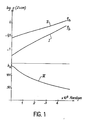
- the molecular concentration c of defects due to irradiation is written as a function of the longitudinal resistivities p b ( ⁇ ) and transverse p a ( ⁇ ) along the transverse axis more weak anisotropy as follows:
- curve 1 relates to the dosimeter whose sensitive element is a crystal of TMTSF-DMTCNQ
- curve II to the dosimeter whose sensitive element is a crystal of TTF-TCNQ
- curve III to the dosimeter whose l the sensitive element is a TTT 2 1 3 crystal.
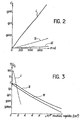
- FIG. 3 the variations in electrical conductivity are shown. of three dosimeters of the invention subjected to irradiation by means of fast neutrons at a temperature of 20oK.
- curve 1 relates to a dosimeter whose sensitive element is a TMTSF-DMTCNQ crystal
- curve II to a dosimeter whose sensitive element is a TTT crystal 2 1 3
- curve III to a dosimeter whose sensitive element is a TST 2 1 crystal.
- these dosimeters have the advantage of being much more punctual because it is possible to use a sensitive element of very small surface (approximately 1 mm 2 ). They allow measurements "in situ” and some of them such as Qn (TCNQ) 2 are practically not activated under neutron irradiation.
- dosimeters the sensitive element of which is a charge transfer complex or a radical ion salt, cannot be used for a long time at temperatures above 70 ° C. Also, for measurements carried out at temperatures of the order of 600 ° C., it is preferable to use dosimeters, the sensitive element of which is a phthalocyanine.
- curve 1 presents an anomaly at the start of the irradiation, it is specified that this anomaly is not found when the irradiation is carried out at room temperature because we are in this case directly in the regime exponential as for the irradiations of figure 1.
- the anomaly at the start of irradiation comes from the fact that the irradiation temperature was 200K, that is to say lower than the Peierls phase transition temperature.
- the dosimeters of the invention can also be used for alpha dosimetry.
- the sensitive element of the dosimeter must have a thickness less than the average path of the alpha radiation.
- a dosimetry method is described below using these dosimeters to determine the plutonium content of nuclear fuels.
- the dosimeter, the sensitive element of which has a very small thickness is brought into contact with plutonium and the resistivity of the dosimeter is determined several times to determine the slope of the curve obtained by carrying the resistivity of the element in logarithmic coordinates as a function of the radiation dose absorbed.
- the dosimeter is then brought into contact with a sample of nuclear fuel, for example uranium dioxide and plutonium, and its resistivity is also measured several times in order to determine the new slope of the curve representing the variations in the resistivity as a function of the absorbed dose.
- a sample of nuclear fuel for example uranium dioxide and plutonium
- the plutonium content of the fuel can be determined, which corresponds to the ratio of the slopes between the two curves.
Landscapes
- Physics & Mathematics (AREA)
- Health & Medical Sciences (AREA)
- Life Sciences & Earth Sciences (AREA)
- General Physics & Mathematics (AREA)
- High Energy & Nuclear Physics (AREA)
- Molecular Biology (AREA)
- Spectroscopy & Molecular Physics (AREA)
- Measurement Of Radiation (AREA)
Applications Claiming Priority (2)
| Application Number | Priority Date | Filing Date | Title |
|---|---|---|---|
| FR8106102 | 1981-03-26 | ||
| FR8106102A FR2502793A1 (fr) | 1981-03-26 | 1981-03-26 | Dosimetre pour les photons x et gamma, pour les rayons alpha et pour les neutrons rapides, utilisable en particulier pour la mesure de fortes doses |
Publications (2)
| Publication Number | Publication Date |
|---|---|
| EP0062561A1 EP0062561A1 (fr) | 1982-10-13 |
| EP0062561B1 true EP0062561B1 (fr) | 1985-02-06 |
Family
ID=9256678
Family Applications (1)
| Application Number | Title | Priority Date | Filing Date |
|---|---|---|---|
| EP19820400525 Expired EP0062561B1 (fr) | 1981-03-26 | 1982-03-23 | Dosimètre pour les photons X et gamma, pour les rayons alpha et pour les neutrons rapides, utilisable en particulier pour la mesure de fortes doses |
Country Status (3)
| Country | Link |
|---|---|
| EP (1) | EP0062561B1 (cg-RX-API-DMAC7.html) |
| DE (1) | DE3262191D1 (cg-RX-API-DMAC7.html) |
| FR (1) | FR2502793A1 (cg-RX-API-DMAC7.html) |
Family Cites Families (4)
| Publication number | Priority date | Publication date | Assignee | Title |
|---|---|---|---|---|
| US3086117A (en) * | 1959-07-20 | 1963-04-16 | Raytheon Co | Semiconductive dosimeters |
| US3171026A (en) * | 1961-03-08 | 1965-02-23 | Gen Dynamics Corp | Tellurium dosimeter |
| US3320421A (en) * | 1964-02-27 | 1967-05-16 | Boeing Co | Neutron dosimeter comprising nickel oxide with lithium as an impurity |
| FR2222660A1 (en) * | 1973-03-21 | 1974-10-18 | Radiotechnique Compelec | Radiation detection device - measures beta, gamma and X-rays in the range below 50 keV |
-
1981
- 1981-03-26 FR FR8106102A patent/FR2502793A1/fr active Granted
-
1982
- 1982-03-23 DE DE8282400525T patent/DE3262191D1/de not_active Expired
- 1982-03-23 EP EP19820400525 patent/EP0062561B1/fr not_active Expired
Also Published As
| Publication number | Publication date |
|---|---|
| DE3262191D1 (en) | 1985-03-21 |
| EP0062561A1 (fr) | 1982-10-13 |
| FR2502793B1 (cg-RX-API-DMAC7.html) | 1984-10-12 |
| FR2502793A1 (fr) | 1982-10-01 |
Similar Documents
| Publication | Publication Date | Title |
|---|---|---|
| He et al. | Sensitivity and detection limit of spectroscopic‐grade perovskite CsPbBr3 crystal for hard X‐ray detection | |
| EP2625547B1 (fr) | Procede de detection utilisant un detecteur alpha electrochimiquement assiste pour la mesure nucleaire en milieu liquide | |
| US3844843A (en) | Solar cell with organic semiconductor contained in a gel | |
| US20240290900A1 (en) | Electrochemical UV Sensor Using Carbon Quantum Dots | |
| US3900945A (en) | Organic semiconductor solar cell | |
| FR2748158A1 (fr) | Detecteur rapide de rayonnement | |
| Nambiar et al. | Bismuth sulfide nanoflowers for detection of X-rays in the mammographic energy range | |
| Bapathi et al. | Cumulative effect of spectral downshifting, anti-reflection and space-charge region formation in enhancing the spectral response of self-powered silicon photodetectors on sensitisation with CdZnS/ZnS core-shell quantum dots | |
| EP0062561B1 (fr) | Dosimètre pour les photons X et gamma, pour les rayons alpha et pour les neutrons rapides, utilisable en particulier pour la mesure de fortes doses | |
| Wang et al. | Single ZnO nanotetrapod-based sensors for monitoring localized UV irradiation | |
| Baily et al. | The lithium-drifted silicon pin junction as an x-ray and gamma-ray dosimeter | |
| Limbani et al. | The Influence of PEABr Passivation Concentration, Light Exposure, and Temperature on the Electrochemical Behavior and Charge Transfer Resistance in MAPbBr3 Single Crystals | |
| Menzel et al. | Charge-carrier photogeneration in doped metal-free phthalocyanine | |
| Pfister et al. | Photoelectronic Properties of Acid‐Doped Poly (N‐Vinylcarbazole): o‐Dinitrobenzene Charge Transfer Complex Films | |
| Girolami et al. | Imaging of Sr-90 Radionuclide Sources Based on Diamond Pixel Detectors | |
| CA1052013A (fr) | Detecteur nucleaire comprenant un cristal de tellurure de cadmium | |
| Deng et al. | Preparation of PbO-Ga2O3 system polycrystalline thin film for direct conversion flexible X-ray detector application | |
| Dobužinskas et al. | Bromine‐enhanced organic materials for X‐ray sensors: unveiling the potential of small molecules and polymers through material design and film fabrication | |
| Arbour et al. | Surface chemistries and photoelectrochemistries of thin film molecular semiconductor materials | |
| Omar et al. | Metal oxide films/structures for gamma radiation detection | |
| Qin et al. | Study of the Sensitivity of MAPbI 3 Radiation Detectors Based on Monte Carlo Simulation | |
| Bakhlanov et al. | Influence of {\alpha}-particles irradiation on the performance and defect levels structure of Al/SiO2/p-type Si surface barrier detector | |
| Kukurudziak et al. | Photodetectors for X-and γ-Ray Scintillators | |
| Ibnaouf et al. | Synthesis and Characterization of CdS Nanoparticle/Porous Silicon Heterojunction for UV and Gamma Detection | |
| Verger et al. | CdTe detectors responses to pulsed X-rays: comparison of different materials |
Legal Events
| Date | Code | Title | Description |
|---|---|---|---|
| PUAI | Public reference made under article 153(3) epc to a published international application that has entered the european phase |
Free format text: ORIGINAL CODE: 0009012 |
|
| AK | Designated contracting states |
Designated state(s): BE DE GB IT |
|
| 17P | Request for examination filed |
Effective date: 19830314 |
|
| ITF | It: translation for a ep patent filed | ||
| GRAA | (expected) grant |
Free format text: ORIGINAL CODE: 0009210 |
|
| AK | Designated contracting states |
Designated state(s): BE DE GB IT |
|
| REF | Corresponds to: |
Ref document number: 3262191 Country of ref document: DE Date of ref document: 19850321 |
|
| PLBE | No opposition filed within time limit |
Free format text: ORIGINAL CODE: 0009261 |
|
| STAA | Information on the status of an ep patent application or granted ep patent |
Free format text: STATUS: NO OPPOSITION FILED WITHIN TIME LIMIT |
|
| 26N | No opposition filed | ||
| PG25 | Lapsed in a contracting state [announced via postgrant information from national office to epo] |
Ref country code: GB Effective date: 19890323 |
|
| PG25 | Lapsed in a contracting state [announced via postgrant information from national office to epo] |
Ref country code: BE Effective date: 19890331 |
|
| BERE | Be: lapsed |
Owner name: COMMISSARIAT A L'ENERGIE ATOMIQUE ETABLISSEMENT D Effective date: 19890331 |
|
| GBPC | Gb: european patent ceased through non-payment of renewal fee | ||
| PG25 | Lapsed in a contracting state [announced via postgrant information from national office to epo] |
Ref country code: DE Effective date: 19891201 |