EP0061372B1 - Dispositif optique d'amplification en temps réel de l'énergie radiante d'un faisceau - Google Patents
Dispositif optique d'amplification en temps réel de l'énergie radiante d'un faisceau Download PDFInfo
- Publication number
- EP0061372B1 EP0061372B1 EP82400360A EP82400360A EP0061372B1 EP 0061372 B1 EP0061372 B1 EP 0061372B1 EP 82400360 A EP82400360 A EP 82400360A EP 82400360 A EP82400360 A EP 82400360A EP 0061372 B1 EP0061372 B1 EP 0061372B1
- Authority
- EP
- European Patent Office
- Prior art keywords
- layers
- network
- time
- displacement
- phase
- Prior art date
- Legal status (The legal status is an assumption and is not a legal conclusion. Google has not performed a legal analysis and makes no representation as to the accuracy of the status listed.)
- Expired
Links
- 230000003321 amplification Effects 0.000 title claims description 14
- 238000003199 nucleic acid amplification method Methods 0.000 title claims description 14
- 230000003287 optical effect Effects 0.000 title claims description 10
- 230000005855 radiation Effects 0.000 title 1
- 239000000463 material Substances 0.000 claims description 34
- 239000013078 crystal Substances 0.000 claims description 25
- 238000006073 displacement reaction Methods 0.000 claims description 19
- 230000005684 electric field Effects 0.000 claims description 11
- 238000005286 illumination Methods 0.000 claims description 11
- 230000010363 phase shift Effects 0.000 claims description 11
- 230000001427 coherent effect Effects 0.000 claims description 8
- JSILWGOAJSWOGY-UHFFFAOYSA-N bismuth;oxosilicon Chemical compound [Bi].[Si]=O JSILWGOAJSWOGY-UHFFFAOYSA-N 0.000 claims description 3
- 230000008878 coupling Effects 0.000 description 8
- 238000010168 coupling process Methods 0.000 description 8
- 238000005859 coupling reaction Methods 0.000 description 8
- 230000003993 interaction Effects 0.000 description 5
- 230000004044 response Effects 0.000 description 4
- 238000010586 diagram Methods 0.000 description 3
- 238000009792 diffusion process Methods 0.000 description 3
- 238000000034 method Methods 0.000 description 3
- 230000008901 benefit Effects 0.000 description 2
- 230000008569 process Effects 0.000 description 2
- 238000005086 pumping Methods 0.000 description 2
- 230000002787 reinforcement Effects 0.000 description 2
- 238000010521 absorption reaction Methods 0.000 description 1
- 238000005516 engineering process Methods 0.000 description 1
- 238000001093 holography Methods 0.000 description 1
- 238000012886 linear function Methods 0.000 description 1
- 230000000750 progressive effect Effects 0.000 description 1
- 230000001902 propagating effect Effects 0.000 description 1
- 230000002441 reversible effect Effects 0.000 description 1
- 239000004065 semiconductor Substances 0.000 description 1
- 230000001360 synchronised effect Effects 0.000 description 1
- 230000002123 temporal effect Effects 0.000 description 1
Images
Classifications
-
- G—PHYSICS
- G03—PHOTOGRAPHY; CINEMATOGRAPHY; ANALOGOUS TECHNIQUES USING WAVES OTHER THAN OPTICAL WAVES; ELECTROGRAPHY; HOLOGRAPHY
- G03H—HOLOGRAPHIC PROCESSES OR APPARATUS
- G03H1/00—Holographic processes or apparatus using light, infrared or ultraviolet waves for obtaining holograms or for obtaining an image from them; Details peculiar thereto
- G03H1/02—Details of features involved during the holographic process; Replication of holograms without interference recording
- G03H1/024—Hologram nature or properties
- G03H1/0248—Volume holograms
-
- G—PHYSICS
- G02—OPTICS
- G02F—OPTICAL DEVICES OR ARRANGEMENTS FOR THE CONTROL OF LIGHT BY MODIFICATION OF THE OPTICAL PROPERTIES OF THE MEDIA OF THE ELEMENTS INVOLVED THEREIN; NON-LINEAR OPTICS; FREQUENCY-CHANGING OF LIGHT; OPTICAL LOGIC ELEMENTS; OPTICAL ANALOGUE/DIGITAL CONVERTERS
- G02F1/00—Devices or arrangements for the control of the intensity, colour, phase, polarisation or direction of light arriving from an independent light source, e.g. switching, gating or modulating; Non-linear optics
- G02F1/01—Devices or arrangements for the control of the intensity, colour, phase, polarisation or direction of light arriving from an independent light source, e.g. switching, gating or modulating; Non-linear optics for the control of the intensity, phase, polarisation or colour
- G02F1/03—Devices or arrangements for the control of the intensity, colour, phase, polarisation or direction of light arriving from an independent light source, e.g. switching, gating or modulating; Non-linear optics for the control of the intensity, phase, polarisation or colour based on ceramics or electro-optical crystals, e.g. exhibiting Pockels effect or Kerr effect
- G02F1/05—Devices or arrangements for the control of the intensity, colour, phase, polarisation or direction of light arriving from an independent light source, e.g. switching, gating or modulating; Non-linear optics for the control of the intensity, phase, polarisation or colour based on ceramics or electro-optical crystals, e.g. exhibiting Pockels effect or Kerr effect with ferro-electric properties
- G02F1/0541—Devices or arrangements for the control of the intensity, colour, phase, polarisation or direction of light arriving from an independent light source, e.g. switching, gating or modulating; Non-linear optics for the control of the intensity, phase, polarisation or colour based on ceramics or electro-optical crystals, e.g. exhibiting Pockels effect or Kerr effect with ferro-electric properties using photorefractive effects
Definitions
- the invention relates to an optical device for real-time amplification of the radiant energy of a beam.
- an optical device can be interposed on the path of the beam in question. It is known to use an optical device consisting of a recording medium in which the beam under consideration and a second reference beam interfere.
- This recording medium can be, for example, a photosensitive electro-optical material such as bismuth-silicon oxide or BSO.
- a network of fringes created by the interference of the wave front coming from the object and the reference wave front, induces, in real time, at the time of the registration of the material, a network of index strata, constituting a hologram characteristic of the object wavefront. It diffracts part of the energy of the incident reference wavefront according to a diffracted wave whose wavefront is isomorphic to the object wavefront.
- the intensity of the directly transmitted object beam is increased, in practice, by a factor of 2 to 3 in the presence of the reference beam which acts, under these conditions, as a pumping wave.
- the reference beam which acts, under these conditions, as a pumping wave.
- only recording by zero-field diffusion satisfies the optimal conditions for this wave coupling. These conditions are no longer verified when an electric field is applied which allows a high index variation to be induced.
- the invention relates to these techniques for coupling waves in materials allowing the registration of dynamic holograms by variation of photo-induced index.
- the proposed device ensures under optimal conditions, in the presence of a transverse field applied to the material considered, the transfer of energy from the reference wave to the object wave. To achieve these conditions, a displacement of interference fringes is introduced. As such, this device allows the coherent amplification of the radiant energy of a beam.
- the subject of the invention is therefore an optical device for real-time amplification of the radiant energy of a light beam
- a recording material consisting of a photosensitive electro-optical crystal and having a writing time T within which is inscribed, in real time, a network of photo-induced index strata obtained thanks to the interference, in the volume of this material, of an incident object beam from a coherent source and a beam of reference which is coherent to it, an energy transfer taking place between this reference beam and this object beam, an electric field orthogonal to the plane of the strata being applied to the terminals of this material
- the device proposed in this patent is based on dynamic holographic writing on a photosensitive support operating by variation of photo-induced index.
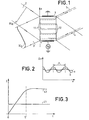
- the operation is illustrated diagrammatically in FIG. 1.
- the signal wavefront ⁇ o diffracted by the object interferes coherently with a plane wave referenced ⁇ ⁇ .
- the network of interference fringes is registered in real time in the material in the form of a variation of photo-induced index.
- the coupling of waves results in a transfer of energy from the reference beam to the signal wave after crossing the crystal.
- the intensity of the object beam is therefore increased in the presence of the reference beam which, under these conditions, acts as a pumping wave.
- the rate of modulation of the fringes due to the interference of these two beams is low: la and I R being the light intensities of the beams.
- the reference wave diffracted by the phase grating generates a wave E d identical to the signal wave.
- a thick single crystal 1 cut from an electro-optical photoconductive material, for example BSO.
- this object wave 3 interferes with a reference wave 2, with a plane wavefront ⁇ R.
- the network of interference fringes 11 thus created generates, in real time, in the crystal, a network of strata of index 12, after a writing time ⁇ .
- This network of strata diffracts part of the energy of the reference wave 2 into a diffracted wave 4, the wave front of which is isomorphic to the object wave front E o .
- the photo-induced grating can be exactly ⁇ / 2 phase shifted with respect to the incident illumination grating, which results in obtaining a wave diffracted 4 strictly superimposed on the transmitted object wave 5; everything happens as if the transmitted object wave was enriched with a fraction of the energy of the reference wave. If the thickness of the crystal concerned by the interference of the two beams is large, of the order of 1 cm, the transmitted object beam can be considerably reinforced, by a factor of 2 to 3.
- this reinforced object wave again interferes with the reference beam, which accentuates the modulation of the fringes and creates a contribution of energy on the object beam a little more important, and thus, step by step , throughout the thickness of the crystal in which the object and reference beams interfere, because the new photo-induced network is always in phase with the main network, thanks to the phase shift of ⁇ / 2 between the interference network and the index network.
- the fringe modulation rate is higher than on the entry face, as shown in fig. 2 in b.
- the diagram in FIG. 3 this increase in the transmitted beam due to the coupling of waves in a thick crystal.
- the straight line 41 represents the intensity of the directly transmitted object beam, in the absence of the reference beam 3. This intensity is constant from time 0 when the incident object beam arrives on the crystal BSO .
- Curve 42 shows the establishment, at the end of time T , of the diffracted object beam in the case of the present invention, with an intensity two to three times greater than that of the directly transmitted object beam, the energy of this diffracted beam being taken from the reference beam.
- the crystal 1 may or may not be subjected to a transverse electric field, in the direction of the axis OX in FIG. 1, the phase shift of n / 2 between the interference network and the index network is established automatically, but the effectiveness of the amplification phenomenon is all the greater the higher the applied electric field, typically between 10 and 20 kVcm -1 .
- This saturation entry of the index network from the interference fringe network is not instantaneous and requires a certain time ⁇ , typically 100 ms, and the same is true for the erasure of the network.
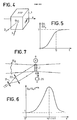
- the preferential orientation of the single crystal with respect to the direction of the electric field which is the x-axis is that which is shown in FIG. 4, that is to say perpendicular to the faces of the shape 001 of the crystal.
- the incidence of the beams on the faces of the form ⁇ 110 ⁇ or ⁇ - 110 ⁇ and which determines the pitch of the fringes, is optimal around 20 to 30 °, for example + 20 ° for the object beam, -20 ° for the reference beam.
- the time constants T used for the transfer of energy from the reference beam to the object beam are practically independent of the ratio of the intensities of the incident beams, reference and object, T varies from 50 to 100 ms when this ratio varies from 1 at 1000.
- the amplification coefficient obtained on the transmitted object beam is also independent of this ratio as soon as it is greater than 10 and is a non-linear function of the electric field applied to the crystal when this field exceeds a threshold value of 10kV Cm -1 . It is also technologically difficult to work at more than 20 kV ⁇ cm -1 .
- a recording by diffusion with null field E o 0; ⁇ 0.5 to 1 ⁇ m.
- the amplitude of the photo-induced index modulation ⁇ n a is low, but proportional to the gradient of the illumination: and a recording by drift under applied field E o ⁇ 6 kV ⁇ cm -1 ; ⁇ 3 ⁇ m.
- the present device makes it possible to take advantage of the high index variation due to the recording under the applied field by introducing a suitable displacement of the interference fringes during the recording time of the material.
- This displacement of the material leads to a phase shift of the photo-induced network with respect to the incident illumination.
- the amplification of the incident image was obtained for values of the applied field greater than 6 kV ⁇ cm -1 with a pitch of the strata ⁇ 3 ⁇ m.
- the incident illumination which corresponds to the interference of the two beams 2 and 3 is a signal of the form: m being the modulation rate and k the wave vector such that , A being the step of the strata.
- ⁇ n can be broken down into ⁇ n 1 and ⁇ n 2 , ⁇ n 1 being in phase with the illumination and ⁇ n 2 in quadrature with this illumination.
- ⁇ n 2 is the component which allows a coupling of waves such that there is an optimal energy transfer.
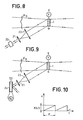
- the medium 1 can be displaced at speed v using a motor 25, and this during the writing time T of the medium as shown in FIG. 7, but it is possible to overcome this displacement of the material by placing a phase modulator 20 on the path of the reference wave, as shown in FIG. 8. This ensures displacement of the fringes at a speed v such that .
- This phase shift can be achieved using a mirror associated with a piezoelectric transducer for example, or using an acousto-optical device according to the necessary speeds.
- FIG. 9 For sequential operation, there is a control signal V o in the form of a sawtooth, as illustrated in FIG. 10.
- This mirror 24 is produced, for example, with a piezoelectric material having the form of a film and one of the faces of which is metallized; it can also be one of the control electrodes 23, as shown in FIG. 9.
- the sawtooth signal makes it possible to achieve a displacement of the strata which appears regular.
- the amplitude of this signal must allow a displacement of an integer number of fringes.
- the curve of fig. 10 shows the displacement of the mirror. If ⁇ is the wavelength of the reflected beam, a displacement of the mirror being amplified by two at the level of the beam, the phase shift represented by this signal is therefore equal to
- An acousto-optical sliding phenomenon is then used for continuous operation, the acousto-optical material being controlled by a signal of frequency F.
- the incident signal having a frequency fo
- the propagation of an acoustic wave in a refractive medium is translated, on the optical index of this medium, by a synchronous undulatory disturbance whose origin is in the modulation brought to the local density of matter by the distribution local pressures.
- a progressive wave of frequency F therefore corresponds, from the optical point of view, to a phase grating in this acousto-optical material whose pitch is equal to and therefore, like ,
- phase modulator or the acousto-optical device on the incident object beam and no longer on the reference beam.
Landscapes
- Physics & Mathematics (AREA)
- General Physics & Mathematics (AREA)
- Nonlinear Science (AREA)
- Chemical & Material Sciences (AREA)
- Engineering & Computer Science (AREA)
- Ceramic Engineering (AREA)
- Crystallography & Structural Chemistry (AREA)
- Optics & Photonics (AREA)
- Holo Graphy (AREA)
- Non-Silver Salt Photosensitive Materials And Non-Silver Salt Photography (AREA)
Applications Claiming Priority (2)
| Application Number | Priority Date | Filing Date | Title |
|---|---|---|---|
| FR8105135 | 1981-03-13 | ||
| FR8105135A FR2501872A1 (fr) | 1981-03-13 | 1981-03-13 | Dispositif optique d'amplification en temps reel de l'energie radiante d'un faisceau |
Publications (2)
| Publication Number | Publication Date |
|---|---|
| EP0061372A1 EP0061372A1 (fr) | 1982-09-29 |
| EP0061372B1 true EP0061372B1 (fr) | 1984-11-14 |
Family
ID=9256247
Family Applications (1)
| Application Number | Title | Priority Date | Filing Date |
|---|---|---|---|
| EP82400360A Expired EP0061372B1 (fr) | 1981-03-13 | 1982-03-02 | Dispositif optique d'amplification en temps réel de l'énergie radiante d'un faisceau |
Country Status (5)
| Country | Link |
|---|---|
| US (1) | US4505536A (en:Method) |
| EP (1) | EP0061372B1 (en:Method) |
| JP (1) | JPS57161878A (en:Method) |
| DE (1) | DE3261219D1 (en:Method) |
| FR (1) | FR2501872A1 (en:Method) |
Families Citing this family (16)
| Publication number | Priority date | Publication date | Assignee | Title |
|---|---|---|---|---|
| GB8610027D0 (en) * | 1986-04-24 | 1986-05-29 | British Petroleum Co Plc | Phase conjugate reflecting media |
| US4703992A (en) * | 1986-05-27 | 1987-11-03 | Rockwell International Corporation | Laser beam cleanup by photorefractive two-way mixing |
| US4761059A (en) * | 1986-07-28 | 1988-08-02 | Rockwell International Corporation | External beam combining of multiple lasers |
| FR2608792B1 (fr) * | 1986-12-23 | 1989-03-31 | Thomson Csf | Dispositif d'amplification de signaux optiques a milieu photosensible |
| US4784473A (en) * | 1987-03-02 | 1988-11-15 | United States Of America As Represented By The Secretary Of The Navy | Ferroelectric optical switching |
| US4877297A (en) * | 1988-04-29 | 1989-10-31 | Rockwell International Corporation | Reconfigurable 0ptical interconnect using dynamic hologram |
| FR2674642B1 (fr) * | 1991-03-25 | 1993-12-03 | Gaz De France | Fibre optique a reseau de bragg interne variable et ses applications. |
| FR2681988A1 (fr) * | 1991-09-27 | 1993-04-02 | Thomson Csf | Laser de puissance a deflexion. |
| FR2696014B1 (fr) * | 1992-09-18 | 1994-11-04 | Thomson Csf | Miroir à conjugaison de phase. |
| US5422873A (en) * | 1993-03-25 | 1995-06-06 | California Institute Of Technology | Multiplexing and selective updatable fixing and erasing of volume holograms in photorefractive media and second harmonic generation in photorefractive media by optically induced periodic poling |
| FR2707447B1 (fr) * | 1993-07-09 | 1995-09-01 | Thomson Csf | Dispositif de visualisation couleurs. |
| US5665493A (en) * | 1995-10-03 | 1997-09-09 | Sri International | Gated recording of holograms using rare-earth doped ferroelectric materials |
| KR19990071670A (ko) * | 1995-11-28 | 1999-09-27 | 에드워드 이. 데이비스 | 지속파 레이저를 이용하는 포토굴절 물질에서, 두-단계의게이트 홀로그래피 기록. |
| FR2755516B1 (fr) | 1996-11-05 | 1999-01-22 | Thomson Csf | Dispositif compact d'illumination |
| US5978108A (en) * | 1997-03-12 | 1999-11-02 | Stanford Research Institute | Two-step gated holographic recording in photorefractive materials using cw lasers |
| FR2819061B1 (fr) * | 2000-12-28 | 2003-04-11 | Thomson Csf | Dispositif de controle de polarisation dans une liaison optique |
Family Cites Families (1)
| Publication number | Priority date | Publication date | Assignee | Title |
|---|---|---|---|---|
| FR2362466A1 (fr) * | 1976-08-19 | 1978-03-17 | Thomson Csf | Cellule d'enregistrement holographique, memoire et dispositif de calcul optique utilisant une telle cellule |
-
1981
- 1981-03-13 FR FR8105135A patent/FR2501872A1/fr active Granted
-
1982
- 1982-03-02 US US06/354,049 patent/US4505536A/en not_active Expired - Lifetime
- 1982-03-02 DE DE8282400360T patent/DE3261219D1/de not_active Expired
- 1982-03-02 EP EP82400360A patent/EP0061372B1/fr not_active Expired
- 1982-03-11 JP JP57038828A patent/JPS57161878A/ja active Granted
Also Published As
| Publication number | Publication date |
|---|---|
| FR2501872B1 (en:Method) | 1984-01-20 |
| JPH0322963B2 (en:Method) | 1991-03-28 |
| EP0061372A1 (fr) | 1982-09-29 |
| DE3261219D1 (en) | 1984-12-20 |
| JPS57161878A (en) | 1982-10-05 |
| FR2501872A1 (fr) | 1982-09-17 |
| US4505536A (en) | 1985-03-19 |
Similar Documents
| Publication | Publication Date | Title |
|---|---|---|
| EP0061372B1 (fr) | Dispositif optique d'amplification en temps réel de l'énergie radiante d'un faisceau | |
| EP0451047B1 (fr) | Composant optique intégré protégé contre l'environnement et son procédé de fabrication | |
| EP0067082B1 (fr) | Source cohérente de rayonnement générant un faisceau de direction de propagation réglable | |
| EP2676166B1 (fr) | Modulateur terahertz | |
| EP0061360B1 (fr) | Dispositif optique d'entretien d'une impulsion d'énergie radiante circulant dans un guide d'onde monomode, gyromètre et hydrophone comportant un tel dispositif | |
| EP0275768A1 (fr) | Dispositif d'amplification de signaux optiques à milieu photosensible | |
| EP0138668B1 (fr) | Dispositif d'enregistrement d'une image cohérente dans une cavité optique multimode | |
| EP0095960B1 (fr) | Dispositif de mise en mémoire d'une image cohérente dans une cavité optique multimode | |
| EP0053052B1 (fr) | Dispositif d'interférométrie pour la visualisation en temps réel des déformations de structures vibrantes | |
| EP0210690B1 (fr) | Structure séparatrice, élément de commutation optique incluant de telles structures et matrice de commutation optique formée de ces éléments de commutation | |
| FR2688899A1 (fr) | Procede de mesure du temps pour former un reseau d'indices de refraction d'un milieu photo-non lineaire. | |
| EP0141739B1 (fr) | Dispositif interférométrique de mesure d'une vitesse de rotation angulaire | |
| EP0271411A2 (fr) | Dispositif bistable optique à cristal photoréfractif | |
| EP0708509A1 (fr) | Dispositif d'émission mono-longueur d'onde | |
| EP0299840B1 (fr) | Corrélateur à fibre optique | |
| EP0109886B1 (fr) | Dispositif acousto-optique d'analyse de spectre | |
| EP0098185B1 (fr) | Dispositif d'éclairement d'un milieu électro-optique pour enregistrer des hologrammes en temps réel | |
| EP0306401B1 (fr) | Translateur de fréquence pour onde du domaine infra-rouge moyen | |
| EP0228312A1 (fr) | Commutateur opto-électronique à seuil de puissance et son procédé de commande | |
| FR2535072A1 (fr) | Dispositif optique de dephasage et application a un generateur laser | |
| FR2492541A1 (fr) | Concentrateur de rayonnement solaire et son procede de fabrication | |
| FR2669123A1 (fr) | Deflecteur de faisceau lumineux comprenant un reseau de bragg. | |
| EP0486356A1 (fr) | Modulateur spatial bidimensionnel de lumière à commande piézoélectrique, comprenant un réseau de Bragg | |
| FR2586485A1 (fr) | Dispositif optique a filtrage spectral selectif | |
| FR2751094A1 (fr) | Dispositif de controle d'impulsions lumineuses par un dispositif programmable acousto-optique |
Legal Events
| Date | Code | Title | Description |
|---|---|---|---|
| PUAI | Public reference made under article 153(3) epc to a published international application that has entered the european phase |
Free format text: ORIGINAL CODE: 0009012 |
|
| AK | Designated contracting states |
Designated state(s): DE GB NL |
|
| 17P | Request for examination filed |
Effective date: 19821014 |
|
| GRAA | (expected) grant |
Free format text: ORIGINAL CODE: 0009210 |
|
| AK | Designated contracting states |
Designated state(s): DE GB NL |
|
| REF | Corresponds to: |
Ref document number: 3261219 Country of ref document: DE Date of ref document: 19841220 |
|
| PLBE | No opposition filed within time limit |
Free format text: ORIGINAL CODE: 0009261 |
|
| STAA | Information on the status of an ep patent application or granted ep patent |
Free format text: STATUS: NO OPPOSITION FILED WITHIN TIME LIMIT |
|
| 26N | No opposition filed | ||
| PGFP | Annual fee paid to national office [announced via postgrant information from national office to epo] |
Ref country code: NL Payment date: 19940331 Year of fee payment: 13 |
|
| REG | Reference to a national code |
Ref country code: GB Ref legal event code: 746 Effective date: 19950214 |
|
| PG25 | Lapsed in a contracting state [announced via postgrant information from national office to epo] |
Ref country code: NL Effective date: 19951001 |
|
| NLV4 | Nl: lapsed or anulled due to non-payment of the annual fee |
Effective date: 19951001 |
|
| PGFP | Annual fee paid to national office [announced via postgrant information from national office to epo] |
Ref country code: GB Payment date: 19970218 Year of fee payment: 16 Ref country code: DE Payment date: 19970218 Year of fee payment: 16 |
|
| PG25 | Lapsed in a contracting state [announced via postgrant information from national office to epo] |
Ref country code: GB Free format text: LAPSE BECAUSE OF NON-PAYMENT OF DUE FEES Effective date: 19980302 |
|
| GBPC | Gb: european patent ceased through non-payment of renewal fee |
Effective date: 19980302 |
|
| PG25 | Lapsed in a contracting state [announced via postgrant information from national office to epo] |
Ref country code: DE Free format text: LAPSE BECAUSE OF NON-PAYMENT OF DUE FEES Effective date: 19981201 |