EP0061307B1 - Compositions comprising a wax and an organopolysiloxane - Google Patents
Compositions comprising a wax and an organopolysiloxane Download PDFInfo
- Publication number
- EP0061307B1 EP0061307B1 EP82301394A EP82301394A EP0061307B1 EP 0061307 B1 EP0061307 B1 EP 0061307B1 EP 82301394 A EP82301394 A EP 82301394A EP 82301394 A EP82301394 A EP 82301394A EP 0061307 B1 EP0061307 B1 EP 0061307B1
- Authority
- EP
- European Patent Office
- Prior art keywords
- component
- denotes
- wax
- group
- organopolysiloxane
- Prior art date
- Legal status (The legal status is an assumption and is not a legal conclusion. Google has not performed a legal analysis and makes no representation as to the accuracy of the status listed.)
- Expired
Links
Classifications
-
- C—CHEMISTRY; METALLURGY
- C09—DYES; PAINTS; POLISHES; NATURAL RESINS; ADHESIVES; COMPOSITIONS NOT OTHERWISE PROVIDED FOR; APPLICATIONS OF MATERIALS NOT OTHERWISE PROVIDED FOR
- C09G—POLISHING COMPOSITIONS; SKI WAXES
- C09G1/00—Polishing compositions
- C09G1/06—Other polishing compositions
- C09G1/08—Other polishing compositions based on wax
- C09G1/10—Other polishing compositions based on wax based on mixtures of wax and natural or synthetic resin
- C09G1/12—Other polishing compositions based on wax based on mixtures of wax and natural or synthetic resin mixtures of wax and silicon-containing polycondensates
-
- C—CHEMISTRY; METALLURGY
- C08—ORGANIC MACROMOLECULAR COMPOUNDS; THEIR PREPARATION OR CHEMICAL WORKING-UP; COMPOSITIONS BASED THEREON
- C08L—COMPOSITIONS OF MACROMOLECULAR COMPOUNDS
- C08L83/00—Compositions of macromolecular compounds obtained by reactions forming in the main chain of the macromolecule a linkage containing silicon with or without sulfur, nitrogen, oxygen or carbon only; Compositions of derivatives of such polymers
- C08L83/04—Polysiloxanes
- C08L83/06—Polysiloxanes containing silicon bound to oxygen-containing groups
Definitions
- the present invention relates to a composition comprising a wax and an organopolysiloxane. More specifically, the present invention relates to a composition which has excellent lubricating properties, luster-bestowing properties and water-repellent properties and comprises a homogeneous mixture of a wax and an organopolysiloxane bearing at least one silicon- bonded hydrocarbon ester group.
- Waxes are themselves lubricious and are used as lubricants for machine sewing threads. They have come to be widely used as fluff bindings and as lubricants of warps when weaving textiles, or as polishes for automobiles and furniture, etc. Furthermore, as lubrificants for machine sewing thread or as protecting agents for protecting and polishing the surfaces of automobiles and furniture, mixtures of waxes and dimethylpolysiloxane oils or alkylaralkylpolysiloxane oils have come to be used.
- the present invention offers a wax and organopolysiloxane composition of high compatibility, and which excels in lubricity, luster-bestowing properties, and water repellency, and these characteristics are very durable.
- the present invention relates to a composition
- a composition comprising a homogeneous mixture of (A) from 0.5 to 99.5 parts by weight of a wax and (B) from 0.5 to 99.5 parts by weight of an organopolysiloxane havina the formula- wherein R denote a substituted or unsubstituted monovalent hydrocarbon group, Q denotes a hydrocarbon ester group having the formula -R 1 CO 2 R 2 ,Z denotes an R group ora Qgroup, R 1 denotes a divalent hydrocarbon group, R 2 denotes a saturated monovalent hydrocarbon group having at least 3 carbon atoms, m and n each has an average value of zero or more, the sum of m + n has an average value of from 1 to 2000, there being an average of at least one Q group per molecul of organopolysiloxane B and the total weight of component A plus component B being 100 parts by weight.
- Component A of the compositions of this invention can be any well-known wax.
- Suitable waxes for the purpose of this invention include, but are not limited to, animal waxes such as beeswax, spermaceti, lanolin and ceramic wax; plant waxes such as carnauba wax and candelilla wax; mineral waxes such as ozocerite wax, sericin wax, Montan wax, paraffin wax and microcrystalline wax; and synthetic waxes such as oxides of paraffin wax or their esters, cane sugar - aliphatic acid ester waxes, polyol ether esters, higher alcohols - higher aliphatic acid waxes and chlorinated naphthalenes.
- Component B of the compositions of this invention is an organopolysiloxane having the formula-
- each R denotes, independently, a substituted or an unsubstituted monovalent hydrocabon group.
- unsubstituted R groups include, butare not limited to, alkyl groups such as methyl, ethyl, propyl, octyl, and octadecyl; cycloaliphatic groups such as cyclohexyl; alkenyl groups such as vinyl and allyl; aryl groups such as phenyl and tolyl; and arylalkyl groups such as benzyl, 2-phenylethyl and 2-phenylpropyl.
- substituted R groups include, but are not limited to, the above delineated groups bearing halogen substitution or cyano substitution.
- R be selected from alkyl groups and cycloaliphatic groups, and most preferably from alkyl groups. All R groups do not have to be the same.
- R 1 denotes a divalent hydrocarbon group linking a silicon atom and a -CO z R 3 group.
- suitable R' groups include alkylene groups, which are preferred, such as -CH 2 CH 2 -, -CH 2 CH 2 CH 2 -, -CH 2 CHCH 3 ,-CH 2 CH(CH 3 ) CH 2 -and -(CH2)4-; alkylene arylene groups such as -(CH 2 ) 2 C 6 H 4 -; and arylalkylene groups such as -(CH 2 ) 4 CH 2 CHCH 2 C 6 H 5 .
- R 2 is a saturated hydrocarbon group having three or more carbon atoms.
- R 2 groups include alkyl groups, which are preferred, such as propyl, hexyl, decyl, octadecyl and myricyl; and cycloaliphatic groups such as cyclohexyl.
- Alkyl groups having more than 6 carbon atoms are most preferred for improved compatability between wax and organopolysiloxane.
- m and n denote number each having an average value of zero or more, such as 0, 1, 2, 10, 20, 50 and higher, with the restriction that both m and n cannot be zero simultaneously.
- the sum of m + n must be from 1 to 2000, and preferably from 10 to 1000. When m + n is zero the lubricity and luster properties are poor, and when it exceeds 2000 the compatibility of the organopolysiloxane component with the wax component declines.
- Z denotes an R group or a Q group, hereinabove delineated.
- m has a value of zero, at least one Z must be a Q group because the organopolysiloxane component must contain at least one Q group in the composition of this invention.
- Organopolysiloxanes having the above formula have improved compatibility with waxes; however, a highly preferred organopolysiloxane component B for the compositions of this invention has the formula- where m and n each has an average value of at least one and the sum of m + n has an average value of from 10 to 1000.
- Me denotes the methyl radical and R, R 1 and R 2 are the preferred alkyl groups, alkylene groups and alkyl groups, respectively, denoted above.
- These highly preferred organopolysiloxanes provide particularly excellent luster-bestowing properties, lubricating properties and water-repellency properties to the compositions of this invention when used therein as component B.
- a hydrosilylation catalyst such as chloroplatinic acid.
- compositions of this invention can be prepared by mixing from 0.5 to 99.5 parts by weight of the wax component A and from 0.5 to 99.5 parts by weight of the organopolysiloxane component B with the total weight of A + B being 100 parts by weight.
- the amount of each component ranges from 10 to 90, and most preferably from 20 to 80 parts by weight.
- the present composition is obtained merely by heating and mixing component A and component B above the melting point of the wax.
- a solvent common to both component A and component B should be used.
- components A and B should be mixed with an emulsifying agent, such as ester sulfate salts of higher alcohols, alkylbenzenesulfonate, or polyoxyalkylene adducts of higher aliphatic acids, and the mixture heated above the melting point of the wax, emulsified while adding water slowly, and cooled rapidly.
- an emulsifying agent such as ester sulfate salts of higher alcohols, alkylbenzenesulfonate, or polyoxyalkylene adducts of higher aliphatic acids
- composition of the present invention can be combined in the composition of the present invention according to its uses.
- a lubricant for machine sewing threads small amounts of fluid paraffin and trimethylsiloxy-endblocked dimethylpolysiloxane oil can be used, or antistatic agents of ester phosphate systems may be used with it in small amounts.
- perfumes, solvents, water, abrasives, coloring agents, anti-rust agents, or surfactants may also be added.
- the composition of the present invention is useful as a lubricant for machine threads, a lubrificant for warps when weaving textiles, a protective coating agent to preventing rust, or as a polish for automobiles and furniture.
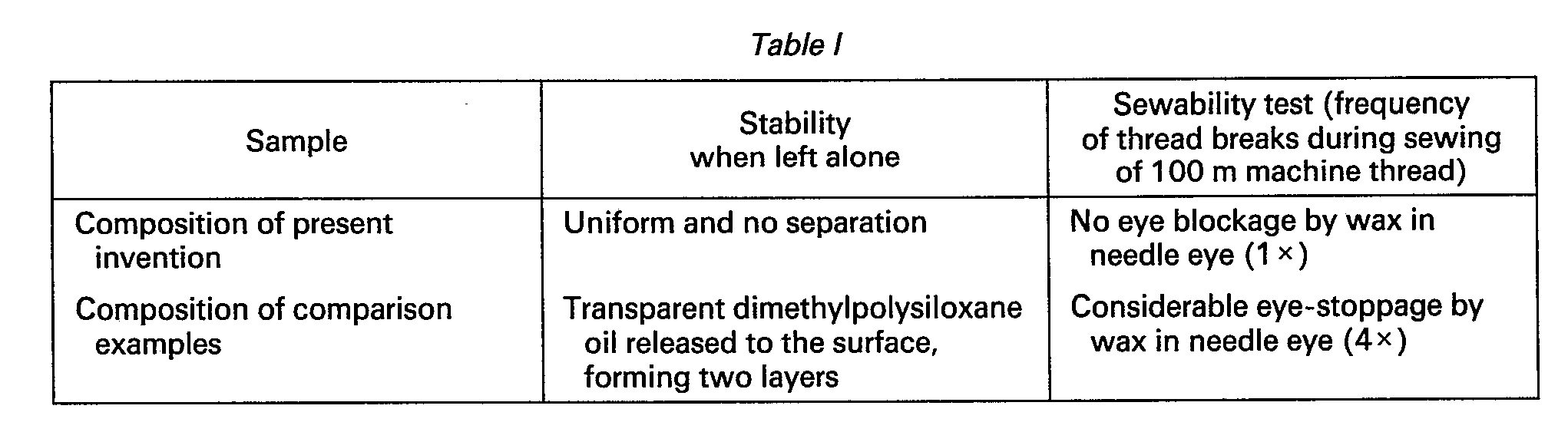
- OX-1949 wax manufactured by Nippon Seiro K.K. obtained by partially oxidizing paraffin wax (35 parts) and the organopolysiloxane expressed by the following structural formula- and having a viscosity of 400 mm 2 /s- 1 (65 parts) were placed in a beaker, and mixed by a stirrer with four paddles for 60 min while heating to 90° C. After it had been uniformly mixed, it was slowly cooled to room temperature while stirring. This liquid mixture was divided into two equal parts, one of which was placed in a transparent glass bottle and left alone at room temperature for 20 d. Then the storage stability of organopolysiloxane and wax was investigated by looking for separation of the components.
- test panels were arranged beneath an artificial shower connected to a water conduit and showered for a total of 20 h, and the initial luster and water repellency, and their durability, were investigated. The results are shown in Table II.
Landscapes
- Chemical & Material Sciences (AREA)
- Organic Chemistry (AREA)
- Health & Medical Sciences (AREA)
- Chemical Kinetics & Catalysis (AREA)
- Medicinal Chemistry (AREA)
- Polymers & Plastics (AREA)
- Compositions Of Macromolecular Compounds (AREA)
- Treatments For Attaching Organic Compounds To Fibrous Goods (AREA)
- Lubricants (AREA)
- Silicon Polymers (AREA)
Description
- 1. The present invention relates to a composition comprising a wax and an organopolysiloxane. More specifically, the present invention relates to a composition which has excellent lubricating properties, luster-bestowing properties and water-repellent properties and comprises a homogeneous mixture of a wax and an organopolysiloxane bearing at least one silicon- bonded hydrocarbon ester group.
- Waxes are themselves lubricious and are used as lubricants for machine sewing threads. They have come to be widely used as fluff bindings and as lubricants of warps when weaving textiles, or as polishes for automobiles and furniture, etc. Furthermore, as lubrificants for machine sewing thread or as protecting agents for protecting and polishing the surfaces of automobiles and furniture, mixtures of waxes and dimethylpolysiloxane oils or alkylaralkylpolysiloxane oils have come to be used.
- The present invention offers a wax and organopolysiloxane composition of high compatibility, and which excels in lubricity, luster-bestowing properties, and water repellency, and these characteristics are very durable.
- It is the object of this invention to provide a mixture of a wax and an organopolysiloxane which does not separate into two layers. It is an additional object of this invention to provide a coating composition which is resistant to removal from a substrate to which it is applied. It is another object of this invention to provide a water-resistant polish composition. It is also an object of this invention to provide an improved thread lubricant composition.
- These objects, and others which will become apparent after considering the following specification and appended claims, are obtained by mixting a wax and certain organopolysiloxanes bearing hydrocarbon ester groups, optionally along with non-essential components well known in the lubricant and polish art.
- The present invention relates to a composition comprising a homogeneous mixture of (A) from 0.5 to 99.5 parts by weight of a wax and (B) from 0.5 to 99.5 parts by weight of an organopolysiloxane havina the formula-

- Component A of the compositions of this invention can be any well-known wax. Suitable waxes for the purpose of this invention include, but are not limited to, animal waxes such as beeswax, spermaceti, lanolin and ceramic wax; plant waxes such as carnauba wax and candelilla wax; mineral waxes such as ozocerite wax, sericin wax, Montan wax, paraffin wax and microcrystalline wax; and synthetic waxes such as oxides of paraffin wax or their esters, cane sugar - aliphatic acid ester waxes, polyol ether esters, higher alcohols - higher aliphatic acid waxes and chlorinated naphthalenes.
- Component B of the compositions of this invention is an organopolysiloxane having the formula-

- I n the formula for component B, each R denotes, independently, a substituted or an unsubstituted monovalent hydrocabon group. Examples of unsubstituted R groups include, butare not limited to, alkyl groups such as methyl, ethyl, propyl, octyl, and octadecyl; cycloaliphatic groups such as cyclohexyl; alkenyl groups such as vinyl and allyl; aryl groups such as phenyl and tolyl; and arylalkyl groups such as benzyl, 2-phenylethyl and 2-phenylpropyl. Examples of substituted R groups include, but are not limited to, the above delineated groups bearing halogen substitution or cyano substitution. For optimum compatability between the wax A and the organopolysiloxane B, it is preferred that R be selected from alkyl groups and cycloaliphatic groups, and most preferably from alkyl groups. All R groups do not have to be the same.
- In the formula for component B, Q denotes a hydrocarbon ester group having the formula -R' COzR2, R1 denotes a divalent hydrocarbon group linking a silicon atom and a -COzR3 group. Examples of suitable R' groups include alkylene groups, which are preferred, such as -CH2CH2-, -CH2CH2CH2-, -CH2CHCH3,-CH2CH(CH3) CH2-and -(CH2)4-; alkylene arylene groups such as -(CH2)2C6H4-; and arylalkylene groups such as -(CH2)4CH2CHCH2C6H5. All R1 groups do not have to be the same. R2 is a saturated hydrocarbon group having three or more carbon atoms. Examples of R2 groups include alkyl groups, which are preferred, such as propyl, hexyl, decyl, octadecyl and myricyl; and cycloaliphatic groups such as cyclohexyl. Alkyl groups having more than 6 carbon atoms are most preferred for improved compatability between wax and organopolysiloxane.
- In the formula for component B, m and n denote number each having an average value of zero or more, such as 0, 1, 2, 10, 20, 50 and higher, with the restriction that both m and n cannot be zero simultaneously. The sum of m + n must be from 1 to 2000, and preferably from 10 to 1000. When m + n is zero the lubricity and luster properties are poor, and when it exceeds 2000 the compatibility of the organopolysiloxane component with the wax component declines.
- In the formula for componentB, Z denotes an R group or a Q group, hereinabove delineated. When m has a value of zero, at least one Z must be a Q group because the organopolysiloxane component must contain at least one Q group in the composition of this invention.
- Organopolysiloxanes having the above formula have improved compatibility with waxes; however, a highly preferred organopolysiloxane component B for the compositions of this invention has the formula-

- The organopolysiloxane component B can be prepared by well-known methods. For example a suitable organohydrogenpolysiloxane can be reacted with a hydrocarbon ester which is unsaturated in its acid portion, such as CH2=CHCH2CO2R2, in the presence of a hydrosilylation catalyst, such as chloroplatinic acid. U.S. Patent No. 2823218 is hereby incorporated herein to further show how to prepare component B.
- The compositions of this invention can be prepared by mixing from 0.5 to 99.5 parts by weight of the wax component A and from 0.5 to 99.5 parts by weight of the organopolysiloxane component B with the total weight of A + B being 100 parts by weight. Preferably the amount of each component ranges from 10 to 90, and most preferably from 20 to 80 parts by weight.
- The present composition is obtained merely by heating and mixing component A and component B above the melting point of the wax. When used as a solution, a solvent common to both component A and component B should be used. When used as an emulsion, components A and B should be mixed with an emulsifying agent, such as ester sulfate salts of higher alcohols, alkylbenzenesulfonate, or polyoxyalkylene adducts of higher aliphatic acids, and the mixture heated above the melting point of the wax, emulsified while adding water slowly, and cooled rapidly.
- Besides components A and B, various well-known additives can be combined in the composition of the present invention according to its uses. For example, when used as a lubricant for machine sewing threads, small amounts of fluid paraffin and trimethylsiloxy-endblocked dimethylpolysiloxane oil can be used, or antistatic agents of ester phosphate systems may be used with it in small amounts. When used as polishes for automobiles and furniture, perfumes, solvents, water, abrasives, coloring agents, anti-rust agents, or surfactants may also be added. The composition of the present invention is useful as a lubricant for machine threads, a lubrificant for warps when weaving textiles, a protective coating agent to preventing rust, or as a polish for automobiles and furniture.
- The following examples are disclosed to further teach how to practice this invention. Me denotes the methyl group. All parts and percentages are by weight, unless otherwise stated. Viscosities were measured at 25° C.
- OX-1949 wax manufactured by Nippon Seiro K.K., obtained by partially oxidizing paraffin wax (35 parts) and the organopolysiloxane expressed by the following structural formula-

- As a comparison example, a trimethylsiloxy-endblocked dimethylpolysiloxane oil (100 mm2/ s-1) was used in the place of the above organopolysiloxane, and exactely the same test as above was carried out. The results are shown in Table I. As that table shows, the present composition was extremely good, in that compatibility was good and there was no separation, and there was littlethread breakage of machine thread due to eye-stoppage.
- Beeswax, whose primary component is myricyl palmitate (C15H31CO2C30H61) (80 parts), and an organopolysiloxane with a viscosity of 600 mm2/s-1 which is expressed by the following structural formula-


- Next, while observing the luster of each, these test panels were arranged beneath an artificial shower connected to a water conduit and showered for a total of 20 h, and the initial luster and water repellency, and their durability, were investigated. The results are shown in Table II.
- As shown in Table I those to which the present composition was applied had the best luster, water repellency, and durability.

Claims (5)
wherein R denotes a subtituted or unsubstituted monovalent hydrocarbon group, Q denotes a hydrocarbon ester group having the formula -R1 CO2R2,Z denotes an R group or Qgroup, R1 denotes a divalent hydrocarbon group, R2 denotes a saturated monovalent hydrocarbon group having at least 3 carbon atoms, m and n each has an average value of zero or more, the sum of m + n has an average value of from 1 to 2000, there being an average of at least one Q group per molecule of organopolysiloxane (B) and the total weight of component (A) plus component (B) being 100 parts by weight.

Applications Claiming Priority (2)
| Application Number | Priority Date | Filing Date | Title |
|---|---|---|---|
| JP56039902A JPS57153097A (en) | 1981-03-19 | 1981-03-19 | Organopolysiloxane composition |
| JP39902/81 | 1981-03-19 |
Publications (2)
| Publication Number | Publication Date |
|---|---|
| EP0061307A1 EP0061307A1 (en) | 1982-09-29 |
| EP0061307B1 true EP0061307B1 (en) | 1984-08-22 |
Family
ID=12565884
Family Applications (1)
| Application Number | Title | Priority Date | Filing Date |
|---|---|---|---|
| EP82301394A Expired EP0061307B1 (en) | 1981-03-19 | 1982-03-18 | Compositions comprising a wax and an organopolysiloxane |
Country Status (5)
| Country | Link |
|---|---|
| US (1) | US4404035A (en) |
| EP (1) | EP0061307B1 (en) |
| JP (1) | JPS57153097A (en) |
| CA (1) | CA1184696A (en) |
| DE (1) | DE3260598D1 (en) |
Cited By (2)
| Publication number | Priority date | Publication date | Assignee | Title |
|---|---|---|---|---|
| EP0274100A3 (en) * | 1986-12-22 | 1990-09-12 | Wacker Silicones Corporation | Sulfur containing organopolysiloxane waxes and a method for preparing the same |
| EP0372205A3 (en) * | 1988-12-03 | 1992-01-15 | TAIHO INDUSTRIES Co., LTD. | Glazing agent for an automobile |
Families Citing this family (27)
| Publication number | Priority date | Publication date | Assignee | Title |
|---|---|---|---|---|
| US4591502A (en) * | 1982-11-24 | 1986-05-27 | Schlossman Mitchell L | Compressing aid for cosmetic powders |
| US4609545A (en) * | 1982-11-24 | 1986-09-02 | Schlossman Mitchell L | Compressing aid for compressing powders |
| JPS6155159A (en) * | 1984-08-25 | 1986-03-19 | Nippon Oil Co Ltd | Aqueous composition for coating film protection |
| US4828885A (en) * | 1985-06-06 | 1989-05-09 | Edge Line Products, Inc. | Ski wax composition and process of application |
| JPH0657820B2 (en) * | 1987-03-16 | 1994-08-03 | 石原薬品株式会社 | Lustering method for vehicles in which waxing agent does not adhere to window glass |
| JPH01239164A (en) * | 1988-03-17 | 1989-09-25 | Kanebo Ltd | Polishing of fiber structure |
| JPH0798919B2 (en) * | 1988-11-29 | 1995-10-25 | 東レ・ダウコーニング・シリコーン株式会社 | Polish |
| US4936914A (en) * | 1988-12-20 | 1990-06-26 | S. C. Johnson & Con, Inc. | Film-forming emulsion polish compositions containing copolymeric siloxanes |
| US5112394A (en) * | 1990-06-25 | 1992-05-12 | S.C. Johnson & Son, Inc. | Furniture polish concentrate and formulations |
| US5328696A (en) * | 1991-07-22 | 1994-07-12 | Dow Corning Corporation | Devices using silicone pressure sensitive adhesives containing organic wax |
| US5217758A (en) * | 1992-05-15 | 1993-06-08 | Dow Corning Corporation | Silicone containing automotive vinyl protectant |
| GB2270919B (en) * | 1992-09-26 | 1996-04-24 | Sandoz Ltd | Aqueous wax and silicone dispersions,their production and use |
| US5435839A (en) * | 1992-12-24 | 1995-07-25 | Matsushita Electric Industrial Co., Ltd. | Finishing agents and method of manufacturing the same |
| US5703145A (en) * | 1993-06-30 | 1997-12-30 | Hitachi Koki Co., Ltd. | Hot melt type ink composition for ink jet |
| US5998541A (en) * | 1995-06-14 | 1999-12-07 | Matsushita Electric Industrial Co., Ltd. | Finishing agents and method of using the same |
| US5962074A (en) * | 1996-06-05 | 1999-10-05 | 3M Innovative Properties Company | Wax composition and method of use |
| US6159551A (en) * | 1998-02-27 | 2000-12-12 | John Yeiser | Wax and method of wax application |
| US6953500B2 (en) | 2001-09-10 | 2005-10-11 | Lewis Glenn H | Water wax emulsion cleaner and waxer |
| US20050233157A1 (en) * | 2002-06-21 | 2005-10-20 | Boler Lewyn B Jr | Device and system for coating a surface |
| US7094449B2 (en) * | 2002-06-21 | 2006-08-22 | Boler Jr Lewyn B | Device and system for coating a surface and reducing surface irregularities |
| RU2009117593A (en) * | 2006-10-10 | 2010-11-20 | Дау Корнинг Корпорейшн (Us) | SILICONE AGENT REGULATING FOAMING |
| CA2709354C (en) | 2007-12-21 | 2014-06-17 | Amgen Inc. | Anti-amyloid antibodies and uses thereof |
| CN102348765B (en) | 2009-03-10 | 2015-09-09 | 道康宁东丽株式会社 | Oil-in-water silicone emulsion composition |
| GB0905502D0 (en) | 2009-03-31 | 2009-05-13 | Dow Corning | Organopolysiloxane emulsions and their production |
| GB0905507D0 (en) | 2009-03-31 | 2009-05-13 | Dow Corning | Organopol Ysiloxane Compositions Containing An Active Material |
| KR101833966B1 (en) | 2010-07-02 | 2018-03-02 | 다우 코닝 도레이 캄파니 리미티드 | Oil-in-water silicone emulsion composition |
| PL237798B1 (en) * | 2017-11-17 | 2021-05-31 | Madonis Spolka Z Ograniczona Odpowiedzialnoscia | Agents for the wooden furniture and flooring care |
Family Cites Families (6)
| Publication number | Priority date | Publication date | Assignee | Title |
|---|---|---|---|---|
| BE553159A (en) * | 1955-12-05 | |||
| US3813425A (en) * | 1971-03-17 | 1974-05-28 | Gen Electric | Process for producing polysiloxane useful as brake fluids |
| US3890271A (en) * | 1973-02-07 | 1975-06-17 | Dow Corning | Polish ingredient |
| US3836371A (en) * | 1973-02-07 | 1974-09-17 | Dow Corning | Polish ingredient |
| US3960574A (en) * | 1974-05-13 | 1976-06-01 | Dow Corning Corporation | Detergent resistant auto polish |
| GB1521309A (en) * | 1975-12-10 | 1978-08-16 | Goldschmidt Ag Th | Textile fibre dressings containing organosilicon compound |
-
1981
- 1981-03-19 JP JP56039902A patent/JPS57153097A/en active Granted
-
1982
- 1982-03-15 US US06/358,161 patent/US4404035A/en not_active Expired - Lifetime
- 1982-03-18 DE DE8282301394T patent/DE3260598D1/en not_active Expired
- 1982-03-18 CA CA000398740A patent/CA1184696A/en not_active Expired
- 1982-03-18 EP EP82301394A patent/EP0061307B1/en not_active Expired
Cited By (2)
| Publication number | Priority date | Publication date | Assignee | Title |
|---|---|---|---|---|
| EP0274100A3 (en) * | 1986-12-22 | 1990-09-12 | Wacker Silicones Corporation | Sulfur containing organopolysiloxane waxes and a method for preparing the same |
| EP0372205A3 (en) * | 1988-12-03 | 1992-01-15 | TAIHO INDUSTRIES Co., LTD. | Glazing agent for an automobile |
Also Published As
| Publication number | Publication date |
|---|---|
| JPS57153097A (en) | 1982-09-21 |
| JPS61871B2 (en) | 1986-01-11 |
| US4404035A (en) | 1983-09-13 |
| CA1184696A (en) | 1985-03-26 |
| DE3260598D1 (en) | 1984-09-27 |
| EP0061307A1 (en) | 1982-09-29 |
Similar Documents
| Publication | Publication Date | Title |
|---|---|---|
| US4404035A (en) | Compositions comprising a wax and an organopolysiloxane | |
| CA1123542A (en) | Polish formulations | |
| US5174813A (en) | Polish containing derivatized amine functional organosilicon compounds | |
| US4247330A (en) | Protective coatings | |
| US5154759A (en) | Polish containing amine functional siloxane | |
| US3508933A (en) | Automobile polish | |
| EP0515044B1 (en) | Silicone compositions and their use for treating fibers | |
| DE2404138C3 (en) | Additive for polishing agents | |
| US5326387A (en) | Surface protectant composition | |
| DE19749380A1 (en) | Compositions containing aminosiloxanes | |
| US3814710A (en) | Polish compositions | |
| US4462828A (en) | Polishing agent composition | |
| NL8503028A (en) | ORGANOSILOXAN-OXYALKYLENE COPOLYMERS. | |
| EP0135471A2 (en) | Process for treating textile materials | |
| US5036123A (en) | Straight oil composition for fibrous material | |
| US4087478A (en) | Siloxane copolymers and thread finisher prepared therewith | |
| US3856533A (en) | Surface polishes based on organopolysiloxanes and wax | |
| JPS61111360A (en) | Emulsion polymerization silicone emulsion having uv absorberbonded to siloxane | |
| US5705592A (en) | Fluorosiloxane-containing care compositions | |
| US4831169A (en) | Organopolysiloxane oils | |
| US2804440A (en) | Organopolysiloxane polishes | |
| US3817889A (en) | Polishing composition | |
| US3960574A (en) | Detergent resistant auto polish | |
| US3221040A (en) | Copolymeric organosilicon lubricants | |
| JP3909132B2 (en) | Cosmetic additives |
Legal Events
| Date | Code | Title | Description |
|---|---|---|---|
| PUAI | Public reference made under article 153(3) epc to a published international application that has entered the european phase |
Free format text: ORIGINAL CODE: 0009012 |
|
| AK | Designated contracting states |
Designated state(s): DE FR GB IT |
|
| 17P | Request for examination filed |
Effective date: 19830308 |
|
| ITF | It: translation for a ep patent filed | ||
| GRAA | (expected) grant |
Free format text: ORIGINAL CODE: 0009210 |
|
| AK | Designated contracting states |
Designated state(s): DE FR GB IT |
|
| REF | Corresponds to: |
Ref document number: 3260598 Country of ref document: DE Date of ref document: 19840927 |
|
| ET | Fr: translation filed | ||
| PLBE | No opposition filed within time limit |
Free format text: ORIGINAL CODE: 0009261 |
|
| STAA | Information on the status of an ep patent application or granted ep patent |
Free format text: STATUS: NO OPPOSITION FILED WITHIN TIME LIMIT |
|
| 26N | No opposition filed | ||
| ITTA | It: last paid annual fee | ||
| PGFP | Annual fee paid to national office [announced via postgrant information from national office to epo] |
Ref country code: DE Payment date: 19971203 Year of fee payment: 17 |
|
| PGFP | Annual fee paid to national office [announced via postgrant information from national office to epo] |
Ref country code: FR Payment date: 19971204 Year of fee payment: 17 |
|
| PGFP | Annual fee paid to national office [announced via postgrant information from national office to epo] |
Ref country code: GB Payment date: 19971218 Year of fee payment: 17 |
|
| PG25 | Lapsed in a contracting state [announced via postgrant information from national office to epo] |
Ref country code: GB Free format text: LAPSE BECAUSE OF NON-PAYMENT OF DUE FEES Effective date: 19990318 |
|
| GBPC | Gb: european patent ceased through non-payment of renewal fee |
Effective date: 19990318 |
|
| PG25 | Lapsed in a contracting state [announced via postgrant information from national office to epo] |
Ref country code: FR Free format text: LAPSE BECAUSE OF NON-PAYMENT OF DUE FEES Effective date: 19991130 |
|
| REG | Reference to a national code |
Ref country code: FR Ref legal event code: ST |
|
| PG25 | Lapsed in a contracting state [announced via postgrant information from national office to epo] |
Ref country code: DE Free format text: LAPSE BECAUSE OF NON-PAYMENT OF DUE FEES Effective date: 20000101 |