EP0059970B1 - Einbettungsmittel zur Herstellung von dünnen Schnitten von eingebetteten biologischen Stoffen - Google Patents
Einbettungsmittel zur Herstellung von dünnen Schnitten von eingebetteten biologischen Stoffen Download PDFInfo
- Publication number
- EP0059970B1 EP0059970B1 EP82101835A EP82101835A EP0059970B1 EP 0059970 B1 EP0059970 B1 EP 0059970B1 EP 82101835 A EP82101835 A EP 82101835A EP 82101835 A EP82101835 A EP 82101835A EP 0059970 B1 EP0059970 B1 EP 0059970B1
- Authority
- EP
- European Patent Office
- Prior art keywords
- weight
- container containing
- hexylmethacrylate
- combined
- hydroxypropylmethacrylate
- Prior art date
- Legal status (The legal status is an assumption and is not a legal conclusion. Google has not performed a legal analysis and makes no representation as to the accuracy of the status listed.)
- Expired
Links
- 238000002360 preparation method Methods 0.000 title claims description 21
- 239000012620 biological material Substances 0.000 title claims description 16
- LNCPIMCVTKXXOY-UHFFFAOYSA-N hexyl 2-methylprop-2-enoate Chemical compound CCCCCCOC(=O)C(C)=C LNCPIMCVTKXXOY-UHFFFAOYSA-N 0.000 claims description 41
- VHSHLMUCYSAUQU-UHFFFAOYSA-N 2-hydroxypropyl methacrylate Chemical compound CC(O)COC(=O)C(C)=C VHSHLMUCYSAUQU-UHFFFAOYSA-N 0.000 claims description 33
- 239000003999 initiator Substances 0.000 claims description 33
- 229940095095 2-hydroxyethyl acrylate Drugs 0.000 claims description 31
- OMIGHNLMNHATMP-UHFFFAOYSA-N 2-hydroxyethyl prop-2-enoate Chemical compound OCCOC(=O)C=C OMIGHNLMNHATMP-UHFFFAOYSA-N 0.000 claims description 31
- 238000000034 method Methods 0.000 claims description 31
- HWSSEYVMGDIFMH-UHFFFAOYSA-N 2-[2-[2-(2-methylprop-2-enoyloxy)ethoxy]ethoxy]ethyl 2-methylprop-2-enoate Chemical compound CC(=C)C(=O)OCCOCCOCCOC(=O)C(C)=C HWSSEYVMGDIFMH-UHFFFAOYSA-N 0.000 claims description 28
- SUPCQIBBMFXVTL-UHFFFAOYSA-N ethyl 2-methylprop-2-enoate Chemical compound CCOC(=O)C(C)=C SUPCQIBBMFXVTL-UHFFFAOYSA-N 0.000 claims description 15
- 239000000203 mixture Substances 0.000 claims description 13
- 150000003254 radicals Chemical class 0.000 claims description 6
- XLYOFNOQVPJJNP-UHFFFAOYSA-N water Substances O XLYOFNOQVPJJNP-UHFFFAOYSA-N 0.000 description 15
- 235000018102 proteins Nutrition 0.000 description 14
- 102000004169 proteins and genes Human genes 0.000 description 14
- 108090000623 proteins and genes Proteins 0.000 description 14
- 229920005989 resin Polymers 0.000 description 14
- 239000011347 resin Substances 0.000 description 14
- 239000013078 crystal Substances 0.000 description 13
- 239000003431 cross linking reagent Substances 0.000 description 12
- 230000018044 dehydration Effects 0.000 description 11
- 238000006297 dehydration reaction Methods 0.000 description 11
- 230000000694 effects Effects 0.000 description 11
- 239000000306 component Substances 0.000 description 10
- 239000000178 monomer Substances 0.000 description 10
- 102000004625 Aspartate Aminotransferases Human genes 0.000 description 9
- 108010003415 Aspartate Aminotransferases Proteins 0.000 description 9
- 102000016938 Catalase Human genes 0.000 description 9
- 108010053835 Catalase Proteins 0.000 description 9
- LFQSCWFLJHTTHZ-UHFFFAOYSA-N Ethanol Chemical compound CCO LFQSCWFLJHTTHZ-UHFFFAOYSA-N 0.000 description 9
- LYCAIKOWRPUZTN-UHFFFAOYSA-N Ethylene glycol Chemical compound OCCO LYCAIKOWRPUZTN-UHFFFAOYSA-N 0.000 description 9
- 230000036571 hydration Effects 0.000 description 7
- 238000006703 hydration reaction Methods 0.000 description 7
- 239000012024 dehydrating agents Substances 0.000 description 6
- 230000008595 infiltration Effects 0.000 description 6
- 238000001764 infiltration Methods 0.000 description 6
- 239000007788 liquid Substances 0.000 description 6
- 230000008901 benefit Effects 0.000 description 5
- 238000004925 denaturation Methods 0.000 description 5
- 230000036425 denaturation Effects 0.000 description 5
- ISAOCJYIOMOJEB-UHFFFAOYSA-N benzoin Chemical compound C=1C=CC=CC=1C(O)C(=O)C1=CC=CC=C1 ISAOCJYIOMOJEB-UHFFFAOYSA-N 0.000 description 4
- 210000003850 cellular structure Anatomy 0.000 description 4
- 239000002904 solvent Substances 0.000 description 4
- 238000010186 staining Methods 0.000 description 4
- WVDDGKGOMKODPV-UHFFFAOYSA-N Benzyl alcohol Chemical compound OCC1=CC=CC=C1 WVDDGKGOMKODPV-UHFFFAOYSA-N 0.000 description 3
- OKKJLVBELUTLKV-UHFFFAOYSA-N Methanol Chemical compound OC OKKJLVBELUTLKV-UHFFFAOYSA-N 0.000 description 3
- ZMXDDKWLCZADIW-UHFFFAOYSA-N N,N-Dimethylformamide Chemical compound CN(C)C=O ZMXDDKWLCZADIW-UHFFFAOYSA-N 0.000 description 3
- 210000004027 cell Anatomy 0.000 description 3
- 239000000463 material Substances 0.000 description 3
- 238000002844 melting Methods 0.000 description 3
- 230000008018 melting Effects 0.000 description 3
- 150000002734 metacrylic acid derivatives Chemical class 0.000 description 3
- OZAIFHULBGXAKX-UHFFFAOYSA-N 2-(2-cyanopropan-2-yldiazenyl)-2-methylpropanenitrile Chemical compound N#CC(C)(C)N=NC(C)(C)C#N OZAIFHULBGXAKX-UHFFFAOYSA-N 0.000 description 2
- KMNCBSZOIQAUFX-UHFFFAOYSA-N 2-ethoxy-1,2-diphenylethanone Chemical compound C=1C=CC=CC=1C(OCC)C(=O)C1=CC=CC=C1 KMNCBSZOIQAUFX-UHFFFAOYSA-N 0.000 description 2
- BQZJOQXSCSZQPS-UHFFFAOYSA-N 2-methoxy-1,2-diphenylethanone Chemical compound C=1C=CC=CC=1C(OC)C(=O)C1=CC=CC=C1 BQZJOQXSCSZQPS-UHFFFAOYSA-N 0.000 description 2
- SOGAXMICEFXMKE-UHFFFAOYSA-N Butylmethacrylate Chemical compound CCCCOC(=O)C(C)=C SOGAXMICEFXMKE-UHFFFAOYSA-N 0.000 description 2
- SXRSQZLOMIGNAQ-UHFFFAOYSA-N Glutaraldehyde Chemical compound O=CCCCC=O SXRSQZLOMIGNAQ-UHFFFAOYSA-N 0.000 description 2
- WOBHKFSMXKNTIM-UHFFFAOYSA-N Hydroxyethyl methacrylate Chemical compound CC(=C)C(=O)OCCO WOBHKFSMXKNTIM-UHFFFAOYSA-N 0.000 description 2
- 102000004895 Lipoproteins Human genes 0.000 description 2
- 108090001030 Lipoproteins Proteins 0.000 description 2
- CERQOIWHTDAKMF-UHFFFAOYSA-M Methacrylate Chemical compound CC(=C)C([O-])=O CERQOIWHTDAKMF-UHFFFAOYSA-M 0.000 description 2
- -1 Polypropylene Polymers 0.000 description 2
- 244000028419 Styrax benzoin Species 0.000 description 2
- 235000000126 Styrax benzoin Nutrition 0.000 description 2
- 235000008411 Sumatra benzointree Nutrition 0.000 description 2
- 238000002441 X-ray diffraction Methods 0.000 description 2
- 229960002130 benzoin Drugs 0.000 description 2
- IISBACLAFKSPIT-UHFFFAOYSA-N bisphenol A Chemical compound C=1C=C(O)C=CC=1C(C)(C)C1=CC=C(O)C=C1 IISBACLAFKSPIT-UHFFFAOYSA-N 0.000 description 2
- 239000003795 chemical substances by application Substances 0.000 description 2
- 238000001493 electron microscopy Methods 0.000 description 2
- 239000003822 epoxy resin Substances 0.000 description 2
- 238000004880 explosion Methods 0.000 description 2
- 239000011521 glass Substances 0.000 description 2
- 235000019382 gum benzoic Nutrition 0.000 description 2
- 229910001385 heavy metal Inorganic materials 0.000 description 2
- 230000002209 hydrophobic effect Effects 0.000 description 2
- 238000012744 immunostaining Methods 0.000 description 2
- 239000012533 medium component Substances 0.000 description 2
- 239000013028 medium composition Substances 0.000 description 2
- 239000012528 membrane Substances 0.000 description 2
- 239000012454 non-polar solvent Substances 0.000 description 2
- 229910052762 osmium Inorganic materials 0.000 description 2
- SYQBFIAQOQZEGI-UHFFFAOYSA-N osmium atom Chemical compound [Os] SYQBFIAQOQZEGI-UHFFFAOYSA-N 0.000 description 2
- 239000002798 polar solvent Substances 0.000 description 2
- 229920000647 polyepoxide Polymers 0.000 description 2
- 238000004321 preservation Methods 0.000 description 2
- 239000000126 substance Substances 0.000 description 2
- 238000009281 ultraviolet germicidal irradiation Methods 0.000 description 2
- 229920002818 (Hydroxyethyl)methacrylate Polymers 0.000 description 1
- KWVGIHKZDCUPEU-UHFFFAOYSA-N 2,2-dimethoxy-2-phenylacetophenone Chemical compound C=1C=CC=CC=1C(OC)(OC)C(=O)C1=CC=CC=C1 KWVGIHKZDCUPEU-UHFFFAOYSA-N 0.000 description 1
- XMLYCEVDHLAQEL-UHFFFAOYSA-N 2-hydroxy-2-methyl-1-phenylpropan-1-one Chemical compound CC(C)(O)C(=O)C1=CC=CC=C1 XMLYCEVDHLAQEL-UHFFFAOYSA-N 0.000 description 1
- 229940044192 2-hydroxyethyl methacrylate Drugs 0.000 description 1
- GWZMWHWAWHPNHN-UHFFFAOYSA-N 2-hydroxypropyl prop-2-enoate Chemical compound CC(O)COC(=O)C=C GWZMWHWAWHPNHN-UHFFFAOYSA-N 0.000 description 1
- GNSFRPWPOGYVLO-UHFFFAOYSA-N 3-hydroxypropyl 2-methylprop-2-enoate Chemical compound CC(=C)C(=O)OCCCO GNSFRPWPOGYVLO-UHFFFAOYSA-N 0.000 description 1
- DBCAQXHNJOFNGC-UHFFFAOYSA-N 4-bromo-1,1,1-trifluorobutane Chemical compound FC(F)(F)CCCBr DBCAQXHNJOFNGC-UHFFFAOYSA-N 0.000 description 1
- KRKNYBCHXYNGOX-UHFFFAOYSA-K Citrate Chemical compound [O-]C(=O)CC(O)(CC([O-])=O)C([O-])=O KRKNYBCHXYNGOX-UHFFFAOYSA-K 0.000 description 1
- 201000004624 Dermatitis Diseases 0.000 description 1
- BRLQWZUYTZBJKN-UHFFFAOYSA-N Epichlorohydrin Chemical compound ClCC1CO1 BRLQWZUYTZBJKN-UHFFFAOYSA-N 0.000 description 1
- 239000004698 Polyethylene Substances 0.000 description 1
- 239000004743 Polypropylene Substances 0.000 description 1
- COQLPRJCUIATTQ-UHFFFAOYSA-N Uranyl acetate Chemical compound O.O.O=[U]=O.CC(O)=O.CC(O)=O COQLPRJCUIATTQ-UHFFFAOYSA-N 0.000 description 1
- 150000001252 acrylic acid derivatives Chemical class 0.000 description 1
- NIXOWILDQLNWCW-UHFFFAOYSA-N acrylic acid group Chemical group C(C=C)(=O)O NIXOWILDQLNWCW-UHFFFAOYSA-N 0.000 description 1
- BAPJBEWLBFYGME-UHFFFAOYSA-N acrylic acid methyl ester Natural products COC(=O)C=C BAPJBEWLBFYGME-UHFFFAOYSA-N 0.000 description 1
- 230000004913 activation Effects 0.000 description 1
- 125000000539 amino acid group Chemical group 0.000 description 1
- 208000010668 atopic eczema Diseases 0.000 description 1
- 235000019445 benzyl alcohol Nutrition 0.000 description 1
- 230000015572 biosynthetic process Effects 0.000 description 1
- HOQPTLCRWVZIQZ-UHFFFAOYSA-H bis[[2-(5-hydroxy-4,7-dioxo-1,3,2$l^{2}-dioxaplumbepan-5-yl)acetyl]oxy]lead Chemical compound [Pb+2].[Pb+2].[Pb+2].[O-]C(=O)CC(O)(CC([O-])=O)C([O-])=O.[O-]C(=O)CC(O)(CC([O-])=O)C([O-])=O HOQPTLCRWVZIQZ-UHFFFAOYSA-H 0.000 description 1
- 239000000872 buffer Substances 0.000 description 1
- 210000002421 cell wall Anatomy 0.000 description 1
- 239000007979 citrate buffer Substances 0.000 description 1
- 230000002860 competitive effect Effects 0.000 description 1
- 150000001875 compounds Chemical class 0.000 description 1
- 239000007859 condensation product Substances 0.000 description 1
- 230000002380 cytological effect Effects 0.000 description 1
- 238000001446 dark-field microscopy Methods 0.000 description 1
- 230000003247 decreasing effect Effects 0.000 description 1
- 230000002939 deleterious effect Effects 0.000 description 1
- 230000001419 dependent effect Effects 0.000 description 1
- 239000010432 diamond Substances 0.000 description 1
- 229910003460 diamond Inorganic materials 0.000 description 1
- 208000037265 diseases, disorders, signs and symptoms Diseases 0.000 description 1
- STVZJERGLQHEKB-UHFFFAOYSA-N ethylene glycol dimethacrylate Substances CC(=C)C(=O)OCCOC(=O)C(C)=C STVZJERGLQHEKB-UHFFFAOYSA-N 0.000 description 1
- 239000012530 fluid Substances 0.000 description 1
- 238000009472 formulation Methods 0.000 description 1
- LNEPOXFFQSENCJ-UHFFFAOYSA-N haloperidol Chemical compound C1CC(O)(C=2C=CC(Cl)=CC=2)CCN1CCCC(=O)C1=CC=C(F)C=C1 LNEPOXFFQSENCJ-UHFFFAOYSA-N 0.000 description 1
- 238000001239 high-resolution electron microscopy Methods 0.000 description 1
- 150000002632 lipids Chemical class 0.000 description 1
- 229910052751 metal Inorganic materials 0.000 description 1
- 239000002184 metal Substances 0.000 description 1
- 125000005395 methacrylic acid group Chemical group 0.000 description 1
- 125000002496 methyl group Chemical group [H]C([H])([H])* 0.000 description 1
- 238000000386 microscopy Methods 0.000 description 1
- 102000039446 nucleic acids Human genes 0.000 description 1
- 108020004707 nucleic acids Proteins 0.000 description 1
- 150000007523 nucleic acids Chemical class 0.000 description 1
- 239000003960 organic solvent Substances 0.000 description 1
- BULVZWIRKLYCBC-UHFFFAOYSA-N phorate Chemical compound CCOP(=S)(OCC)SCSCC BULVZWIRKLYCBC-UHFFFAOYSA-N 0.000 description 1
- 239000008363 phosphate buffer Substances 0.000 description 1
- 239000004033 plastic Substances 0.000 description 1
- 229920003023 plastic Polymers 0.000 description 1
- 239000004014 plasticizer Substances 0.000 description 1
- 239000003495 polar organic solvent Substances 0.000 description 1
- 229920000573 polyethylene Polymers 0.000 description 1
- 229920000642 polymer Polymers 0.000 description 1
- 238000006116 polymerization reaction Methods 0.000 description 1
- 230000000379 polymerizing effect Effects 0.000 description 1
- 229920001155 polypropylene Polymers 0.000 description 1
- 239000000843 powder Substances 0.000 description 1
- 238000001556 precipitation Methods 0.000 description 1
- NHARPDSAXCBDDR-UHFFFAOYSA-N propyl 2-methylprop-2-enoate Chemical compound CCCOC(=O)C(C)=C NHARPDSAXCBDDR-UHFFFAOYSA-N 0.000 description 1
- 108010080187 protein AG-gold complex Proteins 0.000 description 1
- 230000009257 reactivity Effects 0.000 description 1
- 229910052709 silver Inorganic materials 0.000 description 1
- 239000004332 silver Substances 0.000 description 1
- 230000000087 stabilizing effect Effects 0.000 description 1
- 238000003756 stirring Methods 0.000 description 1
Classifications
-
- G—PHYSICS
- G01—MEASURING; TESTING
- G01N—INVESTIGATING OR ANALYSING MATERIALS BY DETERMINING THEIR CHEMICAL OR PHYSICAL PROPERTIES
- G01N1/00—Sampling; Preparing specimens for investigation
- G01N1/28—Preparing specimens for investigation including physical details of (bio-)chemical methods covered elsewhere, e.g. G01N33/50, C12Q
- G01N1/36—Embedding or analogous mounting of samples
Definitions
- This invention relates to embedding mediums for the preparation of thin sections of embedded biological materials.
- the thin sections are of the type which may be employed for light or electron microscopic study of the embedded biological materials.
- an embedding medium which comprises admixing several methacrylates and a free radical polymerisation initiator is known from DE-A-27 48 938.
- this embedding medium is likewise produced by elevated temperature polymerisation and additionally by admixing the monomer mixture with a further component of polymer powder.
- the preparation of biological specimens by the embedding thin sectioning technique although usually adequate for general cytological work, has severe limitations for high resolution electron microscopy as in the molecular region.
- a number of deleterious effects must be minimised, including the effects of molecular denaturation, supramolecular disordering, damage by sectioning, and other factors related to observation, such as staining, and beam damage due to irradiation in the electron microscope.
- This enables determination of the influence of each parameter on the different structural aspects in biological materials such as proteinaceous complexes and protein-rich lipoprotein membranes.
- the parameters are extremely inter-dependent or intercorrelated, as for example illustrated by the fact that aminoacid residues at the surface of proteins as well as polar heads of lipids are firmly associated with a layer of water, the hydration shell, and the fact that the binding of this water on proteins is different for different molecular surfaces and can become "melted away” at different temperatures.
- the higher this "melting temperature” the “firmer” is the water bound. This phenomenon is involved in the formation of the hydrophobic bond, which becomes established only upon raising of temperature.
- non-polar and polar embedding medium components for admixture with a cross-linking agent and a small amount of polymerisation initiator.
- a variety of components may be suitable for preparing non-polar and polar embedding mediums and similarly a variety of cross-linking agents may be suitable.
- any substance capable of providing a free radical with sufficient reactivity for free radical polymerisation would be suitable for use in preparing embedding mediums of the present invention.
- the nature of the polymerisation initiator and the amount employed in the preparation of the embedding medium would in general be chosen so that polymerisation is not too rapid which can cause perturbation of the cellular structures such as by "polymerisation explosion" or so that no significant amount of heat is generated, which can also lead to perturbation or distortion of cellular structures.
- Any benzoin would in essence be suitable for use as the polymerisation initiator, benzoin monomethylether being exemplary.
- the amount of polymerisation initiator employed in preparing the embedding mediums of the present invention is not critical, but would be at least 0.1 % by weight based on the total weight of the embedding medium prepared. More than 1% of polymerisation initiator would not provide any benefit.
- the cross-linking agent should be present in a sufficient amount in each of the embedding mediums of the present invention since it is probable that the gelling effect of the cross-linking agent on the medium will lower or exclude monomer flow from one region to another in embedded cellular structures which can result in "polymerisation explosion" of the nature mentioned above, or rupture of sensitive membranes defining cell structures.
- the energy for polymerisation initiator for example UV irradiation, should be such that polymerisation is not too rapid.
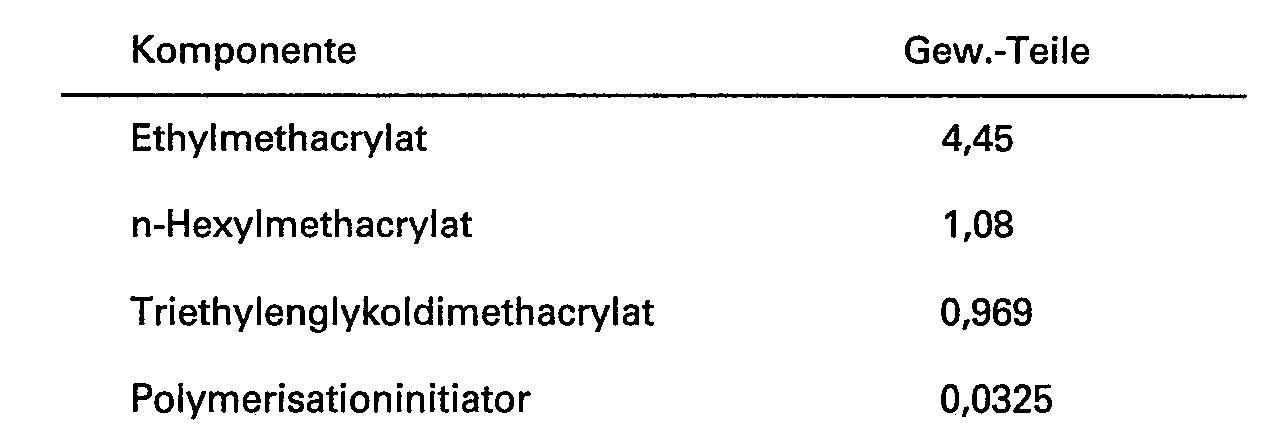
- non-polar embedding medium of the present invention two non-polar monomers for admixture, or already admixed, have been established to be suitable. These are ethyl methacrylate and n-hexylmethacrylate, although it is to be understood that other non-polar monomers could be employed without departing from the essential characteristics of the present invention.
- the non-polar embedding medium of the present invention will only be described and claimed in relation to ethyl methacrylate and n-hexylmethacrylate monomers.
- the cross-linking agent only triethyleneglycoldimethacrylate will be described and claimed as a cross-linking agent actually known and established to be suitable for this purpose at the ratios indicated.
- polar monomers for admixture or already admixed, have been established to be suitable. These are 2-hydroxyethylacrylate and 2-hydroxypropylmethacrylate. These two polar monomers are also admixed with an amount of a non-polar monomer, which for similar reasons as discussed above is identified as n-hexylmethacrylate. Triethyleneglycoldimethacrylate is employed as cross-linking agent in the preparation of the polar embedding medium.
- Table II shows the components and parts by weight which are employed for the preparation of a polar embedding medium:
- the ratio by weight of ethylmethacrylate:n-hexylmethacrylate can lie between the two extreme limits of 4:1.2 and 4.9:0.9. This is equivalent to a ratio of ethylmethacrylate:n-hexylmethacrylate of 3.3 to 5.4:1.
- the ratio by weight of the combined ethylmethacrylate and n-hexylmethacrylate:triethyleneglycoldimethacrylate can lie between the two extreme limits of 4+0.9:1.3 and 4.9+1.2:0.65.
- the ethyl methacrylate and n-hexylmethacrylate are provided in combined form in a single container at said ratio of 3.3 to 5.4:1 and the triethyleneglycoldimethacrylate cross-linking agent is provided in a separate container.
- the triethyleneglycoldimethacrylate cross-linking agent is provided in a separate container.
- a three component package for preparing the non-polar embedding medium is therefore a convenient means for making available the non-polar embedding medium components.
- the ratio by weight of the 2-hydroxyethylacrylate:2-hydroxypropylmethacrylate can lie between the two extreme limits of 1.4:3.5 and 1.74:2.9. This is equivalent to a ratio of 2-hydroxyethylacrylate:2-hydroxypropylmethacrylate of 0.39 to 0.60:1.
- the ratio by weight of the combined 2-hydroxyethylacrylate and 2-hydroxypropylmethacrylate:n-hexylmethacrylate can lie between the two extreme limits of 1.4+2.9:0.9 and 1.74+3.55:0.74.
- the ratio by weight of the combined 2-hydroxyethylacrylate, 2-hydroxypropylmethacrylate and n-hexylmethacrylate:triethyleneglycoldimethacrylate can lie between the extreme limits of 1.4+2.9+0.74:1.25 and 1.74+3.55+0.9:0.6, which is equivalent to a ratio by weight of combined 2-hydroxyethylacrylate, 2-hydroxypropylmethacrylate and n-hexy[methacrylate:triethyleneglycoldimethacrylate of 3.77 to 9.38:1.
- the 2-hydroxyethylacrylate and 2-hydroxypropylmethacrylate may be provided in combined form in a single container at said ratio of 0.39 to 0.60:1.
- the n-hexylmethacrylate and triethyleneglycoldimethacrylate are provided in separate containers.
- the 2-hydroxyethylacrylate and n-hexylmethacrylate are provided in combined admixed form in a single container at a ratio by weight of between 1.4:0.9 and 1.74:0.74, which is equivalent to a ratio by weight of 2-hydroxyethylacrylate:n-hexylmethacrylate of 1.56 to 2.35:1.
- the 2-hydroxypropylmethacrylate and triethyleneglycoldimethacrylate are then provided in separate containers.
- a further alternative is to provide the 2-hydroxypropylmethacrylate and the n-hexylmethacrylate in combined admixed form in a single container at a ratio by weight of between 2.9:0.9 and 3.55:0.74, which is equivalent to a ratio by weight of 2-hydroxypropylmethacrylate:n-hexylmethacrylate of 3.22 to 4.80:1.
- the 2-hydroxyethylacrylate and the triethyleneglycoldimethacrylate are provided in separate containers.
- the 2-hydroxyethylacrylate, 2-hydroxypropylmethacrylate and n-hexylmethacrylate are provided in combined admixed form in a single container at a ratio by weight of 2-hydroxyethylacrylate:2-hydroxypropylmethacrylate:n-hexylmethacrylate of 1.4 to 1.74:2.9 to 3.55:0.74 to 0.9 as reflected in the Table II above.
- 2-hydroxyethylacrylate and n-hexylmethacrylate are provided in combined admixed form in a single container, 0.60 to 0.91 parts by weight of this combined form are admixed with 1 part by weight of 2-hydroxypropylmethacrylate. As before, 4.03 to 10.32 parts by weight of the resulting mixture would be admixed with 1 part by weight of the triethyleneglycoldimethacrylate and the polymerisation initiator added.
- the 2-hydroxyethylacrylate, 2-hydroxypropylmethacrylate and the n-hexylmethacrylate are most conveniently provided in admixed form in a single container.
- 4.03 to 10.32 parts by weight of the admixed form are simply admixed with 1 part by weight of the triethyleneglycoldimethacrylate and the polymerisation initiator added.
- the hardness and hence adaptability to sectioning can be adjusted.
- higher proportions of ethyl methacrylate (within the limits indicated) inclines the embedding medium composition to produce an embedding having harder properties
- higher proportions of n-hexylmethacrylate (within the limits indicated) inclines the embedding medium composition to produce an embedding having softer properties.
- a balance between the two properties can be achieved as desired by choosing the ratios of admixture.
- the resulting embedding medium will form an embedding which would be too brittle for sectioning.
- the embedding mediums of the present invention are particularly characterised by a relatively high proportion of cross-linking agent which is higher than any previous embedding mediums employed in microscopy.
- the embedding mediums of the invention are capable of polymerisation at low temperatures down to -50°C.
- a further characteristic of the embedding mediums of the present invention is their capability to absorb ultraviolet light of a wavelength which does not act on embedded biological materials such as proteins, nucleic acids and kemoglobin. It will be appreciated that if energy sources are employed which involve wavelength emissions, which are absorbed by the embedded materials, the energy would not be available for activation of the polymerisation initiator. Also, it will be appreciated that one would not wish transmitted energy to act on the biological materials since this might act to destroy cellular structures.
- a variety of components may be suitable for preparing non-polar and polar embedding mediums.
- Further exemplary monofunctional monomers which could be suitable for preparing embedding mediums having properties equivalent to those of the invention are 2-hydroxyethylmethacrylate, 2-hydroxypropylacrylate, propylmethacrylate and acrylic and methacrylic esters of benzyl alcohol.
- Other cross-linking agents which could prove suitable include ethyleneglycol- dimethacrylate and hexandioldimethacrylate.
- Exemplary polymerisation initiators suitable for low temperature UV light polymerisation and which possess the necessary activity are benzoin, benzoinethylether, benzoin monomethylether, 2,2-dimethoxy-2-phenylacetophenone and 2-hydroxy-2-methyl-1-phenyl-propan-1-one.
- Sectioning and Staining The embedding mediums, easily yield silver to grey sections on diamond or glass knives. Optimal sectioning requires a moderate cutting speed. Poststaining is easily effected with uranyl acetate; Reynold's lead citrate appears acceptable for low magnification work.
- the polar embedding medium provides excellent results with immunostaining on sections with the known protein A-gold complex technique.
- the first protein is aspartate aminotransferase (AAT), a relatively stable protein which produces a crystal that is resistant to molecular disordering. Such a crystal would allow the denaturation of the protein to be monitored.
- AAT aspartate aminotransferase
- the second protein is catalase (CAT), a well-known test specimen for electron microscopy.
- CAT catalase
- the working temperatures range from -35°C to -70°C, depending on the resin.
- the mechanical properties (for sectioning) and chemical characteristics (i.e. hydrophilicity) can be easily varied.
- the crystals were dehydrated using a stepwise procedure of 50%, 70%, 90%, 100% dehydrating agent/water mixtures.
- One of the following dehydrating agents were employed in each test: dimethyl formamide, ethanol, ethylene glycol. All dehydration steps were carried out either at 0°C or 20°C.
- Infiltration three steps were used: 1 to 2, Epon 812/dehydrating agent; 2:1, Epon 812/dehydrating agent; and finally 100% Epon 812. In all cases, typical dehydration and infiltration times were used.
- the Epon 812 was polymerised at 45°C for 12 h, then at 70°C for 4 days.
- the low temperature procedures involved only three dehydration agents: ethylene glycol, ethanol and methanol.
- the dehydration was carried out as follows: 50% dehydrating agent in H 2 0 at 0°C, then 80-90% dehydrating agent/H 2 0 at -50°C.
- For infiltration the crystals were treated with one part resin to one part 80-90% dehydrating agent in H 2 0, then placed into 100% resin.
- the length of time for each step was just long enough to insure adequate exchange.
- the polar and non-polar embedding mediums were tested. The use of the polar medium limits the minimum temperature to -35°C, so that just before infiltration the temperature was raised. If X-ray analysis was to be done on the un-hardened crystals, the temperature was slowly raised to room temperature.
- Table V below shows the influence on (AAT) and (CAT) protein crystals of various steps within various embedding media.
- the embedding media of the present invention are also compared with Epon 812 R (epoxy resin, condensation product of epichlorohydrin and bisphenol A) and HPMA Leduc and HEM Leduc (hydroxypropyl methacrylate and hydroxyethyl methacrylate) embedding mediums known in the art.
- Glutaraldehyde fixation did not affect the quality of diffraction for either crystal. Some intensity changes were observed. Osmium fixation using "conventional" concentrations destroyed all diffraction. This was probably due to uncontrolled precipitation of the metal. Low Os0 4 concentrations (0.001%-0.1 %) did maintain some diffraction in the crystal, but the resolution limit decreased with increasing Os0 4 concentration.
- AAT when fixed, could easily have all of its water removed and still maintain diffraction out to 1.0 nm while at 0°-20°C. Such is not the case with catalase: all diffraction is lost when it is dehydrated at such temperatures. At low temperature, both AAT and CAT have improved diffraction. AAT prefers ethylene glycol while CAT prefers ethanol.
- AAT maintains diffraction out to 0.5 nm in liquid polar medium, and out to 0.6 nm in the hardened resin. In Epon 812, AAT did not diffract better than 1.0 nm. On the other hand, AAT shows high order diffraction only in non-polar medium. In liquid non-polar medium, CAT diffracts to 0.8 nm and does not appreciably lose this diffraction during polymerisation.
- Epon 812 it is impossible to gain the advantages offered by low temperature embedding procedures, which is typical of any epoxy resins which cannot be cured at low temperature.
- Leduc embedding mediums which do have polar properties, these are partly prepolymerised preparations resulting in too high viscosity which again eliminates possibilities to gain the advantages offered by low temperature embedding procedures.
- the polar embedding medium of the present invention is water compatible and provides rapid, but uniform, infiltration and UV-polymerisation without sacrificing sectioning quality.
- the medium maintains the low viscosity and water-miscible characteristics of previous methacrylate formulations, but does not suffer from the "melting" phenomenon during irradiation in the microscope.
- the inherent low viscosity of the liquid medium allows for the exploitation of a broad temperature range for specimen preparation, and can easily infiltrate a specimen and be hardened at temperatures as low as -35°C.
- an embedding procedure for sensitive structures can be easily designed to take advantage of the stabilizing effects of low temperatures.
- the polar medium also provides excellent results with immuno-staining techniques on sections.
- the non-polar embedding medium of the invention is a hydrophobic medium which produces blocks of excellent sectioning quality.
- the medium retains the properties of low viscosity and uniform polymerisation, but adds the capability of embedding material at very low temperatures.
- the non-polar medium can be used routinely at temperatures as low as -70°C. At these low temperatures, biological material is stabilized and may even retain its bound water.
- the medium also provides excellent results also . under conventional conditions.
- the mediums of the invention should be prepared in brown glass containers or otherwise protected from direct light. All the components are readily miscible with each other. Excessive stirring should be avoided. Methacrylates and acrylates do cause eczema on sensitive persons, so that it is strongly recommended to use gloves when there is risk of skin contact. Polypropylene or polyethylene are suitable but not gloves made from other plastic material.
- Both resins can be hardened at room temperature with direct irradiation. However, it is recommended that the original initiator is exchanged for the same amount of benzoin ethylether. Room temperature polymerised blocks can be ready for sectioning after a few hours.
- Specimens embedded with the media of the present invention specimens show that excellent ultrastructural preservation is feasible without heavy metal fixation. Enough contrast for observation may be subsequently introduced through section staining or by dark-field microscopy.
- the non-polar medium is particularly suitable for dark-field observation due to its low density as compared to conventional embedding media.
- a further practical application for the embedding media of the present invention is embedding of biological, archeological and other artifacts for preservation purposes.
Landscapes
- Physics & Mathematics (AREA)
- Health & Medical Sciences (AREA)
- Life Sciences & Earth Sciences (AREA)
- Chemical & Material Sciences (AREA)
- Analytical Chemistry (AREA)
- Biochemistry (AREA)
- General Health & Medical Sciences (AREA)
- General Physics & Mathematics (AREA)
- Immunology (AREA)
- Pathology (AREA)
- Organic Low-Molecular-Weight Compounds And Preparation Thereof (AREA)
- Addition Polymer Or Copolymer, Post-Treatments, Or Chemical Modifications (AREA)
- Materials For Medical Uses (AREA)
Claims (18)



Applications Claiming Priority (2)
| Application Number | Priority Date | Filing Date | Title |
|---|---|---|---|
| US06/242,025 US4368312A (en) | 1981-03-09 | 1981-03-09 | Embedding medium suitable for the preparation of thin sections of embedded biological materials |
| US242025 | 1981-03-09 |
Publications (2)
| Publication Number | Publication Date |
|---|---|
| EP0059970A1 EP0059970A1 (de) | 1982-09-15 |
| EP0059970B1 true EP0059970B1 (de) | 1985-07-24 |
Family
ID=22913175
Family Applications (1)
| Application Number | Title | Priority Date | Filing Date |
|---|---|---|---|
| EP82101835A Expired EP0059970B1 (de) | 1981-03-09 | 1982-03-08 | Einbettungsmittel zur Herstellung von dünnen Schnitten von eingebetteten biologischen Stoffen |
Country Status (3)
| Country | Link |
|---|---|
| US (1) | US4368312A (de) |
| EP (1) | EP0059970B1 (de) |
| DE (1) | DE3264836D1 (de) |
Families Citing this family (4)
| Publication number | Priority date | Publication date | Assignee | Title |
|---|---|---|---|---|
| DE3426043A1 (de) * | 1984-07-14 | 1986-01-16 | Kulzer & Co GmbH, 6393 Wehrheim | Photopolymerisierbares material fuer das einbetten von schliffproben |
| EP0195108B1 (de) * | 1985-03-22 | 1989-08-16 | Chemische Werke Lowi Beteiligungs GmbH | Einbettungsmittel zur Herstellung von dünnen Schnitten von eingebetteten, biologischen Stoffen |
| SG11202008624PA (en) * | 2018-03-16 | 2020-10-29 | Cryocapcell | Embedding medium of biological sample for its imaging by light and/or electron microscopy |
| CN112378899B (zh) * | 2020-10-27 | 2024-07-05 | 西北矿冶研究院 | 一种低温分离icp-aes法测定粗铅样品中金的方法 |
Family Cites Families (8)
| Publication number | Priority date | Publication date | Assignee | Title |
|---|---|---|---|---|
| US3257279A (en) * | 1962-07-31 | 1966-06-21 | Schain Philip | Water-soluble medium for tissue infiltrating and embedding |
| US3466209A (en) * | 1964-07-15 | 1969-09-09 | Newton G Leveskis | Method of preparing microscope slides using terpolymers of vinyl benzene;methyl methacrylate,and acrylate ester |
| US3503942A (en) * | 1965-10-23 | 1970-03-31 | Maurice Seiderman | Hydrophilic plastic contact lens |
| JPS5337028B2 (de) * | 1973-12-11 | 1978-10-06 | ||
| DE2748938A1 (de) * | 1977-11-02 | 1979-05-03 | Kulzer & Co Gmbh | Einbettungsmittel fuer die histologische technik |
| DE2847974A1 (de) * | 1978-11-04 | 1980-05-22 | Hoechst Ag | Verfahren zur einbettung von gewebsproben |
| JPS55104311A (en) * | 1979-02-01 | 1980-08-09 | Mitsubishi Rayon Co Ltd | Novel resin composition for embedding and fixing of living organism tissue |
| DE2939582A1 (de) * | 1979-09-29 | 1981-04-09 | Hoechst Ag, 6000 Frankfurt | Verfahren und einbettungssystem zur einbettung von gewebsproben |
-
1981
- 1981-03-09 US US06/242,025 patent/US4368312A/en not_active Expired - Lifetime
-
1982
- 1982-03-08 EP EP82101835A patent/EP0059970B1/de not_active Expired
- 1982-03-08 DE DE8282101835T patent/DE3264836D1/de not_active Expired
Also Published As
| Publication number | Publication date |
|---|---|
| DE3264836D1 (en) | 1985-08-29 |
| EP0059970A1 (de) | 1982-09-15 |
| US4368312A (en) | 1983-01-11 |
Similar Documents
| Publication | Publication Date | Title |
|---|---|---|
| Robinson et al. | Methods of preparation for electron microscopy: an introduction for the biomedical sciences | |
| Glauert et al. | Araldite as an embedding medium for electron microscopy | |
| Carlemalm et al. | Resin development for electron microscopy and an analysis of embedding at low temperature | |
| Bernhard et al. | Improved techniques for the preparation of ultrathin frozen sections | |
| Newman et al. | Resins for combined light and electron microscopy: a half century of development | |
| Hendler et al. | A cytological study of the albumin-secreting cells of the hen oviduct | |
| Frangioni et al. | Polystyrene embedding: a new method for light and electron microscopy | |
| EP0059970B1 (de) | Einbettungsmittel zur Herstellung von dünnen Schnitten von eingebetteten biologischen Stoffen | |
| US4424329A (en) | Embedding medium suitable for the preparation of thin sections of embedded biological materials | |
| Islam et al. | Plastic embedding in routine histology I: Preparation of semi‐thin sections of undecalcified marrow cores | |
| Hanstede et al. | A new plastic for morphometric investigation of blood vessels, especially in large organs such as the human liver | |
| Spaur et al. | Improvements of glycol methacrylate. I. Its use as an embedding medium for electron microscopic studies. | |
| Moore | Removal of glass coverslips from cultures flat embedded in epoxy resins using hydrofluoric acid | |
| Rostgaard et al. | A procedure for minimizing cellular shrinkage in electron microscope preparation: a quantitative study on frog gall bladder | |
| Altus et al. | Loading of assimilates in wheat leaves. II. The path from chloroplast to vein | |
| KUSHIDA | An improved epoxy resin ‘Epok 533’, and polyethylene glycol 200 as a dehydrating agent | |
| EP0195108B1 (de) | Einbettungsmittel zur Herstellung von dünnen Schnitten von eingebetteten, biologischen Stoffen | |
| Murice-Lambert et al. | Histological preparation of implanted biomaterials for light microscopic evaluation of the implant-tissue interaction | |
| Von Schack et al. | The study of the cell nucleus using cryofixation and cryosubstitution | |
| Furtado | The fibrin clot; a medium for supporting loose cells and delicate structures during processing for microscopy | |
| Skepper et al. | Ultrastructural immunochemistry | |
| Hunziker | Application of cryotechniques in cartilage tissue preservation an immunoelectron microscopy: Potentials and problems | |
| Kushida et al. | Simultaneous double staining | |
| Low et al. | Polyester-methacrylate embedments for electron microscopy | |
| Spoerri et al. | A simple embedding technique for monolayer neuronal cultures grown in plastic flasks |
Legal Events
| Date | Code | Title | Description |
|---|---|---|---|
| PUAI | Public reference made under article 153(3) epc to a published international application that has entered the european phase |
Free format text: ORIGINAL CODE: 0009012 |
|
| AK | Designated contracting states |
Designated state(s): CH DE FR GB IT LI SE |
|
| 17P | Request for examination filed |
Effective date: 19821013 |
|
| ITF | It: translation for a ep patent filed | ||
| GRAA | (expected) grant |
Free format text: ORIGINAL CODE: 0009210 |
|
| AK | Designated contracting states |
Designated state(s): CH DE FR GB IT LI SE |
|
| PG25 | Lapsed in a contracting state [announced via postgrant information from national office to epo] |
Ref country code: SE Effective date: 19850730 |
|
| REF | Corresponds to: |
Ref document number: 3264836 Country of ref document: DE Date of ref document: 19850829 |
|
| ET | Fr: translation filed | ||
| PLBE | No opposition filed within time limit |
Free format text: ORIGINAL CODE: 0009261 |
|
| STAA | Information on the status of an ep patent application or granted ep patent |
Free format text: STATUS: NO OPPOSITION FILED WITHIN TIME LIMIT |
|
| 26N | No opposition filed | ||
| PGFP | Annual fee paid to national office [announced via postgrant information from national office to epo] |
Ref country code: GB Payment date: 19910114 Year of fee payment: 10 |
|
| PGFP | Annual fee paid to national office [announced via postgrant information from national office to epo] |
Ref country code: FR Payment date: 19910128 Year of fee payment: 10 |
|
| PGFP | Annual fee paid to national office [announced via postgrant information from national office to epo] |
Ref country code: DE Payment date: 19910327 Year of fee payment: 10 |
|
| PGFP | Annual fee paid to national office [announced via postgrant information from national office to epo] |
Ref country code: CH Payment date: 19910328 Year of fee payment: 10 |
|
| ITTA | It: last paid annual fee | ||
| PG25 | Lapsed in a contracting state [announced via postgrant information from national office to epo] |
Ref country code: GB Effective date: 19920308 |
|
| PG25 | Lapsed in a contracting state [announced via postgrant information from national office to epo] |
Ref country code: LI Effective date: 19920331 Ref country code: CH Effective date: 19920331 |
|
| GBPC | Gb: european patent ceased through non-payment of renewal fee | ||
| PG25 | Lapsed in a contracting state [announced via postgrant information from national office to epo] |
Ref country code: FR Effective date: 19921130 |
|
| REG | Reference to a national code |
Ref country code: CH Ref legal event code: PL |
|
| PG25 | Lapsed in a contracting state [announced via postgrant information from national office to epo] |
Ref country code: DE Effective date: 19921201 |
|
| REG | Reference to a national code |
Ref country code: FR Ref legal event code: ST |