EP0059343B2 - Trennen der Frequenzen an einer Antenne mit einer Einrichtung mit breitbandiger Durchlass- oder Reflexionscharakteristik - Google Patents
Trennen der Frequenzen an einer Antenne mit einer Einrichtung mit breitbandiger Durchlass- oder Reflexionscharakteristik Download PDFInfo
- Publication number
- EP0059343B2 EP0059343B2 EP82100938A EP82100938A EP0059343B2 EP 0059343 B2 EP0059343 B2 EP 0059343B2 EP 82100938 A EP82100938 A EP 82100938A EP 82100938 A EP82100938 A EP 82100938A EP 0059343 B2 EP0059343 B2 EP 0059343B2
- Authority
- EP
- European Patent Office
- Prior art keywords
- frequency
- lattice
- antenna apparatus
- lattices
- separator
- Prior art date
- Legal status (The legal status is an assumption and is not a legal conclusion. Google has not performed a legal analysis and makes no representation as to the accuracy of the status listed.)
- Expired - Lifetime
Links
- 230000005540 biological transmission Effects 0.000 title description 18
- 230000000737 periodic effect Effects 0.000 claims description 7
- 239000004020 conductor Substances 0.000 claims description 4
- 230000002452 interceptive effect Effects 0.000 claims 1
- 238000010586 diagram Methods 0.000 description 11
- 238000006073 displacement reaction Methods 0.000 description 8
- 230000003993 interaction Effects 0.000 description 8
- 230000010287 polarization Effects 0.000 description 8
- 238000000034 method Methods 0.000 description 7
- 230000000694 effects Effects 0.000 description 5
- 230000006866 deterioration Effects 0.000 description 4
- 230000001419 dependent effect Effects 0.000 description 3
- 230000001939 inductive effect Effects 0.000 description 3
- 230000000295 complement effect Effects 0.000 description 2
- 239000000758 substrate Substances 0.000 description 2
- 238000004458 analytical method Methods 0.000 description 1
- 239000003989 dielectric material Substances 0.000 description 1
- 239000000463 material Substances 0.000 description 1
- 230000003287 optical effect Effects 0.000 description 1
- 230000001902 propagating effect Effects 0.000 description 1
- 230000009467 reduction Effects 0.000 description 1
- 230000004044 response Effects 0.000 description 1
- 239000010409 thin film Substances 0.000 description 1
- 230000003313 weakening effect Effects 0.000 description 1
Images






Classifications
-
- H—ELECTRICITY
- H01—ELECTRIC ELEMENTS
- H01Q—ANTENNAS, i.e. RADIO AERIALS
- H01Q15/00—Devices for reflection, refraction, diffraction or polarisation of waves radiated from an antenna, e.g. quasi-optical devices
- H01Q15/0006—Devices acting selectively as reflecting surface, as diffracting or as refracting device, e.g. frequency filtering or angular spatial filtering devices
- H01Q15/0013—Devices acting selectively as reflecting surface, as diffracting or as refracting device, e.g. frequency filtering or angular spatial filtering devices said selective devices working as frequency-selective reflecting surfaces, e.g. FSS, dichroic plates, surfaces being partly transmissive and reflective
- H01Q15/0033—Devices acting selectively as reflecting surface, as diffracting or as refracting device, e.g. frequency filtering or angular spatial filtering devices said selective devices working as frequency-selective reflecting surfaces, e.g. FSS, dichroic plates, surfaces being partly transmissive and reflective used for beam splitting or combining, e.g. acting as a quasi-optical multiplexer
-
- H—ELECTRICITY
- H01—ELECTRIC ELEMENTS
- H01Q—ANTENNAS, i.e. RADIO AERIALS
- H01Q5/00—Arrangements for simultaneous operation of antennas on two or more different wavebands, e.g. dual-band or multi-band arrangements
- H01Q5/40—Imbricated or interleaved structures; Combined or electromagnetically coupled arrangements, e.g. comprising two or more non-connected fed radiating elements
- H01Q5/45—Imbricated or interleaved structures; Combined or electromagnetically coupled arrangements, e.g. comprising two or more non-connected fed radiating elements using two or more feeds in association with a common reflecting, diffracting or refracting device
Definitions
- the present invention relates to an antenna apparatus including an improved frequency separator using frequency-selective reflecting surfaces (FSRSs).
- FSRSs frequency-selective reflecting surfaces
- a single reflector In satellite communication, an increase in the communication capacity commonly requires the use of a single reflector by two or more frequencies.
- a common reflector In order that a common reflector can be used by a plurality of frequencies, beams of different frequencies transmitted from a plurality of electromagnetic horns to the reflector have to be composed, or beams of different frequencies reflected from the reflector to the plurality of electromagnetic horns have to be separated. It is known that this object can be achieved by arranging, in the path of electromagnetic waves propagating through free space, a frequency-selective reflecting surface (FSRS) or surfaces having transmissive and reflective characteristics which depend on the frequency.
- FSRS frequency-selective reflecting surface
- a metallic plate having square apertures periodically arranged in a lattice form.
- This lattice apparently serves as an inductance in a relatively low frequency region, and its transmission coefficient is in principle (1) at its resonance frequency. In a higher frequency region higher modes occur each having its own resonance frequency and a certain transmission coefficient smaller than 1.
- JP-A-137703/81 published after the priority dates claimed for the present application, the present inventors proposed a frequency separator whose pass band is set in a frequency region higher than the region where an FSRS having a lattice of square apertures is considered as an inductance but lower than the inherent resonance frequency of the lattice and in which a plurality of lattices are arranged at prescribed intervals.
- Lattices arranged in the pass band in this manner can be regarded as resonant elements of inductance capacitances (LCs), and the resonance of each lattice coupled with that resulting from interactions between the lattices enabled a frequency separator having a wide band pass characteristic to be realized.
- LCs inductance capacitances
- This frequency separator proposed in JP-A-137703/81 involves the problem that, because it uses a lattice of square apertures, incoming electromagnetic waves of the transverse electric (TE) mode and waves of the transverse magnetic (TM) mode will have different resonance frequencies, if those waves are obliquely incident on an FSRS. This results in the deterioration of its frequency characteristic and leads to a frequency characteristic widely different from that for normally incident waves.
- a technique using a lattice with rectangular instead of square apertures is known.
- this article relates to the theory and performance of a quasi-optical Fabry-Perot diplexer employing two rectangular meshes and capable of polarization-independent operation at large angles of incidence.
- This disclosed diplexer is suitable for use in a dual-polarization dual-frequency beam feed system for millimeter-wave antennas.
- rectangular cells of the mesh which dimensions are adapted to the incidence of angle of the electromagnetic wave a polarization-independent operation has been achieved.
- the article mostly deals with inductive meshes, it is also mentioned that a capacitive mesh can be formed from a complementary structure.
- One object of the present invention is to provide an antenna apparatus including a frequency separator without the performance deterioration resulting from the oblique incidence of electromagnetic waves on FSRSs where the FSRSs are regarded as the resonant elements of LCs.
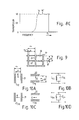
- Fig. 1 shows an offset type antenna apparatus in which a frequency-selective reflecting surface (FSRS) 12 is used for transmitting and reflecting electromagnetic waves fed from two horns 13 and 14 in the same direction with a single reflector 11.
- the horn 13 transmits a signal whose frequency is within the pass band of the FSRS 12, through FSRS 12 to the reflector 11 which in turn reflects it into the intended direction D.
- the horn 14 transmits a signal whose frequency is in the reflection band of the FSRS 12, to the FSRS 12 from which the signal is reflected to the reflector 11 from which it is then reflected and sent out in the direction D.
- a conventional FSRS illustrated in Fig. 2 consists of a metallic square-apertured lattice 15.
- an incident wave S IN comes in on the lattice 15 as shown in Fig. 3, it is separated into a reflected wave S R and a transmitted wave S T according to the frequency of the incident wave.
- the proportion of the transmitted energy to the incident energy i.e. the frequency dependent of the transmission is such as illustrated in Fig. 4.
- the FSRS in a relatively low frequency zone (Z I ), the FSRS apparently acts as an inductance, and its transmission coefficient is in principle 1 at a resonance frequency f 1 .
- Z H higher modes arise, each mode having a resonance frequency f 2 , f 3 or the like.
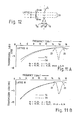
- Fig. 5A it has two lattices 15 and 15', each of which has the characteristic shown in Fig. 4.
- the lattices 15 and 15' are arranged at an interval of 1 between them, so that the separator utilizes the resonance resulting from interactions between the inductances of the two lattices.
- Figs. 5B and 5C respectively show an equivalent circuit diagram for the arrangement of Fig. 5A and the transmission characteristic thereof. As can be seen from Fig.
- this frequency separator can have a resonance point 16 attributable to interactions between its two lattices in the inductance zone Z having a frequency lower than the inherent resonance frequency f 1 of the lattices. It was already pointed out that, since the curve of the resonance characteristic of this frequency separator is steeply inclined, the separator needs a greater number of lattices to obtain a wider band pass characteristic, and therefore is uneconomical and susceptible to greater transmission losses.
- the TE incident wave and the TM incident wave will have different frequency characteristics if electromagnetic waves are obliquely incident on a FSRS, as stated above.
- This disadvantage can be obviated by using rectangular lattice apertures and adjusting their size and periodicity of arrangement in such a way that the inductances of the vertical and horizontal strips be identical with each other, as proposed in the above-cited article by Saleh et al.
- the frequency separator designed by the present inventors to achieve a broader band pass characteristic has its pass band in the region where the FSRSs can be regarded as the resonant elements of LCs rather than inductances like in previous separators.
- the identity of the inductive components of the strips such as proposed by Saleh et al as referred to above, by itself is inadequate for eliminating the disparity between the pass bands of the TE incident wave and the TM incident wave or preventing the occurrence of the dip in which a signal to be transmitted is blocked.
- a square-apertured lattice is a combination of vertical parallel strips and horizontal parallel strips.
- the parallel strips of Fig. 6A and those of Fig. 7A are put together to constitute the square-apertured lattice shown in Fig. 2.
- the equivalent circuit can be represented by an inductance L as in Fig. 6B.
- the plane of polarization E is perpendicular to parallel strips as in Fig.
- the equivalent circuit can be represented by a capacitance C as in Fig. 7B. Therefore, the equivalent circuit of a square-apertured lattice can be represented by an LC resonance circuit, though in the frequency region above its resonance frequency f 1 the equivalent circuit cannot be so simply represented because, as stated above, such a frequency region is of higher modes.
- the frequency characteristic of the lattice below the frequency f 1 in Fig. 4 is represented by an LC resonance circuit. In the lower frequency zone where the effect of said capacitance C is reduced, only the inductance L is relevant.
- the pass band of a frequency separator can be set in the region which can be regarded as the LC resonance zone of each of its lattices in the following manner.
- Fig. 8A three lattices 17 are arranged parallel to each other at intervals of 1 1 and 1 2 .
- the equivalent circuit of this arrangement can be represented by Fig. 8B. If the frequencies of inherent resonances of the lattices 17 are equally designed at f 1 , the transmission of the separator arranged as in Fig. 8A will be 1 atfrequency fl. Further, to avert a region of higher modes, f 1 is set slightly above the upper limit of the pass band to be used.
- the Q factors of the L-C resonance circuits being represented by Q i , Q 2 and Q 3 , two resonance points attributable to interactions between the lattices (two for three lattices 17) can be created, as represented by 18 and 18' in FIG. 8C, in addition to the inherent resonance point f 1 if Q factors Q 1 , Q 2 and Q 3 and the intervals 1 1 and 1 2 between the lattices are properly selected.
- the Q factor of each lattice and the intervals between the lattices should be so selected that the two additional resonance points may not enter the region of higher modes but can be realized in lowerfrequencies than f 1 and yet can cover the pass band. In this manner the characteristic illustrated in FIG. 8C is achieved.
- the Q factor of each lattice is determined by the a/dx ratio of the apertures and strips, while the resonance point f 1 is determined by the ratio dx/ ⁇ of the period of the lattice to the wavelength ⁇ . Therefore, by properly selecting a and dx, the lattice can be given any desired f 1 and Q.
- the pass band of frequency separator is set in the L C resonance region of its lattices, the pass band can be further broadened, compared with that of a frequency separater using L resonance region. In this case too, however, if the apertures of the lattice are square, oblique incidence of electromagnetic waves on the FSRSs would cause the deterioration of the frequency separating performance.
- the lattice 19 of rectangular periodic pattern has apertures 20 having a width a in the direction of the x axis and a width b in the direction of the y axis. Also, the lattice 19 is composed by conductive strip members 21 having a width W x in the direction of the x axis and conductive strip members 22 having a width Wy in the direction of the y axis.
- the vertical strips 21 function as inductances L in the case of TE incident waves or as capacitances C in TM incident waves, while the horizontal strips 22 act as capacitances C in TE incident waves or as inductances L in FM incident waves.
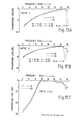
- Fig. 11 shows experimental data on the transmission loss frequency characteristic of the FSRS, illustrated in FIG. 9.
- a frequency separator having a broad pass band as shown in Fig. 11 C.
- Reference numerals 23s in Figs. 11A and 11B respectively, represent resonance points.
- the angle of incidence 0 of signals coming into the separator is 20°, and the intervals between adjoining lattices are 8.9 mm each.
- the rectangular lattices 19 were designed with reference to theoretical analyses by the Moment method, and the specific dimensions (dx, dy, a and b) of their apertures and plate thickness are stated in Fig. 11 in millimeters.
- the arrangement of lattices structured as shown in Fig. 9, in the manner illustrated in Fig. 12 eliminates the difference in characteristics for different planes of polarization in the case of oblique incidence, or approximately equalizes the resonance characteristics of the TE incident wave and the TM incident wave.
- the pass band of the separator can be instituted about 4 GHz in its width, as seen from Fig. 11 C.
- the occurence of such a dip can be explained in the following way.
- the rectangular lattice arrangement shown in Fig. 9 can be regarded as an LC parallel resonant circuit in which an inductive strip grating and a capacitive strip grating are combined.
- the oblique incidence of a TE wave on this lattice arrangement can be substantially explained by the function of the LC resonsant circuit.
- a TM wave comes in, a TE 11 mode 25 will be induced on the apertures as illustrated in Fig. 13A and therefore, the equivalent circuit cannot be represented by a simple LC parallel resonant circuit around the dip.
- Fig. 14 shows a plane view of an FSRS composed in such a manner.
- the pattern of the rectangular lattice is a brickwork arrangement wherein a periodic pattern 27, consisting of a conductor, is displaced to a prescribed extent in the direction of the x axis.
- This arrangement makes it possible to control the position of the dip point attributable to a TM incident wave.
- the TE11 mode occurring in the upper row of the pattern and that arising in the lower row of the pattern are aligned with each other neither in distribution pattern nor in phase as shown in Fig. 15, the effects of the capacitances 26 work in the mutually weakening direction. Accordingly, the dip point 24 (Fig. 11C) attributable to the TM incident wave can be shifted toward a higher frequency and outside the band.
- Fig. 14 illustrates the horizontal displacement of the lattice, it can also be displaced vertically.
- An example of such vertical displacement is shown in Fig. 18, and the calculation results of its transmission frequency characteristic by the Moment method are given in Fig. 19.
- the dip point shifting effect of this vertical displacement though smaller than that of the horizontal displacement, is evident, seeming to promise a broader band for a separator in which FSRSs are arranged as illustrated in Fig. 12, as in the case of Fig. 17C.
- Fig. 20 illustrates the structure of a low-pass type FSRS in which the metallic parts (29) and the aperture parts (28) are reversed, and this type of FSRS and a high-pass type FSRS would complement each other.
- the metallic parts 29 are preferably formed on a dielectric substrate.
- the individual transmission-frequency response of this lattice is shown in Fig. 21A, and the characteristic of a three-layer combination of such lattices, like in Fig. 12, is shown in Fig. 21 B.
- a peak point 30 in the figures limits the width of the reflective band, but it can be shifted to broaden the band by displacing the lattice pattern, as in the case of the high-pass type lattice described above.
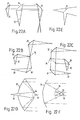
- Figs. 22A-22F illustrate some conceivable applications of the frequency separator according to the present invention.
- Fig. 22A shows a separator 31 according to the invention, formed in a curved shape and used as a beam waveguide curved mirror.
- Reference numeral 32 represents curved reflective mirrors, and reference numerals 33 represent electromagnetic feed horns.
- Figs. 22B and 22C show a flat frequency-separating FSRS 34 according to the invention used as beam waveguides.
- a frequency-sharing antenna by implementing the invention in the form of a sub-reflective mirror 36 for a Cassegrain and parabolic antennas, respectively.
- Reference numeral 35 represents a main reflective mirror.
- Fig. 22E illustrates an instance in which a frequency-sharing horn is composed by inserting a frequency-separating FSRS 37 according to the present invention into an electromagnetic feed horn.
Landscapes
- Physics & Mathematics (AREA)
- Electromagnetism (AREA)
- Aerials With Secondary Devices (AREA)
Claims (6)
Applications Claiming Priority (4)
| Application Number | Priority Date | Filing Date | Title |
|---|---|---|---|
| JP1783181A JPS57132401A (en) | 1981-02-09 | 1981-02-09 | High-frequency branching device |
| JP17831/81 | 1981-02-09 | ||
| JP18711/81 | 1981-02-10 | ||
| JP1871181A JPS57132402A (en) | 1981-02-10 | 1981-02-10 | High-frequency branching device |
Publications (3)
| Publication Number | Publication Date |
|---|---|
| EP0059343A1 EP0059343A1 (de) | 1982-09-08 |
| EP0059343B1 EP0059343B1 (de) | 1986-05-14 |
| EP0059343B2 true EP0059343B2 (de) | 1993-01-13 |
Family
ID=26354411
Family Applications (1)
| Application Number | Title | Priority Date | Filing Date |
|---|---|---|---|
| EP82100938A Expired - Lifetime EP0059343B2 (de) | 1981-02-09 | 1982-02-09 | Trennen der Frequenzen an einer Antenne mit einer Einrichtung mit breitbandiger Durchlass- oder Reflexionscharakteristik |
Country Status (4)
| Country | Link |
|---|---|
| US (1) | US4476471A (de) |
| EP (1) | EP0059343B2 (de) |
| CA (1) | CA1198811A (de) |
| DE (1) | DE3271093D1 (de) |
Families Citing this family (16)
| Publication number | Priority date | Publication date | Assignee | Title |
|---|---|---|---|---|
| JPS5991708A (ja) * | 1982-11-17 | 1984-05-26 | Mitsubishi Electric Corp | アンテナ装置 |
| IT1197781B (it) * | 1986-07-18 | 1988-12-06 | Gte Telecom Spa | Sistema irradiante a diversita' angolare per radiocollegamenti a diffusione troposferica |
| GB2294813B (en) * | 1994-11-04 | 1998-04-15 | Mms Space Systems Ltd | Frequency selective surface devices |
| US6208316B1 (en) | 1995-10-02 | 2001-03-27 | Matra Marconi Space Uk Limited | Frequency selective surface devices for separating multiple frequencies |
| AU5561696A (en) * | 1996-04-18 | 1997-11-07 | International Business Machines Corporation | Organic-metallic composite coating for copper surface protection |
| KR20000001836A (ko) * | 1998-06-15 | 2000-01-15 | 윤종용 | 인접 주파수를 사용하는 시스템간의 간섭 제거를 위한 반사장치 |
| US6232931B1 (en) | 1999-02-19 | 2001-05-15 | The United States Of America As Represented By The Secretary Of The Navy | Opto-electronically controlled frequency selective surface |
| US6154174A (en) * | 1999-04-20 | 2000-11-28 | General Atomics | Large aperture vibration compensated millimeter wave sensor |
| US6512485B2 (en) | 2001-03-12 | 2003-01-28 | Wildblue Communications, Inc. | Multi-band antenna for bundled broadband satellite internet access and DBS television service |
| US8170221B2 (en) * | 2005-03-21 | 2012-05-01 | Harman Becker Automotive Systems Gmbh | Audio enhancement system and method |
| GB0902952D0 (en) * | 2009-02-23 | 2009-04-08 | Qinetiq Ltd | Radiation attenuation |
| CN103682670B (zh) * | 2012-08-31 | 2018-04-17 | 深圳光启高等理工研究院 | 一种超材料、超材料卫星天线及卫星接收系统 |
| EP2911241A1 (de) | 2014-02-20 | 2015-08-26 | Agence Spatiale Europeenne | Dualband-Strahlenreflektorantenne für breitbandige Satelliten |
| RU2659303C1 (ru) * | 2014-08-22 | 2018-06-29 | Этелсат С А | Спутниковый многополосный антенный блок |
| CN108333788A (zh) * | 2018-01-15 | 2018-07-27 | 上海机电工程研究所 | 射频和红外波束复合方法和模拟装置 |
| CN112909725B (zh) * | 2021-01-13 | 2022-05-20 | 华中科技大学 | 基于星形反射的蓝光半导体激光器波长合束装置及方法 |
Family Cites Families (13)
| Publication number | Priority date | Publication date | Assignee | Title |
|---|---|---|---|---|
| US3148370A (en) * | 1962-05-08 | 1964-09-08 | Ite Circuit Breaker Ltd | Frequency selective mesh with controllable mesh tuning |
| US3231892A (en) * | 1962-06-26 | 1966-01-25 | Philco Corp | Antenna feed system simultaneously operable at two frequencies utilizing polarization independent frequency selective intermediate reflector |
| US3394378A (en) * | 1964-11-16 | 1968-07-23 | Radiation Inc | Multiple reflector multiple frequency band antenna system |
| US3769623A (en) * | 1972-09-21 | 1973-10-30 | Nasa | Low loss dichroic plate |
| FR2205754B1 (de) * | 1972-11-03 | 1977-04-22 | Thomson Csf | |
| US3842421A (en) * | 1973-02-15 | 1974-10-15 | Philco Ford Corp | Multiple band frequency selective reflectors |
| US3924239A (en) * | 1974-06-27 | 1975-12-02 | Nasa | Dichroic plate |
| FR2281660A1 (fr) * | 1974-08-09 | 1976-03-05 | Thomson Csf | Dispositif muni d'une grille de filtrage |
| FR2281659A1 (fr) * | 1974-08-09 | 1976-03-05 | Thomson Csf | Grille de filtrage d'ondes electro-magnetiques |
| US3961333A (en) * | 1974-08-29 | 1976-06-01 | Texas Instruments Incorporated | Radome wire grid having low pass frequency characteristics |
| US4017865A (en) * | 1975-11-10 | 1977-04-12 | Rca Corporation | Frequency selective reflector system |
| US4160254A (en) * | 1978-02-16 | 1979-07-03 | Nasa | Microwave dichroic plate |
| US4284992A (en) * | 1979-12-26 | 1981-08-18 | Bell Telephone Laboratories, Incorporated | Wide scan quasi-optical frequency diplexer |
-
1982
- 1982-02-08 CA CA000395754A patent/CA1198811A/en not_active Expired
- 1982-02-08 US US06/346,818 patent/US4476471A/en not_active Expired - Lifetime
- 1982-02-09 EP EP82100938A patent/EP0059343B2/de not_active Expired - Lifetime
- 1982-02-09 DE DE8282100938T patent/DE3271093D1/de not_active Expired
Also Published As
| Publication number | Publication date |
|---|---|
| CA1198811A (en) | 1985-12-31 |
| EP0059343A1 (de) | 1982-09-08 |
| US4476471A (en) | 1984-10-09 |
| EP0059343B1 (de) | 1986-05-14 |
| DE3271093D1 (en) | 1986-06-19 |
Similar Documents
| Publication | Publication Date | Title |
|---|---|---|
| EP0059343B2 (de) | Trennen der Frequenzen an einer Antenne mit einer Einrichtung mit breitbandiger Durchlass- oder Reflexionscharakteristik | |
| US6054967A (en) | Dual polarization frequency selective medium for diplexing two close bands at an incident angle | |
| US6208316B1 (en) | Frequency selective surface devices for separating multiple frequencies | |
| US4130813A (en) | Surface wave device having enhanced reflectivity gratings | |
| US4169268A (en) | Metallic grating spatial filter for directional beam forming antenna | |
| US9887458B2 (en) | Compact butler matrix, planar two-dimensional beam-former and planar antenna comprising such a butler matrix | |
| US20040081466A1 (en) | Wavelength division and polarization division multiple access free space optical terminal using a single aperture | |
| US6836258B2 (en) | Complementary dual antenna system | |
| US11990681B2 (en) | Phase diversity input for an array of traveling-wave antennas | |
| EP0649572B1 (de) | Phasenkorrigierende zonenplatte | |
| CA1135548A (en) | Wide scan quasi-optical frequency diplexer | |
| EP0711001B1 (de) | Frequenzselektive Oberflächenanordnung | |
| US3465361A (en) | Electromagnetic wave retarding structure | |
| US4495506A (en) | Image spatial filter | |
| JPS6081902A (ja) | 高周波分波装置 | |
| KR102328062B1 (ko) | 넓은 대역폭 및 고효율의 평면형 메타표면 역반사체 | |
| US4490696A (en) | Crossed waveguide type polarization separator | |
| Daghari et al. | Antenna Radiation Performance Enhancement Using Metamaterial Filter for Vehicle to Vehicle Communications Applications | |
| JPS6231844B2 (de) | ||
| CA2712165A1 (en) | A phase element for introducing a phase shift pattern into an electromagnetic wave | |
| JPH0116041B2 (de) | ||
| US12424745B2 (en) | Device for controlling RF electromagnetic beams according to their frequency band, and manufacturing method | |
| JPH057881B2 (de) | ||
| Au et al. | Wideband filters employing multilayer gratings | |
| WO1984001242A1 (en) | Frequency selective surfaces |
Legal Events
| Date | Code | Title | Description |
|---|---|---|---|
| PUAI | Public reference made under article 153(3) epc to a published international application that has entered the european phase |
Free format text: ORIGINAL CODE: 0009012 |
|
| AK | Designated contracting states |
Designated state(s): DE FR GB IT |
|
| 17P | Request for examination filed |
Effective date: 19821230 |
|
| RAP1 | Party data changed (applicant data changed or rights of an application transferred) |
Owner name: NEC CORPORATION |
|
| GRAA | (expected) grant |
Free format text: ORIGINAL CODE: 0009210 |
|
| AK | Designated contracting states |
Kind code of ref document: B1 Designated state(s): DE FR GB IT |
|
| REF | Corresponds to: |
Ref document number: 3271093 Country of ref document: DE Date of ref document: 19860619 |
|
| ET | Fr: translation filed | ||
| ITF | It: translation for a ep patent filed | ||
| RIN2 | Information on inventor provided after grant (corrected) |
Free format text: SATO, IKURO * TAMAGAWA, SUSUMU * IWATA, RYUICHI |
|
| PLBI | Opposition filed |
Free format text: ORIGINAL CODE: 0009260 |
|
| 26 | Opposition filed |
Opponent name: SIEMENS AKTIENGESELLSCHAFT, BERLIN UND MUENCHEN Effective date: 19870213 |
|
| ITTA | It: last paid annual fee | ||
| PUAH | Patent maintained in amended form |
Free format text: ORIGINAL CODE: 0009272 |
|
| STAA | Information on the status of an ep patent application or granted ep patent |
Free format text: STATUS: PATENT MAINTAINED AS AMENDED |
|
| 27A | Patent maintained in amended form |
Effective date: 19930113 |
|
| AK | Designated contracting states |
Kind code of ref document: B2 Designated state(s): DE FR GB IT |
|
| ET3 | Fr: translation filed ** decision concerning opposition | ||
| ITF | It: translation for a ep patent filed | ||
| PGFP | Annual fee paid to national office [announced via postgrant information from national office to epo] |
Ref country code: DE Payment date: 20010205 Year of fee payment: 20 |
|
| PGFP | Annual fee paid to national office [announced via postgrant information from national office to epo] |
Ref country code: GB Payment date: 20010207 Year of fee payment: 20 |
|
| PGFP | Annual fee paid to national office [announced via postgrant information from national office to epo] |
Ref country code: FR Payment date: 20010213 Year of fee payment: 20 |
|
| REG | Reference to a national code |
Ref country code: GB Ref legal event code: IF02 |
|
| PG25 | Lapsed in a contracting state [announced via postgrant information from national office to epo] |
Ref country code: GB Free format text: LAPSE BECAUSE OF EXPIRATION OF PROTECTION Effective date: 20020208 |
|
| REG | Reference to a national code |
Ref country code: GB Ref legal event code: PE20 Effective date: 20020208 |